COOLING
TOWER
By. Engr. Yuri G. Melliza
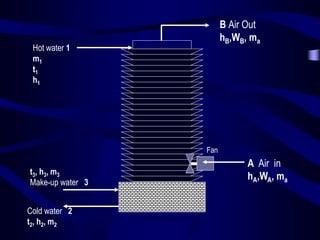
B Air Out
hB,WB, ma

Hot water 1
m1
t1
h1

Fan

A Air in
hA,WA, ma

t 3 , h3 , m3
Make-up water 3
Cold water 2
t 2 , h 2 , m2

Catch Basin
Cooling Tower

A Cooling tower is a wind braced enclosure or shell
usually made of wood, concrete or metal with fillings on
the inside to aid water exposure. The water to be cooled
is pumped into a distributing header at the top of the
tower from which it drops in sprays to the filling. The
water spreads out in the filling thus exposing new water
surfaces to the air circulating through the tower. The
cooled water drops to the bottom of the tower called the
catch basin. The air
circulating through the tower becomes partially saturated
with moisture by evaporating some amount of water.
This evaporation is mostly what cools the water.
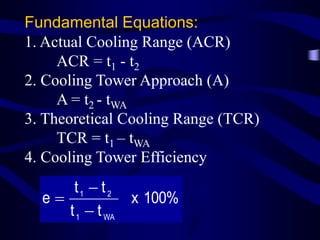
Fundamental Equations:
1. Actual Cooling Range (ACR)
ACR = t1 - t2
2. Cooling Tower Approach (A)
A = t2 - tWA
3. Theoretical Cooling Range (TCR)
TCR = t1 – tWA
4. Cooling Tower Efficiency

t1  t 2
e
t 1  t WA

x 100%
5. Vapor Pressure
PV = PW - PA(td - tW)
where: A = 6.66 x 10⁻⁴ (For tW of equal or greater
than 0C.
A = 5.94 x 10⁻⁴ (For tW of less than 0C)
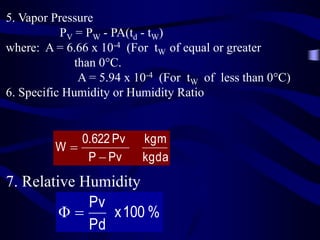
6. Specific Humidity or Humidity Ratio

0.622 Pv
W
P  Pv

kgm
kgda

7. Relative Humidity
Pv
Φ
x 100 %
Pd
8. Enthalpy
h = 1.0045td + W(2501.3 + 1.86td) KJ/kgda
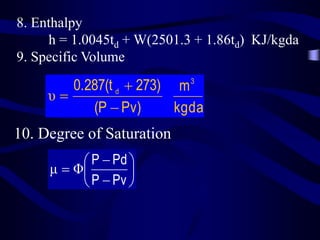
9. Specific Volume

0.287(t d  273) m 3
υ
(P  Pv)
kgda

10. Degree of Saturation
 P  Pd 
μ  Φ

 P  Pv 
11. By moisture balance in the tower:
a) With make up water, m1 = m2
m3 = ma(WB - WA)
kg/sec
b) Without make up water available, m1  m2:
m1 - m2 = ma (WB - WA) kg/sec

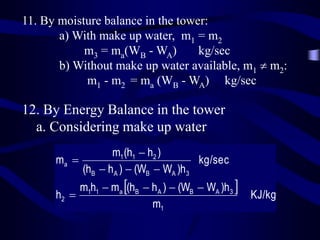
12. By Energy Balance in the tower
a. Considering make up water
m1 (h1  h2 )
ma 
kg/sec
(hB  h A )  (WB  WA )h3

m1h1  ma (hB  h A )  (WB  WA )h3 
h2 
m1

KJ/kg
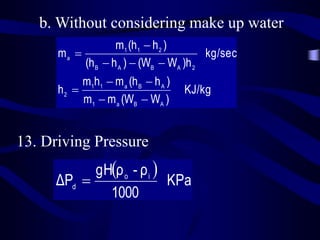
b. Without considering make up water
m1 (h1  h 2 )
ma 
kg/sec
(h B  h A )  (WB  WA )h 2
m1h1  m a (h B  h A )
h2 
m1  m a (WB  WA )

KJ/kg

13. Driving Pressure
gHρ o - ρ i 
ΔPd 
KPa
1000
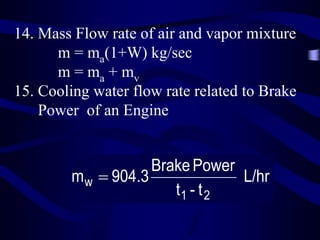
14. Mass Flow rate of air and vapor mixture
m = ma(1+W) kg/sec
m = ma + mv
15. Cooling water flow rate related to Brake
Power of an Engine

Brake Power
m w  904.3
L/hr
t1 - t 2
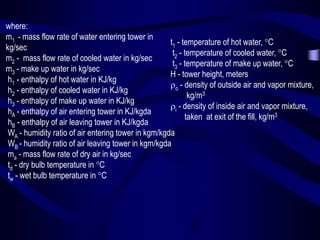
where:
m1 - mass flow rate of water entering tower in
t1 - temperature of hot water, C
kg/sec
t2 - temperature of cooled water, C
m2 - mass flow rate of cooled water in kg/sec
t3 - temperature of make up water, C
m3 - make up water in kg/sec
H - tower height, meters
h1 - enthalpy of hot water in KJ/kg
o - density of outside air and vapor mixture,
h2 - enthalpy of cooled water in KJ/kg
kg/m3
h3 - enthalpy of make up water in KJ/kg
i - density of inside air and vapor mixture,
hA - enthalpy of air entering tower in KJ/kgda
taken at exit of the fill, kg/m3
hB - enthalpy of air leaving tower in KJ/kgda
WA - humidity ratio of air entering tower in kgm/kgda
WB - humidity ratio of air leaving tower in kgm/kgda
ma - mass flow rate of dry air in kg/sec
td - dry bulb temperature in C
tw - wet bulb temperature in C
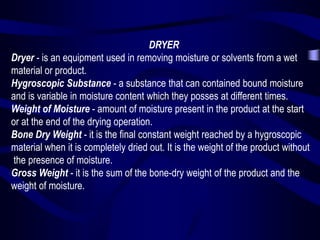
DRYER
Dryer - is an equipment used in removing moisture or solvents from a wet
material or product.
Hygroscopic Substance - a substance that can contained bound moisture
and is variable in moisture content which they posses at different times.
Weight of Moisture - amount of moisture present in the product at the start
or at the end of the drying operation.
Bone Dry Weight - it is the final constant weight reached by a hygroscopic
material when it is completely dried out. It is the weight of the product without
the presence of moisture.
Gross Weight - it is the sum of the bone-dry weight of the product and the
weight of moisture.
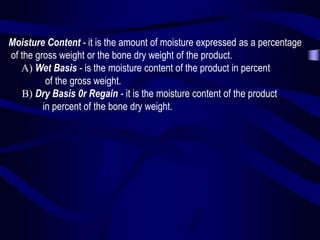
Moisture Content - it is the amount of moisture expressed as a percentage
of the gross weight or the bone dry weight of the product.
A) Wet Basis - is the moisture content of the product in percent
of the gross weight.
B) Dry Basis 0r Regain - it is the moisture content of the product
in percent of the bone dry weight.
Continuous Drying - is that type of drying operation in which the material
to be dried is fed to and discharge from the dryer continuously.
Batch Drying - is that type of drying operation in which the material to be
dried is done in batches at definite interval of time.
CLASSIFICATION OF DRYERS
1. Direct Dryers - conduction heat transfer
2. Indirect Dryers - convection heat transfer
3. Infra-red Dryers - radiation heat transfer
PRODUCT SYMBOLS
1. GW = BDW + M
2. Xm = [M/GW] x 100% (wet basis)
3. Xm = [M/BDW] x 100% (dry basis or regain)
where: GW - gross weight
BDW - bone dry weight
M - weight of moisture
Xm - moisture content
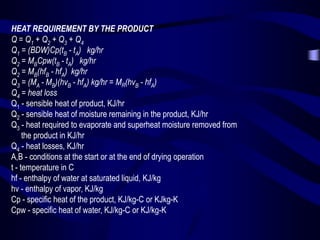
HEAT REQUIREMENT BY THE PRODUCT
Q = Q1 + Q2 + Q3 + Q4
Q1 = (BDW)Cp(tB - tA) kg/hr
Q2 = MBCpw(tB - tA) kg/hr
Q2 = MB(hfB - hfA) kg/hr
Q3 = (MA - MB)(hvB - hfA) kg/hr = MR(hvB - hfA)
Q4 = heat loss
Q1 - sensible heat of product, KJ/hr
Q2 - sensible heat of moisture remaining in the product, KJ/hr
Q3 - heat required to evaporate and superheat moisture removed from
the product in KJ/hr
Q4 - heat losses, KJ/hr
A,B - conditions at the start or at the end of drying operation
t - temperature in C
hf - enthalpy of water at saturated liquid, KJ/kg
hv - enthalpy of vapor, KJ/kg
Cp - specific heat of the product, KJ/kg-C or KJkg-K
Cpw - specific heat of water, KJ/kg-C or KJ/kg-K
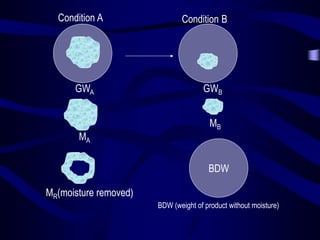
Condition A

GWA

MA

Condition B

GWB

MB

BDW
MR(moisture removed)
BDW (weight of product without moisture)
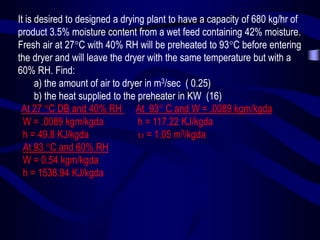
It is desired to designed a drying plant to have a capacity of 680 kg/hr of
product 3.5% moisture content from a wet feed containing 42% moisture.
Fresh air at 27C with 40% RH will be preheated to 93C before entering
the dryer and will leave the dryer with the same temperature but with a
60% RH. Find:
a) the amount of air to dryer in m3/sec ( 0.25)
b) the heat supplied to the preheater in KW (16)
At 27 C DB and 40% RH At 93 C and W = .0089 kgm/kgda
W = .0089 kgm/kgda
h = 117.22 KJ/kgda
h = 49.8 KJ/kgda
 = 1.05 m3/kgda
At 93 C and 60% RH
W = 0.54 kgm/kgda
h = 1538.94 KJ/kgda
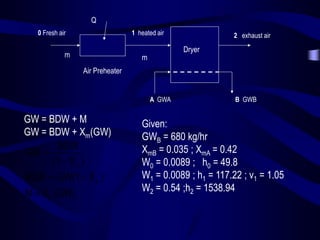
Q
0 Fresh air

1 heated air

m

2 exhaust air

Dryer

m
Air Preheater

A GWA

GW = BDW + M
GW = BDW + Xm(GW)
BDW
GW 
(1  X m )

BDW  GW(1  X m )
M  X m (GW)

B GWB

Given:
GWB = 680 kg/hr
XmB = 0.035 ; XmA = 0.42
W0 = 0.0089 ; h0 = 49.8
W1 = 0.0089 ; h1 = 117.22 ; v1 = 1.05
W2 = 0.54 ;h2 = 1538.94
h2
h1

2

W2

h0
0

1

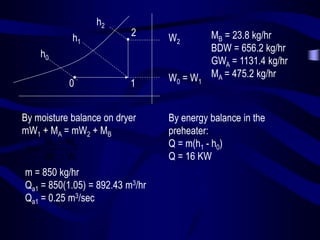
By moisture balance on dryer
mW1 + MA = mW2 + MB
M A  MB
m
W2  W1
m = 850 kg/hr
Qa1 = 850(1.05) = 892.43 m3/hr
Qa1 = 0.25 m3/sec

W0 = W 1

MB = 23.8 kg/hr
BDW = 656.2 kg/hr
GWA = 1131.4 kg/hr
MA = 475.2 kg/hr

By energy balance in the
preheater:
Q = m(h1 - h0)
Q = 16 KW
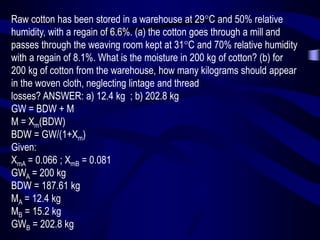
Raw cotton has been stored in a warehouse at 29C and 50% relative
humidity, with a regain of 6.6%. (a) the cotton goes through a mill and
passes through the weaving room kept at 31C and 70% relative humidity
with a regain of 8.1%. What is the moisture in 200 kg of cotton? (b) for
200 kg of cotton from the warehouse, how many kilograms should appear
in the woven cloth, neglecting lintage and thread
losses? ANSWER: a) 12.4 kg ; b) 202.8 kg
GW = BDW + M
M = Xm(BDW)
BDW = GW/(1+Xm)
Given:
XmA = 0.066 ; XmB = 0.081
GWA = 200 kg
BDW = 187.61 kg
MA = 12.4 kg
MB = 15.2 kg
GWB = 202.8 kg
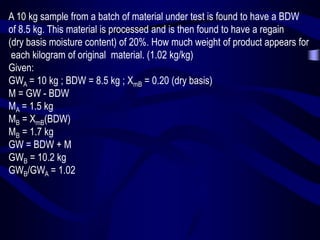
A 10 kg sample from a batch of material under test is found to have a BDW
of 8.5 kg. This material is processed and is then found to have a regain
(dry basis moisture content) of 20%. How much weight of product appears for
each kilogram of original material. (1.02 kg/kg)
Given:
GWA = 10 kg ; BDW = 8.5 kg ; XmB = 0.20 (dry basis)
M = GW - BDW
MA = 1.5 kg
MB = XmB(BDW)
MB = 1.7 kg
GW = BDW + M
GWB = 10.2 kg
GWB/GWA = 1.02
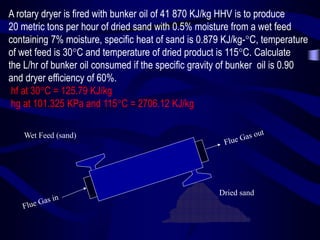
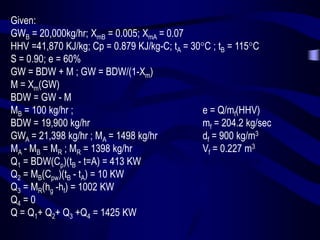
A rotary dryer is fired with bunker oil of 41 870 KJ/kg HHV is to produce
20 metric tons per hour of dried sand with 0.5% moisture from a wet feed
containing 7% moisture, specific heat of sand is 0.879 KJ/kg-C, temperature
of wet feed is 30C and temperature of dried product is 115C. Calculate
the L/hr of bunker oil consumed if the specific gravity of bunker oil is 0.90
and dryer efficiency of 60%.
hf at 30C = 125.79 KJ/kg
hg at 101.325 KPa and 115C = 2706.12 KJ/kg
Wet Feed (sand)

Dried sand
Given:
GWB = 20,000kg/hr; XmB = 0.005; XmA = 0.07
HHV =41,870 KJ/kg; Cp = 0.879 KJ/kg-C; tA = 30C ; tB = 115C
S = 0.90; e = 60%
GW = BDW + M ; GW = BDW/(1-Xm)
M = Xm(GW)
BDW = GW - M
MB = 100 kg/hr ;
e = Q/mf(HHV)
BDW = 19,900 kg/hr
mf = 204.2 kg/sec
GWA = 21,398 kg/hr ; MA = 1498 kg/hr
df = 900 kg/m3
MA - MB = MR ; MR = 1398 kg/hr
Vf = 0.227 m3
Q1 = BDW(Cp)(tB - t=A) = 413 KW
Vf = 227 Liters
Q2 = MB(Cpw)(tB - tA) = 10 KW
Q3 = MR(hg -hf) = 1002 KW
Q4 = 0
Q = Q1+ Q2+ Q3 +Q4 = 1425 KW

Cooling Tower & Dryer Fundamentals

  • 1.
  • 2.
    B Air Out hB,WB,ma Hot water 1 m1 t1 h1 Fan A Air in hA,WA, ma t 3 , h3 , m3 Make-up water 3 Cold water 2 t 2 , h 2 , m2 Catch Basin
  • 3.
    Cooling Tower A Coolingtower is a wind braced enclosure or shell usually made of wood, concrete or metal with fillings on the inside to aid water exposure. The water to be cooled is pumped into a distributing header at the top of the tower from which it drops in sprays to the filling. The water spreads out in the filling thus exposing new water surfaces to the air circulating through the tower. The cooled water drops to the bottom of the tower called the catch basin. The air circulating through the tower becomes partially saturated with moisture by evaporating some amount of water. This evaporation is mostly what cools the water.
  • 4.
    Fundamental Equations: 1. ActualCooling Range (ACR) ACR = t1 - t2 2. Cooling Tower Approach (A) A = t2 - tWA 3. Theoretical Cooling Range (TCR) TCR = t1 – tWA 4. Cooling Tower Efficiency t1  t 2 e t 1  t WA x 100%
  • 5.
    5. Vapor Pressure PV= PW - PA(td - tW) where: A = 6.66 x 10⁻⁴ (For tW of equal or greater than 0C. A = 5.94 x 10⁻⁴ (For tW of less than 0C) 6. Specific Humidity or Humidity Ratio 0.622 Pv W P  Pv kgm kgda 7. Relative Humidity Pv Φ x 100 % Pd
  • 6.
    8. Enthalpy h =1.0045td + W(2501.3 + 1.86td) KJ/kgda 9. Specific Volume 0.287(t d  273) m 3 υ (P  Pv) kgda 10. Degree of Saturation  P  Pd  μ  Φ   P  Pv 
  • 7.
    11. By moisturebalance in the tower: a) With make up water, m1 = m2 m3 = ma(WB - WA) kg/sec b) Without make up water available, m1  m2: m1 - m2 = ma (WB - WA) kg/sec 12. By Energy Balance in the tower a. Considering make up water m1 (h1  h2 ) ma  kg/sec (hB  h A )  (WB  WA )h3 m1h1  ma (hB  h A )  (WB  WA )h3  h2  m1 KJ/kg
  • 8.
    b. Without consideringmake up water m1 (h1  h 2 ) ma  kg/sec (h B  h A )  (WB  WA )h 2 m1h1  m a (h B  h A ) h2  m1  m a (WB  WA ) KJ/kg 13. Driving Pressure gHρ o - ρ i  ΔPd  KPa 1000
  • 9.
    14. Mass Flowrate of air and vapor mixture m = ma(1+W) kg/sec m = ma + mv 15. Cooling water flow rate related to Brake Power of an Engine Brake Power m w  904.3 L/hr t1 - t 2
  • 10.
    where: m1 - massflow rate of water entering tower in t1 - temperature of hot water, C kg/sec t2 - temperature of cooled water, C m2 - mass flow rate of cooled water in kg/sec t3 - temperature of make up water, C m3 - make up water in kg/sec H - tower height, meters h1 - enthalpy of hot water in KJ/kg o - density of outside air and vapor mixture, h2 - enthalpy of cooled water in KJ/kg kg/m3 h3 - enthalpy of make up water in KJ/kg i - density of inside air and vapor mixture, hA - enthalpy of air entering tower in KJ/kgda taken at exit of the fill, kg/m3 hB - enthalpy of air leaving tower in KJ/kgda WA - humidity ratio of air entering tower in kgm/kgda WB - humidity ratio of air leaving tower in kgm/kgda ma - mass flow rate of dry air in kg/sec td - dry bulb temperature in C tw - wet bulb temperature in C
  • 11.
    DRYER Dryer - isan equipment used in removing moisture or solvents from a wet material or product. Hygroscopic Substance - a substance that can contained bound moisture and is variable in moisture content which they posses at different times. Weight of Moisture - amount of moisture present in the product at the start or at the end of the drying operation. Bone Dry Weight - it is the final constant weight reached by a hygroscopic material when it is completely dried out. It is the weight of the product without the presence of moisture. Gross Weight - it is the sum of the bone-dry weight of the product and the weight of moisture.
  • 12.
    Moisture Content -it is the amount of moisture expressed as a percentage of the gross weight or the bone dry weight of the product. A) Wet Basis - is the moisture content of the product in percent of the gross weight. B) Dry Basis 0r Regain - it is the moisture content of the product in percent of the bone dry weight.
  • 13.
    Continuous Drying -is that type of drying operation in which the material to be dried is fed to and discharge from the dryer continuously. Batch Drying - is that type of drying operation in which the material to be dried is done in batches at definite interval of time. CLASSIFICATION OF DRYERS 1. Direct Dryers - conduction heat transfer 2. Indirect Dryers - convection heat transfer 3. Infra-red Dryers - radiation heat transfer PRODUCT SYMBOLS 1. GW = BDW + M 2. Xm = [M/GW] x 100% (wet basis) 3. Xm = [M/BDW] x 100% (dry basis or regain) where: GW - gross weight BDW - bone dry weight M - weight of moisture Xm - moisture content
  • 14.
    HEAT REQUIREMENT BYTHE PRODUCT Q = Q1 + Q2 + Q3 + Q4 Q1 = (BDW)Cp(tB - tA) kg/hr Q2 = MBCpw(tB - tA) kg/hr Q2 = MB(hfB - hfA) kg/hr Q3 = (MA - MB)(hvB - hfA) kg/hr = MR(hvB - hfA) Q4 = heat loss Q1 - sensible heat of product, KJ/hr Q2 - sensible heat of moisture remaining in the product, KJ/hr Q3 - heat required to evaporate and superheat moisture removed from the product in KJ/hr Q4 - heat losses, KJ/hr A,B - conditions at the start or at the end of drying operation t - temperature in C hf - enthalpy of water at saturated liquid, KJ/kg hv - enthalpy of vapor, KJ/kg Cp - specific heat of the product, KJ/kg-C or KJkg-K Cpw - specific heat of water, KJ/kg-C or KJ/kg-K
  • 15.
    Condition A GWA MA Condition B GWB MB BDW MR(moistureremoved) BDW (weight of product without moisture)
  • 16.
    It is desiredto designed a drying plant to have a capacity of 680 kg/hr of product 3.5% moisture content from a wet feed containing 42% moisture. Fresh air at 27C with 40% RH will be preheated to 93C before entering the dryer and will leave the dryer with the same temperature but with a 60% RH. Find: a) the amount of air to dryer in m3/sec ( 0.25) b) the heat supplied to the preheater in KW (16) At 27 C DB and 40% RH At 93 C and W = .0089 kgm/kgda W = .0089 kgm/kgda h = 117.22 KJ/kgda h = 49.8 KJ/kgda  = 1.05 m3/kgda At 93 C and 60% RH W = 0.54 kgm/kgda h = 1538.94 KJ/kgda
  • 17.
    Q 0 Fresh air 1heated air m 2 exhaust air Dryer m Air Preheater A GWA GW = BDW + M GW = BDW + Xm(GW) BDW GW  (1  X m ) BDW  GW(1  X m ) M  X m (GW) B GWB Given: GWB = 680 kg/hr XmB = 0.035 ; XmA = 0.42 W0 = 0.0089 ; h0 = 49.8 W1 = 0.0089 ; h1 = 117.22 ; v1 = 1.05 W2 = 0.54 ;h2 = 1538.94
  • 18.
    h2 h1 2 W2 h0 0 1 By moisture balanceon dryer mW1 + MA = mW2 + MB M A  MB m W2  W1 m = 850 kg/hr Qa1 = 850(1.05) = 892.43 m3/hr Qa1 = 0.25 m3/sec W0 = W 1 MB = 23.8 kg/hr BDW = 656.2 kg/hr GWA = 1131.4 kg/hr MA = 475.2 kg/hr By energy balance in the preheater: Q = m(h1 - h0) Q = 16 KW
  • 19.
    Raw cotton hasbeen stored in a warehouse at 29C and 50% relative humidity, with a regain of 6.6%. (a) the cotton goes through a mill and passes through the weaving room kept at 31C and 70% relative humidity with a regain of 8.1%. What is the moisture in 200 kg of cotton? (b) for 200 kg of cotton from the warehouse, how many kilograms should appear in the woven cloth, neglecting lintage and thread losses? ANSWER: a) 12.4 kg ; b) 202.8 kg GW = BDW + M M = Xm(BDW) BDW = GW/(1+Xm) Given: XmA = 0.066 ; XmB = 0.081 GWA = 200 kg BDW = 187.61 kg MA = 12.4 kg MB = 15.2 kg GWB = 202.8 kg
  • 20.
    A 10 kgsample from a batch of material under test is found to have a BDW of 8.5 kg. This material is processed and is then found to have a regain (dry basis moisture content) of 20%. How much weight of product appears for each kilogram of original material. (1.02 kg/kg) Given: GWA = 10 kg ; BDW = 8.5 kg ; XmB = 0.20 (dry basis) M = GW - BDW MA = 1.5 kg MB = XmB(BDW) MB = 1.7 kg GW = BDW + M GWB = 10.2 kg GWB/GWA = 1.02
  • 21.
    A rotary dryeris fired with bunker oil of 41 870 KJ/kg HHV is to produce 20 metric tons per hour of dried sand with 0.5% moisture from a wet feed containing 7% moisture, specific heat of sand is 0.879 KJ/kg-C, temperature of wet feed is 30C and temperature of dried product is 115C. Calculate the L/hr of bunker oil consumed if the specific gravity of bunker oil is 0.90 and dryer efficiency of 60%. hf at 30C = 125.79 KJ/kg hg at 101.325 KPa and 115C = 2706.12 KJ/kg Wet Feed (sand) Dried sand
  • 22.
    Given: GWB = 20,000kg/hr;XmB = 0.005; XmA = 0.07 HHV =41,870 KJ/kg; Cp = 0.879 KJ/kg-C; tA = 30C ; tB = 115C S = 0.90; e = 60% GW = BDW + M ; GW = BDW/(1-Xm) M = Xm(GW) BDW = GW - M MB = 100 kg/hr ; e = Q/mf(HHV) BDW = 19,900 kg/hr mf = 204.2 kg/sec GWA = 21,398 kg/hr ; MA = 1498 kg/hr df = 900 kg/m3 MA - MB = MR ; MR = 1398 kg/hr Vf = 0.227 m3 Q1 = BDW(Cp)(tB - t=A) = 413 KW Vf = 227 Liters Q2 = MB(Cpw)(tB - tA) = 10 KW Q3 = MR(hg -hf) = 1002 KW Q4 = 0 Q = Q1+ Q2+ Q3 +Q4 = 1425 KW