Control Systems Design   PID Controller Tuning Method Parul Goyal
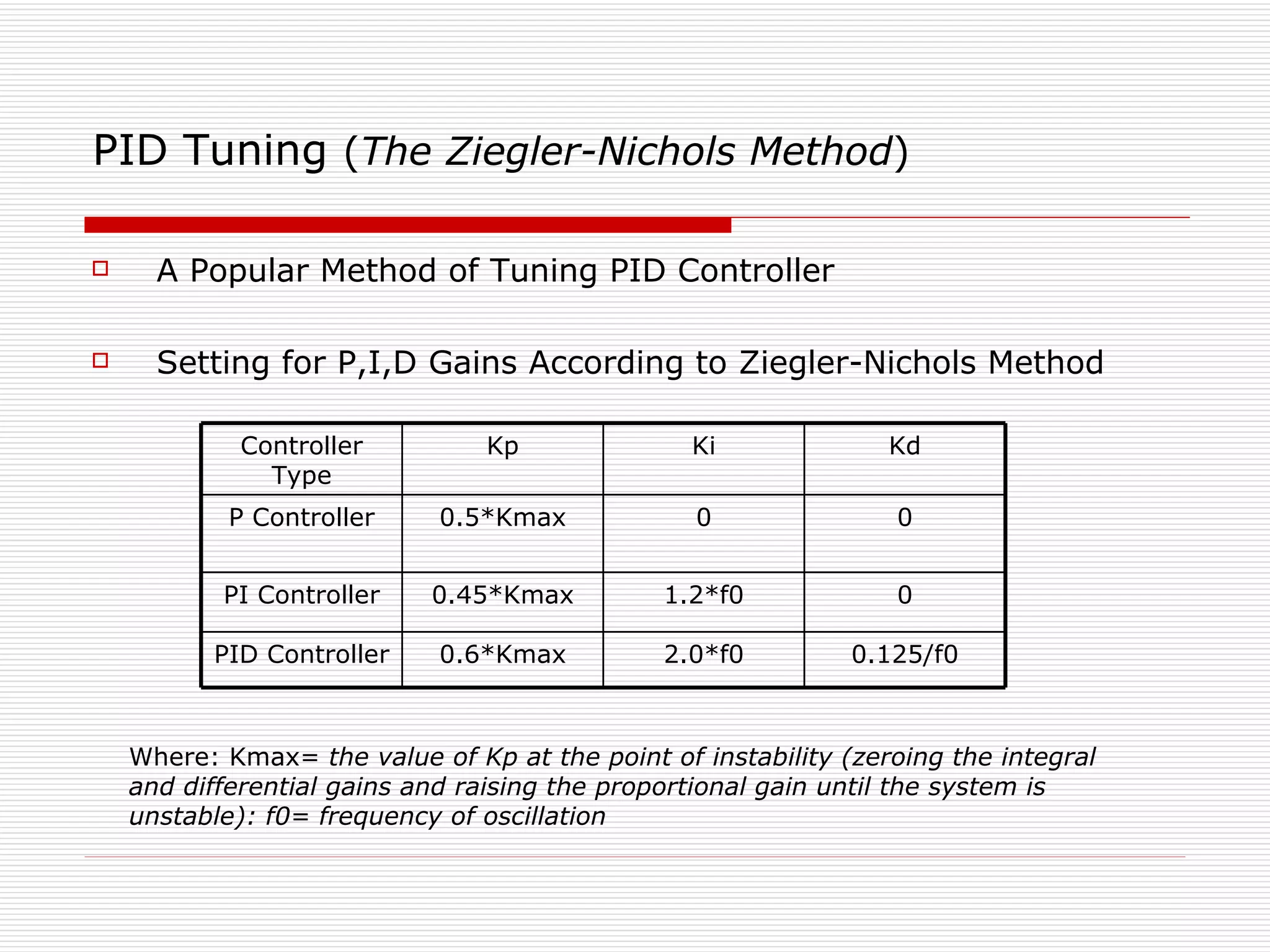
PID Tuning  ( The Ziegler-Nichols Method ) A Popular Method of Tuning PID Controller Setting for P,I,D Gains According to Ziegler-Nichols Method Where: Kmax=  the value of Kp at the point of instability (zeroing the integral and differential gains and raising the proportional gain until the system is unstable): f0= frequency of oscillation 0.125/f0 2.0*f0 0.6*Kmax PID Controller 0 1.2*f0 0.45*Kmax PI Controller 0 0 0.5*Kmax P Controller Kd Ki Kp Controller Type
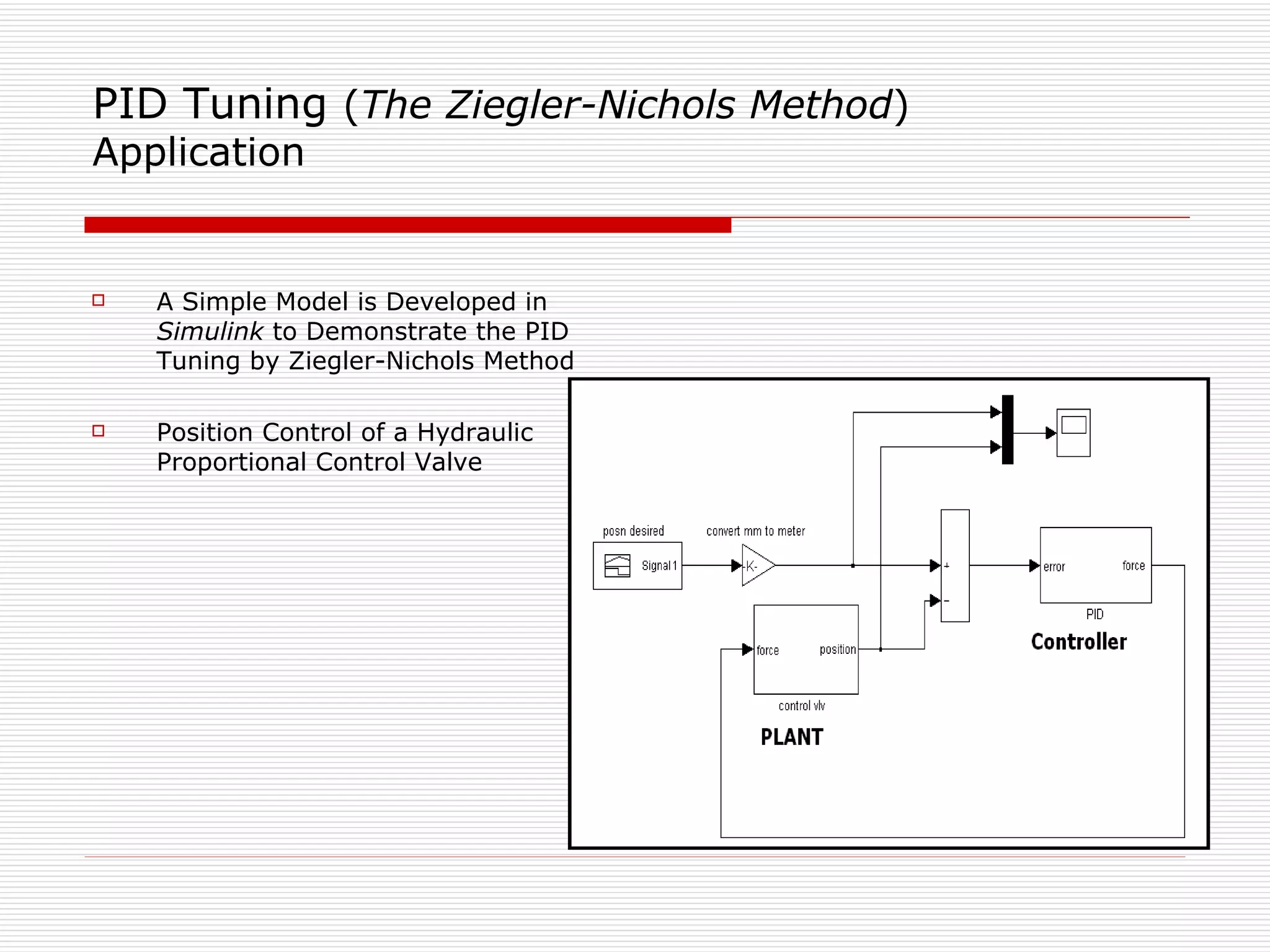
PID Tuning  ( The Ziegler-Nichols Method ) Application A Simple Model is Developed in  Simulink  to Demonstrate the PID Tuning by Ziegler-Nichols Method Position Control of a Hydraulic Proportional Control Valve
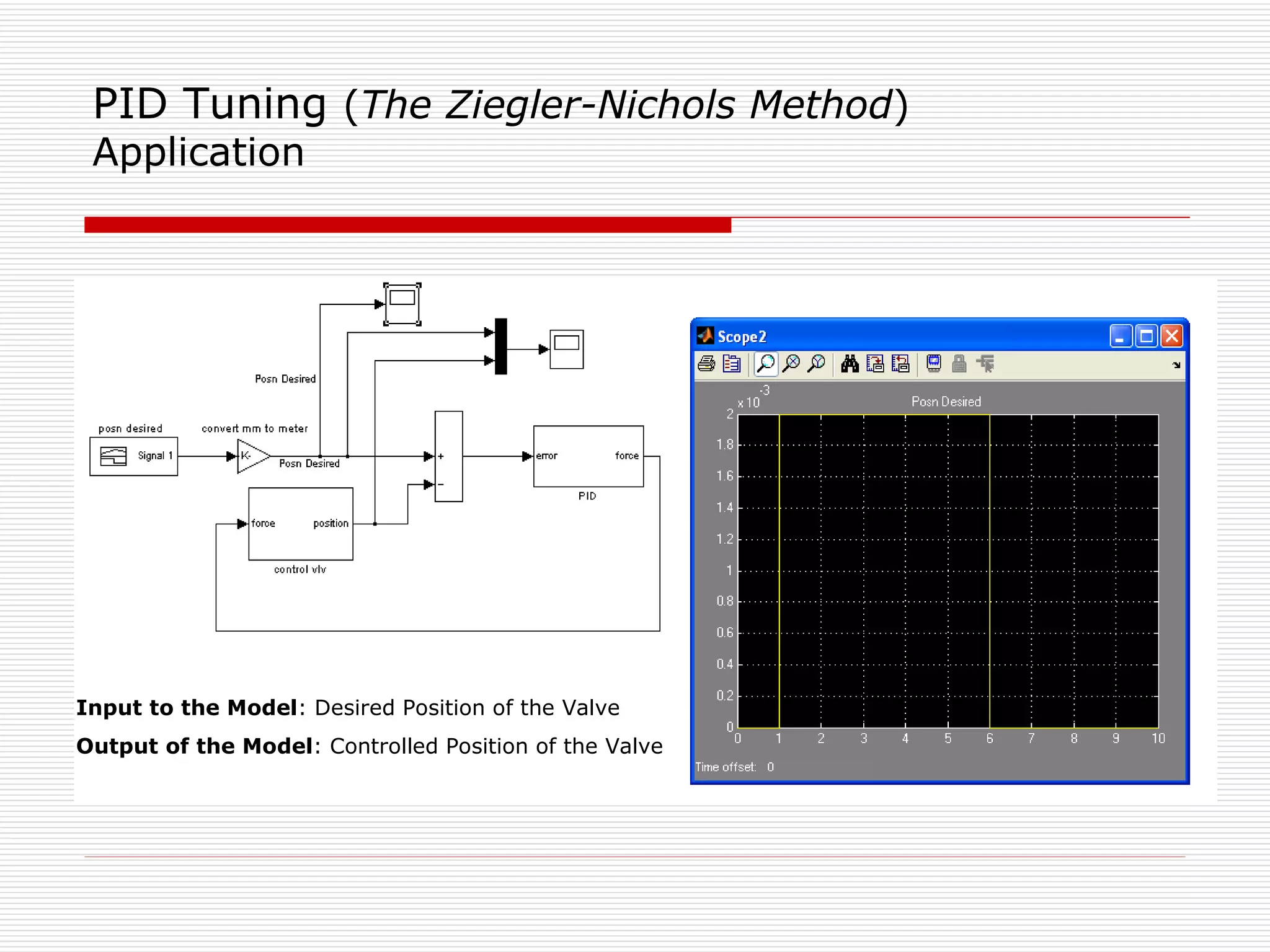
PID Tuning  ( The Ziegler-Nichols Method ) Application Input to the Model : Desired Position of the Valve Output of the Model : Controlled Position of the Valve
PID Tuning  ( The Ziegler-Nichols Method ) Application Setting PID Gains:  Kp=increase until output becomes unstable Ki=0, Kd=0 At Kp=21.5*1.1, Position Output is still Stable
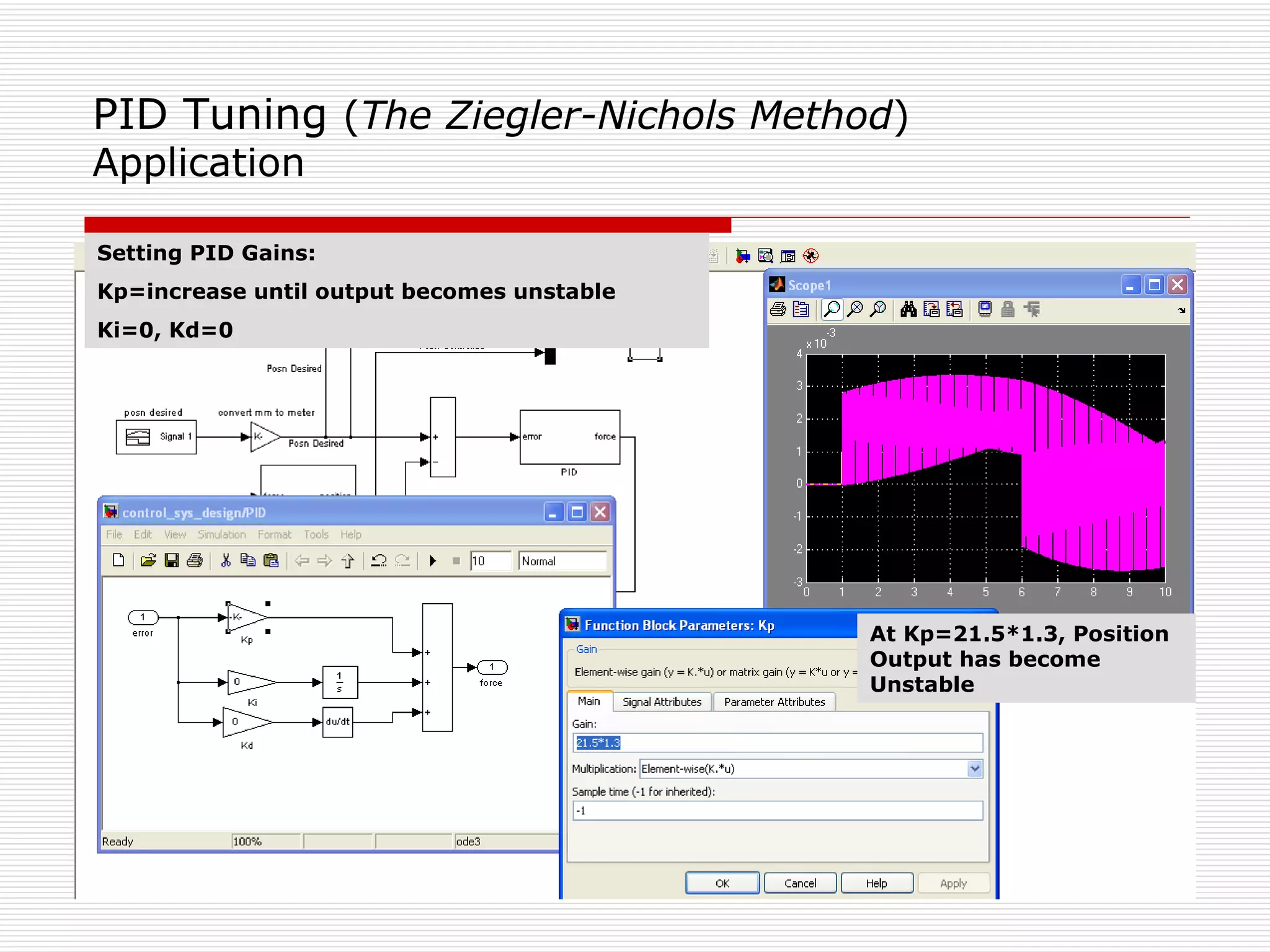
PID Tuning  ( The Ziegler-Nichols Method ) Application Setting PID Gains:  Kp=increase until output becomes unstable Ki=0, Kd=0 At Kp=21.5*1.3, Position Output has become Unstable
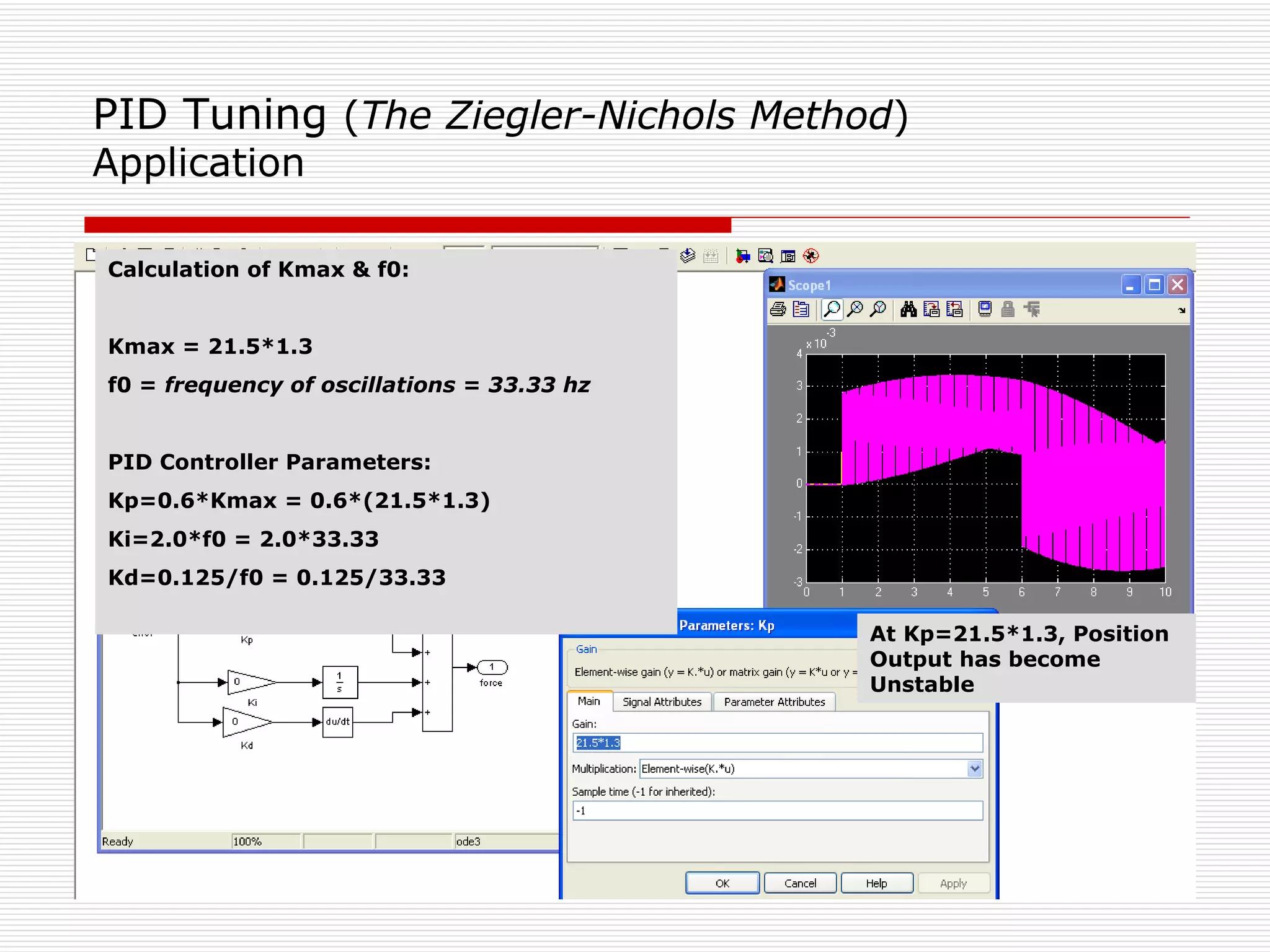
PID Tuning  ( The Ziegler-Nichols Method ) Application Calculation of Kmax & f0: Kmax = 21.5*1.3 f0 =  frequency of oscillations = 33.33 hz PID Controller Parameters: Kp=0.6*Kmax = 0.6*(21.5*1.3) Ki=2.0*f0 = 2.0*33.33 Kd=0.125/f0 = 0.125/33.33 At Kp=21.5*1.3, Position Output has become Unstable
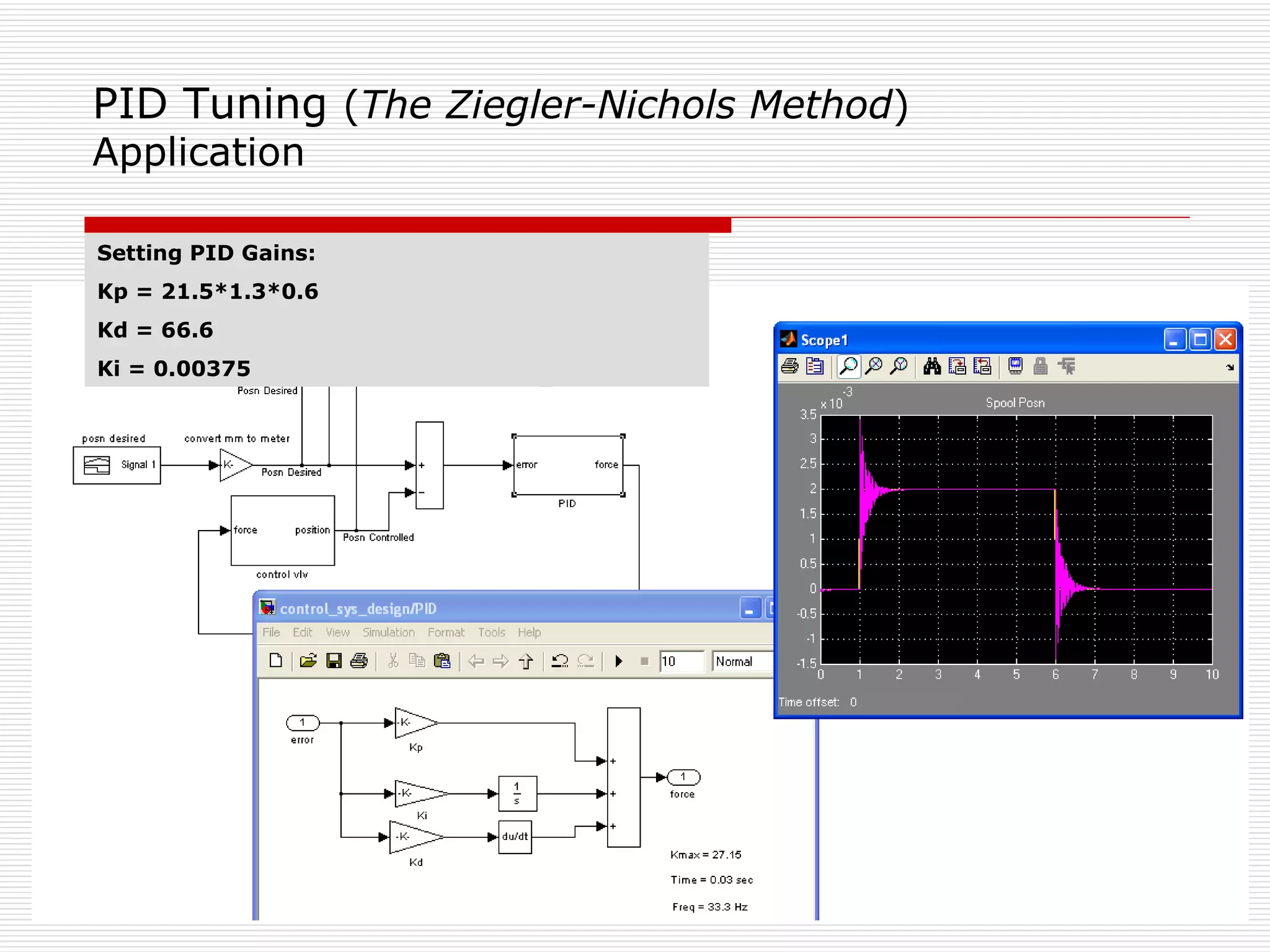
PID Tuning  ( The Ziegler-Nichols Method ) Application Setting PID Gains:  Kp = 21.5*1.3*0.6 Kd = 66.6 Ki = 0.00375
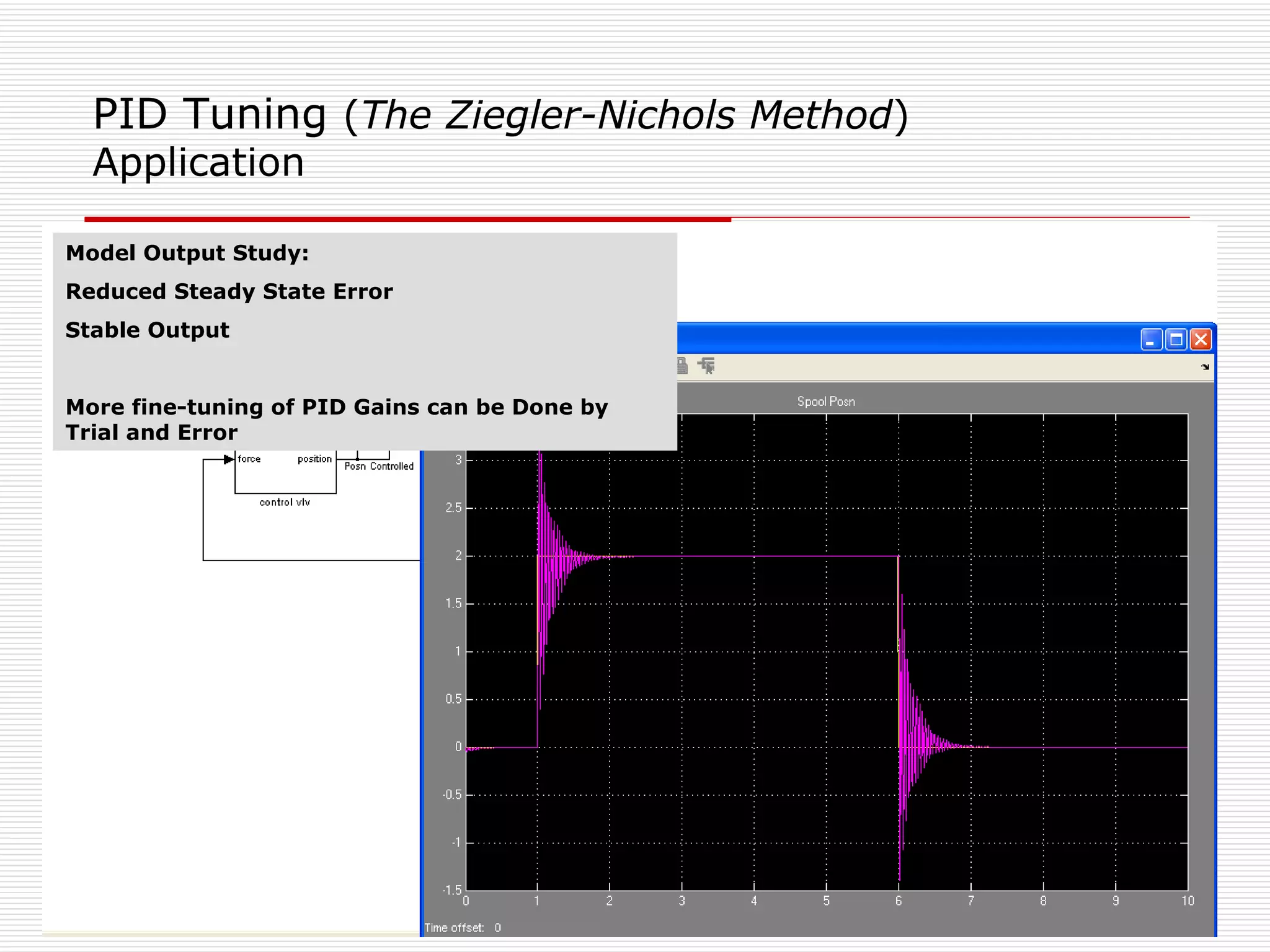
PID Tuning  ( The Ziegler-Nichols Method ) Application Model Output Study: Reduced Steady State Error Stable Output More fine-tuning of PID Gains can be Done by Trial and Error

Control Systems Design- PID Tuning

  • 1.
    Control Systems Design PID Controller Tuning Method Parul Goyal
  • 2.
    PID Tuning ( The Ziegler-Nichols Method ) A Popular Method of Tuning PID Controller Setting for P,I,D Gains According to Ziegler-Nichols Method Where: Kmax= the value of Kp at the point of instability (zeroing the integral and differential gains and raising the proportional gain until the system is unstable): f0= frequency of oscillation 0.125/f0 2.0*f0 0.6*Kmax PID Controller 0 1.2*f0 0.45*Kmax PI Controller 0 0 0.5*Kmax P Controller Kd Ki Kp Controller Type
  • 3.
    PID Tuning ( The Ziegler-Nichols Method ) Application A Simple Model is Developed in Simulink to Demonstrate the PID Tuning by Ziegler-Nichols Method Position Control of a Hydraulic Proportional Control Valve
  • 4.
    PID Tuning ( The Ziegler-Nichols Method ) Application Input to the Model : Desired Position of the Valve Output of the Model : Controlled Position of the Valve
  • 5.
    PID Tuning ( The Ziegler-Nichols Method ) Application Setting PID Gains: Kp=increase until output becomes unstable Ki=0, Kd=0 At Kp=21.5*1.1, Position Output is still Stable
  • 6.
    PID Tuning ( The Ziegler-Nichols Method ) Application Setting PID Gains: Kp=increase until output becomes unstable Ki=0, Kd=0 At Kp=21.5*1.3, Position Output has become Unstable
  • 7.
    PID Tuning ( The Ziegler-Nichols Method ) Application Calculation of Kmax & f0: Kmax = 21.5*1.3 f0 = frequency of oscillations = 33.33 hz PID Controller Parameters: Kp=0.6*Kmax = 0.6*(21.5*1.3) Ki=2.0*f0 = 2.0*33.33 Kd=0.125/f0 = 0.125/33.33 At Kp=21.5*1.3, Position Output has become Unstable
  • 8.
    PID Tuning ( The Ziegler-Nichols Method ) Application Setting PID Gains: Kp = 21.5*1.3*0.6 Kd = 66.6 Ki = 0.00375
  • 9.
    PID Tuning ( The Ziegler-Nichols Method ) Application Model Output Study: Reduced Steady State Error Stable Output More fine-tuning of PID Gains can be Done by Trial and Error