For queries:
Irfan.Anjum@ucp.edu.pk
Computer Architecture~ Fall 2018 1
 Where one instruction cannot immediately follow another
 Types of hazards
◦ Structural hazards - attempt to use same resource twice
◦ Data hazards - attempt to use data before it is ready
◦ Control hazards - attempt to make decision before condition is
evaluated
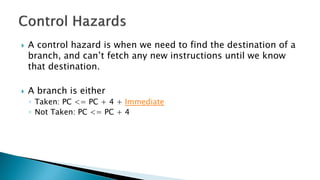
 A control hazard is when we need to find the destination of a
branch, and can’t fetch any new instructions until we know
that destination.
 A branch is either
◦ Taken: PC <= PC + 4 + Immediate
◦ Not Taken: PC <= PC + 4
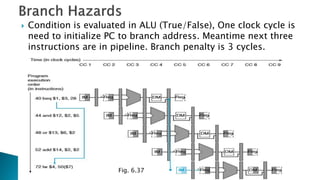
 Condition is evaluated in ALU (True/False), One clock cycle is
need to initialize PC to branch address. Meantime next three
instructions are in pipeline. Branch penalty is 3 cycles.
Fig. 6.37
1. Stall? Not practical, wastes cycles.
2. Decision in ID stage? Add additional hardware, make decision and calculate
address in ID stage. (Branch penalty reduces to one CC).
3. Delayed Branch? Specify in architecture that the instruction immediately
after branch is always executed. Compiler re-arranges code to insert an
independent instruction after branch instrution.
4. Predict? Assume an outcome and continue execution normally, whenever
assumption fails flush three fetched instructions.
1. 1-bit branch prediction
2. 2-bit branch prediction
 Based on SPEC (Standard Performance Evaluation Corporation)
benchmarks
◦ Branches occur with a frequency of 14% to 16% in integer programs
and 3% to 12% in floating point programs.
◦ About 75% of the branches are forward branches
◦ 60% of forward branches are taken
◦ 80% of backward branches are taken
◦ 67% of all branches are taken
 Why are branches (especially backward branches) more likely
to be taken than not taken?
 For every branch instruction encountered, predict either it will be
taken or not taken.
 Predict Branch taken
◦ Speculatively fetch and execute instructions at the branch target address
◦ Useful only if target address known earlier than branch outcome
◦ May require stall cycles till target address known
◦ Flush pipeline if prediction is incorrect
◦ Must ensure that flushed instructions do not update memory/registers
 Predicting branch not taken:
◦ Speculatively fetch and execute in-line instructions following the branch
◦ If prediction incorrect flush pipeline of speculated instructions
◦ Convert these instructions to NOPs by clearing pipeline registers
◦ Must ensure that flushed instructions do not update memory/registers
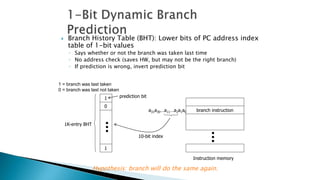
 Branch History Table (BHT): Lower bits of PC address index
table of 1-bit values
◦ Says whether or not the branch was taken last time
◦ No address check (saves HW, but may not be the right branch)
◦ If prediction is wrong, invert prediction bit
a31a30…a11…a2a1a0 branch instruction
1K-entry BHT
10-bit index
0
1
1
prediction bit
Instruction memory
Hypothesis: branch will do the same again.
1 = branch was last taken
0 = branch was last not taken
Computer Architecture~ Fall 2018 9
 Example:
Consider a loop branch that is taken 9 times in
a row and then not taken once. What is the
prediction accuracy of the 1-bit predictor for
this branch assuming only this branch ever
changes its corresponding prediction bit?
◦ Answer: 80%. Because there are two mispredictions – one on
the first iteration and one on the last iteration. Is this good
enough and Why?
Computer Architecture~ Fall 2018 12
Computer Architecture~ Fall 2018 13
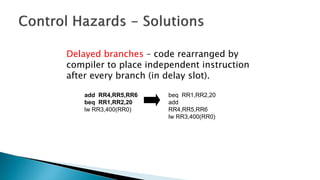
Delayed branches – code rearranged by
compiler to place independent instruction
after every branch (in delay slot).
add RR4,RR5,RR6
beq RR1,RR2,20
lw RR3,400(RR0)
beq RR1,RR2,20
add
RR4,RR5,RR6
lw RR3,400(RR0)
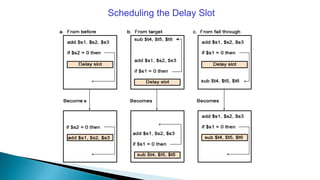
Scheduling the Delay Slot
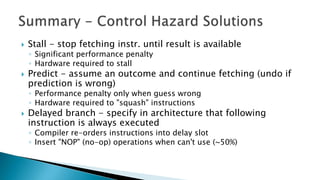
 Stall - stop fetching instr. until result is available
◦ Significant performance penalty
◦ Hardware required to stall
 Predict - assume an outcome and continue fetching (undo if
prediction is wrong)
◦ Performance penalty only when guess wrong
◦ Hardware required to "squash" instructions
 Delayed branch - specify in architecture that following
instruction is always executed
◦ Compiler re-orders instructions into delay slot
◦ Insert "NOP" (no-op) operations when can't use (~50%)
Computer Architecture~ Fall 2018 17
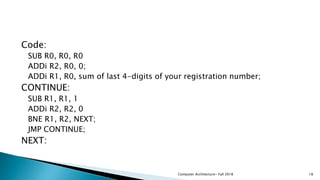
Code:
SUB R0, R0, R0
ADDi R2, R0, 0;
ADDi R1, R0, sum of last 4-digits of your registration number;
CONTINUE:
SUB R1, R1, 1
ADDi R2, R2, 0
BNE R1, R2, NEXT;
JMP CONTINUE;
NEXT:
Computer Architecture~ Fall 2018 18
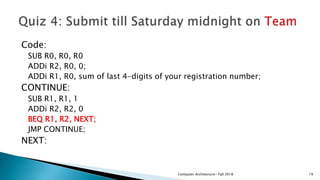
Code:
SUB R0, R0, R0
ADDi R2, R0, 0;
ADDi R1, R0, sum of last 4-digits of your registration number;
CONTINUE:
SUB R1, R1, 1
ADDi R2, R2, 0
BEQ R1, R2, NEXT;
JMP CONTINUE;
NEXT:
Computer Architecture~ Fall 2018 19

Control hazards MIPS pipeline.pptx

  • 1.
  • 2.
     Where oneinstruction cannot immediately follow another  Types of hazards ◦ Structural hazards - attempt to use same resource twice ◦ Data hazards - attempt to use data before it is ready ◦ Control hazards - attempt to make decision before condition is evaluated
  • 3.
     A controlhazard is when we need to find the destination of a branch, and can’t fetch any new instructions until we know that destination.  A branch is either ◦ Taken: PC <= PC + 4 + Immediate ◦ Not Taken: PC <= PC + 4
  • 4.
     Condition isevaluated in ALU (True/False), One clock cycle is need to initialize PC to branch address. Meantime next three instructions are in pipeline. Branch penalty is 3 cycles. Fig. 6.37
  • 5.
    1. Stall? Notpractical, wastes cycles. 2. Decision in ID stage? Add additional hardware, make decision and calculate address in ID stage. (Branch penalty reduces to one CC). 3. Delayed Branch? Specify in architecture that the instruction immediately after branch is always executed. Compiler re-arranges code to insert an independent instruction after branch instrution. 4. Predict? Assume an outcome and continue execution normally, whenever assumption fails flush three fetched instructions. 1. 1-bit branch prediction 2. 2-bit branch prediction
  • 6.
     Based onSPEC (Standard Performance Evaluation Corporation) benchmarks ◦ Branches occur with a frequency of 14% to 16% in integer programs and 3% to 12% in floating point programs. ◦ About 75% of the branches are forward branches ◦ 60% of forward branches are taken ◦ 80% of backward branches are taken ◦ 67% of all branches are taken  Why are branches (especially backward branches) more likely to be taken than not taken?
  • 7.
     For everybranch instruction encountered, predict either it will be taken or not taken.  Predict Branch taken ◦ Speculatively fetch and execute instructions at the branch target address ◦ Useful only if target address known earlier than branch outcome ◦ May require stall cycles till target address known ◦ Flush pipeline if prediction is incorrect ◦ Must ensure that flushed instructions do not update memory/registers  Predicting branch not taken: ◦ Speculatively fetch and execute in-line instructions following the branch ◦ If prediction incorrect flush pipeline of speculated instructions ◦ Convert these instructions to NOPs by clearing pipeline registers ◦ Must ensure that flushed instructions do not update memory/registers
  • 8.
     Branch HistoryTable (BHT): Lower bits of PC address index table of 1-bit values ◦ Says whether or not the branch was taken last time ◦ No address check (saves HW, but may not be the right branch) ◦ If prediction is wrong, invert prediction bit a31a30…a11…a2a1a0 branch instruction 1K-entry BHT 10-bit index 0 1 1 prediction bit Instruction memory Hypothesis: branch will do the same again. 1 = branch was last taken 0 = branch was last not taken
  • 9.
  • 10.
     Example: Consider aloop branch that is taken 9 times in a row and then not taken once. What is the prediction accuracy of the 1-bit predictor for this branch assuming only this branch ever changes its corresponding prediction bit? ◦ Answer: 80%. Because there are two mispredictions – one on the first iteration and one on the last iteration. Is this good enough and Why?
  • 12.
  • 13.
  • 14.
    Delayed branches –code rearranged by compiler to place independent instruction after every branch (in delay slot). add RR4,RR5,RR6 beq RR1,RR2,20 lw RR3,400(RR0) beq RR1,RR2,20 add RR4,RR5,RR6 lw RR3,400(RR0)
  • 15.
  • 16.
     Stall -stop fetching instr. until result is available ◦ Significant performance penalty ◦ Hardware required to stall  Predict - assume an outcome and continue fetching (undo if prediction is wrong) ◦ Performance penalty only when guess wrong ◦ Hardware required to "squash" instructions  Delayed branch - specify in architecture that following instruction is always executed ◦ Compiler re-orders instructions into delay slot ◦ Insert "NOP" (no-op) operations when can't use (~50%)
  • 17.
  • 18.
    Code: SUB R0, R0,R0 ADDi R2, R0, 0; ADDi R1, R0, sum of last 4-digits of your registration number; CONTINUE: SUB R1, R1, 1 ADDi R2, R2, 0 BNE R1, R2, NEXT; JMP CONTINUE; NEXT: Computer Architecture~ Fall 2018 18
  • 19.
    Code: SUB R0, R0,R0 ADDi R2, R0, 0; ADDi R1, R0, sum of last 4-digits of your registration number; CONTINUE: SUB R1, R1, 1 ADDi R2, R2, 0 BEQ R1, R2, NEXT; JMP CONTINUE; NEXT: Computer Architecture~ Fall 2018 19