CONTRACTS & CLAIMS MANAGEMENT
TRAINING WORKSHOP
SESSION-1
AUGUST 06, 2011
Conducted By:
General Manager Contracts
Engr. Tahir B Mirza
OBJECTIVES OF TRAINING WORKSHOP
1. Exchange of knowledge for practical purposes
2. Capacity building through exchange of knowledge to meet
futuristic challenges
3. To evolve & implement strategic approach on all the
projects across the organization.
4. To prevent drain of hard earned revenues due to time
barred claim cases
5. To implement proactive management practices rather than
reactive responses
6. To achieve systematic data tracking & report generation on
organizational basis
TOPICS PRESENTED
1. RULES OF ENGAGEMENT FOR PROJECT
EXECUTION & CONSTRUCTION CLAIMS
2. CONSTRUCTION CLAIM IDENTIFICATION &
RECORD KEEPING GUIDELINES
3. CONSTRUCTION CLAIMS DOCUMENTATION
GUIDELINES
RULES OF ENGAGEMENT FOR PROJECT EXECUTION & CONSTRUCTION CLAIMS
INTRODUCTION
There are always certain assumptions that both the contractor
and the owner possess when entering into a construction
contract. These assumptions do not necessarily coincide with one
another.
THE CONTRACTOR'S SIX RULES OF ENGAGEMENT
1. Read and know the contract documents
2. Develop a comprehensive and accurate construction
schedule
3. Prepare accurate and comprehensive daily construction
reports
4. Notify the owner of issues
5. Keep track of costs
RULES OF ENGAGEMENT FOR PROJECT EXECUTION & CONSTRUCTION CLAIMS
THE CONSTRUCTION CLAIM
1. A Contractor’s claim may be defined as a legitimate request for
additional compensation of cost and time as per terms of the
contract and the relevant contract act.
2. Even if both the contractor and the owner follow their respective
rules of engagement, the resulting project is not assured to be
claim free. A construction claim, on the other hand, does not
necessarily result from disputes among the parties.
3. A claim can develop concurrently with an event that disrupts the
construction progress, or it can develop after the results of the
disruption are thoroughly reviewed and all cost impacts are
evaluated.
4. Claims can develop from both the contractor's perspective and
the owner's perspective. An owner's claim against the contractor
is somewhat unusual, but it can occur.
RULES OF ENGAGEMENT FOR PROJECT EXECUTION & CONSTRUCTION CLAIMS
4. There are many different approaches for administering a construction
contract from both the owner's position and the contractor's position. If
both the contractor and the owner follow their respective rules of
engagement, the process of claim evaluation can be simplified.
5. A concise strategy to administer a construction contract is important
and should support a successful project. Knowing and understanding
this strategy can support or challenge construction claims.
6. The basic theory behind construction claims remains simple; the
claims, however, have become extremely complex. Successfully
proving and pricing claims requires an extensive knowledge of key
elements of the claim and the ability to illustrate the facts and/or
position persuasively.
7. Successfully challenging a claim also requires an extensive knowledge
of key elements of the claim, the ability to illustrate the facts, and the
ability to respond persuasively to the pricing of the claim.
RULES OF ENGAGEMENT FOR PROJECT EXECUTION & CONSTRUCTION CLAIMS
POTENTIAL HEADS OF CONTRACTOR’S CLAIM
1. Site Establishment Cost
2. Overhead Costs
A. Head office overheads
B. Site overheads
3. Profits
4. Inflation
5. Loss of Productivity or acceleration cost
6. Finance Charges
7. Interest on Delayed Payments
8. Cost of Preparation of Claims
9. General, 2nd Learning Curve Expenses
10. Variations
RULES OF ENGAGEMENT FOR PROJECT EXECUTION & CONSTRUCTION CLAIMS
PRELIMINARIES (ON SITE ESTABLISHMENT)
1. Set up costs
2. Running Costs
3. Demolition or clearing costs
VARIOUS ITEMS CONSTITUTING THIS COST HEAD ARE AS FOLLOWS;
1. Site Management expenses
2. Plant, equipment & Scaffolding
3. Power for lighting & use in works
4. Temporary hoardings site offices & storage sheds
5. Local authority charges for the temporary hoarding & other costs
6. Water for the Works
7. Telephone services
8. Insurance for works & third party
9. Performance bonds & guarantees
10. Supervision of nominated subcontractors
11. Site security watching lighting
12. Site safety, sanitation & welfare measures
13. Program & progress schedule
14. Site clearance & maintenance of temporary roads
RULES OF ENGAGEMENT FOR PROJECT EXECUTION & CONSTRUCTION CLAIMS
CONCLUSIONS
If the previously discussed rules of engagement are
followed, the contractor will have a thorough and complete
knowledge of the contract requirements and will have
preserved its contractual rights. Any disruption in the
construction schedule would have been described
comprehensively and accurately in the updated construction
schedule and daily reports.
CONSTRUCTION CLAIM IDENTIFICATION & RECORD KEEPING GUIDELINES
CONTRACTOR’S CLAIM DEFINATION
A Contractor’s claim may be defined as a legitimate request for
additional compensation of cost and time as per terms of the contract
and the relevant contract act.
COMPENSATION FOR LOSS OR DAMAGE CAUSED BY
BREACH OF CONTRACT
When a contract has been broken, the party who suffers by such breach
is entitled to receive, from the party who has broken the contract,
compensation for any loss or damage caused to him thereby, which
naturally arose in the usual course of things from such breach, or which
the parties knew, when they made the contract, to be likely to result from
the breach of it.
CONSTRUCTION CLAIM IDENTIFICATION & RECORD KEEPING GUIDELINES
CLAIM IDENTIFICATION
1. The state, of economy and high interest rates have made
project owners much more anxious to hold down original capital
outlay, and avoid additional costs.
2. Revisions have been made to owner-consultant agreements
designed to take control of funds out of the consultant's hands.
3. Revisions are made to standard contract forms intended to
transfer increased liability to the contractors and sub-
contractors, as well as require more burdensome warranties.
4. Stiffer competition prevails for reasons noted earlier.
5. All of these give rise to a greater possibility for disputes and
claims.
6. It is prudent to recognize the situation and deal with it in a
realistic, positive and sensible manner.
7. This is much better than trying to brush things under the carpet
until the end of the job - for fear of upsetting the friendly,
contractual relationship.
CONSTRUCTION CLAIM IDENTIFICATION & RECORD KEEPING GUIDELINES
CLAIM NOTIFICATION
1. A claim should be made only after careful consideration,
in a formal and objective manner,
2. Precisely on contractual and Lawful grounds,
3. And the corresponding time extension to the contract, if
appropriate.
CONSTRUCTION CLAIM IDENTIFICATION & RECORD KEEPING GUIDELINES
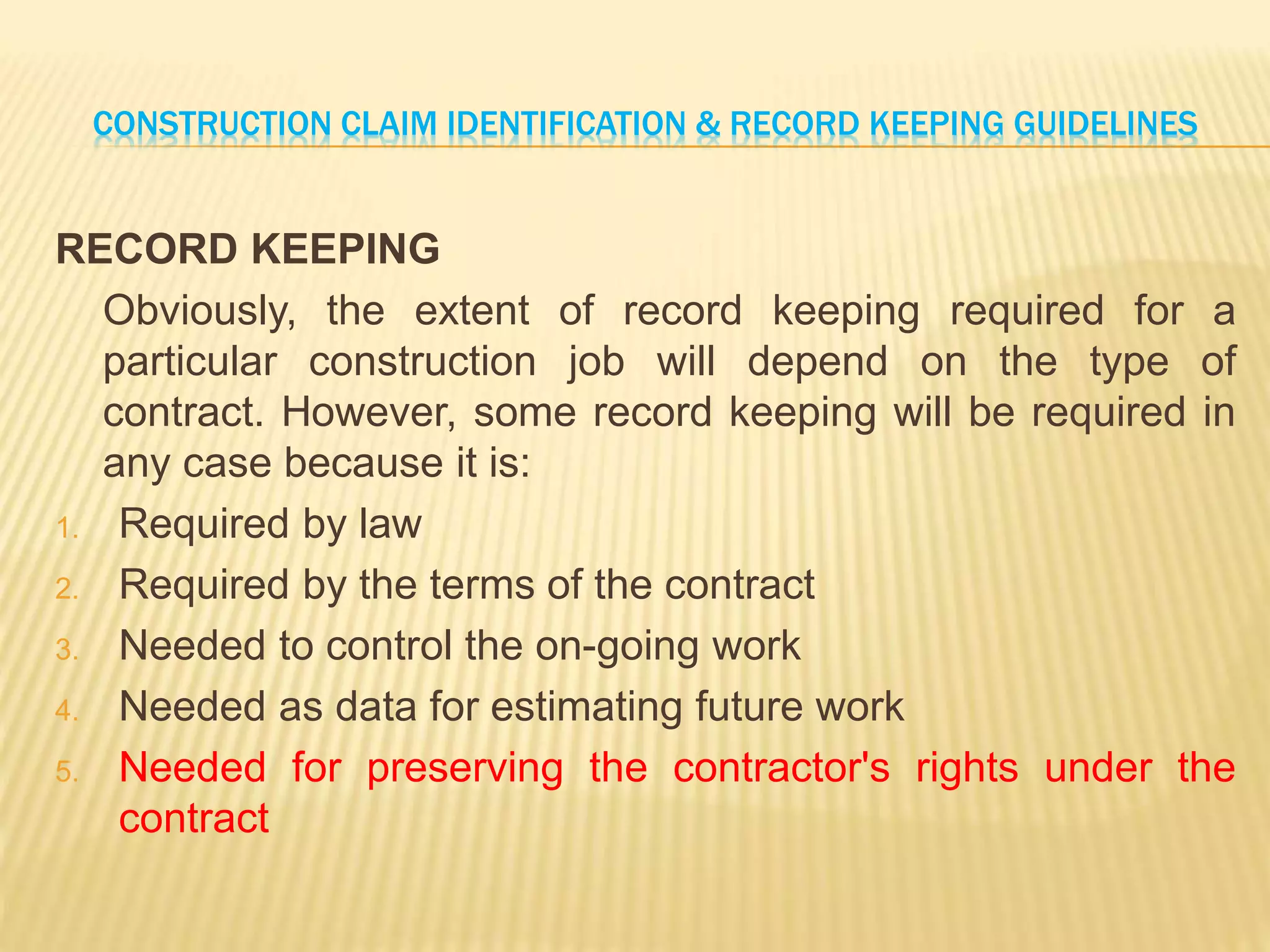
RECORD KEEPING
Obviously, the extent of record keeping required for a
particular construction job will depend on the type of
contract. However, some record keeping will be required in
any case because it is:
1. Required by law
2. Required by the terms of the contract
3. Needed to control the on-going work
4. Needed as data for estimating future work
5. Needed for preserving the contractor's rights under the
contract
CONSTRUCTION CLAIM IDENTIFICATION & RECORD KEEPING GUIDELINES
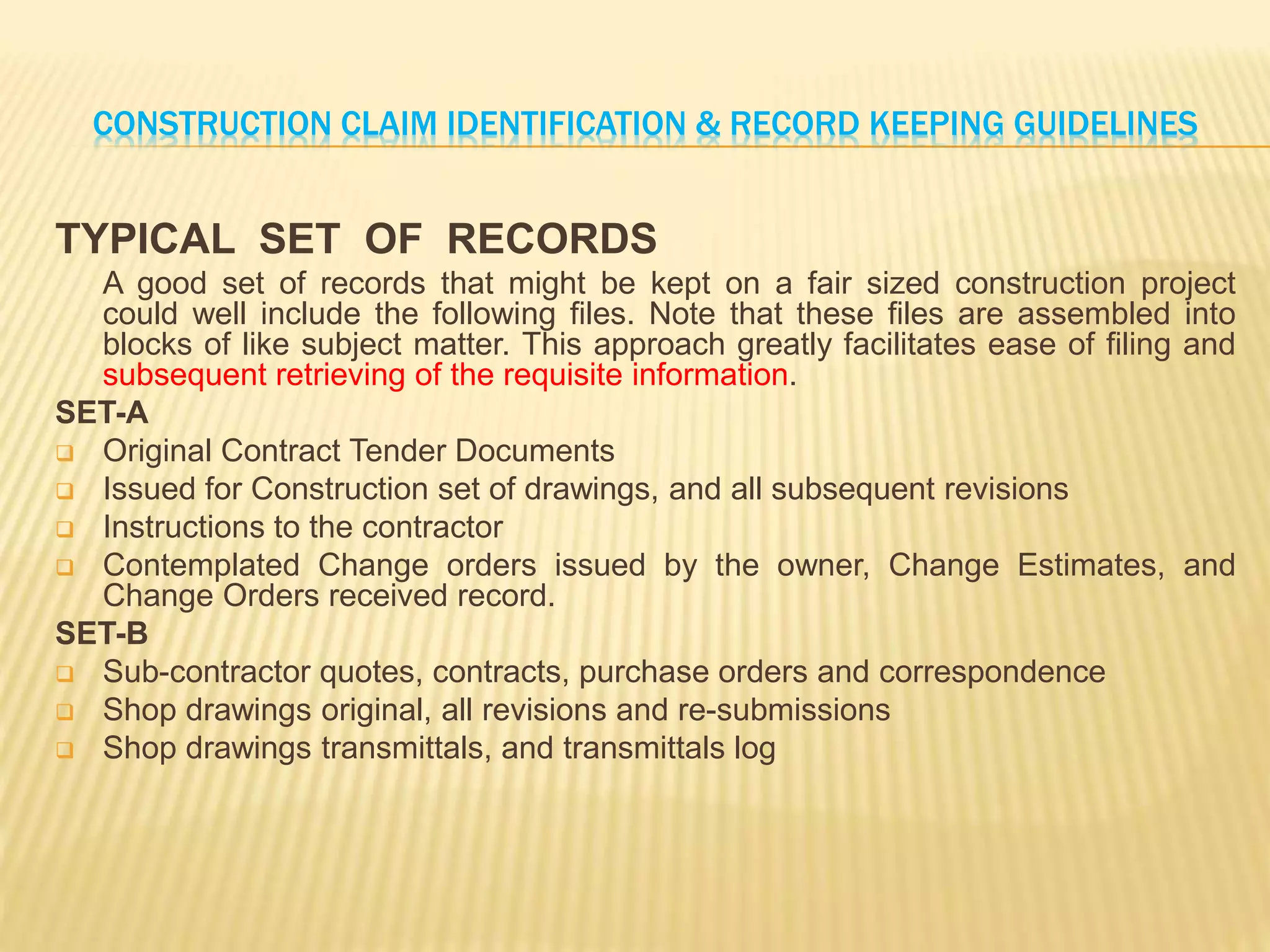
TYPICAL SET OF RECORDS
A good set of records that might be kept on a fair sized construction project
could well include the following files. Note that these files are assembled into
blocks of like subject matter. This approach greatly facilitates ease of filing and
subsequent retrieving of the requisite information.
SET-A
 Original Contract Tender Documents
 Issued for Construction set of drawings, and all subsequent revisions
 Instructions to the contractor
 Contemplated Change orders issued by the owner, Change Estimates, and
Change Orders received record.
SET-B
 Sub-contractor quotes, contracts, purchase orders and correspondence
 Shop drawings original, all revisions and re-submissions
 Shop drawings transmittals, and transmittals log
CONSTRUCTION CLAIM IDENTIFICATION & RECORD KEEPING GUIDELINES
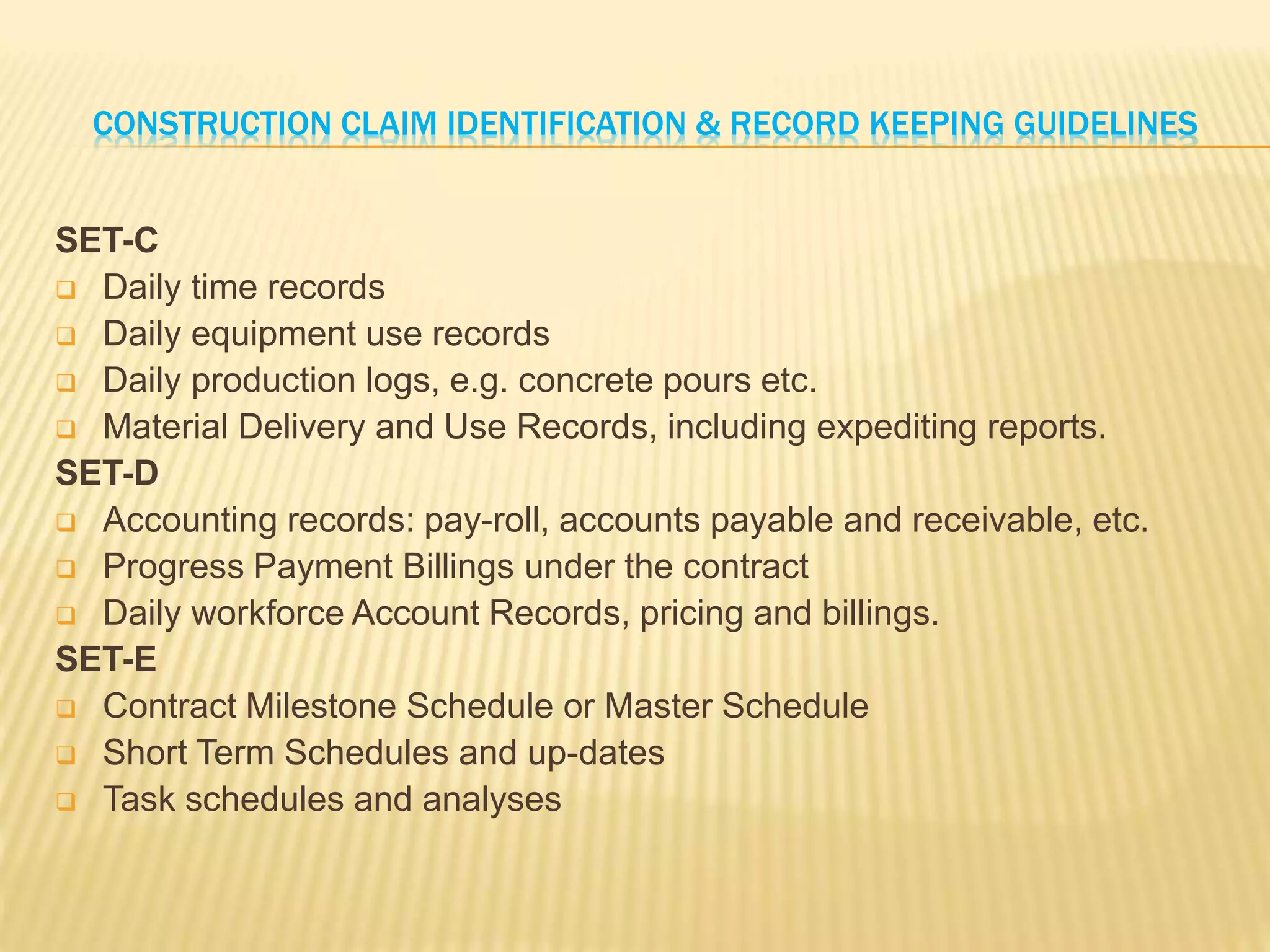
SET-C
 Daily time records
 Daily equipment use records
 Daily production logs, e.g. concrete pours etc.
 Material Delivery and Use Records, including expediting reports.
SET-D
 Accounting records: pay-roll, accounts payable and receivable, etc.
 Progress Payment Billings under the contract
 Daily workforce Account Records, pricing and billings.
SET-E
 Contract Milestone Schedule or Master Schedule
 Short Term Schedules and up-dates
 Task schedules and analyses
CONSTRUCTION CLAIM IDENTIFICATION & RECORD KEEPING GUIDELINES
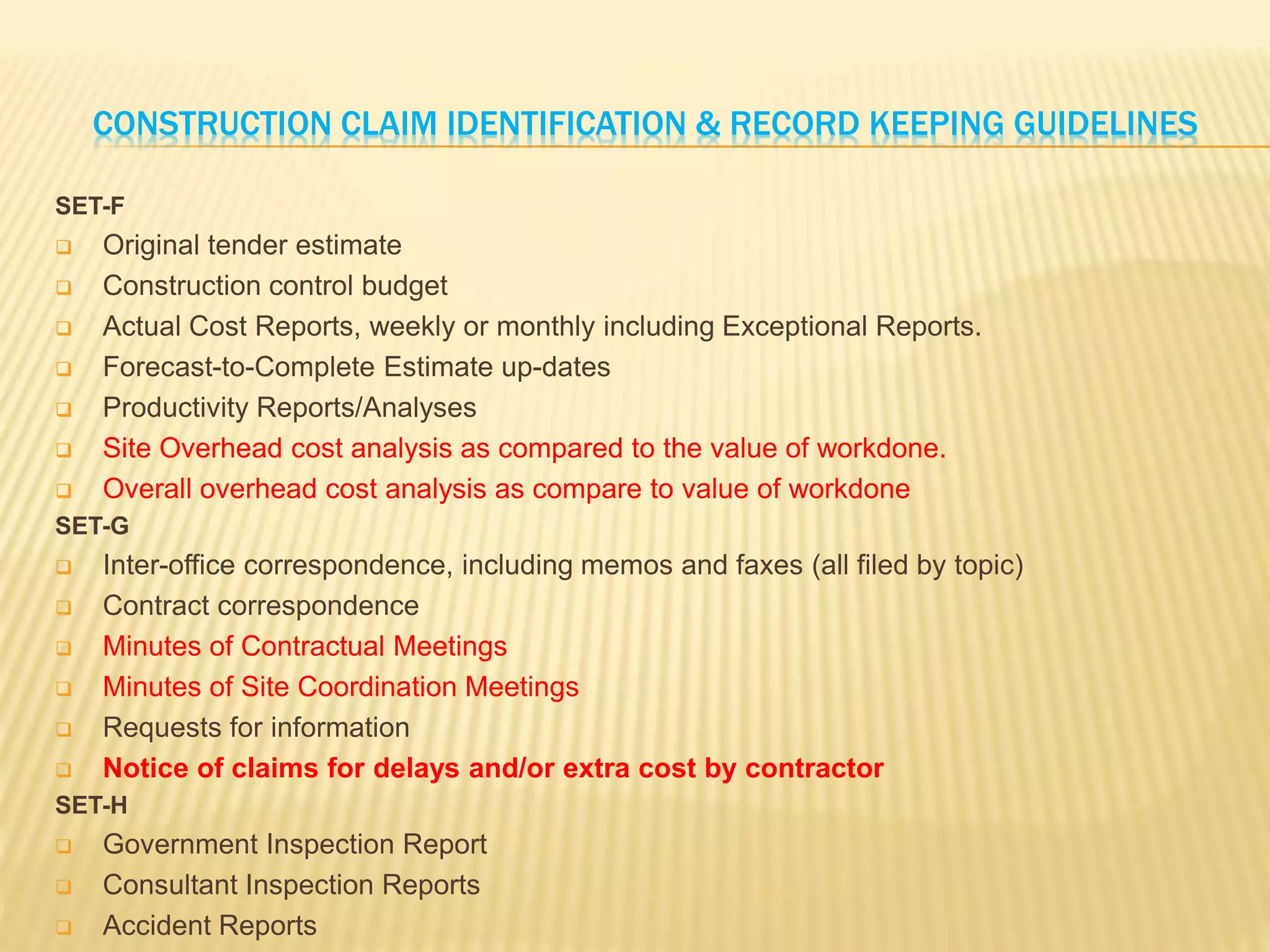
SET-F
 Original tender estimate
 Construction control budget
 Actual Cost Reports, weekly or monthly including Exceptional Reports.
 Forecast-to-Complete Estimate up-dates
 Productivity Reports/Analyses
 Site Overhead cost analysis as compared to the value of workdone.
 Overall overhead cost analysis as compare to value of workdone
SET-G
 Inter-office correspondence, including memos and faxes (all filed by topic)
 Contract correspondence
 Minutes of Contractual Meetings
 Minutes of Site Coordination Meetings
 Requests for information
 Notice of claims for delays and/or extra cost by contractor
SET-H
 Government Inspection Report
 Consultant Inspection Reports
 Accident Reports
CONSTRUCTION CLAIM IDENTIFICATION & RECORD KEEPING GUIDELINES
SET-I
 Daily Project diary or journal entries
 Notes of telephonic conversations
 Progress Reports, weekly, monthly or quarterly
 Progress photographs
 Any other reports, such as material testing reports.
SET-J
 Data of all the Record Files that are being maintained
 Focus on the Last Two Groups
 That's quite a healthy list, and needs the administrative staff to support
it.
 Most of the list is automatic and self explanatory.
 However, the last six items are often overlooked and therefore are worth
elaborating
CONSTRUCTION CLAIM IDENTIFICATION & RECORD KEEPING GUIDELINES
OTHER RECORD KEEPING GUIDELINES
Original Records
1. As noted earlier, for the prudent Contractor anxious to stay solvent,
records are required for estimating future work, And for protecting his
contractual rights.
2. Both of these require some form of post-contract review. However,
there can be little argument that reliable data cannot be extracted from
records created after the fact. Even the best of memories are imperfect
and the written record serves to provide the solid reminder. Data may
be extracted, analyzed and presented in a different light, but
satisfactory records cannot be created later.
Instant memos
For example, all verbal directives should be committed to writing
immediately and exchanged with the other party. This serves to keep
the other party properly informed, clarify understanding if the
instructions were not clear, and, of course, to preserve contractual
rights.
CONSTRUCTION CLAIM IDENTIFICATION & RECORD KEEPING GUIDELINES
Project diaries
1. Diaries can provide a wealth of information. Unfortunately, they tend to
be overlooked, either because the pace is so hectic that there is not
time to keep these updated, or alternatively, there seems to be so little
of importance going on that it hardly seems worth writing!
2. In any case, what should be recorded are solid facts such as the
make-up of various crews, sub-contractors and equipment on site,
work reallocation and for what reasons, delivery problems, and
weather conditions, visitors to the site, discussions, and visitors
comments about the work. Needless to say, what should be avoided,
are personal opinions and derogatory remarks.
Photographs
For record purposes, these must show what is actually going on at the
time with the location and view point identified, as well as the date and
photographer's name. A camera which prints the date on the negative
is a great start and well worth the expense. Also the photographer
should realize that it is the content, and not the artistic effect, that is the
most important.
CONSTRUCTION CLAIM IDENTIFICATION & RECORD KEEPING GUIDELINES
Computer Application
1. As we have seen, the road to contract
documentation is long and arduous. The worst part
is trying to find that vital piece of information
amongst the morass of paper, which is now so
urgently required.
2. However, the secret is to get data organized as early
in the job as possible, and then commit to consistent
maintenance, regular backup and off-site storage. If
this is done meticulously, the subsequent saving in
time through search and find, or through spread
sheet and database design and use, can be
invaluable.
CONSTRUCTION CLAIM IDENTIFICATION & RECORD KEEPING GUIDELINES
Managing the Records
As well as managing the files, the records themselves
also need managing. Some simple rules can help as
follows:
1. Determine what records are to be kept, and how.
Establish logs of the records, so that they can be found,
referred to and/or followed up as required. Well
organized contractors establish standard reference lists
and coding for all their contracts. This greatly facilitates
managing, analyzing and comparing contracts.
2. Once the records have been identified, ensure that they
are in fact set up, maintained and used for managing the
job.
CONSTRUCTION CLAIM IDENTIFICATION & RECORD KEEPING GUIDELINES
3. Review the record keeping system from time to time, because
records have a habit of growing in unexpected ways - like half
the correspondence showing up under Miscellaneous, and the
other half under General. In addition, some records may
become obsolete or redundant, and should be discontinued.
Unnecessary record keeping can waste a lot of time and money.
4. Records also take up space and equipment. Determine the
useful life of the different components, and take a systematic
approach to record disposal.
5. Take steps to ensure accuracy, reliability and hence credibility.
Unreliable records can be quite useless, as well as a waste of
money, and possibly even detrimental.
CONSTRUCTION CLAIM DOCUMENTATION GUIDELINES
HOW TO ESTABLISH THE ENTITLEMENT & AND AMOUNT OF CLAIM
1. Firstly, it is necessary to discuss what must be established to prevail
on a claim. A construction claim is a demand for payment of additional
compensation, or extension in time to complete the project works,
adjustment of the parties' respective contractual obligations, or any
other change in the contract compensation or terms.
2. In presenting a disputed claim to the party with whom the contract
agreement has been signed it is necessary to establish the other
party's liability for the claim (often referred to as "entitlement") and that
the amount of the damages sought (often referred to as "quantum") as
correctly as possible.
3. Generally, if the Contractor is unable to establish both aspects of the
claim it will not prevail. Thus, establishing liability and damages are of
equal importance. Nonetheless, many claimants focus on the
entitlement issues with the end result being that the damages are not
properly established.
CONSTRUCTION CLAIM DOCUMENTATION GUIDELINES
4. Proving entitlement to prevail on a claim is generally a matter of making
a correct legal interpretation of whether the facts as applied to the
relevant contractual provisions allow the recovery of additional
compensation or not.
5. As a practical matter the provisions of the construction contracts
incorporate the general conditions and specifications. Therefore, the
proper legal interpretation of the general conditions and specifications
is essential.
6. The actual analysis of the facts that entitle a claimant to recover the
extra costs/time typically includes an objective review of the scheduling,
general conditions, specifications, building codes and standards of the
industry.
7. Obviously, the application of the facts to the relevant contract
provisions must be made on a case-by-case basis.
CONSTRUCTION CLAIM DOCUMENTATION GUIDELINES
8. Establishing the quantum aspect of the claim also requires an
objective analysis of the costs associated with the additional
work. If the contract does not establish a method for determining
the additional costs, the claimant should rely on cost accounting
principles to quantify the damages.
9. The type of claim will generally dictate the method for calculating
damages. However, the types of costs that are considered
include: home office overhead, job site overhead, material costs,
labor costs and equipment costs, insurance costs, bank charges,
deactivation & reactivation charges in case of work suspensions,
amounts corresponding to losses incurred in cancellation of
material procurement orders, workers & staff lay off payments,
inflation, change in interest rate
CONSTRUCTION CLAIM DOCUMENTATION GUIDELINES
GENERAL FORMAT FOR A CONSTRUCTION CLAIM
It includes the following
1. Cover Letter supported by Conditions of Contract
2. Executive Summary sheet
3. The Actual Claim Analysis
4. Summary of Claim
5. Underlying facts
6. Entitlement Analysis
7. Quantum (amounts claimed) Calculation Analysis
8. Factual Support for Claim
9. Attachments
CONSTRUCTION CLAIM DOCUMENTATION GUIDELINES
CONCLUSIONS
1. The claim format set forth in this guideline is a general
outline of what should be included in a claim. The actual
format should be modified to present the claim in a
persuasive manner.
2. Since many contracts require the claim to be submitted in
a particular format at a particular time and updated on a
particular, set schedule, therefore review of the relevant
contract to determine what contractual obligations exist is
imperative.
3. Failure to follow the contractual mandates relevant to the
claim presentation may result in barring the claim
processing. Therefore, if the contract agreement mandates
the format for preparing the claim than those requirements
have to be strictly complied with.
CONSTRUCTION CLAIM DOCUMENTATION GUIDELINES
4. For preparing a claim document the guidance of competent
consultants who specialize in construction and have
experience preparing and advocating the claim should be
sought.
5. Irrespective, of other matters the claim preparation process
shall start by preparing a ring binder with sections based on
the aforementioned claim format as soon as the event
causing a claim is recognized.
6. As the claim is refined it should be supplemented by adding
new supporting documentation and refining the claim
analysis. The sooner the effort is started in organizing the
claim and gathering the supporting documentation, the
easier it is to prepare the final claim documents.
THANKS

Contracts & Claims Management Workshop (Session-1)

  • 1.
    CONTRACTS & CLAIMSMANAGEMENT TRAINING WORKSHOP SESSION-1 AUGUST 06, 2011 Conducted By: General Manager Contracts Engr. Tahir B Mirza
  • 2.
    OBJECTIVES OF TRAININGWORKSHOP 1. Exchange of knowledge for practical purposes 2. Capacity building through exchange of knowledge to meet futuristic challenges 3. To evolve & implement strategic approach on all the projects across the organization. 4. To prevent drain of hard earned revenues due to time barred claim cases 5. To implement proactive management practices rather than reactive responses 6. To achieve systematic data tracking & report generation on organizational basis
  • 3.
    TOPICS PRESENTED 1. RULESOF ENGAGEMENT FOR PROJECT EXECUTION & CONSTRUCTION CLAIMS 2. CONSTRUCTION CLAIM IDENTIFICATION & RECORD KEEPING GUIDELINES 3. CONSTRUCTION CLAIMS DOCUMENTATION GUIDELINES
  • 4.
    RULES OF ENGAGEMENTFOR PROJECT EXECUTION & CONSTRUCTION CLAIMS INTRODUCTION There are always certain assumptions that both the contractor and the owner possess when entering into a construction contract. These assumptions do not necessarily coincide with one another. THE CONTRACTOR'S SIX RULES OF ENGAGEMENT 1. Read and know the contract documents 2. Develop a comprehensive and accurate construction schedule 3. Prepare accurate and comprehensive daily construction reports 4. Notify the owner of issues 5. Keep track of costs
  • 5.
    RULES OF ENGAGEMENTFOR PROJECT EXECUTION & CONSTRUCTION CLAIMS THE CONSTRUCTION CLAIM 1. A Contractor’s claim may be defined as a legitimate request for additional compensation of cost and time as per terms of the contract and the relevant contract act. 2. Even if both the contractor and the owner follow their respective rules of engagement, the resulting project is not assured to be claim free. A construction claim, on the other hand, does not necessarily result from disputes among the parties. 3. A claim can develop concurrently with an event that disrupts the construction progress, or it can develop after the results of the disruption are thoroughly reviewed and all cost impacts are evaluated. 4. Claims can develop from both the contractor's perspective and the owner's perspective. An owner's claim against the contractor is somewhat unusual, but it can occur.
  • 6.
    RULES OF ENGAGEMENTFOR PROJECT EXECUTION & CONSTRUCTION CLAIMS 4. There are many different approaches for administering a construction contract from both the owner's position and the contractor's position. If both the contractor and the owner follow their respective rules of engagement, the process of claim evaluation can be simplified. 5. A concise strategy to administer a construction contract is important and should support a successful project. Knowing and understanding this strategy can support or challenge construction claims. 6. The basic theory behind construction claims remains simple; the claims, however, have become extremely complex. Successfully proving and pricing claims requires an extensive knowledge of key elements of the claim and the ability to illustrate the facts and/or position persuasively. 7. Successfully challenging a claim also requires an extensive knowledge of key elements of the claim, the ability to illustrate the facts, and the ability to respond persuasively to the pricing of the claim.
  • 7.
    RULES OF ENGAGEMENTFOR PROJECT EXECUTION & CONSTRUCTION CLAIMS POTENTIAL HEADS OF CONTRACTOR’S CLAIM 1. Site Establishment Cost 2. Overhead Costs A. Head office overheads B. Site overheads 3. Profits 4. Inflation 5. Loss of Productivity or acceleration cost 6. Finance Charges 7. Interest on Delayed Payments 8. Cost of Preparation of Claims 9. General, 2nd Learning Curve Expenses 10. Variations
  • 8.
    RULES OF ENGAGEMENTFOR PROJECT EXECUTION & CONSTRUCTION CLAIMS PRELIMINARIES (ON SITE ESTABLISHMENT) 1. Set up costs 2. Running Costs 3. Demolition or clearing costs VARIOUS ITEMS CONSTITUTING THIS COST HEAD ARE AS FOLLOWS; 1. Site Management expenses 2. Plant, equipment & Scaffolding 3. Power for lighting & use in works 4. Temporary hoardings site offices & storage sheds 5. Local authority charges for the temporary hoarding & other costs 6. Water for the Works 7. Telephone services 8. Insurance for works & third party 9. Performance bonds & guarantees 10. Supervision of nominated subcontractors 11. Site security watching lighting 12. Site safety, sanitation & welfare measures 13. Program & progress schedule 14. Site clearance & maintenance of temporary roads
  • 9.
    RULES OF ENGAGEMENTFOR PROJECT EXECUTION & CONSTRUCTION CLAIMS CONCLUSIONS If the previously discussed rules of engagement are followed, the contractor will have a thorough and complete knowledge of the contract requirements and will have preserved its contractual rights. Any disruption in the construction schedule would have been described comprehensively and accurately in the updated construction schedule and daily reports.
  • 10.
    CONSTRUCTION CLAIM IDENTIFICATION& RECORD KEEPING GUIDELINES CONTRACTOR’S CLAIM DEFINATION A Contractor’s claim may be defined as a legitimate request for additional compensation of cost and time as per terms of the contract and the relevant contract act. COMPENSATION FOR LOSS OR DAMAGE CAUSED BY BREACH OF CONTRACT When a contract has been broken, the party who suffers by such breach is entitled to receive, from the party who has broken the contract, compensation for any loss or damage caused to him thereby, which naturally arose in the usual course of things from such breach, or which the parties knew, when they made the contract, to be likely to result from the breach of it.
  • 11.
    CONSTRUCTION CLAIM IDENTIFICATION& RECORD KEEPING GUIDELINES CLAIM IDENTIFICATION 1. The state, of economy and high interest rates have made project owners much more anxious to hold down original capital outlay, and avoid additional costs. 2. Revisions have been made to owner-consultant agreements designed to take control of funds out of the consultant's hands. 3. Revisions are made to standard contract forms intended to transfer increased liability to the contractors and sub- contractors, as well as require more burdensome warranties. 4. Stiffer competition prevails for reasons noted earlier. 5. All of these give rise to a greater possibility for disputes and claims. 6. It is prudent to recognize the situation and deal with it in a realistic, positive and sensible manner. 7. This is much better than trying to brush things under the carpet until the end of the job - for fear of upsetting the friendly, contractual relationship.
  • 12.
    CONSTRUCTION CLAIM IDENTIFICATION& RECORD KEEPING GUIDELINES CLAIM NOTIFICATION 1. A claim should be made only after careful consideration, in a formal and objective manner, 2. Precisely on contractual and Lawful grounds, 3. And the corresponding time extension to the contract, if appropriate.
  • 13.
    CONSTRUCTION CLAIM IDENTIFICATION& RECORD KEEPING GUIDELINES RECORD KEEPING Obviously, the extent of record keeping required for a particular construction job will depend on the type of contract. However, some record keeping will be required in any case because it is: 1. Required by law 2. Required by the terms of the contract 3. Needed to control the on-going work 4. Needed as data for estimating future work 5. Needed for preserving the contractor's rights under the contract
  • 14.
    CONSTRUCTION CLAIM IDENTIFICATION& RECORD KEEPING GUIDELINES TYPICAL SET OF RECORDS A good set of records that might be kept on a fair sized construction project could well include the following files. Note that these files are assembled into blocks of like subject matter. This approach greatly facilitates ease of filing and subsequent retrieving of the requisite information. SET-A  Original Contract Tender Documents  Issued for Construction set of drawings, and all subsequent revisions  Instructions to the contractor  Contemplated Change orders issued by the owner, Change Estimates, and Change Orders received record. SET-B  Sub-contractor quotes, contracts, purchase orders and correspondence  Shop drawings original, all revisions and re-submissions  Shop drawings transmittals, and transmittals log
  • 15.
    CONSTRUCTION CLAIM IDENTIFICATION& RECORD KEEPING GUIDELINES SET-C  Daily time records  Daily equipment use records  Daily production logs, e.g. concrete pours etc.  Material Delivery and Use Records, including expediting reports. SET-D  Accounting records: pay-roll, accounts payable and receivable, etc.  Progress Payment Billings under the contract  Daily workforce Account Records, pricing and billings. SET-E  Contract Milestone Schedule or Master Schedule  Short Term Schedules and up-dates  Task schedules and analyses
  • 16.
    CONSTRUCTION CLAIM IDENTIFICATION& RECORD KEEPING GUIDELINES SET-F  Original tender estimate  Construction control budget  Actual Cost Reports, weekly or monthly including Exceptional Reports.  Forecast-to-Complete Estimate up-dates  Productivity Reports/Analyses  Site Overhead cost analysis as compared to the value of workdone.  Overall overhead cost analysis as compare to value of workdone SET-G  Inter-office correspondence, including memos and faxes (all filed by topic)  Contract correspondence  Minutes of Contractual Meetings  Minutes of Site Coordination Meetings  Requests for information  Notice of claims for delays and/or extra cost by contractor SET-H  Government Inspection Report  Consultant Inspection Reports  Accident Reports
  • 17.
    CONSTRUCTION CLAIM IDENTIFICATION& RECORD KEEPING GUIDELINES SET-I  Daily Project diary or journal entries  Notes of telephonic conversations  Progress Reports, weekly, monthly or quarterly  Progress photographs  Any other reports, such as material testing reports. SET-J  Data of all the Record Files that are being maintained  Focus on the Last Two Groups  That's quite a healthy list, and needs the administrative staff to support it.  Most of the list is automatic and self explanatory.  However, the last six items are often overlooked and therefore are worth elaborating
  • 18.
    CONSTRUCTION CLAIM IDENTIFICATION& RECORD KEEPING GUIDELINES OTHER RECORD KEEPING GUIDELINES Original Records 1. As noted earlier, for the prudent Contractor anxious to stay solvent, records are required for estimating future work, And for protecting his contractual rights. 2. Both of these require some form of post-contract review. However, there can be little argument that reliable data cannot be extracted from records created after the fact. Even the best of memories are imperfect and the written record serves to provide the solid reminder. Data may be extracted, analyzed and presented in a different light, but satisfactory records cannot be created later. Instant memos For example, all verbal directives should be committed to writing immediately and exchanged with the other party. This serves to keep the other party properly informed, clarify understanding if the instructions were not clear, and, of course, to preserve contractual rights.
  • 19.
    CONSTRUCTION CLAIM IDENTIFICATION& RECORD KEEPING GUIDELINES Project diaries 1. Diaries can provide a wealth of information. Unfortunately, they tend to be overlooked, either because the pace is so hectic that there is not time to keep these updated, or alternatively, there seems to be so little of importance going on that it hardly seems worth writing! 2. In any case, what should be recorded are solid facts such as the make-up of various crews, sub-contractors and equipment on site, work reallocation and for what reasons, delivery problems, and weather conditions, visitors to the site, discussions, and visitors comments about the work. Needless to say, what should be avoided, are personal opinions and derogatory remarks. Photographs For record purposes, these must show what is actually going on at the time with the location and view point identified, as well as the date and photographer's name. A camera which prints the date on the negative is a great start and well worth the expense. Also the photographer should realize that it is the content, and not the artistic effect, that is the most important.
  • 20.
    CONSTRUCTION CLAIM IDENTIFICATION& RECORD KEEPING GUIDELINES Computer Application 1. As we have seen, the road to contract documentation is long and arduous. The worst part is trying to find that vital piece of information amongst the morass of paper, which is now so urgently required. 2. However, the secret is to get data organized as early in the job as possible, and then commit to consistent maintenance, regular backup and off-site storage. If this is done meticulously, the subsequent saving in time through search and find, or through spread sheet and database design and use, can be invaluable.
  • 21.
    CONSTRUCTION CLAIM IDENTIFICATION& RECORD KEEPING GUIDELINES Managing the Records As well as managing the files, the records themselves also need managing. Some simple rules can help as follows: 1. Determine what records are to be kept, and how. Establish logs of the records, so that they can be found, referred to and/or followed up as required. Well organized contractors establish standard reference lists and coding for all their contracts. This greatly facilitates managing, analyzing and comparing contracts. 2. Once the records have been identified, ensure that they are in fact set up, maintained and used for managing the job.
  • 22.
    CONSTRUCTION CLAIM IDENTIFICATION& RECORD KEEPING GUIDELINES 3. Review the record keeping system from time to time, because records have a habit of growing in unexpected ways - like half the correspondence showing up under Miscellaneous, and the other half under General. In addition, some records may become obsolete or redundant, and should be discontinued. Unnecessary record keeping can waste a lot of time and money. 4. Records also take up space and equipment. Determine the useful life of the different components, and take a systematic approach to record disposal. 5. Take steps to ensure accuracy, reliability and hence credibility. Unreliable records can be quite useless, as well as a waste of money, and possibly even detrimental.
  • 23.
    CONSTRUCTION CLAIM DOCUMENTATIONGUIDELINES HOW TO ESTABLISH THE ENTITLEMENT & AND AMOUNT OF CLAIM 1. Firstly, it is necessary to discuss what must be established to prevail on a claim. A construction claim is a demand for payment of additional compensation, or extension in time to complete the project works, adjustment of the parties' respective contractual obligations, or any other change in the contract compensation or terms. 2. In presenting a disputed claim to the party with whom the contract agreement has been signed it is necessary to establish the other party's liability for the claim (often referred to as "entitlement") and that the amount of the damages sought (often referred to as "quantum") as correctly as possible. 3. Generally, if the Contractor is unable to establish both aspects of the claim it will not prevail. Thus, establishing liability and damages are of equal importance. Nonetheless, many claimants focus on the entitlement issues with the end result being that the damages are not properly established.
  • 24.
    CONSTRUCTION CLAIM DOCUMENTATIONGUIDELINES 4. Proving entitlement to prevail on a claim is generally a matter of making a correct legal interpretation of whether the facts as applied to the relevant contractual provisions allow the recovery of additional compensation or not. 5. As a practical matter the provisions of the construction contracts incorporate the general conditions and specifications. Therefore, the proper legal interpretation of the general conditions and specifications is essential. 6. The actual analysis of the facts that entitle a claimant to recover the extra costs/time typically includes an objective review of the scheduling, general conditions, specifications, building codes and standards of the industry. 7. Obviously, the application of the facts to the relevant contract provisions must be made on a case-by-case basis.
  • 25.
    CONSTRUCTION CLAIM DOCUMENTATIONGUIDELINES 8. Establishing the quantum aspect of the claim also requires an objective analysis of the costs associated with the additional work. If the contract does not establish a method for determining the additional costs, the claimant should rely on cost accounting principles to quantify the damages. 9. The type of claim will generally dictate the method for calculating damages. However, the types of costs that are considered include: home office overhead, job site overhead, material costs, labor costs and equipment costs, insurance costs, bank charges, deactivation & reactivation charges in case of work suspensions, amounts corresponding to losses incurred in cancellation of material procurement orders, workers & staff lay off payments, inflation, change in interest rate
  • 26.
    CONSTRUCTION CLAIM DOCUMENTATIONGUIDELINES GENERAL FORMAT FOR A CONSTRUCTION CLAIM It includes the following 1. Cover Letter supported by Conditions of Contract 2. Executive Summary sheet 3. The Actual Claim Analysis 4. Summary of Claim 5. Underlying facts 6. Entitlement Analysis 7. Quantum (amounts claimed) Calculation Analysis 8. Factual Support for Claim 9. Attachments
  • 27.
    CONSTRUCTION CLAIM DOCUMENTATIONGUIDELINES CONCLUSIONS 1. The claim format set forth in this guideline is a general outline of what should be included in a claim. The actual format should be modified to present the claim in a persuasive manner. 2. Since many contracts require the claim to be submitted in a particular format at a particular time and updated on a particular, set schedule, therefore review of the relevant contract to determine what contractual obligations exist is imperative. 3. Failure to follow the contractual mandates relevant to the claim presentation may result in barring the claim processing. Therefore, if the contract agreement mandates the format for preparing the claim than those requirements have to be strictly complied with.
  • 28.
    CONSTRUCTION CLAIM DOCUMENTATIONGUIDELINES 4. For preparing a claim document the guidance of competent consultants who specialize in construction and have experience preparing and advocating the claim should be sought. 5. Irrespective, of other matters the claim preparation process shall start by preparing a ring binder with sections based on the aforementioned claim format as soon as the event causing a claim is recognized. 6. As the claim is refined it should be supplemented by adding new supporting documentation and refining the claim analysis. The sooner the effort is started in organizing the claim and gathering the supporting documentation, the easier it is to prepare the final claim documents.
  • 29.