Loay Ghazaleh, MBA, BSc. Civil Eng.
Advisor, Undersecretary Office
Ministry of Works, Bahrain
loay.ghz@gmail.com , +973-36711547
NEW FIDIC Yellow & Silver In EPC & PPP Contracts
2
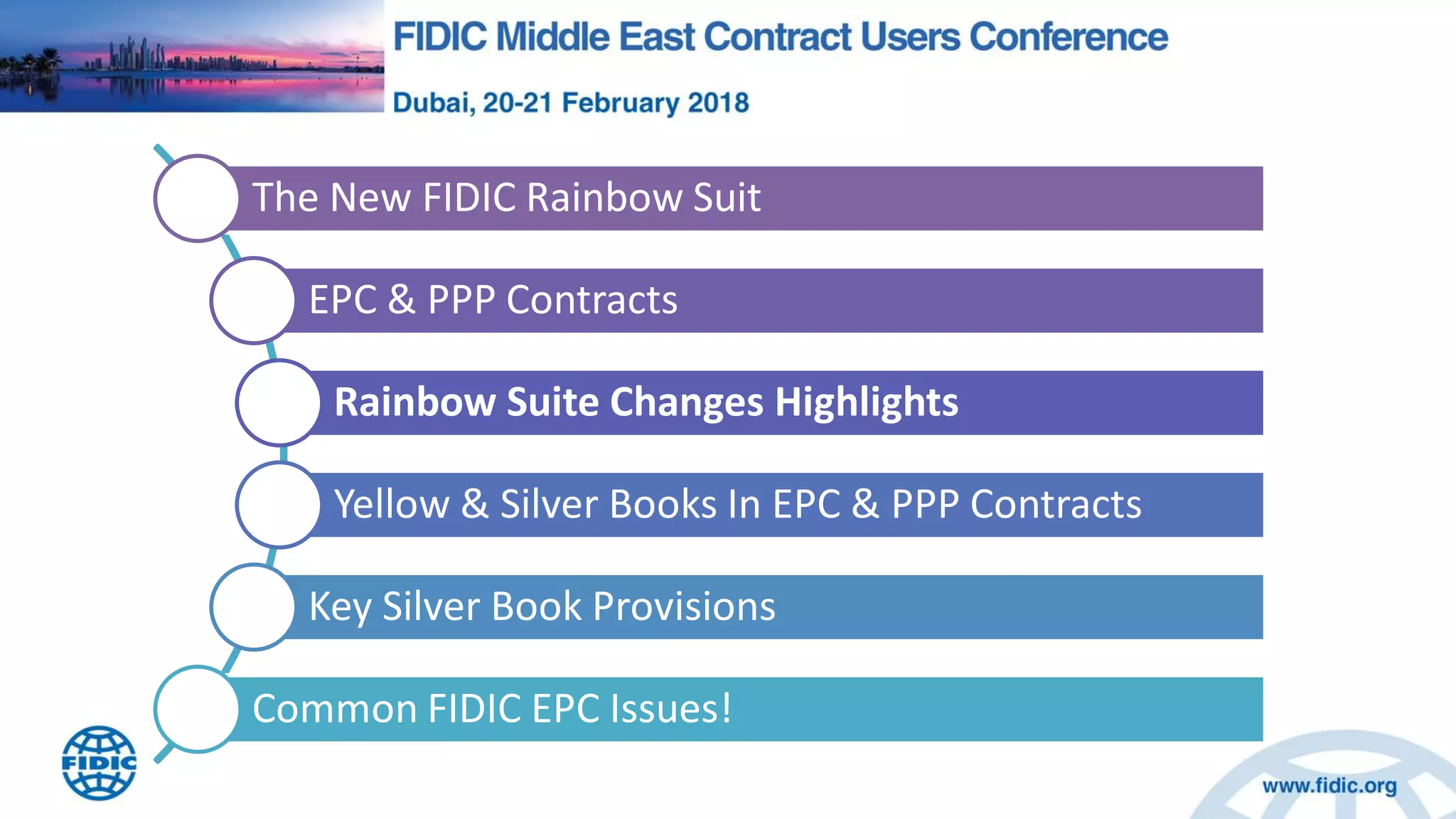
The New FIDIC Rainbow Suit
EPC & PPP Contracts
Rainbow Suite Changes Highlights
Yellow & Silver Books In EPC & PPP Contracts
Key Silver Book Provisions
Common FIDIC EPC Issues!
The New FIDIC Rainbow Suit
“Red, Yellow and Silver”
FIDIC Suite History Preview
 Fédération Internationale Des Ingénieurs-Conseils1 (FIDIC) was founded in Belgium in 1913.
 The first contract, known as the Red Book first edition,2 was actually an authorized reproduction, 're-badged'
by FIDIC, of the ICE (Institution of Civil Engineers) Conditions of Contract fourth edition. Successive
editions of the Red Book were issued in 1969, 1977 and 1988.
 The other long-established FIDIC contract is the Yellow Book, first produced in 1963 with subsequent editions
in 1980 and 1987, which is the design and build equivalent of the employer design Red Book.
 In the mid-1990s, a turnkey contract - the Orange Book – was issued and a task group was set to produce a
major revision of the Red and Yellow Books.
 These events led to the launch in 1999 of the current editions of the principal FIDIC contracts, known
colloquially as the “Rainbow Suite”, from the colors of the covers of the respective Books: “Red, Yellow and
Silver”.
 Also FIDIC issued The White Book: Client/Consultant Model Services Agreement: (4th Ed 2006, updated
2017) and Sub-consultancy Agreement: (1st Ed 1992).
2017 - The Second Edition of the Rainbow Suite
 The Second Edition of the Rainbow Suite is considerably longer, more detailed than the 1999 version,
spanning more than 200 pages each and containing 21 Clauses. For example, the General Conditions of the
Yellow Book have increased from 63 to 106 pages.
 The underlying philosophy is to achieve increased clarity with a number of step-by-step processes and
procedures and makes higher demands on the parties‟ claims and handling and avoidance of disputes.
 The update also addresses issues raised by users over the past 18 years arising out of use of the 1999 Form and
reflects current international best practice.
 A key theme of the Second Edition is the increased emphasis on dispute avoidance by adopting enhanced
project management procedures to promote more effective communication.
 The suit on the other hand seems unnecessarily perspective from a contract management view, with a large
number of cross references and with key changes which both Employer‟s and Contractor‟s need to know and
manage or risk losing entitlements to claims.
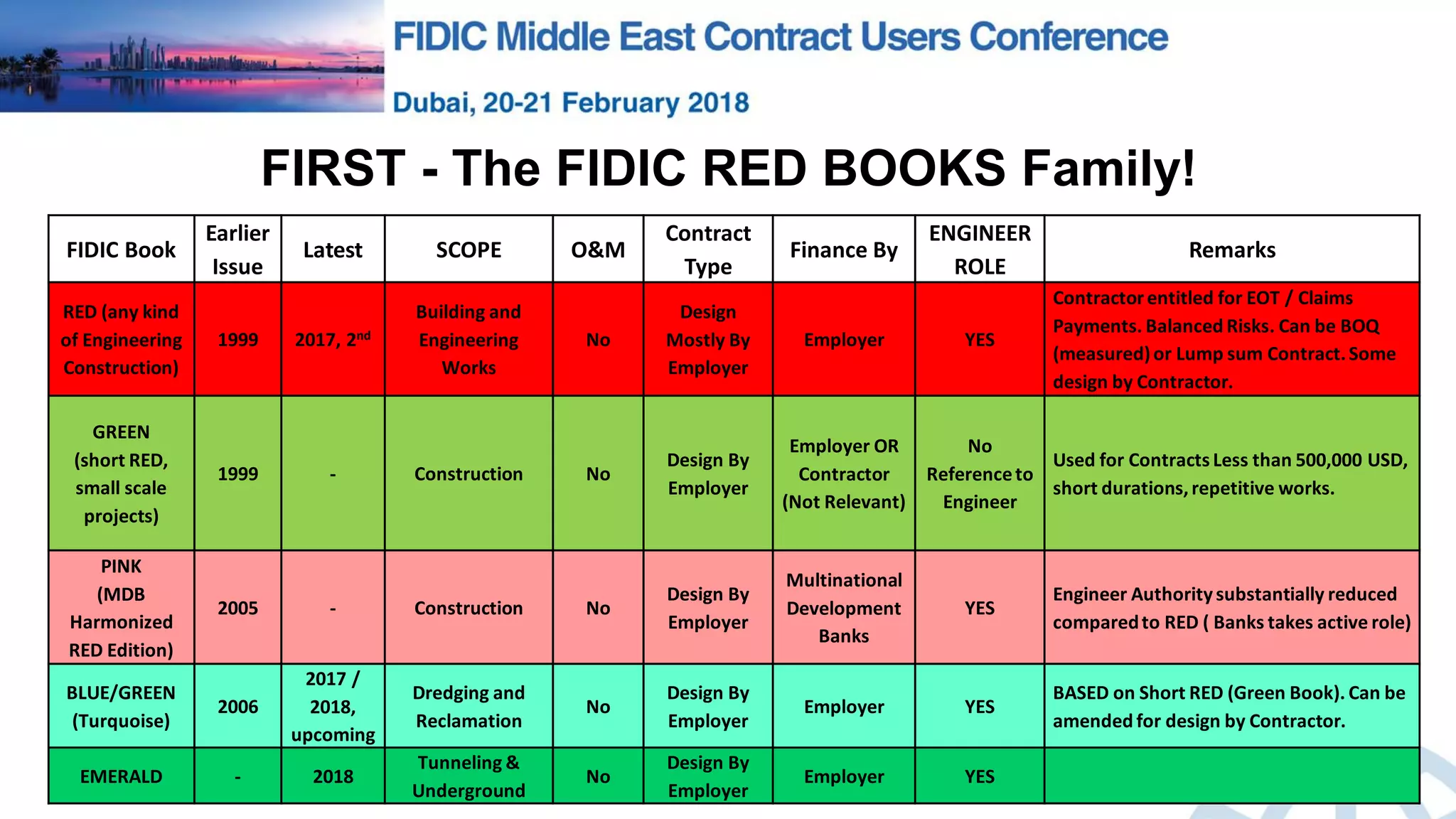
FIRST - The FIDIC RED BOOKS Family!
FIDIC Book
Earlier
Issue
Latest SCOPE O&M
Contract
Type
Finance By
ENGINEER
ROLE
Remarks
RED (any kind
of Engineering
Construction)
1999 2017, 2nd
Building and
Engineering
Works
No
Design
Mostly By
Employer
Employer YES
Contractorentitled for EOT / Claims
Payments. Balanced Risks. Can be BOQ
(measured)or Lump sum Contract.Some
design by Contractor.
GREEN
(short RED,
small scale
projects)
1999 - Construction No
Design By
Employer
Employer OR
Contractor
(Not Relevant)
No
Referenceto
Engineer
Used for ContractsLess than 500,000 USD,
short durations,repetitive works.
PINK
(MDB
Harmonized
RED Edition)
2005 - Construction No
Design By
Employer
Multinational
Development
Banks
YES
Engineer Authoritysubstantially reduced
comparedto RED ( Banks takes active role)
BLUE/GREEN
(Turquoise)
2006
2017 /
2018,
upcoming
Dredging and
Reclamation
No
Design By
Employer
Employer YES
BASED on Short RED (Green Book). Can be
amended for design by Contractor.
EMERALD - 2018
Tunneling &
Underground
No
Design By
Employer
Employer YES
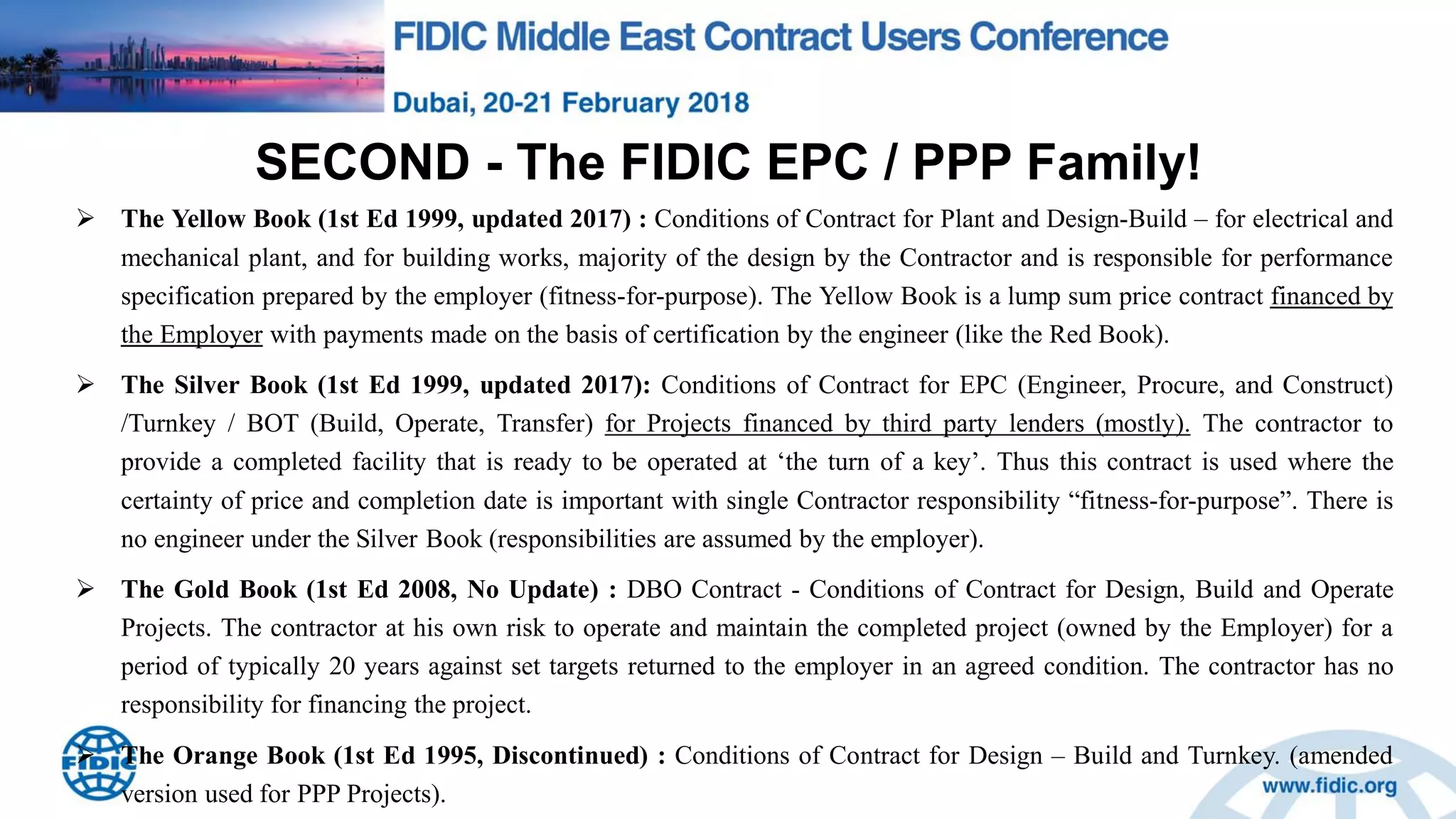
SECOND - The FIDIC EPC / PPP Family!
 The Yellow Book (1st Ed 1999, updated 2017) : Conditions of Contract for Plant and Design-Build – for electrical and
mechanical plant, and for building works, majority of the design by the Contractor and is responsible for performance
specification prepared by the employer (fitness-for-purpose). The Yellow Book is a lump sum price contract financed by
the Employer with payments made on the basis of certification by the engineer (like the Red Book).
 The Silver Book (1st Ed 1999, updated 2017): Conditions of Contract for EPC (Engineer, Procure, and Construct)
/Turnkey / BOT (Build, Operate, Transfer) for Projects financed by third party lenders (mostly). The contractor to
provide a completed facility that is ready to be operated at „the turn of a key‟. Thus this contract is used where the
certainty of price and completion date is important with single Contractor responsibility “fitness-for-purpose”. There is
no engineer under the Silver Book (responsibilities are assumed by the employer).
 The Gold Book (1st Ed 2008, No Update) : DBO Contract - Conditions of Contract for Design, Build and Operate
Projects. The contractor at his own risk to operate and maintain the completed project (owned by the Employer) for a
period of typically 20 years against set targets returned to the employer in an agreed condition. The contractor has no
responsibility for financing the project.
 The Orange Book (1st Ed 1995, Discontinued) : Conditions of Contract for Design – Build and Turnkey. (amended
version used for PPP Projects).
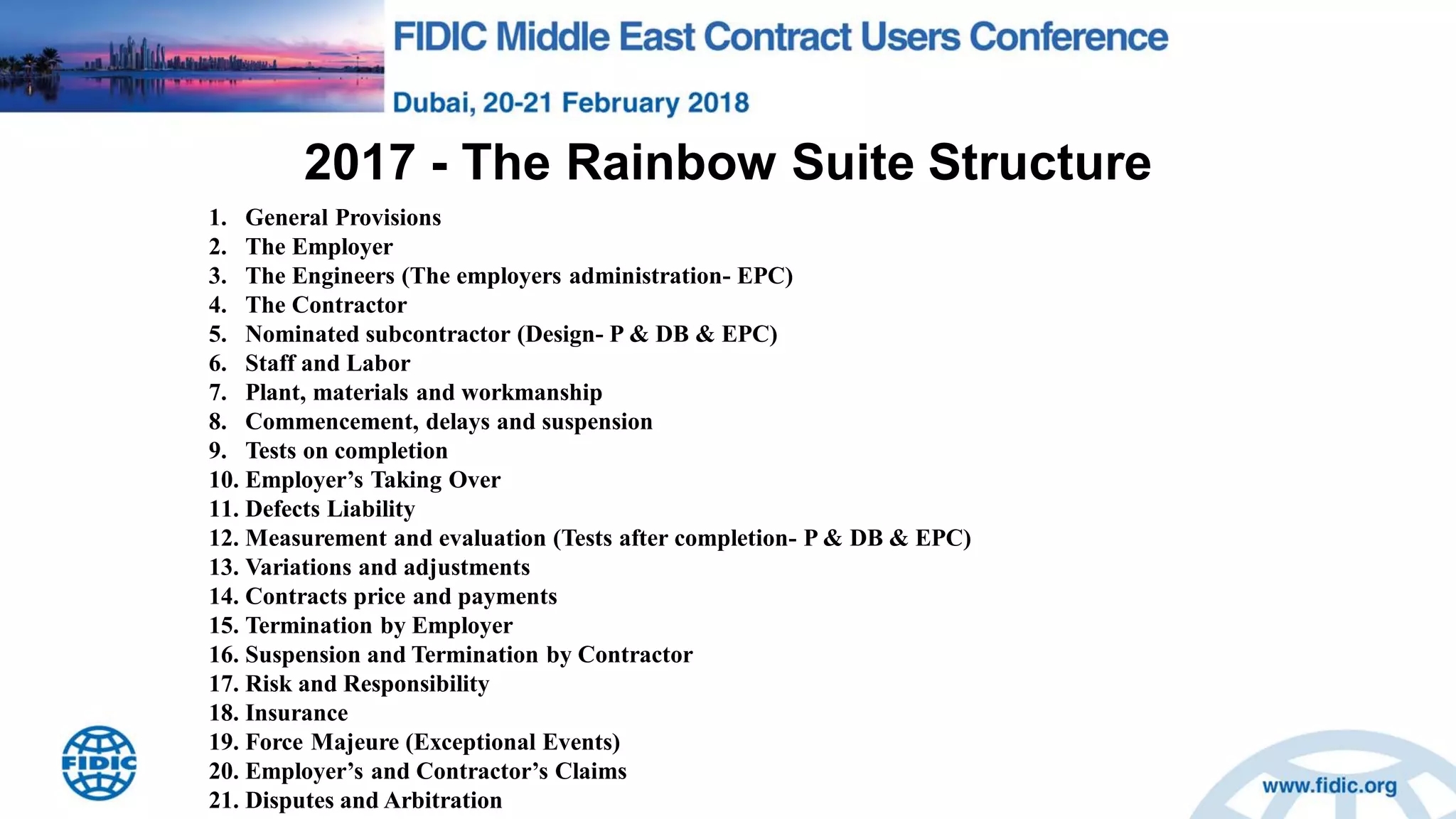
2017 - The Rainbow Suite Structure
1. General Provisions
2. The Employer
3. The Engineers (The employers administration- EPC)
4. The Contractor
5. Nominated subcontractor (Design- P & DB & EPC)
6. Staff and Labor
7. Plant, materials and workmanship
8. Commencement, delays and suspension
9. Tests on completion
10. Employer‟s Taking Over
11. Defects Liability
12. Measurement and evaluation (Tests after completion- P & DB & EPC)
13. Variations and adjustments
14. Contracts price and payments
15. Termination by Employer
16. Suspension and Termination by Contractor
17. Risk and Responsibility
18. Insurance
19. Force Majeure (Exceptional Events)
20. Employer‟s and Contractor‟s Claims
21. Disputes and Arbitration
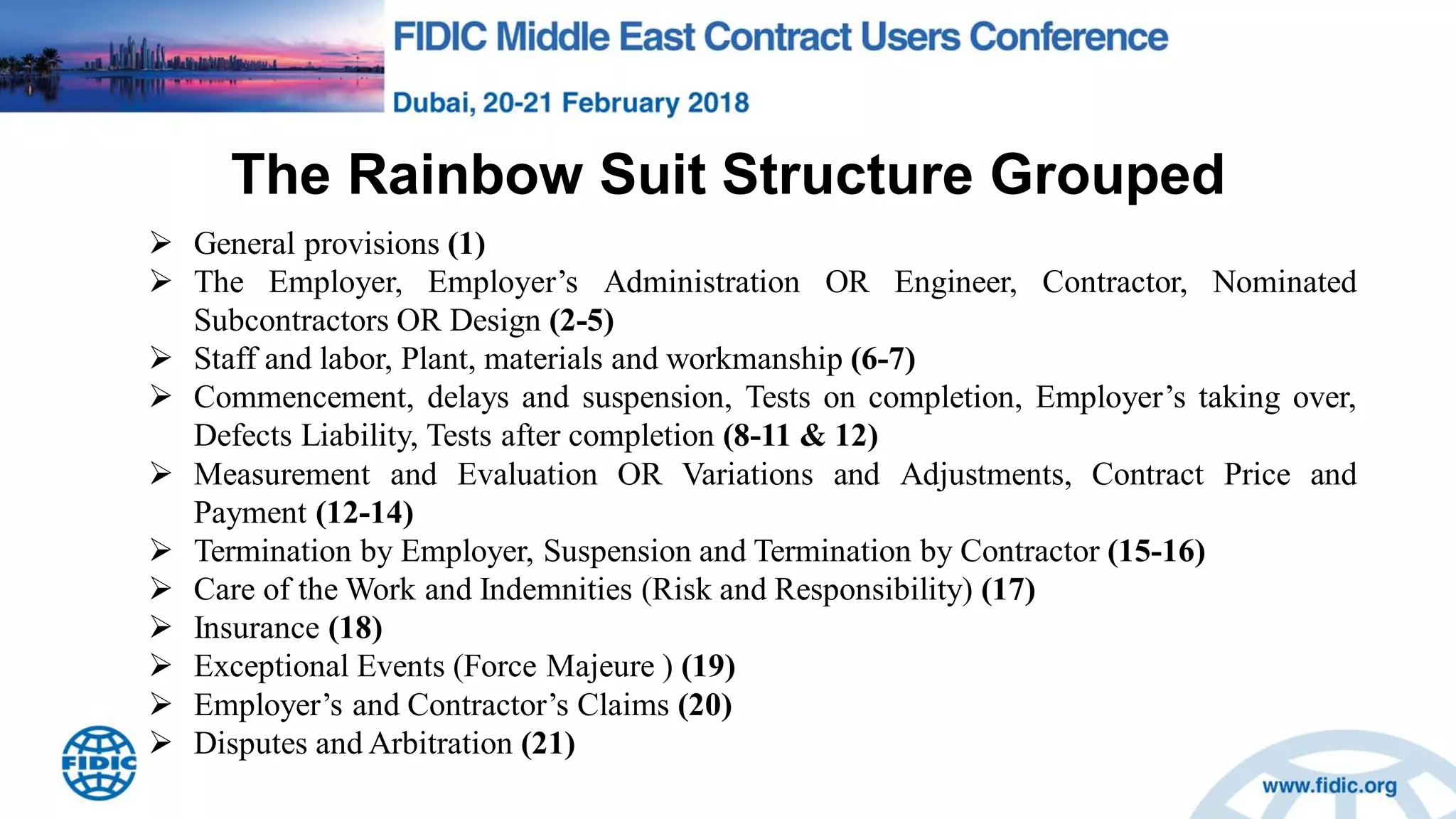
The Rainbow Suit Structure Grouped
 General provisions (1)
 The Employer, Employer‟s Administration OR Engineer, Contractor, Nominated
Subcontractors OR Design (2-5)
 Staff and labor, Plant, materials and workmanship (6-7)
 Commencement, delays and suspension, Tests on completion, Employer‟s taking over,
Defects Liability, Tests after completion (8-11 & 12)
 Measurement and Evaluation OR Variations and Adjustments, Contract Price and
Payment (12-14)
 Termination by Employer, Suspension and Termination by Contractor (15-16)
 Care of the Work and Indemnities (Risk and Responsibility) (17)
 Insurance (18)
 Exceptional Events (Force Majeure ) (19)
 Employer‟s and Contractor‟s Claims (20)
 Disputes and Arbitration (21)
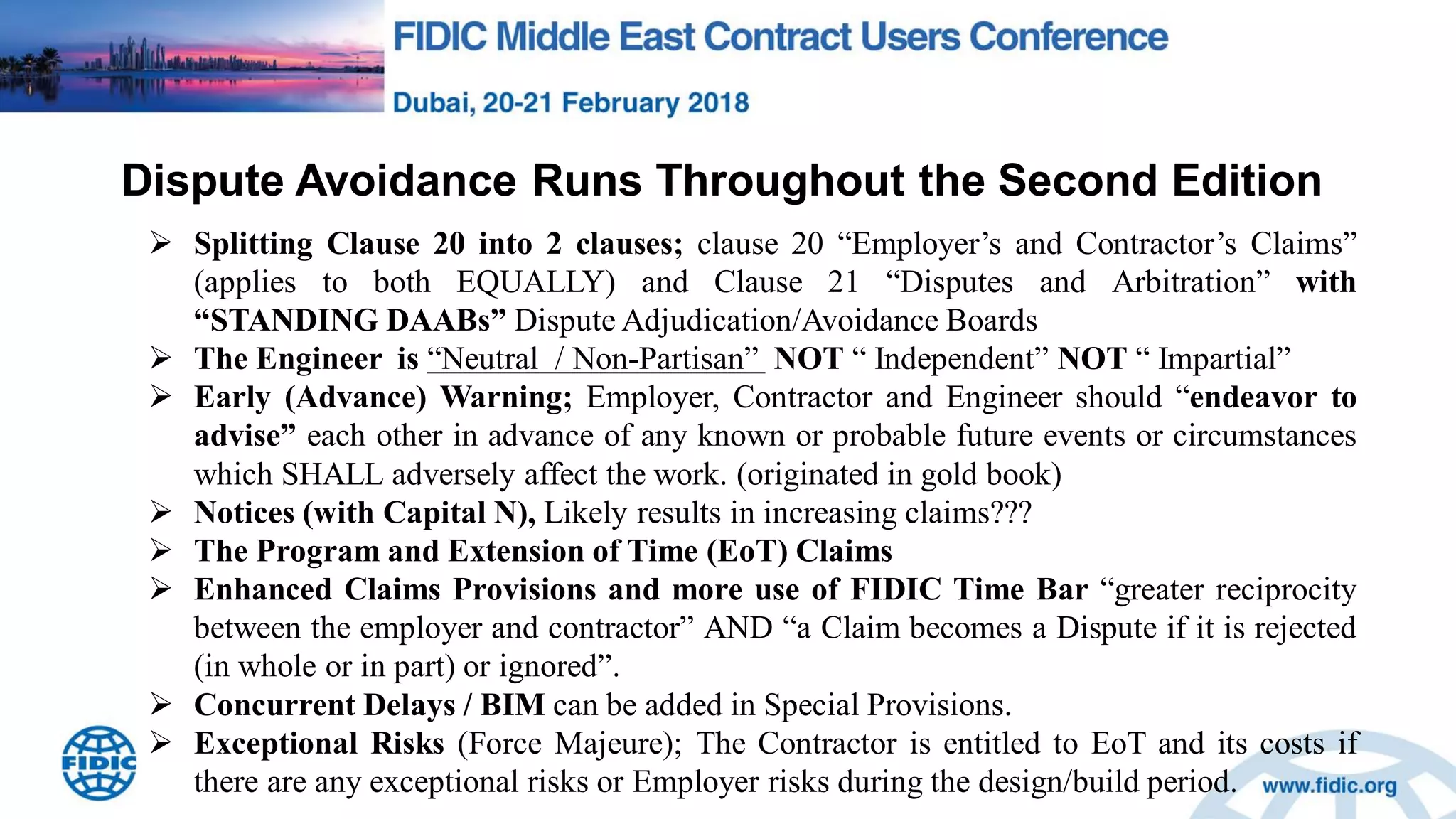
Dispute Avoidance Runs Throughout the Second Edition
 Splitting Clause 20 into 2 clauses; clause 20 “Employer‟s and Contractor‟s Claims”
(applies to both EQUALLY) and Clause 21 “Disputes and Arbitration” with
“STANDING DAABs” Dispute Adjudication/Avoidance Boards
 The Engineer is “Neutral / Non-Partisan” NOT “ Independent” NOT “ Impartial”
 Early (Advance) Warning; Employer, Contractor and Engineer should “endeavor to
advise” each other in advance of any known or probable future events or circumstances
which SHALL adversely affect the work. (originated in gold book)
 Notices (with Capital N), Likely results in increasing claims???
 The Program and Extension of Time (EoT) Claims
 Enhanced Claims Provisions and more use of FIDIC Time Bar “greater reciprocity
between the employer and contractor” AND “a Claim becomes a Dispute if it is rejected
(in whole or in part) or ignored”.
 Concurrent Delays / BIM can be added in Special Provisions.
 Exceptional Risks (Force Majeure); The Contractor is entitled to EoT and its costs if
there are any exceptional risks or Employer risks during the design/build period.
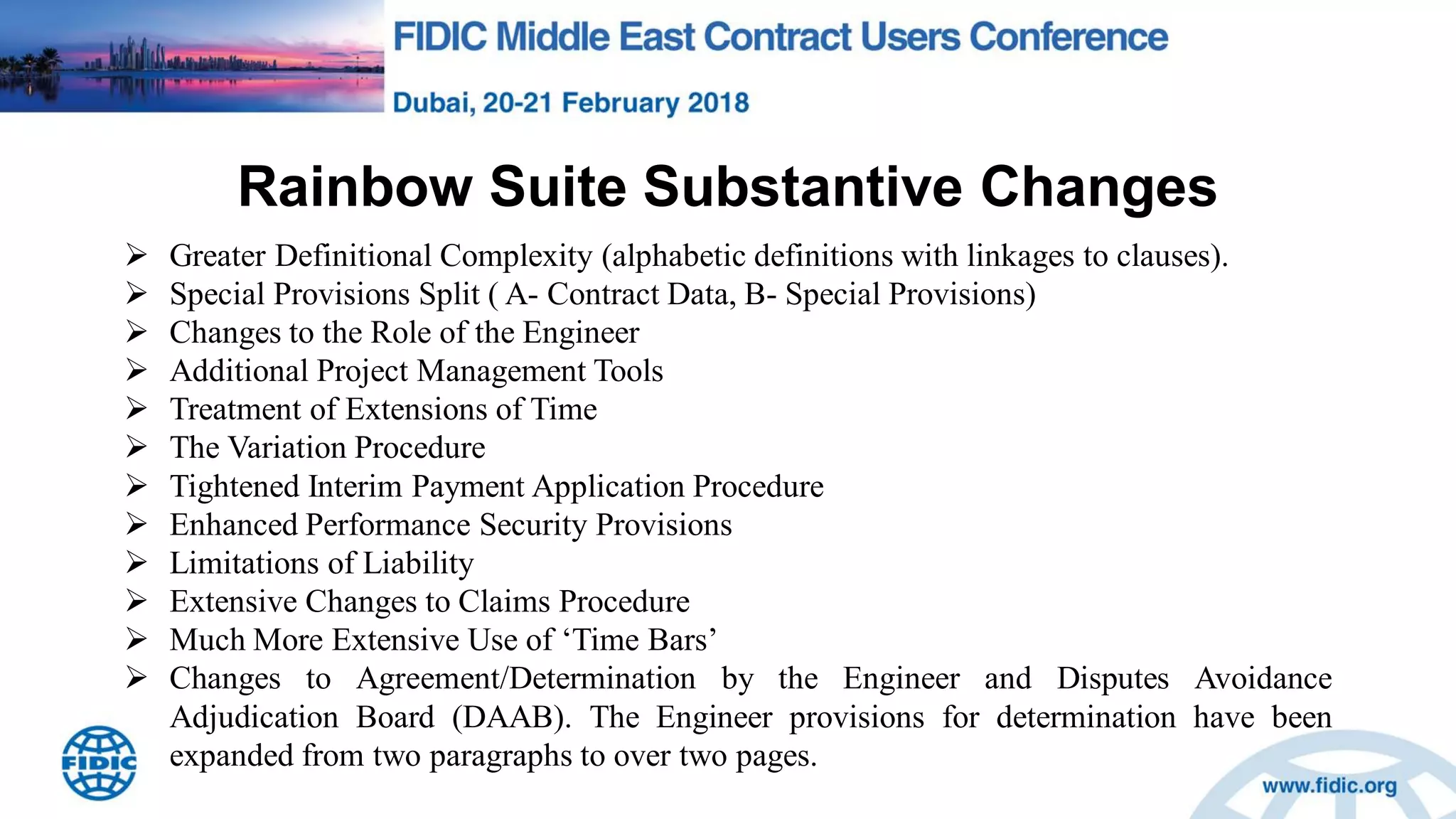
Rainbow Suite Substantive Changes
 Greater Definitional Complexity (alphabetic definitions with linkages to clauses).
 Special Provisions Split ( A- Contract Data, B- Special Provisions)
 Changes to the Role of the Engineer
 Additional Project Management Tools
 Treatment of Extensions of Time
 The Variation Procedure
 Tightened Interim Payment Application Procedure
 Enhanced Performance Security Provisions
 Limitations of Liability
 Extensive Changes to Claims Procedure
 Much More Extensive Use of „Time Bars‟
 Changes to Agreement/Determination by the Engineer and Disputes Avoidance
Adjudication Board (DAAB). The Engineer provisions for determination have been
expanded from two paragraphs to over two pages.
Rainbow Suite Changes Highlights
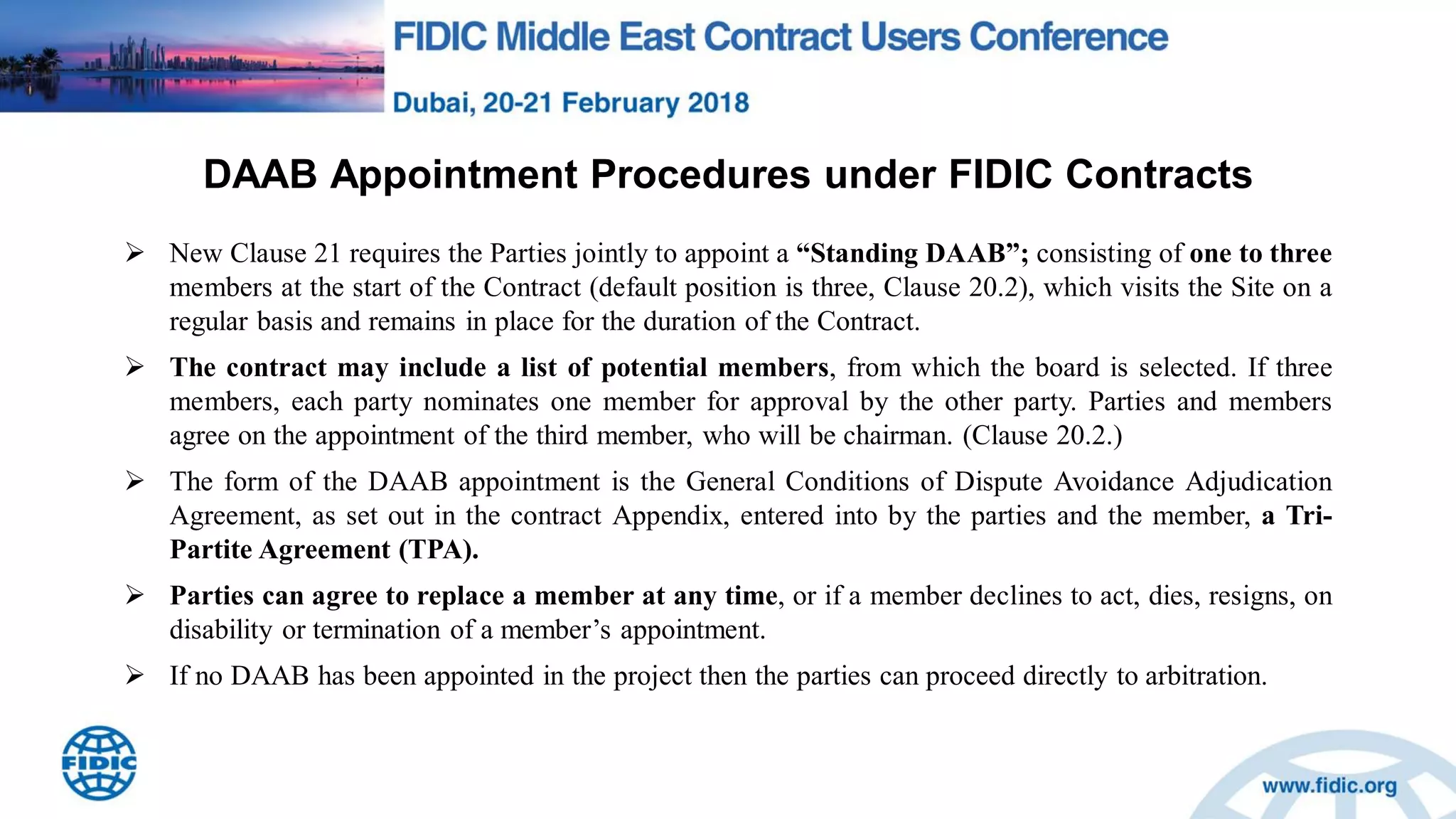
DAAB Appointment Procedures under FIDIC Contracts
 New Clause 21 requires the Parties jointly to appoint a “Standing DAAB”; consisting of one to three
members at the start of the Contract (default position is three, Clause 20.2), which visits the Site on a
regular basis and remains in place for the duration of the Contract.
 The contract may include a list of potential members, from which the board is selected. If three
members, each party nominates one member for approval by the other party. Parties and members
agree on the appointment of the third member, who will be chairman. (Clause 20.2.)
 The form of the DAAB appointment is the General Conditions of Dispute Avoidance Adjudication
Agreement, as set out in the contract Appendix, entered into by the parties and the member, a Tri-
Partite Agreement (TPA).
 Parties can agree to replace a member at any time, or if a member declines to act, dies, resigns, on
disability or termination of a member‟s appointment.
 If no DAAB has been appointed in the project then the parties can proceed directly to arbitration.
Dispute Avoidance / Adjudication Boards (“DAABs”)
 The DAAB has the power to invite the Parties to make such a referral if it becomes aware of any such issue
or disagreement. Also the Parties may: “Jointly request (with a copy to the Engineer) DAAB to provide
assistance and/or informally discuss and attempt to resolve any issue or disagreement”.
 The DAB must issue its decision within 84 days of a dispute being referred. If a Party is dissatisfied with a
DAAB Decision then within 28 days of the Decision they must issue a Notice of Dissatisfaction (NoD).
 The Parties and Engineer must comply with the DAAB's decision whether or not they served a Notice of
Dissatisfaction (Clause 20.4.); however, where a Party serves a NoD this makes DAAB Decision non-final.
[FIDIC recommends the Parties consider agreeing a longer time than the 28 day stated in Sub-Clause 21.5]
 If no NoD is served, DAAB decision is final and binding, any dispute shall be finally settled by the Rules of
Arbitration of the International Chamber of Commerce (ICC Arbitration).
 Under the new provisions if no arbitration is commenced within 182 days then the NoD will be deemed to
have lapsed and no longer valid.
[NOTE; The 1999 Edition prevented Parties for 56 days from starting arbitration ,this time period has been reduced to 28 days
and does not apply if a Party fails to comply with a DAAB Decision as they can proceed immediately to arbitration, however,
obliging parties to commence arbitral proceedings while the works are still progressing may seem odd.]
Changing the Role of the Engineer – “Neutral” Determination
 The engineer is a key person in the FIDIC Yellow and Red Books (FIDIC Silver Book has
“Employer‟s Representative”). The engineer inspects, certifies, instructs, assesses, approves,
mediates, makes decisions, etc. Also there is a new role for “Engineer‟s Representative” on site.
 The new sub-clause 3.7 imposes a positive obligation on the Engineer to act “neutrally” and is not
required to obtain the Employer‟s consent or act for the Employer. Further, the Engineer is to
encourage discussions between the Parties to reach agreement (42 days). A failure to achieve
agreement within this 42 day period gives the Engineer a further 42 days to make a determination.
 "The Engineer shall make a fair determination in accordance with the Contract, taking due regard of
all relevant circumstances" . Failure to determine within the 84 days is deemed a rejection.
 If either party disagrees with the Engineer‟s determination (regarding a claim for an extension of
time/payment or an „other claim‟), it is, within 28 days, entitled to issue a Notice of Dissatisfaction
(“NOD”) to the other party (with a copy to the Engineer) referring to the DAAB under Clause 21.
 Failure to comply with the 28 days time period means that the dispute is final and binding on the
parties, however, the Engineer‟s determination shall remain binding on the parties until the DAAB
process has commenced.
Engineer Time Bar Waiver Authority
 The time bars and preliminary notice provisions (but not „other claims‟), are subject to a new Sub-
Clause 20.3, “Waiver of Time-limits, which only applies if a Notice have been given to the Engineer.
 If the deadlines are not met, the right to enforce the claim will generally be forfeited. However,
the 2017 edition contains provisions in respect of the engineer nevertheless determining the (late)
claim and which circumstances may be taken into account in such respect.
 The new sub-clause 20.2.5 does provide the Engineer with the power to waive a failure to follow a
time bar requirement. The Engineer can take the following into account:
 Whether the other Party would be prejudiced by acceptance of the late submission; and
 Whether the other Party had prior knowledge of the event in question or basis of claim.
 The engineer shall make a determination of the matter or claim pursuant to sub-clause 3.7.
Early Warning
 A new sub-clause 8.4 which follows the lead given by the 2008 Gold Book adds the concept of
advance warning of a potential problem.
 Sub-Clause 8.3 of the „old‟ Yellow, Red and Silver Books required only the Contractor to give
advance warnings, now it says the Employer, Contractor and Engineer should “endeavor to
advise” each other in advance of any known or probable future events or circumstances which
SHALL adversely affect the work.
 As part of the consultations following any advance warning given under sub-cause 8.4, the Contractor
may need to update the program and provide proposals to overcome the effects of any delays.
 The purpose of the early warning is not to decide who is responsible for the foreseeable problem, but
rather to determine how the parties can work together to resolve the issue and avoid a claim.
 Upon receipt of an advance warning, the Engineer may instruct the Contractor to submit a proposal to
avoid or mitigate the effects of the event in question and this may give rise to a variation.
 The FIDIC provision stops short of specifying sanction for failure to give advance warning.
Notices & Variations
 A greater degree of clarity has been added to the variation procedure set out in Sub-Clause 13.3 and the
clause has been expanded considerably (it now runs to almost two pages).
 In addition to the Engineer being able to request a proposal prior to instructing a Variation, an instructed
Variation must be by way of a Notice (with a capital „N‟).
 The Notice must „describe itself‟ as a notice and be issued in accordance with Sub-Clause 1.3 (Notices
and other communications) including a requirement to refer to the relevant Sub-Clause under which it is
issued. The intention is to avoid uncertainty as to whether a particular communication is intended to be a
Variation instruction.
 If the Contractor believes that an instruction constitutes a variation then the new Clause 3.5 allows the
Contractor to issue a Notice to the Engineer that the instruction is a variation “immediately and before
commencing any work related to the instruction”. However the clause (new 3.5) does not go on to
explain what happens if the contractor fails to give a notice.
Enhanced Claims Provisions
 The Sub-Clause dealing with Employer Claims in the 1st edition has been deleted in its entirety and individual
claim clause provisions for Employer (former Sub-Clause 2.5) and Contractor (former Sub-Clause 20.1), have
now been merged together within Sub-Clauses 20.1 and 20.2.
 Sub-clause 20.2.3 imposes a new express obligation on the claiming party to “keep such contemporaneous
records as may be necessary to substantiate the Claim”. The sub-clause also entitles the Engineer to
monitor the Contractor‟s record keeping and to even instruct the Contractor to keep additional records (but
does not extend to the Employer‟s records).
 Under sub-clause 20.2.4, one must provide a statement of the contractual or legal basis of the claim within 84
days. [after the claiming party becomes aware, or ought to have become aware of the event or circumstance
giving rise to the claim, or “such other period (if any) as may be proposed by the claiming party and agreed by
the Engineer”].
 For other Claims (e.g. a party‟s failure to assist in obtaining permits); Sub-Clause 20.1 provides that if
either party considers that it has a claim which relates to any matter other than to payment or extension of
time, the claiming party shall notify the Engineer of the claim “as soon as practicable after the claiming
Party becomes aware of the other Party‟s disagreement with the requested entitlement”.
 Sub-Clause 20.2.2 sets out that the Engineer has a positive duty within 14 days of receipt of the notice of
claim to give a preliminary response if he considers that the initial notice of claim is not time barred. For other
claims a decision shall be given “as soon as practicable”.
The Program and Extension of Time (EoT) Claims
 The program provisions of the contract have been extensively re-written and amplified in a new
clause 8.3. There are deemed notices of no objection within 21 days/14 days of receipt of the
contractor‟s program although FIDIC has retained the stand that the program does not become a
contract document.
 There is also a positive obligation on the Contractor to update the program whenever it ceases to
reflect actual progress, sub-clause 8.3 (k)(v).
 New sub-clause 8.5 references concurrent delay saying that if a delay is caused by the Employer is
concurrent with a Contractor delay, then the entitlement to an extension of time shall be assessed “in
accordance with the rules and procedures stated in the Special Provisions”.
 Time extension for weather (in yellow book) has been tightened so that it is limited to unforeseeable
climatic conditions at the site.
 The extension of time provisions have also been amended with regard to delays by authorities to
include a reference to delay by private utility entities.

Contract Price Payment
 There has been a departure from the earlier “reasonable profit” position (for example
within the Variation procedure, Sub-Clause 13.3 1st edition) by way of the insertion of a
newly constituted definition, Cost Plus Profit.
 This is defined to mean Cost plus the applicable percentage for profit stated in the
Contract Data, which is to be 5% if not otherwise stated.
 New provisions at clause 13.4 amplify the arrangements for agreement of provisional
sums by reference to quotations.
 Adjustments to the Contract Price by reference to changes in the law (13.6) have been
amplified to reference not merely legislative action but also permits, permission licenses
and approvals.
 The contract now references a Schedule of Rates for valuing variations.
Interim Payment Certificates (IPC‟s)
 Clause 14.6 has been amended to indicate that the value will be the amount the Engineer
fairly “considers” to be due and that the Engineer may withhold an amount if he
considers that there is a “significant error or discrepancy” in the statement. The Engineer
must “detail his calculations” of the amount withheld and state the “reasons for it being
withheld”.
 The clause now includes an additional provision (clause 14.6.3) for both the Engineer
and the contractor to correct and/or modify IPCs.
 Clause 14.6.3 says the contractor should highlight “identified amounts” that are disputed
in IPCs. These may be referred for determination by the Engineer under clause 3.7 where
appropriate where the identified amounts exceed 5% of the accepted contract amount.
Defects
 The defects liability is generally maintained but with slight changes in the 2017 edition. It appears now
from sub-clause 11.4 that the employer may fix a date on or by which the contractor must remedy defects if
the contractor‟s remedial work is “unduly delayed”, whereas the criterion in the 1999 edition was “fails to
remedy within reasonable time”. (There are references in sub-clause 11.1 to sub-clause 7.5).
 Sub-clause 11.7 (“Right of Access after Taking Over”) introduces a procedure for the contractor‟s access to
the works to remedy defects: the contractor must request access on a certain, preferred date, and the
employer must respond within 7 days by either stating its consent or by proposing a new date.
 Only if the contractor incurs additional costs as a result of any "unreasonable delay” by the employer in
permitting access to the works, the contractor will be entitled to payment of such costs especially if the
contractor has provided an uptime or availability guarantee or is liable for production losses in general.
 FIDIC has suggested that if the Employer wishes to have certain parts of the Works completed by certain
times but does not wish to take over those parts of the Works when they are completed, such parts ought to
be described in the Specification as "Milestones".
 In such circumstances, FIDIC recommends that alternative provisions be added that would entitle the
Employer to Delay Damages if the Contractor fails to complete the works of the Milestone within the time
for completion of the Milestone subject to any extension of time.
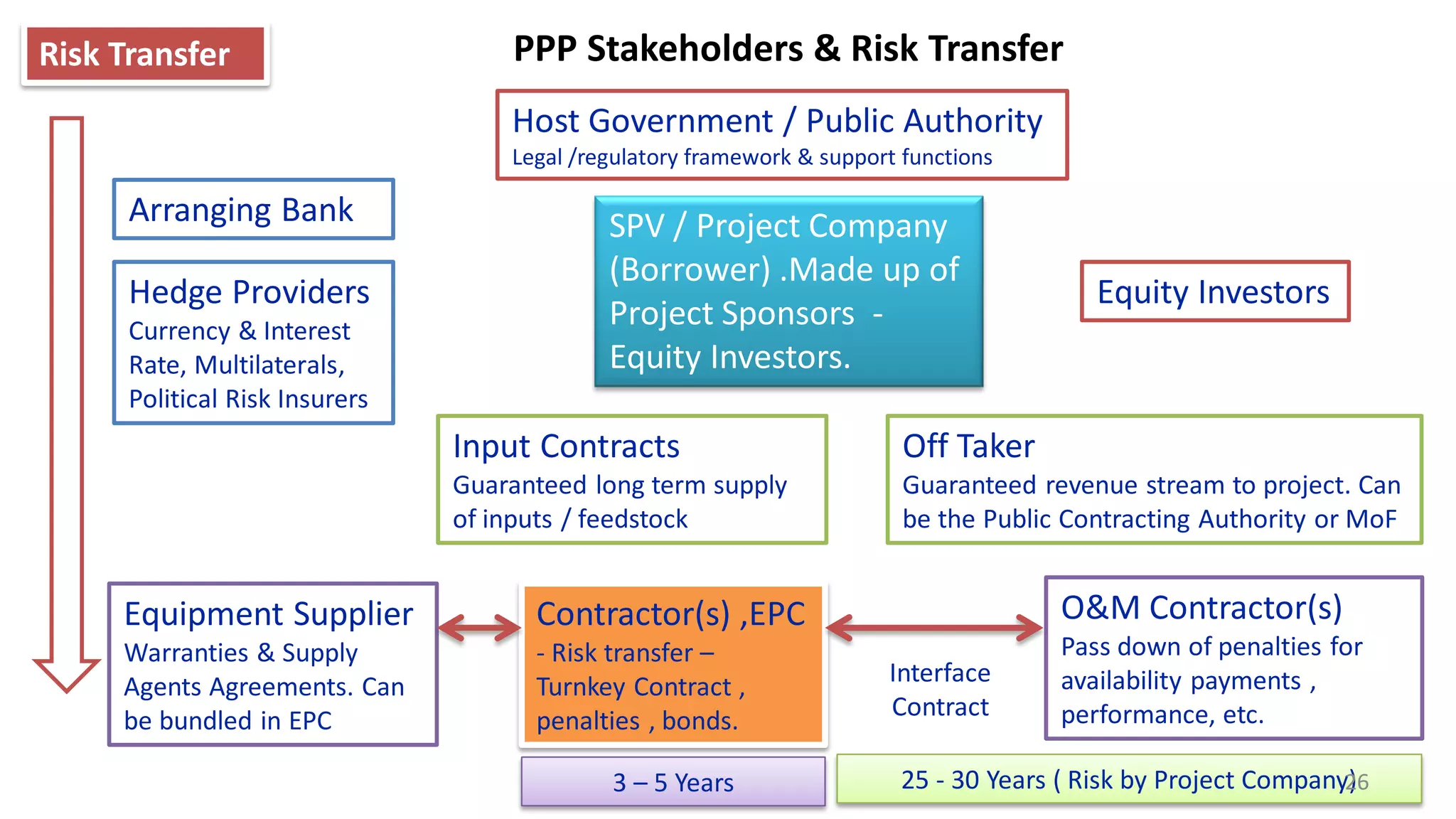
EPC & PPP Contracts
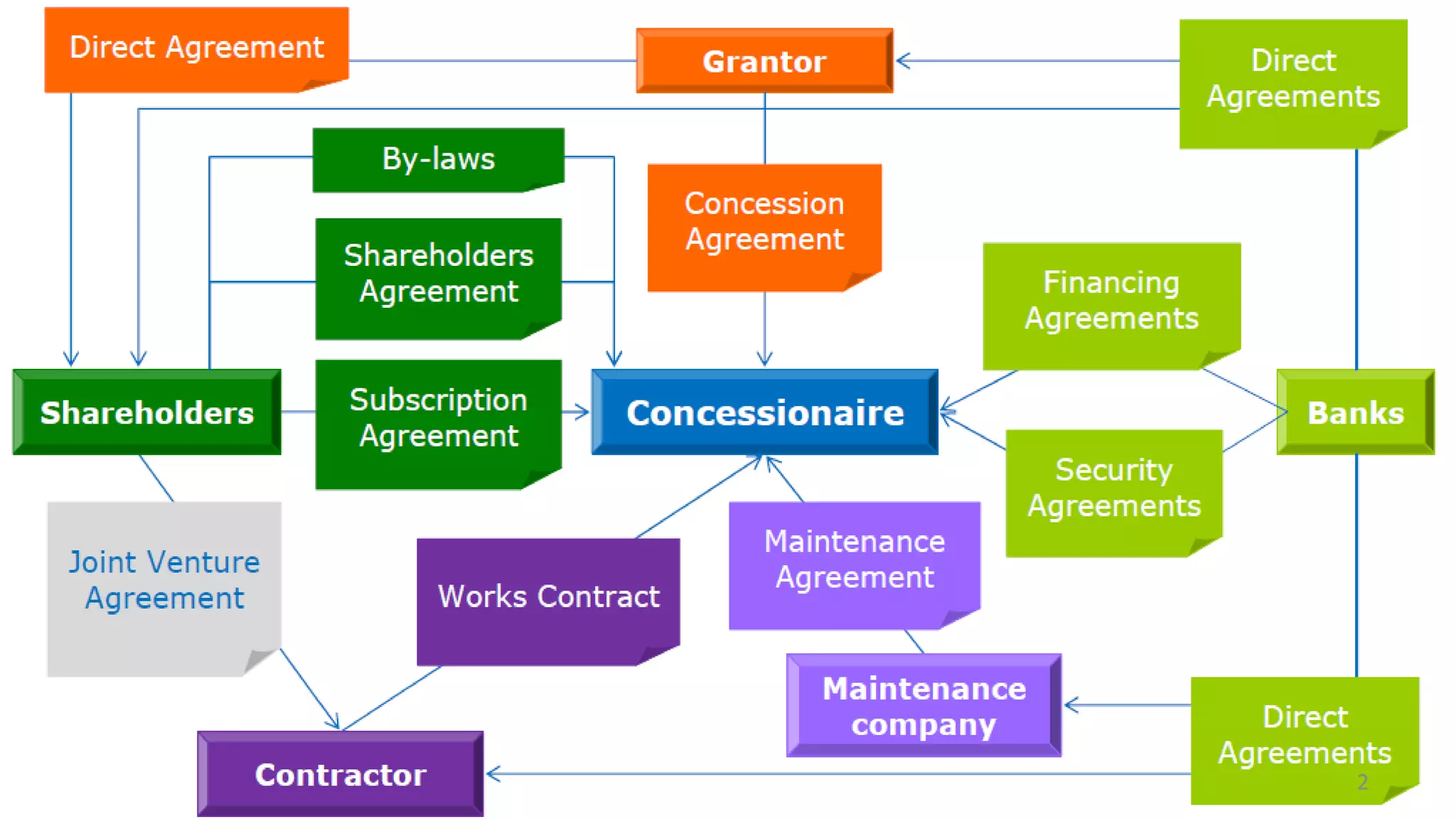
Input Contracts
Guaranteed long term supply
of inputs / feedstock
SPV / Project Company
(Borrower) .Made up of
Project Sponsors -
Equity Investors.
Off Taker
Guaranteed revenue stream to project. Can
be the Public Contracting Authority or MoF
Contractor(s) ,EPC
- Risk transfer –
Turnkey Contract ,
penalties , bonds.
O&M Contractor(s)
Pass down of penalties for
availability payments ,
performance, etc.
Host Government / Public Authority
Legal /regulatory framework & support functions
PPP Stakeholders & Risk Transfer
Interface
Contract
Risk Transfer
3 – 5 Years 25 - 30 Years ( Risk by Project Company)
Equipment Supplier
Warranties & Supply
Agents Agreements. Can
be bundled in EPC
Arranging Bank
Hedge Providers
Currency & Interest
Rate, Multilaterals,
Political Risk Insurers
Equity Investors
26
EPC & PPP Contracts
Engineering, procurement and construction (EPC) contracts are most common form of contract
used in major international infrastructure projects.
There is a D&C Contract embedded in every PPP - BOOT, BOT contract. Construction phase of a
PPP likely to be delivered via design-build EPC agreement. EPC Contractors obligations typically
include:
 A complete facility which must perform to a specified level
 For a guaranteed price determined based on the 'lump-sum' principle
 By a guaranteed date
Because EPC Contracts involve Contractor taking a high level of risk they involve high
insurance costs.
EPC / PPP Contract Advantages & Disadvantages
Advantages
 Bankable, but with many debt covenant provisions.
 Near Delivery Certainty
 “Turnkey” responsibility on the EPC Contractor
Disadvantages
 Higher Contract price than alternative structures due to more risk allocation to
Contractor (built-in Contractor contingencies)
 Limited scope for Project Sponsor to intervene if problems arise during construction
 Not many players
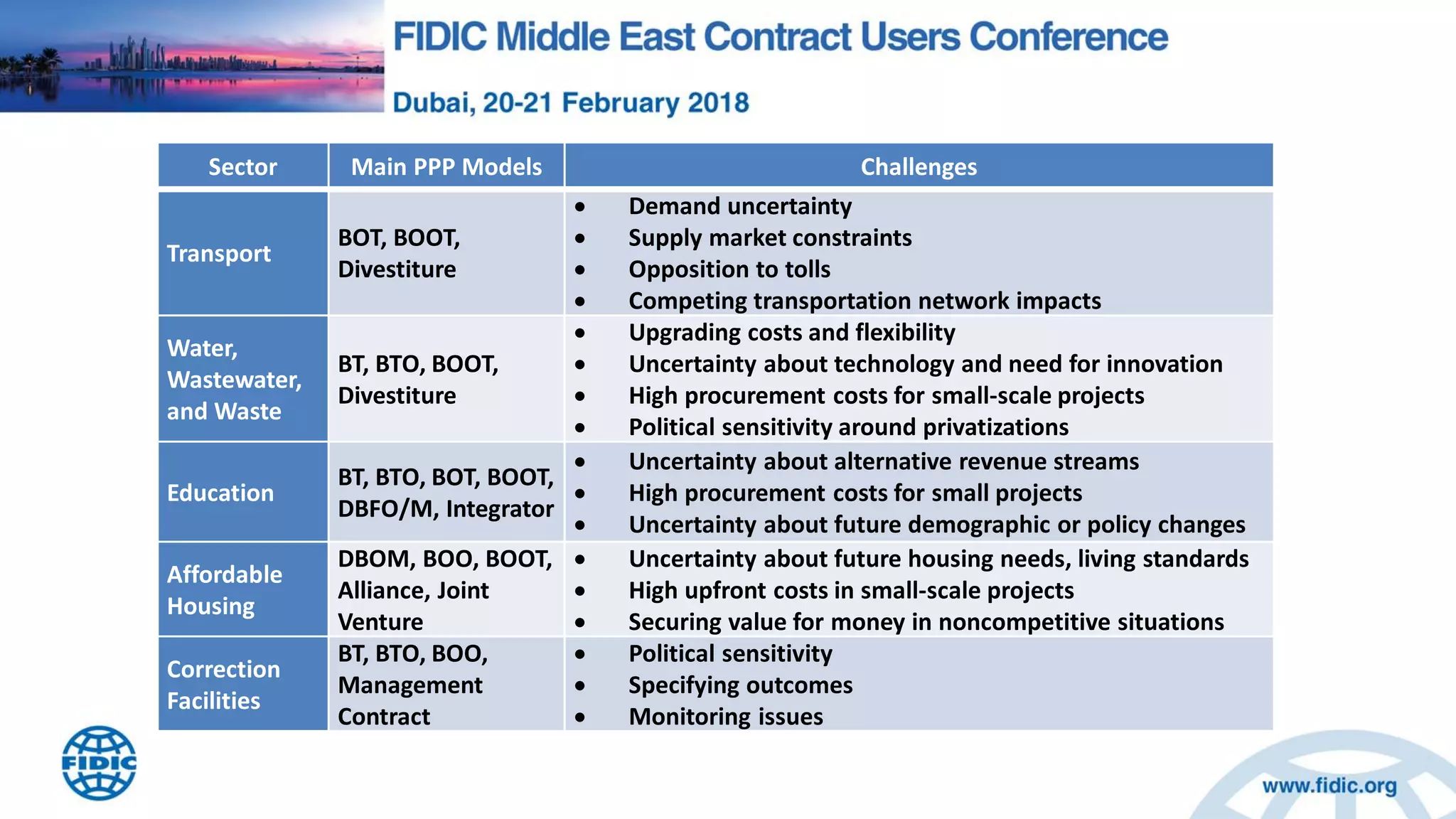
Sector Main PPP Models Challenges
Transport
BOT, BOOT,
Divestiture
 Demand uncertainty
 Supply market constraints
 Opposition to tolls
 Competing transportation network impacts
Water,
Wastewater,
and Waste
BT, BTO, BOOT,
Divestiture
 Upgrading costs and flexibility
 Uncertainty about technology and need for innovation
 High procurement costs for small-scale projects
 Political sensitivity around privatizations
Education
BT, BTO, BOT, BOOT,
DBFO/M, Integrator
 Uncertainty about alternative revenue streams
 High procurement costs for small projects
 Uncertainty about future demographic or policy changes
Affordable
Housing
DBOM, BOO, BOOT,
Alliance, Joint
Venture
 Uncertainty about future housing needs, living standards
 High upfront costs in small-scale projects
 Securing value for money in noncompetitive situations
Correction
Facilities
BT, BTO, BOO,
Management
Contract
 Political sensitivity
 Specifying outcomes
 Monitoring issues
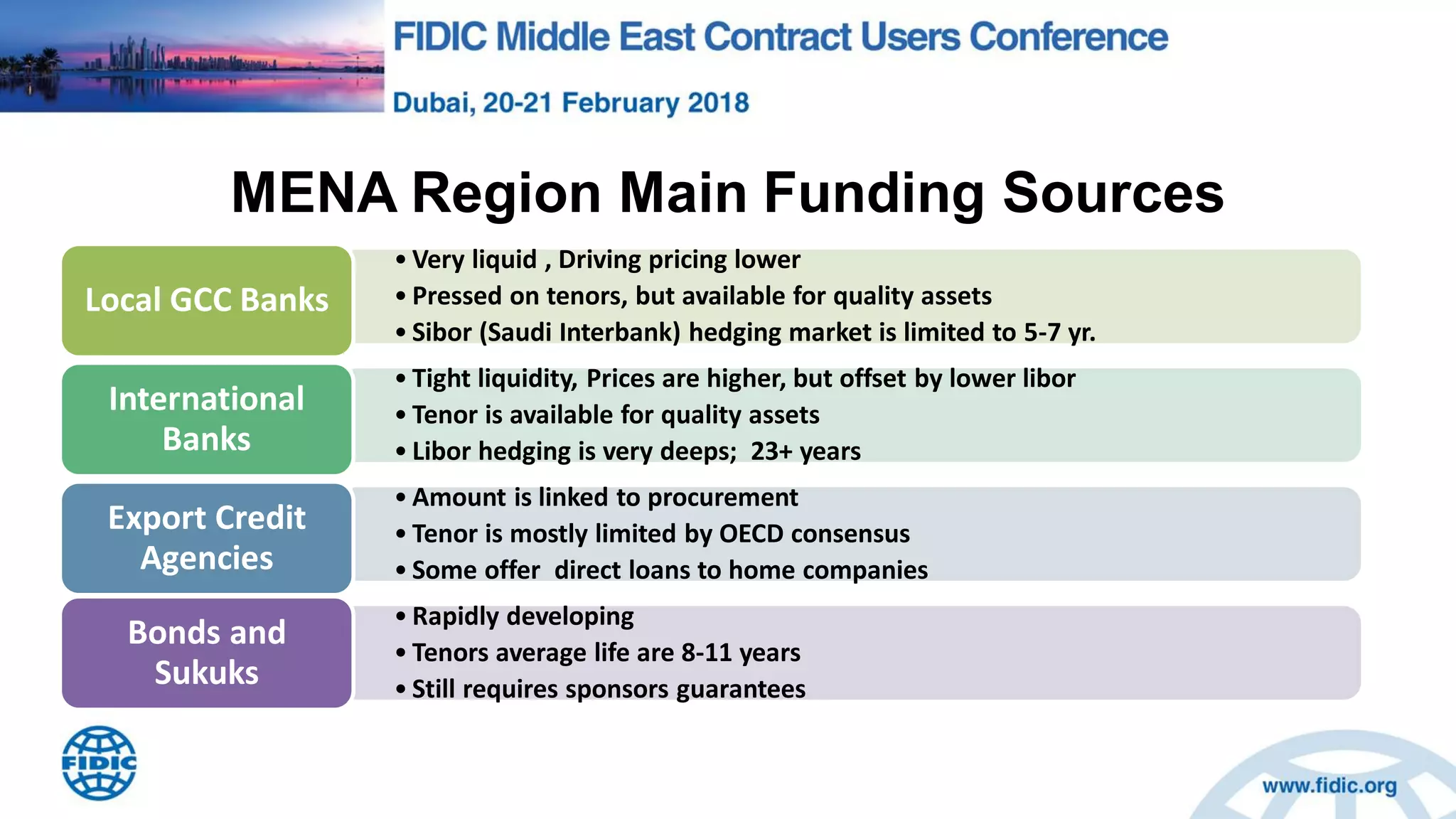
MENA Region Main Funding Sources
• Very liquid , Driving pricing lower
• Pressed on tenors, but available for quality assets
• Sibor (Saudi Interbank) hedging market is limited to 5-7 yr.
Local GCC Banks
• Tight liquidity, Prices are higher, but offset by lower libor
• Tenor is available for quality assets
• Libor hedging is very deeps; 23+ years
International
Banks
• Amount is linked to procurement
• Tenor is mostly limited by OECD consensus
• Some offer direct loans to home companies
Export Credit
Agencies
• Rapidly developing
• Tenors average life are 8-11 years
• Still requires sponsors guarantees
Bonds and
Sukuks
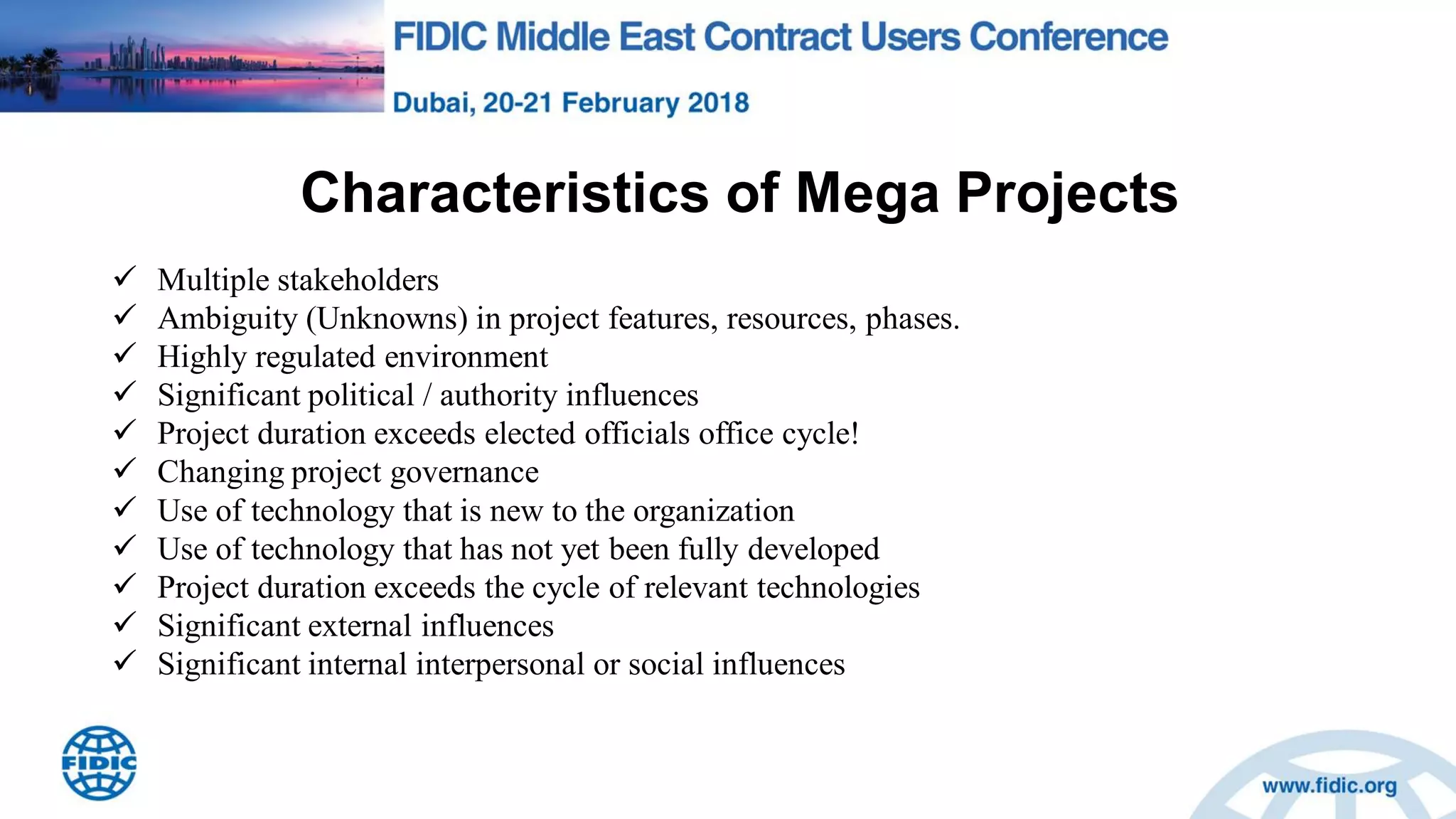
Characteristics of Mega Projects
 Multiple stakeholders
 Ambiguity (Unknowns) in project features, resources, phases.
 Highly regulated environment
 Significant political / authority influences
 Project duration exceeds elected officials office cycle!
 Changing project governance
 Use of technology that is new to the organization
 Use of technology that has not yet been fully developed
 Project duration exceeds the cycle of relevant technologies
 Significant external influences
 Significant internal interpersonal or social influences
Yellow & Silver Books In EPC & PPP
Contracts
Yellow & Silver In EPC & PPP Contracts
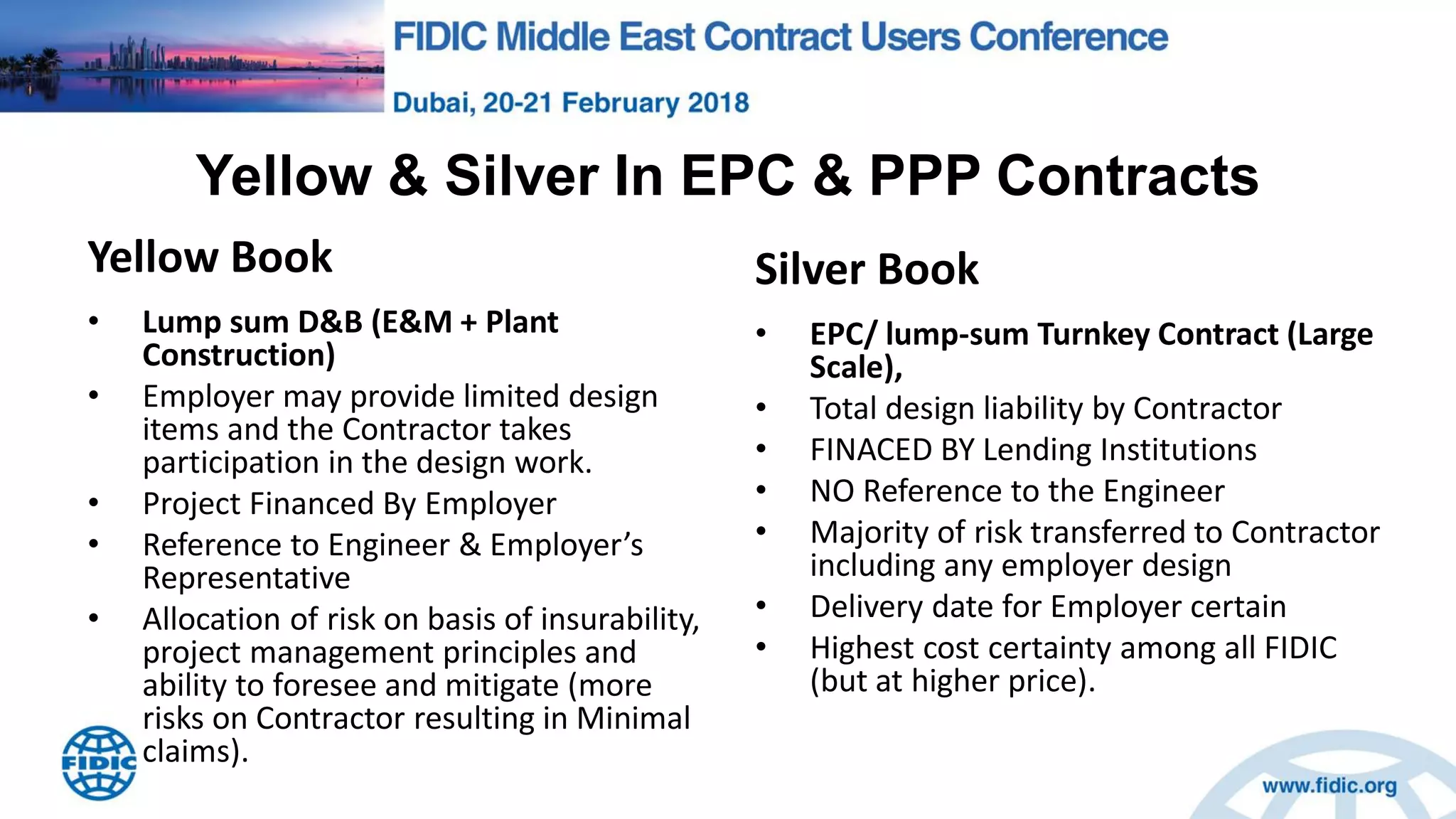
Yellow Book
• Lump sum D&B (E&M + Plant
Construction)
• Employer may provide limited design
items and the Contractor takes
participation in the design work.
• Project Financed By Employer
• Reference to Engineer & Employer’s
Representative
• Allocation of risk on basis of insurability,
project management principles and
ability to foresee and mitigate (more
risks on Contractor resulting in Minimal
claims).
Silver Book
• EPC/ lump-sum Turnkey Contract (Large
Scale),
• Total design liability by Contractor
• FINACED BY Lending Institutions
• NO Reference to the Engineer
• Majority of risk transferred to Contractor
including any employer design
• Delivery date for Employer certain
• Highest cost certainty among all FIDIC
(but at higher price).
General NOTES on Yellow & Silver Books
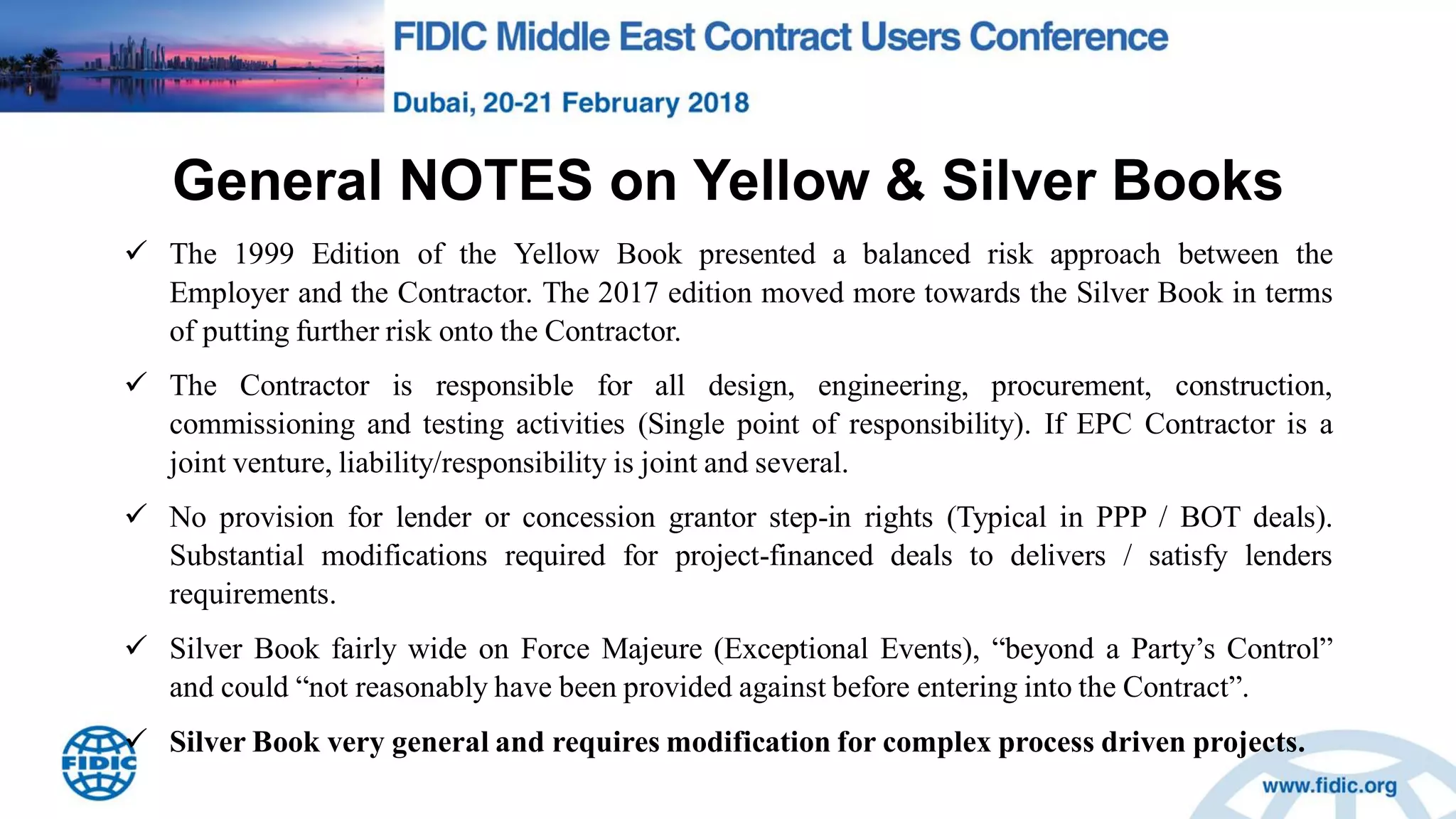
 The 1999 Edition of the Yellow Book presented a balanced risk approach between the
Employer and the Contractor. The 2017 edition moved more towards the Silver Book in terms
of putting further risk onto the Contractor.
 The Contractor is responsible for all design, engineering, procurement, construction,
commissioning and testing activities (Single point of responsibility). If EPC Contractor is a
joint venture, liability/responsibility is joint and several.
 No provision for lender or concession grantor step-in rights (Typical in PPP / BOT deals).
Substantial modifications required for project-financed deals to delivers / satisfy lenders
requirements.
 Silver Book fairly wide on Force Majeure (Exceptional Events), “beyond a Party‟s Control”
and could “not reasonably have been provided against before entering into the Contract”.
 Silver Book very general and requires modification for complex process driven projects.
FIDIC 5 Golden Principles!
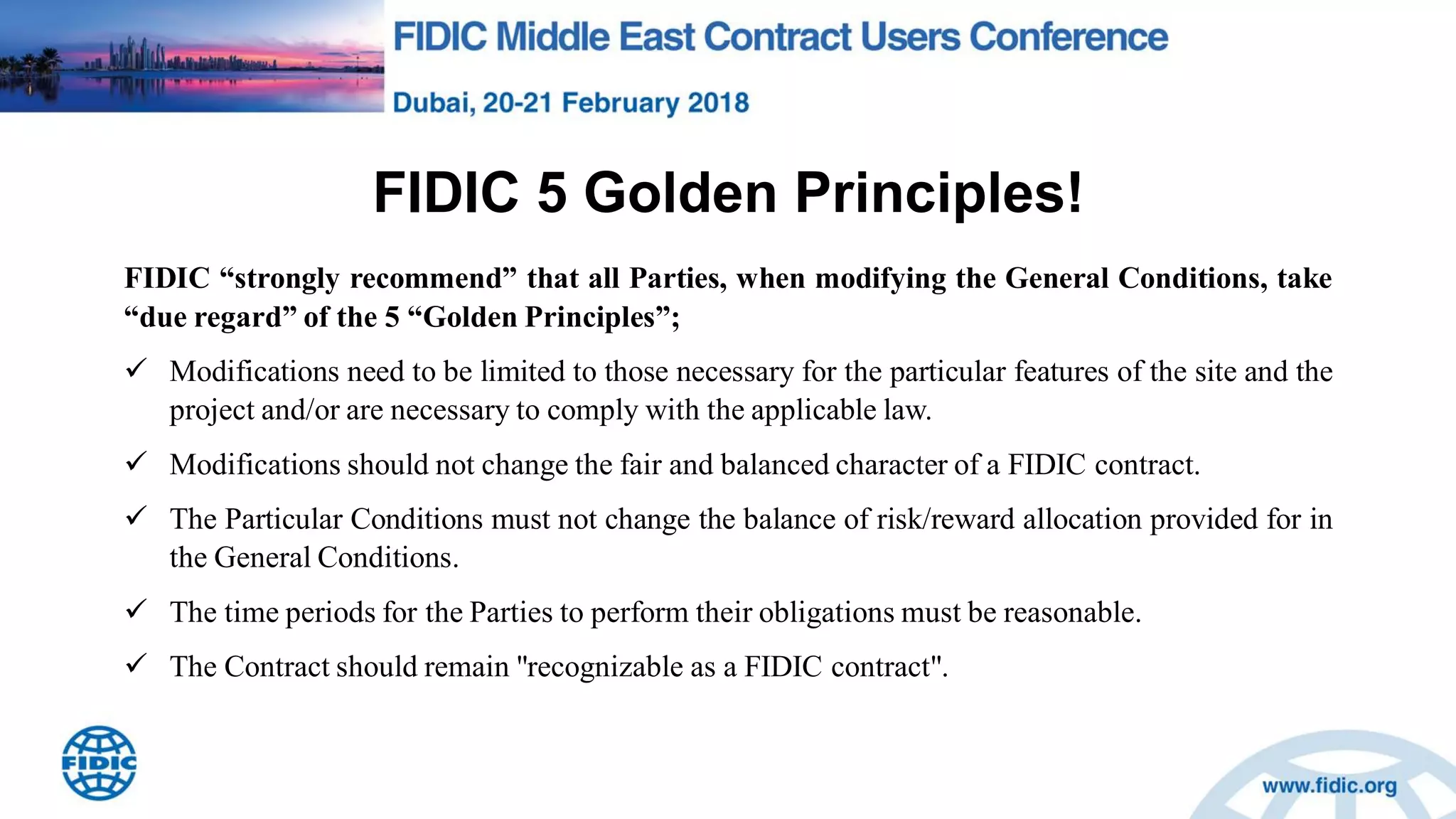
FIDIC “strongly recommend” that all Parties, when modifying the General Conditions, take
“due regard” of the 5 “Golden Principles”;
 Modifications need to be limited to those necessary for the particular features of the site and the
project and/or are necessary to comply with the applicable law.
 Modifications should not change the fair and balanced character of a FIDIC contract.
 The Particular Conditions must not change the balance of risk/reward allocation provided for in
the General Conditions.
 The time periods for the Parties to perform their obligations must be reasonable.
 The Contract should remain "recognizable as a FIDIC contract".
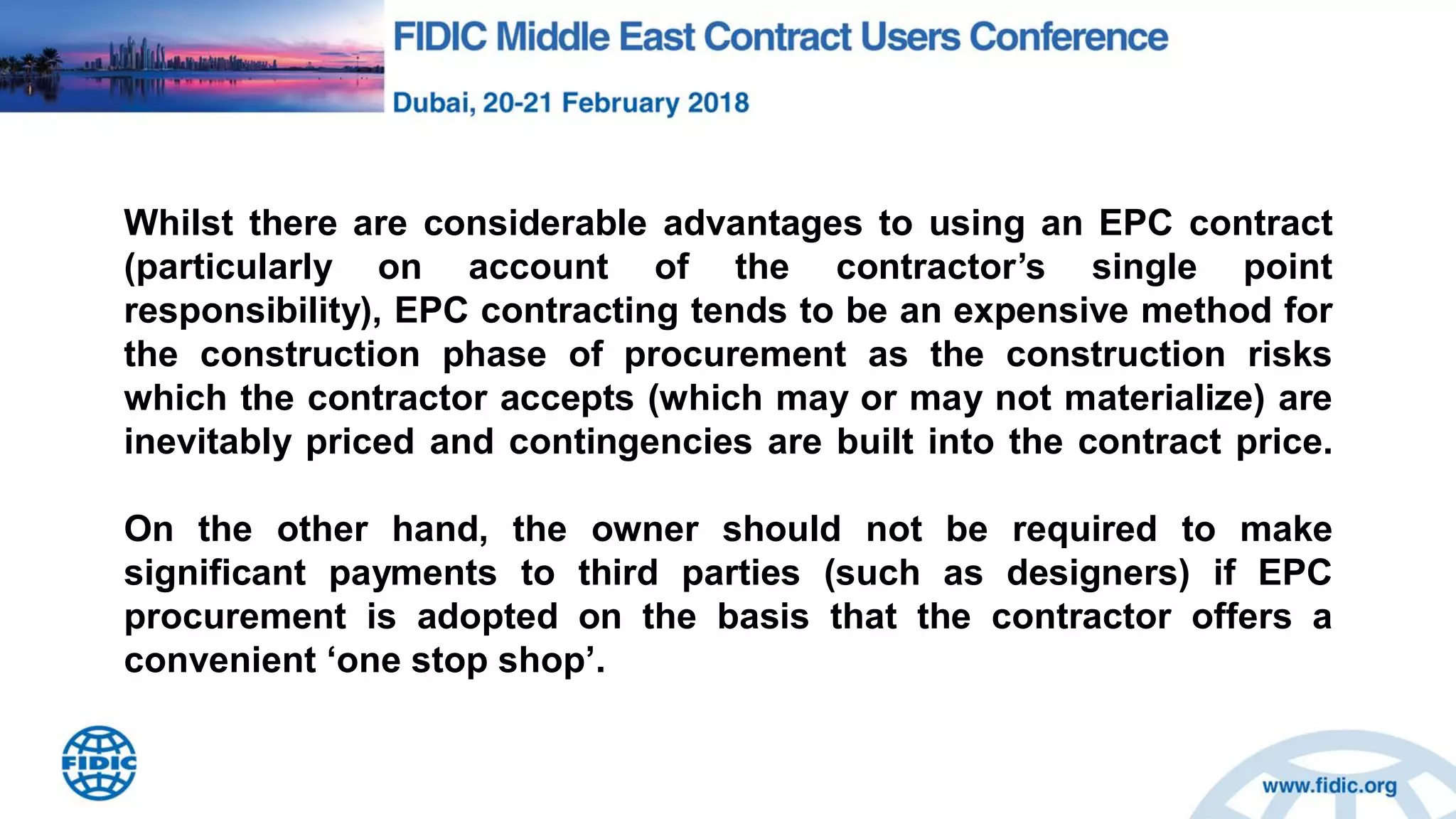
Whilst there are considerable advantages to using an EPC contract
(particularly on account of the contractor‟s single point
responsibility), EPC contracting tends to be an expensive method for
the construction phase of procurement as the construction risks
which the contractor accepts (which may or may not materialize) are
inevitably priced and contingencies are built into the contract price.
On the other hand, the owner should not be required to make
significant payments to third parties (such as designers) if EPC
procurement is adopted on the basis that the contractor offers a
convenient „one stop shop‟.
Key Silver Book Provisions
The Silver Book: Shift of Risks
 Employer‟s Engineer is Employer‟s Representative
 (No) Unforeseeable difficulties.
 Verification/ interpretation of Employer data (incl. sub-surface, hydrological and
Employer Requirements).
 General design obligations, design error
 No extension of Time for Completion for:
 Exceptionally adverse climatic conditions (except FM)
 Unforeseeable shortages in personnel or goods by epidemic or government actions
 Errors in Employer‟s Requirements
 Unforeseeable physical conditions
The Silver Book: Employer Issues
 Employer‟s Risk excludes:
 Use of works by Employer,
 Design of works by Employer‟s personnel,
 Unforeseeable operation of forces of nature
 Contractor fully responsible for design and design coordination (including Employer design)
 Full ground condition risk to Contractor
 Employer to retain influence over project
 Right to Variations
 Limited scope for Contractor claims for time/money;
Contractor will price these risks & execute extensive due diligence on the project (longer
tender time needed).
Sliver Book: Securities & Insurance
 EPC Contract requires that securities be supplied by the Contractor (Silver Book Art.
4.2). Typical securities include:
 Bank guarantee between 5-15% of Contract Price
 Retention (withholding of 5-15%) of each payment under EPC contract (Silver
Book Arts. 4.2 and 14.3(c) and Annex F)
 Advance Payment Guarantee – if an advance payment is made (Silver Book Art.
4.2 and Annex E)
 Parent Company Guarantee – to secure Contractor‟s performance if it does not
perform (Silver Book Art. 4.2 and Annex A)
 Project specific insurance provisions; all insurance money go in separate insurance
proceeds account for benefit Employer
The Silver Book: Payment, Delay
 Payments against schedule of payments & Performance Certificate. Generally long payment
periods.
 No claim for additional time or money for Variations/innovations, etc. (Silver Book Arts. 3.5 /13).
 Limited rights for extension of Time for Completion. Liquidated Damages for delay (10 %)
 NOTE; The FIDIC Contract does not provide for giving verbal instructions. Under clause 1.8,
wherever provision is made for the giving of notice, instruction, etc. unless otherwise specified
such communication shall be in writing.
 Under clause 13.8, if payment is delayed, the contractor is entitled to receive financing changes
compounded monthly on the amount unpaid during the delay. Unless states otherwise, this is 3%
above the discount rate of the central bank in the country of the currency of the payment. The
contractor is not required to give notice in order to receive this payment.
 FIDIC DB and Turnkey Contracts does not provide for payment for materials held off site.
General Clauses that Allow Claim for Cost
and / or Cost Plus Reasonable Profit?
 Clause 2.2- Employers failure gives access
 Clause 4.11 - Unforeseeable physical conditions
 Clause 4.24 - Fossils
 Clause 8.8 - Suspension
 Clause 11.4- Employer not permitting access for testing
 Clause 12.8- Contractor instructed to search
 Clause 13.16 - Changes in legislation
 Clause 16.1- Default by Employer
 Clause 17.4 - Employer‟s Risks
 Clause 19.5 - Force Majeure (Exceptional Events)
The Silver Book: Testing / Performance and Defects
 Employer to set Regimes for;
 Performance/reliability standards , maximum guarantee levels
 Interfacing of commissioning and testing regimes
 Consistency between testing/off take/PPA regimes.
 Interfacing between the Off taker and EPC Contractor (metering, point of delivery, etc)
 EPC Contract to include Testing Methodology, Testing Equipment, Tolerances, Ambient Conditions, etc.
PLUS Contractor right to modify the plant in event performance guarantees are not met.
 Performance (Output) Liquidated Damages are payable by the Contractor if performance is not met.
(Silver Book does not provide for performance liquidated damages –Art. 9.4. but can be amended to include
performance LD in the range of (10 – 20 %) with trigger points. [Performance Liquidated Damages are
usually calculated on net present value of revenue foregone less expense over the project life.]
 “Fit for Purpose” includes Liability cap, sub-caps and „carve-outs‟
 “Hand-over” occurs after all performance tests are satisfied to retains both performance and delay damages.
 Defects liability period (1 – 2 yrs): default is 1 yr; warranty bond after Taking Over. Contractors required to
repair defects 12-24 months following completion of performance testing (Silver Book Art. 11).
Silver Book: Bankability Focus
 Revenue is used to service project debt, thus it‟s vital the facility performs in respect of
output, efficiency and reliability.
 EPC contracts must have risk allocation that satisfies Lenders.
 Lenders focus on lack of ability to claim additional costs; and/or extensions of time
 Lenders also look to Contractor‟s securities (e.g. parent company guarantees/bank
guarantees securing Contractor‟s performance)
 The less comfortable Lenders are, the more equity the Sponsors will be required to
provide.
 Lenders also need to be satisfied with technical risk and performance Lender‟s input is
important here but their focus is on debt service.
Bankability Issues Examined in Sliver Book
 Fixed Completion Date , failure to meet this date will attract LDs. (Silver Book Art. 8.2, 13 and 20)
 Fixed Completion Price , generally limited to direct variations to works (Silver Book Arts. 13.1, 14.1 and 20)
 Extension of Time (EOT) to be granted where Contractor is delayed due to act/omissions of owner/project company
(Silver Book Art. 8.4(c))
 Restrictions to Claim Extensions of Time and Additional Costs (Silver Book Arts. 13.1 and 13.4)
 No or Limited Technology Risk (Silver Book Arts. 5.8, 7.5, 9.1 and 11 etc)
 “Fit For Purpose” (Silver Book Arts. 4.1 & 5)
 Output Guarantees (Silver Book – no performance LDs, rather obligations to remedy defects and/or reduction in
contract price in case the project is accepted below its performance targets)
 Liquidated Damages for both Delay and Performance
 Security from Contractor and/or its Parent (Silver Book Art. 4.2)
 Caps on Liability – ideally none but often one is negotiated (Silver Book Art. 17.6)
 Conditions to which Parties excused from performance for certain Force Majeure events (Silver Book Art. 19)
Sliver Book: Caps on Liability
 Most EPC Contractors hesitate at unlimited liability. Market is generally puts a cap at 100% of
the Contract Price. Sub-caps of 20% of Contract Price on delay and performance liquidated
damages also common (Silver Book – Limits of Liability is dealt with in Special Conditions –
see Art. 17.6)
 Consequential damages are also generally excluded. Profit also often expressly excluded
(Silver Book Art. 17.6)
 There may be some exceptions to those caps (e.g. willful misconduct, breach of patent rights).
 The new clause 8.8 introduces the possibility of delay damages outside the scope of the
liquidated sums agreed in the case of fraud, deliberate default or reckless misconduct.
 NOTE: Parties using FIDIC should look carefully at the limitation on liability clauses and
consider whether they wish to exclude recovery of both direct and indirect loss of profit claims
and whether they are prepared to cap liability in the ways proposed.
Sliver Book: Suspension &Termination
 Project Co has the right to suspend the contract (Silver Book Arts. 8.8 to 8.12)
 Contractor has very limited rights e.g. non-payment/ extended suspension, material
breach by employer (Silver Book Art. 16.2)
 Project Company has much broader rights. This will be tied with third party agreements.
Can terminate:
 For convenience (Silver Book Art. 15.5)
 For breach/insolvency, otherwise (Silver Book Art. 15.2)
 NOTE: Contract termination by the employer for convenience has been tightened and is
conditioned that the original contractor receives compensation for loss of profit. [The
termination provisions in the Gold Book permits the Employer to recover all sums paid,
finance charges etc.]
Common FIDIC EPC Issues!
FIDIC “Fit For Purpose” Provisions
 Clause 17 addresses “Care of the Work and Indemnities” ( in contrast to Old Red Book fit purpose
provision sub-clause 4.1 (Contractor's General Obligations). Sub-clause 17.4 states to avoid open
ended fitness for purpose obligations or uncertainty that: "When completed, the Works (or Section or
Part or major item of Plant, if any) shall be fit for the purpose (s) for which they are intended, as
defined and described in the Employer's Requirements (or, where no purpose (s) are so defined and
described, fit for their ordinary purpose (s))"
 Sub-clause 17.7 includes an indemnity in relation to “the design of the Works and other professional
services which result in the Works not being fit for purpose”. This indemnity is “carved out” of the
overall cap on liability.
 Sub-clause 17.6 which sets out the Limitations of Liability has been moved to become sub-clause 1.15,
as part of the Definitions Section, and although an express design indemnity has been included; it is
now subject to consequential loss exclusion (indirect losses) and the overall liability cap and with the
"shared indemnities" concept; i.e. the scenario that both parties have contributed to an event for which
one of the parties shall indemnify the other.
“Fit for Purpose” or “Reasonable Care” - UAE Law
 Unlike the UK and other common law jurisdictions, there are no implied terms which dictate that construction
contracts must be carried out with reasonable skill and care. However, Article 383(1) of the UAE Civil Code
does provide that: „If that which is required of an obligor is the preservation of a thing, or the management
thereof, or the exercise of care in the performance of his obligation, he shall have discharged that obligation if, in
the performance thereof, he exercises all such care as the reasonable man would exercise, notwithstanding that
the intended object is not achieved, unless there is an agreement or a provision of law to the contrary.‟
 Therefore; under UAE law it is possible for the Contractor to have fulfilled his obligations if the work or services
are performed with reasonable skill and care, even though the intended „object‟ or purpose is not achieved.
 Under UAE law, the contract is silent as to a consultant‟s obligation to perform the services , however, Article
880 of the UAE Civil Codes provides that the Contractor and Consultant shall always be jointly liable to
compensate the Employer for a period of ten years from the date of delivery of the work, if the building suffers
(a) total, or (b) partial collapse, or (c) there is a defect that threatens the stability and safety of the building.
FIDIC and Application of Local Laws - UAE
 the Emirates Code for Civil Transactions (brought into force on 16 December
1985 by Law No.5/1985) allows courts broad powers to change the level of
liquidated and ascertained damages the parties have agreed to under the contract.
 Article 390 of the Civil Transactions code provides:
“(1) The contracting parties may fix the amount of damages by expressly stating it in
the contract or in the subsequent agreement without prejudice to the provision of the
law.
(2) The Judge may in all cases, upon the request of one of the parties, amend this
agreement in order to adjust the amount of compensation to the harm incurred. Any
agreement to the contrary shall be null and void.”
FIDIC and Application of Local Laws - UK
 The dispute resolution procedures will not comply with Part II of the 1996
Construction Act as the Act requires the contract to provide for the parties‟ right to
refer a dispute to adjudication.
 The „pay when paid‟ clauses will breach the Construction Act as it prohibits the use of
such clauses in „construction contracts‟.
 The deletion of the „fitness for purpose‟ clause may not be sufficient to remove the
performance standard from the contract, it is common practice in UK contracts to
include a lower standard of „reasonable skill, care and diligence‟.
 The FIDIC contract excludes either party‟s recovery of loss of profit and loss of
contract (except for fraud, deliberate default or reckless misconduct). Under English
law, this could mean the contractor is unable to recover its direct loss in a claim for
damages for breach of contract where the employer has omitted part of the works.
FIDIC and Clause Relating to Changes in Legislation
 The mechanism in FIDIC contract for dealing with any impact on the works (delays or
additional costs) resulting from changes in the law applies only in relation to the
„Laws‟ of the country where the project is located. Changes in the law of another
country which affect the plant / equipment / components of the build being
manufactured elsewhere will not be caught unless bespoke drafting is included in the
contract.
 Another area of concern is the narrow drafting of „Laws‟, defined as “all national (or
state) legislation, statutes, ordinances and other laws, and regulations and by-laws of
any legally constituted public authority”. This is not particularly broad and may not,
for example, include guidance from the Health and Safety Executive or the
Environment Agency. Parties should consider broadening the definition of Laws.
Inconsistency Between the Employer‟s
Requirements and the Contractor‟s Proposal
 Clause 1.6 lists the priority of documents, the Employer‟s requirements being third in the
list, the contractor‟s proposal being eighth; therefore Employer‟s requirements take
precedence.
 The RED Book clause regarding errors in the Employer‟s Requirements (clause 1.9) has
been amplified and rebalanced in favor of the employer (if the contractor fails to give
notice within 42 days).
Employer‟s Requirements
It is important to check employer requirements and specifications interface with contractual terms as envisaged by
FIDIC. The following clauses rely on the content of the specification or generally cross-refer to the specification:
 Definition of „Employer‟s Equipment‟ (clause 1.1.6.3)
 Permissions obtained by employer (clause 1.13(a))
 Opportunities for works by others (clause 4.6)
 Values for emissions and discharges (clause 4.18)
 Details of employer‟s equipment and free-issue materials (clause 4.19)
 Criteria for designers (Yellow Book – clause 5.1)
 Technical documents included in contractor‟s documents and language for contractor‟s documents (Yellow Book –
clause 5.2)
 Contractor‟s documents to be submitted for review and/or approval (Yellow Book – clause 5.3)
 Other standards for compliance (Yellow Book – clause 5.4)
 Training to be provided for employer‟s personnel (Yellow Book – clause 5.5)
 Numbers and types of copies of as-built drawings (Yellow Book – clause 5.6)
 O&M manuals (Yellow Book – clause 5.7)
 Arrangements for staff and labor (clause 6.1)
 Facilities for staff and labor (clause 6.6)
 Payment of royalties (clause 7.8)
FIDIC 2017 Yellow and Silver in EPC and PPP Contracts

FIDIC 2017 Yellow and Silver in EPC and PPP Contracts

  • 1.
    Loay Ghazaleh, MBA,BSc. Civil Eng. Advisor, Undersecretary Office Ministry of Works, Bahrain loay.ghz@gmail.com , +973-36711547 NEW FIDIC Yellow & Silver In EPC & PPP Contracts
  • 2.
  • 3.
    The New FIDICRainbow Suit EPC & PPP Contracts Rainbow Suite Changes Highlights Yellow & Silver Books In EPC & PPP Contracts Key Silver Book Provisions Common FIDIC EPC Issues!
  • 4.
    The New FIDICRainbow Suit “Red, Yellow and Silver”
  • 5.
    FIDIC Suite HistoryPreview  Fédération Internationale Des Ingénieurs-Conseils1 (FIDIC) was founded in Belgium in 1913.  The first contract, known as the Red Book first edition,2 was actually an authorized reproduction, 're-badged' by FIDIC, of the ICE (Institution of Civil Engineers) Conditions of Contract fourth edition. Successive editions of the Red Book were issued in 1969, 1977 and 1988.  The other long-established FIDIC contract is the Yellow Book, first produced in 1963 with subsequent editions in 1980 and 1987, which is the design and build equivalent of the employer design Red Book.  In the mid-1990s, a turnkey contract - the Orange Book – was issued and a task group was set to produce a major revision of the Red and Yellow Books.  These events led to the launch in 1999 of the current editions of the principal FIDIC contracts, known colloquially as the “Rainbow Suite”, from the colors of the covers of the respective Books: “Red, Yellow and Silver”.  Also FIDIC issued The White Book: Client/Consultant Model Services Agreement: (4th Ed 2006, updated 2017) and Sub-consultancy Agreement: (1st Ed 1992).
  • 6.
    2017 - TheSecond Edition of the Rainbow Suite  The Second Edition of the Rainbow Suite is considerably longer, more detailed than the 1999 version, spanning more than 200 pages each and containing 21 Clauses. For example, the General Conditions of the Yellow Book have increased from 63 to 106 pages.  The underlying philosophy is to achieve increased clarity with a number of step-by-step processes and procedures and makes higher demands on the parties‟ claims and handling and avoidance of disputes.  The update also addresses issues raised by users over the past 18 years arising out of use of the 1999 Form and reflects current international best practice.  A key theme of the Second Edition is the increased emphasis on dispute avoidance by adopting enhanced project management procedures to promote more effective communication.  The suit on the other hand seems unnecessarily perspective from a contract management view, with a large number of cross references and with key changes which both Employer‟s and Contractor‟s need to know and manage or risk losing entitlements to claims.
  • 7.
    FIRST - TheFIDIC RED BOOKS Family! FIDIC Book Earlier Issue Latest SCOPE O&M Contract Type Finance By ENGINEER ROLE Remarks RED (any kind of Engineering Construction) 1999 2017, 2nd Building and Engineering Works No Design Mostly By Employer Employer YES Contractorentitled for EOT / Claims Payments. Balanced Risks. Can be BOQ (measured)or Lump sum Contract.Some design by Contractor. GREEN (short RED, small scale projects) 1999 - Construction No Design By Employer Employer OR Contractor (Not Relevant) No Referenceto Engineer Used for ContractsLess than 500,000 USD, short durations,repetitive works. PINK (MDB Harmonized RED Edition) 2005 - Construction No Design By Employer Multinational Development Banks YES Engineer Authoritysubstantially reduced comparedto RED ( Banks takes active role) BLUE/GREEN (Turquoise) 2006 2017 / 2018, upcoming Dredging and Reclamation No Design By Employer Employer YES BASED on Short RED (Green Book). Can be amended for design by Contractor. EMERALD - 2018 Tunneling & Underground No Design By Employer Employer YES
  • 8.
    SECOND - TheFIDIC EPC / PPP Family!  The Yellow Book (1st Ed 1999, updated 2017) : Conditions of Contract for Plant and Design-Build – for electrical and mechanical plant, and for building works, majority of the design by the Contractor and is responsible for performance specification prepared by the employer (fitness-for-purpose). The Yellow Book is a lump sum price contract financed by the Employer with payments made on the basis of certification by the engineer (like the Red Book).  The Silver Book (1st Ed 1999, updated 2017): Conditions of Contract for EPC (Engineer, Procure, and Construct) /Turnkey / BOT (Build, Operate, Transfer) for Projects financed by third party lenders (mostly). The contractor to provide a completed facility that is ready to be operated at „the turn of a key‟. Thus this contract is used where the certainty of price and completion date is important with single Contractor responsibility “fitness-for-purpose”. There is no engineer under the Silver Book (responsibilities are assumed by the employer).  The Gold Book (1st Ed 2008, No Update) : DBO Contract - Conditions of Contract for Design, Build and Operate Projects. The contractor at his own risk to operate and maintain the completed project (owned by the Employer) for a period of typically 20 years against set targets returned to the employer in an agreed condition. The contractor has no responsibility for financing the project.  The Orange Book (1st Ed 1995, Discontinued) : Conditions of Contract for Design – Build and Turnkey. (amended version used for PPP Projects).
  • 9.
    2017 - TheRainbow Suite Structure 1. General Provisions 2. The Employer 3. The Engineers (The employers administration- EPC) 4. The Contractor 5. Nominated subcontractor (Design- P & DB & EPC) 6. Staff and Labor 7. Plant, materials and workmanship 8. Commencement, delays and suspension 9. Tests on completion 10. Employer‟s Taking Over 11. Defects Liability 12. Measurement and evaluation (Tests after completion- P & DB & EPC) 13. Variations and adjustments 14. Contracts price and payments 15. Termination by Employer 16. Suspension and Termination by Contractor 17. Risk and Responsibility 18. Insurance 19. Force Majeure (Exceptional Events) 20. Employer‟s and Contractor‟s Claims 21. Disputes and Arbitration
  • 10.
    The Rainbow SuitStructure Grouped  General provisions (1)  The Employer, Employer‟s Administration OR Engineer, Contractor, Nominated Subcontractors OR Design (2-5)  Staff and labor, Plant, materials and workmanship (6-7)  Commencement, delays and suspension, Tests on completion, Employer‟s taking over, Defects Liability, Tests after completion (8-11 & 12)  Measurement and Evaluation OR Variations and Adjustments, Contract Price and Payment (12-14)  Termination by Employer, Suspension and Termination by Contractor (15-16)  Care of the Work and Indemnities (Risk and Responsibility) (17)  Insurance (18)  Exceptional Events (Force Majeure ) (19)  Employer‟s and Contractor‟s Claims (20)  Disputes and Arbitration (21)
  • 11.
    Dispute Avoidance RunsThroughout the Second Edition  Splitting Clause 20 into 2 clauses; clause 20 “Employer‟s and Contractor‟s Claims” (applies to both EQUALLY) and Clause 21 “Disputes and Arbitration” with “STANDING DAABs” Dispute Adjudication/Avoidance Boards  The Engineer is “Neutral / Non-Partisan” NOT “ Independent” NOT “ Impartial”  Early (Advance) Warning; Employer, Contractor and Engineer should “endeavor to advise” each other in advance of any known or probable future events or circumstances which SHALL adversely affect the work. (originated in gold book)  Notices (with Capital N), Likely results in increasing claims???  The Program and Extension of Time (EoT) Claims  Enhanced Claims Provisions and more use of FIDIC Time Bar “greater reciprocity between the employer and contractor” AND “a Claim becomes a Dispute if it is rejected (in whole or in part) or ignored”.  Concurrent Delays / BIM can be added in Special Provisions.  Exceptional Risks (Force Majeure); The Contractor is entitled to EoT and its costs if there are any exceptional risks or Employer risks during the design/build period.
  • 12.
    Rainbow Suite SubstantiveChanges  Greater Definitional Complexity (alphabetic definitions with linkages to clauses).  Special Provisions Split ( A- Contract Data, B- Special Provisions)  Changes to the Role of the Engineer  Additional Project Management Tools  Treatment of Extensions of Time  The Variation Procedure  Tightened Interim Payment Application Procedure  Enhanced Performance Security Provisions  Limitations of Liability  Extensive Changes to Claims Procedure  Much More Extensive Use of „Time Bars‟  Changes to Agreement/Determination by the Engineer and Disputes Avoidance Adjudication Board (DAAB). The Engineer provisions for determination have been expanded from two paragraphs to over two pages.
  • 13.
  • 14.
    DAAB Appointment Proceduresunder FIDIC Contracts  New Clause 21 requires the Parties jointly to appoint a “Standing DAAB”; consisting of one to three members at the start of the Contract (default position is three, Clause 20.2), which visits the Site on a regular basis and remains in place for the duration of the Contract.  The contract may include a list of potential members, from which the board is selected. If three members, each party nominates one member for approval by the other party. Parties and members agree on the appointment of the third member, who will be chairman. (Clause 20.2.)  The form of the DAAB appointment is the General Conditions of Dispute Avoidance Adjudication Agreement, as set out in the contract Appendix, entered into by the parties and the member, a Tri- Partite Agreement (TPA).  Parties can agree to replace a member at any time, or if a member declines to act, dies, resigns, on disability or termination of a member‟s appointment.  If no DAAB has been appointed in the project then the parties can proceed directly to arbitration.
  • 15.
    Dispute Avoidance /Adjudication Boards (“DAABs”)  The DAAB has the power to invite the Parties to make such a referral if it becomes aware of any such issue or disagreement. Also the Parties may: “Jointly request (with a copy to the Engineer) DAAB to provide assistance and/or informally discuss and attempt to resolve any issue or disagreement”.  The DAB must issue its decision within 84 days of a dispute being referred. If a Party is dissatisfied with a DAAB Decision then within 28 days of the Decision they must issue a Notice of Dissatisfaction (NoD).  The Parties and Engineer must comply with the DAAB's decision whether or not they served a Notice of Dissatisfaction (Clause 20.4.); however, where a Party serves a NoD this makes DAAB Decision non-final. [FIDIC recommends the Parties consider agreeing a longer time than the 28 day stated in Sub-Clause 21.5]  If no NoD is served, DAAB decision is final and binding, any dispute shall be finally settled by the Rules of Arbitration of the International Chamber of Commerce (ICC Arbitration).  Under the new provisions if no arbitration is commenced within 182 days then the NoD will be deemed to have lapsed and no longer valid. [NOTE; The 1999 Edition prevented Parties for 56 days from starting arbitration ,this time period has been reduced to 28 days and does not apply if a Party fails to comply with a DAAB Decision as they can proceed immediately to arbitration, however, obliging parties to commence arbitral proceedings while the works are still progressing may seem odd.]
  • 16.
    Changing the Roleof the Engineer – “Neutral” Determination  The engineer is a key person in the FIDIC Yellow and Red Books (FIDIC Silver Book has “Employer‟s Representative”). The engineer inspects, certifies, instructs, assesses, approves, mediates, makes decisions, etc. Also there is a new role for “Engineer‟s Representative” on site.  The new sub-clause 3.7 imposes a positive obligation on the Engineer to act “neutrally” and is not required to obtain the Employer‟s consent or act for the Employer. Further, the Engineer is to encourage discussions between the Parties to reach agreement (42 days). A failure to achieve agreement within this 42 day period gives the Engineer a further 42 days to make a determination.  "The Engineer shall make a fair determination in accordance with the Contract, taking due regard of all relevant circumstances" . Failure to determine within the 84 days is deemed a rejection.  If either party disagrees with the Engineer‟s determination (regarding a claim for an extension of time/payment or an „other claim‟), it is, within 28 days, entitled to issue a Notice of Dissatisfaction (“NOD”) to the other party (with a copy to the Engineer) referring to the DAAB under Clause 21.  Failure to comply with the 28 days time period means that the dispute is final and binding on the parties, however, the Engineer‟s determination shall remain binding on the parties until the DAAB process has commenced.
  • 17.
    Engineer Time BarWaiver Authority  The time bars and preliminary notice provisions (but not „other claims‟), are subject to a new Sub- Clause 20.3, “Waiver of Time-limits, which only applies if a Notice have been given to the Engineer.  If the deadlines are not met, the right to enforce the claim will generally be forfeited. However, the 2017 edition contains provisions in respect of the engineer nevertheless determining the (late) claim and which circumstances may be taken into account in such respect.  The new sub-clause 20.2.5 does provide the Engineer with the power to waive a failure to follow a time bar requirement. The Engineer can take the following into account:  Whether the other Party would be prejudiced by acceptance of the late submission; and  Whether the other Party had prior knowledge of the event in question or basis of claim.  The engineer shall make a determination of the matter or claim pursuant to sub-clause 3.7.
  • 18.
    Early Warning  Anew sub-clause 8.4 which follows the lead given by the 2008 Gold Book adds the concept of advance warning of a potential problem.  Sub-Clause 8.3 of the „old‟ Yellow, Red and Silver Books required only the Contractor to give advance warnings, now it says the Employer, Contractor and Engineer should “endeavor to advise” each other in advance of any known or probable future events or circumstances which SHALL adversely affect the work.  As part of the consultations following any advance warning given under sub-cause 8.4, the Contractor may need to update the program and provide proposals to overcome the effects of any delays.  The purpose of the early warning is not to decide who is responsible for the foreseeable problem, but rather to determine how the parties can work together to resolve the issue and avoid a claim.  Upon receipt of an advance warning, the Engineer may instruct the Contractor to submit a proposal to avoid or mitigate the effects of the event in question and this may give rise to a variation.  The FIDIC provision stops short of specifying sanction for failure to give advance warning.
  • 19.
    Notices & Variations A greater degree of clarity has been added to the variation procedure set out in Sub-Clause 13.3 and the clause has been expanded considerably (it now runs to almost two pages).  In addition to the Engineer being able to request a proposal prior to instructing a Variation, an instructed Variation must be by way of a Notice (with a capital „N‟).  The Notice must „describe itself‟ as a notice and be issued in accordance with Sub-Clause 1.3 (Notices and other communications) including a requirement to refer to the relevant Sub-Clause under which it is issued. The intention is to avoid uncertainty as to whether a particular communication is intended to be a Variation instruction.  If the Contractor believes that an instruction constitutes a variation then the new Clause 3.5 allows the Contractor to issue a Notice to the Engineer that the instruction is a variation “immediately and before commencing any work related to the instruction”. However the clause (new 3.5) does not go on to explain what happens if the contractor fails to give a notice.
  • 20.
    Enhanced Claims Provisions The Sub-Clause dealing with Employer Claims in the 1st edition has been deleted in its entirety and individual claim clause provisions for Employer (former Sub-Clause 2.5) and Contractor (former Sub-Clause 20.1), have now been merged together within Sub-Clauses 20.1 and 20.2.  Sub-clause 20.2.3 imposes a new express obligation on the claiming party to “keep such contemporaneous records as may be necessary to substantiate the Claim”. The sub-clause also entitles the Engineer to monitor the Contractor‟s record keeping and to even instruct the Contractor to keep additional records (but does not extend to the Employer‟s records).  Under sub-clause 20.2.4, one must provide a statement of the contractual or legal basis of the claim within 84 days. [after the claiming party becomes aware, or ought to have become aware of the event or circumstance giving rise to the claim, or “such other period (if any) as may be proposed by the claiming party and agreed by the Engineer”].  For other Claims (e.g. a party‟s failure to assist in obtaining permits); Sub-Clause 20.1 provides that if either party considers that it has a claim which relates to any matter other than to payment or extension of time, the claiming party shall notify the Engineer of the claim “as soon as practicable after the claiming Party becomes aware of the other Party‟s disagreement with the requested entitlement”.  Sub-Clause 20.2.2 sets out that the Engineer has a positive duty within 14 days of receipt of the notice of claim to give a preliminary response if he considers that the initial notice of claim is not time barred. For other claims a decision shall be given “as soon as practicable”.
  • 21.
    The Program andExtension of Time (EoT) Claims  The program provisions of the contract have been extensively re-written and amplified in a new clause 8.3. There are deemed notices of no objection within 21 days/14 days of receipt of the contractor‟s program although FIDIC has retained the stand that the program does not become a contract document.  There is also a positive obligation on the Contractor to update the program whenever it ceases to reflect actual progress, sub-clause 8.3 (k)(v).  New sub-clause 8.5 references concurrent delay saying that if a delay is caused by the Employer is concurrent with a Contractor delay, then the entitlement to an extension of time shall be assessed “in accordance with the rules and procedures stated in the Special Provisions”.  Time extension for weather (in yellow book) has been tightened so that it is limited to unforeseeable climatic conditions at the site.  The extension of time provisions have also been amended with regard to delays by authorities to include a reference to delay by private utility entities. 
  • 22.
    Contract Price Payment There has been a departure from the earlier “reasonable profit” position (for example within the Variation procedure, Sub-Clause 13.3 1st edition) by way of the insertion of a newly constituted definition, Cost Plus Profit.  This is defined to mean Cost plus the applicable percentage for profit stated in the Contract Data, which is to be 5% if not otherwise stated.  New provisions at clause 13.4 amplify the arrangements for agreement of provisional sums by reference to quotations.  Adjustments to the Contract Price by reference to changes in the law (13.6) have been amplified to reference not merely legislative action but also permits, permission licenses and approvals.  The contract now references a Schedule of Rates for valuing variations.
  • 23.
    Interim Payment Certificates(IPC‟s)  Clause 14.6 has been amended to indicate that the value will be the amount the Engineer fairly “considers” to be due and that the Engineer may withhold an amount if he considers that there is a “significant error or discrepancy” in the statement. The Engineer must “detail his calculations” of the amount withheld and state the “reasons for it being withheld”.  The clause now includes an additional provision (clause 14.6.3) for both the Engineer and the contractor to correct and/or modify IPCs.  Clause 14.6.3 says the contractor should highlight “identified amounts” that are disputed in IPCs. These may be referred for determination by the Engineer under clause 3.7 where appropriate where the identified amounts exceed 5% of the accepted contract amount.
  • 24.
    Defects  The defectsliability is generally maintained but with slight changes in the 2017 edition. It appears now from sub-clause 11.4 that the employer may fix a date on or by which the contractor must remedy defects if the contractor‟s remedial work is “unduly delayed”, whereas the criterion in the 1999 edition was “fails to remedy within reasonable time”. (There are references in sub-clause 11.1 to sub-clause 7.5).  Sub-clause 11.7 (“Right of Access after Taking Over”) introduces a procedure for the contractor‟s access to the works to remedy defects: the contractor must request access on a certain, preferred date, and the employer must respond within 7 days by either stating its consent or by proposing a new date.  Only if the contractor incurs additional costs as a result of any "unreasonable delay” by the employer in permitting access to the works, the contractor will be entitled to payment of such costs especially if the contractor has provided an uptime or availability guarantee or is liable for production losses in general.  FIDIC has suggested that if the Employer wishes to have certain parts of the Works completed by certain times but does not wish to take over those parts of the Works when they are completed, such parts ought to be described in the Specification as "Milestones".  In such circumstances, FIDIC recommends that alternative provisions be added that would entitle the Employer to Delay Damages if the Contractor fails to complete the works of the Milestone within the time for completion of the Milestone subject to any extension of time.
  • 25.
    EPC & PPPContracts
  • 26.
    Input Contracts Guaranteed longterm supply of inputs / feedstock SPV / Project Company (Borrower) .Made up of Project Sponsors - Equity Investors. Off Taker Guaranteed revenue stream to project. Can be the Public Contracting Authority or MoF Contractor(s) ,EPC - Risk transfer – Turnkey Contract , penalties , bonds. O&M Contractor(s) Pass down of penalties for availability payments , performance, etc. Host Government / Public Authority Legal /regulatory framework & support functions PPP Stakeholders & Risk Transfer Interface Contract Risk Transfer 3 – 5 Years 25 - 30 Years ( Risk by Project Company) Equipment Supplier Warranties & Supply Agents Agreements. Can be bundled in EPC Arranging Bank Hedge Providers Currency & Interest Rate, Multilaterals, Political Risk Insurers Equity Investors 26
  • 27.
    EPC & PPPContracts Engineering, procurement and construction (EPC) contracts are most common form of contract used in major international infrastructure projects. There is a D&C Contract embedded in every PPP - BOOT, BOT contract. Construction phase of a PPP likely to be delivered via design-build EPC agreement. EPC Contractors obligations typically include:  A complete facility which must perform to a specified level  For a guaranteed price determined based on the 'lump-sum' principle  By a guaranteed date Because EPC Contracts involve Contractor taking a high level of risk they involve high insurance costs.
  • 28.
    EPC / PPPContract Advantages & Disadvantages Advantages  Bankable, but with many debt covenant provisions.  Near Delivery Certainty  “Turnkey” responsibility on the EPC Contractor Disadvantages  Higher Contract price than alternative structures due to more risk allocation to Contractor (built-in Contractor contingencies)  Limited scope for Project Sponsor to intervene if problems arise during construction  Not many players
  • 29.
    Sector Main PPPModels Challenges Transport BOT, BOOT, Divestiture  Demand uncertainty  Supply market constraints  Opposition to tolls  Competing transportation network impacts Water, Wastewater, and Waste BT, BTO, BOOT, Divestiture  Upgrading costs and flexibility  Uncertainty about technology and need for innovation  High procurement costs for small-scale projects  Political sensitivity around privatizations Education BT, BTO, BOT, BOOT, DBFO/M, Integrator  Uncertainty about alternative revenue streams  High procurement costs for small projects  Uncertainty about future demographic or policy changes Affordable Housing DBOM, BOO, BOOT, Alliance, Joint Venture  Uncertainty about future housing needs, living standards  High upfront costs in small-scale projects  Securing value for money in noncompetitive situations Correction Facilities BT, BTO, BOO, Management Contract  Political sensitivity  Specifying outcomes  Monitoring issues
  • 30.
    MENA Region MainFunding Sources • Very liquid , Driving pricing lower • Pressed on tenors, but available for quality assets • Sibor (Saudi Interbank) hedging market is limited to 5-7 yr. Local GCC Banks • Tight liquidity, Prices are higher, but offset by lower libor • Tenor is available for quality assets • Libor hedging is very deeps; 23+ years International Banks • Amount is linked to procurement • Tenor is mostly limited by OECD consensus • Some offer direct loans to home companies Export Credit Agencies • Rapidly developing • Tenors average life are 8-11 years • Still requires sponsors guarantees Bonds and Sukuks
  • 31.
    Characteristics of MegaProjects  Multiple stakeholders  Ambiguity (Unknowns) in project features, resources, phases.  Highly regulated environment  Significant political / authority influences  Project duration exceeds elected officials office cycle!  Changing project governance  Use of technology that is new to the organization  Use of technology that has not yet been fully developed  Project duration exceeds the cycle of relevant technologies  Significant external influences  Significant internal interpersonal or social influences
  • 32.
    Yellow & SilverBooks In EPC & PPP Contracts
  • 33.
    Yellow & SilverIn EPC & PPP Contracts Yellow Book • Lump sum D&B (E&M + Plant Construction) • Employer may provide limited design items and the Contractor takes participation in the design work. • Project Financed By Employer • Reference to Engineer & Employer’s Representative • Allocation of risk on basis of insurability, project management principles and ability to foresee and mitigate (more risks on Contractor resulting in Minimal claims). Silver Book • EPC/ lump-sum Turnkey Contract (Large Scale), • Total design liability by Contractor • FINACED BY Lending Institutions • NO Reference to the Engineer • Majority of risk transferred to Contractor including any employer design • Delivery date for Employer certain • Highest cost certainty among all FIDIC (but at higher price).
  • 34.
    General NOTES onYellow & Silver Books  The 1999 Edition of the Yellow Book presented a balanced risk approach between the Employer and the Contractor. The 2017 edition moved more towards the Silver Book in terms of putting further risk onto the Contractor.  The Contractor is responsible for all design, engineering, procurement, construction, commissioning and testing activities (Single point of responsibility). If EPC Contractor is a joint venture, liability/responsibility is joint and several.  No provision for lender or concession grantor step-in rights (Typical in PPP / BOT deals). Substantial modifications required for project-financed deals to delivers / satisfy lenders requirements.  Silver Book fairly wide on Force Majeure (Exceptional Events), “beyond a Party‟s Control” and could “not reasonably have been provided against before entering into the Contract”.  Silver Book very general and requires modification for complex process driven projects.
  • 35.
    FIDIC 5 GoldenPrinciples! FIDIC “strongly recommend” that all Parties, when modifying the General Conditions, take “due regard” of the 5 “Golden Principles”;  Modifications need to be limited to those necessary for the particular features of the site and the project and/or are necessary to comply with the applicable law.  Modifications should not change the fair and balanced character of a FIDIC contract.  The Particular Conditions must not change the balance of risk/reward allocation provided for in the General Conditions.  The time periods for the Parties to perform their obligations must be reasonable.  The Contract should remain "recognizable as a FIDIC contract".
  • 36.
    Whilst there areconsiderable advantages to using an EPC contract (particularly on account of the contractor‟s single point responsibility), EPC contracting tends to be an expensive method for the construction phase of procurement as the construction risks which the contractor accepts (which may or may not materialize) are inevitably priced and contingencies are built into the contract price. On the other hand, the owner should not be required to make significant payments to third parties (such as designers) if EPC procurement is adopted on the basis that the contractor offers a convenient „one stop shop‟.
  • 37.
    Key Silver BookProvisions
  • 38.
    The Silver Book:Shift of Risks  Employer‟s Engineer is Employer‟s Representative  (No) Unforeseeable difficulties.  Verification/ interpretation of Employer data (incl. sub-surface, hydrological and Employer Requirements).  General design obligations, design error  No extension of Time for Completion for:  Exceptionally adverse climatic conditions (except FM)  Unforeseeable shortages in personnel or goods by epidemic or government actions  Errors in Employer‟s Requirements  Unforeseeable physical conditions
  • 39.
    The Silver Book:Employer Issues  Employer‟s Risk excludes:  Use of works by Employer,  Design of works by Employer‟s personnel,  Unforeseeable operation of forces of nature  Contractor fully responsible for design and design coordination (including Employer design)  Full ground condition risk to Contractor  Employer to retain influence over project  Right to Variations  Limited scope for Contractor claims for time/money; Contractor will price these risks & execute extensive due diligence on the project (longer tender time needed).
  • 40.
    Sliver Book: Securities& Insurance  EPC Contract requires that securities be supplied by the Contractor (Silver Book Art. 4.2). Typical securities include:  Bank guarantee between 5-15% of Contract Price  Retention (withholding of 5-15%) of each payment under EPC contract (Silver Book Arts. 4.2 and 14.3(c) and Annex F)  Advance Payment Guarantee – if an advance payment is made (Silver Book Art. 4.2 and Annex E)  Parent Company Guarantee – to secure Contractor‟s performance if it does not perform (Silver Book Art. 4.2 and Annex A)  Project specific insurance provisions; all insurance money go in separate insurance proceeds account for benefit Employer
  • 41.
    The Silver Book:Payment, Delay  Payments against schedule of payments & Performance Certificate. Generally long payment periods.  No claim for additional time or money for Variations/innovations, etc. (Silver Book Arts. 3.5 /13).  Limited rights for extension of Time for Completion. Liquidated Damages for delay (10 %)  NOTE; The FIDIC Contract does not provide for giving verbal instructions. Under clause 1.8, wherever provision is made for the giving of notice, instruction, etc. unless otherwise specified such communication shall be in writing.  Under clause 13.8, if payment is delayed, the contractor is entitled to receive financing changes compounded monthly on the amount unpaid during the delay. Unless states otherwise, this is 3% above the discount rate of the central bank in the country of the currency of the payment. The contractor is not required to give notice in order to receive this payment.  FIDIC DB and Turnkey Contracts does not provide for payment for materials held off site.
  • 42.
    General Clauses thatAllow Claim for Cost and / or Cost Plus Reasonable Profit?  Clause 2.2- Employers failure gives access  Clause 4.11 - Unforeseeable physical conditions  Clause 4.24 - Fossils  Clause 8.8 - Suspension  Clause 11.4- Employer not permitting access for testing  Clause 12.8- Contractor instructed to search  Clause 13.16 - Changes in legislation  Clause 16.1- Default by Employer  Clause 17.4 - Employer‟s Risks  Clause 19.5 - Force Majeure (Exceptional Events)
  • 43.
    The Silver Book:Testing / Performance and Defects  Employer to set Regimes for;  Performance/reliability standards , maximum guarantee levels  Interfacing of commissioning and testing regimes  Consistency between testing/off take/PPA regimes.  Interfacing between the Off taker and EPC Contractor (metering, point of delivery, etc)  EPC Contract to include Testing Methodology, Testing Equipment, Tolerances, Ambient Conditions, etc. PLUS Contractor right to modify the plant in event performance guarantees are not met.  Performance (Output) Liquidated Damages are payable by the Contractor if performance is not met. (Silver Book does not provide for performance liquidated damages –Art. 9.4. but can be amended to include performance LD in the range of (10 – 20 %) with trigger points. [Performance Liquidated Damages are usually calculated on net present value of revenue foregone less expense over the project life.]  “Fit for Purpose” includes Liability cap, sub-caps and „carve-outs‟  “Hand-over” occurs after all performance tests are satisfied to retains both performance and delay damages.  Defects liability period (1 – 2 yrs): default is 1 yr; warranty bond after Taking Over. Contractors required to repair defects 12-24 months following completion of performance testing (Silver Book Art. 11).
  • 44.
    Silver Book: BankabilityFocus  Revenue is used to service project debt, thus it‟s vital the facility performs in respect of output, efficiency and reliability.  EPC contracts must have risk allocation that satisfies Lenders.  Lenders focus on lack of ability to claim additional costs; and/or extensions of time  Lenders also look to Contractor‟s securities (e.g. parent company guarantees/bank guarantees securing Contractor‟s performance)  The less comfortable Lenders are, the more equity the Sponsors will be required to provide.  Lenders also need to be satisfied with technical risk and performance Lender‟s input is important here but their focus is on debt service.
  • 45.
    Bankability Issues Examinedin Sliver Book  Fixed Completion Date , failure to meet this date will attract LDs. (Silver Book Art. 8.2, 13 and 20)  Fixed Completion Price , generally limited to direct variations to works (Silver Book Arts. 13.1, 14.1 and 20)  Extension of Time (EOT) to be granted where Contractor is delayed due to act/omissions of owner/project company (Silver Book Art. 8.4(c))  Restrictions to Claim Extensions of Time and Additional Costs (Silver Book Arts. 13.1 and 13.4)  No or Limited Technology Risk (Silver Book Arts. 5.8, 7.5, 9.1 and 11 etc)  “Fit For Purpose” (Silver Book Arts. 4.1 & 5)  Output Guarantees (Silver Book – no performance LDs, rather obligations to remedy defects and/or reduction in contract price in case the project is accepted below its performance targets)  Liquidated Damages for both Delay and Performance  Security from Contractor and/or its Parent (Silver Book Art. 4.2)  Caps on Liability – ideally none but often one is negotiated (Silver Book Art. 17.6)  Conditions to which Parties excused from performance for certain Force Majeure events (Silver Book Art. 19)
  • 46.
    Sliver Book: Capson Liability  Most EPC Contractors hesitate at unlimited liability. Market is generally puts a cap at 100% of the Contract Price. Sub-caps of 20% of Contract Price on delay and performance liquidated damages also common (Silver Book – Limits of Liability is dealt with in Special Conditions – see Art. 17.6)  Consequential damages are also generally excluded. Profit also often expressly excluded (Silver Book Art. 17.6)  There may be some exceptions to those caps (e.g. willful misconduct, breach of patent rights).  The new clause 8.8 introduces the possibility of delay damages outside the scope of the liquidated sums agreed in the case of fraud, deliberate default or reckless misconduct.  NOTE: Parties using FIDIC should look carefully at the limitation on liability clauses and consider whether they wish to exclude recovery of both direct and indirect loss of profit claims and whether they are prepared to cap liability in the ways proposed.
  • 47.
    Sliver Book: Suspension&Termination  Project Co has the right to suspend the contract (Silver Book Arts. 8.8 to 8.12)  Contractor has very limited rights e.g. non-payment/ extended suspension, material breach by employer (Silver Book Art. 16.2)  Project Company has much broader rights. This will be tied with third party agreements. Can terminate:  For convenience (Silver Book Art. 15.5)  For breach/insolvency, otherwise (Silver Book Art. 15.2)  NOTE: Contract termination by the employer for convenience has been tightened and is conditioned that the original contractor receives compensation for loss of profit. [The termination provisions in the Gold Book permits the Employer to recover all sums paid, finance charges etc.]
  • 48.
  • 49.
    FIDIC “Fit ForPurpose” Provisions  Clause 17 addresses “Care of the Work and Indemnities” ( in contrast to Old Red Book fit purpose provision sub-clause 4.1 (Contractor's General Obligations). Sub-clause 17.4 states to avoid open ended fitness for purpose obligations or uncertainty that: "When completed, the Works (or Section or Part or major item of Plant, if any) shall be fit for the purpose (s) for which they are intended, as defined and described in the Employer's Requirements (or, where no purpose (s) are so defined and described, fit for their ordinary purpose (s))"  Sub-clause 17.7 includes an indemnity in relation to “the design of the Works and other professional services which result in the Works not being fit for purpose”. This indemnity is “carved out” of the overall cap on liability.  Sub-clause 17.6 which sets out the Limitations of Liability has been moved to become sub-clause 1.15, as part of the Definitions Section, and although an express design indemnity has been included; it is now subject to consequential loss exclusion (indirect losses) and the overall liability cap and with the "shared indemnities" concept; i.e. the scenario that both parties have contributed to an event for which one of the parties shall indemnify the other.
  • 50.
    “Fit for Purpose”or “Reasonable Care” - UAE Law  Unlike the UK and other common law jurisdictions, there are no implied terms which dictate that construction contracts must be carried out with reasonable skill and care. However, Article 383(1) of the UAE Civil Code does provide that: „If that which is required of an obligor is the preservation of a thing, or the management thereof, or the exercise of care in the performance of his obligation, he shall have discharged that obligation if, in the performance thereof, he exercises all such care as the reasonable man would exercise, notwithstanding that the intended object is not achieved, unless there is an agreement or a provision of law to the contrary.‟  Therefore; under UAE law it is possible for the Contractor to have fulfilled his obligations if the work or services are performed with reasonable skill and care, even though the intended „object‟ or purpose is not achieved.  Under UAE law, the contract is silent as to a consultant‟s obligation to perform the services , however, Article 880 of the UAE Civil Codes provides that the Contractor and Consultant shall always be jointly liable to compensate the Employer for a period of ten years from the date of delivery of the work, if the building suffers (a) total, or (b) partial collapse, or (c) there is a defect that threatens the stability and safety of the building.
  • 51.
    FIDIC and Applicationof Local Laws - UAE  the Emirates Code for Civil Transactions (brought into force on 16 December 1985 by Law No.5/1985) allows courts broad powers to change the level of liquidated and ascertained damages the parties have agreed to under the contract.  Article 390 of the Civil Transactions code provides: “(1) The contracting parties may fix the amount of damages by expressly stating it in the contract or in the subsequent agreement without prejudice to the provision of the law. (2) The Judge may in all cases, upon the request of one of the parties, amend this agreement in order to adjust the amount of compensation to the harm incurred. Any agreement to the contrary shall be null and void.”
  • 52.
    FIDIC and Applicationof Local Laws - UK  The dispute resolution procedures will not comply with Part II of the 1996 Construction Act as the Act requires the contract to provide for the parties‟ right to refer a dispute to adjudication.  The „pay when paid‟ clauses will breach the Construction Act as it prohibits the use of such clauses in „construction contracts‟.  The deletion of the „fitness for purpose‟ clause may not be sufficient to remove the performance standard from the contract, it is common practice in UK contracts to include a lower standard of „reasonable skill, care and diligence‟.  The FIDIC contract excludes either party‟s recovery of loss of profit and loss of contract (except for fraud, deliberate default or reckless misconduct). Under English law, this could mean the contractor is unable to recover its direct loss in a claim for damages for breach of contract where the employer has omitted part of the works.
  • 53.
    FIDIC and ClauseRelating to Changes in Legislation  The mechanism in FIDIC contract for dealing with any impact on the works (delays or additional costs) resulting from changes in the law applies only in relation to the „Laws‟ of the country where the project is located. Changes in the law of another country which affect the plant / equipment / components of the build being manufactured elsewhere will not be caught unless bespoke drafting is included in the contract.  Another area of concern is the narrow drafting of „Laws‟, defined as “all national (or state) legislation, statutes, ordinances and other laws, and regulations and by-laws of any legally constituted public authority”. This is not particularly broad and may not, for example, include guidance from the Health and Safety Executive or the Environment Agency. Parties should consider broadening the definition of Laws.
  • 54.
    Inconsistency Between theEmployer‟s Requirements and the Contractor‟s Proposal  Clause 1.6 lists the priority of documents, the Employer‟s requirements being third in the list, the contractor‟s proposal being eighth; therefore Employer‟s requirements take precedence.  The RED Book clause regarding errors in the Employer‟s Requirements (clause 1.9) has been amplified and rebalanced in favor of the employer (if the contractor fails to give notice within 42 days).
  • 55.
    Employer‟s Requirements It isimportant to check employer requirements and specifications interface with contractual terms as envisaged by FIDIC. The following clauses rely on the content of the specification or generally cross-refer to the specification:  Definition of „Employer‟s Equipment‟ (clause 1.1.6.3)  Permissions obtained by employer (clause 1.13(a))  Opportunities for works by others (clause 4.6)  Values for emissions and discharges (clause 4.18)  Details of employer‟s equipment and free-issue materials (clause 4.19)  Criteria for designers (Yellow Book – clause 5.1)  Technical documents included in contractor‟s documents and language for contractor‟s documents (Yellow Book – clause 5.2)  Contractor‟s documents to be submitted for review and/or approval (Yellow Book – clause 5.3)  Other standards for compliance (Yellow Book – clause 5.4)  Training to be provided for employer‟s personnel (Yellow Book – clause 5.5)  Numbers and types of copies of as-built drawings (Yellow Book – clause 5.6)  O&M manuals (Yellow Book – clause 5.7)  Arrangements for staff and labor (clause 6.1)  Facilities for staff and labor (clause 6.6)  Payment of royalties (clause 7.8)