Lecture 10 : Project Communications Management (1/12)
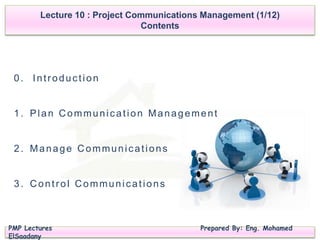
Contents
PMP Lectures Prepared By: Eng. Mohamed
ElSaadany
0. Introduction
1. Plan Communication Management
2. Manage Communications
3. Control Communications
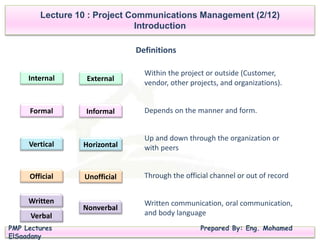
Within the project or outside (Customer,
vendor, other projects, and organizations).
Depends on the manner and form.
Up and down through the organization or
with peers
Through the official channel or out of record
Written communication, oral communication,
and body language
PMP Lectures Prepared By: Eng. Mohamed
ElSaadany
Definitions
Lecture 10 : Project Communications Management (2/12)
Introduction
Internal
Formal
Vertical
Official
External
Informal
Horizontal
Unofficial
Written
Nonverbal
Verbal
PMP Lectures Prepared By: Eng. Mohamed
ElSaadany
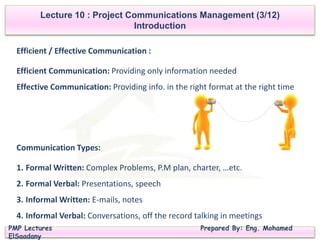
Efficient / Effective Communication :
Efficient Communication: Providing only information needed
Effective Communication: Providing info. in the right format at the right time
Lecture 10 : Project Communications Management (3/12)
Introduction
Communication Types:
1. Formal Written: Complex Problems, P.M plan, charter, …etc.
2. Formal Verbal: Presentations, speech
3. Informal Written: E-mails, notes
4. Informal Verbal: Conversations, off the record talking in meetings
PMP Lectures Prepared By: Eng. Mohamed
ElSaadany
Lecture 10 : Project Communications Management (4/12)
Introduction
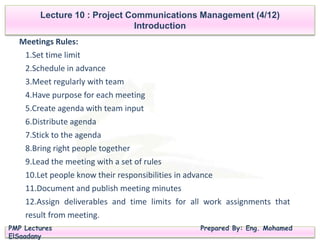
Meetings Rules:
1.Set time limit
2.Schedule in advance
3.Meet regularly with team
4.Have purpose for each meeting
5.Create agenda with team input
6.Distribute agenda
7.Stick to the agenda
8.Bring right people together
9.Lead the meeting with a set of rules
10.Let people know their responsibilities in advance
11.Document and publish meeting minutes
12.Assign deliverables and time limits for all work assignments that
result from meeting.
PMP Lectures Prepared By: Eng. Mohamed
ElSaadany
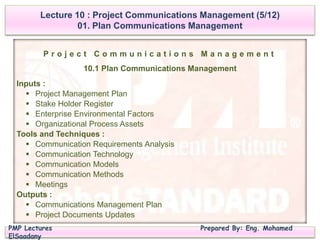
P r o j e c t C o m m u n i c a t i o n s M a n a g e m e n t
10.1 Plan Communications Management
Inputs :
 Project Management Plan
 Stake Holder Register
 Enterprise Environmental Factors
 Organizational Process Assets
Tools and Techniques :
 Communication Requirements Analysis
 Communication Technology
 Communication Models
 Communication Methods
 Meetings
Outputs :
 Communications Management Plan
 Project Documents Updates
Lecture 10 : Project Communications Management (5/12)
01. Plan Communications Management
PMP Lectures Prepared By: Eng. Mohamed
ElSaadany
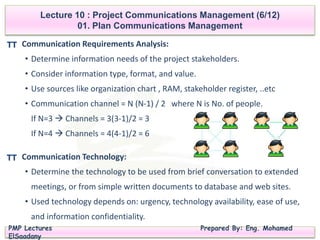
Communication Requirements Analysis:
• Determine information needs of the project stakeholders.
• Consider information type, format, and value.
• Use sources like organization chart , RAM, stakeholder register, ..etc
• Communication channel = N (N-1) / 2 where N is No. of people.
If N=3  Channels = 3(3-1)/2 = 3
If N=4  Channels = 4(4-1)/2 = 6
Lecture 10 : Project Communications Management (6/12)
01. Plan Communications Management
TT
Communication Technology:
• Determine the technology to be used from brief conversation to extended
meetings, or from simple written documents to database and web sites.
• Used technology depends on: urgency, technology availability, ease of use,
and information confidentiality.
TT
PMP Lectures Prepared By: Eng. Mohamed
ElSaadany
Lecture 10 : Project Communications Management (7/12)
01. Plan Communications Management
TT
Notes:
• For effective communication , sender should ask for feedback and receiver should
encode message carefully (listen/watch) and confirm it’s understood.
• 55% of communications are nonverbal (mannerism) ‫اسلوب‬
• Pitch and tone ‫الدرجة‬‫و‬‫النغمة‬ of voice (paralingual) ‫الخصائص‬‫الصوتية‬‫للحديث‬ help to
convey message. Paralingual examples include accent ‫نبرة‬ , time of voice, and speed
of speech.
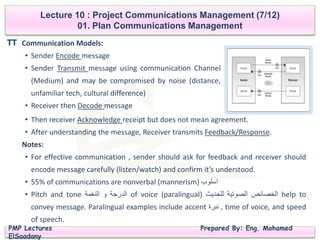
Communication Models:
• Sender Encode message
• Sender Transmit message using communication Channel
(Medium) and may be compromised by noise (distance,
unfamiliar tech, cultural difference)
• Receiver then Decode message
• Then receiver Acknowledge receipt but does not mean agreement.
• After understanding the message, Receiver transmits Feedback/Response.
PMP Lectures Prepared By: Eng. Mohamed
ElSaadany
Lecture 10 : Project Communications Management (8/12)
01. Plan Communications Management
TT Communication Methods:
1. Interactive Communication: Most efficient to ensure good
understanding. Ex: Phone calls, meetings, and virtual
conferences, … etc.
2. Push Communication: It’s a one way stream. Ex: Reports,
letters, memos, fax, mail, … etc.
3. Pull Communication: Recipient retrieve data from a central
location. Ex: Intranet, share, …etc.
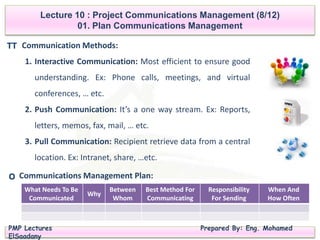
Communications Management Plan:
What Needs To Be
Communicated
Why
Between
Whom
Best Method For
Communicating
Responsibility
For Sending
When And
How Often
O
PMP Lectures Prepared By: Eng. Mohamed
ElSaadany
P r o j e c t C o m m u n i c a t i o n s M a n a g e m e n t
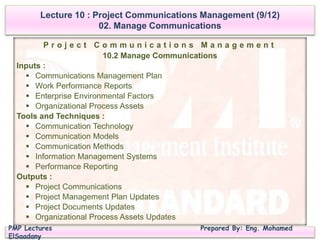
10.2 Manage Communications
Inputs :
 Communications Management Plan
 Work Performance Reports
 Enterprise Environmental Factors
 Organizational Process Assets
Tools and Techniques :
 Communication Technology
 Communication Models
 Communication Methods
 Information Management Systems
 Performance Reporting
Outputs :
 Project Communications
 Project Management Plan Updates
 Project Documents Updates
 Organizational Process Assets Updates
Lecture 10 : Project Communications Management (9/12)
02. Manage Communications
PMP Lectures Prepared By: Eng. Mohamed
ElSaadany
Lecture 10 : Project Communications Management (10/12)
02. Manage Communications
Information Management Systems:
The tools that will be used for managing and distributing information:
1. Hard-copy document management: Letters, memos, and reports.
2. Electronic communications management: Phone, e-mail, web conf.
3. Electronic PM Tools: Primavera web, PCM, Portals
TT
Performance Reporting:
• Types of Reports:
1. Status Reports: Performance Information (scope – time – cost – quality)
2. Forecast Report: Predict future status based on actual
3. Progress Report: What has been accomplished
4. Variance Report: Compare actual vs. baseline
5. Trend Report: Results over time
6. Earned Value Report
7. Lessons Learned Documentation
TT
PMP Lectures Prepared By: Eng. Mohamed
ElSaadany
P r o j e c t C o m m u n i c a t i o n s M a n a g e m e n t
10.3 Control Communications
Inputs :
 Project Management Plan
 Project Communications
 Issue Log
 Work Performance data
 Organizational Process Assets
Tools and Techniques :
 Information Management Systems
 Expert Judgment
 Meetings
Outputs :
 Work Performance Information
 Change Requests
 Project Management Plan Updates
 Project Documents Updates
 Organizational Process Assets Updates
Lecture 10 : Project Communications Management (11/12)
03. Control Communications
PMP Lectures Prepared By: Eng. Mohamed
ElSaadany
Lecture 10 : Project Communications Management (12/12)
03. Control Communications
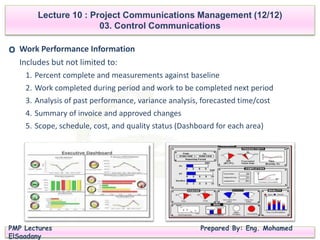
O Work Performance Information
Includes but not limited to:
1. Percent complete and measurements against baseline
2. Work completed during period and work to be completed next period
3. Analysis of past performance, variance analysis, forecasted time/cost
4. Summary of invoice and approved changes
5. Scope, schedule, cost, and quality status (Dashboard for each area)

PMP Preparation - 10 Communication Management

  • 1.
    Lecture 10 :Project Communications Management (1/12) Contents PMP Lectures Prepared By: Eng. Mohamed ElSaadany 0. Introduction 1. Plan Communication Management 2. Manage Communications 3. Control Communications
  • 2.
    Within the projector outside (Customer, vendor, other projects, and organizations). Depends on the manner and form. Up and down through the organization or with peers Through the official channel or out of record Written communication, oral communication, and body language PMP Lectures Prepared By: Eng. Mohamed ElSaadany Definitions Lecture 10 : Project Communications Management (2/12) Introduction Internal Formal Vertical Official External Informal Horizontal Unofficial Written Nonverbal Verbal
  • 3.
    PMP Lectures PreparedBy: Eng. Mohamed ElSaadany Efficient / Effective Communication : Efficient Communication: Providing only information needed Effective Communication: Providing info. in the right format at the right time Lecture 10 : Project Communications Management (3/12) Introduction Communication Types: 1. Formal Written: Complex Problems, P.M plan, charter, …etc. 2. Formal Verbal: Presentations, speech 3. Informal Written: E-mails, notes 4. Informal Verbal: Conversations, off the record talking in meetings
  • 4.
    PMP Lectures PreparedBy: Eng. Mohamed ElSaadany Lecture 10 : Project Communications Management (4/12) Introduction Meetings Rules: 1.Set time limit 2.Schedule in advance 3.Meet regularly with team 4.Have purpose for each meeting 5.Create agenda with team input 6.Distribute agenda 7.Stick to the agenda 8.Bring right people together 9.Lead the meeting with a set of rules 10.Let people know their responsibilities in advance 11.Document and publish meeting minutes 12.Assign deliverables and time limits for all work assignments that result from meeting.
  • 5.
    PMP Lectures PreparedBy: Eng. Mohamed ElSaadany P r o j e c t C o m m u n i c a t i o n s M a n a g e m e n t 10.1 Plan Communications Management Inputs :  Project Management Plan  Stake Holder Register  Enterprise Environmental Factors  Organizational Process Assets Tools and Techniques :  Communication Requirements Analysis  Communication Technology  Communication Models  Communication Methods  Meetings Outputs :  Communications Management Plan  Project Documents Updates Lecture 10 : Project Communications Management (5/12) 01. Plan Communications Management
  • 6.
    PMP Lectures PreparedBy: Eng. Mohamed ElSaadany Communication Requirements Analysis: • Determine information needs of the project stakeholders. • Consider information type, format, and value. • Use sources like organization chart , RAM, stakeholder register, ..etc • Communication channel = N (N-1) / 2 where N is No. of people. If N=3  Channels = 3(3-1)/2 = 3 If N=4  Channels = 4(4-1)/2 = 6 Lecture 10 : Project Communications Management (6/12) 01. Plan Communications Management TT Communication Technology: • Determine the technology to be used from brief conversation to extended meetings, or from simple written documents to database and web sites. • Used technology depends on: urgency, technology availability, ease of use, and information confidentiality. TT
  • 7.
    PMP Lectures PreparedBy: Eng. Mohamed ElSaadany Lecture 10 : Project Communications Management (7/12) 01. Plan Communications Management TT Notes: • For effective communication , sender should ask for feedback and receiver should encode message carefully (listen/watch) and confirm it’s understood. • 55% of communications are nonverbal (mannerism) ‫اسلوب‬ • Pitch and tone ‫الدرجة‬‫و‬‫النغمة‬ of voice (paralingual) ‫الخصائص‬‫الصوتية‬‫للحديث‬ help to convey message. Paralingual examples include accent ‫نبرة‬ , time of voice, and speed of speech. Communication Models: • Sender Encode message • Sender Transmit message using communication Channel (Medium) and may be compromised by noise (distance, unfamiliar tech, cultural difference) • Receiver then Decode message • Then receiver Acknowledge receipt but does not mean agreement. • After understanding the message, Receiver transmits Feedback/Response.
  • 8.
    PMP Lectures PreparedBy: Eng. Mohamed ElSaadany Lecture 10 : Project Communications Management (8/12) 01. Plan Communications Management TT Communication Methods: 1. Interactive Communication: Most efficient to ensure good understanding. Ex: Phone calls, meetings, and virtual conferences, … etc. 2. Push Communication: It’s a one way stream. Ex: Reports, letters, memos, fax, mail, … etc. 3. Pull Communication: Recipient retrieve data from a central location. Ex: Intranet, share, …etc. Communications Management Plan: What Needs To Be Communicated Why Between Whom Best Method For Communicating Responsibility For Sending When And How Often O
  • 9.
    PMP Lectures PreparedBy: Eng. Mohamed ElSaadany P r o j e c t C o m m u n i c a t i o n s M a n a g e m e n t 10.2 Manage Communications Inputs :  Communications Management Plan  Work Performance Reports  Enterprise Environmental Factors  Organizational Process Assets Tools and Techniques :  Communication Technology  Communication Models  Communication Methods  Information Management Systems  Performance Reporting Outputs :  Project Communications  Project Management Plan Updates  Project Documents Updates  Organizational Process Assets Updates Lecture 10 : Project Communications Management (9/12) 02. Manage Communications
  • 10.
    PMP Lectures PreparedBy: Eng. Mohamed ElSaadany Lecture 10 : Project Communications Management (10/12) 02. Manage Communications Information Management Systems: The tools that will be used for managing and distributing information: 1. Hard-copy document management: Letters, memos, and reports. 2. Electronic communications management: Phone, e-mail, web conf. 3. Electronic PM Tools: Primavera web, PCM, Portals TT Performance Reporting: • Types of Reports: 1. Status Reports: Performance Information (scope – time – cost – quality) 2. Forecast Report: Predict future status based on actual 3. Progress Report: What has been accomplished 4. Variance Report: Compare actual vs. baseline 5. Trend Report: Results over time 6. Earned Value Report 7. Lessons Learned Documentation TT
  • 11.
    PMP Lectures PreparedBy: Eng. Mohamed ElSaadany P r o j e c t C o m m u n i c a t i o n s M a n a g e m e n t 10.3 Control Communications Inputs :  Project Management Plan  Project Communications  Issue Log  Work Performance data  Organizational Process Assets Tools and Techniques :  Information Management Systems  Expert Judgment  Meetings Outputs :  Work Performance Information  Change Requests  Project Management Plan Updates  Project Documents Updates  Organizational Process Assets Updates Lecture 10 : Project Communications Management (11/12) 03. Control Communications
  • 12.
    PMP Lectures PreparedBy: Eng. Mohamed ElSaadany Lecture 10 : Project Communications Management (12/12) 03. Control Communications O Work Performance Information Includes but not limited to: 1. Percent complete and measurements against baseline 2. Work completed during period and work to be completed next period 3. Analysis of past performance, variance analysis, forecasted time/cost 4. Summary of invoice and approved changes 5. Scope, schedule, cost, and quality status (Dashboard for each area)