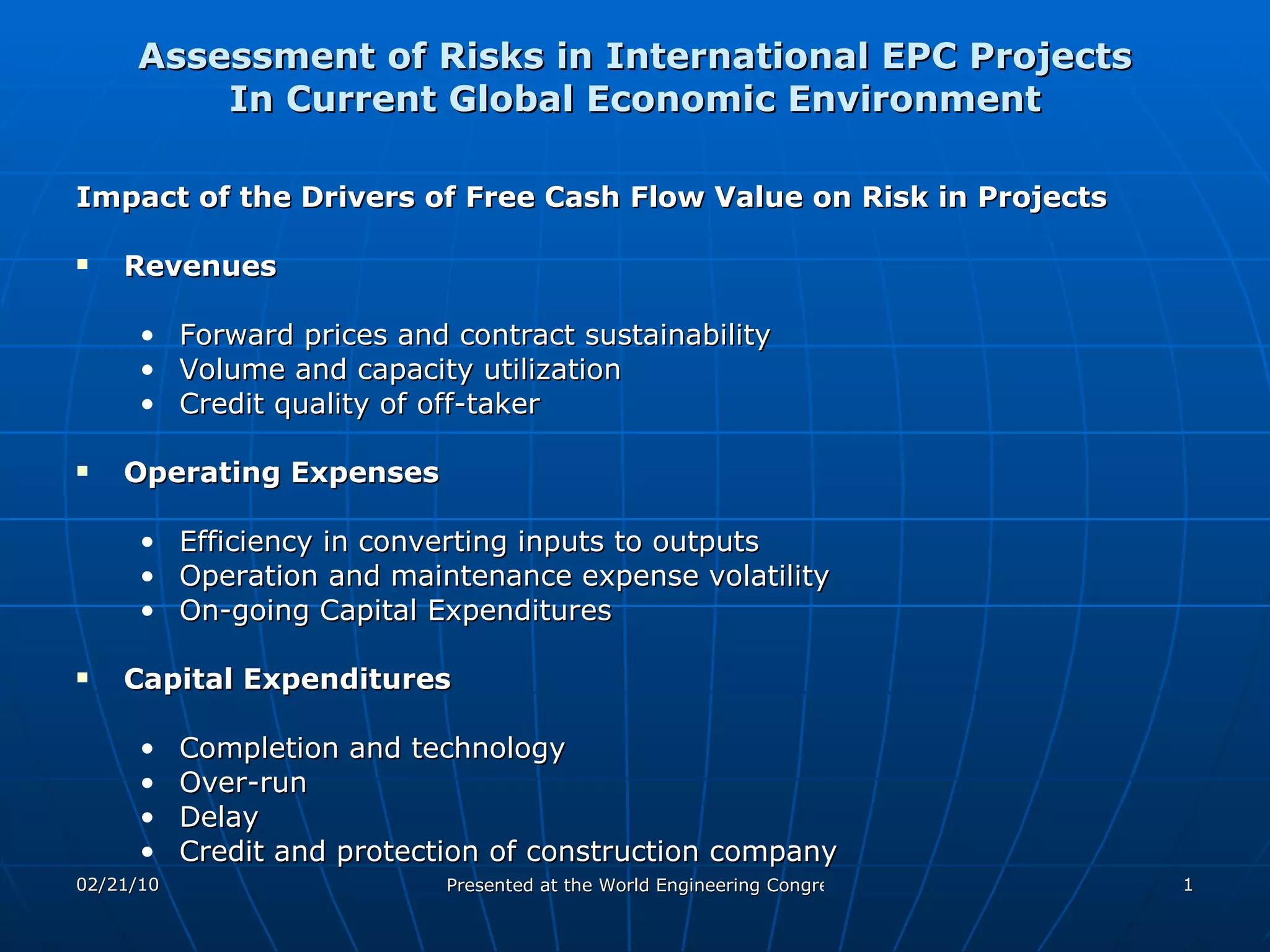
Assessment of Risks in International EPC Projects In Current Global Economic Environment Impact of the Drivers of Free Cash Flow Value on Risk in Projects Revenues Forward prices and contract sustainability Volume and capacity utilization Credit quality of off-taker Operating Expenses Efficiency in converting inputs to outputs Operation and maintenance expense volatility On-going Capital Expenditures Capital Expenditures Completion and technology Over-run Delay Credit and protection of construction company
Assessment of Risks in International EPC Projects In Current Global Economic Environment Classification of Risks – Free Cash Flow Project finance risk can be classified in a number of different ways.  One is the free cash flow items of  Construction Risk and Capital Expenditures Cost over-runs Construction delays Plant performance Commodity Price Risk Trends in prices over time Productivity Equilibrium long-run cost of production Upper and lower boundaries Volatility Volume Risk
Assessment of Risks in International EPC Projects In Current Global Economic Environment Approach to Risk Assessment  Capital expenditures and the construction phase Revenues in the operation phase Expenses in the operation phase In addressing failures, examine the mistakes that could have prevented the failure.
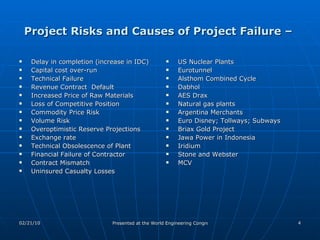
Project Risks and Causes of Project Failure –  Delay in completion (increase in IDC) Capital cost over-run Technical Failure Revenue Contract  Default Increased Price of Raw Materials Loss of Competitive Position Commodity Price Risk Volume Risk Overoptimistic Reserve Projections Exchange rate  Technical Obsolescence of Plant Financial Failure of Contractor Contract Mismatch Uninsured Casualty Losses US Nuclear Plants Eurotunnel Alsthom Combined Cycle Dabhol AES Drax Natural gas plants  Argentina Merchants Euro Disney; Tollways; Subways Briax Gold Project Jawa Power in Indonesia Iridium Stone and Webster MCV
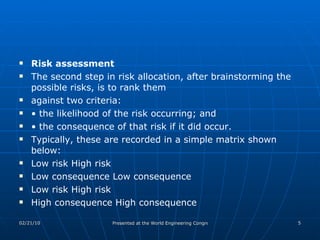
Risk assessment The second step in risk allocation, after brainstorming the possible risks, is to rank them against two criteria: •  the likelihood of the risk occurring; and •  the consequence of that risk if it did occur. Typically, these are recorded in a simple matrix shown below: Low risk High risk Low consequence Low consequence Low risk High risk High consequence High consequence
 
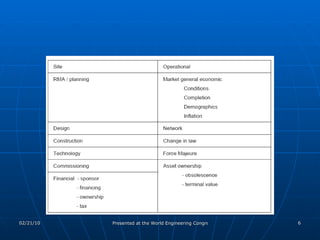
As you can see there are a range of operational risks and, while they are to an extent generic, assessing the project against the headings is a very useful starting point. We have already covered some of these and wanted to speak to three of these risks in the context of PPPs.
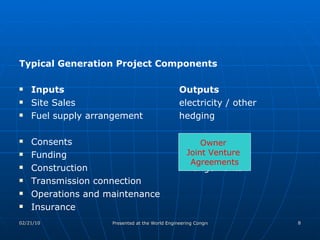
Typical Generation Project Components Inputs  Outputs Site Sales electricity / other Fuel supply arrangement hedging Consents Owner Funding Joint Venture  Construction Arrangements Transmission connection Operations and maintenance Insurance Owner  Joint Venture  Agreements
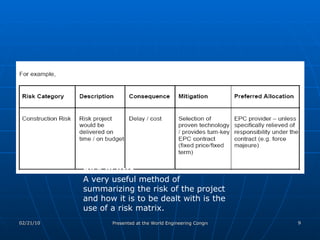
Risk matrix A very useful method of summarizing the risk of the project and how it is to be dealt with is the use of a risk matrix.
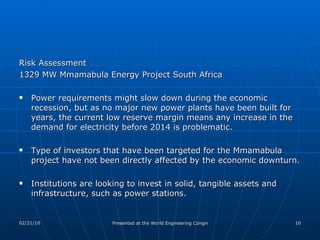
Risk Assessment  1329 MW Mmamabula Energy Project South Africa Power requirements might slow down during the economic recession, but as no major new power plants have been built for years, the current low reserve margin means any increase in the demand for electricity before 2014 is problematic. Type of investors that have been targeted for the Mmamabula project have not been directly affected by the economic downturn.  Institutions are looking to invest in solid, tangible assets and infrastructure, such as power stations.
 
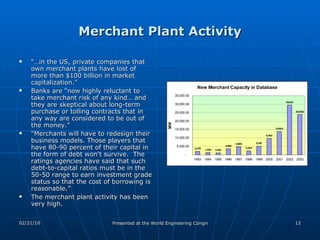
Merchant Plant Activity “… in the US, private companies that own merchant plants have lost of more than $100 billion in market capitalization.” Banks are “now highly reluctant to take merchant risk of any kind… and they are skeptical about long-term purchase or tolling contracts that in any way are considered to be out of the money.”  “ Merchants will have to redesign their business models. Those players that have 80-90 percent of their capital in the form of debt won't survive.  The ratings agencies have said that such debt-to-capital ratios must be in the 50-50 range to earn investment grade status so that the cost of borrowing is reasonable.”  The merchant plant activity has been very high.
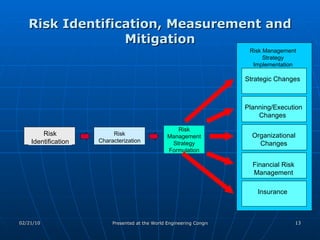
Risk Identification, Measurement and Mitigation Risk Management Strategy Formulation Risk Identification Risk Characterization Strategic Changes  Planning/Execution Changes  Financial Risk Management Insurance  Organizational Changes Risk Management Strategy Implementation
Risks Present Even with EPC Contract Construction contracts cannot eliminate all risk to a project. Some residual level of risk generally remains force majeure change-of-law events change orders By definition, the vendor and contractor cannot control such events.  Better projects, especially heavily leveraged, high fixed cost ones, will seek to minimize these risks through insurance or sovereign guarantees and provisions to renegotiate tariff cost-offsetting provisions of power purchase agreements.
Evaluation of Feasibility Study and Independent Engineer Report – Standard and Poor’s (Reference) Independent engineer's evaluation about the adequacy of contingencies for schedule and budget, and related assumptions.  Evaluate performance requirements and incentives for the construction contractors along with the financial and technical capacity of the contractors to perform on these contracts.  For newer technologies, evaluate whether the contractor has significant experience working with that technology and whether the contractor has worked in the host country.  A project having a legal structure that includes construction monitoring by an expert third party, such as an independent engineer, enhances construction surveillance by providing systematic oversight.  Monitor surveillance of work in progress with the independent engineer to establish the predictability of the remaining construction schedule.
Risk Analysis in AES Drax Revenue Risk UK Electric Prices Contract with TXU Europe Volume – Capacity Factor Risk Construction Risk Simulate Costs of Alternative Projects Operating Expense Risk Coal and Natural Gas Prices Heat Rates  Other Operating Expenses
Problems with PPA’s in Asia Some countries have encouraged joint ventures with the private sector. (China, India and Singapore) Some countries have part privatised through floats (IPO’s) and stock market listing (Malaysia & China) IPP’s with long term PPA’s have added a substantial stock of generators to DC’s (Pakistan, the Philippines, India, Malaysia, Thailand, Indonesia)  Some PPA’s featured high prices for a variety of reasons (Pakistan, India, Indonesia, Philippines)
Contract Risk and Dahbol Investment in a $3 billion, 10-year liquefied natural gas power plant development project, the largest development project and the single largest direct foreign investment in India’s history. Begun in 1992, the Dabhol power plant near India’s financial capital of Bombay in Maharashtra state was to have gone online by 1997. It was supposed to supply energy-hungry India with more than 2,000 megawatts of electricity, about one-fifth the new energy needed by India each year. In a joint venture with U.S. companies General Electric and Bechtel, Enron created an Indian subsidiary, Dabhol Power Co. DPC, which was 65 percent owned by Enron, was to build the power plant. Enron was to develop and operate the plant. Bechtel was to design and construct it, with GE supplying the equipment. Enron brokered a deal with Qatar to provide the Dabhol plant 2.5 million tons of liquefied natural gas per year for 25 years, starting in 1997.
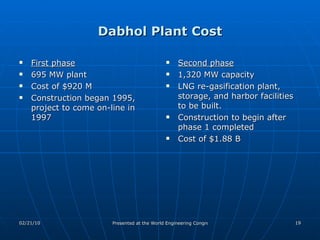
Dabhol Plant Cost First phase 695 MW plant Cost of $920 M Construction began 1995, project to come on-line in 1997 Second phase 1,320 MW capacity LNG re-gasification plant, storage, and harbor facilities to be built. Construction to begin after phase 1 completed Cost of $1.88 B
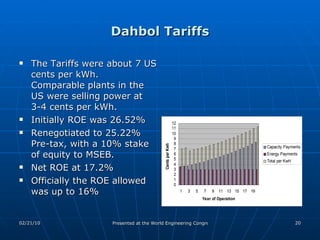
Dahbol Tariffs The Tariffs were about 7 US cents per kWh.  Comparable plants in the US were selling power at 3-4 cents per kWh. Initially ROE was 26.52% Renegotiated to 25.22% Pre-tax, with a 10% stake of equity to MSEB. Net ROE at 17.2% Officially the ROE allowed was up to 16%
Contract Off-taker Risk and Dahbol Endless disputes over prices and terms of the deal turned the venture into a symbol of what can go wrong in large-scale development projects when cultures collide. In April 1993, a World Bank analysis questioned the project's economic viability, citing the high cost of importing and using liquefied natural gas relative to other domestic sources of fuels. Because of those findings, the World Bank refused to provide funds for the project.  "Price is becoming a sticky issue," the Financial Times reported. "Indian officials see the price as very high compared to domestic gas and imported and indigenous alternative fuels."  Protesters took to the streets to support demands for changes in the plant's design and -- more broadly -- to oppose the Indian government’s economic liberalization policies. Social activists, lawyers, villagers and farmers banded together in groups opposed to the Enron project.  The devaluation meant that Dabhol's energy prices would soar to between two and five times the average price in the area.
Cost Risk Management Sponsors projects mitigate supply risk through several strategies.  Some enter into commodity supply contracts (indexed to the product price) coterminous with the debt.  Second, transportation arrangements for the commodity should evidence a high level of dependability, with the transportation agreements again being coterminous with the debt.  Perhaps the best strategy uses a complete pass-through of supply costs to the purchaser. This strategy, however, places the buyer at risk of a price shock if the commodity's price should suddenly increase.
Cost Risk Management Projects can either hedge supply risk, or transfer it to an entity with the means and willingness to assume the project's output price risk.  The commodity supply markets in the U.S. and the U.K., are sufficiently liquid to support credible risk management strategies.  A U.K.-based sponsor may partially hedge its natural gas fuel supply price risk through fixed price-volume contracts or derivative products The sponsor will demonstrate the ability and experience to engage in these complex risk management strategies.
Risks Remaining in Supply Contracts (S&P) Although a project may contractually receive fixed payments that cover its debt obligations, project input or supply arrangements, such as for fuel, ash disposal and water, may expose the project (and bondholders) at risk as regards those contracts' price and volume arrangements.  If the buyer's obligation to pay a fixed price under the offtake contract is contingent on the project's availability and a disruption in fuel or other supply commodity occurs to make the project not available, if the disruption extends over a period of time with the result that the buyer is not contractually required to make fixed payments under the offtake agreement the project may not have sufficient revenues to pay debt service on the bonds.  Another risk to bondholders arises from the potential narrowing of the spread between supply prices and project product prices.
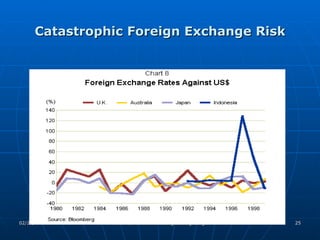
Catastrophic Foreign Exchange Risk
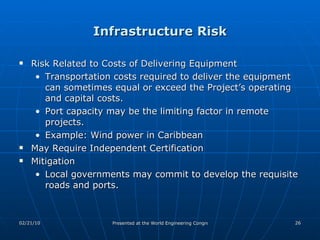
Infrastructure Risk Risk Related to Costs of Delivering Equipment Transportation costs required to deliver the equipment can sometimes equal or exceed the Project’s operating and capital costs.  Port capacity may be the limiting factor in remote projects. Example: Wind power in Caribbean May Require Independent Certification Mitigation Local governments may commit to develop the requisite roads and ports.
Analysis of Residual Risks
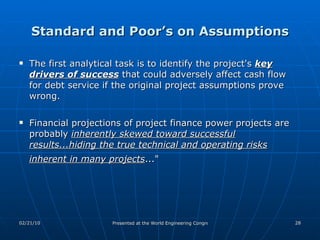
Standard and Poor’s on Assumptions The first analytical task is to identify the project's  key drivers of success  that could adversely affect cash flow for debt service if the original project assumptions prove wrong.  Financial projections of project finance power projects are probably  inherently skewed toward successful results...hiding the true technical and operating risks inherent in many projects ..."
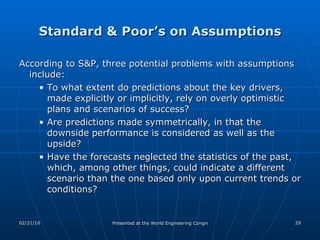
Standard & Poor’s on Assumptions According to S&P, three potential problems with assumptions include: To what extent do predictions about the key drivers, made explicitly or implicitly, rely on overly optimistic plans and scenarios of success? Are predictions made symmetrically, in that the downside performance is considered as well as the upside? Have the forecasts neglected the statistics of the past, which, among other things, could indicate a different scenario than the one based only upon current trends or conditions?
Three Risk Analysis Techniques with Project Finance Models Traditional methods of using a project finance model with expert judgement to assess the risk include break-even analysis, scenario analysis and sensitivity analysis: Sensitivity analysis Evaluates how the credit quality and value is affected by changing single variables.  Scenario analysis Measures the ability to service debt and generate cash flow under a comprehensive set of assumptions for market prices, fuel costs, plant availability and other variables.  Break-even analysis  Tests how much worse a variable can become before a default or non-payment of debt occurs.  Break-even analysis can be applied to the minimum debt service coverage ratio or the amount of debt outstanding at the end of the life of a project.
Sensitivity Analysis and Scenario Analysis (Reference) Sensitivity Analysis Simple sensitivities to potential changes in fuel prices, project availability, mechanical efficiency, inflation, and O&M costs usually sufficed to measure financial risk.  Too simplistic and thus, may not capture a project's financial risk. Because sensitivity analysis only tests a projects' response to one variable, it ignores the multidimensional reality of business and, therefore, may ignore the full range of uncertainty. Still worse, sensitivity analysis may elevate pinhole risks, and their usual attendant dire consequences, to levels that needlessly dominate the credit analysis.  Scenario Analysis Scenario analysis collectively considers a number of variables and their potential values that a project could face through its debt maturity. A good collection of project scenarios, when placed into the project's financial model, will explore the various, and sometimes complex, linkages and correlations among variables, such as interest rates, inflation, foreign exchange, product price, or cost of production in some industries. Assess the long-term drivers of profitability in the project's industry, as well as the specific project, and identify the critical uncertainties. Develop several scenarios based on those uncertainties, asses their relative likelihood of occurrence, and then determine how robust or weak the project is under varying economic and market conditions.
Rating Agency Comments on Risk Analysis with Models Fitch The object is to determine if the project is likely to continue to cover operating expenses and debt interest and principal payments despite unexpected stress levels. The scenarios also reveal whether there are particular variables to which the project has a greater degree of sensitivity. The evaluation of the stress scenario results is focused on the  minimum debt service coverage  in any single year and the average debt service coverage over the entire life of the debt. If the cash flows are unable to cover payments on project debt under certain stress scenarios, the debt service reserve or other forms of credit enhancement available to the project are applied. Thus, [sensitivity analysis] can be used to size the appropriate debt service reserve or other credit enhancements needed to avoid default under adverse scenarios.  Fitch performs sensitivity analyses that stress cash flows down to a break-even level to see how the project performs under extreme hardship conditions and at what minimum power price the project can perform while covering operating costs and debt service payments.
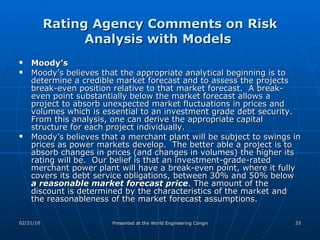
Rating Agency Comments on Risk Analysis with Models  Moody’s Moody’s believes that the appropriate analytical beginning is to determine a credible market forecast and to assess the projects break-even position relative to that market forecast.  A break-even point substantially below the market forecast allows a project to absorb unexpected market fluctuations in prices and volumes which is essential to an investment grade debt security. From this analysis, one can derive the appropriate capital structure for each project individually. Moody’s believes that a merchant plant will be subject to swings in prices as power markets develop.  The better able a project is to absorb changes in prices (and changes in volumes) the higher its rating will be.  Our belief is that an investment-grade-rated merchant power plant will have a break-even point, where it fully covers its debt service obligations, between 30% and 50% below  a reasonable market forecast price . The amount of the discount is determined by the characteristics of the market and the reasonableness of the market forecast assumptions.
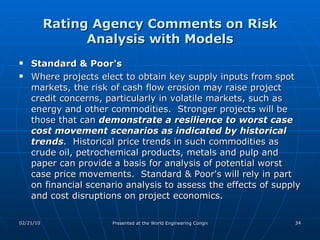
Rating Agency Comments on Risk Analysis with Models Standard & Poor's Where projects elect to obtain key supply inputs from spot markets, the risk of cash flow erosion may raise project credit concerns, particularly in volatile markets, such as energy and other commodities.  Stronger projects will be those that can  demonstrate a resilience to worst case cost movement scenarios as indicated by historical trends .  Historical price trends in such commodities as crude oil, petrochemical products, metals and pulp and paper can provide a basis for analysis of potential worst case price movements.  Standard & Poor's will rely in part on financial scenario analysis to assess the effects of supply and cost disruptions on project economics.
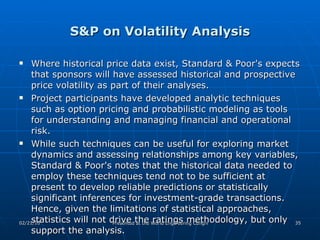
S&P on Volatility Analysis Where historical price data exist, Standard & Poor's expects that sponsors will have assessed historical and prospective price volatility as part of their analyses.  Project participants have developed analytic techniques such as option pricing and probabilistic modeling as tools for understanding and managing financial and operational risk.  While such techniques can be useful for exploring market dynamics and assessing relationships among key variables, Standard & Poor's notes that the historical data needed to employ these techniques tend not to be sufficient at present to develop reliable predictions or statistically significant inferences for investment-grade transactions. Hence, given the limitations of statistical approaches, statistics will not drive the ratings methodology, but only support the analysis.
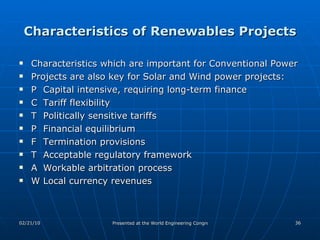
Characteristics of Renewables Projects Characteristics which are important for Conventional Power Projects are also key for Solar and Wind power projects: 􀀁 Capital intensive, requiring long-term finance 􀀁 Tariff flexibility 􀀁 Politically sensitive tariffs 􀀁 Financial equilibrium 􀀁 Termination provisions 􀀁 Acceptable regulatory framework 􀀁 Workable arbitration process 􀀁 Local currency revenues
No Single Model for Wind Power Projects Types of Financing Models: – Project Finance – Holding Company Investments 􀀁 Type of Projects: – Greenfield project/expansion of existing facilities – Privatization/expansion – Concession-based/BOT/Sponsor-owned – Local sponsors/foreign sponsors/join ventures – Public-Private partnerships
Risk Assessment Methods with Project Finance Models Methods of Risk Assessment Using judgmental assessments Sensitivity analysis Scenario analysis Stress test analysis Break-even analysis Using mathematical analysis Volatility Monte Carlo simulation Value at Risk
Assessment of Risks in International EPC Projects In Current Global Economic Environment Moody’s Comments on Risk Classification and Assessment The analysis of project finance transactions is a complex procedure.  Risks analyzed include  Economic risk,  Construction,  Operating Technology risk Legal Political Regulatory risk.  Frequently, the participants in each transaction analyze such risks in minute detail and put in place structural enhancements that seek to mitigate them.
Assessment of Risks in International EPC Projects In Current Global Economic Environment S&P Categorization of Six Risks Evaluate project  operational and financing contracts  that, along with the project's physical plant, serve as the basis of the project enterprise;  Assess the  technology and performance  of the project enterprise; Analyze the  competitive position  of the project;  Determine the risk that  counterparties  present to the project enterprise; Appraise the project's  legal structure ; and  Evaluate the  financial risks  that may affect forecast results.
Assessment of Risks in International EPC Projects In Current Global Economic Environment Contractors initially welcomed the lion’s share of risk on EPC projects in return for the significant profit potential that could be derived from having simultaneous  control over  design,  procurement, and  construction  and any resulting efficiencies in  cost  schedule.  Over time, however, owners began to demand   an increased role in the design process,  heightened fast-track completion requirements,  enhanced performance guaranties  -with no corresponding assumption of risk.
Assessment of Risks in International EPC Projects In Current Global Economic Environment Risks associated with third-party technology and equipment   supplied by owner equipment manufacturers (OEMs)  increasingly shifted to the contractor. Contractors bid on EPC projects where they were   unable to adequately utilize value engineering innovate to balance increase in accepted risk.
Assessment of Risks in International EPC Projects In Current Global Economic Environment Profit margins declined,   Owner penalties  increased,    EPC contractors were caught in the squeeze.  Not surprisingly, contractors met the increase in risk with higher pricing, thereby  depriving owners of the cost savings EPC projects were intended to provide.  Even worse,  the incidence of disputes soared,  often followed by protracted and costly litigation.
Assessment of Risks in International EPC Projects In Current Global Economic Environment A recent survey of construction trends in Power Plants in US, Europe and Asia (Middle East) by (BASmS) Business Advisory Services management Solutions  found that there has been a significant  Increase in construction related disputes over the past few months The survey also found that the disputes were much more prevalent on complex projects costing more than$500 million
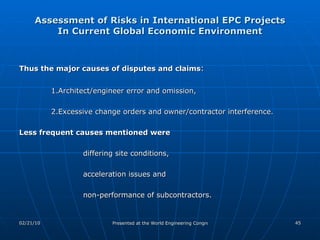
Assessment of Risks in International EPC Projects In Current Global Economic Environment Thus the major causes of disputes and claims :  1.Architect/engineer error and omission,  2.Excessive change orders and owner/contractor interference.  Less frequent causes mentioned were  differing site conditions,  acceleration issues and  non-performance of subcontractors.
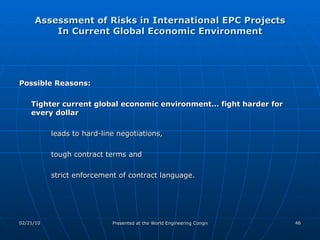
Assessment of Risks in International EPC Projects In Current Global Economic Environment Possible Reasons: Tighter current global economic environment… fight harder for every dollar   leads to hard-line negotiations,  tough contract terms and  strict enforcement of contract language.
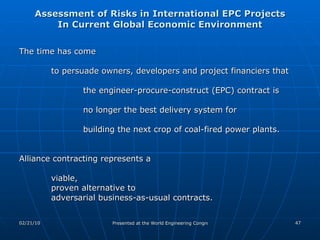
Assessment of Risks in International EPC Projects In Current Global Economic Environment The time has come  to persuade owners, developers and project financiers that  the engineer-procure-construct (EPC) contract is  no longer the best delivery system for building the next crop of coal-fired power plants. Alliance contracting represents a  viable,  proven alternative to adversarial business-as-usual contracts.

Assessment of Risks in International EPC Projects Reference Current Global Economic Environment

  • 1.
    Assessment of Risksin International EPC Projects In Current Global Economic Environment Impact of the Drivers of Free Cash Flow Value on Risk in Projects Revenues Forward prices and contract sustainability Volume and capacity utilization Credit quality of off-taker Operating Expenses Efficiency in converting inputs to outputs Operation and maintenance expense volatility On-going Capital Expenditures Capital Expenditures Completion and technology Over-run Delay Credit and protection of construction company
  • 2.
    Assessment of Risksin International EPC Projects In Current Global Economic Environment Classification of Risks – Free Cash Flow Project finance risk can be classified in a number of different ways. One is the free cash flow items of Construction Risk and Capital Expenditures Cost over-runs Construction delays Plant performance Commodity Price Risk Trends in prices over time Productivity Equilibrium long-run cost of production Upper and lower boundaries Volatility Volume Risk
  • 3.
    Assessment of Risksin International EPC Projects In Current Global Economic Environment Approach to Risk Assessment Capital expenditures and the construction phase Revenues in the operation phase Expenses in the operation phase In addressing failures, examine the mistakes that could have prevented the failure.
  • 4.
    Project Risks andCauses of Project Failure – Delay in completion (increase in IDC) Capital cost over-run Technical Failure Revenue Contract Default Increased Price of Raw Materials Loss of Competitive Position Commodity Price Risk Volume Risk Overoptimistic Reserve Projections Exchange rate Technical Obsolescence of Plant Financial Failure of Contractor Contract Mismatch Uninsured Casualty Losses US Nuclear Plants Eurotunnel Alsthom Combined Cycle Dabhol AES Drax Natural gas plants Argentina Merchants Euro Disney; Tollways; Subways Briax Gold Project Jawa Power in Indonesia Iridium Stone and Webster MCV
  • 5.
    Risk assessment Thesecond step in risk allocation, after brainstorming the possible risks, is to rank them against two criteria: • the likelihood of the risk occurring; and • the consequence of that risk if it did occur. Typically, these are recorded in a simple matrix shown below: Low risk High risk Low consequence Low consequence Low risk High risk High consequence High consequence
  • 6.
  • 7.
    As you cansee there are a range of operational risks and, while they are to an extent generic, assessing the project against the headings is a very useful starting point. We have already covered some of these and wanted to speak to three of these risks in the context of PPPs.
  • 8.
    Typical Generation ProjectComponents Inputs Outputs Site Sales electricity / other Fuel supply arrangement hedging Consents Owner Funding Joint Venture Construction Arrangements Transmission connection Operations and maintenance Insurance Owner Joint Venture Agreements
  • 9.
    Risk matrix Avery useful method of summarizing the risk of the project and how it is to be dealt with is the use of a risk matrix.
  • 10.
    Risk Assessment 1329 MW Mmamabula Energy Project South Africa Power requirements might slow down during the economic recession, but as no major new power plants have been built for years, the current low reserve margin means any increase in the demand for electricity before 2014 is problematic. Type of investors that have been targeted for the Mmamabula project have not been directly affected by the economic downturn. Institutions are looking to invest in solid, tangible assets and infrastructure, such as power stations.
  • 11.
  • 12.
    Merchant Plant Activity“… in the US, private companies that own merchant plants have lost of more than $100 billion in market capitalization.” Banks are “now highly reluctant to take merchant risk of any kind… and they are skeptical about long-term purchase or tolling contracts that in any way are considered to be out of the money.” “ Merchants will have to redesign their business models. Those players that have 80-90 percent of their capital in the form of debt won't survive. The ratings agencies have said that such debt-to-capital ratios must be in the 50-50 range to earn investment grade status so that the cost of borrowing is reasonable.” The merchant plant activity has been very high.
  • 13.
    Risk Identification, Measurementand Mitigation Risk Management Strategy Formulation Risk Identification Risk Characterization Strategic Changes Planning/Execution Changes Financial Risk Management Insurance Organizational Changes Risk Management Strategy Implementation
  • 14.
    Risks Present Evenwith EPC Contract Construction contracts cannot eliminate all risk to a project. Some residual level of risk generally remains force majeure change-of-law events change orders By definition, the vendor and contractor cannot control such events. Better projects, especially heavily leveraged, high fixed cost ones, will seek to minimize these risks through insurance or sovereign guarantees and provisions to renegotiate tariff cost-offsetting provisions of power purchase agreements.
  • 15.
    Evaluation of FeasibilityStudy and Independent Engineer Report – Standard and Poor’s (Reference) Independent engineer's evaluation about the adequacy of contingencies for schedule and budget, and related assumptions. Evaluate performance requirements and incentives for the construction contractors along with the financial and technical capacity of the contractors to perform on these contracts. For newer technologies, evaluate whether the contractor has significant experience working with that technology and whether the contractor has worked in the host country. A project having a legal structure that includes construction monitoring by an expert third party, such as an independent engineer, enhances construction surveillance by providing systematic oversight. Monitor surveillance of work in progress with the independent engineer to establish the predictability of the remaining construction schedule.
  • 16.
    Risk Analysis inAES Drax Revenue Risk UK Electric Prices Contract with TXU Europe Volume – Capacity Factor Risk Construction Risk Simulate Costs of Alternative Projects Operating Expense Risk Coal and Natural Gas Prices Heat Rates Other Operating Expenses
  • 17.
    Problems with PPA’sin Asia Some countries have encouraged joint ventures with the private sector. (China, India and Singapore) Some countries have part privatised through floats (IPO’s) and stock market listing (Malaysia & China) IPP’s with long term PPA’s have added a substantial stock of generators to DC’s (Pakistan, the Philippines, India, Malaysia, Thailand, Indonesia) Some PPA’s featured high prices for a variety of reasons (Pakistan, India, Indonesia, Philippines)
  • 18.
    Contract Risk andDahbol Investment in a $3 billion, 10-year liquefied natural gas power plant development project, the largest development project and the single largest direct foreign investment in India’s history. Begun in 1992, the Dabhol power plant near India’s financial capital of Bombay in Maharashtra state was to have gone online by 1997. It was supposed to supply energy-hungry India with more than 2,000 megawatts of electricity, about one-fifth the new energy needed by India each year. In a joint venture with U.S. companies General Electric and Bechtel, Enron created an Indian subsidiary, Dabhol Power Co. DPC, which was 65 percent owned by Enron, was to build the power plant. Enron was to develop and operate the plant. Bechtel was to design and construct it, with GE supplying the equipment. Enron brokered a deal with Qatar to provide the Dabhol plant 2.5 million tons of liquefied natural gas per year for 25 years, starting in 1997.
  • 19.
    Dabhol Plant CostFirst phase 695 MW plant Cost of $920 M Construction began 1995, project to come on-line in 1997 Second phase 1,320 MW capacity LNG re-gasification plant, storage, and harbor facilities to be built. Construction to begin after phase 1 completed Cost of $1.88 B
  • 20.
    Dahbol Tariffs TheTariffs were about 7 US cents per kWh. Comparable plants in the US were selling power at 3-4 cents per kWh. Initially ROE was 26.52% Renegotiated to 25.22% Pre-tax, with a 10% stake of equity to MSEB. Net ROE at 17.2% Officially the ROE allowed was up to 16%
  • 21.
    Contract Off-taker Riskand Dahbol Endless disputes over prices and terms of the deal turned the venture into a symbol of what can go wrong in large-scale development projects when cultures collide. In April 1993, a World Bank analysis questioned the project's economic viability, citing the high cost of importing and using liquefied natural gas relative to other domestic sources of fuels. Because of those findings, the World Bank refused to provide funds for the project. "Price is becoming a sticky issue," the Financial Times reported. "Indian officials see the price as very high compared to domestic gas and imported and indigenous alternative fuels." Protesters took to the streets to support demands for changes in the plant's design and -- more broadly -- to oppose the Indian government’s economic liberalization policies. Social activists, lawyers, villagers and farmers banded together in groups opposed to the Enron project. The devaluation meant that Dabhol's energy prices would soar to between two and five times the average price in the area.
  • 22.
    Cost Risk ManagementSponsors projects mitigate supply risk through several strategies. Some enter into commodity supply contracts (indexed to the product price) coterminous with the debt. Second, transportation arrangements for the commodity should evidence a high level of dependability, with the transportation agreements again being coterminous with the debt. Perhaps the best strategy uses a complete pass-through of supply costs to the purchaser. This strategy, however, places the buyer at risk of a price shock if the commodity's price should suddenly increase.
  • 23.
    Cost Risk ManagementProjects can either hedge supply risk, or transfer it to an entity with the means and willingness to assume the project's output price risk. The commodity supply markets in the U.S. and the U.K., are sufficiently liquid to support credible risk management strategies. A U.K.-based sponsor may partially hedge its natural gas fuel supply price risk through fixed price-volume contracts or derivative products The sponsor will demonstrate the ability and experience to engage in these complex risk management strategies.
  • 24.
    Risks Remaining inSupply Contracts (S&P) Although a project may contractually receive fixed payments that cover its debt obligations, project input or supply arrangements, such as for fuel, ash disposal and water, may expose the project (and bondholders) at risk as regards those contracts' price and volume arrangements. If the buyer's obligation to pay a fixed price under the offtake contract is contingent on the project's availability and a disruption in fuel or other supply commodity occurs to make the project not available, if the disruption extends over a period of time with the result that the buyer is not contractually required to make fixed payments under the offtake agreement the project may not have sufficient revenues to pay debt service on the bonds. Another risk to bondholders arises from the potential narrowing of the spread between supply prices and project product prices.
  • 25.
  • 26.
    Infrastructure Risk RiskRelated to Costs of Delivering Equipment Transportation costs required to deliver the equipment can sometimes equal or exceed the Project’s operating and capital costs. Port capacity may be the limiting factor in remote projects. Example: Wind power in Caribbean May Require Independent Certification Mitigation Local governments may commit to develop the requisite roads and ports.
  • 27.
  • 28.
    Standard and Poor’son Assumptions The first analytical task is to identify the project's key drivers of success that could adversely affect cash flow for debt service if the original project assumptions prove wrong. Financial projections of project finance power projects are probably inherently skewed toward successful results...hiding the true technical and operating risks inherent in many projects ..."
  • 29.
    Standard & Poor’son Assumptions According to S&P, three potential problems with assumptions include: To what extent do predictions about the key drivers, made explicitly or implicitly, rely on overly optimistic plans and scenarios of success? Are predictions made symmetrically, in that the downside performance is considered as well as the upside? Have the forecasts neglected the statistics of the past, which, among other things, could indicate a different scenario than the one based only upon current trends or conditions?
  • 30.
    Three Risk AnalysisTechniques with Project Finance Models Traditional methods of using a project finance model with expert judgement to assess the risk include break-even analysis, scenario analysis and sensitivity analysis: Sensitivity analysis Evaluates how the credit quality and value is affected by changing single variables. Scenario analysis Measures the ability to service debt and generate cash flow under a comprehensive set of assumptions for market prices, fuel costs, plant availability and other variables. Break-even analysis Tests how much worse a variable can become before a default or non-payment of debt occurs. Break-even analysis can be applied to the minimum debt service coverage ratio or the amount of debt outstanding at the end of the life of a project.
  • 31.
    Sensitivity Analysis andScenario Analysis (Reference) Sensitivity Analysis Simple sensitivities to potential changes in fuel prices, project availability, mechanical efficiency, inflation, and O&M costs usually sufficed to measure financial risk. Too simplistic and thus, may not capture a project's financial risk. Because sensitivity analysis only tests a projects' response to one variable, it ignores the multidimensional reality of business and, therefore, may ignore the full range of uncertainty. Still worse, sensitivity analysis may elevate pinhole risks, and their usual attendant dire consequences, to levels that needlessly dominate the credit analysis. Scenario Analysis Scenario analysis collectively considers a number of variables and their potential values that a project could face through its debt maturity. A good collection of project scenarios, when placed into the project's financial model, will explore the various, and sometimes complex, linkages and correlations among variables, such as interest rates, inflation, foreign exchange, product price, or cost of production in some industries. Assess the long-term drivers of profitability in the project's industry, as well as the specific project, and identify the critical uncertainties. Develop several scenarios based on those uncertainties, asses their relative likelihood of occurrence, and then determine how robust or weak the project is under varying economic and market conditions.
  • 32.
    Rating Agency Commentson Risk Analysis with Models Fitch The object is to determine if the project is likely to continue to cover operating expenses and debt interest and principal payments despite unexpected stress levels. The scenarios also reveal whether there are particular variables to which the project has a greater degree of sensitivity. The evaluation of the stress scenario results is focused on the minimum debt service coverage in any single year and the average debt service coverage over the entire life of the debt. If the cash flows are unable to cover payments on project debt under certain stress scenarios, the debt service reserve or other forms of credit enhancement available to the project are applied. Thus, [sensitivity analysis] can be used to size the appropriate debt service reserve or other credit enhancements needed to avoid default under adverse scenarios. Fitch performs sensitivity analyses that stress cash flows down to a break-even level to see how the project performs under extreme hardship conditions and at what minimum power price the project can perform while covering operating costs and debt service payments.
  • 33.
    Rating Agency Commentson Risk Analysis with Models Moody’s Moody’s believes that the appropriate analytical beginning is to determine a credible market forecast and to assess the projects break-even position relative to that market forecast. A break-even point substantially below the market forecast allows a project to absorb unexpected market fluctuations in prices and volumes which is essential to an investment grade debt security. From this analysis, one can derive the appropriate capital structure for each project individually. Moody’s believes that a merchant plant will be subject to swings in prices as power markets develop. The better able a project is to absorb changes in prices (and changes in volumes) the higher its rating will be. Our belief is that an investment-grade-rated merchant power plant will have a break-even point, where it fully covers its debt service obligations, between 30% and 50% below a reasonable market forecast price . The amount of the discount is determined by the characteristics of the market and the reasonableness of the market forecast assumptions.
  • 34.
    Rating Agency Commentson Risk Analysis with Models Standard & Poor's Where projects elect to obtain key supply inputs from spot markets, the risk of cash flow erosion may raise project credit concerns, particularly in volatile markets, such as energy and other commodities. Stronger projects will be those that can demonstrate a resilience to worst case cost movement scenarios as indicated by historical trends . Historical price trends in such commodities as crude oil, petrochemical products, metals and pulp and paper can provide a basis for analysis of potential worst case price movements. Standard & Poor's will rely in part on financial scenario analysis to assess the effects of supply and cost disruptions on project economics.
  • 35.
    S&P on VolatilityAnalysis Where historical price data exist, Standard & Poor's expects that sponsors will have assessed historical and prospective price volatility as part of their analyses. Project participants have developed analytic techniques such as option pricing and probabilistic modeling as tools for understanding and managing financial and operational risk. While such techniques can be useful for exploring market dynamics and assessing relationships among key variables, Standard & Poor's notes that the historical data needed to employ these techniques tend not to be sufficient at present to develop reliable predictions or statistically significant inferences for investment-grade transactions. Hence, given the limitations of statistical approaches, statistics will not drive the ratings methodology, but only support the analysis.
  • 36.
    Characteristics of RenewablesProjects Characteristics which are important for Conventional Power Projects are also key for Solar and Wind power projects: 􀀁 Capital intensive, requiring long-term finance 􀀁 Tariff flexibility 􀀁 Politically sensitive tariffs 􀀁 Financial equilibrium 􀀁 Termination provisions 􀀁 Acceptable regulatory framework 􀀁 Workable arbitration process 􀀁 Local currency revenues
  • 37.
    No Single Modelfor Wind Power Projects Types of Financing Models: – Project Finance – Holding Company Investments 􀀁 Type of Projects: – Greenfield project/expansion of existing facilities – Privatization/expansion – Concession-based/BOT/Sponsor-owned – Local sponsors/foreign sponsors/join ventures – Public-Private partnerships
  • 38.
    Risk Assessment Methodswith Project Finance Models Methods of Risk Assessment Using judgmental assessments Sensitivity analysis Scenario analysis Stress test analysis Break-even analysis Using mathematical analysis Volatility Monte Carlo simulation Value at Risk
  • 39.
    Assessment of Risksin International EPC Projects In Current Global Economic Environment Moody’s Comments on Risk Classification and Assessment The analysis of project finance transactions is a complex procedure. Risks analyzed include Economic risk, Construction, Operating Technology risk Legal Political Regulatory risk. Frequently, the participants in each transaction analyze such risks in minute detail and put in place structural enhancements that seek to mitigate them.
  • 40.
    Assessment of Risksin International EPC Projects In Current Global Economic Environment S&P Categorization of Six Risks Evaluate project operational and financing contracts that, along with the project's physical plant, serve as the basis of the project enterprise; Assess the technology and performance of the project enterprise; Analyze the competitive position of the project; Determine the risk that counterparties present to the project enterprise; Appraise the project's legal structure ; and Evaluate the financial risks that may affect forecast results.
  • 41.
    Assessment of Risksin International EPC Projects In Current Global Economic Environment Contractors initially welcomed the lion’s share of risk on EPC projects in return for the significant profit potential that could be derived from having simultaneous control over design, procurement, and construction and any resulting efficiencies in cost schedule. Over time, however, owners began to demand an increased role in the design process, heightened fast-track completion requirements, enhanced performance guaranties -with no corresponding assumption of risk.
  • 42.
    Assessment of Risksin International EPC Projects In Current Global Economic Environment Risks associated with third-party technology and equipment supplied by owner equipment manufacturers (OEMs) increasingly shifted to the contractor. Contractors bid on EPC projects where they were unable to adequately utilize value engineering innovate to balance increase in accepted risk.
  • 43.
    Assessment of Risksin International EPC Projects In Current Global Economic Environment Profit margins declined, Owner penalties increased, EPC contractors were caught in the squeeze. Not surprisingly, contractors met the increase in risk with higher pricing, thereby depriving owners of the cost savings EPC projects were intended to provide. Even worse, the incidence of disputes soared, often followed by protracted and costly litigation.
  • 44.
    Assessment of Risksin International EPC Projects In Current Global Economic Environment A recent survey of construction trends in Power Plants in US, Europe and Asia (Middle East) by (BASmS) Business Advisory Services management Solutions found that there has been a significant Increase in construction related disputes over the past few months The survey also found that the disputes were much more prevalent on complex projects costing more than$500 million
  • 45.
    Assessment of Risksin International EPC Projects In Current Global Economic Environment Thus the major causes of disputes and claims : 1.Architect/engineer error and omission, 2.Excessive change orders and owner/contractor interference. Less frequent causes mentioned were differing site conditions, acceleration issues and non-performance of subcontractors.
  • 46.
    Assessment of Risksin International EPC Projects In Current Global Economic Environment Possible Reasons: Tighter current global economic environment… fight harder for every dollar leads to hard-line negotiations, tough contract terms and strict enforcement of contract language.
  • 47.
    Assessment of Risksin International EPC Projects In Current Global Economic Environment The time has come to persuade owners, developers and project financiers that the engineer-procure-construct (EPC) contract is no longer the best delivery system for building the next crop of coal-fired power plants. Alliance contracting represents a viable, proven alternative to adversarial business-as-usual contracts.