Guidelines For A Successful Construction Project
                           Table of Contents

  Clicking on an entry in the Table of Contents will take you directly to that Guideline. In a Guideline, clicking on a
  How to use this PDF:

  reference to another Guideline will take you to the referenced document.

Mission Statement
The Associated General Contractors of America, the American Subcontractors Association, and the Associated Specialty
Contractors have agreed to work together to develop, maintain and promote Guidelines for a Successful Construction
Project. The Guidelines represent the joint efforts and approval of these organizations who will continue to address
industry concerns as the need arises.

A. Introduction & Overview
  1. General Contractor-Subcontractor Relations .................................................................................................................1
  2. Owner’s Ability to Pay ..................................................................................................................................................5
  3. Contractor’s Payment Rights, Obligations, and Responsibilities..................................................................................7
  4. Design Responsibility ....................................................................................................................................................9
  5. Liaison Committees .....................................................................................................................................................10

B. Bidding Processes
  1. Bidding Procedures ......................................................................................................................................................11
  2. Project Scheduling, Delays, and Liquidated Damages ...............................................................................................13
  3. "Scope" Bidding for Private Work...............................................................................................................................15
  4. Bid Shopping & Bid Peddling .....................................................................................................................................17
  5. Exchanging Documents and Data in Electronic Form ................................................................................................18
  6. Volatile Price Adjustment Clauses ...............................................................................................................................20
  7. Building Information Management .............................................................................................................................21

C. Preconstruction Planning
  1. Preconstruction Conferences .......................................................................................................................................23
  2. Partnering .....................................................................................................................................................................26
  3. Sequenced Project Schedules.......................................................................................................................................29
  4. Site Logistics ...............................................................................................................................................................31
  5. Surety Bonding ............................................................................................................................................................35


Guidelines for a Successful Construction Project. Copyright © 2008, The Associated General Contractors of America/American
Subcontractors Association, Inc./Associated Specialty Contractors.                                                                                                                        i
Table of Contents

D. Successful Project Execution
  1. Environmental Health & Safety
      a. Project Safety and Health........................................................................................................................................37
      b. Unforeseen Environmental Problems in Construction ...........................................................................................38
  2. Coordination
      a. Communication .......................................................................................................................................................40
      b. Project Meetings .....................................................................................................................................................42
  3. Contract Administration
      a. Avoidance and Resolution of Construction Disputes .............................................................................................43
      b. Benefits to the Owner of Effective Allocation, Delegation, and Performance of General Conditions
         Responsibilities ......................................................................................................................................................45
      c. Consequential Damages ..........................................................................................................................................46
      d. Procedures for Change Orders................................................................................................................................49
      e. Charges for Non-contracted Construction Services................................................................................................51
      f. Prompt Payment ......................................................................................................................................................52
      g. Payment for Stored Materials and Equipment........................................................................................................53
      h. Purchase of Materials or Equipment by Owner .....................................................................................................54
      i. Overtime, Construction Costs and Productivity......................................................................................................55
      j. (Reserved) ................................................................................................................................................................58
      k. Retainage.................................................................................................................................................................59
      l. Terminations and Suspensions.................................................................................................................................60
  4. Quality Assurance/Quality Control
      a. Total Quality Management......................................................................................................................................62
      b. Project Inspections ..................................................................................................................................................65
  5. Project Closeout
      a. Project Closeout ......................................................................................................................................................67
      b. Punch List Procedures ............................................................................................................................................69
      c. Warranty for a Construction Project .......................................................................................................................70

E. Appendix - Forms
  1. Subbid Proposal ...........................................................................................................................................................71
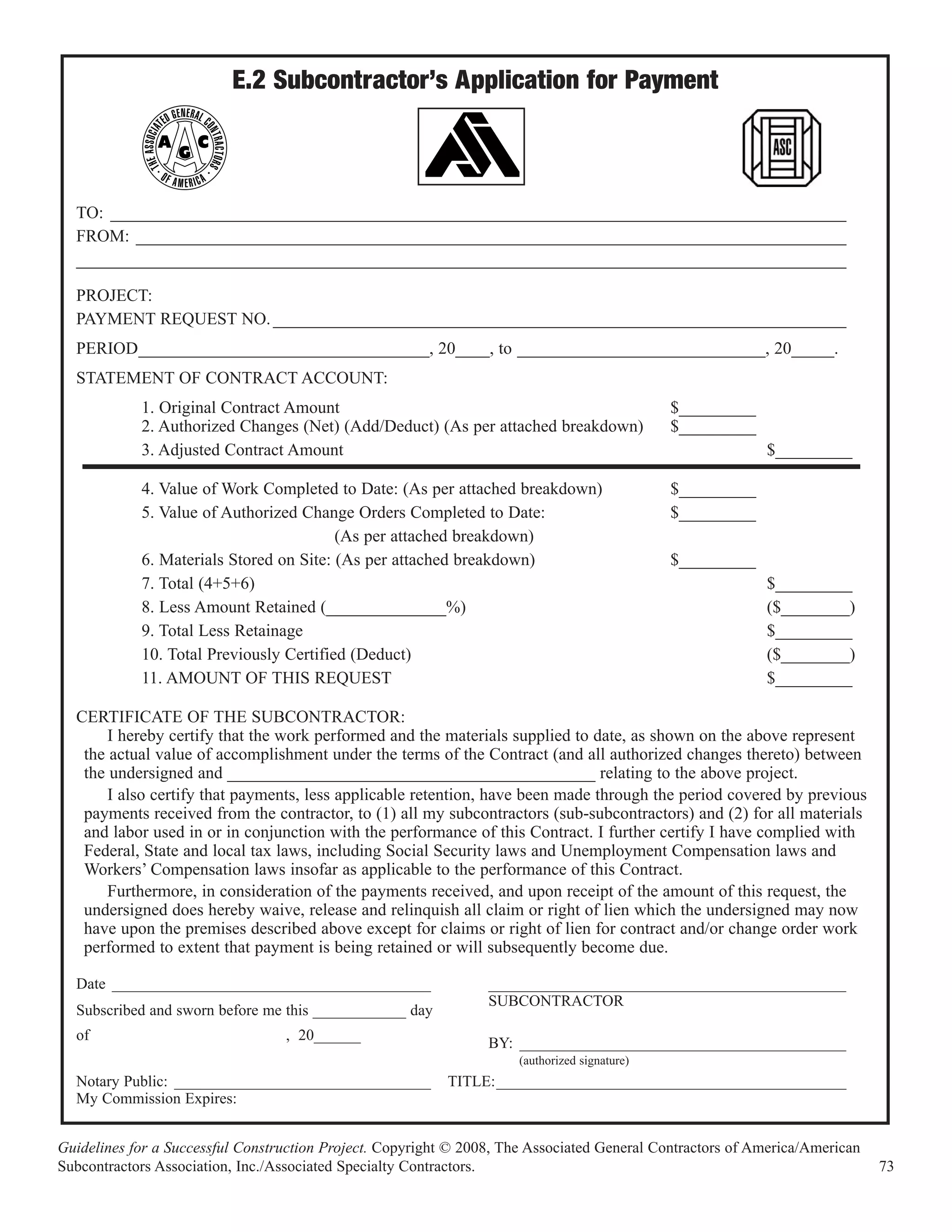
  2. Subcontractor’s Application for Payment....................................................................................................................73
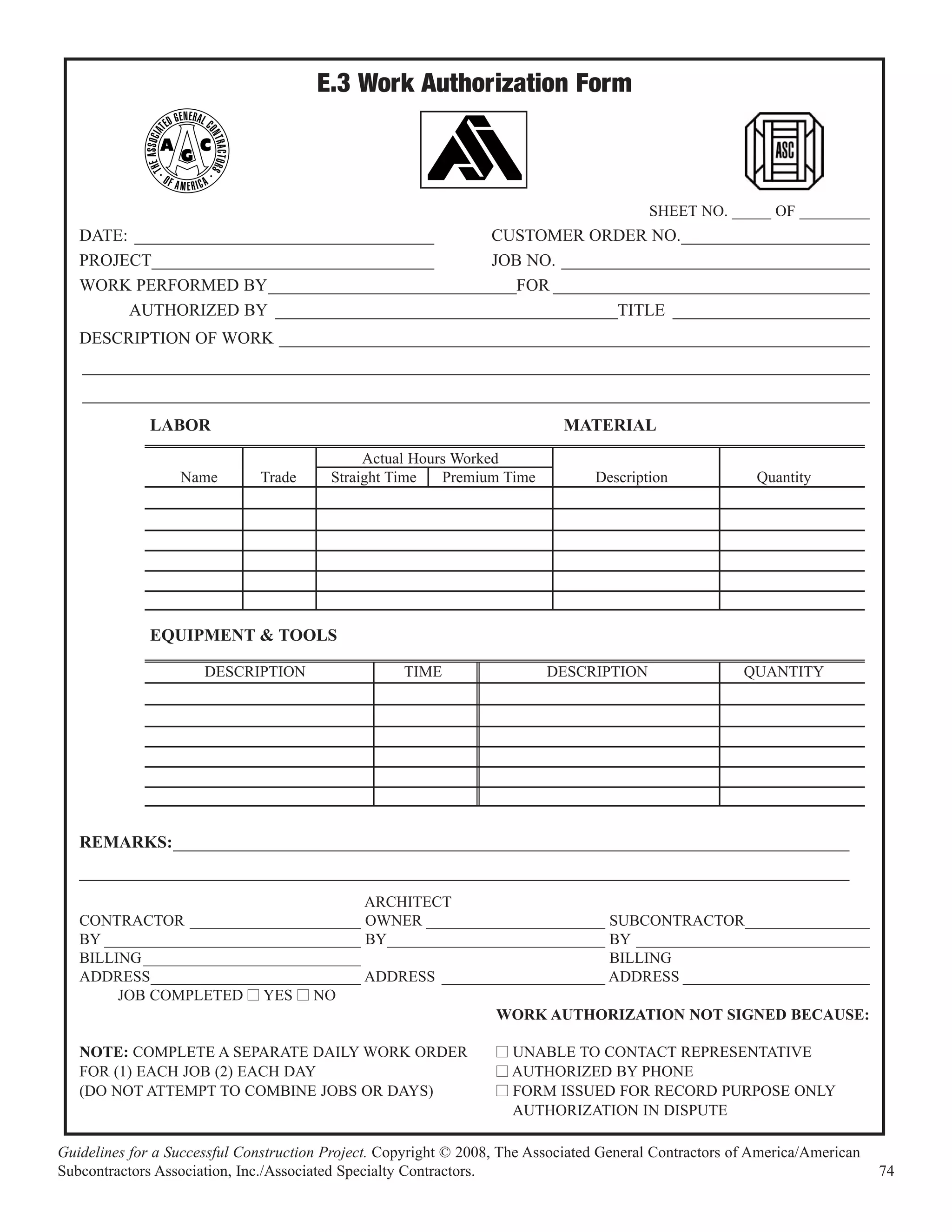
  3. Work Authorization Form ............................................................................................................................................74
  4. Change Proposal/Order Form ......................................................................................................................................75


Guidelines for a Successful Construction Project. Copyright © 2008, The Associated General Contractors of America/American
Subcontractors Association, Inc./Associated Specialty Contractors.                                                                                                                   ii
A.1
Guideline on General Contractor-Subcontractor Relations
                                                                  culture. Keeping everyone on a project working together
                                                                  in a harmonious fashion, without unduly delaying or
Preamble
The primary objectives of every general contractor and            damaging others, is a highly complex task requiring the
subcontractor are to successfully deliver to the owner the        utmost coordination, cooperation, communication, and
specified project safely, on time, at the contract price and      sometimes, compromise. As difficult as it may be, this is
achieve a reasonable profit in return for performance of          what makes a project profitable and the construction
its work. Regardless of personal pride, business philoso-         industry rewarding (see D.2.a.Communication and
phy, contractual authority or years of experience, no gen-        D.2.b.Project Meetings).
eral contractor can deliver a project successfully without
the cooperation of competent subcontractors.                      Each general contractor and subcontractor on a project
                                                                  should be regarded with equal respect. Each is an expert
Similarly, no subcontractor, regardless of skill and experi-      in its own field. Ethical conduct, regardless of contractual
ence in its specialty, can perform its work successfully          "rights" or ability to make another firm suffer, is essential
without the corresponding measure of cooperation and              for harmony. The golden rule, "Do unto others as you
leadership of a competent general contractor.                     would have others do unto you," is still the best guideline
Both seek a business relationship on which they can               in dealing with other individuals and businesses.
depend. Usually, each wants to continue to do business            Contractors should also assist architects, engineers and
with the other on future projects as well as those at hand.       owners by advising them, when requested, on relative
Skill, integrity, fairness, trust, respect, and responsibility    costs of alternates while plans are being prepared so as to
will make the contractual relationship—now and in the             reduce the number of alternates.
future—possible, profitable and pleasant.
                                                                  The following guidelines, developed by the Associated
                                                                  General Contractors of America, the American
                                                                  Subcontractors Association, and the Associated Specialty
Contract Documents
A written contract document usually establishes the               Contractors, provide suggestions for mutually profitable
framework for the relationship between the general con-           and ethical general contractor-subcontractor relations.
tractor and the subcontractor. To foster cooperation, the         These are arranged in the chronological order of the con-
subcontract should be fair to both parties and non-adver-         struction process.
sarial. Experienced participants in the construction indus-
try know that no architect/engineer can prepare a perfect
set of documents, and that no general contractor or sub-
                                                                  Pre-bid phase
contractor can perform perfectly. Likewise, contract docu-          1. The general contractor should issue bid invitations to
ments cannot detail every industry practice or anticipate              subcontractors, in sufficient time for subcontractors
every crisis or situation that will arise at the site.                 to review the project documents and prepare respon-
Mistakes will occur and miscommunications will arise.                  sible and responsive bids (see B.1. Bidding
Most general contractors and subcontractors solve their                Procedures).
problems without resorting to litigation. Errors and omis-          2. The general contractor should make the project
sions, when discovered and made known in a timely fash-                financing information available to subcontractors
ion, can generally be overcome with minimal damage to                  before the deadline for subbids (see A.2. Owner’s
all concerned. Mistakes that are admitted and corrected                Ability to Pay).
immediately are the least costly mistakes.
                                                                    3. The general contractor should furnish any special
                                                                       bid proposal forms required and make necessary
                                                                       bidding documents reasonably available to subcon-
Project Culture, Trust, and Teamwork
Key to successful construction relationships is mutual                 tractor bidders. General contractors receiving sub-
trust which must be nurtured to develop a positive project             contractor bids, as well as subcontractors receiving


Guidelines for a Successful Construction Project. Copyright © 2008, The Associated General Contractors of America/American
Subcontractors Association, Inc./Associated Specialty Contractors.                                                            1
A.1 Guideline on General Contractor-Subcontractor Relations

     sub-subs’ bids, should provide a convenient plan                  petition by any method is a breach of faith and a
     room or make documents available via the Internet                 betrayal of principles. Any false or malicious word
     for subcontractors’ use in preparing estimates.                   or act that would harm, or is intended to harm, the
                                                                       reputation of a competitor is unethical.
  4. The general contractor should promptly make bul-
     letin and addenda information available to bidding             5. The amount of a bid should not be altered after the
     subcontractors.                                                   opening, nor should alterations be requested, except
                                                                       when a substantial change is made in the work (see
  5. Each subcontractor should deliver to the general
                                                                       B.1 Bidding Procedures).
     contractor, at least 24 hours before the bid hour, a
     written bid without dollar amount, setting forth its
     proposed scope, alternates, unit prices, addenda             Award of contract
     and/or bulletins to be included. The scope should              1. Upon execution of the general contract, the general
     reference specification divisions or sections and                 contractor should promptly award subcontracts at
     specifically identify any omissions or additions.                 the bid amounts to responsible subcontractors whose
  6. Proposals should not be invited, accepted, or consid-             bids were used in the preparation of the general con-
     ered from any subcontractor or supplier known to be               tractor’s bid. Subcontract terms should be the same
     unqualified to perform the proposed work or render                as those in the owner-contractor agreement as relat-
     the specified service, or from one who, for some                  ed to the subcontractor’s work. The interests of all
     reason, has no genuine possibility of being awarded               parties in the construction process are well served
     a contract.                                                       by each being fully aware of its responsibilities and
                                                                       rights. All parties should pursue a full understanding
                                                                       of their contract obligations; those included by ref-
                                                                       erence as well as express terms. Likewise, a full
Bid period
  1. The subcontractor should submit its finalized bid                 understanding of surety bond obligations, if any, and
     dollar amount and any necessary clarifications to the             rights of claims against such bonds should be pur-
     general contractor at least four hours before the gen-            sued.
     eral contractor bid hour. The general contractor
                                                                    2. The general contractor should establish a progress
     should establish for all bidders a cutoff time for
                                                                       payment procedure and schedule which is approved
     receiving subcontractor bids, make it known, and
                                                                       by the owner and issue copies to the subcontractors
     adhere to it.
                                                                       upon request. The general contractor should prompt-
  2. Subcontractors should not quote on unapproved sub-                ly coordinate with the owner’s payment approval
     stitutions, except as an alternate.                               authority to assure that the procedure and schedule
                                                                       will be followed (see D.3.f. Prompt Payment).
  3. The bid amount of one competitor should not be
     divulged to another before the award of the subcon-            3. The general contractor should issue each subcontrac-
     tract or order, nor should it be used by the general              tor a timely written "notice to proceed" for the sub-
     contractor to secure a lower proposal from another                contractor’s work and promptly notify the subcon-
     bidder on that project (see B.4 Bid Shopping & Bid                tractor of any changes in such date.
     Peddling). If a bid is so low in comparison with
     other bids as to suggest clearly an error, the general
     contractor should notify the subcontractor immedi-
                                                                  Pre-construction conference
     ately that its bid appears to be out of line. The sub-       The general contractor should arrange for and conduct a
     contractor should either withdraw or stand on its            preconstruction conference as soon as the schedule has
     bid, but not modify it.                                      been prepared (see C.1. Pre-construction Conferences for
                                                                  more detail beyond the summary outlined below). A
  4. Fair and bona fide competition is a fundamental              responsible representative(s) of each subcontractor, major
     service the industry brings to its customers. Any act        supplier, the architect/engineer and owner’s representative
     or scheme to restrict or suppress free and fair com-         should attend. Detailed minutes should be recorded and


Guidelines for a Successful Construction Project. Copyright © 2008, The Associated General Contractors of America/American
Subcontractors Association, Inc./Associated Specialty Contractors.                                                           2
A.1 Guideline on General Contractor-Subcontractor Relations

distributed to all such parties on the project. The purposes           to permit subcontractors’ work to proceed in a rea-
of the meeting are:                                                    sonable and logical sequence and manner.
  1. To introduce members of the team to one another                2. A network diagram showing the critical path and
     and establish the project communication procedure                 clearly showing when each subcontractor is to start
     (see D.2.a. Communication);                                       and complete the various portions of its work is a
                                                                       valuable tool. The general contractor and each sub-
  2. To review the job schedule prepared by the general
                                                                       contractor should be sure to understand the particu-
     contractor and ascertain that a reasonable time has
                                                                       lar schedule used.
     been allowed for performing the work of each trade
     (see B.2. Project Scheduling, Delays, and                      3. Conflicts in the project schedule should be discussed
     Liquidated Damages);                                              when they arise. Resolution frequently necessitates
                                                                       compromise.
  3. To coordinate the submission of shop drawings and
     samples;                                                       4. The schedule should be continuously monitored,
                                                                       updated and issued to all project participants on a
  4. To set up change order procedures (see D.3.d.
                                                                       periodic basis (weekly or monthly depending on
     Procedures for Change Orders);
                                                                       project size and complexity)
  5. To list all initial questions that will require an
                                                                    5. When a schedule change is made, each subcontractor
     answer from the architect/engineer or owner’s agent;
                                                                       affected should be notified immediately.
  6. To ascertain whether there are likely to be any labor
                                                                    6. Dates for delivery and installation of heavy equip-
     or material problems which could seriously impede
                                                                       ment should appear on the project schedule. Access
     progress of the project;
                                                                       for such equipment installation should be main-
  7. To establish how non-contracted services for                      tained accordingly.
     cleanup, temporary facilities, etc., will be authorized
     and charged (see D.3.e. Charges for Non-contracted
     Construction Services);
                                                                  Shop drawings and samples
                                                                  The subcontractor should plan and schedule shop draw-
  8. To describe temporary facilities for the project and         ings and sample submissions in a logical sequence with
     establish parameters for their use (see D.3.e.               input from suppliers involved and coordinated with the
     Charges for Non-contracted Construction Services             general contractor. The sequence must:
     and C.4. Site Logistics);
                                                                    1. Allow for the project’s established approval process
  9. To explain punch list procedures (see D.5.b. Punch                turnaround time.
     List Procedures).
                                                                    2. Prioritize subcontractor submittals to obtain approval
Scheduling                                                             for the longest lead time deliveries first.
                                                                    3. Comply with the project schedule.
A workable project schedule is absolutely essential for a
successful project (see B.2 Project Scheduling, Delays,
and Liquidated Damages). It should be prepared by the             Building codes
general contractor with input from major subcontractors           Strict compliance with all local and national building
and suppliers. Failures to meet schedule requirements             codes should be observed and maintained.
hurt all members of the team. Effective scheduling incor-
porates the following concepts:
  1. The general contractor should only require a subcon-
                                                                  Safety
     tractor on site when the project is ready for that sub-      Precautionary measures should be introduced and
     contractor’s work. The general contractor should             observed to ensure safety and protection of the public and
     strive to coordinate the project in such a manner as         those engaged in the industry. Subcontractors must abide


Guidelines for a Successful Construction Project. Copyright © 2008, The Associated General Contractors of America/American
Subcontractors Association, Inc./Associated Specialty Contractors.                                                            3
A.1 Guideline on General Contractor-Subcontractor Relations

by the safety requirements established by the general con-        completion of the work. Any manipulation of retentions
tractor as well as those of their own safety programs and         for any other purpose, such as a credit device, is an
applicable jurisdictions.                                         improper use of others’ money. Any adjustment of the
                                                                  retained percentage in the general contract made during
                                                                  the course of construction should be equally, proportion-
                                                                  ately, and promptly applied to the subcontract interest. A
Payments
Prime contractors should make payment promptly and in             subcontractor that has completed its work properly should
just proportion to work done by subcontractors and sup-           not be penalized by having final payment withheld
pliers, and any changes in retained percentages should            because some other contractor has not completed its con-
likewise be passed along in proper proportion (see D.3.f.         tract.
Prompt Payment).
In like manner, it is expected that the subcontractor will        Project closeout
pay promptly for all its labor and material as far as exe-
                                                                  All parties must work throughout the project with an eye
cuted, and should submit evidence of this fact to the gen-
                                                                  towards the final completion and acceptance by the
eral contractor if requested (see D.3.f. Prompt Payment).
                                                                  owner. As a result, Project Closeout procedures must be
                                                                  integrated into all phases of the work beginning at con-
Retainage                                                         tract award (see D.5.a. Project Closeout).
Percentage retentions by the owner with respect to the
general contractor and by the general contractor with
respect to subcontractors are for the purpose of assuring


Guidelines for a Successful Construction Project. Copyright © 2008, The Associated General Contractors of America/American
Subcontractors Association, Inc./Associated Specialty Contractors.                                                           4
A.2
                        Guideline on Owner’s Ability to Pay
Delays or defaults by owners in meeting contractual pay-          struction requires that the owner have a sufficient com-
ment obligations to contractors are a continuing cause of         mitment from a lending institution or other source of con-
litigation, liens, long delays in completion of construc-         struction capital. This includes funding to make all
tion, abandonment of contracts, and bankruptcy of con-            progress payments and final payment promptly as provid-
tractors and subcontractors. Qualified contractors often          ed for in the contract documents, as well as to pay for
are unwilling to bid on projects for owners whose finan-          changes and any damages for which the contractors are
cial capacity and credit rating are not widely known. This        entitled to reimbursement.
results in reduced competition and the possibility of high-
                                                                  It is not advisable for construction contracts to be execut-
er bids to the detriment of the owners.
                                                                  ed unless all necessary funds to pay for the construction
The problem has been partially addressed in standard              have been placed on deposit, or unless all of those who
contract documents. For example, ConsensusDOCS 200                bid on the project have full knowledge of deficiencies in
Standard Form of Agreement and General Conditions                 funding before preparing bids or signing contracts. It is
Between Owner and Contractor (2007 edition) states in             improper for any payment delay of even one day to occur
sections 4.2 and 11.5.2.1:                                        because of administrative lapses or because release of
                                                                  funds is deliberately delayed while waiting for certificates
     Prior to commencement of the Work and thereafter at
                                                                  of deposit or investments to mature. Such actions pass on
     the written request of the Contractor, the Owner shall
                                                                  to contractors the responsibility of financing the project,
     provide the Contractor with evidence of Project
                                                                  which should normally not be a contractor obligation. A
     financing. Evidence of such financing shall be a con-
                                                                  means of avoiding these difficulties might be for pay-
     dition precedent to the Contractor’s commencing or
                                                                  ments to be issued to prime contractors by the lending
     continuing the Work. The Contractor shall be notified
                                                                  institution or a title company from loan commitments. In
     prior to any material change in Project financing.
                                                                  addition, when a project is constructed with borrowed
     In addition, upon seven (7) days’ written notice to          funds then the loan should be tied to the contract
     the Owner, the Contractor may terminate the                  retainage provisions, so that there is an obligation by the
     Agreement if the Owner:                                      lender, as well as by the owner to pay retainage (see
                                                                  D.3.f. Prompt Payment).
     .1 fails to furnish reasonable evidence prusuant to
     Paragraph 4.2 that sufficient funds are available            In order to obtain the most competitive bids, owners
     and committed for Project financing…                         should furnish current written information needed by gen-
                                                                  eral contractors and subcontractors to enforce lien and
Even though these clauses alert owners to the need to             bond rights. The following procedure is suggested to own-
provide such "reasonable evidence" before construction            ers and to architects and engineers for recommendation to
can commence and during the course of the project, they           owners at the time bidding documents are being prepared:
may not completely reassure contractors who are consid-
ering bidding the work and investing many thousands of              • Invitations for bids should contain clear statements
dollars in the process of preparing their bids.                       that the owner has made sufficient financial arrange-
Furthermore, the requirement of "reasonable evidence"                 ments for the completion of the project and adminis-
may be vague and cause misunderstandings.                             trative arrangements for timely disbursement of
                                                                      every payment, including change orders and claims.
The owner may have made financial arrangements to ful-
fill its obligation, but that does not necessarily mean that        • Bidders should be invited to make inquiry about
procedures have been established to assure that contrac-              these arrangements so that they may satisfy them-
tors will, in fact, receive timely payments and will not be           selves about financial details.
forced to borrow working capital with interest to pay their
                                                                    • Inquiries from contractors who have been invited to
ongoing expenses on the project. A trouble-free arrange-
                                                                      bid the project should be answered quickly and can-
ment from the beginning to the completion of the con-
                                                                      didly by the owner and/or the construction lender.


Guidelines for a Successful Construction Project. Copyright © 2008, The Associated General Contractors of America/American
Subcontractors Association, Inc./Associated Specialty Contractors.                                                           5
A.2 Guideline on Owner’s Ability to Pay

In the case of governmental bodies, statements that neces-        governments which have defaulted or approached default
sary funds have been appropriated for the financing of the        on obligations. Because of the reputation of many gov-
project by legislative bodies having appropriation authori-       ernmental bodies of delaying payments due to procedural
ty or that necessary bonds have been sold and funds are           red tape, it is especially important that bidders on public
on deposit will serve the same important purpose. Bidders         works have clear assurances that such delays will not
who once felt confident in bidding to governmental bod-           occur.
ies may have lost such confidence due to a number of


Guidelines for a Successful Construction Project. Copyright © 2008, The Associated General Contractors of America/American
Subcontractors Association, Inc./Associated Specialty Contractors.                                                           6
A.3
                     Guideline on Contractor’s Payment
                  Rights, Obligations, and Responsibilities
1. One of the most important aspects of the construction               It is your responsibility to understand the adequacy
   process is timely and complete payment for work                     and source of the money for each project. You have
   accomplished.                                                       a right to this information upon request. In most
                                                                       cases, there will be a financial arrangement in place:
2. At times, contractors fail to do adequate due diligence
                                                                       e.g. loan, line of credit or owner supplied funds. It is
   in determining the terms and conditions for payment.
                                                                       appropriate for you to assure yourself that enough
   In addition, many contractors do not understand their
                                                                       money and/or credit is in place and that you under-
   rights to determine whether or not an owner, under
                                                                       stand the terms under which the money/credit can
   contract with a general or prime contractor, has the
                                                                       be accessed (see A.2. Owner’s Ability to Pay).
   ability to fund the construction project.
                                                                       It is your responsibility to understand the billing
3. The responsibility of the contractors and subcontractors
                                                                       process of the owner, contractor, and lender. Each of
   is to:
                                                                       their specific requirements could lead to significant
  • Understand the payment terms and conditions of                     delays in actual payment. Ensure that your payment
    their contracts.                                                   forms are submitted in a timely manner, as pre-
                                                                       scribed by contract, and that each requisition is
  • Confirm the owner’s ability to pay for services pro-               complete. Changes, revisions, or incorrect billing
    vided.                                                             forms may delay payment in some cases until the
4. The following is a checklist to assist you in under-                next billing cycle (see D.3.f. Prompt Payment).
   standing your payment entitlements and obligations.                 You must understand your obligations as required
     It is imperative that all parties review the contract             by the contract. If you are not in complete compli-
     or subcontract before entering into such agreements.              ance with your contract, it may affect your ability to
                                                                       collect on the work that you have completed.
     It is your responsibility to review the specific pay-
     ment terms and obligations spelled out in the con-                It is your right to obtain any information deemed
     tract with the owner and/or your subcontract with a               appropriate to your work on the project. This
     prime contractor.                                                 includes any financial conditions, terms, and the
                                                                       ability to change or modify those terms and condi-
     It is your responsibility, if a general contractor, to            tions. It is important that your contract spell out if
     research the owner’s ability to pay for the project               any of the financial conditions change for the proj-
     and to convey such information promptly upon                      ect, you are to be notified in advance.
     request to all members of your construction team at
     the outset and during the course of the project,                  Understand your bond rights, if any, and appli-
     including:                                                        cable lien laws. Avoid the premature waiver of any
                                                                       bond or lien rights and file all required bond and
        • Total Financing Amount                                       intent to lien notices promptly.
        • Current Contract Amount                                      Understand the conditions of your contract as to
        • Pending Amount of Change Orders and Extras                   when you are entitled to stop work, if necessary,
                                                                       for lack of payment. It is important that you retain
        • Contingency Funds Available                                  the contractual right on each project to stop work, or
     It is your responsibility, if a subcontractor, to                 to terminate, in the event of nonpayment for proper-
     research the owner’s ability to pay for the project               ly performed work
     and the general contractor’s ability to pay those with            Understand, however, that you must have com-
     whom it has contracts for goods or services.                      plied with all terms and conditions of your con-


Guidelines for a Successful Construction Project. Copyright © 2008, The Associated General Contractors of America/American
Subcontractors Association, Inc./Associated Specialty Contractors.                                                              7
A.3 Guideline on Contractors Payment Rights, Obligations and Responsibilities

  tract before actions allowed by the contract provisions           requirements of each individual project and the
     can be exercised.                                              owner’s ability to pay. It is not only your right but also
                                                                    a prerequisite for your success in the construction
5. The person most responsible for prompt and com-
                                                                    industry.
   plete payment is you. Protect yourself and your
   company. Understand and research the payment


Guidelines for a Successful Construction Project. Copyright © 2008, The Associated General Contractors of America/American
8Subcontractors Association, Inc./Associated Specialty Contractors.                                                          8
A.4
                         Guideline on Design Responsibility
All owners, architects and other design professionals are              prices, frequent change orders, and lost time usually
urged to uniformly accept responsibility for design-relat-             result when design documents lack clarity or fail to
ed plans and specifications applying to construction proj-             adequately integrate the work of individual trades.
ects. This design responsibility includes drafting complete            Attempts to shift design responsibility to the con-
specifications for inclusion in project bidding documents,             tractor impose an unquantifiable risk on the contrac-
initiating or approving all design-related additions, dele-            tor that may increase the owner's cost without
tions and changes to project specifications and accepting              shielding the owner against liability to others.
ultimate responsibility for the safety and utility of all
                                                                    6. Specification divisions for each trade must be clear
project design elements. For design-build projects, the
                                                                       and complete. Phrases such as "intended results,"
responsibility for the plans and specifications must be
                                                                       "including but not limited to" and "reasonably infer-
extended to the design-build entity in order to ensure
                                                                       able" create bidding uncertainties, result frequently
project success.
                                                                       in claims and lessen the owner's chances that the
Delegation of professional services which constitute the               project will meet its expectations (see also B.3.
practice of architecture or engineering, should ordinarily             "Scope" Bidding for Private Work).
be limited to manufactured products such as curtain walls
                                                                    7. Review of design drawings and documents by the
and elevators, and then only subject to constraints includ-
                                                                       contractor should be for the purpose of facilitating
ing the following:
                                                                       construction and not impose on the contractor a duty
  1. The owner and architect must specify all perform-                 to discover errors, omissions or inconsistencies. It
     ance and design criteria that these professional serv-            should be recognized by all concerned that the con-
     ices must satisfy.                                                tractor's review is made in its capacity as a contrac-
                                                                       tor and not as a design professional.
  2. All such services must be specifically required in the
     contract documents and not be in violation of any              8. Review and approval of contractor submittals by the
     applicable law.                                                   designer is another area that can create distress for
                                                                       the project team. Some designers will "approve" a
  3. The architect, or other owner designated design pro-
                                                                       submittal with an approval stamp that contains lan-
     fessional, must approve all design-related work per-
                                                                       guage absolving the designer of responsibility for
     formed by others and coordinate the overall design
                                                                       any mistakes in the review process. During contract
     integration, safety of the public, compliance with
                                                                       negotiations and initial meetings between the owner,
     codes and other legal or owner requirements as con-
                                                                       designer, and construction team, this issue should be
     tracted. With respect to other than the manufactured
                                                                       frankly discussed.
     products themselves, the architect or other owner
     designated design professional shall accept and              Long experience demonstrates that a clear division of
     retain sole responsibility for overall design.               responsibility between the architect, as designer, and the
                                                                  contractor, as builder, offers an effective way to achieve
  4. Contractors and subcontractors must not be held
                                                                  fast, safe, and economical construction results.
     responsible for the adequacy of the performance or
     design criteria indicated by the contract documents.
  5. The use of inappropriate or unclear specifications
     ordinarily increases costs to the owner. Higher bid


Guidelines for a Successful Construction Project. Copyright © 2008, The Associated General Contractors of America/American
Subcontractors Association, Inc./Associated Specialty Contractors.                                                             9
A.5
                     Guideline on Liaison Committees:
                Starting or Expanding an Existing Program
The AGC-ASA-ASC Guidelines for a Successful                            (see A.1. Contractor-Subcontractor Relations) and
Construction Project are available online at                           other contents of the Guidelines.
www.constructionguidelines.org. The guidelines may be
                                                                        a. Go over carefully the materials contained in the
used as a framework for local industry discussions. They
                                                                           Guidelines for a Successful Construction Project
may be distributed by individual contractors to their cus-
                                                                           so that all committee members are familiar with
tomers as a vehicle for bringing about a better under-
                                                                           the material. Discuss each item thoroughly.
standing of the complexity of the industry. Architects,
consulting engineers and members of construction users’                 b. Go over the list of the prearranged meeting items.
groups should receive personally delivered copies.                         Get the information your group needs and keep
                                                                           the discussion on a high plane—don’t be argu-
Starting a construction industry liaison committee                         mentative.

In those areas of the country where some form of an                     c. Based on the meeting comments, and where prac-
industry liaison committee now exists, much has been                       tical, plan to initiate those actions that represen-
done to jointly develop solutions to many of the vexing—                   tatives feel are necessary or helpful.
but unnecessary—problems that may occur in the work-                    d. If a controversy exists, find out the reasons and
ing relationship between general contractors and subcon-                   seek a mutually acceptable solution. A start
tractors.                                                                  towards a reasonable approach to common prob-
Use and implementation of the Guidelines, adapting them                    lems is a significant accomplishment.
where required to fit local needs, will strengthen and              III. Take action with respect to holding future meetings
improve the efforts of existing committees. Where such                   of the entire industry liaison committee and of the
an effort has not yet begun, the Guidelines can be invalu-               subcommittees or task forces which can carry out
able in initiating a productive and ongoing program. All                 many of the committee’s programs between full
local leaders of AGC, ASA and ASC have access to the                     committee meetings.
Guidelines and related documents.
                                                                        a. It would be advisable, for subsequent meetings of
                                                                            the full committee, for the chairperson to be
                                                                            alternated among the members, so that all groups
How to get going
  I. To gain maximum support and strength from your                         have an equal role. Make a full written report of
      chapter members, establish an industry liaison com-                   committee discussions and agreements and dis-
      mittee within your chapter, including the chapter                     tribute them promptly to all committee represen-
      manager or executive director. Members of this                        tatives.
      committee may then serve as members of an indus-
                                                                        b. In the interest of continuity, it is quite helpful to
      try liaison committee. Take the initiative to organize
                                                                           have permanent members from all organiza-
      an informal industry liaison committee.
                                                                           tions—rather than rotating membership.
  II. At the first industry liaison committee meeting, plan
                                                                        c. Make distribution of copies of the Guidelines to
      a meeting of the members of all of the local con-
                                                                           local architects, consulting engineers and owners
      struction association chapters and members of spon-
                                                                           a priority objective of the industry liaison com-
      soring organizations not having chapters. Organize a
                                                                           mittee.
      thorough and frank discussion of the Guideline on
      Better General Contractor-Subcontractor Relations


Guidelines for a Successful Construction Project. Copyright © 2008, The Associated General Contractors of America/American
Subcontractors Association, Inc./Associated Specialty Contractors.                                                             10
B.1
                           Guideline on Bidding Procedures
Most construction projects in the United States are com-          plan deposit system and/or to purchase partial or complete
petitively bid. However, bidding procedures from one              sets directly from a printer or the architect.
geographic region to another frequently vary widely. This
                                                                  Recent developments in the use of "electronic plan rooms"
variety has become an increasing industry problem as
                                                                  have increased the availability of project information to
owners, design professionals, contractors and subcontrac-
                                                                  multiple users. Owners and general contractors are encour-
tors more frequently move from construction market to
                                                                  aged to investigate and implement web-based plan access to
construction market.
                                                                  maximize plan availability while minimizing cost.
As a result, there is a need to establish more uniform
guidelines for bidding competitively-priced projects in
order to reduce confusion, increase fair competition and
                                                                  Plan Deposits
lower construction costs. Some key concepts for bidding           In order for an owner to receive the best possible price on a
are summarized below:                                             construction project, it is important that all bidders on the
                                                                  project (prime contractors and subcontractors) have access
                                                                  to the most accurate and complete plans and specifications.
                                                                  It is in the interest of owners to provide sufficient sets of
Advertisement for Bids
Owners should advertise the availability and distribution         drawings and specifications to permit all interested con-
of bidding documents as far in advance as possible, but           tractors, subcontractors and material suppliers to prepare
no later than 30 days prior to bid document issue. An             accurate bids. A fee for the use of such plans, when added
advertisement should contain a short description of the           to the contractors’ other estimating costs, can be a factor
project, including bid date, time, approximate contract           limiting both quantity and quality of the bids on the project
amount, approximate size, project location, licensing             since only successful bidders can recover these costs.
requirements, plus bid and performance and payment
                                                                  Deposits, not exceeding reproduction costs for the plans,
bond requirements. It also should state the date of docu-
                                                                  are reasonable. There should be a provision, however, for
ment availability, location of documents, and deposit and
                                                                  prompt refunds in full to anyone who pays the deposits and
refund information. The advertisement should be circulat-
                                                                  who submits a bid or sub-bid on the project and returns the
ed to both individual prime and major subcontractor and
                                                                  plans within 30 days after bid opening (if its bid was
material supplier prospect bidders, placed in construction
                                                                  unsuccessful) or who returns plans promptly after examin-
publications and posted in plan rooms.
                                                                  ing them and making a decision not to prepare a bid.
                                                                  Further, it is reasonable to charge reproduction costs for
                                                                  plans to those material suppliers or bidders on smaller
Bid Documents
Bid documents should be complete before they are issued.          subcontracts who wish a set of plans for their own exclu-
For small or simple projects, at least two weeks should be        sive personal use, yet for whom plan room or borrowed
allowed for bid preparation. If a project is large and/or com-    sets of plans would normally be adequate for careful bid
plex, four to six weeks or even more may be necessary.            preparation.
Bid documents should be made available to a sufficient            With these facts in mind, and in order to promote the best,
number of bidders to foster competition. Thus, the owner          most careful and complete bidding on all projects, an ade-
should furnish each local plan room with at least four com-       quate number of plans to permit careful preparation of bids
plete sets of bidding documents. In addition, the owner           should be provided to interested parties at no cost to bid-
should provide each prime bidder with at least four sets of       ders who return such plans within 30 days after bidding.
bidding documents for its use and the use of its subcontrac-
tors and suppliers. Major subcontractors also should be
provided, by the prime bidders, with a copy of the bid doc-
                                                                  Scope Letters
uments. Any prospective bidder should be afforded the             Each sub bidder should submit a written scope letter to
opportunity to obtain complete sets of documents through a        the prime bidder at least 24 hours before the bid time.

Guidelines for a Successful Construction Project. Copyright © 2008, The Associated General Contractors of America/American
Subcontractors Association, Inc./Associated Specialty Contractors.                                                           11
B.1 Guideline on Bidding Procedures

The scope letter should contain any information the prime         underway, undermines the entire system of competitive
bidder needs to evaluate the sub bidder’s bid, including          bidding and is an open invitation to abuse.
its proposed scope, alternates, unit prices, addenda,
                                                                  Use of the following procedures is recommended when a
and/or bulletins to be included. The scope letter should
                                                                  bid error is discovered:
reference specific divisions or sections and specifically
identify any omissions or additions. Each sub bidder                   When an apparent low bidder discovers an error in
should submit its final bid dollar amount and any neces-               its bid price, it shall have the following options:
sary clarifications to the prime bidder at least four hours
before the prime bidder’s bid hour. The prime bidder                    1. The low bidder may, at its option, confirm its
should establish a cutoff time for receiving sub bids,                     original bid price; or
make it known, and adhere to it.                                        2. The low bidder may withdraw the bid, without
                                                                           penalty or forfeiture of bid security if it estab-
                                                                           lishes that a valid computational or transcribing
                                                                           error resulted in an unintentionally low bid, but
Ethics In Bidding
The bid amount of one competitor should not be divulged                    shall not be allowed to re-bid the job under any
to another prior to bid time, nor should it be used by the                 circumstances.
prime bidder to secure a lower bid proposal from another
bidder on that project. A subcontract bidder or supplier               The owner shall then have the option of awarding
also should not request information from the prime bidder              the contract to the second low bidder or of re-solic-
regarding any sub bid prior to the award of the subcontract            iting bids for the project. In the event the project is
(see B.4. Bid Shopping and Bid Peddling for more details).             re-bid, the former low bidder shall not be allowed to
                                                                       bid for the contract. Unless required by statute, no
Owners should publicly open and read aloud the bids.                   adjustment in bid price should be allowed a bidder
Construction contracts should be awarded to those                      as a result of an error in its bid.
responsible and responsive bidders, at all levels of the
project, which submit the low bids for their portions of          If a subcontractor bid is so low in comparison with other
the work prior to bid time. Bids should not be held longer        bids as to suggest clearly an error, the general contractor
than 60 days without an award being made.                         should notify the subcontractor immediately that its bid
                                                                  appears to be out of line. The subcontractor should either
                                                                  withdraw or confirm its bid, but not modify it. The
                                                                  American Society of Professional Estimators has pre-
Bid Errors and Adjustments
If, after bids are opened, a low bidder claims it has made        pared even more detailed Bidding Procedures for
a material error in the preparation of its bid and can sup-       Competitively Bid Construction Projects. It is available
port such a claim with satisfactory evidence, it should be        online at http://www.aspenational.com/
permitted to withdraw its bid, without forfeiting its bid         RecommendedBiddingProcedures.htm
security. Under no circumstances should a bidder be
                                                                  Other references include:
allowed to adjust its bid price as a result of an error in its
bid. If the owner opts to re-solicit bids for the project, the         Recommended Guide for Competitive Bidding
erring contractor should not be allowed to bid for the con-            Procedures and Contract Awards for Building
tract, unless precluded by local, state, or federal law.               Construction published by AGC and the American
                                                                       Institute of Architects:
Some construction owners allow a low bidder who can
                                                                       http://www.agc.org/contracts
demonstrate an error in its bid to upwardly adjust its bid
                                                                       http://www.aia.org/documents/
price to the extent of the error. The low bidder will be
awarded the contract at the adjusted price so long as that             Recommended Competitive Bidding Procedures
price, as adjusted, is still below that of the second low              Construction Projects published by the Engineers
bidder.                                                                Joint Contract Documents Committee:
                                                                       http://www.asce.org
Allowing a low bidder to adjust its price under any condi-
tions, other than change orders issued after the contract is


Guidelines for a Successful Construction Project. Copyright © 2008, The Associated General Contractors of America/American
Subcontractors Association, Inc./Associated Specialty Contractors.                                                           12
B.2
                   Guideline on Project Scheduling, Delays,
                           and Liquidated Damages
Proper project scheduling and avoidance of delays are             ise for inclusion in the information stream in electing to
critically important. When the owner has decided to               "go" or "not go" with the project. If a major subcontractor
include liquidated damages in the contract, or reserves the       bypasses this step, it assumes the risk involved in not
right to pursue un-liquidated, consequential damages,             completing the project on schedule.
then the owner’s design team must become involved with
the pre-bid scheduling process, including the following:          Schedule Documentation and Communication
  • Review critical lead-time items: e.g., steel, mechani-        Documentation of schedule and a communication plan
    cal equipment, electrical distribution equipment, etc.        must be comprehensive. Every tier of contractor, subcon-
  • Determine in advance (within the time constraints             tractor and supplier must have access to complete plans,
    available) that the major equipment and supplies can          specifications, and the project schedule to be fully
    be purchased and delivered (within the time con-              informed of risks involved in non-performance.
    straints available).                                          Any subsequent variation to the projected schedule must
  • Determine in advance that responsible marketplace             be communicated up and down the project ladder.
    participants can deliver this type of project within          Without this communication, significant risk in project
    specified time constraints.                                   expansion or contraction is assumed by those who do not
                                                                  communicate (see D.2.a.Communication).
  • Consult with knowledgeable and experienced con-
    struction contractors about all aspects of the pro-
    posed construction project and schedule.
                                                                  Team Responsibilities
Only after all of the above elements have been undertak-          The design team accepts an enormous responsibility for
en should the request for proposal (RFP) or invitation for        drawing review, submittal review, change order approval,
bid (IFB) process go forward. To expect the construction          and the impacts of tardy review and return. Contractors
industry to meet the owner’s requirements without owner           must assume the responsibility for timely submission and
implementation of the above action items allocates unrea-         its impact on the project schedule, but the design team
sonable risks to the construction contractor and adversely        must provide its review in time to meet schedule guide-
impacts project costs.                                            lines.
                                                                  The entire construction team must understand that each
                                                                  member is responsible for its performance in the project
                                                                  schedule. Any hitch or stumble affects the entire process
Contractor Review
The contractor review of the construction documents and           and creates risk for claims by downstream contractors.
schedule must be a realistic assessment of the project to         Project expansion and contraction are two of the risks
provide critique and direction for the owner and design           involved.
team before the contractor completes the pricing process.
This review is essentially a marketing opportunity for the
contractor that is honest and up-front with the owner, and
                                                                  Project Closeout
comes prepared with the documentation necessary to back           Project closeout and delaying the processing of change
up its assessment.                                                orders until the end of the project, create risk in complet-
When the construction contractor bypasses this step, the          ing and finalizing a construction project. It is unreason-
contractor assumes the risk of accepting a project that has       able to assume lower-tier contractors must wait for their
no chance of meeting the project schedule.                        payment while the paperwork for changes they were
                                                                  directed to complete is delayed. While the owner may be
In addition, the major subcontractors and suppliers must          using the building, the construction contractor incurs an
accept their responsibility to review their areas of expert-      increased financial burden, possible claims for non-pay-

Guidelines for a Successful Construction Project. Copyright © 2008, The Associated General Contractors of America/American
Subcontractors Association, Inc./Associated Specialty Contractors.                                                           13
B.2 Guideline on Project Scheduling, Delays and Liquidated Damages

ment on change orders and potential litigation (see D.5.a.        While utilizing the partnering process is a good start, a
Closeout, D.3.c. Consequential Damages, and D.3.k.                quality project is the goal, and success for the entire proj-
Retainage).                                                       ect team must be the vision to strive for, including the on-
                                                                  time, on-budget successful completion of the owner’s
Team Relationships                                                project (see C.2. Partnering).

Utilizing project relationships to the detriment of a team
member of one project in the hope of winning a future
project is irresponsible. This practice should be discour-
aged by any team member, including the design profes-
sionals and prime or lower-tier contractors.


Guidelines for a Successful Construction Project. Copyright © 2008, The Associated General Contractors of America/American
Subcontractors Association, Inc./Associated Specialty Contractors.                                                           14
B.3
           Guideline on “Scope” Bidding for Private Work
So-called "scope" bidding has proliferated in recent years
in relation to traditional competitive bidding. On the one
                                                                  Background
hand, the concept has introduced flexibility in contract          This guideline applies to projects where the architect and
administration that is useful and desirable. However, the         engineer are responsible for design but plans and specifi-
concept has also introduced an uncertainty and an                 cations do not cover every item necessary for a complete
extreme risk to contractors and subcontractors by imply-          project. It is recognized that, in practically all areas of
ing responsibility and liability for added work under the         plans and specifications, every single item of construction
"scope" concept which the contractor and subcontractor            material and technique cannot be delineated. It is reason-
could not have deduced was required from the informa-             able to require the providing contractor, as part of its
tion given on the scope documents. Note that the con-             work, to include those items which are part of its trade
cerns in this guideline may not be applicable to Design-          and which are installed as part of the work without spe-
Build delivery methods.                                           cific instructions being required to demand that activity
                                                                  (see B.1. Bidding Procedures "Scope Letters").
Concept Overview                                                  On the other hand, demands upon the contractor to cover
                                                                  a multitude of changes and additions on the basis that
The "scope" document may appear in the form of a stamp
                                                                  they come within the definition of the "scope," are
on the plans or specifications that has many variations,
                                                                  unwarranted and should be rejected. Design and design
with infinite interpretations. One example is:
                                                                  changes for a project should be the sole responsibility of
                                                                  the architect and/or engineer unless, as a part of the con-
   Scope Document                                                 tract obligations, the contractor assumes that responsibili-
                                                                  ty. In that case, the full responsibility for design, installa-
   “This document indicates the general scope of the
                                                                  tion and performance should be specific (see A.4. Design
   project in terms of architectural design, the dimen-
                                                                  Responsibility).
   sions of the building, the major architectural parts
   and the type of structural, mechanical, and electri-
   cal systems. This document does not necessarily                Guideline Details
   indicate or describe all work required for full per-
                                                                  1. Performance specifications or scope criteria should not
   formance and completion of the Contract
                                                                     be used in the award of competitively bid contracts for
   Documents. On the basis of the general scope indi-
                                                                     public buildings. Scope and performance criteria do not
   cated or described, the contractor shall furnish all
                                                                     generate the best competitive bidding among contrac-
   items required for the proper execution and com-
                                                                     tors nor do they provide the awarding authority with
   pletion of work. Decisions of the architect, as to
                                                                     sufficient means for accurate and fair comparison of
   the work included within the scope of this docu-
                                                                     proposals received.
   ment, shall be final and binding on the contractor
   and the owner.”                                                2. Where "scope" plans and specifications are a part of
                                                                     the project documents, each contractor should provide
Note that the above example is not a recommendation,
                                                                     the following:
but is presented for information to those not familiar with
"scope" projects.                                                   a. All material and equipment of standard quality,
                                                                       whether specified or not, and within the limitations
Because of the inherent risk presented by such a contract
                                                                       of the architectural, structural, mechanical and elec-
document, owner-users, architects, engineers, contractors
                                                                       trical drawings and specifications, to cause the
and subcontractors should be aware of the problems asso-
                                                                       installation to function in accordance with the inten-
ciated with "Scope Bidding." The obligations and limita-
                                                                       tion and objective of the finished project. The origi-
tions of the various groups within the construction indus-
                                                                       nal intention should be specifically set forth in the
try are outlined below.
                                                                       documents.


Guidelines for a Successful Construction Project. Copyright © 2008, The Associated General Contractors of America/American
Subcontractors Association, Inc./Associated Specialty Contractors.                                                             15
B.3 Guideline on “Scope” Bidding for Private Work

  b. All material necessary for equipment to function in a          b. Changes in location of equipment, materials and
     normal and acceptable peculiar or particular type                 facilities due to alterations in architectural concept
     manner, unless that equipment is of a manufacture                 and design.
     which requires singular, unique or special installa-
                                                                    c. Changes in sizes, capacities and locations of compo-
     tion devices or techniques. In that case, it should be
                                                                       nents of the installation due to modifications of the
     the obligation of the architect/engineer to specify
                                                                       building or its components.
     those requirements.
                                                                    d. Determination of capacities and sizes, unless made a
  c. All work required to cause its operations to fit and
                                                                       part of bidding and contract requirements, and the
     coordinate with others, causing the other trades no
                                                                       furnishing of equipment to satisfy those capacities.
     added cost, subject to the limitations of the structure
     as shown on plans.                                             e. Basic design changes to meet applicable codes and
                                                                       ordinances, including but not limited to, added
  d. All work required to comply with governing codes
                                                                       stairs, exits, added sprinklers, fire protection or
     with respect to its activity, except for design criteria
                                                                       changes from specified or indicated items.
     involving capacities and basic design.
                                                                  By following this guideline in preparing project docu-
  e. When not indicated in the plans and specifications,
                                                                  ments, and in making architectural and engineering deci-
     the sizing of interconnecting facilities, such as pip-
                                                                  sions and interpretations, many disputes arising from the
     ing, ducts and wiring, between pieces of equipment
                                                                  word "scope" may be avoided.
     in order to utilize the specified capacities of the
     equipment.
3. The contractor should not be required to provide the
   following:
  a. Material or equipment not specified to be furnished,
     unless required for normal functioning of the system
     or to comply with the original stated intent.


Guidelines for a Successful Construction Project. Copyright © 2008, The Associated General Contractors of America/American
Subcontractors Association, Inc./Associated Specialty Contractors.                                                              16
B.4
                 Guideline on Bid Shopping & Bid Peddling
Bid shopping and bid peddling are abhorrent business              Proprietary information includes the price, the design or
practices that threaten the integrity of the competitive bid-     novel technique, or an innovative approach used in
ding system that serves the construction industry and the         preparing a proposal.
economy so well.
                                                                  The preparation of bids, proposals, submissions or
The bid amount of one competitor should not be divulged           design-build documents is the result of professional con-
to another before the award of the subcontract or order,          sideration which is the intellectual property of the prepar-
nor should it be used by the contractor to secure a lower         er, and so any such information should be considered pro-
proposal from another bidder on that project (bid shop-           prietary.
ping). Neither should the subcontractor or supplier
                                                                  It is unethical to disclose to others, any information that
request information from the contractor regarding any
                                                                  is provided with an expectation that such information will
subbid in order to submit a lower proposal on that project
                                                                  be kept confidential.
(bid peddling).
An important, but often unrecognized, business asset of
the construction contractor is its proprietary information.


Guidelines for a Successful Construction Project. Copyright © 2008, The Associated General Contractors of America/American
Subcontractors Association, Inc./Associated Specialty Contractors.                                                           17
B.5
         Guideline on Exchanging Documents and Data in
                         Electronic Form
The advent of alternative project delivery methods requir-        a practice counterintuitive to facilitating and expediting
ing greater project communication levels, utilization of          document and data exchange, and out-of-step with pres-
new and emerging technologies such as project collabora-          ent industry communication and collaboration needs.
tion software, and frequent owner insistence on shorter
                                                                  Moreover, in many instances where design professionals
project schedules, have increased the likelihood that proj-
                                                                  do forward documents in electronic form to contractors,
ect team members, especially contractors and specialty
                                                                  such documents often are accompanied by statements dis-
contractors, will be expected to receive and exchange
                                                                  claiming accuracy and completeness or exculpating or
contract documents or other project information and data
                                                                  limiting the design professional’s liability. Such language
in electronic form. Important notices, submittals, plan
                                                                  requires a conscious decision on the part of contractors
changes, and other crucial documents are frequently
                                                                  and specialty contractors to decide whether they are will-
transmitted by means other than the U.S. mails or private
                                                                  ing to accept such documents in electronic form, thereby
mail carriers, such as by posting to project-specific web
                                                                  increasing their potential liability, or if they would be bet-
sites or FTP (“file transfer protocol”) sites. Often, the par-
                                                                  ter served by waiting for the “hard copies.” A more bal-
ties neither have discussed any issues relating to the
                                                                  anced approach would permit a standard of reasonable
exchange in advance, such as costs, safeguards and main-
                                                                  use of electronic documents and data by project parties.
tenance responsibilities, nor, in turn, addressed such
                                                                  To that end, parameters governing electronic document
issues in their project agreements. Without careful consid-
                                                                  exchange would be described and agreed on in a written
eration of such issues, project parties exchanging elec-
                                                                  protocol incorporated in or attached to the parties’ con-
tronic documents and data risk misunderstandings,
                                                                  struction agreement. Key to the successful exchange pro-
delays, additional costs and even increased liability.
                                                                  tocol is an agreement that clearly defines ownership,
Current industry standardized forms neither address these         management, and security responsibilities of the informa-
issues in any detail, nor permit contractors and subcon-          tion transfer. Such a protocol, at a minimum, should
tractors to make use of electronic documents or data that         address in detail the following points:
are provided to them without considerable risk of liabili-
                                                                    • Identification of one party to manage the exchange
ty. For example, EJCDC C-700, Standard General
                                                                      process, including responsibility for providing and
Conditions of the Construction Contract, 2002 Edition,
                                                                      coordinating notifications.
Subparagraph 3.06 – Electronic Data, in part states:
                                                                    • Identification of an individual or individuals within
     “A. Copies of data furnished by Owner or Engineer
                                                                      each firm or company responsible for compliance
     to Contractor or Contractor to Owner or Engineer
                                                                      with document exchange protocols.
     that may be relied upon are limited to the printed
     copies (also known as hard copies). Files in elec-             • The definition of documents to be accepted in elec-
     tronic media format of text, data, graphics, or other            tronic form and/or transmitted electronically, includ-
     types are furnished only for the convenience of the              ing a specific listing of such documents for the proj-
     receiving party. Any conclusion or information                   ect (e.g., drawings, shop drawings, change orders,
     obtained or derived from such electronic files will              requests for information, etc.).
     be at the user’s sole risk. If there is a discrepancy
     between the electronic files and the hard copies, the          • The parties’ listing of, and responsibilities for com-
     hard copies govern”                                              pliance with, equipment, software and services
                                                                      impacting the transmission, receipt and/or utilization
In the above provision, all risks are assumed by the recip-           of electronic documents and data (including any
ient of the electronic information, which in most cases is            prohibitions on or cautions as to utilization of differ-
the contractor. In effect, the provision establishes a prac-          ent operating systems or translation programs and any
tice where the contractor may receive electronic informa-             equipment and software upgrading expectations).
tion but may rely on it solely at his or her own detriment,


Guidelines for a Successful Construction Project. Copyright © 2008, The Associated General Contractors of America/American
Subcontractors Association, Inc./Associated Specialty Contractors.                                                           18
B.5 Guideline on Exchanging Documents and Data in Electronic Form

  • Document transmission standards, such as accept-                • Contractual reporting requirements for known or
    able formats, transmission methods and verification               observed errors or omissions in contract documents
    procedures.                                                       should be reviewed to ascertain if they are adequate
                                                                      and consistent given the potentially increased pace
  • Identification of third-party providers, if any, with
                                                                      of electronic document exchanges.
    copies of governing agreements/licenses.
                                                                    • Confidentiality provisions should be reviewed for
  • Methods for maintaining version control of electronic             consistency with similar requirements in exchange
    documents, including a depository of record copies of             agreements.
    transmitted and received electronic documents.
                                                                  Rapid advances in technologies and the uniqueness of
  • Specific privacy and security requirements.                   each project will require parties to continually review and
  • Storage and retrieval requirements for electronic             assess the adequacy of their electronic document
    documents and data.                                           exchange protocols and agreements. Although such agree-
                                                                  ments cannot prevent errors in every instance, they do
  • Reciprocal indemnity obligations for violations of            give the parties assurance that they may reasonably rely
    the exchange agreement.                                       on documents and data transmitted electronically to per-
  • Applicable insurance requirements, if any.                    form their project services, so long as they comply with
                                                                  clearly established protocols. With appropriate protections
During bid preparation, the parties should review their           in place, project participants may reap the productivity
respective construction documents relative to any                 gains and time savings offered by emerging project tech-
exchange agreements. Among the subjects for careful               nologies.
review are the following:
  • They should assess whether provisions governing
    ownership of documents are consistent with the pro-
    visions of the exchange agreement, and that require-
    ments for similar agreements and protocols are in
    place with lower-tiered subcontractors and suppliers.
  • The parties should review contract provisions in the
    design and construction agreements that address the
    line and flow of communications among the project
    parties to assess if such provisions need modifica-
    tion in appropriate, limited circumstances to permit
    direct communications among parties not in contrac-
    tual privity, such as the principal design professional
    and a specialty contractor performing a portion of
    the design. In such circumstances, contemporaneous
    notification of such communications or exchanges
    should be given to the parties otherwise in the line
    of communications.


Guidelines for a Successful Construction Project. Copyright © 2008, The Associated General Contractors of America/American
Subcontractors Association, Inc./Associated Specialty Contractors.                                                           19
B.6
           Guideline on Volatile Price Adjustment Clauses
Volatility of construction material and equipment costs is        ance, and (ii) contingencies that would otherwise be
greater now and in recent years than has previously been          included in the contract price can be identified and cov-
the case. The combination of raw material and natural             ered separately in the contract. Price adjustments based
resource scarcity, burgeoning infrastructure, commodity           on established prices should normally be restricted to
and construction demand in the Far East and elsewhere,            industry-wide contingencies. Price adjustments based on
and unpredictability of world political stability (and ship-      labor and material costs should be limited to contingen-
ping infrastructure too) argues for ever greater vigilance        cies beyond the contractor’s control.
in commodity purchasing and price commitments in pro-
                                                                  The Federal Acquisition Regulation, ConsensusDOCS
curement planning for fixed-price construction contracts.
                                                                  and the American Institute of Architects’ contract docu-
With volatility emerging as the norm in the 21st Century,         ments all have prescribed methods to address these chal-
fair contract risk allocation will more frequently require        lenges.
an equitable cost adjustment clause in fixed-price con-
                                                                  Note: Contracting parties should scrupulously avoid any
struction contracts, as the most specific way to adequately
                                                                  claims for costs not actually incurred, as False Claims Act
address an otherwise uncontrollable and unforeseeable
                                                                  provisions are strictly enforced and sanctions for viola-
risk factor.
                                                                  tions are severe.
Cost adjustment escalation clauses set the basic parame-
                                                                  Note: As a private-sector form document, such percent-
ters for the foreseeable range of price fluctuation by a set
                                                                  age limits an adjustment must be left to the negotiations
baseline—either actual costs, catalog prices, or common
                                                                  among the contacting parties.
price indexes. Shared risk of volatility beyond that range
is then allocated between the contracting parties. The            Actual costs, catalog prices or common published indexes
shared risk approach to either exceptional increases or           can all be used to set the baseline for cost adjustment
decreases in price can help eliminate bid contingencies,          clauses. ENR publishes a series on common construction
avoid defaults and delays mid-project, for the benefit of         material cost indexes. (Go to: www.enr.com). Also,
all parties and the project as a whole.                           The U.S. Department of Labor’s Bureau of Labor
                                                                  Statistics publishes a very comprehensive set of
Force majeure and contract impossibility defenses are not
                                                                  Construction Material producer price Indexes along with
adequate to address the problem. Volatile price adjust-
                                                                  a comprehensive guide on the subject, Escalation and
ment clauses operate in the same way as common unfore-
                                                                  Producer Price Indexes: A Guide for Contracting Parties.
seen site conditions clauses, by allocating uncontrollable
                                                                  (Go to: www.bls.gov/ppi.home).
and unknown risk equitably, rather than putting all the
risk on just one party, subjecting the owner and the proj-        Influential public and private contracting policy docu-
ect to price contingencies based on that unbalanced risk.         ments have been responsive to these trends and risks.
Cost adjustment clauses address material cost volatility
and unavailability in a way that is much more specific            For further reference:
than a standard force majeure clause. Force majeure                  ConsensusDOCS – www.consensusdocs.org
clauses (superior force, acts of God,) and contract impos-
sibility defenses are limited to very extraordinary extrane-         American Institute of Architects Supplementary
ous events, often are subject to very narrow interpretation          Conditions – www.aia.org
by courts, and may be limited to time extension remedies             FAR Contract Clause (Part 52-216-4)
only.
Fixed-price contracts with [an] economic price adjust-
ment should be used, when: (i) there is serious doubt
concerning the stability of market or labor conditions that
will exist during an extended period of contract perform-


Guidelines for a Successful Construction Project. Copyright © 2008, The Associated General Contractors of America/American
Subcontractors Association, Inc./Associated Specialty Contractors.                                                           20
B.7
        Guideline on Building Information Modeling (BIM)
Building Information Modeling (BIM) is a tool that                     increased prefabrication, the minimization of waste
enables the construction industry to more efficiently oper-            in both the shop and the field, the reduction of field
ate in new and increasingly expeditious ways. Initially,               interferences and collisions, and a general increase
BIM and 3D models have primarily helped eliminate                      in productivity at all stages of the project.
design conflicts with far more efficient coordination.
                                                                  As the use of BIM accelerates within the design and con-
Other benefits of BIM include the following:
                                                                  struction industry, it will lead to a revolution in project
  • Project scheduling and the concept of 4D                      delivery. Many are already referring to this revolution as
    (3D+Schedule), in which time considerations are               leading to the fully collaborative project team. The theo-
    inserted into the modeling process. With manpow-              ry of full collaboration generally envisions the entire proj-
    er loading inserted into the scheduling portion of the        ect team: Owner, Architect, Engineers, Consultants,
    model, the project team will be able, on a long term,         GC/CM, and Specialty Contractors being involved from
    look ahead basis, to observe and plan to the detail           the project’s inception by “sitting together at one table” in
    on a daily (perhaps eventually even hourly) basis.            developing the project design. Essentially the team con-
                                                                  structs the project electronically in 3D with the use of
  • Estimating and quantification when 5D
                                                                  BIM. This full collaboration allows for increased speed
    (3D+Schedule+Cost) concepts are incorporated
                                                                  of project delivery, enhanced economics for the project,
    with the BIM process. As the 3D model is devel-
                                                                  and true lean construction all levels not historically expe-
    oped, a materials quantity report is instantaneously
                                                                  rienced in our industry. However, in order to make this
    available. Further, depending on the sophistication
                                                                  collaboration truly successful, the interoperability of BIM
    of the software, pricing information could also be
                                                                  software is essential for all parties involved in the project.
    instantaneously generated.
                                                                  Useful resources in the implementation of BIM into con-
  • The speed of shop drawing development and the
                                                                  tracts is the ConsensusDOCS 200.2 (Electronic
    associated coordination between all trades.
                                                                  Communications Protocol Addendum) and the
    Simply put, with 3D, it is realistic to envision that
                                                                  ConsensusDOCS BIM Addendum.
    shop drawings could be developed simultaneously
    as the design unfolds. Thus, the “issued for con-             Key aspects of the ConsensusDOCS BIM Addendum
    struction” model is just that—eliminating the need            include:
    for approvals and submittal “turnarounds,” as that
                                                                    • Maintaining the contractual relationships and risk
    process will already have been accomplished during
                                                                      allocation among the project participants unless oth-
    the design period.
                                                                      erwise specifically stated in the contract.
  • Request for Information (RFI’s) will be signifi-
                                                                    • Maintaining the Architect/Engineer’s obligation and
    cantly reduced during field construction due to
                                                                      role as the person responsible for and in charge of
    the enhanced coordination and conflict reduction
                                                                      the design of the project.
    with the use of 3D.
                                                                    • Participation of the contractor or its subcontractors
  • Accurate as-built drawings are available immedi-
                                                                      and suppliers in contributions to a model shall not
    ately at the close of construction with the use of
                                                                      constitute the performance of design services.
    BIM and a 3D model. The 3D model, as it is
    updated throughout the project duration, actually               • In general, a design model is not intended to provide
    represents in electronic format the physical design               the level of detail needed in order to extract precise
    and construction of the project throughout all trades.            material or object quantities.
  • The use of BIM and 3D modeling allows for the                   • The design model shall take precedence in the event
    optimization of lean construction techniques and                  of a conflict between any other design models.
    principles. This will lead to the potential for


Guidelines for a Successful Construction Project. Copyright © 2008, The Associated General Contractors of America/American
Subcontractors Association, Inc./Associated Specialty Contractors.                                                           21
B.7 Guideline on Building Information Modeling (BIM)

  • Each party shall be responsible for any contribution             BuildingSmart Alliance –
    that it makes to a model or that arises from that par-           www.buildingsmartalliance.org
    ties access to the model.
                                                                     National Building Information Model Standard –
While this is a brief overview of the BIM process and                www.facilityinformationcouncil.org/bim
benefits, other information can be found on the following
                                                                     American Institute of Architects (AIA) Integrated
websites:
                                                                     Practice – www.aia.org/ip_default
   Associated General Contractors of America (AGC)
   BIMForum – www.bimforum.org
   ConsensusDOCS 200.2 and BIM Addendum –
   www.consensusdocs.org


Guidelines for a Successful Construction Project. Copyright © 2008, The Associated General Contractors of America/American
Subcontractors Association, Inc./Associated Specialty Contractors.                                                           22
C.1
                Guideline on Preconstruction Conferences
Conference time and participation                                 It should include:

The best time for the preconstruction conference is after           • The Owner                    • The General Contractor
all subcontracts have been awarded but before the begin-            • Local Jurisdiction Officials • The Architect
ning of actual construction. This timing will permit the            • The Subcontractors           • The Engineers
important details discussed at the conference to become a           • The Major Suppliers
background for understanding the intended operational             Full attendance and participation can be assured by mak-
plan among members of the project team.                           ing an agreement for the general contractor and all sub-
It is essential that all members of the project team attend       contractors to attend the preconstruction conference one
the conference. The presence of the owner will enable it          of the conditions of the contract documents. This action
to better appreciate the potential operational problems           will emphasize the importance of the conference.
encountered by the team on the project. This procedure
will aid the total building team by:                              Purpose
  • Providing greater insight on specific owner needs.            The primary purpose of the conference is to establish
                                                                  acceptable ground rules for all parties concerned, and to
  • Helping the architect to secure and translate team
                                                                  assure that each party understands the complete job require-
    cooperation into a quality job consistent with the
                                                                  ments and coordinates its work to produce a completed job
    scheduled time and costs.
                                                                  in a minimum amount of time, with maximum economic
                                                                  gains, and in proper coordination with the owner, architect,
Preconstruction conference                                        engineer, prime contractor, and all subcontractors. The pre-
The preconstruction conference is a practical forum in            construction conference is primarily concerned with man-
which problems of economic waste and disruptive con-              agement and operational considerations. It is in these areas
struction problems can be discussed and prevented. The            of contract interpretation and clarification that the greatest
conference is designed to benefit all concerned parties by        value of the preconstruction conference can be achieved.
recognizing the responsibilities for various tasks before
the project is begun. The benefits are as follows:                Topics for discussion
1. Recognition and elimination of delays and disagree-            The preconstruction conference should be scheduled to
   ments.                                                         permit sufficient time to cover the total agenda. Topics
                                                                  for discussion typically depend upon the nature, size and
2. Establishment of agreements that curb increases in
                                                                  complexity of the project. It is, however, necessary to
   construction costs.
                                                                  assign priorities. Although each job is different, certain
3. Predisposition of the gray-area responsibilities which,        factors are common to all types of construction.
   if left unassigned, can cause disputes.
                                                                  Agenda for a typical preconstruction conference
4. Unification of management requirements and establish-
                                                                  1. Progress payments. When, how, and to whom, in exact
   ment of clear understanding of these requirements.
                                                                     terms, stated clearly so that no question exists about
5. Establishment of lines of communication.                          billing and payment requirements and responsibilities.
                                                                     This should also apply to the areas of retention and
Participants                                                         final payment (see D.3.f. Prompt Payment).
                                                                  2. The form for payment requests. For a suggested form,
The preconstruction conference is a meeting of the princi-
                                                                     see E.2 Appendix – "Subcontractor’s Application for
pal parties involved in the planning and execution of a
                                                                     Payment." Are the suppliers’ waivers required? Is it
construction project.
                                                                     possible that waivers can be one payment behind; that


Guidelines for a Successful Construction Project. Copyright © 2008, The Associated General Contractors of America/American
Subcontractors Association, Inc./Associated Specialty Contractors.                                                            23
C.1 Guideline on Preconstruction Conferences

  is, can a waiver for a particular request be submitted at         c. Determination of the individual(s) authorized to
  the time the next request is presented?                              approve change orders.
3. Payroll reports. The requirements, if any, for payroll           d. Procedures to be followed when submitting change
   reports and accidents.                                              order proposals.
4. Shop drawing and sample submittal data including pro-            e. Change order forms to be used. American Institute of
   cedures for submittal, review, and approval. The form               Architects’, general contractor’s, subcontractor’s,
   in which data is to be submitted. The number of copies              others.
   required and the number to be returned; the type of
                                                                    f. Time extension—requests made by the subcontrac-
   approval, e.g., "approved," "approved as noted,"
                                                                        tors due to changes in drawings or specifications.
   "approved as noted-resubmit," "rejected," etc.
                                                                    g. The detail required of subcontractors when submit-
5. Requirements, if any, for interference and/or composite
                                                                       ting change order proposals. Will a complete break-
   drawings. Who initiates them and what will be the
                                                                       down of all costs be required? Brief description?
   order of progression of these drawings; what is the
                                                                       Descriptive drawings?
   impact on time for performing the work if composite
   drawings are required?                                           h. Overtime—due to change orders. Consideration of
                                                                       decreased productivity (see D.3.i. Overtime,
6. Insurance requirements.
                                                                       Construction Costs and Productivity).
7. Job progress scheduling. A preconstruction conference
                                                                    i. When materials or equipment are to be removed due
   provides an opportunity for the essential involvement
                                                                       to a change, who owns it, and who removes it from
   of subcontractors in the development and correlation of
                                                                       the site of the job?
   the individual schedules that make up the construction
   schedule. Many large projects are conducted with an              j. Responsibility for as-built drawings brought about
   overall schedule, using the CMP (Critical Path Method)               due to change orders.
   or the PERT (Project Evaluation Review Technique)
   systems. Such scheduling is most effective when it is            k. Acceptance and payment. Consideration of methods
   thoroughly understood by all parties.                               for achieving expeditious acceptance and prompt
                                                                       payment.
8. Site logistics. Many utility and other services are
   essential to the construction process but do not form a        10. Warranty requirements. Since damage or defects
   part of the finished product. Under the uniform system,            caused by abuse, modifications by others, improper
   the specifications related to this scope are spelled out           or insufficient maintenance, improper operation or
   under "General Requirements"; under other systems the              normal wear and tear are responsible for many dis-
   requirements are less well defined. This is a gray area,           putes, this should be discussed.
   requiring clear definitions of responsibility (see C.4.        11. Employment practices.
   Site Logistics for a complete listing of categories that
   should be covered).                                            12. Listing and identification of all tiers of subcontrac-
                                                                      tors.
9. Change orders. Since change orders are responsible for
   more disputes than any other single aspect of a con-           13. Inspections Protocol (see D.4.b. Project Inspections).
   struction project, they should be discussed in complete        14. Punch lists. The procedure for establishing timely
   detail (see D.3.d. Procedures for Change Orders).                  punch list items and the avoidance of a multiple num-
   Typical items for discussion include:                              ber of punchlists (see D.5.b. Punch List Procedures).
  a. Percentage mark-ups for overhead and profit to be            15. Lines of communication. The procedure for transfer-
     applied to change orders; what costs will or will not            ring information to and from the owner, architect,
     be included in the change order price.                           engineers, contractor, subcontractors, and major sup-
  b. Length of time that a change order proposal price is             pliers (see D.2.a. Communication).
     to be considered firm.

Guidelines for a Successful Construction Project. Copyright © 2008, The Associated General Contractors of America/American
Subcontractors Association, Inc./Associated Specialty Contractors.                                                             24
C.1 Guideline on Preconstruction Conferences

16. Commissioning protocol to develop consensus as to             pliers is essential for the successful completion of a con-
    the extent, timing and procedures for commissioning           struction project. Only with such a basis of understanding
    of the project.                                               can the necessary planning and work proceed without
                                                                  conflict or costly dispute. The preconstruction conference
Conclusion                                                        is a practical means toward this end.

Effective communication among owners, architects, engi-
neers, general contractors, subcontractors, and major sup-


Guidelines for a Successful Construction Project. Copyright © 2008, The Associated General Contractors of America/American
Subcontractors Association, Inc./Associated Specialty Contractors.                                                           25
C.2
                                      Guideline on Partnering
Construction contracting is a very high-risk business.            ment to satisfying each stockholder’s requirements for a
Intense competition, coupled with occasional, unfortunate         successful project by utilizing win/win thinking.
misperceptions of conflicting objectives among owners,
                                                                  Development of Mutual Goals/Objectives – At a
contractors, architect/engineers, subcontractors and sup-
                                                                  Partnering workshop, the stakeholders should identify all
pliers, can set the stage for adversarial and unrewarding
                                                                  prospective goals for the project in which their interests
relationships. Litigation, with all of its negative impact, is
                                                                  overlap. These jointly developed and mutually agreed to
counterproductive to the mission of every construction
                                                                  goals may include achieving zero injuries during construc-
team member to profit while producing quality projects
                                                                  tion, value engineering savings, meeting the financial
on time and within budget.
                                                                  goals of each party, limiting cost growth, limiting review
In order for a construction project to be deemed success-         periods for contract submittals, early completion, minimiz-
ful, all the members of a construction team must work             ing paperwork for the purpose of case building or postur-
together to:                                                      ing, no litigation, and other goals specific to the project.
  • Emphasize cooperation and clearly define common               Implementation – Stakeholders together should develop
    objectives.                                                   strategies for implementing their mutual goals and the
                                                                  mechanisms for solving problems.
  • Recognize the respective roles and inherent risks of
    other team members.                                           Continuous Evaluation – In order to ensure implementa-
                                                                  tion, the stakeholders should agree to plan for periodic
  • Develop synergistic systems for rapid issue resolu-
                                                                  joint evaluation based on the mutually agreed to goals.
    tion and to jointly evaluate partnership effectiveness.
                                                                  This will ensure the plan is proceeding as intended and
One way to achieve this goal is through a strategy and            that all stakeholders are carrying their share of the load.
process called Partnering. Partnering is a strategy for
                                                                  Timely Responsiveness – Timely communication and
building relationships based on trust, honesty, and
                                                                  decision making will not only save money but can also
respect. Partnering is a proactive process aimed at pre-
                                                                  keep a problem from growing into a dispute.
vention prior to dispute. For Partnering to have its most
effective results, all construction team members should           Benefits to the project contractors, subcontractors,
participate in the development of the Partnering strategy         suppliers and workers
for the project. A Partnering workshop should be conduct-
                                                                    • Better control over safety and health issues.
ed during the early stages of the contract process.
                                                                    • Reduced exposure to litigation through communica-
The key elements of Partnering are embodied in the 3C’s:
                                                                      tion and issue resolution strategies.
Commitment, Communication, and Conflict Resolution.
To ensure Partnering success, the following concepts                • Increased productivity because of elimination of
should be considered and incorporated into the process:               defensive case building.
Commitment – Commitment to Partnering must come                     • Lower risk of cost overruns and delays because of
from the top management of all construction team mem-                 better time and cost control over the project.
bers who have a stake in the project and are called stake-
holders.                                                            • Increased opportunity for innovation and implemen-
                                                                      tation of value engineering in the work.
Early Involvement of Stakeholders – Owner representa-
tives, design professionals, general contractors, subcon-           • Potential to improve cash flow due to fewer disputes
tractors and local officials need to be part of the evolution         and withheld payments.
of the framework of the partnership charter.                        • Improved decision making that helps avoid costly
Equity – Every stake holder’s interests must be consid-               claims and saves time and money.
ered in creating mutual goals. There must be a commit-

Guidelines for a Successful Construction Project. Copyright © 2008, The Associated General Contractors of America/American
Subcontractors Association, Inc./Associated Specialty Contractors.                                                           26
C.2 Guideline on Partnering

  • Enhanced role in decision making process as an                  bers should participate in a Partnering workshop, again
    active team member.                                             at a neutral site away from the job site and outside of
                                                                    the respective corporate cultures of the various stake-
  • Increased opportunity for a financially successful
                                                                    holders. Key team members from each stakeholder
    project because of a non-adversarial win/win atti-
                                                                    organization at the workshop are those who actually
    tude.
                                                                    will be involved in contract performance and those with
  • Improved long-term relationships between team                   decision making authority. They might include the con-
    members for future projects.                                    tractor’s area manager, project manager, superintendent
                                                                    and project engineer; the architect/engineer’s chief
                                                                    designer, construction administrator and consultants;
                                                                    subcontractors’ project managers or superintendents;
The Partnering Process
Because every project is unique and the particular stake-           the owner’s manager or representative; and, depending
holders for each project will vary, the process should be           on the project, special participants such as a representa-
tailored by and for the stakeholders for each project. A            tive from a testing laboratory or a key public official.
partnering process can be developed for any type project            Larger projects might utilize a facilitator, as discussed
and any size project.                                               below, but a facilitator is not essential to the concept.
The following is a model to guide the Partnering process.           While partnering workshops are most effective at the
                                                                    beginning of a new project, project relations and prob-
1. Educate Your Organization. Whether you are an
                                                                    lem solving can be improved even midway on a proj-
   owner, contractor, subcontractor or supplier, you
                                                                    ect.
   should educate your own organization about Partnering
   before attempting a project using the concept.                   a. Creation of a Partnering Charter. The mutually
   Understanding and commitment are essential.                         developed objectives form the basis for the
                                                                       Partnering charter. In this process the team members
2. Make Partnering Intentions Clear. The owner’s
                                                                       get to know one another and develop team attitudes
   intention to encourage Partnering may be mentioned in
                                                                       rather than “we/they” or "us/them" attitudes. The
   the project solicitation advertisement and specifica-
                                                                       charter not only is a symbol of the stakeholders’
   tions. The provision should emphasize the voluntary
                                                                       commitment to Partnering, but also can be used as a
   nature of Partnering and that the costs associated with
                                                                       scale against which the implementation of the
   implementing it would be shared. The pre-bid confer-
                                                                       process can be evaluated. The ceremonial signing of
   ence may include a presentation of Partnering. In the
                                                                       the charter after the personal interaction necessary
   context of a negotiated contract for private work, the
                                                                       for the development of mutual goals is an important
   contractor may propose the use of Partnering. In public
                                                                       formalization of the bonds among all stakeholders.
   works contracts, the contractor can propose and initiate
                                                                       This charter should be communicated throughout
   a Partnering agreement after the award because the
                                                                       the project and to all participants including other
   Partnering process does not change the contract.
                                                                       organizations not directly involved with the charter
3. Commitment from Top Management at the Start.                        development. The charter should also be communi-
   Following the award, the owner or the contractor can                cated within each organization, especially to key
   request a meeting at the chief executive officer level to           managers who may join the project team after the
   discuss the Partnering approach to managing the proj-               charter has been finalized.
   ect and the CEO role. Commitment at this level is
                                                                    b. Development of an Issue Resolution Process. In
   essential for Partnering to achieve its potential. Upon
                                                                       the workshop, the partners design systems for resolv-
   agreement, each entity will designate a Partnering
                                                                       ing issues on the project. They decide how issues
   leader. These leaders will meet at a neutral site to get
                                                                       that are not resolved at their level will be escalated
   to know one another as individuals and to plan a
                                                                       to the next level of management in a timely manner
   Partnering workshop.
                                                                       so that the decision-making process becomes more
4. The Partnering Workshop. As soon as possible,                       efficient and costly delays are avoided.
   before problems arise, all key construction team mem-


Guidelines for a Successful Construction Project. Copyright © 2008, The Associated General Contractors of America/American
Subcontractors Association, Inc./Associated Specialty Contractors.                                                           27
C.2 Guideline on Partnering

  c. Development of a Joint Evaluation Process. In                     vidual problem solving styles. Whether to use a
     Partnering the effectiveness of the process participa-            facilitator is a business decision to be made jointly
     tion is reviewed and evaluated by all participants.               by all stakeholders. A qualified facilitator is particu-
     Evaluation can be written, through periodic meet-                 larly valuable in initial Partnering experiences to
     ings of the key team members, and/or periodic exec-               help develop comfort and confidence with regard to
     utive meetings.                                                   the effective implementation of the Partnering pro-
                                                                       gram.
  d. Discussion of Individual Roles/Concerns. A work-
     shop goal should be a high-trust culture in which
     everyone feels they can express their ideas and con-         Summary
     tribute to the solution. Risks and potentially difficult     Partnering is a challenging endeavor with lofty goals. It is
     areas of the contract should be discussed openly.            not a panacea. The participants must be committed to
     Team members should be made aware of the poten-              change and to working in a team environment which
     tial for value engineering. Understanding other              stimulates win/win relationships.
     stakeholders’ risks and concerns and seeing where
     one’s portion of the contract fits in relation to other-     Successful construction projects do not simply happen;
     s’ help to build the essential team attitude.                they are made to happen. The essence and spirit of
                                                                  Partnering is a winning strategy to make construction
  e. The Facilitated Workshop. Although not essential             projects successful.
     to the process, a neutral facilitator can be very help-
     ful in organizing the workshop agenda and provid-            Partnering has the potential to change our industry, one
     ing training in conflict management, listening and           project at a time!
     communication skills, as well as insights into indi-


Guidelines for a Successful Construction Project. Copyright © 2008, The Associated General Contractors of America/American
Subcontractors Association, Inc./Associated Specialty Contractors.                                                           28
C.3
                Guideline on Sequenced Project Schedules
The purpose of this guideline is to describe the sequence           • A "general" schedule for major trades should be part
and schedule of work, and to establish project criteria for           of all projects.
managing the work and responsibilities of all trades. This
                                                                    • For bid projects, scheduling should occur well
guideline will allow contractors the opportunity to define
                                                                      before any work starts, with the possible exception
the job conditions and sequencing necessary to complete
                                                                      of preparatory site work, such as grading.
their work in a timely and productive manner. It will also
assist the general contractor in determining the responsi-          • A "detailed" schedule should be provided "up front"
bility of those contractors whose actions fail to properly            for negotiated projects.
maintain a sequenced project schedule.
                                                                  What information should be included in the
Definitions                                                       sequenced project schedule?
  • Sequenced Project Schedule: A preliminary depic-                • Project and task durations and milestones (e.g.
    tion of project activities in sequential order that               delivery dates for critical material and equipment).
    identifies the critical path controlling project dura-
    tion.                                                           • Responsibility for various tasks (owner, designer
                                                                      contractor, subcontractor, or vendor).
  • Critical Path: The longest sequence of project
    activities that has no float and therefore determines           • Design tasks.
    the actual completion date.
                                                                    • Plan and permit review and acquisition.
  • Float: Amount of time an activity finish can be
                                                                    • Pertinent codes and building regulations.
    delayed without delaying the follow-on activity or
    the total project completion.                                   • Submittal review, response and procurement activi-
                                                                      ties.
Why plan and sequence project schedules?                            • Establish start and completion times for each task
  • To provide an aid to visualize the parts of the proj-             and provide an estimate of project completion date.
    ect and identify conflict and problems before they              • Effects of weather, other project conditions.
    occur.
                                                                    • Inspection, punch list, and closeout activities.
  • To communicate the project schedule plan.
                                                                    • Integration of the schedule with milestones and
  • To facilitate better time management.                             known or anticipated time constraints and impedi-
  • To permit identification of activities most “critical”            ments.
    to timely project completion.
  • To develop documentation of scheduled, and com-
                                                                  Building project sequencing into a schedule
    pleted, work.                                                   • Assign a competent scheduler.
  • To allow for more efficient use of people and equip-            • The scheduler should be familiar with all of the var-
    ment, minimize unproductive time, and promote                     ious trades and be able to communicate with each
    equal level of commitment from all participating                  trade.
    parties.
                                                                    • The schedule should receive input and support from
                                                                      all stakeholders.
                                                                    • Break the project down to discrete activities, estab-
When should a contractor develop a
                                                                      lish the necessary and logical sequence of these
sequenced project schedule?

Guidelines for a Successful Construction Project. Copyright © 2008, The Associated General Contractors of America/American
Subcontractors Association, Inc./Associated Specialty Contractors.                                                           29
C.3 Guideline on Scheduling

     activities, and represent the plan with a diagram or         For more information on scheduling, see A.1. General
     chart.                                                       Contractor-Subcontractor Relations, B.2. Project
                                                                  Scheduling, Delays and Liquidated Damages, and C.1.
  • Particular attention needs to be given to timely
                                                                  Preconstruction Conferences.
    receipt and approval of shop drawings, submittal
    data and procurement times.
  • Determine duration, start and completion time for
    each activity.
  • Determine early/late starts – including the possibili-
    ty of “float.”
  • Seek input for alternate sequencing in case problems
    arise.
  • Consider alternate resources for labor and equip-
    ment, and the adjusted costs for each activity
    (resource loading).

Communicate the sequenced project schedule
  • Distribute the sequenced project schedule to all
    project participants and identify critical path items.
  • Confirm all participants’ understanding of the
    sequenced project schedule and obtain each party’s
    agreement to accept the agreed-upon schedule.
  • Monitor the progress of the job and compare with
    the target schedule, and take corrective action if
    required.

Summary
All parties will clearly benefit from the development and
implementation of sequenced schedules. Schedule devel-
opment will help guide the contractor through the
sequencing process, force the identification of what activ-
ities must be accomplished and identify who is responsi-
ble for each phase of the project and its schedule.
Conflicts or problems can be discovered before they
occur, enabling the contractor to avoid them or prepare
alternate solutions.
Remember that success will only be achieved if ALL par-
ties are committed to the creation of a properly sequenced
project schedule. Participation in the development of the
sequenced schedule and its implementation are impera-
tive for a successful project. In view of increased owner
awareness and enforcement of liquidated damages, proper
project scheduling and avoidance of delays are critically
important.

Guidelines for a Successful Construction Project. Copyright © 2008, The Associated General Contractors of America/American
Subcontractors Association, Inc./Associated Specialty Contractors.                                                           30
C.4
                                  Guideline on Site Logistics
                                                                    tion conference (see C.1. Preconstruction Conferences).
                                                                    Before the established times, each contractor or sub-
Overview
Providing the necessary facilities and services to support          contractor should satisfy its own requirements for such
successful project delivery is sometimes overlooked or              services.
put low on the priority list when bidding or setting up a
project.                                                          3. The contract documents prepared by the architect and
                                                                     engineer should clearly indicate the location of existing
This section provides a simple checklist for analyzing,              on-site and off-site utilities, and, where applicable, the
developing, implementing, and maintaining a comprehen-               quantity and conditions of use with respect to the specif-
sive Site Logistics plan. It is also suggested that the fol-         ic type of temporary services and temporary facilities.
lowing "service obligations" serve as a guide for use by
contractors and subcontractors in discussing job site con-
ditions relative to safety, temporary job utilities and tem-
                                                                  Analysis/Scope/Plan Development
porary services. Such discussions may help eliminate              Understand requirements applying to your work by
misunderstandings and promote cooperation among the               reviewing:
members of the construction team. When adequate identi-
fication of temporary services is provided and logical              • Your contractual responsibilities
assignments of responsibilities are made, the costs of              • Responsibilities of the owner, CM/GC, GC or other
such services may be adequately covered in contract                   participants
arrangements. This guideline is a comprehensive outline
of key issues to be considered and should be adapted to           When determining the responsible party, the appropriate
local conditions, preferably by local industry liaison            specification section can be utilized and modified to fit
committees of contractors and subcontractors.                     project specific requirements. After determining your
                                                                  contractual responsibilities, a plan can be developed by
Achievement of these desirable relationships can be initi-        using the guideline below supplemented by project spe-
ated by segregating requirements for each type of tempo-          cific requirements, including who is to pay the temporary
rary service in a manner which is consistent with the             services costs.
organization of the contract documents, the scope of the
work of contracting parties who would ordinarily estab-           1. Access
lish and maintain the services, and any jurisdictional divi-      The general contractor should provide an adequate access
sions of work that may exist. The following general               and/or roads to the site of the structure, if required. The
guidelines are suggested:                                         general contractor should maintain onsite road conditions
1. Each employer whether it be general contractor, prime          to allow for easy access around the project and for a min-
   contractor or subcontractor shall be separately respon-        imization of debris being tracked into the buildings or
   sible for all specific safety requirements promulgated         carried offsite by traffic. The general contractor should
   by any governmental authority, including without limi-         also provide and maintain at least one temporary or per-
   tation, the requirements of the Occupational Safety and        manent access to each working elevation which is to be
   Health Act of 1970, as amended ("OSHA"), and all               permanently occupied.
   standards and regulations which have been or shall be            a. Familiarize yourself with the area surrounding the
   promulgated by parties or agencies which administer                 project (including visiting the project site if possi-
   the Act. With respect to the requirements of OSHA,                  ble).
   each contractor and subcontractor is responsible for the
   acts of its employees and for appropriate recordkeeping          b. From what direction will most construction traffic
   and reporting.                                                      come?

2. Specific timing for the availability of each temporary           c. How will nearby businesses, schools, or other facili-
   facility should be established during the preconstruc-              ties be impacted?

Guidelines for a Successful Construction Project. Copyright © 2008, The Associated General Contractors of America/American
Subcontractors Association, Inc./Associated Specialty Contractors.                                                              31
C.4 Guideline on Site Logistics

  d. Are there any overhead utilities that will impede            prior notification to the general contractor and to replace
     deliveries or cranes?                                        same in satisfactory manner.
  e. What type of onsite traffic flow is optimal to support       4. Security
     your plans for the project?
                                                                    a. Does the project require security fencing?
  f. How many access points are needed and who will
                                                                    b. Will you be interfacing with or subject to existing
     develop the traffic flow on and off the site?
                                                                       client security plans? If so, familiarize yourself with
  g. Is a truck wheel wash or other method required to                 the requirements and determine any impact to your
     clean vehicles tires prior to leaving the project site?           personnel and plan.
  h. How will access be provided to each level of any               c. Does the project require off-hours security patrols
     structures?                                                       and/or staffed gates?
  i. Review your plan with the appropriate project organ-           d. Locate adequate gates to support traffic flow.
      izations and with local officials as required.
                                                                    e. Determine who will be responsible to open and close
2. Hoisting Facilities                                                 gates to support work hours.
The general contractor and individual subcontractors                f. Will the security plan require modification throughout
should be responsible for providing hoisting of their own              the project to support different phase requirements?
materials on construction of (fill-in based on grade state
                                                                  5. Parking
or local practice) floors or less above. A tower hoist or
other hoisting facility of suitable capacity to carry all nor-      a. Where will onsite management, workers, visitors,
mal items of material should be provided on a pre-                     inspectors, client representatives, and others park?
agreed basis to subcontractors by the general contractor
on construction more of than (fill-in) floors.                      b. If space is limited, investigate options for offsite
Subcontractors should conform to a mutually agreeable                  parking and logistics for getting workers to and
schedule during normal working hours. Hoisting facilities              from the site. Review local labor requirements for
should be maintained until the bulk of all materials are               terms related to offsite parking and travel time for
stored in the building. When materials exceed the capaci-              additional cost impacts.
ty of normal hoisting facilities in either size or weight, or     6. Safety Orientation/Training
demand excessive time, the individual subcontractor
should be required to make its own arrangements. When               a. Determine what type of safety training will be
the magnitude of the work force and the height of the                  required (see D.1.a. Project Safety and Health).
work requires, a suitable personnel elevator or man lift            b. Determine who will provide the training:
should also be provided by the general contractor.
                                                                        i. CM/GC or GC.
OSHA compliance for all hoists, conveyors, and elevators
on the job site is the responsibility of the installing con-            ii. Your company or outside resources.
tractor. Maintenance of the facilities in compliance with               iii. Client (for interfacing with their facili-
the law is the responsibility of the contractor or subcon-                   ties/operations).
tractors operating the equipment.
                                                                  7. Trailers/Shantys
3. Guardrails, floor and wall openings and stairways
                                                                    a. What are the space needs for your staff and subcon-
The general contractor should provide guardrails,                      tractors?
handrails and covers for floor, roof and wall openings and
perimeters, and stairways installed and/or constructed by           b. Determine a location for your trailers/shantys (Can
its own forces. If movement of these protective facilities             you use existing ones or other existing structures
is required for the subcontractor to perform its work, it              instead?)
should be the responsibility of that subcontractor to give
                                                                    c. Locate utility connection points (see Section 9 below).

Guidelines for a Successful Construction Project. Copyright © 2008, The Associated General Contractors of America/American
Subcontractors Association, Inc./Associated Specialty Contractors.                                                            32
C.4 Guideline on Site Logistics

8. Break/Lunch Facilities                                              any case, the plumbing contractor should provide at
                                                                       minimum a ____-inch hose bibb supply (state/local
  a. What are the local requirements for break/lunch
                                                                       practice). During the course of construction the
     facilities?
                                                                       water bill should be paid by the general contractor.
  b. Determine peak headcount for your employees.                      Any contractor or subcontractor whose water
                                                                       requirements are in excess of those specified should
  c. Determine your space requirements (25sf/person                    be responsible for their facility.
     average).
                                                                    d. Electrical service: The general contractor (through
  d. Where can you locate or can you use existing facili-              the electrical contractor) should furnish and main-
     ties or the work area?                                            tain temporary electrical service for both power and
9. Toilets/Wash Facilities                                             lighting, if indicated by the architect/engineer in the
                                                                       specifications, which should also indicate the type,
The general contractor should be responsible for furnish-              quantity, wattage, amperage and voltage character-
ing adequate temporary toilet and wash-up facilities on                istics of temporary lighting, power circuits and out-
the job site.                                                          lets. But in any case the electrical contractor should
  a. What are the local requirements for facilities?                   provide at a minimum, _____ amperage (state/local
                                                                       practice), _____ voltage (state/local practice),
  b. If flush toilets and running water are required, locate           _____ phase electrical receptacles (state/local prac-
     facilities to minimize utility runs.                              tice) at each floor of each building so that any point
  c. Provide separate facilities for men and women as                  on each floor can be reached by a _____-foot
     needed.                                                           extension cord (state/local practice). Energy charges
                                                                       should be paid by the general contractor. Any con-
10. Storage Facilities                                                 tractor having requirements for power, lighting or
                                                                       service other than those discussed in this guideline
The general contractor should coordinate the allocation of
                                                                       should make the necessary arrangements at its own
storage areas to the various subcontractors.
                                                                       expense.
  a. Determine lay-down, storage, staging requirements.
                                                                    e. Telecommunication Service: The general contractor
  b. Will there be any onsite storage available other than             should provide for sufficient voice and data phone
     inside the work area?                                             lines to support the anticipated needs of the general
                                                                       contractor and onsite subcontractor offices. A con-
  c. Establish maximum loading restrictions, if appropriate.
                                                                       venient connection terminal should be provided by
11. Temporary Utilities                                                the general contractor to minimize installation costs.
                                                                       Each subcontractor should be responsible for plac-
  a. Drinking water: Potable drinking water on the job                 ing orders and paying for their phone charges.
     site should be provided free of charge to subcontrac-
     tors, in convenient and accessible locations, by the         12. Temporary Lighting
     general contractor, so long as the general contractor
                                                                  During construction, the general contractor should provide
     has personnel on the job requiring drinking water.
                                                                  temporary lighting (via the electrical contractor) as follows:
  b. Sewer: The general contactor should extend and
                                                                    a. Exterior: Provides security lighting and general
     connect sewer service to support construction toilets
                                                                       lighting in trailer, parking, lay down, traffic, and
     as required.
                                                                       other exterior areas to support project work hours.
  c. Water service: The general contractor (through the
                                                                    b. Interior: Meets the OSHA minimum requirements
     plumbing contractor) should furnish a temporary
                                                                       for general access lighting. Subcontractors should be
     water supply at each floor of a building, and at other
                                                                       responsible for task specific lighting needs.
     access points if indicated by the architect/engineer
     in the specifications, which should also indicate the
     size, quantity and pressure at the water outlets. In


Guidelines for a Successful Construction Project. Copyright © 2008, The Associated General Contractors of America/American
Subcontractors Association, Inc./Associated Specialty Contractors.                                                            33
C.4 Guideline on Site Logistics

13. Weather Protection and Temporary Heat/                        tractor should include in its bid for the cost of temporary
Ventilation                                                       heat and/or temporary ventilating labor. The HVAC con-
                                                                  tractor also should state the hourly rates for furnishing
During construction, weather protection and heat-
                                                                  labor for temporary heat, in order that a cost adjustment
ing/ventilation may be required for protection of workers
                                                                  may be made against the stated allowance. The cost of all
and protection of construction:
                                                                  fuel, water, electricity and other consumable products
  a. Before permanent enclosure of the building;                  should be paid by the owner.
  b. After enclosure but before finishing operations; and         14. Trash/Recycling:
  c. During finishing operations.                                 The general contractor should be responsible for provid-
                                                                  ing trash receptacles on each floor of the building. Each
Local agreements prior to bidding for use in the contract         contractor or subcontractor should be responsible for col-
documents should establish the type, duration and level of        lecting and depositing its debris in such collection facili-
requirements for heating/ventilating and weather protection.      ties. The general contractor should be responsible for the
Generally, the general contractor should be responsible           removal of all debris from the jobsite. Trash and debris
for providing general weather protection. The heat-               should not be allowed to accumulate.
ing/ventilating contractor should be responsible for pro-           a. What are the contract requirements for trash and
viding heating/ventilating of workers and construction                 recycling?
after permanent enclosures have been installed and the
permanent heating system is sufficiently completed to               b. Depending on local availability, incorporate recy-
allow safe operation, as determined by the archi-                      cling into your trash plan including separate recepta-
tect/engineer and/or owner. Subcontractors having specif-              cles for:
ic or unusual HVAC requirements should be responsible
                                                                        • Wood
for their own requirements.
                                                                        • Cardboard
Because of the many variable climatic conditions which
occur throughout the United States, no guidelines are sug-              • Metal
gested regarding the specifics of weather protection and
                                                                        • Drywall
heating/ventilation requirements. However, such specifi-
cations for local use may be prepared in such a manner                  • Others
that the heating and/or ventilation contractor should be
required to furnish temporary connection to the perma-            15. Fire Protection
nent heating or ventilation system and the removal of the         The general contractor should provide the general tempo-
same. (This also should include placing the system back           rary fire protection requirements. Subcontractors should
in first class condition before turning the system over to        be responsible for their own specialty requirements.
the owner.) Also, in order that an allowance can be estab-        Permanent fire protection equipment used for fire protec-
lished in the contract price, the architect/engineer should       tion during construction should be the responsibility of
incorporate in the specifications a lump sum dollar               the installing contractor.
amount or a total number of hours that the HVAC con-


Guidelines for a Successful Construction Project. Copyright © 2008, The Associated General Contractors of America/American
Subcontractors Association, Inc./Associated Specialty Contractors.                                                           34
C.5
                                Guideline on Surety Bonding
Contract surety bonds offer an important means of protec-         selected by the contractor to best serve the contractor. An
tion for project owners and for project participants to           important role for the surety producers is to develop a
address construction risks of non-performance and/or              high degree of knowledge of the contractor's character,
financial failure. They are statutorily required on most          experience and financial capacity to present to the surety.
public projects and a requirement on a significant number         Items to consider when specifying and/or selecting the
of private construction projects.                                 surety include that the surety be certified by the U.S.
                                                                  Department of the Treasury and listed in Circular 570 and
Public Projects:                                                  admitted in the state where the bond is issued.
At the Federal level, the Miller Act (40 U.S.C. § 3131 et.        The bond amount will be the same amount as the contract
seq.) requires that contractors performing contracts for          price.
the construction, alteration or repair of public buildings or
works exceeding $100,000.00 furnish performance and               Default Insurance Products
payment bonds. States have enacted similar laws, termed
                                                                  Subcontractor default insurance (SDI) is an insurance
“little Miller Acts,” which require performance and pay-
                                                                  policy that is intended to address the risk of subcontractor
ment bonds on state and local construction projects.
                                                                  default. SDI is marketed to prime contractors as an alter-
These laws ensure that federal, state, and local govern-
                                                                  native to bonding subcontractors. It requires prime con-
ments are positioned through requirements for contract
                                                                  tractors to undertake rigorous pre-qualification of subcon-
surety bonds to manage the risk of contractor nonperfor-
                                                                  tractors, a service otherwise performed by the sureties,
mance, thereby protecting precious taxpayer dollars.
                                                                  and to self-insure a significant portion of the risk associ-
Payment bonds assure payment to certain categories of
                                                                  ated with subcontractor default through deductibles and
subcontractors and materials suppliers, who are not in
                                                                  co-pays. The information obtained in this prequalification
direct contractual relationships with contracting agencies
                                                                  process is confidential and will be used for this process
and in most jurisdictions are without lien rights against
                                                                  only.
public property. Project delivery method selection, such
as design-bid build, construction management at risk or           SDI programs are not a substitute for prime contractor
design-build, does not change the need for public sector          performance and payment bonding on public sector proj-
bonding requirement.                                              ects. Lien or claim rights for all contractors should be
                                                                  protected at all costs.
Private Projects:
                                                                  Directed Suretyship
Many private owners also seek to manage project risks
through contract requirements for performance and pay-            Direct suretyship is the practice of forcing a contractor to
ment bonds. Commonly used standard form documents                 use a designated surety producer or surety company unfa-
include provisions in which the owner can require perform-        miliar with the contractor's needs and service require-
ance and payment bonds. In addition, prime contractors            ments. It imposes a relationship not voluntarily assumed
performing commercial construction often decide to handle         and subjects the contractor to disclose business informa-
the risk of subcontractor default through inclusion of sub-       tion to persons that may not act in the best interest of the
contract requirements for performance and payment bonds.          contractor.
                                                                  Further, the practice of directed suretyship may serve to
Important Surety Issues & Considerations                          lessen competition on projects: a single surety likely will
Traditional                                                       not accept all bidders and many contractors likely will be
                                                                  reticent to disclose confidential personal and business
The relationship between a contractor and its surety pro-         financial information to an unknown third party. For
ducer is one of trust and confidence, similar to the rela-        these reasons, most states and the federal government
tionship of a contractor with its banker, attorney, or            have enacted statutes that prohibit the practice of direct-
accountant. The surety and the surety producer should be          ed suretyship.

Guidelines for a Successful Construction Project. Copyright © 2008, The Associated General Contractors of America/American
Subcontractors Association, Inc./Associated Specialty Contractors.                                                           35
C.5 Guideline on Surety Bonding

                                                                  American Institute of Architects (AIA) A201 – General
                                                                  Conditions of the Contract for Construction
References
ConsensusDOCS 200 – Owner/Contractor Standard                     (www.aiacontractdocuments.org)

Agreement & General Conditions (Lump Sum)
(www.consensusdocs.org)


Guidelines for a Successful Construction Project. Copyright © 2008, The Associated General Contractors of America/American
Subcontractors Association, Inc./Associated Specialty Contractors.                                                           36
D.1.a
                    Guideline on Project Safety and Health
Safety must be the number one concern in the                        • Early involvement of key subcontractors;
construction industry!                                              • Candid dialogue between the General Contractor,
                                                                      Subcontractors, and Craft workers without fear of
The construction industry, by its inherent nature, is sus-
                                                                      retribution.
ceptible to potentially dangerous conditions that affect the
safety of all personnel working on construction projects.
As a result, it is imperative in all planning, design, bid-       All parties involved must be totally committed
ding, and implementation that safety be the one constant          to safety
built into each project.
                                                                  Each contractor and subcontractor must make a commit-
The Associated General Contractors of America (AGC),              ment to support the development of the project safety cul-
the American Subcontractors Association (ASA), and the            ture. This commitment includes:
Associated Specialty Contractors (ASC) are committed to
maintaining a safe, healthful industry and to protecting            • Training their employees to work in a safe and
the public against any potential hazards caused by con-               respectful manner.
struction operations. Every member of the construction              • Developing a written safety policy that spells out its
team is responsible for safety and should be held account-            commitment to run each project in a safe manner.
able for ensuring a safe and healthful worksite.                      That policy should emphasize the firm’s pledge to
                                                                      comply with all federal and state safety laws and
Developing a project culture that supports                            regulations.
worker safety                                                       • Informing employees of employment requirements
                                                                      for safety, and advising them that they will be held
The foundation to executing a safe project is the early
                                                                      accountable for their own actions on the job site.
establishment and nurturing of a project culture that is
based on the values of good working relationships and               • Making available to all jobsite personnel a list of all
candid communication. Without these values, the proba-                available safety equipment, jobsite safety require-
bility of a safe project is likely to decrease.                       ments and prohibited unsafe work habits.
The development of the project team’s approach to safety            • Enforcement by subcontractors of safety their
is intertwined with the overall approach developed by the             responsibilities and penalties.
general contractor in partnership with the owner and
architect and in consultation with major subcontractors.          Every member of the construction team, including the
Safety should be an integral part of any Partnering (see          project owner, design team, general contractor, and sub-
C.2. Partnering) or Preconstruction Meetings (see C.1.            contractors, must appreciate the value of a good safety
Preconstruction Conferences).                                     program.

The General Contractor holds the key role in developing           AGC, ASA and ASC each have produced comprehensive
coordination and communication methods that will allow            safety materials for the use of employers and employees
for the planning and execution of the work safely (see            in the construction industry, as have many other trade and
D.2.a. Communication). These communication channels               professional organizations associated with the construc-
should allow for:                                                 tion industry. For more information on safety, contact
                                                                  your sponsoring association.
  • Early analysis of the project scope to identify key
    risk areas;
  • Clear communication of the project safety approach,
    programs, roles and responsibilities;


Guidelines for a Successful Construction Project. Copyright © 2008, The Associated General Contractors of America/American
Subcontractors Association, Inc./Associated Specialty Contractors.                                                           37
D.1.b
          Guideline on Unforseen Environmental Problems
                          in Construction
                                                                    and the general contractor) and the Federal Acquisition
                                                                    Regulation Changed Conditions clause. The relevant
Impact of Unforeseen Environmental Problems
1. Few changed conditions can adversely affect a con-               passages of these documents are indicated below.
   struction project more than the discovery of environ-
   mental hazards. Whether the problem is hazardous               4.1. AIA A201 (1997 edition)
   waste that was not discovered or anticipated by the              4.1.1. Article 10.3.1
   Owner, or some other environmental contamination,
   invariably it will require highly specialized responses             "If reasonable precautions will be inadequate to pre-
   that are expensive, time consuming, and sometimes                   vent foreseeable bodily injury or death to person
   risky. A contractor who did not anticipate the perform-             resulting from a material or substance, including but
   ance of environmental work because it was not speci-                not limited to, asbestos or polychlorinated biphenyl
   fied cannot reasonably be expected to assume the cost               (PCB) encountered on the site by the Contractor, the
   or the liability related to handling the unforeseen envi-           Contractor shall, upon recognizing the condition,
   ronmental complication.                                             immediately stop Work in the area affected and
                                                                       report the condition to the Owner and Architect in
2. The discovery of an unforeseen environmental problem                writing."
   also damages the owner or client. Because the cost of
   the problem will not have been built into the original           4.1.2. Article 10.3.2
   project budget, dealing with it will mean that the proj-            "… When the material or substance has been ren-
   ect will likely exceed its anticipated cost. As the prob-           dered harmless, Work in the affected area shall
   lem has been uncovered midway through a project, the                resume upon written agreement of the Owner and
   pressure to take care of it quickly and remain as close             Contractor. The Contract Time shall be extended
   to the schedule as possible will mean less opportunity              appropriately and the Contract Sum shall be
   to get the most competitive price for the environmental             increased in the amount of the Contractor’s reason-
   work. Environmental problems may also jeopardize                    able additional costs of shut-down, delay, and start-
   project funding by triggering concerns about a lender’s             up…"
   liability or affect the availability and cost of insurance.
                                                                    4.1.3. Article 10.3.3
Industry Practice and Relevant Authorities                             "To the fullest extent permitted by law, the Owner
                                                                       shall indemnify and hold harmless the Contractor,
3. Best practices in the industry recognize that the fairest
                                                                       Subcontractors, Architect, Architect’s consultants
   and most cost-effective allocation of this risk and
                                                                       and agents, and employees of any of them from and
   responsibility is for the project owner who did not dis-
                                                                       against claims, damages, losses, and expenses,
   close the conditions to undertake full responsibility for
                                                                       including but not limited to attorneys’ fees, arising
   the proper remediation of the condition. Environmental
                                                                       out of or resulting from performance of the Work in
   laws and regulations, such as the Resource
                                                                       the affected area if, in fact, the material or substance
   Conservation and Recovery Act, have made owners
                                                                       presents the risk of bodily injury or death as
   responsible for all environmental wastes and byprod-
                                                                       described in Subparagraph 10.3.1 and has not been
   ucts of construction projects as the "generator." This
                                                                       rendered harmless … and provided that such dam-
   means that owners will always retain the authority and
                                                                       age, loss or expense is not due to the sole negli-
   control over how environmental issues are handled.
                                                                       gence of a party seeking indemnity."
4. Owner responsibility for remediation is embodied in
                                                                    4.1.4. Article 10.5
   the recognized industry standard form documents such
   as the AIA A201 form General Condition of the                       "If, without negligence on the part of the Contractor,
   Contract for Construction (contract between the owner               the Contractor is held liable for the cost of remedia-

Guidelines for a Successful Construction Project. Copyright © 2008, The Associated General Contractors of America/American
Subcontractors Association, Inc./Associated Specialty Contractors.                                                           38
D.1.b Guideline on Unforseen Environmental Problems in Construction

     tion of a hazardous material or substance solely by
     reason of performing Work as required by the
                                                                  Conclusion
     Contract Documents, the Owner shall indemnify the            5. The relevant authorities, industry practice and history,
     Contractor for all cost and expense thereby                     and common sense all support owners bearing respon-
     incurred."                                                      sibility for unforeseen environmental conditions dis-
                                                                     covered on a construction project. A properly drafted
  4.2. FAR Changed Conditions Clause, 48 CFR §                       contract should reflect the owner’s responsibility for
     52.243-5                                                        such work.
     "(b) The Contractor shall promptly notify the                6. Before relying on any language cited above, the con-
     Contracting officer, in writing, of subsurface or               tractor should consult an attorney and the full docu-
     latent physical conditions differing materially from            ments from which these passages have been taken.
     those indicated in this contract or unknown unusual
     physical conditions at the site before proceeding            7. Further information on the subject can be found in
     with the work.                                                  AGC #1184, Construction Contractor’s Environmental
                                                                     Risk Management Procedures Manual, published by
     "(c) If changes under...paragraph (b) increase or               the Associated General Contractors of America:
     decrease the cost of, or time required for performing           http://www.agc.org/contractdocuments/
     the work, the Contracting officer shall make an
     equitable adjustment...."


Guidelines for a Successful Construction Project. Copyright © 2008, The Associated General Contractors of America/American
Subcontractors Association, Inc./Associated Specialty Contractors.                                                           39
D.2.a
                               Guideline on Communication
A key ingredient in all successful construction projects is         ate from the schedule, interfere, or otherwise adversely
clear, efficient and effective communication between all            affect the work of others. The general contractor should
participants. Good communication does not automatically             monitor and coordinate the work of all parties to ensure
occur on construction projects, but must be nurtured from           compliance with the project schedule.
project inception through close-out.
                                                                  4. The general contractor should establish a comprehen-
The owner, general contractor, and designer must set the             sive Site Logistics plan to support all phases of the
stage for effective project communication during initial             project (see C.4. Site Logistics). This plan should
contract negotiations and teamwork discussions. Use of               include, for example:
the Partnering process can facilitate the beginnings of
                                                                    • Storage areas for all subcontractors at the appropri-
good communication (see C.2. Partnering). Effective Pre-
                                                                      ate time. Such areas should not obstruct the work.
Construction Conferences can also be a vehicle to devel-
                                                                      Relocating materials is costly and should be avoid-
op communication channels including subcontractors and
                                                                      ed. Subcontractors should store material in designat-
inspectors (see C.1. Preconstruction Conferences). The
                                                                      ed areas only.
use of clear and concise meeting minutes can minimize
miscommunication between parties (see D.2.b. Project                • Adequate personnel lifts, when required, and cranes
Meetings).                                                            and hoists at times and places that will minimize
                                                                      waiting time as much as possible, regardless of who
Basic concepts of coordination and cooperation, as sum-
                                                                      is contractually responsible.
marized below, can foster continuing effective communi-
cation throughout the project.                                      • Adequate lighting, heating, weatherproofing, venti-
                                                                      lating, fire protection, and cleanup is provided in a
                                                                      timely manner regardless of who is contractually
                                                                      responsible.
Coordination
1. The general contractor should have a competent full-
   time superintendent on the project backed up by a gen-         5. The general contractor should monitor and expedite the
   eral superintendent and/or project manager. Each major            processing of shop drawings, samples and other sub-
   subcontractor should have a competent foreman on the              mittals for approval. This procedure is especially
   job backed up by an outside superintendent and/or                 important when change orders are involved.
   project manager who is readily available to represent          6. The general contractor and all subcontractors should
   the subcontractor. Each subcontractor employing only              respect one another’s work. When damage or loss does
   one or two workers on the job should have at least a              occur, it should be reported immediately to the injured
   competent crew leader in charge of the work backed up             party, appropriate insurance carriers, and the general
   by an outside superintendent and/or project manager               contractor, and corrected promptly.
   who is readily available to represent the subcontractor.
2. Coordination should be assured through regular on-the-         Cooperation
   job meetings of the general contractor’s authorized
   project representative and the on-site subcontractors’         1. The general contractor should make a good faith effort
   authorized project representatives. Additional meetings           to effectively and equally represent each subcontractor
   may be required for subcontractors whose work might               in disputes with the owner or architect and invite the
   interfere with another at a given time. Minutes of such           affected subcontractor to attend and participate in any
   meetings should be prepared promptly and distributed              conferences related to the subcontractor’s work.
   to all attendees and their home offices.                       2. The general contractor and subcontractors should nego-
3. The general contractor and each subcontractor should              tiate disputes in good faith with the intent of achieving
   organize their own work in such a way as not to devi-             a fair and expeditious agreement. The general contrac-
                                                                     tor also should make a good faith effort toward resolv-


Guidelines for a Successful Construction Project. Copyright © 2008, The Associated General Contractors of America/American
Subcontractors Association, Inc./Associated Specialty Contractors.                                                           40
D.2.a Guideline on Communication

  ing disputes between subcontractors on the project.             6. Communications between the subcontractor and the
  Monetary issues in connection with disputes should be              architect/engineer or its consultants for the project
  settled as promptly as possible; however, every effort             should go through the general contractor, in the
  should be made to avoid departing from the schedule                absence of a specific agreement to the contrary. For
  or delaying the project (see D.3.a. Avoidance and                  example, one such agreement may be for the subcon-
  Resolution of Construction Disputes).                              tractor to make reasonable requests directly to the
                                                                     architect/engineer, upon the architect engineer/s con-
3. A work authorization form should be completed and
                                                                     sent, about action taken on that subcontractor’s pay-
   signed prior to performing any work for another con-
                                                                     ment application.
   tractor or subcontractor. "Back charges" work should
   not be performed unless authorized by such a form or a         7. On-the-job relationships should be conducted between
   specifically agreed alternative (see D.3.e. Charges for           the general contractors’ and subcontractors’ authorized
   Non-contracted Construction Services and E.3. Work                project representatives. Conflicts or problems not
   Authorization Form).                                              promptly settled on site should be handled by home
                                                                     office personnel without disruption to the job.
4. Each subcontractor should submit progress and final
   payment applications in accordance with the contract’s         Communication can either bolster the development of a
   established procedure (see E.2. Subcontractor’s                positive project culture, or can lead to its downfall. All
   Application for Payment).                                      project parties must invest time in developing an effective
                                                                  system for communication and then effectively imple-
5. It is improper to demand releases or waivers of future
                                                                  ment the process.
   claims or claims that, although properly made, remain
   unpaid.


Guidelines for a Successful Construction Project. Copyright © 2008, The Associated General Contractors of America/American
Subcontractors Association, Inc./Associated Specialty Contractors.                                                            41
D.2.b
                              Guideline on Project Meetings
Regularly scheduled project meetings, when correctly              3. Promptly prepare and distribute minutes of each meet-
planned and conducted by the controlling/coordinating                ing to all contractors (whether in attendance or not),
contractor/owner agent (responsible contractor), will                including a specific list of follow-up tasks with
facilitate the orderly and cost-effective construction and           assigned responsibilities. The task list automatically
completion of a project.                                             becomes an item on the agenda for the next project
                                                                     meeting.
Meeting Schedule and Participants                                 4. Prepare, distribute in advance, review and revise a two
Typically, meetings should be held weekly at the same                week "look ahead" schedule and update at each meet-
time each week with bi-weekly meetings appropriate on                ing.
some projects. Each contractor’s authorized representa-           5. Keep and distribute in advance of each meeting a "run-
tives should attend meetings starting two weeks prior to             ning" log of outstanding items.
mobilization and continuing until their work is complet-
ed. Attendance should be required and with authorized             6. Start meetings promptly and keep discussion short and
representatives knowledgeable of the project scope and               "to the point" with an agreed upon time for adjourn-
requirements. In the event a specific contractors’ work is           ment.
intermittent, it may not be necessary to attend meetings          7. Have current information on changes requested,
when not on site. One meeting per month should include               changes approved, approved drawings and related proj-
home office management from each contractor and                      ect updates at each meeting.
owner’s representative.
                                                                  Web Site Projects
                                                                  On projects where communications and information
Meeting Content and Structure
The responsible contractor should have previously com-            exchange is in an electronic format, integrate project
pleted project schedule and sequencing (see C.1.                  meeting minutes with follow-up lists of assigned respon-
Preconstruction Conferences and B.2. Project Scheduling,          sibilities, sequencing, changes, and other pertinent project
Delays, and Liquidated Damages). In addition, the                 information into the web site.
responsible contractor should assign a person who has a
comprehensive knowledge of overall project require-
ments. That individual will have the responsibility to:
                                                                  Summary
1. Prepare and distribute a written agenda.                       Properly planned and conducted “Project Meetings” will
                                                                  result in positive attitudes, committed participants, less
2. Notify all parties expected to attend. Pre-determine           “lost motion,” better production, on time completion and
   order of each contractor’s participation and when prac-        higher profits.
   tical, excuse contractors from the meeting after receiv-
   ing their input and determining if subsequent agenda
   items are irrelevant to their operations.


Guidelines for a Successful Construction Project. Copyright © 2008, The Associated General Contractors of America/American
Subcontractors Association, Inc./Associated Specialty Contractors.                                                           42
D.3.a
                    Guideline on Avoidance and Resolution
                           of Construction Disputes
The construction industry is, by nature, a complex one. In
the process, inevitable differences arise concerning scope
                                                                  Non-binding alternative disputes resolution
definition, delays, accelerations, obstructions, and
                                                                  (ADR) methods
changed conditions. All the while, the process of building        The most frequently used method of non-binding alterna-
must go forward with a minimum of disruption.                     tive disputes resolution (ADR) is mediation. Mediation
                                                                  consists of one or more impartial parties advising and
Resorting to lawsuits can be costly and time consuming,
                                                                  consulting with those involved in a dispute. The mediator
and judges and juries generally lack an understanding of
                                                                  can not impose a settlement, but rather guides the parties
the construction process. The net result is all too often
                                                                  toward their own settlement. Mediation is available to the
that only lawyers, consultants and expert witnesses bene-
                                                                  parties by mutual agreement even though a contract may
fit from lengthy court actions.
                                                                  specify arbitration. Language recommending considera-
                                                                  tion of mediation prior to arbitration, if the parties so
Disputes avoidance                                                agree, is strongly encouraged for inclusion in all contacts.
The Associated General Contractors of America, the                Another non-binding ADR method available for use is the
American Subcontractors Association, and the Associated           mini-trial. This process is not a trial in the usual sense of
Specialty Contractors support programs to minimize dis-           an adversarial judicial proceeding. Instead, it is a relative-
putes through equitable allocation of risks in contracts          ly structured process whereby management representa-
and fostering cooperation among members of the con-               tives of the parties to a dispute operate within mutually-
struction team throughout the building process. Dispute           agreed upon time limits to conduct informal conferences
avoidance and resolution may be accomplished through              and hold non-binding, confidential discussions. Typically,
teamwork programs such as the partnering concept that             attorneys prepare positions for the parties. The basic idea
involves post-award, several-day meetings of owner,               is to have the principals of firms see the relative strengths
design professional, construction manager, and major              and weaknesses of their cases and to serve as a basis for
contractor representatives working together to identify           negotiations between them to resolve the dispute.
potential problems and to develop practical solutions (see        Disputes resolution and counseling panels are other non-
C.2. Partnering). The concept also may involve group              binding ADR services. These panels use members who
bonuses payable only if all trades achieve established            are ordinarily technical experts, chosen in advance, to
project goals.                                                    address disputes at the times they arise on a project. The
In principle, a vast majority of construction disputes are        aim is to act quickly on moderate size disputes before
susceptible to settlement through a give-and-take process         confrontational attitudes harden. Panel decisions entered
by decision-makers of construction team members with-             as evidence in arbitration or litigation or, by agreement of
out resort to formal third party intervention. All parties in     the parties can be accepted as final and binding.
construction projects are urged to minimize the role of           Still other ADR techniques are:
lawyers, inasmuch as construction problems usually relate
to fact and customary industry practice rather than               1. Step negotiations involving the passing of disputes to
emphasis on legal issues.                                            successively higher levels of management until
                                                                     resolved,
Because of the desirability of settling disputes quickly
and inexpensively, language calling for the parties to            2. Referral of technical questions to project architects for
endeavor to settle disputes through direct discussions               initial decisions,
before considering mediation or arbitration should be             3. Advisory rulings by neutral experts and,
included in all contracts.
                                                                  4. Fact-based mediation whereby a mediator suggests a
                                                                     settlement amount and then assists in negotiation.


Guidelines for a Successful Construction Project. Copyright © 2008, The Associated General Contractors of America/American
Subcontractors Association, Inc./Associated Specialty Contractors.                                                            43
D.3.a Guideline on Avoidance and Resolution of Construction Disputes

4. Fact-based mediation whereby a mediator suggests a             arbitration by tailoring rules to fit specific cases is an
   settlement amount and then assists in negotiation.             advantage to this approach. However, excessive use of
                                                                  legalistic approaches that unnecessarily slow the settle-
                                                                  ment process and increase costs to the parties is
                                                                  deplorable.
Arbitration
Unlike most other ADR methods, arbitration is final and
binding. Decisions are subject to challenge only on nar-
row grounds such as prejudice or bad faith. Arbitration is
                                                                  Conclusion
used widely in the construction industry, and the practice        AGC, ASA and ASC support initial efforts to settle dis-
is encouraged by provisions in standard documents call-           putes through direct negotiations. If it becomes necessary
ing for arbitration in accordance with the Construction           to use neutral third parties to assist in the resolution
Industry Arbitration Rules of the American Arbitration            process, we encourage consideration first of the use of
Association (see http://adr.org/commercial_arbitration).          mediation or other non-binding ADR methods because of
                                                                  speed and cost considerations. Finally, where parties to a
Arbitration may involve one or three arbitrators jointly
                                                                  dispute want final and binding resolution, the associations
chosen by the parties. The process normally is faster and
                                                                  support arbitration using qualified, properly trained per-
less costly than litigation and has the major advantage of
                                                                  sons as arbitrators and utilizing expedited procedures to
cases being heard by persons experienced in the construc-
                                                                  the extent practical.
tion industry. The desirability of using the flexibility of


Guidelines for a Successful Construction Project. Copyright © 2008, The Associated General Contractors of America/American
Subcontractors Association, Inc./Associated Specialty Contractors.                                                             44
D.3.b
            Guideline on Benefits to the Owner of
             Effective Allocation, Delegation, and
      Performance of General Conditions Responsibilities
1. As construction processes change to meet the needs of          4. Regardless of the project delivery system used, owners
   effective construction project delivery, owners must              must ensure that a general contractor or appropriate
   take care to ensure that all necessary functions of the           entity responsible to the owner performs and is liable
   building process, often called general conditions, are            for the completion of general conditions items. The
   performed on a coordinated, interactive basis.                    person or entity responsible for delivery or perform-
                                                                     ance of general conditions items should maintain a job-
2. In the traditional project delivery system, there is a
                                                                     site presence. These include, but are not limited to:
   clear relationship between the general contractor and
   its subcontractor. Contract documents, prepared by the           • Safety (see D.1.a. Project Safety & Health)
   owner and/or the owner’s representative, spell out the
                                                                    • Scheduling/Coordination (see B.2. Project
   obligations for which each is responsible. The general
                                                                      Scheduling, Delays, and Liquidated Damages)
   contractor maintains continuous supervision, adminis-
   tration, and control of a project. Communication of the          • Site Logistics (site access, temporary utilities, stor-
   many details and coordination of the various phases is             age, etc.) (see C.4. Site Logistics)
   handled by the general contractor as the job progresses.
   These responsibilities are part of the general conditions        • Communication (see D.2.a. Communication)
   of the project, and the general contractor has a contract        • Inspection (see D.4.b. Project Inspections)
   with the owner to deliver these services. These general
   conditions include the temporary infrastructure and              • Project closeout (see D.5.a. Project Closeout)
   services which are needed to support successful com-           5. While each construction project must be defined in
   pletion of the project, but are not a part of the complet-        contract terms that express the unique characteristics
   ed project.                                                       and requirements of the project, maximum efficiency
3. Alternate project delivery systems have evolved in an             and successful project delivery are achieved when the
   effort to shorten project delivery times and to gain              owner ensures that a responsible party performs the
   other efficiencies and savings. Responsibilities are              general conditions work. The value to the owner
   often divided among unrelated parties and manage-                 includes timely project completion, reduced costs,
   ment, and control of the overall project, including gen-          delivery of a quality project, and reduced likelihood of
   eral conditions, may not be clearly established. A proj-          claims.
   ect may have a general contractor and/or construction
   manager, but they may not be contractually required to
   perform all of the traditional duties contained in the
   typical general conditions. The use of such alternate
   delivery systems can create confusion among the stake-
   holders on the jobsite and problems for the owner in
   the form of delays and additional costs.


Guidelines for a Successful Construction Project. Copyright © 2008, The Associated General Contractors of America/American
Subcontractors Association, Inc./Associated Specialty Contractors.                                                           45
D.3.c
                      Guideline on Consequential Damages
                                                                        .2. damages incurred by the Contractor for principal
                                                                            office expenses including the compensation of
Overview
1. Growing windfalls and disproportionately large court                     personnel stationed there, for losses of financing
   and arbitrator awards on lost profit and similarly specu-                business and reputation, and for loss of profit
   lative claims have led to major losses by owners and                     except anticipated profit arising directly from the
   contractors and increased litigation. These claims                       Work.
   involve highly subjective, ripple-effect cost impact
   estimates growing out of project delays and disrup-            4. Owners benefit from the mutual waiver of consequen-
   tions.                                                            tial damages by avoiding potential claims for contrac-
                                                                     tors’ and subcontractors’ extended home office over-
2. Individual consequential damage awards may far                    head. These costs are extremely complex and owners
   exceed the total value of a contract or subcontract.              and contractors have had to devote significant
   They are neither insurable nor subject to being                   resources to deal with these claims.1
   recouped through pricing in today’s highly competitive
   construction marketplace. Besides legal and award              5. Specific waiver language is necessary on each job to
   costs, valuable time is often required of key employees           avoid liability for consequential damages. Contracts
   to defend claims. Finally, delays and their resulting             and subcontracts that are silent on the subject offer no
   costs generally involve complex circumstances where               protection against all sorts of indirect cost claims for
   fault is shared by numerous parties. The end result has           alleged damages or performance deficiencies.
   been uncertainty and a misallocation of risk to those          6. Construction projects are frequently based on aggres-
   lacking adequate control.                                         sive target completion dates that make no allowance
                                                                     for delays due to weather, late infrastructure work,
Contract Language                                                    labor shortages, changes to plans, and coordination
                                                                     problems. Owners who place reliance on these aggres-
3. All parties in the construction process are best served           sive target dates in obtaining financial commitments
   through clear contractual understandings that achieve             and leasing the premises should be prepared to accept
   certainty and restrict recovery of claimed damages to             the associated risks.
   amounts, if any, specifically agreed upon by the par-
   ties. Accordingly, relevant text should be included on         7. Consequential damages may arise from performance as
   mutual consequential damage waiver language in con-               well as delays. For example, an owner may contend that
   struction agreements. Both AGC 200 and AIA A201                   office-building leasing was slower than anticipated and
   contain language that accomplishes this goal. Section             rental rates were below plan because of intermittent
   4.3.10 of The American Institute of Architects docu-              HVAC problems.
   ment A201, General Conditions of the Contract for
                                                                  8. Liquidated damages, unlike consequential damages,
   Construction (1997 Edition) reads as follows:
                                                                     allow contractors and subcontractors to make business
     The Contractor and Owner waive Claims against                   decisions about whether or not to bid the work and to
     each other for consequential damages arising out of             include contingencies in their pricing. On projects
     or relating to this Contract. This mutual waiver                where it is foreseeable that delay beyond a given date
     includes:                                                       will result in known, specific costs, the parties may
                                                                     agree in advance on a reasonable dollar amount of liq-
     .1. damages incurred by the Owner for rental                    uidated damages for each day of unexcused delay.
         expenses, for losses of use, income, profit,                Owners should be aware that inclusion of liquidated
         financing, business and reputation, and for loss            damages generally may result in higher prices and per-
         of management or employee productivity or of                haps fewer bidders.
         the services of such persons, and


Guidelines for a Successful Construction Project. Copyright © 2008, The Associated General Contractors of America/American
Subcontractors Association, Inc./Associated Specialty Contractors.                                                           46
D.3.c Guideline on Consequential Damages

Conclusion                                                        ______________________

9. Certainty and predictability are principles on which
                                                                  1
                                                                    General Contractors and subcontractors may wish,
   construction contracts should be based. AGC, ASA,              instead, to routinely charge project specific costs (such as
   and ASC support the concept that risks should be limit-        salaried supervision) to each job to avoid the consequen-
   ed to those foreseen and agreed upon in contracts, with        tial damages waiver impact on these well-established cost
   each party specifically disclaiming any right to assert a      items.
   claim for consequential damages.


Guidelines for a Successful Construction Project. Copyright © 2008, The Associated General Contractors of America/American
Subcontractors Association, Inc./Associated Specialty Contractors.                                                           47
D.3.d
                Guideline on Procedures for Change Orders
                                                                  5. The period of time during which the change proposed
                                                                     will be open for review, acceptance, or rejection.
Reasons for a change order
There are many reasons for issuing a change order on a con-
struction project. The most common reason is to accommo-
date a change in the owner’s requirements. Other common
                                                                  Contractor or subcontractor-initiated change
reasons for change orders include: changing requirements of       order
public authorities; deletion of project features; resolution of   When a change order is initiated by the contractor or a sub-
project coordination problems; correction of errors or con-       contractor, the approved project procedure should be fol-
flicts in the plans or specifications; changes in materials or    lowed. The change order should include, at a minimum:
equipment; unavailability or delayed delivery of specified
items; or changes in technology.                                  1. The reason for the proposed change, a reference to the
                                                                     plans and specifications, the benefit to the owner and
As the number of change orders on a project increases, so            the project, and the effect of the change on the project
does the possibility of misunderstanding among the con-              sequence.
tracting parties. Such a misunderstanding may occur
because one or more of the parties lacks full knowledge           2. The effect of the proposed change on the contract time
of the change order process itself, the costs involved in            and price in sufficient detail to permit proper evaluation
implementing changes, or the delays, conflicts, and inter-           by the contractor, the owner, and the owner’s agent.
ruption of the construction sequence and schedule which
                                                                  3. A reasonable but definite time period for the owner to
can adversely impact project coordination.
                                                                     accept or reject the change proposal without interrup-
The following procedures are recommended to owners,                  tion or delay in the project schedule.
architects, contractors, and subcontractors to minimize
                                                                  The timely issuance of change orders can prevent exces-
the possibility of misunderstanding and project disruption
                                                                  sive costs, delays, and friction between the parties. All
stemming from change orders.
                                                                  parties must understand the time constraints in the con-
                                                                  tract and subcontracts for and abide by these constraints.
Owner-initiated change order                                      Accumulating change order requests until the end of the
                                                                  project is not acceptable and will most likely lead to a
When a change order is initiated by the owner or owner’s
                                                                  dispute. Late changes in the contract documents can be
agent, the process should begin with a request for propos-
                                                                  reduced by the owner through continual review of the
al (RFP). The RFP should contain all the information
                                                                  documents and inspection of the work as it progresses.
needed by the contractor or subcontractors to make a rea-
sonable and realistic estimate of the costs and the time          The owner’s agent, the contractor, and subcontractors also
needed to implement the change. This information should           can reduce conflicts and last-minute revisions by review-
include, but may not be limited to:                               ing plans and specifications before construction and mak-
                                                                  ing timely requests for necessary clarifications. The
1. Revised plans and specifications that permit accurate
                                                                  owner’s agent should be diligent in the issuance of clarifi-
   quantification of work to be added, deleted, or substi-
                                                                  cation responses and submittal approvals, thus avoiding
   tuted and its relation to unchanged work.
                                                                  interruption in the work and substantial delays in the proj-
2. The time span for making the change and specific               ect schedule.
   authorization for overtime, if required.
3. The amount of supplemental work to be performed if             Types of change orders
   the change is in a completed area.                             The lump sum change order
4. The degree of detail expected in the cost breakdown of         The lump sum change order is the most common type of
   the contractor’s change order proposal.                        change order. It is preferred because it defines precisely


Guidelines for a Successful Construction Project. Copyright © 2008, The Associated General Contractors of America/American
Subcontractors Association, Inc./Associated Specialty Contractors.                                                           48
D.3.d Guideline on Procedures for Change Orders

the total cost or credit and time variation to the contract.      time and price. A contractor or subcontractor does not
It is negotiated by the parties and agreed upon before the        waive its rights to time and price adjustments when it
work is executed, in most cases.                                  proceeds pursuant to a signed change directive.
Unit price change order                                           Recorded minor change order
The unit price change order is used when unit prices for          The recorded minor change order in most cases is initiat-
specific items or trades are prenegotiated and made part          ed by the owner’s agent and is used when the change is
of the contract. Thus, only quantities of each item of            so minor that there is no significant effect on project cost
work are estimated or measured before or after the                or time, but the variations to the plans or specifications
changes are performed. However, problems or inequities            nevertheless should be recorded for later incorporation
can arise when the performance of the work conflicts              into the as-built drawings. This type of change order also
with other trades or delays the construction schedule, or         is useful to avoid problems later when memories of
when substantial variations are made to the total quantity        unrecorded changes might fail or when authorization for
of work on which the original prices were based.                  the change may be questioned. This procedure also per-
                                                                  mits the contractor or subcontractor to recover expenses
Time and material change order
                                                                  when a large number of minor changes accumulate.
The time and material change order is most often used
                                                                  Authorization of change
when the scope of the change cannot be defined properly
before work must begin, either because the parties can            Change order work should not begin until after the owner
not agree or because there is not enough time for standard        or owner’s agent issues a written authorization to pro-
change order processing. When using a time and material           ceed. Adherence to this precedence will promote smooth
change order, the parties should be sure to have a clear          and efficient adjustments by all parties. This written
definition of reimbursable costs before the work is begun.        authorization should reflect the variations in the work and
Following are some examples of reimbursable items to be           the contract cost or time schedule. The authorization also
clearly defined:                                                  should specify that variations are made in accordance
                                                                  with the terms of the original contract, and, to the extent
  • Labor rates to be charged, including specific per-
                                                                  provided in the contract documents, allow for payment of
    centages for payroll taxes and other statutory and
                                                                  undisputed amounts as part of monthly progress pay-
    employer-provided benefits.
                                                                  ments.
  • Rates for machinery and equipment supplied by the
                                                                  When the contract is finalized, the owner should identify
    contractor, whether owned or rented.
                                                                  those individuals who have authority to authorize changes
  • Costs of small tools and miscellaneous material,              on the owner’s behalf. The contractor and subcontractors
    regardless of whether consumed in the work (this              also should identify which of their employees are author-
    may be stated as either a percentage of labor and             ized to accept or negotiate changes (preferably job super-
    materials incorporated into the work, or as individ-          intendents, job engineers, or the project manager). It is
    ual line items).                                              important that the owner or the owner’s agent deal only
                                                                  with the contractor’s authorized representative.
  • Expenses for estimating, engineering coordination
    and field supervision.                                        Special care should be taken with subcontractors and
                                                                  material suppliers to clarify the proper communication
  • Overhead expenses on the job and in the home                  paths and to identify the persons in authority. Direct com-
    office and a reasonable fee for the additional work.          munication between subcontractors and the Owner,
    Overhead and fee or profit is not normally deducted           Owner’s agent, designer, or designer sub-consultants can
    on deductive change orders.                                   result in ambiguous contractual issues. Appropriate com-
Change directive                                                  munication processes should be clearly outlined during
                                                                  the Pre-Construction Conference attended by all parties
Construction change directives formally alter the scope of        (see C.1. Preconstruction Conferences).
the work in the same manner as a change order, but with-
out formal agreement as to the proper adjustments for

Guidelines for a Successful Construction Project. Copyright © 2008, The Associated General Contractors of America/American
Subcontractors Association, Inc./Associated Specialty Contractors.                                                           49
D.3.d Guideline on Procedures for Change Orders

The major problem affecting the proper execution of                 any limits on the authority of those individuals. This
change orders is the time lag between the submittal of the          information should be made known to all parties during
cost and time estimates for the changes and later accept-           the preconstruction conference.
ance or rejection by the owner (see B.2. Project
                                                                  3. No work beyond the scope of the base contract should
Scheduling, Delays, and Liquidated Damages and D.5.a.
                                                                     be performed without prior written authorization from
Project Closeout). The longer the time lag between sub-
                                                                     the owner, except in emergencies.
mittal and acceptance or rejection, the greater the possi-
bility of an increase in cost to the owner or a delay in the      4. The scope of the change order should be clear and the
completion of the work. The contractor and subcontrac-               request for the change should contain enough informa-
tors must state prominently, on the face of each proposal,           tion to enable the contractor or subcontractors to make
a reasonable time period during which the quoted price               a realistic estimate of the costs and time involved.
may be considered firm and after which the project will
be delayed.                                                       5. Proposals should be submitted as soon as possible after
                                                                     the receipt of a request and, once submitted, should be
Emergency changes require expedited procedures which                 acted upon immediately.
should be developed and communicated as part of the
Pre-Construction Conference. Regardless, emergency                6. The proposal should acknowledge the contractor’s or
changes should be documented by written authorization                subcontractor’s right to include overhead and profit
immediately following.                                               percentages in additive changes, and to exclude these
                                                                     from deductive changes.
                                                                  7. All parties should acknowledge and honor the contrac-
                                                                     tor’s or subcontractor’s right to compensation for the
Conclusion
Although each change order must be evaluated separately,             cost of time delays, the cost of processing additive as
certain procedures are applicable to most change orders              well as deductive changes, the cost of legally disposing
and should be followed.                                              of materials, and all other costs incurred in the execu-
1. Establish change order handling procedures at the pre-            tion of the change.
   construction conference.
2. Identify those individuals who have authority to nego-
   tiate and approve change orders. Also, notify others of


Guidelines for a Successful Construction Project. Copyright © 2008, The Associated General Contractors of America/American
Subcontractors Association, Inc./Associated Specialty Contractors.                                                           50
D.3.e
                           Guideline on Charges for
                     Non-contracted Construction Services
The following guidelines are recommended to ensure                   be taken by the contractor or subcontractor on behalf
proper notice and compensation for additional services:              of the other.
(1) Services should be rendered or material or equipment          (4) No charges for services rendered or materials fur-
    furnished by the contractor to or on behalf of the sub-           nished by the contractor to the subcontractor or by the
    contractor only on the basis of prior notice by the               subcontractor to the contractor should be valid unless
    contractor and concurrence by the subcontractor                   a written claim is given by the contractor to the sub-
    (Appendix E.3. Work Authorization Form is suggest-                contractor, or by the subcontractor to the contractor,
    ed).                                                              during the first ten days of the calendar month follow-
                                                                      ing that in which the claim originated.
(2) Services should be rendered or material or equipment
    furnished by the subcontractor to or on behalf of the         This guideline applies to construction services only, as
    contractor on the basis of prior notice by the subcon-        distinct from changes in the work as required by the con-
    tractor and concurrence by the contractor (Appendix           tract documents (see D.3.d. Procedures for Change
    E.3. Work Authorization Form is suggested).                   Orders).
(3) Where prior notice cannot be given due to the need
    for immediate action, such action as is necessary may


Guidelines for a Successful Construction Project. Copyright © 2008, The Associated General Contractors of America/American
Subcontractors Association, Inc./Associated Specialty Contractors.                                                           51
D.3.f
                              Guideline on Prompt Payment
Undue delays by owners, architects/engineers, general             is suggested. The schedule assumes normal trade contract
contractors, subcontractors and sub-subcontractors in pro-        terms allowing monthly progress payments for work per-
cessing payments or in making timely payments impose              formed and materials suitably stored through the end of
hardships and improper financial burdens on the contrac-          the month. This schedule does not refer to payments to
tors and suppliers who await payment, and amount to               suppliers who are not subcontractors.
extensions of credit by the contractor and suppliers to
                                                                  It is important to note that along the sequence of events,
their respective higher tiers.
                                                                  any recipient of a payment request who takes exception to
In order to avoid such problems, all payments should be           an item of billing should immediately contact the initiat-
made on all contracts promptly. This should include pay-          ing party by telephone and attempt to resolve the matter.
ment for all labor, services and materials stored on the job      Failing resolution, the party taking exception should noti-
site or other approved storage sites as of the closing date       fy the other party in writing of the reasons for the action.
of requisitions. This applies to both progress payments
                                                                  The schedule should be adjusted by making appropriate
and final payments.
                                                                  billings and payments on the last working day prior to
Contractor and subcontractor requisitions should not              any listed Saturday, Sunday or holiday. It is also suggest-
include amounts that the requisitioner does not intend to         ed that collection efforts be commenced immediately fol-
pay its subcontractors or suppliers because of a dispute or       lowing the day any payment due was not paid.
other reason.
The following schedule of billings, certificates and pay-
ments by various participants in the construction process


                                                                           10th             17th             24th
                                                                                 7 Days max      7 Days max

                                                                        or sooner        or sooner        or sooner


                                                                            22


Guidelines for a Successful Construction Project. Copyright © 2008, The Associated General Contractors of America/American
Subcontractors Association, Inc./Associated Specialty Contractors.                                                           52
D.3.g
Guideline on Payment for Stored Materials and Equipment
Advance procurement of construction materials and                 withheld until the material or equipment is actually
equipment is a prudent practice that saves money and              installed in the work. Owners that fail to provide for pay-
promotes the timely completion of construction projects.          ment of stored materials and equipment discourage pru-
Construction project owners garner the full benefit of            dent business practices and prompt schedule compliance.
advance procurement by allowing progress payments to              Safeguards can be taken to assure that the owner’s inter-
include payment for materials and equipment stored at the         ests are protected from diversion, destruction, theft, or
construction site or some other agreed location.                  damage to stored materials or equipment that the contrac-
                                                                  tor or subcontractor is holding for future installation.
As a matter of careful construction practice, contractors
                                                                  These safeguards may include, but are not limited to:
and subcontractors often purchase and request delivery of
construction materials and equipment soon after a con-              • Provision of delivery tickets, packing lists, and/or
tract is executed and well before the equipment or materi-            photographs to substantiate delivery.
al is needed. The purpose of advance purchases is to
                                                                    • Inspection of stored material by the owner or
assure that specified materials and equipment are avail-
                                                                      owner’s representative.
able for installation or use in accordance with the con-
struction schedule. Early procurement of materials and              • Provision of proof of insurance coverage for off-site
equipment also guards against escalating costs, particular-           storage material.
ly in long-term contracts, and enables the contractor and
its subcontractors to make timely purchases when short-             • Inclusion of all of the above with the progress pay-
ages may be a problem.                                                ment request.

The contractor’s and subcontractor’s progress payments
for suitably stored material or equipment should not be


Guidelines for a Successful Construction Project. Copyright © 2008, The Associated General Contractors of America/American
Subcontractors Association, Inc./Associated Specialty Contractors.                                                           53
D.3.h
                             Guideline on Purchase of
                          Materials or Equipment by Owner
When an owner decides to purchase materials or equip-               • The issue of shipping charges is also important
ment directly, it is imperative that adequate details for             because most manufacturers ship materials so that
proper installation be included in all bid documents. In              title passes to the purchaser at the manufacturing or
addition, owner purchased materials or equipment may                  shipping point.
increase the project price because a contractor will have
                                                                    • Under an owner direct purchase option, unless other
to cover contingencies over which it has little or no con-
                                                                      arrangements are made, the owner may have to
trol. Before deciding to exercise the direct purchase of
                                                                      assume responsibility for warehousing, transfer and
equipment or materials option, owners are encouraged to
                                                                      security of materials or equipment.
consider the following:
                                                                    • When an owner buys materials or equipment, the
  • When an owner purchases equipment and when
                                                                      owner also assumes the responsibility of resolving
    equipment is installed by the owner’s or equipment
                                                                      any warranty issues with the manufacturer.
    supplier’s employees, there will always be the addi-
    tional burden of coordinating delivery and installa-            • A contractor’s overhead cost remains the same. In
    tion. There is also a possibility of craft jurisdiction           addition, in states in which a contractor is required
    problems.                                                         to pay the sales tax on any equipment it installs
                                                                      whether it purchases it or not, the contractor may
  • Contract performance can be adversely affected on
                                                                      build taxes on the retail price of the equipment into
    projects experiencing untimely, unscheduled or
                                                                      its bid.
    failed delivery of equipment and materials.
                                                                  Owners should consider potential consequences of direct-
  • A contractor is most familiar with local building
                                                                  ly purchased equipment or materials. Complete and full
    code requirements, which often address both materi-
                                                                  disclosure of all aspects of owner purchases should be
    als and equipment installation requirements.
                                                                  communicated and coordinated with the contractor.


Guidelines for a Successful Construction Project. Copyright © 2008, The Associated General Contractors of America/American
Subcontractors Association, Inc./Associated Specialty Contractors.                                                           54
D.3.i
Guideline on Overtime, Construction Costs and Productivity
The practice of scheduling overtime in machine-paced              weeks of scheduled overtime, total productivity per work-
fabricating and other types of manufacturing operations is        er is normally greater than in a 40-hour week, but not as
widespread. Perhaps some scheduled overtime to main-              much more as the number of additional work hours. After
tain production schedules is less costly than bringing new        seven to nine consecutive 50- or 60-hour weeks, produc-
employees into the work force in some repetitive,                 tivity is likely to be no more than that attainable by the
machine-paced factory operations. However, any advan-             same work force in a 40-hour week. Productivity will
tages of scheduled overtime which might be found in               continue to diminish as the overtime schedule continues.
manufacturing do not apply to construction. Non-repeti-           After another eight weeks or so of scheduled overtime,
tive work, fatiguing physical labor and other features            the substandard productivity of later weeks can be expect-
make construction work far different from machine-paced           ed to cancel out the costly gains in total weekly produc-
factory employment.                                               tion realized in early weeks of the overtime schedule, so
                                                                  that total work accomplished during the entire period over
Scheduled overtime is seldom found on competitively
                                                                  which weekly overtime was worked will be no greater, or
bid, firm-price contracts. Most contractors are mindful of
                                                                  possibly even less, than the work accomplished if the reg-
some of the negative effects of overtime on costs and pro-
                                                                  ular schedule had been used.
ductivity. However, scheduled overtime is sometimes
ordered by owners or construction managers, particularly          When the loss of productivity is added to the higher wage
on large cost-reimbursable projects, in an effort to:             cost with premiums, productive value per wage dollar
                                                                  paid after several weeks of scheduled overtime drops to:
  • Accelerate completion;
                                                                    • Less than 75 percent for five 10-hour days
  • Make up for previous delays;
                                                                    • Less than 62 percent for six 10-hour days
  • Complete as originally scheduled a project which
    has been increased in size and complexity by                    • Less than 40 percent for seven 12-hour days
    change orders; or
                                                                  Studies on this subject conducted by the Bureau of Labor
  • Compensate for shortages of skilled construction              Statistics of the U.S. Department of Labor, the
    workers in the area.                                          Construction Industry Institute, the Business Roundtable,
                                                                  the National Electrical Contractors Association, and the
One of the worst but most common reasons to use over-
                                                                  Mechanical Contractors Association of America produced
time premium pay is to induce needed workers to leave
                                                                  similar results. All of them showed that continuing sched-
other jobs and accept employment on the project on
                                                                  uled overtime has a strong negative effect on productivity
which the overtime is scheduled.
                                                                  which increases in magnitude proportionate to the amount
                                                                  and duration of overtime. Abandonment of the overtime
Productivity Impacts                                              schedule appears to be the only effective remedy. Only
                                                                  the BLS study evaluated what happens when scheduled
Simple arithmetic shows that premium pay for double
                                                                  overtime is discontinued. That study showed a dramatic
time or time and one-half makes overtime work much
                                                                  jump in productivity per hour upon return to a 40-hour
more expensive. However, people who insist on overtime
                                                                  week.
seldom realize that other costs associated with overtime
may be even more significant than premium pay.
Premiums affect only overtime hours, but continuing,              Reasons for declining productivity under over-
scheduled overtime drastically affects the costs of all
hours.
                                                                  time schedules
                                                                  Several logical reasons have been found to account for
All available research findings indicate a serious inverse        declining productivity under overtime schedules.
ratio between the amount and duration of scheduled con-
struction overtime hours and productivity. In the first few


Guidelines for a Successful Construction Project. Copyright © 2008, The Associated General Contractors of America/American
Subcontractors Association, Inc./Associated Specialty Contractors.                                                           55
D.3.i Guideline on Overtime, Construction Costs and Productivity

Work pace inertia                                                 when work was light. When the work was heavy, it took
                                                                  about 2 hours of work to produce 1 hour of additional
Industrial engineers have found that workers expend ener-
                                                                  output."
gy at an established pace determined by long periods of
adaptation. Hence, when the hours of work increase, there         Morale and attitude
is a tendency to adjust the pace to accomplish about the
                                                                  Anything which adversely affects morale and which
same amount of work in an extended workday or work-
                                                                  lessens cooperative and positive attitudes toward the
week as was accomplished before the extension. The
                                                                  work, the employer, and the customer will result in low-
interdependency of construction workers with others on
                                                                  ered output. Fatigue causes deterioration in morale and
the same crew and with workers of other trades on the
                                                                  positive attitude along with an overall negative impact to
same project make it difficult or impossible for any indi-
                                                                  the project culture. In addition, continuing expensive
vidual worker who may attempt to overcome this tenden-
                                                                  overtime can quickly result in an attitude that, "Cost
cy to do so without the problem of "running out of work"
                                                                  means nothing to the customer, so why should we work-
while waiting for other work to be performed.
                                                                  ers worry about efficiency?" Deteriorating morale and
Absenteeism                                                       attitude coupled with fatigue increase friction among the
                                                                  workers, grievances against management, and jurisdic-
Bureau of Labor Statistics Bulletin 917 states: "But,
                                                                  tional disputes with other trades.
whatever the reason, one fact stands out clearly in the
survey: the longer the hours, the more scheduled work             Turnover
time lost through absenteeism." Absenteeism is promoted
                                                                  Frequent turnover of workers is expensive and disruptive.
when the effects of cumulative fatigue, desires of workers
                                                                  Regardless of the skills of new workers, a considerable
to spend more time with their families, and need for time
                                                                  amount of time is needed to train them to the specific
away from the job to take care of personal business com-
                                                                  needs of the project and orient them to what they will be
bine with lack of economic necessity to work all available
                                                                  doing and how it meshes with the work done by others on
hours because of the high pay received during overtime
                                                                  the job. Turnover can be expected at an accelerating rate
weeks. Absenteeism of even a few employees seriously
                                                                  as overtime schedules continue because of fatigue, poor
disrupts scheduled daily operations and reduces total
                                                                  morale and attitude, and lack of economic need to contin-
project efficiency.
                                                                  ue working.
Accidents
                                                                  Job shopping
When extended overtime is employed, the result is
                                                                  In an area where one or more large projects have sched-
increased accidents and injuries, along with the produc-
                                                                  uled overtime, workers seem to spend more effort finding
tivity-killing effects on morale. The BLS Bulletin states:
                                                                  the project having the highest premiums than in getting
"Injuries also increased as hours increased, not only in
                                                                  the work accomplished. If other construction employers
absolute numbers, but also in rate of incidence. In most of
                                                                  feel induced to schedule overtime to keep their share of
the observed instances, the number of injuries per million
                                                                  the area work force, a daily "auction" for available man-
hours worked was very much higher at the longer hours."
                                                                  power is likely to occur.
Fatigue
                                                                  Supervision problems
Physical and mental fatigue build up at an accelerated
                                                                  Because of their greater responsibilities, supervisory
rate from excessive hours on the job and lack of recupera-
                                                                  employees are likely to feel the fatiguing and demoraliz-
tive time off the job, even when overtime work is result-
                                                                  ing effects of prolonged overtime schedules even more
ing in little or no additional work being accomplished. In
                                                                  than production workers. Loss of key supervisors part
work such as construction, which is not machine-paced
                                                                  way through a construction job can have highly detrimen-
and which requires sustained physical effort as well as
                                                                  tal effects, but such loss can be expected on a job with
mental alertness, fatigue obviously reduced productivity
                                                                  prolonged overtime due to illness or resignations because
during all hours worked. The BLS Bulletin stated: "For
                                                                  of overwork. Pressures resulting from scheduled overtime
hours above 8 per day and 48 per week, it usually took 3
                                                                  also cause supervisors to become careless, to make errors
hours of work to produce 2 additional hours of output


Guidelines for a Successful Construction Project. Copyright © 2008, The Associated General Contractors of America/American
Subcontractors Association, Inc./Associated Specialty Contractors.                                                           56
D.3.i Guideline on Overtime, Construction Costs and Productivity

time also cause supervisors to become careless, to make              started early enough that the customer need for a
errors in judgment and to become irritable, adversely                completion date will be taken care of without artificial
affecting their relations with workers and others.                   acceleration.
Obviously, the alternative of not having experienced
                                                                  (3) Change orders of a size or number which will delay
supervisors present during all overtime hours being
                                                                      completion should be avoided unless the completion
worked can have even more serious consequences.
                                                                      time can be extended to permit performance of both
Stacking of trades                                                    the changed work and the original work without
                                                                      resorting to overtime. No change should be contem-
Scheduled overtime almost always distorts the orderly
                                                                      plated or authorized without full consideration by all
sequence schedule originally adopted. This inevitably
                                                                      parties of its effect on completion time.
results in space conflicts and undesirable mixing of
employees of different crews and different contractors.           (4) If the costs of scheduled overtime are to be paid by
                                                                      the customer under a cost-reimbursable contract or
Pressure for more overtime
                                                                      under cost-reimbursement provisions for changes or
It is common for jobs with scheduled overtime to have                 acceleration orders, the contractor should not be per-
worker pressure for more overtime and slowdown among                  mitted to proceed with scheduled overtime without
workers receiving less overtime pay than others.                      the previous written agreement of the customer.
Competition to get the largest paychecks seems to                     Before agreeing to the proposed overtime schedule,
become a greater motivator than pride of participating in             the customer should thoroughly study the inherent
a successful project.                                                 disadvantages, consult with contractor associations in
                                                                      the area for their opinions on what the effects of
                                                                      scheduled overtime will be, and make sure that no
                                                                      other alternative is available.
Avoiding the effects of scheduled overtime
The following steps are recommended to avoid the effects
                                                                  (5) Contractors on firm-price contracts should be fully
of scheduled overtime:
                                                                      compensated for loss of productivity as well as for
(1) All parties concerned with planning and scheduling                overtime premiums and additional supervisory and
    construction projects, including owners, construction             administrative costs resulting from working on over-
    managers, architects, engineers and contractors,                  time schedules when required by the customer to per-
    should be fully aware of the magnitude of the extra               form changed or accelerated work which necessitates
    costs caused by scheduling overtime and that produc-              scheduled overtime.
    tivity losses will affect work during normal hours as
                                                                  (6) An effort should be made to negotiate and utilize
    well as during overtime hours. All must recognize that
                                                                      workable shift work clauses to perform much of the
    the supposed benefits to be gained from scheduling
                                                                      work which must be performed outside scheduled
    overtime, such as accelerating completion or making
                                                                      working hours with employees who are not employed
    up for previous delays, are unlikely to be realized and
                                                                      during regular working hours. It should be recog-
    very costly to attempt.
                                                                      nized, however, that productivity during shift periods
(2) Initial completion schedules should be realistic and              is not likely to equal that during regularly scheduled
    take into account such factors as availability of skilled         working hours.
    manpower and potential delays from weather, strikes,
                                                                  (7) Overtime should never be used to induce needed
    licensing delays, interference by environmental inter-
                                                                      workers to leave other jobs and accept employment
    ests, etc. Completion schedules should allow suffi-
                                                                      on the project for which the overtime is scheduled.
    cient flexibility to absorb unexpected but unavoidable
    delays. Design should be completed and construction


Guidelines for a Successful Construction Project. Copyright © 2008, The Associated General Contractors of America/American
Subcontractors Association, Inc./Associated Specialty Contractors.                                                           57
D.3.j
                                Guideline on Risk Allocation
A guideline on this topic is being developed.


Guidelines for a Successful Construction Project. Copyright © 2008, The Associated General Contractors of America/American
Subcontractors Association, Inc./Associated Specialty Contractors.                                                           58
D.3.k
                                      Guideline on Retainage
The holding of retainage is a traditional and common                   work, a line item basis should be used by owners
business practice in the construction industry and is used             and contractors in determining the point of any
to assure a timely and satisfactory completion of the con-             reduction in the rate of retainage, the time for
struction project.                                                     release of retained funds, and the time for making
                                                                       final payment. For unit price quantities, retainage is
Whenever practical, however, retainage should be elimi-
                                                                       not released until final quantities are approved and
nated or reduced. If the need for retainage can not be
                                                                       paid by owner (see D.5.a. Project Closeout and
eliminated, an acceptable alternative form of security in
                                                                       D.5.b Punch List Procedures).
lieu of retainage may be used. If retainage is required, the
percentage retained should be as low as possible.                   • Progress payments, reduction of retainage, release
                                                                      of retained funds, and payments for completed work
Where withholding a retained sum from progress pay-
                                                                      should not be delayed because work under change
ments is deemed necessary to secure performance on a
                                                                      orders has not been finalized. Final payments for
construction project from prime or subcontractors, the
                                                                      change order work should be made promptly after
following guidelines are recommended:
                                                                      its completion.
  • The percentage level of any retainage should be the
                                                                    • Where retainage is used, retained amounts should be
    same for subcontractors as for prime contractors on
                                                                      deposited in an escrow account accruing interest to
    the project. This approach is applicable provided the
                                                                      the contractor and the subcontractor in their respec-
    subcontractor exhibits the ability to provide the
                                                                      tive shares.
    same level of security as the prime contractor and
    the prime contractor underwrites the cost of any                • Consideration should also be given to not holding
    excess required security that is not included in the              retainage on subcontracts and material purchase
    contract documents.                                               agreements of less than $10,000 in order to mini-
                                                                      mize contract administration efforts.
  • Early release of retainage for completed and accept-
    ed work should be encouraged. Upon substantial
    completion of a contractor’s or subcontractor’s


Guidelines for a Successful Construction Project. Copyright © 2008, The Associated General Contractors of America/American
Subcontractors Association, Inc./Associated Specialty Contractors.                                                           59
D.3.l
               Guideline on Terminations and Suspensions
                                                                  tools and equipment which will not be incorporated in the
                                                                  completed structure. Terminations should be a last resort
Overview
Most construction contracts and subcontracts entitle the          because replacement of a contractor often causes job
parties to terminate or suspend work for good cause and,          progress to be delayed and costs to increase, as well as
under more limited circumstances, for the owner’s con-            creating divided responsibility for the completed work.
venience. Contract termination procedures typically call          Claims are often asserted by contractors alleging prema-
for adequate notice plus an opportunity to correct defi-          ture termination which require time and money to be
ciencies before the owner or a contractor or subcontractor        spent defending actions seeking recovery for monetary
can be terminated for default.                                    losses and for damage to reputation. If an owner or prime
                                                                  contractor is unable to establish that a termination was for
                                                                  just cause, the termination is deemed to be for conven-
                                                                  ience, thereby entitling the terminated party to compensa-
Communication and Documentation
Good communications and documentation are helpful in              tion as noted below in the Termination by Owner for
avoiding or mitigating the impact of termination for cause        Convenience section. In either event, contractors’ and
and suspension for cause. All parties benefit when con-           subcontractors’ warranties may be voided when their
cerns about such problem areas as job performance and             work is completed by others.
slow pay are addressed as soon as practical. Many prema-
ture terminations result from misunderstandings or insuf-
ficient information due to a lack of prompt, clear commu-
                                                                  Right to Carry Out the Contractor’s or
nications. This includes the need for complete job meet-
ing minutes and regular communications between meet-
                                                                  Subcontractor’s Work
                                                                  As an alternative to termination for cause, most construc-
ings. The faster that problems are reported, the better the-
                                                                  tion contracts and subcontracts also allow an owner or
ses can be addressed cooperatively to mitigate any unfa-
                                                                  prime contractor to correct deficiencies in contractors and
vorable impact and to lessen the chances of inappropriate
                                                                  subcontractors work. Deductions covering the reasonable
terminations, suspensions or takeover of work.
                                                                  costs for such work are made from payments owing to the
                                                                  contractors and subcontractors. Prior written notice is
                                                                  generally required along with reasonable time to cure the
                                                                  deficiency prior to such takeover of the work. Many con-
Termination of Contractors and

                                                                  tracts and subcontracts require a second notice to help
Subcontractors for Cause
Owners and prime contractors are customarily entitled to          avoid disputes which may result from an earlier lack of
terminate a contractor or subcontractor for persistent or         communication or clarity about the claimed deficiencies
repeated failure to adequately supply sufficient workers,         and action being taken to address them. Disputes also fre-
for failure to pass through payments to subcontractors and        quently arise concerning the reasonableness of correction
suppliers or for a material breach of contractual duties.         costs and the divided responsibility for the completed
Such terminations require prior written notice plus rea-          work inasmuch as contractors’ and subcontractors’ war-
sonable time for the contractor or subcontractor to com-          ranties may be voided when others complete their work.
mence and diligently pursue correction of the deficien-           Hence, owners frequently use the threat of takeover to
cies. The owner or prime contractor is entitled to com-           speed job progress, but normally takeover the work only
plete the work and to be reimbursed for its reasonable            in extreme cases.
completion costs. The terminated party’s jobsite material
and equipment can be used by the owner or prime con-
tractor provided payment has been made in full for such
                                                                  Termination by Owner for Convenience
material and equipment. Hence, contractors having equip-          Terminations by Owner for convenience ranges from situ-
ment such as cranes and rented equipment that they wish           ations where projects are cancelled for reasons well with-
to exempt from such contract provisions should routinely          in the owner’s control to drastic changes in circumstances
clarify their contractual right to remove general purpose

Guidelines for a Successful Construction Project. Copyright © 2008, The Associated General Contractors of America/American
Subcontractors Association, Inc./Associated Specialty Contractors.                                                           60
D.3.l Guideline on Terminations and Suspensions

such as the owner running out of money. Construction              and many other causes such as probable claims or unex-
contracts typically call for the contractor and its subcon-       cused contractor delays. Subcontracts may contain contin-
tractors to immediately stop work, follow the owner’s             gent payment terms whereby monies owing to subcon-
instructions and strive to minimize further job costs by          tractors may not become due until paid by the owner to
canceling subcontracts, orders and commitments.                   the prime contractor. Consequently, many subcontractors
Recommended industry practice calls for contractors and           prefer to reduce the number of jobsite employees when
their subcontractors to be reimbursed for work performed          experiencing payment delays rather than risking the many
and material delivered to the termination date, plus an           perils associated with terminating their contract work.
agreed upon premium.
                                                                  Suspension by Contractor for Cause
                                                                  Contractors are often permitted by contract to suspend
Suspension by Owner for Convenience
Owners are customarily permitted by contract to order the         their work if not paid timely for properly performed
contractor in writing to suspend, delay or interrupt all or a     work. Contractor suspension is similarly authorized if the
designated portion of project work for the convenience of         owner fails to provide adequate evidence of project
the owner. The contractor and its subcontractors must             financing, upon encountering hazardous substances or for
then immediately suspend, delay or interrupt that portion         reasons beyond the contractor’s reasonable control such
of the work as ordered by the owner. Both contract time           as unusually severe weather conditions. These contractor
and price are subject to adjustment through change orders         suspension rights normally flow through as well to their
because of owner directed suspensions, delays or inter-           subcontractors. Contractors and subcontractors who stop
ruptions. This usually includes contractors’ and subcon-          work because of owner or prime contractor failures are
tractors’ shut-down and start-up costs associated with            customarily entitled to additional completion time and
their suspension of project work.                                 payment for their reasonable costs of shut-down, delay
                                                                  and start-up. Many contracts also entitle them to interest
                                                                  if suspension is due to untimely payment. For reasons
                                                                  noted in the Termination by Contractor for Cause section
Termination by Contractor for Cause
Construction contracts typically allow contractors to ter-        above, contractors and subcontractors are generally reluc-
minate their contracts if work is stopped for thirty consec-      tant to pull all of their workers off of a project because of
utive days or longer, through no fault of the contractor or       late payment. By reducing a company’s work force
its subcontractors, because of owner’s failure to make            instead, there is less vulnerability to claims of work aban-
contractually required payments to the contractor, as well        donment and also the opportunity to safeguard the con-
as for court orders, national emergences, or owner’s fail-        tractor’s or subcontractor’s material and equipment stored
ure to provide evidence of adequate project financing.            at the jobsite.
Contractors are usually permitted to terminate for repeat-
ed, prolonged suspensions, delays or interruptions or for
owner’s persistent failure to fulfill its contract obligations
following contractor’s written notice. The same termina-
tion rights commonly flow through to subcontractors.
Contractors and subcontractors initiating such termina-
tions are generally entitled to be paid for their demon-
strated losses, including overhead, profit and damages.
However, contractors and subcontractors need to be sure
that payment was unreasonably denied before discontinu-
ing performance of their work for untimely pay.
Otherwise, they may be portrayed as having improperly
abandoned the job and charged with the costs of others
finishing their work. Construction contracts typically
allow the withholding of payments for work deficiencies


Guidelines for a Successful Construction Project. Copyright © 2008, The Associated General Contractors of America/American
Subcontractors Association, Inc./Associated Specialty Contractors.                                                           61
D.4.a
                    Guideline on Total Quality Management
Every member of the construction team can benefit from              • Safer work execution and resulting in lower insur-
the implementation of Total Quality Management (TQM)                  ance cost
within their companies. The purpose of this guideline is
                                                                    • Lower absenteeism and turnover rate
to provide a brief overview of TQM and to assist con-
struction company executives in their understanding of            The individual in a TQM company can expect:
the benefits of implementing TQM in their companies.
                                                                    • Fewer job-related injuries
There is misunderstanding by many in the construction
industry over differences between Total Quality                     • Greater self-satisfaction
Management and Quality Control or Quality Assurance.                • Higher morale
TQM is a continuing process of improvement involving
all aspects of the business. The wider aim of TQM is to             • Improved working environment
prevent mistakes before they happen. Quality Control and            • Increased job security
Assurance is just one aspect of the process.
In the construction industry, a total commitment to TQM           Top management’s commitment and
includes applying the principles of partnering to the indi-
vidual construction project. All of the construction team
                                                                  involvement
members must be given the opportunity to participate in           Total Quality Management cannot be achieved without
the TQM process (see C.2. Partnering).                            the active involvement and firm commitment of top man-
                                                                  agement. The chief executive officer must initiate the
There is nothing magical about TQM. It is a process to fol-       quality policy and commit the necessary corporate
low in reducing errors in work. The keys to continuous            resources to carry out that policy.
improvement are commitment and teamwork. This commit-
ment must start with the chief executive officer and filter       Management must undergo quality training and lead the
throughout the entire organization. TQM will not work             improvement process in creating a quality attitude within
without a total commitment and involvement from top man-          the organization. This training should start at the top and
agement. Managers, in all areas of the company, must pro-         filter down through all levels of management and on to
vide employees with the proper training, tools, equipment         the job site.
and work place environment to accomplish the assigned
                                                                  TQM is not a program. It is a management process
task. The task or requirements must be clearly defined.
                                                                  through which quality products and services are provided
                                                                  on a continuing basis. A company can expect a behavioral
TQM Benefits                                                      change as well as a technical change in the corporate atti-
                                                                  tude. The commitment must be for the long term.
Significant improvement in profitability has been
achieved by companies embracing TQM. The TQM-
focused company can expect:                                       Develop and communicate mission statement
  • Improved project and company culture                          The company’s first step in the TQM process is to devel-
                                                                  op a mission statement that describes the organization, its
  • Increased customer satisfaction                               values, guiding principles, purposes and vision. It should
  • Greater efficiency                                            identify the organization to employees, customers and
                                                                  community as one deserving of admiration.
  • Larger market share
  • Reduced rework and warranty work                              When the mission is clearly transmitted throughout the
                                                                  organization, employees will identify with it and will be
  • Higher profits                                                guided by its principles.
  • Improved reputation

Guidelines for a Successful Construction Project. Copyright © 2008, The Associated General Contractors of America/American
Subcontractors Association, Inc./Associated Specialty Contractors.                                                           62
D.4.a Guideline on Total Quality Management

Quality policy                                                    Recognition program
A clearly defined statement of an organization’s public           Recognizing individual and team achievement is critical
commitment to quality and continuous improvement                  to the success of the TQM process. Celebrate success sto-
makes a powerful impression on the entire company                 ries by publishing them in the company newsletter along
about the importance of quality. The quality policy is            with a photo of the individual or team and discuss them at
focused on quality as it relates to customers, whereas the        meetings. Indicate a description of the problem, the solu-
corporate mission statement encompasses all aspects of a          tion, cost savings and team members. Recognition should
company’s existence.                                              come from the chief executive officer to reinforce the
                                                                  commitment of the company to the process. Recognition
                                                                  helps to broaden participation. Celebrated successes stim-
                                                                  ulate participation in the quality improvement process.
Resources
Implementation of the TQM process requires an invest-
ment of today’s resources in the company’s future.                Just as important as recognizing internal team members is
Training requires time and money. Top management must             the recognition of other members of the construction
be prepared to commit both its time and its employees’            team, including the owner, the architect, engineers, the
time, including that of busy managers at all levels. This         general contractors, subcontractors, major suppliers and
cost is the first part of the cost of quality, the cost of pre-   inspectors.
vention. The cost of quality is defined as the cost of pre-
vention, plus the cost of errors. The cost of errors              Independent reading and research
includes rework, delays, unplanned work, accidents,
                                                                  There is a great deal of information available in books,
excessive paperwork, lost jobs, idle time, excessive crew
                                                                  periodicals, and videos on the subject of quality and
size, equipment failure and late starts. The cost of preven-
                                                                  TQM. External customers can help, too. When an execu-
tion includes supervision, training, inspection, planning
                                                                  tive gets serious about TQM, the first step is education
and meetings.
                                                                  through independent reading and research programs.
                                                                  Reading this overview is only a start in the educational
Coordinate overall quality improvement                            process. The serious executive must dedicate time to the
process                                                           subject to gain more than a cursory understanding of TQM.
Quality action teams are established to study needed
improvements for targeted processes. Once implemented,            Continuous improvement process
the results are monitored and measured against previous           Total Quality Management is a never-ending journey. It is
performance standards and goals. Employees working in             a continuous process of investigation, prevention, evalua-
a given process are trained in monitoring and are empow-          tion, reviewing and taking corrective action. The process
ered to affect continuous improvements.                           requires top management’s total commitment and
                                                                  involvement and a willingness to change the corporate
Upward flow of communications                                     attitude if necessary.
All participants need the freedom to make suggestions for         All work is a process. As soon as one process is improved
improvement without fear of reprisal. For some compa-             and functioning properly, a TQM company must improve
nies or some individuals, this feedback will be foreign to        the next process in order of priority and then do it all over
their corporate culture. Management should be committed           again.
to recognizing individuals who offer good ideas when
presented and again when implemented, regardless of the
source. A formal feedback, or "lessons learned" process
                                                                  Conclusion
should be put in place to gather, evaluate, and implement         Nearly all successful companies practice some form of
corrective actions.                                               management improvement program based upon satisfying
                                                                  customers, striving to perform a task right the first time
                                                                  and knowing that improvement must be continuous.


Guidelines for a Successful Construction Project. Copyright © 2008, The Associated General Contractors of America/American
Subcontractors Association, Inc./Associated Specialty Contractors.                                                           63
D.4.a Guideline on Total Quality Management

Total Quality Management provides an art and science for          niques have been successfully employed in many manu-
the practice of good management. It also provides the             facturing industries for some time and offer substantial
intellectual foundation for advancing the study of man-           benefits to the construction industry.
agement techniques and how they can be used to better
satisfy the consumers of goods and services. TQM tech-


Guidelines for a Successful Construction Project. Copyright © 2008, The Associated General Contractors of America/American
Subcontractors Association, Inc./Associated Specialty Contractors.                                                           64
D.4.b
                           Guideline on Project Inspections
Today construction projects are more complex with                 ent. The conference agenda should include the following
sophisticated and integrated systems requiring compli-            items:
ance inspections and/or corrections when installed and
                                                                  1. Scope of project.
operated and throughout various phases of the construc-
tion process. As a consequence, traditional reliance on an        2. Specification requirements.
end-of-project punch list is an inefficient and costly
approach to ensuring that products, equipment, or sys-            3. Identification of design deficiencies.
tems operate as designed and specified. The goal of the           4. Material product data sheets.
inspections process should be a zero punch list perform-
ance through the use of periodic inspections throughout           5. Pre-bid project minutes.
the project (see D.5.b. Punch List Procedures).                   6. Project schedule.
The type and intensity of inspections vary greatly depending      7. Acceptance procedures.
upon project complexity and client needs. Virtually all proj-
ects come under some minimum code standards with inspec-          8. Inspector(s) qualifications.
tions during various phases of the project by code officials.     9. Inspector’s authority - Prior to the project start, all
Clients will often specify inspections to occur at specified         parties should be advised on the level and limits of
intervals, for purpose of approving progress payments.               authority and responsibility of the inspector(s).
Absent an effective inspection system, experience has             10. Testing procedures and instrumentation - Testing pro-
demonstrated that "end-of-the-project" punch lists can be             cedures and the required listing of instruments,
overwhelming and delay project completion.                            including calibration, should be reviewed.
The first step toward a zero punch list is a commitment to        11. Procedure for the resolution of disputes.
a project management process with all the key parties
involved. A properly planned project involves a detailed          12. Inspection HOLD Points and Documentation – (Hold
pre-bid process, continuing planning meetings throughout              Point – a point in the installation schedule at which a
the various phases with everyone involved, and an                     specific inspection or testing procedure is required by
inspection team committed to a timely completion and a                specification to be performed.)
zero punch list. The cost of failing to implement a proj-
                                                                  Upon agreement to these inspection specifics, a second
ect-management process is substantial and often results in
                                                                  pre-project Inspections Conference should be held with
more time for corrective action and a negative impact on
                                                                  the project subcontractors. Depending on the complexity
the operation of other integrated or related products,
                                                                  of the project, inspections may be discussed as part of the
equipment or systems.
                                                                  overall Preconstruction Conference for the project in lieu
                                                                  of the second Inspections Conference (see C.1. Precon-
Purpose of the Inspections Protocol                               struction Conferences).
  • To ensure a higher level of quality by improving
    communications and understanding of project                   Inspection Hold Points and Documentation
    requirements.
                                                                  1. A schedule of hold points in the sequence of work
  • To produce a zero punch list and timely, cost effec-             operations, at which the testing procedures are to be
    tive project completion.                                         employed (hold points) should be identified. In addi-
                                                                     tion, inspection hold points must be mutually agreed to
Coordination Requirements                                            minimize disruption.
                                                                  2. The inspector(s) must be committed to the project
A pre-project Inspection Conference should be held with
                                                                     schedule with inspections conducted accordingly.
the inspector(s), contractor, owner, and designers all pres-

Guidelines for a Successful Construction Project. Copyright © 2008, The Associated General Contractors of America/American
Subcontractors Association, Inc./Associated Specialty Contractors.                                                             65
D.4.b Guideline on Project Inspections

  3. Conditions or work practices inconsistent with speci-        3. Functional Qualifications – an inspector should have a
     fication requirements or defective products, equip-             current working knowledge of the operation and use of
     ment, or systems must be reported in writing to the             the inspection equipment required for the project.
     responsible contractor representative.
                                                                  4. Knowledge – an inspector should have an understand-
  4. Quality Assurance/Quality Control reports should be             ing of project specifications and plans.
     provided to not only the owner, but also to the per-
                                                                  5. Conflict of Interest – a full disclosure should be made
     forming contractor.
                                                                     by the inspector of any reasons that would prevent an
                                                                     impartial evaluation of the contractor’s performance.
Resolution of Dispute Procedure
A written procedure should be in place to resolve any dis-        Completion of Work
pute or conflict between specifications, manufacturer’s
                                                                  1. If, after an inspection of work, proper completion is at
literature, work in progress, or completed work (see
                                                                     issue, the inspector should issue a certificate that notes
D.3.a. Avoidance and Resolution of Construction
                                                                     those items in question.
Disputes).
                                                                  2. If the owner or an installer of the owner’s equipment or
                                                                     furnishings damages the work, the inspector should
                                                                     promptly advise the owner of its obligation to repair
Requirements for Inspection Personnel
1. Education, Training and Experience – Inspector(s)                 the damaged work. If the owner wants the contractor to
   should have successfully completed an education and               repair such damaged work, or perform maintenance
   training program from a recognized organization offer-            work not specified in the owner/prime contractor
   ing a curriculum equivalent to the disciplines of the             agreement, the contractor should be reimbursed for
   project and a minimum of five years experience in the             such work.
   discipline related to the type of work to be inspected.
                                                                  3. If completed and inspected work is damaged after
2. Physical Qualifications – an inspector should be physi-           inspection, it should be repaired through change orders.
   cally capable of performing the required inspection
   using standard, OSHA-approved, equipment.


Guidelines for a Successful Construction Project. Copyright © 2008, The Associated General Contractors of America/American
Subcontractors Association, Inc./Associated Specialty Contractors.                                                           66
D.5.a
                               Guideline on Project Closeout
The general contractor and subcontractors should cooper-          3. Upon achieving substantial completion of the work or
ate in accomplishing the following objectives:                       designated portion, the general contractor should verify
                                                                     that each subcontractor’s work is substantially com-
  • Assure the owner and architect/engineer representa-
                                                                     plete and then request a prompt substantial completion
    tives that all work on the project will be completed
                                                                     inspection by the owner, its architect/engineer and/or
    in a timely manner and at a level of quality in accor-
                                                                     their consultants as contractually required. The general
    dance with the contract documents.
                                                                     contractor’s authorized project representative should be
  • Cause the owner to provide the general contractor a              present during the inspection process along with the
    positive incentive to complete the work properly on              project representative(s) of the subcontractor(s) whose
    or ahead of time by prompt and proper payment for                work is being inspected.
    work satisfactorily performed.
                                                                  4. Punch lists may contain items that fall into two cate-
  • Provide the subcontractors a positive incentive to               gories that are difficult to resolve in a timely manner:
    complete their work properly on or ahead of time by
                                                                    • Scope issues: The punch list process may uncover
    providing prompt and proper payment for work sat-
                                                                      incomplete work scope that has not been contracted
    isfactorily performed.
                                                                      to any subcontractor. The general contractor should
  • Prevent multiple punch lists by encouraging the                   expedite performance of such work by the appropri-
    owner, its architect/engineer and their consultants               ate party.
    to:
                                                                    • Finish details: Visual inspection, especially of
     • Communicate any known issues throughout the                    detailed finish work can uncover the need for addi-
       life of the project to the general contractor and              tional clarification between the general contractor,
       subcontractors to allow early agreement and cor-               subcontractors, architect/engineer, and the owner.
       rection. The goal should be to create the shortest             These items should be highlighted during the punch
       possible punch list upon final inspection.                     list process and the project’s clarification process
                                                                      should be used to document and formally resolve
     • Perform a prompt and thorough substantial com-                 these items.
       pletion inspection and prepare a punch list of all
       detected omissions and deficiencies of the desig-          These items should be pursued through the appropriate
       nated portion of the project.                              project processes and resolved quickly in order not to
                                                                  impede the overall completion and closeout of the project.
     • Include subsequently detected omissions and
       deficiencies, if any, in such substantially com-           5. At substantial completion, the general contractor and
       plete portions of the work as part of the warranty            each subcontractor should be preparing the paperwork
       punch list.                                                   necessary to complete the closeout. This documenta-
                                                                     tion should include as-built drawings, operation and
1. After a subcontractor considers its work completed and            maintenance manuals, warranties, lien releases, etc.
   before its workers leave the project, the general con-
   tractor’s and subcontractor’s authorized project repre-        6. Upon receipt of the substantial completion punch list,
   sentatives should prepare a list of items requiring cor-          the general contractor should request release of final
   rection or completion. The subcontractor promptly                 payment, including retainage, less withholding suffi-
   should satisfy such requirements and arrange for any              cient to complete the punch list of omissions and defi-
   contractually required tests.                                     ciencies. Upon receipt of such payment, the general
                                                                     contractor should make payment to each subcontractor
2. No party should ask for a substantial completion                  in the same manner (see D.3.k. Retainage).
   inspection and punch list until the designated portion of
   the work has in fact reached substantial completion.           7. The general contractor promptly should establish a
                                                                     schedule for correction and completion of punch list

Guidelines for a Successful Construction Project. Copyright © 2008, The Associated General Contractors of America/American
Subcontractors Association, Inc./Associated Specialty Contractors.                                                              67
D.5.a Guideline on Project Closeout

items in a way that will minimize interference among                held funds should be conditioned solely upon satisfac-
   trades. Disputes as to contractual requirements of any           tion of substantial completion punch list items.
   punch list omission or deficiency should be reported             Omissions and/or deficiencies noted after the substan-
   immediately in writing to the owner and/or archi-                tial completion punch list should be treated as warranty
   tect/engineer as appropriate, seeking an early resolu-           items and therefore independent of substantial comple-
   tion. The general contractor and each subcontractor              tion, the punch list, and the final payment conditions.
   should immediately correct and complete all other                The general contractor should use its best efforts to
   items on the punch list, recognizing that failure to do          assure such understanding by the owner and its archi-
   so will delay payment to all parties.                            tect/engineer.
8. Upon satisfaction that all omissions and deficiencies of       9. When feasible, the general contractor should seek from
   the punch list have been completed, with the exception            the owner release of claim and final payment for that
   of any excusably delayed items, the general contractor            portion of the project performed by a single subcon-
   should immediately request a certificate of final com-            tractor and approved by the owner as satisfactorily
   pletion. Final inspection should determine only the sat-          complete (see D.5.b. Punch List Procedures).
   isfactory correction of the previously documented sub-
   stantial completion punch list items. Release of with-


Guidelines for a Successful Construction Project. Copyright © 2008, The Associated General Contractors of America/American
Subcontractors Association, Inc./Associated Specialty Contractors.                                                           68
D.5.b
                        Guideline on Punch List Procedures
The following punch list procedures are recommended to              with the contract documents. This punch list should be
owners, owners’ agents, contractors, and subcontractors             forwarded immediately to the contractor.
to assure timely completion and delivery of projects to
                                                                  5. Upon receipt of the punch list, the contractor should
owners and bring prompt and full payment to contractors
                                                                     assign appropriate punch list items and a list of defi-
and subcontractors (see D.5.a. Project Closeout).
                                                                     ciencies to each subcontractor.
                                                                  6. The contractor and each subcontractor should correct
                                                                     assigned deficiencies in a timely manner.
Pre-punch list procedures
1. The contractor and each subcontractor should carefully
   check its work throughout the performance period.              7. When advised by the contractor that the punch list
                                                                     items have been completed, the owner’s agent, accom-
2. The contractor should prepare, maintain and distribute            panied by the contractor and the subcontractors, should
   a written record of all observed deficiencies as the job          conduct the final inspection of the work. If the punch
   progresses, so that all necessary remedial action may             list items have been completed satisfactorily, the
   be taken promptly.                                                owner’s agent should issue a certificate of final pay-
3. Unsatisfactory work should be corrected immediately,              ment for the work.
   to prevent it from becoming part of the punch list.            8. If after final inspection of the work, there remains a
4. Correction of each subcontractor’s work should be                 question of whether one or more punch list items have
   made before that subcontractor leaves the project.                been properly completed, the owner’s agent should
                                                                     issue a certificate that notes those items remaining in
                                                                     question. Final payment including any retained monies
                                                                     for that portion should be made, less an amount which
Punch list procedures
1. During the finishing stages of the work, the contractor           the owner’s agent reasonably estimates would be
   and the owner’s agent, accompanied by the subcontrac-             required to cover the cost of completing any remaining
   tors, should make frequent and careful inspections of             punch list item(s). This amount should be withheld
   the work in order to discover and ensure the correction           only until satisfactory completion of the remaining
   of any faulty or deficient work. Specific dates should            item(s).
   be established for equipment testing, acceptance peri-         9. If the owner or an installer of the owner’s equipment or
   ods, warranty periods, and instruction sessions not pre-          furnishings damages the work, the owner’s agent
   viously completed or agreed upon.                                 promptly should advise the owner of its obligation to
2. When the work is substantially complete in accordance             repair the damaged work. If the owner directs that the
   with the terms of the contract, the contractor should             contractor repair such damaged work or perform main-
   notify the owner’s agent immediately.                             tenance work not called for in the owner/contractor
                                                                     agreement, the contractor should be reimbursed for
3. Upon such notification by the contractor, the owner’s             such work.
   agent promptly should make arrangements to inspect
   the work. Representatives of the contractor and the            10. Neither the punch list nor the final acceptance of any
   subcontractors should be prepared to participate in this           portion of the work should be used arbitrarily to
   inspection and answer questions about the work.                    establish commencement dates of warranties or guar-
                                                                      antees. Such dates should be established by contractu-
4. Following the inspection, the owner’s agent promptly               al agreement between the parties.
   should prepare a punch list setting forth in accurate
   detail any items of the work that are not in accordance


Guidelines for a Successful Construction Project. Copyright © 2008, The Associated General Contractors of America/American
Subcontractors Association, Inc./Associated Specialty Contractors.                                                             69
D.5.c
         Guideline on Warranty for a Construction Project
Warranty is the last component in the completion of a             material, product, component or equipment. Likewise,
construction project. Action under a project warranty is          labor costs for warranty repairs or replacements on or for
best handled in the line of contract from General                 structural and/or finish material, products, equipment or
Contractor (GC) to subcontractor to lower tier subcon-            components purchased by a GC and installed by a sub-
tractor(s) for that specific project. Normally the GC is          contractor at the GC’s direction are the responsibility of
notified about an item subject to a project’s warranty and        the GC.
the GC then notifies the subcontractor(s) responsible for
the specific item or equipment in question.
The warranty document should be clear and direct. It
                                                                  Time
                                                                  A construction warranty usually lasts for one year.
should be understood by all parties that if materials, prod-      However, product warranties may last for more than one
ucts, components or equipment need to be addressed                year. In such a case, it is the Owner’s responsibility to
under a warranty it should be addressed as soon as issues         resolve warranty issues directly with the manufacturer of
are identified.                                                   defective or malfunctioning materials, products, compo-
                                                                  nents or equipment.
                                                                  The warranty starts on the earliest of the following two
Warranty Management
The General Contractor is responsible for warranty man-           events: (1) the date the Owner begins to use the project
agement. The GC is the first point of contact and man-            for its intended purpose, whether the project is complete
ages warranty action according to the contract and                or partially complete, or (2) upon notice of substantial
through directions to the appropriate subcontractor to            completion. However, installed equipment may be placed
resolve the issue identified by the project owner.                in use prior to either of these events. If there is an issue
                                                                  as to warranty start date it should be resolved with the
A written warranty consists of three parts:
                                                                  construction team at the time installed equipment is
One is labor. The GC assigns one or more individuals to           placed in use. It should also be noted that warranty issues
review, document and complete the repair or replacement.          and contract retainage are separate and unrelated issues.
                                                                  Retainage is not intended, and should not be used, as a
Two is product warranty, which in line of contract is             contingency to address potential warranty issues.
facilitated by the contractor whose area of responsibility
includes the item installed. Generally, all repairs, replace-     The Owner of a construction project should under-
ment or alterations of a product installed by this contrac-       stand that notification is critical in the warranty
tor are the responsibility of that contractor unless the spe-     process. Notification delays interfere with and impede
cific item at issue is outside the original contract for the      the resolution of warranty issues.
construction project. In such a case, a change order must
be issued, or in most instances a direct purchase order
would be issued by the owner of the project.
Three is owner-supplied equipment. Owner-supplied
equipment is not covered by the project warranty.
If materials, a product, component or piece of equipment
is defective and in need of repair or replacement, the con-
tractor or subcontractor responsible for its purchase must
seek reimbursement of the costs for its repair or replace-
ment from the manufacturer. The manufacturer is respon-
sible for these costs through its contract with the contrac-
tor or subcontractor that has purchased the warrantied


Guidelines for a Successful Construction Project. Copyright © 2008, The Associated General Contractors of America/American
Subcontractors Association, Inc./Associated Specialty Contractors.                                                           70
E.1 Subbid Proposal


    Subcontractor _____________________________                                          Project ________________________________
    Address __________________________________                                           ______________________________________
     ________________________________________                                            Location _______________________________
     ________________________________________
     ________________________________________                                            ______________________________________
    General Contractor _________________________                                         A&E__________________________________
                                                                                         ______________________________________
                                                                                         Bid Time & Date ________________________
    Address __________________________________                                           Subbid Time & Date _____________________
     ________________________________________
    Type of Work (including specification sections) ____________________________________________
    __________________________________________________________________________________
    (List the category(ies) this proposal will cover, such as plumbing, heating, air conditioning and ventilation, electrical and elevators.)


    This proposal includes furnishing all materials and performing all work in the category(ies) listed above,
    as required by the plans, specifications, general and special conditions and addenda _________________
                                                                                                                                 (Here list addenda by numbers)
    Identify work to be excluded by specification paragraph. Otherwise, the subcontractor will be responsi-
    ble for all work in the above category(ies) required by the specifications and plans.

    If this proposal, including prices, is accepted, the subcontractor agrees to enter into a subcontract and, if
    required, furnish performance and payment bonds from _______________________________________
                                                                                                          (Name of surety company or agency)
    guaranteeing full performance of the work and payment of all costs incident thereto, and the cost of the
    bond is not included in this proposal.

    This proposal will remain in effect and will not be withdrawn by the subcontractor for a period of 30 days
    or for the same period of time required by the contract documents for the general contractor in regard to
    the prime bid, plus 15 days, whichever period is longer.

                                                                                         ______________________________________
                                                                                         Subcontractor

                                                                                         ______________________________________
                                                                                         By                  (Title)
                                                                                                                                                   (Continued)


Guidelines for a Successful Construction Project. Copyright © 2008, The Associated General Contractors of America/American
Subcontractors Association, Inc./Associated Specialty Contractors.                                                                                                71
E.1 Subbid Proposal (continued)


    BASE BID _______________________________                                            Alternates
     ________________________________________                                     Add                    Deduct
     ________________________________________
                                                                    1. $                         $
                                                                    2. $                         $
                                                                    3. $                         $
                                                                    4. $                         $
                                                                    5. $                         $
                                                                    6. $                         $
                                                                    7. $                         $
                                                                    8. $                         $
                                     UNIT PRICES
                            (Insert Unit Prices if Requested)
                                   Add                    Deduct
                     1. $                         $
                     2. $                         $
                     3. $                         $
                     4. $                         $
                     5. $                         $
                     6. $                         $
                     7. $                         $
                     8. $                         $

    (Any Additional Information and Clarifications)


Guidelines for a Successful Construction Project. Copyright © 2008, The Associated General Contractors of America/American
Subcontractors Association, Inc./Associated Specialty Contractors.                                                           72
E.2 Subcontractor’s Application for Payment


  TO: ______________________________________________________________________________________
  FROM: ___________________________________________________________________________________
  __________________________________________________________________________________________

  PROJECT:
  PAYMENT REQUEST NO. ___________________________________________________________________
  PERIOD__________________________________, 20____, to _____________________________, 20_____.
  STATEMENT OF CONTRACT ACCOUNT:
            1. Original Contract Amount                                                        $_________
            2. Authorized Changes (Net) (Add/Deduct) (As per attached breakdown)               $_________
            3. Adjusted Contract Amount                                                                     $_________

            4. Value of Work Completed to Date: (As per attached breakdown)                    $_________
            5. Value of Authorized Change Orders Completed to Date:                            $_________
                                         (As per attached breakdown)
            6. Materials Stored on Site: (As per attached breakdown)                           $_________
            7. Total (4+5+6)                                                                                $_________
            8. Less Amount Retained (______________%)                                                       ($________)
            9. Total Less Retainage                                                                         $_________
            10. Total Previously Certified (Deduct)                                                         ($________)
            11. AMOUNT OF THIS REQUEST                                                                      $_________

  CERTIFICATE OF THE SUBCONTRACTOR:
       I hereby certify that the work performed and the materials supplied to date, as shown on the above represent
   the actual value of accomplishment under the terms of the Contract (and all authorized changes thereto) between
   the undersigned and ___________________________________________ relating to the above project.
       I also certify that payments, less applicable retention, have been made through the period covered by previous
   payments received from the contractor, to (1) all my subcontractors (sub-subcontractors) and (2) for all materials
   and labor used in or in conjunction with the performance of this Contract. I further certify I have complied with
   Federal, State and local tax laws, including Social Security laws and Unemployment Compensation laws and
   Workers’ Compensation laws insofar as applicable to the performance of this Contract.
       Furthermore, in consideration of the payments received, and upon receipt of the amount of this request, the
   undersigned does hereby waive, release and relinquish all claim or right of lien which the undersigned may now
   have upon the premises described above except for claims or right of lien for contract and/or change order work
   performed to extent that payment is being retained or will subsequently become due.

  Date _________________________________________                 ______________________________________________
                                                                 SUBCONTRACTOR
  Subscribed and sworn before me this ____________ day
  of                              , 20______
                                                                 BY: __________________________________________
                                                                      (authorized signature)
  Notary Public: _________________________________         TITLE:_____________________________________________
  My Commission Expires:


Guidelines for a Successful Construction Project. Copyright © 2008, The Associated General Contractors of America/American
Subcontractors Association, Inc./Associated Specialty Contractors.                                                           73
E.3 Work Authorization Form


                                                                                         SHEET NO. _____ OF _________
   DATE: ___________________________________   CUSTOMER ORDER NO.______________________
   PROJECT_________________________________    JOB NO. ____________________________________
   WORK PERFORMED BY_____________________________FOR _____________________________________
        AUTHORIZED BY ________________________________________TITLE _______________________
   DESCRIPTION OF WORK _____________________________________________________________________
   ____________________________________________________________________________________________
   ____________________________________________________________________________________________
              LABOR                                                         MATERIAL
                                              Actual Hours Worked
                  Name        Trade      Straight Time   Premium Time            Description              Quantity


              EQUIPMENT & TOOLS

                      DESCRIPTION                   TIME                  DESCRIPTION                   QUANTITY


   REMARKS:_______________________________________________________________________________
   __________________________________________________________________________________________
                                        ARCHITECT
   CONTRACTOR ______________________ OWNER _______________________ SUBCONTRACTOR________________
   BY _________________________________ BY____________________________ BY ______________________________
   BILLING ____________________________                                BILLING
   ADDRESS___________________________ ADDRESS _____________________ ADDRESS ________________________
        JOB COMPLETED I YES I NO
                                                        WORK AUTHORIZATION NOT SIGNED BECAUSE:

   NOTE: COMPLETE A SEPARATE DAILY WORK ORDER                     I UNABLE TO CONTACT REPRESENTATIVE
   FOR (1) EACH JOB (2) EACH DAY                                  I AUTHORIZED BY PHONE
   (DO NOT ATTEMPT TO COMBINE JOBS OR DAYS)                       I FORM ISSUED FOR RECORD PURPOSE ONLY
                                                                    AUTHORIZATION IN DISPUTE

Guidelines for a Successful Construction Project. Copyright © 2008, The Associated General Contractors of America/American
Subcontractors Association, Inc./Associated Specialty Contractors.                                                           74
E.4 Change Proposal/Order Form


                                                             Instructions:
                                        G Part I is to be completed by the Contractor;
                                        G Part II is to be completed by the Subcontractor;
                                        G Part III is to be completed by the Contractor and
                                          executed by the Contractor and Subcontractor.


  Part I
  Date: ________________________________________
  Contractor: _______________________________________________________________
  Contractor Division No.: _____________________________________________________
  Change Proposal Request No.: _______________________________________________
  Project: __________________________________________________________________
  Proposed By: _________________________________                             Submitted By: ________________________________
  To: ____________________________________________
                                (Subcontractor)


                                                              Change Description

  A Change in the Scope of Work is indicated below. Except as otherwise specifically mentioned, the general character of
  the work required by this Change Proposal Request shall be the same as originally specified in the project. Where an
  item is mentioned with no additional specifications given, reference is to be made to the original Contract Documents.

        Detailed Labor and Material: Required______________________ Not Required___________________
        Attachments: (Specify) _____________________________________________________________________
        Description of Proposed Changes:____________________________________________________________
        _______________________________________________________________________________________
        _______________________________________________________________________________________
        _______________________________________________________________________________________
        _______________________________________________________________________________________
                                        This is not an order to proceed with work unless signed below.
  The undersigned hereby acknowledges that Subcontractor is authorized to perform the work and provide the material described above as an extra
  to the contract. Adjustments to the contract price caused by this extra work and material shall be computed and paid for at the fair and reasonable
  value of the work and material.

  Authorized Signature: ____________________________________                               Date: ____________________________
  Position: _______________________________________________
  Company Name: ________________________________________                                                                                (Continued)


Guidelines for a Successful Construction Project. Copyright © 2008, The Associated General Contractors of America/American
Subcontractors Association, Inc./Associated Specialty Contractors.                                                                                      75
Part II
                                                               Change Proposal
  A. J Subcontractor agrees, subject to Contractorʼs approval, to furnish all labor, materials, equipment and services to perform the work required for
  all items described in Part I for the sum of ______________ dollars to (increase) (decrease) (unchange) the Contract Price and (increase) (decrease)
  (unchange) _________________ calendar days in Contract Time. Except as changed by this change proposal/order form all terms and conditions
  of the Contract shall remain the same.

  B. J Subcontractor agrees, subject to Contractorʼs approval, to furnish all labor, materials, equipment and services to perform the work required for
  all items described in Part I on a time and material basis at a labor rate of ______________ dollars per hour and a mark up rate of _____% for the
  sum of _________________ dollars and an (increase) (decrease) (unchange) calendar days in Contract Time. Except as changed by this change
  proposal/order form all terms and conditions of the Contract shall remain the same.


      _______________________________________________                               by ____________________________________
                          (Subcontractor)

      _______________________________________________                               ______________________________________
                             (Address)                                                                         (Title)

                                                                                    ______________________________________
                                                                                                              (Date)


  Part III
                                                                  Change Order
  Contractor ______________________________________                        Contractor Division No.: _______________________________
  Ownerʼs Change Order No.: ________________________
  Change Order No.: _______________________________                        Contract Description:__________________________________

  This Change as described in the Change Description as shown on Part I of this document is hereby ordered on the above-described
  Contract and the Subcontractorʼs Change Proposal in Part II is hereby accepted. The Original Contract terms are modified as follows:

  •      The Original Contract Price                                                                                           $______________
  •      Net Change by Previous Authorized Change Orders                                                                       $______________
  •      The Contract Price prior to this Change Order                                                                         $______________
  •      The Contract Price will be (increased) (decreased) (unchanged)
         by this Change Order                                                                                                  $______________
  •      The New Contract Price including this Change Order                                                                    $______________
  The Contract Time will be (increased) (decreased) (unchanged) by ___________________ days.

  Date of Substantial Completion as of the date of this Change Order therefore is _____________________
  IN WITNESS WHEREOF, the Contractor has executed this Change Order in four original counterparts.

  Date:________________________                    Contractor: ________________________________________

                                                   By: ________________________________________________________
                                                                           (Title)

  Date:________________________                    Subcontractor: _____________________________________

                                                   By: ______________________________________________
                                                                           (Title)

Guidelines for a Successful Construction Project. Copyright © 2008, The Associated General Contractors of America/American
Subcontractors Association, Inc./Associated Specialty Contractors.                                                                                        76
Guidelines Full

Guidelines Full

  • 2.
    Guidelines For ASuccessful Construction Project Table of Contents Clicking on an entry in the Table of Contents will take you directly to that Guideline. In a Guideline, clicking on a How to use this PDF: reference to another Guideline will take you to the referenced document. Mission Statement The Associated General Contractors of America, the American Subcontractors Association, and the Associated Specialty Contractors have agreed to work together to develop, maintain and promote Guidelines for a Successful Construction Project. The Guidelines represent the joint efforts and approval of these organizations who will continue to address industry concerns as the need arises. A. Introduction & Overview 1. General Contractor-Subcontractor Relations .................................................................................................................1 2. Owner’s Ability to Pay ..................................................................................................................................................5 3. Contractor’s Payment Rights, Obligations, and Responsibilities..................................................................................7 4. Design Responsibility ....................................................................................................................................................9 5. Liaison Committees .....................................................................................................................................................10 B. Bidding Processes 1. Bidding Procedures ......................................................................................................................................................11 2. Project Scheduling, Delays, and Liquidated Damages ...............................................................................................13 3. "Scope" Bidding for Private Work...............................................................................................................................15 4. Bid Shopping & Bid Peddling .....................................................................................................................................17 5. Exchanging Documents and Data in Electronic Form ................................................................................................18 6. Volatile Price Adjustment Clauses ...............................................................................................................................20 7. Building Information Management .............................................................................................................................21 C. Preconstruction Planning 1. Preconstruction Conferences .......................................................................................................................................23 2. Partnering .....................................................................................................................................................................26 3. Sequenced Project Schedules.......................................................................................................................................29 4. Site Logistics ...............................................................................................................................................................31 5. Surety Bonding ............................................................................................................................................................35 Guidelines for a Successful Construction Project. Copyright © 2008, The Associated General Contractors of America/American Subcontractors Association, Inc./Associated Specialty Contractors. i
  • 3.
    Table of Contents D.Successful Project Execution 1. Environmental Health & Safety a. Project Safety and Health........................................................................................................................................37 b. Unforeseen Environmental Problems in Construction ...........................................................................................38 2. Coordination a. Communication .......................................................................................................................................................40 b. Project Meetings .....................................................................................................................................................42 3. Contract Administration a. Avoidance and Resolution of Construction Disputes .............................................................................................43 b. Benefits to the Owner of Effective Allocation, Delegation, and Performance of General Conditions Responsibilities ......................................................................................................................................................45 c. Consequential Damages ..........................................................................................................................................46 d. Procedures for Change Orders................................................................................................................................49 e. Charges for Non-contracted Construction Services................................................................................................51 f. Prompt Payment ......................................................................................................................................................52 g. Payment for Stored Materials and Equipment........................................................................................................53 h. Purchase of Materials or Equipment by Owner .....................................................................................................54 i. Overtime, Construction Costs and Productivity......................................................................................................55 j. (Reserved) ................................................................................................................................................................58 k. Retainage.................................................................................................................................................................59 l. Terminations and Suspensions.................................................................................................................................60 4. Quality Assurance/Quality Control a. Total Quality Management......................................................................................................................................62 b. Project Inspections ..................................................................................................................................................65 5. Project Closeout a. Project Closeout ......................................................................................................................................................67 b. Punch List Procedures ............................................................................................................................................69 c. Warranty for a Construction Project .......................................................................................................................70 E. Appendix - Forms 1. Subbid Proposal ...........................................................................................................................................................71 2. Subcontractor’s Application for Payment....................................................................................................................73 3. Work Authorization Form ............................................................................................................................................74 4. Change Proposal/Order Form ......................................................................................................................................75 Guidelines for a Successful Construction Project. Copyright © 2008, The Associated General Contractors of America/American Subcontractors Association, Inc./Associated Specialty Contractors. ii
  • 4.
    A.1 Guideline on GeneralContractor-Subcontractor Relations culture. Keeping everyone on a project working together in a harmonious fashion, without unduly delaying or Preamble The primary objectives of every general contractor and damaging others, is a highly complex task requiring the subcontractor are to successfully deliver to the owner the utmost coordination, cooperation, communication, and specified project safely, on time, at the contract price and sometimes, compromise. As difficult as it may be, this is achieve a reasonable profit in return for performance of what makes a project profitable and the construction its work. Regardless of personal pride, business philoso- industry rewarding (see D.2.a.Communication and phy, contractual authority or years of experience, no gen- D.2.b.Project Meetings). eral contractor can deliver a project successfully without the cooperation of competent subcontractors. Each general contractor and subcontractor on a project should be regarded with equal respect. Each is an expert Similarly, no subcontractor, regardless of skill and experi- in its own field. Ethical conduct, regardless of contractual ence in its specialty, can perform its work successfully "rights" or ability to make another firm suffer, is essential without the corresponding measure of cooperation and for harmony. The golden rule, "Do unto others as you leadership of a competent general contractor. would have others do unto you," is still the best guideline Both seek a business relationship on which they can in dealing with other individuals and businesses. depend. Usually, each wants to continue to do business Contractors should also assist architects, engineers and with the other on future projects as well as those at hand. owners by advising them, when requested, on relative Skill, integrity, fairness, trust, respect, and responsibility costs of alternates while plans are being prepared so as to will make the contractual relationship—now and in the reduce the number of alternates. future—possible, profitable and pleasant. The following guidelines, developed by the Associated General Contractors of America, the American Subcontractors Association, and the Associated Specialty Contract Documents A written contract document usually establishes the Contractors, provide suggestions for mutually profitable framework for the relationship between the general con- and ethical general contractor-subcontractor relations. tractor and the subcontractor. To foster cooperation, the These are arranged in the chronological order of the con- subcontract should be fair to both parties and non-adver- struction process. sarial. Experienced participants in the construction indus- try know that no architect/engineer can prepare a perfect set of documents, and that no general contractor or sub- Pre-bid phase contractor can perform perfectly. Likewise, contract docu- 1. The general contractor should issue bid invitations to ments cannot detail every industry practice or anticipate subcontractors, in sufficient time for subcontractors every crisis or situation that will arise at the site. to review the project documents and prepare respon- Mistakes will occur and miscommunications will arise. sible and responsive bids (see B.1. Bidding Most general contractors and subcontractors solve their Procedures). problems without resorting to litigation. Errors and omis- 2. The general contractor should make the project sions, when discovered and made known in a timely fash- financing information available to subcontractors ion, can generally be overcome with minimal damage to before the deadline for subbids (see A.2. Owner’s all concerned. Mistakes that are admitted and corrected Ability to Pay). immediately are the least costly mistakes. 3. The general contractor should furnish any special bid proposal forms required and make necessary bidding documents reasonably available to subcon- Project Culture, Trust, and Teamwork Key to successful construction relationships is mutual tractor bidders. General contractors receiving sub- trust which must be nurtured to develop a positive project contractor bids, as well as subcontractors receiving Guidelines for a Successful Construction Project. Copyright © 2008, The Associated General Contractors of America/American Subcontractors Association, Inc./Associated Specialty Contractors. 1
  • 5.
    A.1 Guideline onGeneral Contractor-Subcontractor Relations sub-subs’ bids, should provide a convenient plan petition by any method is a breach of faith and a room or make documents available via the Internet betrayal of principles. Any false or malicious word for subcontractors’ use in preparing estimates. or act that would harm, or is intended to harm, the reputation of a competitor is unethical. 4. The general contractor should promptly make bul- letin and addenda information available to bidding 5. The amount of a bid should not be altered after the subcontractors. opening, nor should alterations be requested, except when a substantial change is made in the work (see 5. Each subcontractor should deliver to the general B.1 Bidding Procedures). contractor, at least 24 hours before the bid hour, a written bid without dollar amount, setting forth its proposed scope, alternates, unit prices, addenda Award of contract and/or bulletins to be included. The scope should 1. Upon execution of the general contract, the general reference specification divisions or sections and contractor should promptly award subcontracts at specifically identify any omissions or additions. the bid amounts to responsible subcontractors whose 6. Proposals should not be invited, accepted, or consid- bids were used in the preparation of the general con- ered from any subcontractor or supplier known to be tractor’s bid. Subcontract terms should be the same unqualified to perform the proposed work or render as those in the owner-contractor agreement as relat- the specified service, or from one who, for some ed to the subcontractor’s work. The interests of all reason, has no genuine possibility of being awarded parties in the construction process are well served a contract. by each being fully aware of its responsibilities and rights. All parties should pursue a full understanding of their contract obligations; those included by ref- erence as well as express terms. Likewise, a full Bid period 1. The subcontractor should submit its finalized bid understanding of surety bond obligations, if any, and dollar amount and any necessary clarifications to the rights of claims against such bonds should be pur- general contractor at least four hours before the gen- sued. eral contractor bid hour. The general contractor 2. The general contractor should establish a progress should establish for all bidders a cutoff time for payment procedure and schedule which is approved receiving subcontractor bids, make it known, and by the owner and issue copies to the subcontractors adhere to it. upon request. The general contractor should prompt- 2. Subcontractors should not quote on unapproved sub- ly coordinate with the owner’s payment approval stitutions, except as an alternate. authority to assure that the procedure and schedule will be followed (see D.3.f. Prompt Payment). 3. The bid amount of one competitor should not be divulged to another before the award of the subcon- 3. The general contractor should issue each subcontrac- tract or order, nor should it be used by the general tor a timely written "notice to proceed" for the sub- contractor to secure a lower proposal from another contractor’s work and promptly notify the subcon- bidder on that project (see B.4 Bid Shopping & Bid tractor of any changes in such date. Peddling). If a bid is so low in comparison with other bids as to suggest clearly an error, the general contractor should notify the subcontractor immedi- Pre-construction conference ately that its bid appears to be out of line. The sub- The general contractor should arrange for and conduct a contractor should either withdraw or stand on its preconstruction conference as soon as the schedule has bid, but not modify it. been prepared (see C.1. Pre-construction Conferences for more detail beyond the summary outlined below). A 4. Fair and bona fide competition is a fundamental responsible representative(s) of each subcontractor, major service the industry brings to its customers. Any act supplier, the architect/engineer and owner’s representative or scheme to restrict or suppress free and fair com- should attend. Detailed minutes should be recorded and Guidelines for a Successful Construction Project. Copyright © 2008, The Associated General Contractors of America/American Subcontractors Association, Inc./Associated Specialty Contractors. 2
  • 6.
    A.1 Guideline onGeneral Contractor-Subcontractor Relations distributed to all such parties on the project. The purposes to permit subcontractors’ work to proceed in a rea- of the meeting are: sonable and logical sequence and manner. 1. To introduce members of the team to one another 2. A network diagram showing the critical path and and establish the project communication procedure clearly showing when each subcontractor is to start (see D.2.a. Communication); and complete the various portions of its work is a valuable tool. The general contractor and each sub- 2. To review the job schedule prepared by the general contractor should be sure to understand the particu- contractor and ascertain that a reasonable time has lar schedule used. been allowed for performing the work of each trade (see B.2. Project Scheduling, Delays, and 3. Conflicts in the project schedule should be discussed Liquidated Damages); when they arise. Resolution frequently necessitates compromise. 3. To coordinate the submission of shop drawings and samples; 4. The schedule should be continuously monitored, updated and issued to all project participants on a 4. To set up change order procedures (see D.3.d. periodic basis (weekly or monthly depending on Procedures for Change Orders); project size and complexity) 5. To list all initial questions that will require an 5. When a schedule change is made, each subcontractor answer from the architect/engineer or owner’s agent; affected should be notified immediately. 6. To ascertain whether there are likely to be any labor 6. Dates for delivery and installation of heavy equip- or material problems which could seriously impede ment should appear on the project schedule. Access progress of the project; for such equipment installation should be main- 7. To establish how non-contracted services for tained accordingly. cleanup, temporary facilities, etc., will be authorized and charged (see D.3.e. Charges for Non-contracted Construction Services); Shop drawings and samples The subcontractor should plan and schedule shop draw- 8. To describe temporary facilities for the project and ings and sample submissions in a logical sequence with establish parameters for their use (see D.3.e. input from suppliers involved and coordinated with the Charges for Non-contracted Construction Services general contractor. The sequence must: and C.4. Site Logistics); 1. Allow for the project’s established approval process 9. To explain punch list procedures (see D.5.b. Punch turnaround time. List Procedures). 2. Prioritize subcontractor submittals to obtain approval Scheduling for the longest lead time deliveries first. 3. Comply with the project schedule. A workable project schedule is absolutely essential for a successful project (see B.2 Project Scheduling, Delays, and Liquidated Damages). It should be prepared by the Building codes general contractor with input from major subcontractors Strict compliance with all local and national building and suppliers. Failures to meet schedule requirements codes should be observed and maintained. hurt all members of the team. Effective scheduling incor- porates the following concepts: 1. The general contractor should only require a subcon- Safety tractor on site when the project is ready for that sub- Precautionary measures should be introduced and contractor’s work. The general contractor should observed to ensure safety and protection of the public and strive to coordinate the project in such a manner as those engaged in the industry. Subcontractors must abide Guidelines for a Successful Construction Project. Copyright © 2008, The Associated General Contractors of America/American Subcontractors Association, Inc./Associated Specialty Contractors. 3
  • 7.
    A.1 Guideline onGeneral Contractor-Subcontractor Relations by the safety requirements established by the general con- completion of the work. Any manipulation of retentions tractor as well as those of their own safety programs and for any other purpose, such as a credit device, is an applicable jurisdictions. improper use of others’ money. Any adjustment of the retained percentage in the general contract made during the course of construction should be equally, proportion- ately, and promptly applied to the subcontract interest. A Payments Prime contractors should make payment promptly and in subcontractor that has completed its work properly should just proportion to work done by subcontractors and sup- not be penalized by having final payment withheld pliers, and any changes in retained percentages should because some other contractor has not completed its con- likewise be passed along in proper proportion (see D.3.f. tract. Prompt Payment). In like manner, it is expected that the subcontractor will Project closeout pay promptly for all its labor and material as far as exe- All parties must work throughout the project with an eye cuted, and should submit evidence of this fact to the gen- towards the final completion and acceptance by the eral contractor if requested (see D.3.f. Prompt Payment). owner. As a result, Project Closeout procedures must be integrated into all phases of the work beginning at con- Retainage tract award (see D.5.a. Project Closeout). Percentage retentions by the owner with respect to the general contractor and by the general contractor with respect to subcontractors are for the purpose of assuring Guidelines for a Successful Construction Project. Copyright © 2008, The Associated General Contractors of America/American Subcontractors Association, Inc./Associated Specialty Contractors. 4
  • 8.
    A.2 Guideline on Owner’s Ability to Pay Delays or defaults by owners in meeting contractual pay- struction requires that the owner have a sufficient com- ment obligations to contractors are a continuing cause of mitment from a lending institution or other source of con- litigation, liens, long delays in completion of construc- struction capital. This includes funding to make all tion, abandonment of contracts, and bankruptcy of con- progress payments and final payment promptly as provid- tractors and subcontractors. Qualified contractors often ed for in the contract documents, as well as to pay for are unwilling to bid on projects for owners whose finan- changes and any damages for which the contractors are cial capacity and credit rating are not widely known. This entitled to reimbursement. results in reduced competition and the possibility of high- It is not advisable for construction contracts to be execut- er bids to the detriment of the owners. ed unless all necessary funds to pay for the construction The problem has been partially addressed in standard have been placed on deposit, or unless all of those who contract documents. For example, ConsensusDOCS 200 bid on the project have full knowledge of deficiencies in Standard Form of Agreement and General Conditions funding before preparing bids or signing contracts. It is Between Owner and Contractor (2007 edition) states in improper for any payment delay of even one day to occur sections 4.2 and 11.5.2.1: because of administrative lapses or because release of funds is deliberately delayed while waiting for certificates Prior to commencement of the Work and thereafter at of deposit or investments to mature. Such actions pass on the written request of the Contractor, the Owner shall to contractors the responsibility of financing the project, provide the Contractor with evidence of Project which should normally not be a contractor obligation. A financing. Evidence of such financing shall be a con- means of avoiding these difficulties might be for pay- dition precedent to the Contractor’s commencing or ments to be issued to prime contractors by the lending continuing the Work. The Contractor shall be notified institution or a title company from loan commitments. In prior to any material change in Project financing. addition, when a project is constructed with borrowed In addition, upon seven (7) days’ written notice to funds then the loan should be tied to the contract the Owner, the Contractor may terminate the retainage provisions, so that there is an obligation by the Agreement if the Owner: lender, as well as by the owner to pay retainage (see D.3.f. Prompt Payment). .1 fails to furnish reasonable evidence prusuant to Paragraph 4.2 that sufficient funds are available In order to obtain the most competitive bids, owners and committed for Project financing… should furnish current written information needed by gen- eral contractors and subcontractors to enforce lien and Even though these clauses alert owners to the need to bond rights. The following procedure is suggested to own- provide such "reasonable evidence" before construction ers and to architects and engineers for recommendation to can commence and during the course of the project, they owners at the time bidding documents are being prepared: may not completely reassure contractors who are consid- ering bidding the work and investing many thousands of • Invitations for bids should contain clear statements dollars in the process of preparing their bids. that the owner has made sufficient financial arrange- Furthermore, the requirement of "reasonable evidence" ments for the completion of the project and adminis- may be vague and cause misunderstandings. trative arrangements for timely disbursement of every payment, including change orders and claims. The owner may have made financial arrangements to ful- fill its obligation, but that does not necessarily mean that • Bidders should be invited to make inquiry about procedures have been established to assure that contrac- these arrangements so that they may satisfy them- tors will, in fact, receive timely payments and will not be selves about financial details. forced to borrow working capital with interest to pay their • Inquiries from contractors who have been invited to ongoing expenses on the project. A trouble-free arrange- bid the project should be answered quickly and can- ment from the beginning to the completion of the con- didly by the owner and/or the construction lender. Guidelines for a Successful Construction Project. Copyright © 2008, The Associated General Contractors of America/American Subcontractors Association, Inc./Associated Specialty Contractors. 5
  • 9.
    A.2 Guideline onOwner’s Ability to Pay In the case of governmental bodies, statements that neces- governments which have defaulted or approached default sary funds have been appropriated for the financing of the on obligations. Because of the reputation of many gov- project by legislative bodies having appropriation authori- ernmental bodies of delaying payments due to procedural ty or that necessary bonds have been sold and funds are red tape, it is especially important that bidders on public on deposit will serve the same important purpose. Bidders works have clear assurances that such delays will not who once felt confident in bidding to governmental bod- occur. ies may have lost such confidence due to a number of Guidelines for a Successful Construction Project. Copyright © 2008, The Associated General Contractors of America/American Subcontractors Association, Inc./Associated Specialty Contractors. 6
  • 10.
    A.3 Guideline on Contractor’s Payment Rights, Obligations, and Responsibilities 1. One of the most important aspects of the construction It is your responsibility to understand the adequacy process is timely and complete payment for work and source of the money for each project. You have accomplished. a right to this information upon request. In most cases, there will be a financial arrangement in place: 2. At times, contractors fail to do adequate due diligence e.g. loan, line of credit or owner supplied funds. It is in determining the terms and conditions for payment. appropriate for you to assure yourself that enough In addition, many contractors do not understand their money and/or credit is in place and that you under- rights to determine whether or not an owner, under stand the terms under which the money/credit can contract with a general or prime contractor, has the be accessed (see A.2. Owner’s Ability to Pay). ability to fund the construction project. It is your responsibility to understand the billing 3. The responsibility of the contractors and subcontractors process of the owner, contractor, and lender. Each of is to: their specific requirements could lead to significant • Understand the payment terms and conditions of delays in actual payment. Ensure that your payment their contracts. forms are submitted in a timely manner, as pre- scribed by contract, and that each requisition is • Confirm the owner’s ability to pay for services pro- complete. Changes, revisions, or incorrect billing vided. forms may delay payment in some cases until the 4. The following is a checklist to assist you in under- next billing cycle (see D.3.f. Prompt Payment). standing your payment entitlements and obligations. You must understand your obligations as required It is imperative that all parties review the contract by the contract. If you are not in complete compli- or subcontract before entering into such agreements. ance with your contract, it may affect your ability to collect on the work that you have completed. It is your responsibility to review the specific pay- ment terms and obligations spelled out in the con- It is your right to obtain any information deemed tract with the owner and/or your subcontract with a appropriate to your work on the project. This prime contractor. includes any financial conditions, terms, and the ability to change or modify those terms and condi- It is your responsibility, if a general contractor, to tions. It is important that your contract spell out if research the owner’s ability to pay for the project any of the financial conditions change for the proj- and to convey such information promptly upon ect, you are to be notified in advance. request to all members of your construction team at the outset and during the course of the project, Understand your bond rights, if any, and appli- including: cable lien laws. Avoid the premature waiver of any bond or lien rights and file all required bond and • Total Financing Amount intent to lien notices promptly. • Current Contract Amount Understand the conditions of your contract as to • Pending Amount of Change Orders and Extras when you are entitled to stop work, if necessary, for lack of payment. It is important that you retain • Contingency Funds Available the contractual right on each project to stop work, or It is your responsibility, if a subcontractor, to to terminate, in the event of nonpayment for proper- research the owner’s ability to pay for the project ly performed work and the general contractor’s ability to pay those with Understand, however, that you must have com- whom it has contracts for goods or services. plied with all terms and conditions of your con- Guidelines for a Successful Construction Project. Copyright © 2008, The Associated General Contractors of America/American Subcontractors Association, Inc./Associated Specialty Contractors. 7
  • 11.
    A.3 Guideline onContractors Payment Rights, Obligations and Responsibilities tract before actions allowed by the contract provisions requirements of each individual project and the can be exercised. owner’s ability to pay. It is not only your right but also a prerequisite for your success in the construction 5. The person most responsible for prompt and com- industry. plete payment is you. Protect yourself and your company. Understand and research the payment Guidelines for a Successful Construction Project. Copyright © 2008, The Associated General Contractors of America/American 8Subcontractors Association, Inc./Associated Specialty Contractors. 8
  • 12.
    A.4 Guideline on Design Responsibility All owners, architects and other design professionals are prices, frequent change orders, and lost time usually urged to uniformly accept responsibility for design-relat- result when design documents lack clarity or fail to ed plans and specifications applying to construction proj- adequately integrate the work of individual trades. ects. This design responsibility includes drafting complete Attempts to shift design responsibility to the con- specifications for inclusion in project bidding documents, tractor impose an unquantifiable risk on the contrac- initiating or approving all design-related additions, dele- tor that may increase the owner's cost without tions and changes to project specifications and accepting shielding the owner against liability to others. ultimate responsibility for the safety and utility of all 6. Specification divisions for each trade must be clear project design elements. For design-build projects, the and complete. Phrases such as "intended results," responsibility for the plans and specifications must be "including but not limited to" and "reasonably infer- extended to the design-build entity in order to ensure able" create bidding uncertainties, result frequently project success. in claims and lessen the owner's chances that the Delegation of professional services which constitute the project will meet its expectations (see also B.3. practice of architecture or engineering, should ordinarily "Scope" Bidding for Private Work). be limited to manufactured products such as curtain walls 7. Review of design drawings and documents by the and elevators, and then only subject to constraints includ- contractor should be for the purpose of facilitating ing the following: construction and not impose on the contractor a duty 1. The owner and architect must specify all perform- to discover errors, omissions or inconsistencies. It ance and design criteria that these professional serv- should be recognized by all concerned that the con- ices must satisfy. tractor's review is made in its capacity as a contrac- tor and not as a design professional. 2. All such services must be specifically required in the contract documents and not be in violation of any 8. Review and approval of contractor submittals by the applicable law. designer is another area that can create distress for the project team. Some designers will "approve" a 3. The architect, or other owner designated design pro- submittal with an approval stamp that contains lan- fessional, must approve all design-related work per- guage absolving the designer of responsibility for formed by others and coordinate the overall design any mistakes in the review process. During contract integration, safety of the public, compliance with negotiations and initial meetings between the owner, codes and other legal or owner requirements as con- designer, and construction team, this issue should be tracted. With respect to other than the manufactured frankly discussed. products themselves, the architect or other owner designated design professional shall accept and Long experience demonstrates that a clear division of retain sole responsibility for overall design. responsibility between the architect, as designer, and the contractor, as builder, offers an effective way to achieve 4. Contractors and subcontractors must not be held fast, safe, and economical construction results. responsible for the adequacy of the performance or design criteria indicated by the contract documents. 5. The use of inappropriate or unclear specifications ordinarily increases costs to the owner. Higher bid Guidelines for a Successful Construction Project. Copyright © 2008, The Associated General Contractors of America/American Subcontractors Association, Inc./Associated Specialty Contractors. 9
  • 13.
    A.5 Guideline on Liaison Committees: Starting or Expanding an Existing Program The AGC-ASA-ASC Guidelines for a Successful (see A.1. Contractor-Subcontractor Relations) and Construction Project are available online at other contents of the Guidelines. www.constructionguidelines.org. The guidelines may be a. Go over carefully the materials contained in the used as a framework for local industry discussions. They Guidelines for a Successful Construction Project may be distributed by individual contractors to their cus- so that all committee members are familiar with tomers as a vehicle for bringing about a better under- the material. Discuss each item thoroughly. standing of the complexity of the industry. Architects, consulting engineers and members of construction users’ b. Go over the list of the prearranged meeting items. groups should receive personally delivered copies. Get the information your group needs and keep the discussion on a high plane—don’t be argu- Starting a construction industry liaison committee mentative. In those areas of the country where some form of an c. Based on the meeting comments, and where prac- industry liaison committee now exists, much has been tical, plan to initiate those actions that represen- done to jointly develop solutions to many of the vexing— tatives feel are necessary or helpful. but unnecessary—problems that may occur in the work- d. If a controversy exists, find out the reasons and ing relationship between general contractors and subcon- seek a mutually acceptable solution. A start tractors. towards a reasonable approach to common prob- Use and implementation of the Guidelines, adapting them lems is a significant accomplishment. where required to fit local needs, will strengthen and III. Take action with respect to holding future meetings improve the efforts of existing committees. Where such of the entire industry liaison committee and of the an effort has not yet begun, the Guidelines can be invalu- subcommittees or task forces which can carry out able in initiating a productive and ongoing program. All many of the committee’s programs between full local leaders of AGC, ASA and ASC have access to the committee meetings. Guidelines and related documents. a. It would be advisable, for subsequent meetings of the full committee, for the chairperson to be alternated among the members, so that all groups How to get going I. To gain maximum support and strength from your have an equal role. Make a full written report of chapter members, establish an industry liaison com- committee discussions and agreements and dis- mittee within your chapter, including the chapter tribute them promptly to all committee represen- manager or executive director. Members of this tatives. committee may then serve as members of an indus- b. In the interest of continuity, it is quite helpful to try liaison committee. Take the initiative to organize have permanent members from all organiza- an informal industry liaison committee. tions—rather than rotating membership. II. At the first industry liaison committee meeting, plan c. Make distribution of copies of the Guidelines to a meeting of the members of all of the local con- local architects, consulting engineers and owners struction association chapters and members of spon- a priority objective of the industry liaison com- soring organizations not having chapters. Organize a mittee. thorough and frank discussion of the Guideline on Better General Contractor-Subcontractor Relations Guidelines for a Successful Construction Project. Copyright © 2008, The Associated General Contractors of America/American Subcontractors Association, Inc./Associated Specialty Contractors. 10
  • 14.
    B.1 Guideline on Bidding Procedures Most construction projects in the United States are com- plan deposit system and/or to purchase partial or complete petitively bid. However, bidding procedures from one sets directly from a printer or the architect. geographic region to another frequently vary widely. This Recent developments in the use of "electronic plan rooms" variety has become an increasing industry problem as have increased the availability of project information to owners, design professionals, contractors and subcontrac- multiple users. Owners and general contractors are encour- tors more frequently move from construction market to aged to investigate and implement web-based plan access to construction market. maximize plan availability while minimizing cost. As a result, there is a need to establish more uniform guidelines for bidding competitively-priced projects in order to reduce confusion, increase fair competition and Plan Deposits lower construction costs. Some key concepts for bidding In order for an owner to receive the best possible price on a are summarized below: construction project, it is important that all bidders on the project (prime contractors and subcontractors) have access to the most accurate and complete plans and specifications. It is in the interest of owners to provide sufficient sets of Advertisement for Bids Owners should advertise the availability and distribution drawings and specifications to permit all interested con- of bidding documents as far in advance as possible, but tractors, subcontractors and material suppliers to prepare no later than 30 days prior to bid document issue. An accurate bids. A fee for the use of such plans, when added advertisement should contain a short description of the to the contractors’ other estimating costs, can be a factor project, including bid date, time, approximate contract limiting both quantity and quality of the bids on the project amount, approximate size, project location, licensing since only successful bidders can recover these costs. requirements, plus bid and performance and payment Deposits, not exceeding reproduction costs for the plans, bond requirements. It also should state the date of docu- are reasonable. There should be a provision, however, for ment availability, location of documents, and deposit and prompt refunds in full to anyone who pays the deposits and refund information. The advertisement should be circulat- who submits a bid or sub-bid on the project and returns the ed to both individual prime and major subcontractor and plans within 30 days after bid opening (if its bid was material supplier prospect bidders, placed in construction unsuccessful) or who returns plans promptly after examin- publications and posted in plan rooms. ing them and making a decision not to prepare a bid. Further, it is reasonable to charge reproduction costs for plans to those material suppliers or bidders on smaller Bid Documents Bid documents should be complete before they are issued. subcontracts who wish a set of plans for their own exclu- For small or simple projects, at least two weeks should be sive personal use, yet for whom plan room or borrowed allowed for bid preparation. If a project is large and/or com- sets of plans would normally be adequate for careful bid plex, four to six weeks or even more may be necessary. preparation. Bid documents should be made available to a sufficient With these facts in mind, and in order to promote the best, number of bidders to foster competition. Thus, the owner most careful and complete bidding on all projects, an ade- should furnish each local plan room with at least four com- quate number of plans to permit careful preparation of bids plete sets of bidding documents. In addition, the owner should be provided to interested parties at no cost to bid- should provide each prime bidder with at least four sets of ders who return such plans within 30 days after bidding. bidding documents for its use and the use of its subcontrac- tors and suppliers. Major subcontractors also should be provided, by the prime bidders, with a copy of the bid doc- Scope Letters uments. Any prospective bidder should be afforded the Each sub bidder should submit a written scope letter to opportunity to obtain complete sets of documents through a the prime bidder at least 24 hours before the bid time. Guidelines for a Successful Construction Project. Copyright © 2008, The Associated General Contractors of America/American Subcontractors Association, Inc./Associated Specialty Contractors. 11
  • 15.
    B.1 Guideline onBidding Procedures The scope letter should contain any information the prime underway, undermines the entire system of competitive bidder needs to evaluate the sub bidder’s bid, including bidding and is an open invitation to abuse. its proposed scope, alternates, unit prices, addenda, Use of the following procedures is recommended when a and/or bulletins to be included. The scope letter should bid error is discovered: reference specific divisions or sections and specifically identify any omissions or additions. Each sub bidder When an apparent low bidder discovers an error in should submit its final bid dollar amount and any neces- its bid price, it shall have the following options: sary clarifications to the prime bidder at least four hours before the prime bidder’s bid hour. The prime bidder 1. The low bidder may, at its option, confirm its should establish a cutoff time for receiving sub bids, original bid price; or make it known, and adhere to it. 2. The low bidder may withdraw the bid, without penalty or forfeiture of bid security if it estab- lishes that a valid computational or transcribing error resulted in an unintentionally low bid, but Ethics In Bidding The bid amount of one competitor should not be divulged shall not be allowed to re-bid the job under any to another prior to bid time, nor should it be used by the circumstances. prime bidder to secure a lower bid proposal from another bidder on that project. A subcontract bidder or supplier The owner shall then have the option of awarding also should not request information from the prime bidder the contract to the second low bidder or of re-solic- regarding any sub bid prior to the award of the subcontract iting bids for the project. In the event the project is (see B.4. Bid Shopping and Bid Peddling for more details). re-bid, the former low bidder shall not be allowed to bid for the contract. Unless required by statute, no Owners should publicly open and read aloud the bids. adjustment in bid price should be allowed a bidder Construction contracts should be awarded to those as a result of an error in its bid. responsible and responsive bidders, at all levels of the project, which submit the low bids for their portions of If a subcontractor bid is so low in comparison with other the work prior to bid time. Bids should not be held longer bids as to suggest clearly an error, the general contractor than 60 days without an award being made. should notify the subcontractor immediately that its bid appears to be out of line. The subcontractor should either withdraw or confirm its bid, but not modify it. The American Society of Professional Estimators has pre- Bid Errors and Adjustments If, after bids are opened, a low bidder claims it has made pared even more detailed Bidding Procedures for a material error in the preparation of its bid and can sup- Competitively Bid Construction Projects. It is available port such a claim with satisfactory evidence, it should be online at http://www.aspenational.com/ permitted to withdraw its bid, without forfeiting its bid RecommendedBiddingProcedures.htm security. Under no circumstances should a bidder be Other references include: allowed to adjust its bid price as a result of an error in its bid. If the owner opts to re-solicit bids for the project, the Recommended Guide for Competitive Bidding erring contractor should not be allowed to bid for the con- Procedures and Contract Awards for Building tract, unless precluded by local, state, or federal law. Construction published by AGC and the American Institute of Architects: Some construction owners allow a low bidder who can http://www.agc.org/contracts demonstrate an error in its bid to upwardly adjust its bid http://www.aia.org/documents/ price to the extent of the error. The low bidder will be awarded the contract at the adjusted price so long as that Recommended Competitive Bidding Procedures price, as adjusted, is still below that of the second low Construction Projects published by the Engineers bidder. Joint Contract Documents Committee: http://www.asce.org Allowing a low bidder to adjust its price under any condi- tions, other than change orders issued after the contract is Guidelines for a Successful Construction Project. Copyright © 2008, The Associated General Contractors of America/American Subcontractors Association, Inc./Associated Specialty Contractors. 12
  • 16.
    B.2 Guideline on Project Scheduling, Delays, and Liquidated Damages Proper project scheduling and avoidance of delays are ise for inclusion in the information stream in electing to critically important. When the owner has decided to "go" or "not go" with the project. If a major subcontractor include liquidated damages in the contract, or reserves the bypasses this step, it assumes the risk involved in not right to pursue un-liquidated, consequential damages, completing the project on schedule. then the owner’s design team must become involved with the pre-bid scheduling process, including the following: Schedule Documentation and Communication • Review critical lead-time items: e.g., steel, mechani- Documentation of schedule and a communication plan cal equipment, electrical distribution equipment, etc. must be comprehensive. Every tier of contractor, subcon- • Determine in advance (within the time constraints tractor and supplier must have access to complete plans, available) that the major equipment and supplies can specifications, and the project schedule to be fully be purchased and delivered (within the time con- informed of risks involved in non-performance. straints available). Any subsequent variation to the projected schedule must • Determine in advance that responsible marketplace be communicated up and down the project ladder. participants can deliver this type of project within Without this communication, significant risk in project specified time constraints. expansion or contraction is assumed by those who do not communicate (see D.2.a.Communication). • Consult with knowledgeable and experienced con- struction contractors about all aspects of the pro- posed construction project and schedule. Team Responsibilities Only after all of the above elements have been undertak- The design team accepts an enormous responsibility for en should the request for proposal (RFP) or invitation for drawing review, submittal review, change order approval, bid (IFB) process go forward. To expect the construction and the impacts of tardy review and return. Contractors industry to meet the owner’s requirements without owner must assume the responsibility for timely submission and implementation of the above action items allocates unrea- its impact on the project schedule, but the design team sonable risks to the construction contractor and adversely must provide its review in time to meet schedule guide- impacts project costs. lines. The entire construction team must understand that each member is responsible for its performance in the project schedule. Any hitch or stumble affects the entire process Contractor Review The contractor review of the construction documents and and creates risk for claims by downstream contractors. schedule must be a realistic assessment of the project to Project expansion and contraction are two of the risks provide critique and direction for the owner and design involved. team before the contractor completes the pricing process. This review is essentially a marketing opportunity for the contractor that is honest and up-front with the owner, and Project Closeout comes prepared with the documentation necessary to back Project closeout and delaying the processing of change up its assessment. orders until the end of the project, create risk in complet- When the construction contractor bypasses this step, the ing and finalizing a construction project. It is unreason- contractor assumes the risk of accepting a project that has able to assume lower-tier contractors must wait for their no chance of meeting the project schedule. payment while the paperwork for changes they were directed to complete is delayed. While the owner may be In addition, the major subcontractors and suppliers must using the building, the construction contractor incurs an accept their responsibility to review their areas of expert- increased financial burden, possible claims for non-pay- Guidelines for a Successful Construction Project. Copyright © 2008, The Associated General Contractors of America/American Subcontractors Association, Inc./Associated Specialty Contractors. 13
  • 17.
    B.2 Guideline onProject Scheduling, Delays and Liquidated Damages ment on change orders and potential litigation (see D.5.a. While utilizing the partnering process is a good start, a Closeout, D.3.c. Consequential Damages, and D.3.k. quality project is the goal, and success for the entire proj- Retainage). ect team must be the vision to strive for, including the on- time, on-budget successful completion of the owner’s Team Relationships project (see C.2. Partnering). Utilizing project relationships to the detriment of a team member of one project in the hope of winning a future project is irresponsible. This practice should be discour- aged by any team member, including the design profes- sionals and prime or lower-tier contractors. Guidelines for a Successful Construction Project. Copyright © 2008, The Associated General Contractors of America/American Subcontractors Association, Inc./Associated Specialty Contractors. 14
  • 18.
    B.3 Guideline on “Scope” Bidding for Private Work So-called "scope" bidding has proliferated in recent years in relation to traditional competitive bidding. On the one Background hand, the concept has introduced flexibility in contract This guideline applies to projects where the architect and administration that is useful and desirable. However, the engineer are responsible for design but plans and specifi- concept has also introduced an uncertainty and an cations do not cover every item necessary for a complete extreme risk to contractors and subcontractors by imply- project. It is recognized that, in practically all areas of ing responsibility and liability for added work under the plans and specifications, every single item of construction "scope" concept which the contractor and subcontractor material and technique cannot be delineated. It is reason- could not have deduced was required from the informa- able to require the providing contractor, as part of its tion given on the scope documents. Note that the con- work, to include those items which are part of its trade cerns in this guideline may not be applicable to Design- and which are installed as part of the work without spe- Build delivery methods. cific instructions being required to demand that activity (see B.1. Bidding Procedures "Scope Letters"). Concept Overview On the other hand, demands upon the contractor to cover a multitude of changes and additions on the basis that The "scope" document may appear in the form of a stamp they come within the definition of the "scope," are on the plans or specifications that has many variations, unwarranted and should be rejected. Design and design with infinite interpretations. One example is: changes for a project should be the sole responsibility of the architect and/or engineer unless, as a part of the con- Scope Document tract obligations, the contractor assumes that responsibili- ty. In that case, the full responsibility for design, installa- “This document indicates the general scope of the tion and performance should be specific (see A.4. Design project in terms of architectural design, the dimen- Responsibility). sions of the building, the major architectural parts and the type of structural, mechanical, and electri- cal systems. This document does not necessarily Guideline Details indicate or describe all work required for full per- 1. Performance specifications or scope criteria should not formance and completion of the Contract be used in the award of competitively bid contracts for Documents. On the basis of the general scope indi- public buildings. Scope and performance criteria do not cated or described, the contractor shall furnish all generate the best competitive bidding among contrac- items required for the proper execution and com- tors nor do they provide the awarding authority with pletion of work. Decisions of the architect, as to sufficient means for accurate and fair comparison of the work included within the scope of this docu- proposals received. ment, shall be final and binding on the contractor and the owner.” 2. Where "scope" plans and specifications are a part of the project documents, each contractor should provide Note that the above example is not a recommendation, the following: but is presented for information to those not familiar with "scope" projects. a. All material and equipment of standard quality, whether specified or not, and within the limitations Because of the inherent risk presented by such a contract of the architectural, structural, mechanical and elec- document, owner-users, architects, engineers, contractors trical drawings and specifications, to cause the and subcontractors should be aware of the problems asso- installation to function in accordance with the inten- ciated with "Scope Bidding." The obligations and limita- tion and objective of the finished project. The origi- tions of the various groups within the construction indus- nal intention should be specifically set forth in the try are outlined below. documents. Guidelines for a Successful Construction Project. Copyright © 2008, The Associated General Contractors of America/American Subcontractors Association, Inc./Associated Specialty Contractors. 15
  • 19.
    B.3 Guideline on“Scope” Bidding for Private Work b. All material necessary for equipment to function in a b. Changes in location of equipment, materials and normal and acceptable peculiar or particular type facilities due to alterations in architectural concept manner, unless that equipment is of a manufacture and design. which requires singular, unique or special installa- c. Changes in sizes, capacities and locations of compo- tion devices or techniques. In that case, it should be nents of the installation due to modifications of the the obligation of the architect/engineer to specify building or its components. those requirements. d. Determination of capacities and sizes, unless made a c. All work required to cause its operations to fit and part of bidding and contract requirements, and the coordinate with others, causing the other trades no furnishing of equipment to satisfy those capacities. added cost, subject to the limitations of the structure as shown on plans. e. Basic design changes to meet applicable codes and ordinances, including but not limited to, added d. All work required to comply with governing codes stairs, exits, added sprinklers, fire protection or with respect to its activity, except for design criteria changes from specified or indicated items. involving capacities and basic design. By following this guideline in preparing project docu- e. When not indicated in the plans and specifications, ments, and in making architectural and engineering deci- the sizing of interconnecting facilities, such as pip- sions and interpretations, many disputes arising from the ing, ducts and wiring, between pieces of equipment word "scope" may be avoided. in order to utilize the specified capacities of the equipment. 3. The contractor should not be required to provide the following: a. Material or equipment not specified to be furnished, unless required for normal functioning of the system or to comply with the original stated intent. Guidelines for a Successful Construction Project. Copyright © 2008, The Associated General Contractors of America/American Subcontractors Association, Inc./Associated Specialty Contractors. 16
  • 20.
    B.4 Guideline on Bid Shopping & Bid Peddling Bid shopping and bid peddling are abhorrent business Proprietary information includes the price, the design or practices that threaten the integrity of the competitive bid- novel technique, or an innovative approach used in ding system that serves the construction industry and the preparing a proposal. economy so well. The preparation of bids, proposals, submissions or The bid amount of one competitor should not be divulged design-build documents is the result of professional con- to another before the award of the subcontract or order, sideration which is the intellectual property of the prepar- nor should it be used by the contractor to secure a lower er, and so any such information should be considered pro- proposal from another bidder on that project (bid shop- prietary. ping). Neither should the subcontractor or supplier It is unethical to disclose to others, any information that request information from the contractor regarding any is provided with an expectation that such information will subbid in order to submit a lower proposal on that project be kept confidential. (bid peddling). An important, but often unrecognized, business asset of the construction contractor is its proprietary information. Guidelines for a Successful Construction Project. Copyright © 2008, The Associated General Contractors of America/American Subcontractors Association, Inc./Associated Specialty Contractors. 17
  • 21.
    B.5 Guideline on Exchanging Documents and Data in Electronic Form The advent of alternative project delivery methods requir- a practice counterintuitive to facilitating and expediting ing greater project communication levels, utilization of document and data exchange, and out-of-step with pres- new and emerging technologies such as project collabora- ent industry communication and collaboration needs. tion software, and frequent owner insistence on shorter Moreover, in many instances where design professionals project schedules, have increased the likelihood that proj- do forward documents in electronic form to contractors, ect team members, especially contractors and specialty such documents often are accompanied by statements dis- contractors, will be expected to receive and exchange claiming accuracy and completeness or exculpating or contract documents or other project information and data limiting the design professional’s liability. Such language in electronic form. Important notices, submittals, plan requires a conscious decision on the part of contractors changes, and other crucial documents are frequently and specialty contractors to decide whether they are will- transmitted by means other than the U.S. mails or private ing to accept such documents in electronic form, thereby mail carriers, such as by posting to project-specific web increasing their potential liability, or if they would be bet- sites or FTP (“file transfer protocol”) sites. Often, the par- ter served by waiting for the “hard copies.” A more bal- ties neither have discussed any issues relating to the anced approach would permit a standard of reasonable exchange in advance, such as costs, safeguards and main- use of electronic documents and data by project parties. tenance responsibilities, nor, in turn, addressed such To that end, parameters governing electronic document issues in their project agreements. Without careful consid- exchange would be described and agreed on in a written eration of such issues, project parties exchanging elec- protocol incorporated in or attached to the parties’ con- tronic documents and data risk misunderstandings, struction agreement. Key to the successful exchange pro- delays, additional costs and even increased liability. tocol is an agreement that clearly defines ownership, Current industry standardized forms neither address these management, and security responsibilities of the informa- issues in any detail, nor permit contractors and subcon- tion transfer. Such a protocol, at a minimum, should tractors to make use of electronic documents or data that address in detail the following points: are provided to them without considerable risk of liabili- • Identification of one party to manage the exchange ty. For example, EJCDC C-700, Standard General process, including responsibility for providing and Conditions of the Construction Contract, 2002 Edition, coordinating notifications. Subparagraph 3.06 – Electronic Data, in part states: • Identification of an individual or individuals within “A. Copies of data furnished by Owner or Engineer each firm or company responsible for compliance to Contractor or Contractor to Owner or Engineer with document exchange protocols. that may be relied upon are limited to the printed copies (also known as hard copies). Files in elec- • The definition of documents to be accepted in elec- tronic media format of text, data, graphics, or other tronic form and/or transmitted electronically, includ- types are furnished only for the convenience of the ing a specific listing of such documents for the proj- receiving party. Any conclusion or information ect (e.g., drawings, shop drawings, change orders, obtained or derived from such electronic files will requests for information, etc.). be at the user’s sole risk. If there is a discrepancy between the electronic files and the hard copies, the • The parties’ listing of, and responsibilities for com- hard copies govern” pliance with, equipment, software and services impacting the transmission, receipt and/or utilization In the above provision, all risks are assumed by the recip- of electronic documents and data (including any ient of the electronic information, which in most cases is prohibitions on or cautions as to utilization of differ- the contractor. In effect, the provision establishes a prac- ent operating systems or translation programs and any tice where the contractor may receive electronic informa- equipment and software upgrading expectations). tion but may rely on it solely at his or her own detriment, Guidelines for a Successful Construction Project. Copyright © 2008, The Associated General Contractors of America/American Subcontractors Association, Inc./Associated Specialty Contractors. 18
  • 22.
    B.5 Guideline onExchanging Documents and Data in Electronic Form • Document transmission standards, such as accept- • Contractual reporting requirements for known or able formats, transmission methods and verification observed errors or omissions in contract documents procedures. should be reviewed to ascertain if they are adequate and consistent given the potentially increased pace • Identification of third-party providers, if any, with of electronic document exchanges. copies of governing agreements/licenses. • Confidentiality provisions should be reviewed for • Methods for maintaining version control of electronic consistency with similar requirements in exchange documents, including a depository of record copies of agreements. transmitted and received electronic documents. Rapid advances in technologies and the uniqueness of • Specific privacy and security requirements. each project will require parties to continually review and • Storage and retrieval requirements for electronic assess the adequacy of their electronic document documents and data. exchange protocols and agreements. Although such agree- ments cannot prevent errors in every instance, they do • Reciprocal indemnity obligations for violations of give the parties assurance that they may reasonably rely the exchange agreement. on documents and data transmitted electronically to per- • Applicable insurance requirements, if any. form their project services, so long as they comply with clearly established protocols. With appropriate protections During bid preparation, the parties should review their in place, project participants may reap the productivity respective construction documents relative to any gains and time savings offered by emerging project tech- exchange agreements. Among the subjects for careful nologies. review are the following: • They should assess whether provisions governing ownership of documents are consistent with the pro- visions of the exchange agreement, and that require- ments for similar agreements and protocols are in place with lower-tiered subcontractors and suppliers. • The parties should review contract provisions in the design and construction agreements that address the line and flow of communications among the project parties to assess if such provisions need modifica- tion in appropriate, limited circumstances to permit direct communications among parties not in contrac- tual privity, such as the principal design professional and a specialty contractor performing a portion of the design. In such circumstances, contemporaneous notification of such communications or exchanges should be given to the parties otherwise in the line of communications. Guidelines for a Successful Construction Project. Copyright © 2008, The Associated General Contractors of America/American Subcontractors Association, Inc./Associated Specialty Contractors. 19
  • 23.
    B.6 Guideline on Volatile Price Adjustment Clauses Volatility of construction material and equipment costs is ance, and (ii) contingencies that would otherwise be greater now and in recent years than has previously been included in the contract price can be identified and cov- the case. The combination of raw material and natural ered separately in the contract. Price adjustments based resource scarcity, burgeoning infrastructure, commodity on established prices should normally be restricted to and construction demand in the Far East and elsewhere, industry-wide contingencies. Price adjustments based on and unpredictability of world political stability (and ship- labor and material costs should be limited to contingen- ping infrastructure too) argues for ever greater vigilance cies beyond the contractor’s control. in commodity purchasing and price commitments in pro- The Federal Acquisition Regulation, ConsensusDOCS curement planning for fixed-price construction contracts. and the American Institute of Architects’ contract docu- With volatility emerging as the norm in the 21st Century, ments all have prescribed methods to address these chal- fair contract risk allocation will more frequently require lenges. an equitable cost adjustment clause in fixed-price con- Note: Contracting parties should scrupulously avoid any struction contracts, as the most specific way to adequately claims for costs not actually incurred, as False Claims Act address an otherwise uncontrollable and unforeseeable provisions are strictly enforced and sanctions for viola- risk factor. tions are severe. Cost adjustment escalation clauses set the basic parame- Note: As a private-sector form document, such percent- ters for the foreseeable range of price fluctuation by a set age limits an adjustment must be left to the negotiations baseline—either actual costs, catalog prices, or common among the contacting parties. price indexes. Shared risk of volatility beyond that range is then allocated between the contracting parties. The Actual costs, catalog prices or common published indexes shared risk approach to either exceptional increases or can all be used to set the baseline for cost adjustment decreases in price can help eliminate bid contingencies, clauses. ENR publishes a series on common construction avoid defaults and delays mid-project, for the benefit of material cost indexes. (Go to: www.enr.com). Also, all parties and the project as a whole. The U.S. Department of Labor’s Bureau of Labor Statistics publishes a very comprehensive set of Force majeure and contract impossibility defenses are not Construction Material producer price Indexes along with adequate to address the problem. Volatile price adjust- a comprehensive guide on the subject, Escalation and ment clauses operate in the same way as common unfore- Producer Price Indexes: A Guide for Contracting Parties. seen site conditions clauses, by allocating uncontrollable (Go to: www.bls.gov/ppi.home). and unknown risk equitably, rather than putting all the risk on just one party, subjecting the owner and the proj- Influential public and private contracting policy docu- ect to price contingencies based on that unbalanced risk. ments have been responsive to these trends and risks. Cost adjustment clauses address material cost volatility and unavailability in a way that is much more specific For further reference: than a standard force majeure clause. Force majeure ConsensusDOCS – www.consensusdocs.org clauses (superior force, acts of God,) and contract impos- sibility defenses are limited to very extraordinary extrane- American Institute of Architects Supplementary ous events, often are subject to very narrow interpretation Conditions – www.aia.org by courts, and may be limited to time extension remedies FAR Contract Clause (Part 52-216-4) only. Fixed-price contracts with [an] economic price adjust- ment should be used, when: (i) there is serious doubt concerning the stability of market or labor conditions that will exist during an extended period of contract perform- Guidelines for a Successful Construction Project. Copyright © 2008, The Associated General Contractors of America/American Subcontractors Association, Inc./Associated Specialty Contractors. 20
  • 24.
    B.7 Guideline on Building Information Modeling (BIM) Building Information Modeling (BIM) is a tool that increased prefabrication, the minimization of waste enables the construction industry to more efficiently oper- in both the shop and the field, the reduction of field ate in new and increasingly expeditious ways. Initially, interferences and collisions, and a general increase BIM and 3D models have primarily helped eliminate in productivity at all stages of the project. design conflicts with far more efficient coordination. As the use of BIM accelerates within the design and con- Other benefits of BIM include the following: struction industry, it will lead to a revolution in project • Project scheduling and the concept of 4D delivery. Many are already referring to this revolution as (3D+Schedule), in which time considerations are leading to the fully collaborative project team. The theo- inserted into the modeling process. With manpow- ry of full collaboration generally envisions the entire proj- er loading inserted into the scheduling portion of the ect team: Owner, Architect, Engineers, Consultants, model, the project team will be able, on a long term, GC/CM, and Specialty Contractors being involved from look ahead basis, to observe and plan to the detail the project’s inception by “sitting together at one table” in on a daily (perhaps eventually even hourly) basis. developing the project design. Essentially the team con- structs the project electronically in 3D with the use of • Estimating and quantification when 5D BIM. This full collaboration allows for increased speed (3D+Schedule+Cost) concepts are incorporated of project delivery, enhanced economics for the project, with the BIM process. As the 3D model is devel- and true lean construction all levels not historically expe- oped, a materials quantity report is instantaneously rienced in our industry. However, in order to make this available. Further, depending on the sophistication collaboration truly successful, the interoperability of BIM of the software, pricing information could also be software is essential for all parties involved in the project. instantaneously generated. Useful resources in the implementation of BIM into con- • The speed of shop drawing development and the tracts is the ConsensusDOCS 200.2 (Electronic associated coordination between all trades. Communications Protocol Addendum) and the Simply put, with 3D, it is realistic to envision that ConsensusDOCS BIM Addendum. shop drawings could be developed simultaneously as the design unfolds. Thus, the “issued for con- Key aspects of the ConsensusDOCS BIM Addendum struction” model is just that—eliminating the need include: for approvals and submittal “turnarounds,” as that • Maintaining the contractual relationships and risk process will already have been accomplished during allocation among the project participants unless oth- the design period. erwise specifically stated in the contract. • Request for Information (RFI’s) will be signifi- • Maintaining the Architect/Engineer’s obligation and cantly reduced during field construction due to role as the person responsible for and in charge of the enhanced coordination and conflict reduction the design of the project. with the use of 3D. • Participation of the contractor or its subcontractors • Accurate as-built drawings are available immedi- and suppliers in contributions to a model shall not ately at the close of construction with the use of constitute the performance of design services. BIM and a 3D model. The 3D model, as it is updated throughout the project duration, actually • In general, a design model is not intended to provide represents in electronic format the physical design the level of detail needed in order to extract precise and construction of the project throughout all trades. material or object quantities. • The use of BIM and 3D modeling allows for the • The design model shall take precedence in the event optimization of lean construction techniques and of a conflict between any other design models. principles. This will lead to the potential for Guidelines for a Successful Construction Project. Copyright © 2008, The Associated General Contractors of America/American Subcontractors Association, Inc./Associated Specialty Contractors. 21
  • 25.
    B.7 Guideline onBuilding Information Modeling (BIM) • Each party shall be responsible for any contribution BuildingSmart Alliance – that it makes to a model or that arises from that par- www.buildingsmartalliance.org ties access to the model. National Building Information Model Standard – While this is a brief overview of the BIM process and www.facilityinformationcouncil.org/bim benefits, other information can be found on the following American Institute of Architects (AIA) Integrated websites: Practice – www.aia.org/ip_default Associated General Contractors of America (AGC) BIMForum – www.bimforum.org ConsensusDOCS 200.2 and BIM Addendum – www.consensusdocs.org Guidelines for a Successful Construction Project. Copyright © 2008, The Associated General Contractors of America/American Subcontractors Association, Inc./Associated Specialty Contractors. 22
  • 26.
    C.1 Guideline on Preconstruction Conferences Conference time and participation It should include: The best time for the preconstruction conference is after • The Owner • The General Contractor all subcontracts have been awarded but before the begin- • Local Jurisdiction Officials • The Architect ning of actual construction. This timing will permit the • The Subcontractors • The Engineers important details discussed at the conference to become a • The Major Suppliers background for understanding the intended operational Full attendance and participation can be assured by mak- plan among members of the project team. ing an agreement for the general contractor and all sub- It is essential that all members of the project team attend contractors to attend the preconstruction conference one the conference. The presence of the owner will enable it of the conditions of the contract documents. This action to better appreciate the potential operational problems will emphasize the importance of the conference. encountered by the team on the project. This procedure will aid the total building team by: Purpose • Providing greater insight on specific owner needs. The primary purpose of the conference is to establish acceptable ground rules for all parties concerned, and to • Helping the architect to secure and translate team assure that each party understands the complete job require- cooperation into a quality job consistent with the ments and coordinates its work to produce a completed job scheduled time and costs. in a minimum amount of time, with maximum economic gains, and in proper coordination with the owner, architect, Preconstruction conference engineer, prime contractor, and all subcontractors. The pre- The preconstruction conference is a practical forum in construction conference is primarily concerned with man- which problems of economic waste and disruptive con- agement and operational considerations. It is in these areas struction problems can be discussed and prevented. The of contract interpretation and clarification that the greatest conference is designed to benefit all concerned parties by value of the preconstruction conference can be achieved. recognizing the responsibilities for various tasks before the project is begun. The benefits are as follows: Topics for discussion 1. Recognition and elimination of delays and disagree- The preconstruction conference should be scheduled to ments. permit sufficient time to cover the total agenda. Topics for discussion typically depend upon the nature, size and 2. Establishment of agreements that curb increases in complexity of the project. It is, however, necessary to construction costs. assign priorities. Although each job is different, certain 3. Predisposition of the gray-area responsibilities which, factors are common to all types of construction. if left unassigned, can cause disputes. Agenda for a typical preconstruction conference 4. Unification of management requirements and establish- 1. Progress payments. When, how, and to whom, in exact ment of clear understanding of these requirements. terms, stated clearly so that no question exists about 5. Establishment of lines of communication. billing and payment requirements and responsibilities. This should also apply to the areas of retention and Participants final payment (see D.3.f. Prompt Payment). 2. The form for payment requests. For a suggested form, The preconstruction conference is a meeting of the princi- see E.2 Appendix – "Subcontractor’s Application for pal parties involved in the planning and execution of a Payment." Are the suppliers’ waivers required? Is it construction project. possible that waivers can be one payment behind; that Guidelines for a Successful Construction Project. Copyright © 2008, The Associated General Contractors of America/American Subcontractors Association, Inc./Associated Specialty Contractors. 23
  • 27.
    C.1 Guideline onPreconstruction Conferences is, can a waiver for a particular request be submitted at c. Determination of the individual(s) authorized to the time the next request is presented? approve change orders. 3. Payroll reports. The requirements, if any, for payroll d. Procedures to be followed when submitting change reports and accidents. order proposals. 4. Shop drawing and sample submittal data including pro- e. Change order forms to be used. American Institute of cedures for submittal, review, and approval. The form Architects’, general contractor’s, subcontractor’s, in which data is to be submitted. The number of copies others. required and the number to be returned; the type of f. Time extension—requests made by the subcontrac- approval, e.g., "approved," "approved as noted," tors due to changes in drawings or specifications. "approved as noted-resubmit," "rejected," etc. g. The detail required of subcontractors when submit- 5. Requirements, if any, for interference and/or composite ting change order proposals. Will a complete break- drawings. Who initiates them and what will be the down of all costs be required? Brief description? order of progression of these drawings; what is the Descriptive drawings? impact on time for performing the work if composite drawings are required? h. Overtime—due to change orders. Consideration of decreased productivity (see D.3.i. Overtime, 6. Insurance requirements. Construction Costs and Productivity). 7. Job progress scheduling. A preconstruction conference i. When materials or equipment are to be removed due provides an opportunity for the essential involvement to a change, who owns it, and who removes it from of subcontractors in the development and correlation of the site of the job? the individual schedules that make up the construction schedule. Many large projects are conducted with an j. Responsibility for as-built drawings brought about overall schedule, using the CMP (Critical Path Method) due to change orders. or the PERT (Project Evaluation Review Technique) systems. Such scheduling is most effective when it is k. Acceptance and payment. Consideration of methods thoroughly understood by all parties. for achieving expeditious acceptance and prompt payment. 8. Site logistics. Many utility and other services are essential to the construction process but do not form a 10. Warranty requirements. Since damage or defects part of the finished product. Under the uniform system, caused by abuse, modifications by others, improper the specifications related to this scope are spelled out or insufficient maintenance, improper operation or under "General Requirements"; under other systems the normal wear and tear are responsible for many dis- requirements are less well defined. This is a gray area, putes, this should be discussed. requiring clear definitions of responsibility (see C.4. 11. Employment practices. Site Logistics for a complete listing of categories that should be covered). 12. Listing and identification of all tiers of subcontrac- tors. 9. Change orders. Since change orders are responsible for more disputes than any other single aspect of a con- 13. Inspections Protocol (see D.4.b. Project Inspections). struction project, they should be discussed in complete 14. Punch lists. The procedure for establishing timely detail (see D.3.d. Procedures for Change Orders). punch list items and the avoidance of a multiple num- Typical items for discussion include: ber of punchlists (see D.5.b. Punch List Procedures). a. Percentage mark-ups for overhead and profit to be 15. Lines of communication. The procedure for transfer- applied to change orders; what costs will or will not ring information to and from the owner, architect, be included in the change order price. engineers, contractor, subcontractors, and major sup- b. Length of time that a change order proposal price is pliers (see D.2.a. Communication). to be considered firm. Guidelines for a Successful Construction Project. Copyright © 2008, The Associated General Contractors of America/American Subcontractors Association, Inc./Associated Specialty Contractors. 24
  • 28.
    C.1 Guideline onPreconstruction Conferences 16. Commissioning protocol to develop consensus as to pliers is essential for the successful completion of a con- the extent, timing and procedures for commissioning struction project. Only with such a basis of understanding of the project. can the necessary planning and work proceed without conflict or costly dispute. The preconstruction conference Conclusion is a practical means toward this end. Effective communication among owners, architects, engi- neers, general contractors, subcontractors, and major sup- Guidelines for a Successful Construction Project. Copyright © 2008, The Associated General Contractors of America/American Subcontractors Association, Inc./Associated Specialty Contractors. 25
  • 29.
    C.2 Guideline on Partnering Construction contracting is a very high-risk business. ment to satisfying each stockholder’s requirements for a Intense competition, coupled with occasional, unfortunate successful project by utilizing win/win thinking. misperceptions of conflicting objectives among owners, Development of Mutual Goals/Objectives – At a contractors, architect/engineers, subcontractors and sup- Partnering workshop, the stakeholders should identify all pliers, can set the stage for adversarial and unrewarding prospective goals for the project in which their interests relationships. Litigation, with all of its negative impact, is overlap. These jointly developed and mutually agreed to counterproductive to the mission of every construction goals may include achieving zero injuries during construc- team member to profit while producing quality projects tion, value engineering savings, meeting the financial on time and within budget. goals of each party, limiting cost growth, limiting review In order for a construction project to be deemed success- periods for contract submittals, early completion, minimiz- ful, all the members of a construction team must work ing paperwork for the purpose of case building or postur- together to: ing, no litigation, and other goals specific to the project. • Emphasize cooperation and clearly define common Implementation – Stakeholders together should develop objectives. strategies for implementing their mutual goals and the mechanisms for solving problems. • Recognize the respective roles and inherent risks of other team members. Continuous Evaluation – In order to ensure implementa- tion, the stakeholders should agree to plan for periodic • Develop synergistic systems for rapid issue resolu- joint evaluation based on the mutually agreed to goals. tion and to jointly evaluate partnership effectiveness. This will ensure the plan is proceeding as intended and One way to achieve this goal is through a strategy and that all stakeholders are carrying their share of the load. process called Partnering. Partnering is a strategy for Timely Responsiveness – Timely communication and building relationships based on trust, honesty, and decision making will not only save money but can also respect. Partnering is a proactive process aimed at pre- keep a problem from growing into a dispute. vention prior to dispute. For Partnering to have its most effective results, all construction team members should Benefits to the project contractors, subcontractors, participate in the development of the Partnering strategy suppliers and workers for the project. A Partnering workshop should be conduct- • Better control over safety and health issues. ed during the early stages of the contract process. • Reduced exposure to litigation through communica- The key elements of Partnering are embodied in the 3C’s: tion and issue resolution strategies. Commitment, Communication, and Conflict Resolution. To ensure Partnering success, the following concepts • Increased productivity because of elimination of should be considered and incorporated into the process: defensive case building. Commitment – Commitment to Partnering must come • Lower risk of cost overruns and delays because of from the top management of all construction team mem- better time and cost control over the project. bers who have a stake in the project and are called stake- holders. • Increased opportunity for innovation and implemen- tation of value engineering in the work. Early Involvement of Stakeholders – Owner representa- tives, design professionals, general contractors, subcon- • Potential to improve cash flow due to fewer disputes tractors and local officials need to be part of the evolution and withheld payments. of the framework of the partnership charter. • Improved decision making that helps avoid costly Equity – Every stake holder’s interests must be consid- claims and saves time and money. ered in creating mutual goals. There must be a commit- Guidelines for a Successful Construction Project. Copyright © 2008, The Associated General Contractors of America/American Subcontractors Association, Inc./Associated Specialty Contractors. 26
  • 30.
    C.2 Guideline onPartnering • Enhanced role in decision making process as an bers should participate in a Partnering workshop, again active team member. at a neutral site away from the job site and outside of the respective corporate cultures of the various stake- • Increased opportunity for a financially successful holders. Key team members from each stakeholder project because of a non-adversarial win/win atti- organization at the workshop are those who actually tude. will be involved in contract performance and those with • Improved long-term relationships between team decision making authority. They might include the con- members for future projects. tractor’s area manager, project manager, superintendent and project engineer; the architect/engineer’s chief designer, construction administrator and consultants; subcontractors’ project managers or superintendents; The Partnering Process Because every project is unique and the particular stake- the owner’s manager or representative; and, depending holders for each project will vary, the process should be on the project, special participants such as a representa- tailored by and for the stakeholders for each project. A tive from a testing laboratory or a key public official. partnering process can be developed for any type project Larger projects might utilize a facilitator, as discussed and any size project. below, but a facilitator is not essential to the concept. The following is a model to guide the Partnering process. While partnering workshops are most effective at the beginning of a new project, project relations and prob- 1. Educate Your Organization. Whether you are an lem solving can be improved even midway on a proj- owner, contractor, subcontractor or supplier, you ect. should educate your own organization about Partnering before attempting a project using the concept. a. Creation of a Partnering Charter. The mutually Understanding and commitment are essential. developed objectives form the basis for the Partnering charter. In this process the team members 2. Make Partnering Intentions Clear. The owner’s get to know one another and develop team attitudes intention to encourage Partnering may be mentioned in rather than “we/they” or "us/them" attitudes. The the project solicitation advertisement and specifica- charter not only is a symbol of the stakeholders’ tions. The provision should emphasize the voluntary commitment to Partnering, but also can be used as a nature of Partnering and that the costs associated with scale against which the implementation of the implementing it would be shared. The pre-bid confer- process can be evaluated. The ceremonial signing of ence may include a presentation of Partnering. In the the charter after the personal interaction necessary context of a negotiated contract for private work, the for the development of mutual goals is an important contractor may propose the use of Partnering. In public formalization of the bonds among all stakeholders. works contracts, the contractor can propose and initiate This charter should be communicated throughout a Partnering agreement after the award because the the project and to all participants including other Partnering process does not change the contract. organizations not directly involved with the charter 3. Commitment from Top Management at the Start. development. The charter should also be communi- Following the award, the owner or the contractor can cated within each organization, especially to key request a meeting at the chief executive officer level to managers who may join the project team after the discuss the Partnering approach to managing the proj- charter has been finalized. ect and the CEO role. Commitment at this level is b. Development of an Issue Resolution Process. In essential for Partnering to achieve its potential. Upon the workshop, the partners design systems for resolv- agreement, each entity will designate a Partnering ing issues on the project. They decide how issues leader. These leaders will meet at a neutral site to get that are not resolved at their level will be escalated to know one another as individuals and to plan a to the next level of management in a timely manner Partnering workshop. so that the decision-making process becomes more 4. The Partnering Workshop. As soon as possible, efficient and costly delays are avoided. before problems arise, all key construction team mem- Guidelines for a Successful Construction Project. Copyright © 2008, The Associated General Contractors of America/American Subcontractors Association, Inc./Associated Specialty Contractors. 27
  • 31.
    C.2 Guideline onPartnering c. Development of a Joint Evaluation Process. In vidual problem solving styles. Whether to use a Partnering the effectiveness of the process participa- facilitator is a business decision to be made jointly tion is reviewed and evaluated by all participants. by all stakeholders. A qualified facilitator is particu- Evaluation can be written, through periodic meet- larly valuable in initial Partnering experiences to ings of the key team members, and/or periodic exec- help develop comfort and confidence with regard to utive meetings. the effective implementation of the Partnering pro- gram. d. Discussion of Individual Roles/Concerns. A work- shop goal should be a high-trust culture in which everyone feels they can express their ideas and con- Summary tribute to the solution. Risks and potentially difficult Partnering is a challenging endeavor with lofty goals. It is areas of the contract should be discussed openly. not a panacea. The participants must be committed to Team members should be made aware of the poten- change and to working in a team environment which tial for value engineering. Understanding other stimulates win/win relationships. stakeholders’ risks and concerns and seeing where one’s portion of the contract fits in relation to other- Successful construction projects do not simply happen; s’ help to build the essential team attitude. they are made to happen. The essence and spirit of Partnering is a winning strategy to make construction e. The Facilitated Workshop. Although not essential projects successful. to the process, a neutral facilitator can be very help- ful in organizing the workshop agenda and provid- Partnering has the potential to change our industry, one ing training in conflict management, listening and project at a time! communication skills, as well as insights into indi- Guidelines for a Successful Construction Project. Copyright © 2008, The Associated General Contractors of America/American Subcontractors Association, Inc./Associated Specialty Contractors. 28
  • 32.
    C.3 Guideline on Sequenced Project Schedules The purpose of this guideline is to describe the sequence • A "general" schedule for major trades should be part and schedule of work, and to establish project criteria for of all projects. managing the work and responsibilities of all trades. This • For bid projects, scheduling should occur well guideline will allow contractors the opportunity to define before any work starts, with the possible exception the job conditions and sequencing necessary to complete of preparatory site work, such as grading. their work in a timely and productive manner. It will also assist the general contractor in determining the responsi- • A "detailed" schedule should be provided "up front" bility of those contractors whose actions fail to properly for negotiated projects. maintain a sequenced project schedule. What information should be included in the Definitions sequenced project schedule? • Sequenced Project Schedule: A preliminary depic- • Project and task durations and milestones (e.g. tion of project activities in sequential order that delivery dates for critical material and equipment). identifies the critical path controlling project dura- tion. • Responsibility for various tasks (owner, designer contractor, subcontractor, or vendor). • Critical Path: The longest sequence of project activities that has no float and therefore determines • Design tasks. the actual completion date. • Plan and permit review and acquisition. • Float: Amount of time an activity finish can be • Pertinent codes and building regulations. delayed without delaying the follow-on activity or the total project completion. • Submittal review, response and procurement activi- ties. Why plan and sequence project schedules? • Establish start and completion times for each task • To provide an aid to visualize the parts of the proj- and provide an estimate of project completion date. ect and identify conflict and problems before they • Effects of weather, other project conditions. occur. • Inspection, punch list, and closeout activities. • To communicate the project schedule plan. • Integration of the schedule with milestones and • To facilitate better time management. known or anticipated time constraints and impedi- • To permit identification of activities most “critical” ments. to timely project completion. • To develop documentation of scheduled, and com- Building project sequencing into a schedule pleted, work. • Assign a competent scheduler. • To allow for more efficient use of people and equip- • The scheduler should be familiar with all of the var- ment, minimize unproductive time, and promote ious trades and be able to communicate with each equal level of commitment from all participating trade. parties. • The schedule should receive input and support from all stakeholders. • Break the project down to discrete activities, estab- When should a contractor develop a lish the necessary and logical sequence of these sequenced project schedule? Guidelines for a Successful Construction Project. Copyright © 2008, The Associated General Contractors of America/American Subcontractors Association, Inc./Associated Specialty Contractors. 29
  • 33.
    C.3 Guideline onScheduling activities, and represent the plan with a diagram or For more information on scheduling, see A.1. General chart. Contractor-Subcontractor Relations, B.2. Project Scheduling, Delays and Liquidated Damages, and C.1. • Particular attention needs to be given to timely Preconstruction Conferences. receipt and approval of shop drawings, submittal data and procurement times. • Determine duration, start and completion time for each activity. • Determine early/late starts – including the possibili- ty of “float.” • Seek input for alternate sequencing in case problems arise. • Consider alternate resources for labor and equip- ment, and the adjusted costs for each activity (resource loading). Communicate the sequenced project schedule • Distribute the sequenced project schedule to all project participants and identify critical path items. • Confirm all participants’ understanding of the sequenced project schedule and obtain each party’s agreement to accept the agreed-upon schedule. • Monitor the progress of the job and compare with the target schedule, and take corrective action if required. Summary All parties will clearly benefit from the development and implementation of sequenced schedules. Schedule devel- opment will help guide the contractor through the sequencing process, force the identification of what activ- ities must be accomplished and identify who is responsi- ble for each phase of the project and its schedule. Conflicts or problems can be discovered before they occur, enabling the contractor to avoid them or prepare alternate solutions. Remember that success will only be achieved if ALL par- ties are committed to the creation of a properly sequenced project schedule. Participation in the development of the sequenced schedule and its implementation are impera- tive for a successful project. In view of increased owner awareness and enforcement of liquidated damages, proper project scheduling and avoidance of delays are critically important. Guidelines for a Successful Construction Project. Copyright © 2008, The Associated General Contractors of America/American Subcontractors Association, Inc./Associated Specialty Contractors. 30
  • 34.
    C.4 Guideline on Site Logistics tion conference (see C.1. Preconstruction Conferences). Before the established times, each contractor or sub- Overview Providing the necessary facilities and services to support contractor should satisfy its own requirements for such successful project delivery is sometimes overlooked or services. put low on the priority list when bidding or setting up a project. 3. The contract documents prepared by the architect and engineer should clearly indicate the location of existing This section provides a simple checklist for analyzing, on-site and off-site utilities, and, where applicable, the developing, implementing, and maintaining a comprehen- quantity and conditions of use with respect to the specif- sive Site Logistics plan. It is also suggested that the fol- ic type of temporary services and temporary facilities. lowing "service obligations" serve as a guide for use by contractors and subcontractors in discussing job site con- ditions relative to safety, temporary job utilities and tem- Analysis/Scope/Plan Development porary services. Such discussions may help eliminate Understand requirements applying to your work by misunderstandings and promote cooperation among the reviewing: members of the construction team. When adequate identi- fication of temporary services is provided and logical • Your contractual responsibilities assignments of responsibilities are made, the costs of • Responsibilities of the owner, CM/GC, GC or other such services may be adequately covered in contract participants arrangements. This guideline is a comprehensive outline of key issues to be considered and should be adapted to When determining the responsible party, the appropriate local conditions, preferably by local industry liaison specification section can be utilized and modified to fit committees of contractors and subcontractors. project specific requirements. After determining your contractual responsibilities, a plan can be developed by Achievement of these desirable relationships can be initi- using the guideline below supplemented by project spe- ated by segregating requirements for each type of tempo- cific requirements, including who is to pay the temporary rary service in a manner which is consistent with the services costs. organization of the contract documents, the scope of the work of contracting parties who would ordinarily estab- 1. Access lish and maintain the services, and any jurisdictional divi- The general contractor should provide an adequate access sions of work that may exist. The following general and/or roads to the site of the structure, if required. The guidelines are suggested: general contractor should maintain onsite road conditions 1. Each employer whether it be general contractor, prime to allow for easy access around the project and for a min- contractor or subcontractor shall be separately respon- imization of debris being tracked into the buildings or sible for all specific safety requirements promulgated carried offsite by traffic. The general contractor should by any governmental authority, including without limi- also provide and maintain at least one temporary or per- tation, the requirements of the Occupational Safety and manent access to each working elevation which is to be Health Act of 1970, as amended ("OSHA"), and all permanently occupied. standards and regulations which have been or shall be a. Familiarize yourself with the area surrounding the promulgated by parties or agencies which administer project (including visiting the project site if possi- the Act. With respect to the requirements of OSHA, ble). each contractor and subcontractor is responsible for the acts of its employees and for appropriate recordkeeping b. From what direction will most construction traffic and reporting. come? 2. Specific timing for the availability of each temporary c. How will nearby businesses, schools, or other facili- facility should be established during the preconstruc- ties be impacted? Guidelines for a Successful Construction Project. Copyright © 2008, The Associated General Contractors of America/American Subcontractors Association, Inc./Associated Specialty Contractors. 31
  • 35.
    C.4 Guideline onSite Logistics d. Are there any overhead utilities that will impede prior notification to the general contractor and to replace deliveries or cranes? same in satisfactory manner. e. What type of onsite traffic flow is optimal to support 4. Security your plans for the project? a. Does the project require security fencing? f. How many access points are needed and who will b. Will you be interfacing with or subject to existing develop the traffic flow on and off the site? client security plans? If so, familiarize yourself with g. Is a truck wheel wash or other method required to the requirements and determine any impact to your clean vehicles tires prior to leaving the project site? personnel and plan. h. How will access be provided to each level of any c. Does the project require off-hours security patrols structures? and/or staffed gates? i. Review your plan with the appropriate project organ- d. Locate adequate gates to support traffic flow. izations and with local officials as required. e. Determine who will be responsible to open and close 2. Hoisting Facilities gates to support work hours. The general contractor and individual subcontractors f. Will the security plan require modification throughout should be responsible for providing hoisting of their own the project to support different phase requirements? materials on construction of (fill-in based on grade state 5. Parking or local practice) floors or less above. A tower hoist or other hoisting facility of suitable capacity to carry all nor- a. Where will onsite management, workers, visitors, mal items of material should be provided on a pre- inspectors, client representatives, and others park? agreed basis to subcontractors by the general contractor on construction more of than (fill-in) floors. b. If space is limited, investigate options for offsite Subcontractors should conform to a mutually agreeable parking and logistics for getting workers to and schedule during normal working hours. Hoisting facilities from the site. Review local labor requirements for should be maintained until the bulk of all materials are terms related to offsite parking and travel time for stored in the building. When materials exceed the capaci- additional cost impacts. ty of normal hoisting facilities in either size or weight, or 6. Safety Orientation/Training demand excessive time, the individual subcontractor should be required to make its own arrangements. When a. Determine what type of safety training will be the magnitude of the work force and the height of the required (see D.1.a. Project Safety and Health). work requires, a suitable personnel elevator or man lift b. Determine who will provide the training: should also be provided by the general contractor. i. CM/GC or GC. OSHA compliance for all hoists, conveyors, and elevators on the job site is the responsibility of the installing con- ii. Your company or outside resources. tractor. Maintenance of the facilities in compliance with iii. Client (for interfacing with their facili- the law is the responsibility of the contractor or subcon- ties/operations). tractors operating the equipment. 7. Trailers/Shantys 3. Guardrails, floor and wall openings and stairways a. What are the space needs for your staff and subcon- The general contractor should provide guardrails, tractors? handrails and covers for floor, roof and wall openings and perimeters, and stairways installed and/or constructed by b. Determine a location for your trailers/shantys (Can its own forces. If movement of these protective facilities you use existing ones or other existing structures is required for the subcontractor to perform its work, it instead?) should be the responsibility of that subcontractor to give c. Locate utility connection points (see Section 9 below). Guidelines for a Successful Construction Project. Copyright © 2008, The Associated General Contractors of America/American Subcontractors Association, Inc./Associated Specialty Contractors. 32
  • 36.
    C.4 Guideline onSite Logistics 8. Break/Lunch Facilities any case, the plumbing contractor should provide at minimum a ____-inch hose bibb supply (state/local a. What are the local requirements for break/lunch practice). During the course of construction the facilities? water bill should be paid by the general contractor. b. Determine peak headcount for your employees. Any contractor or subcontractor whose water requirements are in excess of those specified should c. Determine your space requirements (25sf/person be responsible for their facility. average). d. Electrical service: The general contractor (through d. Where can you locate or can you use existing facili- the electrical contractor) should furnish and main- ties or the work area? tain temporary electrical service for both power and 9. Toilets/Wash Facilities lighting, if indicated by the architect/engineer in the specifications, which should also indicate the type, The general contractor should be responsible for furnish- quantity, wattage, amperage and voltage character- ing adequate temporary toilet and wash-up facilities on istics of temporary lighting, power circuits and out- the job site. lets. But in any case the electrical contractor should a. What are the local requirements for facilities? provide at a minimum, _____ amperage (state/local practice), _____ voltage (state/local practice), b. If flush toilets and running water are required, locate _____ phase electrical receptacles (state/local prac- facilities to minimize utility runs. tice) at each floor of each building so that any point c. Provide separate facilities for men and women as on each floor can be reached by a _____-foot needed. extension cord (state/local practice). Energy charges should be paid by the general contractor. Any con- 10. Storage Facilities tractor having requirements for power, lighting or service other than those discussed in this guideline The general contractor should coordinate the allocation of should make the necessary arrangements at its own storage areas to the various subcontractors. expense. a. Determine lay-down, storage, staging requirements. e. Telecommunication Service: The general contractor b. Will there be any onsite storage available other than should provide for sufficient voice and data phone inside the work area? lines to support the anticipated needs of the general contractor and onsite subcontractor offices. A con- c. Establish maximum loading restrictions, if appropriate. venient connection terminal should be provided by 11. Temporary Utilities the general contractor to minimize installation costs. Each subcontractor should be responsible for plac- a. Drinking water: Potable drinking water on the job ing orders and paying for their phone charges. site should be provided free of charge to subcontrac- tors, in convenient and accessible locations, by the 12. Temporary Lighting general contractor, so long as the general contractor During construction, the general contractor should provide has personnel on the job requiring drinking water. temporary lighting (via the electrical contractor) as follows: b. Sewer: The general contactor should extend and a. Exterior: Provides security lighting and general connect sewer service to support construction toilets lighting in trailer, parking, lay down, traffic, and as required. other exterior areas to support project work hours. c. Water service: The general contractor (through the b. Interior: Meets the OSHA minimum requirements plumbing contractor) should furnish a temporary for general access lighting. Subcontractors should be water supply at each floor of a building, and at other responsible for task specific lighting needs. access points if indicated by the architect/engineer in the specifications, which should also indicate the size, quantity and pressure at the water outlets. In Guidelines for a Successful Construction Project. Copyright © 2008, The Associated General Contractors of America/American Subcontractors Association, Inc./Associated Specialty Contractors. 33
  • 37.
    C.4 Guideline onSite Logistics 13. Weather Protection and Temporary Heat/ tractor should include in its bid for the cost of temporary Ventilation heat and/or temporary ventilating labor. The HVAC con- tractor also should state the hourly rates for furnishing During construction, weather protection and heat- labor for temporary heat, in order that a cost adjustment ing/ventilation may be required for protection of workers may be made against the stated allowance. The cost of all and protection of construction: fuel, water, electricity and other consumable products a. Before permanent enclosure of the building; should be paid by the owner. b. After enclosure but before finishing operations; and 14. Trash/Recycling: c. During finishing operations. The general contractor should be responsible for provid- ing trash receptacles on each floor of the building. Each Local agreements prior to bidding for use in the contract contractor or subcontractor should be responsible for col- documents should establish the type, duration and level of lecting and depositing its debris in such collection facili- requirements for heating/ventilating and weather protection. ties. The general contractor should be responsible for the Generally, the general contractor should be responsible removal of all debris from the jobsite. Trash and debris for providing general weather protection. The heat- should not be allowed to accumulate. ing/ventilating contractor should be responsible for pro- a. What are the contract requirements for trash and viding heating/ventilating of workers and construction recycling? after permanent enclosures have been installed and the permanent heating system is sufficiently completed to b. Depending on local availability, incorporate recy- allow safe operation, as determined by the archi- cling into your trash plan including separate recepta- tect/engineer and/or owner. Subcontractors having specif- cles for: ic or unusual HVAC requirements should be responsible • Wood for their own requirements. • Cardboard Because of the many variable climatic conditions which occur throughout the United States, no guidelines are sug- • Metal gested regarding the specifics of weather protection and • Drywall heating/ventilation requirements. However, such specifi- cations for local use may be prepared in such a manner • Others that the heating and/or ventilation contractor should be required to furnish temporary connection to the perma- 15. Fire Protection nent heating or ventilation system and the removal of the The general contractor should provide the general tempo- same. (This also should include placing the system back rary fire protection requirements. Subcontractors should in first class condition before turning the system over to be responsible for their own specialty requirements. the owner.) Also, in order that an allowance can be estab- Permanent fire protection equipment used for fire protec- lished in the contract price, the architect/engineer should tion during construction should be the responsibility of incorporate in the specifications a lump sum dollar the installing contractor. amount or a total number of hours that the HVAC con- Guidelines for a Successful Construction Project. Copyright © 2008, The Associated General Contractors of America/American Subcontractors Association, Inc./Associated Specialty Contractors. 34
  • 38.
    C.5 Guideline on Surety Bonding Contract surety bonds offer an important means of protec- selected by the contractor to best serve the contractor. An tion for project owners and for project participants to important role for the surety producers is to develop a address construction risks of non-performance and/or high degree of knowledge of the contractor's character, financial failure. They are statutorily required on most experience and financial capacity to present to the surety. public projects and a requirement on a significant number Items to consider when specifying and/or selecting the of private construction projects. surety include that the surety be certified by the U.S. Department of the Treasury and listed in Circular 570 and Public Projects: admitted in the state where the bond is issued. At the Federal level, the Miller Act (40 U.S.C. § 3131 et. The bond amount will be the same amount as the contract seq.) requires that contractors performing contracts for price. the construction, alteration or repair of public buildings or works exceeding $100,000.00 furnish performance and Default Insurance Products payment bonds. States have enacted similar laws, termed Subcontractor default insurance (SDI) is an insurance “little Miller Acts,” which require performance and pay- policy that is intended to address the risk of subcontractor ment bonds on state and local construction projects. default. SDI is marketed to prime contractors as an alter- These laws ensure that federal, state, and local govern- native to bonding subcontractors. It requires prime con- ments are positioned through requirements for contract tractors to undertake rigorous pre-qualification of subcon- surety bonds to manage the risk of contractor nonperfor- tractors, a service otherwise performed by the sureties, mance, thereby protecting precious taxpayer dollars. and to self-insure a significant portion of the risk associ- Payment bonds assure payment to certain categories of ated with subcontractor default through deductibles and subcontractors and materials suppliers, who are not in co-pays. The information obtained in this prequalification direct contractual relationships with contracting agencies process is confidential and will be used for this process and in most jurisdictions are without lien rights against only. public property. Project delivery method selection, such as design-bid build, construction management at risk or SDI programs are not a substitute for prime contractor design-build, does not change the need for public sector performance and payment bonding on public sector proj- bonding requirement. ects. Lien or claim rights for all contractors should be protected at all costs. Private Projects: Directed Suretyship Many private owners also seek to manage project risks through contract requirements for performance and pay- Direct suretyship is the practice of forcing a contractor to ment bonds. Commonly used standard form documents use a designated surety producer or surety company unfa- include provisions in which the owner can require perform- miliar with the contractor's needs and service require- ance and payment bonds. In addition, prime contractors ments. It imposes a relationship not voluntarily assumed performing commercial construction often decide to handle and subjects the contractor to disclose business informa- the risk of subcontractor default through inclusion of sub- tion to persons that may not act in the best interest of the contract requirements for performance and payment bonds. contractor. Further, the practice of directed suretyship may serve to Important Surety Issues & Considerations lessen competition on projects: a single surety likely will Traditional not accept all bidders and many contractors likely will be reticent to disclose confidential personal and business The relationship between a contractor and its surety pro- financial information to an unknown third party. For ducer is one of trust and confidence, similar to the rela- these reasons, most states and the federal government tionship of a contractor with its banker, attorney, or have enacted statutes that prohibit the practice of direct- accountant. The surety and the surety producer should be ed suretyship. Guidelines for a Successful Construction Project. Copyright © 2008, The Associated General Contractors of America/American Subcontractors Association, Inc./Associated Specialty Contractors. 35
  • 39.
    C.5 Guideline onSurety Bonding American Institute of Architects (AIA) A201 – General Conditions of the Contract for Construction References ConsensusDOCS 200 – Owner/Contractor Standard (www.aiacontractdocuments.org) Agreement & General Conditions (Lump Sum) (www.consensusdocs.org) Guidelines for a Successful Construction Project. Copyright © 2008, The Associated General Contractors of America/American Subcontractors Association, Inc./Associated Specialty Contractors. 36
  • 40.
    D.1.a Guideline on Project Safety and Health Safety must be the number one concern in the • Early involvement of key subcontractors; construction industry! • Candid dialogue between the General Contractor, Subcontractors, and Craft workers without fear of The construction industry, by its inherent nature, is sus- retribution. ceptible to potentially dangerous conditions that affect the safety of all personnel working on construction projects. As a result, it is imperative in all planning, design, bid- All parties involved must be totally committed ding, and implementation that safety be the one constant to safety built into each project. Each contractor and subcontractor must make a commit- The Associated General Contractors of America (AGC), ment to support the development of the project safety cul- the American Subcontractors Association (ASA), and the ture. This commitment includes: Associated Specialty Contractors (ASC) are committed to maintaining a safe, healthful industry and to protecting • Training their employees to work in a safe and the public against any potential hazards caused by con- respectful manner. struction operations. Every member of the construction • Developing a written safety policy that spells out its team is responsible for safety and should be held account- commitment to run each project in a safe manner. able for ensuring a safe and healthful worksite. That policy should emphasize the firm’s pledge to comply with all federal and state safety laws and Developing a project culture that supports regulations. worker safety • Informing employees of employment requirements for safety, and advising them that they will be held The foundation to executing a safe project is the early accountable for their own actions on the job site. establishment and nurturing of a project culture that is based on the values of good working relationships and • Making available to all jobsite personnel a list of all candid communication. Without these values, the proba- available safety equipment, jobsite safety require- bility of a safe project is likely to decrease. ments and prohibited unsafe work habits. The development of the project team’s approach to safety • Enforcement by subcontractors of safety their is intertwined with the overall approach developed by the responsibilities and penalties. general contractor in partnership with the owner and architect and in consultation with major subcontractors. Every member of the construction team, including the Safety should be an integral part of any Partnering (see project owner, design team, general contractor, and sub- C.2. Partnering) or Preconstruction Meetings (see C.1. contractors, must appreciate the value of a good safety Preconstruction Conferences). program. The General Contractor holds the key role in developing AGC, ASA and ASC each have produced comprehensive coordination and communication methods that will allow safety materials for the use of employers and employees for the planning and execution of the work safely (see in the construction industry, as have many other trade and D.2.a. Communication). These communication channels professional organizations associated with the construc- should allow for: tion industry. For more information on safety, contact your sponsoring association. • Early analysis of the project scope to identify key risk areas; • Clear communication of the project safety approach, programs, roles and responsibilities; Guidelines for a Successful Construction Project. Copyright © 2008, The Associated General Contractors of America/American Subcontractors Association, Inc./Associated Specialty Contractors. 37
  • 41.
    D.1.b Guideline on Unforseen Environmental Problems in Construction and the general contractor) and the Federal Acquisition Regulation Changed Conditions clause. The relevant Impact of Unforeseen Environmental Problems 1. Few changed conditions can adversely affect a con- passages of these documents are indicated below. struction project more than the discovery of environ- mental hazards. Whether the problem is hazardous 4.1. AIA A201 (1997 edition) waste that was not discovered or anticipated by the 4.1.1. Article 10.3.1 Owner, or some other environmental contamination, invariably it will require highly specialized responses "If reasonable precautions will be inadequate to pre- that are expensive, time consuming, and sometimes vent foreseeable bodily injury or death to person risky. A contractor who did not anticipate the perform- resulting from a material or substance, including but ance of environmental work because it was not speci- not limited to, asbestos or polychlorinated biphenyl fied cannot reasonably be expected to assume the cost (PCB) encountered on the site by the Contractor, the or the liability related to handling the unforeseen envi- Contractor shall, upon recognizing the condition, ronmental complication. immediately stop Work in the area affected and report the condition to the Owner and Architect in 2. The discovery of an unforeseen environmental problem writing." also damages the owner or client. Because the cost of the problem will not have been built into the original 4.1.2. Article 10.3.2 project budget, dealing with it will mean that the proj- "… When the material or substance has been ren- ect will likely exceed its anticipated cost. As the prob- dered harmless, Work in the affected area shall lem has been uncovered midway through a project, the resume upon written agreement of the Owner and pressure to take care of it quickly and remain as close Contractor. The Contract Time shall be extended to the schedule as possible will mean less opportunity appropriately and the Contract Sum shall be to get the most competitive price for the environmental increased in the amount of the Contractor’s reason- work. Environmental problems may also jeopardize able additional costs of shut-down, delay, and start- project funding by triggering concerns about a lender’s up…" liability or affect the availability and cost of insurance. 4.1.3. Article 10.3.3 Industry Practice and Relevant Authorities "To the fullest extent permitted by law, the Owner shall indemnify and hold harmless the Contractor, 3. Best practices in the industry recognize that the fairest Subcontractors, Architect, Architect’s consultants and most cost-effective allocation of this risk and and agents, and employees of any of them from and responsibility is for the project owner who did not dis- against claims, damages, losses, and expenses, close the conditions to undertake full responsibility for including but not limited to attorneys’ fees, arising the proper remediation of the condition. Environmental out of or resulting from performance of the Work in laws and regulations, such as the Resource the affected area if, in fact, the material or substance Conservation and Recovery Act, have made owners presents the risk of bodily injury or death as responsible for all environmental wastes and byprod- described in Subparagraph 10.3.1 and has not been ucts of construction projects as the "generator." This rendered harmless … and provided that such dam- means that owners will always retain the authority and age, loss or expense is not due to the sole negli- control over how environmental issues are handled. gence of a party seeking indemnity." 4. Owner responsibility for remediation is embodied in 4.1.4. Article 10.5 the recognized industry standard form documents such as the AIA A201 form General Condition of the "If, without negligence on the part of the Contractor, Contract for Construction (contract between the owner the Contractor is held liable for the cost of remedia- Guidelines for a Successful Construction Project. Copyright © 2008, The Associated General Contractors of America/American Subcontractors Association, Inc./Associated Specialty Contractors. 38
  • 42.
    D.1.b Guideline onUnforseen Environmental Problems in Construction tion of a hazardous material or substance solely by reason of performing Work as required by the Conclusion Contract Documents, the Owner shall indemnify the 5. The relevant authorities, industry practice and history, Contractor for all cost and expense thereby and common sense all support owners bearing respon- incurred." sibility for unforeseen environmental conditions dis- covered on a construction project. A properly drafted 4.2. FAR Changed Conditions Clause, 48 CFR § contract should reflect the owner’s responsibility for 52.243-5 such work. "(b) The Contractor shall promptly notify the 6. Before relying on any language cited above, the con- Contracting officer, in writing, of subsurface or tractor should consult an attorney and the full docu- latent physical conditions differing materially from ments from which these passages have been taken. those indicated in this contract or unknown unusual physical conditions at the site before proceeding 7. Further information on the subject can be found in with the work. AGC #1184, Construction Contractor’s Environmental Risk Management Procedures Manual, published by "(c) If changes under...paragraph (b) increase or the Associated General Contractors of America: decrease the cost of, or time required for performing http://www.agc.org/contractdocuments/ the work, the Contracting officer shall make an equitable adjustment...." Guidelines for a Successful Construction Project. Copyright © 2008, The Associated General Contractors of America/American Subcontractors Association, Inc./Associated Specialty Contractors. 39
  • 43.
    D.2.a Guideline on Communication A key ingredient in all successful construction projects is ate from the schedule, interfere, or otherwise adversely clear, efficient and effective communication between all affect the work of others. The general contractor should participants. Good communication does not automatically monitor and coordinate the work of all parties to ensure occur on construction projects, but must be nurtured from compliance with the project schedule. project inception through close-out. 4. The general contractor should establish a comprehen- The owner, general contractor, and designer must set the sive Site Logistics plan to support all phases of the stage for effective project communication during initial project (see C.4. Site Logistics). This plan should contract negotiations and teamwork discussions. Use of include, for example: the Partnering process can facilitate the beginnings of • Storage areas for all subcontractors at the appropri- good communication (see C.2. Partnering). Effective Pre- ate time. Such areas should not obstruct the work. Construction Conferences can also be a vehicle to devel- Relocating materials is costly and should be avoid- op communication channels including subcontractors and ed. Subcontractors should store material in designat- inspectors (see C.1. Preconstruction Conferences). The ed areas only. use of clear and concise meeting minutes can minimize miscommunication between parties (see D.2.b. Project • Adequate personnel lifts, when required, and cranes Meetings). and hoists at times and places that will minimize waiting time as much as possible, regardless of who Basic concepts of coordination and cooperation, as sum- is contractually responsible. marized below, can foster continuing effective communi- cation throughout the project. • Adequate lighting, heating, weatherproofing, venti- lating, fire protection, and cleanup is provided in a timely manner regardless of who is contractually responsible. Coordination 1. The general contractor should have a competent full- time superintendent on the project backed up by a gen- 5. The general contractor should monitor and expedite the eral superintendent and/or project manager. Each major processing of shop drawings, samples and other sub- subcontractor should have a competent foreman on the mittals for approval. This procedure is especially job backed up by an outside superintendent and/or important when change orders are involved. project manager who is readily available to represent 6. The general contractor and all subcontractors should the subcontractor. Each subcontractor employing only respect one another’s work. When damage or loss does one or two workers on the job should have at least a occur, it should be reported immediately to the injured competent crew leader in charge of the work backed up party, appropriate insurance carriers, and the general by an outside superintendent and/or project manager contractor, and corrected promptly. who is readily available to represent the subcontractor. 2. Coordination should be assured through regular on-the- Cooperation job meetings of the general contractor’s authorized project representative and the on-site subcontractors’ 1. The general contractor should make a good faith effort authorized project representatives. Additional meetings to effectively and equally represent each subcontractor may be required for subcontractors whose work might in disputes with the owner or architect and invite the interfere with another at a given time. Minutes of such affected subcontractor to attend and participate in any meetings should be prepared promptly and distributed conferences related to the subcontractor’s work. to all attendees and their home offices. 2. The general contractor and subcontractors should nego- 3. The general contractor and each subcontractor should tiate disputes in good faith with the intent of achieving organize their own work in such a way as not to devi- a fair and expeditious agreement. The general contrac- tor also should make a good faith effort toward resolv- Guidelines for a Successful Construction Project. Copyright © 2008, The Associated General Contractors of America/American Subcontractors Association, Inc./Associated Specialty Contractors. 40
  • 44.
    D.2.a Guideline onCommunication ing disputes between subcontractors on the project. 6. Communications between the subcontractor and the Monetary issues in connection with disputes should be architect/engineer or its consultants for the project settled as promptly as possible; however, every effort should go through the general contractor, in the should be made to avoid departing from the schedule absence of a specific agreement to the contrary. For or delaying the project (see D.3.a. Avoidance and example, one such agreement may be for the subcon- Resolution of Construction Disputes). tractor to make reasonable requests directly to the architect/engineer, upon the architect engineer/s con- 3. A work authorization form should be completed and sent, about action taken on that subcontractor’s pay- signed prior to performing any work for another con- ment application. tractor or subcontractor. "Back charges" work should not be performed unless authorized by such a form or a 7. On-the-job relationships should be conducted between specifically agreed alternative (see D.3.e. Charges for the general contractors’ and subcontractors’ authorized Non-contracted Construction Services and E.3. Work project representatives. Conflicts or problems not Authorization Form). promptly settled on site should be handled by home office personnel without disruption to the job. 4. Each subcontractor should submit progress and final payment applications in accordance with the contract’s Communication can either bolster the development of a established procedure (see E.2. Subcontractor’s positive project culture, or can lead to its downfall. All Application for Payment). project parties must invest time in developing an effective system for communication and then effectively imple- 5. It is improper to demand releases or waivers of future ment the process. claims or claims that, although properly made, remain unpaid. Guidelines for a Successful Construction Project. Copyright © 2008, The Associated General Contractors of America/American Subcontractors Association, Inc./Associated Specialty Contractors. 41
  • 45.
    D.2.b Guideline on Project Meetings Regularly scheduled project meetings, when correctly 3. Promptly prepare and distribute minutes of each meet- planned and conducted by the controlling/coordinating ing to all contractors (whether in attendance or not), contractor/owner agent (responsible contractor), will including a specific list of follow-up tasks with facilitate the orderly and cost-effective construction and assigned responsibilities. The task list automatically completion of a project. becomes an item on the agenda for the next project meeting. Meeting Schedule and Participants 4. Prepare, distribute in advance, review and revise a two Typically, meetings should be held weekly at the same week "look ahead" schedule and update at each meet- time each week with bi-weekly meetings appropriate on ing. some projects. Each contractor’s authorized representa- 5. Keep and distribute in advance of each meeting a "run- tives should attend meetings starting two weeks prior to ning" log of outstanding items. mobilization and continuing until their work is complet- ed. Attendance should be required and with authorized 6. Start meetings promptly and keep discussion short and representatives knowledgeable of the project scope and "to the point" with an agreed upon time for adjourn- requirements. In the event a specific contractors’ work is ment. intermittent, it may not be necessary to attend meetings 7. Have current information on changes requested, when not on site. One meeting per month should include changes approved, approved drawings and related proj- home office management from each contractor and ect updates at each meeting. owner’s representative. Web Site Projects On projects where communications and information Meeting Content and Structure The responsible contractor should have previously com- exchange is in an electronic format, integrate project pleted project schedule and sequencing (see C.1. meeting minutes with follow-up lists of assigned respon- Preconstruction Conferences and B.2. Project Scheduling, sibilities, sequencing, changes, and other pertinent project Delays, and Liquidated Damages). In addition, the information into the web site. responsible contractor should assign a person who has a comprehensive knowledge of overall project require- ments. That individual will have the responsibility to: Summary 1. Prepare and distribute a written agenda. Properly planned and conducted “Project Meetings” will result in positive attitudes, committed participants, less 2. Notify all parties expected to attend. Pre-determine “lost motion,” better production, on time completion and order of each contractor’s participation and when prac- higher profits. tical, excuse contractors from the meeting after receiv- ing their input and determining if subsequent agenda items are irrelevant to their operations. Guidelines for a Successful Construction Project. Copyright © 2008, The Associated General Contractors of America/American Subcontractors Association, Inc./Associated Specialty Contractors. 42
  • 46.
    D.3.a Guideline on Avoidance and Resolution of Construction Disputes The construction industry is, by nature, a complex one. In the process, inevitable differences arise concerning scope Non-binding alternative disputes resolution definition, delays, accelerations, obstructions, and (ADR) methods changed conditions. All the while, the process of building The most frequently used method of non-binding alterna- must go forward with a minimum of disruption. tive disputes resolution (ADR) is mediation. Mediation consists of one or more impartial parties advising and Resorting to lawsuits can be costly and time consuming, consulting with those involved in a dispute. The mediator and judges and juries generally lack an understanding of can not impose a settlement, but rather guides the parties the construction process. The net result is all too often toward their own settlement. Mediation is available to the that only lawyers, consultants and expert witnesses bene- parties by mutual agreement even though a contract may fit from lengthy court actions. specify arbitration. Language recommending considera- tion of mediation prior to arbitration, if the parties so Disputes avoidance agree, is strongly encouraged for inclusion in all contacts. The Associated General Contractors of America, the Another non-binding ADR method available for use is the American Subcontractors Association, and the Associated mini-trial. This process is not a trial in the usual sense of Specialty Contractors support programs to minimize dis- an adversarial judicial proceeding. Instead, it is a relative- putes through equitable allocation of risks in contracts ly structured process whereby management representa- and fostering cooperation among members of the con- tives of the parties to a dispute operate within mutually- struction team throughout the building process. Dispute agreed upon time limits to conduct informal conferences avoidance and resolution may be accomplished through and hold non-binding, confidential discussions. Typically, teamwork programs such as the partnering concept that attorneys prepare positions for the parties. The basic idea involves post-award, several-day meetings of owner, is to have the principals of firms see the relative strengths design professional, construction manager, and major and weaknesses of their cases and to serve as a basis for contractor representatives working together to identify negotiations between them to resolve the dispute. potential problems and to develop practical solutions (see Disputes resolution and counseling panels are other non- C.2. Partnering). The concept also may involve group binding ADR services. These panels use members who bonuses payable only if all trades achieve established are ordinarily technical experts, chosen in advance, to project goals. address disputes at the times they arise on a project. The In principle, a vast majority of construction disputes are aim is to act quickly on moderate size disputes before susceptible to settlement through a give-and-take process confrontational attitudes harden. Panel decisions entered by decision-makers of construction team members with- as evidence in arbitration or litigation or, by agreement of out resort to formal third party intervention. All parties in the parties can be accepted as final and binding. construction projects are urged to minimize the role of Still other ADR techniques are: lawyers, inasmuch as construction problems usually relate to fact and customary industry practice rather than 1. Step negotiations involving the passing of disputes to emphasis on legal issues. successively higher levels of management until resolved, Because of the desirability of settling disputes quickly and inexpensively, language calling for the parties to 2. Referral of technical questions to project architects for endeavor to settle disputes through direct discussions initial decisions, before considering mediation or arbitration should be 3. Advisory rulings by neutral experts and, included in all contracts. 4. Fact-based mediation whereby a mediator suggests a settlement amount and then assists in negotiation. Guidelines for a Successful Construction Project. Copyright © 2008, The Associated General Contractors of America/American Subcontractors Association, Inc./Associated Specialty Contractors. 43
  • 47.
    D.3.a Guideline onAvoidance and Resolution of Construction Disputes 4. Fact-based mediation whereby a mediator suggests a arbitration by tailoring rules to fit specific cases is an settlement amount and then assists in negotiation. advantage to this approach. However, excessive use of legalistic approaches that unnecessarily slow the settle- ment process and increase costs to the parties is deplorable. Arbitration Unlike most other ADR methods, arbitration is final and binding. Decisions are subject to challenge only on nar- row grounds such as prejudice or bad faith. Arbitration is Conclusion used widely in the construction industry, and the practice AGC, ASA and ASC support initial efforts to settle dis- is encouraged by provisions in standard documents call- putes through direct negotiations. If it becomes necessary ing for arbitration in accordance with the Construction to use neutral third parties to assist in the resolution Industry Arbitration Rules of the American Arbitration process, we encourage consideration first of the use of Association (see http://adr.org/commercial_arbitration). mediation or other non-binding ADR methods because of speed and cost considerations. Finally, where parties to a Arbitration may involve one or three arbitrators jointly dispute want final and binding resolution, the associations chosen by the parties. The process normally is faster and support arbitration using qualified, properly trained per- less costly than litigation and has the major advantage of sons as arbitrators and utilizing expedited procedures to cases being heard by persons experienced in the construc- the extent practical. tion industry. The desirability of using the flexibility of Guidelines for a Successful Construction Project. Copyright © 2008, The Associated General Contractors of America/American Subcontractors Association, Inc./Associated Specialty Contractors. 44
  • 48.
    D.3.b Guideline on Benefits to the Owner of Effective Allocation, Delegation, and Performance of General Conditions Responsibilities 1. As construction processes change to meet the needs of 4. Regardless of the project delivery system used, owners effective construction project delivery, owners must must ensure that a general contractor or appropriate take care to ensure that all necessary functions of the entity responsible to the owner performs and is liable building process, often called general conditions, are for the completion of general conditions items. The performed on a coordinated, interactive basis. person or entity responsible for delivery or perform- ance of general conditions items should maintain a job- 2. In the traditional project delivery system, there is a site presence. These include, but are not limited to: clear relationship between the general contractor and its subcontractor. Contract documents, prepared by the • Safety (see D.1.a. Project Safety & Health) owner and/or the owner’s representative, spell out the • Scheduling/Coordination (see B.2. Project obligations for which each is responsible. The general Scheduling, Delays, and Liquidated Damages) contractor maintains continuous supervision, adminis- tration, and control of a project. Communication of the • Site Logistics (site access, temporary utilities, stor- many details and coordination of the various phases is age, etc.) (see C.4. Site Logistics) handled by the general contractor as the job progresses. These responsibilities are part of the general conditions • Communication (see D.2.a. Communication) of the project, and the general contractor has a contract • Inspection (see D.4.b. Project Inspections) with the owner to deliver these services. These general conditions include the temporary infrastructure and • Project closeout (see D.5.a. Project Closeout) services which are needed to support successful com- 5. While each construction project must be defined in pletion of the project, but are not a part of the complet- contract terms that express the unique characteristics ed project. and requirements of the project, maximum efficiency 3. Alternate project delivery systems have evolved in an and successful project delivery are achieved when the effort to shorten project delivery times and to gain owner ensures that a responsible party performs the other efficiencies and savings. Responsibilities are general conditions work. The value to the owner often divided among unrelated parties and manage- includes timely project completion, reduced costs, ment, and control of the overall project, including gen- delivery of a quality project, and reduced likelihood of eral conditions, may not be clearly established. A proj- claims. ect may have a general contractor and/or construction manager, but they may not be contractually required to perform all of the traditional duties contained in the typical general conditions. The use of such alternate delivery systems can create confusion among the stake- holders on the jobsite and problems for the owner in the form of delays and additional costs. Guidelines for a Successful Construction Project. Copyright © 2008, The Associated General Contractors of America/American Subcontractors Association, Inc./Associated Specialty Contractors. 45
  • 49.
    D.3.c Guideline on Consequential Damages .2. damages incurred by the Contractor for principal office expenses including the compensation of Overview 1. Growing windfalls and disproportionately large court personnel stationed there, for losses of financing and arbitrator awards on lost profit and similarly specu- business and reputation, and for loss of profit lative claims have led to major losses by owners and except anticipated profit arising directly from the contractors and increased litigation. These claims Work. involve highly subjective, ripple-effect cost impact estimates growing out of project delays and disrup- 4. Owners benefit from the mutual waiver of consequen- tions. tial damages by avoiding potential claims for contrac- tors’ and subcontractors’ extended home office over- 2. Individual consequential damage awards may far head. These costs are extremely complex and owners exceed the total value of a contract or subcontract. and contractors have had to devote significant They are neither insurable nor subject to being resources to deal with these claims.1 recouped through pricing in today’s highly competitive construction marketplace. Besides legal and award 5. Specific waiver language is necessary on each job to costs, valuable time is often required of key employees avoid liability for consequential damages. Contracts to defend claims. Finally, delays and their resulting and subcontracts that are silent on the subject offer no costs generally involve complex circumstances where protection against all sorts of indirect cost claims for fault is shared by numerous parties. The end result has alleged damages or performance deficiencies. been uncertainty and a misallocation of risk to those 6. Construction projects are frequently based on aggres- lacking adequate control. sive target completion dates that make no allowance for delays due to weather, late infrastructure work, Contract Language labor shortages, changes to plans, and coordination problems. Owners who place reliance on these aggres- 3. All parties in the construction process are best served sive target dates in obtaining financial commitments through clear contractual understandings that achieve and leasing the premises should be prepared to accept certainty and restrict recovery of claimed damages to the associated risks. amounts, if any, specifically agreed upon by the par- ties. Accordingly, relevant text should be included on 7. Consequential damages may arise from performance as mutual consequential damage waiver language in con- well as delays. For example, an owner may contend that struction agreements. Both AGC 200 and AIA A201 office-building leasing was slower than anticipated and contain language that accomplishes this goal. Section rental rates were below plan because of intermittent 4.3.10 of The American Institute of Architects docu- HVAC problems. ment A201, General Conditions of the Contract for 8. Liquidated damages, unlike consequential damages, Construction (1997 Edition) reads as follows: allow contractors and subcontractors to make business The Contractor and Owner waive Claims against decisions about whether or not to bid the work and to each other for consequential damages arising out of include contingencies in their pricing. On projects or relating to this Contract. This mutual waiver where it is foreseeable that delay beyond a given date includes: will result in known, specific costs, the parties may agree in advance on a reasonable dollar amount of liq- .1. damages incurred by the Owner for rental uidated damages for each day of unexcused delay. expenses, for losses of use, income, profit, Owners should be aware that inclusion of liquidated financing, business and reputation, and for loss damages generally may result in higher prices and per- of management or employee productivity or of haps fewer bidders. the services of such persons, and Guidelines for a Successful Construction Project. Copyright © 2008, The Associated General Contractors of America/American Subcontractors Association, Inc./Associated Specialty Contractors. 46
  • 50.
    D.3.c Guideline onConsequential Damages Conclusion ______________________ 9. Certainty and predictability are principles on which 1 General Contractors and subcontractors may wish, construction contracts should be based. AGC, ASA, instead, to routinely charge project specific costs (such as and ASC support the concept that risks should be limit- salaried supervision) to each job to avoid the consequen- ed to those foreseen and agreed upon in contracts, with tial damages waiver impact on these well-established cost each party specifically disclaiming any right to assert a items. claim for consequential damages. Guidelines for a Successful Construction Project. Copyright © 2008, The Associated General Contractors of America/American Subcontractors Association, Inc./Associated Specialty Contractors. 47
  • 51.
    D.3.d Guideline on Procedures for Change Orders 5. The period of time during which the change proposed will be open for review, acceptance, or rejection. Reasons for a change order There are many reasons for issuing a change order on a con- struction project. The most common reason is to accommo- date a change in the owner’s requirements. Other common Contractor or subcontractor-initiated change reasons for change orders include: changing requirements of order public authorities; deletion of project features; resolution of When a change order is initiated by the contractor or a sub- project coordination problems; correction of errors or con- contractor, the approved project procedure should be fol- flicts in the plans or specifications; changes in materials or lowed. The change order should include, at a minimum: equipment; unavailability or delayed delivery of specified items; or changes in technology. 1. The reason for the proposed change, a reference to the plans and specifications, the benefit to the owner and As the number of change orders on a project increases, so the project, and the effect of the change on the project does the possibility of misunderstanding among the con- sequence. tracting parties. Such a misunderstanding may occur because one or more of the parties lacks full knowledge 2. The effect of the proposed change on the contract time of the change order process itself, the costs involved in and price in sufficient detail to permit proper evaluation implementing changes, or the delays, conflicts, and inter- by the contractor, the owner, and the owner’s agent. ruption of the construction sequence and schedule which 3. A reasonable but definite time period for the owner to can adversely impact project coordination. accept or reject the change proposal without interrup- The following procedures are recommended to owners, tion or delay in the project schedule. architects, contractors, and subcontractors to minimize The timely issuance of change orders can prevent exces- the possibility of misunderstanding and project disruption sive costs, delays, and friction between the parties. All stemming from change orders. parties must understand the time constraints in the con- tract and subcontracts for and abide by these constraints. Owner-initiated change order Accumulating change order requests until the end of the project is not acceptable and will most likely lead to a When a change order is initiated by the owner or owner’s dispute. Late changes in the contract documents can be agent, the process should begin with a request for propos- reduced by the owner through continual review of the al (RFP). The RFP should contain all the information documents and inspection of the work as it progresses. needed by the contractor or subcontractors to make a rea- sonable and realistic estimate of the costs and the time The owner’s agent, the contractor, and subcontractors also needed to implement the change. This information should can reduce conflicts and last-minute revisions by review- include, but may not be limited to: ing plans and specifications before construction and mak- ing timely requests for necessary clarifications. The 1. Revised plans and specifications that permit accurate owner’s agent should be diligent in the issuance of clarifi- quantification of work to be added, deleted, or substi- cation responses and submittal approvals, thus avoiding tuted and its relation to unchanged work. interruption in the work and substantial delays in the proj- 2. The time span for making the change and specific ect schedule. authorization for overtime, if required. 3. The amount of supplemental work to be performed if Types of change orders the change is in a completed area. The lump sum change order 4. The degree of detail expected in the cost breakdown of The lump sum change order is the most common type of the contractor’s change order proposal. change order. It is preferred because it defines precisely Guidelines for a Successful Construction Project. Copyright © 2008, The Associated General Contractors of America/American Subcontractors Association, Inc./Associated Specialty Contractors. 48
  • 52.
    D.3.d Guideline onProcedures for Change Orders the total cost or credit and time variation to the contract. time and price. A contractor or subcontractor does not It is negotiated by the parties and agreed upon before the waive its rights to time and price adjustments when it work is executed, in most cases. proceeds pursuant to a signed change directive. Unit price change order Recorded minor change order The unit price change order is used when unit prices for The recorded minor change order in most cases is initiat- specific items or trades are prenegotiated and made part ed by the owner’s agent and is used when the change is of the contract. Thus, only quantities of each item of so minor that there is no significant effect on project cost work are estimated or measured before or after the or time, but the variations to the plans or specifications changes are performed. However, problems or inequities nevertheless should be recorded for later incorporation can arise when the performance of the work conflicts into the as-built drawings. This type of change order also with other trades or delays the construction schedule, or is useful to avoid problems later when memories of when substantial variations are made to the total quantity unrecorded changes might fail or when authorization for of work on which the original prices were based. the change may be questioned. This procedure also per- mits the contractor or subcontractor to recover expenses Time and material change order when a large number of minor changes accumulate. The time and material change order is most often used Authorization of change when the scope of the change cannot be defined properly before work must begin, either because the parties can Change order work should not begin until after the owner not agree or because there is not enough time for standard or owner’s agent issues a written authorization to pro- change order processing. When using a time and material ceed. Adherence to this precedence will promote smooth change order, the parties should be sure to have a clear and efficient adjustments by all parties. This written definition of reimbursable costs before the work is begun. authorization should reflect the variations in the work and Following are some examples of reimbursable items to be the contract cost or time schedule. The authorization also clearly defined: should specify that variations are made in accordance with the terms of the original contract, and, to the extent • Labor rates to be charged, including specific per- provided in the contract documents, allow for payment of centages for payroll taxes and other statutory and undisputed amounts as part of monthly progress pay- employer-provided benefits. ments. • Rates for machinery and equipment supplied by the When the contract is finalized, the owner should identify contractor, whether owned or rented. those individuals who have authority to authorize changes • Costs of small tools and miscellaneous material, on the owner’s behalf. The contractor and subcontractors regardless of whether consumed in the work (this also should identify which of their employees are author- may be stated as either a percentage of labor and ized to accept or negotiate changes (preferably job super- materials incorporated into the work, or as individ- intendents, job engineers, or the project manager). It is ual line items). important that the owner or the owner’s agent deal only with the contractor’s authorized representative. • Expenses for estimating, engineering coordination and field supervision. Special care should be taken with subcontractors and material suppliers to clarify the proper communication • Overhead expenses on the job and in the home paths and to identify the persons in authority. Direct com- office and a reasonable fee for the additional work. munication between subcontractors and the Owner, Overhead and fee or profit is not normally deducted Owner’s agent, designer, or designer sub-consultants can on deductive change orders. result in ambiguous contractual issues. Appropriate com- Change directive munication processes should be clearly outlined during the Pre-Construction Conference attended by all parties Construction change directives formally alter the scope of (see C.1. Preconstruction Conferences). the work in the same manner as a change order, but with- out formal agreement as to the proper adjustments for Guidelines for a Successful Construction Project. Copyright © 2008, The Associated General Contractors of America/American Subcontractors Association, Inc./Associated Specialty Contractors. 49
  • 53.
    D.3.d Guideline onProcedures for Change Orders The major problem affecting the proper execution of any limits on the authority of those individuals. This change orders is the time lag between the submittal of the information should be made known to all parties during cost and time estimates for the changes and later accept- the preconstruction conference. ance or rejection by the owner (see B.2. Project 3. No work beyond the scope of the base contract should Scheduling, Delays, and Liquidated Damages and D.5.a. be performed without prior written authorization from Project Closeout). The longer the time lag between sub- the owner, except in emergencies. mittal and acceptance or rejection, the greater the possi- bility of an increase in cost to the owner or a delay in the 4. The scope of the change order should be clear and the completion of the work. The contractor and subcontrac- request for the change should contain enough informa- tors must state prominently, on the face of each proposal, tion to enable the contractor or subcontractors to make a reasonable time period during which the quoted price a realistic estimate of the costs and time involved. may be considered firm and after which the project will be delayed. 5. Proposals should be submitted as soon as possible after the receipt of a request and, once submitted, should be Emergency changes require expedited procedures which acted upon immediately. should be developed and communicated as part of the Pre-Construction Conference. Regardless, emergency 6. The proposal should acknowledge the contractor’s or changes should be documented by written authorization subcontractor’s right to include overhead and profit immediately following. percentages in additive changes, and to exclude these from deductive changes. 7. All parties should acknowledge and honor the contrac- tor’s or subcontractor’s right to compensation for the Conclusion Although each change order must be evaluated separately, cost of time delays, the cost of processing additive as certain procedures are applicable to most change orders well as deductive changes, the cost of legally disposing and should be followed. of materials, and all other costs incurred in the execu- 1. Establish change order handling procedures at the pre- tion of the change. construction conference. 2. Identify those individuals who have authority to nego- tiate and approve change orders. Also, notify others of Guidelines for a Successful Construction Project. Copyright © 2008, The Associated General Contractors of America/American Subcontractors Association, Inc./Associated Specialty Contractors. 50
  • 54.
    D.3.e Guideline on Charges for Non-contracted Construction Services The following guidelines are recommended to ensure be taken by the contractor or subcontractor on behalf proper notice and compensation for additional services: of the other. (1) Services should be rendered or material or equipment (4) No charges for services rendered or materials fur- furnished by the contractor to or on behalf of the sub- nished by the contractor to the subcontractor or by the contractor only on the basis of prior notice by the subcontractor to the contractor should be valid unless contractor and concurrence by the subcontractor a written claim is given by the contractor to the sub- (Appendix E.3. Work Authorization Form is suggest- contractor, or by the subcontractor to the contractor, ed). during the first ten days of the calendar month follow- ing that in which the claim originated. (2) Services should be rendered or material or equipment furnished by the subcontractor to or on behalf of the This guideline applies to construction services only, as contractor on the basis of prior notice by the subcon- distinct from changes in the work as required by the con- tractor and concurrence by the contractor (Appendix tract documents (see D.3.d. Procedures for Change E.3. Work Authorization Form is suggested). Orders). (3) Where prior notice cannot be given due to the need for immediate action, such action as is necessary may Guidelines for a Successful Construction Project. Copyright © 2008, The Associated General Contractors of America/American Subcontractors Association, Inc./Associated Specialty Contractors. 51
  • 55.
    D.3.f Guideline on Prompt Payment Undue delays by owners, architects/engineers, general is suggested. The schedule assumes normal trade contract contractors, subcontractors and sub-subcontractors in pro- terms allowing monthly progress payments for work per- cessing payments or in making timely payments impose formed and materials suitably stored through the end of hardships and improper financial burdens on the contrac- the month. This schedule does not refer to payments to tors and suppliers who await payment, and amount to suppliers who are not subcontractors. extensions of credit by the contractor and suppliers to It is important to note that along the sequence of events, their respective higher tiers. any recipient of a payment request who takes exception to In order to avoid such problems, all payments should be an item of billing should immediately contact the initiat- made on all contracts promptly. This should include pay- ing party by telephone and attempt to resolve the matter. ment for all labor, services and materials stored on the job Failing resolution, the party taking exception should noti- site or other approved storage sites as of the closing date fy the other party in writing of the reasons for the action. of requisitions. This applies to both progress payments The schedule should be adjusted by making appropriate and final payments. billings and payments on the last working day prior to Contractor and subcontractor requisitions should not any listed Saturday, Sunday or holiday. It is also suggest- include amounts that the requisitioner does not intend to ed that collection efforts be commenced immediately fol- pay its subcontractors or suppliers because of a dispute or lowing the day any payment due was not paid. other reason. The following schedule of billings, certificates and pay- ments by various participants in the construction process 10th 17th 24th 7 Days max 7 Days max or sooner or sooner or sooner 22 Guidelines for a Successful Construction Project. Copyright © 2008, The Associated General Contractors of America/American Subcontractors Association, Inc./Associated Specialty Contractors. 52
  • 56.
    D.3.g Guideline on Paymentfor Stored Materials and Equipment Advance procurement of construction materials and withheld until the material or equipment is actually equipment is a prudent practice that saves money and installed in the work. Owners that fail to provide for pay- promotes the timely completion of construction projects. ment of stored materials and equipment discourage pru- Construction project owners garner the full benefit of dent business practices and prompt schedule compliance. advance procurement by allowing progress payments to Safeguards can be taken to assure that the owner’s inter- include payment for materials and equipment stored at the ests are protected from diversion, destruction, theft, or construction site or some other agreed location. damage to stored materials or equipment that the contrac- tor or subcontractor is holding for future installation. As a matter of careful construction practice, contractors These safeguards may include, but are not limited to: and subcontractors often purchase and request delivery of construction materials and equipment soon after a con- • Provision of delivery tickets, packing lists, and/or tract is executed and well before the equipment or materi- photographs to substantiate delivery. al is needed. The purpose of advance purchases is to • Inspection of stored material by the owner or assure that specified materials and equipment are avail- owner’s representative. able for installation or use in accordance with the con- struction schedule. Early procurement of materials and • Provision of proof of insurance coverage for off-site equipment also guards against escalating costs, particular- storage material. ly in long-term contracts, and enables the contractor and its subcontractors to make timely purchases when short- • Inclusion of all of the above with the progress pay- ages may be a problem. ment request. The contractor’s and subcontractor’s progress payments for suitably stored material or equipment should not be Guidelines for a Successful Construction Project. Copyright © 2008, The Associated General Contractors of America/American Subcontractors Association, Inc./Associated Specialty Contractors. 53
  • 57.
    D.3.h Guideline on Purchase of Materials or Equipment by Owner When an owner decides to purchase materials or equip- • The issue of shipping charges is also important ment directly, it is imperative that adequate details for because most manufacturers ship materials so that proper installation be included in all bid documents. In title passes to the purchaser at the manufacturing or addition, owner purchased materials or equipment may shipping point. increase the project price because a contractor will have • Under an owner direct purchase option, unless other to cover contingencies over which it has little or no con- arrangements are made, the owner may have to trol. Before deciding to exercise the direct purchase of assume responsibility for warehousing, transfer and equipment or materials option, owners are encouraged to security of materials or equipment. consider the following: • When an owner buys materials or equipment, the • When an owner purchases equipment and when owner also assumes the responsibility of resolving equipment is installed by the owner’s or equipment any warranty issues with the manufacturer. supplier’s employees, there will always be the addi- tional burden of coordinating delivery and installa- • A contractor’s overhead cost remains the same. In tion. There is also a possibility of craft jurisdiction addition, in states in which a contractor is required problems. to pay the sales tax on any equipment it installs whether it purchases it or not, the contractor may • Contract performance can be adversely affected on build taxes on the retail price of the equipment into projects experiencing untimely, unscheduled or its bid. failed delivery of equipment and materials. Owners should consider potential consequences of direct- • A contractor is most familiar with local building ly purchased equipment or materials. Complete and full code requirements, which often address both materi- disclosure of all aspects of owner purchases should be als and equipment installation requirements. communicated and coordinated with the contractor. Guidelines for a Successful Construction Project. Copyright © 2008, The Associated General Contractors of America/American Subcontractors Association, Inc./Associated Specialty Contractors. 54
  • 58.
    D.3.i Guideline on Overtime,Construction Costs and Productivity The practice of scheduling overtime in machine-paced weeks of scheduled overtime, total productivity per work- fabricating and other types of manufacturing operations is er is normally greater than in a 40-hour week, but not as widespread. Perhaps some scheduled overtime to main- much more as the number of additional work hours. After tain production schedules is less costly than bringing new seven to nine consecutive 50- or 60-hour weeks, produc- employees into the work force in some repetitive, tivity is likely to be no more than that attainable by the machine-paced factory operations. However, any advan- same work force in a 40-hour week. Productivity will tages of scheduled overtime which might be found in continue to diminish as the overtime schedule continues. manufacturing do not apply to construction. Non-repeti- After another eight weeks or so of scheduled overtime, tive work, fatiguing physical labor and other features the substandard productivity of later weeks can be expect- make construction work far different from machine-paced ed to cancel out the costly gains in total weekly produc- factory employment. tion realized in early weeks of the overtime schedule, so that total work accomplished during the entire period over Scheduled overtime is seldom found on competitively which weekly overtime was worked will be no greater, or bid, firm-price contracts. Most contractors are mindful of possibly even less, than the work accomplished if the reg- some of the negative effects of overtime on costs and pro- ular schedule had been used. ductivity. However, scheduled overtime is sometimes ordered by owners or construction managers, particularly When the loss of productivity is added to the higher wage on large cost-reimbursable projects, in an effort to: cost with premiums, productive value per wage dollar paid after several weeks of scheduled overtime drops to: • Accelerate completion; • Less than 75 percent for five 10-hour days • Make up for previous delays; • Less than 62 percent for six 10-hour days • Complete as originally scheduled a project which has been increased in size and complexity by • Less than 40 percent for seven 12-hour days change orders; or Studies on this subject conducted by the Bureau of Labor • Compensate for shortages of skilled construction Statistics of the U.S. Department of Labor, the workers in the area. Construction Industry Institute, the Business Roundtable, the National Electrical Contractors Association, and the One of the worst but most common reasons to use over- Mechanical Contractors Association of America produced time premium pay is to induce needed workers to leave similar results. All of them showed that continuing sched- other jobs and accept employment on the project on uled overtime has a strong negative effect on productivity which the overtime is scheduled. which increases in magnitude proportionate to the amount and duration of overtime. Abandonment of the overtime Productivity Impacts schedule appears to be the only effective remedy. Only the BLS study evaluated what happens when scheduled Simple arithmetic shows that premium pay for double overtime is discontinued. That study showed a dramatic time or time and one-half makes overtime work much jump in productivity per hour upon return to a 40-hour more expensive. However, people who insist on overtime week. seldom realize that other costs associated with overtime may be even more significant than premium pay. Premiums affect only overtime hours, but continuing, Reasons for declining productivity under over- scheduled overtime drastically affects the costs of all hours. time schedules Several logical reasons have been found to account for All available research findings indicate a serious inverse declining productivity under overtime schedules. ratio between the amount and duration of scheduled con- struction overtime hours and productivity. In the first few Guidelines for a Successful Construction Project. Copyright © 2008, The Associated General Contractors of America/American Subcontractors Association, Inc./Associated Specialty Contractors. 55
  • 59.
    D.3.i Guideline onOvertime, Construction Costs and Productivity Work pace inertia when work was light. When the work was heavy, it took about 2 hours of work to produce 1 hour of additional Industrial engineers have found that workers expend ener- output." gy at an established pace determined by long periods of adaptation. Hence, when the hours of work increase, there Morale and attitude is a tendency to adjust the pace to accomplish about the Anything which adversely affects morale and which same amount of work in an extended workday or work- lessens cooperative and positive attitudes toward the week as was accomplished before the extension. The work, the employer, and the customer will result in low- interdependency of construction workers with others on ered output. Fatigue causes deterioration in morale and the same crew and with workers of other trades on the positive attitude along with an overall negative impact to same project make it difficult or impossible for any indi- the project culture. In addition, continuing expensive vidual worker who may attempt to overcome this tenden- overtime can quickly result in an attitude that, "Cost cy to do so without the problem of "running out of work" means nothing to the customer, so why should we work- while waiting for other work to be performed. ers worry about efficiency?" Deteriorating morale and Absenteeism attitude coupled with fatigue increase friction among the workers, grievances against management, and jurisdic- Bureau of Labor Statistics Bulletin 917 states: "But, tional disputes with other trades. whatever the reason, one fact stands out clearly in the survey: the longer the hours, the more scheduled work Turnover time lost through absenteeism." Absenteeism is promoted Frequent turnover of workers is expensive and disruptive. when the effects of cumulative fatigue, desires of workers Regardless of the skills of new workers, a considerable to spend more time with their families, and need for time amount of time is needed to train them to the specific away from the job to take care of personal business com- needs of the project and orient them to what they will be bine with lack of economic necessity to work all available doing and how it meshes with the work done by others on hours because of the high pay received during overtime the job. Turnover can be expected at an accelerating rate weeks. Absenteeism of even a few employees seriously as overtime schedules continue because of fatigue, poor disrupts scheduled daily operations and reduces total morale and attitude, and lack of economic need to contin- project efficiency. ue working. Accidents Job shopping When extended overtime is employed, the result is In an area where one or more large projects have sched- increased accidents and injuries, along with the produc- uled overtime, workers seem to spend more effort finding tivity-killing effects on morale. The BLS Bulletin states: the project having the highest premiums than in getting "Injuries also increased as hours increased, not only in the work accomplished. If other construction employers absolute numbers, but also in rate of incidence. In most of feel induced to schedule overtime to keep their share of the observed instances, the number of injuries per million the area work force, a daily "auction" for available man- hours worked was very much higher at the longer hours." power is likely to occur. Fatigue Supervision problems Physical and mental fatigue build up at an accelerated Because of their greater responsibilities, supervisory rate from excessive hours on the job and lack of recupera- employees are likely to feel the fatiguing and demoraliz- tive time off the job, even when overtime work is result- ing effects of prolonged overtime schedules even more ing in little or no additional work being accomplished. In than production workers. Loss of key supervisors part work such as construction, which is not machine-paced way through a construction job can have highly detrimen- and which requires sustained physical effort as well as tal effects, but such loss can be expected on a job with mental alertness, fatigue obviously reduced productivity prolonged overtime due to illness or resignations because during all hours worked. The BLS Bulletin stated: "For of overwork. Pressures resulting from scheduled overtime hours above 8 per day and 48 per week, it usually took 3 also cause supervisors to become careless, to make errors hours of work to produce 2 additional hours of output Guidelines for a Successful Construction Project. Copyright © 2008, The Associated General Contractors of America/American Subcontractors Association, Inc./Associated Specialty Contractors. 56
  • 60.
    D.3.i Guideline onOvertime, Construction Costs and Productivity time also cause supervisors to become careless, to make started early enough that the customer need for a errors in judgment and to become irritable, adversely completion date will be taken care of without artificial affecting their relations with workers and others. acceleration. Obviously, the alternative of not having experienced (3) Change orders of a size or number which will delay supervisors present during all overtime hours being completion should be avoided unless the completion worked can have even more serious consequences. time can be extended to permit performance of both Stacking of trades the changed work and the original work without resorting to overtime. No change should be contem- Scheduled overtime almost always distorts the orderly plated or authorized without full consideration by all sequence schedule originally adopted. This inevitably parties of its effect on completion time. results in space conflicts and undesirable mixing of employees of different crews and different contractors. (4) If the costs of scheduled overtime are to be paid by the customer under a cost-reimbursable contract or Pressure for more overtime under cost-reimbursement provisions for changes or It is common for jobs with scheduled overtime to have acceleration orders, the contractor should not be per- worker pressure for more overtime and slowdown among mitted to proceed with scheduled overtime without workers receiving less overtime pay than others. the previous written agreement of the customer. Competition to get the largest paychecks seems to Before agreeing to the proposed overtime schedule, become a greater motivator than pride of participating in the customer should thoroughly study the inherent a successful project. disadvantages, consult with contractor associations in the area for their opinions on what the effects of scheduled overtime will be, and make sure that no other alternative is available. Avoiding the effects of scheduled overtime The following steps are recommended to avoid the effects (5) Contractors on firm-price contracts should be fully of scheduled overtime: compensated for loss of productivity as well as for (1) All parties concerned with planning and scheduling overtime premiums and additional supervisory and construction projects, including owners, construction administrative costs resulting from working on over- managers, architects, engineers and contractors, time schedules when required by the customer to per- should be fully aware of the magnitude of the extra form changed or accelerated work which necessitates costs caused by scheduling overtime and that produc- scheduled overtime. tivity losses will affect work during normal hours as (6) An effort should be made to negotiate and utilize well as during overtime hours. All must recognize that workable shift work clauses to perform much of the the supposed benefits to be gained from scheduling work which must be performed outside scheduled overtime, such as accelerating completion or making working hours with employees who are not employed up for previous delays, are unlikely to be realized and during regular working hours. It should be recog- very costly to attempt. nized, however, that productivity during shift periods (2) Initial completion schedules should be realistic and is not likely to equal that during regularly scheduled take into account such factors as availability of skilled working hours. manpower and potential delays from weather, strikes, (7) Overtime should never be used to induce needed licensing delays, interference by environmental inter- workers to leave other jobs and accept employment ests, etc. Completion schedules should allow suffi- on the project for which the overtime is scheduled. cient flexibility to absorb unexpected but unavoidable delays. Design should be completed and construction Guidelines for a Successful Construction Project. Copyright © 2008, The Associated General Contractors of America/American Subcontractors Association, Inc./Associated Specialty Contractors. 57
  • 61.
    D.3.j Guideline on Risk Allocation A guideline on this topic is being developed. Guidelines for a Successful Construction Project. Copyright © 2008, The Associated General Contractors of America/American Subcontractors Association, Inc./Associated Specialty Contractors. 58
  • 62.
    D.3.k Guideline on Retainage The holding of retainage is a traditional and common work, a line item basis should be used by owners business practice in the construction industry and is used and contractors in determining the point of any to assure a timely and satisfactory completion of the con- reduction in the rate of retainage, the time for struction project. release of retained funds, and the time for making final payment. For unit price quantities, retainage is Whenever practical, however, retainage should be elimi- not released until final quantities are approved and nated or reduced. If the need for retainage can not be paid by owner (see D.5.a. Project Closeout and eliminated, an acceptable alternative form of security in D.5.b Punch List Procedures). lieu of retainage may be used. If retainage is required, the percentage retained should be as low as possible. • Progress payments, reduction of retainage, release of retained funds, and payments for completed work Where withholding a retained sum from progress pay- should not be delayed because work under change ments is deemed necessary to secure performance on a orders has not been finalized. Final payments for construction project from prime or subcontractors, the change order work should be made promptly after following guidelines are recommended: its completion. • The percentage level of any retainage should be the • Where retainage is used, retained amounts should be same for subcontractors as for prime contractors on deposited in an escrow account accruing interest to the project. This approach is applicable provided the the contractor and the subcontractor in their respec- subcontractor exhibits the ability to provide the tive shares. same level of security as the prime contractor and the prime contractor underwrites the cost of any • Consideration should also be given to not holding excess required security that is not included in the retainage on subcontracts and material purchase contract documents. agreements of less than $10,000 in order to mini- mize contract administration efforts. • Early release of retainage for completed and accept- ed work should be encouraged. Upon substantial completion of a contractor’s or subcontractor’s Guidelines for a Successful Construction Project. Copyright © 2008, The Associated General Contractors of America/American Subcontractors Association, Inc./Associated Specialty Contractors. 59
  • 63.
    D.3.l Guideline on Terminations and Suspensions tools and equipment which will not be incorporated in the completed structure. Terminations should be a last resort Overview Most construction contracts and subcontracts entitle the because replacement of a contractor often causes job parties to terminate or suspend work for good cause and, progress to be delayed and costs to increase, as well as under more limited circumstances, for the owner’s con- creating divided responsibility for the completed work. venience. Contract termination procedures typically call Claims are often asserted by contractors alleging prema- for adequate notice plus an opportunity to correct defi- ture termination which require time and money to be ciencies before the owner or a contractor or subcontractor spent defending actions seeking recovery for monetary can be terminated for default. losses and for damage to reputation. If an owner or prime contractor is unable to establish that a termination was for just cause, the termination is deemed to be for conven- ience, thereby entitling the terminated party to compensa- Communication and Documentation Good communications and documentation are helpful in tion as noted below in the Termination by Owner for avoiding or mitigating the impact of termination for cause Convenience section. In either event, contractors’ and and suspension for cause. All parties benefit when con- subcontractors’ warranties may be voided when their cerns about such problem areas as job performance and work is completed by others. slow pay are addressed as soon as practical. Many prema- ture terminations result from misunderstandings or insuf- ficient information due to a lack of prompt, clear commu- Right to Carry Out the Contractor’s or nications. This includes the need for complete job meet- ing minutes and regular communications between meet- Subcontractor’s Work As an alternative to termination for cause, most construc- ings. The faster that problems are reported, the better the- tion contracts and subcontracts also allow an owner or ses can be addressed cooperatively to mitigate any unfa- prime contractor to correct deficiencies in contractors and vorable impact and to lessen the chances of inappropriate subcontractors work. Deductions covering the reasonable terminations, suspensions or takeover of work. costs for such work are made from payments owing to the contractors and subcontractors. Prior written notice is generally required along with reasonable time to cure the deficiency prior to such takeover of the work. Many con- Termination of Contractors and tracts and subcontracts require a second notice to help Subcontractors for Cause Owners and prime contractors are customarily entitled to avoid disputes which may result from an earlier lack of terminate a contractor or subcontractor for persistent or communication or clarity about the claimed deficiencies repeated failure to adequately supply sufficient workers, and action being taken to address them. Disputes also fre- for failure to pass through payments to subcontractors and quently arise concerning the reasonableness of correction suppliers or for a material breach of contractual duties. costs and the divided responsibility for the completed Such terminations require prior written notice plus rea- work inasmuch as contractors’ and subcontractors’ war- sonable time for the contractor or subcontractor to com- ranties may be voided when others complete their work. mence and diligently pursue correction of the deficien- Hence, owners frequently use the threat of takeover to cies. The owner or prime contractor is entitled to com- speed job progress, but normally takeover the work only plete the work and to be reimbursed for its reasonable in extreme cases. completion costs. The terminated party’s jobsite material and equipment can be used by the owner or prime con- tractor provided payment has been made in full for such Termination by Owner for Convenience material and equipment. Hence, contractors having equip- Terminations by Owner for convenience ranges from situ- ment such as cranes and rented equipment that they wish ations where projects are cancelled for reasons well with- to exempt from such contract provisions should routinely in the owner’s control to drastic changes in circumstances clarify their contractual right to remove general purpose Guidelines for a Successful Construction Project. Copyright © 2008, The Associated General Contractors of America/American Subcontractors Association, Inc./Associated Specialty Contractors. 60
  • 64.
    D.3.l Guideline onTerminations and Suspensions such as the owner running out of money. Construction and many other causes such as probable claims or unex- contracts typically call for the contractor and its subcon- cused contractor delays. Subcontracts may contain contin- tractors to immediately stop work, follow the owner’s gent payment terms whereby monies owing to subcon- instructions and strive to minimize further job costs by tractors may not become due until paid by the owner to canceling subcontracts, orders and commitments. the prime contractor. Consequently, many subcontractors Recommended industry practice calls for contractors and prefer to reduce the number of jobsite employees when their subcontractors to be reimbursed for work performed experiencing payment delays rather than risking the many and material delivered to the termination date, plus an perils associated with terminating their contract work. agreed upon premium. Suspension by Contractor for Cause Contractors are often permitted by contract to suspend Suspension by Owner for Convenience Owners are customarily permitted by contract to order the their work if not paid timely for properly performed contractor in writing to suspend, delay or interrupt all or a work. Contractor suspension is similarly authorized if the designated portion of project work for the convenience of owner fails to provide adequate evidence of project the owner. The contractor and its subcontractors must financing, upon encountering hazardous substances or for then immediately suspend, delay or interrupt that portion reasons beyond the contractor’s reasonable control such of the work as ordered by the owner. Both contract time as unusually severe weather conditions. These contractor and price are subject to adjustment through change orders suspension rights normally flow through as well to their because of owner directed suspensions, delays or inter- subcontractors. Contractors and subcontractors who stop ruptions. This usually includes contractors’ and subcon- work because of owner or prime contractor failures are tractors’ shut-down and start-up costs associated with customarily entitled to additional completion time and their suspension of project work. payment for their reasonable costs of shut-down, delay and start-up. Many contracts also entitle them to interest if suspension is due to untimely payment. For reasons noted in the Termination by Contractor for Cause section Termination by Contractor for Cause Construction contracts typically allow contractors to ter- above, contractors and subcontractors are generally reluc- minate their contracts if work is stopped for thirty consec- tant to pull all of their workers off of a project because of utive days or longer, through no fault of the contractor or late payment. By reducing a company’s work force its subcontractors, because of owner’s failure to make instead, there is less vulnerability to claims of work aban- contractually required payments to the contractor, as well donment and also the opportunity to safeguard the con- as for court orders, national emergences, or owner’s fail- tractor’s or subcontractor’s material and equipment stored ure to provide evidence of adequate project financing. at the jobsite. Contractors are usually permitted to terminate for repeat- ed, prolonged suspensions, delays or interruptions or for owner’s persistent failure to fulfill its contract obligations following contractor’s written notice. The same termina- tion rights commonly flow through to subcontractors. Contractors and subcontractors initiating such termina- tions are generally entitled to be paid for their demon- strated losses, including overhead, profit and damages. However, contractors and subcontractors need to be sure that payment was unreasonably denied before discontinu- ing performance of their work for untimely pay. Otherwise, they may be portrayed as having improperly abandoned the job and charged with the costs of others finishing their work. Construction contracts typically allow the withholding of payments for work deficiencies Guidelines for a Successful Construction Project. Copyright © 2008, The Associated General Contractors of America/American Subcontractors Association, Inc./Associated Specialty Contractors. 61
  • 65.
    D.4.a Guideline on Total Quality Management Every member of the construction team can benefit from • Safer work execution and resulting in lower insur- the implementation of Total Quality Management (TQM) ance cost within their companies. The purpose of this guideline is • Lower absenteeism and turnover rate to provide a brief overview of TQM and to assist con- struction company executives in their understanding of The individual in a TQM company can expect: the benefits of implementing TQM in their companies. • Fewer job-related injuries There is misunderstanding by many in the construction industry over differences between Total Quality • Greater self-satisfaction Management and Quality Control or Quality Assurance. • Higher morale TQM is a continuing process of improvement involving all aspects of the business. The wider aim of TQM is to • Improved working environment prevent mistakes before they happen. Quality Control and • Increased job security Assurance is just one aspect of the process. In the construction industry, a total commitment to TQM Top management’s commitment and includes applying the principles of partnering to the indi- vidual construction project. All of the construction team involvement members must be given the opportunity to participate in Total Quality Management cannot be achieved without the TQM process (see C.2. Partnering). the active involvement and firm commitment of top man- agement. The chief executive officer must initiate the There is nothing magical about TQM. It is a process to fol- quality policy and commit the necessary corporate low in reducing errors in work. The keys to continuous resources to carry out that policy. improvement are commitment and teamwork. This commit- ment must start with the chief executive officer and filter Management must undergo quality training and lead the throughout the entire organization. TQM will not work improvement process in creating a quality attitude within without a total commitment and involvement from top man- the organization. This training should start at the top and agement. Managers, in all areas of the company, must pro- filter down through all levels of management and on to vide employees with the proper training, tools, equipment the job site. and work place environment to accomplish the assigned TQM is not a program. It is a management process task. The task or requirements must be clearly defined. through which quality products and services are provided on a continuing basis. A company can expect a behavioral TQM Benefits change as well as a technical change in the corporate atti- tude. The commitment must be for the long term. Significant improvement in profitability has been achieved by companies embracing TQM. The TQM- focused company can expect: Develop and communicate mission statement • Improved project and company culture The company’s first step in the TQM process is to devel- op a mission statement that describes the organization, its • Increased customer satisfaction values, guiding principles, purposes and vision. It should • Greater efficiency identify the organization to employees, customers and community as one deserving of admiration. • Larger market share • Reduced rework and warranty work When the mission is clearly transmitted throughout the organization, employees will identify with it and will be • Higher profits guided by its principles. • Improved reputation Guidelines for a Successful Construction Project. Copyright © 2008, The Associated General Contractors of America/American Subcontractors Association, Inc./Associated Specialty Contractors. 62
  • 66.
    D.4.a Guideline onTotal Quality Management Quality policy Recognition program A clearly defined statement of an organization’s public Recognizing individual and team achievement is critical commitment to quality and continuous improvement to the success of the TQM process. Celebrate success sto- makes a powerful impression on the entire company ries by publishing them in the company newsletter along about the importance of quality. The quality policy is with a photo of the individual or team and discuss them at focused on quality as it relates to customers, whereas the meetings. Indicate a description of the problem, the solu- corporate mission statement encompasses all aspects of a tion, cost savings and team members. Recognition should company’s existence. come from the chief executive officer to reinforce the commitment of the company to the process. Recognition helps to broaden participation. Celebrated successes stim- ulate participation in the quality improvement process. Resources Implementation of the TQM process requires an invest- ment of today’s resources in the company’s future. Just as important as recognizing internal team members is Training requires time and money. Top management must the recognition of other members of the construction be prepared to commit both its time and its employees’ team, including the owner, the architect, engineers, the time, including that of busy managers at all levels. This general contractors, subcontractors, major suppliers and cost is the first part of the cost of quality, the cost of pre- inspectors. vention. The cost of quality is defined as the cost of pre- vention, plus the cost of errors. The cost of errors Independent reading and research includes rework, delays, unplanned work, accidents, There is a great deal of information available in books, excessive paperwork, lost jobs, idle time, excessive crew periodicals, and videos on the subject of quality and size, equipment failure and late starts. The cost of preven- TQM. External customers can help, too. When an execu- tion includes supervision, training, inspection, planning tive gets serious about TQM, the first step is education and meetings. through independent reading and research programs. Reading this overview is only a start in the educational Coordinate overall quality improvement process. The serious executive must dedicate time to the process subject to gain more than a cursory understanding of TQM. Quality action teams are established to study needed improvements for targeted processes. Once implemented, Continuous improvement process the results are monitored and measured against previous Total Quality Management is a never-ending journey. It is performance standards and goals. Employees working in a continuous process of investigation, prevention, evalua- a given process are trained in monitoring and are empow- tion, reviewing and taking corrective action. The process ered to affect continuous improvements. requires top management’s total commitment and involvement and a willingness to change the corporate Upward flow of communications attitude if necessary. All participants need the freedom to make suggestions for All work is a process. As soon as one process is improved improvement without fear of reprisal. For some compa- and functioning properly, a TQM company must improve nies or some individuals, this feedback will be foreign to the next process in order of priority and then do it all over their corporate culture. Management should be committed again. to recognizing individuals who offer good ideas when presented and again when implemented, regardless of the source. A formal feedback, or "lessons learned" process Conclusion should be put in place to gather, evaluate, and implement Nearly all successful companies practice some form of corrective actions. management improvement program based upon satisfying customers, striving to perform a task right the first time and knowing that improvement must be continuous. Guidelines for a Successful Construction Project. Copyright © 2008, The Associated General Contractors of America/American Subcontractors Association, Inc./Associated Specialty Contractors. 63
  • 67.
    D.4.a Guideline onTotal Quality Management Total Quality Management provides an art and science for niques have been successfully employed in many manu- the practice of good management. It also provides the facturing industries for some time and offer substantial intellectual foundation for advancing the study of man- benefits to the construction industry. agement techniques and how they can be used to better satisfy the consumers of goods and services. TQM tech- Guidelines for a Successful Construction Project. Copyright © 2008, The Associated General Contractors of America/American Subcontractors Association, Inc./Associated Specialty Contractors. 64
  • 68.
    D.4.b Guideline on Project Inspections Today construction projects are more complex with ent. The conference agenda should include the following sophisticated and integrated systems requiring compli- items: ance inspections and/or corrections when installed and 1. Scope of project. operated and throughout various phases of the construc- tion process. As a consequence, traditional reliance on an 2. Specification requirements. end-of-project punch list is an inefficient and costly approach to ensuring that products, equipment, or sys- 3. Identification of design deficiencies. tems operate as designed and specified. The goal of the 4. Material product data sheets. inspections process should be a zero punch list perform- ance through the use of periodic inspections throughout 5. Pre-bid project minutes. the project (see D.5.b. Punch List Procedures). 6. Project schedule. The type and intensity of inspections vary greatly depending 7. Acceptance procedures. upon project complexity and client needs. Virtually all proj- ects come under some minimum code standards with inspec- 8. Inspector(s) qualifications. tions during various phases of the project by code officials. 9. Inspector’s authority - Prior to the project start, all Clients will often specify inspections to occur at specified parties should be advised on the level and limits of intervals, for purpose of approving progress payments. authority and responsibility of the inspector(s). Absent an effective inspection system, experience has 10. Testing procedures and instrumentation - Testing pro- demonstrated that "end-of-the-project" punch lists can be cedures and the required listing of instruments, overwhelming and delay project completion. including calibration, should be reviewed. The first step toward a zero punch list is a commitment to 11. Procedure for the resolution of disputes. a project management process with all the key parties involved. A properly planned project involves a detailed 12. Inspection HOLD Points and Documentation – (Hold pre-bid process, continuing planning meetings throughout Point – a point in the installation schedule at which a the various phases with everyone involved, and an specific inspection or testing procedure is required by inspection team committed to a timely completion and a specification to be performed.) zero punch list. The cost of failing to implement a proj- Upon agreement to these inspection specifics, a second ect-management process is substantial and often results in pre-project Inspections Conference should be held with more time for corrective action and a negative impact on the project subcontractors. Depending on the complexity the operation of other integrated or related products, of the project, inspections may be discussed as part of the equipment or systems. overall Preconstruction Conference for the project in lieu of the second Inspections Conference (see C.1. Precon- Purpose of the Inspections Protocol struction Conferences). • To ensure a higher level of quality by improving communications and understanding of project Inspection Hold Points and Documentation requirements. 1. A schedule of hold points in the sequence of work • To produce a zero punch list and timely, cost effec- operations, at which the testing procedures are to be tive project completion. employed (hold points) should be identified. In addi- tion, inspection hold points must be mutually agreed to Coordination Requirements minimize disruption. 2. The inspector(s) must be committed to the project A pre-project Inspection Conference should be held with schedule with inspections conducted accordingly. the inspector(s), contractor, owner, and designers all pres- Guidelines for a Successful Construction Project. Copyright © 2008, The Associated General Contractors of America/American Subcontractors Association, Inc./Associated Specialty Contractors. 65
  • 69.
    D.4.b Guideline onProject Inspections 3. Conditions or work practices inconsistent with speci- 3. Functional Qualifications – an inspector should have a fication requirements or defective products, equip- current working knowledge of the operation and use of ment, or systems must be reported in writing to the the inspection equipment required for the project. responsible contractor representative. 4. Knowledge – an inspector should have an understand- 4. Quality Assurance/Quality Control reports should be ing of project specifications and plans. provided to not only the owner, but also to the per- 5. Conflict of Interest – a full disclosure should be made forming contractor. by the inspector of any reasons that would prevent an impartial evaluation of the contractor’s performance. Resolution of Dispute Procedure A written procedure should be in place to resolve any dis- Completion of Work pute or conflict between specifications, manufacturer’s 1. If, after an inspection of work, proper completion is at literature, work in progress, or completed work (see issue, the inspector should issue a certificate that notes D.3.a. Avoidance and Resolution of Construction those items in question. Disputes). 2. If the owner or an installer of the owner’s equipment or furnishings damages the work, the inspector should promptly advise the owner of its obligation to repair Requirements for Inspection Personnel 1. Education, Training and Experience – Inspector(s) the damaged work. If the owner wants the contractor to should have successfully completed an education and repair such damaged work, or perform maintenance training program from a recognized organization offer- work not specified in the owner/prime contractor ing a curriculum equivalent to the disciplines of the agreement, the contractor should be reimbursed for project and a minimum of five years experience in the such work. discipline related to the type of work to be inspected. 3. If completed and inspected work is damaged after 2. Physical Qualifications – an inspector should be physi- inspection, it should be repaired through change orders. cally capable of performing the required inspection using standard, OSHA-approved, equipment. Guidelines for a Successful Construction Project. Copyright © 2008, The Associated General Contractors of America/American Subcontractors Association, Inc./Associated Specialty Contractors. 66
  • 70.
    D.5.a Guideline on Project Closeout The general contractor and subcontractors should cooper- 3. Upon achieving substantial completion of the work or ate in accomplishing the following objectives: designated portion, the general contractor should verify that each subcontractor’s work is substantially com- • Assure the owner and architect/engineer representa- plete and then request a prompt substantial completion tives that all work on the project will be completed inspection by the owner, its architect/engineer and/or in a timely manner and at a level of quality in accor- their consultants as contractually required. The general dance with the contract documents. contractor’s authorized project representative should be • Cause the owner to provide the general contractor a present during the inspection process along with the positive incentive to complete the work properly on project representative(s) of the subcontractor(s) whose or ahead of time by prompt and proper payment for work is being inspected. work satisfactorily performed. 4. Punch lists may contain items that fall into two cate- • Provide the subcontractors a positive incentive to gories that are difficult to resolve in a timely manner: complete their work properly on or ahead of time by • Scope issues: The punch list process may uncover providing prompt and proper payment for work sat- incomplete work scope that has not been contracted isfactorily performed. to any subcontractor. The general contractor should • Prevent multiple punch lists by encouraging the expedite performance of such work by the appropri- owner, its architect/engineer and their consultants ate party. to: • Finish details: Visual inspection, especially of • Communicate any known issues throughout the detailed finish work can uncover the need for addi- life of the project to the general contractor and tional clarification between the general contractor, subcontractors to allow early agreement and cor- subcontractors, architect/engineer, and the owner. rection. The goal should be to create the shortest These items should be highlighted during the punch possible punch list upon final inspection. list process and the project’s clarification process should be used to document and formally resolve • Perform a prompt and thorough substantial com- these items. pletion inspection and prepare a punch list of all detected omissions and deficiencies of the desig- These items should be pursued through the appropriate nated portion of the project. project processes and resolved quickly in order not to impede the overall completion and closeout of the project. • Include subsequently detected omissions and deficiencies, if any, in such substantially com- 5. At substantial completion, the general contractor and plete portions of the work as part of the warranty each subcontractor should be preparing the paperwork punch list. necessary to complete the closeout. This documenta- tion should include as-built drawings, operation and 1. After a subcontractor considers its work completed and maintenance manuals, warranties, lien releases, etc. before its workers leave the project, the general con- tractor’s and subcontractor’s authorized project repre- 6. Upon receipt of the substantial completion punch list, sentatives should prepare a list of items requiring cor- the general contractor should request release of final rection or completion. The subcontractor promptly payment, including retainage, less withholding suffi- should satisfy such requirements and arrange for any cient to complete the punch list of omissions and defi- contractually required tests. ciencies. Upon receipt of such payment, the general contractor should make payment to each subcontractor 2. No party should ask for a substantial completion in the same manner (see D.3.k. Retainage). inspection and punch list until the designated portion of the work has in fact reached substantial completion. 7. The general contractor promptly should establish a schedule for correction and completion of punch list Guidelines for a Successful Construction Project. Copyright © 2008, The Associated General Contractors of America/American Subcontractors Association, Inc./Associated Specialty Contractors. 67
  • 71.
    D.5.a Guideline onProject Closeout items in a way that will minimize interference among held funds should be conditioned solely upon satisfac- trades. Disputes as to contractual requirements of any tion of substantial completion punch list items. punch list omission or deficiency should be reported Omissions and/or deficiencies noted after the substan- immediately in writing to the owner and/or archi- tial completion punch list should be treated as warranty tect/engineer as appropriate, seeking an early resolu- items and therefore independent of substantial comple- tion. The general contractor and each subcontractor tion, the punch list, and the final payment conditions. should immediately correct and complete all other The general contractor should use its best efforts to items on the punch list, recognizing that failure to do assure such understanding by the owner and its archi- so will delay payment to all parties. tect/engineer. 8. Upon satisfaction that all omissions and deficiencies of 9. When feasible, the general contractor should seek from the punch list have been completed, with the exception the owner release of claim and final payment for that of any excusably delayed items, the general contractor portion of the project performed by a single subcon- should immediately request a certificate of final com- tractor and approved by the owner as satisfactorily pletion. Final inspection should determine only the sat- complete (see D.5.b. Punch List Procedures). isfactory correction of the previously documented sub- stantial completion punch list items. Release of with- Guidelines for a Successful Construction Project. Copyright © 2008, The Associated General Contractors of America/American Subcontractors Association, Inc./Associated Specialty Contractors. 68
  • 72.
    D.5.b Guideline on Punch List Procedures The following punch list procedures are recommended to with the contract documents. This punch list should be owners, owners’ agents, contractors, and subcontractors forwarded immediately to the contractor. to assure timely completion and delivery of projects to 5. Upon receipt of the punch list, the contractor should owners and bring prompt and full payment to contractors assign appropriate punch list items and a list of defi- and subcontractors (see D.5.a. Project Closeout). ciencies to each subcontractor. 6. The contractor and each subcontractor should correct assigned deficiencies in a timely manner. Pre-punch list procedures 1. The contractor and each subcontractor should carefully check its work throughout the performance period. 7. When advised by the contractor that the punch list items have been completed, the owner’s agent, accom- 2. The contractor should prepare, maintain and distribute panied by the contractor and the subcontractors, should a written record of all observed deficiencies as the job conduct the final inspection of the work. If the punch progresses, so that all necessary remedial action may list items have been completed satisfactorily, the be taken promptly. owner’s agent should issue a certificate of final pay- 3. Unsatisfactory work should be corrected immediately, ment for the work. to prevent it from becoming part of the punch list. 8. If after final inspection of the work, there remains a 4. Correction of each subcontractor’s work should be question of whether one or more punch list items have made before that subcontractor leaves the project. been properly completed, the owner’s agent should issue a certificate that notes those items remaining in question. Final payment including any retained monies for that portion should be made, less an amount which Punch list procedures 1. During the finishing stages of the work, the contractor the owner’s agent reasonably estimates would be and the owner’s agent, accompanied by the subcontrac- required to cover the cost of completing any remaining tors, should make frequent and careful inspections of punch list item(s). This amount should be withheld the work in order to discover and ensure the correction only until satisfactory completion of the remaining of any faulty or deficient work. Specific dates should item(s). be established for equipment testing, acceptance peri- 9. If the owner or an installer of the owner’s equipment or ods, warranty periods, and instruction sessions not pre- furnishings damages the work, the owner’s agent viously completed or agreed upon. promptly should advise the owner of its obligation to 2. When the work is substantially complete in accordance repair the damaged work. If the owner directs that the with the terms of the contract, the contractor should contractor repair such damaged work or perform main- notify the owner’s agent immediately. tenance work not called for in the owner/contractor agreement, the contractor should be reimbursed for 3. Upon such notification by the contractor, the owner’s such work. agent promptly should make arrangements to inspect the work. Representatives of the contractor and the 10. Neither the punch list nor the final acceptance of any subcontractors should be prepared to participate in this portion of the work should be used arbitrarily to inspection and answer questions about the work. establish commencement dates of warranties or guar- antees. Such dates should be established by contractu- 4. Following the inspection, the owner’s agent promptly al agreement between the parties. should prepare a punch list setting forth in accurate detail any items of the work that are not in accordance Guidelines for a Successful Construction Project. Copyright © 2008, The Associated General Contractors of America/American Subcontractors Association, Inc./Associated Specialty Contractors. 69
  • 73.
    D.5.c Guideline on Warranty for a Construction Project Warranty is the last component in the completion of a material, product, component or equipment. Likewise, construction project. Action under a project warranty is labor costs for warranty repairs or replacements on or for best handled in the line of contract from General structural and/or finish material, products, equipment or Contractor (GC) to subcontractor to lower tier subcon- components purchased by a GC and installed by a sub- tractor(s) for that specific project. Normally the GC is contractor at the GC’s direction are the responsibility of notified about an item subject to a project’s warranty and the GC. the GC then notifies the subcontractor(s) responsible for the specific item or equipment in question. The warranty document should be clear and direct. It Time A construction warranty usually lasts for one year. should be understood by all parties that if materials, prod- However, product warranties may last for more than one ucts, components or equipment need to be addressed year. In such a case, it is the Owner’s responsibility to under a warranty it should be addressed as soon as issues resolve warranty issues directly with the manufacturer of are identified. defective or malfunctioning materials, products, compo- nents or equipment. The warranty starts on the earliest of the following two Warranty Management The General Contractor is responsible for warranty man- events: (1) the date the Owner begins to use the project agement. The GC is the first point of contact and man- for its intended purpose, whether the project is complete ages warranty action according to the contract and or partially complete, or (2) upon notice of substantial through directions to the appropriate subcontractor to completion. However, installed equipment may be placed resolve the issue identified by the project owner. in use prior to either of these events. If there is an issue as to warranty start date it should be resolved with the A written warranty consists of three parts: construction team at the time installed equipment is One is labor. The GC assigns one or more individuals to placed in use. It should also be noted that warranty issues review, document and complete the repair or replacement. and contract retainage are separate and unrelated issues. Retainage is not intended, and should not be used, as a Two is product warranty, which in line of contract is contingency to address potential warranty issues. facilitated by the contractor whose area of responsibility includes the item installed. Generally, all repairs, replace- The Owner of a construction project should under- ment or alterations of a product installed by this contrac- stand that notification is critical in the warranty tor are the responsibility of that contractor unless the spe- process. Notification delays interfere with and impede cific item at issue is outside the original contract for the the resolution of warranty issues. construction project. In such a case, a change order must be issued, or in most instances a direct purchase order would be issued by the owner of the project. Three is owner-supplied equipment. Owner-supplied equipment is not covered by the project warranty. If materials, a product, component or piece of equipment is defective and in need of repair or replacement, the con- tractor or subcontractor responsible for its purchase must seek reimbursement of the costs for its repair or replace- ment from the manufacturer. The manufacturer is respon- sible for these costs through its contract with the contrac- tor or subcontractor that has purchased the warrantied Guidelines for a Successful Construction Project. Copyright © 2008, The Associated General Contractors of America/American Subcontractors Association, Inc./Associated Specialty Contractors. 70
  • 74.
    E.1 Subbid Proposal Subcontractor _____________________________ Project ________________________________ Address __________________________________ ______________________________________ ________________________________________ Location _______________________________ ________________________________________ ________________________________________ ______________________________________ General Contractor _________________________ A&E__________________________________ ______________________________________ Bid Time & Date ________________________ Address __________________________________ Subbid Time & Date _____________________ ________________________________________ Type of Work (including specification sections) ____________________________________________ __________________________________________________________________________________ (List the category(ies) this proposal will cover, such as plumbing, heating, air conditioning and ventilation, electrical and elevators.) This proposal includes furnishing all materials and performing all work in the category(ies) listed above, as required by the plans, specifications, general and special conditions and addenda _________________ (Here list addenda by numbers) Identify work to be excluded by specification paragraph. Otherwise, the subcontractor will be responsi- ble for all work in the above category(ies) required by the specifications and plans. If this proposal, including prices, is accepted, the subcontractor agrees to enter into a subcontract and, if required, furnish performance and payment bonds from _______________________________________ (Name of surety company or agency) guaranteeing full performance of the work and payment of all costs incident thereto, and the cost of the bond is not included in this proposal. This proposal will remain in effect and will not be withdrawn by the subcontractor for a period of 30 days or for the same period of time required by the contract documents for the general contractor in regard to the prime bid, plus 15 days, whichever period is longer. ______________________________________ Subcontractor ______________________________________ By (Title) (Continued) Guidelines for a Successful Construction Project. Copyright © 2008, The Associated General Contractors of America/American Subcontractors Association, Inc./Associated Specialty Contractors. 71
  • 75.
    E.1 Subbid Proposal(continued) BASE BID _______________________________ Alternates ________________________________________ Add Deduct ________________________________________ 1. $ $ 2. $ $ 3. $ $ 4. $ $ 5. $ $ 6. $ $ 7. $ $ 8. $ $ UNIT PRICES (Insert Unit Prices if Requested) Add Deduct 1. $ $ 2. $ $ 3. $ $ 4. $ $ 5. $ $ 6. $ $ 7. $ $ 8. $ $ (Any Additional Information and Clarifications) Guidelines for a Successful Construction Project. Copyright © 2008, The Associated General Contractors of America/American Subcontractors Association, Inc./Associated Specialty Contractors. 72
  • 76.
    E.2 Subcontractor’s Applicationfor Payment TO: ______________________________________________________________________________________ FROM: ___________________________________________________________________________________ __________________________________________________________________________________________ PROJECT: PAYMENT REQUEST NO. ___________________________________________________________________ PERIOD__________________________________, 20____, to _____________________________, 20_____. STATEMENT OF CONTRACT ACCOUNT: 1. Original Contract Amount $_________ 2. Authorized Changes (Net) (Add/Deduct) (As per attached breakdown) $_________ 3. Adjusted Contract Amount $_________ 4. Value of Work Completed to Date: (As per attached breakdown) $_________ 5. Value of Authorized Change Orders Completed to Date: $_________ (As per attached breakdown) 6. Materials Stored on Site: (As per attached breakdown) $_________ 7. Total (4+5+6) $_________ 8. Less Amount Retained (______________%) ($________) 9. Total Less Retainage $_________ 10. Total Previously Certified (Deduct) ($________) 11. AMOUNT OF THIS REQUEST $_________ CERTIFICATE OF THE SUBCONTRACTOR: I hereby certify that the work performed and the materials supplied to date, as shown on the above represent the actual value of accomplishment under the terms of the Contract (and all authorized changes thereto) between the undersigned and ___________________________________________ relating to the above project. I also certify that payments, less applicable retention, have been made through the period covered by previous payments received from the contractor, to (1) all my subcontractors (sub-subcontractors) and (2) for all materials and labor used in or in conjunction with the performance of this Contract. I further certify I have complied with Federal, State and local tax laws, including Social Security laws and Unemployment Compensation laws and Workers’ Compensation laws insofar as applicable to the performance of this Contract. Furthermore, in consideration of the payments received, and upon receipt of the amount of this request, the undersigned does hereby waive, release and relinquish all claim or right of lien which the undersigned may now have upon the premises described above except for claims or right of lien for contract and/or change order work performed to extent that payment is being retained or will subsequently become due. Date _________________________________________ ______________________________________________ SUBCONTRACTOR Subscribed and sworn before me this ____________ day of , 20______ BY: __________________________________________ (authorized signature) Notary Public: _________________________________ TITLE:_____________________________________________ My Commission Expires: Guidelines for a Successful Construction Project. Copyright © 2008, The Associated General Contractors of America/American Subcontractors Association, Inc./Associated Specialty Contractors. 73
  • 77.
    E.3 Work AuthorizationForm SHEET NO. _____ OF _________ DATE: ___________________________________ CUSTOMER ORDER NO.______________________ PROJECT_________________________________ JOB NO. ____________________________________ WORK PERFORMED BY_____________________________FOR _____________________________________ AUTHORIZED BY ________________________________________TITLE _______________________ DESCRIPTION OF WORK _____________________________________________________________________ ____________________________________________________________________________________________ ____________________________________________________________________________________________ LABOR MATERIAL Actual Hours Worked Name Trade Straight Time Premium Time Description Quantity EQUIPMENT & TOOLS DESCRIPTION TIME DESCRIPTION QUANTITY REMARKS:_______________________________________________________________________________ __________________________________________________________________________________________ ARCHITECT CONTRACTOR ______________________ OWNER _______________________ SUBCONTRACTOR________________ BY _________________________________ BY____________________________ BY ______________________________ BILLING ____________________________ BILLING ADDRESS___________________________ ADDRESS _____________________ ADDRESS ________________________ JOB COMPLETED I YES I NO WORK AUTHORIZATION NOT SIGNED BECAUSE: NOTE: COMPLETE A SEPARATE DAILY WORK ORDER I UNABLE TO CONTACT REPRESENTATIVE FOR (1) EACH JOB (2) EACH DAY I AUTHORIZED BY PHONE (DO NOT ATTEMPT TO COMBINE JOBS OR DAYS) I FORM ISSUED FOR RECORD PURPOSE ONLY AUTHORIZATION IN DISPUTE Guidelines for a Successful Construction Project. Copyright © 2008, The Associated General Contractors of America/American Subcontractors Association, Inc./Associated Specialty Contractors. 74
  • 78.
    E.4 Change Proposal/OrderForm Instructions: G Part I is to be completed by the Contractor; G Part II is to be completed by the Subcontractor; G Part III is to be completed by the Contractor and executed by the Contractor and Subcontractor. Part I Date: ________________________________________ Contractor: _______________________________________________________________ Contractor Division No.: _____________________________________________________ Change Proposal Request No.: _______________________________________________ Project: __________________________________________________________________ Proposed By: _________________________________ Submitted By: ________________________________ To: ____________________________________________ (Subcontractor) Change Description A Change in the Scope of Work is indicated below. Except as otherwise specifically mentioned, the general character of the work required by this Change Proposal Request shall be the same as originally specified in the project. Where an item is mentioned with no additional specifications given, reference is to be made to the original Contract Documents. Detailed Labor and Material: Required______________________ Not Required___________________ Attachments: (Specify) _____________________________________________________________________ Description of Proposed Changes:____________________________________________________________ _______________________________________________________________________________________ _______________________________________________________________________________________ _______________________________________________________________________________________ _______________________________________________________________________________________ This is not an order to proceed with work unless signed below. The undersigned hereby acknowledges that Subcontractor is authorized to perform the work and provide the material described above as an extra to the contract. Adjustments to the contract price caused by this extra work and material shall be computed and paid for at the fair and reasonable value of the work and material. Authorized Signature: ____________________________________ Date: ____________________________ Position: _______________________________________________ Company Name: ________________________________________ (Continued) Guidelines for a Successful Construction Project. Copyright © 2008, The Associated General Contractors of America/American Subcontractors Association, Inc./Associated Specialty Contractors. 75
  • 79.
    Part II Change Proposal A. J Subcontractor agrees, subject to Contractorʼs approval, to furnish all labor, materials, equipment and services to perform the work required for all items described in Part I for the sum of ______________ dollars to (increase) (decrease) (unchange) the Contract Price and (increase) (decrease) (unchange) _________________ calendar days in Contract Time. Except as changed by this change proposal/order form all terms and conditions of the Contract shall remain the same. B. J Subcontractor agrees, subject to Contractorʼs approval, to furnish all labor, materials, equipment and services to perform the work required for all items described in Part I on a time and material basis at a labor rate of ______________ dollars per hour and a mark up rate of _____% for the sum of _________________ dollars and an (increase) (decrease) (unchange) calendar days in Contract Time. Except as changed by this change proposal/order form all terms and conditions of the Contract shall remain the same. _______________________________________________ by ____________________________________ (Subcontractor) _______________________________________________ ______________________________________ (Address) (Title) ______________________________________ (Date) Part III Change Order Contractor ______________________________________ Contractor Division No.: _______________________________ Ownerʼs Change Order No.: ________________________ Change Order No.: _______________________________ Contract Description:__________________________________ This Change as described in the Change Description as shown on Part I of this document is hereby ordered on the above-described Contract and the Subcontractorʼs Change Proposal in Part II is hereby accepted. The Original Contract terms are modified as follows: • The Original Contract Price $______________ • Net Change by Previous Authorized Change Orders $______________ • The Contract Price prior to this Change Order $______________ • The Contract Price will be (increased) (decreased) (unchanged) by this Change Order $______________ • The New Contract Price including this Change Order $______________ The Contract Time will be (increased) (decreased) (unchanged) by ___________________ days. Date of Substantial Completion as of the date of this Change Order therefore is _____________________ IN WITNESS WHEREOF, the Contractor has executed this Change Order in four original counterparts. Date:________________________ Contractor: ________________________________________ By: ________________________________________________________ (Title) Date:________________________ Subcontractor: _____________________________________ By: ______________________________________________ (Title) Guidelines for a Successful Construction Project. Copyright © 2008, The Associated General Contractors of America/American Subcontractors Association, Inc./Associated Specialty Contractors. 76