Chapter 6.0
Claims, Disputes and Dispute Settlement
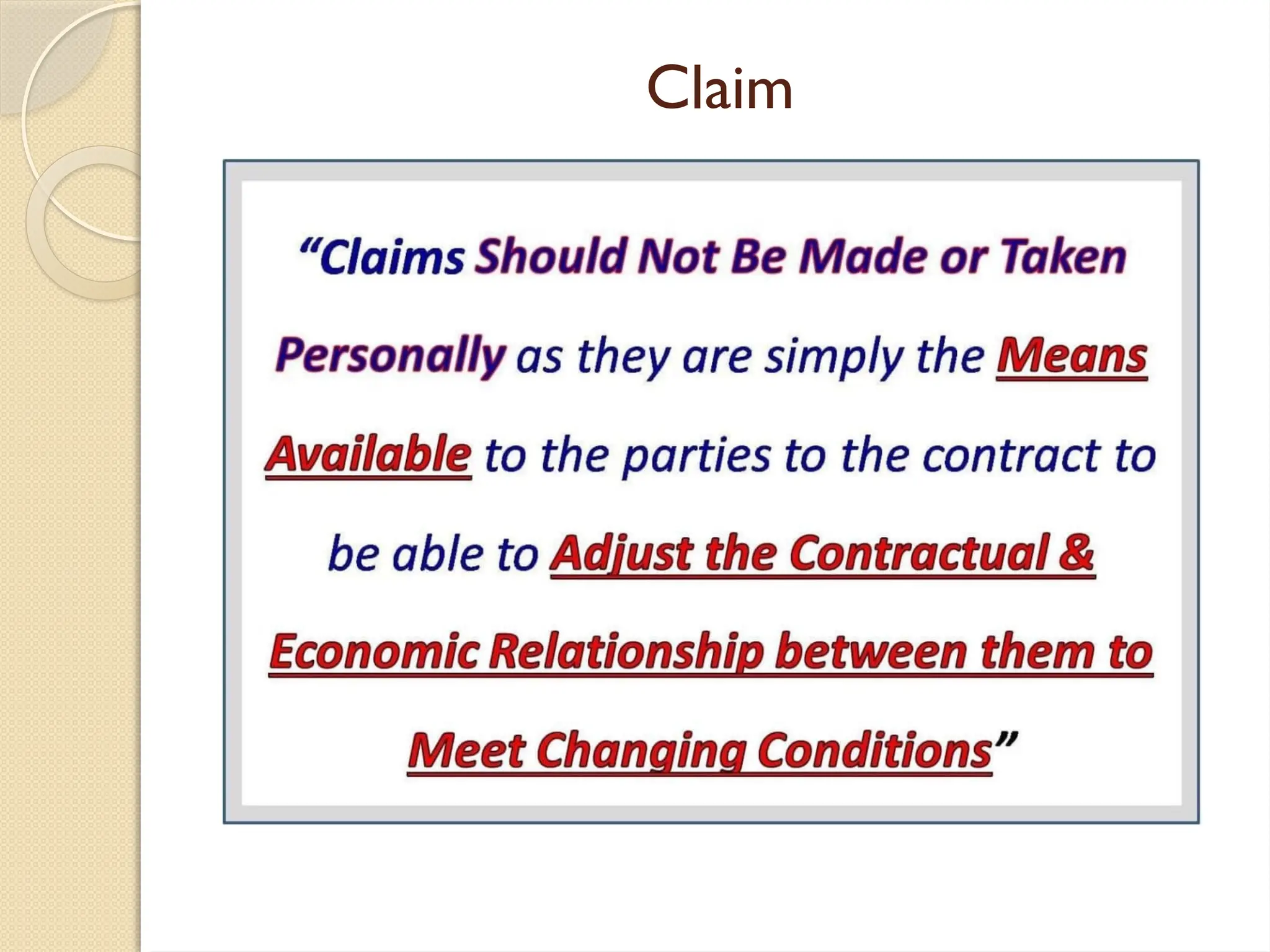
Claim
What is claim?
 In simple contractual terms it is a request for reimbursement of
cost and / or time from one party to another.
 A formal contract procedure used to review contract disputes
between the contracting parties.The claim process is identified
in the contract provisions which describes the steps to be taken
to protest an initial decision over the merits of a change order
proposal.
 Basic ingredients of claims
 Claim must include following:
◦ Definition of relevant risk events: what event or
circumstances happened? Allegation of occurrence of events
must be supported by evidence
◦ Identification of contractual provisions which flow from the
events eg. Unforeseen ground condition
◦ Identification of obligations
◦ Demonstrate cause and effect
◦ Value the effect in terms of cost or time
Definition
 A request, demand or assertion of rights under the
construction contract.
 Is a request for compensation which is not anticipated in the
terms and conditions of the original contract documents.
 A disputed change order is a claim. Disputes may be on
schedule targets, performance guarantees, or any deviation
from the original contract terms and conditions, which
causes significant commercial consequences (profit and
losses).
 Claims commonly arise between the parties to construction
contracts.This can be as a result of problems such as delays,
changes, unforeseen circumstances, insufficient information
and conflicts.
Construction Claim/Contract Claim
 Claim is a request for compensation for damages incurred
by any party to the contract.
 Claim is a disagreement that can not be resolved by mutual
agreement and become construction disputes, which must
be resolved by arbitration, mediation, adjudication and
dispute review boards, litigation or other alternative dispute
resolution methods as specified in the contract documents.
 Construction claim takes place when contractor feels that a
change exist which may losses him (in terms of money and
time) but the employer disagrees and/or both parties agree
that change exists but not agree on the impact and cost of
the change in future and its commercial consequences.
Construction Claim/Contract Claim
 Therefore, claim is an unresolved change or disputes due to
this change demand for money, time or an adjustment in the
original contract terms and conditions.
 Construction disputes create frustration, upsetting and never
ending discussion, time consuming, project delays, additional
costs and liabilities added and unavoidable.
 A construction claim in contract consists of two parts:
a) The entitlement section, which includes a detailed
descriptions of the actions of inactions of the part from whom
relief is specified or defined, entitling the claimant to
compensation as claimed.
b) The damages sections, which sets forth the calculations and
support for the compensation as claimed.
Types of Construction Claim:
Construction Claim can be classified by “Cause” and “Entitlement”
1) Extension ofTime (Delay)
2) Acceleration of progress. i.e. on request of owner
3) Financial charges
4) Disruption/Interference by owner or third party
5)Variation account. i.e. instruction of owner withVO
6) Interest i.e. delay in payment
7) Increased cost i.e. impossibility to performance
8) Retention release
9) Claim preparation cost
10) Loss of profit i.e. strikes due to owner
11) Lost opportunity i.e. impact on future project
12)Wrongful withholding of due payment
Reasons/Causes for arising Claims:
1) Defective contract documents: vague/ambiguities/wrong/incomplete drawings and
specification/contradictory statement or clauses/duel meaning clauses in the contract
document.
2) Differing site conditions: Geology, Hydrology, Geography
3) Cardinal changes: Fundamental change by owner or by the need of the project people
4) Termination: Forced termination, unnatural termination before completion, low bidding
practices in construction industry, unprofessional contractors with less familiar with
contract documents and procedures.
5) Acceleration of Progress: on the request or interest of the owner
6) Suspension of work: by the owner or by the other reason not attributable to the
contractor
7) Delays due to no any fault of either Owner or the Contractor.
8) Strikes: strikes, bandha, conflicts other than due to contractor’s internal affairs.
9) Directed Change: by the instruction of owner giving variation order.
10) Access to the site: No clear access, associated social problems, public demand
11) Delay in payment by the Employer: advance payment/Mobilization, Interim Payments,
Invoices
12) Unusual inflation
13) Mal-administration of contract documents: willful or intentional wrong administration
or negligence
14) Inclement weather: not predictable by an experienced contractor
Sources of Claim:
1) Delay in Payment: Mobilization, Interim payments
2) Change in the scope of work: Changes in the contract work (extra
work other than BoQ)
3)Tight construction schedule: rescheduling of project to meet client’s
schedule and requirements rather than constraint of the project and
limitations of the contractor.
4) Insufficient details and ambiguity in design, specifications and
contract documents.
5) Unusual inflation in construction materials and labors: increase
in cost due to change in legislations.
6) Delay in decision making
7) Unusual site conditions
8) Unpredictable weather conditions
9) Force majeure
10) Incompetent consultant and contractor
11) Suspension of work
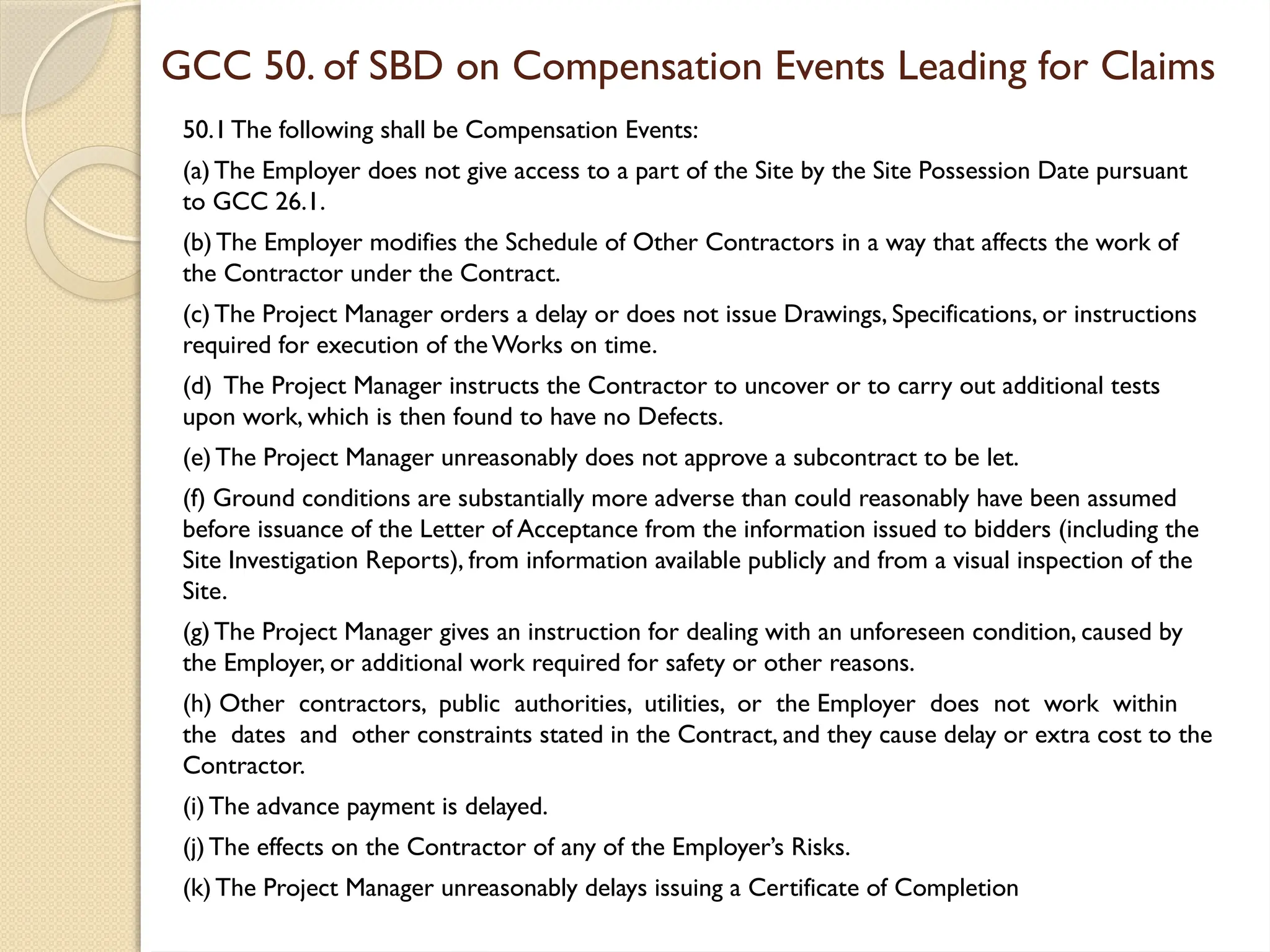
GCC 50. of SBD on Compensation Events Leading for Claims
50.1The following shall be Compensation Events:
(a)The Employer does not give access to a part of the Site by the Site Possession Date pursuant
to GCC 26.1.
(b)The Employer modifies the Schedule of Other Contractors in a way that affects the work of
the Contractor under the Contract.
(c)The Project Manager orders a delay or does not issue Drawings, Specifications, or instructions
required for execution of theWorks on time.
(d) The Project Manager instructs the Contractor to uncover or to carry out additional tests
upon work, which is then found to have no Defects.
(e)The Project Manager unreasonably does not approve a subcontract to be let.
(f) Ground conditions are substantially more adverse than could reasonably have been assumed
before issuance of the Letter of Acceptance from the information issued to bidders (including the
Site Investigation Reports), from information available publicly and from a visual inspection of the
Site.
(g)The Project Manager gives an instruction for dealing with an unforeseen condition, caused by
the Employer, or additional work required for safety or other reasons.
(h) Other contractors, public authorities, utilities, or the Employer does not work within
the dates and other constraints stated in the Contract, and they cause delay or extra cost to the
Contractor.
(i)The advance payment is delayed.
(j)The effects on the Contractor of any of the Employer’s Risks.
(k)The Project Manager unreasonably delays issuing a Certificate of Completion
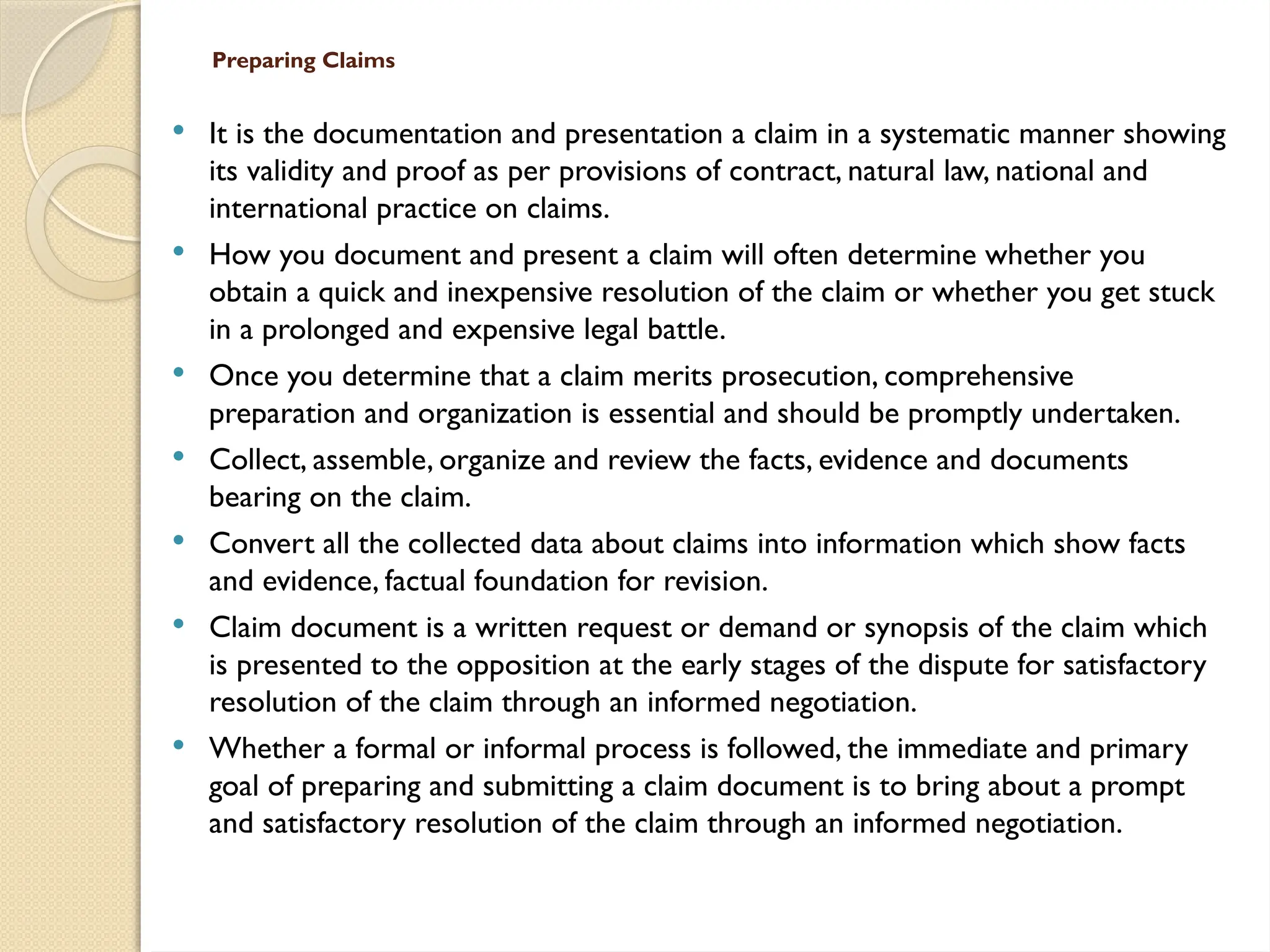
Preparing Claims
 It is the documentation and presentation a claim in a systematic manner showing
its validity and proof as per provisions of contract, natural law, national and
international practice on claims.
 How you document and present a claim will often determine whether you
obtain a quick and inexpensive resolution of the claim or whether you get stuck
in a prolonged and expensive legal battle.
 Once you determine that a claim merits prosecution, comprehensive
preparation and organization is essential and should be promptly undertaken.
 Collect, assemble, organize and review the facts, evidence and documents
bearing on the claim.
 Convert all the collected data about claims into information which show facts
and evidence, factual foundation for revision.
 Claim document is a written request or demand or synopsis of the claim which
is presented to the opposition at the early stages of the dispute for satisfactory
resolution of the claim through an informed negotiation.
 Whether a formal or informal process is followed, the immediate and primary
goal of preparing and submitting a claim document is to bring about a prompt
and satisfactory resolution of the claim through an informed negotiation.
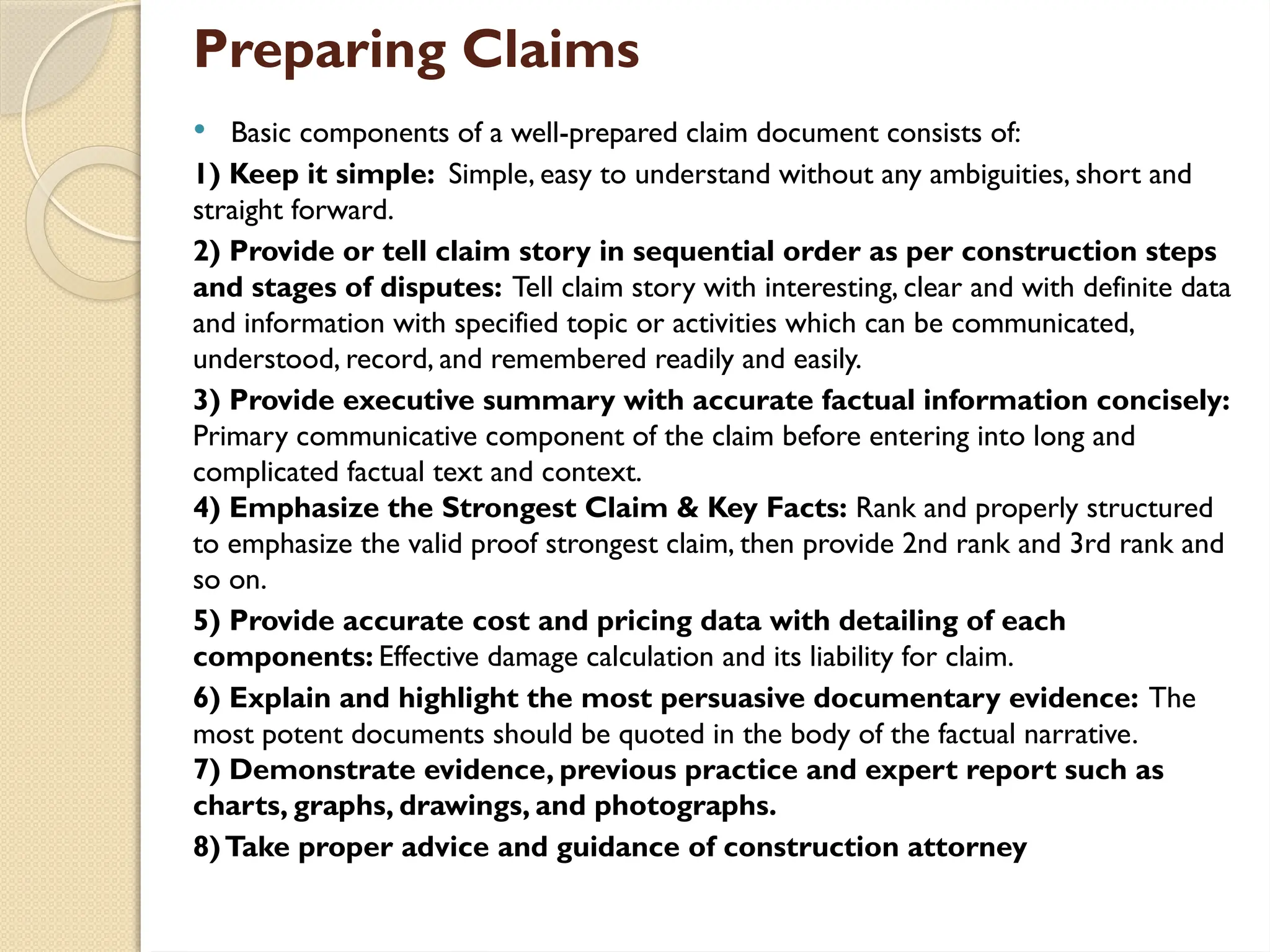
Preparing Claims
 Basic components of a well-prepared claim document consists of:
1) Keep it simple: Simple, easy to understand without any ambiguities, short and
straight forward.
2) Provide or tell claim story in sequential order as per construction steps
and stages of disputes: Tell claim story with interesting, clear and with definite data
and information with specified topic or activities which can be communicated,
understood, record, and remembered readily and easily.
3) Provide executive summary with accurate factual information concisely:
Primary communicative component of the claim before entering into long and
complicated factual text and context.
4) Emphasize the Strongest Claim & Key Facts: Rank and properly structured
to emphasize the valid proof strongest claim, then provide 2nd rank and 3rd rank and
so on.
5) Provide accurate cost and pricing data with detailing of each
components: Effective damage calculation and its liability for claim.
6) Explain and highlight the most persuasive documentary evidence: The
most potent documents should be quoted in the body of the factual narrative.
7) Demonstrate evidence, previous practice and expert report such as
charts, graphs, drawings, and photographs.
8)Take proper advice and guidance of construction attorney
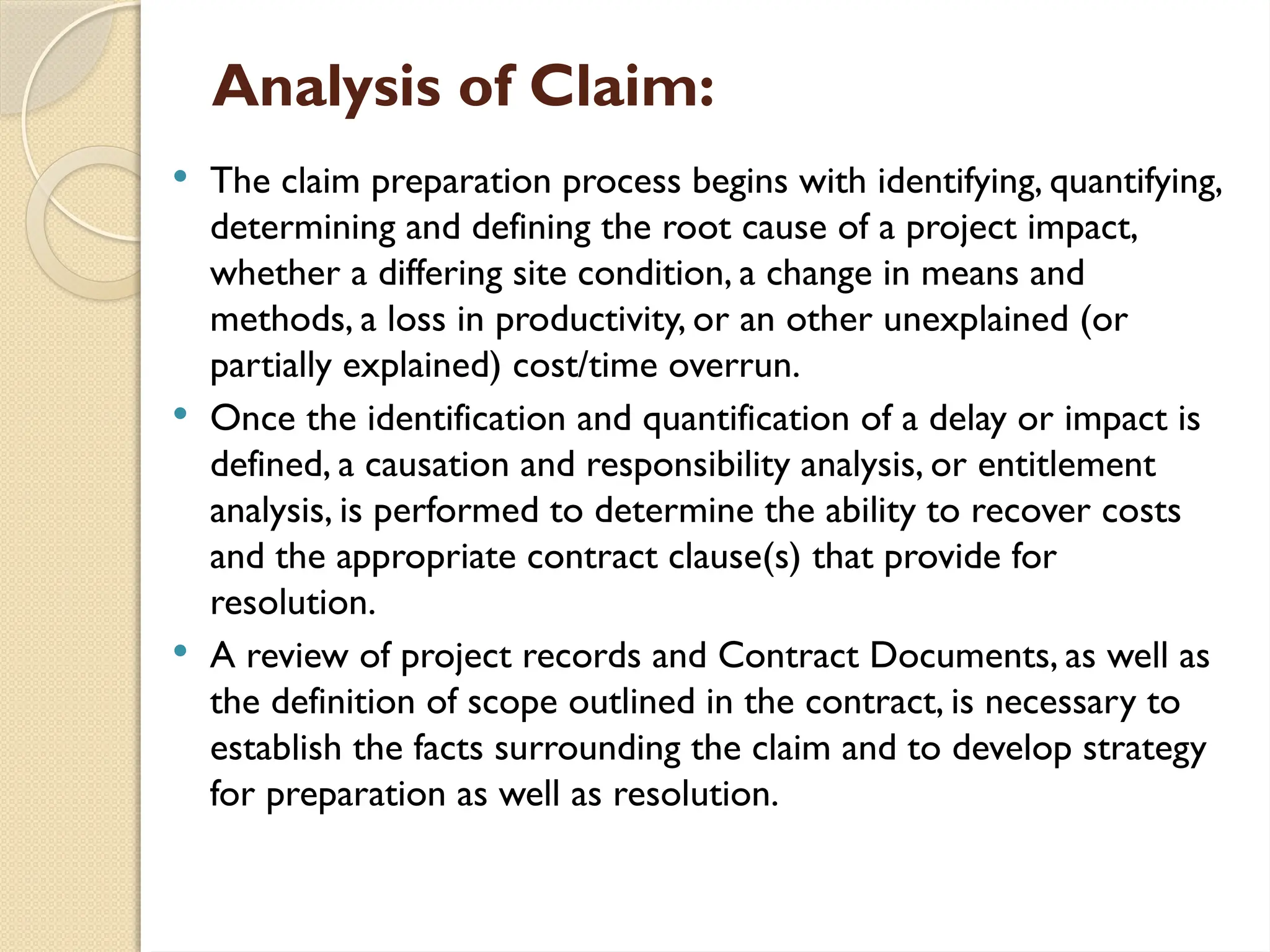
Analysis of Claim:
 The claim preparation process begins with identifying, quantifying,
determining and defining the root cause of a project impact,
whether a differing site condition, a change in means and
methods, a loss in productivity, or an other unexplained (or
partially explained) cost/time overrun.
 Once the identification and quantification of a delay or impact is
defined, a causation and responsibility analysis, or entitlement
analysis, is performed to determine the ability to recover costs
and the appropriate contract clause(s) that provide for
resolution.
 A review of project records and Contract Documents, as well as
the definition of scope outlined in the contract, is necessary to
establish the facts surrounding the claim and to develop strategy
for preparation as well as resolution.
Avoiding Claim
 Preparing Contract Document Well
 Formulate Contract Document on risk sharing basis:Timely issues of
contractual notices and communications
 Understanding the meaning and spirit of each clauses and enforced
provisions in the contract.
 Maintain complete project records in written to ensure a sound basis for
supporting or safeguarding against claim or damages
 Be Objective:
◦ Avoid inflated, overstated and duplication of billings or damages.
◦ Resolve disputes with good communication and negotiation
 Issues Letter of Intent: Issue letter confirming with appropriate and
undisputed clear access to contractor.
 Verify compliance with bid statement
 Make payment on time
 Work out the problems with your contractor at an early stage
 Communicate in time:Timely issue of contractual notices.
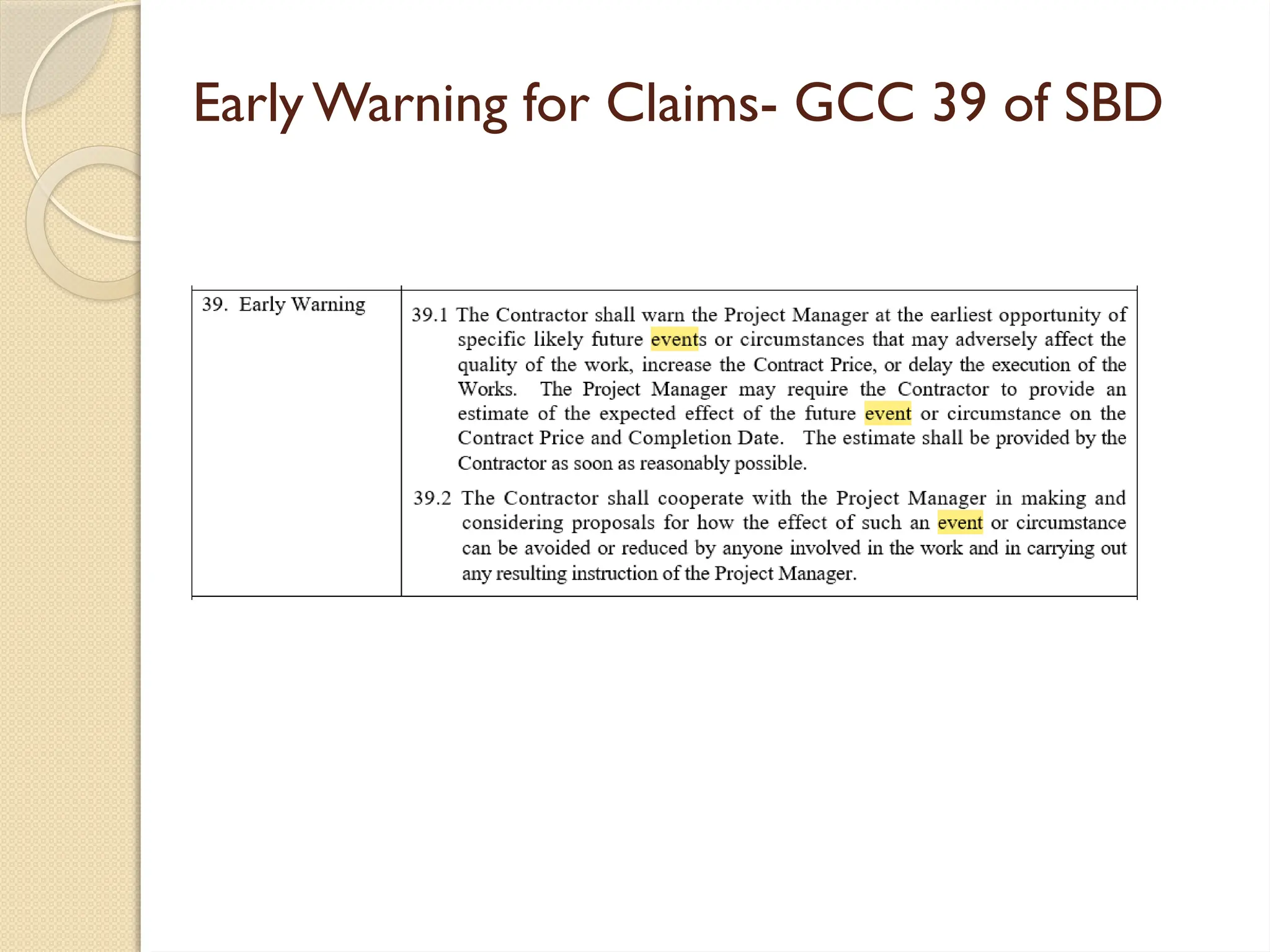
Early Warning for Claims- GCC 39 of SBD
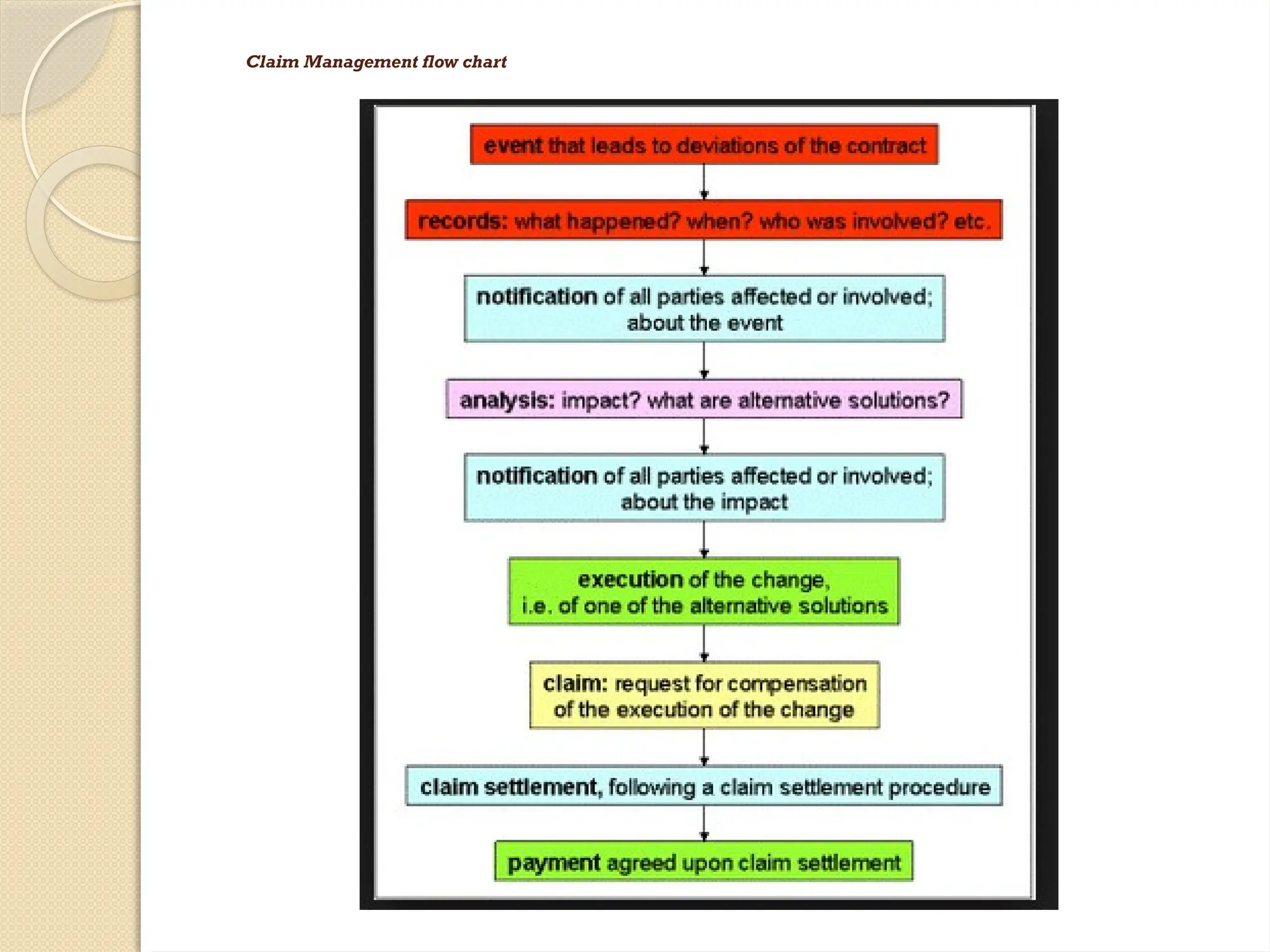
Claim Management flow chart
Claim document
 It contains four basic features
◦ The narrative: records relevant events, both
cause and effects
◦ The entitlement: demonstrates the contractual
or legal entitlement to compensation
◦ The argument or discussion: linking cause to
effect, event to entitlement
◦ Quantum: quantity reimbursement or time being
claimed
◦ Note: either party should notify the claim within
the 21 days from the event occurred for
compensation with the documents stated above
as per PPA/ PPR
DISPUTES
An argument about on certain issues, debate,
controversy.
 Dispute may be defined as an assertion of right,
claim or demand on one side, met by contrary
claim or allegation or repudiation on the other.
 Dispute exists when one party makes a decision
and the other party does not agree to it.When
either party in contract makes certain issue or
claim against other party or the later does not
accept the claim raised by the first party.
Causes of Construction Disputes (Why):
1) Absence of the clear objective, definite roles, and
proper communication between contracting parties
2) Absence of clear procedural guidelines for the
contract administration
3) Incomplete and improper contract documents
4) Defective design and specifications
5) Poor record keeping and documentation of
contracting parties.
6) Misunderstanding the meaning and spirit of each
clauses of contract conditions.
7) Involvement of third party and its involvement.
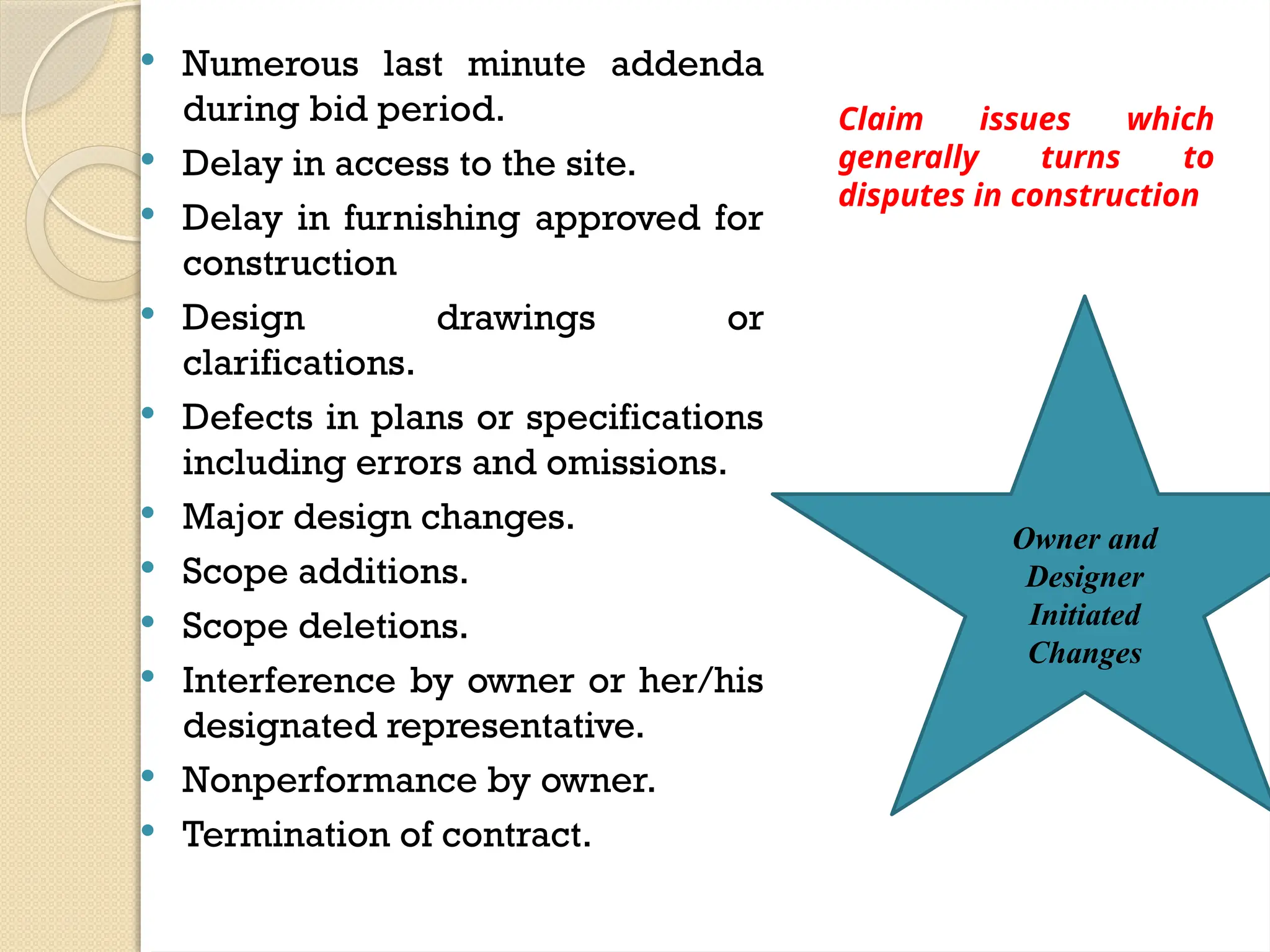
 Numerous last minute addenda
during bid period.
 Delay in access to the site.
 Delay in furnishing approved for
construction
 Design drawings or
clarifications.
 Defects in plans or specifications
including errors and omissions.
 Major design changes.
 Scope additions.
 Scope deletions.
 Interference by owner or her/his
designated representative.
 Nonperformance by owner.
 Termination of contract.
Owner and
Designer
Initiated
Changes
Claim issues which
generally turns to
disputes in construction
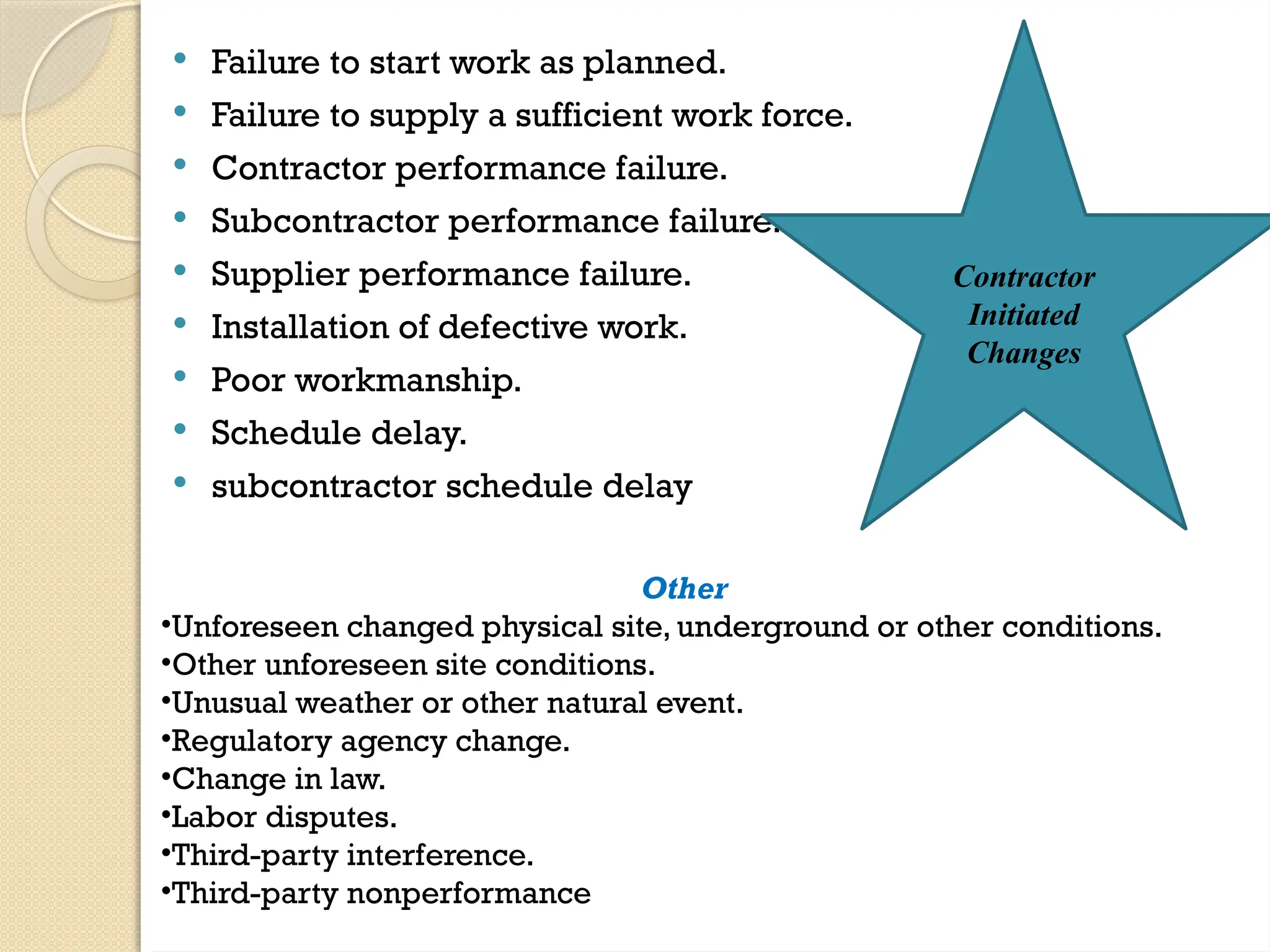
 Failure to start work as planned.
 Failure to supply a sufficient work force.
 Contractor performance failure.
 Subcontractor performance failure.
 Supplier performance failure.
 Installation of defective work.
 Poor workmanship.
 Schedule delay.
 subcontractor schedule delay
Other
•Unforeseen changed physical site, underground or other conditions.
•Other unforeseen site conditions.
•Unusual weather or other natural event.
•Regulatory agency change.
•Change in law.
•Labor disputes.
•Third-party interference.
•Third-party nonperformance
Contractor
Initiated
Changes
Characteristic of a Dispute Resolution process
General characteristics should be:
◦ Settlement in short period/ Minimum delay
◦ Fair Decision
◦ Settlement achieved is final
◦ Minimum costs
◦ Control of process
◦ The ability to preserve the relationships between
the parties
◦ Confidentiality
◦ Flexibility
Disputes Resolutions
Dispute resolution techniques (Methods)
include:
a) Negotiation – The most common form of
dispute resolution where the parties
themselves attempt to resolve the dispute.
Advantages:
Speed
Cost saving
Confidentiality
Preservation of relationships
Range of possible solutions
Control of process and outcome
Disputes : Causes and Resolutions
b) Mediation – A private and structured form of
negotiation assisted by a third party that is initially non-
binding. If settlement is reached it can become a legally
binding contract.
•Mediation is negotiation with the assistance of a neutral third
party. It is often referred to as ‘structured negotiation’.
•Applied when and where conventional negotiation failed or is
making slow progress.
•Format – mediation is essentially a flexible process with no fixed
procedures
•The mediator – the mediator’s role is to facilitate negotiations.
The mediator will not express views on any party’s position.
•Participants – the team attending the mediation should be kept
as small as possible
•Preparation – each party usually prepares a brief summary of its
position for the mediator and the other party, with the key
supporting documents
Disputes Resolutions
c) Conciliation – As per mediation, but a conciliator can
propose a solution. Mutually agreed terms and conditions.
“give & take approach”
d) Neutral evaluation – a private and non-binding
technique whereby a third party, usually legally qualified,
gives an opinion on the likely outcome at trial as a basis for
settlement discussions.
•It can be particularly useful where the dispute turns on a
point of law.
•Each side submits an outline of their case with an
indication of what evidence they would be able to produce
at trial.
•A third-party neutral, usually a retired judge or a lawyer,
gives a confidential opinion as to what the outcome of a
trial would be.
•This procedure can be carried out entirely on paper,
saving the parties the time and expense of an oral hearing.
Disputes Resolutions
e) Expert determination – A private process
involving an independent expert with
inquisitorial powers who gives a binding
decision.
•In expert determination, the parties agree to
be bound by the decision of an expert in the
field of dispute.
•This process can be useful where the dispute
is about a technical matter.
•The expert will commonly be given powers to
investigate the background of the dispute
himself, rather than just relying on the
evidence the parties choose to present
f) Adjudication– Adjudication does not
necessarily achieve final settlement of dispute
because either of the parties has right to have the
same dispute heard afresh in court or where the
contract specifies arbitration.
 The disputing parties has right to choose a learned
adjudicator having expertise in subject related to dispute
 Adjudicator imposes a fair and impartial decision like
arbitrator or judge
 It is faster than arbitration or litigation, it could be within
28 days
 Disputes can be resolved while works are still in progress
 Better understanding of facts and figures through site
investigations and studies
 Amicable settlement can be done after adjudication award
 Adjudication is private and confidential
g) Arbitration
 Arbitration is a process to resolve disputes
between contracting parties based on a
contract agreement.
 It is supported by law. Arbitration is initiated
when one party gives notice to the other.
The parties then appoint independent
person as an arbitrator to resolve disputes.
 The decision by the arbitrator called an
award is legal and binding. In Nepal NEPCA
does the ad-hoc procedures of arbitration.
Arbitrator is usually a lawyer or professional
worker
Advantages/ Features of Arbitration
• Neutrality
• Expertise
• Flexible procedures
• Appeal is limited
• Confidentiality
• Binding internationally
• Resolution is guaranteed
• Possible cost saving over litigation
Disputes Resolutions
h) Litigation – the formal process whereby
claims are taken through the civil courts and
conducted in public. The judgments are
binding on parties subject to rights of appeal.
Its advantages are:
Possible to bring an unwilling party into the
procedure
Solution will be enforceable without further
agreement
Its disadvantages are:
Potentially lengthy and costly
Adversarial process likely to damage
business relationships
Disputes Resolutions
Alternative Dispute Resolution (ADR)
Alternative Dispute Resolution is a commonly
used term to include a range of processes
which involve the use of an external third
party and which are regarded as an
alternative to litigation, however they do not
replace litigation. ADR is defined as, “a
collective description of methods for
resolving disputes otherwise than through the
normal trial process”.
Except negotiation and litigation other
methods of dispute resolution can be
considered as ADR.
PPA/PPR Provision
Dispute Settlement Mechanism
 Dispute between the Contracting parties
(Public Entity and Contractor/ Supplier/
Service Provider/Consultants) to be settled
through mutual consent
 Contract to provide mechanism for dispute
not settled by amicable settlement.
 Dispute will be settled by Arbitration in
accordance with prevailing laws if no
mechanism is stipulated in a contract
Arbitration
• Any dispute between the Parties as to
matters arising pursuant to this Contract
which cannot be settled amicably within thirty
(30) days after receipt by one Party of the
other Party‘s request for such amicable
settlement may be referred to Arbitration
within 30 days after the expiration of
amicable settlement period.
• by Arbitration in accordance with the
prevailing laws, if no such provisions are
stipulated in the Contract.
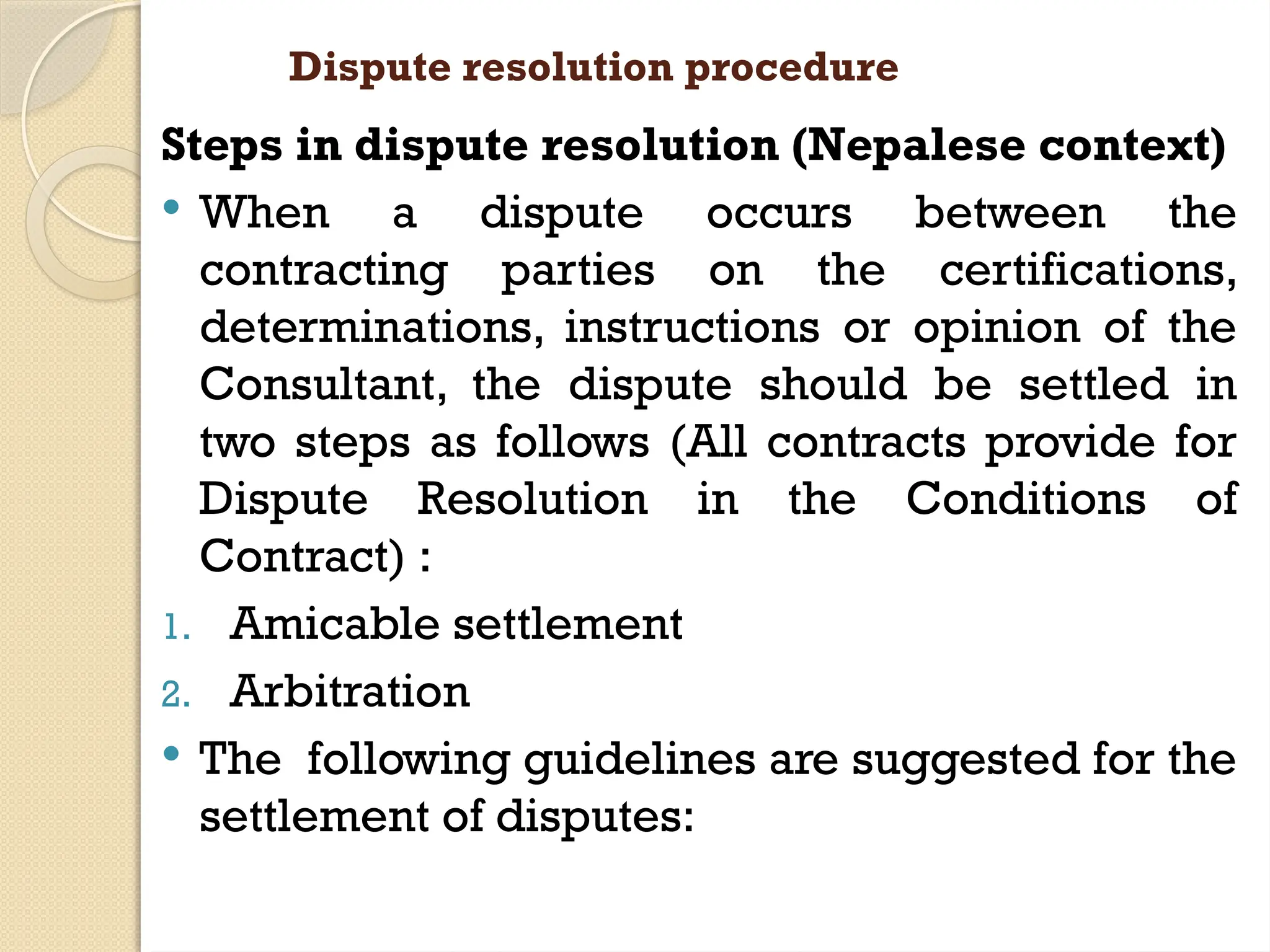
Dispute resolution procedure
Steps in dispute resolution (Nepalese context)
 When a dispute occurs between the
contracting parties on the certifications,
determinations, instructions or opinion of the
Consultant, the dispute should be settled in
two steps as follows (All contracts provide for
Dispute Resolution in the Conditions of
Contract) :
1. Amicable settlement
2. Arbitration
 The following guidelines are suggested for the
settlement of disputes:
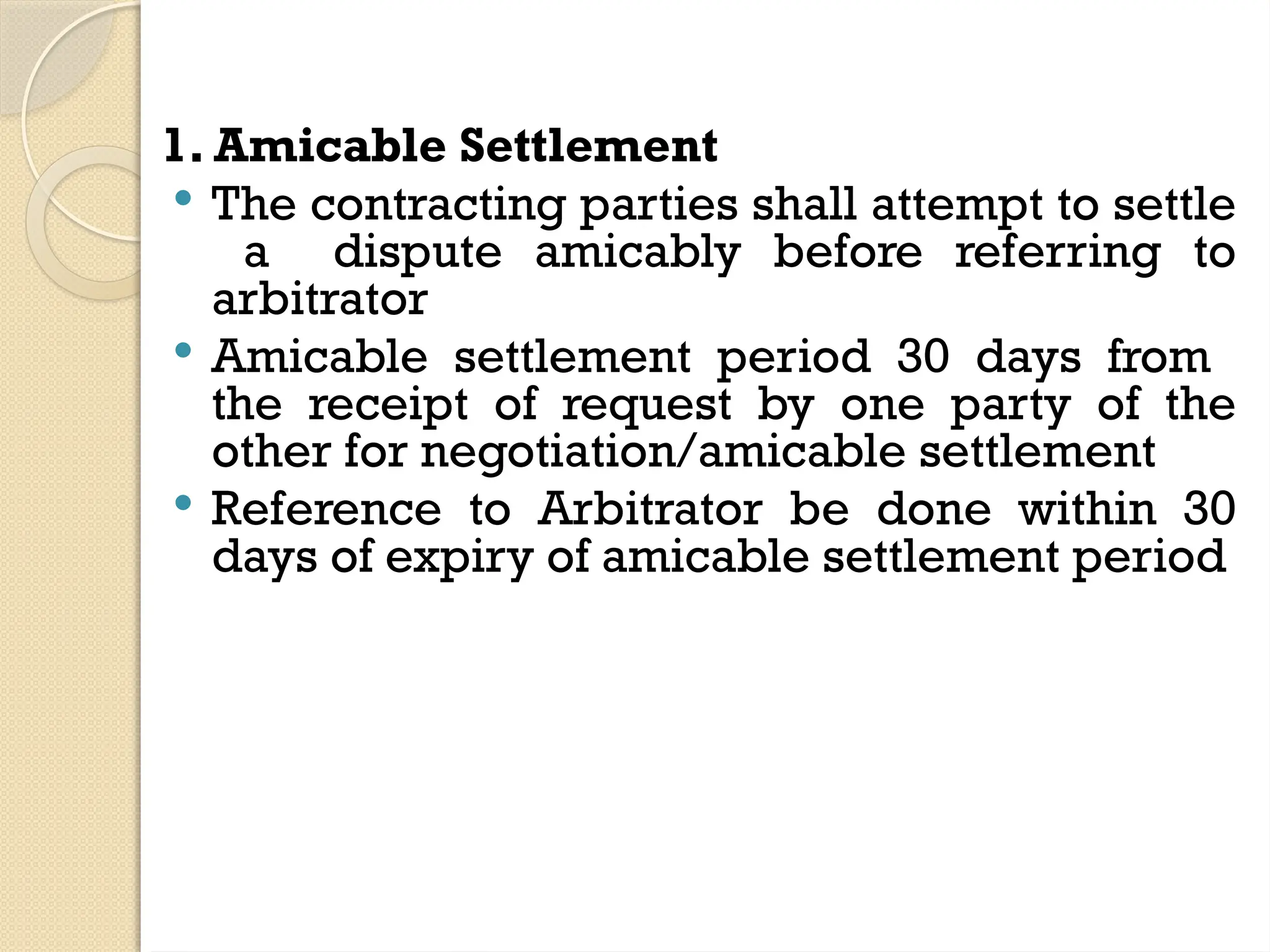
1. Amicable Settlement
 The contracting parties shall attempt to settle
a dispute amicably before referring to
arbitrator
 Amicable settlement period 30 days from
the receipt of request by one party of the
other for negotiation/amicable settlement
 Reference to Arbitrator be done within 30
days of expiry of amicable settlement period
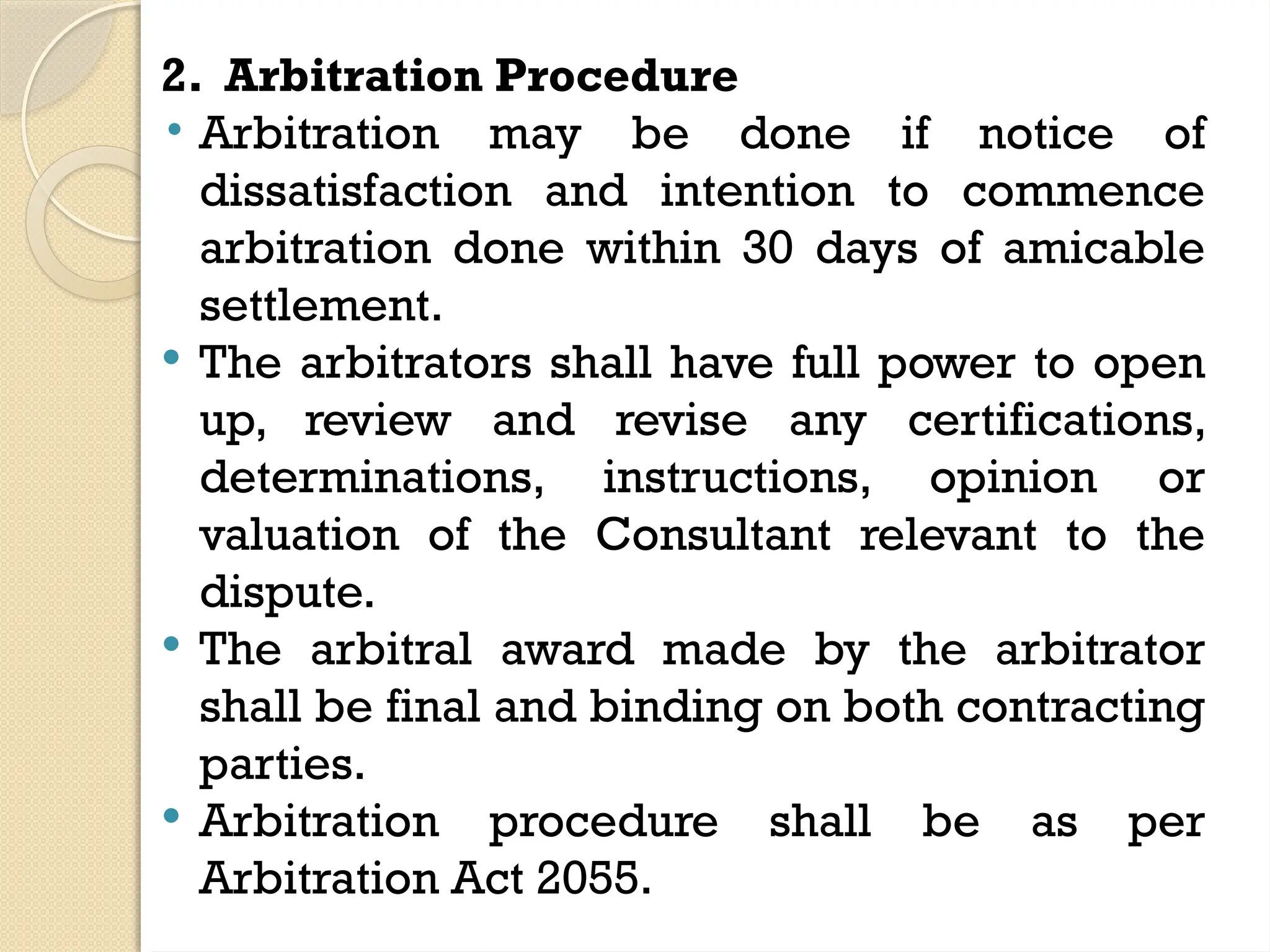
2. Arbitration Procedure
• Arbitration may be done if notice of
dissatisfaction and intention to commence
arbitration done within 30 days of amicable
settlement.
 The arbitrators shall have full power to open
up, review and revise any certifications,
determinations, instructions, opinion or
valuation of the Consultant relevant to the
dispute.
 The arbitral award made by the arbitrator
shall be final and binding on both contracting
parties.
 Arbitration procedure shall be as per
Arbitration Act 2055.
Cost of construction disputes
 8-10 % of the contract’s price.
 The costs of disputes are not only borne by the
client, designer or contractor but through the
community through additional taxes and costly
delays to the commissioning of vital projects.
Direct cost
 obtaining legal advice
 engaging experts and consultants
 the diversion of in-house resources while staff
are engaged in activities associated with the
pursuit or defense of the claim
 the preparation for the arbitral or court
hearing.
• Indirect cost
 the costs incurred by the parties as a result of delays
to the project
• adverse performance of the project
 distraction and over burdening of staff on the project
• reduced morale
• erosion of trust and confidence in working
relationships
• adverse impact on the reputation of the parties
• emotional impact on the people involved
• lost opportunities for future work
• destruction of business relationships
• loss of people to the industry because of wasted
effort.
Nepal Arbitration Council (NEPCA):
 NEPCA, founded in 1991, an autonomous and non-profitable
 organization, Established to administer arbitration and other alternative
methods of dispute resolution in an expeditious and less expensive manner by
arranging co-operation from the concerned sector.
 Committed for the settlement of national and international disputes of
development, construction, industry, trade and other nature which are to be
resolved through arbitration.
 Provides supremacy in the appointment of arbitrators applicable law, venue of
arbitration, language and procedure followed by the arbitrator.
 NEPCA provides administrative services for arbitrating different kinds of
dispute at reasonable fees.
 The council is not involved in deciding cases but supplies lists of individuals
from which the parties mutually select impartial arbitrators.
 Arbitration is conducted by specific rules and procedures, and the awards by
arbitrators are legally binding and enforceable.
Nepal Arbitration Act 2055
 Act. Incorporates basic principles of United Nations commission on International Trade
Law (UNCITRAL), UNCITRAL Model law.
 Provides supremacy of the contracting parties in the appointment of arbitrators, applicable
law, venue of arbitration, language and procedure followed by the arbitrators.
 Provide time frame to reduce delay in court procedures.
 Arbitration is guided as per the conditions of contract.
 The no. of arbitrators, unless otherwise stated in the contract, will be three.
 Unless and otherwise stated in the contract two arbitrators will be appointed by each
party and third will be appointed by both appointed members, the third member will work
as the principal arbitrator.
 If there is no provision regarding the appointment of arbitrators in the contract or failed
to appoint arbitrator, either party may apply to Appellate Court for the appointment of
the arbitrator.
 Arbitrator has to take oath before starting his work.
 Unless otherwise stated in the contract agreement the arbitrator should give his Arbitral
Award within 120 days after the receipt of all the necessary documents.
 If either party is dissatisfied with the award, can to go the court within 35 days of the
notice of the award.
 In case of difference of opinion among the arbitrators and fail to enter into decision by
majority the opinion of the Principal arbitrator will prevail.
Avoidance of disputes
 Prevention is better than cure, so at the
beginning of a construction project, identify the
potential risks and put in place procurement
strategies and contract structures that are most
likely to allow the project to progress smoothly.
Mitigation
 Should a dispute arise, recognizing the problem
and dealing with it quickly is key. Having the
right expertise available to isolate and manage
issues swiftly will mitigate the effects of the
dispute, thus avoiding expensive and lengthy
difficulties.
9. CLaim and DIspute Reference materials

  • 1.
    Chapter 6.0 Claims, Disputesand Dispute Settlement
  • 3.
  • 4.
    What is claim? In simple contractual terms it is a request for reimbursement of cost and / or time from one party to another.  A formal contract procedure used to review contract disputes between the contracting parties.The claim process is identified in the contract provisions which describes the steps to be taken to protest an initial decision over the merits of a change order proposal.  Basic ingredients of claims  Claim must include following: ◦ Definition of relevant risk events: what event or circumstances happened? Allegation of occurrence of events must be supported by evidence ◦ Identification of contractual provisions which flow from the events eg. Unforeseen ground condition ◦ Identification of obligations ◦ Demonstrate cause and effect ◦ Value the effect in terms of cost or time
  • 5.
    Definition  A request,demand or assertion of rights under the construction contract.  Is a request for compensation which is not anticipated in the terms and conditions of the original contract documents.  A disputed change order is a claim. Disputes may be on schedule targets, performance guarantees, or any deviation from the original contract terms and conditions, which causes significant commercial consequences (profit and losses).  Claims commonly arise between the parties to construction contracts.This can be as a result of problems such as delays, changes, unforeseen circumstances, insufficient information and conflicts.
  • 6.
    Construction Claim/Contract Claim Claim is a request for compensation for damages incurred by any party to the contract.  Claim is a disagreement that can not be resolved by mutual agreement and become construction disputes, which must be resolved by arbitration, mediation, adjudication and dispute review boards, litigation or other alternative dispute resolution methods as specified in the contract documents.  Construction claim takes place when contractor feels that a change exist which may losses him (in terms of money and time) but the employer disagrees and/or both parties agree that change exists but not agree on the impact and cost of the change in future and its commercial consequences.
  • 7.
    Construction Claim/Contract Claim Therefore, claim is an unresolved change or disputes due to this change demand for money, time or an adjustment in the original contract terms and conditions.  Construction disputes create frustration, upsetting and never ending discussion, time consuming, project delays, additional costs and liabilities added and unavoidable.  A construction claim in contract consists of two parts: a) The entitlement section, which includes a detailed descriptions of the actions of inactions of the part from whom relief is specified or defined, entitling the claimant to compensation as claimed. b) The damages sections, which sets forth the calculations and support for the compensation as claimed.
  • 8.
    Types of ConstructionClaim: Construction Claim can be classified by “Cause” and “Entitlement” 1) Extension ofTime (Delay) 2) Acceleration of progress. i.e. on request of owner 3) Financial charges 4) Disruption/Interference by owner or third party 5)Variation account. i.e. instruction of owner withVO 6) Interest i.e. delay in payment 7) Increased cost i.e. impossibility to performance 8) Retention release 9) Claim preparation cost 10) Loss of profit i.e. strikes due to owner 11) Lost opportunity i.e. impact on future project 12)Wrongful withholding of due payment
  • 9.
    Reasons/Causes for arisingClaims: 1) Defective contract documents: vague/ambiguities/wrong/incomplete drawings and specification/contradictory statement or clauses/duel meaning clauses in the contract document. 2) Differing site conditions: Geology, Hydrology, Geography 3) Cardinal changes: Fundamental change by owner or by the need of the project people 4) Termination: Forced termination, unnatural termination before completion, low bidding practices in construction industry, unprofessional contractors with less familiar with contract documents and procedures. 5) Acceleration of Progress: on the request or interest of the owner 6) Suspension of work: by the owner or by the other reason not attributable to the contractor 7) Delays due to no any fault of either Owner or the Contractor. 8) Strikes: strikes, bandha, conflicts other than due to contractor’s internal affairs. 9) Directed Change: by the instruction of owner giving variation order. 10) Access to the site: No clear access, associated social problems, public demand 11) Delay in payment by the Employer: advance payment/Mobilization, Interim Payments, Invoices 12) Unusual inflation 13) Mal-administration of contract documents: willful or intentional wrong administration or negligence 14) Inclement weather: not predictable by an experienced contractor
  • 10.
    Sources of Claim: 1)Delay in Payment: Mobilization, Interim payments 2) Change in the scope of work: Changes in the contract work (extra work other than BoQ) 3)Tight construction schedule: rescheduling of project to meet client’s schedule and requirements rather than constraint of the project and limitations of the contractor. 4) Insufficient details and ambiguity in design, specifications and contract documents. 5) Unusual inflation in construction materials and labors: increase in cost due to change in legislations. 6) Delay in decision making 7) Unusual site conditions 8) Unpredictable weather conditions 9) Force majeure 10) Incompetent consultant and contractor 11) Suspension of work
  • 11.
    GCC 50. ofSBD on Compensation Events Leading for Claims 50.1The following shall be Compensation Events: (a)The Employer does not give access to a part of the Site by the Site Possession Date pursuant to GCC 26.1. (b)The Employer modifies the Schedule of Other Contractors in a way that affects the work of the Contractor under the Contract. (c)The Project Manager orders a delay or does not issue Drawings, Specifications, or instructions required for execution of theWorks on time. (d) The Project Manager instructs the Contractor to uncover or to carry out additional tests upon work, which is then found to have no Defects. (e)The Project Manager unreasonably does not approve a subcontract to be let. (f) Ground conditions are substantially more adverse than could reasonably have been assumed before issuance of the Letter of Acceptance from the information issued to bidders (including the Site Investigation Reports), from information available publicly and from a visual inspection of the Site. (g)The Project Manager gives an instruction for dealing with an unforeseen condition, caused by the Employer, or additional work required for safety or other reasons. (h) Other contractors, public authorities, utilities, or the Employer does not work within the dates and other constraints stated in the Contract, and they cause delay or extra cost to the Contractor. (i)The advance payment is delayed. (j)The effects on the Contractor of any of the Employer’s Risks. (k)The Project Manager unreasonably delays issuing a Certificate of Completion
  • 12.
    Preparing Claims  Itis the documentation and presentation a claim in a systematic manner showing its validity and proof as per provisions of contract, natural law, national and international practice on claims.  How you document and present a claim will often determine whether you obtain a quick and inexpensive resolution of the claim or whether you get stuck in a prolonged and expensive legal battle.  Once you determine that a claim merits prosecution, comprehensive preparation and organization is essential and should be promptly undertaken.  Collect, assemble, organize and review the facts, evidence and documents bearing on the claim.  Convert all the collected data about claims into information which show facts and evidence, factual foundation for revision.  Claim document is a written request or demand or synopsis of the claim which is presented to the opposition at the early stages of the dispute for satisfactory resolution of the claim through an informed negotiation.  Whether a formal or informal process is followed, the immediate and primary goal of preparing and submitting a claim document is to bring about a prompt and satisfactory resolution of the claim through an informed negotiation.
  • 13.
    Preparing Claims  Basiccomponents of a well-prepared claim document consists of: 1) Keep it simple: Simple, easy to understand without any ambiguities, short and straight forward. 2) Provide or tell claim story in sequential order as per construction steps and stages of disputes: Tell claim story with interesting, clear and with definite data and information with specified topic or activities which can be communicated, understood, record, and remembered readily and easily. 3) Provide executive summary with accurate factual information concisely: Primary communicative component of the claim before entering into long and complicated factual text and context. 4) Emphasize the Strongest Claim & Key Facts: Rank and properly structured to emphasize the valid proof strongest claim, then provide 2nd rank and 3rd rank and so on. 5) Provide accurate cost and pricing data with detailing of each components: Effective damage calculation and its liability for claim. 6) Explain and highlight the most persuasive documentary evidence: The most potent documents should be quoted in the body of the factual narrative. 7) Demonstrate evidence, previous practice and expert report such as charts, graphs, drawings, and photographs. 8)Take proper advice and guidance of construction attorney
  • 14.
    Analysis of Claim: The claim preparation process begins with identifying, quantifying, determining and defining the root cause of a project impact, whether a differing site condition, a change in means and methods, a loss in productivity, or an other unexplained (or partially explained) cost/time overrun.  Once the identification and quantification of a delay or impact is defined, a causation and responsibility analysis, or entitlement analysis, is performed to determine the ability to recover costs and the appropriate contract clause(s) that provide for resolution.  A review of project records and Contract Documents, as well as the definition of scope outlined in the contract, is necessary to establish the facts surrounding the claim and to develop strategy for preparation as well as resolution.
  • 15.
    Avoiding Claim  PreparingContract Document Well  Formulate Contract Document on risk sharing basis:Timely issues of contractual notices and communications  Understanding the meaning and spirit of each clauses and enforced provisions in the contract.  Maintain complete project records in written to ensure a sound basis for supporting or safeguarding against claim or damages  Be Objective: ◦ Avoid inflated, overstated and duplication of billings or damages. ◦ Resolve disputes with good communication and negotiation  Issues Letter of Intent: Issue letter confirming with appropriate and undisputed clear access to contractor.  Verify compliance with bid statement  Make payment on time  Work out the problems with your contractor at an early stage  Communicate in time:Timely issue of contractual notices.
  • 16.
    Early Warning forClaims- GCC 39 of SBD
  • 17.
  • 18.
    Claim document  Itcontains four basic features ◦ The narrative: records relevant events, both cause and effects ◦ The entitlement: demonstrates the contractual or legal entitlement to compensation ◦ The argument or discussion: linking cause to effect, event to entitlement ◦ Quantum: quantity reimbursement or time being claimed ◦ Note: either party should notify the claim within the 21 days from the event occurred for compensation with the documents stated above as per PPA/ PPR
  • 19.
    DISPUTES An argument abouton certain issues, debate, controversy.  Dispute may be defined as an assertion of right, claim or demand on one side, met by contrary claim or allegation or repudiation on the other.  Dispute exists when one party makes a decision and the other party does not agree to it.When either party in contract makes certain issue or claim against other party or the later does not accept the claim raised by the first party.
  • 20.
    Causes of ConstructionDisputes (Why): 1) Absence of the clear objective, definite roles, and proper communication between contracting parties 2) Absence of clear procedural guidelines for the contract administration 3) Incomplete and improper contract documents 4) Defective design and specifications 5) Poor record keeping and documentation of contracting parties. 6) Misunderstanding the meaning and spirit of each clauses of contract conditions. 7) Involvement of third party and its involvement.
  • 21.
     Numerous lastminute addenda during bid period.  Delay in access to the site.  Delay in furnishing approved for construction  Design drawings or clarifications.  Defects in plans or specifications including errors and omissions.  Major design changes.  Scope additions.  Scope deletions.  Interference by owner or her/his designated representative.  Nonperformance by owner.  Termination of contract. Owner and Designer Initiated Changes Claim issues which generally turns to disputes in construction
  • 22.
     Failure tostart work as planned.  Failure to supply a sufficient work force.  Contractor performance failure.  Subcontractor performance failure.  Supplier performance failure.  Installation of defective work.  Poor workmanship.  Schedule delay.  subcontractor schedule delay Other •Unforeseen changed physical site, underground or other conditions. •Other unforeseen site conditions. •Unusual weather or other natural event. •Regulatory agency change. •Change in law. •Labor disputes. •Third-party interference. •Third-party nonperformance Contractor Initiated Changes
  • 23.
    Characteristic of aDispute Resolution process General characteristics should be: ◦ Settlement in short period/ Minimum delay ◦ Fair Decision ◦ Settlement achieved is final ◦ Minimum costs ◦ Control of process ◦ The ability to preserve the relationships between the parties ◦ Confidentiality ◦ Flexibility
  • 24.
    Disputes Resolutions Dispute resolutiontechniques (Methods) include: a) Negotiation – The most common form of dispute resolution where the parties themselves attempt to resolve the dispute. Advantages: Speed Cost saving Confidentiality Preservation of relationships Range of possible solutions Control of process and outcome
  • 25.
    Disputes : Causesand Resolutions b) Mediation – A private and structured form of negotiation assisted by a third party that is initially non- binding. If settlement is reached it can become a legally binding contract. •Mediation is negotiation with the assistance of a neutral third party. It is often referred to as ‘structured negotiation’. •Applied when and where conventional negotiation failed or is making slow progress. •Format – mediation is essentially a flexible process with no fixed procedures •The mediator – the mediator’s role is to facilitate negotiations. The mediator will not express views on any party’s position. •Participants – the team attending the mediation should be kept as small as possible •Preparation – each party usually prepares a brief summary of its position for the mediator and the other party, with the key supporting documents
  • 26.
    Disputes Resolutions c) Conciliation– As per mediation, but a conciliator can propose a solution. Mutually agreed terms and conditions. “give & take approach” d) Neutral evaluation – a private and non-binding technique whereby a third party, usually legally qualified, gives an opinion on the likely outcome at trial as a basis for settlement discussions. •It can be particularly useful where the dispute turns on a point of law. •Each side submits an outline of their case with an indication of what evidence they would be able to produce at trial. •A third-party neutral, usually a retired judge or a lawyer, gives a confidential opinion as to what the outcome of a trial would be. •This procedure can be carried out entirely on paper, saving the parties the time and expense of an oral hearing.
  • 27.
    Disputes Resolutions e) Expertdetermination – A private process involving an independent expert with inquisitorial powers who gives a binding decision. •In expert determination, the parties agree to be bound by the decision of an expert in the field of dispute. •This process can be useful where the dispute is about a technical matter. •The expert will commonly be given powers to investigate the background of the dispute himself, rather than just relying on the evidence the parties choose to present
  • 28.
    f) Adjudication– Adjudicationdoes not necessarily achieve final settlement of dispute because either of the parties has right to have the same dispute heard afresh in court or where the contract specifies arbitration.  The disputing parties has right to choose a learned adjudicator having expertise in subject related to dispute  Adjudicator imposes a fair and impartial decision like arbitrator or judge  It is faster than arbitration or litigation, it could be within 28 days  Disputes can be resolved while works are still in progress  Better understanding of facts and figures through site investigations and studies  Amicable settlement can be done after adjudication award  Adjudication is private and confidential
  • 29.
    g) Arbitration  Arbitrationis a process to resolve disputes between contracting parties based on a contract agreement.  It is supported by law. Arbitration is initiated when one party gives notice to the other. The parties then appoint independent person as an arbitrator to resolve disputes.  The decision by the arbitrator called an award is legal and binding. In Nepal NEPCA does the ad-hoc procedures of arbitration. Arbitrator is usually a lawyer or professional worker
  • 30.
    Advantages/ Features ofArbitration • Neutrality • Expertise • Flexible procedures • Appeal is limited • Confidentiality • Binding internationally • Resolution is guaranteed • Possible cost saving over litigation
  • 31.
    Disputes Resolutions h) Litigation– the formal process whereby claims are taken through the civil courts and conducted in public. The judgments are binding on parties subject to rights of appeal. Its advantages are: Possible to bring an unwilling party into the procedure Solution will be enforceable without further agreement Its disadvantages are: Potentially lengthy and costly Adversarial process likely to damage business relationships
  • 32.
    Disputes Resolutions Alternative DisputeResolution (ADR) Alternative Dispute Resolution is a commonly used term to include a range of processes which involve the use of an external third party and which are regarded as an alternative to litigation, however they do not replace litigation. ADR is defined as, “a collective description of methods for resolving disputes otherwise than through the normal trial process”. Except negotiation and litigation other methods of dispute resolution can be considered as ADR.
  • 33.
    PPA/PPR Provision Dispute SettlementMechanism  Dispute between the Contracting parties (Public Entity and Contractor/ Supplier/ Service Provider/Consultants) to be settled through mutual consent  Contract to provide mechanism for dispute not settled by amicable settlement.  Dispute will be settled by Arbitration in accordance with prevailing laws if no mechanism is stipulated in a contract
  • 34.
    Arbitration • Any disputebetween the Parties as to matters arising pursuant to this Contract which cannot be settled amicably within thirty (30) days after receipt by one Party of the other Party‘s request for such amicable settlement may be referred to Arbitration within 30 days after the expiration of amicable settlement period. • by Arbitration in accordance with the prevailing laws, if no such provisions are stipulated in the Contract.
  • 35.
    Dispute resolution procedure Stepsin dispute resolution (Nepalese context)  When a dispute occurs between the contracting parties on the certifications, determinations, instructions or opinion of the Consultant, the dispute should be settled in two steps as follows (All contracts provide for Dispute Resolution in the Conditions of Contract) : 1. Amicable settlement 2. Arbitration  The following guidelines are suggested for the settlement of disputes:
  • 36.
    1. Amicable Settlement The contracting parties shall attempt to settle a dispute amicably before referring to arbitrator  Amicable settlement period 30 days from the receipt of request by one party of the other for negotiation/amicable settlement  Reference to Arbitrator be done within 30 days of expiry of amicable settlement period
  • 37.
    2. Arbitration Procedure •Arbitration may be done if notice of dissatisfaction and intention to commence arbitration done within 30 days of amicable settlement.  The arbitrators shall have full power to open up, review and revise any certifications, determinations, instructions, opinion or valuation of the Consultant relevant to the dispute.  The arbitral award made by the arbitrator shall be final and binding on both contracting parties.  Arbitration procedure shall be as per Arbitration Act 2055.
  • 38.
    Cost of constructiondisputes  8-10 % of the contract’s price.  The costs of disputes are not only borne by the client, designer or contractor but through the community through additional taxes and costly delays to the commissioning of vital projects. Direct cost  obtaining legal advice  engaging experts and consultants  the diversion of in-house resources while staff are engaged in activities associated with the pursuit or defense of the claim  the preparation for the arbitral or court hearing.
  • 39.
    • Indirect cost the costs incurred by the parties as a result of delays to the project • adverse performance of the project  distraction and over burdening of staff on the project • reduced morale • erosion of trust and confidence in working relationships • adverse impact on the reputation of the parties • emotional impact on the people involved • lost opportunities for future work • destruction of business relationships • loss of people to the industry because of wasted effort.
  • 40.
    Nepal Arbitration Council(NEPCA):  NEPCA, founded in 1991, an autonomous and non-profitable  organization, Established to administer arbitration and other alternative methods of dispute resolution in an expeditious and less expensive manner by arranging co-operation from the concerned sector.  Committed for the settlement of national and international disputes of development, construction, industry, trade and other nature which are to be resolved through arbitration.  Provides supremacy in the appointment of arbitrators applicable law, venue of arbitration, language and procedure followed by the arbitrator.  NEPCA provides administrative services for arbitrating different kinds of dispute at reasonable fees.  The council is not involved in deciding cases but supplies lists of individuals from which the parties mutually select impartial arbitrators.  Arbitration is conducted by specific rules and procedures, and the awards by arbitrators are legally binding and enforceable.
  • 41.
    Nepal Arbitration Act2055  Act. Incorporates basic principles of United Nations commission on International Trade Law (UNCITRAL), UNCITRAL Model law.  Provides supremacy of the contracting parties in the appointment of arbitrators, applicable law, venue of arbitration, language and procedure followed by the arbitrators.  Provide time frame to reduce delay in court procedures.  Arbitration is guided as per the conditions of contract.  The no. of arbitrators, unless otherwise stated in the contract, will be three.  Unless and otherwise stated in the contract two arbitrators will be appointed by each party and third will be appointed by both appointed members, the third member will work as the principal arbitrator.  If there is no provision regarding the appointment of arbitrators in the contract or failed to appoint arbitrator, either party may apply to Appellate Court for the appointment of the arbitrator.  Arbitrator has to take oath before starting his work.  Unless otherwise stated in the contract agreement the arbitrator should give his Arbitral Award within 120 days after the receipt of all the necessary documents.  If either party is dissatisfied with the award, can to go the court within 35 days of the notice of the award.  In case of difference of opinion among the arbitrators and fail to enter into decision by majority the opinion of the Principal arbitrator will prevail.
  • 42.
    Avoidance of disputes Prevention is better than cure, so at the beginning of a construction project, identify the potential risks and put in place procurement strategies and contract structures that are most likely to allow the project to progress smoothly. Mitigation  Should a dispute arise, recognizing the problem and dealing with it quickly is key. Having the right expertise available to isolate and manage issues swiftly will mitigate the effects of the dispute, thus avoiding expensive and lengthy difficulties.