Plate Tectonics
Earth’s Drifting Continents
• Theory of Continental drift- the theory,
proposed by Alfred Wegener, that the
continents were once joined together and
have since drifted apart.
– Alfred Wegener concept in 1912.
– He thought some of the continents coasts look like
they could have fit together at one time.
– Discredited by many scientists until the 1950’s.
– Went against many geological basic principles.
• Pangaea- means all Earth; is the name of the
super continent from millions of years ago.
– Fossil records showed that the same kind of
animals and plant remains were separated by the
Atlantic Ocean.
– Evidence from Rocks- when you line South
America and Africa up together there is rock
formations that line up and are the same age as
each other.
• Rock deposits left from glaciers.
– Many of the same rock deposits have been found
in South America, Africa, India, Australia, and
Antarctica.
– Ancient glacial deposits have been found in areas
with very warm climates.
Earth’s Spreading Floor
• During the 1950’s, new mapping techniques
discovered midocean ridges.
– Midocean Ridges- an undersea mountain chain
where new ocean floor is produced.
• This gave the final piece of evidence for the
Theory of Continental Drift to be expected.
• Midocean Ridges form the worlds longest
mountain chain (80,000 km).
– Great deal of volcanic activity occurs in this area.
– When the ocean floor moves apart, lava wells up
and hardens causing new oceanic crust.
• Ocean-floor spreading- the process in which
old ocean floor is pushed away from a
midocean ridge by the formation of new
ocean floor.
– Helped explain Continental Drift.
– When the ocean floor moves, it takes the
continent with it.
• Transform fault- a fault that runs across a
midocean ridge.
• New deep-sea drilling also provides evidence
to support the idea of ocean-floor spreading.
• Rock samples from the ocean floor indicate
that rocks next to a midocean ridge are
younger than rocks farther away.
• Magnetic stripes in ocean-floor rocks further
convinced scientists of ocean-floor spreading.
• Trenches- deep V-shaped valley that lie along
the bottom of the ocean.
– They are found near some continents or near
strings of islands.
• Subduction- process in which crust plunges
back into the Earth.
– The older oceanic crust is pushed under the
continental crust.
Homework
• Page 59 1-3
• Page 64 1-3
Earth’s Moving Plates
• Theory of Plate Tectonics- links together the
ideas of continental drift and ocean-floor
spreading, explains how the Earth has evolved
over time. It helps to explain the formation,
movements, collisions, and destruction of the
Earth’s crust.
• Provides a framework for understanding
mountains, volcanoes, earthquakes, and other
landforms and processes of the physical Earth.
Plate Tectonics
• Gives scientists insight into how and why life
on earth has evolved.
• Helps people to understand the past and to
predict the future.
Lithospheric Plates
• Lithosphere- the topmost solid part of the
Earth.
– Made up of a number of plates.
– Plates contain a thin layer of crust above a thick
layer of relatively cool, rigid mantle rock.
– Plates usually contain both oceanic and
continental crust.
7 Major Lithospheric Plates
• Pacific Plate- covers 1/5 of the Earth’s surface.
• North American
• South American
• Eurasian
• African
• Indo-Australian
• Antarctic
Plate Boundaries
Three Main Types of Boundaries
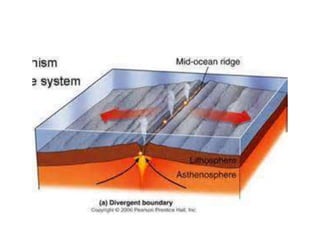
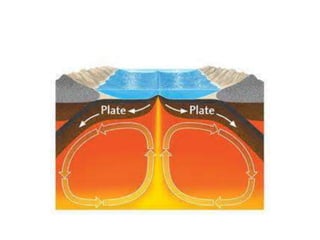
• Divergent Boundaries- a plate boundary at
which plates move apart.
– This type occurs at the midocean ridges.
– Also called constructive boundaries.
• Convergent Boundaries- a plate boundary at
which plates come together.
– This plate boundary has trenches.
– They are also called destructive boundaries.
– Cause tremendous pressure and friction.
– Causes severe earthquakes.
– When the plate material melts in the Earth’s
mantle, some of it surges upward to produce
volcanoes.
• Strike-Slip Boundaries- two plates grind
together and slip past each other horizontally.
– No new plate material is made, and no plate
material is destroyed.
– It is also called the conservative boundary.
– Earthquakes often occur along these boundaries.
Plate Motion
• Convection Currents- a movement of material
caused by differences in temperatures.
– convection currents move air in the atmosphere
and water in the ocean. And they may move the
plates of the lithosphere as well.
– A rising and sinking cycle repeats over and over.
• Subduction- the process in which crust
plunges back into the interior of the Earth.
– The denser plate is subducted, and the other plate
edge floats over it.
– When two oceanic plates collide, the older
oceanic plate is subducted under the younger
plate.
– When two continental plates collide that have the
same density, neither plate is subducted, and they
push upward to form a mountain.
Homework
Page 71 1-5

Chapter 3 Plate Tectonics

  • 1.
  • 2.
    Earth’s Drifting Continents •Theory of Continental drift- the theory, proposed by Alfred Wegener, that the continents were once joined together and have since drifted apart. – Alfred Wegener concept in 1912. – He thought some of the continents coasts look like they could have fit together at one time. – Discredited by many scientists until the 1950’s. – Went against many geological basic principles.
  • 3.
    • Pangaea- meansall Earth; is the name of the super continent from millions of years ago. – Fossil records showed that the same kind of animals and plant remains were separated by the Atlantic Ocean. – Evidence from Rocks- when you line South America and Africa up together there is rock formations that line up and are the same age as each other.
  • 5.
    • Rock depositsleft from glaciers. – Many of the same rock deposits have been found in South America, Africa, India, Australia, and Antarctica. – Ancient glacial deposits have been found in areas with very warm climates.
  • 6.
    Earth’s Spreading Floor •During the 1950’s, new mapping techniques discovered midocean ridges. – Midocean Ridges- an undersea mountain chain where new ocean floor is produced. • This gave the final piece of evidence for the Theory of Continental Drift to be expected.
  • 7.
    • Midocean Ridgesform the worlds longest mountain chain (80,000 km). – Great deal of volcanic activity occurs in this area. – When the ocean floor moves apart, lava wells up and hardens causing new oceanic crust.
  • 8.
    • Ocean-floor spreading-the process in which old ocean floor is pushed away from a midocean ridge by the formation of new ocean floor. – Helped explain Continental Drift. – When the ocean floor moves, it takes the continent with it. • Transform fault- a fault that runs across a midocean ridge.
  • 10.
    • New deep-seadrilling also provides evidence to support the idea of ocean-floor spreading. • Rock samples from the ocean floor indicate that rocks next to a midocean ridge are younger than rocks farther away. • Magnetic stripes in ocean-floor rocks further convinced scientists of ocean-floor spreading.
  • 11.
    • Trenches- deepV-shaped valley that lie along the bottom of the ocean. – They are found near some continents or near strings of islands. • Subduction- process in which crust plunges back into the Earth. – The older oceanic crust is pushed under the continental crust.
  • 13.
    Homework • Page 591-3 • Page 64 1-3
  • 14.
    Earth’s Moving Plates •Theory of Plate Tectonics- links together the ideas of continental drift and ocean-floor spreading, explains how the Earth has evolved over time. It helps to explain the formation, movements, collisions, and destruction of the Earth’s crust. • Provides a framework for understanding mountains, volcanoes, earthquakes, and other landforms and processes of the physical Earth.
  • 15.
    Plate Tectonics • Givesscientists insight into how and why life on earth has evolved. • Helps people to understand the past and to predict the future.
  • 16.
    Lithospheric Plates • Lithosphere-the topmost solid part of the Earth. – Made up of a number of plates. – Plates contain a thin layer of crust above a thick layer of relatively cool, rigid mantle rock. – Plates usually contain both oceanic and continental crust.
  • 17.
    7 Major LithosphericPlates • Pacific Plate- covers 1/5 of the Earth’s surface. • North American • South American • Eurasian • African • Indo-Australian • Antarctic
  • 19.
    Plate Boundaries Three MainTypes of Boundaries • Divergent Boundaries- a plate boundary at which plates move apart. – This type occurs at the midocean ridges. – Also called constructive boundaries.
  • 21.
    • Convergent Boundaries-a plate boundary at which plates come together. – This plate boundary has trenches. – They are also called destructive boundaries. – Cause tremendous pressure and friction. – Causes severe earthquakes. – When the plate material melts in the Earth’s mantle, some of it surges upward to produce volcanoes.
  • 23.
    • Strike-Slip Boundaries-two plates grind together and slip past each other horizontally. – No new plate material is made, and no plate material is destroyed. – It is also called the conservative boundary. – Earthquakes often occur along these boundaries.
  • 25.
    Plate Motion • ConvectionCurrents- a movement of material caused by differences in temperatures. – convection currents move air in the atmosphere and water in the ocean. And they may move the plates of the lithosphere as well. – A rising and sinking cycle repeats over and over.
  • 27.
    • Subduction- theprocess in which crust plunges back into the interior of the Earth. – The denser plate is subducted, and the other plate edge floats over it. – When two oceanic plates collide, the older oceanic plate is subducted under the younger plate. – When two continental plates collide that have the same density, neither plate is subducted, and they push upward to form a mountain.
  • 31.