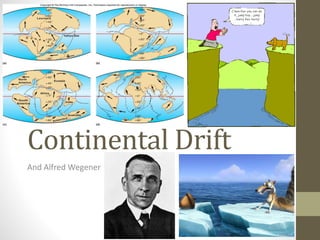
Continental Drift
And Alfred Wegener
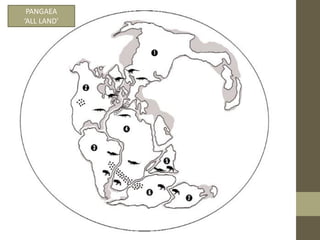
PANGAEA
‘ALL LAND’
Alfred Wegener
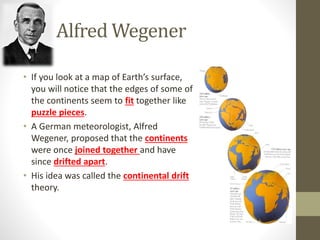
• If you look at a map of Earth’s surface,
you will notice that the edges of some of
the continents seem to fit together like
puzzle pieces.
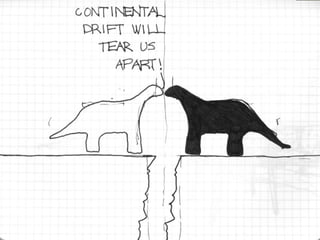
• A German meteorologist, Alfred
Wegener, proposed that the continents
were once joined together and have
since drifted apart.
• His idea was called the continental drift
theory.
Alfred Wegener
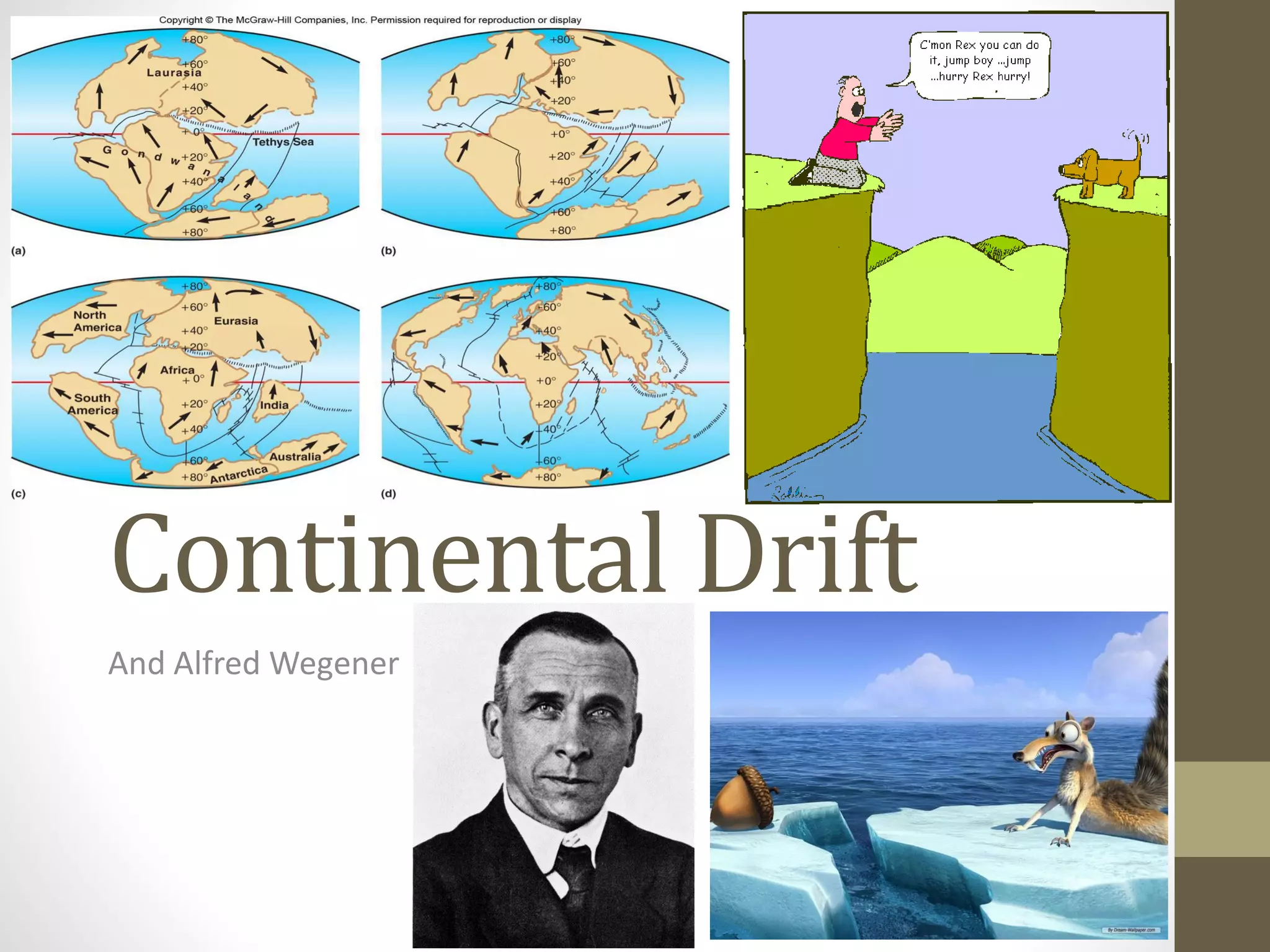
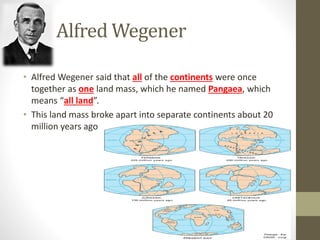
• Alfred Wegener said that all of the continents were once
together as one land mass, which he named Pangaea, which
means “all land”.
• This land mass broke apart into separate continents about 20
million years ago
Pangaea / Drift Proof
• Wegener’s idea of continental drift was controversial at the
time.
• People wanted proof that this has and is occurring.
• To prove his idea, Wegener found 4 major pieces of evidence:
• Shape
• Fossils
• Climates
• Rocks
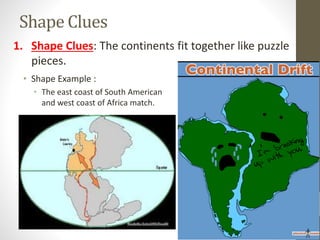
Shape Clues
• Shape Example :
• The east coast of South American
and west coast of Africa match.
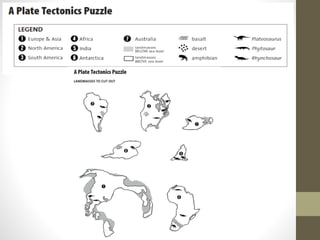
1. Shape Clues: The continents fit together like puzzle
pieces.
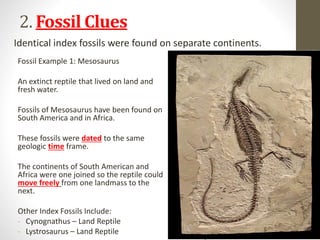
2. Fossil Clues
Fossil Example 1: Mesosaurus
An extinct reptile that lived on land and
fresh water.
Fossils of Mesosaurus have been found on
South America and in Africa.
These fossils were dated to the same
geologic time frame.
The continents of South American and
Africa were one joined so the reptile could
move freely from one landmass to the
next.
Other Index Fossils Include:
- Cynognathus – Land Reptile
- Lystrosaurus – Land Reptile
Identical index fossils were found on separate continents.
Fossil Clues
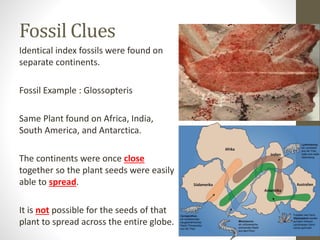
Identical index fossils were found on
separate continents.
Fossil Example : Glossopteris
Same Plant found on Africa, India,
South America, and Antarctica.
The continents were once close
together so the plant seeds were easily
able to spread.
It is not possible for the seeds of that
plant to spread across the entire globe.
3. Climate Clues
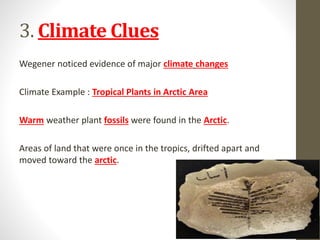
Wegener noticed evidence of major climate changes
Climate Example : Tropical Plants in Arctic Area
Warm weather plant fossils were found in the Arctic.
Areas of land that were once in the tropics, drifted apart and
moved toward the arctic.
3. Climate Clues
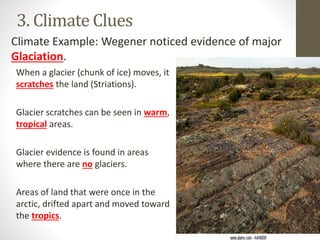
When a glacier (chunk of ice) moves, it
scratches the land (Striations).
Glacier scratches can be seen in warm,
tropical areas.
Glacier evidence is found in areas
where there are no glaciers.
Areas of land that were once in the
arctic, drifted apart and moved toward
the tropics.
Climate Example: Wegener noticed evidence of major
Glaciation.
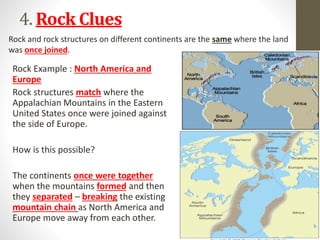
4. Rock Clues
Rock Example : North America and
Europe
Rock structures match where the
Appalachian Mountains in the Eastern
United States once were joined against
the side of Europe.
How is this possible?
The continents once were together
when the mountains formed and then
they separated – breaking the existing
mountain chain as North America and
Europe move away from each other.
Rock and rock structures on different continents are the same where the land
was once joined.
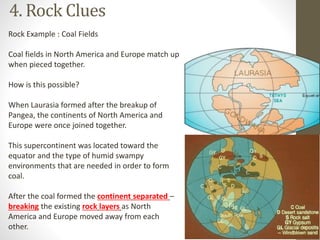
4. Rock Clues
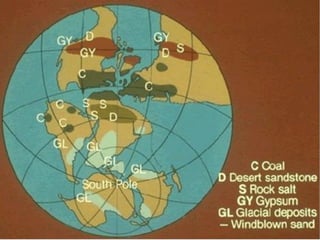
Rock Example : Coal Fields
Coal fields in North America and Europe match up
when pieced together.
How is this possible?
When Laurasia formed after the breakup of
Pangea, the continents of North America and
Europe were once joined together.
This supercontinent was located toward the
equator and the type of humid swampy
environments that are needed in order to form
coal.
After the coal formed the continent separated –
breaking the existing rock layers as North
America and Europe moved away from each
other.
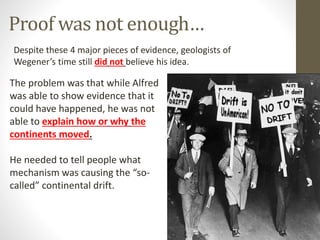
Proof was not enough…
Despite these 4 major pieces of evidence, geologists of
Wegener’s time still did not believe his idea.
The problem was that while Alfred
was able to show evidence that it
could have happened, he was not
able to explain how or why the
continents moved.
He needed to tell people what
mechanism was causing the “so-
called” continental drift.

Continental Drift

  • 1.
  • 3.
  • 4.
    Alfred Wegener • Ifyou look at a map of Earth’s surface, you will notice that the edges of some of the continents seem to fit together like puzzle pieces. • A German meteorologist, Alfred Wegener, proposed that the continents were once joined together and have since drifted apart. • His idea was called the continental drift theory.
  • 6.
    Alfred Wegener • AlfredWegener said that all of the continents were once together as one land mass, which he named Pangaea, which means “all land”. • This land mass broke apart into separate continents about 20 million years ago
  • 8.
    Pangaea / DriftProof • Wegener’s idea of continental drift was controversial at the time. • People wanted proof that this has and is occurring. • To prove his idea, Wegener found 4 major pieces of evidence: • Shape • Fossils • Climates • Rocks
  • 9.
    Shape Clues • ShapeExample : • The east coast of South American and west coast of Africa match. 1. Shape Clues: The continents fit together like puzzle pieces.
  • 11.
    2. Fossil Clues FossilExample 1: Mesosaurus An extinct reptile that lived on land and fresh water. Fossils of Mesosaurus have been found on South America and in Africa. These fossils were dated to the same geologic time frame. The continents of South American and Africa were one joined so the reptile could move freely from one landmass to the next. Other Index Fossils Include: - Cynognathus – Land Reptile - Lystrosaurus – Land Reptile Identical index fossils were found on separate continents.
  • 13.
    Fossil Clues Identical indexfossils were found on separate continents. Fossil Example : Glossopteris Same Plant found on Africa, India, South America, and Antarctica. The continents were once close together so the plant seeds were easily able to spread. It is not possible for the seeds of that plant to spread across the entire globe.
  • 14.
    3. Climate Clues Wegenernoticed evidence of major climate changes Climate Example : Tropical Plants in Arctic Area Warm weather plant fossils were found in the Arctic. Areas of land that were once in the tropics, drifted apart and moved toward the arctic.
  • 15.
    3. Climate Clues Whena glacier (chunk of ice) moves, it scratches the land (Striations). Glacier scratches can be seen in warm, tropical areas. Glacier evidence is found in areas where there are no glaciers. Areas of land that were once in the arctic, drifted apart and moved toward the tropics. Climate Example: Wegener noticed evidence of major Glaciation.
  • 16.
    4. Rock Clues RockExample : North America and Europe Rock structures match where the Appalachian Mountains in the Eastern United States once were joined against the side of Europe. How is this possible? The continents once were together when the mountains formed and then they separated – breaking the existing mountain chain as North America and Europe move away from each other. Rock and rock structures on different continents are the same where the land was once joined.
  • 17.
    4. Rock Clues RockExample : Coal Fields Coal fields in North America and Europe match up when pieced together. How is this possible? When Laurasia formed after the breakup of Pangea, the continents of North America and Europe were once joined together. This supercontinent was located toward the equator and the type of humid swampy environments that are needed in order to form coal. After the coal formed the continent separated – breaking the existing rock layers as North America and Europe moved away from each other.
  • 19.
    Proof was notenough… Despite these 4 major pieces of evidence, geologists of Wegener’s time still did not believe his idea. The problem was that while Alfred was able to show evidence that it could have happened, he was not able to explain how or why the continents moved. He needed to tell people what mechanism was causing the “so- called” continental drift.