5173 Raj Dhamelia .. 5208 Parth Rasania
..
Guided BY.. Ingitamam Jain
K.S. SCHOOL OF BUSINESS MANAGEMENT
The process by which people translate sensory
impressions into a coherent and unified view of the
world around them. Though necessarily based on
incomplete and unverified (or unreliable) information.
Perception is equated with reality for most practical
purposes and guides human behavior in general.
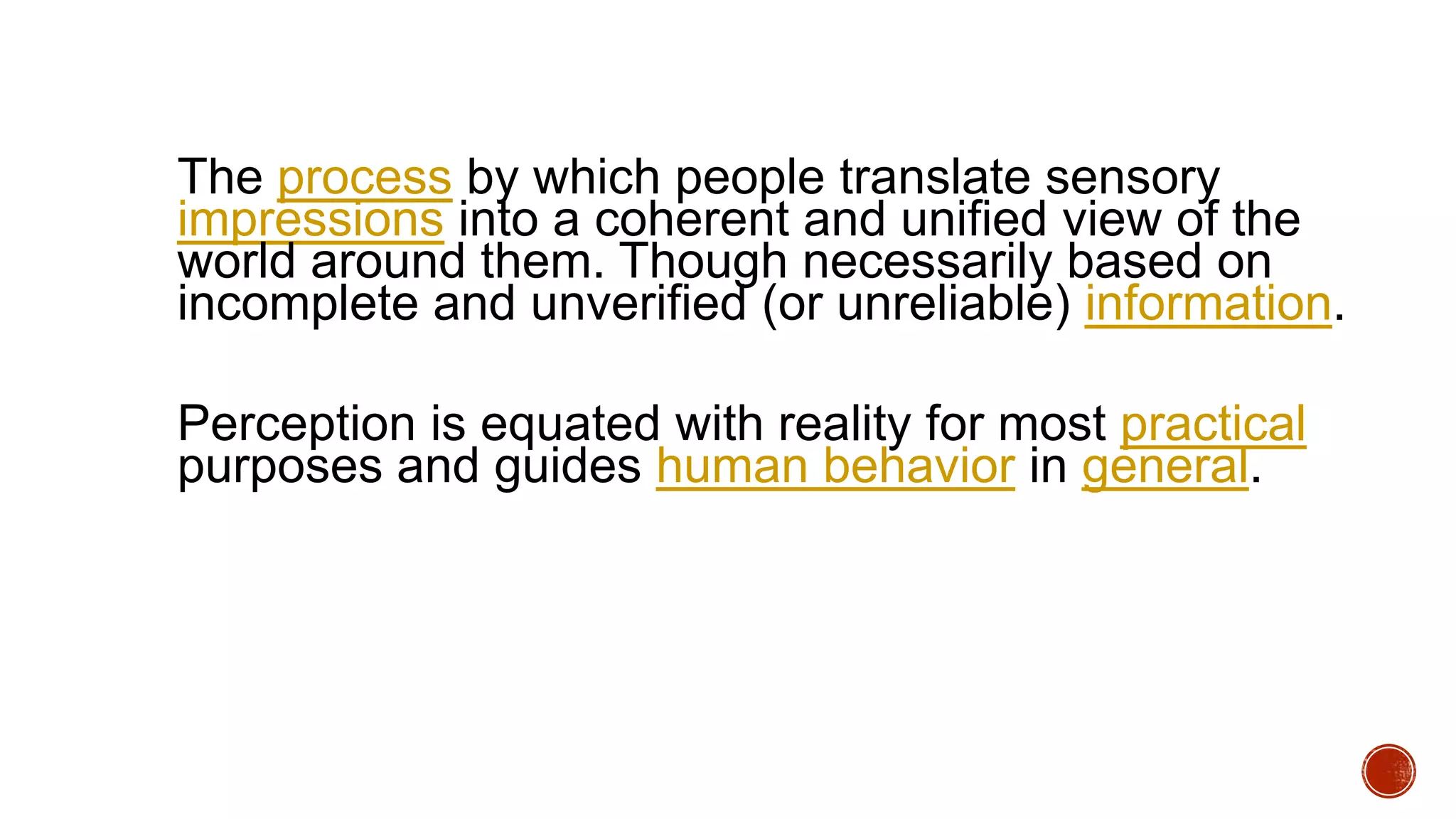
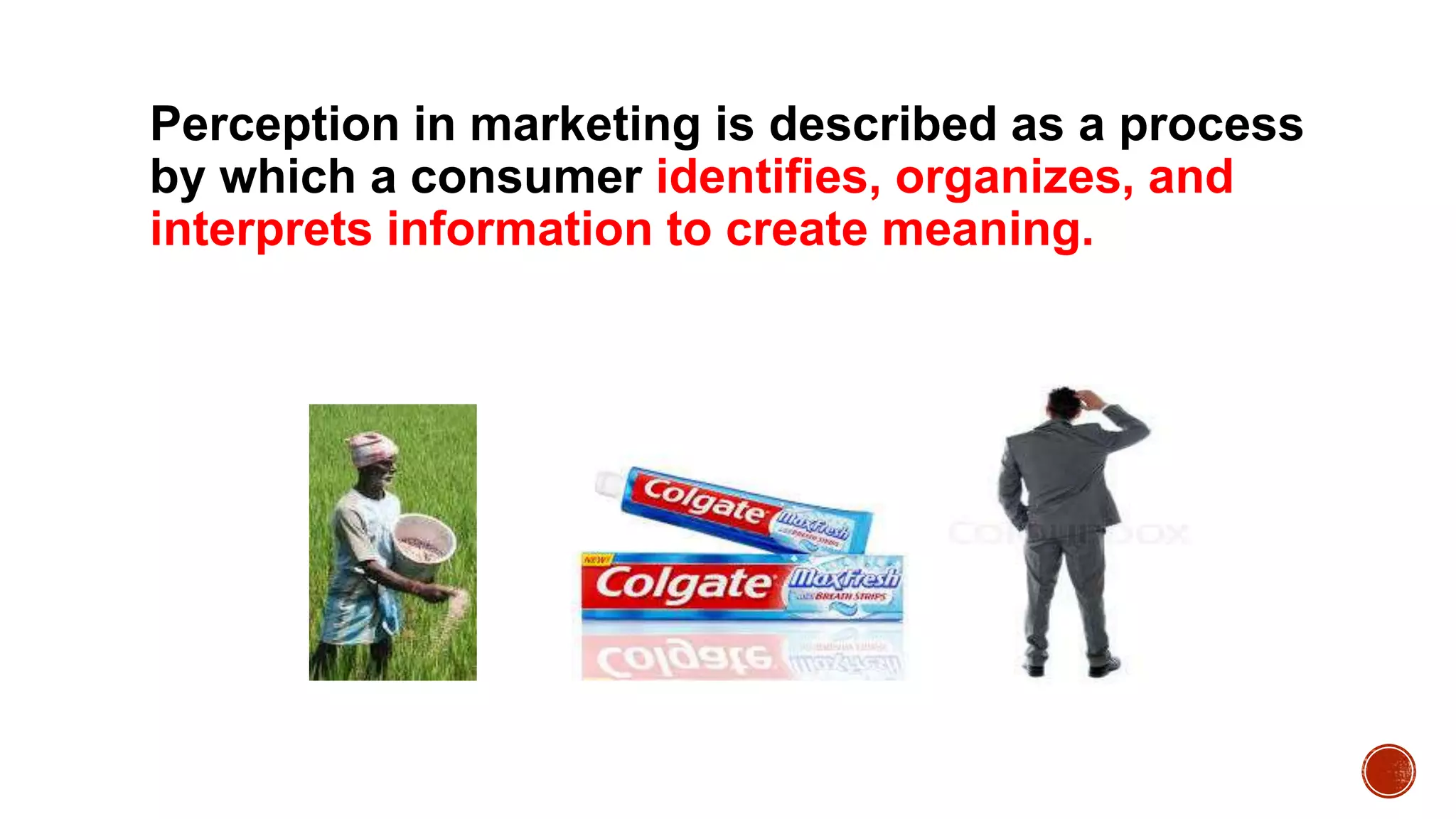
Perception in marketing is described as a process
by which a consumer identifies, organizes, and
interprets information to create meaning.
“ ”
A marketing concept that encompasses a customer's
impression, awareness and/or consciousness about a
company or its offerings.
 Customer perception is typically affected by
advertising, reviews, public relations, social
media, personal experiences and other channels.
ELEMENTS
OF
PERCEPTION
1.Sensation
2.Absolute threshold
3.Differential threshold
4.Subliminal perception
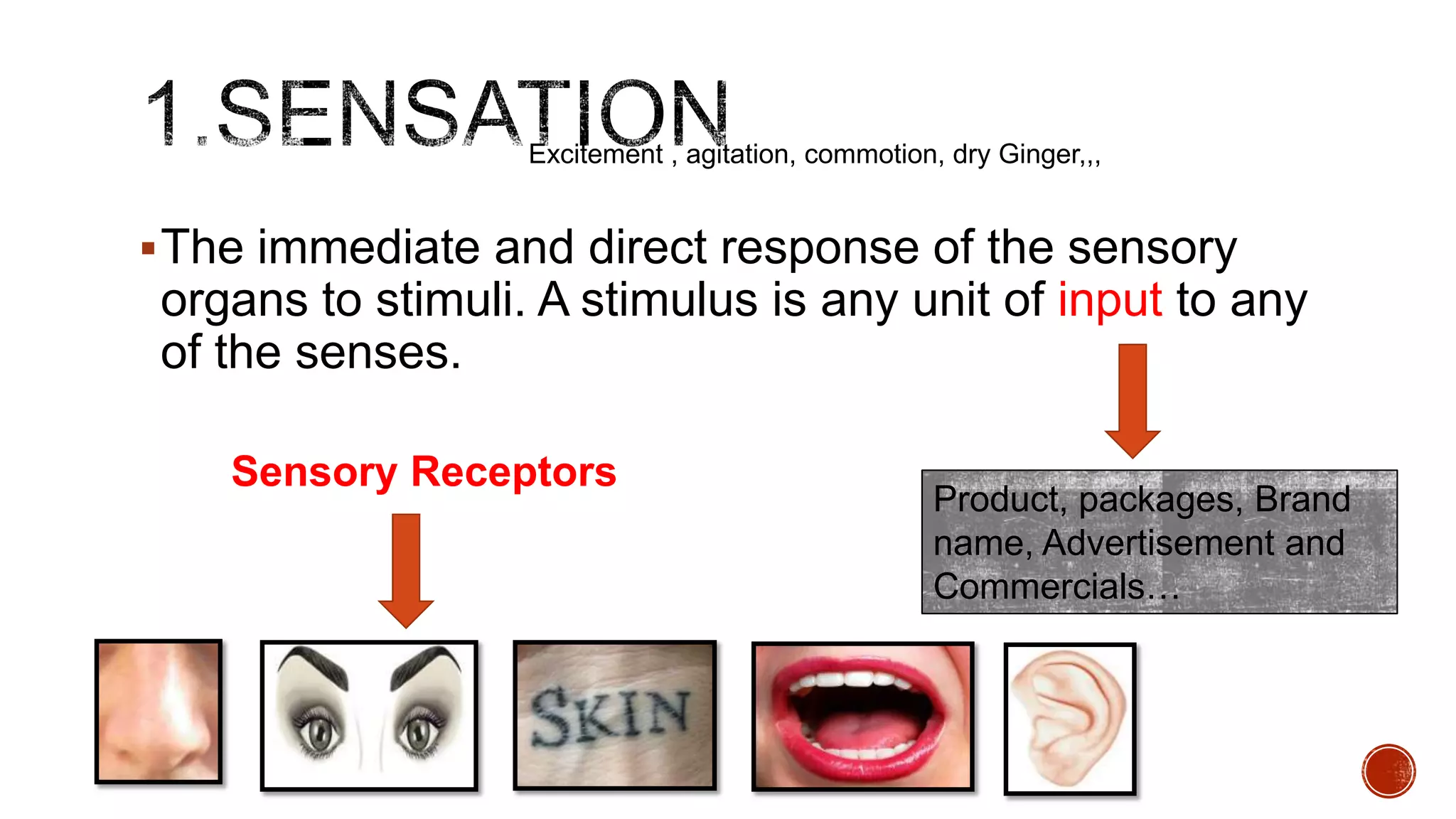
The immediate and direct response of the sensory
organs to stimuli. A stimulus is any unit of input to any
of the senses.
Excitement , agitation, commotion, dry Ginger,,,
Product, packages, Brand
name, Advertisement and
Commercials…
Sensory Receptors
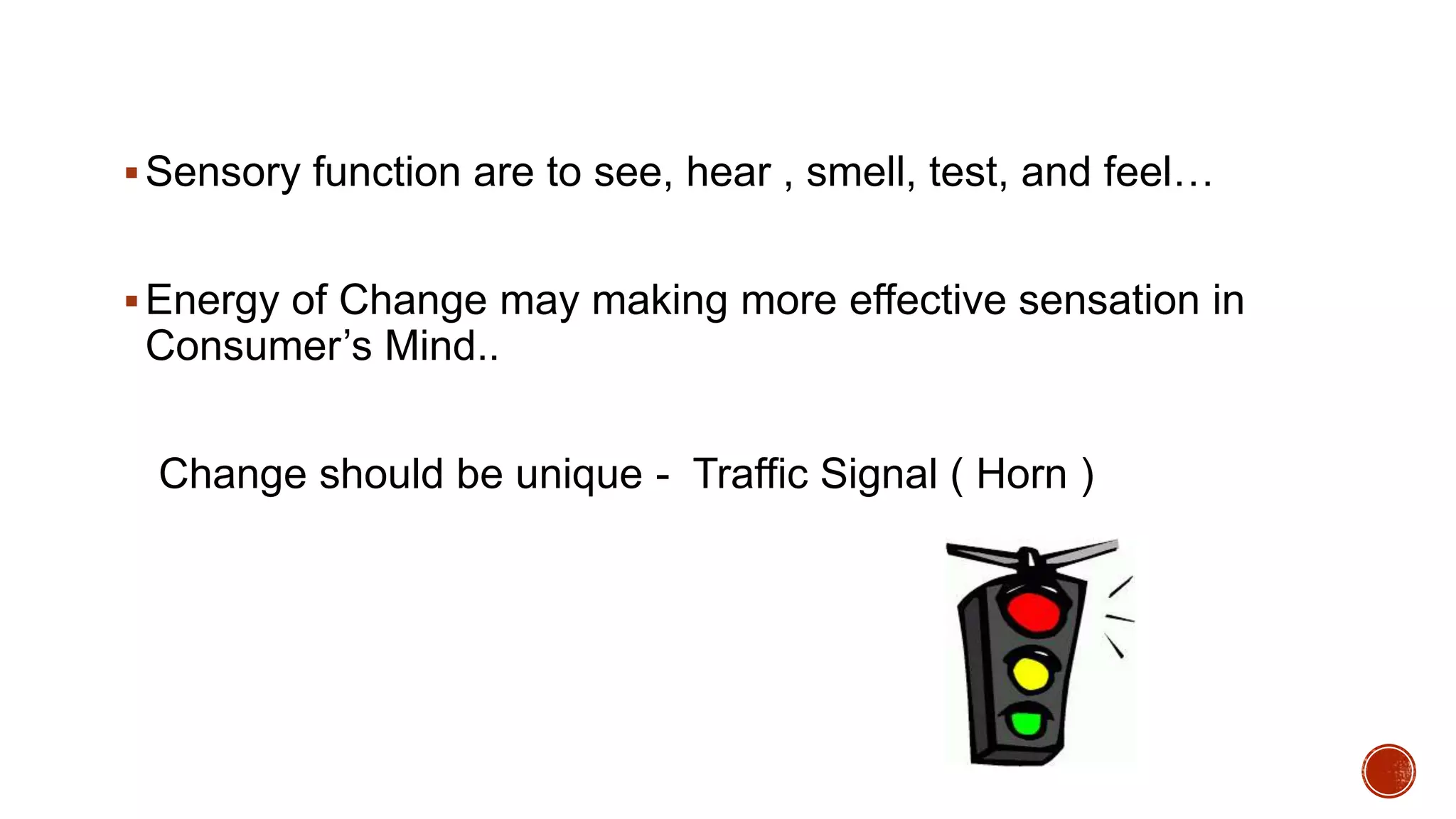
Sensory function are to see, hear , smell, test, and feel…
Energy of Change may making more effective sensation in
Consumer’s Mind..
Change should be unique - Traffic Signal ( Horn )
2. Absolute Threshold..
The absolute threshold is the lowest level at which an
individual can experience a sensation.
Point at which a person can detect a difference between
“Something” and “Nothing” is the person’s absolute threshold
for the stimulus.
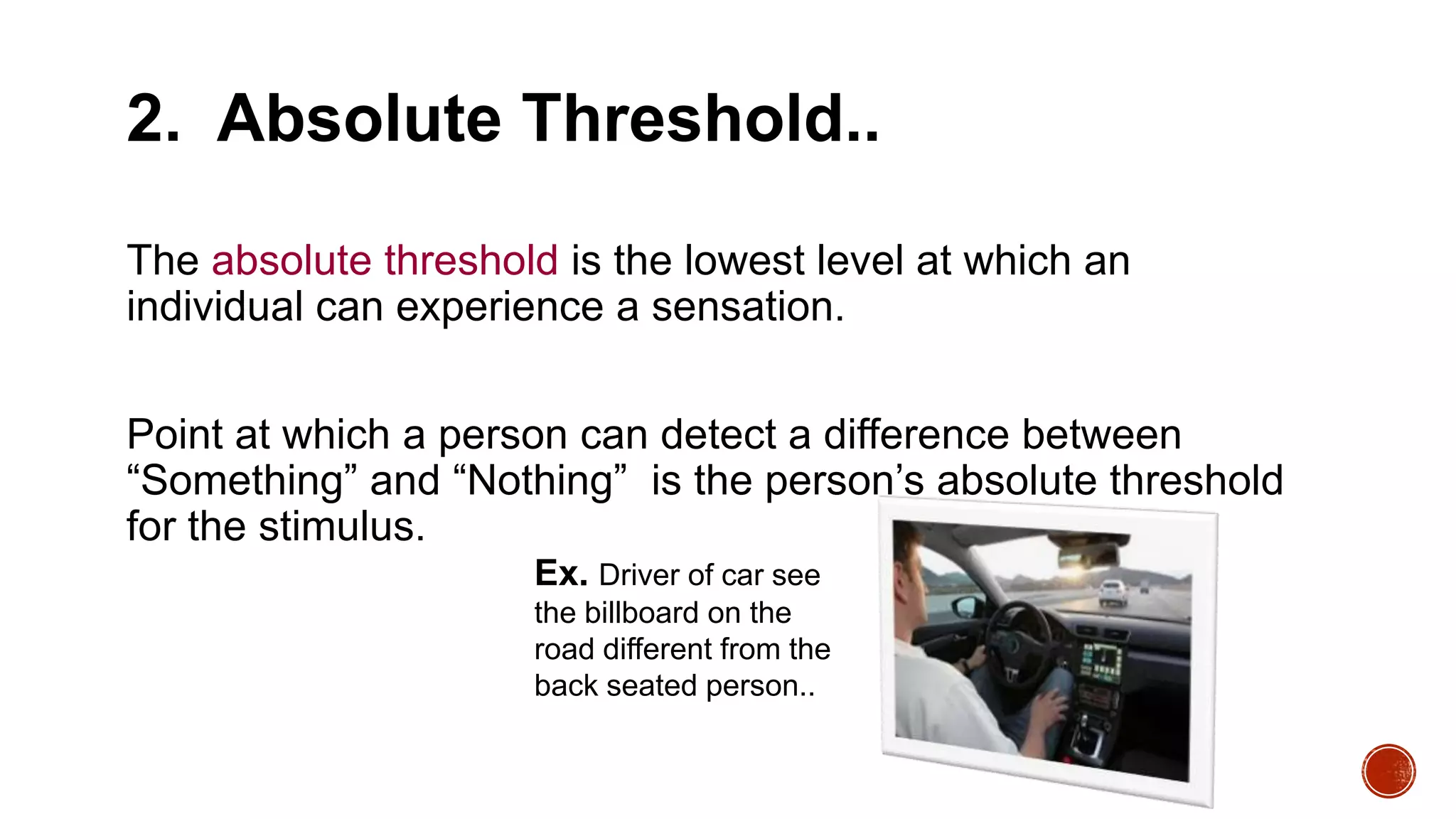
Ex. Driver of car see
the billboard on the
road different from the
back seated person..
3. Differential Threshold
Minimal difference that can be detected between two
similar stimuli
Also known as the just noticeable difference
( the j.n.d.)
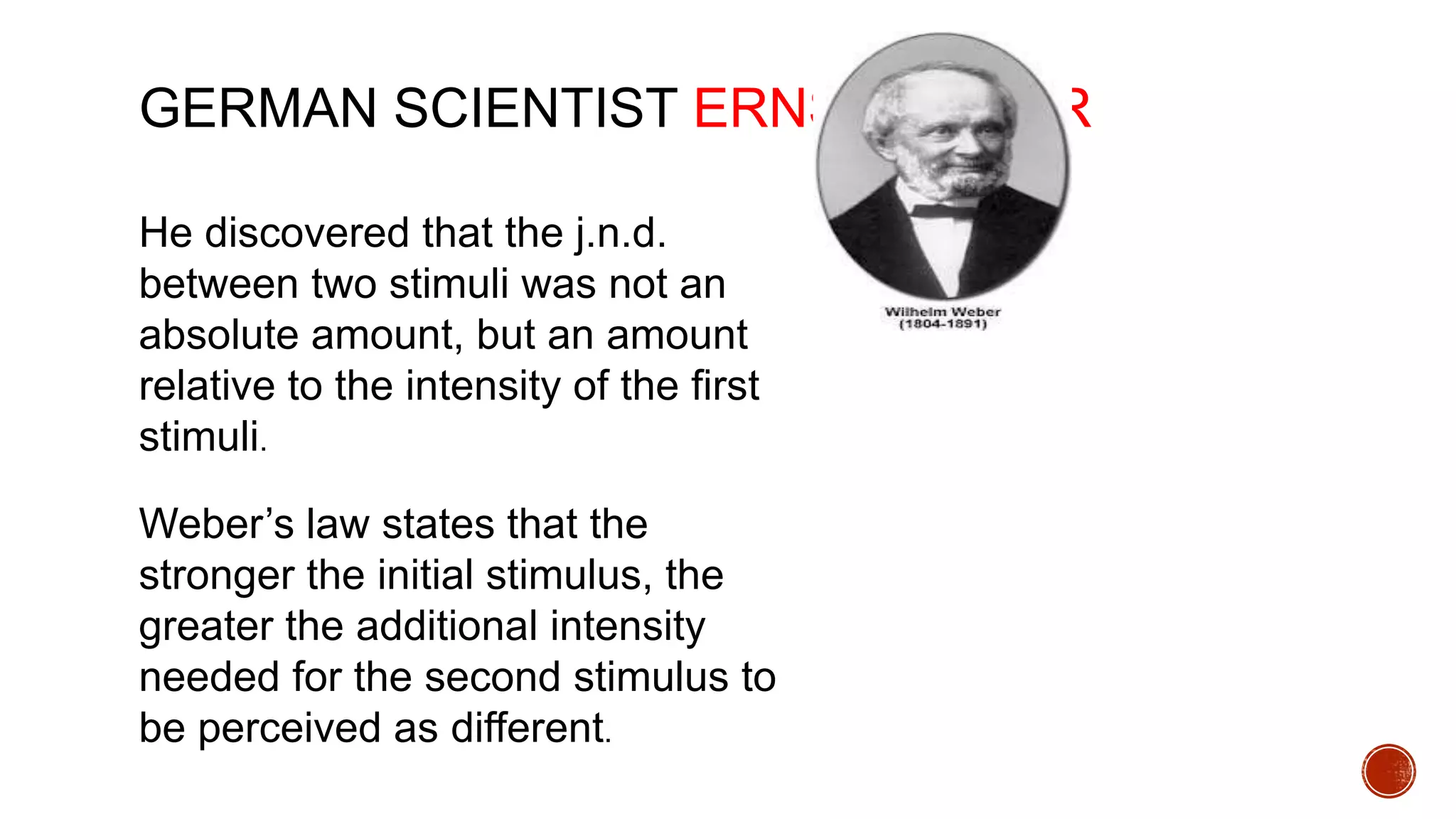
GERMAN SCIENTIST ERNST WEBER
He discovered that the j.n.d.
between two stimuli was not an
absolute amount, but an amount
relative to the intensity of the first
stimuli.
Weber’s law states that the
stronger the initial stimulus, the
greater the additional intensity
needed for the second stimulus to
be perceived as different.
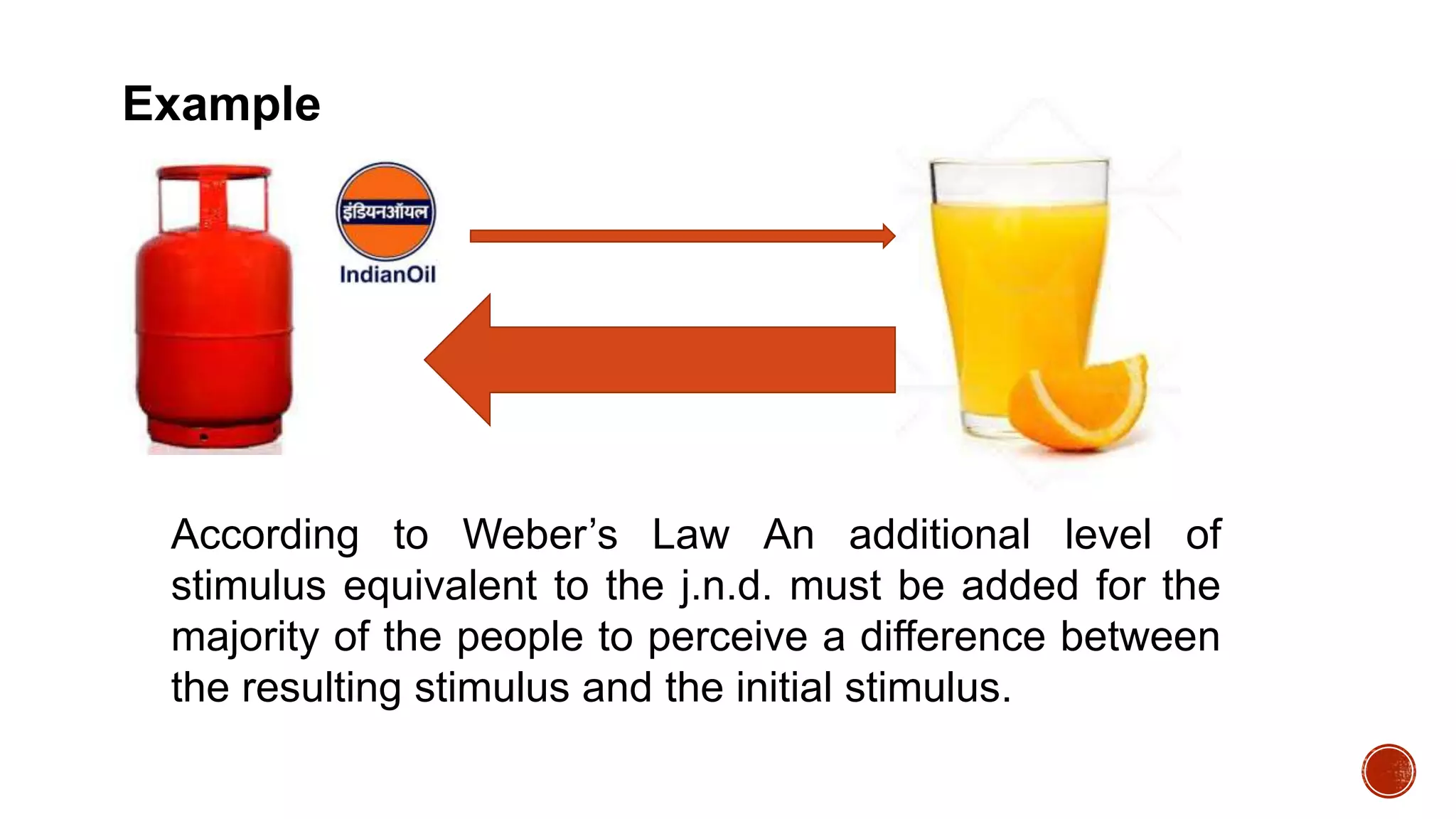
Example
According to Weber’s Law An additional level of
stimulus equivalent to the j.n.d. must be added for the
majority of the people to perceive a difference between
the resulting stimulus and the initial stimulus.
Marketers need to determine the relevant j.n.d. for
their products
so that negative changes are not readily discernible to the
public
so that product improvements are very apparent to
consumers
Stimuli that are too weak or too brief to be consciously seen or
heard may be strong enough to be perceived by one or more
receptor cells.
This process is called subliminal perception because the
stimulus is down the threshold.
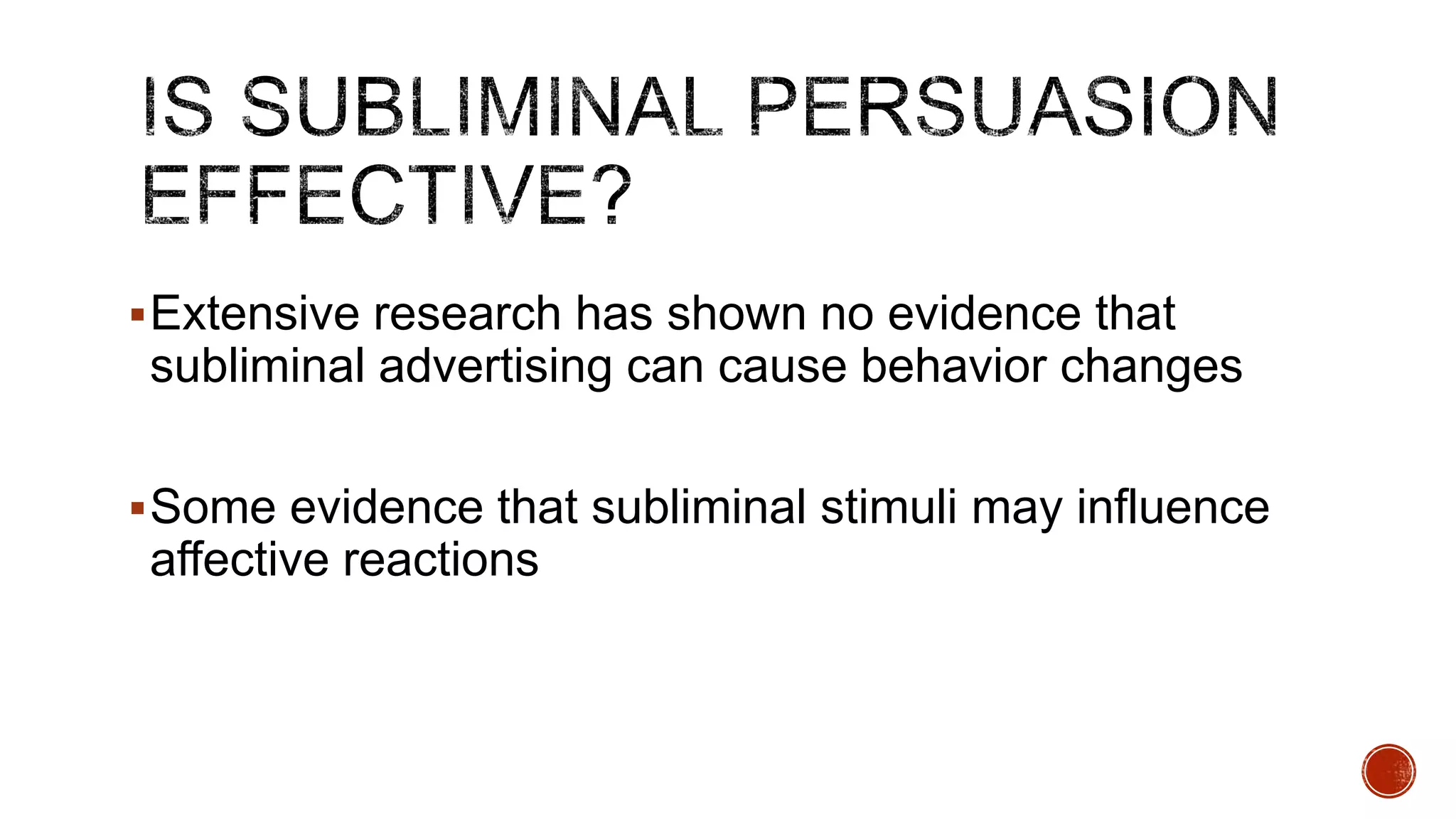
CONSCIOUS AWARENESS AND CHANGES
“EXPRESS YOURSELF”
Extensive research has shown no evidence that
subliminal advertising can cause behavior changes
Some evidence that subliminal stimuli may influence
affective reactions
DYNAMICS OF
PERCEPTION
Human Beings stimuli change during every minute
and every hour of every day..
Physical stimuli from outside Environment..
Other inputs are provided by individual themselves
( Based on previous experience )
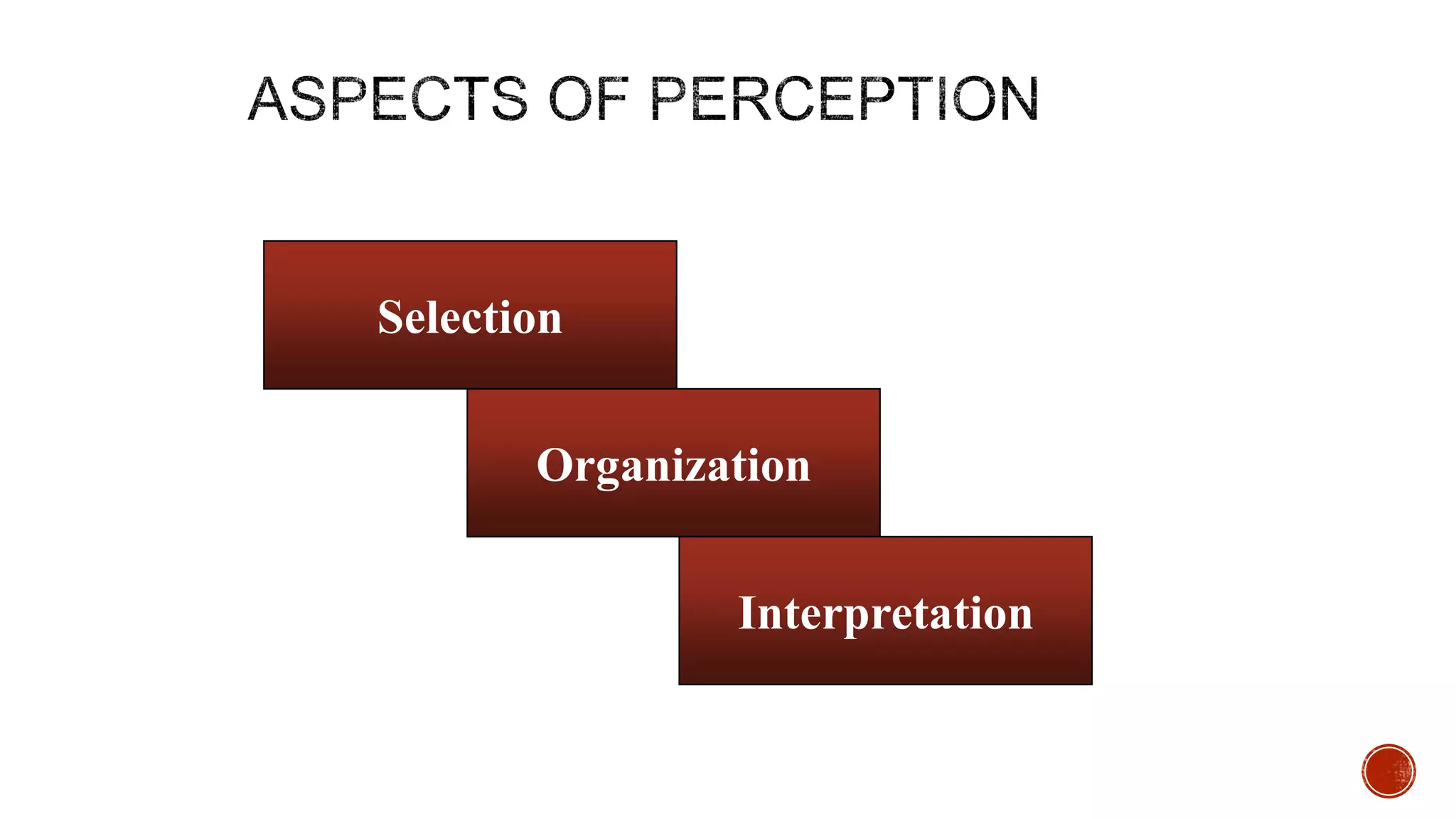
Selection
Organization
Interpretation
PERCEPTUAL
SELECTION
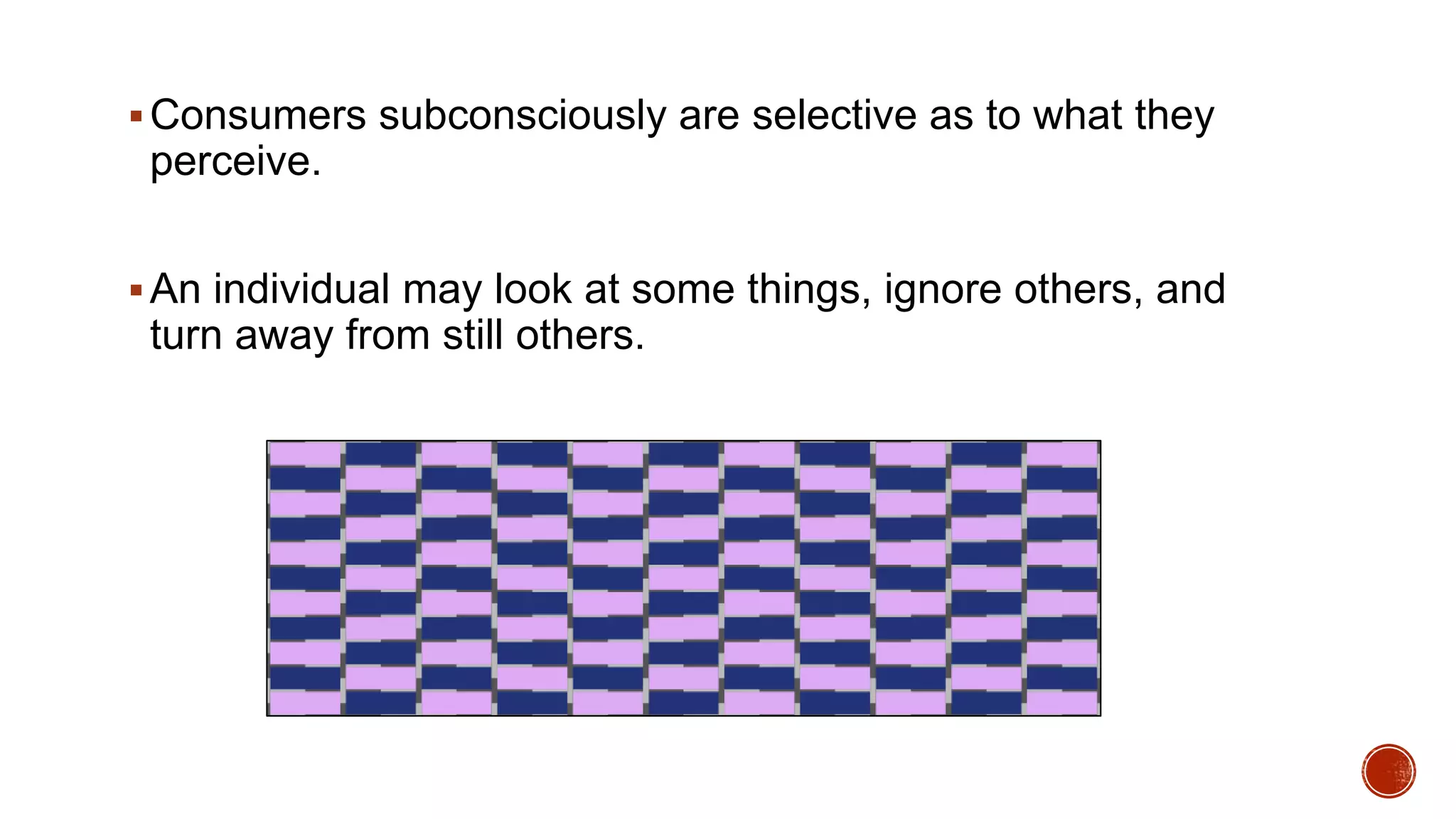
Consumers subconsciously are selective as to what they
perceive.
An individual may look at some things, ignore others, and
turn away from still others.
X
 Lady at Super mall.. .
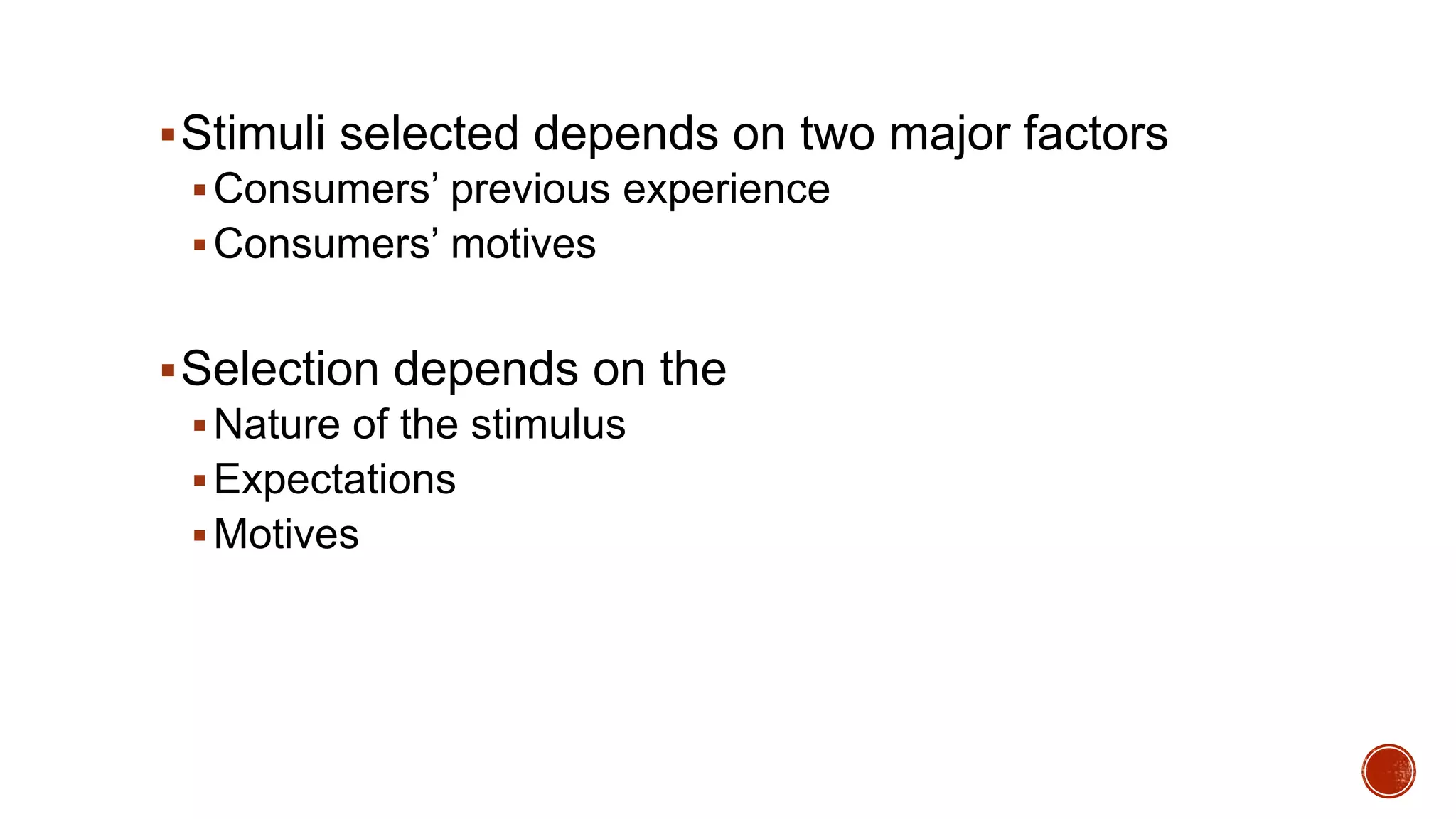
Stimuli selected depends on two major factors
Consumers’ previous experience
Consumers’ motives
Selection depends on the
Nature of the stimulus
Expectations
Motives
SELECTIVE
PERCEPTION
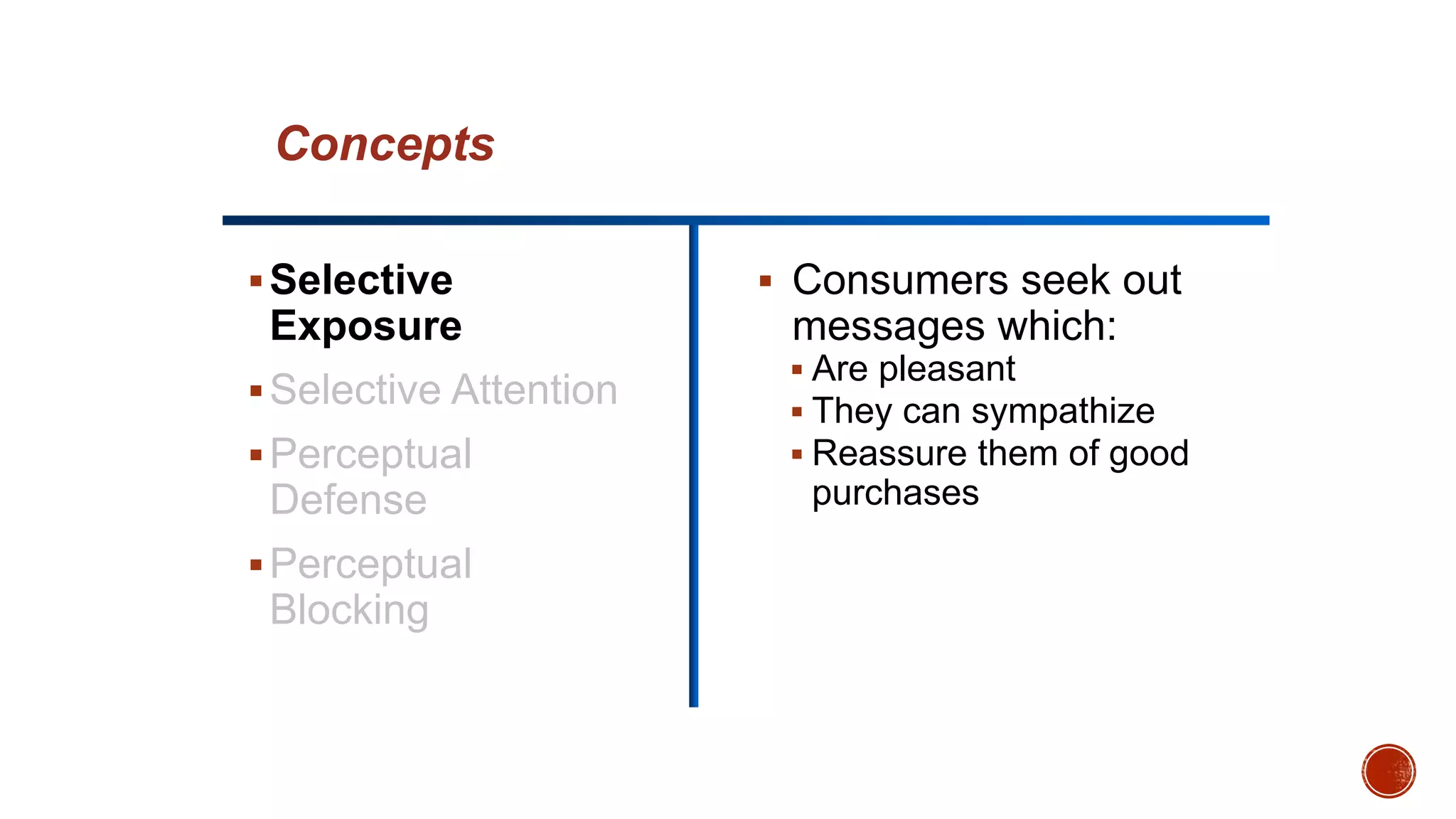
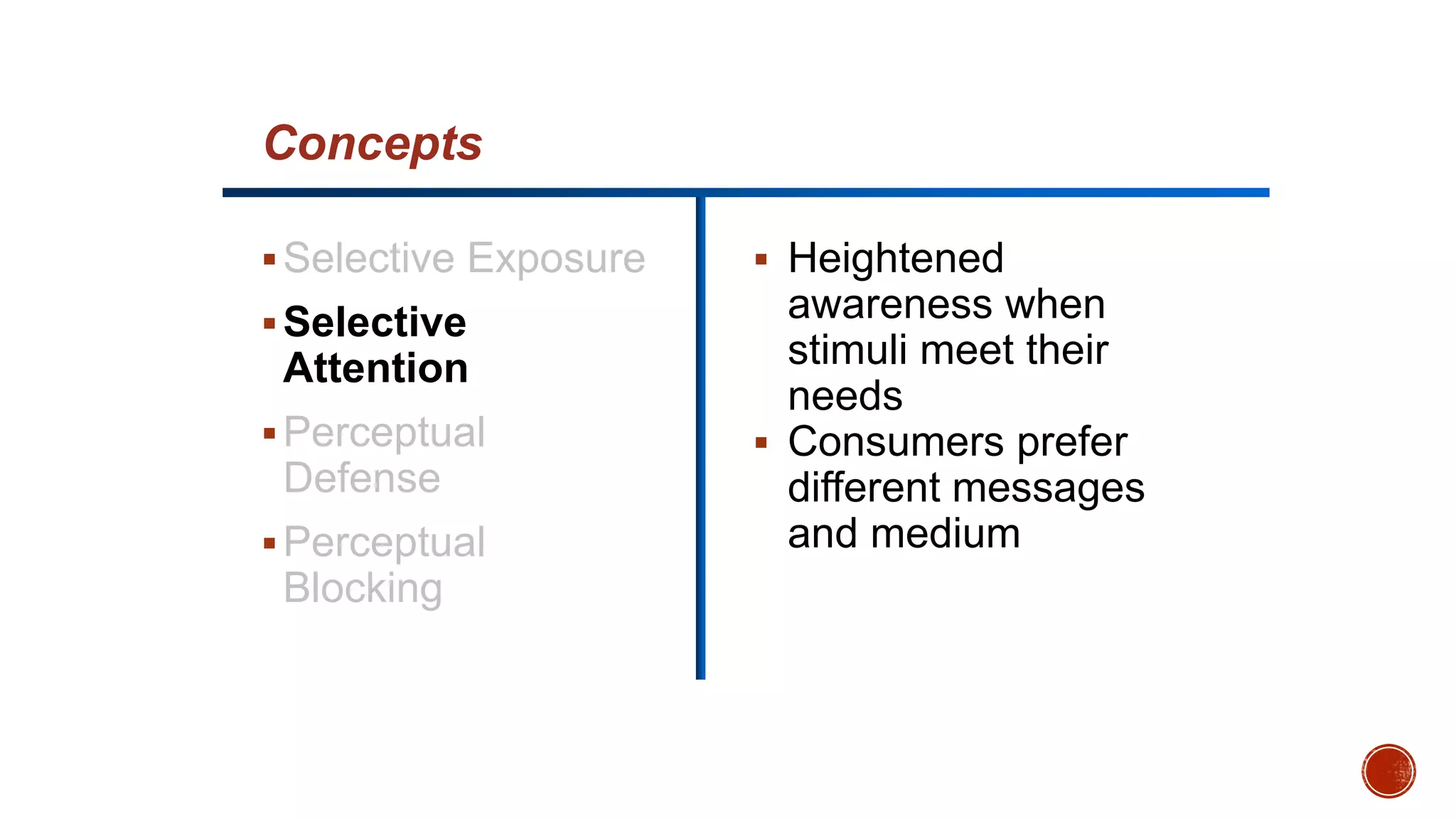
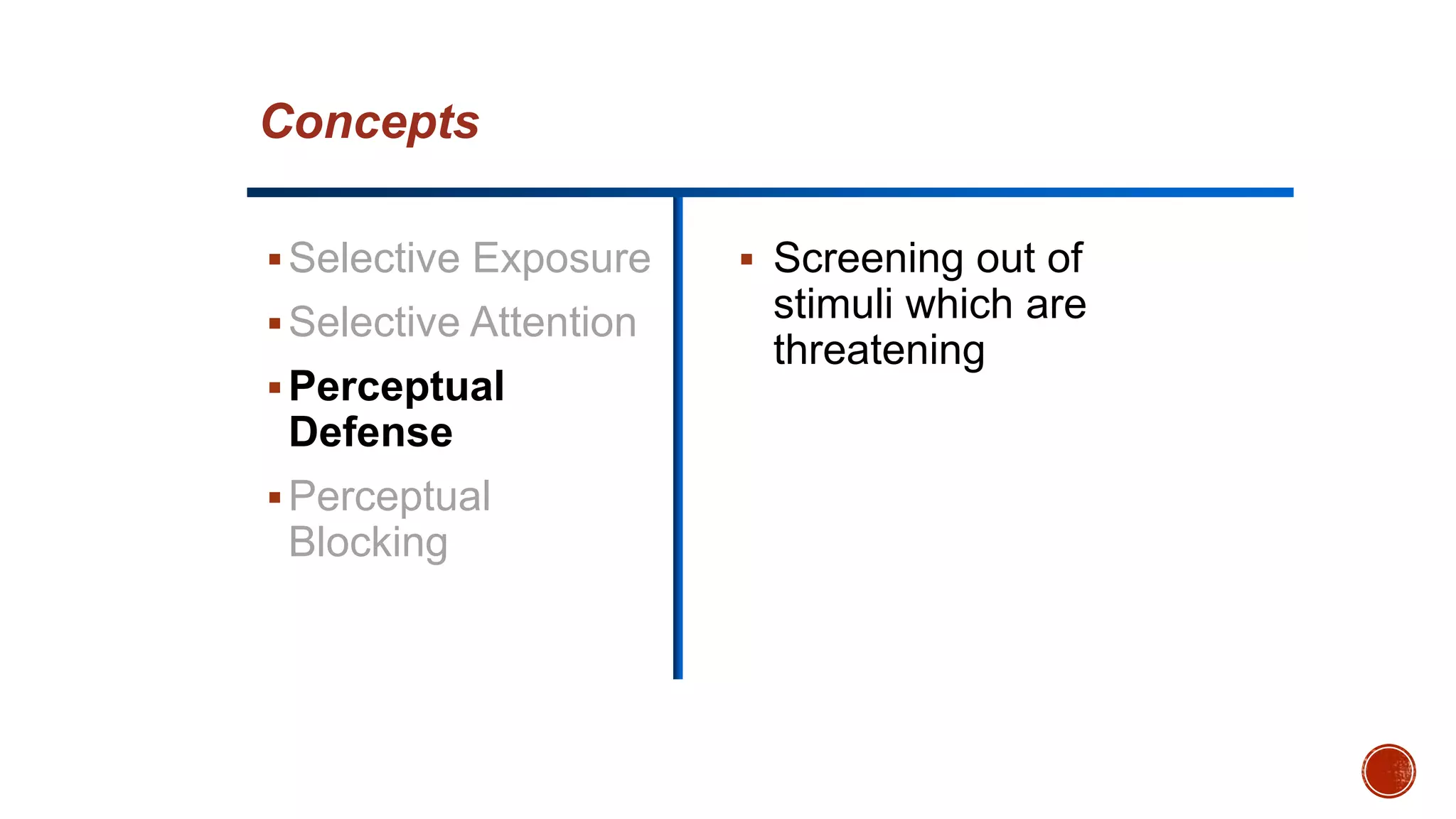
Selective
Exposure
Selective Attention
Perceptual
Defense
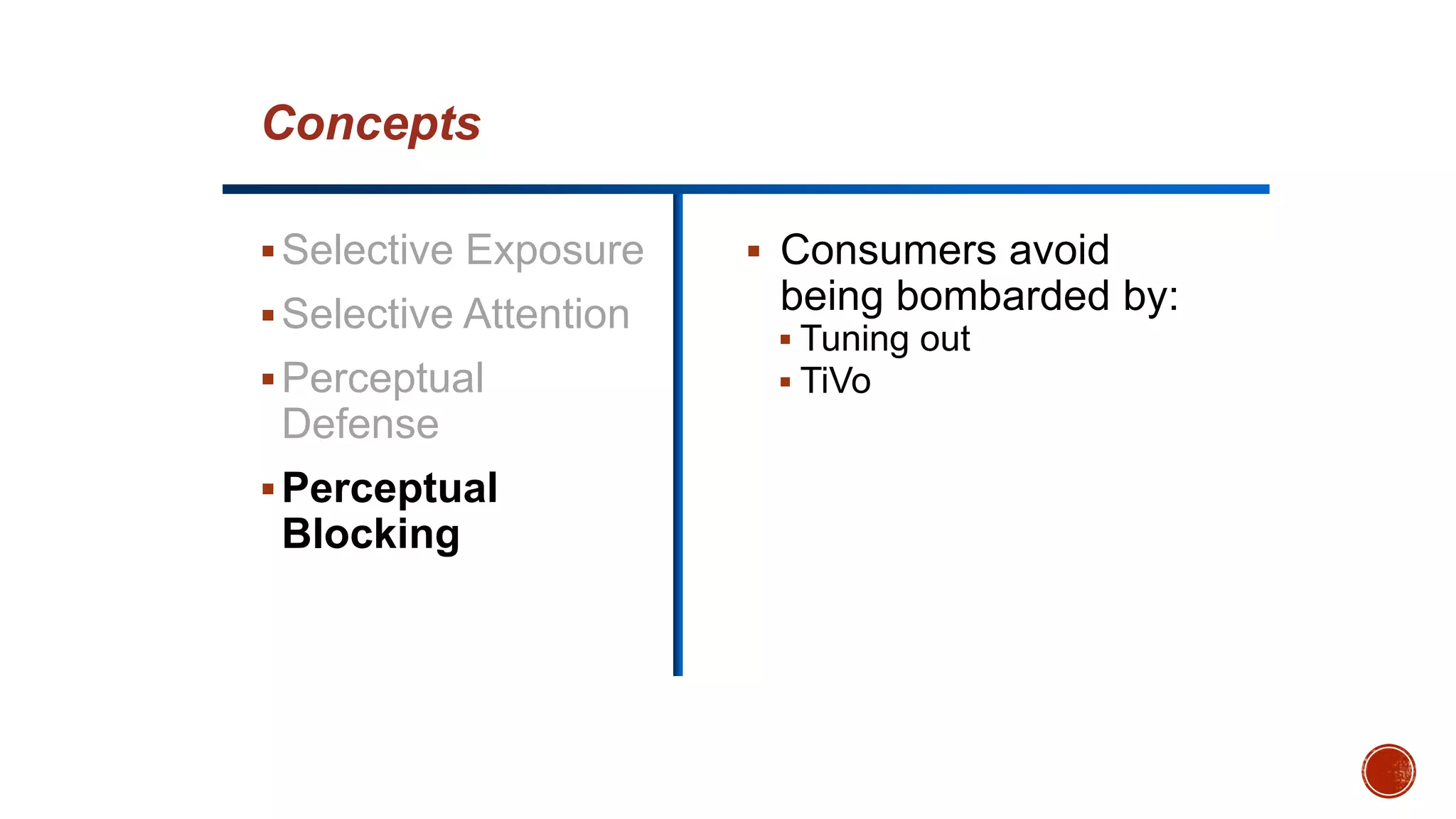
Perceptual
Blocking
 Consumers seek out
messages which:
 Are pleasant
 They can sympathize
 Reassure them of good
purchases
Concepts
Selective Exposure
Selective
Attention
Perceptual
Defense
Perceptual
Blocking
 Heightened
awareness when
stimuli meet their
needs
 Consumers prefer
different messages
and medium
Concepts
Selective Exposure
Selective Attention
Perceptual
Defense
Perceptual
Blocking
 Screening out of
stimuli which are
threatening
Concepts
Selective Exposure
Selective Attention
Perceptual
Defense
Perceptual
Blocking
 Consumers avoid
being bombarded by:
 Tuning out
 TiVo
Concepts
PERCEPTUAL
ORGANIZATION
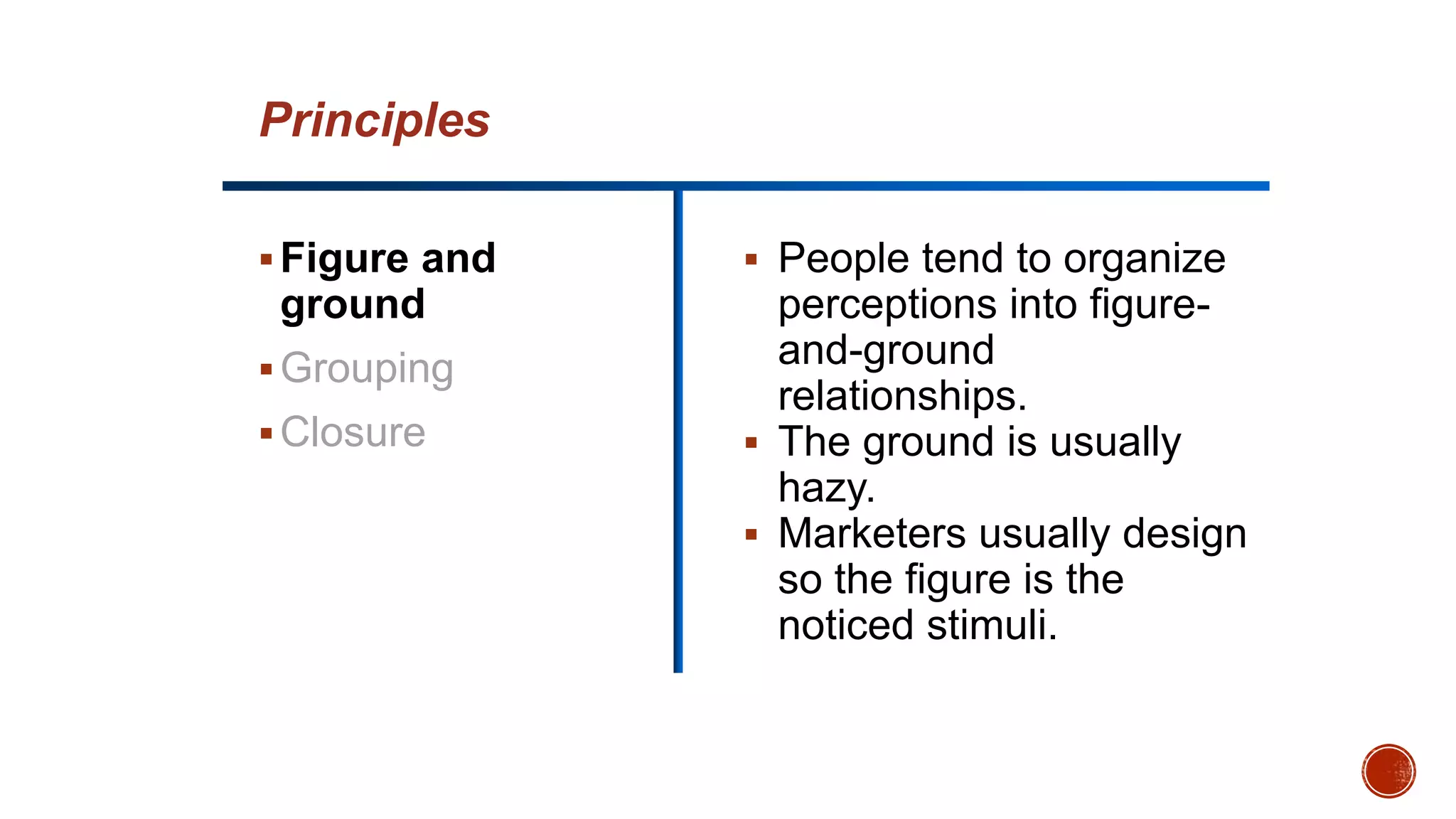
Figure and
ground
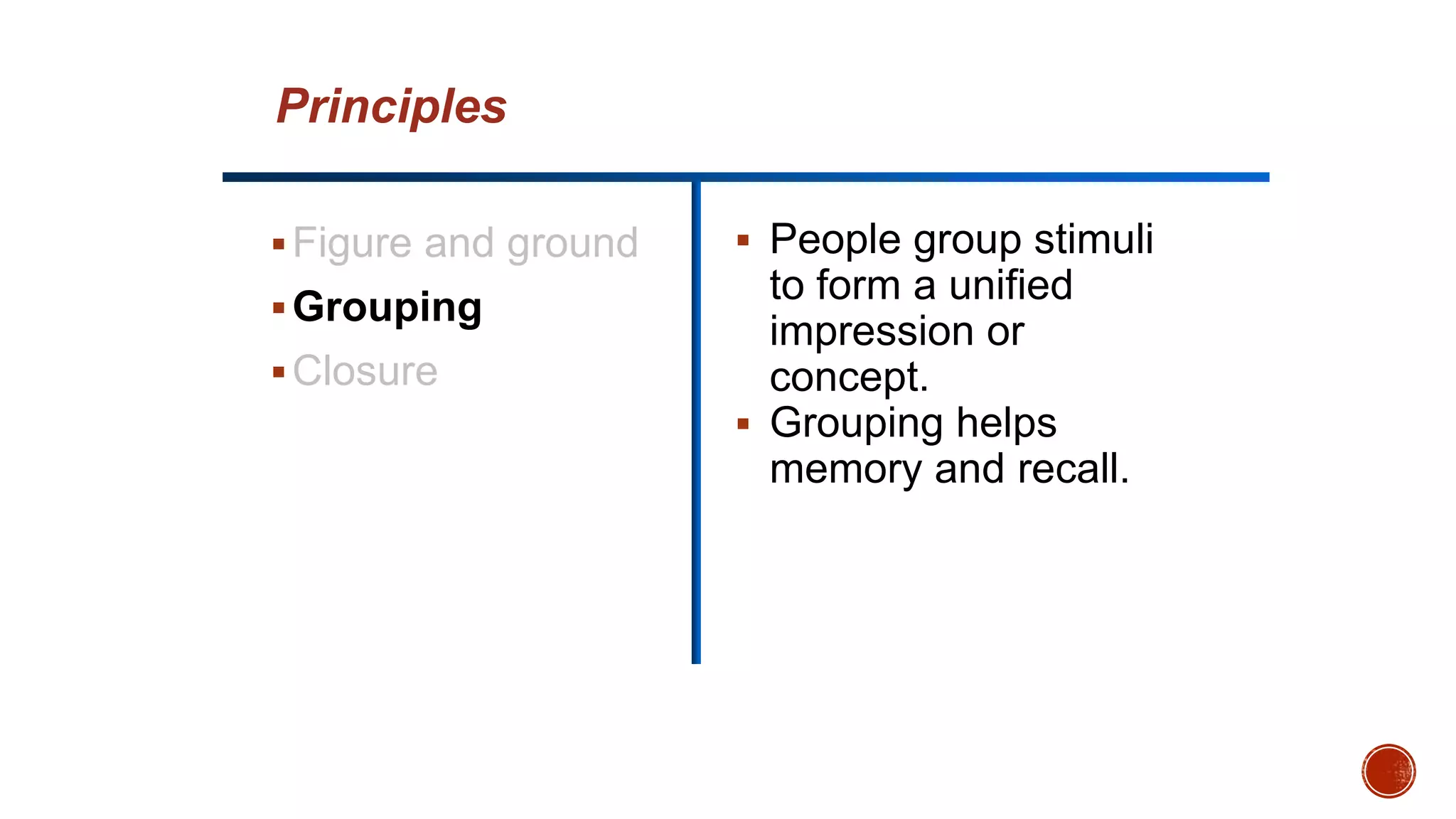
Grouping
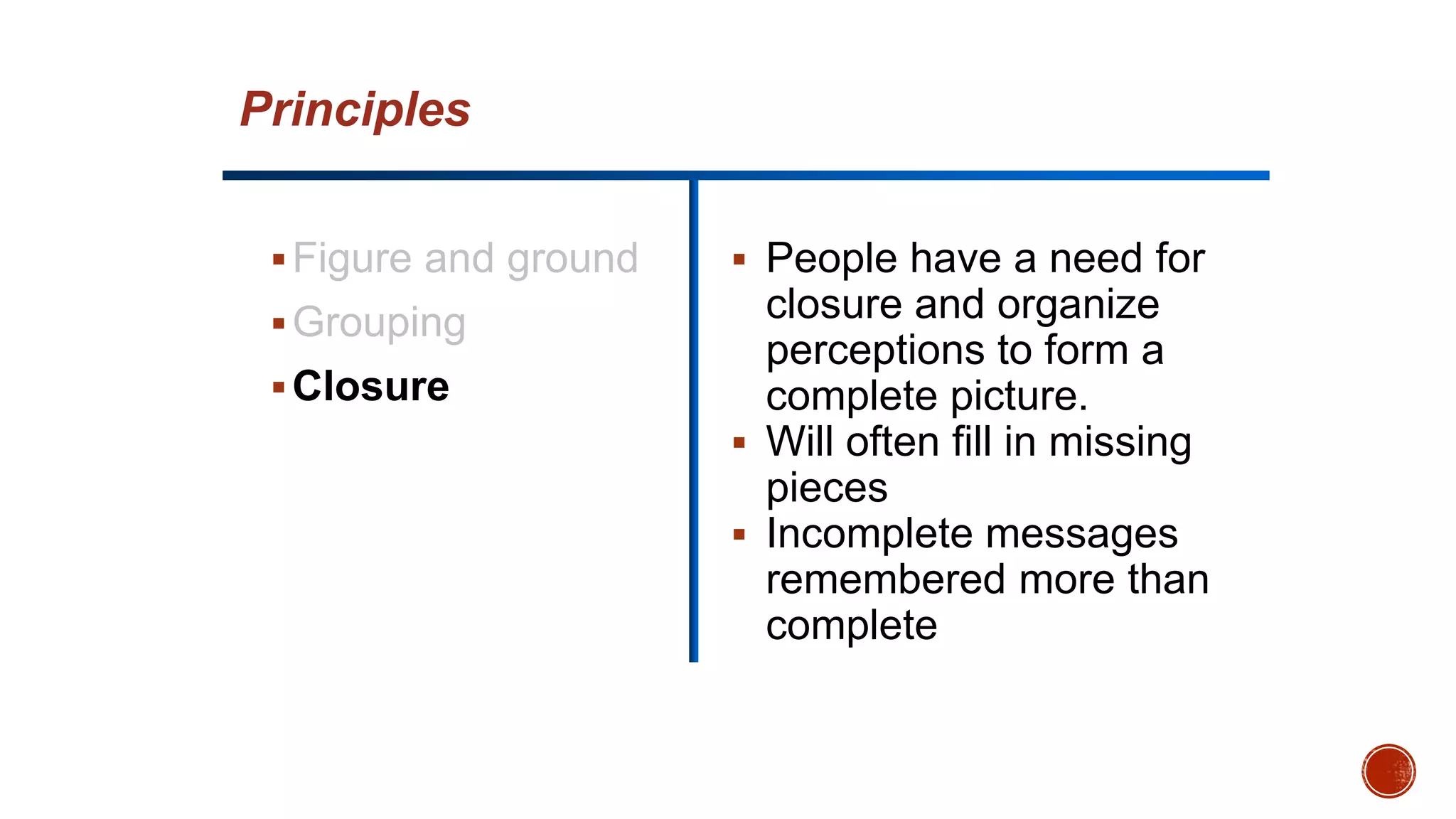
Closure
 People tend to organize
perceptions into figure-
and-ground
relationships.
 The ground is usually
hazy.
 Marketers usually design
so the figure is the
noticed stimuli.
Principles
Figure and ground
Grouping
Closure
 People group stimuli
to form a unified
impression or
concept.
 Grouping helps
memory and recall.
Principles
Figure and ground
Grouping
Closure
 People have a need for
closure and organize
perceptions to form a
complete picture.
 Will often fill in missing
pieces
 Incomplete messages
remembered more than
complete
Principles
PERCEPTUAL
INTERPRETATION
Physical
Appearances
Stereotypes
First Impressions
Jumping to
Conclusions
Halo Effect
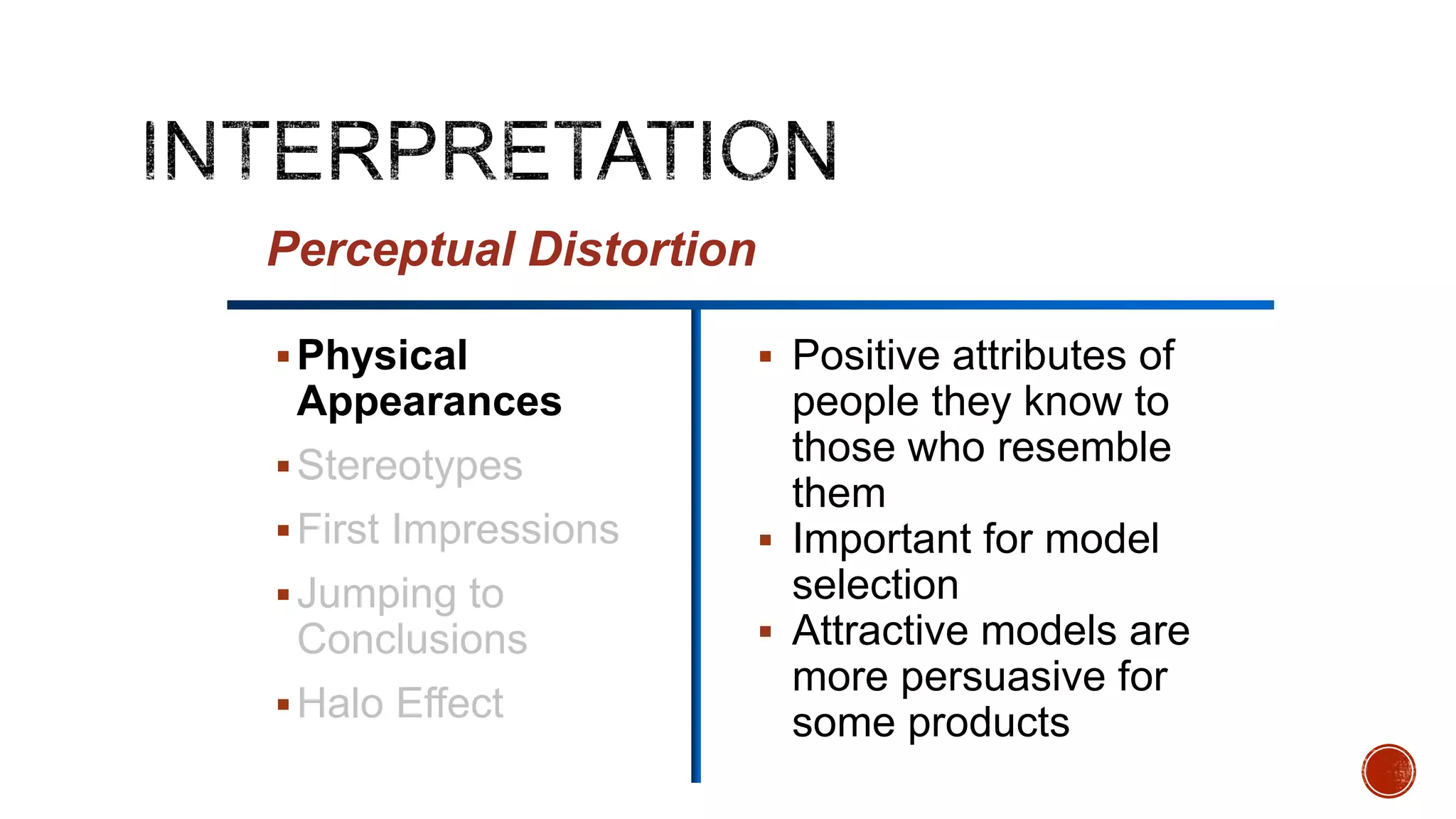
 Positive attributes of
people they know to
those who resemble
them
 Important for model
selection
 Attractive models are
more persuasive for
some products
Perceptual Distortion
Physical
Appearances
Stereotypes
First Impressions
Jumping to
Conclusions
Halo Effect
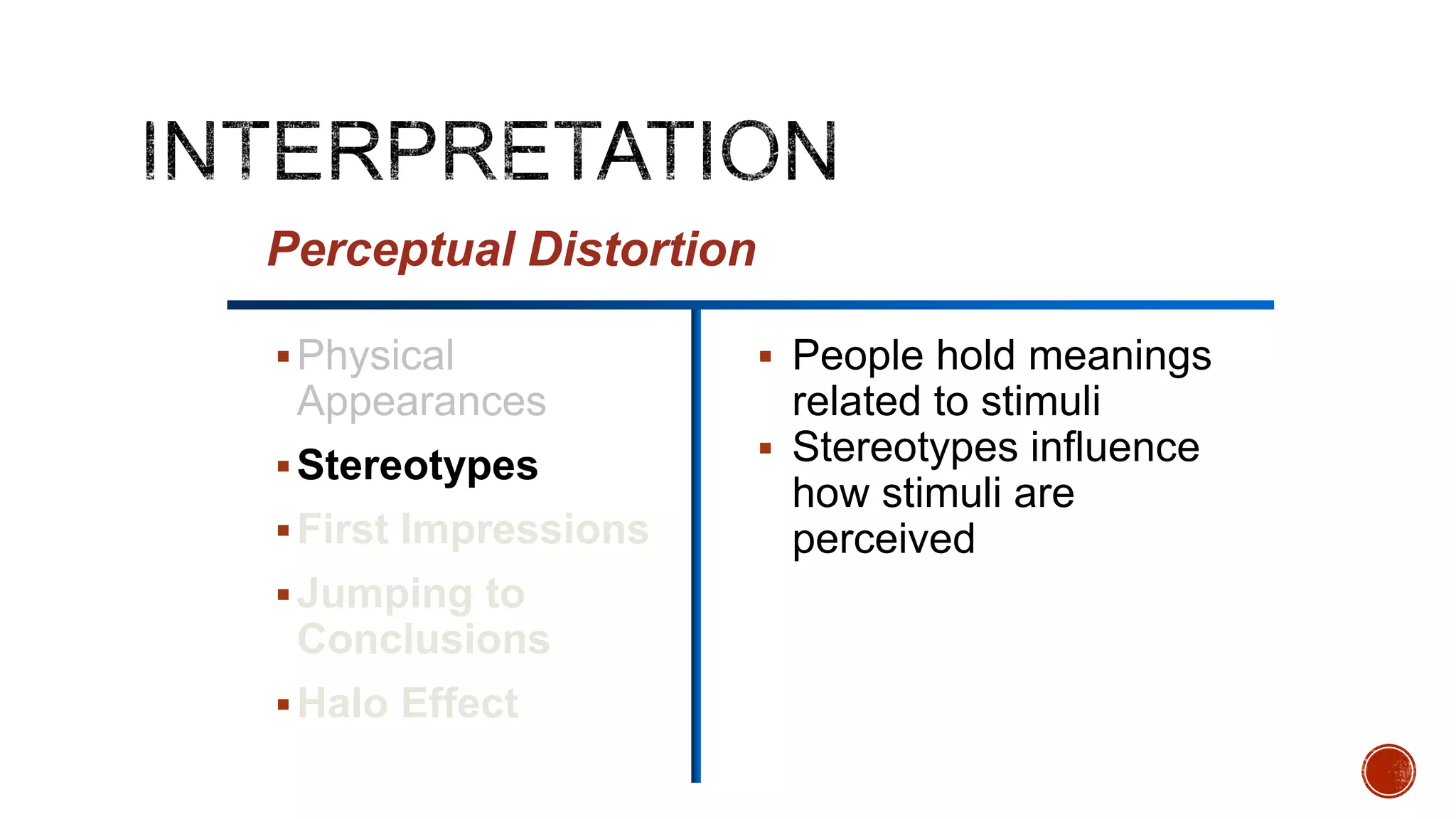
 People hold meanings
related to stimuli
 Stereotypes influence
how stimuli are
perceived
Perceptual Distortion
Physical
Appearances
Stereotypes
First Impressions
Jumping to
Conclusions
Halo Effect
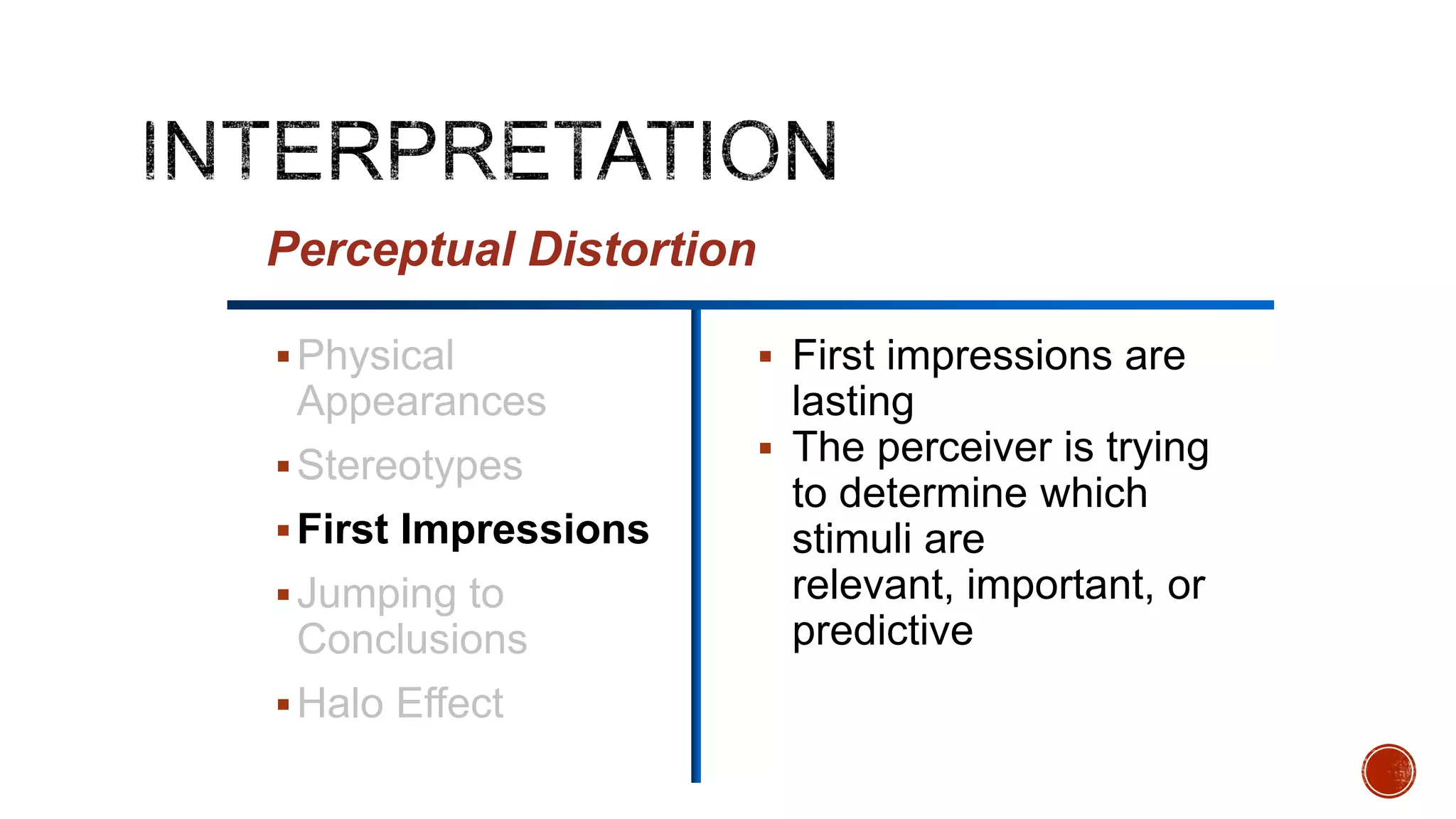
 First impressions are
lasting
 The perceiver is trying
to determine which
stimuli are
relevant, important, or
predictive
Perceptual Distortion
Physical
Appearances
Stereotypes
First Impressions
Jumping to
Conclusions
Halo Effect
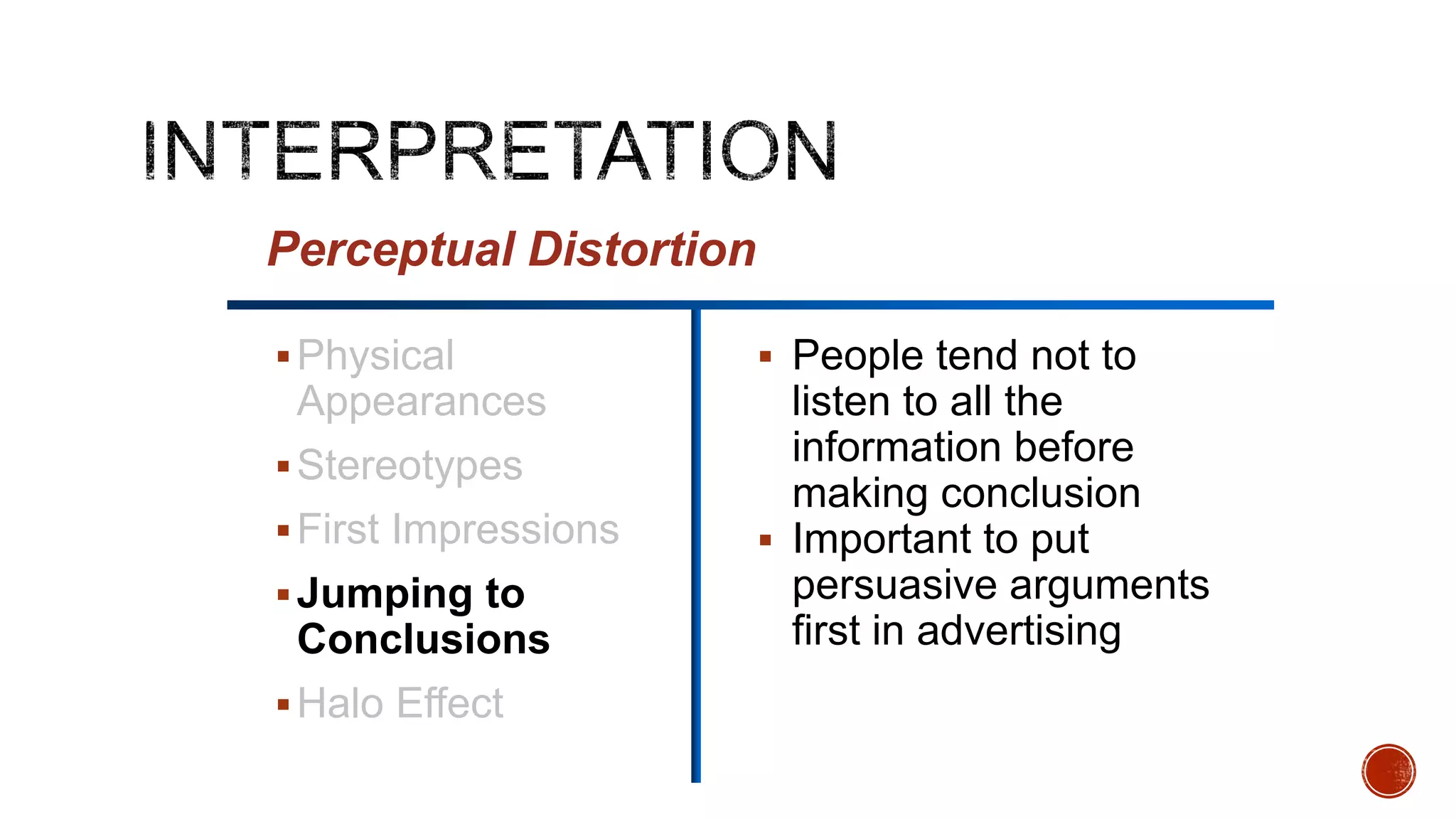
 People tend not to
listen to all the
information before
making conclusion
 Important to put
persuasive arguments
first in advertising
Perceptual Distortion
Physical
Appearances
Stereotypes
First Impressions
Jumping to
Conclusions
Halo Effect
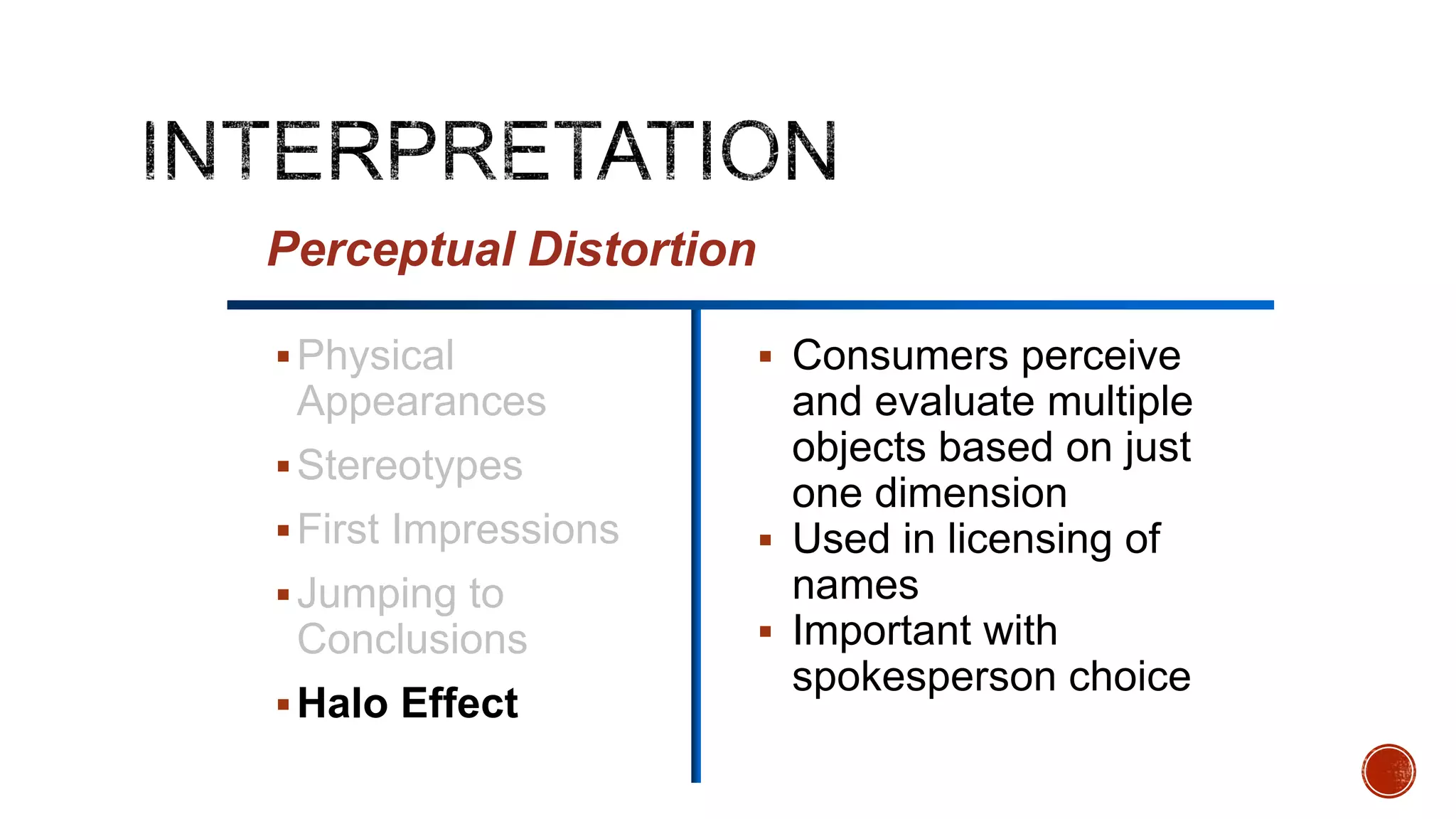
 Consumers perceive
and evaluate multiple
objects based on just
one dimension
 Used in licensing of
names
 Important with
spokesperson choice
Perceptual Distortion
The halo effect
helps Adidas
break into new
product
categories.
THANK
YOU

Consumer perception