





Amity International Business School 
1 
AMITY INTERNATIONAL 
BUSINESS SCHOOL 
MBAIB/IMBA Semester IV 
CONSUMER BEHAVIOUR 
PERCEPTION 
KOKIL JAIN
Amity International Business School 
2 
Perception 
• The process by which an individual 
selects, organizes, and interprets stimuli 
into a meaningful and coherent picture of 
the world 
• How we see the world around us
Amity International Business School 
3 
The Nature of Perception 
• Exposure: when a stimulus comes within range of our 
sensory receptor nerves 
– Random vs. Deliberate 
• Attention: when the stimulus activates one or more 
sensory receptor nerves and the resulting sensations go 
to the brain for processing 
– Low vs. High Involvement 
• Interpretation: the assignment of meaning to sensations 
– Low vs. High Involvement
Amity International Business School 
4 
Elements of Perception 
• Sensation 
• Absolute threshold 
• Differential threshold 
• Subliminal perception
Amity International Business School 
5 
Sensation 
• The immediate and direct response of the sensory organs to 
stimuli 
• Sensitivity to stimuli varies with the quality of an individuals 
sensory receptors 
• Sensation itself depends on energy change within the 
environment where the perception occurs (i.e. the 
differentiation of input) 
• As sensory input decreases , our ability to detect changes in 
input increases, to the point that we attain maximum 
sensitivity under conditions of minimal stimulation
Amity International Business School 
6 
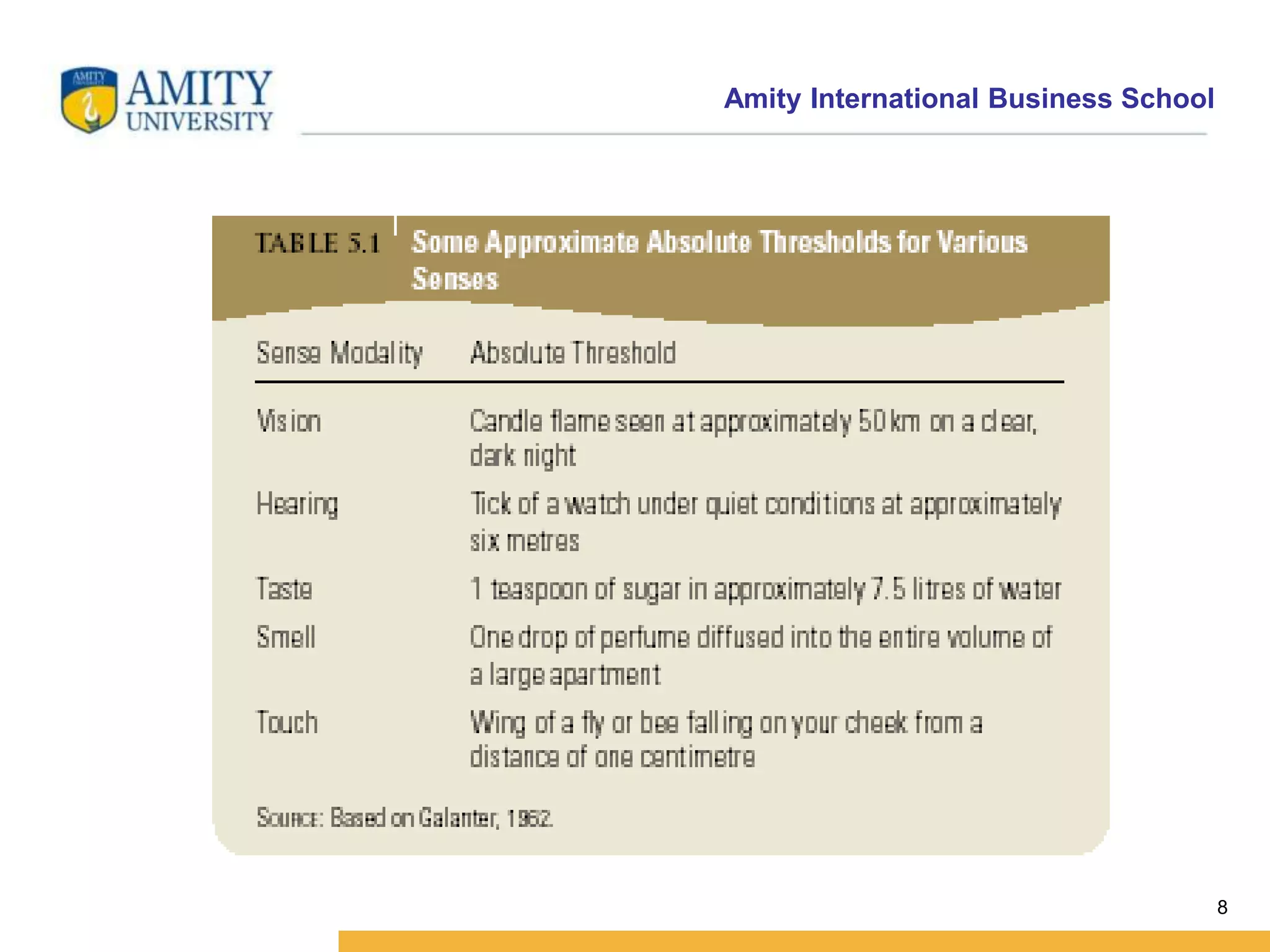
The absolute threshold 
• The lowest level at which individual can experience a 
sensation is called the absolute threshold. 
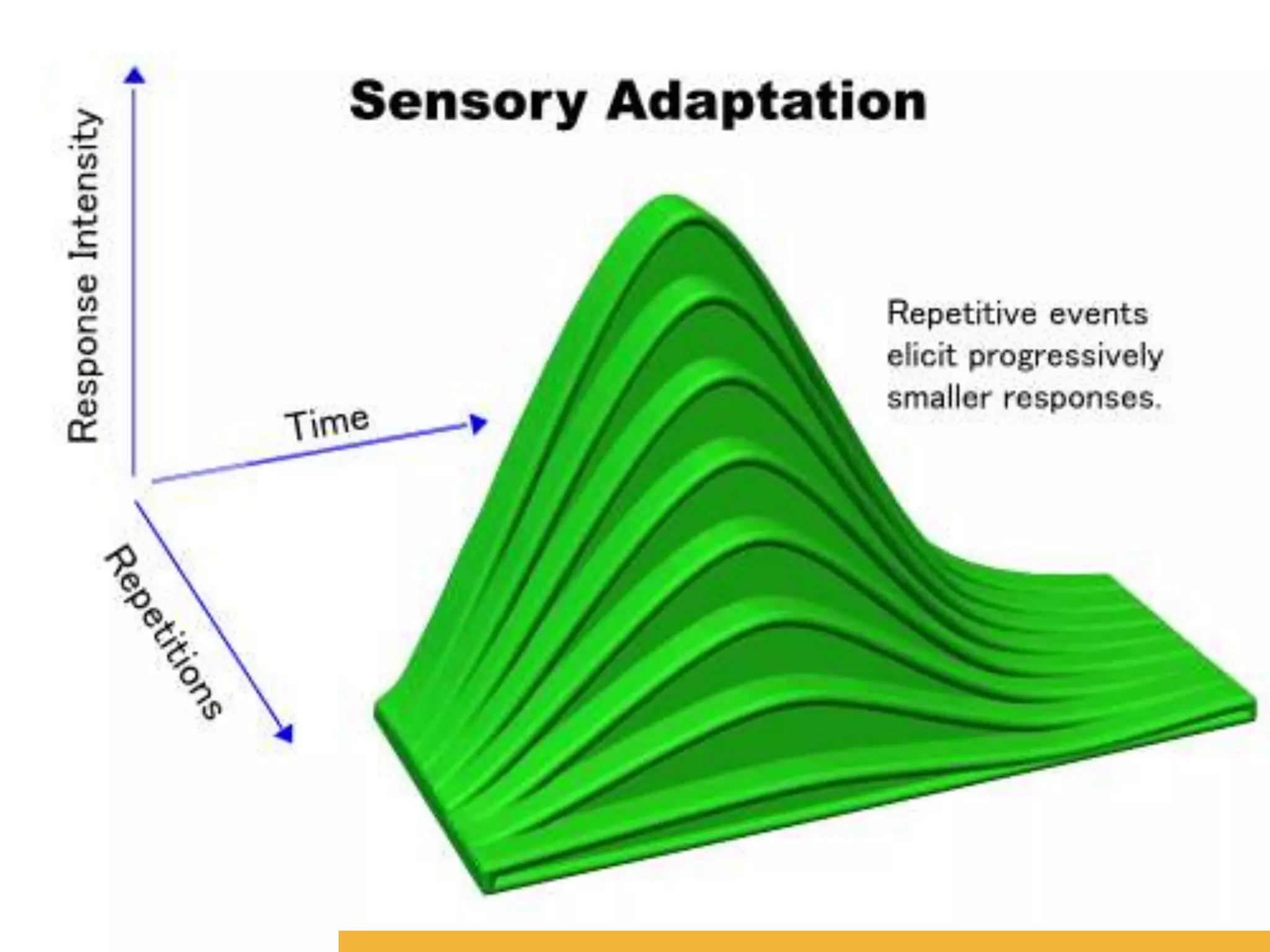
• sensory adaptation-Under conditions of constant 
stimulation , the absolute threshold increases.
Amity International Business School 
7
Amity International Business School 
8
Amity International Business School 
9 
Differential Threshold 
• Minimal difference that can be detected 
between two similar stimuli 
• Also known as the just noticeable 
difference (the j.n.d.)
Amity International Business School 
10 
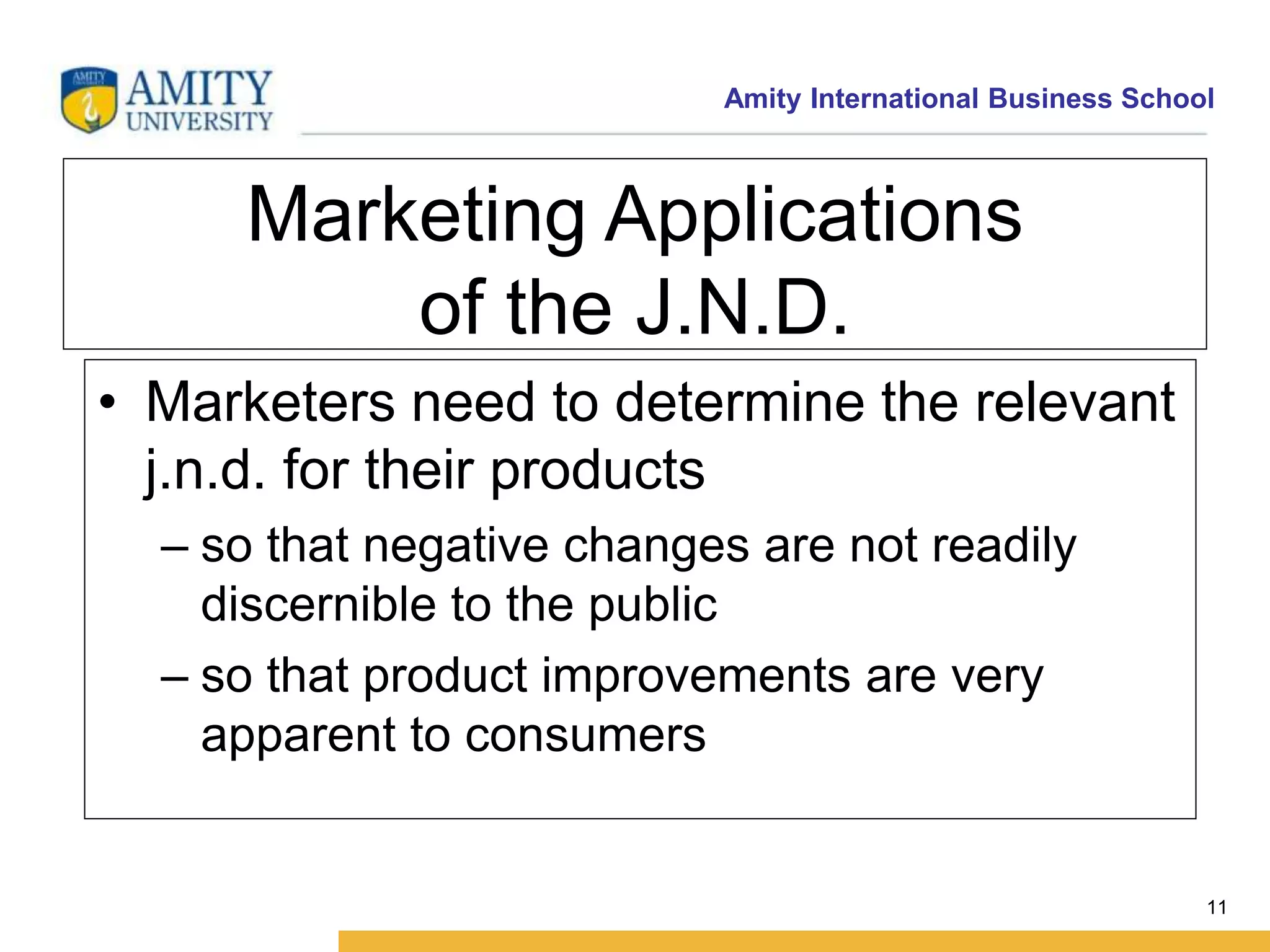
Weber’s Law 
• The j.n.d. between two stimuli is not an 
absolute amount but an amount relative to 
the intensity of the first stimulus 
• Weber’s law states that the stronger the 
initial stimulus, the greater the additional 
intensity needed for the second stimulus to 
be perceived as different.
Amity International Business School 
11 
Marketing Applications 
of the J.N.D. 
• Marketers need to determine the relevant 
j.n.d. for their products 
– so that negative changes are not readily 
discernible to the public 
– so that product improvements are very 
apparent to consumers
Amity International Business School 
12 
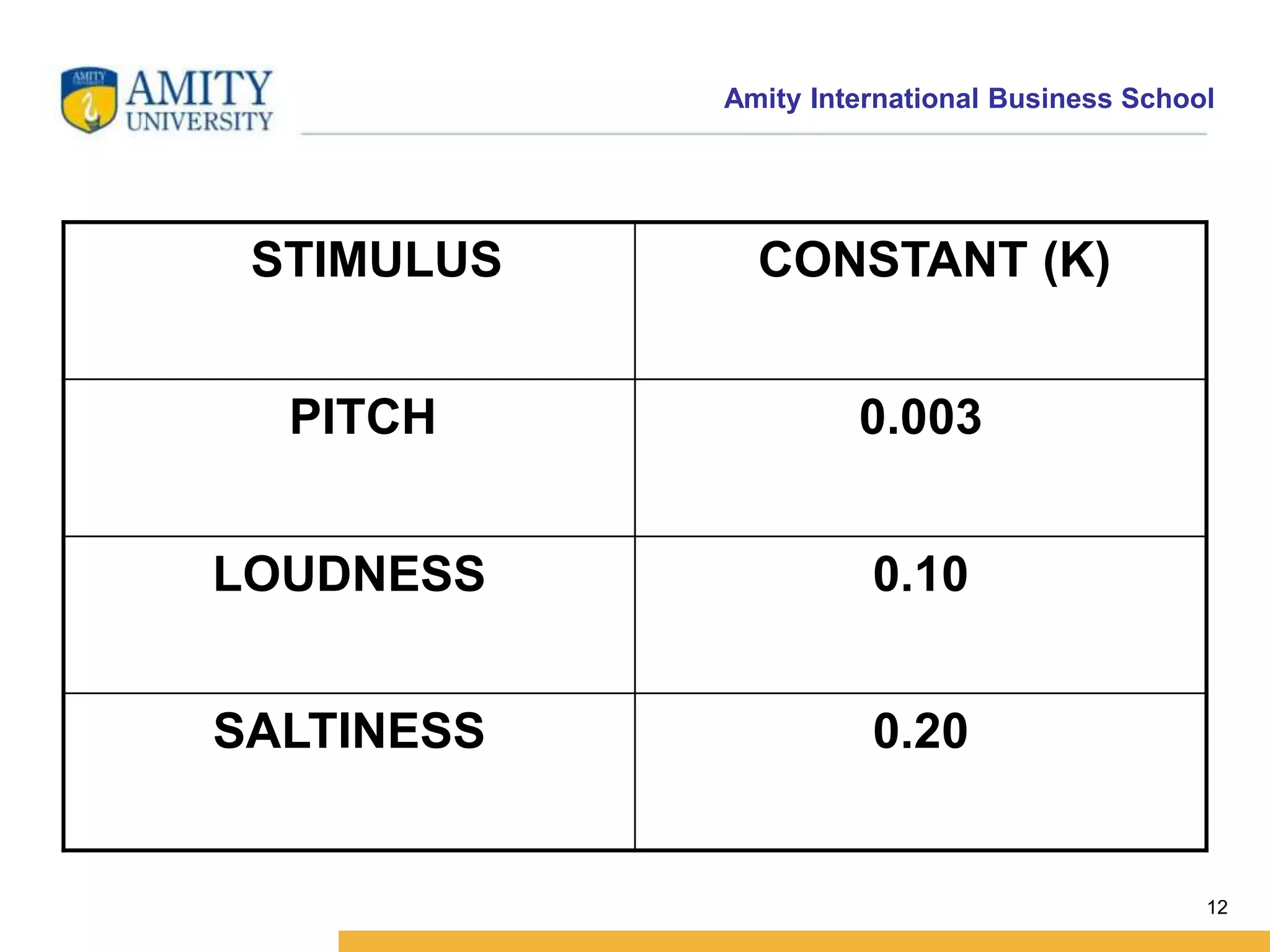
STIMULUS CONSTANT (K) 
PITCH 0.003 
LOUDNESS 0.10 
SALTINESS 0.20
Amity International Business School 
13 
Discussion Question 
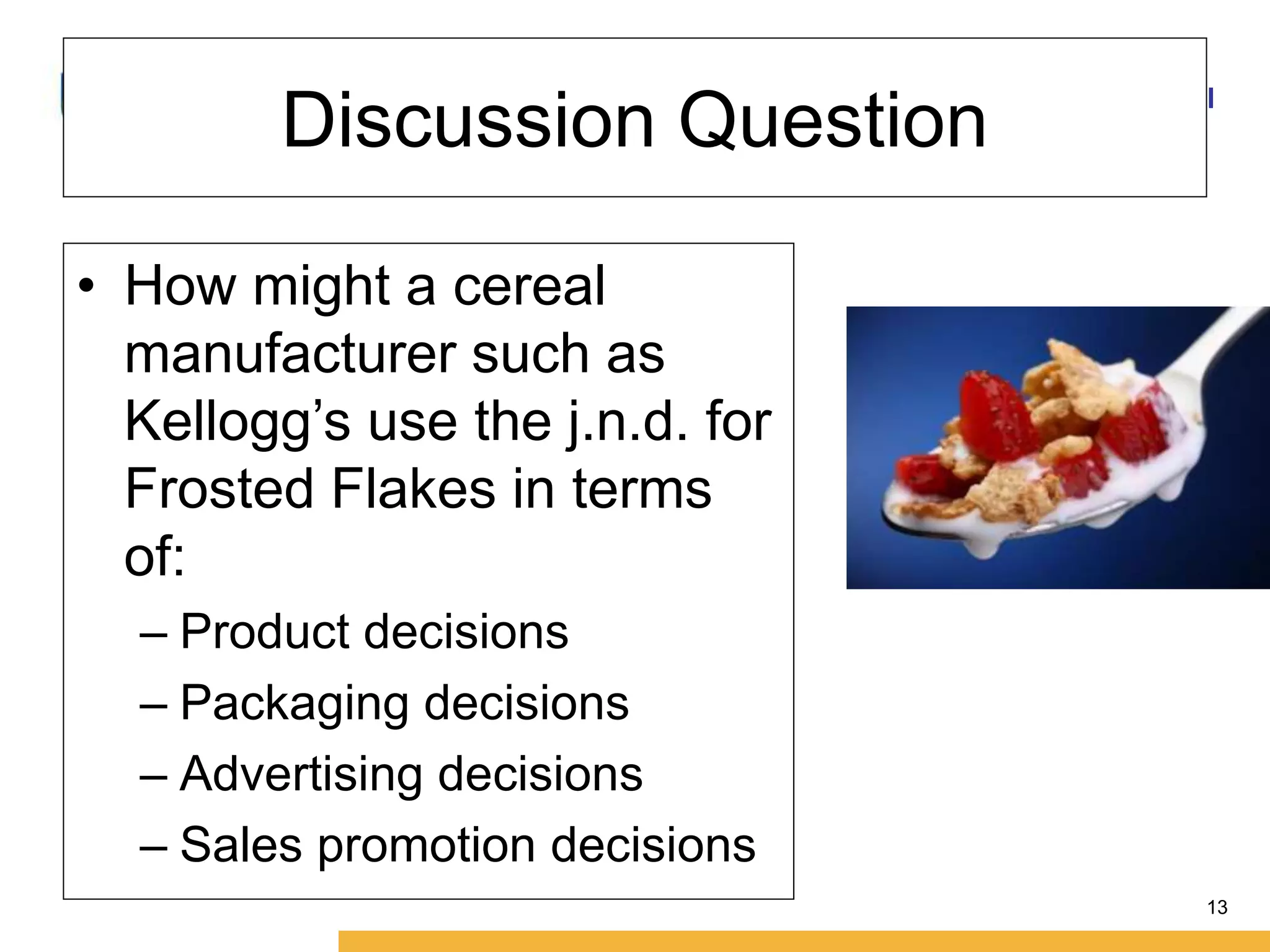
• How might a cereal 
manufacturer such as 
Kellogg’s use the j.n.d. for 
Frosted Flakes in terms 
of: 
– Product decisions 
– Packaging decisions 
– Advertising decisions 
– Sales promotion decisions
Amity International Business School 
14 
Subliminal Perception 
• Stimuli that are too weak or too brief to be 
consciously seen or heard may be strong 
enough to be perceived by one or more 
receptor cells.
Amity International Business School 
15 
Is Subliminal Persuasion 
Effective? 
• Extensive research has shown no 
evidence that subliminal advertising can 
cause behavior changes 
• Some evidence that subliminal stimuli may 
influence affective reactions
Amity International Business School 
16
Amity International Business School 
17 
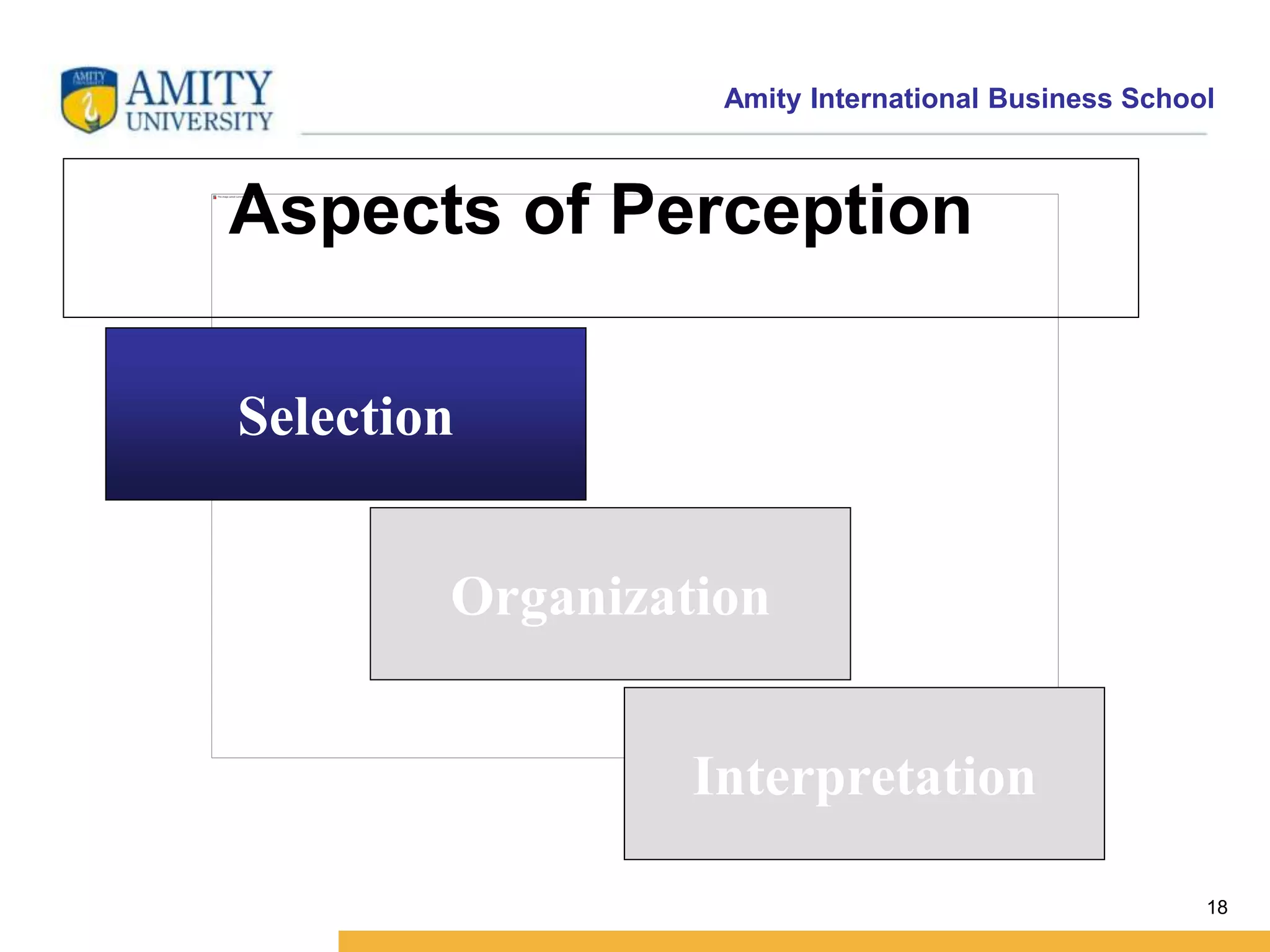
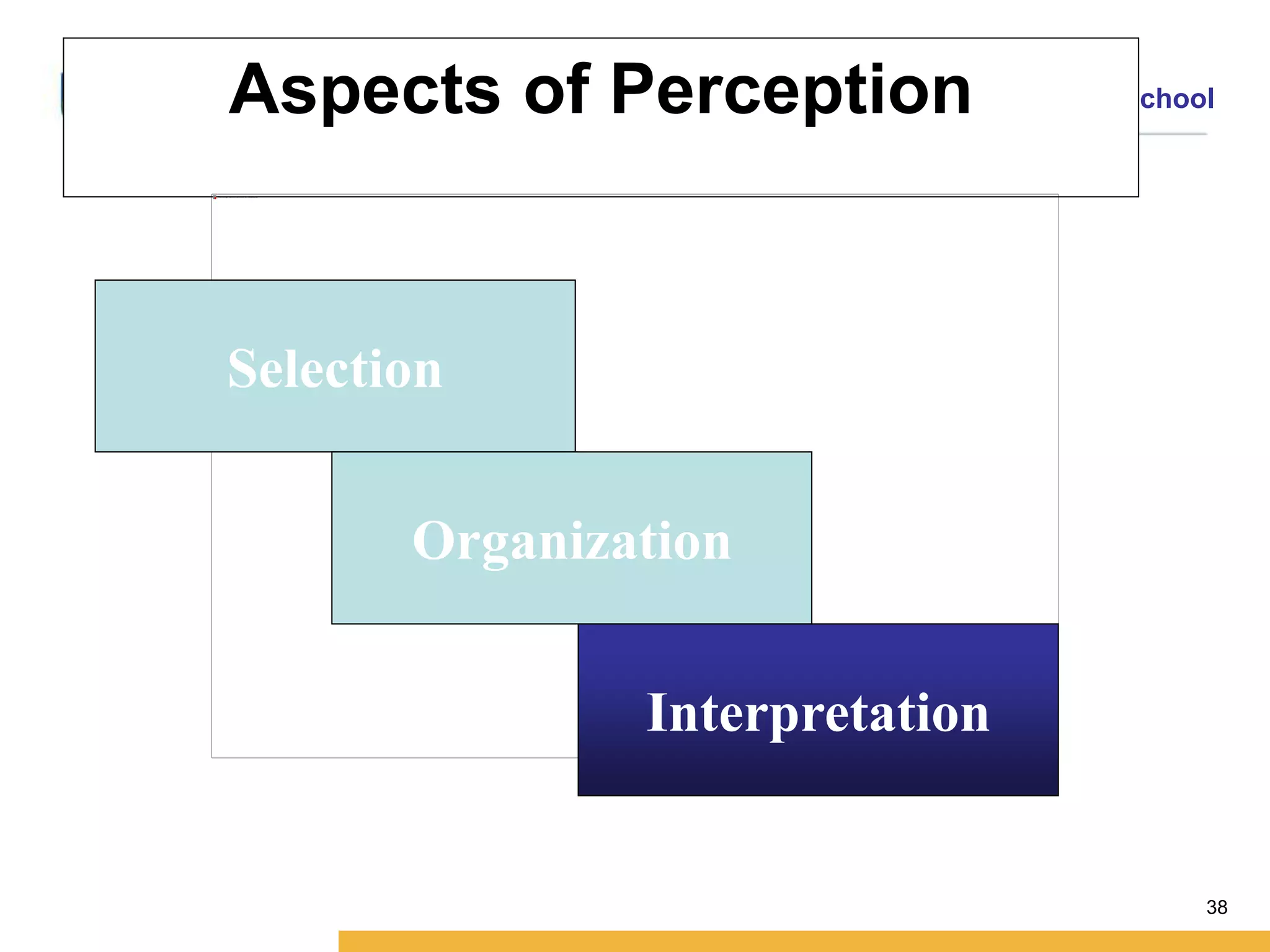
Aspects of Perception 
Selection 
Organization 
Interpretation
Amity International Business School 
18 
Aspects of Perception 
Selection 
Organization 
Interpretation
Amity International Business School 
19 
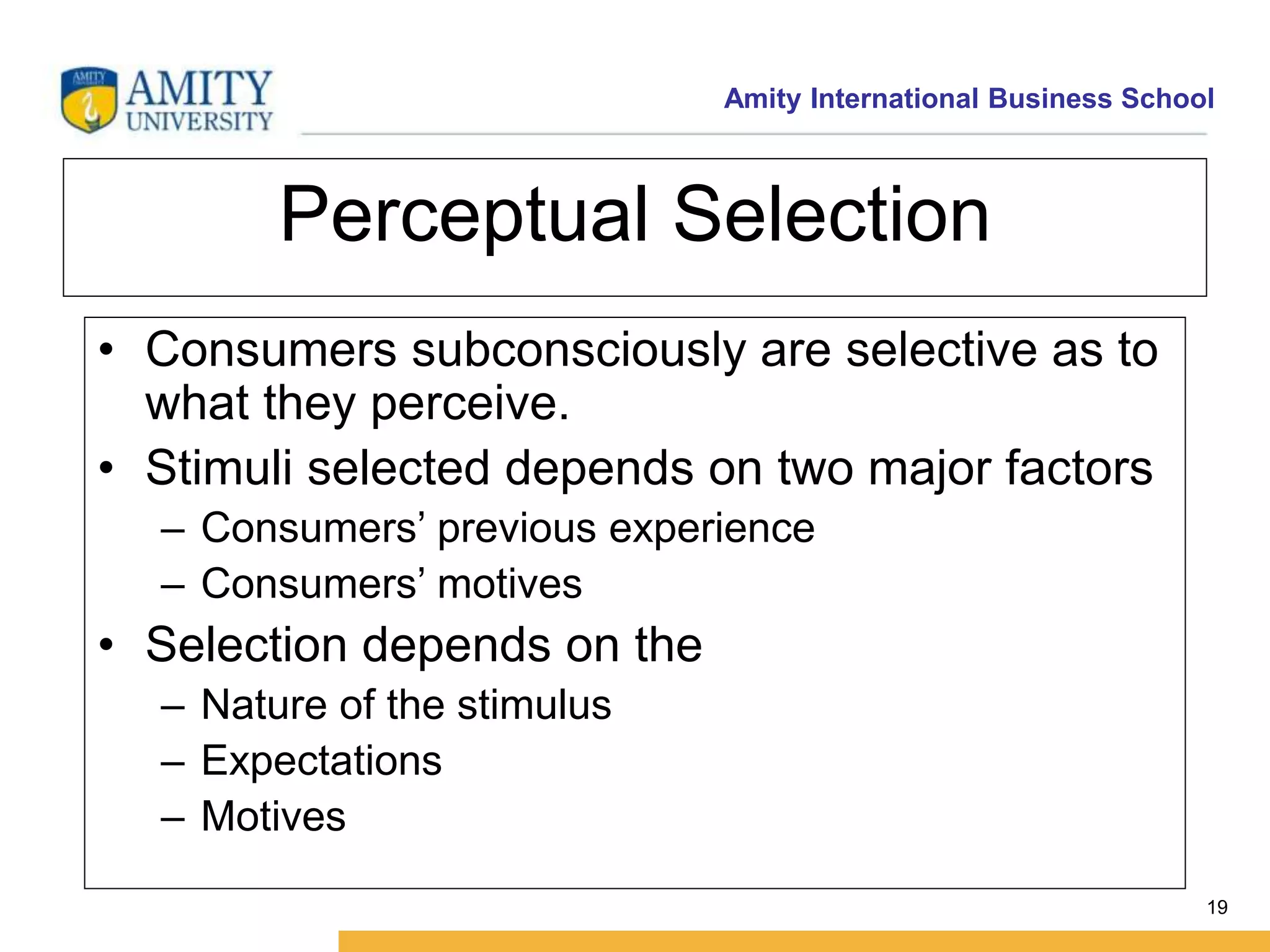
Perceptual Selection 
• Consumers subconsciously are selective as to 
what they perceive. 
• Stimuli selected depends on two major factors 
– Consumers’ previous experience 
– Consumers’ motives 
• Selection depends on the 
– Nature of the stimulus 
– Expectations 
– Motives
Amity International Business School 
20 
Stimulus Factors 
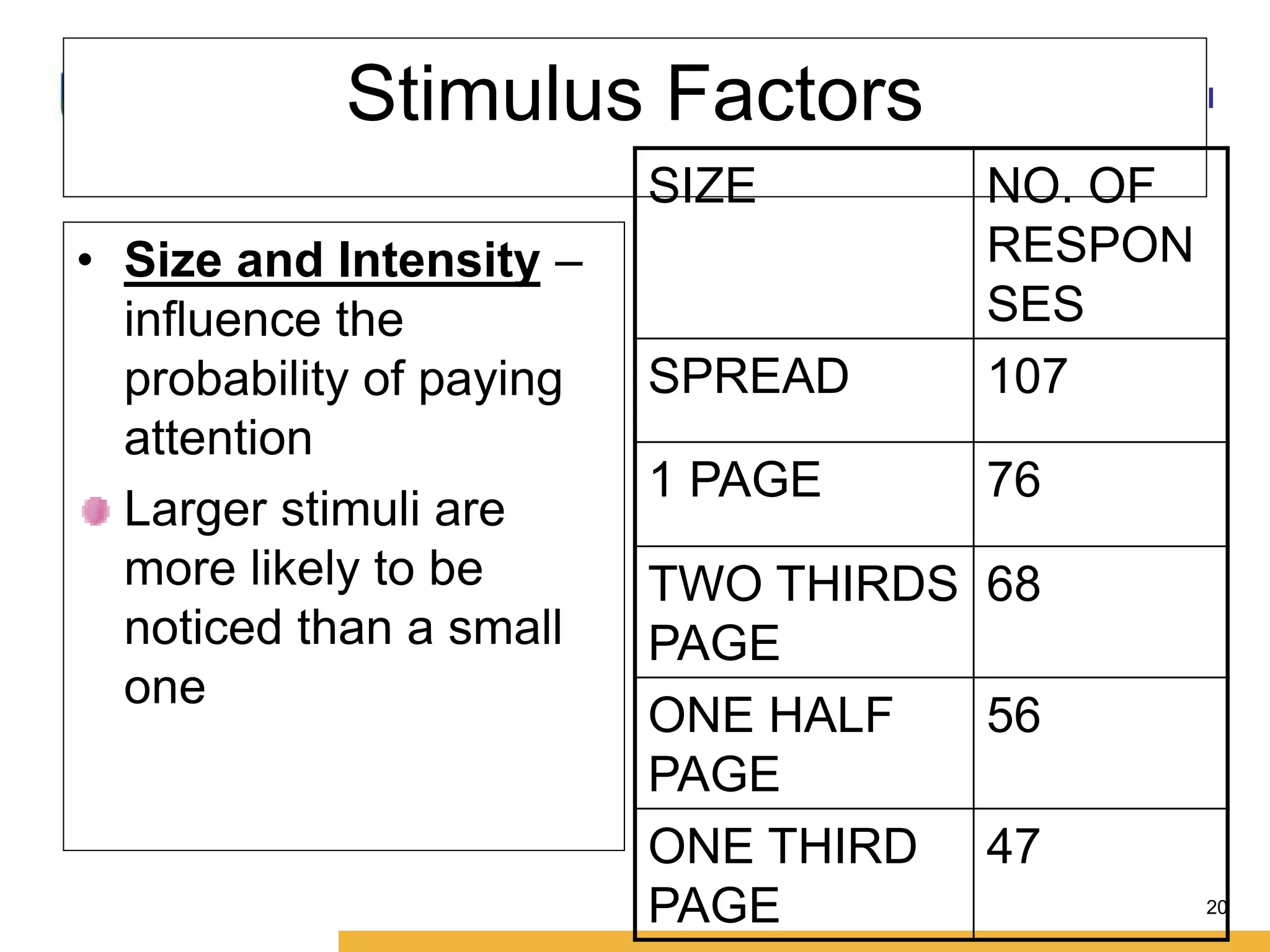
• Size and Intensity – 
influence the 
probability of paying 
attention 
Larger stimuli are 
more likely to be 
noticed than a small 
one 
SIZE NO. OF 
RESPON 
SES 
SPREAD 107 
1 PAGE 76 
TWO THIRDS 
PAGE 
68 
ONE HALF 
PAGE 
56 
ONE THIRD 
PAGE 
47
Amity International Business School 
21 
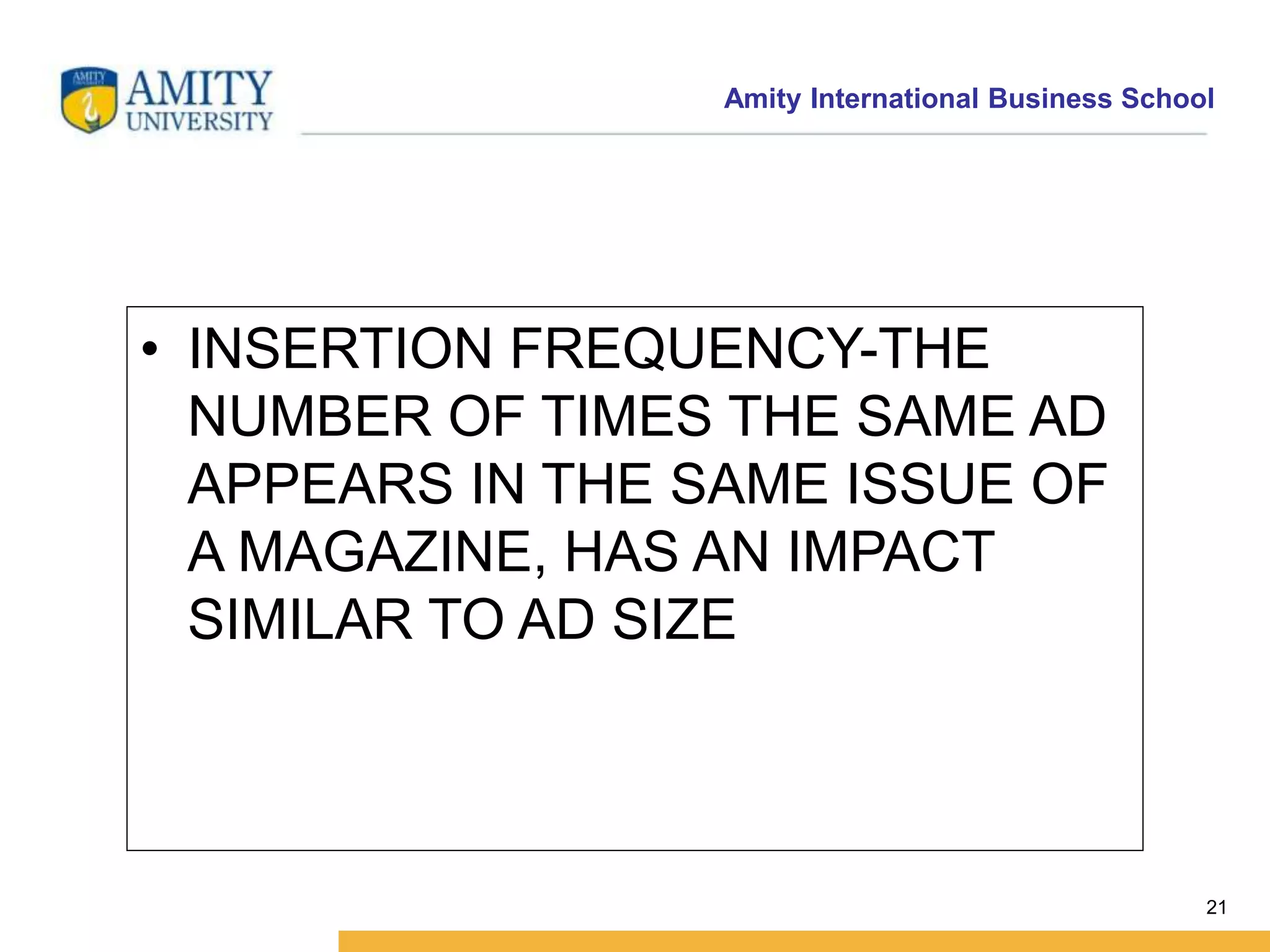
• INSERTION FREQUENCY-THE 
NUMBER OF TIMES THE SAME AD 
APPEARS IN THE SAME ISSUE OF 
A MAGAZINE, HAS AN IMPACT 
SIMILAR TO AD SIZE
Amity International Business School 
22 
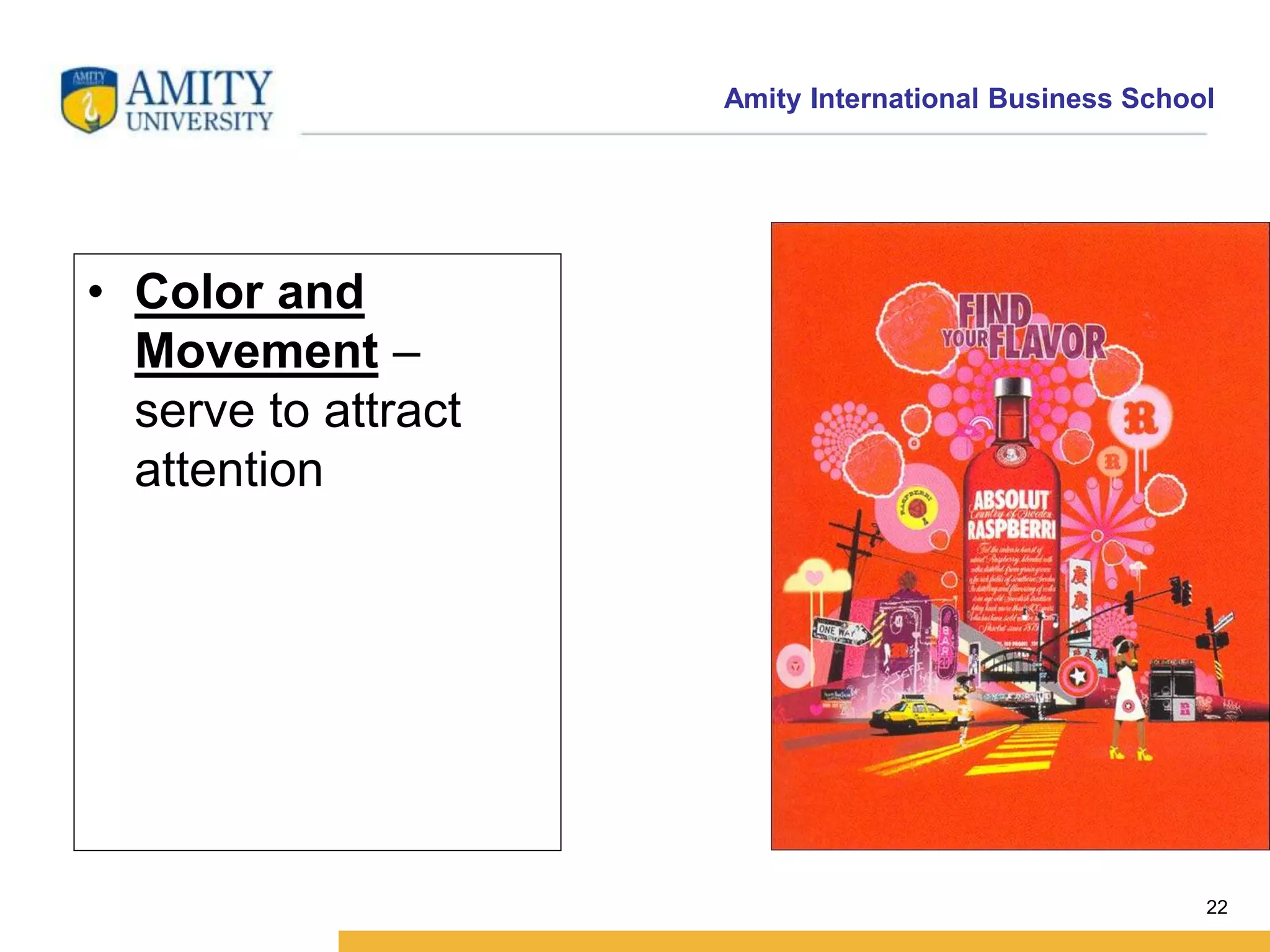
• Color and 
Movement – 
serve to attract 
attention
Amity International Business School 
23 
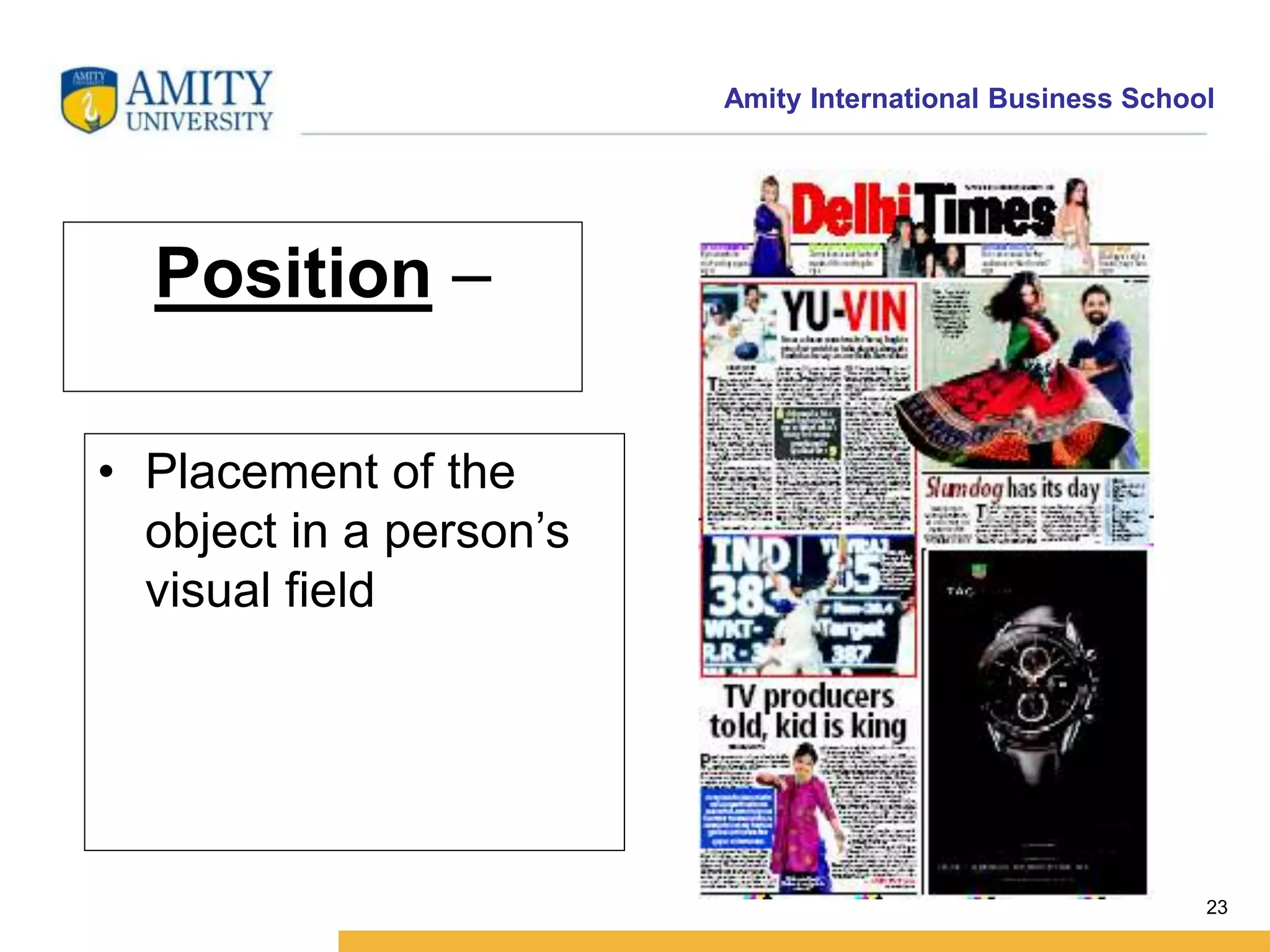
Position – 
• Placement of the 
object in a person’s 
visual field
Amity International Business School 
24 
Perceptual Selection 
• Selective 
Exposure 
• Selective 
Attention 
• Perceptual 
Defense 
• Perceptual 
Blocking 
• Consumers seek out 
messages which: 
– Are pleasant 
– They can sympathize 
– Reassure them of 
good purchases 
Concepts
Amity International Business School 
25 
Perceptual Selection 
• Selective 
Exposure 
• Selective 
Attention 
• Perceptual 
Defense 
• Perceptual 
Blocking 
• Heightened 
awareness when 
stimuli meet their 
needs 
• Consumers prefer 
different messages 
and medium 
Concepts
Amity International Business School 
26 
Perceptual Selection 
• Selective 
Exposure 
• Selective 
Attention 
• Perceptual 
Defense 
• Perceptual 
Blocking 
• Screening out of 
stimuli which are 
threatening 
Concepts
Amity International Business School 
27 
Perceptual Selection 
• Selective 
Exposure 
• Selective 
Attention 
• Perceptual 
Defense 
• Perceptual 
Blocking 
• Consumers avoid 
being bombarded by: 
– Tuning out 
– TiVo 
Concepts
Amity International Business School 
28 
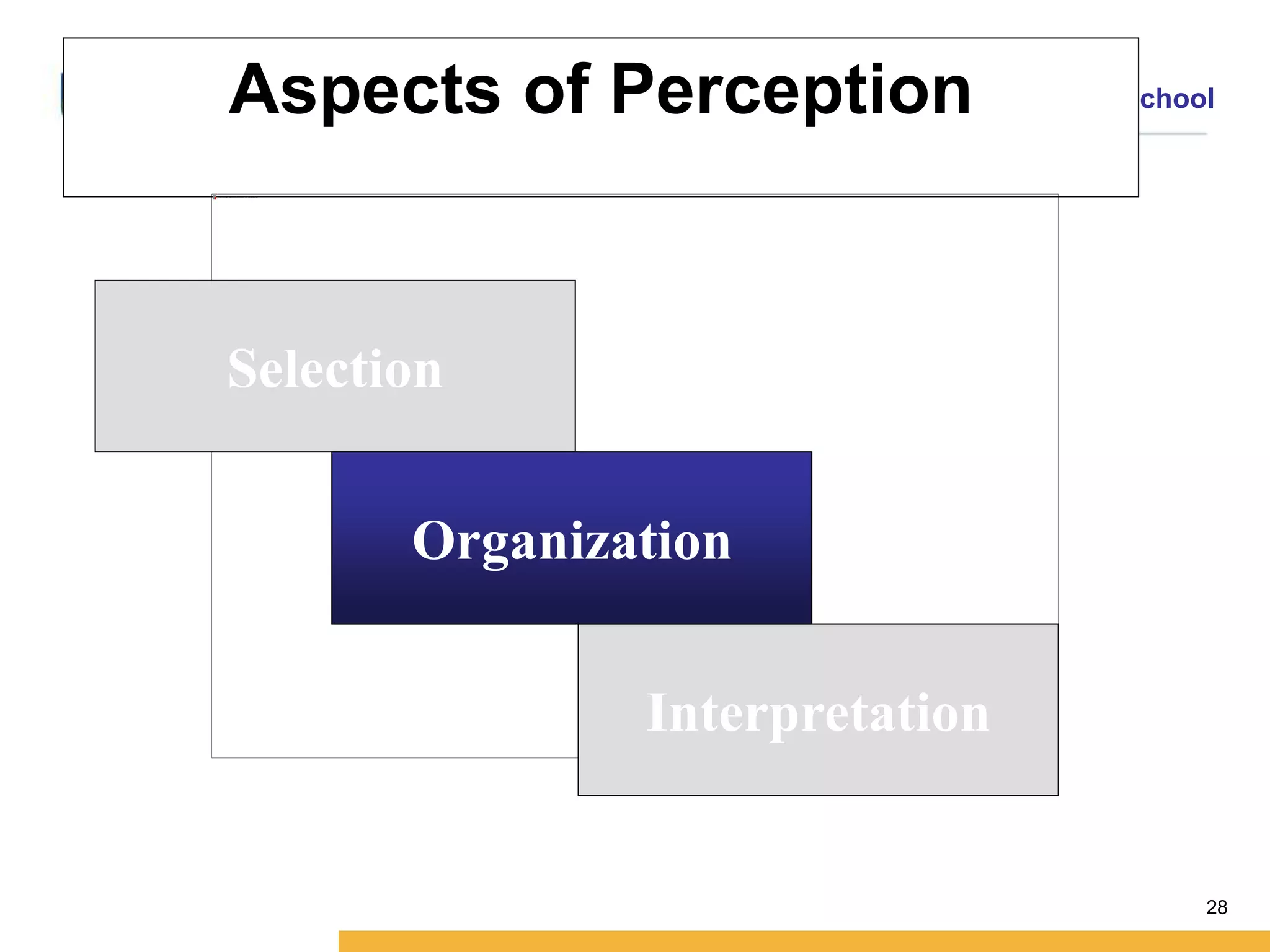
Aspects of Perception 
Selection 
Organization 
Interpretation
Amity International Business School 
29 
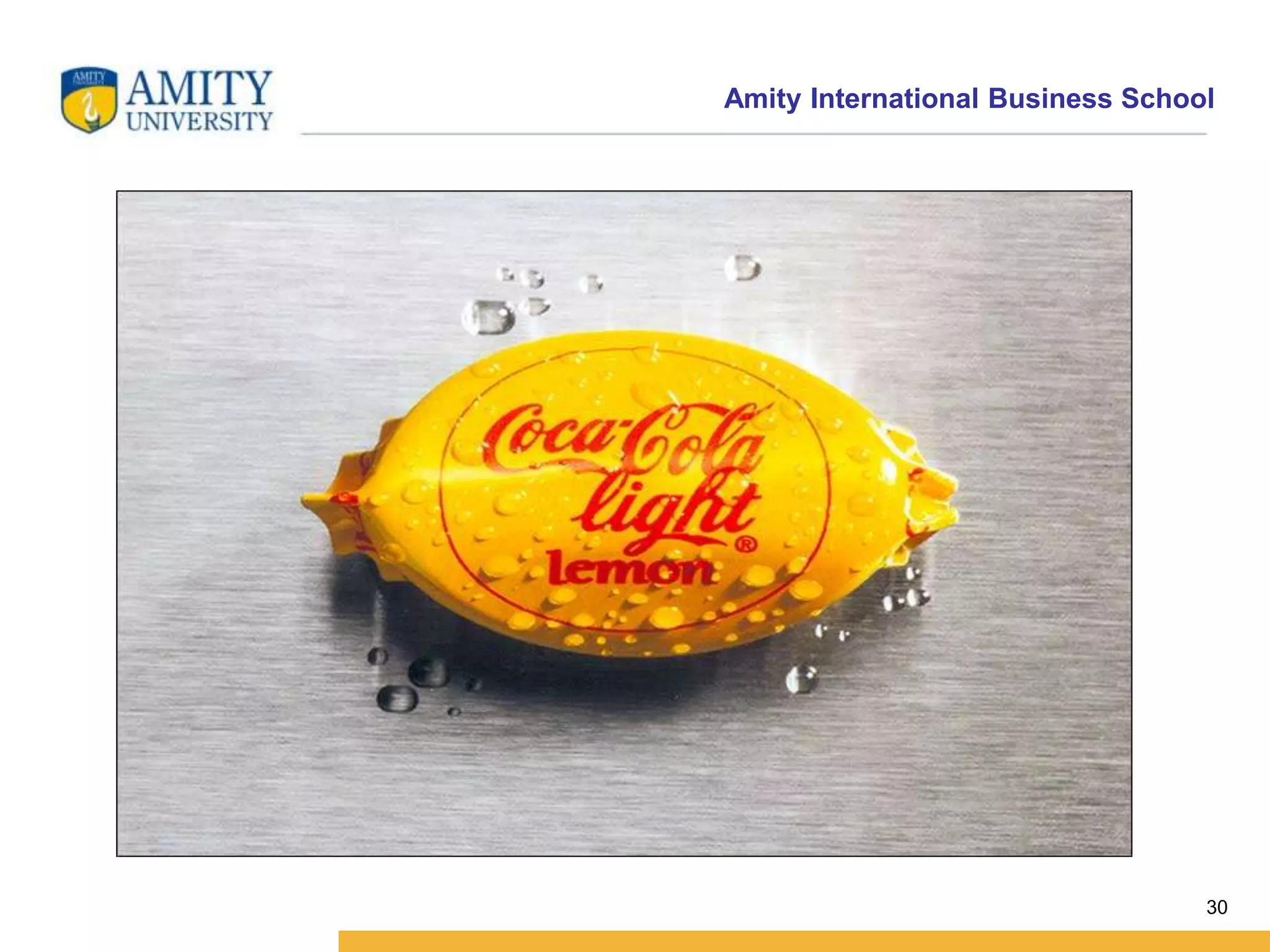
Organization 
• Figure and 
ground 
• Grouping 
• Closure 
• People tend to 
organize perceptions 
into figure-and-ground 
relationships. 
• The ground is usually 
hazy. 
• Marketers usually 
design so the figure is 
the noticed stimuli. 
Principles
Amity International Business School 
30
Amity International Business School 
31
Amity International Business School 
32
Amity International Business School 
33 
Organization 
• Figure and 
ground 
• Grouping 
• Closure 
• People group stimuli 
to form a unified 
impression or 
concept. 
• Grouping helps 
memory and recall. 
Principles
Amity International Business School 
34
Amity International Business School 
35
Amity International Business School 
36 
Organization 
• Figure and ground 
• Grouping 
• Closure 
• People have a need for 
closure and organize 
perceptions to form a 
complete picture. 
• Will often fill in missing 
pieces 
• Incomplete messages 
remembered more than 
complete 
Principles
Amity International Business School 
37
Amity International Business School 
38 
Aspects of Perception 
Selection 
Organization 
Interpretation
Amity International Business School 
39 
Interpretation 
• Physical 
Appearances 
• Stereotypes 
• First Impressions 
• Jumping to 
Conclusions 
• Halo Effect 
• Positive attributes of 
people they know to 
those who resemble 
them 
• Important for model 
selection 
• Attractive models are 
more persuasive for 
some products 
Perceptual Distortion
Amity International Business School 
40 
Interpretation 
• Physical 
Appearances 
• Stereotypes 
• First Impressions 
• Jumping to 
Conclusions 
• Halo Effect 
• People hold meanings 
related to stimuli 
• Stereotypes influence 
how stimuli are 
perceived 
Perceptual Distortion
Amity International Business School 
41 
Interpretation 
• Physical 
Appearances 
• Stereotypes 
• First Impressions 
• Jumping to 
Conclusions 
• Halo Effect 
• First impressions are 
lasting 
• The perceiver is trying 
to determine which 
stimuli are relevant, 
important, or 
predictive 
Perceptual Distortion
Amity International Business School 
42 
Interpretation 
• Physical 
Appearances 
• Stereotypes 
• First Impressions 
• Jumping to 
Conclusions 
• Halo Effect 
• People tend not to 
listen to all the 
information before 
making conclusion 
• Important to put 
persuasive arguments 
first in advertising 
Perceptual Distortion
Amity International Business School 
43 
Interpretation 
• Physical 
Appearances 
• Stereotypes 
• First Impressions 
• Jumping to 
Conclusions 
• Halo Effect 
• Consumers perceive 
and evaluate multiple 
objects based on just 
one dimension 
• Used in licensing of 
names 
• Important with 
spokesperson choice 
Perceptual Distortion
Amity International Business School 
44 
Issues in Consumer Imagery 
• Product Positioning and Repositioning 
• Positioning of Services 
• Perceived Price 
• Perceived Quality 
• Retail Store Image 
• Manufacturer Image 
• Perceived Risk
Amity International Business School 
45 
Positioning 
• Establishing a specific image for a brand in 
the consumer’s mind 
• Product is positioned in relation to competing 
brands 
• Conveys the concept, or meaning, of the 
product in terms of how it fulfills a consumer 
need 
• Result of successful positioning is a 
distinctive, positive brand image
Amity International Business School 
46 
Positioning Techniques 
• Umbrella Positioning 
• Positioning against 
Competition 
• Positioning Based on 
a Specific Benefit 
• Finding an “Unowned” 
Position 
• Filling Several 
Positions 
• Repositioning
Amity International Business School 
49 
Perceived Quality 
• Perceived Quality of Products 
– Intrinsic vs. Extrinsic Cues 
• Perceived Quality of Services 
• Price/Quality Relationship
Amity International Business School 
50 
Perceived Quality of Services 
• Difficult due to characteristics of services 
– Intangible 
– Variable 
– Perishable 
– Simultaneously Produced and Consumed 
• SERVQUAL scale used to measure gap 
between customers’ expectation of service and 
perceptions of actual service
Amity International Business School 
51 
Price/Quality Relationship 
• The perception of price as an indicator of 
product quality (e.g., the higher the price, 
the higher the perceived quality of the 
product.)

Perception

  • 1.
    Amity International BusinessSchool 1 AMITY INTERNATIONAL BUSINESS SCHOOL MBAIB/IMBA Semester IV CONSUMER BEHAVIOUR PERCEPTION KOKIL JAIN
  • 2.
    Amity International BusinessSchool 2 Perception • The process by which an individual selects, organizes, and interprets stimuli into a meaningful and coherent picture of the world • How we see the world around us
  • 3.
    Amity International BusinessSchool 3 The Nature of Perception • Exposure: when a stimulus comes within range of our sensory receptor nerves – Random vs. Deliberate • Attention: when the stimulus activates one or more sensory receptor nerves and the resulting sensations go to the brain for processing – Low vs. High Involvement • Interpretation: the assignment of meaning to sensations – Low vs. High Involvement
  • 4.
    Amity International BusinessSchool 4 Elements of Perception • Sensation • Absolute threshold • Differential threshold • Subliminal perception
  • 5.
    Amity International BusinessSchool 5 Sensation • The immediate and direct response of the sensory organs to stimuli • Sensitivity to stimuli varies with the quality of an individuals sensory receptors • Sensation itself depends on energy change within the environment where the perception occurs (i.e. the differentiation of input) • As sensory input decreases , our ability to detect changes in input increases, to the point that we attain maximum sensitivity under conditions of minimal stimulation
  • 6.
    Amity International BusinessSchool 6 The absolute threshold • The lowest level at which individual can experience a sensation is called the absolute threshold. • sensory adaptation-Under conditions of constant stimulation , the absolute threshold increases.
  • 7.
  • 8.
  • 9.
    Amity International BusinessSchool 9 Differential Threshold • Minimal difference that can be detected between two similar stimuli • Also known as the just noticeable difference (the j.n.d.)
  • 10.
    Amity International BusinessSchool 10 Weber’s Law • The j.n.d. between two stimuli is not an absolute amount but an amount relative to the intensity of the first stimulus • Weber’s law states that the stronger the initial stimulus, the greater the additional intensity needed for the second stimulus to be perceived as different.
  • 11.
    Amity International BusinessSchool 11 Marketing Applications of the J.N.D. • Marketers need to determine the relevant j.n.d. for their products – so that negative changes are not readily discernible to the public – so that product improvements are very apparent to consumers
  • 12.
    Amity International BusinessSchool 12 STIMULUS CONSTANT (K) PITCH 0.003 LOUDNESS 0.10 SALTINESS 0.20
  • 13.
    Amity International BusinessSchool 13 Discussion Question • How might a cereal manufacturer such as Kellogg’s use the j.n.d. for Frosted Flakes in terms of: – Product decisions – Packaging decisions – Advertising decisions – Sales promotion decisions
  • 14.
    Amity International BusinessSchool 14 Subliminal Perception • Stimuli that are too weak or too brief to be consciously seen or heard may be strong enough to be perceived by one or more receptor cells.
  • 15.
    Amity International BusinessSchool 15 Is Subliminal Persuasion Effective? • Extensive research has shown no evidence that subliminal advertising can cause behavior changes • Some evidence that subliminal stimuli may influence affective reactions
  • 16.
  • 17.
    Amity International BusinessSchool 17 Aspects of Perception Selection Organization Interpretation
  • 18.
    Amity International BusinessSchool 18 Aspects of Perception Selection Organization Interpretation
  • 19.
    Amity International BusinessSchool 19 Perceptual Selection • Consumers subconsciously are selective as to what they perceive. • Stimuli selected depends on two major factors – Consumers’ previous experience – Consumers’ motives • Selection depends on the – Nature of the stimulus – Expectations – Motives
  • 20.
    Amity International BusinessSchool 20 Stimulus Factors • Size and Intensity – influence the probability of paying attention Larger stimuli are more likely to be noticed than a small one SIZE NO. OF RESPON SES SPREAD 107 1 PAGE 76 TWO THIRDS PAGE 68 ONE HALF PAGE 56 ONE THIRD PAGE 47
  • 21.
    Amity International BusinessSchool 21 • INSERTION FREQUENCY-THE NUMBER OF TIMES THE SAME AD APPEARS IN THE SAME ISSUE OF A MAGAZINE, HAS AN IMPACT SIMILAR TO AD SIZE
  • 22.
    Amity International BusinessSchool 22 • Color and Movement – serve to attract attention
  • 23.
    Amity International BusinessSchool 23 Position – • Placement of the object in a person’s visual field
  • 24.
    Amity International BusinessSchool 24 Perceptual Selection • Selective Exposure • Selective Attention • Perceptual Defense • Perceptual Blocking • Consumers seek out messages which: – Are pleasant – They can sympathize – Reassure them of good purchases Concepts
  • 25.
    Amity International BusinessSchool 25 Perceptual Selection • Selective Exposure • Selective Attention • Perceptual Defense • Perceptual Blocking • Heightened awareness when stimuli meet their needs • Consumers prefer different messages and medium Concepts
  • 26.
    Amity International BusinessSchool 26 Perceptual Selection • Selective Exposure • Selective Attention • Perceptual Defense • Perceptual Blocking • Screening out of stimuli which are threatening Concepts
  • 27.
    Amity International BusinessSchool 27 Perceptual Selection • Selective Exposure • Selective Attention • Perceptual Defense • Perceptual Blocking • Consumers avoid being bombarded by: – Tuning out – TiVo Concepts
  • 28.
    Amity International BusinessSchool 28 Aspects of Perception Selection Organization Interpretation
  • 29.
    Amity International BusinessSchool 29 Organization • Figure and ground • Grouping • Closure • People tend to organize perceptions into figure-and-ground relationships. • The ground is usually hazy. • Marketers usually design so the figure is the noticed stimuli. Principles
  • 30.
  • 31.
  • 32.
  • 33.
    Amity International BusinessSchool 33 Organization • Figure and ground • Grouping • Closure • People group stimuli to form a unified impression or concept. • Grouping helps memory and recall. Principles
  • 34.
  • 35.
  • 36.
    Amity International BusinessSchool 36 Organization • Figure and ground • Grouping • Closure • People have a need for closure and organize perceptions to form a complete picture. • Will often fill in missing pieces • Incomplete messages remembered more than complete Principles
  • 37.
  • 38.
    Amity International BusinessSchool 38 Aspects of Perception Selection Organization Interpretation
  • 39.
    Amity International BusinessSchool 39 Interpretation • Physical Appearances • Stereotypes • First Impressions • Jumping to Conclusions • Halo Effect • Positive attributes of people they know to those who resemble them • Important for model selection • Attractive models are more persuasive for some products Perceptual Distortion
  • 40.
    Amity International BusinessSchool 40 Interpretation • Physical Appearances • Stereotypes • First Impressions • Jumping to Conclusions • Halo Effect • People hold meanings related to stimuli • Stereotypes influence how stimuli are perceived Perceptual Distortion
  • 41.
    Amity International BusinessSchool 41 Interpretation • Physical Appearances • Stereotypes • First Impressions • Jumping to Conclusions • Halo Effect • First impressions are lasting • The perceiver is trying to determine which stimuli are relevant, important, or predictive Perceptual Distortion
  • 42.
    Amity International BusinessSchool 42 Interpretation • Physical Appearances • Stereotypes • First Impressions • Jumping to Conclusions • Halo Effect • People tend not to listen to all the information before making conclusion • Important to put persuasive arguments first in advertising Perceptual Distortion
  • 43.
    Amity International BusinessSchool 43 Interpretation • Physical Appearances • Stereotypes • First Impressions • Jumping to Conclusions • Halo Effect • Consumers perceive and evaluate multiple objects based on just one dimension • Used in licensing of names • Important with spokesperson choice Perceptual Distortion
  • 44.
    Amity International BusinessSchool 44 Issues in Consumer Imagery • Product Positioning and Repositioning • Positioning of Services • Perceived Price • Perceived Quality • Retail Store Image • Manufacturer Image • Perceived Risk
  • 45.
    Amity International BusinessSchool 45 Positioning • Establishing a specific image for a brand in the consumer’s mind • Product is positioned in relation to competing brands • Conveys the concept, or meaning, of the product in terms of how it fulfills a consumer need • Result of successful positioning is a distinctive, positive brand image
  • 46.
    Amity International BusinessSchool 46 Positioning Techniques • Umbrella Positioning • Positioning against Competition • Positioning Based on a Specific Benefit • Finding an “Unowned” Position • Filling Several Positions • Repositioning
  • 47.
    Amity International BusinessSchool 49 Perceived Quality • Perceived Quality of Products – Intrinsic vs. Extrinsic Cues • Perceived Quality of Services • Price/Quality Relationship
  • 48.
    Amity International BusinessSchool 50 Perceived Quality of Services • Difficult due to characteristics of services – Intangible – Variable – Perishable – Simultaneously Produced and Consumed • SERVQUAL scale used to measure gap between customers’ expectation of service and perceptions of actual service
  • 49.
    Amity International BusinessSchool 51 Price/Quality Relationship • The perception of price as an indicator of product quality (e.g., the higher the price, the higher the perceived quality of the product.)