PERCEPTION Aparna Goyal
PERCEPTION How we see the world in and around us
Perception Consumer as Perceiver The  objective reality  of the product matters a little and what matters is the consumers perception about the product/ brand The process by which an individual  selects, organizes, and interprets stimuli into a meaningful and coherent picture  of the world is called Perception. Amity Business School
THE MESSAGES TO WHICH WE  DO  CHOOSE TO PAY ATTENTION OFTEN WIND UP DIFFERING FROM WHAT THE SPONSORS INTENDED, AS WE EACH PUT OUR PERSONAL  SPIN   ON THINGS BY ADOPTING MEANINGS CONSISTENT WITH OUR OWN UNIQUE EXPERIENCES, BIASES AND DESIRES. ADVERTISING ANGLE TO PERCEPTION OF CONSUMERS
Factor Shaping  Perception is SENSATION SENSATION - The  immediate and direct response of our sensory receptors  to basic stimuli.  A  perfectly unchanging environment  provides little to  no sensation  at all. PERCEPTION -  Process by which people select, organize and interpret these sensations. Focus is on what we ADD to these raw sensations in order to give them meaning Cont….
Decreased Sensory inputs  Increased Sensory inputs  Absolute threshold Differential threshold Subliminal perception
Absolute Threshold Lowest intensity of a stimulus that can be registered on a sensory channel Minimum stimulation that can be detected on a given sensory channel Whispering Small print characters
Differential Threshold Ability of a  sensory system to detect changes  or differences between two stimuli Minimum difference we can detect  between two stimuli is the J.N.D.
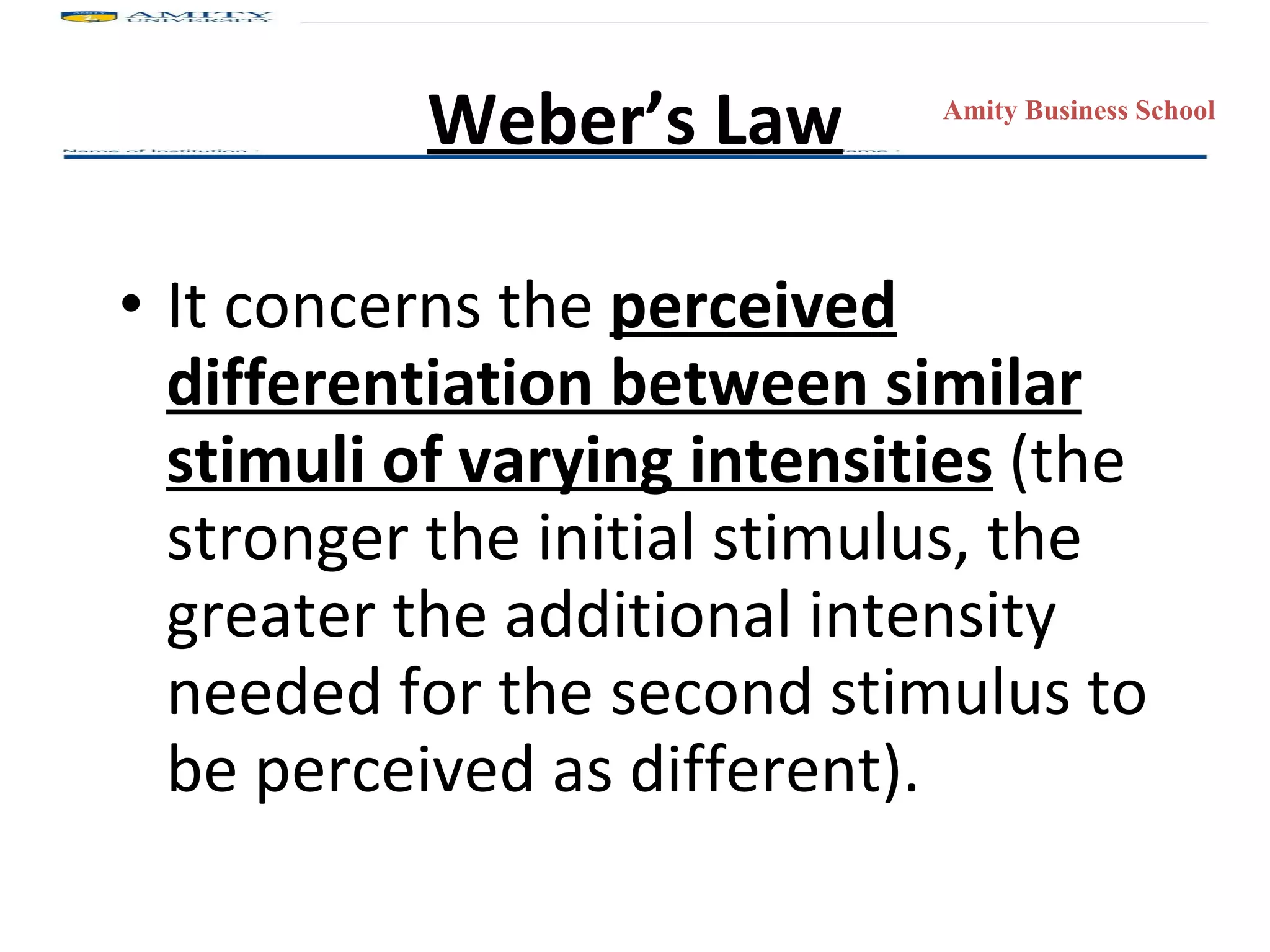
It concerns the  perceived differentiation between similar stimuli of varying intensities  (the stronger the initial stimulus, the greater the additional intensity needed for the second stimulus to be perceived as different). Weber’s Law
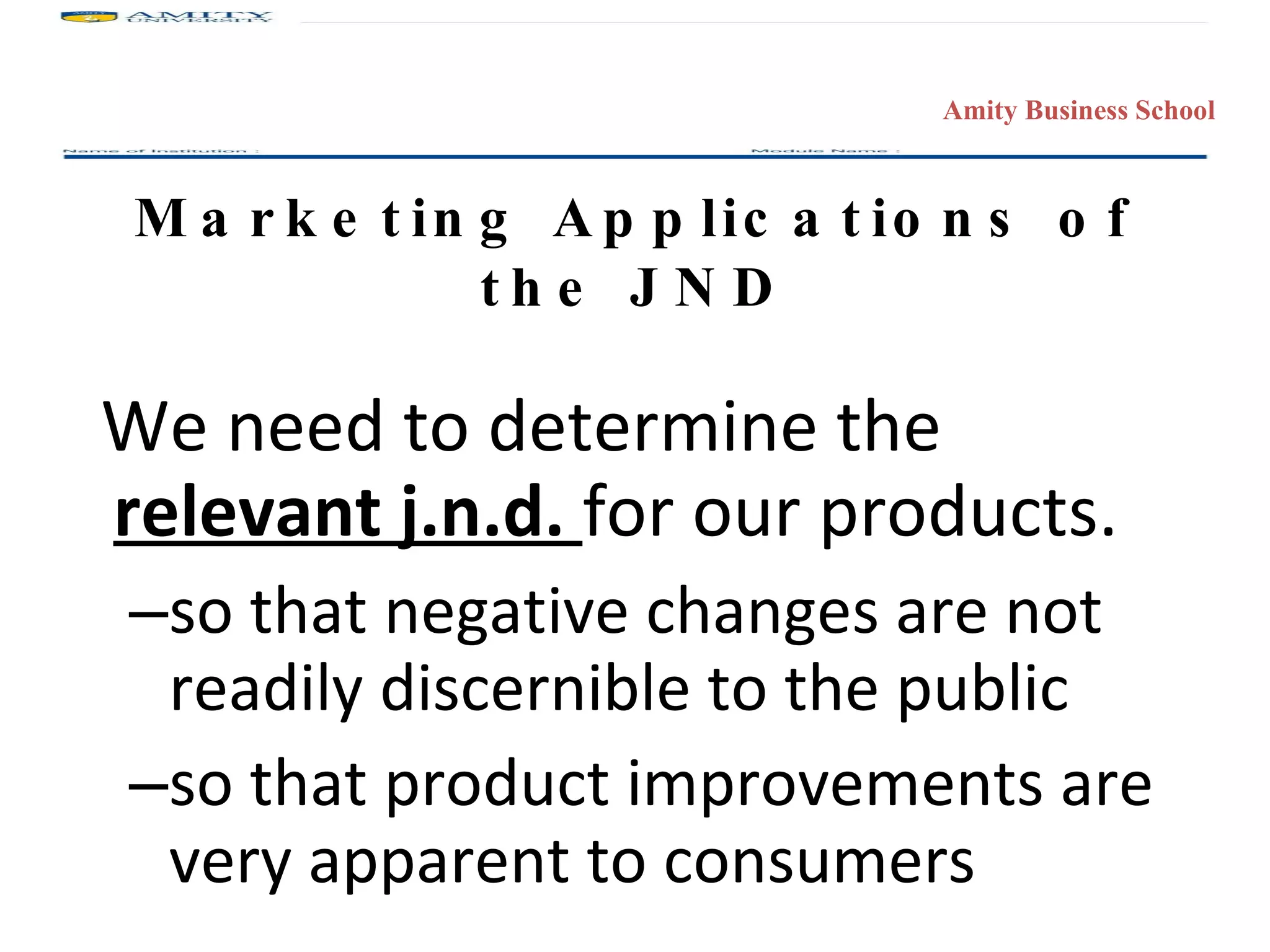
Marketing Applications of the JND We need to determine the  relevant j.n.d.  for our products. so that negative changes are not readily discernible to the public so that product improvements are very apparent to consumers
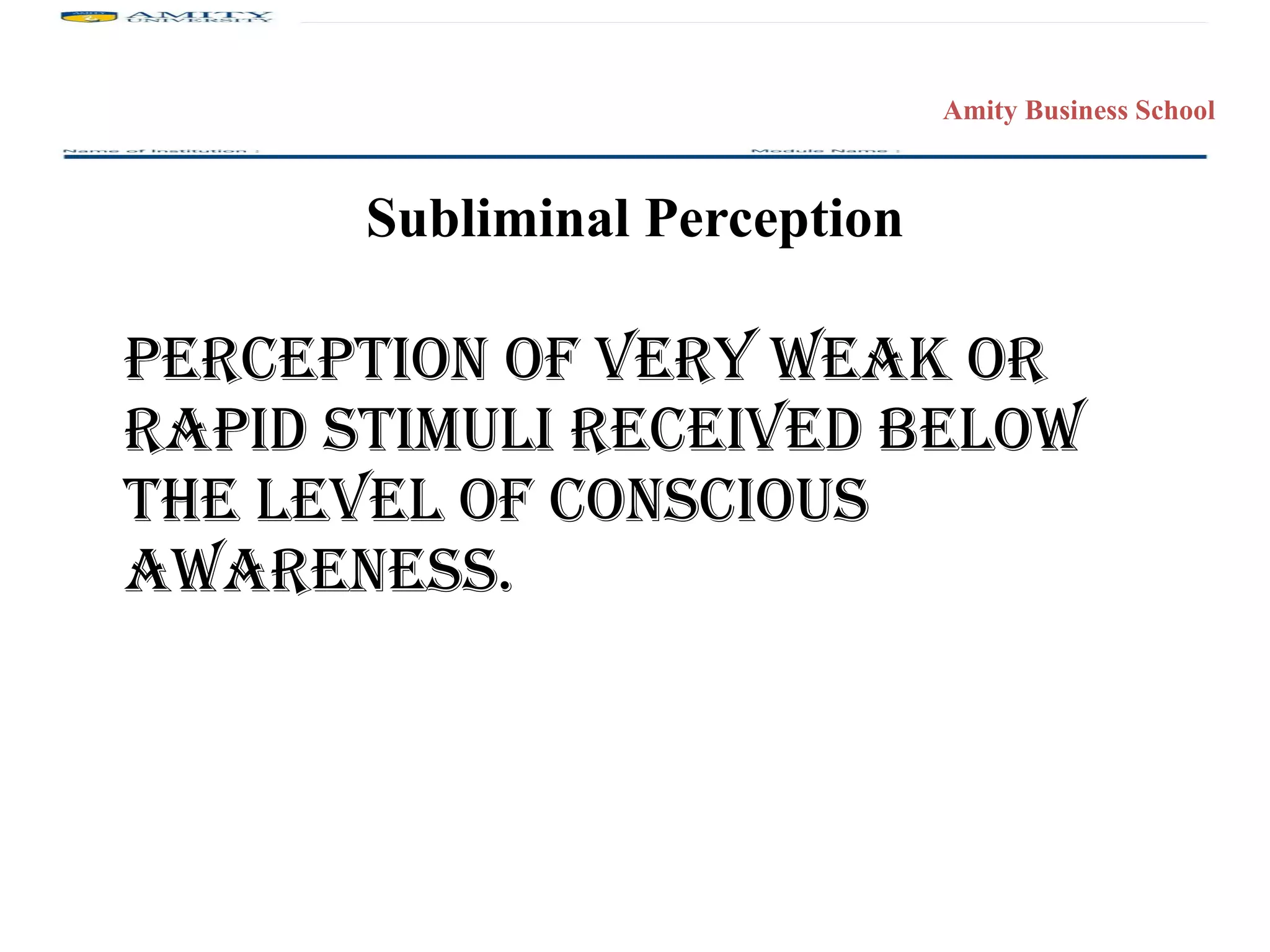
Subliminal Perception Perception of very weak or rapid stimuli received below the level of conscious awareness.
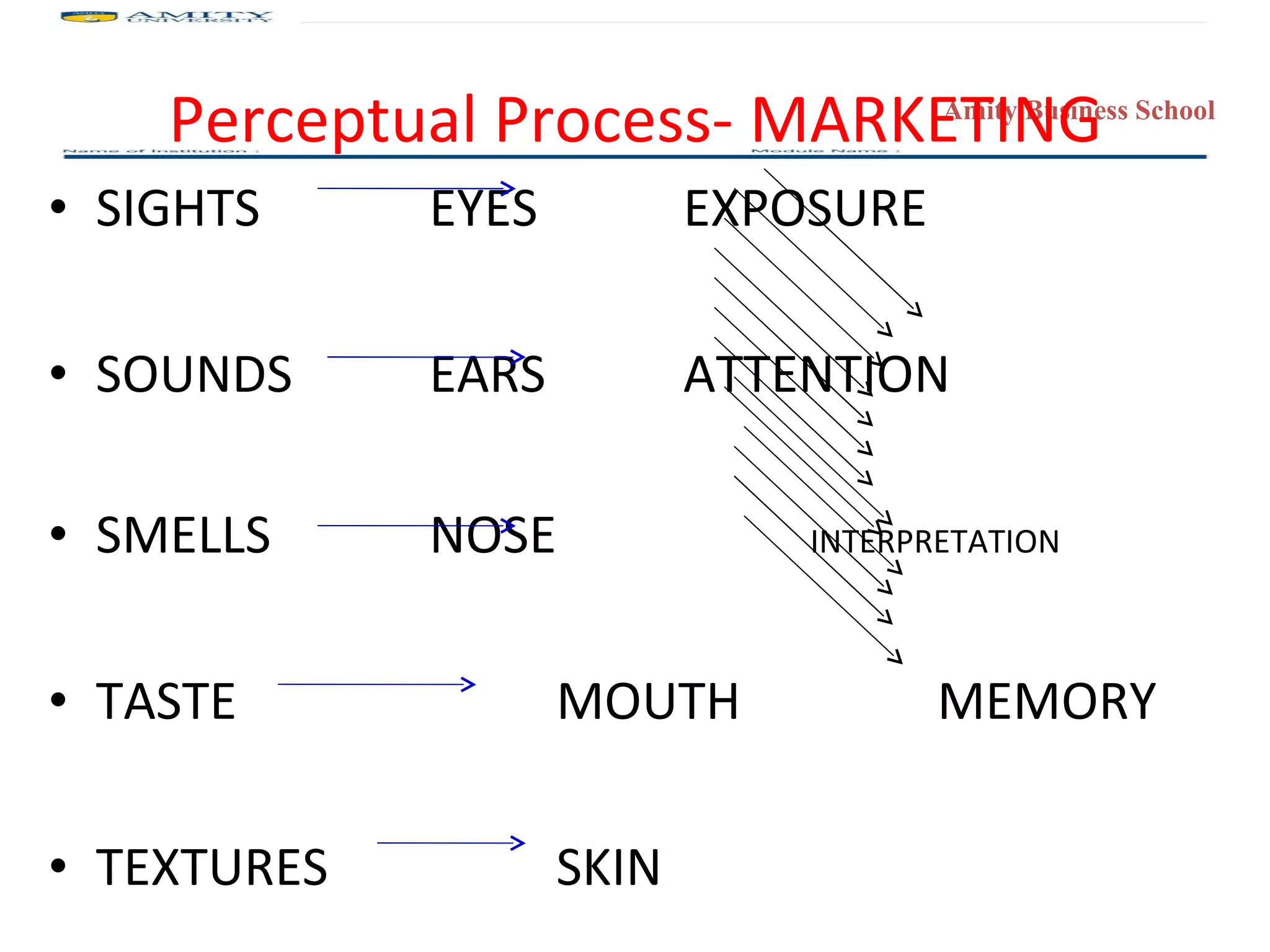
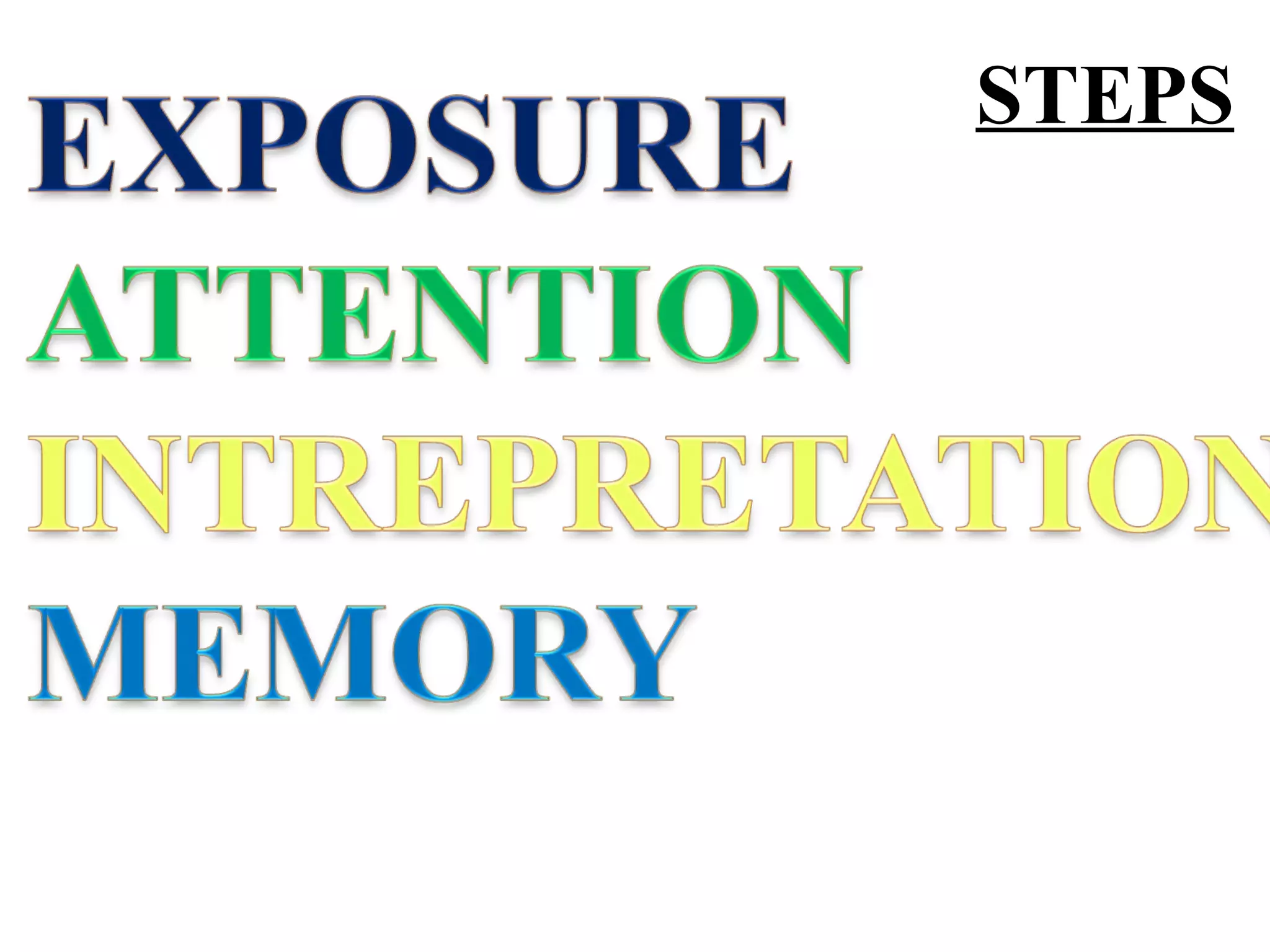
Perceptual Process- MARKETING SIGHTS EYES EXPOSURE SOUNDS EARS ATTENTION SMELLS NOSE INTERPRETATION TASTE MOUTH MEMORY TEXTURES SKIN
EXAMPLES SOFTNESS OF A CASHMERE PULLOVER TASTE OF A NEW FLAVOUR OF ICE-CREAM SMELL OF FRESH ROSES HEARING FAVOURITE SONG SEEING A NEAR & DEAR ONE AFTER YEARS
HEDONIC CONSUMPTION MULTISENSORY, FANTASY AND EMOTIONAL ASPECTS OF CONSUMERS’ INTERACTIONS WITH PRODUCTS Home cleaners with exotic scents – competitive advantage
SENSORY MARKETING
Extra attention to the impact of sensations on product experiences Our senses decide which products appeal us and which stand out
Vision  Colours Design Package Size Style Patterns Trade dress …
VISION
SMELL Odours Invoke memories Relieve stress Store environment Mood Relax Stimulates
TOUCH Tactile stimulation or haptic sense Coca-Cola bottle Massage Winter wind bite Feel & compare textures More sure about what we perceive when we touch Need For Touch (NFT) scales Touch products in a retail store Silk as luxury, denim as practical & durable
TASTE Electronic mouth Artificial saliva Spicy Bitter Sweet Sour Hot Cold
 
STEPS
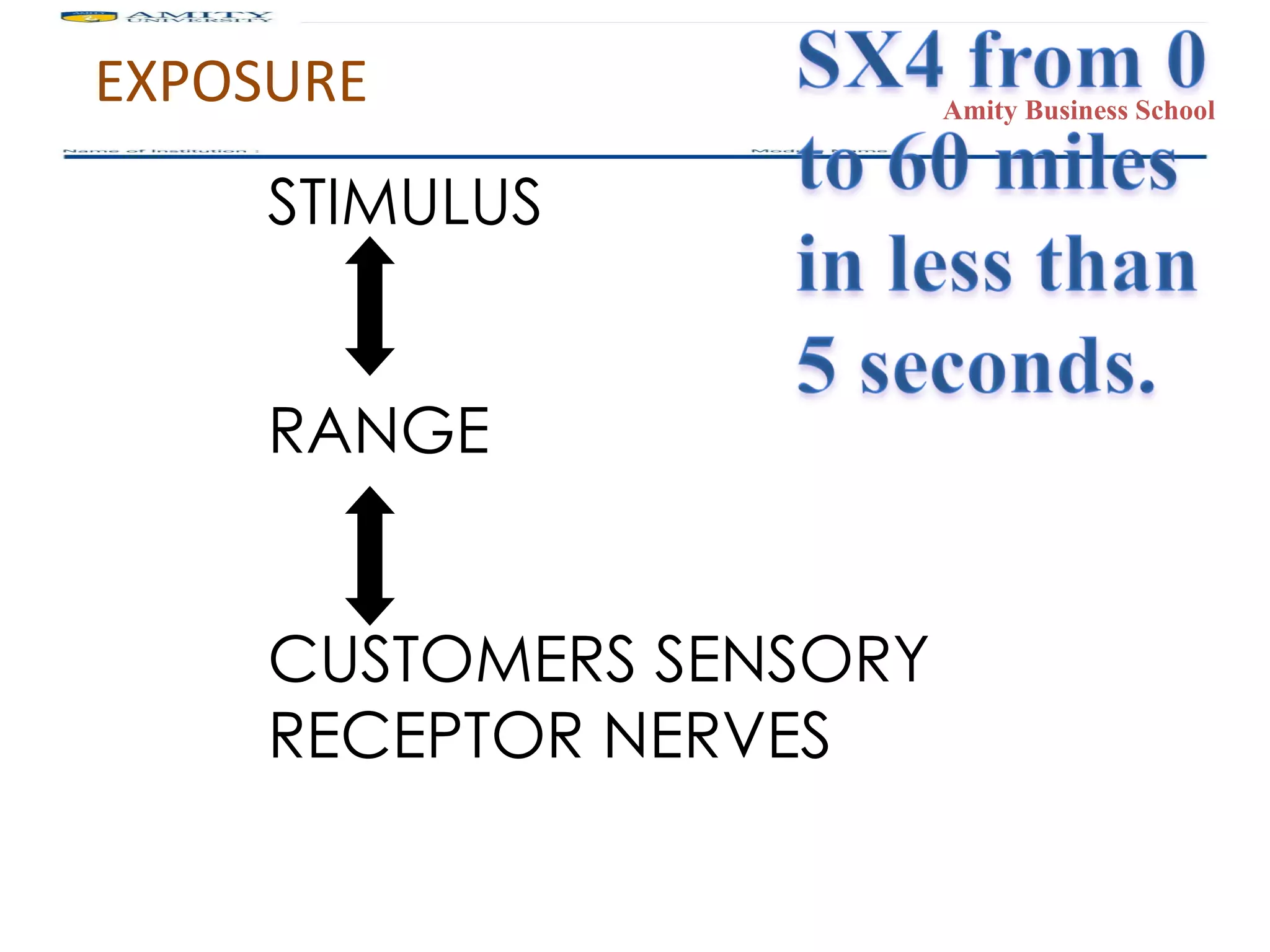
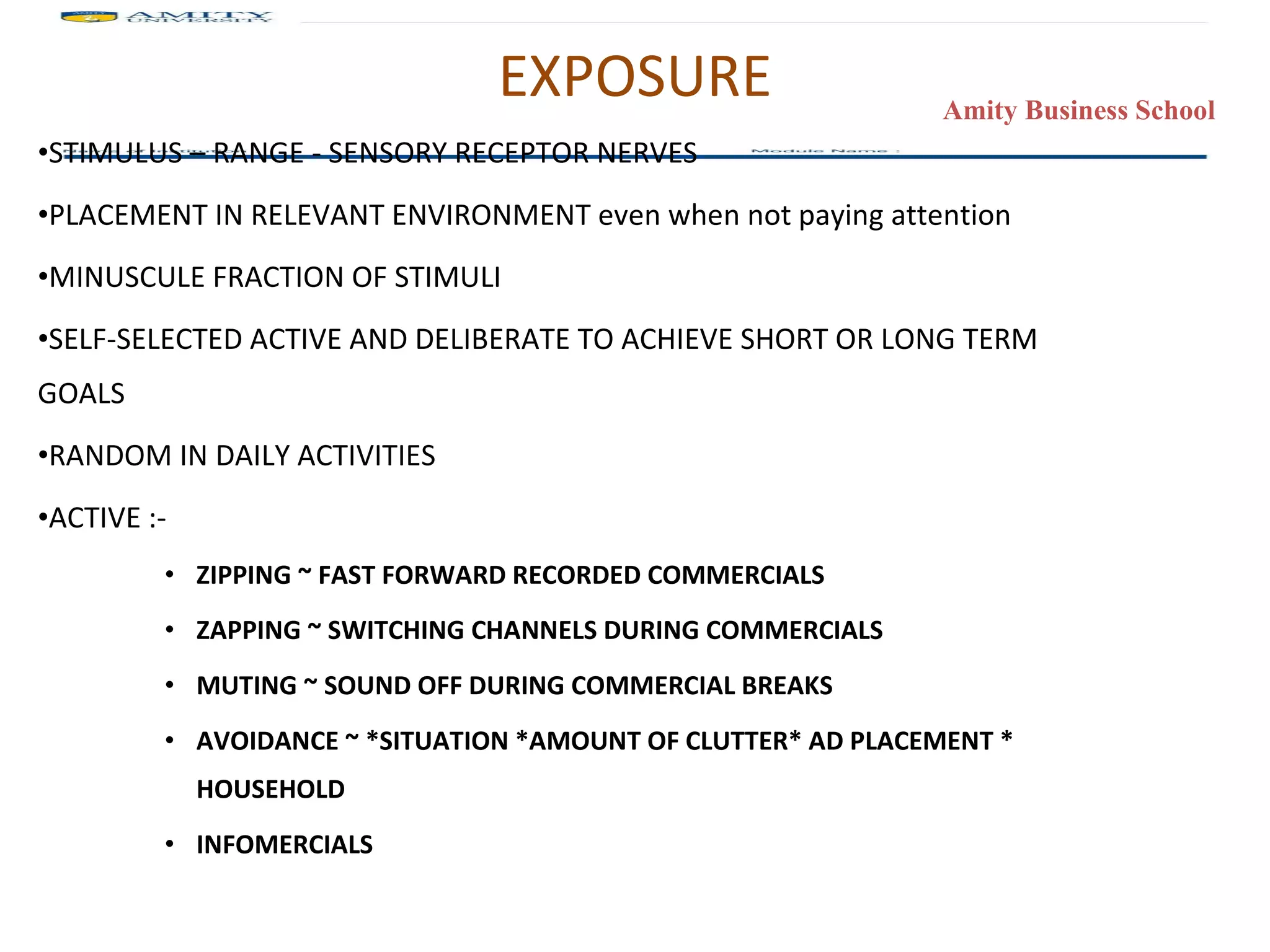
EXPOSURE STIMULUS RANGE  CUSTOMERS SENSORY  RECEPTOR NERVES
EXPOSURE STIMULUS – RANGE - SENSORY RECEPTOR NERVES PLACEMENT IN RELEVANT ENVIRONMENT even when not paying attention MINUSCULE FRACTION OF STIMULI SELF-SELECTED ACTIVE AND DELIBERATE TO ACHIEVE SHORT OR LONG TERM GOALS RANDOM IN DAILY ACTIVITIES ACTIVE :- ZIPPING ~ FAST FORWARD RECORDED COMMERCIALS ZAPPING ~ SWITCHING CHANNELS DURING COMMERCIALS MUTING ~ SOUND OFF DURING COMMERCIAL BREAKS AVOIDANCE ~ *SITUATION *AMOUNT OF CLUTTER* AD PLACEMENT * HOUSEHOLD INFOMERCIALS
 
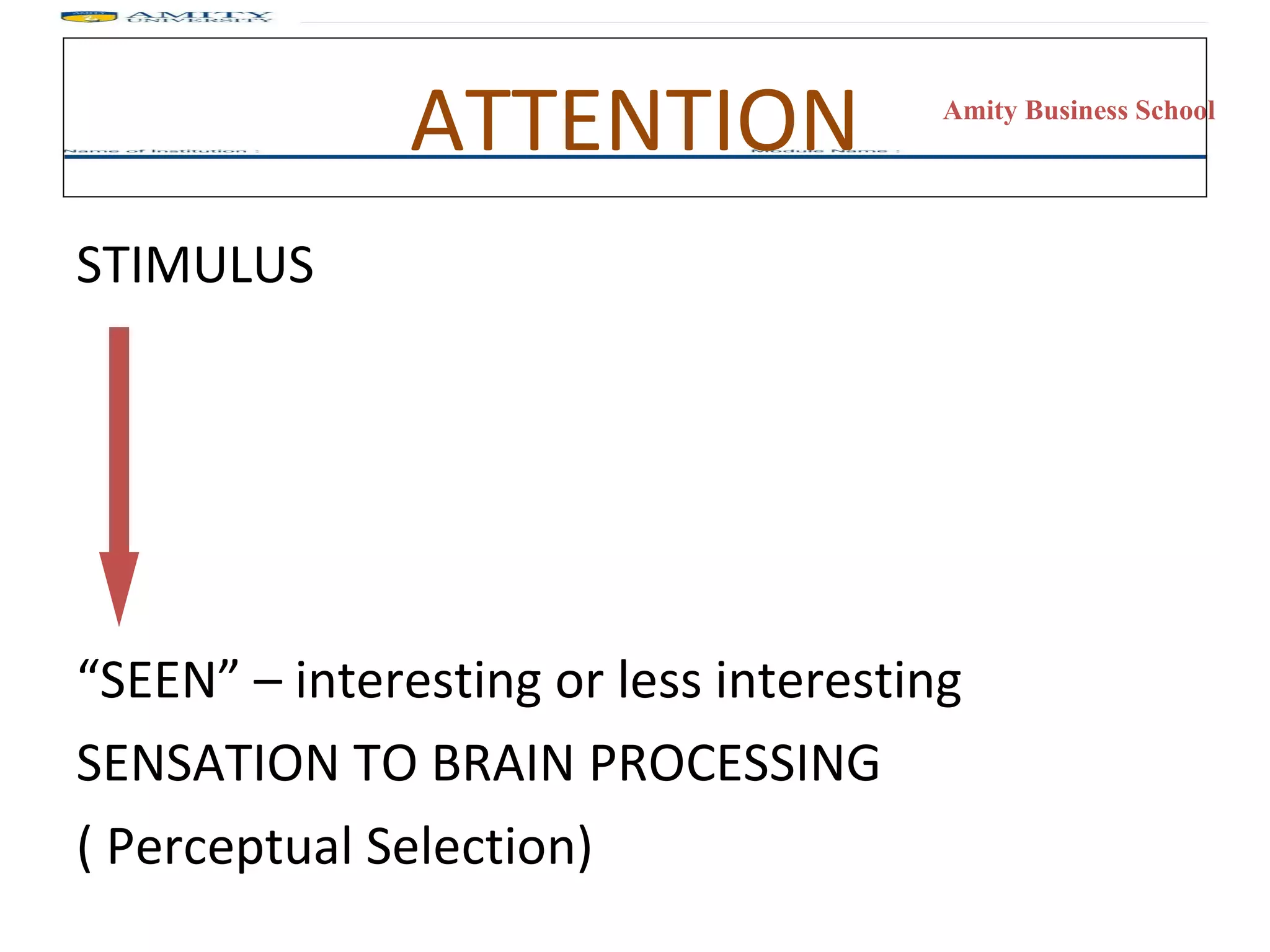
ATTENTION STIMULUS “ SEEN” – interesting or less interesting SENSATION TO BRAIN PROCESSING ( Perceptual Selection)
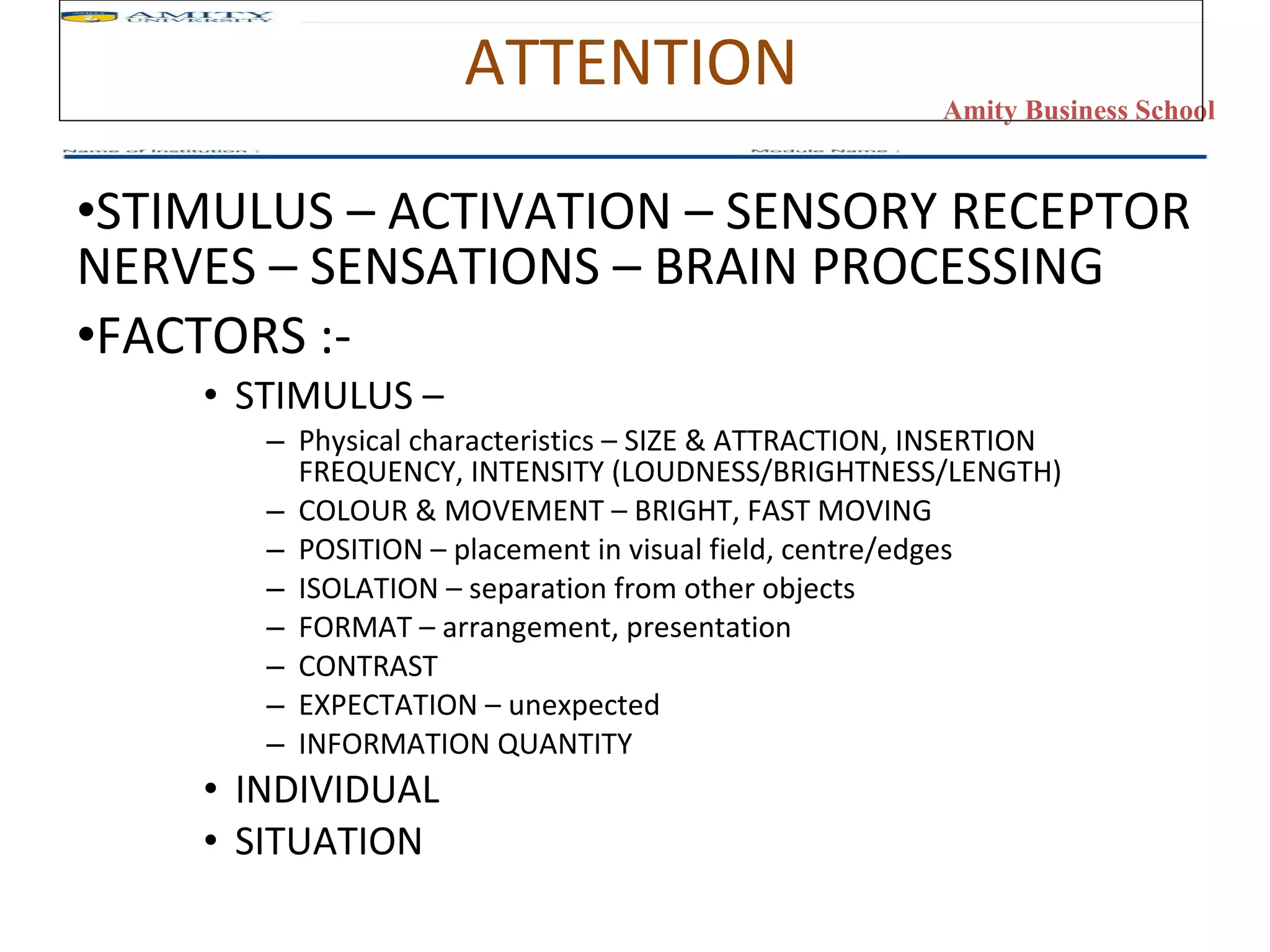
ATTENTION STIMULUS – ACTIVATION – SENSORY RECEPTOR NERVES – SENSATIONS – BRAIN PROCESSING FACTORS :- STIMULUS –  Physical characteristics – SIZE & ATTRACTION, INSERTION FREQUENCY, INTENSITY (LOUDNESS/BRIGHTNESS/LENGTH) COLOUR & MOVEMENT – BRIGHT, FAST MOVING POSITION – placement in visual field, centre/edges ISOLATION – separation from other objects FORMAT – arrangement, presentation CONTRAST EXPECTATION – unexpected INFORMATION QUANTITY INDIVIDUAL SITUATION
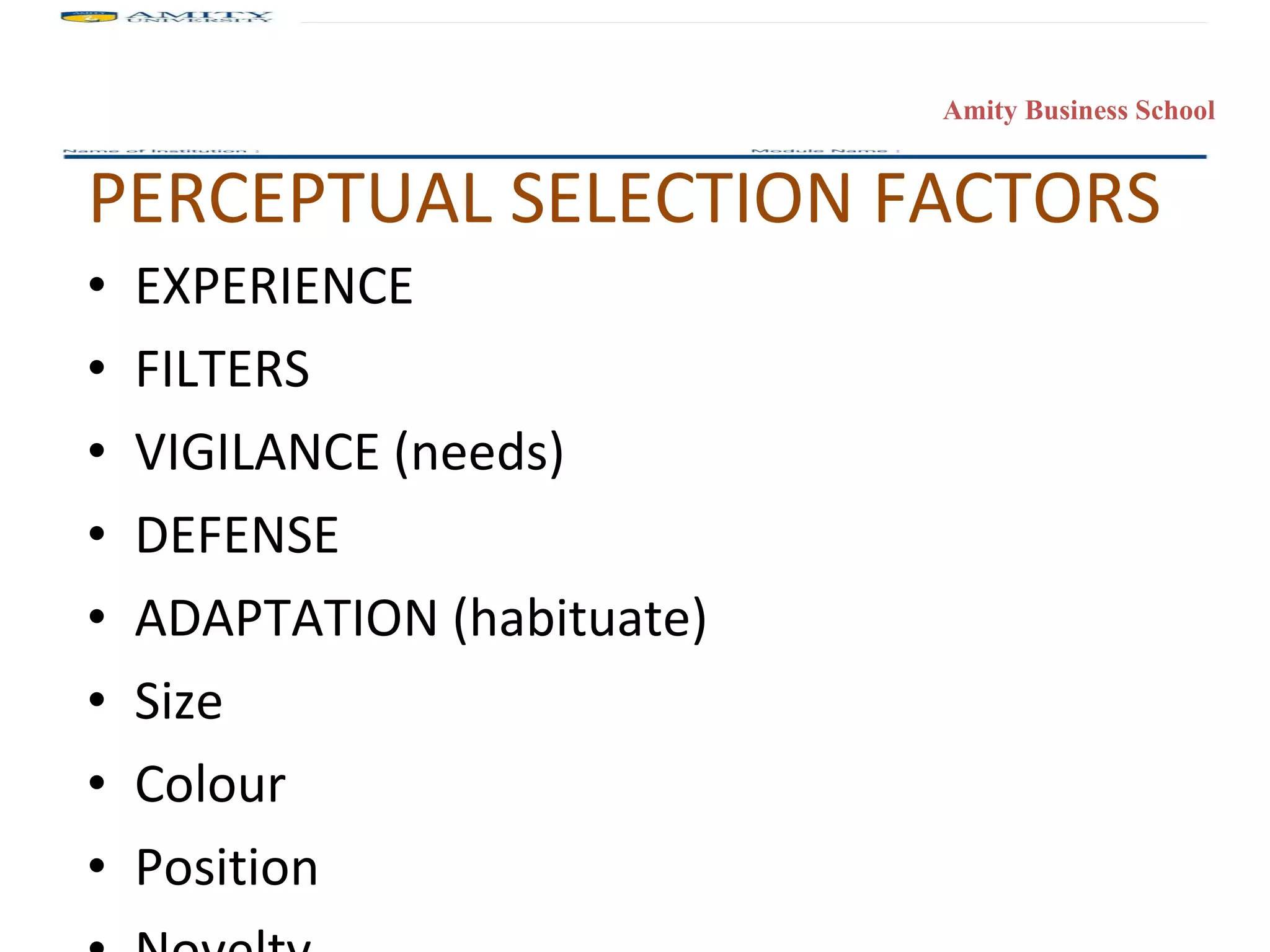
PERCEPTUAL SELECTION FACTORS EXPERIENCE FILTERS VIGILANCE (needs) DEFENSE ADAPTATION (habituate) Size Colour Position Novelty
 
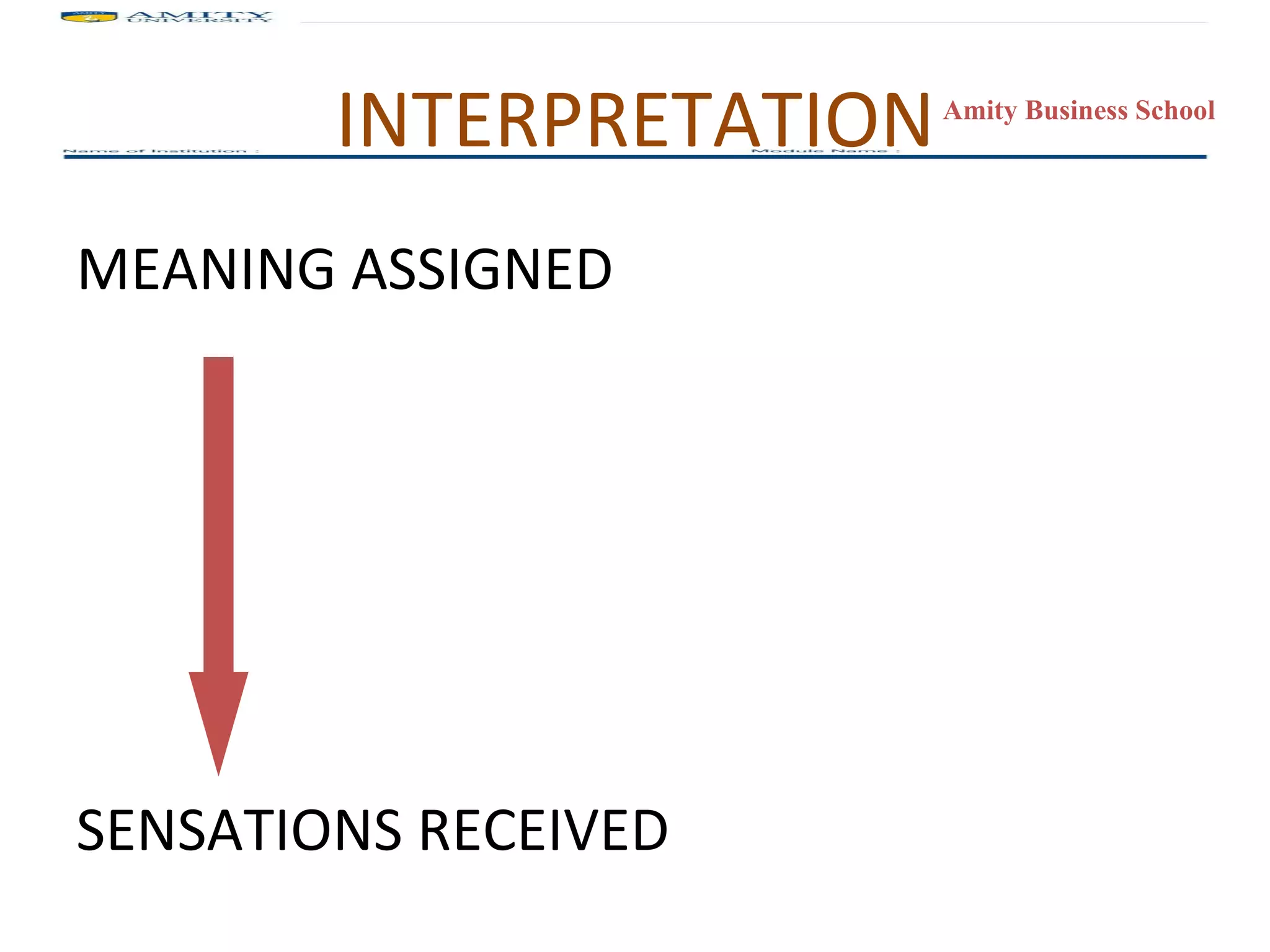
INTERPRETATION MEANING ASSIGNED SENSATIONS RECEIVED
MEMORY SHORT-TERM USE MEANING IMMEDIATE DECISION MAKING LONGER RETENTION
INTERPRETATION AND MEMORY MEANING ASSIGNED TO SENSATIONS FUNCTION OF STIMULUS/INDIVIDUAL/SITUATION eg.sale COGNITIVE INTERPRETATION – STIMULI PLACED IN EXISTING MEANING AFFECTIVE INTERPRETATION – STIMULI TRIGGERS EMOTIONS/ FEELINGS INDIVIDUAL CHARACTERISTICS – LEARNING AND EXPECTATIONS SITUATIONAL CHARACTERISTICS – mood, time, temperatuire, message, distractions, news STIMULUS CHARACTERISTICS – package, colour, message, music, product placement  Similar Stimulus discrimination JND- minimum brand difference but noticed (candy, tissue roll, water glass – high imagery stimulus)  CONSUMER INFERENCES – value assigned missing attribute CONTEXTUAL PRIMING EFFECTS-positive or negative programming SEMANTIC PSYCHOLOGICAL
 
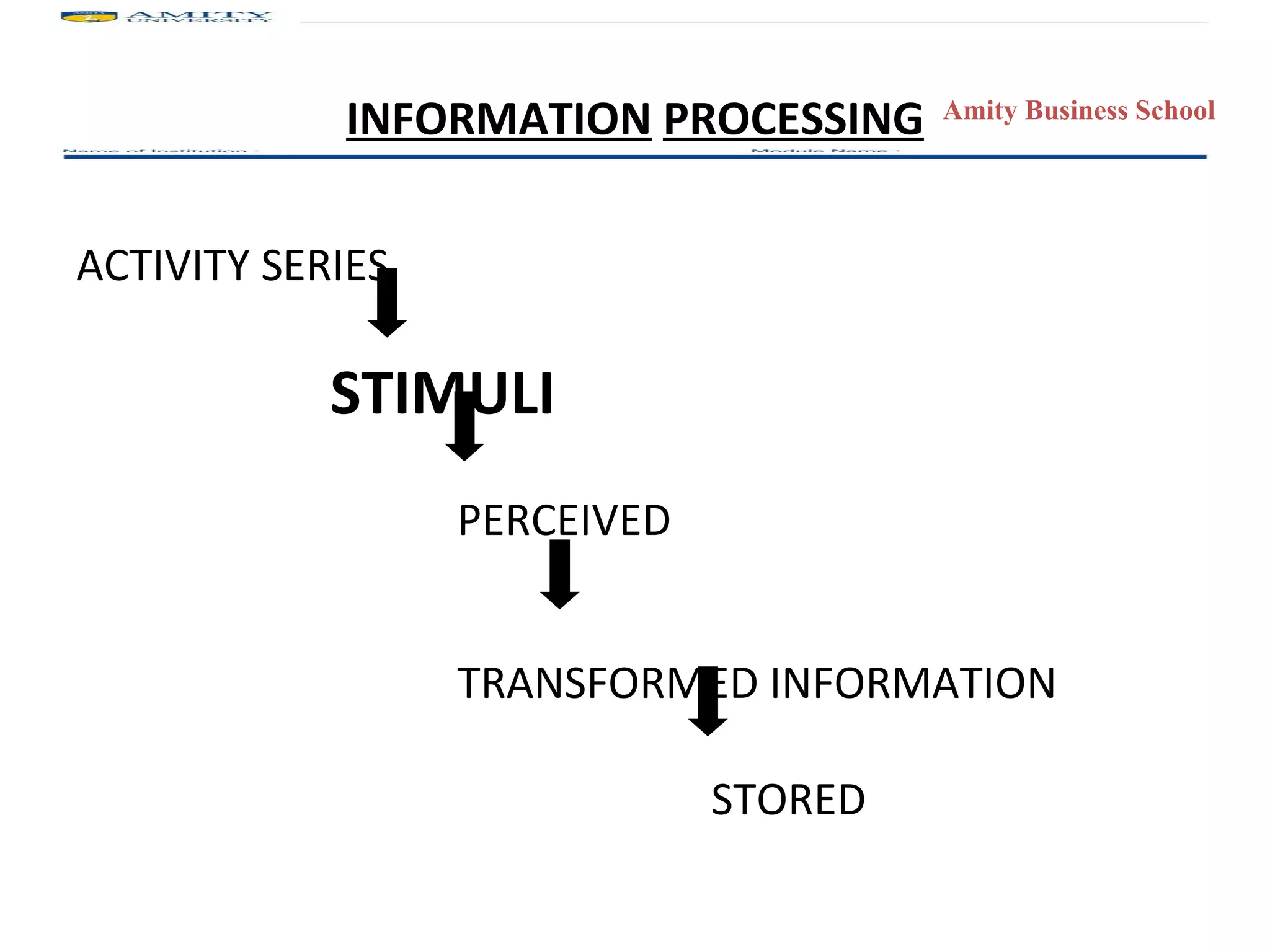
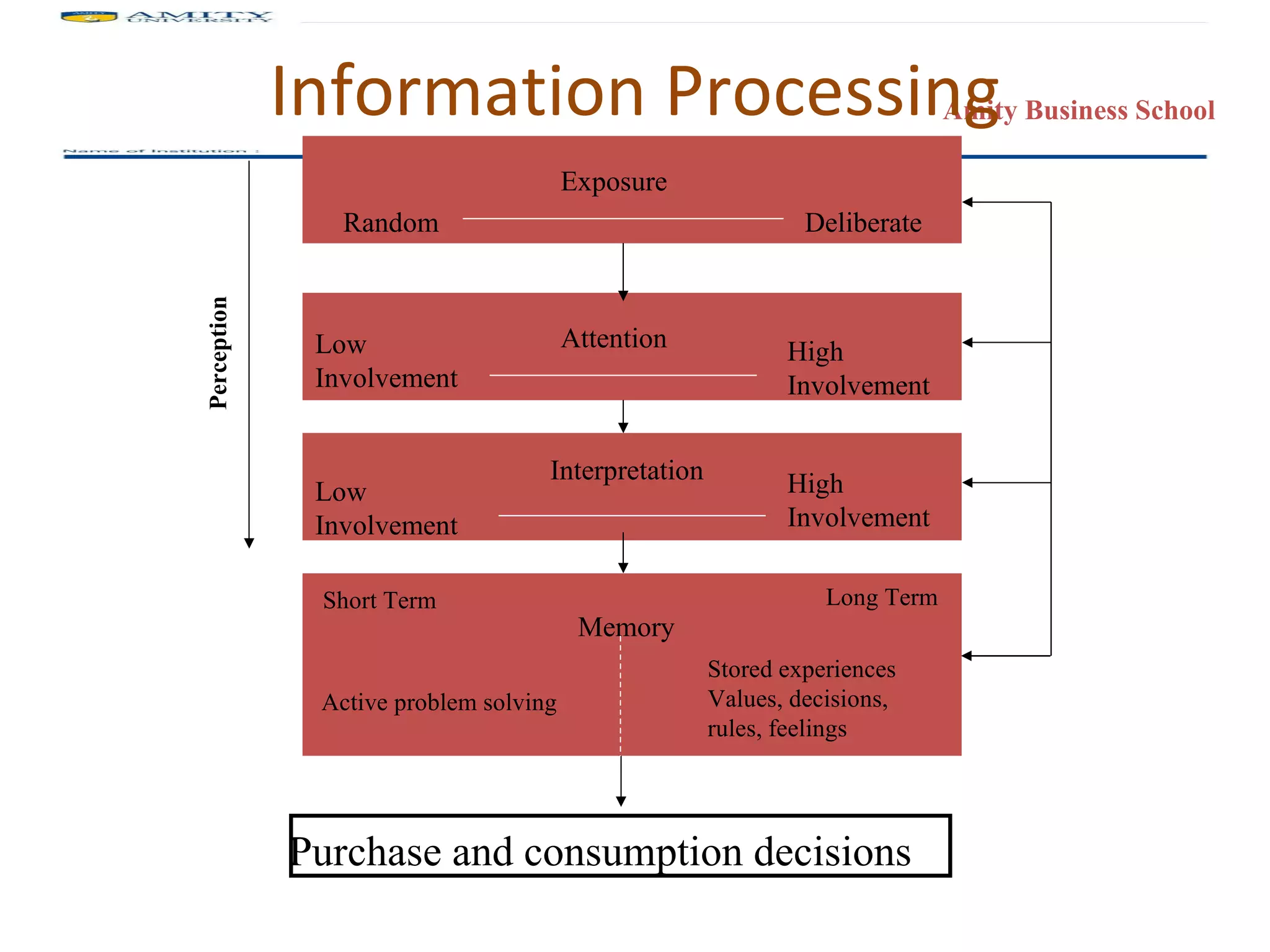
INFORMATION   PROCESSING ACTIVITY SERIES STIMULI PERCEIVED TRANSFORMED INFORMATION STORED
Information Processing Exposure Random Deliberate Attention Low Involvement High Involvement Interpretation Memory Active problem solving Stored experiences Values, decisions, rules, feelings High Involvement Low Involvement Short Term Long Term Perception Purchase and consumption decisions
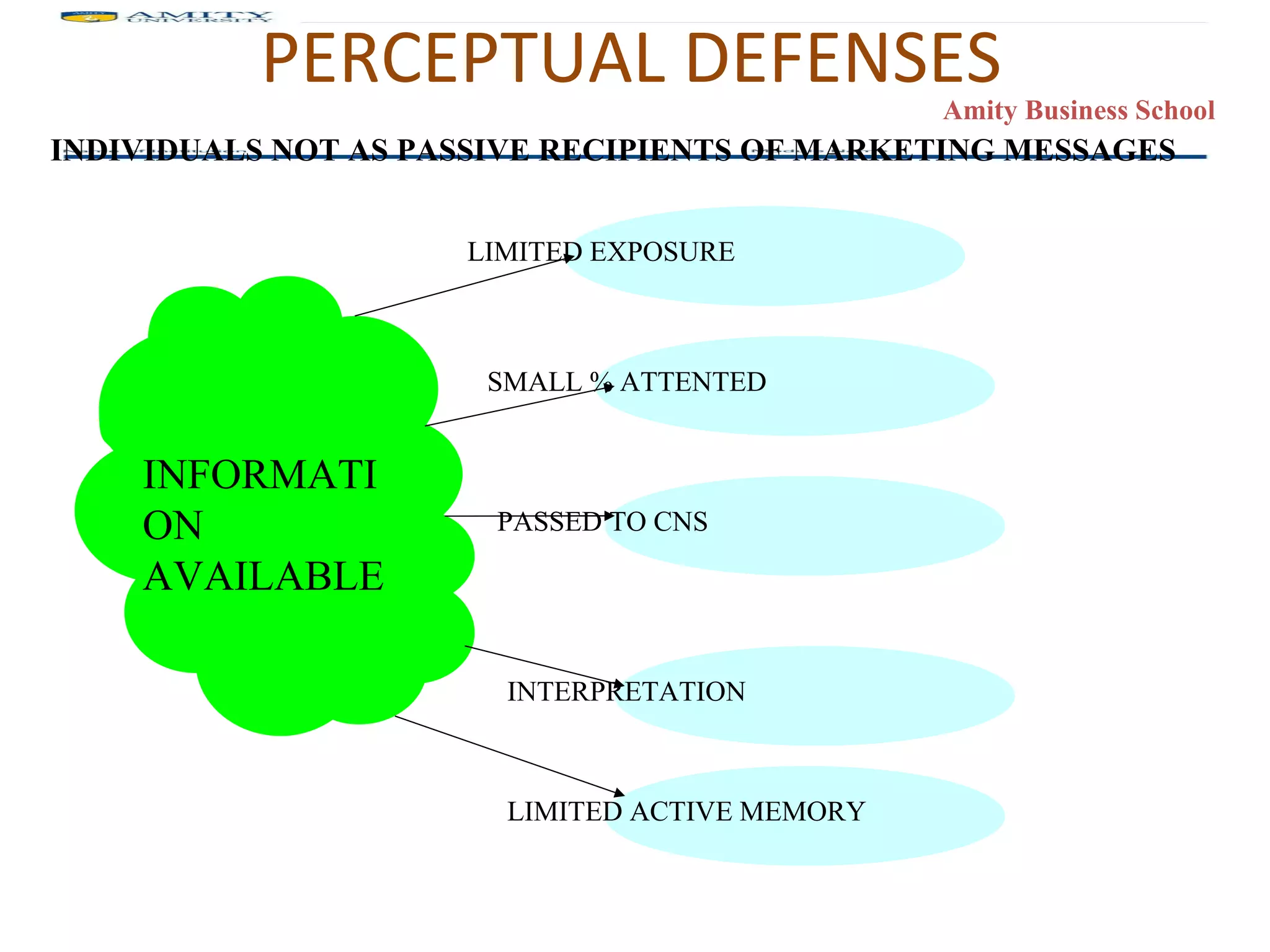
PERCEPTUAL DEFENSES INFORMATION AVAILABLE LIMITED EXPOSURE SMALL % ATTENTED PASSED TO CNS INTERPRETATION LIMITED ACTIVE MEMORY INDIVIDUALS NOT AS PASSIVE RECIPIENTS OF MARKETING MESSAGES
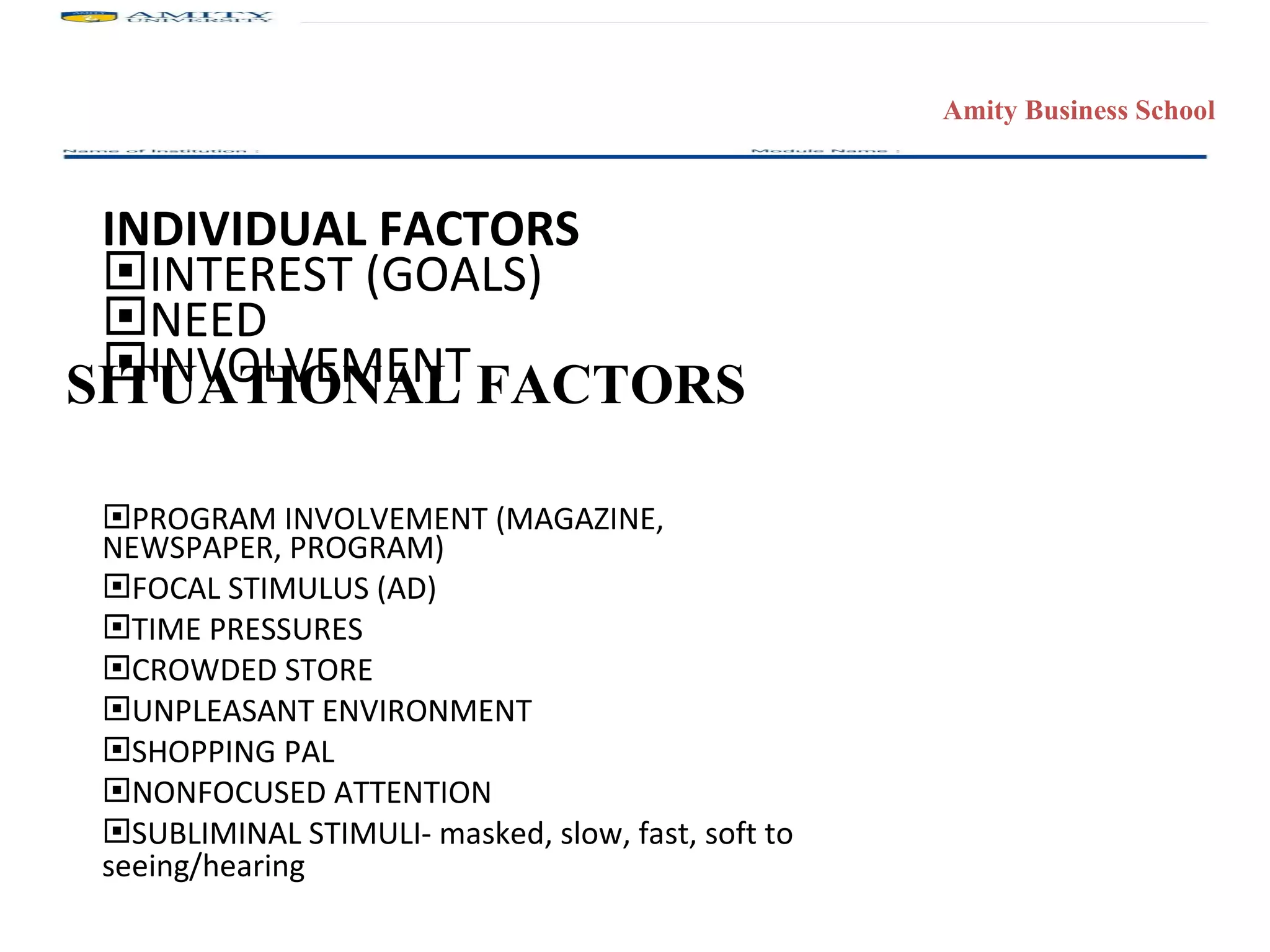
INDIVIDUAL FACTORS INTEREST (GOALS) NEED INVOLVEMENT PROGRAM INVOLVEMENT (MAGAZINE,  NEWSPAPER, PROGRAM) FOCAL STIMULUS (AD) TIME PRESSURES CROWDED STORE UNPLEASANT ENVIRONMENT SHOPPING PAL NONFOCUSED ATTENTION SUBLIMINAL STIMULI- masked, slow, fast, soft to seeing/hearing SITUATIONAL FACTORS
 
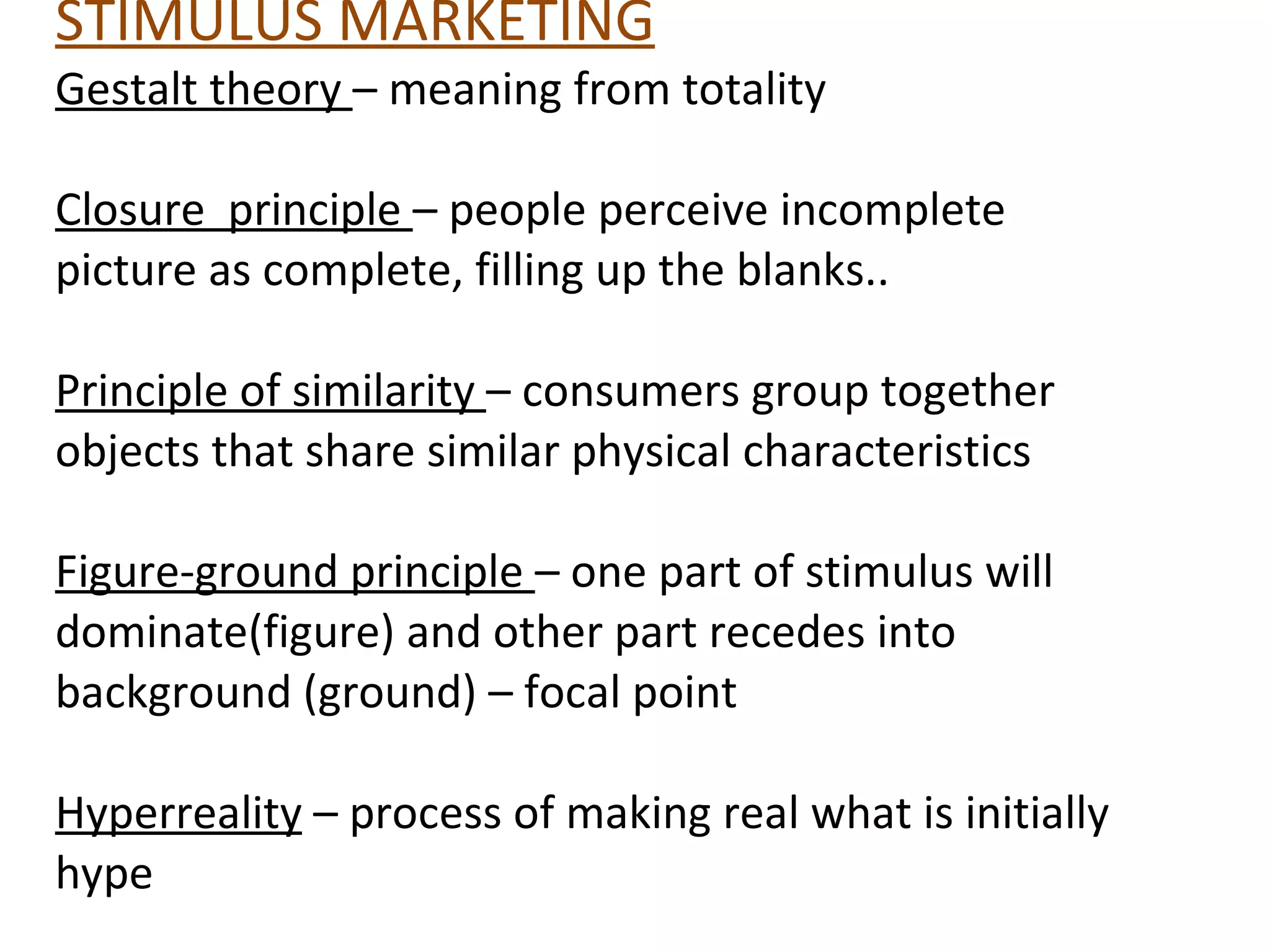
STIMULUS MARKETING Gestalt theory  – meaning from totality Closure  principle  – people perceive incomplete picture as complete, filling up the blanks.. Principle of similarity  – consumers group together objects that share similar physical characteristics Figure-ground principle  – one part of stimulus will dominate(figure) and other part recedes into background (ground) – focal point Hyperreality  – process of making real what is initially hype
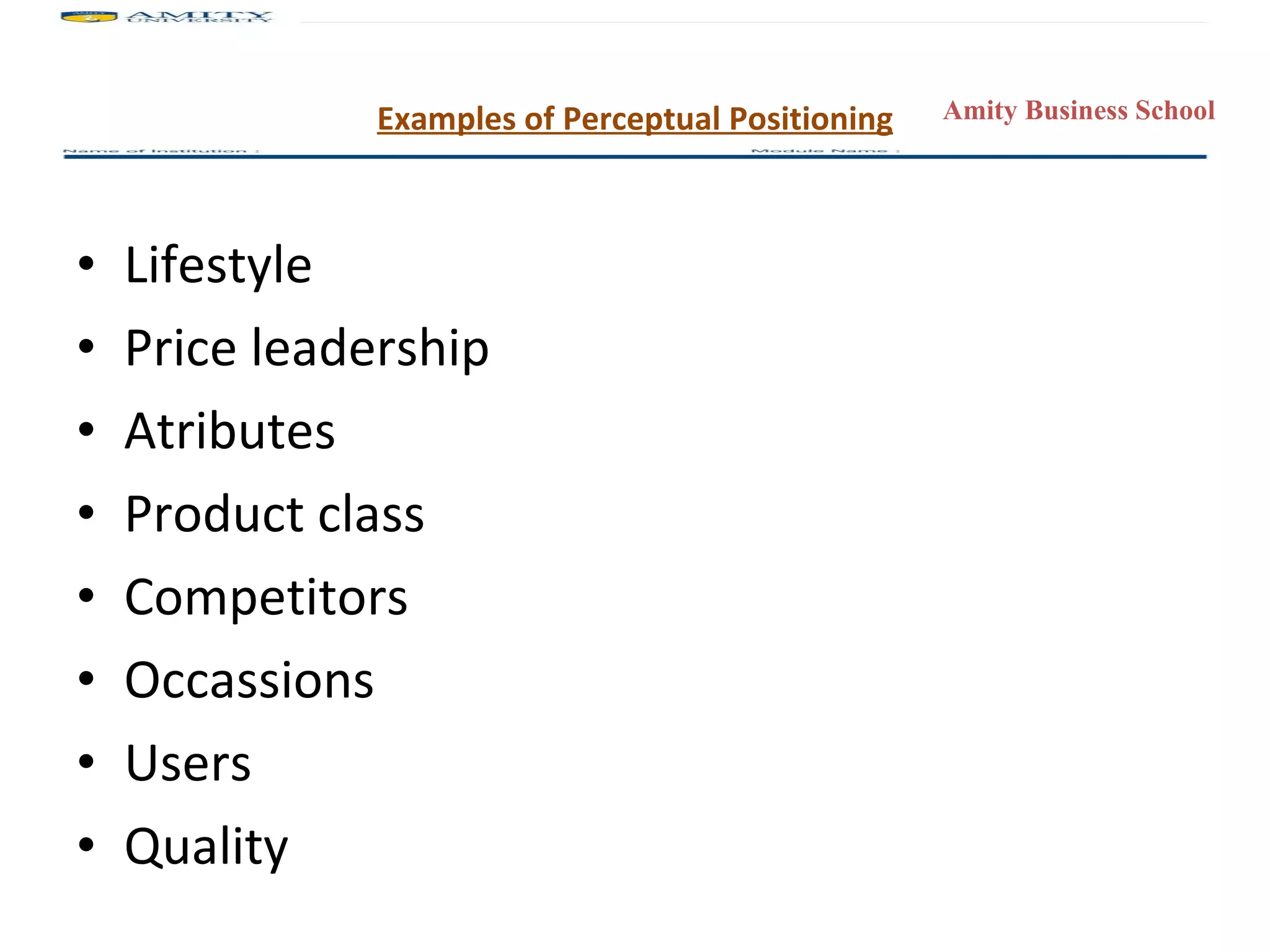
Examples of Perceptual Positioning Lifestyle Price leadership Atributes Product class Competitors Occassions Users Quality
 
Perceptual Selection Depends on two major factors Consumers’ previous experience  Expectation Consumers’ motives
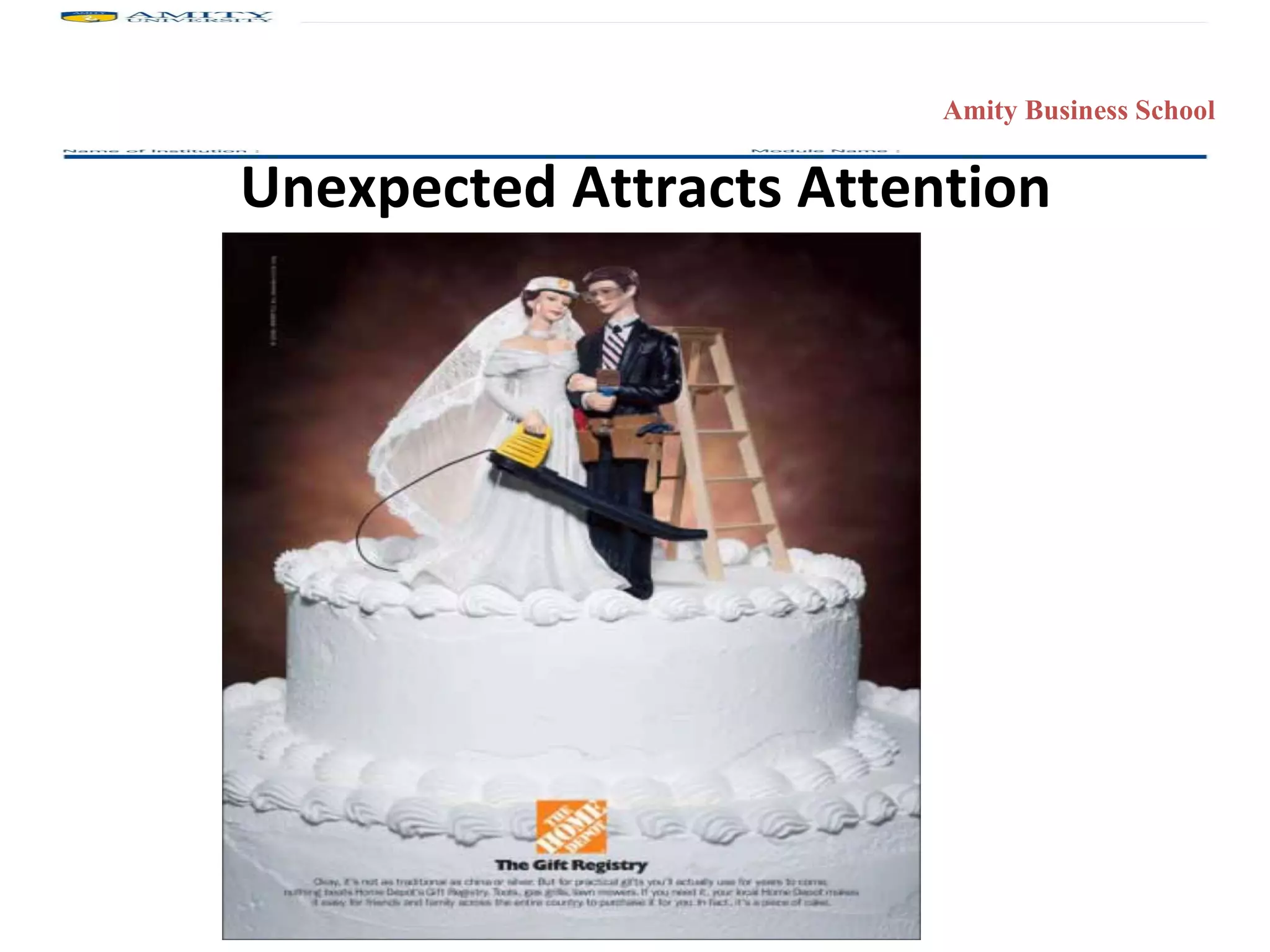
Unexpected Attracts Attention
Biases in perceptual process Gestalt  Psychology Selective Exposure Selective Attention Perceptual Defense Perceptual Blocking
Perceptual Organization Figure and ground Grouping - easy to remember when we associate  Closure
INTERPRETATION- Influences of Perceptual Distortion Physical Appearances Stereotypes e.g Benetton adds First Impressions Jumping to Conclusions Halo Effect
Conclusion People tend to add to or subtract fm the stimuli to which they are exposed on the basis of their Expectations and motives.
Consumer Imagery Product Positioning and Repositioning Positioning of Services Perceived Price Perceived Quality Retail Store Image Manufacturers Image Perceived Risk
Perceptual Mapping A research technique that enables marketers to plot graphically consumers’ perceptions concerning product attributes of specific brands. Pricing Strategies Focused on Perceived Value Satisfaction-based Pricing Relationship Pricing Efficiency Pricing 20% to 70% Off! Was $199 Now $99 Sale!
Evaluations least favorable for ads stating the minimum discount level Ads stating maximum discount levels are better than stating a range  Save 10% or more Save upto 50%
ASSIGNMENT

Mba Gen Slides Without Examples4 Amizone

  • 1.
  • 2.
    PERCEPTION How wesee the world in and around us
  • 3.
    Perception Consumer asPerceiver The objective reality of the product matters a little and what matters is the consumers perception about the product/ brand The process by which an individual selects, organizes, and interprets stimuli into a meaningful and coherent picture of the world is called Perception. Amity Business School
  • 4.
    THE MESSAGES TOWHICH WE DO CHOOSE TO PAY ATTENTION OFTEN WIND UP DIFFERING FROM WHAT THE SPONSORS INTENDED, AS WE EACH PUT OUR PERSONAL SPIN ON THINGS BY ADOPTING MEANINGS CONSISTENT WITH OUR OWN UNIQUE EXPERIENCES, BIASES AND DESIRES. ADVERTISING ANGLE TO PERCEPTION OF CONSUMERS
  • 5.
    Factor Shaping Perception is SENSATION SENSATION - The immediate and direct response of our sensory receptors to basic stimuli. A perfectly unchanging environment provides little to no sensation at all. PERCEPTION - Process by which people select, organize and interpret these sensations. Focus is on what we ADD to these raw sensations in order to give them meaning Cont….
  • 6.
    Decreased Sensory inputs Increased Sensory inputs Absolute threshold Differential threshold Subliminal perception
  • 7.
    Absolute Threshold Lowestintensity of a stimulus that can be registered on a sensory channel Minimum stimulation that can be detected on a given sensory channel Whispering Small print characters
  • 8.
    Differential Threshold Abilityof a sensory system to detect changes or differences between two stimuli Minimum difference we can detect between two stimuli is the J.N.D.
  • 9.
    It concerns the perceived differentiation between similar stimuli of varying intensities (the stronger the initial stimulus, the greater the additional intensity needed for the second stimulus to be perceived as different). Weber’s Law
  • 10.
    Marketing Applications ofthe JND We need to determine the relevant j.n.d. for our products. so that negative changes are not readily discernible to the public so that product improvements are very apparent to consumers
  • 11.
    Subliminal Perception Perceptionof very weak or rapid stimuli received below the level of conscious awareness.
  • 12.
    Perceptual Process- MARKETINGSIGHTS EYES EXPOSURE SOUNDS EARS ATTENTION SMELLS NOSE INTERPRETATION TASTE MOUTH MEMORY TEXTURES SKIN
  • 13.
    EXAMPLES SOFTNESS OFA CASHMERE PULLOVER TASTE OF A NEW FLAVOUR OF ICE-CREAM SMELL OF FRESH ROSES HEARING FAVOURITE SONG SEEING A NEAR & DEAR ONE AFTER YEARS
  • 14.
    HEDONIC CONSUMPTION MULTISENSORY,FANTASY AND EMOTIONAL ASPECTS OF CONSUMERS’ INTERACTIONS WITH PRODUCTS Home cleaners with exotic scents – competitive advantage
  • 15.
  • 16.
    Extra attention tothe impact of sensations on product experiences Our senses decide which products appeal us and which stand out
  • 17.
    Vision ColoursDesign Package Size Style Patterns Trade dress …
  • 18.
  • 19.
    SMELL Odours Invokememories Relieve stress Store environment Mood Relax Stimulates
  • 20.
    TOUCH Tactile stimulationor haptic sense Coca-Cola bottle Massage Winter wind bite Feel & compare textures More sure about what we perceive when we touch Need For Touch (NFT) scales Touch products in a retail store Silk as luxury, denim as practical & durable
  • 21.
    TASTE Electronic mouthArtificial saliva Spicy Bitter Sweet Sour Hot Cold
  • 22.
  • 23.
  • 24.
    EXPOSURE STIMULUS RANGE CUSTOMERS SENSORY RECEPTOR NERVES
  • 25.
    EXPOSURE STIMULUS –RANGE - SENSORY RECEPTOR NERVES PLACEMENT IN RELEVANT ENVIRONMENT even when not paying attention MINUSCULE FRACTION OF STIMULI SELF-SELECTED ACTIVE AND DELIBERATE TO ACHIEVE SHORT OR LONG TERM GOALS RANDOM IN DAILY ACTIVITIES ACTIVE :- ZIPPING ~ FAST FORWARD RECORDED COMMERCIALS ZAPPING ~ SWITCHING CHANNELS DURING COMMERCIALS MUTING ~ SOUND OFF DURING COMMERCIAL BREAKS AVOIDANCE ~ *SITUATION *AMOUNT OF CLUTTER* AD PLACEMENT * HOUSEHOLD INFOMERCIALS
  • 26.
  • 27.
    ATTENTION STIMULUS “SEEN” – interesting or less interesting SENSATION TO BRAIN PROCESSING ( Perceptual Selection)
  • 28.
    ATTENTION STIMULUS –ACTIVATION – SENSORY RECEPTOR NERVES – SENSATIONS – BRAIN PROCESSING FACTORS :- STIMULUS – Physical characteristics – SIZE & ATTRACTION, INSERTION FREQUENCY, INTENSITY (LOUDNESS/BRIGHTNESS/LENGTH) COLOUR & MOVEMENT – BRIGHT, FAST MOVING POSITION – placement in visual field, centre/edges ISOLATION – separation from other objects FORMAT – arrangement, presentation CONTRAST EXPECTATION – unexpected INFORMATION QUANTITY INDIVIDUAL SITUATION
  • 29.
    PERCEPTUAL SELECTION FACTORSEXPERIENCE FILTERS VIGILANCE (needs) DEFENSE ADAPTATION (habituate) Size Colour Position Novelty
  • 30.
  • 31.
  • 32.
    MEMORY SHORT-TERM USEMEANING IMMEDIATE DECISION MAKING LONGER RETENTION
  • 33.
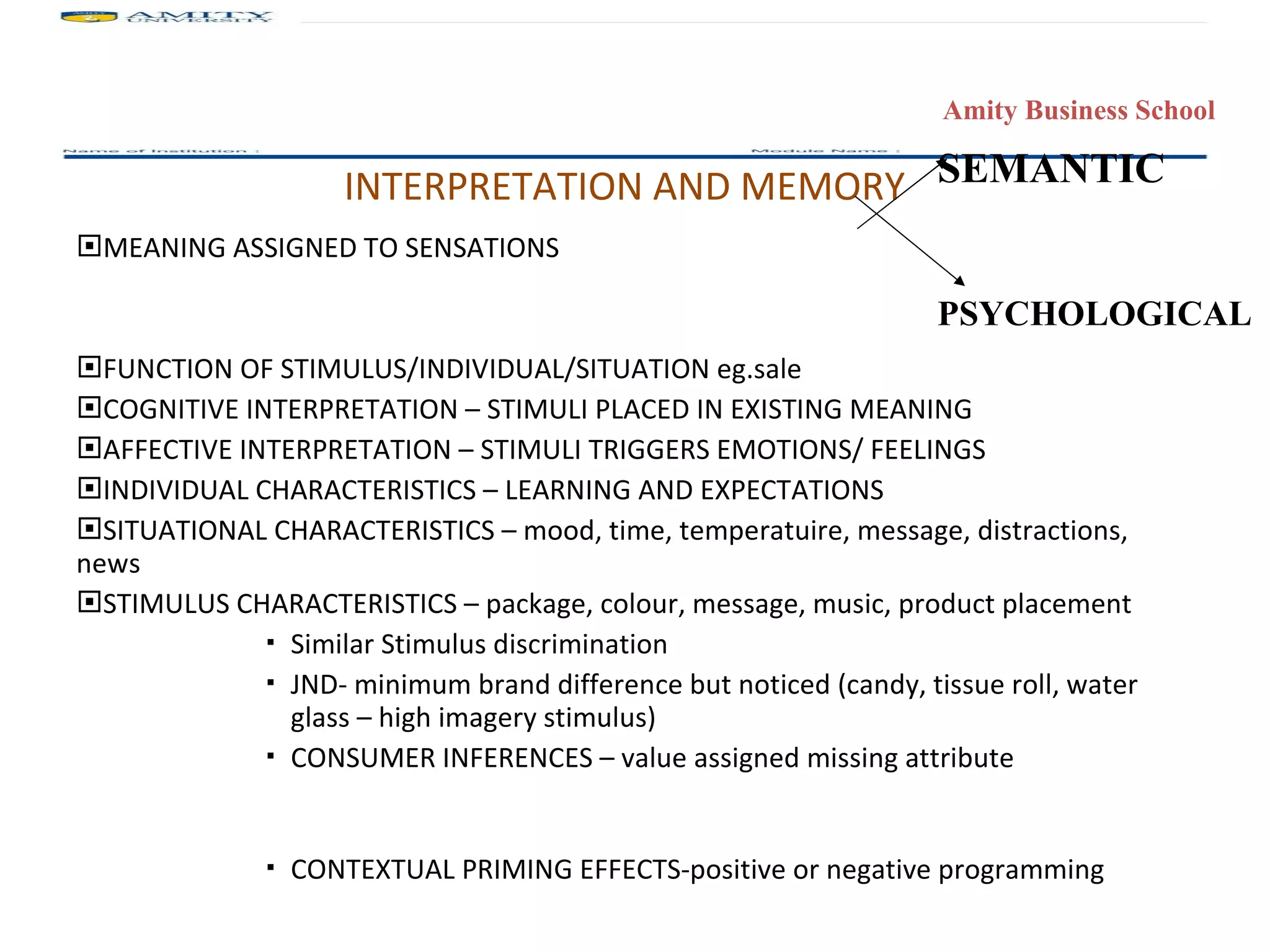
    INTERPRETATION AND MEMORYMEANING ASSIGNED TO SENSATIONS FUNCTION OF STIMULUS/INDIVIDUAL/SITUATION eg.sale COGNITIVE INTERPRETATION – STIMULI PLACED IN EXISTING MEANING AFFECTIVE INTERPRETATION – STIMULI TRIGGERS EMOTIONS/ FEELINGS INDIVIDUAL CHARACTERISTICS – LEARNING AND EXPECTATIONS SITUATIONAL CHARACTERISTICS – mood, time, temperatuire, message, distractions, news STIMULUS CHARACTERISTICS – package, colour, message, music, product placement Similar Stimulus discrimination JND- minimum brand difference but noticed (candy, tissue roll, water glass – high imagery stimulus) CONSUMER INFERENCES – value assigned missing attribute CONTEXTUAL PRIMING EFFECTS-positive or negative programming SEMANTIC PSYCHOLOGICAL
  • 34.
  • 35.
    INFORMATION PROCESSING ACTIVITY SERIES STIMULI PERCEIVED TRANSFORMED INFORMATION STORED
  • 36.
    Information Processing ExposureRandom Deliberate Attention Low Involvement High Involvement Interpretation Memory Active problem solving Stored experiences Values, decisions, rules, feelings High Involvement Low Involvement Short Term Long Term Perception Purchase and consumption decisions
  • 37.
    PERCEPTUAL DEFENSES INFORMATIONAVAILABLE LIMITED EXPOSURE SMALL % ATTENTED PASSED TO CNS INTERPRETATION LIMITED ACTIVE MEMORY INDIVIDUALS NOT AS PASSIVE RECIPIENTS OF MARKETING MESSAGES
  • 38.
    INDIVIDUAL FACTORS INTEREST(GOALS) NEED INVOLVEMENT PROGRAM INVOLVEMENT (MAGAZINE, NEWSPAPER, PROGRAM) FOCAL STIMULUS (AD) TIME PRESSURES CROWDED STORE UNPLEASANT ENVIRONMENT SHOPPING PAL NONFOCUSED ATTENTION SUBLIMINAL STIMULI- masked, slow, fast, soft to seeing/hearing SITUATIONAL FACTORS
  • 39.
  • 40.
    STIMULUS MARKETING Gestalttheory – meaning from totality Closure principle – people perceive incomplete picture as complete, filling up the blanks.. Principle of similarity – consumers group together objects that share similar physical characteristics Figure-ground principle – one part of stimulus will dominate(figure) and other part recedes into background (ground) – focal point Hyperreality – process of making real what is initially hype
  • 41.
    Examples of PerceptualPositioning Lifestyle Price leadership Atributes Product class Competitors Occassions Users Quality
  • 42.
  • 43.
    Perceptual Selection Dependson two major factors Consumers’ previous experience Expectation Consumers’ motives
  • 44.
  • 45.
    Biases in perceptualprocess Gestalt Psychology Selective Exposure Selective Attention Perceptual Defense Perceptual Blocking
  • 46.
    Perceptual Organization Figureand ground Grouping - easy to remember when we associate Closure
  • 47.
    INTERPRETATION- Influences ofPerceptual Distortion Physical Appearances Stereotypes e.g Benetton adds First Impressions Jumping to Conclusions Halo Effect
  • 48.
    Conclusion People tendto add to or subtract fm the stimuli to which they are exposed on the basis of their Expectations and motives.
  • 49.
    Consumer Imagery ProductPositioning and Repositioning Positioning of Services Perceived Price Perceived Quality Retail Store Image Manufacturers Image Perceived Risk
  • 50.
    Perceptual Mapping Aresearch technique that enables marketers to plot graphically consumers’ perceptions concerning product attributes of specific brands. Pricing Strategies Focused on Perceived Value Satisfaction-based Pricing Relationship Pricing Efficiency Pricing 20% to 70% Off! Was $199 Now $99 Sale!
  • 51.
    Evaluations least favorablefor ads stating the minimum discount level Ads stating maximum discount levels are better than stating a range Save 10% or more Save upto 50%
  • 52.

Editor's Notes

  • #44 People see what they want to see. Horror movie Stimuli which conflict sharply attract attention. Stronger the need greater the motivation.
  • #47 Formulas and point. Circle or Arch The moment we hear familiar music we try to complete it. Messages require to fill in is to increase the participation of the consumer.
  • #48 Models are percieved as having more knowledge regarding enhancing pdts. But not regarding problem sloving pdts.Acne, dandriff.