CHAPTER FOUR
1
Learning Objectives
1. To Understand the Types of Human Needs
and Motives and the Meaning of Goals.
2. To Understand the Dynamics of Motivation,
Arousal of Needs, Setting of Goals, and
Interrelationship Between Needs and Goals.
3. To Learn About Several Systems of Needs
Developed by Researchers.
4. To Understand How Human Motives Are
Studied and Measured.
Copyright 2010 Pearson Education, Inc. publishing as Prentice Hall
2Chapter Four
Slide
Motivation as a Psychological
Force
• Motivation is the
driving force within
individuals that impels
them to action.
• Needs are the essence
of the marketing
concept. Marketers do
not create needs but can
make consumers aware
of needs.
Copyright 2010 Pearson Education, Inc. publishing as Prentice Hall
3Chapter Four
Slide
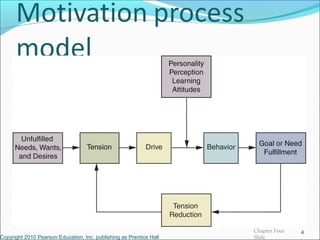
Copyright 2010 Pearson Education, Inc. publishing as Prentice Hall
4Chapter Four
Slide
Types of Needs
Innate Needs
Physiological (or biogenic) needs that are considered
primary needs or motives
Acquired Needs
Learned in response to our culture or environment. Are
generally psychological and considered secondary needs
Copyright 2010 Pearson Education, Inc. publishing as Prentice Hall
5Chapter Four
Slide
Goals
The sought-after results of motivated behavior
Generic goals are general categories of goals that
consumers see as a way to fulfill their needs
Product-specific goals are specifically branded
products or services that consumers select as their
goals
Copyright 2010 Pearson Education, Inc. publishing as Prentice Hall
6Chapter Four
Slide
The Selection of Goals
The goals selected by an individual depend on their:
Personal experiences
Physical capacity
Prevailing cultural norms and values
Goal’s accessibility in the physical and social
environment
Copyright 2010 Pearson Education, Inc. publishing as Prentice Hall
7Chapter Four
Slide
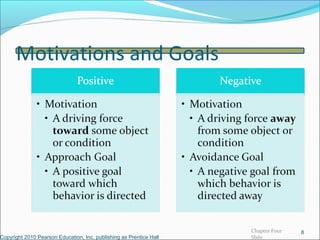
Motivations and Goals
Copyright 2010 Pearson Education, Inc. publishing as Prentice Hall
8Chapter Four
Slide
Rational versus Emotional Motives
Rationality implies that consumers select goals
based on totally objective criteria, such as size, weight,
price, or miles per gallon
Emotional motives imply the selection of goals
according to personal or subjective criteria
Copyright 2010 Pearson Education, Inc. publishing as Prentice Hall
9Chapter Four
Slide
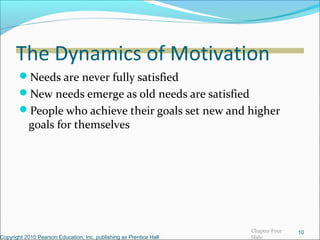
The Dynamics of Motivation
Needs are never fully satisfied
New needs emerge as old needs are satisfied
People who achieve their goals set new and higher
goals for themselves
Copyright 2010 Pearson Education, Inc. publishing as Prentice Hall
10Chapter Four
Slide
Substitute Goals
Are used when a consumer cannot attain a specific
goal he/she anticipates will satisfy a need
The substitute goal will dispel tension
Substitute goals may actually replace the primary goal
over time
Copyright 2010 Pearson Education, Inc. publishing as Prentice Hall
11Chapter Four
Slide
Frustration
Failure to achieve a goal may result in frustration.
Some adapt; others adopt defense mechanisms to
protect their ego.
Copyright 2010 Pearson Education, Inc. publishing as Prentice Hall
12Chapter Four
Slide
Arousal of Motives
Physiological arousal
Emotional arousal
Cognitive arousal
Environmental arousal
Copyright 2010 Pearson Education, Inc. publishing as Prentice Hall
13Chapter Four
Slide
Philosophies Concerned with
Arousal of Motives
Behaviorist School
Behavior is response to stimulus
Elements of conscious thoughts are to be ignored
Consumer does not act, but reacts
Cognitive School
Behavior is directed at goal achievement
Needs and past experiences are reasoned, categorized,
and transformed into attitudes and beliefs
Copyright 2010 Pearson Education, Inc. publishing as Prentice Hall
14Chapter Four
Slide
Types and Systems of Needs
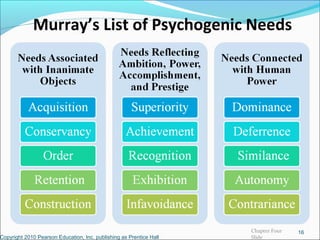
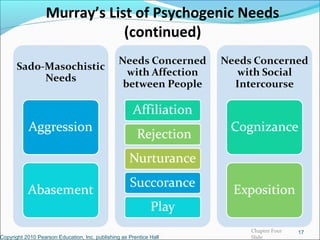
Henry Murray’s 28 psychogenic needs
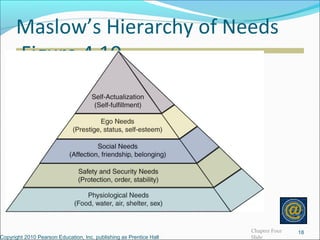
Abraham Maslow’s hierarchy of needs
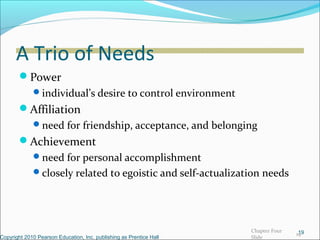
A trio of needs
Copyright 2010 Pearson Education, Inc. publishing as Prentice Hall
15Chapter Four
Slide
Murray’s List of Psychogenic Needs
Copyright 2010 Pearson Education, Inc. publishing as Prentice Hall
16Chapter Four
Slide
Murray’s List of Psychogenic Needs
(continued)
Copyright 2010 Pearson Education, Inc. publishing as Prentice Hall
17Chapter Four
Slide
Maslow’s Hierarchy of Needs
Figure 4.10
Copyright 2010 Pearson Education, Inc. publishing as Prentice Hall
18Chapter Four
Slide
A Trio of Needs
Power
individual’s desire to control environment
Affiliation
need for friendship, acceptance, and belonging
Achievement
need for personal accomplishment
closely related to egoistic and self-actualization needs
Copyright 2010 Pearson Education, Inc. publishing as Prentice Hall
1919
Chapter Four
Slide
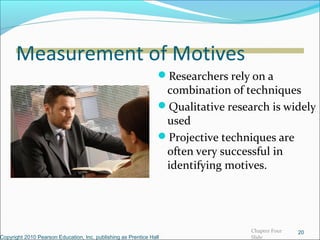
Measurement of Motives
Researchers rely on a
combination of techniques
Qualitative research is widely
used
Projective techniques are
often very successful in
identifying motives.
Copyright 2010 Pearson Education, Inc. publishing as Prentice Hall
20Chapter Four
Slide