Sales Promotions
Sales Promotion “ Sales Promotion  is a Marketing Discipline that Utilizes a Variety of Incentive Techniques to Structure Sales-Related Programs Targeted to Consumers, Trade, and/or Sales Levels that Generate a Specific, Measurable Action or Response for a Product or Service.”
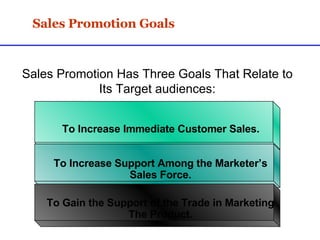
Sales Promotion Goals Sales Promotion Has Three Goals That Relate to Its Target audiences: To Increase Immediate Customer Sales. To Increase Support Among the Marketer’s Sales Force. To Gain the Support of the Trade in Marketing The Product.
 
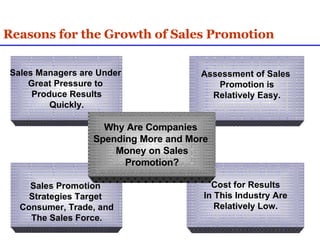
Reasons for the Growth of Sales Promotion Sales Managers are Under  Great Pressure to  Produce Results Quickly. Sales Promotion  Strategies Target  Consumer, Trade, and The Sales Force. Assessment of Sales  Promotion is Relatively Easy. Cost for Results In This Industry Are Relatively Low. Why Are Companies  Spending More and More  Money on Sales Promotion?
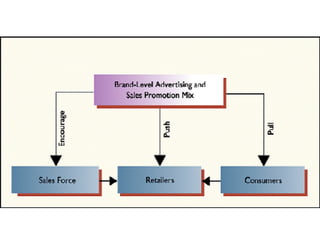
Consumer Promotions Consumer sales promotions  are directed at the ultimate user of the good or service. Intended to “presell” consumers so when people go into a store, they will look for a particular brand. Primary strengths are their variety and flexibility. Many techniques that can be combined to meet almost any kind of sales promotion planner’s objectives.
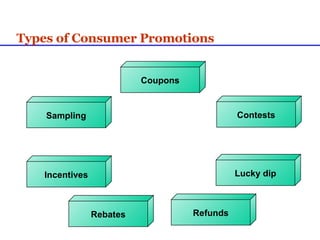
Types of Consumer Promotions Lucky dip Incentives Sampling Contests Rebates Refunds Coupons
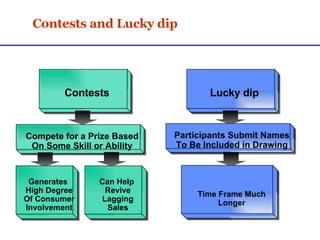
Contests and Lucky dip Lucky dip Participants Submit Names To Be Included in Drawing Time Frame Much Longer Contests Compete for a Prize Based On Some Skill or Ability Generates  High Degree Of Consumer Involvement Can Help  Revive Lagging Sales
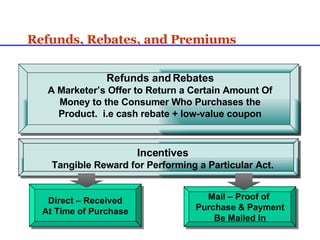
Refunds, Rebates, and Premiums Refunds and Rebates A Marketer’s Offer to Return a Certain Amount Of Money to the Consumer Who Purchases the Product.  i.e cash rebate + low-value coupon Incentives Tangible Reward for Performing a Particular Act. Direct – Received At Time of Purchase Mail – Proof of  Purchase & Payment Be Mailed In
Sampling Allowing the Customer to Experience the  Product or Service. Very Effective Strategy for Introducing  A New or Modified Product. Most Common Method of Distributing Samples is Through the Mail. 9 Out of 10 Customers Prefer a Sample To a Rupee-Off Coupon to Introduce Product.
Trade Promotions Trade advertising  is directed at wholesalers and retailers and represents 50% of the total promotional spending. Four goals of a trade promotion are: Stimulate in-store merchandising or other trade support, Manipulate levels of inventory held by wholesalers and retailers, Expand product distribution to new areas of the country or new classes of trade, Create a high level of excitement about the product among those responsible for its sale.
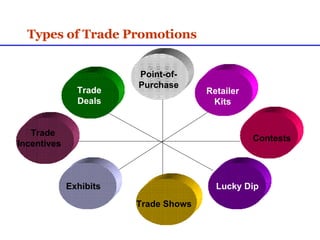
Types of Trade Promotions Point-of-Purchase Retailer Kits Contests Lucky Dip Trade Shows  Exhibits   Trade Incentives  Trade Deals
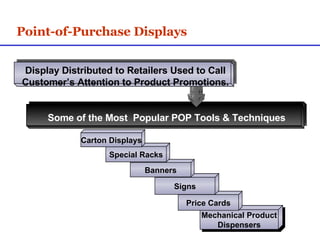
Point-of-Purchase Displays Display Distributed to Retailers Used to Call Customer’s Attention to Product Promotions. Some of the Most  Popular POP Tools & Techniques Mechanical Product Dispensers Price Cards Signs Banners Special Racks Carton Displays
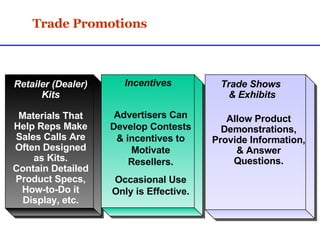
Trade Promotions Trade Shows  & Exhibits Allow Product Demonstrations, Provide Information, & Answer Questions. Retailer (Dealer) Kits Materials That Help Reps Make Sales Calls Are Often Designed as Kits. Contain Detailed Product Specs, How-to-Do it Display, etc. Incentives Advertisers Can Develop Contests & incentives to Motivate Resellers. Occasional Use Only is Effective.
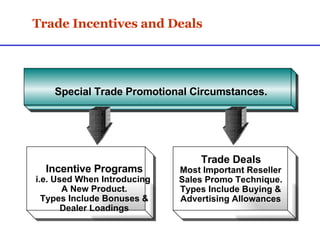
Trade Incentives and Deals  Incentive Programs i.e. Used When Introducing  A New Product. Types Include Bonuses & Dealer Loadings Special Trade Promotional Circumstances.  Trade Deals Most Important Reseller Sales Promo Technique. Types Include Buying & Advertising Allowances
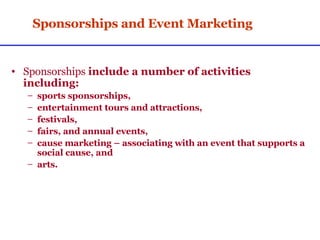
Sponsorships and Event Marketing Sponsorships  include a number of activities including:  sports sponsorships,  entertainment tours and attractions, festivals,  fairs, and annual events,  cause marketing – associating with an event that supports a social cause, and arts.
Sponsorships and Event Marketing Event marketing  describes the marketing practice in which a brand is linked to an event to create experiences for customers and associate the brand personality with a certain lifestyle. A  sponsorship  occurs when a company sponsors a sports event or concert, or supports a charity with its resources. It is attempting to increase the perceived value of the sponsor’s brand in the consumer's mind. Blimps, balloons, and inflatables are used at many events.
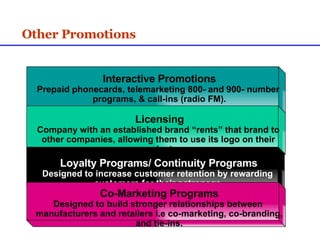
Other Promotions Interactive Promotions Prepaid phonecards, telemarketing 800- and 900- number  programs, & call-ins (radio FM). Licensing Company with an established brand “rents” that brand to  other companies, allowing them to use its logo on their  products. Loyalty Programs/ Continuity Programs Designed to increase customer retention by rewarding  customers for their patronage. Co-Marketing Programs Designed to build stronger relationships between  manufacturers and retailers i.e co-marketing, co-branding, and tie-ins.
Four Mandates of Loyalty Programs Identify your best customers. Connect with those best customers. Retain the best customers, usually by rewarding them for their patronage. Cultivate new “best customers”.
Promotion Strategies Promotion Can: Offer an immediate inducement, Cause customers to try a product, Persuade customers to buy again, Introduce a new product Promotion Can’t: Create an image for a brand, Compensate for a lack of advertising, Do much to compensate for a negative image, Reverse a sales decline.
Generalizations about Sales Promotions Temporary retail price reductions substantially increase sales The greater the frequency of deals, the lower the height of the deal spike The frequency of deals changes the consumer’s reference price Higher market share brands are less deal elastic
Generalizations about Sales Promotions Advertised promotions can result in increased store traffic Feature advertising and displays operate synergistically to influence sales of discounted brands Promotions in one product category affect sales of brands in complementary and competitive categories
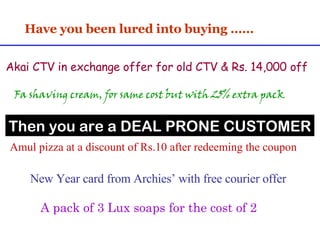
Have you been lured into buying …… A pack of 3 Lux soaps for the cost of 2 Amul pizza at a discount of Rs.10 after redeeming the coupon Fa shaving cream, for same cost but with 25% extra pack New Year card from Archies’ with free courier offer Pack of 2 AXE deodorant with a free Swiss Knife Akai CTV in exchange offer for old CTV & Rs. 14,000 off Then you are a DEAL PRONE CUSTOMER
Defining Deal Proneness Deal proneness has been defined as: "an increased propensity to respond to a purchase offer  because the form of the purchase offer positively affects  purchase evaluations” In other words, deal prone consumers may perceive the deal as an end in itself and just the fact that it is a deal, makes them want to make a purchase Thus, deal prone individuals are suggested to be more likely to respond to a promotional deal
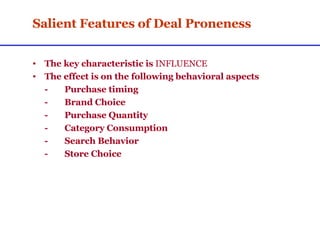
Salient Features of Deal Proneness The key characteristic is  INFLUENCE The effect is on the following behavioral aspects - Purchase timing - Brand Choice - Purchase Quantity - Category Consumption - Search Behavior - Store Choice
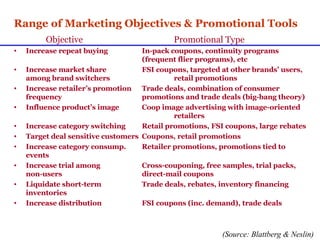
Range of Marketing Objectives & Promotional Tools Objective Promotional Type Increase repeat buying In-pack coupons, continuity programs  (frequent flier programs), etc Increase market share FSI coupons, targeted at other brands’ users, among brand switchers retail promotions Increase retailer’s promotion Trade deals, combination of consumer frequency promotions and trade deals (big-bang theory) Influence product’s image Coop image advertising with image-oriented  retailers  Increase category switching Retail promotions, FSI coupons, large rebates Target deal sensitive customers Coupons, retail promotions Increase category consump. Retailer promotions, promotions tied to events Increase trial among  Cross-couponing, free samples, trial packs, non-users direct-mail coupons Liquidate short-term Trade deals, rebates, inventory financing inventories Increase distribution FSI coupons (inc. demand), trade deals (Source: Blattberg & Neslin)
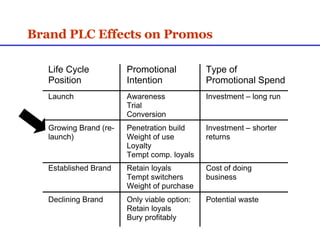
Brand PLC Effects on Promos
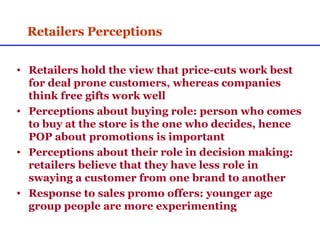
Retailers Perceptions Retailers hold the view that price-cuts work best for deal prone customers, whereas companies think free gifts work well Perceptions about buying role: person who comes to buy at the store is the one who decides, hence POP about promotions is important  Perceptions about their role in decision making: retailers believe that they have less role in swaying a customer from one brand to another Response to sales promo offers: younger age group people are more experimenting
Retailers Perceptions Communication of sales promo; WOM and television advertising works well Gifts given to retailer for motivations are seen as half-hearted attempt by companies by retailers Post promotion behavior: in LR customers switch back to original brand
Customer Perceptions Reasons for switching brands: sales promo was not the only reason for switching brands but the need for variety was also there Recall of brand promoted Willingness to buy on sales promotion offer: 63% of the respondents did not show willingness to buy on promo offer Ability to induce trials: 40% of respondents mentioned that promo had a potential for trials Long-term impact: 80% of respondents said they would not continue with purchased brand
Customer Perceptions Preference of schemes: Price-off is seen as best Perceived quality: 93% said they didn’t see a fall in quality during promo offers Perceptions about company motivations: most respondents believe that sales promos are intended  “to increase sales”, or to “attract switchers” or “to sell excess stocks”, intention of “value for money to customers” ranked lower
Reasons For Switching Brands Variety/boredom Availability Packaging/ Novelty/ features Impulse Sales promotion Advertising Price
Thus, To Sum Up Models of promotions should determine: The objectives of the promotion Characteristics of the promotion type and their effects on objectives The effectiveness of different promotions The range of promotional decisions

Sales Promotions

  • 1.
  • 2.
    Sales Promotion “Sales Promotion is a Marketing Discipline that Utilizes a Variety of Incentive Techniques to Structure Sales-Related Programs Targeted to Consumers, Trade, and/or Sales Levels that Generate a Specific, Measurable Action or Response for a Product or Service.”
  • 3.
    Sales Promotion GoalsSales Promotion Has Three Goals That Relate to Its Target audiences: To Increase Immediate Customer Sales. To Increase Support Among the Marketer’s Sales Force. To Gain the Support of the Trade in Marketing The Product.
  • 4.
  • 5.
    Reasons for theGrowth of Sales Promotion Sales Managers are Under Great Pressure to Produce Results Quickly. Sales Promotion Strategies Target Consumer, Trade, and The Sales Force. Assessment of Sales Promotion is Relatively Easy. Cost for Results In This Industry Are Relatively Low. Why Are Companies Spending More and More Money on Sales Promotion?
  • 6.
    Consumer Promotions Consumersales promotions are directed at the ultimate user of the good or service. Intended to “presell” consumers so when people go into a store, they will look for a particular brand. Primary strengths are their variety and flexibility. Many techniques that can be combined to meet almost any kind of sales promotion planner’s objectives.
  • 7.
    Types of ConsumerPromotions Lucky dip Incentives Sampling Contests Rebates Refunds Coupons
  • 8.
    Contests and Luckydip Lucky dip Participants Submit Names To Be Included in Drawing Time Frame Much Longer Contests Compete for a Prize Based On Some Skill or Ability Generates High Degree Of Consumer Involvement Can Help Revive Lagging Sales
  • 9.
    Refunds, Rebates, andPremiums Refunds and Rebates A Marketer’s Offer to Return a Certain Amount Of Money to the Consumer Who Purchases the Product. i.e cash rebate + low-value coupon Incentives Tangible Reward for Performing a Particular Act. Direct – Received At Time of Purchase Mail – Proof of Purchase & Payment Be Mailed In
  • 10.
    Sampling Allowing theCustomer to Experience the Product or Service. Very Effective Strategy for Introducing A New or Modified Product. Most Common Method of Distributing Samples is Through the Mail. 9 Out of 10 Customers Prefer a Sample To a Rupee-Off Coupon to Introduce Product.
  • 11.
    Trade Promotions Tradeadvertising is directed at wholesalers and retailers and represents 50% of the total promotional spending. Four goals of a trade promotion are: Stimulate in-store merchandising or other trade support, Manipulate levels of inventory held by wholesalers and retailers, Expand product distribution to new areas of the country or new classes of trade, Create a high level of excitement about the product among those responsible for its sale.
  • 12.
    Types of TradePromotions Point-of-Purchase Retailer Kits Contests Lucky Dip Trade Shows Exhibits Trade Incentives Trade Deals
  • 13.
    Point-of-Purchase Displays DisplayDistributed to Retailers Used to Call Customer’s Attention to Product Promotions. Some of the Most Popular POP Tools & Techniques Mechanical Product Dispensers Price Cards Signs Banners Special Racks Carton Displays
  • 14.
    Trade Promotions TradeShows & Exhibits Allow Product Demonstrations, Provide Information, & Answer Questions. Retailer (Dealer) Kits Materials That Help Reps Make Sales Calls Are Often Designed as Kits. Contain Detailed Product Specs, How-to-Do it Display, etc. Incentives Advertisers Can Develop Contests & incentives to Motivate Resellers. Occasional Use Only is Effective.
  • 15.
    Trade Incentives andDeals Incentive Programs i.e. Used When Introducing A New Product. Types Include Bonuses & Dealer Loadings Special Trade Promotional Circumstances. Trade Deals Most Important Reseller Sales Promo Technique. Types Include Buying & Advertising Allowances
  • 16.
    Sponsorships and EventMarketing Sponsorships include a number of activities including: sports sponsorships, entertainment tours and attractions, festivals, fairs, and annual events, cause marketing – associating with an event that supports a social cause, and arts.
  • 17.
    Sponsorships and EventMarketing Event marketing describes the marketing practice in which a brand is linked to an event to create experiences for customers and associate the brand personality with a certain lifestyle. A sponsorship occurs when a company sponsors a sports event or concert, or supports a charity with its resources. It is attempting to increase the perceived value of the sponsor’s brand in the consumer's mind. Blimps, balloons, and inflatables are used at many events.
  • 18.
    Other Promotions InteractivePromotions Prepaid phonecards, telemarketing 800- and 900- number programs, & call-ins (radio FM). Licensing Company with an established brand “rents” that brand to other companies, allowing them to use its logo on their products. Loyalty Programs/ Continuity Programs Designed to increase customer retention by rewarding customers for their patronage. Co-Marketing Programs Designed to build stronger relationships between manufacturers and retailers i.e co-marketing, co-branding, and tie-ins.
  • 19.
    Four Mandates ofLoyalty Programs Identify your best customers. Connect with those best customers. Retain the best customers, usually by rewarding them for their patronage. Cultivate new “best customers”.
  • 20.
    Promotion Strategies PromotionCan: Offer an immediate inducement, Cause customers to try a product, Persuade customers to buy again, Introduce a new product Promotion Can’t: Create an image for a brand, Compensate for a lack of advertising, Do much to compensate for a negative image, Reverse a sales decline.
  • 21.
    Generalizations about SalesPromotions Temporary retail price reductions substantially increase sales The greater the frequency of deals, the lower the height of the deal spike The frequency of deals changes the consumer’s reference price Higher market share brands are less deal elastic
  • 22.
    Generalizations about SalesPromotions Advertised promotions can result in increased store traffic Feature advertising and displays operate synergistically to influence sales of discounted brands Promotions in one product category affect sales of brands in complementary and competitive categories
  • 23.
    Have you beenlured into buying …… A pack of 3 Lux soaps for the cost of 2 Amul pizza at a discount of Rs.10 after redeeming the coupon Fa shaving cream, for same cost but with 25% extra pack New Year card from Archies’ with free courier offer Pack of 2 AXE deodorant with a free Swiss Knife Akai CTV in exchange offer for old CTV & Rs. 14,000 off Then you are a DEAL PRONE CUSTOMER
  • 24.
    Defining Deal PronenessDeal proneness has been defined as: "an increased propensity to respond to a purchase offer because the form of the purchase offer positively affects purchase evaluations” In other words, deal prone consumers may perceive the deal as an end in itself and just the fact that it is a deal, makes them want to make a purchase Thus, deal prone individuals are suggested to be more likely to respond to a promotional deal
  • 25.
    Salient Features ofDeal Proneness The key characteristic is INFLUENCE The effect is on the following behavioral aspects - Purchase timing - Brand Choice - Purchase Quantity - Category Consumption - Search Behavior - Store Choice
  • 26.
    Range of MarketingObjectives & Promotional Tools Objective Promotional Type Increase repeat buying In-pack coupons, continuity programs (frequent flier programs), etc Increase market share FSI coupons, targeted at other brands’ users, among brand switchers retail promotions Increase retailer’s promotion Trade deals, combination of consumer frequency promotions and trade deals (big-bang theory) Influence product’s image Coop image advertising with image-oriented retailers Increase category switching Retail promotions, FSI coupons, large rebates Target deal sensitive customers Coupons, retail promotions Increase category consump. Retailer promotions, promotions tied to events Increase trial among Cross-couponing, free samples, trial packs, non-users direct-mail coupons Liquidate short-term Trade deals, rebates, inventory financing inventories Increase distribution FSI coupons (inc. demand), trade deals (Source: Blattberg & Neslin)
  • 27.
  • 28.
    Retailers Perceptions Retailershold the view that price-cuts work best for deal prone customers, whereas companies think free gifts work well Perceptions about buying role: person who comes to buy at the store is the one who decides, hence POP about promotions is important Perceptions about their role in decision making: retailers believe that they have less role in swaying a customer from one brand to another Response to sales promo offers: younger age group people are more experimenting
  • 29.
    Retailers Perceptions Communicationof sales promo; WOM and television advertising works well Gifts given to retailer for motivations are seen as half-hearted attempt by companies by retailers Post promotion behavior: in LR customers switch back to original brand
  • 30.
    Customer Perceptions Reasonsfor switching brands: sales promo was not the only reason for switching brands but the need for variety was also there Recall of brand promoted Willingness to buy on sales promotion offer: 63% of the respondents did not show willingness to buy on promo offer Ability to induce trials: 40% of respondents mentioned that promo had a potential for trials Long-term impact: 80% of respondents said they would not continue with purchased brand
  • 31.
    Customer Perceptions Preferenceof schemes: Price-off is seen as best Perceived quality: 93% said they didn’t see a fall in quality during promo offers Perceptions about company motivations: most respondents believe that sales promos are intended “to increase sales”, or to “attract switchers” or “to sell excess stocks”, intention of “value for money to customers” ranked lower
  • 32.
    Reasons For SwitchingBrands Variety/boredom Availability Packaging/ Novelty/ features Impulse Sales promotion Advertising Price
  • 33.
    Thus, To SumUp Models of promotions should determine: The objectives of the promotion Characteristics of the promotion type and their effects on objectives The effectiveness of different promotions The range of promotional decisions