II. Consumer Decision
Making
Definition
 The customer’s decision to purchase a product or
service is an important moment for most marketers
that can signify whether a marketing strategy has been
wise, insightful, and effective, or whether it was poorly
planned and missed the market.
 A decision is the selection of an option from
two or more alternative choices.
 The choice can be between product/brand x
and product /brand y, between activity A and
activity B, and even between buying and not
buying
Types of Consumer Decisions
Substance of the
Decision
Budget
Product
Brand
Store
LevelVariations
Involvement
Learning
Bases of Classification
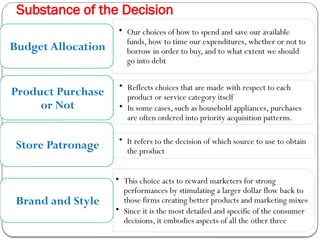
Substance of the Decision
• Our choices of how to spend and save our available
funds, how to time our expenditures, whether or not to
borrow in order to buy, and to what extent we should
go into debt
Budget Allocation
• Reflects choices that are made with respect to each
product or service category itself
• In some cases, such as household appliances, purchases
are often ordered into priority acquisition patterns.
Product Purchase
or Not
• It refers to the decision of which source to use to obtain
the product
Store Patronage
• This choice acts to reward marketers for strong
performances by stimulating a larger dollar flow back to
those firms creating better products and marketing mixes
• Since it is the most detailed and specific of the consumer
decisions, it embodies aspects of all the other three
Brand and Style
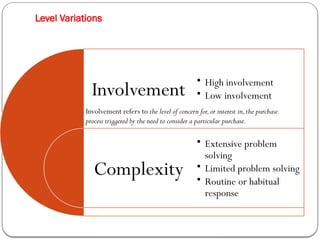
Level Variations
Involvement
Complexity
• High involvement
• Low involvement
• Extensive problem
solving
• Limited problem solving
• Routine or habitual
response
Involvement refers to the level of concern for,or interest in,the purchase
process triggered by the need to consider a particular purchase.
The Consumer Decision Process
Problem Recognition
Information Search and
Evaluation of Alternatives
Decision and Purchase
Consumption and
Evaluation
Future Decision
Processes
Prepurchase Processes
Purchase Processes
Postpurchase Processes
Prepurchase Processes
Problem Recognition
 Problem recognition represents the beginning of a
consumer decision process.
 Problem recognition is the result of a
discrepancy between a desired state and an actual
state that is sufficient to arouse and activate the
decision process. (Mothersbaugh and Hawkins)
o An actual state is the way an individual perceives his
or her feelings and situation to be at the present time
o A desired state is the way an individual
wants to feel or be at the present time.
Ideal State
Actual State
No Problem Opportunity
Recognition
Need
Recognition
Ideal State
Ideal State
Actual State
Actual State
Source: Consumer behavior: a European perspective by Michael Solomon and company
Causes of Problem Recognition
Changes in
Actual State
Changes in Ideal
(Desired) State
Depletion of stock
Dissatisfaction with
current stock
New “need” circumstances
New product opportunities
Purchase of other products
Change in finances
The current situations
The Role of Marketers in Problem Recognition
 Relatively less marketing attention seems directed towards influencing the
current state (perhaps because this will vary so much among consumers).
The most likely form of marketing strategy here seems to be to try to induce
some dissatisfaction with the current stock of goods by:
 Asking whether a husband is underinsured,
 Pointing out a husband’s ring around the collar, or
 Stressing the social punishments that await someone who is out of step with the current
styles.
 Most marketing efforts seem to be aimed at affecting the levels of the
desired state.
 In most cases, this means that product benefits can be highlighted in quite
positive sense.
 Presentation of products and services as problem solutions can thus lead to
consumers recognizing the problems in the first place!
 We see new products being marketed as ways to achieve faster, more convenient,
safer, or more exciting experiences for consumers.
Information Search and Alternative Evaluation
 To reach the goal of matching the levels of actual and
desired states, consumers need to discover what
their options are, process information about them,
and decide which alternative to choose
 Information Search can either be:
1. Un-intentional (incidental learning)
2. Intentional (purchase directed)
a) Internal search only (for habitual, impulsive or loyalty
decisions)
b) Internal and external search (for other types of
decisions)
Sources of Information
 The five primary sources of information available to
consumers are:
1. Memory of past searches, personal experience, and
low-involvement learning
2. Personal sources, such as friends and family
3. Independent sources, such as consumer groups and
government agencies
4. Marketing sources, such as sales personnel and
advertising
5. Experiential sources, such as inspection or product
trial
Internal Source of Information
The only one used in most consumer decisions
But it is obtained from external sources in the past through
direct experience, personal sources, or other means
Marketer Controlled Sources
Just one of five sources of information and frequently of
limited value in directly influencing consumer decisions
But they greatly influence the type of information
obtained from the other four sources
Types of Information Sought
A consumer decision requires information on the
following:
1. Evaluative Criteria: desirable attributes to look
for and use in comparing alternatives
2. Appropriate Alternatives: list of alternatives
to consider (awareness set, evoked set,
consideration set)
3. Characteristics of the Alternatives: specific
information about the alternatives being
considered
Factors Associated With
Lower Search levels Higher Search Levels
Overall
High perceived costs of search, with low
perceived benefits
High perceived benefits from search, with
low perceived costs
Psychological
Factors
Low involvement
Much past purchase experience
Satisfaction with current brands
Mood factors/ dislike of shopping
Brand loyalty
High involvement
Little relevant experience
Enjoyment of shopping
Curiosity
Favorable attitudes towards several
stores/brands
Situational
Factors
Social pressures (friends, family)
High time pressure on the purchase
Physical constraints on mobility
Special price offer
Easy return and guarantees
Low cost/low risk
Effective selling
Social pressure to search (e.g. husband and
wife “team”)
Easy to shop
Many stores and sources available
Long time horizon for purchase
Long product life
High price/ high risk
Significant differences exist in price and/or
quality levels
Technological improvements in the product
Information
Processing
Factors
Inability to understand product
information
Lack of confidence in dealing with
salespersons
Desire to learn more about product
Confidence in ability to use information
Higher number of evaluative criteria (key
attributes)
Key Factors in Information Search
Purchase Processes
Purchase processes involve two
activities:
Decision Making
• Choosing which brand to buy and from which
store
Purchase
• The actual purchase of the product chosen from
the store chosen
Methods for Studding Consumer Purchase Processes
Input-output
Research
• Manipulate
marketing inputs
(the 4 P’s) to see
the impact on
consumer choices
Methods
of Study
Process Monitoring
Research
• It focuses on trying
to capture the reality
of the decision
process itself, as it
occurs
How Do Consumers Decide?
 Consumers use a number of basic
strategies experts refer to as decision
heuristics (rule of thumb) to arrive at
a choice.
o.“I always buy the best”or“I only buy
on sale”are two common heuristics
some consumers use
 For the sake of simplicity lets call these
decision rules
Types of Decision Rules
• Choose the brand with best overall score
The compensatory rule
• Arrange attributes in the order of importance and choose the
brand that rates highest in the most important attribute
• If there is a tie, move to the next most important attribute
The Lexicographic Rule
• Establish some minimum standards for attributes and pick the
brand that meets the minimum for all attributes
The conjunctive rule
• Establish a minimum standard (one significantly higher than what
was used for the conjunctive rule) pick a brand that meets the
minimum for at least 1 attribute
The disjunctive rule
Brands
Attribute Importance A B C D
Style 40 6 8 8 3
Price 30 7 7 8 7
Covering 20 7 4 1 8
Durability 10 6 7 3 9
 Belief rating scale ranges between 1 and 10, with 10
the most favorable
 Assume Ed’s conjunctive cutoff = 5.0, assume
Dianne’s disjunctive cutoff = 8.5
 Brands are A= Air Attaché, B= Beauty Brief, C =
Comfort Case, D = Downtowner
Luggage Ratings For Decision Rules
Brands
Attribute Importance A B C D
Style 40 6 8 8 3
Price 30 7 7 8 7
Covering 20 7 4 1 8
Durability 10 6 7 3 9
Compensatory Rule
Pick the alternative with the best overall score
Multiply each alternative‘s belief rating for each
alternative with importance weight for that attribute and
add the results




Lexicographic Rule
Arrange the attributes in their order of importance
from the most to the least important
Compare all brands in terms of the most important
attribute and pick the brand that performs best.If there is
a tie,move to the next important attribute to break the tie
Brands
Attribute Importance A B C D
Style 40 6 8 8 3
Price 30 7 7 8 7
Covering 20 7 4 1 8
Durability 10 6 7 3 9
6<8 8=8
7<8
8>3
  

Conjunctive Rule
Establish minimum acceptable standards for each attribute
Choose the brand that meets all the standards
Brands
Attribute Importance A B C D
Style 40 6 8 8 3
Price 30 7 7 8 7
Covering 20 7 4 1 8
Durability 10 6 7 3 9
Assume the minimum standard for each attribute is a score of 5
6>5
7>5
7>5
6>5

8>5
7>5
4<5

8>5
8>5
1<5

3<5

The Disjunctive Rule
Set what you think is an exceptionally high
standard for each attribute
Pick the brand (s) that meet the standard for at
least one attribute
Assume the minimum standard for each attribute is a score of 8.5
Brands
Attribute Importance A B C D
Style 40 6 8 8 3
Price 30 7 7 8 7
Covering 20 7 4 1 8
Durability 10 6 7 3 9
6<8.5
7<8.5
7<8.5
6<8.5

8<8.5
7<8.5
4<8.5
7<8.5

8<8.5
8<8.5
1<8.5
3<8.5
3<8.5

7<8.5
8<8.5
9>8.5

Rule Description
Conjunctive
Select all (any or first) brands that surpass a minimum level
on each relevant evaluative criterion
Disjunctive
Select all (or any or first) brands that surpass a satisfactory
level on any relevant evaluative criterion
Lexicographic
Rank the evaluative criteria in terms of importance. Start
with the most important criterion and select the brand that
scores highest on that dimension. If two or more brands tie,
continue through the attributes in order of importance until
one of the remaining brands outperforms the others
Elimination-by-
aspects
Rank the evaluative criteria in terms of importance and
establish satisfactory levels for each. Start with the most
important attribute and eliminate all brands that do not
meet the satisfactory level. Continue through the attributes
in order of importance until only one brand is left.
Compensatory
Select the brand that provides the highest total score when
the performance ratings for all the relevant attributes are
added (with or without importance weights) together for
each brand.
Summary of Decision Rules
Post purchase Processes
Post purchase refers to what goes on after
the consumer makes a purchase
It may seem the least important step from
the perspective of short term revenues and
profits
It is the most important from the
consumers’ perspective and from the
perspective of long term profits and
revenues
The Post Purchase Phase
Prepurchase
and Purchase
Processes
Postpurchase
Processes
Delivery Preparation Consumption Disposal
Storage
Maintenance
Repair
Time
Usage Costs
Acquisition Consumption Disposal
Within the
consumption
system
Key activities
within the
postpurchase
sector
The Consumption of Products and Services
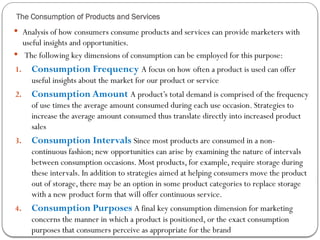
 Analysis of how consumers consume products and services can provide marketers with
useful insights and opportunities.
 The following key dimensions of consumption can be employed for this purpose:
1. Consumption Frequency A focus on how often a product is used can offer
useful insights about the market for our product or service
2. Consumption Amount A product’s total demand is comprised of the frequency
of use times the average amount consumed during each use occasion. Strategies to
increase the average amount consumed thus translate directly into increased product
sales
3. Consumption Intervals Since most products are consumed in a non-
continuous fashion; new opportunities can arise by examining the nature of intervals
between consumption occasions. Most products, for example, require storage during
these intervals. In addition to strategies aimed at helping consumers move the product
out of storage, there may be an option in some product categories to replace storage
with a new product form that will offer continuous service.
4. Consumption Purposes A final key consumption dimension for marketing
concerns the manner in which a product is positioned, or the exact consumption
purposes that consumers perceive as appropriate for the brand
Product Disposal
 Following consumption, the final stage in a
product’s life occurs when the consumer
disposes of it.
 This process can be more complex than we
might first imagine. For example, there are
three major options in product disposition:
1. Trash it!
2. Save it (either store it or repair it).
3. Sell or give it away
Psychological Process During Postpurchase
 One of the most interesting aspects of the postpurchase phase involves
several forms of psychological processes consumers can experience
following a purchase.
 As we’ve noted in the previous sections, consumption provides extremely
important information to the consumer in the form of actual experience
with the product.
 One key psychological process, therefore, is consumer learning.
 Here the consumer discovers something of objective reality about a product
or service, stores this new knowledge in LTM, modifies relevant attitudes,
and is ready for the next decision process with an improved base of
knowledge.
 Two other important psychological processes that we’ll discuss further are:
1. Cognitive dissonance
2. Consumer satisfaction/dissatisfaction
Cognitive Dissonance
 It refers to the doubt and anxiety consumers experience
after making a difficult choice:
 Did I make the right choice?
 What if I chose the wrong one?
 This anxiety emanates from people’s desires to have consistent
(consonant) thoughts in their mind.
 Cognitive dissonance arises when the individual experiences
conflicting or inconsistent (dissonant) thought. For example,
the following two thoughts are inconsistent:
 “AddisAbaba University is the best university in the
country.”
 “I go to Bahir Dar University.”
 The probability of a consumer experiencing post
purchase dissonance, as well as the magnitude of such
dissonance, is a function of:
1. The degree of commitment or irrevocability of the
decision.
2. The importance of the decision to the consumer.The
more important the decision, the more likely
dissonance will result
3. The difficulty of choosing among the alternatives.
4. The individual’s tendency to experience anxiety.
 Dissonance occurs because making a relatively
permanent commitment to a chosen alternative
requires one to give up the attractive features of the
un-chose alternative.This is inconsistent with the
desire for those features.
 Since post purchase dissonance can cause significant
discomfort and stress, consumers try to reduce it by
doing one or more of the following:
1. Increase the desirability of the brand purchased
2. Decrease the desirability of rejected alternatives
3. Decrease the importance of the purchase
Consumer Satisfaction/Dissatisfaction
 It refers to an emotional response to
an evaluation of a product,store,or
service consumption experience.
 Consumer satisfaction is likely to
result when actual performance levels
either meet or exceed expected levels
and dissatisfaction occurs when actual
outcomes fall below the expected
levels of performance.
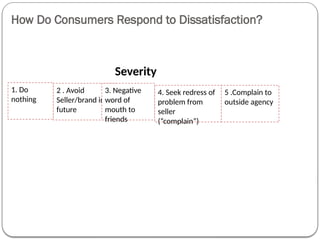
How Do Consumers Respond to Dissatisfaction?
1. Do
nothing
2 . Avoid
Seller/brand in
future
3. Negative
word of
mouth to
friends
4. Seek redress of
problem from
seller
(“complain”)
5 .Complain to
outside agency
Severity
 Factors that influence a consumer’s decision to complain or
not include:
1. Level of DissatisfactionWhen a high level of dissatisfaction occurs, the
likelihood of more severe consumer response increases
2. Importance Products or services that are more important to us are more
likely to generate complaints when unsatisfactory experiences occur.
3. Cost/Benefits of ActionsWe are more likely to complain when our
expected benefits of complaining are high and our expected costs of
complaining are low.
4. Personal Characteristics Studies have shown that some people are more
likely to complain than others. (High-educated persons, individuals with
aggressive personality, or with more time)
5. Attribution of Blame If a person has a problem, but believes that she/he
herself/himself could possibly be at fault, she/he is less likely to complain
than if she/he attributes the cause of the problem to be the manufacturer or
seller.

CHAPTER II. Consumer Decision Making.pptx

  • 1.
  • 2.
    Definition  The customer’sdecision to purchase a product or service is an important moment for most marketers that can signify whether a marketing strategy has been wise, insightful, and effective, or whether it was poorly planned and missed the market.  A decision is the selection of an option from two or more alternative choices.  The choice can be between product/brand x and product /brand y, between activity A and activity B, and even between buying and not buying
  • 3.
    Types of ConsumerDecisions Substance of the Decision Budget Product Brand Store LevelVariations Involvement Learning Bases of Classification
  • 4.
    Substance of theDecision • Our choices of how to spend and save our available funds, how to time our expenditures, whether or not to borrow in order to buy, and to what extent we should go into debt Budget Allocation • Reflects choices that are made with respect to each product or service category itself • In some cases, such as household appliances, purchases are often ordered into priority acquisition patterns. Product Purchase or Not • It refers to the decision of which source to use to obtain the product Store Patronage • This choice acts to reward marketers for strong performances by stimulating a larger dollar flow back to those firms creating better products and marketing mixes • Since it is the most detailed and specific of the consumer decisions, it embodies aspects of all the other three Brand and Style
  • 5.
    Level Variations Involvement Complexity • Highinvolvement • Low involvement • Extensive problem solving • Limited problem solving • Routine or habitual response Involvement refers to the level of concern for,or interest in,the purchase process triggered by the need to consider a particular purchase.
  • 6.
    The Consumer DecisionProcess Problem Recognition Information Search and Evaluation of Alternatives Decision and Purchase Consumption and Evaluation Future Decision Processes Prepurchase Processes Purchase Processes Postpurchase Processes
  • 7.
    Prepurchase Processes Problem Recognition Problem recognition represents the beginning of a consumer decision process.  Problem recognition is the result of a discrepancy between a desired state and an actual state that is sufficient to arouse and activate the decision process. (Mothersbaugh and Hawkins) o An actual state is the way an individual perceives his or her feelings and situation to be at the present time o A desired state is the way an individual wants to feel or be at the present time.
  • 8.
    Ideal State Actual State NoProblem Opportunity Recognition Need Recognition Ideal State Ideal State Actual State Actual State Source: Consumer behavior: a European perspective by Michael Solomon and company Causes of Problem Recognition
  • 9.
    Causes of ProblemRecognition Changes in Actual State Changes in Ideal (Desired) State Depletion of stock Dissatisfaction with current stock New “need” circumstances New product opportunities Purchase of other products Change in finances The current situations
  • 10.
    The Role ofMarketers in Problem Recognition  Relatively less marketing attention seems directed towards influencing the current state (perhaps because this will vary so much among consumers). The most likely form of marketing strategy here seems to be to try to induce some dissatisfaction with the current stock of goods by:  Asking whether a husband is underinsured,  Pointing out a husband’s ring around the collar, or  Stressing the social punishments that await someone who is out of step with the current styles.  Most marketing efforts seem to be aimed at affecting the levels of the desired state.  In most cases, this means that product benefits can be highlighted in quite positive sense.  Presentation of products and services as problem solutions can thus lead to consumers recognizing the problems in the first place!  We see new products being marketed as ways to achieve faster, more convenient, safer, or more exciting experiences for consumers.
  • 11.
    Information Search andAlternative Evaluation  To reach the goal of matching the levels of actual and desired states, consumers need to discover what their options are, process information about them, and decide which alternative to choose  Information Search can either be: 1. Un-intentional (incidental learning) 2. Intentional (purchase directed) a) Internal search only (for habitual, impulsive or loyalty decisions) b) Internal and external search (for other types of decisions)
  • 12.
    Sources of Information The five primary sources of information available to consumers are: 1. Memory of past searches, personal experience, and low-involvement learning 2. Personal sources, such as friends and family 3. Independent sources, such as consumer groups and government agencies 4. Marketing sources, such as sales personnel and advertising 5. Experiential sources, such as inspection or product trial
  • 13.
    Internal Source ofInformation The only one used in most consumer decisions But it is obtained from external sources in the past through direct experience, personal sources, or other means Marketer Controlled Sources Just one of five sources of information and frequently of limited value in directly influencing consumer decisions But they greatly influence the type of information obtained from the other four sources
  • 14.
    Types of InformationSought A consumer decision requires information on the following: 1. Evaluative Criteria: desirable attributes to look for and use in comparing alternatives 2. Appropriate Alternatives: list of alternatives to consider (awareness set, evoked set, consideration set) 3. Characteristics of the Alternatives: specific information about the alternatives being considered
  • 15.
    Factors Associated With LowerSearch levels Higher Search Levels Overall High perceived costs of search, with low perceived benefits High perceived benefits from search, with low perceived costs Psychological Factors Low involvement Much past purchase experience Satisfaction with current brands Mood factors/ dislike of shopping Brand loyalty High involvement Little relevant experience Enjoyment of shopping Curiosity Favorable attitudes towards several stores/brands Situational Factors Social pressures (friends, family) High time pressure on the purchase Physical constraints on mobility Special price offer Easy return and guarantees Low cost/low risk Effective selling Social pressure to search (e.g. husband and wife “team”) Easy to shop Many stores and sources available Long time horizon for purchase Long product life High price/ high risk Significant differences exist in price and/or quality levels Technological improvements in the product Information Processing Factors Inability to understand product information Lack of confidence in dealing with salespersons Desire to learn more about product Confidence in ability to use information Higher number of evaluative criteria (key attributes) Key Factors in Information Search
  • 16.
    Purchase Processes Purchase processesinvolve two activities: Decision Making • Choosing which brand to buy and from which store Purchase • The actual purchase of the product chosen from the store chosen
  • 17.
    Methods for StuddingConsumer Purchase Processes Input-output Research • Manipulate marketing inputs (the 4 P’s) to see the impact on consumer choices Methods of Study Process Monitoring Research • It focuses on trying to capture the reality of the decision process itself, as it occurs
  • 18.
    How Do ConsumersDecide?  Consumers use a number of basic strategies experts refer to as decision heuristics (rule of thumb) to arrive at a choice. o.“I always buy the best”or“I only buy on sale”are two common heuristics some consumers use  For the sake of simplicity lets call these decision rules
  • 19.
    Types of DecisionRules • Choose the brand with best overall score The compensatory rule • Arrange attributes in the order of importance and choose the brand that rates highest in the most important attribute • If there is a tie, move to the next most important attribute The Lexicographic Rule • Establish some minimum standards for attributes and pick the brand that meets the minimum for all attributes The conjunctive rule • Establish a minimum standard (one significantly higher than what was used for the conjunctive rule) pick a brand that meets the minimum for at least 1 attribute The disjunctive rule
  • 20.
    Brands Attribute Importance AB C D Style 40 6 8 8 3 Price 30 7 7 8 7 Covering 20 7 4 1 8 Durability 10 6 7 3 9  Belief rating scale ranges between 1 and 10, with 10 the most favorable  Assume Ed’s conjunctive cutoff = 5.0, assume Dianne’s disjunctive cutoff = 8.5  Brands are A= Air Attaché, B= Beauty Brief, C = Comfort Case, D = Downtowner Luggage Ratings For Decision Rules
  • 21.
    Brands Attribute Importance AB C D Style 40 6 8 8 3 Price 30 7 7 8 7 Covering 20 7 4 1 8 Durability 10 6 7 3 9 Compensatory Rule Pick the alternative with the best overall score Multiply each alternative‘s belief rating for each alternative with importance weight for that attribute and add the results    
  • 22.
    Lexicographic Rule Arrange theattributes in their order of importance from the most to the least important Compare all brands in terms of the most important attribute and pick the brand that performs best.If there is a tie,move to the next important attribute to break the tie Brands Attribute Importance A B C D Style 40 6 8 8 3 Price 30 7 7 8 7 Covering 20 7 4 1 8 Durability 10 6 7 3 9 6<8 8=8 7<8 8>3    
  • 23.
    Conjunctive Rule Establish minimumacceptable standards for each attribute Choose the brand that meets all the standards Brands Attribute Importance A B C D Style 40 6 8 8 3 Price 30 7 7 8 7 Covering 20 7 4 1 8 Durability 10 6 7 3 9 Assume the minimum standard for each attribute is a score of 5 6>5 7>5 7>5 6>5  8>5 7>5 4<5  8>5 8>5 1<5  3<5 
  • 24.
    The Disjunctive Rule Setwhat you think is an exceptionally high standard for each attribute Pick the brand (s) that meet the standard for at least one attribute Assume the minimum standard for each attribute is a score of 8.5 Brands Attribute Importance A B C D Style 40 6 8 8 3 Price 30 7 7 8 7 Covering 20 7 4 1 8 Durability 10 6 7 3 9 6<8.5 7<8.5 7<8.5 6<8.5  8<8.5 7<8.5 4<8.5 7<8.5  8<8.5 8<8.5 1<8.5 3<8.5 3<8.5  7<8.5 8<8.5 9>8.5 
  • 25.
    Rule Description Conjunctive Select all(any or first) brands that surpass a minimum level on each relevant evaluative criterion Disjunctive Select all (or any or first) brands that surpass a satisfactory level on any relevant evaluative criterion Lexicographic Rank the evaluative criteria in terms of importance. Start with the most important criterion and select the brand that scores highest on that dimension. If two or more brands tie, continue through the attributes in order of importance until one of the remaining brands outperforms the others Elimination-by- aspects Rank the evaluative criteria in terms of importance and establish satisfactory levels for each. Start with the most important attribute and eliminate all brands that do not meet the satisfactory level. Continue through the attributes in order of importance until only one brand is left. Compensatory Select the brand that provides the highest total score when the performance ratings for all the relevant attributes are added (with or without importance weights) together for each brand. Summary of Decision Rules
  • 26.
    Post purchase Processes Postpurchase refers to what goes on after the consumer makes a purchase It may seem the least important step from the perspective of short term revenues and profits It is the most important from the consumers’ perspective and from the perspective of long term profits and revenues
  • 27.
    The Post PurchasePhase Prepurchase and Purchase Processes Postpurchase Processes Delivery Preparation Consumption Disposal Storage Maintenance Repair Time Usage Costs Acquisition Consumption Disposal Within the consumption system Key activities within the postpurchase sector
  • 28.
    The Consumption ofProducts and Services  Analysis of how consumers consume products and services can provide marketers with useful insights and opportunities.  The following key dimensions of consumption can be employed for this purpose: 1. Consumption Frequency A focus on how often a product is used can offer useful insights about the market for our product or service 2. Consumption Amount A product’s total demand is comprised of the frequency of use times the average amount consumed during each use occasion. Strategies to increase the average amount consumed thus translate directly into increased product sales 3. Consumption Intervals Since most products are consumed in a non- continuous fashion; new opportunities can arise by examining the nature of intervals between consumption occasions. Most products, for example, require storage during these intervals. In addition to strategies aimed at helping consumers move the product out of storage, there may be an option in some product categories to replace storage with a new product form that will offer continuous service. 4. Consumption Purposes A final key consumption dimension for marketing concerns the manner in which a product is positioned, or the exact consumption purposes that consumers perceive as appropriate for the brand
  • 29.
    Product Disposal  Followingconsumption, the final stage in a product’s life occurs when the consumer disposes of it.  This process can be more complex than we might first imagine. For example, there are three major options in product disposition: 1. Trash it! 2. Save it (either store it or repair it). 3. Sell or give it away
  • 30.
    Psychological Process DuringPostpurchase  One of the most interesting aspects of the postpurchase phase involves several forms of psychological processes consumers can experience following a purchase.  As we’ve noted in the previous sections, consumption provides extremely important information to the consumer in the form of actual experience with the product.  One key psychological process, therefore, is consumer learning.  Here the consumer discovers something of objective reality about a product or service, stores this new knowledge in LTM, modifies relevant attitudes, and is ready for the next decision process with an improved base of knowledge.  Two other important psychological processes that we’ll discuss further are: 1. Cognitive dissonance 2. Consumer satisfaction/dissatisfaction
  • 31.
    Cognitive Dissonance  Itrefers to the doubt and anxiety consumers experience after making a difficult choice:  Did I make the right choice?  What if I chose the wrong one?  This anxiety emanates from people’s desires to have consistent (consonant) thoughts in their mind.  Cognitive dissonance arises when the individual experiences conflicting or inconsistent (dissonant) thought. For example, the following two thoughts are inconsistent:  “AddisAbaba University is the best university in the country.”  “I go to Bahir Dar University.”
  • 32.
     The probabilityof a consumer experiencing post purchase dissonance, as well as the magnitude of such dissonance, is a function of: 1. The degree of commitment or irrevocability of the decision. 2. The importance of the decision to the consumer.The more important the decision, the more likely dissonance will result 3. The difficulty of choosing among the alternatives. 4. The individual’s tendency to experience anxiety.
  • 33.
     Dissonance occursbecause making a relatively permanent commitment to a chosen alternative requires one to give up the attractive features of the un-chose alternative.This is inconsistent with the desire for those features.  Since post purchase dissonance can cause significant discomfort and stress, consumers try to reduce it by doing one or more of the following: 1. Increase the desirability of the brand purchased 2. Decrease the desirability of rejected alternatives 3. Decrease the importance of the purchase
  • 34.
    Consumer Satisfaction/Dissatisfaction  Itrefers to an emotional response to an evaluation of a product,store,or service consumption experience.  Consumer satisfaction is likely to result when actual performance levels either meet or exceed expected levels and dissatisfaction occurs when actual outcomes fall below the expected levels of performance.
  • 35.
    How Do ConsumersRespond to Dissatisfaction? 1. Do nothing 2 . Avoid Seller/brand in future 3. Negative word of mouth to friends 4. Seek redress of problem from seller (“complain”) 5 .Complain to outside agency Severity
  • 36.
     Factors thatinfluence a consumer’s decision to complain or not include: 1. Level of DissatisfactionWhen a high level of dissatisfaction occurs, the likelihood of more severe consumer response increases 2. Importance Products or services that are more important to us are more likely to generate complaints when unsatisfactory experiences occur. 3. Cost/Benefits of ActionsWe are more likely to complain when our expected benefits of complaining are high and our expected costs of complaining are low. 4. Personal Characteristics Studies have shown that some people are more likely to complain than others. (High-educated persons, individuals with aggressive personality, or with more time) 5. Attribution of Blame If a person has a problem, but believes that she/he herself/himself could possibly be at fault, she/he is less likely to complain than if she/he attributes the cause of the problem to be the manufacturer or seller.