Course : MBA
Semester : 3rd
Subject : Consumer Behaviour
Faculty : Vivek Singh Sangwan
Topic : Introduction to CB
Lectures : 1-22
CONSUMER
BEHAVIOUR
Why study Consumer Behavior?
 The Consumer is King.
 Only the Customer Can Fire Us All.
 People are different.
 Consumer behavior educates and protects consumers.
 Consumer behavior helps formulate public policy.
 Consumer behavior affects personal policy.
Reference Book:- Consumer Behavior by Blackwell, Miniard and Engel
Why study Consumer Behavior?
 It’s helpful in understanding needs.
 Helps in defining markets and identifying threats and
opportunities of a brand.
 Segmentation becomes easy.
Reference Book:- Consumer Behavior by Blackwell, Miniard and Engel
Definition
 Consumer behaviour is the
study of how, why and what
people do when they buy
product or avail services.
 “It attempts to understand
the buyer decision making
process, both individually
and in groups.” – C.L.
Narayana and R.J. Markin
Need for
understanding
consumer
Behaviour
Shorter product life cycles.
Evolving consumer preferences.
Environmental concerns.
Changing lifestyles.
Faster technology adoption.
Consumer
Insights-
Example
How consumer think, feel, reason,
and select among different
alternatives (e.g., brands & products).
How consumers are influenced by
their environment (e.g., culture,
family, peer groups, and media).
The behaviour of consumer while
shopping or making any choice
decisions.
Consumer
Insights-
Example
 Limitations in consumer
knowledge or information-
processing abilities, which
influence decisions and
marketing outcomes.
 How consumer motivation and
decision strategies differ
between products that vary in
their level of importance or
interest.
 How marketers can adapt and
improve their marketing
campaigns or strategies to
quickly penetrate into the
market.
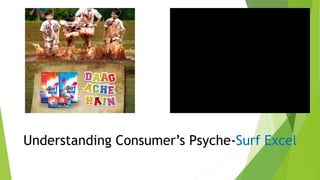
Understanding Consumer’s Psyche-Surf Excel
 It is complex, as each customer has a
unique set of needs.
 It is dynamic in nature, human
behaviour is constantly altered by its
environment
 It varies from customer to customer,
product to product and from countries
to countries.
 It is influenced by varies cultural, social,
personal and psychological factors.
 The buying behaviour and pattern of an
individual reflects his/her status in the
society.
Nature of
Consumer
Behaviour
Scope of
Consumer
Behaviour
Demand Forecasting - Estimating the demand
for products and services.
Marketing - Understanding the needs, expectations,
problems of customers, formulating marketing mix
strategies.
Advertising – understanding human behaviour
towards different advertising appeals and message,
selecting the type of media.
Human Behaviour – understanding the various
motives that’s influences behaviour of a consumer.
Operations – Formulating production, pricing and
distribution policies.
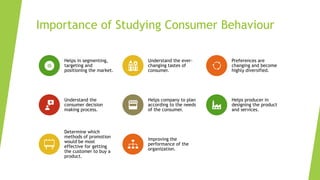
Importance of Studying Consumer Behaviour
Helps in segmenting,
targeting and
positioning the market.
Understand the ever-
changing tastes of
consumer.
Preferences are
changing and become
highly diversified.
Understand the
consumer decision
making process.
Helps company to plan
according to the needs
of the consumer.
Helps producer in
designing the product
and services.
Determine which
methods of promotion
would be most
effective for getting
the customer to buy a
product.
Improving the
performance of the
organization.
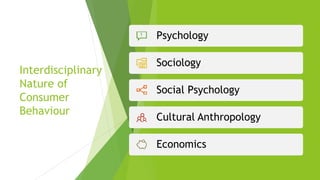
Interdisciplinary
Nature of
Consumer
Behaviour
Psychology
Sociology
Social Psychology
Cultural Anthropology
Economics
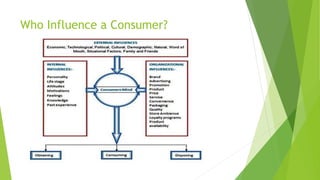
Who Influence a Consumer?
Consumer Research
Customer Research
 It is a part of marketing research in which
the preferences, motivations and buying
behaviour of the targeted customers are
identified through direct observation, mail
surveys, telephone or face to face
interview and from published sources.
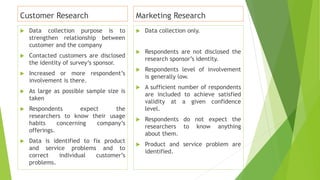
Customer Research
 Data collection purpose is to
strengthen relationship between
customer and the company
 Contacted customers are disclosed
the identity of survey’s sponsor.
 Increased or more respondent’s
involvement is there.
 As large as possible sample size is
taken
 Respondents expect the
researchers to know their usage
habits concerning company’s
offerings.
 Data is identified to fix product
and service problems and to
correct individual customer’s
problems.
Marketing Research
 Data collection only.
 Respondents are not disclosed the
research sponsor’s identity.
 Respondents level of involvement
is generally low.
 A sufficient number of respondents
are included to achieve satisfied
validity at a given confidence
level.
 Respondents do not expect the
researchers to know anything
about them.
 Product and service problem are
identified.
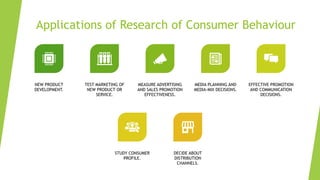
Applications of Research of Consumer Behaviour
NEW PRODUCT
DEVELOPMENT.
TEST MARKETING OF
NEW PRODUCT OR
SERVICE.
MEASURE ADVERTISING
AND SALES PROMOTION
EFFECTIVENESS.
MEDIA PLANNING AND
MEDIA-MIX DECISIONS.
EFFECTIVE PROMOTION
AND COMMUNICATION
DECISIONS.
STUDY CONSUMER
PROFILE.
DECIDE ABOUT
DISTRIBUTION
CHANNELS.
The Importance of
the Consumer
Research Process
 Marketers must understand
customers to design effective:
 marketing strategies
 Products
 promotional messages
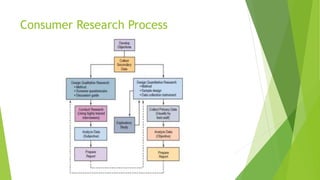
Consumer Research Process
Developing
Research
Objectives
Defining purposes and
objectives helps ensure an
appropriate research design.
A written statement of
objectives helps to define
the type and level of
information needed.
Example of
research
objectives
Management Problem: Why
are store revenues so low?
•Investigate current customer
satisfaction
•Assess target market perceptions
of store and competitors
•Determine target market
awareness
Possible research
objective:
Discussion Questions
Assume you are planning to open
a new pizza restaurant near your
campus.
What might be three objectives of a
research plan for your new
business?
How could you gather these data?
Secondary Data
Data that has been collected for reasons other than the
specific research project at hand Includes internal and
external data
Internal Data
 Data generated in-house
 May include analysis of
customer files
 Useful for calculating
customer lifetime value
External Data
 Data collected by an outside
organization
 Includes federal government,
periodicals, newspapers,
books, search engines
 Commercial data is also
available from market
research firms: Nielsen,
Arbitron, SRDS, and
MRI/Mediamark.
Quality of Secondary Data
 Who sponsored the research?
 Advocacy research, or research conducted to support a
position rather than to find the truth about an issue, is
blatantly unethical
 What is the ability of the researchers?
 Experience is an important consideration for assessing
quality
 Process of data collection
 Bias-free access to respondents is an important
consideration for assessing quality
Pros and Cons of
Secondary Data
 Advantages of Secondary Data
1. Time savings
2. Cost savings
 Disadvantages of
Secondary Data
1. Problems of fit
2. Problems of accuracy
Outline
 Primary research
 Qualitative study
 Quantitative study:
 Data collection methods
 Test market
 Concept of Measurements
 Reliability and Validity
 Measurements Common in Consumer Behavior
Designing
Primary
Research-
Qualitative
Research
Depth Interviews
Focus Groups
Projective Techniques
Metaphor Analysis
Qualitative Collection Method-
Depth Interview
 Also called one-on-one interview
 Usually 20 minutes to 1 hour
 Non structured Interviewer will often probe to
get more feedback
 Session is usually recorded
Qualitative Collection Method- Focus
Group
 8-10 participants
 Respondents are recruited through a
screener questionnaire
 Lasts about 2 hours
 Always taped or videotaped to assist
analysis
 Often held in front of two-way mirrors
 Online focus groups are growing
Qualitative Collection Method- Focus
Group
 8-10 participants
 Respondents are recruited through a
screener questionnaire
 Lasts about 2 hours
 Always taped or videotaped to assist
analysis
 Often held in front of two-way mirrors
 Online focus groups are growing
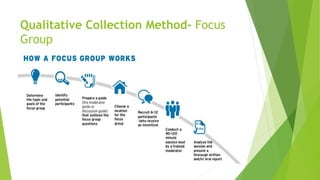
Qualitative Collection Method- Focus
Group
Qualitative Collection Method-
Projective Techniques
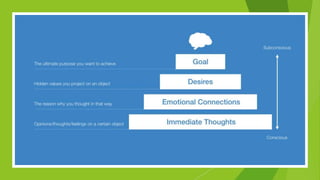
 Research procedures designed to identify
consumers’ subconscious feelings and underlying
motivations
 Consist of a variety of disguised “tests”.
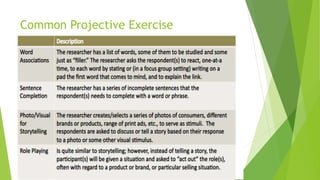
Common Projective Exercise
Qualitative
Collection
Method-
Metaphor
Analysis
Based on belief that metaphors are the most basic
method of thought and communication
Zaltman Metaphor Elicitation Technique (ZMET)
combines collage research and metaphor analysis to
bring to the surface the mental models and the major
themes or constructs that drive consumer thinking and
behavior.
It is believed that much of communication is nonverbal
and that people do not think as much in words as they
do in images.
Qualitative
Collection
Method-
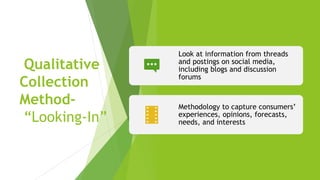
“Looking-In”
Look at information from threads
and postings on social media,
including blogs and discussion
forums
Methodology to capture consumers’
experiences, opinions, forecasts,
needs, and interests
Designing Primary
Research-
Quantitative Research
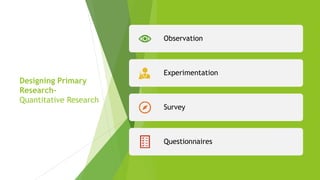
Observation
Experimentation
Survey
Questionnaires
Data Collection Methods- Observational
Research
 Helps marketers gain an in-depth
understanding of the relationship between
people and products by watching them
buying and using products
 Helps researchers gain a better
understanding of what the product
symbolizes
Data
Collection
Methods-
Mechanical
Observational
Research
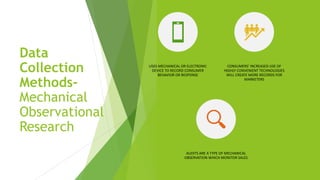
USES MECHANICAL OR ELECTRONIC
DEVICE TO RECORD CONSUMER
BEHAVIOR OR RESPONSE
CONSUMERS’ INCREASED USE OF
HIGHLY CONVENIENT TECHNOLOGIES
WILL CREATE MORE RECORDS FOR
MARKETERS
AUDITS ARE A TYPE OF MECHANICAL
OBSERVATION WHICH MONITOR SALES
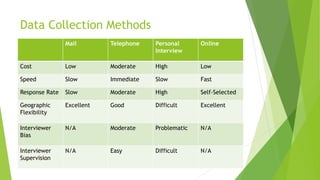
Data Collection Methods
Mail Telephone Personal
Interview
Online
Cost Low Moderate High Low
Speed Slow Immediate Slow Fast
Response Rate Slow Moderate High Self-Selected
Geographic
Flexibility
Excellent Good Difficult Excellent
Interviewer
Bias
N/A Moderate Problematic N/A
Interviewer
Supervision
N/A Easy Difficult N/A
Increase Mail
Response Rate
 Include stamped and
self-addressed envelop
 Multiple waves of
reminders
 Use consumer panels
Increase Mail
Response Rate
 If you were a marketing
manager planning a mail
survey to find out
consumers’ attitude
towards your products.
Traditionally, mail survey is
associated with low
response rate of 1%. What
suggestion would you give
to increase respondent
rate?
Test Market
A controlled experiment done in a limited
but carefully selected sector of the
marketplace.
McDonald’s used test markets to
determine that a market existed for
McDonald’s own higher-end coffee drink.
Three issues in test market: time, cost and
control
Misfires in Market Testing-Example
 Frito-Lay test-marketed its Max Potato, corn and tortilla
chips containing the Olestra fat substitutes in Grand
Junction, Colorado; A TV crew sampled the chips and
succumbed to diarrhea, and then broadcast a report
about it, creating lots of bad publicity for the chips
 Campbell Soup spent 18 months developing a blended
fruit juice called “Juiceworks”. By the time the product
reached the market, three competing brands were
already on store shelves. Campbell dropped its product
Validity and
Reliability
If a study has validity, it
collects the appropriate data
for the study.
A study has reliability if the
same questions, asked of a
similar sample, produce the
same findings.
Measurements
in Consumer
Behavior-
Attitude Scales
 Likert scales
 Asked to agree or disagree with a
statement
 Easy to prepare & interpret
 Simple for consumers
 Semantic differential scales
 Includes bipolar adjectives
 Relatively easy to construct and
administer
 Particularly useful in corporate, brand
and product-image studies.
 Behavior intention scales
 Measures likelihood consumers will act a
certain way
 Easy to construct and administer
 Rank-order scales
 Items ranked in order of preference in
terms of some criteria
Likert Scale
 Respondents indicate their degree of agreement
or disagreement with each of several statements.
 Five to nine categories work well.
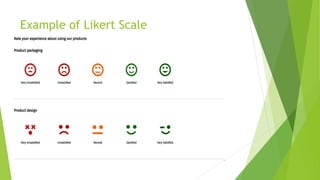
Example of Likert Scale
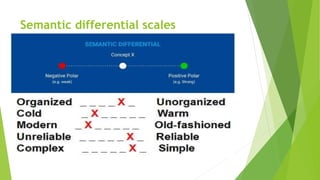
Semantic differential scales
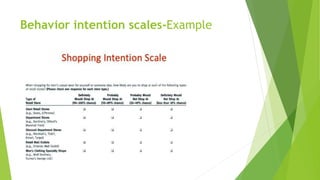
Behavior intention scales-Example
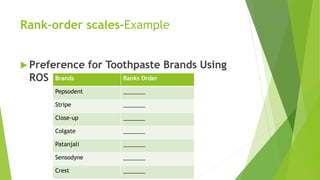
Rank-order scales-Example
 Preference for Toothpaste Brands Using
ROS Brands Ranks Order
Pepsodent _______
Stripe _______
Close-up _______
Colgate _______
Patanjali _______
Sensodyne _______
Crest _______
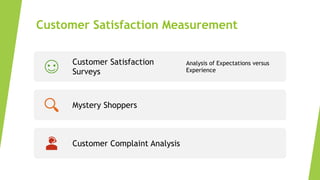
Customer Satisfaction Measurement
Customer Satisfaction
Surveys
Analysis of Expectations versus
Experience
Mystery Shoppers
Customer Complaint Analysis
Sampling and Data Collection
 Samples are a subset of the population used to estimate
characteristics of the entire population.
 A sampling plan addresses:
 Whom to survey
 How many to survey
 How to select them
 Researcher must choose probability or nonprobability
sample.
Data Analysis and Reporting Findings
 Open-ended questions are coded and quantified.
 All responses are tabulated and analyzed.
 Final report includes executive summary, body,
tables, and graphs.
Market Segmentation
Unit 1 Introduction to Consumer Behavior

Unit 1 Introduction to Consumer Behavior

  • 1.
    Course : MBA Semester: 3rd Subject : Consumer Behaviour Faculty : Vivek Singh Sangwan Topic : Introduction to CB Lectures : 1-22
  • 2.
  • 3.
    Why study ConsumerBehavior?  The Consumer is King.  Only the Customer Can Fire Us All.  People are different.  Consumer behavior educates and protects consumers.  Consumer behavior helps formulate public policy.  Consumer behavior affects personal policy. Reference Book:- Consumer Behavior by Blackwell, Miniard and Engel
  • 4.
    Why study ConsumerBehavior?  It’s helpful in understanding needs.  Helps in defining markets and identifying threats and opportunities of a brand.  Segmentation becomes easy. Reference Book:- Consumer Behavior by Blackwell, Miniard and Engel
  • 5.
    Definition  Consumer behaviouris the study of how, why and what people do when they buy product or avail services.  “It attempts to understand the buyer decision making process, both individually and in groups.” – C.L. Narayana and R.J. Markin
  • 6.
    Need for understanding consumer Behaviour Shorter productlife cycles. Evolving consumer preferences. Environmental concerns. Changing lifestyles. Faster technology adoption.
  • 7.
    Consumer Insights- Example How consumer think,feel, reason, and select among different alternatives (e.g., brands & products). How consumers are influenced by their environment (e.g., culture, family, peer groups, and media). The behaviour of consumer while shopping or making any choice decisions.
  • 8.
    Consumer Insights- Example  Limitations inconsumer knowledge or information- processing abilities, which influence decisions and marketing outcomes.  How consumer motivation and decision strategies differ between products that vary in their level of importance or interest.  How marketers can adapt and improve their marketing campaigns or strategies to quickly penetrate into the market.
  • 9.
  • 10.
     It iscomplex, as each customer has a unique set of needs.  It is dynamic in nature, human behaviour is constantly altered by its environment  It varies from customer to customer, product to product and from countries to countries.  It is influenced by varies cultural, social, personal and psychological factors.  The buying behaviour and pattern of an individual reflects his/her status in the society. Nature of Consumer Behaviour
  • 11.
    Scope of Consumer Behaviour Demand Forecasting- Estimating the demand for products and services. Marketing - Understanding the needs, expectations, problems of customers, formulating marketing mix strategies. Advertising – understanding human behaviour towards different advertising appeals and message, selecting the type of media. Human Behaviour – understanding the various motives that’s influences behaviour of a consumer. Operations – Formulating production, pricing and distribution policies.
  • 12.
    Importance of StudyingConsumer Behaviour Helps in segmenting, targeting and positioning the market. Understand the ever- changing tastes of consumer. Preferences are changing and become highly diversified. Understand the consumer decision making process. Helps company to plan according to the needs of the consumer. Helps producer in designing the product and services. Determine which methods of promotion would be most effective for getting the customer to buy a product. Improving the performance of the organization.
  • 13.
  • 14.
    Who Influence aConsumer?
  • 16.
  • 17.
    Customer Research  Itis a part of marketing research in which the preferences, motivations and buying behaviour of the targeted customers are identified through direct observation, mail surveys, telephone or face to face interview and from published sources.
  • 18.
    Customer Research  Datacollection purpose is to strengthen relationship between customer and the company  Contacted customers are disclosed the identity of survey’s sponsor.  Increased or more respondent’s involvement is there.  As large as possible sample size is taken  Respondents expect the researchers to know their usage habits concerning company’s offerings.  Data is identified to fix product and service problems and to correct individual customer’s problems. Marketing Research  Data collection only.  Respondents are not disclosed the research sponsor’s identity.  Respondents level of involvement is generally low.  A sufficient number of respondents are included to achieve satisfied validity at a given confidence level.  Respondents do not expect the researchers to know anything about them.  Product and service problem are identified.
  • 19.
    Applications of Researchof Consumer Behaviour NEW PRODUCT DEVELOPMENT. TEST MARKETING OF NEW PRODUCT OR SERVICE. MEASURE ADVERTISING AND SALES PROMOTION EFFECTIVENESS. MEDIA PLANNING AND MEDIA-MIX DECISIONS. EFFECTIVE PROMOTION AND COMMUNICATION DECISIONS. STUDY CONSUMER PROFILE. DECIDE ABOUT DISTRIBUTION CHANNELS.
  • 20.
    The Importance of theConsumer Research Process  Marketers must understand customers to design effective:  marketing strategies  Products  promotional messages
  • 21.
  • 22.
    Developing Research Objectives Defining purposes and objectiveshelps ensure an appropriate research design. A written statement of objectives helps to define the type and level of information needed.
  • 23.
    Example of research objectives Management Problem:Why are store revenues so low? •Investigate current customer satisfaction •Assess target market perceptions of store and competitors •Determine target market awareness Possible research objective:
  • 24.
    Discussion Questions Assume youare planning to open a new pizza restaurant near your campus. What might be three objectives of a research plan for your new business? How could you gather these data?
  • 25.
    Secondary Data Data thathas been collected for reasons other than the specific research project at hand Includes internal and external data Internal Data  Data generated in-house  May include analysis of customer files  Useful for calculating customer lifetime value External Data  Data collected by an outside organization  Includes federal government, periodicals, newspapers, books, search engines  Commercial data is also available from market research firms: Nielsen, Arbitron, SRDS, and MRI/Mediamark.
  • 26.
    Quality of SecondaryData  Who sponsored the research?  Advocacy research, or research conducted to support a position rather than to find the truth about an issue, is blatantly unethical  What is the ability of the researchers?  Experience is an important consideration for assessing quality  Process of data collection  Bias-free access to respondents is an important consideration for assessing quality
  • 27.
    Pros and Consof Secondary Data  Advantages of Secondary Data 1. Time savings 2. Cost savings  Disadvantages of Secondary Data 1. Problems of fit 2. Problems of accuracy
  • 28.
    Outline  Primary research Qualitative study  Quantitative study:  Data collection methods  Test market  Concept of Measurements  Reliability and Validity  Measurements Common in Consumer Behavior
  • 29.
  • 30.
    Qualitative Collection Method- DepthInterview  Also called one-on-one interview  Usually 20 minutes to 1 hour  Non structured Interviewer will often probe to get more feedback  Session is usually recorded
  • 31.
    Qualitative Collection Method-Focus Group  8-10 participants  Respondents are recruited through a screener questionnaire  Lasts about 2 hours  Always taped or videotaped to assist analysis  Often held in front of two-way mirrors  Online focus groups are growing
  • 32.
    Qualitative Collection Method-Focus Group  8-10 participants  Respondents are recruited through a screener questionnaire  Lasts about 2 hours  Always taped or videotaped to assist analysis  Often held in front of two-way mirrors  Online focus groups are growing
  • 33.
  • 34.
    Qualitative Collection Method- ProjectiveTechniques  Research procedures designed to identify consumers’ subconscious feelings and underlying motivations  Consist of a variety of disguised “tests”.
  • 35.
  • 36.
    Qualitative Collection Method- Metaphor Analysis Based on beliefthat metaphors are the most basic method of thought and communication Zaltman Metaphor Elicitation Technique (ZMET) combines collage research and metaphor analysis to bring to the surface the mental models and the major themes or constructs that drive consumer thinking and behavior. It is believed that much of communication is nonverbal and that people do not think as much in words as they do in images.
  • 38.
    Qualitative Collection Method- “Looking-In” Look at informationfrom threads and postings on social media, including blogs and discussion forums Methodology to capture consumers’ experiences, opinions, forecasts, needs, and interests
  • 39.
  • 40.
    Data Collection Methods-Observational Research  Helps marketers gain an in-depth understanding of the relationship between people and products by watching them buying and using products  Helps researchers gain a better understanding of what the product symbolizes
  • 41.
    Data Collection Methods- Mechanical Observational Research USES MECHANICAL ORELECTRONIC DEVICE TO RECORD CONSUMER BEHAVIOR OR RESPONSE CONSUMERS’ INCREASED USE OF HIGHLY CONVENIENT TECHNOLOGIES WILL CREATE MORE RECORDS FOR MARKETERS AUDITS ARE A TYPE OF MECHANICAL OBSERVATION WHICH MONITOR SALES
  • 42.
    Data Collection Methods MailTelephone Personal Interview Online Cost Low Moderate High Low Speed Slow Immediate Slow Fast Response Rate Slow Moderate High Self-Selected Geographic Flexibility Excellent Good Difficult Excellent Interviewer Bias N/A Moderate Problematic N/A Interviewer Supervision N/A Easy Difficult N/A
  • 43.
    Increase Mail Response Rate Include stamped and self-addressed envelop  Multiple waves of reminders  Use consumer panels
  • 44.
    Increase Mail Response Rate If you were a marketing manager planning a mail survey to find out consumers’ attitude towards your products. Traditionally, mail survey is associated with low response rate of 1%. What suggestion would you give to increase respondent rate?
  • 45.
    Test Market A controlledexperiment done in a limited but carefully selected sector of the marketplace. McDonald’s used test markets to determine that a market existed for McDonald’s own higher-end coffee drink. Three issues in test market: time, cost and control
  • 46.
    Misfires in MarketTesting-Example  Frito-Lay test-marketed its Max Potato, corn and tortilla chips containing the Olestra fat substitutes in Grand Junction, Colorado; A TV crew sampled the chips and succumbed to diarrhea, and then broadcast a report about it, creating lots of bad publicity for the chips  Campbell Soup spent 18 months developing a blended fruit juice called “Juiceworks”. By the time the product reached the market, three competing brands were already on store shelves. Campbell dropped its product
  • 47.
    Validity and Reliability If astudy has validity, it collects the appropriate data for the study. A study has reliability if the same questions, asked of a similar sample, produce the same findings.
  • 48.
    Measurements in Consumer Behavior- Attitude Scales Likert scales  Asked to agree or disagree with a statement  Easy to prepare & interpret  Simple for consumers  Semantic differential scales  Includes bipolar adjectives  Relatively easy to construct and administer  Particularly useful in corporate, brand and product-image studies.  Behavior intention scales  Measures likelihood consumers will act a certain way  Easy to construct and administer  Rank-order scales  Items ranked in order of preference in terms of some criteria
  • 49.
    Likert Scale  Respondentsindicate their degree of agreement or disagreement with each of several statements.  Five to nine categories work well.
  • 50.
  • 51.
  • 52.
  • 53.
    Rank-order scales-Example  Preferencefor Toothpaste Brands Using ROS Brands Ranks Order Pepsodent _______ Stripe _______ Close-up _______ Colgate _______ Patanjali _______ Sensodyne _______ Crest _______
  • 54.
    Customer Satisfaction Measurement CustomerSatisfaction Surveys Analysis of Expectations versus Experience Mystery Shoppers Customer Complaint Analysis
  • 55.
    Sampling and DataCollection  Samples are a subset of the population used to estimate characteristics of the entire population.  A sampling plan addresses:  Whom to survey  How many to survey  How to select them  Researcher must choose probability or nonprobability sample.
  • 56.
    Data Analysis andReporting Findings  Open-ended questions are coded and quantified.  All responses are tabulated and analyzed.  Final report includes executive summary, body, tables, and graphs.
  • 57.