Problem Recognition and
Information Search
Naveen Kashyap, PhD
Indian Institute of Technology Guwahati
Email: naveen.kashyap@iitg.ernet.in
Consumer Decision Process Action Options
• For a high-involvement product, the consumer will
likely use the five EKB model decision process steps
1.Begin the process and stay with it until complete
2.Start and stop and then complete
3.Start and stop and never finish
4.Start and, because of marketplace changes, return
to an earlier step
• For low involvement, the consumer typically goes
directly from problem recognition to choice
Problem Recognition
1. We recognize that we need something
2. We start the process to find the product or service
that will deliver the benefits to fill the need or solve
the problem
Problem Recognition: Actual State
versus Desired State
•Psychological process through which we evaluate the
difference between our actual state and our desired state
•Comparison of our current need or benefits state with
what we would like it to be
•The greater the “perceived distance” between these two,
the more clearly the consumer recognizes potential need
Problem Recognition: Opportunity
Recognition
•You are completely satisfied with your old camera
•You spot an offer for powerful lens and start imagining
•The consumer does not perceive a problem, but perceives
an opportunity that leads to a comparison between actual
state and a new desired state
Influences on Problem Recognition
• Situational influences
•Replace products that are broken, lost, or worn out
•Product acquisition leads consumers to recognize new
needs
•Changed circumstances lead us to perceive new needs
Influences on Problem Recognition
• Consumer influences
• Actual state consumers look to existing goods and services
• Desired state consumers look to new products
Sense of drive to action (motivation) a consumer experiences
once a problem or need has been recognized
1. Optimize satisfaction 4. Resolve conflict
2. Prevent possible future problem 5. Maintain Satisfaction
3. Escape from a problem
Influences on Problem Recognition
• Marketing Influences
• Marketing information may lead the consumer to reevaluate
his or her actual and desired states
• Price information can be influential
• Promotional activities: advertising, coupons, free offers,
sweepstakes, product demonstrations, rebates
• Product or service developments can trigger a reassessment
of actual and desired states
• Place actions can trigger need recognition
Information Search
•Marketplace information is all around us
•Consumers can and do search for and find information
on products in many ways
•Different consumers look for differing amounts and
types of information
•Consumers often combine their information search
with alternative evaluation
If We Know ...
1. Why consumers are searching for information
2. Where they are looking
3. What information they are looking for
4. How extensively they are willing to search
• We can identify potential customers and their information needs
Types of Information Search
• Prepurchase information search
• Directed information searches are purposeful & deliberate
• Browsing may eventually lead to purchasing
• Accidental information search: a consumer who is not
looking for anything in particular is drawn to a product
• Postpurchase information search
• A consumer who has already made a purchase continues to
gather information and/or evaluates other options
• Ongoing search
• Consumers observe and stay current with what is happening
Internal Information Search
•Involves no sources other than the consumer’s own
memory, knowledge, and experience
•Experts are consumers who have gained extensive prior
knowledge through experience and training
•Novices are consumers who have little or no prior
knowledge or experience with a product or service
category
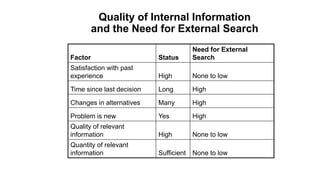
Quality of Internal Information
and the Need for External Search
Factor Status
Need for External
Search
Satisfaction with past
experience High None to low
Time since last decision Long High
Changes in alternatives Many High
Problem is new Yes High
Quality of relevant
information High None to low
Quantity of relevant
information Sufficient None to low
External Information Search
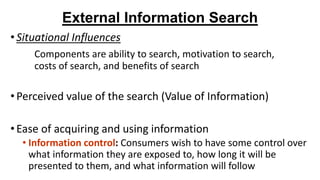
• Situational Influences
Components are ability to search, motivation to search,
costs of search, and benefits of search
• Perceived value of the search (Value of Information)
• Ease of acquiring and using information
• Information control: Consumers wish to have some control over
what information they are exposed to, how long it will be
presented to them, and what information will follow
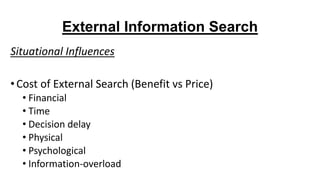
Situational Influences
• Cost of External Search (Benefit vs Price)
• Financial
• Time
• Decision delay
• Physical
• Psychological
• Information-overload
External Information Search
Two Types of Capital
•Information capital is information about product
attributes, benefits, and prices learned by a consumer
in the past that can still be used in the current
situation
•Skill capital is related to how to search. Consumers
who have learned how to search from past experience
will enjoy lower search costs, and the amount of
information gathered will also be higher
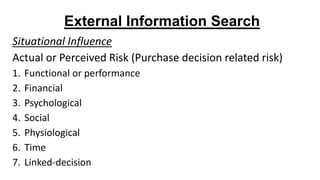
Situational Influence
Actual or Perceived Risk (Purchase decision related risk)
1. Functional or performance
2. Financial
3. Psychological
4. Social
5. Physiological
6. Time
7. Linked-decision
External Information Search
Consumer Influences
• Quality of internal information (reliable, trust, quantity, useful)
• Need to acquire information (Inverted U, Knowledge & Extent)
• Confidence in decision-making ability (consumer influence)
• Locus of control theory (consumer influence)
• Externals believe that events or outcomes are outside their
control
• Internals believe that they are at least in part responsible for
the outcome of their actions
External Information Search
Product Influence
Type of Goods or Services Sought
1. Specialty goods and services (strong preference)
2. Shopping goods and services (major purchase)
3. Convenience goods and services (every day goods)
• Search products: most essential attributes and benefits can
easily be evaluated prior to the purchase
• Experience products: the evaluation cost is so high that
direct experience results in the lowest expenditure of
resources
External Information Search
Purchase Decision Influences
Characteristics of the Purchase Decision
1. Extent to which the number of possible solutions is limited
• If the acceptable characteristics sought are narrowly defined,
consumers are likely to accept the need for an extensive search
2. Need for trial
• If a product needs to be tried out before it is purchased,
consumers are more likely to engage in external search
3. Difficulty of trial
• When prepurchase trial is difficult or impossible, consumers
search for a reliable, quality supplier
External Information Search
External Search Strategy (Limiting Search Activity)
• Using sets: groups used to limit external search and alternative
evaluation
• Universal set—all options to which the consumer has access
• Retrieval set—consumer has front-of-mind awareness
• Relevant or consideration (evoked) set—consumer accepts
• Irrelevant information impact
• Consumers selectively look for “confirming” information that the
product or service delivers the desired benefits
• Information deemed “irrelevant” by its target market(s) will
weaken consumer beliefs concerning the product’s ability “to
deliver”
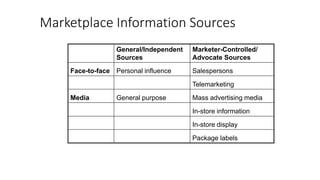
Marketplace Information Sources
General/Independent
Sources
Marketer-Controlled/
Advocate Sources
Face-to-face Personal influence Salespersons
Telemarketing
Media General purpose Mass advertising media
In-store information
In-store display
Package labels
Sources and Uses of
Information in “U-Commerce”
• U-commerce (Uber-commerce) flows out of the hyper-networking
of computers
1. Ubiquity: networked computers are everywhere
2. Universality: access available anywhere
3. Uniqueness: customized to consumer needs
4. Unison or unified: change one, change them all
Believability of Sources of
Information on Products and Services
• Consumer Reports (58 percent)
• Recommendation from a friend (52 percent)
• Direct-mail piece (4 percent)
• Celebrity endorsement (3 percent)

Problem recognition and information search

  • 1.
    Problem Recognition and InformationSearch Naveen Kashyap, PhD Indian Institute of Technology Guwahati Email: naveen.kashyap@iitg.ernet.in
  • 2.
    Consumer Decision ProcessAction Options • For a high-involvement product, the consumer will likely use the five EKB model decision process steps 1.Begin the process and stay with it until complete 2.Start and stop and then complete 3.Start and stop and never finish 4.Start and, because of marketplace changes, return to an earlier step • For low involvement, the consumer typically goes directly from problem recognition to choice
  • 3.
    Problem Recognition 1. Werecognize that we need something 2. We start the process to find the product or service that will deliver the benefits to fill the need or solve the problem
  • 4.
    Problem Recognition: ActualState versus Desired State •Psychological process through which we evaluate the difference between our actual state and our desired state •Comparison of our current need or benefits state with what we would like it to be •The greater the “perceived distance” between these two, the more clearly the consumer recognizes potential need
  • 5.
    Problem Recognition: Opportunity Recognition •Youare completely satisfied with your old camera •You spot an offer for powerful lens and start imagining •The consumer does not perceive a problem, but perceives an opportunity that leads to a comparison between actual state and a new desired state
  • 6.
    Influences on ProblemRecognition • Situational influences •Replace products that are broken, lost, or worn out •Product acquisition leads consumers to recognize new needs •Changed circumstances lead us to perceive new needs
  • 7.
    Influences on ProblemRecognition • Consumer influences • Actual state consumers look to existing goods and services • Desired state consumers look to new products Sense of drive to action (motivation) a consumer experiences once a problem or need has been recognized 1. Optimize satisfaction 4. Resolve conflict 2. Prevent possible future problem 5. Maintain Satisfaction 3. Escape from a problem
  • 8.
    Influences on ProblemRecognition • Marketing Influences • Marketing information may lead the consumer to reevaluate his or her actual and desired states • Price information can be influential • Promotional activities: advertising, coupons, free offers, sweepstakes, product demonstrations, rebates • Product or service developments can trigger a reassessment of actual and desired states • Place actions can trigger need recognition
  • 9.
    Information Search •Marketplace informationis all around us •Consumers can and do search for and find information on products in many ways •Different consumers look for differing amounts and types of information •Consumers often combine their information search with alternative evaluation
  • 10.
    If We Know... 1. Why consumers are searching for information 2. Where they are looking 3. What information they are looking for 4. How extensively they are willing to search • We can identify potential customers and their information needs
  • 11.
    Types of InformationSearch • Prepurchase information search • Directed information searches are purposeful & deliberate • Browsing may eventually lead to purchasing • Accidental information search: a consumer who is not looking for anything in particular is drawn to a product • Postpurchase information search • A consumer who has already made a purchase continues to gather information and/or evaluates other options • Ongoing search • Consumers observe and stay current with what is happening
  • 12.
    Internal Information Search •Involvesno sources other than the consumer’s own memory, knowledge, and experience •Experts are consumers who have gained extensive prior knowledge through experience and training •Novices are consumers who have little or no prior knowledge or experience with a product or service category
  • 13.
    Quality of InternalInformation and the Need for External Search Factor Status Need for External Search Satisfaction with past experience High None to low Time since last decision Long High Changes in alternatives Many High Problem is new Yes High Quality of relevant information High None to low Quantity of relevant information Sufficient None to low
  • 14.
    External Information Search •Situational Influences Components are ability to search, motivation to search, costs of search, and benefits of search • Perceived value of the search (Value of Information) • Ease of acquiring and using information • Information control: Consumers wish to have some control over what information they are exposed to, how long it will be presented to them, and what information will follow
  • 15.
    Situational Influences • Costof External Search (Benefit vs Price) • Financial • Time • Decision delay • Physical • Psychological • Information-overload External Information Search
  • 16.
    Two Types ofCapital •Information capital is information about product attributes, benefits, and prices learned by a consumer in the past that can still be used in the current situation •Skill capital is related to how to search. Consumers who have learned how to search from past experience will enjoy lower search costs, and the amount of information gathered will also be higher
  • 17.
    Situational Influence Actual orPerceived Risk (Purchase decision related risk) 1. Functional or performance 2. Financial 3. Psychological 4. Social 5. Physiological 6. Time 7. Linked-decision External Information Search
  • 18.
    Consumer Influences • Qualityof internal information (reliable, trust, quantity, useful) • Need to acquire information (Inverted U, Knowledge & Extent) • Confidence in decision-making ability (consumer influence) • Locus of control theory (consumer influence) • Externals believe that events or outcomes are outside their control • Internals believe that they are at least in part responsible for the outcome of their actions External Information Search
  • 19.
    Product Influence Type ofGoods or Services Sought 1. Specialty goods and services (strong preference) 2. Shopping goods and services (major purchase) 3. Convenience goods and services (every day goods) • Search products: most essential attributes and benefits can easily be evaluated prior to the purchase • Experience products: the evaluation cost is so high that direct experience results in the lowest expenditure of resources External Information Search
  • 20.
    Purchase Decision Influences Characteristicsof the Purchase Decision 1. Extent to which the number of possible solutions is limited • If the acceptable characteristics sought are narrowly defined, consumers are likely to accept the need for an extensive search 2. Need for trial • If a product needs to be tried out before it is purchased, consumers are more likely to engage in external search 3. Difficulty of trial • When prepurchase trial is difficult or impossible, consumers search for a reliable, quality supplier External Information Search
  • 21.
    External Search Strategy(Limiting Search Activity) • Using sets: groups used to limit external search and alternative evaluation • Universal set—all options to which the consumer has access • Retrieval set—consumer has front-of-mind awareness • Relevant or consideration (evoked) set—consumer accepts • Irrelevant information impact • Consumers selectively look for “confirming” information that the product or service delivers the desired benefits • Information deemed “irrelevant” by its target market(s) will weaken consumer beliefs concerning the product’s ability “to deliver”
  • 22.
    Marketplace Information Sources General/Independent Sources Marketer-Controlled/ AdvocateSources Face-to-face Personal influence Salespersons Telemarketing Media General purpose Mass advertising media In-store information In-store display Package labels
  • 23.
    Sources and Usesof Information in “U-Commerce” • U-commerce (Uber-commerce) flows out of the hyper-networking of computers 1. Ubiquity: networked computers are everywhere 2. Universality: access available anywhere 3. Uniqueness: customized to consumer needs 4. Unison or unified: change one, change them all
  • 24.
    Believability of Sourcesof Information on Products and Services • Consumer Reports (58 percent) • Recommendation from a friend (52 percent) • Direct-mail piece (4 percent) • Celebrity endorsement (3 percent)