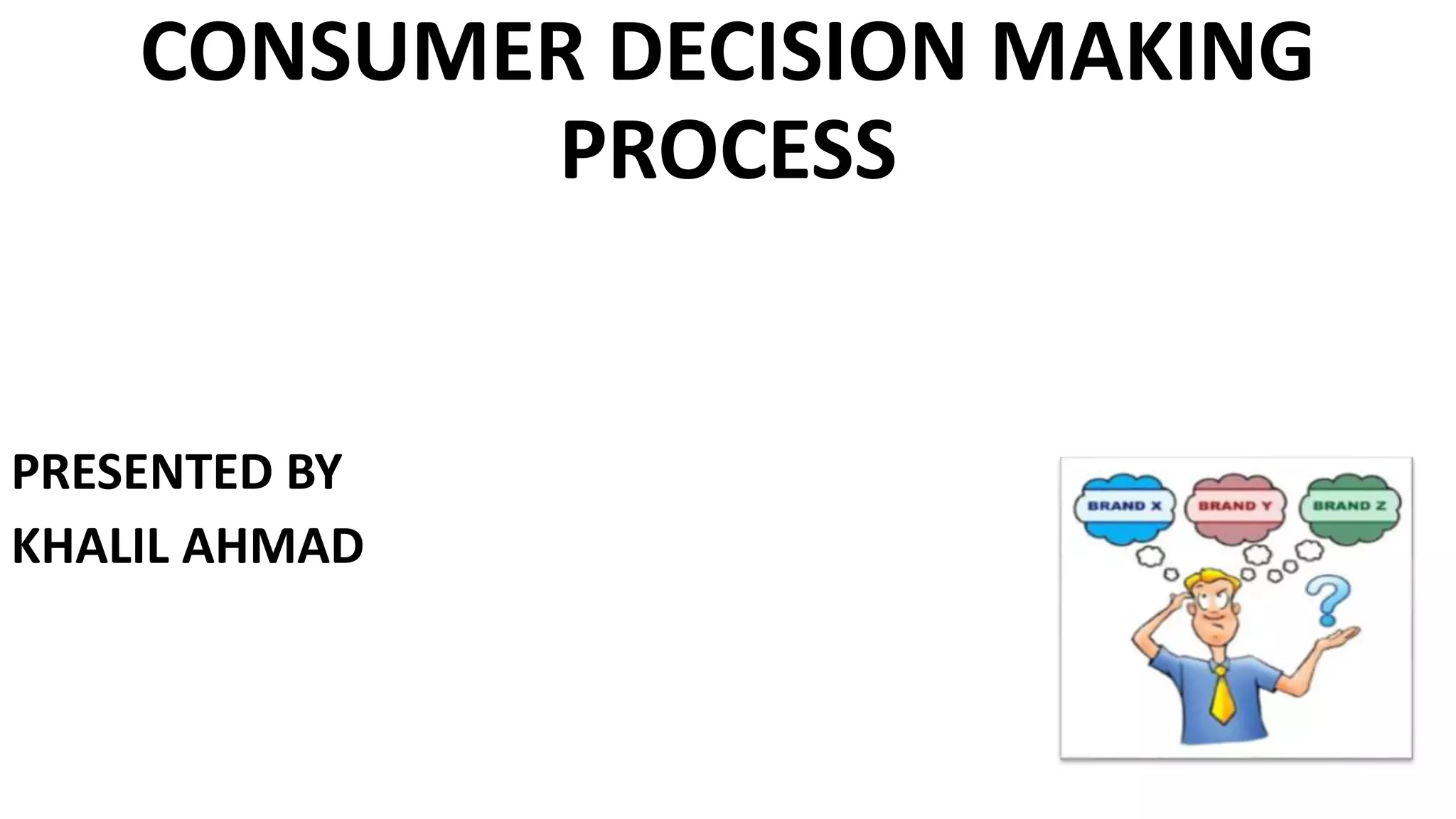
CONSUMER DECISION MAKING
PROCESS
PRESENTED BY
KHALIL AHMAD
CONTENTS
•INTRODUCTION
•FIVE FACTORS INFLUENCING DECISION
•LEVELS OF CONSUMER DECISION
MAKING
•TYPES OF CONSUMER BUYING DECISIONS
•CONSUMER DECISION-MAKING PROCESS
INTRODUCTION
• The purchase is only the visible part of a more complex
decision process created by the consumer for each buying
decision he makes.
• But what happens before and after this purchase?
• What are the factors influencing the choice of product
purchased by the consumer?
• Let’s focus on the Consumer Buying Decision Process and the
stages that lead to purchase a new product.
Five Factors Influencing Decisions
1. Level of consumer involvement
2. Length of time to make decision
3. Cost of good or service
4. Degree of information search
5. Number of alternatives considered
LEVELS OF CONSUMER DECISION
MAKING
• Not all consumer decisions receive or require the same amount of
effort in the information search.
• Researchers have identified three specific levels of consumer decision
making:
i. extensive problem solving,
ii. limited problem solving, and
iii. routinized response behavior.
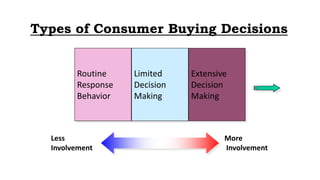
Types of Consumer Buying Decisions
More
Involvement
Less
Involvement
Routine
Response
Behavior
Limited
Decision
Making
Extensive
Decision
Making
Extensive Problem Solving
• When consumers have no established criteria for evaluating a
product, or have not narrowed their choices, then they are in
extensive problem solving.
• At this level, the consumer needs a great deal of information to
establish a set of criteria on which to judge specific brands and a
correspondingly large amount of information concerning each of the
brands to be considered.
• Example- Used while buying expensive, important or technically
complicated product or services.
Limited Problem Solving
• At this level consumers have already established the basic criteria for
evaluating the product category but haven’t established preferred
categories.
• Their search for additional information is more like “fine-tuning;”
they must gather additional brand information to discriminate
among the various brands.
• Example- Usually used when purchasing a new, updated version of
something. Replacing something old with something new.
Routinized Response Behavior
• At this level, consumers have some experience with the product
category and a well-established set of criteria with which to evaluate
the brands they are considering.
• They may search for a small amount of additional information.
• Routinized response behavior implies little need for additional
information.
• Example- Day to day decisions.
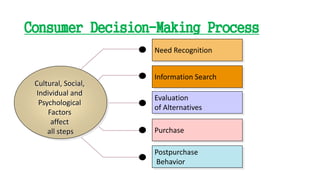
Consumer Decision-Making Process
Postpurchase
Behavior
Purchase
Evaluation
of Alternatives
Information Search
Need Recognition
Cultural, Social,
Individual and
Psychological
Factors
affect
all steps
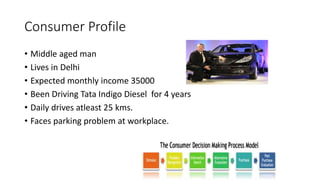
Consumer Profile
• Middle aged man
• Lives in Delhi
• Expected monthly income 35000
• Been Driving Tata Indigo Diesel for 4 years
• Daily drives atleast 25 kms.
• Faces parking problem at workplace.
Need Recognition
• Recognition of a need occurs when a consumer is faced with a
problem.
• Among consumers there seem to be two different problem
recognition styles.
• Actual state types —consumers who perceive that they have a
problem when a product fails to perform satisfactorily.
• Desired state types —the desire for something new may trigger
the decision process.
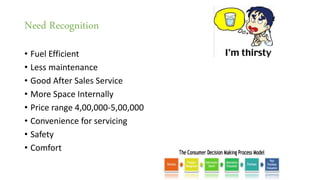
Need Recognition
• Fuel Efficient
• Less maintenance
• Good After Sales Service
• More Space Internally
• Price range 4,00,000-5,00,000
• Convenience for servicing
• Safety
• Comfort
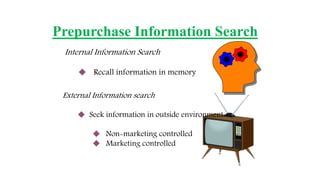
Prepurchase Information Search
Internal Information Search
 Recall information in memory
External Information search
 Seek information in outside environment
 Non-marketing controlled
 Marketing controlled
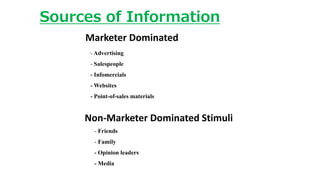
- Advertising
- Salespeople
- Infomercials
- Websites
- Point-of-sales materials
Sources of Information
Marketer Dominated
- Friends
- Family
- Opinion leaders
- Media
Non-Marketer Dominated Stimuli
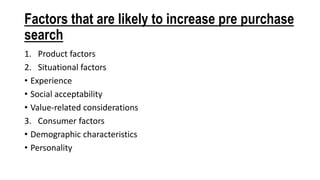
Factors that are likely to increase pre purchase
search
1. Product factors
2. Situational factors
• Experience
• Social acceptability
• Value-related considerations
3. Consumer factors
• Demographic characteristics
• Personality
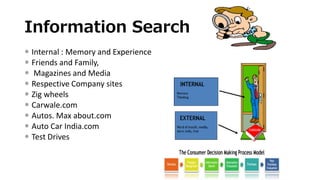
Information Search
 Internal : Memory and Experience
 Friends and Family,
 Magazines and Media
 Respective Company sites
 Zig wheels
 Carwale.com
 Autos. Max about.com
 Auto Car India.com
 Test Drives
Evaluating Alternatives
Determine criteria to be used for
evaluation of products
Assess the relative importance of the
each criteria
Evaluate each alternative based on the
identified criteria
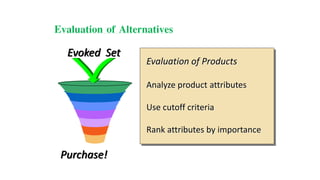
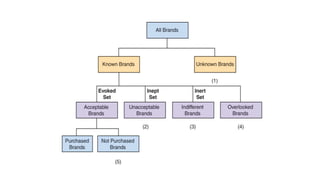
Evoked Set
Purchase!
Evaluation of Products
Analyze product attributes
Use cutoff criteria
Rank attributes by importance
Evaluation of Alternatives
• When evaluating potential alternatives, consumers tend to use two
types of information:
• A “list” of brands (the evoked set).
• The criteria they will use to evaluate each brand.
The evoked set refers to the specific brands the consumer considers
in making a purchase in a particular product category.
The inept set consists of brands the consumer excludes from
purchase consideration as unacceptable.
The inert set is those brands to which the consumer is indifferent
because they are perceived as having no advantage.
Evaluation of Alternatives
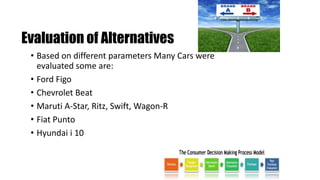
• Based on different parameters Many Cars were
evaluated some are:
• Ford Figo
• Chevrolet Beat
• Maruti A-Star, Ritz, Swift, Wagon-R
• Fiat Punto
• Hyundai i 10
:
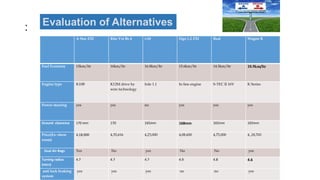
A Star ZXI Ritz Vxi Bs 4 i-10 Figo 1.2 ZXI Beat Wagon R
Fuel Economy 15km/ltr 16km/ltr 16.8km/ltr 15.6km/ltr 14.5km/ltr 18.9km/ltr
Engine type K10B K12M drive by
wire technology
Irde 1.1 In line engine S-TEC II 16V K Series
Power steering yes yes no yes yes yes
Ground clearence 170 mm 170 165mm 168mm 165mm 165mm
Price(Ex- show
room)
4,18,000 4,35,616 4,23,000 4,08,600 4,75,000 4.,18,765
Dual Air-Bags Yes No yes No No yes
Turning radius
(mtrs)
4.7 4.7 4.7 4.9 4.8 4.6
anti lock braking
system
yes yes yes no no yes
Evaluation of Alternatives
Evaluation
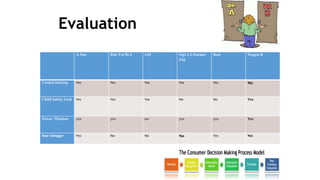
A Star Ritz Vxi Bs 4 i-10 Figo 1.2 Duratec
ZXI
Beat Wagon R
Central locking Yes Yes Yes Yes Yes Yes
Child Safety Lock Yes Yes Yes No No Yes
Power Window yes yes no yes yes Yes
Rear Defogger Yes No No Yes Yes Yes
Purchase
To buy
or not to buy...
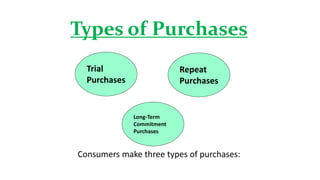
Types of Purchases
Consumers make three types of purchases:
Trial
Purchases
Repeat
Purchases
Long-Term
Commitment
Purchases
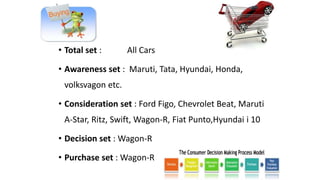
• Total set : All Cars
• Awareness set : Maruti, Tata, Hyundai, Honda,
volksvagon etc.
• Consideration set : Ford Figo, Chevrolet Beat, Maruti
A-Star, Ritz, Swift, Wagon-R, Fiat Punto,Hyundai i 10
• Decision set : Wagon-R
• Purchase set : Wagon-R
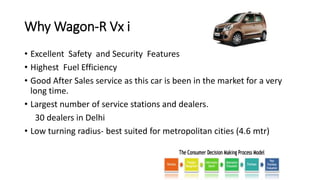
Why Wagon-R Vx i
• Excellent Safety and Security Features
• Highest Fuel Efficiency
• Good After Sales service as this car is been in the market for a very
long time.
• Largest number of service stations and dealers.
30 dealers in Delhi
• Low turning radius- best suited for metropolitan cities (4.6 mtr)
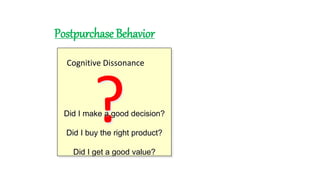
Postpurchase Behavior
Cognitive Dissonance
?Did I make a good decision?
Did I buy the right product?
Did I get a good value?
• As consumers use a product, they evaluate its
performance in light of their own expectations.
• There are three possible outcomes of such
evaluation.
• Actual performance matches the standard, leading
to a neutral feeling.
• Positive disconfirmation when the performance
exceeds the standard.
• Negative disconfirmation when the performance is
below the standard.
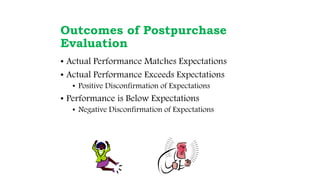
Outcomes of Postpurchase
Evaluation
• Actual Performance Matches Expectations
• Actual Performance Exceeds Expectations
• Positive Disconfirmation of Expectations
• Performance is Below Expectations
• Negative Disconfirmation of Expectations
Consumer decision making process

Consumer decision making process

  • 1.
  • 2.
    CONTENTS •INTRODUCTION •FIVE FACTORS INFLUENCINGDECISION •LEVELS OF CONSUMER DECISION MAKING •TYPES OF CONSUMER BUYING DECISIONS •CONSUMER DECISION-MAKING PROCESS
  • 3.
    INTRODUCTION • The purchaseis only the visible part of a more complex decision process created by the consumer for each buying decision he makes. • But what happens before and after this purchase? • What are the factors influencing the choice of product purchased by the consumer? • Let’s focus on the Consumer Buying Decision Process and the stages that lead to purchase a new product.
  • 4.
    Five Factors InfluencingDecisions 1. Level of consumer involvement 2. Length of time to make decision 3. Cost of good or service 4. Degree of information search 5. Number of alternatives considered
  • 5.
    LEVELS OF CONSUMERDECISION MAKING • Not all consumer decisions receive or require the same amount of effort in the information search. • Researchers have identified three specific levels of consumer decision making: i. extensive problem solving, ii. limited problem solving, and iii. routinized response behavior.
  • 6.
    Types of ConsumerBuying Decisions More Involvement Less Involvement Routine Response Behavior Limited Decision Making Extensive Decision Making
  • 7.
    Extensive Problem Solving •When consumers have no established criteria for evaluating a product, or have not narrowed their choices, then they are in extensive problem solving. • At this level, the consumer needs a great deal of information to establish a set of criteria on which to judge specific brands and a correspondingly large amount of information concerning each of the brands to be considered. • Example- Used while buying expensive, important or technically complicated product or services.
  • 8.
    Limited Problem Solving •At this level consumers have already established the basic criteria for evaluating the product category but haven’t established preferred categories. • Their search for additional information is more like “fine-tuning;” they must gather additional brand information to discriminate among the various brands. • Example- Usually used when purchasing a new, updated version of something. Replacing something old with something new.
  • 9.
    Routinized Response Behavior •At this level, consumers have some experience with the product category and a well-established set of criteria with which to evaluate the brands they are considering. • They may search for a small amount of additional information. • Routinized response behavior implies little need for additional information. • Example- Day to day decisions.
  • 10.
    Consumer Decision-Making Process Postpurchase Behavior Purchase Evaluation ofAlternatives Information Search Need Recognition Cultural, Social, Individual and Psychological Factors affect all steps
  • 11.
    Consumer Profile • Middleaged man • Lives in Delhi • Expected monthly income 35000 • Been Driving Tata Indigo Diesel for 4 years • Daily drives atleast 25 kms. • Faces parking problem at workplace.
  • 12.
    Need Recognition • Recognitionof a need occurs when a consumer is faced with a problem. • Among consumers there seem to be two different problem recognition styles. • Actual state types —consumers who perceive that they have a problem when a product fails to perform satisfactorily. • Desired state types —the desire for something new may trigger the decision process.
  • 13.
    Need Recognition • FuelEfficient • Less maintenance • Good After Sales Service • More Space Internally • Price range 4,00,000-5,00,000 • Convenience for servicing • Safety • Comfort
  • 14.
    Prepurchase Information Search InternalInformation Search  Recall information in memory External Information search  Seek information in outside environment  Non-marketing controlled  Marketing controlled
  • 15.
    - Advertising - Salespeople -Infomercials - Websites - Point-of-sales materials Sources of Information Marketer Dominated - Friends - Family - Opinion leaders - Media Non-Marketer Dominated Stimuli
  • 16.
    Factors that arelikely to increase pre purchase search 1. Product factors 2. Situational factors • Experience • Social acceptability • Value-related considerations 3. Consumer factors • Demographic characteristics • Personality
  • 17.
    Information Search  Internal: Memory and Experience  Friends and Family,  Magazines and Media  Respective Company sites  Zig wheels  Carwale.com  Autos. Max about.com  Auto Car India.com  Test Drives
  • 18.
    Evaluating Alternatives Determine criteriato be used for evaluation of products Assess the relative importance of the each criteria Evaluate each alternative based on the identified criteria
  • 19.
    Evoked Set Purchase! Evaluation ofProducts Analyze product attributes Use cutoff criteria Rank attributes by importance Evaluation of Alternatives
  • 20.
    Evaluation of Alternatives •When evaluating potential alternatives, consumers tend to use two types of information: • A “list” of brands (the evoked set). • The criteria they will use to evaluate each brand. The evoked set refers to the specific brands the consumer considers in making a purchase in a particular product category. The inept set consists of brands the consumer excludes from purchase consideration as unacceptable. The inert set is those brands to which the consumer is indifferent because they are perceived as having no advantage.
  • 22.
    Evaluation of Alternatives •Based on different parameters Many Cars were evaluated some are: • Ford Figo • Chevrolet Beat • Maruti A-Star, Ritz, Swift, Wagon-R • Fiat Punto • Hyundai i 10
  • 23.
    : A Star ZXIRitz Vxi Bs 4 i-10 Figo 1.2 ZXI Beat Wagon R Fuel Economy 15km/ltr 16km/ltr 16.8km/ltr 15.6km/ltr 14.5km/ltr 18.9km/ltr Engine type K10B K12M drive by wire technology Irde 1.1 In line engine S-TEC II 16V K Series Power steering yes yes no yes yes yes Ground clearence 170 mm 170 165mm 168mm 165mm 165mm Price(Ex- show room) 4,18,000 4,35,616 4,23,000 4,08,600 4,75,000 4.,18,765 Dual Air-Bags Yes No yes No No yes Turning radius (mtrs) 4.7 4.7 4.7 4.9 4.8 4.6 anti lock braking system yes yes yes no no yes Evaluation of Alternatives
  • 24.
    Evaluation A Star RitzVxi Bs 4 i-10 Figo 1.2 Duratec ZXI Beat Wagon R Central locking Yes Yes Yes Yes Yes Yes Child Safety Lock Yes Yes Yes No No Yes Power Window yes yes no yes yes Yes Rear Defogger Yes No No Yes Yes Yes
  • 25.
  • 26.
    Types of Purchases Consumersmake three types of purchases: Trial Purchases Repeat Purchases Long-Term Commitment Purchases
  • 27.
    • Total set: All Cars • Awareness set : Maruti, Tata, Hyundai, Honda, volksvagon etc. • Consideration set : Ford Figo, Chevrolet Beat, Maruti A-Star, Ritz, Swift, Wagon-R, Fiat Punto,Hyundai i 10 • Decision set : Wagon-R • Purchase set : Wagon-R
  • 28.
    Why Wagon-R Vxi • Excellent Safety and Security Features • Highest Fuel Efficiency • Good After Sales service as this car is been in the market for a very long time. • Largest number of service stations and dealers. 30 dealers in Delhi • Low turning radius- best suited for metropolitan cities (4.6 mtr)
  • 29.
    Postpurchase Behavior Cognitive Dissonance ?DidI make a good decision? Did I buy the right product? Did I get a good value?
  • 30.
    • As consumersuse a product, they evaluate its performance in light of their own expectations. • There are three possible outcomes of such evaluation. • Actual performance matches the standard, leading to a neutral feeling. • Positive disconfirmation when the performance exceeds the standard. • Negative disconfirmation when the performance is below the standard.
  • 31.
    Outcomes of Postpurchase Evaluation •Actual Performance Matches Expectations • Actual Performance Exceeds Expectations • Positive Disconfirmation of Expectations • Performance is Below Expectations • Negative Disconfirmation of Expectations