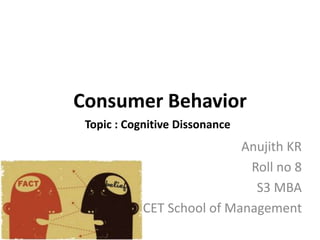
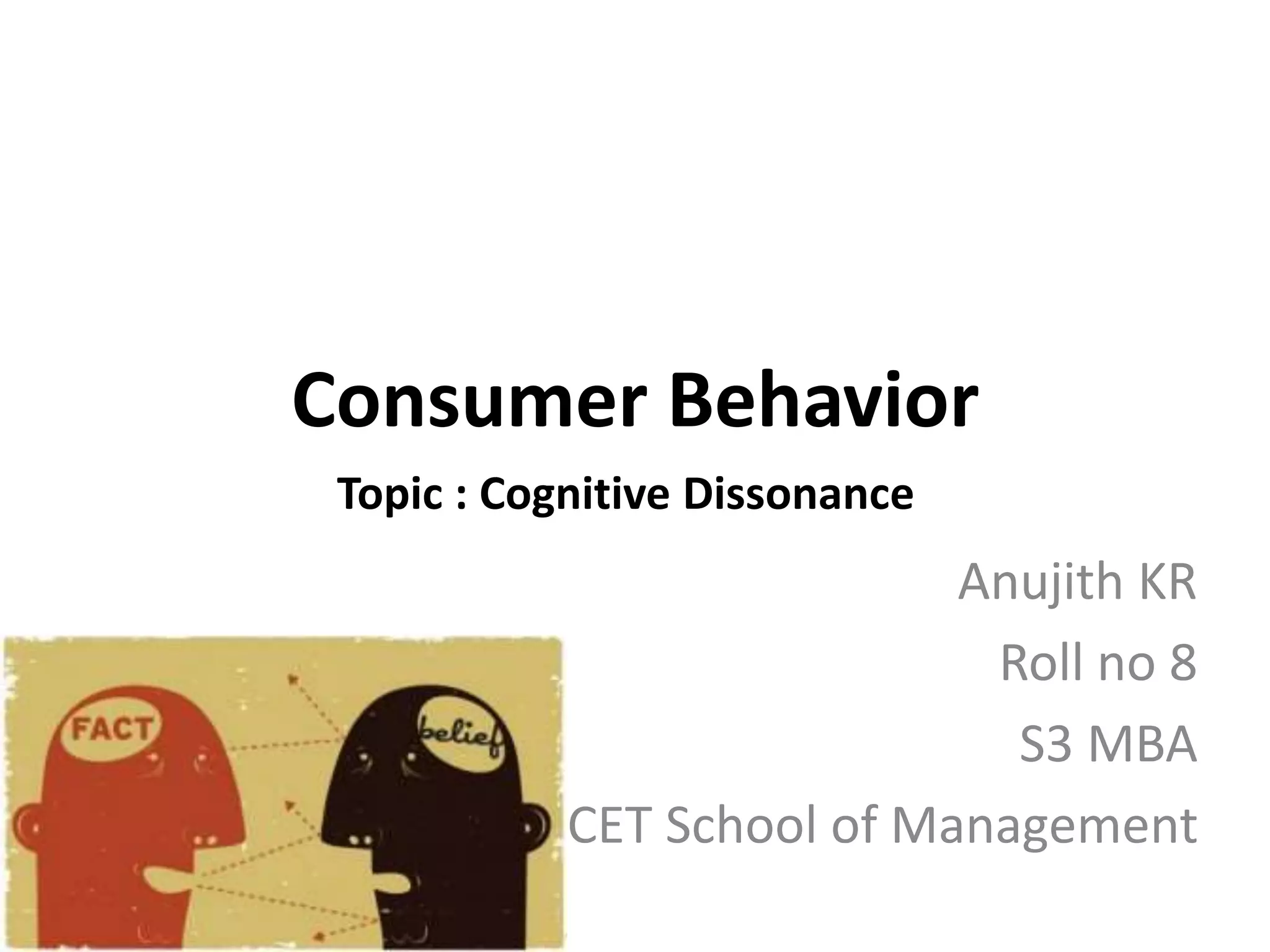
Consumer Behavior
Anujith KR
Roll no 8
S3 MBA
CET School of Management
Topic : Cognitive Dissonance
Definition
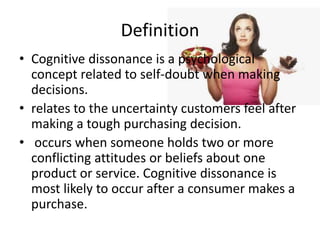
• Cognitive dissonance is a psychological
concept related to self-doubt when making
decisions.
• relates to the uncertainty customers feel after
making a tough purchasing decision.
• occurs when someone holds two or more
conflicting attitudes or beliefs about one
product or service. Cognitive dissonance is
most likely to occur after a consumer makes a
purchase.
• People tend to seek consistency in their
beliefs and perceptions.
• The term cognitive dissonance is used to
describe the feeling of discomfort that results
from holding two conflicting beliefs. When
there is a discrepancy between beliefs and
behaviours , something must change in order
to eliminate or reduce the dissonance.
Minimize cognitive dissonance
• Focus on more supportive beliefs that
outweigh the dissonant belief or behaviour.
• Reduce the importance of the conflicting
belief.
• Change the conflicting belief so that it is
consistent with other beliefs or behaviours.
Examples of Cognitive Dissonance
• Consider a situation in which a man who places a
value on being environmentally responsible just
purchased a new car that he later discovers does
not get great gas mileage.
• The conflict
 It is important for the man to take care of the
environment.
 He is driving a car that is not environmentally-
friendly.
Strategies to minimize cognitive
dissonance
• 1. Focus on more encouraging beliefs that offset the dissonant belief or behaviour.
• 2. Reduce the importance of the contradictory belief.
• 3. Change the conflicting belief so that it is consistent with other beliefs or
• behaviours.
• 4. Focus on more encouraging beliefs that offset the dissonant belief or behaviour.
• 5. Change the conflicting belief so that it is consistent with other beliefs or
• behaviours.
• 6. Looking for credible source which the target consumers trust. At the same time
• word-of-mouth communications need to be increased.
• 7. Emphasize on selecting a likeable source.
• 8. Finding out the sources which match customer’s previous belief.
• 9. Unexpected source sometimes may have more impact on consumer’s attitudes.
Cognitive dissonance

Cognitive dissonance

  • 1.
    Consumer Behavior Anujith KR Rollno 8 S3 MBA CET School of Management Topic : Cognitive Dissonance
  • 2.
    Definition • Cognitive dissonanceis a psychological concept related to self-doubt when making decisions. • relates to the uncertainty customers feel after making a tough purchasing decision. • occurs when someone holds two or more conflicting attitudes or beliefs about one product or service. Cognitive dissonance is most likely to occur after a consumer makes a purchase.
  • 3.
    • People tendto seek consistency in their beliefs and perceptions. • The term cognitive dissonance is used to describe the feeling of discomfort that results from holding two conflicting beliefs. When there is a discrepancy between beliefs and behaviours , something must change in order to eliminate or reduce the dissonance.
  • 4.
    Minimize cognitive dissonance •Focus on more supportive beliefs that outweigh the dissonant belief or behaviour. • Reduce the importance of the conflicting belief. • Change the conflicting belief so that it is consistent with other beliefs or behaviours.
  • 5.
    Examples of CognitiveDissonance • Consider a situation in which a man who places a value on being environmentally responsible just purchased a new car that he later discovers does not get great gas mileage. • The conflict  It is important for the man to take care of the environment.  He is driving a car that is not environmentally- friendly.
  • 6.
    Strategies to minimizecognitive dissonance • 1. Focus on more encouraging beliefs that offset the dissonant belief or behaviour. • 2. Reduce the importance of the contradictory belief. • 3. Change the conflicting belief so that it is consistent with other beliefs or • behaviours. • 4. Focus on more encouraging beliefs that offset the dissonant belief or behaviour. • 5. Change the conflicting belief so that it is consistent with other beliefs or • behaviours. • 6. Looking for credible source which the target consumers trust. At the same time • word-of-mouth communications need to be increased. • 7. Emphasize on selecting a likeable source. • 8. Finding out the sources which match customer’s previous belief. • 9. Unexpected source sometimes may have more impact on consumer’s attitudes.