2015 - CONSUMER BEHAVIOR DR. AHMAD FARAZ – CBA - UOD
Consumer Decision Making:
Basis, Influences, Models & Process.
2015 - CONSUMER BEHAVIOR DR. AHMAD FARAZ – CBA - UOD
Lecture
3
2015 - CONSUMER BEHAVIOR DR. AHMAD FARAZ – CBA - UOD
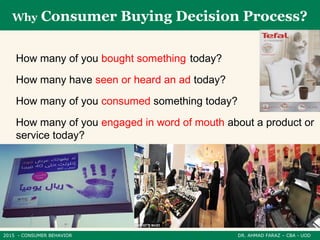
Why Consumer Buying Decision Process?
How many of you bought something today?
How many have seen or heard an ad today?
How many of you consumed something today?
How many of you engaged in word of mouth about a product or
service today?
2015 - CONSUMER BEHAVIOR DR. AHMAD FARAZ – CBA - UOD
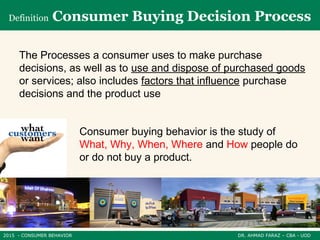
The Processes a consumer uses to make purchase
decisions, as well as to use and dispose of purchased goods
or services; also includes factors that influence purchase
decisions and the product use
Definition Consumer Buying Decision Process
Consumer buying behavior is the study of
What, Why, When, Where and How people do
or do not buy a product.
2015 - CONSUMER BEHAVIOR DR. AHMAD FARAZ – CBA - UOD
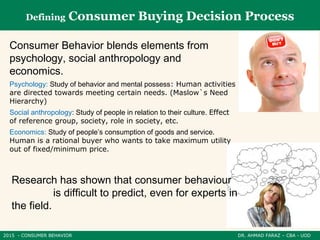
Defining Consumer Buying Decision Process
Consumer Behavior blends elements from
psychology, social anthropology and
economics.
Research has shown that consumer behaviour
is difficult to predict, even for experts in
the field.
Psychology: Study of behavior and mental possess: Human activities
are directed towards meeting certain needs. (Maslow`s Need
Hierarchy)
Social anthropology: Study of people in relation to their culture. Effect
of reference group, society, role in society, etc.
Economics: Study of people’s consumption of goods and service.
Human is a rational buyer who wants to take maximum utility
out of fixed/minimum price.
2015 - CONSUMER BEHAVIOR DR. AHMAD FARAZ – CBA - UOD
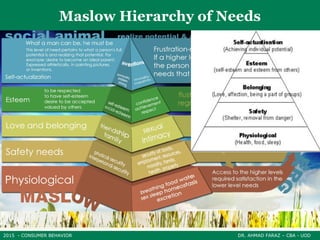
Maslow Hierarchy of Needs
2015 - CONSUMER BEHAVIOR DR. AHMAD FARAZ – CBA - UOD
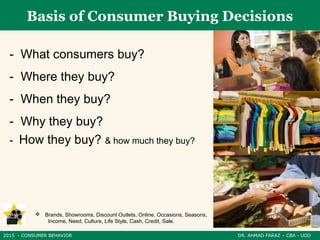
Basis of Consumer Buying Decisions
- What consumers buy?
- Where they buy?
- When they buy?
- Why they buy?
- How they buy? & how much they buy?
 Brands, Showrooms, Discount Outlets, Online, Occasions, Seasons,
Income, Need, Culture, Life Style, Cash, Credit, Sale.
2015 - CONSUMER BEHAVIOR DR. AHMAD FARAZ – CBA - UOD
Types of consumers
• Friendly/co-operative buyer
• Timid/reserved/shy buyer
• Price or quality conscious buyer
• Silent buyer
• Undecided buyer
• Argumentative buyer
• Suspicious buyer
• Impatient buyer
• Impulsive buyer
• Bargain buyer
• Over-cautious buyer
• Slow-thinking buyer
• Rude/ill-mannered buyer
• Clever/intelligent buyer
2015 - CONSUMER BEHAVIOR DR. AHMAD FARAZ – CBA - UOD
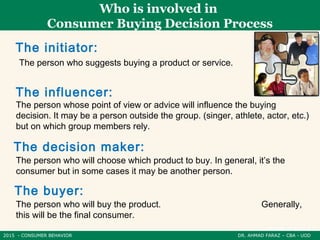
Who is involved in
Consumer Buying Decision Process
The person who suggests buying a product or service.
The initiator:
The person whose point of view or advice will influence the buying
decision. It may be a person outside the group. (singer, athlete, actor, etc.)
but on which group members rely.
The influencer:
The person who will choose which product to buy. In general, it’s the
consumer but in some cases it may be another person.
The decision maker:
The person who will buy the product. Generally,
this will be the final consumer.
The buyer:
2015 - CONSUMER BEHAVIOR DR. AHMAD FARAZ – CBA - UOD
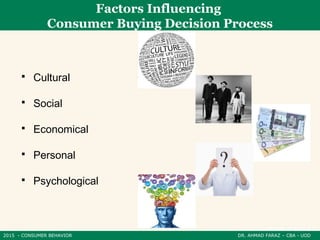
Factors Influencing
Consumer Buying Decision Process
 Cultural
 Social
 Economical
 Personal
 Psychological
2015 - CONSUMER BEHAVIOR DR. AHMAD FARAZ – CBA - UOD
Consumer Buying Decision Process
Consumer’s Buyer Behaviour and the resulting purchase decision are strongly influenced by
cultural, social, personal, economic and psychological characteristics. Marketers will be able
to develop suitable marketing mixes to appeal the target customers. Good understanding of
these influencing factors is essential.
CULTURAL factors include a consumer’s culture, subculture and social class. These factors
are often inherent in our values and decision processes.
SOCIAL factors include groups (reference groups, aspirational groups and member
groups), family, roles and status. This explains the outside influences of others on our
purchase decisions either directly or indirectly.
ECONOMIC factors includes consumer’s those are influenced largely by economic factors,
such as disposable income, savings,
PERSONAL factors include such variables as age and lifecycle stage, occupation, economic
circumstances, lifestyle (activities, interests, opinions and demographics), personality and self
concept. These may explain why our preferences often change as our `situation' changes.
PSCHOLOGICAL factors affecting our purchase decision include motivation (Maslow's
hierarchy of needs), perception, learning, beliefs and attitudes.
2015 - CONSUMER BEHAVIOR DR. AHMAD FARAZ – CBA - UOD
CULTURAL Influence in
Consumer Buying Decision Process
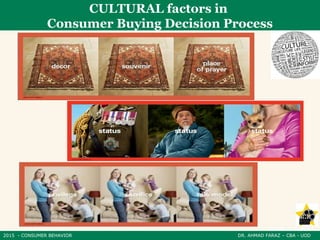
• Cultural factors are coming from the different components related
to culture or cultural environment from which the consumer
belongs.
• Culture is crucial when it comes to understanding the needs and
behaviors of an individual.
• An individual will be influenced by his family, his friends, his
cultural environment or society that will “teach” him values.
• Cultural factors plays an important role in the perception, habits,
behavior or expectations of consumers.
• Every society is composed of several sub-cultures. Subcultures are the
nationalities, religions, ethnic groups, age groups, gender of the
individual, etc..
• Subcultures are often considered by the brands for the segmentation of
a market in order to adapt a product or a communication strategy to the
values ​​or the specific needs of this segment.
2015 - CONSUMER BEHAVIOR DR. AHMAD FARAZ – CBA - UOD
CULTURAL factors in
Consumer Buying Decision Process
2015 - CONSUMER BEHAVIOR DR. AHMAD FARAZ – CBA - UOD
SOCIAL Influences in
Consumer Buying Decision Process
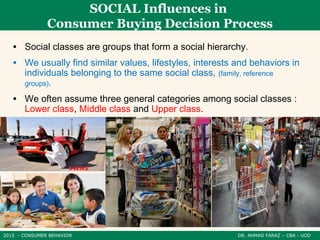
• Social classes are groups that form a social hierarchy.
• We usually find similar values​​, lifestyles, interests and behaviors in
individuals belonging to the same social class, (family, reference
groups).
• We often assume three general categories among social classes :
Lower class, Middle class and Upper class.
2015 - CONSUMER BEHAVIOR DR. AHMAD FARAZ – CBA - UOD
SOCIAL Influences in
Consumer Buying Decision Process
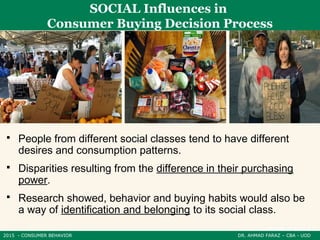
 People from different social classes tend to have different
desires and consumption patterns.
 Disparities resulting from the difference in their purchasing
power.
 Research showed, behavior and buying habits would also be
a way of identification and belonging to its social class.
2015 - CONSUMER BEHAVIOR DR. AHMAD FARAZ – CBA - UOD
ECONOMIC Influences in
Consumer Buying Decision Process
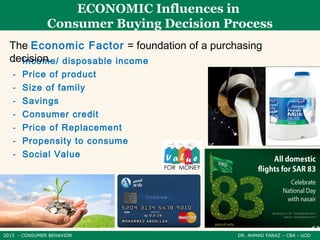
- Income/ disposable income
- Price of product
- Size of family
- Savings
- Consumer credit
- Price of Replacement
- Propensity to consume
- Social Value
The Economic Factor = foundation of a purchasing
decision.
2015 - CONSUMER BEHAVIOR DR. AHMAD FARAZ – CBA - UOD
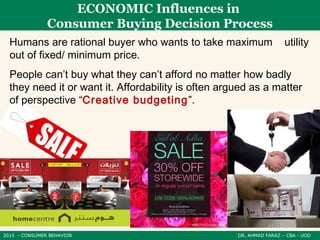
People can’t buy what they can’t afford no matter how badly
they need it or want it. Affordability is often argued as a matter
of perspective “Creative budgeting”.
ECONOMIC Influences in
Consumer Buying Decision Process
Humans are rational buyer who wants to take maximum utility
out of fixed/ minimum price.
2015 - CONSUMER BEHAVIOR DR. AHMAD FARAZ – CBA - UOD
PERSONAL Influences in
Consumer Buying Decision Process
 Age & Life-Cycle Stage
 Occupation
 Economic Situation
 Lifestyle
 Personality & Self-
Concept
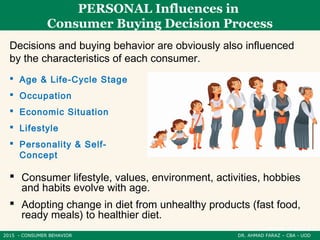
Decisions and buying behavior are obviously also influenced
by the characteristics of each consumer.
 Consumer lifestyle, values​​, environment, activities, hobbies
and habits evolve with age.
 Adopting change in diet from unhealthy products (fast food,
ready meals) to healthier diet.
2015 - CONSUMER BEHAVIOR DR. AHMAD FARAZ – CBA - UOD
PERSONAL Influences in
Consumer Buying Decision Process
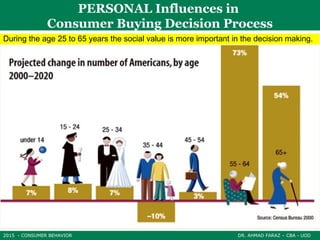
During the age 25 to 65 years the social value is more important in the decision making.
2015 - CONSUMER BEHAVIOR DR. AHMAD FARAZ – CBA - UOD
PSYCHOLOGICAL Influences in
Consumer Buying Decision Process
 Motivation (inner drive to act n compete)
 Perception (interpret stimuli into a meaningful picture)
 Learning (permanent change in behavior due to
experience)
 Beliefs & attitude (the way we think, feel & act
toward our environment)
 Psychological characteristics determines how a person
responds to his or her environment.
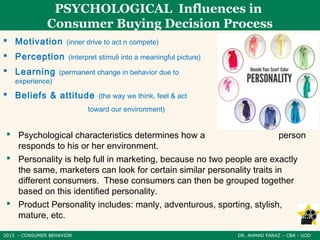
 Personality is help full in marketing, because no two people are exactly
the same, marketers can look for certain similar personality traits in
different consumers. These consumers can then be grouped together
based on this identified personality.
 Product Personality includes: manly, adventurous, sporting, stylish,
mature, etc.
2015 - CONSUMER BEHAVIOR DR. AHMAD FARAZ – CBA - UOD
PERSONAL Influences in
Consumer Buying Decision Process
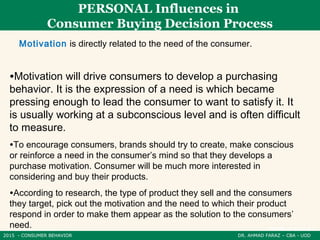
Motivation is directly related to the need of the consumer.
•Motivation will drive consumers to develop a purchasing
behavior. It is the expression of a need is which became
pressing enough to lead the consumer to want to satisfy it. It
is usually working at a subconscious level and is often difficult
to measure.
•To encourage consumers, brands should try to create, make conscious
or reinforce a need in the consumer’s mind so that they develops a
purchase motivation. Consumer will be much more interested in
considering and buy their products.
•According to research, the type of product they sell and the consumers
they target, pick out the motivation and the need to which their product
respond in order to make them appear as the solution to the consumers’
need.
2015 - CONSUMER BEHAVIOR DR. AHMAD FARAZ – CBA - UOD
PERSONAL Influences in
Consumer Buying Decision Process
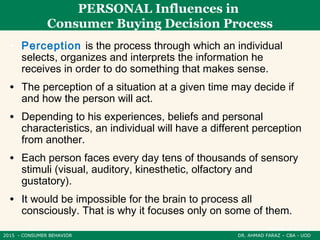
• Perception is the process through which an individual
selects, organizes and interprets the information he
receives in order to do something that makes sense.
• The perception of a situation at a given time may decide if
and how the person will act.
• Depending to his experiences, beliefs and personal
characteristics, an individual will have a different perception
from another.
• Each person faces every day tens of thousands of sensory
stimuli (visual, auditory, kinesthetic, olfactory and
gustatory).
• It would be impossible for the brain to process all
consciously. That is why it focuses only on some of them.
2015 - CONSUMER BEHAVIOR DR. AHMAD FARAZ – CBA - UOD
PERSONAL Influences in
Consumer Buying Decision Process
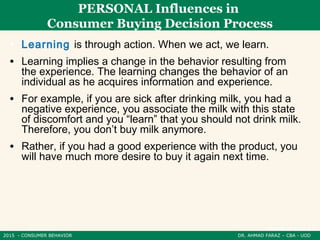
• Learning is through action. When we act, we learn.
• Learning implies a change in the behavior resulting from
the experience. The learning changes the behavior of an
individual as he acquires information and experience.
• For example, if you are sick after drinking milk, you had a
negative experience, you associate the milk with this state
of discomfort and you “learn” that you should not drink milk.
Therefore, you don’t buy milk anymore.
• Rather, if you had a good experience with the product, you
will have much more desire to buy it again next time.
2015 - CONSUMER BEHAVIOR DR. AHMAD FARAZ – CBA - UOD
PERSONAL Influences in
Consumer Buying Decision Process
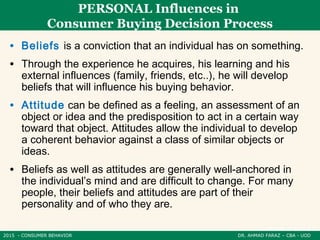
• Beliefs is a conviction that an individual has on something.
• Through the experience he acquires, his learning and his
external influences (family, friends, etc..), he will develop
beliefs that will influence his buying behavior.
• Attitude can be defined as a feeling, an assessment of an
object or idea and the predisposition to act in a certain way
toward that object. Attitudes allow the individual to develop
a coherent behavior against a class of similar objects or
ideas.
• Beliefs as well as attitudes are generally well-anchored in
the individual’s mind and are difficult to change. For many
people, their beliefs and attitudes are part of their
personality and of who they are.
2015 - CONSUMER BEHAVIOR DR. AHMAD FARAZ – CBA - UOD
PSYCHOLOGICAL Influences in
Consumer Buying Decision Process
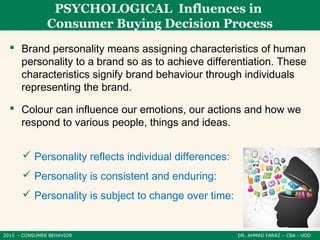
 Brand personality means assigning characteristics of human
personality to a brand so as to achieve differentiation. These
characteristics signify brand behaviour through individuals
representing the brand.
 Personality reflects individual differences:
 Personality is consistent and enduring:
 Personality is subject to change over time:
 Colour can influence our emotions, our actions and how we
respond to various people, things and ideas.
2015 - CONSUMER BEHAVIOR DR. AHMAD FARAZ – CBA - UOD
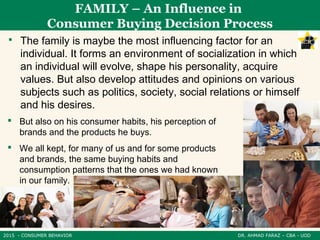
 The family is maybe the most influencing factor for an
individual. It forms an environment of socialization in which
an individual will evolve, shape his personality, acquire
values. But also develop attitudes and opinions on various
subjects such as politics, society, social relations or himself
and his desires.
FAMILY – An Influence in
Consumer Buying Decision Process
 But also on his consumer habits, his perception of
brands and the products he buys.
 We all kept, for many of us and for some products
and brands, the same buying habits and
consumption patterns that the ones we had known
in our family.
2015 - CONSUMER BEHAVIOR DR. AHMAD FARAZ – CBA - UOD
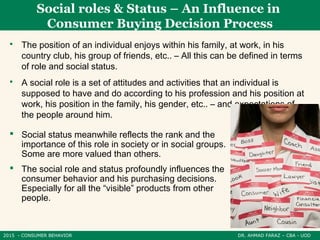
 The position of an individual enjoys within his family, at work, in his
country club, his group of friends, etc.. – All this can be defined in terms
of role and social status.
 A social role is a set of attitudes and activities that an individual is
supposed to have and do according to his profession and his position at
work, his position in the family, his gender, etc.. – and expectations of
the people around him.
Social roles & Status – An Influence in
Consumer Buying Decision Process
 Social status meanwhile reflects the rank and the
importance of this role in society or in social groups.
Some are more valued than others.
 The social role and status profoundly influences the
consumer behavior and his purchasing decisions.
Especially for all the “visible” products from other
people.
2015 - CONSUMER BEHAVIOR DR. AHMAD FARAZ – CBA - UOD
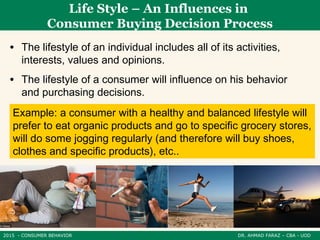
• The lifestyle of an individual includes all of its activities,
interests, values ​​and opinions.
• The lifestyle of a consumer will influence on his behavior
and purchasing decisions.
Life Style – An Influences in
Consumer Buying Decision Process
Example: a consumer with a healthy and balanced lifestyle will
prefer to eat organic products and go to specific grocery stores,
will do some jogging regularly (and therefore will buy shoes,
clothes and specific products), etc..
2015 - CONSUMER BEHAVIOR DR. AHMAD FARAZ – CBA - UOD
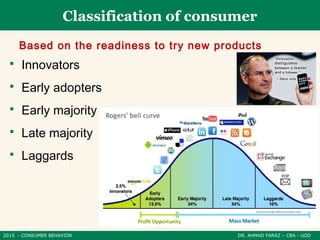
Classification of consumer
Based on the readiness to try new products
 Innovators
 Early adopters
 Early majority
 Late majority
 Laggards
2015 - CONSUMER BEHAVIOR DR. AHMAD FARAZ – CBA - UOD
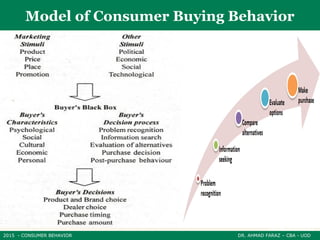
Model of Consumer Buying Behavior
2015 - CONSUMER BEHAVIOR DR. AHMAD FARAZ – CBA - UOD
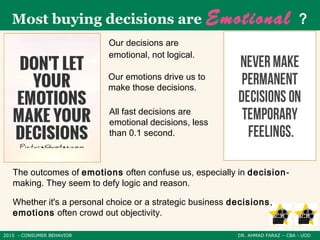
Most buying decisions are Emotional ?
Our decisions are
emotional, not logical.
Our emotions drive us to
make those decisions.
All fast decisions are
emotional decisions, less
than 0.1 second.
The outcomes of emotions often confuse us, especially in decision-
making. They seem to defy logic and reason.
Whether it's a personal choice or a strategic business decisions,
emotions often crowd out objectivity.
2015 - CONSUMER BEHAVIOR DR. AHMAD FARAZ – CBA - UOD
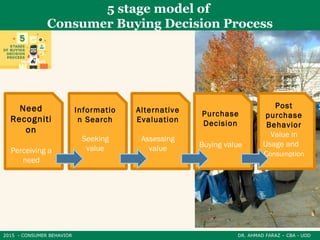
5 stage model of
Consumer Buying Decision Process
Need
Recogniti
on
Perceiving a
need
Informatio
n Search
Seeking
value
Alternative
Evaluation
Assessing
value
Purchase
Decision
Buying value
Post
purchase
Behavior
Value in
Usage and
Consumption
2015 - CONSUMER BEHAVIOR DR. AHMAD FARAZ – CBA - UOD
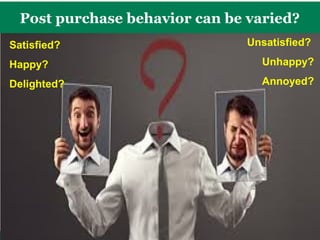
Post purchase behavior can be varied?
Satisfied?
Happy?
Delighted?
Unsatisfied?
Unhappy?
Annoyed?
2015 - CONSUMER BEHAVIOR DR. AHMAD FARAZ – CBA - UOD
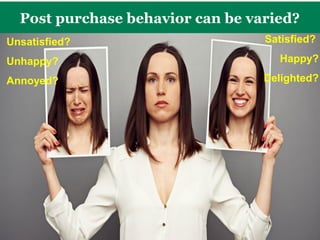
Satisfied?
Happy?
Delighted?
Unsatisfied?
Unhappy?
Annoyed?
Post purchase behavior can be varied?
2015 - CONSUMER BEHAVIOR DR. AHMAD FARAZ – CBA - UOD
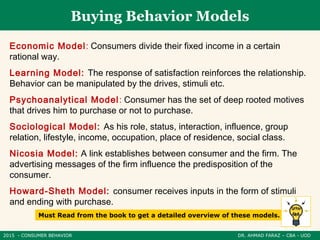
Buying Behavior Models
Economic Model: Consumers divide their fixed income in a certain
rational way.
Learning Model: The response of satisfaction reinforces the relationship.
Behavior can be manipulated by the drives, stimuli etc.
Psychoanalytical Model: Consumer has the set of deep rooted motives
that drives him to purchase or not to purchase.
Sociological Model: As his role, status, interaction, influence, group
relation, lifestyle, income, occupation, place of residence, social class.
Nicosia Model: A link establishes between consumer and the firm. The
advertising messages of the firm influence the predisposition of the
consumer.
Howard-Sheth Model: consumer receives inputs in the form of stimuli
and ending with purchase.
Must Read from the book to get a detailed overview of these models.
2015 - CONSUMER BEHAVIOR DR. AHMAD FARAZ – CBA - UOD
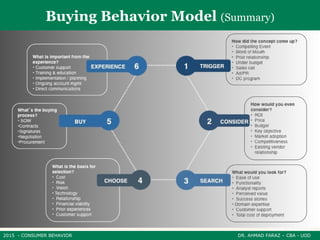
Buying Behavior Model (Summary)
2015 - CONSUMER BEHAVIOR DR. AHMAD FARAZ – CBA - UOD
Thank you and Good Bye, till next class.
2015 - CONSUMER BEHAVIOR DR. AHMAD FARAZ – CBA - UOD

THE CONSUMER DECISION MAKING

  • 1.
    2015 - CONSUMERBEHAVIOR DR. AHMAD FARAZ – CBA - UOD Consumer Decision Making: Basis, Influences, Models & Process. 2015 - CONSUMER BEHAVIOR DR. AHMAD FARAZ – CBA - UOD Lecture 3
  • 2.
    2015 - CONSUMERBEHAVIOR DR. AHMAD FARAZ – CBA - UOD Why Consumer Buying Decision Process? How many of you bought something today? How many have seen or heard an ad today? How many of you consumed something today? How many of you engaged in word of mouth about a product or service today?
  • 3.
    2015 - CONSUMERBEHAVIOR DR. AHMAD FARAZ – CBA - UOD The Processes a consumer uses to make purchase decisions, as well as to use and dispose of purchased goods or services; also includes factors that influence purchase decisions and the product use Definition Consumer Buying Decision Process Consumer buying behavior is the study of What, Why, When, Where and How people do or do not buy a product.
  • 4.
    2015 - CONSUMERBEHAVIOR DR. AHMAD FARAZ – CBA - UOD Defining Consumer Buying Decision Process Consumer Behavior blends elements from psychology, social anthropology and economics. Research has shown that consumer behaviour is difficult to predict, even for experts in the field. Psychology: Study of behavior and mental possess: Human activities are directed towards meeting certain needs. (Maslow`s Need Hierarchy) Social anthropology: Study of people in relation to their culture. Effect of reference group, society, role in society, etc. Economics: Study of people’s consumption of goods and service. Human is a rational buyer who wants to take maximum utility out of fixed/minimum price.
  • 5.
    2015 - CONSUMERBEHAVIOR DR. AHMAD FARAZ – CBA - UOD Maslow Hierarchy of Needs
  • 6.
    2015 - CONSUMERBEHAVIOR DR. AHMAD FARAZ – CBA - UOD Basis of Consumer Buying Decisions - What consumers buy? - Where they buy? - When they buy? - Why they buy? - How they buy? & how much they buy?  Brands, Showrooms, Discount Outlets, Online, Occasions, Seasons, Income, Need, Culture, Life Style, Cash, Credit, Sale.
  • 7.
    2015 - CONSUMERBEHAVIOR DR. AHMAD FARAZ – CBA - UOD Types of consumers • Friendly/co-operative buyer • Timid/reserved/shy buyer • Price or quality conscious buyer • Silent buyer • Undecided buyer • Argumentative buyer • Suspicious buyer • Impatient buyer • Impulsive buyer • Bargain buyer • Over-cautious buyer • Slow-thinking buyer • Rude/ill-mannered buyer • Clever/intelligent buyer
  • 8.
    2015 - CONSUMERBEHAVIOR DR. AHMAD FARAZ – CBA - UOD Who is involved in Consumer Buying Decision Process The person who suggests buying a product or service. The initiator: The person whose point of view or advice will influence the buying decision. It may be a person outside the group. (singer, athlete, actor, etc.) but on which group members rely. The influencer: The person who will choose which product to buy. In general, it’s the consumer but in some cases it may be another person. The decision maker: The person who will buy the product. Generally, this will be the final consumer. The buyer:
  • 9.
    2015 - CONSUMERBEHAVIOR DR. AHMAD FARAZ – CBA - UOD Factors Influencing Consumer Buying Decision Process  Cultural  Social  Economical  Personal  Psychological
  • 10.
    2015 - CONSUMERBEHAVIOR DR. AHMAD FARAZ – CBA - UOD Consumer Buying Decision Process Consumer’s Buyer Behaviour and the resulting purchase decision are strongly influenced by cultural, social, personal, economic and psychological characteristics. Marketers will be able to develop suitable marketing mixes to appeal the target customers. Good understanding of these influencing factors is essential. CULTURAL factors include a consumer’s culture, subculture and social class. These factors are often inherent in our values and decision processes. SOCIAL factors include groups (reference groups, aspirational groups and member groups), family, roles and status. This explains the outside influences of others on our purchase decisions either directly or indirectly. ECONOMIC factors includes consumer’s those are influenced largely by economic factors, such as disposable income, savings, PERSONAL factors include such variables as age and lifecycle stage, occupation, economic circumstances, lifestyle (activities, interests, opinions and demographics), personality and self concept. These may explain why our preferences often change as our `situation' changes. PSCHOLOGICAL factors affecting our purchase decision include motivation (Maslow's hierarchy of needs), perception, learning, beliefs and attitudes.
  • 11.
    2015 - CONSUMERBEHAVIOR DR. AHMAD FARAZ – CBA - UOD CULTURAL Influence in Consumer Buying Decision Process • Cultural factors are coming from the different components related to culture or cultural environment from which the consumer belongs. • Culture is crucial when it comes to understanding the needs and behaviors of an individual. • An individual will be influenced by his family, his friends, his cultural environment or society that will “teach” him values. • Cultural factors plays an important role in the perception, habits, behavior or expectations of consumers. • Every society is composed of several sub-cultures. Subcultures are the nationalities, religions, ethnic groups, age groups, gender of the individual, etc.. • Subcultures are often considered by the brands for the segmentation of a market in order to adapt a product or a communication strategy to the values ​​or the specific needs of this segment.
  • 12.
    2015 - CONSUMERBEHAVIOR DR. AHMAD FARAZ – CBA - UOD CULTURAL factors in Consumer Buying Decision Process
  • 13.
    2015 - CONSUMERBEHAVIOR DR. AHMAD FARAZ – CBA - UOD SOCIAL Influences in Consumer Buying Decision Process • Social classes are groups that form a social hierarchy. • We usually find similar values​​, lifestyles, interests and behaviors in individuals belonging to the same social class, (family, reference groups). • We often assume three general categories among social classes : Lower class, Middle class and Upper class.
  • 14.
    2015 - CONSUMERBEHAVIOR DR. AHMAD FARAZ – CBA - UOD SOCIAL Influences in Consumer Buying Decision Process  People from different social classes tend to have different desires and consumption patterns.  Disparities resulting from the difference in their purchasing power.  Research showed, behavior and buying habits would also be a way of identification and belonging to its social class.
  • 15.
    2015 - CONSUMERBEHAVIOR DR. AHMAD FARAZ – CBA - UOD ECONOMIC Influences in Consumer Buying Decision Process - Income/ disposable income - Price of product - Size of family - Savings - Consumer credit - Price of Replacement - Propensity to consume - Social Value The Economic Factor = foundation of a purchasing decision.
  • 16.
    2015 - CONSUMERBEHAVIOR DR. AHMAD FARAZ – CBA - UOD People can’t buy what they can’t afford no matter how badly they need it or want it. Affordability is often argued as a matter of perspective “Creative budgeting”. ECONOMIC Influences in Consumer Buying Decision Process Humans are rational buyer who wants to take maximum utility out of fixed/ minimum price.
  • 17.
    2015 - CONSUMERBEHAVIOR DR. AHMAD FARAZ – CBA - UOD PERSONAL Influences in Consumer Buying Decision Process  Age & Life-Cycle Stage  Occupation  Economic Situation  Lifestyle  Personality & Self- Concept Decisions and buying behavior are obviously also influenced by the characteristics of each consumer.  Consumer lifestyle, values​​, environment, activities, hobbies and habits evolve with age.  Adopting change in diet from unhealthy products (fast food, ready meals) to healthier diet.
  • 18.
    2015 - CONSUMERBEHAVIOR DR. AHMAD FARAZ – CBA - UOD PERSONAL Influences in Consumer Buying Decision Process During the age 25 to 65 years the social value is more important in the decision making.
  • 19.
    2015 - CONSUMERBEHAVIOR DR. AHMAD FARAZ – CBA - UOD PSYCHOLOGICAL Influences in Consumer Buying Decision Process  Motivation (inner drive to act n compete)  Perception (interpret stimuli into a meaningful picture)  Learning (permanent change in behavior due to experience)  Beliefs & attitude (the way we think, feel & act toward our environment)  Psychological characteristics determines how a person responds to his or her environment.  Personality is help full in marketing, because no two people are exactly the same, marketers can look for certain similar personality traits in different consumers. These consumers can then be grouped together based on this identified personality.  Product Personality includes: manly, adventurous, sporting, stylish, mature, etc.
  • 20.
    2015 - CONSUMERBEHAVIOR DR. AHMAD FARAZ – CBA - UOD PERSONAL Influences in Consumer Buying Decision Process Motivation is directly related to the need of the consumer. •Motivation will drive consumers to develop a purchasing behavior. It is the expression of a need is which became pressing enough to lead the consumer to want to satisfy it. It is usually working at a subconscious level and is often difficult to measure. •To encourage consumers, brands should try to create, make conscious or reinforce a need in the consumer’s mind so that they develops a purchase motivation. Consumer will be much more interested in considering and buy their products. •According to research, the type of product they sell and the consumers they target, pick out the motivation and the need to which their product respond in order to make them appear as the solution to the consumers’ need.
  • 21.
    2015 - CONSUMERBEHAVIOR DR. AHMAD FARAZ – CBA - UOD PERSONAL Influences in Consumer Buying Decision Process • Perception is the process through which an individual selects, organizes and interprets the information he receives in order to do something that makes sense. • The perception of a situation at a given time may decide if and how the person will act. • Depending to his experiences, beliefs and personal characteristics, an individual will have a different perception from another. • Each person faces every day tens of thousands of sensory stimuli (visual, auditory, kinesthetic, olfactory and gustatory). • It would be impossible for the brain to process all consciously. That is why it focuses only on some of them.
  • 22.
    2015 - CONSUMERBEHAVIOR DR. AHMAD FARAZ – CBA - UOD PERSONAL Influences in Consumer Buying Decision Process • Learning is through action. When we act, we learn. • Learning implies a change in the behavior resulting from the experience. The learning changes the behavior of an individual as he acquires information and experience. • For example, if you are sick after drinking milk, you had a negative experience, you associate the milk with this state of discomfort and you “learn” that you should not drink milk. Therefore, you don’t buy milk anymore. • Rather, if you had a good experience with the product, you will have much more desire to buy it again next time.
  • 23.
    2015 - CONSUMERBEHAVIOR DR. AHMAD FARAZ – CBA - UOD PERSONAL Influences in Consumer Buying Decision Process • Beliefs is a conviction that an individual has on something. • Through the experience he acquires, his learning and his external influences (family, friends, etc..), he will develop beliefs that will influence his buying behavior. • Attitude can be defined as a feeling, an assessment of an object or idea and the predisposition to act in a certain way toward that object. Attitudes allow the individual to develop a coherent behavior against a class of similar objects or ideas. • Beliefs as well as attitudes are generally well-anchored in the individual’s mind and are difficult to change. For many people, their beliefs and attitudes are part of their personality and of who they are.
  • 24.
    2015 - CONSUMERBEHAVIOR DR. AHMAD FARAZ – CBA - UOD PSYCHOLOGICAL Influences in Consumer Buying Decision Process  Brand personality means assigning characteristics of human personality to a brand so as to achieve differentiation. These characteristics signify brand behaviour through individuals representing the brand.  Personality reflects individual differences:  Personality is consistent and enduring:  Personality is subject to change over time:  Colour can influence our emotions, our actions and how we respond to various people, things and ideas.
  • 25.
    2015 - CONSUMERBEHAVIOR DR. AHMAD FARAZ – CBA - UOD  The family is maybe the most influencing factor for an individual. It forms an environment of socialization in which an individual will evolve, shape his personality, acquire values. But also develop attitudes and opinions on various subjects such as politics, society, social relations or himself and his desires. FAMILY – An Influence in Consumer Buying Decision Process  But also on his consumer habits, his perception of brands and the products he buys.  We all kept, for many of us and for some products and brands, the same buying habits and consumption patterns that the ones we had known in our family.
  • 26.
    2015 - CONSUMERBEHAVIOR DR. AHMAD FARAZ – CBA - UOD  The position of an individual enjoys within his family, at work, in his country club, his group of friends, etc.. – All this can be defined in terms of role and social status.  A social role is a set of attitudes and activities that an individual is supposed to have and do according to his profession and his position at work, his position in the family, his gender, etc.. – and expectations of the people around him. Social roles & Status – An Influence in Consumer Buying Decision Process  Social status meanwhile reflects the rank and the importance of this role in society or in social groups. Some are more valued than others.  The social role and status profoundly influences the consumer behavior and his purchasing decisions. Especially for all the “visible” products from other people.
  • 27.
    2015 - CONSUMERBEHAVIOR DR. AHMAD FARAZ – CBA - UOD • The lifestyle of an individual includes all of its activities, interests, values ​​and opinions. • The lifestyle of a consumer will influence on his behavior and purchasing decisions. Life Style – An Influences in Consumer Buying Decision Process Example: a consumer with a healthy and balanced lifestyle will prefer to eat organic products and go to specific grocery stores, will do some jogging regularly (and therefore will buy shoes, clothes and specific products), etc..
  • 28.
    2015 - CONSUMERBEHAVIOR DR. AHMAD FARAZ – CBA - UOD Classification of consumer Based on the readiness to try new products  Innovators  Early adopters  Early majority  Late majority  Laggards
  • 29.
    2015 - CONSUMERBEHAVIOR DR. AHMAD FARAZ – CBA - UOD Model of Consumer Buying Behavior
  • 30.
    2015 - CONSUMERBEHAVIOR DR. AHMAD FARAZ – CBA - UOD Most buying decisions are Emotional ? Our decisions are emotional, not logical. Our emotions drive us to make those decisions. All fast decisions are emotional decisions, less than 0.1 second. The outcomes of emotions often confuse us, especially in decision- making. They seem to defy logic and reason. Whether it's a personal choice or a strategic business decisions, emotions often crowd out objectivity.
  • 31.
    2015 - CONSUMERBEHAVIOR DR. AHMAD FARAZ – CBA - UOD 5 stage model of Consumer Buying Decision Process Need Recogniti on Perceiving a need Informatio n Search Seeking value Alternative Evaluation Assessing value Purchase Decision Buying value Post purchase Behavior Value in Usage and Consumption
  • 32.
    2015 - CONSUMERBEHAVIOR DR. AHMAD FARAZ – CBA - UOD Post purchase behavior can be varied? Satisfied? Happy? Delighted? Unsatisfied? Unhappy? Annoyed?
  • 33.
    2015 - CONSUMERBEHAVIOR DR. AHMAD FARAZ – CBA - UOD Satisfied? Happy? Delighted? Unsatisfied? Unhappy? Annoyed? Post purchase behavior can be varied?
  • 34.
    2015 - CONSUMERBEHAVIOR DR. AHMAD FARAZ – CBA - UOD Buying Behavior Models Economic Model: Consumers divide their fixed income in a certain rational way. Learning Model: The response of satisfaction reinforces the relationship. Behavior can be manipulated by the drives, stimuli etc. Psychoanalytical Model: Consumer has the set of deep rooted motives that drives him to purchase or not to purchase. Sociological Model: As his role, status, interaction, influence, group relation, lifestyle, income, occupation, place of residence, social class. Nicosia Model: A link establishes between consumer and the firm. The advertising messages of the firm influence the predisposition of the consumer. Howard-Sheth Model: consumer receives inputs in the form of stimuli and ending with purchase. Must Read from the book to get a detailed overview of these models.
  • 35.
    2015 - CONSUMERBEHAVIOR DR. AHMAD FARAZ – CBA - UOD Buying Behavior Model (Summary)
  • 36.
    2015 - CONSUMERBEHAVIOR DR. AHMAD FARAZ – CBA - UOD Thank you and Good Bye, till next class. 2015 - CONSUMER BEHAVIOR DR. AHMAD FARAZ – CBA - UOD