NURCIU CHIRANA MIHAELA
GROUP 934
CONSUMER MARKETS AND
CONSUMER BEHAVIOR
 Consumer market contains all the
individuals and households that buy or
acquire goods and services for personal
consumption.
 Consumer buyer behavior is the
buying behavior of final consumers:
individuals and households that buy
goods and services for personal
consumption.
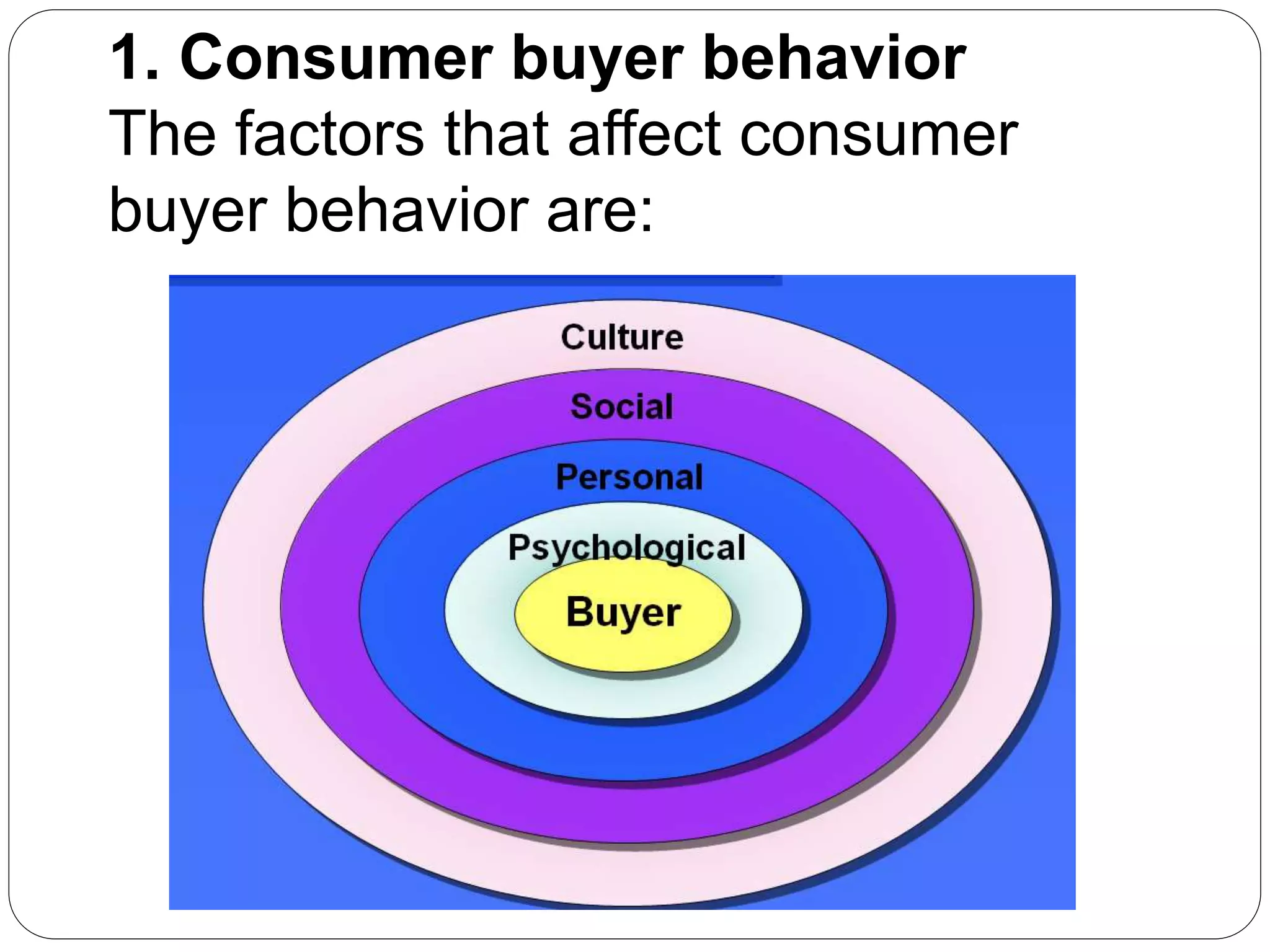
1. Consumer buyer behavior
The factors that affect consumer
buyer behavior are:
 1.1 Cultural factors
 The first factor which is affecting consumer
behavior is culture. Culture is the most basic
cause of a person’s wants and behavior.
 1.2 Social factors
 A consumer’s behavior also is influenced by
social factors, such as the consumer’s small
groups, family, and social roles and status.
 Many small groups influence a person’s
behavior.
 Family members can strongly influence buyer behavior.
The family is the most important consumer buying
organization in society.
 1.3 Personal factors
 A buyer’s decisions also are influenced by personal
characteristics such as the buyer’s age and life-cycle
stage, occupation, economic situation, lifestyle, and
personality and self-concept.
 Buying is also shaped by the stage of the family life
cycle: the stages through which families might pass as
they mature over time.
 A person’s occupation affects the goods and services
bought.
 A person’s economic situation will affect his or her
store and product choices. There are watched trends in
personal income, savings.
 Lifestyle is a person’s pattern of living as expressed in
his or her psychographics.
1.4. Psychological factors
 A person’s buying choices are further influenced by
four major psychological factors: motivation,
perception, learning, and beliefs and attitudes.
 A motive is a need that is sufficiently pressing to
direct the person to seek satisfaction.
 A motivated person is ready to act. How the person
acts is influenced by his or her own perception of
the situation.
 When people act, they learn. Learning describes
changes in an individual’s behavior arising from
experience..
 Through doing and learning, people acquire beliefs
and attitudes.
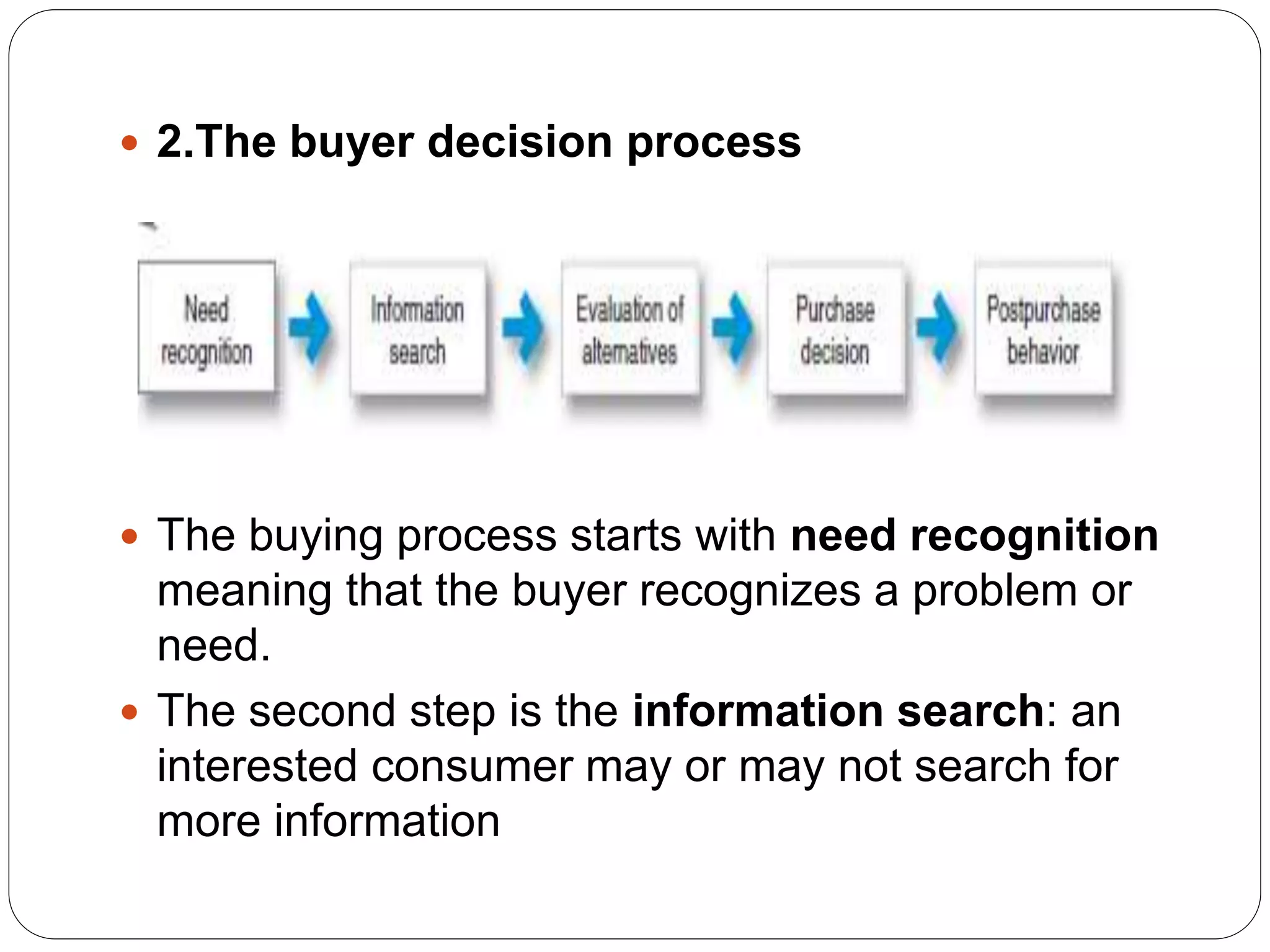
 2.The buyer decision process
 The buying process starts with need recognition
meaning that the buyer recognizes a problem or
need.
 The second step is the information search: an
interested consumer may or may not search for
more information
 Alternative evaluation is the third of the buyer
decision process in which the consumer uses
information to evaluate alternative brands in the
choice set.
 In the evaluation stage, the consumer ranks
brands and forms purchase intentions. Generally,
the consumer’s purchase decision will be to buy
the most preferred brand.
 The last stage is the postpurchase behavior:
after purchasing the product, the consumer will
either be satisfied or dissatisfied and will engage
in postpurchase behavior.
STUDY CASE : CARS BUYING
BEHAVIOR IN ROMANIA
 Consumers often engage in limited problem
solving when buying a car because a buyer may
buy it occasionally .
 The first factor: culture is the cause of the
decision making. Depending on the person’s
culture he decides whether a car is a necessity or
a comfort. From the case study in Romania, 58%
of the population think that a car is a necessity
and 42% consider it as a comfort,fad.
 Social influences also exist such as taking the
decision wih your family. The investigation results
tell us that 75.4% of our respondents ever
discussed their car purchasing decisions with
 As for the personal factors, which play a major role
in the buying decision the first one is the buyer’s
age. By examining the difference of the importance
in means by age groups, we could find out that
younger people (age less than 30) consider the
power and performance of the car more important
than relatively older people, which means younger
people pursue more driving pleasure than other age
groups. Younger people (age less than 30) also
consider brand image more important than other age
groups.
 The occupation affects the sort of car: an elegant one
or a sport one. Skilled employees : workers in
manufacturing, retailing, catering and service
industries; bus and truck drivers, police and firefighters
prefer cheap and small cars. Office workers,
technicians, teachers, engineers, freelancers have
middle class cars. And the persons who own the most
well paid jobs such as government top officials, top
corporate executives, successful professionals acquire
expensive and luxurious cars like Mercedes,BMW and
Audi.
 On the person’s economic situation depends the
money assigned for the car, depending on the income
the person has. By examining the budget groups who
plan to purchase cars within two years, we find out
that respondents with more budget takes fuel
consumption and after-sale maintenance less
important and take exterior design more important
 At the lifestyle factor most of people consider of
purchasing a car as a very important or fairly
important decision, about 60% totally. About 32% of
people chose “neither” important nor “unimportant”.
 Psychological influences tend to impact a buyer’s
motives, perception,learning and attitudes.
 The motives in buying a car differs in genders.
Female consumers consider value for money and
safety more important than male consumers.Male
consumers consider power and brand image more
important than female consumers.
 The managerial implication perceptive, in this
study found that four variables have significant
relationship with intention purchase towards
automobile industries especially for imported car.
The variables were Value Consciousness, Price
Quality inference, Risk Averseness, and Beliefs.
 The differences of importance in means by
education are examined: young people with
higher education level take “riding comfort”,
“safety”, and “equipment and interior” more
important than other education groups and take
“resale value” and “promotion” less important.
 Attitudes and beliefs also vary depending on
the ease of access of a particular car brand.
Romanian consumers seemed to have strong
beliefs system towards imported cars as they
prefer to purchase. This is because they have
past experience toward the car they brought and
drives. Another belief is that half of people
quizzed buy Audi, BMW or Mercedes because of
the quality, safety standards, personal preference
and other things that make 'me' want to buy the
car for 'myself'.
References:
 Kotler and Armstrong (2010)- “Principles of
Marketing”
 http://www.academia.edu/1238098/Buying_behav
ior_of_customers_at_MBA_MARKETING_PROJ
ECT_REPORT
 http://umu.diva-
portal.org/smash/get/diva2:142148/FULLTEXT01.
pdf

Consumer markets and consumer behavior

  • 1.
    NURCIU CHIRANA MIHAELA GROUP934 CONSUMER MARKETS AND CONSUMER BEHAVIOR
  • 2.
     Consumer marketcontains all the individuals and households that buy or acquire goods and services for personal consumption.  Consumer buyer behavior is the buying behavior of final consumers: individuals and households that buy goods and services for personal consumption.
  • 3.
    1. Consumer buyerbehavior The factors that affect consumer buyer behavior are:
  • 4.
     1.1 Culturalfactors  The first factor which is affecting consumer behavior is culture. Culture is the most basic cause of a person’s wants and behavior.  1.2 Social factors  A consumer’s behavior also is influenced by social factors, such as the consumer’s small groups, family, and social roles and status.  Many small groups influence a person’s behavior.
  • 5.
     Family memberscan strongly influence buyer behavior. The family is the most important consumer buying organization in society.  1.3 Personal factors  A buyer’s decisions also are influenced by personal characteristics such as the buyer’s age and life-cycle stage, occupation, economic situation, lifestyle, and personality and self-concept.  Buying is also shaped by the stage of the family life cycle: the stages through which families might pass as they mature over time.  A person’s occupation affects the goods and services bought.  A person’s economic situation will affect his or her store and product choices. There are watched trends in personal income, savings.  Lifestyle is a person’s pattern of living as expressed in his or her psychographics.
  • 6.
    1.4. Psychological factors A person’s buying choices are further influenced by four major psychological factors: motivation, perception, learning, and beliefs and attitudes.  A motive is a need that is sufficiently pressing to direct the person to seek satisfaction.  A motivated person is ready to act. How the person acts is influenced by his or her own perception of the situation.  When people act, they learn. Learning describes changes in an individual’s behavior arising from experience..  Through doing and learning, people acquire beliefs and attitudes.
  • 7.
     2.The buyerdecision process  The buying process starts with need recognition meaning that the buyer recognizes a problem or need.  The second step is the information search: an interested consumer may or may not search for more information
  • 8.
     Alternative evaluationis the third of the buyer decision process in which the consumer uses information to evaluate alternative brands in the choice set.  In the evaluation stage, the consumer ranks brands and forms purchase intentions. Generally, the consumer’s purchase decision will be to buy the most preferred brand.  The last stage is the postpurchase behavior: after purchasing the product, the consumer will either be satisfied or dissatisfied and will engage in postpurchase behavior.
  • 9.
    STUDY CASE :CARS BUYING BEHAVIOR IN ROMANIA  Consumers often engage in limited problem solving when buying a car because a buyer may buy it occasionally .  The first factor: culture is the cause of the decision making. Depending on the person’s culture he decides whether a car is a necessity or a comfort. From the case study in Romania, 58% of the population think that a car is a necessity and 42% consider it as a comfort,fad.  Social influences also exist such as taking the decision wih your family. The investigation results tell us that 75.4% of our respondents ever discussed their car purchasing decisions with
  • 10.
     As forthe personal factors, which play a major role in the buying decision the first one is the buyer’s age. By examining the difference of the importance in means by age groups, we could find out that younger people (age less than 30) consider the power and performance of the car more important than relatively older people, which means younger people pursue more driving pleasure than other age groups. Younger people (age less than 30) also consider brand image more important than other age groups.
  • 11.
     The occupationaffects the sort of car: an elegant one or a sport one. Skilled employees : workers in manufacturing, retailing, catering and service industries; bus and truck drivers, police and firefighters prefer cheap and small cars. Office workers, technicians, teachers, engineers, freelancers have middle class cars. And the persons who own the most well paid jobs such as government top officials, top corporate executives, successful professionals acquire expensive and luxurious cars like Mercedes,BMW and Audi.  On the person’s economic situation depends the money assigned for the car, depending on the income the person has. By examining the budget groups who plan to purchase cars within two years, we find out that respondents with more budget takes fuel consumption and after-sale maintenance less important and take exterior design more important
  • 12.
     At thelifestyle factor most of people consider of purchasing a car as a very important or fairly important decision, about 60% totally. About 32% of people chose “neither” important nor “unimportant”.  Psychological influences tend to impact a buyer’s motives, perception,learning and attitudes.  The motives in buying a car differs in genders. Female consumers consider value for money and safety more important than male consumers.Male consumers consider power and brand image more important than female consumers.
  • 13.
     The managerialimplication perceptive, in this study found that four variables have significant relationship with intention purchase towards automobile industries especially for imported car. The variables were Value Consciousness, Price Quality inference, Risk Averseness, and Beliefs.  The differences of importance in means by education are examined: young people with higher education level take “riding comfort”, “safety”, and “equipment and interior” more important than other education groups and take “resale value” and “promotion” less important.
  • 14.
     Attitudes andbeliefs also vary depending on the ease of access of a particular car brand. Romanian consumers seemed to have strong beliefs system towards imported cars as they prefer to purchase. This is because they have past experience toward the car they brought and drives. Another belief is that half of people quizzed buy Audi, BMW or Mercedes because of the quality, safety standards, personal preference and other things that make 'me' want to buy the car for 'myself'.
  • 15.
    References:  Kotler andArmstrong (2010)- “Principles of Marketing”  http://www.academia.edu/1238098/Buying_behav ior_of_customers_at_MBA_MARKETING_PROJ ECT_REPORT  http://umu.diva- portal.org/smash/get/diva2:142148/FULLTEXT01. pdf