CONSULTING TOOLKIT

     Communicating your Recommendation

     Crafting a Storyline


© 2007-2012 IESIES Development Ltd. All Ltd. Reserved
       © 2007-2012 Development Rights All Rights Reserved
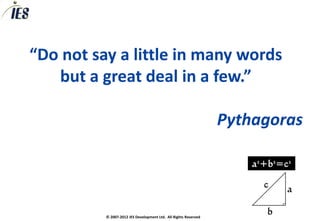
“Do not say a little in many words
   but a great deal in a few.”

                                                                 Pythagoras


          © 2007-2012 IES Development Ltd. All Rights Reserved
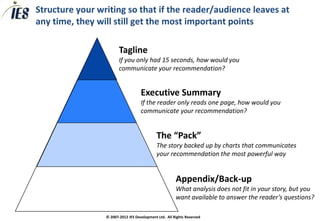
Structure your writing so that if the reader/audience leaves at
any time, they will still get the most important points

                        Tagline
                        If you only had 15 seconds, how would you
                        communicate your recommendation?


                                    Executive Summary
                                    If the reader only reads one page, how would you
                                    communicate your recommendation?


                                            The “Pack”
                                            The story backed up by charts that communicates
                                            your recommendation the most powerful way


                                                       Appendix/Back-up
                                                       What analysis does not fit in your story, but you
                                                       want available to answer the reader’s questions?

                 © 2007-2012 IES Development Ltd. All Rights Reserved
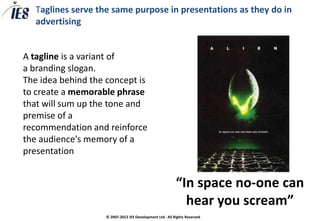
Taglines serve the same purpose in presentations as they do in
   advertising


A tagline is a variant of
a branding slogan.
The idea behind the concept is
to create a memorable phrase
that will sum up the tone and
premise of a
recommendation and reinforce
the audience's memory of a
presentation


                                                          “In space no-one can
                                                            hear you scream”
                    © 2007-2012 IES Development Ltd. All Rights Reserved
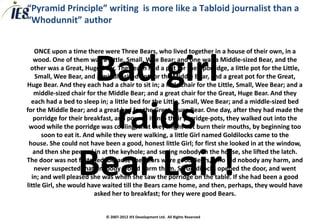
“Pyramid Principle” writing is more like a Tabloid journalist than a
“Whodunnit” author


   ONCE upon a time there were Three Bears, who lived together in a house of their own, in a


                   Bad girl
   wood. One of them was a Little, Small, Wee Bear; and one was a Middle-sized Bear, and the
  other was a Great, Huge Bear. They each had a pot for their porridge, a little pot for the Little,
    Small, Wee Bear, and a middle-sized pot for the Middle Bear, and a great pot for the Great,
Huge Bear. And they each had a chair to sit in; a little chair for the Little, Small, Wee Bear; and a
   middle-sized chair for the Middle Bear; and a great chair for the Great, Huge Bear. And they
  each had a bed to sleep in; a little bed for the Little, Small, Wee Bear; and a middle-sized bed


                    raids
for the Middle Bear; and a great bed for the Great, Huge Bear. One day, after they had made the
   porridge for their breakfast, and poured it into their porridge-pots, they walked out into the
 wood while the porridge was cooling, that they might not burn their mouths, by beginning too
      soon to eat it. And while they were walking, a little Girl named Goldilocks came to the
 house. She could not have been a good, honest little Girl; for first she looked in at the window,


                  Bear Lair!
   and then she peeped in at the keyhole; and seeing nobody in the house, she lifted the latch.
The door was not fastened, because the Bears were good Bears, who did nobody any harm, and
   never suspected that anybody would harm them. So Goldilocks opened the door, and went
  in; and well pleased she was when she saw the porridge on the table. If she had been a good
little Girl, she would have waited till the Bears came home, and then, perhaps, they would have
                         asked her to breakfast; for they were good Bears.


                             © 2007-2012 IES Development Ltd. All Rights Reserved
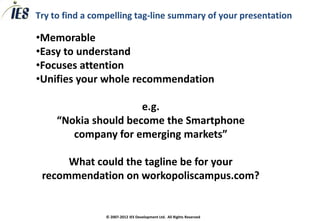
Try to find a compelling tag-line summary of your presentation

•Memorable
•Easy to understand
•Focuses attention
•Unifies your whole recommendation

                      e.g.
     “Nokia should become the Smartphone
        company for emerging markets”

      What could the tagline be for your
 recommendation on workopoliscampus.com?


                 © 2007-2012 IES Development Ltd. All Rights Reserved
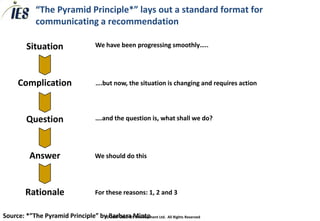
“The Pyramid Principle*” lays out a standard format for
            communicating a recommendation

        Situation                 We have been progressing smoothly…..


     Complication                 ….but now, the situation is changing and requires action


        Question                  ….and the question is, what shall we do?


         Answer                   We should do this


        Rationale                 For these reasons: 1, 2 and 3


Source: *”The Pyramid Principle” by©Barbara Minto Ltd. All Rights Reserved
                                    2007-2012 IES Development
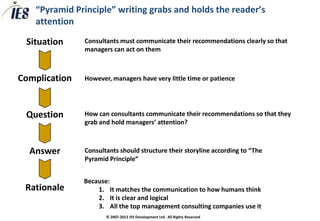
“Pyramid Principle” writing grabs and holds the reader’s
   attention

 Situation     Consultants must communicate their recommendations clearly so that
               managers can act on them


Complication   However, managers have very little time or patience


 Question      How can consultants communicate their recommendations so that they
               grab and hold managers’ attention?


  Answer       Consultants should structure their storyline according to “The
               Pyramid Principle”


               Because:
 Rationale         1. It matches the communication to how humans think
                   2. It is clear and logical
                   3. All the top management consulting companies use it
                      © 2007-2012 IES Development Ltd. All Rights Reserved
In business writing, it is usually best to give the answer away up
front, not make the reader wade through your workings

  • The method you used to solve the problem is NOT the same way that
    you use to communicate it

       – Don’t tell the story of your project!

       – The audience cares about your conclusion, not your journey

       – Don’t communicate your workings – e.g. issue tree or workplan

  • Simplify ruthlessly

       – Cut your pack down to the minimum your need to support your
         recommendation - you don’t get paid per page

       – Drop analysis to the Appendix if the conclusion does not fit your
         story, even if you spent many days on it


                      © 2007-2012 IES Development Ltd. All Rights Reserved
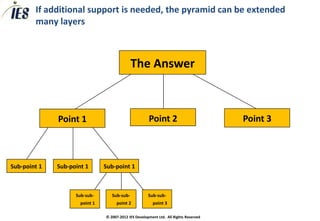
If additional support is needed, the pyramid can be extended
        many layers


                                              The Answer


              Point 1                                  Point 2                         Point 3


Sub-point 1   Sub-point 1       Sub-point 1


                    Sub-sub-       Sub-sub-            Sub-sub-
                      point 1        point 2             point 3

                                © 2007-2012 IES Development Ltd. All Rights Reserved
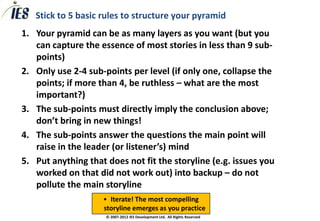
Stick to 5 basic rules to structure your pyramid
1. Your pyramid can be as many layers as you want (but you
   can capture the essence of most stories in less than 9 sub-
   points)
2. Only use 2-4 sub-points per level (if only one, collapse the
   points; if more than 4, be ruthless – what are the most
   important?)
3. The sub-points must directly imply the conclusion above;
   don’t bring in new things!
4. The sub-points answer the questions the main point will
   raise in the leader (or listener’s) mind
5. Put anything that does not fit the storyline (e.g. issues you
   worked on that did not work out) into backup – do not
   pollute the main storyline
                    • Iterate! The most compelling
                    storyline emerges as you practice
                     © 2007-2012 IES Development Ltd. All Rights Reserved

Consulting toolkit crafting a storyline

  • 1.
    CONSULTING TOOLKIT Communicating your Recommendation Crafting a Storyline © 2007-2012 IESIES Development Ltd. All Ltd. Reserved © 2007-2012 Development Rights All Rights Reserved
  • 2.
    “Do not saya little in many words but a great deal in a few.” Pythagoras © 2007-2012 IES Development Ltd. All Rights Reserved
  • 3.
    Structure your writingso that if the reader/audience leaves at any time, they will still get the most important points Tagline If you only had 15 seconds, how would you communicate your recommendation? Executive Summary If the reader only reads one page, how would you communicate your recommendation? The “Pack” The story backed up by charts that communicates your recommendation the most powerful way Appendix/Back-up What analysis does not fit in your story, but you want available to answer the reader’s questions? © 2007-2012 IES Development Ltd. All Rights Reserved
  • 4.
    Taglines serve thesame purpose in presentations as they do in advertising A tagline is a variant of a branding slogan. The idea behind the concept is to create a memorable phrase that will sum up the tone and premise of a recommendation and reinforce the audience's memory of a presentation “In space no-one can hear you scream” © 2007-2012 IES Development Ltd. All Rights Reserved
  • 5.
    “Pyramid Principle” writingis more like a Tabloid journalist than a “Whodunnit” author ONCE upon a time there were Three Bears, who lived together in a house of their own, in a Bad girl wood. One of them was a Little, Small, Wee Bear; and one was a Middle-sized Bear, and the other was a Great, Huge Bear. They each had a pot for their porridge, a little pot for the Little, Small, Wee Bear, and a middle-sized pot for the Middle Bear, and a great pot for the Great, Huge Bear. And they each had a chair to sit in; a little chair for the Little, Small, Wee Bear; and a middle-sized chair for the Middle Bear; and a great chair for the Great, Huge Bear. And they each had a bed to sleep in; a little bed for the Little, Small, Wee Bear; and a middle-sized bed raids for the Middle Bear; and a great bed for the Great, Huge Bear. One day, after they had made the porridge for their breakfast, and poured it into their porridge-pots, they walked out into the wood while the porridge was cooling, that they might not burn their mouths, by beginning too soon to eat it. And while they were walking, a little Girl named Goldilocks came to the house. She could not have been a good, honest little Girl; for first she looked in at the window, Bear Lair! and then she peeped in at the keyhole; and seeing nobody in the house, she lifted the latch. The door was not fastened, because the Bears were good Bears, who did nobody any harm, and never suspected that anybody would harm them. So Goldilocks opened the door, and went in; and well pleased she was when she saw the porridge on the table. If she had been a good little Girl, she would have waited till the Bears came home, and then, perhaps, they would have asked her to breakfast; for they were good Bears. © 2007-2012 IES Development Ltd. All Rights Reserved
  • 6.
    Try to finda compelling tag-line summary of your presentation •Memorable •Easy to understand •Focuses attention •Unifies your whole recommendation e.g. “Nokia should become the Smartphone company for emerging markets” What could the tagline be for your recommendation on workopoliscampus.com? © 2007-2012 IES Development Ltd. All Rights Reserved
  • 7.
    “The Pyramid Principle*”lays out a standard format for communicating a recommendation Situation We have been progressing smoothly….. Complication ….but now, the situation is changing and requires action Question ….and the question is, what shall we do? Answer We should do this Rationale For these reasons: 1, 2 and 3 Source: *”The Pyramid Principle” by©Barbara Minto Ltd. All Rights Reserved 2007-2012 IES Development
  • 8.
    “Pyramid Principle” writinggrabs and holds the reader’s attention Situation Consultants must communicate their recommendations clearly so that managers can act on them Complication However, managers have very little time or patience Question How can consultants communicate their recommendations so that they grab and hold managers’ attention? Answer Consultants should structure their storyline according to “The Pyramid Principle” Because: Rationale 1. It matches the communication to how humans think 2. It is clear and logical 3. All the top management consulting companies use it © 2007-2012 IES Development Ltd. All Rights Reserved
  • 9.
    In business writing,it is usually best to give the answer away up front, not make the reader wade through your workings • The method you used to solve the problem is NOT the same way that you use to communicate it – Don’t tell the story of your project! – The audience cares about your conclusion, not your journey – Don’t communicate your workings – e.g. issue tree or workplan • Simplify ruthlessly – Cut your pack down to the minimum your need to support your recommendation - you don’t get paid per page – Drop analysis to the Appendix if the conclusion does not fit your story, even if you spent many days on it © 2007-2012 IES Development Ltd. All Rights Reserved
  • 10.
    If additional supportis needed, the pyramid can be extended many layers The Answer Point 1 Point 2 Point 3 Sub-point 1 Sub-point 1 Sub-point 1 Sub-sub- Sub-sub- Sub-sub- point 1 point 2 point 3 © 2007-2012 IES Development Ltd. All Rights Reserved
  • 11.
    Stick to 5basic rules to structure your pyramid 1. Your pyramid can be as many layers as you want (but you can capture the essence of most stories in less than 9 sub- points) 2. Only use 2-4 sub-points per level (if only one, collapse the points; if more than 4, be ruthless – what are the most important?) 3. The sub-points must directly imply the conclusion above; don’t bring in new things! 4. The sub-points answer the questions the main point will raise in the leader (or listener’s) mind 5. Put anything that does not fit the storyline (e.g. issues you worked on that did not work out) into backup – do not pollute the main storyline • Iterate! The most compelling storyline emerges as you practice © 2007-2012 IES Development Ltd. All Rights Reserved