Bangkok

BVK

Beijing
Boston
Chennai

China Exit or Co-Investment Opportunities
for German PE Investors

Chicago
London
Los Angeles
Melbourne

Milan

November 26, 2013

Mumbai
Munich
New Delhi
New York
Paris
São Paolo
San Francisco
Seoul
Shanghai
Singapore

L.E.K. Consulting GmbH, Neuturmstr. 5, 80331 München
T: +49 (0) 89 922005-0 F: +49 (0) 89 922005-20 www.lek.com

Sydney
Tokyo
Wroclaw
© 2013 L.E.K. Consulting LLC. All rights reserved.
Agenda

Agenda
 Introduction
 Macroeconomic backdrop
 Co-investments and Exits

CONFIDENTIAL
1
Introduction

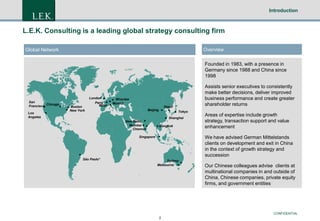
L.E.K. Consulting is a leading global strategy consulting firm
Overview

Global Network

Founded in 1983, with a presence in
Germany since 1988 and China since
1998

San
Francisco Chicago
Los
Angeles

Boston
New York

London
Paris
Milan

Wroclaw
Munich

Seoul

Beijing
New Delhi
Mumbai
Chennai

Assists senior executives to consistently
make better decisions, deliver improved
business performance and create greater
shareholder returns
Tokyo

Shanghai
Bangkok

We have advised German Mittelstands
clients on development and exit in China
in the context of growth strategy and
succession

Singapore

São Paolo*

Areas of expertise include growth
strategy, transaction support and value
enhancement

Sydney
Melbourne

Our Chinese colleagues advise clients at
multinational companies in and outside of
China, Chinese companies, private equity
firms, and government entities

CONFIDENTIAL
2
Introduction

Introduction
 This document summarizes results of a study conducted by L.E.K. Munich and Shanghai
 The goals of the study are to

-

Understand developments in Chinese equity investments in both the domestic China / pan-Asian
market and cross-border investments between China and Germany / Europe

-

Identify trends in likely future investment behaviour and its drivers
Defining success factors both for Chinese and German investors / corporates as to how to benefit
from the potential opportunities of cross-border investments and co-operation

 The study is based on

-

Discussions with 50 representatives of senior investment and corporate professionals in Shanghai,
Beijing and Hong Kong

-

Project experience
Extensive secondary research

CONFIDENTIAL
3
Agenda

Agenda
 Introduction
 Macroeconomic backdrop
 Co-investments and Exits

CONFIDENTIAL
4
Macroeconomic backdrop

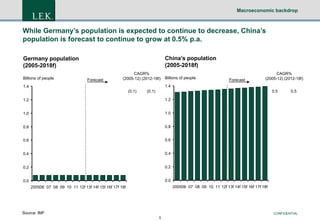
While Germany’s population is expected to continue to decrease, China’s
population is forecast to continue to grow at 0.5% p.a.
China’s population
(2005-2018f)

Germany population
(2005-2018f)
Billions of people

Forecast

CAGR%
(2005-12) (2012-18f)

Billions of people

Forecast

CAGR%
(2005-12) (2012-18f)

1.4

1.4
(0.1)

(0.1)

0.5

1.2

1.2

1.0

1.0

0.8

0.8

0.6

0.6

0.4

0.4

0.2

0.2

0.0

0.5

0.0
200506 07 08 09 10 11 12f 13f 14f 15f 16f 17f 18f

200506 07 08 09 10 11 12f 13f 14f 15f 16f 17f 18f

Source: IMF

CONFIDENTIAL
5
Macroeconomic backdrop

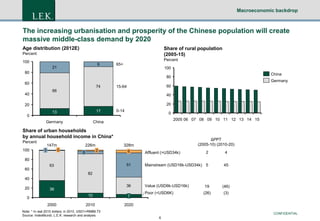
The increasing urbanisation and prosperity of the Chinese population will create
massive middle-class demand by 2020
Age distribution (2012E)

Share of rural population
(2005-15)

Percent
100

9

21

Percent

65+

100

80

China

80

60

74

66

40

Germany

60

15-64

40
20

20

13

17

Germany

0-14

China

0

0

2005 06 07 08 09 10 11 12 13 14 15

Share of urban households
by annual household income in China*
Percent
100

147m

226m
0

1

2

6

ΔPPT
(2005-10) (2010-20)

328m

6

2

4

51

Mainstream (USD16k-USD34k) 5

45

36

Value (USD6k-USD16k)

Affluent (>USD34k)

80
60

63
82

40
20

36
10

0

2000

7

2010

Poor (<USD6K)

19

(46)

(26)

(3)

2020

Note: * In real 2010 dollars; in 2010, USD1=RMB6.73
Source: IndexMundi; L.E.K. research and analysis

CONFIDENTIAL
6
Macroeconomic backdrop

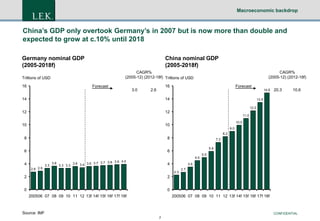
China’s GDP only overtook Germany’s in 2007 but is now more than double and
expected to grow at c.10% until 2018
Germany nominal GDP
(2005-2018f)

China nominal GDP
(2005-2018f)
CAGR%
(2005-12) (2012-18f)

CAGR%
(2005-12) (2012-18f) Trillions of USD

Trillions of USD
16

Forecast

3.0

16

2.6

14

14

12

12

10

Forecast

10

14.9

20.3

10.6

13.5
12.2
11.0

10.0
9.0
8.2

8

8

6

6

7.3
5.9
4.5

4
2.8 2.9

3.3

3.6

3.3 3.3

3.9 4.0
3.6 3.4 3.6 3.7 3.7 3.8

4

3.5
2.3

2

2.7

2

0

5.0

0
200506 07 08 09 10 11 12 13f 14f 15f 16f 17f 18f

200506 07 08 09 10 11 12 13f 14f 15f 16f 17f 18f

Source: IMF

CONFIDENTIAL
7
Macroeconomic backdrop

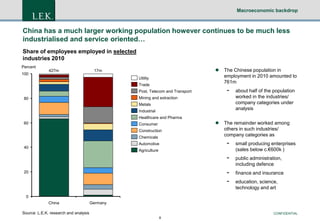
China has a much larger working population however continues to be much less
industrialised and service oriented…
Share of employees employed in selected
industries 2010
Percent
100

427m



17m
Utility
Trade

The Chinese population in
employment in 2010 amounted to
761m

-

Post, Telecom and Transport
Mining and extraction

80

Metals
Industrial

about half of the population
worked in the industries/
company categories under
analysis

Healthcare and Pharma

60



Consumer

Construction
Chemicals

The remainder worked among
others in such industries/
company categories as

-

small producing enterprises
(sales below c.€600k )

-

public administration,
including defence

-

Automotive

40

finance and insurance

Agriculture

20

education, science,
technology and art

0
China

Germany

Source: L.E.K. research and analysis

CONFIDENTIAL
8
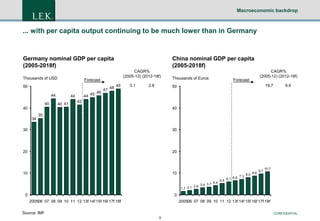
Macroeconomic backdrop

... with per capita output continuing to be much lower than in Germany

Germany nominal GDP per capita
(2005-2018f)
Thousands of USD

44
40
34

CAGR%
(2005-12) (2012-18f)

Forecast

50

40

China nominal GDP per capita
(2005-2018f)

46
44 45

44

40 41

47

48

49

3.1

2.8

Thousands of Euros

Forecast

CAGR%
(2005-12) (2012-18f)
19.7

50

9.9

42
40

35

30

30

20

20

10

10
3.7 4.4
2.6 3.4
1.7 2.1

0

6.6 7.3
5.4 6.1

8.0 8.8

9.7

10.7

0
200506 07 08 09 10 11 12 13f 14f 15f 16f 17f 18f

200506 07 08 09 10 11 12 13f 14f 15f 16f 17f 18f

Source: IMF

CONFIDENTIAL
9
Macroeconomic backdrop

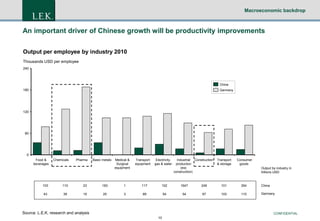
An important driver of Chinese growth will be productivity improvements
Output per employee by industry 2010
Thousands USD per employee
240

China

180

Germany

120

60

0
Food &
beverages

Chemicals

Pharma

Basic metals

Medical &
Surgical
equipment

Transport
equipment

Electricity,
gas & water

Industrial Construction
production
(exc
construction)

Transport
& storage

Consumer
goods
Output by industry in
trillions USD

103

110

23

183

1

117

102

1647

249

101

354

China

43

39

19

25

3

89

54

54

97

103

110

Germany

Source: L.E.K. research and analysis

CONFIDENTIAL
10
Macroeconomic backdrop

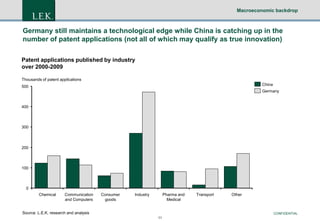
Germany still maintains a technological edge while China is catching up in the
number of patent applications (not all of which may qualify as true innovation)
Patent applications published by industry
over 2000-2009
Thousands of patent applications
China

500

Germany

400

300

200

100

0
Chemical

Communication
and Computers

Consumer
goods

Industry

Pharma and
Medical

Source: L.E.K. research and analysis

Transport

Other

CONFIDENTIAL
11
Macroeconomic backdrop

Summary observations
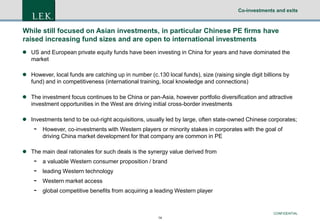
 China continues to be an important market for German companies

-

Continued population growth
Attractive young demographic with lots of demands
Increasing urbanisation
Increasing per capita income and prosperity
Appetite for Western consumer brands and high tech products

 China is orienting towards the West

-

Still very much an agricultural society with relatively small but growing industrial and services sector
Improving productivity – but long way to go
Working on R&D and innovation – partial catch up but still major gaps

Combining China market demand with German market “supply” can be a powerful
investment thesis

CONFIDENTIAL
12
Agenda

Agenda
 Introduction
 Macroeconomic backdrop
 Co-investments and Exits

CONFIDENTIAL
13
Co-investments and exits

While still focused on Asian investments, in particular Chinese PE firms have
raised increasing fund sizes and are open to international investments
 US and European private equity funds have been investing in China for years and have dominated the
market
 However, local funds are catching up in number (c.130 local funds), size (raising single digit billions by
fund) and in competitiveness (international training, local knowledge and connections)
 The investment focus continues to be China or pan-Asia, however portfolio diversification and attractive
investment opportunities in the West are driving initial cross-border investments

 Investments tend to be out-right acquisitions, usually led by large, often state-owned Chinese corporates;

-

However, co-investments with Western players or minority stakes in corporates with the goal of
driving China market development for that company are common in PE

 The main deal rationales for such deals is the synergy value derived from

-

a valuable Western consumer proposition / brand
leading Western technology
Western market access
global competitive benefits from acquiring a leading Western player

CONFIDENTIAL
14
Co-investments and exits

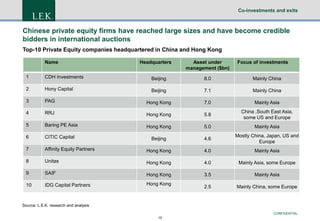
Chinese private equity firms have reached large sizes and have become credible
bidders in international auctions
Top-10 Private Equity companies headquartered in China and Hong Kong
Name

Headquarters

Asset under
management ($bn)

Focus of investments

1

CDH Investments

Beijing

8.0

Mainly China

2

Hony Capital

Beijing

7.1

Mainly China

3

PAG

Hong Kong

7.0

Mainly Asia

4

RRJ

Hong Kong

5.8

China ,South East Asia,
some US and Europe

5

Baring PE Asia

Hong Kong

5.0

Mainly Asia

6

CITIC Capital

Beijing

4.6

Mostly China, Japan, US and
Europe

7

Affinity Equity Partners

Hong Kong

4.0

Mainly Asia

8

Unitas

Hong Kong

4.0

Mainly Asia, some Europe

9

SAIF

Hong Kong

3.5

Mainly Asia

10

IDG Capital Partners

Hong Kong

2.5

Mainly China, some Europe

Source: L.E.K. research and analysis
CONFIDENTIAL
15
Co-investments and exits

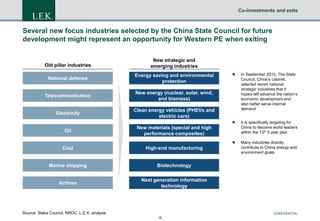
Several new focus industries selected by the China State Council for future
development might represent an opportunity for Western PE when exiting

Old pillar industries

New strategic and
emerging industries

National defense

Energy saving and environmental
protection

Telecommunication

New energy (nuclear, solar, wind,
and biomass)

Electricity

Clean energy vehicles (PHEVs and
electric cars)

Oil

New materials (special and high
performance composites)

Marine shipping

Many industries directly
contribute to China energy and
environment goals

Biotechnology

Airlines

It is specifically targeting for
China to become world leaders
within the 12th 5 year plan



High-end manufacturing

In September 2010, The State
Council, China’s cabinet,
selected seven national
strategic industries that it
hopes will advance the nation’s
economic development and
also better serve internal
demand



Coal



Next generation information
technology

Source: Stake Council, NRDC, L.E.K. analysis

CONFIDENTIAL
16
Co-investments and exits

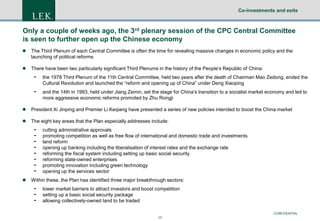
Only a couple of weeks ago, the 3rd plenary session of the CPC Central Committee
is seen to further open up the Chinese economy


The Third Plenum of each Central Committee is often the time for revealing massive changes in economic policy and the
launching of political reforms



There have been two particularly significant Third Plenums in the history of the People’s Republic of China:

-

the 1978 Third Plenum of the 11th Central Committee, held two years after the death of Chairman Mao Zedong, ended the
Cultural Revolution and launched the “reform and opening up of China” under Deng Xiaoping

-

and the 14th in 1993, held under Jiang Zemin, set the stage for China’s transition to a socialist market economy and led to
more aggressive economic reforms promoted by Zhu Rongji



President Xi Jinping and Premier Li Keqiang have presented a series of new policies intended to boost the China market



The eight key areas that the Plan especially addresses include:



cutting administrative approvals
promoting competition as well as free flow of international and domestic trade and investments
land reform
opening up banking including the liberalisation of interest rates and the exchange rate
reforming the fiscal system including setting up basic social security
reforming state-owned enterprises
promoting innovation including green technology
opening up the services sector

Within these, the Plan has identified three major breakthrough sectors:

-

lower market barriers to attract investors and boost competition
setting up a basic social security package
allowing collectively-owned land to be traded
CONFIDENTIAL
17
Co-investments and exits

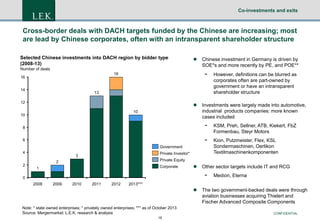
Cross-border deals with DACH targets funded by the Chinese are increasing; most
are lead by Chinese corporates, often with an intransparent shareholder structure
Selected Chinese investments into DACH region by bidder type
(2008-13)



Number of deals

-

16

16
14

Chinese investment in Germany is driven by
SOE*s and more recently by PE, and POE**

13

12


10

10

However, definitions can be blurred as
corporates often are part-owned by
government or have an intransparent
shareholder structure

Investments were largely made into automotive,
industrial products companies: more known
cases included

8

-

KSM, Preh, Sellner, ATB, Kiekert, FbZ
Formenbau, Steyr Motors

6

-

Kion, Putzmeister, Flex, KSL
Sondermaschinen, Oerlikon
Textilmaschinenkomponenten

Government
4
2

Private Investor*

3

Private Equity

2

Corporate

1



-

0

2008

Other sector targets include IT and RCG

2009

2010

2011

2012

Medion, Eterna

2013***



Note: * state owned enterprises; * privately owned enterprises; *** as of October 2013
Source: Mergermarket; L.E.K. research & analysis
18

The two government-backed deals were through
aviation businesses acquiring Thielert and
Fischer Advanced Composite Components
CONFIDENTIAL
Co-investments and exits

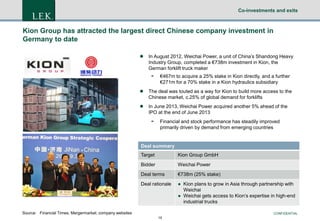
Kion Group has attracted the largest direct Chinese company investment in
Germany to date


In August 2012, Weichai Power, a unit of China’s Shandong Heavy
Industry Group, completed a €738m investment in Kion, the
German forklift truck maker

-

€467m to acquire a 25% stake in Kion directly, and a further
€271m for a 70% stake in a Kion hydraulics subsidiary



The deal was touted as a way for Kion to build more access to the
Chinese market, c.25% of global demand for forklifts



In June 2013, Weichai Power acquired another 5% ahead of the
IPO at the end of June 2013

-

Financial and stock performance has steadily improved
primarily driven by demand from emerging countries

Deal summary
Target

Kion Group GmbH

Bidder

Weichai Power

Deal terms

€738m (25% stake)

Deal rationale

● Kion plans to grow in Asia through partnership with
Weichai
● Weichai gets access to Kion’s expertise in high-end
industrial trucks

Source: Financial Times; Mergermarket; company websites

CONFIDENTIAL
19
Co-investments and exits

In terms of exits to Chinese investors, Putzmeister has been the most sizeable
transaction to date


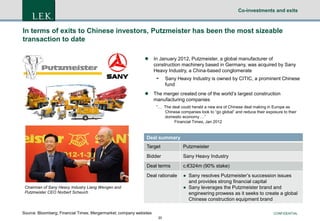
In January 2012, Putzmeister, a global manufacturer of
construction machinery based in Germany, was acquired by Sany
Heavy Industry, a China-based conglomerate



Sany Heavy Industry is owned by CITIC, a prominent Chinese
fund

The merger created one of the world’s largest construction
manufacturing companies
“… The deal could herald a new era of Chinese deal making in Europe as
Chinese companies look to “go global” and reduce their exposure to their
domestic economy …”
Financial Times, Jan 2012

Deal summary
Target

Putzmeister

Bidder

Sany Heavy Industry

Deal terms

c.€324m (90% stake)

Deal rationale

● Sany resolves Putzmeister’s succession issues
and provides strong financial capital
● Sany leverages the Putzmeister brand and
engineering prowess as it seeks to create a global
Chinese construction equipment brand

Chairman of Sany Heavy Industry Liang Wengen and
Putzmeister CEO Norbert Scheuch

Source: Bloomberg; Financial Times; Mergermarket; company websites

CONFIDENTIAL
20
Co-investments and exits

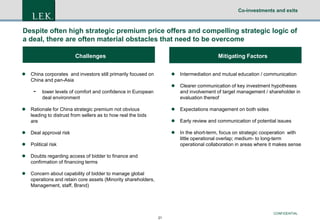
Despite often high strategic premium price offers and compelling strategic logic of
a deal, there are often material obstacles that need to be overcome
Challenges

Mitigating Factors


Intermediation and mutual education / communication



Clearer communication of key investment hypotheses
and involvement of target management / shareholder in
evaluation thereof

Rationale for China strategic premium not obvious
leading to distrust from sellers as to how real the bids
are



Expectations management on both sides



Early review and communication of potential issues



Deal approval risk





Political risk

In the short-term, focus on strategic cooperation with
little operational overlap; medium- to long-term
operational collaboration in areas where it makes sense



Doubts regarding access of bidder to finance and
confirmation of financing terms



Concern about capability of bidder to manage global
operations and retain core assets (Minority shareholders,
Management, staff, Brand)



China corporates and investors still primarily focused on
China and pan-Asia



lower levels of comfort and confidence in European
deal environment

CONFIDENTIAL
21
Summary observations
 China investors, both corporate and financial, will increasingly be looking at investment opportunities
beyond the domestic markets
 Of particular interest for Chinese investors are companies that

-

Are related to China focus industries
Bring a European brand to the Chinese consumer
Help develop Chinese corporates in their globalisation by bringing valuable technology and / or
brand to the table

 Of particular interest for Western / German investors are

-

Flexible strategic equity investment (minority / co-investment as well as lead investments) in
companies which are less interesting for European PE or strategies

-

China market access
Strategic partnership to defend and build global market position

 There are material challenges as with many cross-border deals, however these are often really dealdependent and over time they are on average likely to become less of an issue
Keep Chinese investors on the radar for both co-investment and exit strategies
CONFIDENTIAL
22