M&A TOOLKIT

     Closing:

     Deal Structuring


© 2007-2013 IESIES Development Ltd. All Ltd. Reserved
       © 2007-2013 Development Rights All Rights Reserved
You can increase value creation through smart choices on deal
    structuring
PRIMARY DEAL STRUCTURE CHOICES

 • What are you buying?
        - Asset or share purchase? What is included/excluded?
        - 100%, 51% or minority position?
 • How are you paying?
        - Cash or shares? Funding?
        - Deferred payments? What timescale/pricing mechanism?

 • Where are you buying?
        - What legal vehicle?
        - Tax efficiency? IES Development Ltd. All Rights Reserved
                      © 2007-2013
You can increase value creation through smart choices on deal
      structuring

 ADDING VALUE THROUGH INCLUDE/EXCLUDE CHOICES
          Consider buying one Division from a multinational
            company, e.g. Lenovo buying IBM PC Division

• What do you want to include in the deal?
   oSupport from Corporate that is high value? (e.g. sales support)
   oKey corporate assets (e.g. patents, brand copyrights)


• What do you want to exclude from the deal?
   oLiabilities? (e.g. pension, environmental)
   oAssets you don’t need? (e.g. US assembly plants)
   oSupport from Corporate that is low value to you? (e.g. HR support)
                       © 2007-2013 IES Development Ltd. All Rights Reserved
One of the primary choices is whether to offer cash or shares


SHARE DEAL EQUIVALENCE

                                  Cash deal
  Share deal =                                +
                                              Rights Issue
                                    (usually new shares
                                          issued to target)


                   © 2007-2013 IES Development Ltd. All Rights Reserved
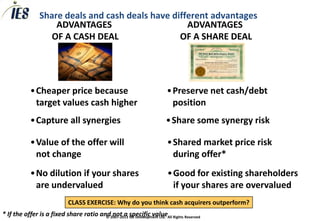
Share deals and cash deals have different advantages
                   ADVANTAGES                      ADVANTAGES
                  OF A CASH DEAL                 OF A SHARE DEAL


           •Cheaper price because                                    •Preserve net cash/debt
            target values cash higher                                 position
           •Capture all synergies                                    •Share some synergy risk

           •Value of the offer will                                  •Shared market price risk
            not change                                                during offer*
           •No dilution if your shares                                •Good for existing shareholders
            are undervalued                                            if your shares are overvalued
                           CLASS EXERCISE: Why do you think cash acquirers outperform?
* If the offer is a fixed share ratio and2007-2013 specific valueAll Rights Reserved
                                        ©
                                          not a IES Development Ltd.
One of the problems with M&A is the “information asymmetry”
    in a deal

THE PROBLEM WITH BUYING A USED CAR


    George Akerlof paper "The Market for Lemons"

    His basic insight was simple: If somebody who has plenty
    of experience driving a particular car is keen to sell it to
    you, why should you be so keen to buy it?

    This “information asymmetry” exists in M&A too

                     © 2007-2013 IES Development Ltd. All Rights Reserved
Deferred payments are a tool to overcome the “information
     asymmetry” problem and generate “win/win” opportunities

ADVANTAGES OF DEFERRED PAYMENTS

1) Provides some protection to acquirer

[Especially important in China, where legal redress limited, having
the cash in your hand improves your negotiating position if you find
a problem in the company]

2) Enables a deal to be negotiated despite different future
 performance assumptions


                          Any other advantages?

                     © 2007-2013 IES Development Ltd. All Rights Reserved
Deferred payments allow deals to be negotiated despite
       different valuation assumptions
EXAMPLE OF A DEAL THAT REQUIRES DEFERRED PAYMENT
• Your DCF valuation model says profits will increase from $20m to
  $25m next year, justifying a price for the business of $275m
• The seller says profits will increase to $30m next year, justifying a
  price of $300m for the business
• Do you believe him?
• Your DCF valuation model says if profits increased to $30m next
  year, the business would be worth $325m
• How can you do a deal?
• Possible deal: $150m cash plus 5 times next year’s profit
• Seller happy =>gets his $300m if he is right
• You are happy
    oif profit is $25m, you pay $275m, the right price
    oif profit is $30m, you pay $300m, creating $25m value

                       © 2007-2013 IES Development Ltd. All Rights Reserved
Deferred payments are payments made after a deal closes
     subject to various conditions

DETAILS REQUIRED FOR DEFERRED PAYMENT DEALS
How long deferred?          Amount of payment?
  •6 months?                    •Lump sum?
  •Next financial year?         •Multiple of profit? What profit?
  •3 years time?                •Independent valuation? Binding?


Key terms?                       What is the payment for?
   •Conditions e.g. satisfaction   •Original price (only up to 1
    with Representations,           year in China)?
    Indemnities and Warranties?    •Additional equity purchase?
   •Rights e.g. Put/Call?          •Consultancy services?

    •What is the problem with deferred payments conditional on future business performance?
    •How can the seller prevent the buyer “gaming” the calculation?
                           © 2007-2013 IES Development Ltd. All Rights Reserved

Mand a toolkit deal structuring

  • 1.
    M&A TOOLKIT Closing: Deal Structuring © 2007-2013 IESIES Development Ltd. All Ltd. Reserved © 2007-2013 Development Rights All Rights Reserved
  • 2.
    You can increasevalue creation through smart choices on deal structuring PRIMARY DEAL STRUCTURE CHOICES • What are you buying? - Asset or share purchase? What is included/excluded? - 100%, 51% or minority position? • How are you paying? - Cash or shares? Funding? - Deferred payments? What timescale/pricing mechanism? • Where are you buying? - What legal vehicle? - Tax efficiency? IES Development Ltd. All Rights Reserved © 2007-2013
  • 3.
    You can increasevalue creation through smart choices on deal structuring ADDING VALUE THROUGH INCLUDE/EXCLUDE CHOICES Consider buying one Division from a multinational company, e.g. Lenovo buying IBM PC Division • What do you want to include in the deal? oSupport from Corporate that is high value? (e.g. sales support) oKey corporate assets (e.g. patents, brand copyrights) • What do you want to exclude from the deal? oLiabilities? (e.g. pension, environmental) oAssets you don’t need? (e.g. US assembly plants) oSupport from Corporate that is low value to you? (e.g. HR support) © 2007-2013 IES Development Ltd. All Rights Reserved
  • 4.
    One of theprimary choices is whether to offer cash or shares SHARE DEAL EQUIVALENCE Cash deal Share deal = + Rights Issue (usually new shares issued to target) © 2007-2013 IES Development Ltd. All Rights Reserved
  • 5.
    Share deals andcash deals have different advantages ADVANTAGES ADVANTAGES OF A CASH DEAL OF A SHARE DEAL •Cheaper price because •Preserve net cash/debt target values cash higher position •Capture all synergies •Share some synergy risk •Value of the offer will •Shared market price risk not change during offer* •No dilution if your shares •Good for existing shareholders are undervalued if your shares are overvalued CLASS EXERCISE: Why do you think cash acquirers outperform? * If the offer is a fixed share ratio and2007-2013 specific valueAll Rights Reserved © not a IES Development Ltd.
  • 6.
    One of theproblems with M&A is the “information asymmetry” in a deal THE PROBLEM WITH BUYING A USED CAR George Akerlof paper "The Market for Lemons" His basic insight was simple: If somebody who has plenty of experience driving a particular car is keen to sell it to you, why should you be so keen to buy it? This “information asymmetry” exists in M&A too © 2007-2013 IES Development Ltd. All Rights Reserved
  • 7.
    Deferred payments area tool to overcome the “information asymmetry” problem and generate “win/win” opportunities ADVANTAGES OF DEFERRED PAYMENTS 1) Provides some protection to acquirer [Especially important in China, where legal redress limited, having the cash in your hand improves your negotiating position if you find a problem in the company] 2) Enables a deal to be negotiated despite different future performance assumptions Any other advantages? © 2007-2013 IES Development Ltd. All Rights Reserved
  • 8.
    Deferred payments allowdeals to be negotiated despite different valuation assumptions EXAMPLE OF A DEAL THAT REQUIRES DEFERRED PAYMENT • Your DCF valuation model says profits will increase from $20m to $25m next year, justifying a price for the business of $275m • The seller says profits will increase to $30m next year, justifying a price of $300m for the business • Do you believe him? • Your DCF valuation model says if profits increased to $30m next year, the business would be worth $325m • How can you do a deal? • Possible deal: $150m cash plus 5 times next year’s profit • Seller happy =>gets his $300m if he is right • You are happy oif profit is $25m, you pay $275m, the right price oif profit is $30m, you pay $300m, creating $25m value © 2007-2013 IES Development Ltd. All Rights Reserved
  • 9.
    Deferred payments arepayments made after a deal closes subject to various conditions DETAILS REQUIRED FOR DEFERRED PAYMENT DEALS How long deferred? Amount of payment? •6 months? •Lump sum? •Next financial year? •Multiple of profit? What profit? •3 years time? •Independent valuation? Binding? Key terms? What is the payment for? •Conditions e.g. satisfaction •Original price (only up to 1 with Representations, year in China)? Indemnities and Warranties? •Additional equity purchase? •Rights e.g. Put/Call? •Consultancy services? •What is the problem with deferred payments conditional on future business performance? •How can the seller prevent the buyer “gaming” the calculation? © 2007-2013 IES Development Ltd. All Rights Reserved