CONSULTING TOOLKIT

     Setting up the Problem

     Defining the Question


© 2007-2012 IESIES Development Ltd. All Ltd. Reserved
       © 2007-2012 Development Rights All Rights Reserved
If you start off your problem solving with a good question, you
  greatly improve the chances of getting a good answer


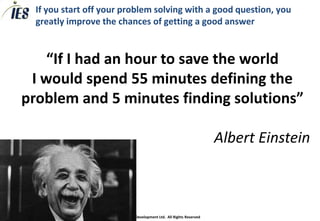
    “If I had an hour to save the world
 I would spend 55 minutes defining the
problem and 5 minutes finding solutions”

                                                                          Albert Einstein


                   © 2007-2012 IES Development Ltd. All Rights Reserved
Even if you are given a question, you should still challenge your
    thinking to find a better one

WHY YOU NEED TO DEFINE YOUR OWN QUESTION

    • Your client/boss/the case is unlikely to serve up the
      best question

    • In your search for a better question, you will
      understand the problem better

    • You will differentiate yourself


                     © 2007-2012 IES Development Ltd. All Rights Reserved
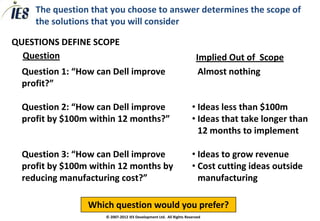
The question that you choose to answer determines the scope of
        the solutions that you will consider

QUESTIONS DEFINE SCOPE
  Question                                                                 Implied Out of Scope
    Question 1: “How can Dell improve                                     Almost nothing
     profit?”

    Question 2: “How can Dell improve                                 • Ideas less than $100m
     profit by $100m within 12 months?”                                • Ideas that take longer than
                                                                         12 months to implement

    Question 3: “How can Dell improve                                 • Ideas to grow revenue
     profit by $100m within 12 months by                               • Cost cutting ideas outside
     reducing manufacturing cost?”                                       manufacturing

                    Which question would you prefer?
                        © 2007-2012 IES Development Ltd. All Rights Reserved
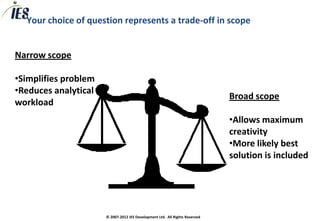
Your choice of question represents a trade-off in scope


Narrow scope

•Simplifies problem
•Reduces analytical
                                                                             Broad scope
workload
                                                                             •Allows maximum
                                                                             creativity
                                                                             •More likely best
                                                                             solution is included


                      © 2007-2012 IES Development Ltd. All Rights Reserved
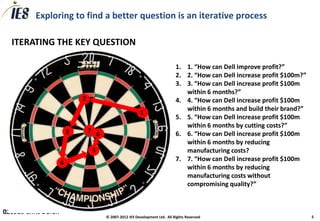
Exploring to find a better question is an iterative process

  ITERATING THE KEY QUESTION

                                                                             1. 1. “How can Dell improve profit?”
                                                                             2. 2. “How can Dell increase profit $100m?”
                                                                             3. 3. “How can Dell increase profit $100m
                                                                                within 6 months?”
                             2                                               4. 4. “How can Dell increase profit $100m
                                                                                within 6 months and build their brand?”
                                                         1
                                                                             5. 5. “How can Dell increase profit $100m
                                                                                within 6 months by cutting costs?”
                         3       7 6                                         6. 6. “How can Dell increase profit $100m
                                                                                within 6 months by reducing
                                  5                                             manufacturing costs?
                                                                             7. 7. “How can Dell increase profit $100m
                     4
                                                                                within 6 months by reducing
                                                                                manufacturing costs without
                                                                                compromising quality?”


020910 Chris Doran
                                       © 2007-2012 IES Development Ltd. All Rights Reserved                                5
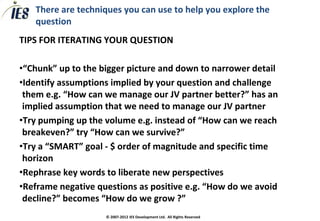
There are techniques you can use to help you explore the
   question
TIPS FOR ITERATING YOUR QUESTION

•“Chunk” up to the bigger picture and down to narrower detail
•Identify assumptions implied by your question and challenge
 them e.g. “How can we manage our JV partner better?” has an
 implied assumption that we need to manage our JV partner
•Try pumping up the volume e.g. instead of “How can we reach
 breakeven?” try “How can we survive?”
•Try a “SMART” goal - $ order of magnitude and specific time
 horizon
•Rephrase key words to liberate new perspectives
•Reframe negative questions as positive e.g. “How do we avoid
 decline?” becomes “How do we grow ?”
                    © 2007-2012 IES Development Ltd. All Rights Reserved
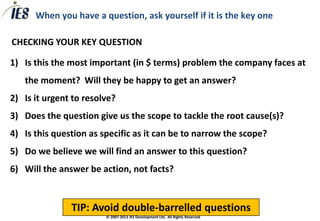
When you have a question, ask yourself if it is the key one

CHECKING YOUR KEY QUESTION

1) Is this the most important (in $ terms) problem the company faces at
   the moment? Will they be happy to get an answer?
2) Is it urgent to resolve?
3) Does the question give us the scope to tackle the root cause(s)?
4) Is this question as specific as it can be to narrow the scope?
5) Do we believe we will find an answer to this question?
6) Will the answer be action, not facts?


               TIP: Avoid double-barrelled questions
                        © 2007-2012 IES Development Ltd. All Rights Reserved
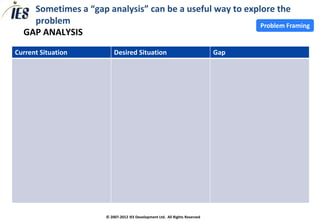
Sometimes a “gap analysis” can be a useful way to explore the
    problem                                               Problem Framing
  GAP ANALYSIS
Current Situation         Desired Situation                                  Gap


                      © 2007-2012 IES Development Ltd. All Rights Reserved
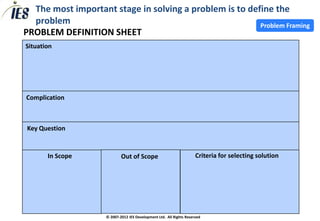
The most important stage in solving a problem is to define the
  problem                                                Problem Framing
PROBLEM DEFINITION SHEET
Situation


Complication


Key Question


       In Scope             Out of Scope                             Criteria for selecting solution


                    © 2007-2012 IES Development Ltd. All Rights Reserved
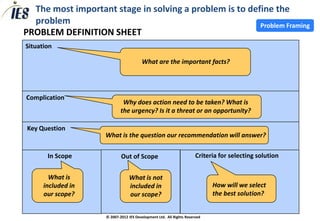
The most important stage in solving a problem is to define the
  problem                                                Problem Framing
PROBLEM DEFINITION SHEET
Situation

                                       What are the important facts?


Complication
                             Why does action need to be taken? What is
                            the urgency? Is it a threat or an opportunity?

Key Question
                    What is the question our recommendation will answer?

       In Scope             Out of Scope                             Criteria for selecting solution


        What is                 What is not
      included in               included in                                How will we select
      our scope?                our scope?                                 the best solution?


                    © 2007-2012 IES Development Ltd. All Rights Reserved

Consulting toolkit defining the question

  • 1.
    CONSULTING TOOLKIT Setting up the Problem Defining the Question © 2007-2012 IESIES Development Ltd. All Ltd. Reserved © 2007-2012 Development Rights All Rights Reserved
  • 2.
    If you startoff your problem solving with a good question, you greatly improve the chances of getting a good answer “If I had an hour to save the world I would spend 55 minutes defining the problem and 5 minutes finding solutions” Albert Einstein © 2007-2012 IES Development Ltd. All Rights Reserved
  • 3.
    Even if youare given a question, you should still challenge your thinking to find a better one WHY YOU NEED TO DEFINE YOUR OWN QUESTION • Your client/boss/the case is unlikely to serve up the best question • In your search for a better question, you will understand the problem better • You will differentiate yourself © 2007-2012 IES Development Ltd. All Rights Reserved
  • 4.
    The question thatyou choose to answer determines the scope of the solutions that you will consider QUESTIONS DEFINE SCOPE Question Implied Out of Scope  Question 1: “How can Dell improve  Almost nothing profit?”  Question 2: “How can Dell improve • Ideas less than $100m profit by $100m within 12 months?” • Ideas that take longer than 12 months to implement  Question 3: “How can Dell improve • Ideas to grow revenue profit by $100m within 12 months by • Cost cutting ideas outside reducing manufacturing cost?” manufacturing Which question would you prefer? © 2007-2012 IES Development Ltd. All Rights Reserved
  • 5.
    Your choice ofquestion represents a trade-off in scope Narrow scope •Simplifies problem •Reduces analytical Broad scope workload •Allows maximum creativity •More likely best solution is included © 2007-2012 IES Development Ltd. All Rights Reserved
  • 6.
    Exploring to finda better question is an iterative process ITERATING THE KEY QUESTION 1. 1. “How can Dell improve profit?” 2. 2. “How can Dell increase profit $100m?” 3. 3. “How can Dell increase profit $100m within 6 months?” 2 4. 4. “How can Dell increase profit $100m within 6 months and build their brand?” 1 5. 5. “How can Dell increase profit $100m within 6 months by cutting costs?” 3 7 6 6. 6. “How can Dell increase profit $100m within 6 months by reducing 5 manufacturing costs? 7. 7. “How can Dell increase profit $100m 4 within 6 months by reducing manufacturing costs without compromising quality?” 020910 Chris Doran © 2007-2012 IES Development Ltd. All Rights Reserved 5
  • 7.
    There are techniquesyou can use to help you explore the question TIPS FOR ITERATING YOUR QUESTION •“Chunk” up to the bigger picture and down to narrower detail •Identify assumptions implied by your question and challenge them e.g. “How can we manage our JV partner better?” has an implied assumption that we need to manage our JV partner •Try pumping up the volume e.g. instead of “How can we reach breakeven?” try “How can we survive?” •Try a “SMART” goal - $ order of magnitude and specific time horizon •Rephrase key words to liberate new perspectives •Reframe negative questions as positive e.g. “How do we avoid decline?” becomes “How do we grow ?” © 2007-2012 IES Development Ltd. All Rights Reserved
  • 8.
    When you havea question, ask yourself if it is the key one CHECKING YOUR KEY QUESTION 1) Is this the most important (in $ terms) problem the company faces at the moment? Will they be happy to get an answer? 2) Is it urgent to resolve? 3) Does the question give us the scope to tackle the root cause(s)? 4) Is this question as specific as it can be to narrow the scope? 5) Do we believe we will find an answer to this question? 6) Will the answer be action, not facts? TIP: Avoid double-barrelled questions © 2007-2012 IES Development Ltd. All Rights Reserved
  • 9.
    Sometimes a “gapanalysis” can be a useful way to explore the problem Problem Framing GAP ANALYSIS Current Situation Desired Situation Gap © 2007-2012 IES Development Ltd. All Rights Reserved
  • 10.
    The most importantstage in solving a problem is to define the problem Problem Framing PROBLEM DEFINITION SHEET Situation Complication Key Question In Scope Out of Scope Criteria for selecting solution © 2007-2012 IES Development Ltd. All Rights Reserved
  • 11.
    The most importantstage in solving a problem is to define the problem Problem Framing PROBLEM DEFINITION SHEET Situation What are the important facts? Complication Why does action need to be taken? What is the urgency? Is it a threat or an opportunity? Key Question What is the question our recommendation will answer? In Scope Out of Scope Criteria for selecting solution What is What is not included in included in How will we select our scope? our scope? the best solution? © 2007-2012 IES Development Ltd. All Rights Reserved