Designing Personal Learning
                        Environments: Staff and
                       Student Considerations in a
                            Digital Landscape

                                  Professor Mike Keppell
                                    Executive Director
                            Australian Digital Futures Institute

                                                                   1

Wednesday, 14 November 12                                              1
Overview
           ‣   Horizon trends and challenges
           ‣   Personal Learning Environments
           ‣   Spaces
           ‣   Tools
           ‣   People
           ‣   Academic learning spaces
           ‣   Student learning spaces
           ‣   ICulture
           ‣   Disconnecting
           ‣   Ecological university

                                                2

Wednesday, 14 November 12                           2
Horizon Trends
       ‣   People expect to be able to work, learn, and
           study whenever and wherever they want.
       ‣   The abundance of resources and
           relationships will challenge our educational
           identity.
       ‣   Students want to use their own technology
           for learning.
       ‣   Teaching paradigms across all sectors are
           shifting to include online learning, hybrid
           learning and collaborative models.
       ‣                                                  3

Wednesday, 14 November 12                                     3
Challenges
       n Seamless    learning – people expect to be
           able to work, learn, and study whenever
           and wherever they want.
       n Digital   literacies – capabilities which fit an
           individual for living, learning and working in a
           digital society (JISC)
       n Personalisation     - our learning, teaching,
           place of learning, technologies will be
           individualised
       n Digital           scholarship will be the norm.


                                                              4

Wednesday, 14 November 12                                         4
References

           n Johnson,   L., Adams, S., Cummins, M., and
               Estrada, V. (2012). Technology Outlook for
               STEM+ Education 2012-2017: An NMC
               Horizon Report Sector Analysis. Austin,
               Texas: The New Media Consortium
           n Sharples, M., McAndrew, P., Weller, M.,
               Ferguson, R., FitzGerald, E., Hirst, T., Mor, Y.,
               Gaved, M. and Whitelock, D. (2012).
               Innovating Pedagogy 2012: Open
               University Innovation Report 1. Milton
               Keynes: The Open University.

                                                                   5

Wednesday, 14 November 12                                              5
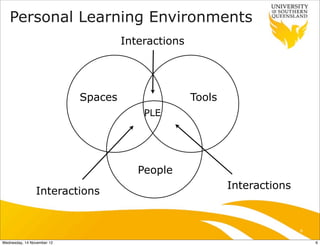
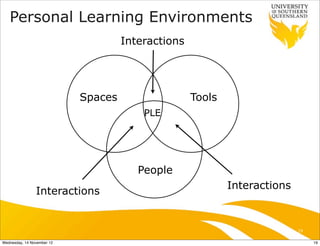
Personal Learning Environments
                                     Interactions


                            Spaces                  Tools
                                         PLE


                                        People
                                                            Interactions
                Interactions


                                                                           6

Wednesday, 14 November 12                                                      6
Spaces


                                     7

Wednesday, 14 November 12                7
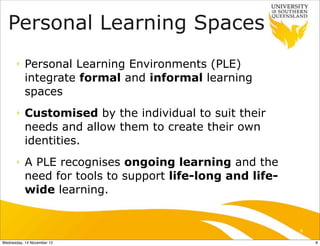
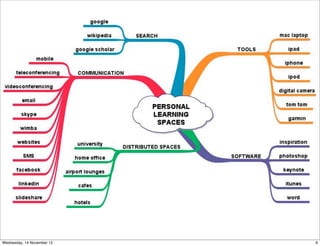
Personal Learning Spaces
      ‣    Personal Learning Environments (PLE)
           integrate formal and informal learning
           spaces
      ‣    Customised by the individual to suit their
           needs and allow them to create their own
           identities.
      ‣    A PLE recognises ongoing learning and the
           need for tools to support life-long and life-
           wide learning.


                                                           8

Wednesday, 14 November 12                                      8
Wednesday, 14 November 12   9
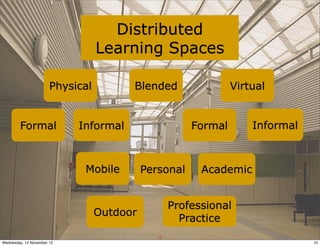
Distributed
                                  Learning Spaces

                       Physical         Blended                  Virtual


        Formal              Informal                    Formal       Informal


                             Mobile         Personal      Academic


                                                    Professional
                                  Outdoor
                                                      Practice
                                               10
Wednesday, 14 November 12                                                       10
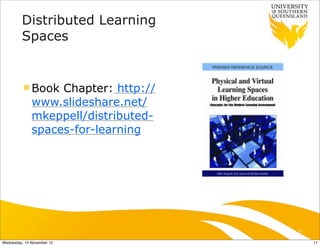
Distributed Learning
         Spaces


          n Book  Chapter: http://
              www.slideshare.net/
              mkeppell/distributed-
              spaces-for-learning


                                      11

Wednesday, 14 November 12                  11
Tools


                                    12

Wednesday, 14 November 12                12
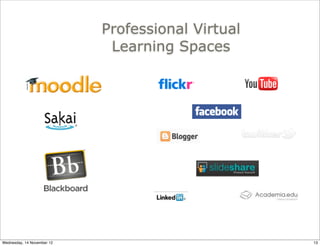
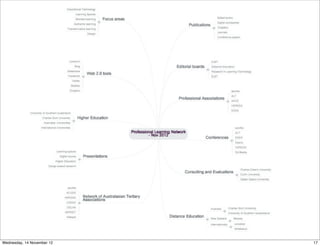
Professional Virtual
                             Learning Spaces


Wednesday, 14 November 12                          13
Wednesday, 14 November 12   14
Wednesday, 14 November 12   15
People


                                     16

Wednesday, 14 November 12                 16
Wednesday, 14 November 12   17
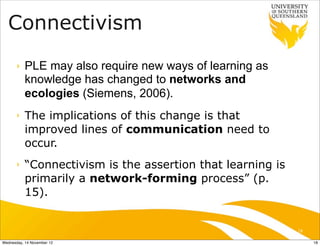
Connectivism
      ‣    PLE may also require new ways of learning as
           knowledge has changed to networks and
           ecologies (Siemens, 2006).
      ‣    The implications of this change is that
           improved lines of communication need to
           occur.
      ‣    “Connectivism is the assertion that learning is
           primarily a network-forming process” (p.
           15).


                                                             18

Wednesday, 14 November 12                                         18
Personal Learning Environments
                                     Interactions


                            Spaces                  Tools
                                         PLE


                                        People
                                                            Interactions
                Interactions


                                                                           19

Wednesday, 14 November 12                                                       19
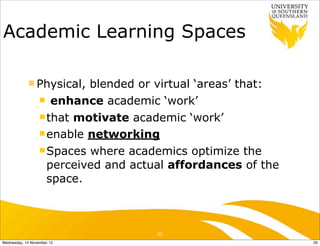
Academic Learning Spaces

            n Physical,    blended or virtual ‘areas’ that:
                  n enhance academic ‘work’

                  n that motivate academic ‘work’

                  n enable networking

                  n Spaces where academics optimize the
                     perceived and actual affordances of the
                     space.


                                      20
Wednesday, 14 November 12                                      20
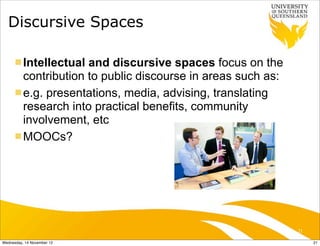
Discursive Spaces

      n Intellectual and discursive spaces focus on the
         contribution to public discourse in areas such as:
      n e.g. presentations, media, advising, translating
         research into practical benefits, community
         involvement, etc
      n MOOCs?


                                                              21

Wednesday, 14 November 12                                          21
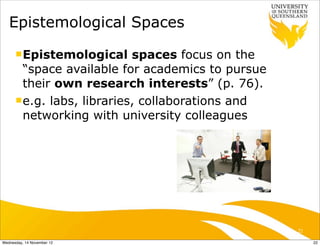
Epistemological Spaces
      n Epistemological     spaces focus on the
         “space available for academics to pursue
         their own research interests” (p. 76).
      n e.g. labs, libraries, collaborations and
         networking with university colleagues


                                                    22

Wednesday, 14 November 12                                22
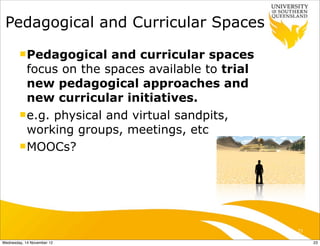
Pedagogical and Curricular Spaces
        n Pedagogical    and curricular spaces
           focus on the spaces available to trial
           new pedagogical approaches and
           new curricular initiatives.
        n e.g. physical and virtual sandpits,
           working groups, meetings, etc
        n MOOCs?


                                                    23

Wednesday, 14 November 12                                23
Wednesday, 14 November 12   24
Wednesday, 14 November 12   25
Ontological Spaces
          n Ontological  spaces focus on ‘academic being’
             which is becoming increasingly multi-faceted
             beyond the research, teaching and community
             commitments. In fact “the widening of
             universities’ ontological spaces may bring
             both peril and liberation” (p. 77).
          n MOOCs?

          n e.g.diverse roles may include: academic staff
             developer, professional developer, manager,
             administrator, facilitator, teacher, researcher,
             evaluator, presenter, writer, editor, consultant,
             project manager, change agent and innovator.


                                                                 26

Wednesday, 14 November 12                                             26
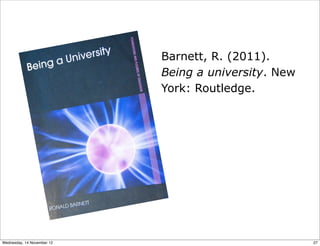
Barnett, R. (2011).
                            Being a university. New
                            York: Routledge.


Wednesday, 14 November 12                             27
Wednesday, 14 November 12   28
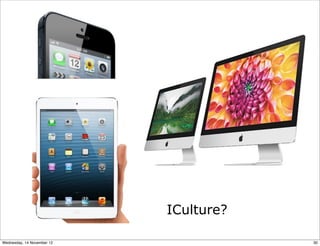
iCulture?


                                        29

Wednesday, 14 November 12                    29
ICulture?

Wednesday, 14 November 12               30
Wednesday, 14 November 12   31
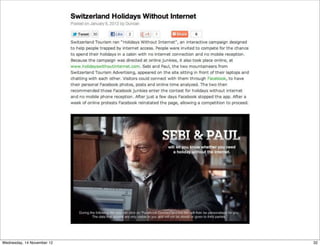
Wednesday, 14 November 12   32
Ecological University
       n Global  connectedness and dependence on
          world around them
       n Instead of ‘having an impact’ on the world
          which can be both positive and negative
          ecological universities seek sustainability
       n They are self-sustainable in their multiple
          levels of interactions.
       n They adopt a ‘care for the world’ as
          opposed to an ‘impact on the world’
          approach (Barnett, 2011).


                                                        33

Wednesday, 14 November 12                                    33
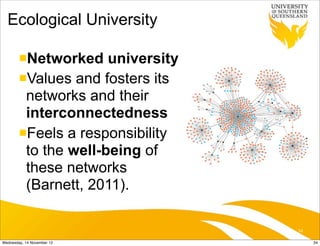
Ecological University

        nNetworked    university
        nValues and fosters its
          networks and their
          interconnectedness
        nFeels a responsibility
          to the well-being of
          these networks
          (Barnett, 2011).

                                    34

Wednesday, 14 November 12                34
Conclusions
  ‣   Importance of documenting our PLE

  ‣   Pros and cons of PLEs

  ‣   Balancing the higher purpose

  ‣   Being able to disconnect


                                          35

Wednesday, 14 November 12                      35
Questions?


                                         36

Wednesday, 14 November 12                     36

2012 nov df_ple

  • 1.
    Designing Personal Learning Environments: Staff and Student Considerations in a Digital Landscape Professor Mike Keppell Executive Director Australian Digital Futures Institute 1 Wednesday, 14 November 12 1
  • 2.
    Overview ‣ Horizon trends and challenges ‣ Personal Learning Environments ‣ Spaces ‣ Tools ‣ People ‣ Academic learning spaces ‣ Student learning spaces ‣ ICulture ‣ Disconnecting ‣ Ecological university 2 Wednesday, 14 November 12 2
  • 3.
    Horizon Trends ‣ People expect to be able to work, learn, and study whenever and wherever they want. ‣ The abundance of resources and relationships will challenge our educational identity. ‣ Students want to use their own technology for learning. ‣ Teaching paradigms across all sectors are shifting to include online learning, hybrid learning and collaborative models. ‣ 3 Wednesday, 14 November 12 3
  • 4.
    Challenges n Seamless learning – people expect to be able to work, learn, and study whenever and wherever they want. n Digital literacies – capabilities which fit an individual for living, learning and working in a digital society (JISC) n Personalisation - our learning, teaching, place of learning, technologies will be individualised n Digital scholarship will be the norm. 4 Wednesday, 14 November 12 4
  • 5.
    References n Johnson, L., Adams, S., Cummins, M., and Estrada, V. (2012). Technology Outlook for STEM+ Education 2012-2017: An NMC Horizon Report Sector Analysis. Austin, Texas: The New Media Consortium n Sharples, M., McAndrew, P., Weller, M., Ferguson, R., FitzGerald, E., Hirst, T., Mor, Y., Gaved, M. and Whitelock, D. (2012). Innovating Pedagogy 2012: Open University Innovation Report 1. Milton Keynes: The Open University. 5 Wednesday, 14 November 12 5
  • 6.
    Personal Learning Environments Interactions Spaces Tools PLE People Interactions Interactions 6 Wednesday, 14 November 12 6
  • 7.
    Spaces 7 Wednesday, 14 November 12 7
  • 8.
    Personal Learning Spaces ‣ Personal Learning Environments (PLE) integrate formal and informal learning spaces ‣ Customised by the individual to suit their needs and allow them to create their own identities. ‣ A PLE recognises ongoing learning and the need for tools to support life-long and life- wide learning. 8 Wednesday, 14 November 12 8
  • 9.
  • 10.
    Distributed Learning Spaces Physical Blended Virtual Formal Informal Formal Informal Mobile Personal Academic Professional Outdoor Practice 10 Wednesday, 14 November 12 10
  • 11.
    Distributed Learning Spaces n Book Chapter: http:// www.slideshare.net/ mkeppell/distributed- spaces-for-learning 11 Wednesday, 14 November 12 11
  • 12.
    Tools 12 Wednesday, 14 November 12 12
  • 13.
    Professional Virtual Learning Spaces Wednesday, 14 November 12 13
  • 14.
  • 15.
  • 16.
    People 16 Wednesday, 14 November 12 16
  • 17.
  • 18.
    Connectivism ‣ PLE may also require new ways of learning as knowledge has changed to networks and ecologies (Siemens, 2006). ‣ The implications of this change is that improved lines of communication need to occur. ‣ “Connectivism is the assertion that learning is primarily a network-forming process” (p. 15). 18 Wednesday, 14 November 12 18
  • 19.
    Personal Learning Environments Interactions Spaces Tools PLE People Interactions Interactions 19 Wednesday, 14 November 12 19
  • 20.
    Academic Learning Spaces n Physical, blended or virtual ‘areas’ that: n enhance academic ‘work’ n that motivate academic ‘work’ n enable networking n Spaces where academics optimize the perceived and actual affordances of the space. 20 Wednesday, 14 November 12 20
  • 21.
    Discursive Spaces n Intellectual and discursive spaces focus on the contribution to public discourse in areas such as: n e.g. presentations, media, advising, translating research into practical benefits, community involvement, etc n MOOCs? 21 Wednesday, 14 November 12 21
  • 22.
    Epistemological Spaces n Epistemological spaces focus on the “space available for academics to pursue their own research interests” (p. 76). n e.g. labs, libraries, collaborations and networking with university colleagues 22 Wednesday, 14 November 12 22
  • 23.
    Pedagogical and CurricularSpaces n Pedagogical and curricular spaces focus on the spaces available to trial new pedagogical approaches and new curricular initiatives. n e.g. physical and virtual sandpits, working groups, meetings, etc n MOOCs? 23 Wednesday, 14 November 12 23
  • 24.
  • 25.
  • 26.
    Ontological Spaces n Ontological spaces focus on ‘academic being’ which is becoming increasingly multi-faceted beyond the research, teaching and community commitments. In fact “the widening of universities’ ontological spaces may bring both peril and liberation” (p. 77). n MOOCs? n e.g.diverse roles may include: academic staff developer, professional developer, manager, administrator, facilitator, teacher, researcher, evaluator, presenter, writer, editor, consultant, project manager, change agent and innovator. 26 Wednesday, 14 November 12 26
  • 27.
    Barnett, R. (2011). Being a university. New York: Routledge. Wednesday, 14 November 12 27
  • 28.
  • 29.
    iCulture? 29 Wednesday, 14 November 12 29
  • 30.
  • 31.
  • 32.
  • 33.
    Ecological University n Global connectedness and dependence on world around them n Instead of ‘having an impact’ on the world which can be both positive and negative ecological universities seek sustainability n They are self-sustainable in their multiple levels of interactions. n They adopt a ‘care for the world’ as opposed to an ‘impact on the world’ approach (Barnett, 2011). 33 Wednesday, 14 November 12 33
  • 34.
    Ecological University nNetworked university nValues and fosters its networks and their interconnectedness nFeels a responsibility to the well-being of these networks (Barnett, 2011). 34 Wednesday, 14 November 12 34
  • 35.
    Conclusions ‣ Importance of documenting our PLE ‣ Pros and cons of PLEs ‣ Balancing the higher purpose ‣ Being able to disconnect 35 Wednesday, 14 November 12 35
  • 36.
    Questions? 36 Wednesday, 14 November 12 36