Getting the Right Mix
Social and Scalable through Three
Generations of Online Pedagogy
Terry Anderson, PhD and Professor
Centre for Distance Education
Values
• We can (and must) continuously improve the
quality, effectiveness, appeal, cost and time
efficiency of the learning experience.
• Student control and freedom is integral to 21st
century life-long education and learning.
• Continuing education opportunity is a basic
human right.
Online Conference Pioneer!
Anderson, L., & Anderson, T. (2009). Online professional development conferences: An
effective, economical and eco-friendly option Canadian Journal of Learning Technology, 35(2).
http://www.cjlt.ca/index.php/cjlt/article/viewArticle/521/254.
Anderson, T., & Mason, R. (1993). The Bangkok Project:
New tool for professional development. American Journal
of Distance Education, 7(2), 5-18.
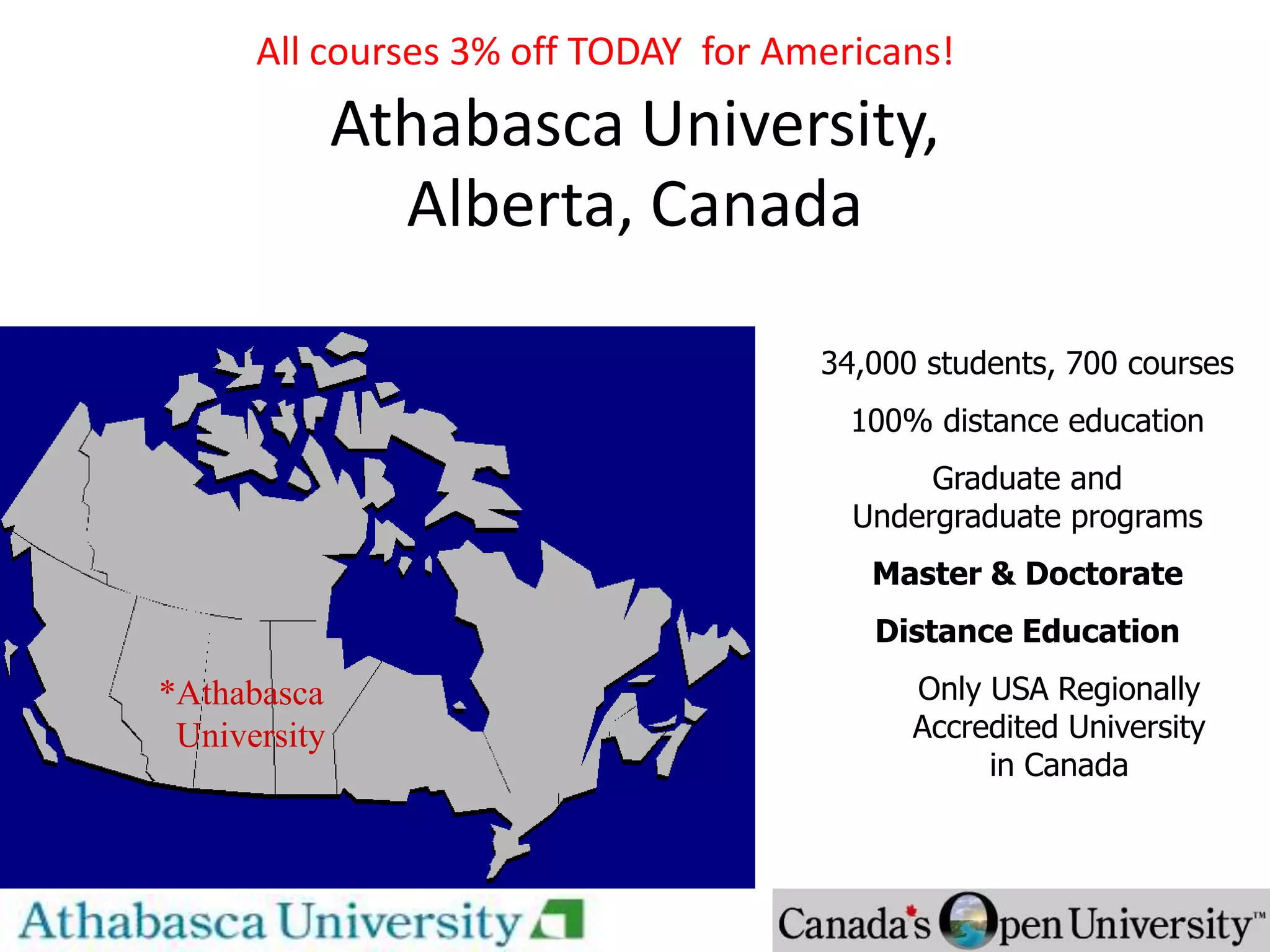
Athabasca University,
Alberta, Canada
* Athabasca University
34,000 students, 700 courses
100% distance education
Graduate and
Undergraduate programs
Master & Doctorate
Distance Education
Only USA Regionally
Accredited University
in Canada
*Athabasca
University
All courses 3% off TODAY for Americans!
Outline
• Generations of Online Education Pedagogy
– Cognitive Behaviourist
• xMOOCs
– Social Constructivist
• sMOOCs and the Online Classroom
– Connectivist
• cMOOCs
• Interactional Equivalency and Costs
• Beyond the LMS
– Athabasca Landing boutique social network
• Net Presence??
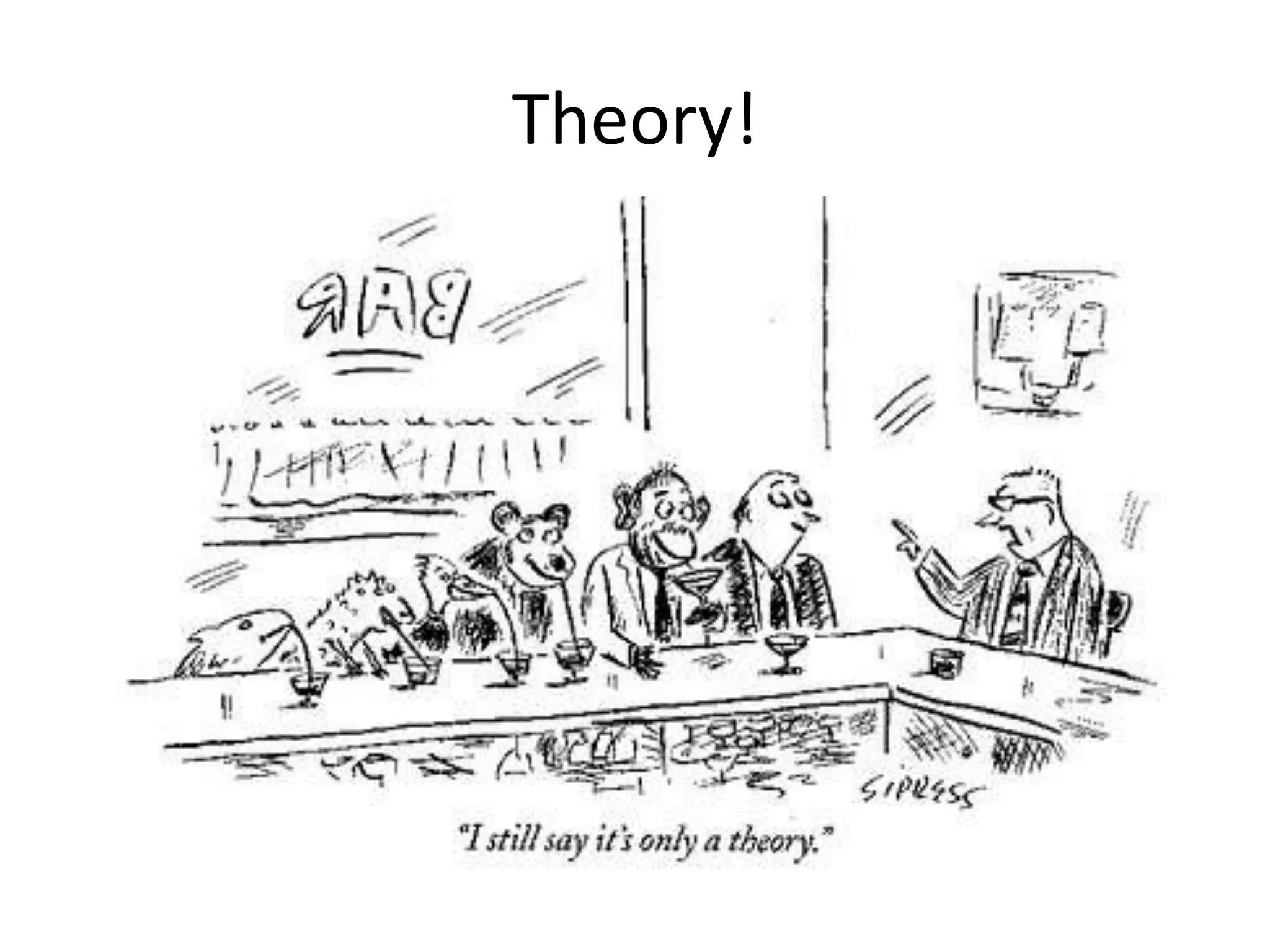
Theory!
ThreeOnline Learning Pedagogy
1. Behaviourist/Cognitive
– Self Paced, Individual
study
2. Social Constructivist –
Groups, LMS
3. Connectivist – Networks
and Sets
Anderson, T., &Dron, J. (2011). Three generations of
distance education pedagogy.
IRRODL, 12(3), 80-97
1. Behavioural/Cognitive Pedagogies
• “tell ‘em what you’re
gonna tell ‘em,
• tell ‘em
• then tell ‘em what you
told ‘em”
Direct Instruction
Gagne’s Events of Instruction (1965)
1. Gain learners' attention
2. Inform learner of objectives
3. Stimulate recall of previous information
4. Present stimulus material
5. Provide learner guidance
6. Elicit performance
7. Provide Feedback
8. Assess performance
9. Enhance transfer opportunities
Instructional Systems Design (ISD)
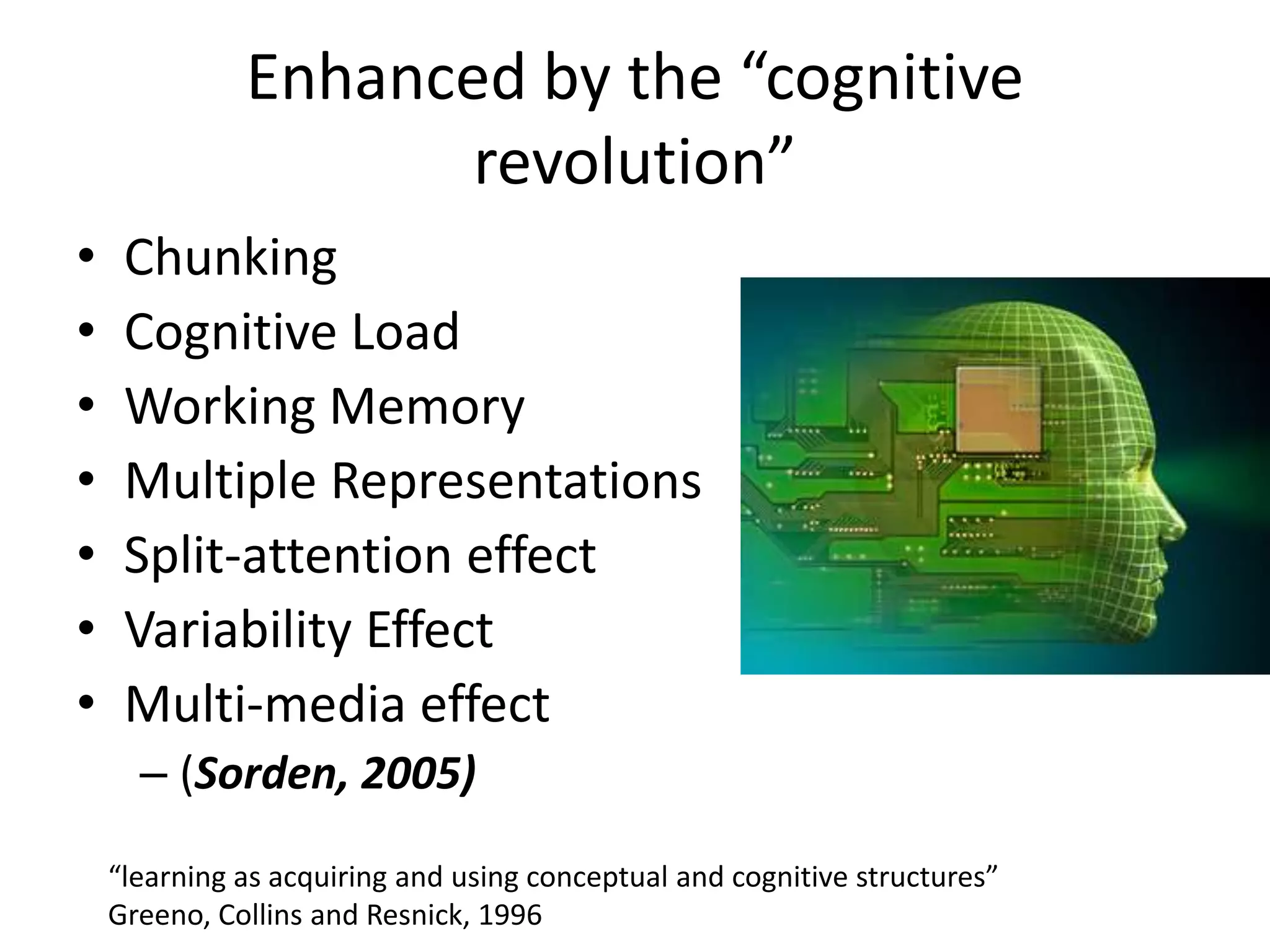
Enhanced by the “cognitive
revolution”
• Chunking
• Cognitive Load
• Working Memory
• Multiple Representations
• Split-attention effect
• Variability Effect
• Multi-media effect
– (Sorden, 2005)
“learning as acquiring and using conceptual and cognitive structures”
Greeno, Collins and Resnick, 1996
Technologies of Ist generation
• CAI, text books, One way Lectures, Video and
audio broadcast
American xMoocs
(example)
• MOOC History by Alys
From
http://prezi.com/754uv3qpe_0k/mooc-
history/ a MOOC History by Alyssa Martin
xMOOCs
• Disruptive
• Scalable
• The next newest thing.
• Access
• Analytics
xMOOC Pedagogy
Gen. 1 - Cognitive Behaviourist
• Medium to high quality content
– Screen captures, video lectures, videos
• Machine scoring of quizzes and assignments
• Assessment (machine scoring and peer) and
emergent accreditation
– Badges, challenge exams for credit, PLAR
• Completion Rates??
Duke University/ CoursEra
2012
Bioelectricity: A Quantitative
Approach
Promoted to millions through
Coursera
12,000 Registered, Paced
4,000 no shows first week
313 (4%) from 37 countries
completed
Clow, D. (2013). MOOCs and the funnel of participation.
MOOC Patterns of Engagement
Cluster
Breakdown
High School
MOOC
Under Grad
MOOC
Graduate
MOOC
Course
Auditing
6% 6% 9%
Completing 27% 8% 5%
Disengaging 28% 12% 6%
Sampling 39% 74% 80%
“Learners in MOOCs who do not adhere to traditional expectations, centered
around regular assessment and culminating in a certificate of completion, count
towards the high attrition rates that receive outsized media attention.”
High Satisf.
Low Satisf.
Kizilcec, R. F., Piech, C., & Schneider, E. (2013). Deconstructing Disengagement: Analyzing Learner
Subpopulations in Massive Open Online Courses. Third International Conference on Learning Analytics and
Knowledge (LAK ’13 Leuven, Belgium) https://landing.athabascau.ca/file/download/279413
• Addition of certificates (CourseEra signature
path with invigilated exams, keystoke
recognition etc)
“the completion rate is 70-80% for users who paid
for certificates”
Coursera http://en.paperblog.com/a-deep-dive-into-coursera-s-economics-493919/
NOT Just MOOCs- Flipped Classroom
• http://ed.ted.com/about#flipThisVideo
http://terrya.edublogs.org/http://terrya.edublogs.org/
http://ed.ted.com/about#flipThisVideo
xMOOC Challenges to
Traditional Schools
• Are our course really better or worse than those
from Stanford?
• How interactive/supportive are our instructors?
• Do we accredit seat time, courses, or learning?
• Will our students choose our fees over free?
• Is American learning (knowledge) the same as
Canadian learning?
• Can we develop a business model from free
MOOCs?
• Will these put me out of a job?
Educational Challenges to
Institutions of Networks
• “Large decreases in
transaction costs create
activities that can't be
taken on by businesses, or
indeed by an institution,
because no matter how
cheap it becomes to
perform a particular
activity, there isn't
enough payoff to support
the cost incurred by being
an institution in the first
place.” Clay Shirky, 2008
1st Gen Cognitive Behavioural
Pedagogy Summary
• Scalable
• Few requirements or opportunities for social
learning
• Ideal for what type or level of learning?
• Are we training learners who can succeed with
this type of learning?
23
2nd Generation
Constructivist Pedagogy
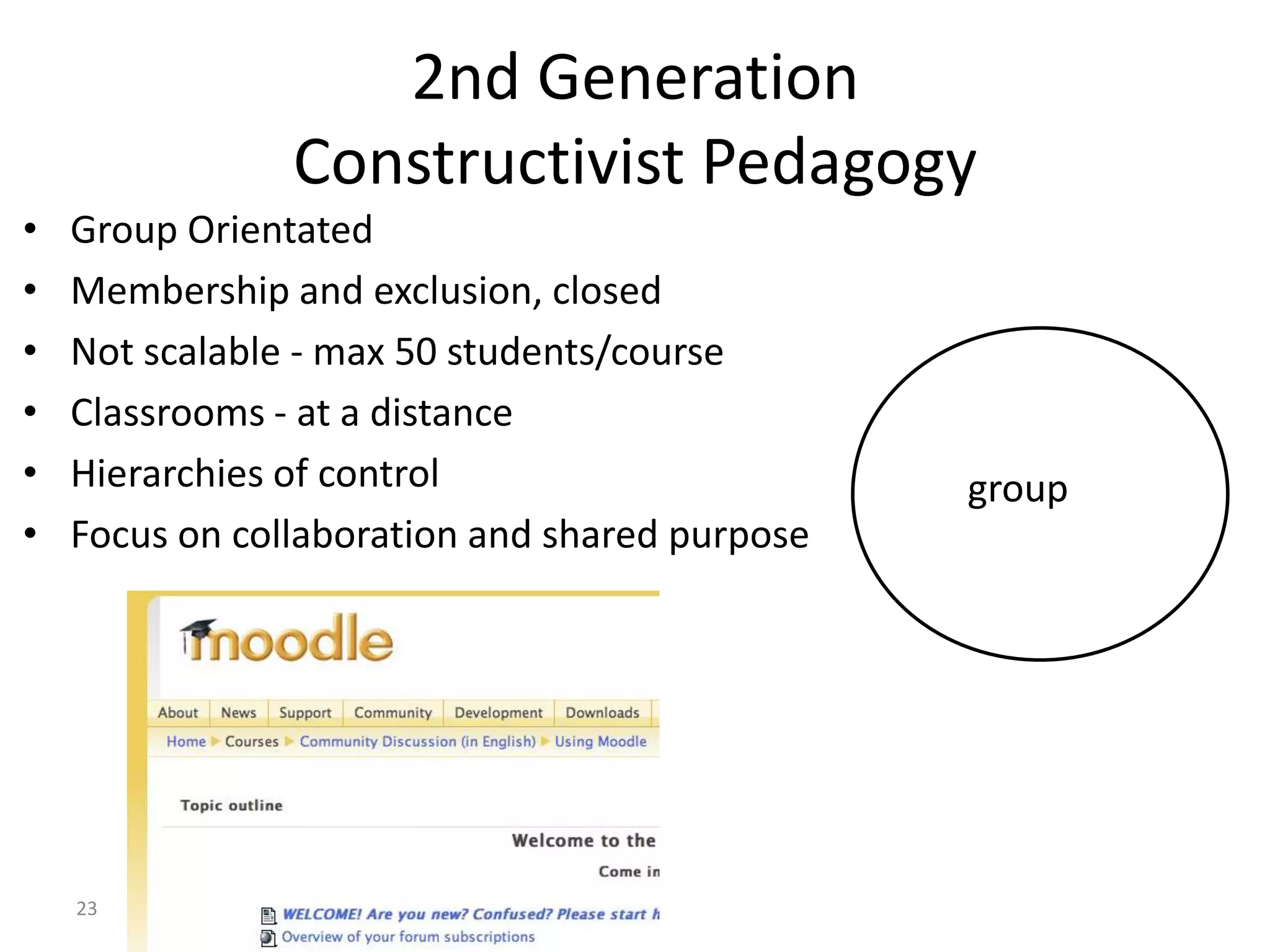
• Group Orientated
• Membership and exclusion, closed
• Not scalable - max 50 students/course
• Classrooms - at a distance
• Hierarchies of control
• Focus on collaboration and shared purpose
group
2nd Generation - Constructivist
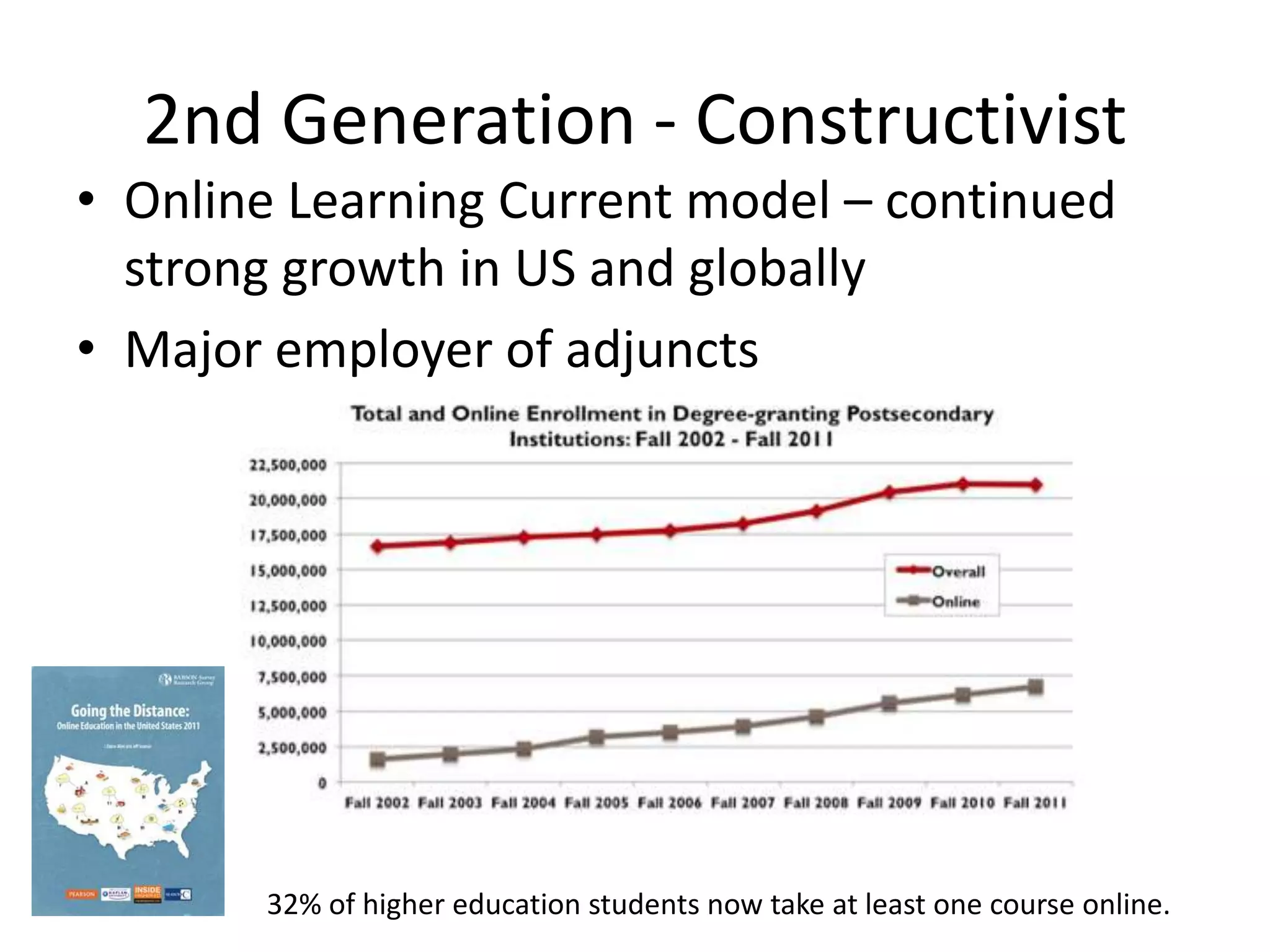
• Online Learning Current model – continued
strong growth in US and globally
• Major employer of adjuncts
32% of higher education students now take at least one course online.
Constructivist Learning in Groups
• Long history of research
and study
• Established sets of tools
– Classrooms
– Learning Management
Systems (LMS)
– Synchronous (chat, video
& net conferencing)
– Email, wikis, blogs
• Need to develop face to
face, mediated and
blended group learning
skills
Garrison, R., Anderson, T., & Archer, W. (2000). Critical thinking in text-based
environment: Computer conferencing in higher education. The Internet and
Higher Education, 2(2), 87-105.
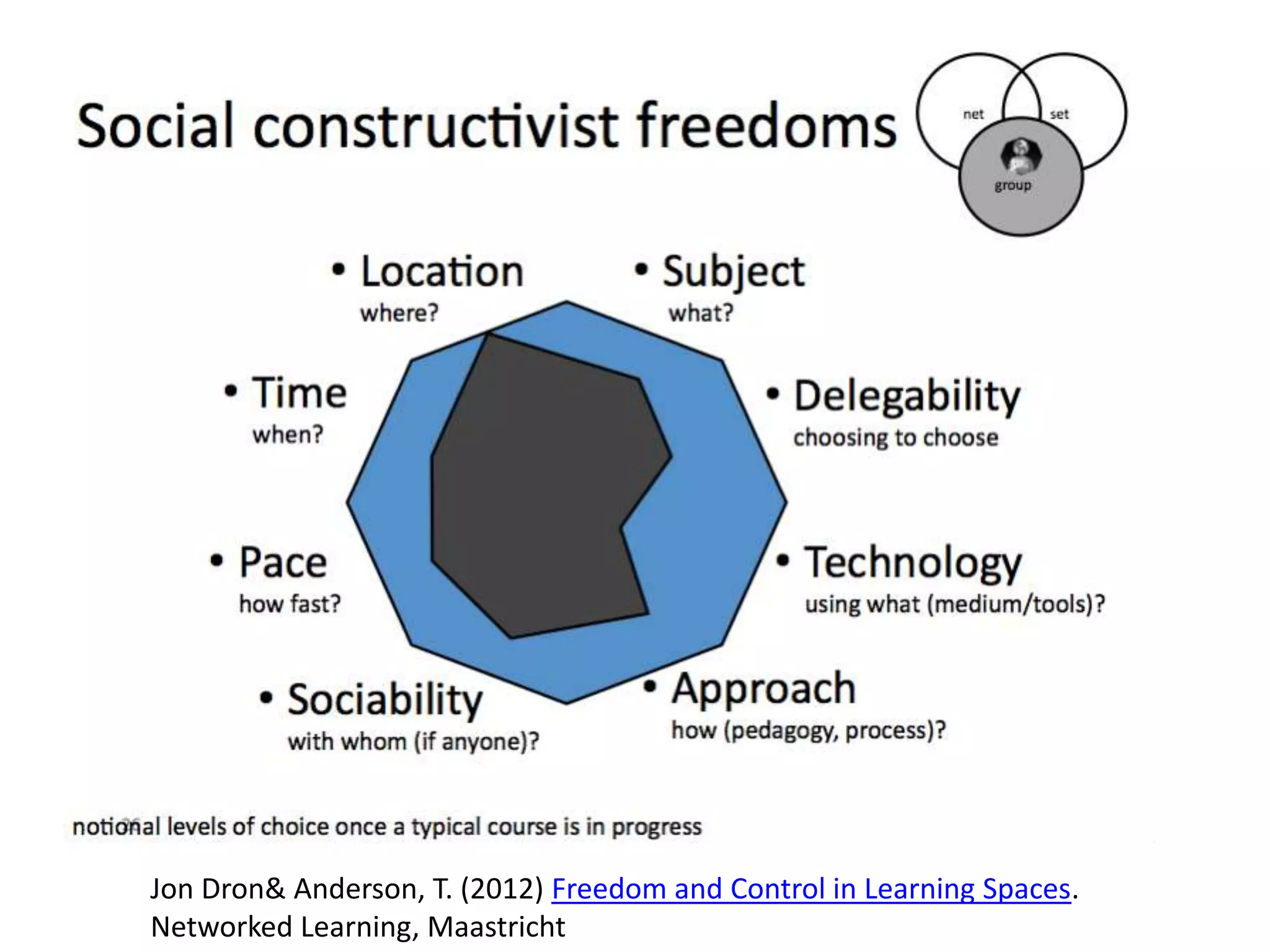
Jon Dron& Anderson, T. (2012) Freedom and Control in Learning Spaces.
Networked Learning, Maastricht
Scaling Up Constructivist MOOC
Athabasca Example
• Openness in Education 2012 – George
Siemens and Rory McGreal – Athabasca
University
• cMOOC format, with Moodle bolt on
• Instructors focused on Moodle group (paying
customers)
• Never reached critical mass in cMOOC
Can MOOCs use Social Constructivism
and still Scale up?
• Meet Ups (online and Face-to-face)
• Threaded discussions
• Challenge to maintain instructor presence
Teacher Presence: Using Introductory Videos in Online and Hybrid Courses
2nd Generation
Summary - Constructivism
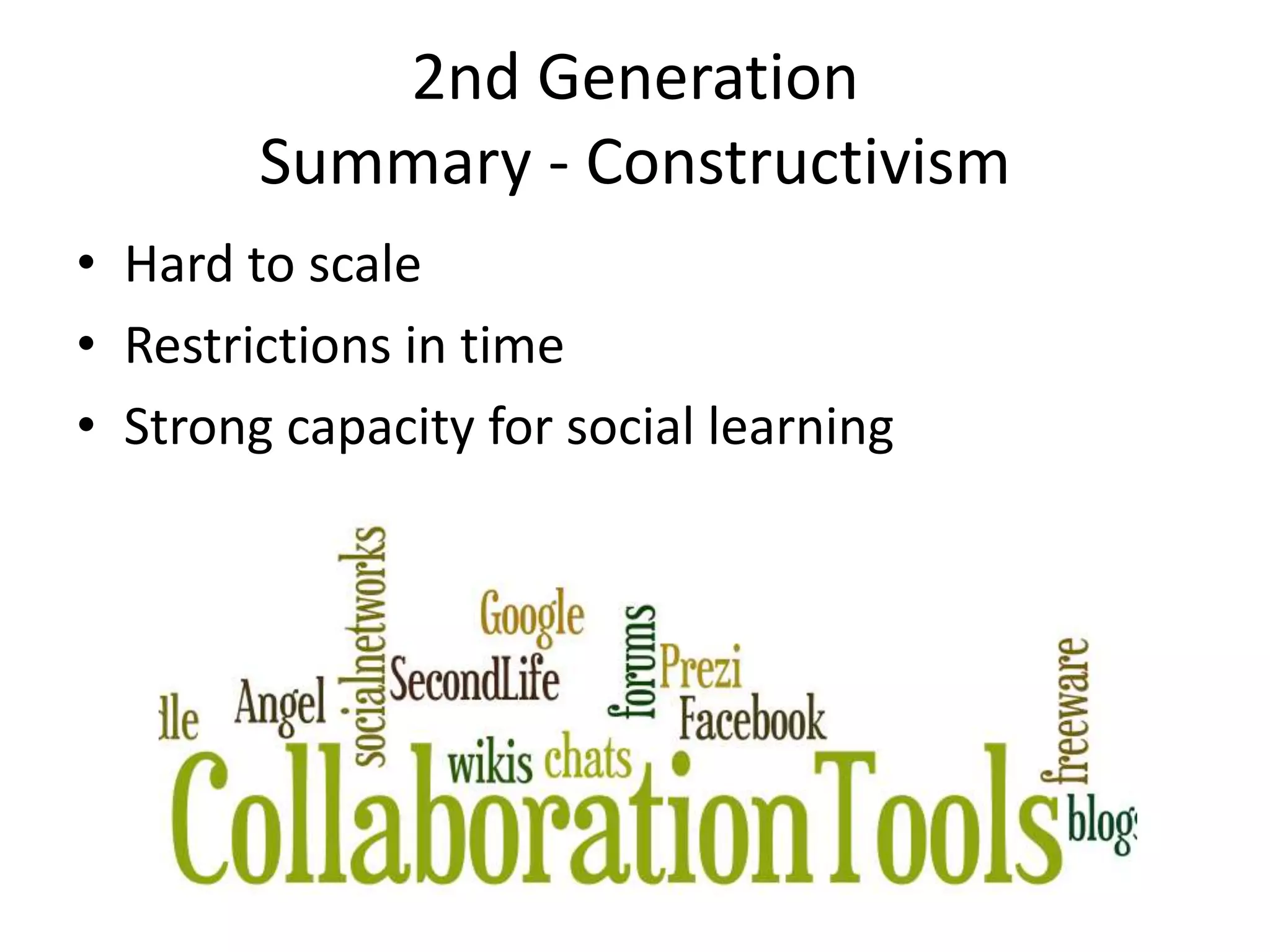
• Hard to scale
• Restrictions in time
• Strong capacity for social learning
3rd Generation: Connectivist Learning
Connectivism
• “connectivism is the thesis that knowledge is
distributed across a network of connections,
and therefore that learning consists of the
ability to construct and traverse those
networks.” Stephen Downes 2007
Connectivist Knowledge
• Is created by linking to appropriate people and
objects
• May be created and stored in non human devices
• Is as much about capacity as current competence
• Assumes the ubiquitous Internet
• Is emergent
See Alan Levine’s Keynote
TCC42JTCC42JTCC42J
Connectivist MOOC
cMOOC
David Cormier’s “What is a MOOC”? Youtube
Disruptions of Connectivism
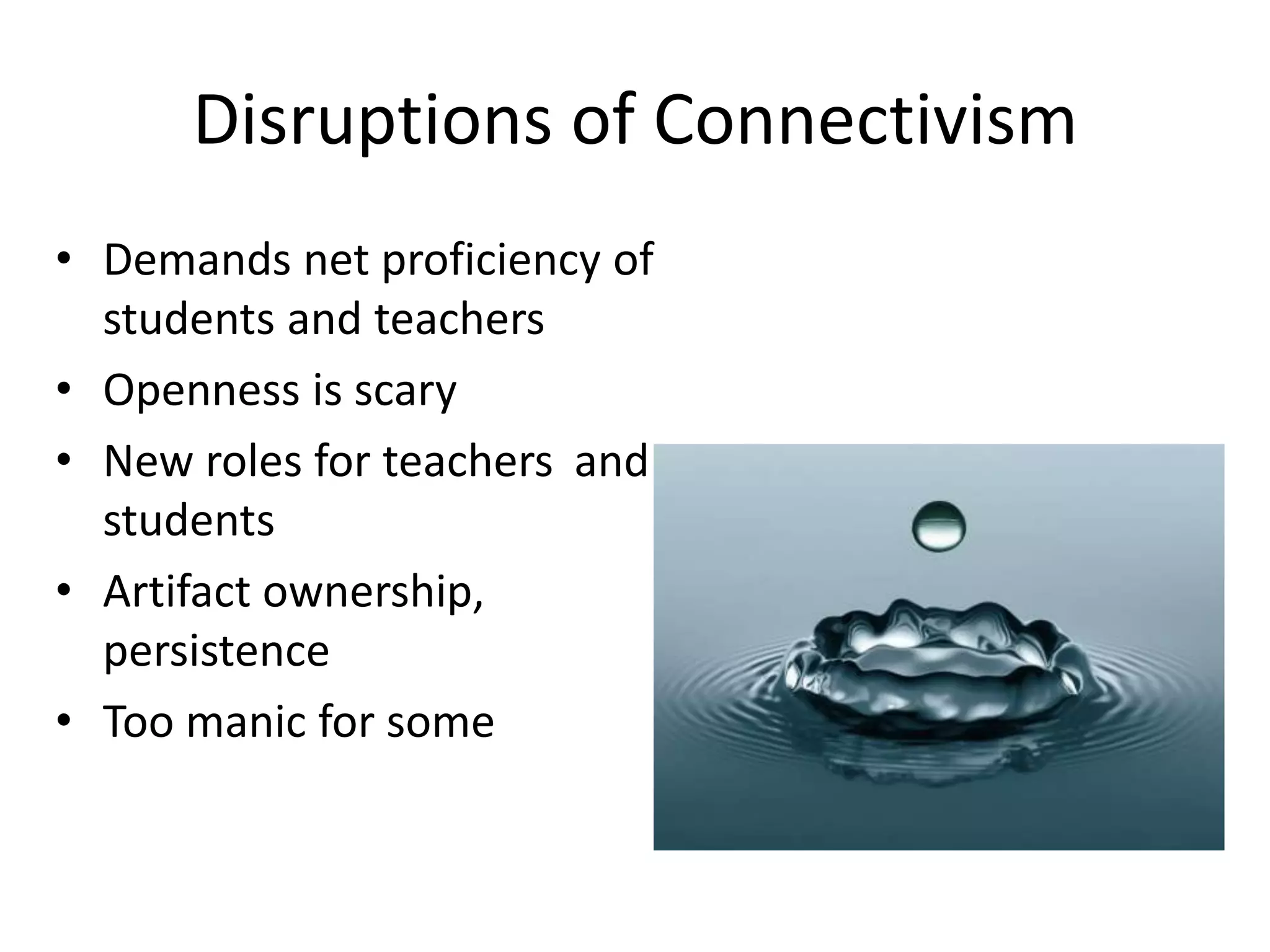
• Demands net proficiency of
students and teachers
• Openness is scary
• New roles for teachers and
students
• Artifact ownership,
persistence
• Too manic for some
Connectivist Learning
Persistence
Accessibility
Network
Effects
“Connectivying” your course
http://terrya.edublogs.org/2012/12/18/connectivy-your-course/
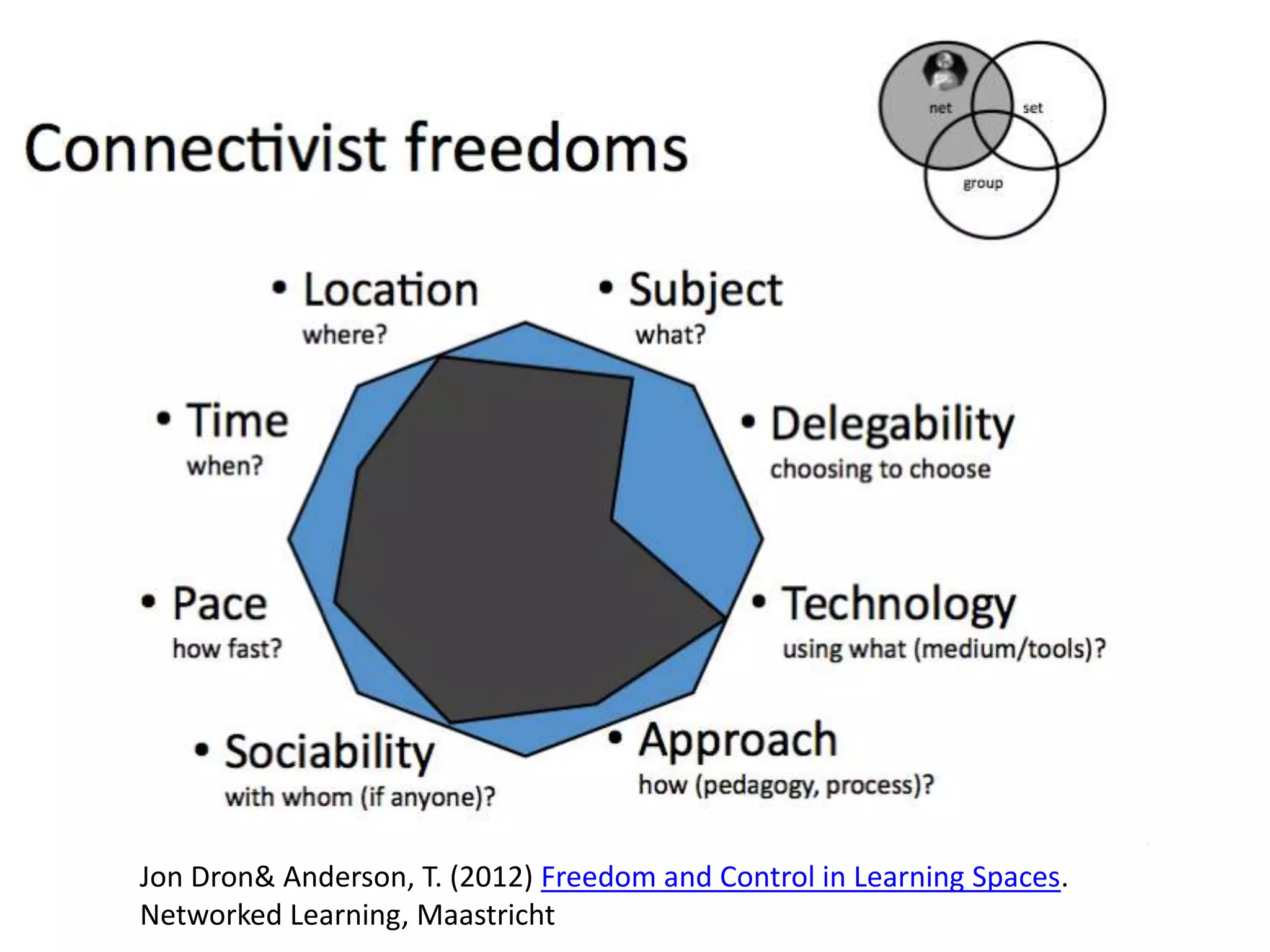
Jon Dron& Anderson, T. (2012) Freedom and Control in Learning Spaces.
Networked Learning, Maastricht
NOT Learning in a Bubble
Networks add diversity to learning
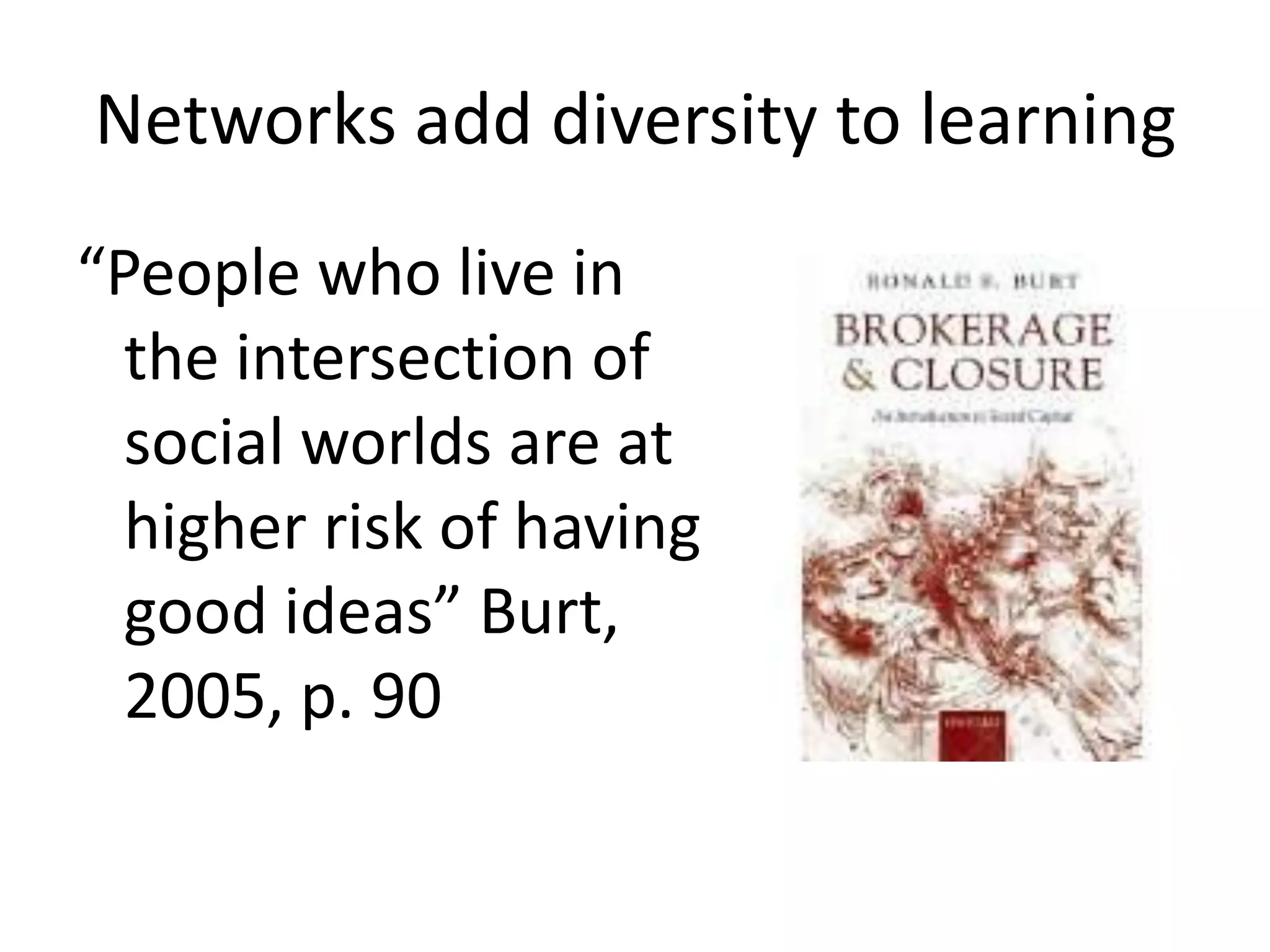
“People who live in
the intersection of
social worlds are at
higher risk of having
good ideas” Burt,
2005, p. 90
If you want to learn how to fix a pipe, solve a
partial differential equation, write software,
you are seconds away from know-how via
YouTube, Wikipedia and search engines. Access
to technology and access to knowledge,
however, isn’t enough. Learning is a social,
active, and ongoing process.
What does a motivated group of self-learners
need to know to agree on a subject or skill, find
and qualify the best learning resources about that
topic, select and use appropriate communication
media to co-learn it?
http://peeragogy.org/
cMOOCs different learning outcomes for different learners
3rd Generation - Connectivism
Summary
• Maximizes learner control and freedoms
• Demands high levels of network literacy
• Ideal training for life-long learning
• May be too much freedom- little capacity to
delegate control
The Interaction Equivalency Theorem
by Anderson (2003)
• Thesis 1. Deep and meaningful formal learning is supported
as long as one of the three forms of interaction (student–
teacher; student–student; student–content) is at a high level.
The other two may be offered at minimal levels, or even
eliminated, without degrading the educational experience.
• Thesis 2. High levels of more than one of these three modes
will likely provide a more satisfying educational experience,
although these experiences may not be as cost- or time
effective as less interactive learning sequences.
Interaction Equivalency (eQuiv) Website http://equivalencytheorem.info/
Cognitive Behaviourist Pedagogy
0
1
2
3
4
5
6
7
8
Student-Student Student-Teacher Student-Content
Interaction
Interaction
xMOOC Model
• “Why on earth would you write an
essay for an automated grader?”
Debbie Morrison
http://onlinelearninginsights.wordpress.com/
Social Constructivist Pedagogy
0
2
4
6
8
10
Student-Student Student-Teacher Student-Content
Interaction
Interaction
Social Constructivist or Small MOOC Model
Connectivist Pedagogy
0
1
2
3
4
5
6
7
8
Student-Student Student-Teacher Student-Content
Interaction
Interaction
cMOOC Model
Summary
• Three generations of pedagogy
• All can work,
• which works best for whom?
• Mix and Match
– Case Study Athabasca Landing
Beyond the LMS
Social networking in a boutique network
https://Landing. athabascau.ca
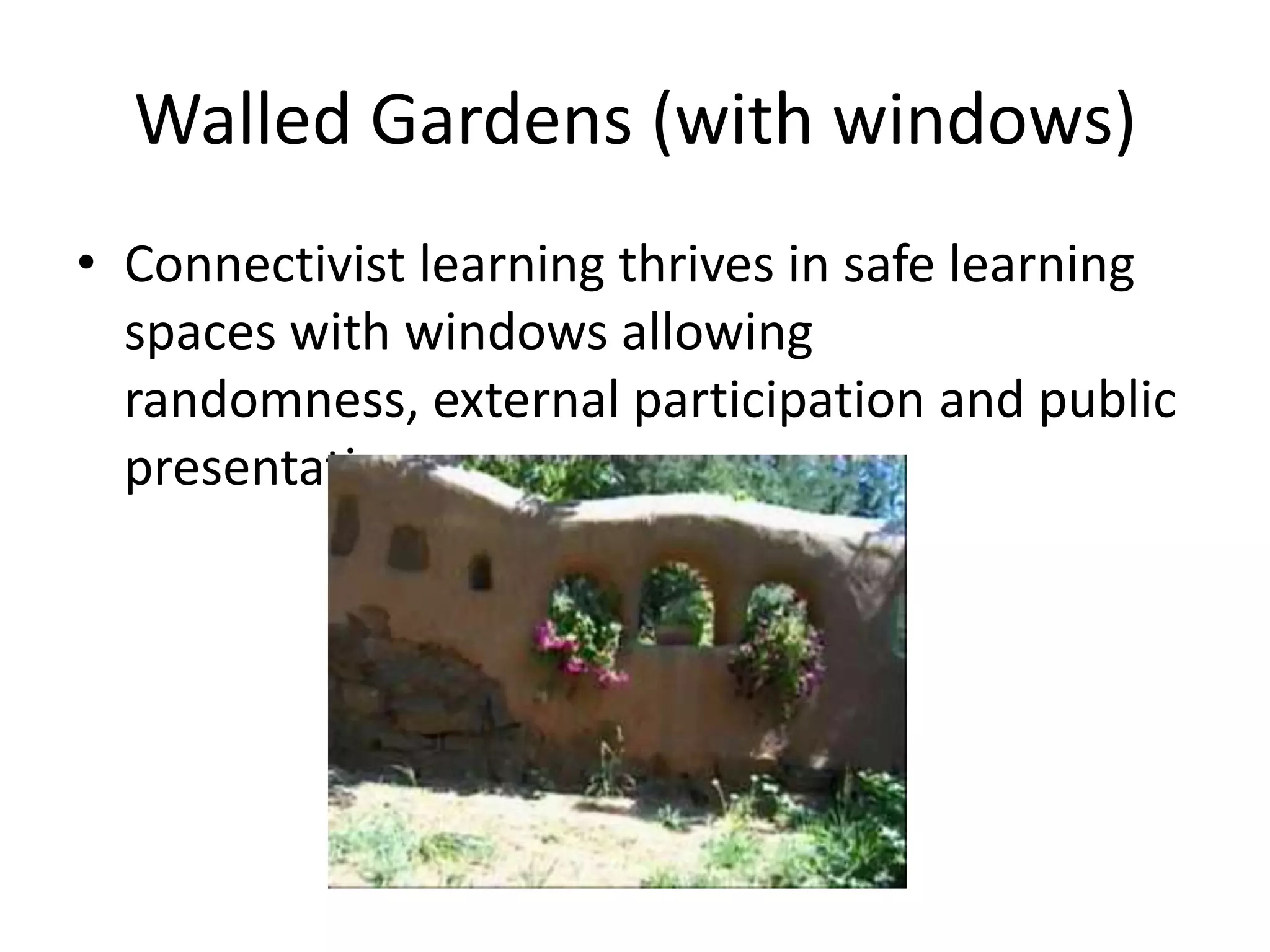
Walled Gardens (with windows)
• Connectivist learning thrives in safe learning
spaces with windows allowing
randomness, external participation and public
presentation
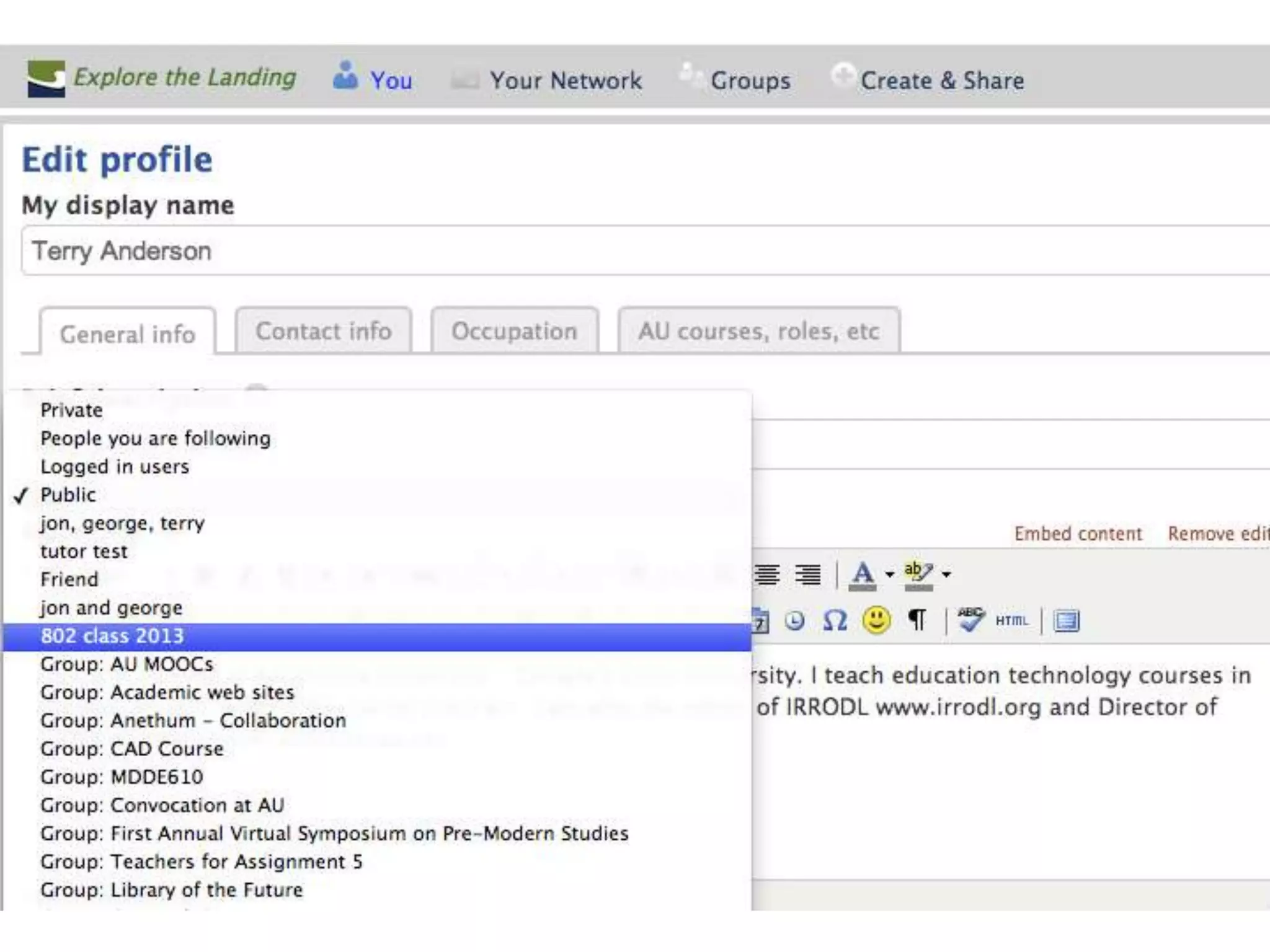
What is the Landing?
• A private space for Athabasca
University – students, staff, alumni
• A public place for sharing knowledge
• A user controlled creative space
• Boutique social network
• Networking, blogging, photos, micro
blogging, polls, calendars, groups
and more
• Built on elgg.org platform
Landing Provides
• User control
• Personal Learning Environment
• Persistence
Net Presence
Goodier, S., &Czerniewicz, L. (2013). Academics’ online presence: A four-step guide to taking control of your visibility.
University of Capetown. http://openuct.uct.ac.za/sites/default/files/Online%20Visibility%20Guidelines.pdf.
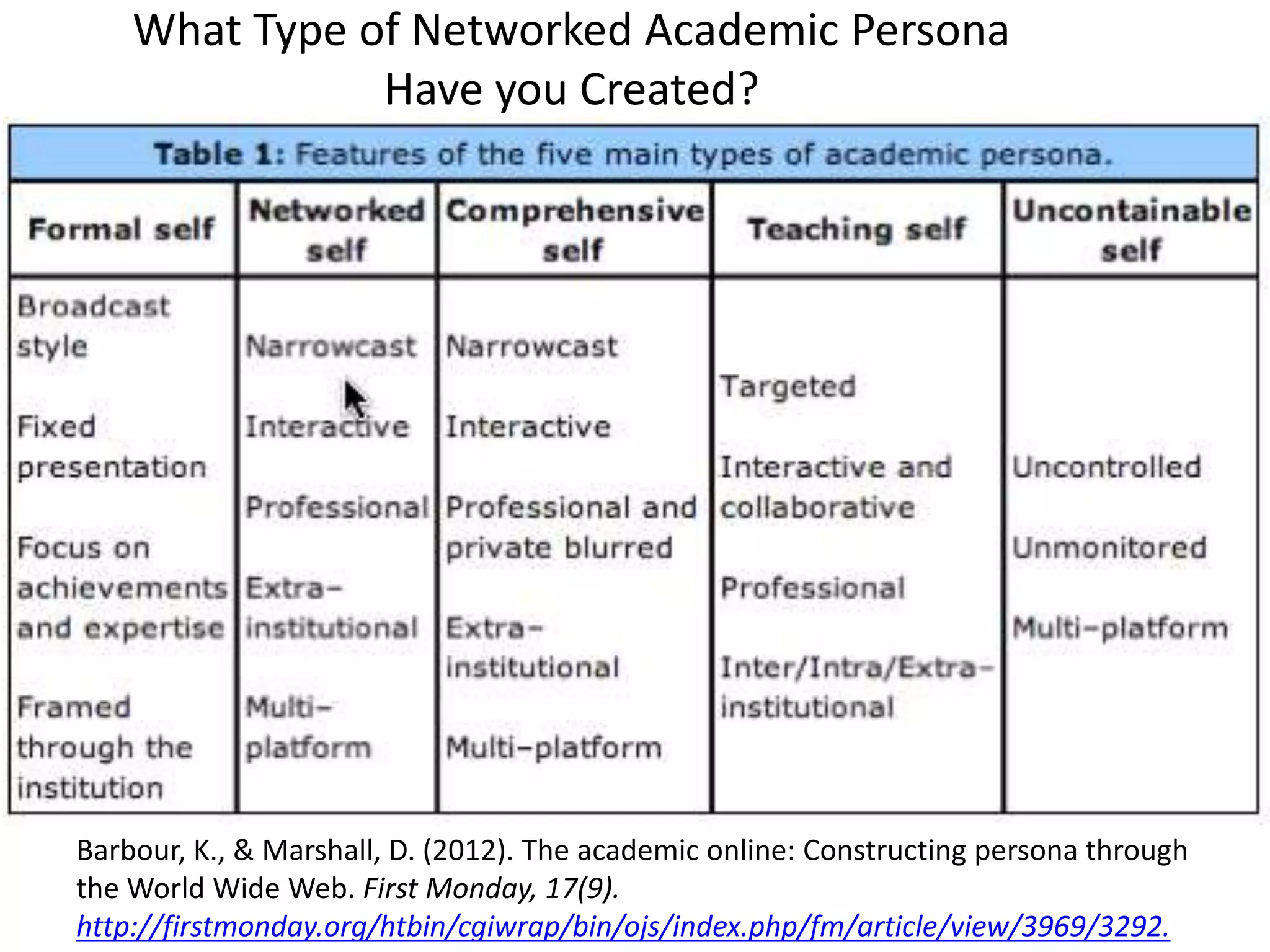
What Type of Networked Academic Persona
Have you Created?
Barbour, K., & Marshall, D. (2012). The academic online: Constructing persona through
the World Wide Web. First Monday, 17(9).
http://firstmonday.org/htbin/cgiwrap/bin/ojs/index.php/fm/article/view/3969/3292.
• "MOOCs may well be the last stand in defense
of academic freedom if knowledge is to
increasingly belong in the public domain, and
not increasingly become a commodity.
• This is our academic challenge. We must own
and use MOOCs to elevate general public
knowledge to be an effective civic moderator
of wealth, power and belief.”
• Professor Renner, University of South Florida.
Renner, E. (2013, March 3). Can MOOCs save academic freedom. Edudemic. Retrieved from
http://edudemic.com/2013/03/moocs-academic-freedom/
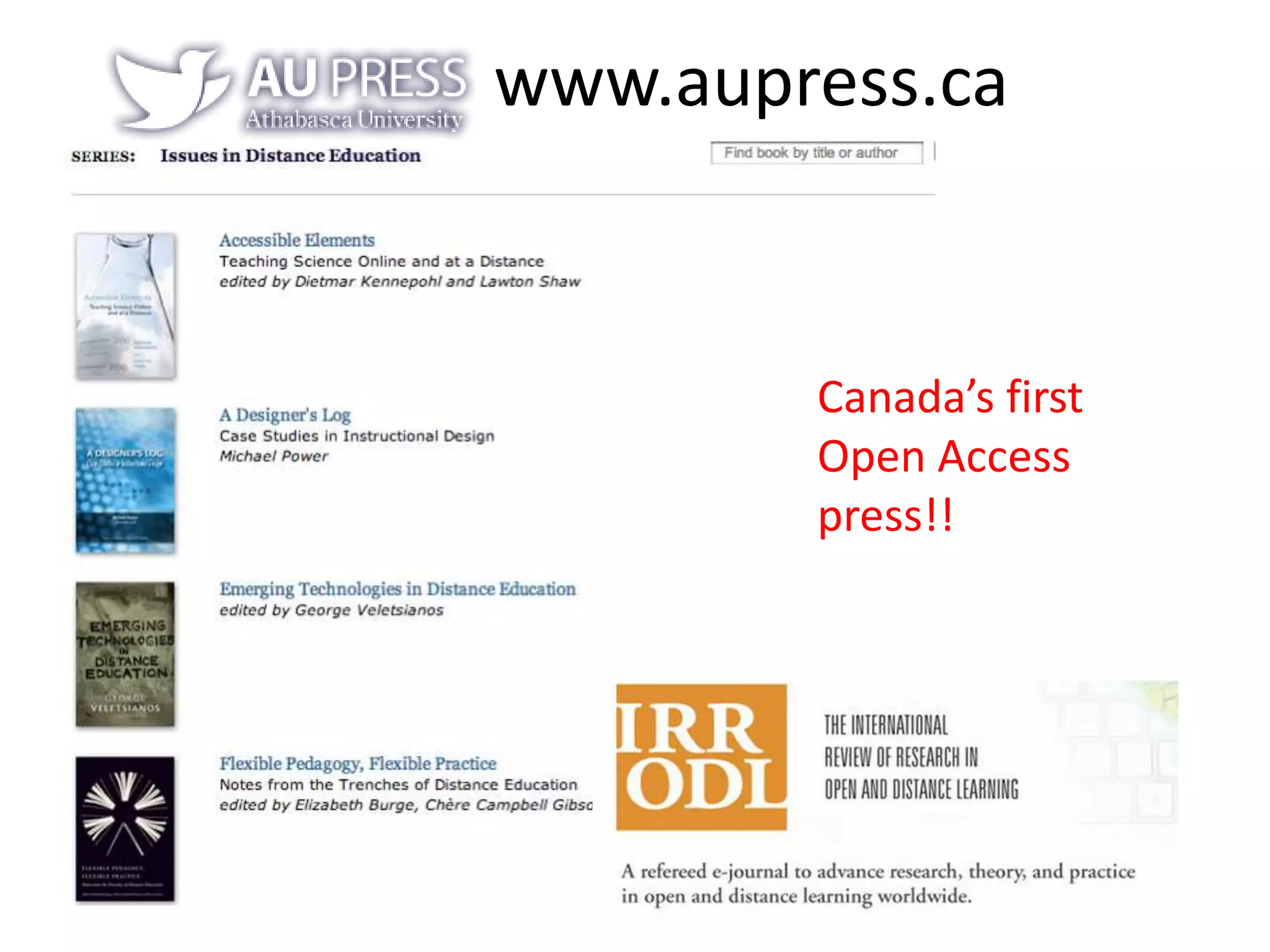
www.aupress.ca
Canada’s first
Open Access
press!!
Conclusion
• All three generations are useful for teaching
and for Learning
• 1St and 3rd are likely scalable
• 2nd nourishes both weak and strong ties
• The networked educator uses strategic
combinations of all three pedagogies to
improve learning and make most effective use
of student time.
Terry Anderson terrya@athabascau.ca
Blog: terrya.edublogs.org
Your comments and questions
most welcomed!

Tcc keynote Hawaii april 2013

  • 1.
    Getting the RightMix Social and Scalable through Three Generations of Online Pedagogy Terry Anderson, PhD and Professor Centre for Distance Education
  • 2.
    Values • We can(and must) continuously improve the quality, effectiveness, appeal, cost and time efficiency of the learning experience. • Student control and freedom is integral to 21st century life-long education and learning. • Continuing education opportunity is a basic human right.
  • 3.
    Online Conference Pioneer! Anderson,L., & Anderson, T. (2009). Online professional development conferences: An effective, economical and eco-friendly option Canadian Journal of Learning Technology, 35(2). http://www.cjlt.ca/index.php/cjlt/article/viewArticle/521/254. Anderson, T., & Mason, R. (1993). The Bangkok Project: New tool for professional development. American Journal of Distance Education, 7(2), 5-18.
  • 4.
    Athabasca University, Alberta, Canada *Athabasca University 34,000 students, 700 courses 100% distance education Graduate and Undergraduate programs Master & Doctorate Distance Education Only USA Regionally Accredited University in Canada *Athabasca University All courses 3% off TODAY for Americans!
  • 5.
    Outline • Generations ofOnline Education Pedagogy – Cognitive Behaviourist • xMOOCs – Social Constructivist • sMOOCs and the Online Classroom – Connectivist • cMOOCs • Interactional Equivalency and Costs • Beyond the LMS – Athabasca Landing boutique social network • Net Presence??
  • 6.
  • 7.
    ThreeOnline Learning Pedagogy 1.Behaviourist/Cognitive – Self Paced, Individual study 2. Social Constructivist – Groups, LMS 3. Connectivist – Networks and Sets Anderson, T., &Dron, J. (2011). Three generations of distance education pedagogy. IRRODL, 12(3), 80-97
  • 8.
    1. Behavioural/Cognitive Pedagogies •“tell ‘em what you’re gonna tell ‘em, • tell ‘em • then tell ‘em what you told ‘em” Direct Instruction
  • 9.
    Gagne’s Events ofInstruction (1965) 1. Gain learners' attention 2. Inform learner of objectives 3. Stimulate recall of previous information 4. Present stimulus material 5. Provide learner guidance 6. Elicit performance 7. Provide Feedback 8. Assess performance 9. Enhance transfer opportunities Instructional Systems Design (ISD)
  • 10.
    Enhanced by the“cognitive revolution” • Chunking • Cognitive Load • Working Memory • Multiple Representations • Split-attention effect • Variability Effect • Multi-media effect – (Sorden, 2005) “learning as acquiring and using conceptual and cognitive structures” Greeno, Collins and Resnick, 1996
  • 11.
    Technologies of Istgeneration • CAI, text books, One way Lectures, Video and audio broadcast
  • 12.
    American xMoocs (example) • MOOCHistory by Alys From http://prezi.com/754uv3qpe_0k/mooc- history/ a MOOC History by Alyssa Martin
  • 13.
    xMOOCs • Disruptive • Scalable •The next newest thing. • Access • Analytics
  • 14.
    xMOOC Pedagogy Gen. 1- Cognitive Behaviourist • Medium to high quality content – Screen captures, video lectures, videos • Machine scoring of quizzes and assignments • Assessment (machine scoring and peer) and emergent accreditation – Badges, challenge exams for credit, PLAR
  • 15.
    • Completion Rates?? DukeUniversity/ CoursEra 2012 Bioelectricity: A Quantitative Approach Promoted to millions through Coursera 12,000 Registered, Paced 4,000 no shows first week 313 (4%) from 37 countries completed Clow, D. (2013). MOOCs and the funnel of participation.
  • 16.
    MOOC Patterns ofEngagement Cluster Breakdown High School MOOC Under Grad MOOC Graduate MOOC Course Auditing 6% 6% 9% Completing 27% 8% 5% Disengaging 28% 12% 6% Sampling 39% 74% 80% “Learners in MOOCs who do not adhere to traditional expectations, centered around regular assessment and culminating in a certificate of completion, count towards the high attrition rates that receive outsized media attention.” High Satisf. Low Satisf. Kizilcec, R. F., Piech, C., & Schneider, E. (2013). Deconstructing Disengagement: Analyzing Learner Subpopulations in Massive Open Online Courses. Third International Conference on Learning Analytics and Knowledge (LAK ’13 Leuven, Belgium) https://landing.athabascau.ca/file/download/279413
  • 17.
    • Addition ofcertificates (CourseEra signature path with invigilated exams, keystoke recognition etc) “the completion rate is 70-80% for users who paid for certificates” Coursera http://en.paperblog.com/a-deep-dive-into-coursera-s-economics-493919/
  • 18.
    NOT Just MOOCs-Flipped Classroom
  • 19.
  • 20.
    xMOOC Challenges to TraditionalSchools • Are our course really better or worse than those from Stanford? • How interactive/supportive are our instructors? • Do we accredit seat time, courses, or learning? • Will our students choose our fees over free? • Is American learning (knowledge) the same as Canadian learning? • Can we develop a business model from free MOOCs? • Will these put me out of a job?
  • 21.
    Educational Challenges to Institutionsof Networks • “Large decreases in transaction costs create activities that can't be taken on by businesses, or indeed by an institution, because no matter how cheap it becomes to perform a particular activity, there isn't enough payoff to support the cost incurred by being an institution in the first place.” Clay Shirky, 2008
  • 22.
    1st Gen CognitiveBehavioural Pedagogy Summary • Scalable • Few requirements or opportunities for social learning • Ideal for what type or level of learning? • Are we training learners who can succeed with this type of learning?
  • 23.
    23 2nd Generation Constructivist Pedagogy •Group Orientated • Membership and exclusion, closed • Not scalable - max 50 students/course • Classrooms - at a distance • Hierarchies of control • Focus on collaboration and shared purpose group
  • 24.
    2nd Generation -Constructivist • Online Learning Current model – continued strong growth in US and globally • Major employer of adjuncts 32% of higher education students now take at least one course online.
  • 25.
    Constructivist Learning inGroups • Long history of research and study • Established sets of tools – Classrooms – Learning Management Systems (LMS) – Synchronous (chat, video & net conferencing) – Email, wikis, blogs • Need to develop face to face, mediated and blended group learning skills Garrison, R., Anderson, T., & Archer, W. (2000). Critical thinking in text-based environment: Computer conferencing in higher education. The Internet and Higher Education, 2(2), 87-105.
  • 26.
    Jon Dron& Anderson,T. (2012) Freedom and Control in Learning Spaces. Networked Learning, Maastricht
  • 27.
    Scaling Up ConstructivistMOOC Athabasca Example • Openness in Education 2012 – George Siemens and Rory McGreal – Athabasca University • cMOOC format, with Moodle bolt on • Instructors focused on Moodle group (paying customers) • Never reached critical mass in cMOOC
  • 28.
    Can MOOCs useSocial Constructivism and still Scale up? • Meet Ups (online and Face-to-face) • Threaded discussions • Challenge to maintain instructor presence Teacher Presence: Using Introductory Videos in Online and Hybrid Courses
  • 29.
    2nd Generation Summary -Constructivism • Hard to scale • Restrictions in time • Strong capacity for social learning
  • 30.
  • 31.
    Connectivism • “connectivism isthe thesis that knowledge is distributed across a network of connections, and therefore that learning consists of the ability to construct and traverse those networks.” Stephen Downes 2007
  • 32.
    Connectivist Knowledge • Iscreated by linking to appropriate people and objects • May be created and stored in non human devices • Is as much about capacity as current competence • Assumes the ubiquitous Internet • Is emergent
  • 33.
    See Alan Levine’sKeynote TCC42JTCC42JTCC42J
  • 34.
    Connectivist MOOC cMOOC David Cormier’s“What is a MOOC”? Youtube
  • 35.
    Disruptions of Connectivism •Demands net proficiency of students and teachers • Openness is scary • New roles for teachers and students • Artifact ownership, persistence • Too manic for some
  • 36.
    Connectivist Learning Persistence Accessibility Network Effects “Connectivying” yourcourse http://terrya.edublogs.org/2012/12/18/connectivy-your-course/
  • 37.
    Jon Dron& Anderson,T. (2012) Freedom and Control in Learning Spaces. Networked Learning, Maastricht
  • 38.
  • 39.
    Networks add diversityto learning “People who live in the intersection of social worlds are at higher risk of having good ideas” Burt, 2005, p. 90
  • 40.
    If you wantto learn how to fix a pipe, solve a partial differential equation, write software, you are seconds away from know-how via YouTube, Wikipedia and search engines. Access to technology and access to knowledge, however, isn’t enough. Learning is a social, active, and ongoing process. What does a motivated group of self-learners need to know to agree on a subject or skill, find and qualify the best learning resources about that topic, select and use appropriate communication media to co-learn it? http://peeragogy.org/
  • 41.
    cMOOCs different learningoutcomes for different learners
  • 42.
    3rd Generation -Connectivism Summary • Maximizes learner control and freedoms • Demands high levels of network literacy • Ideal training for life-long learning • May be too much freedom- little capacity to delegate control
  • 43.
    The Interaction EquivalencyTheorem by Anderson (2003) • Thesis 1. Deep and meaningful formal learning is supported as long as one of the three forms of interaction (student– teacher; student–student; student–content) is at a high level. The other two may be offered at minimal levels, or even eliminated, without degrading the educational experience. • Thesis 2. High levels of more than one of these three modes will likely provide a more satisfying educational experience, although these experiences may not be as cost- or time effective as less interactive learning sequences. Interaction Equivalency (eQuiv) Website http://equivalencytheorem.info/
  • 44.
    Cognitive Behaviourist Pedagogy 0 1 2 3 4 5 6 7 8 Student-StudentStudent-Teacher Student-Content Interaction Interaction xMOOC Model
  • 45.
    • “Why onearth would you write an essay for an automated grader?” Debbie Morrison http://onlinelearninginsights.wordpress.com/
  • 46.
    Social Constructivist Pedagogy 0 2 4 6 8 10 Student-StudentStudent-Teacher Student-Content Interaction Interaction Social Constructivist or Small MOOC Model
  • 47.
    Connectivist Pedagogy 0 1 2 3 4 5 6 7 8 Student-Student Student-TeacherStudent-Content Interaction Interaction cMOOC Model
  • 48.
    Summary • Three generationsof pedagogy • All can work, • which works best for whom? • Mix and Match – Case Study Athabasca Landing
  • 49.
    Beyond the LMS Socialnetworking in a boutique network https://Landing. athabascau.ca
  • 50.
    Walled Gardens (withwindows) • Connectivist learning thrives in safe learning spaces with windows allowing randomness, external participation and public presentation
  • 51.
    What is theLanding? • A private space for Athabasca University – students, staff, alumni • A public place for sharing knowledge • A user controlled creative space • Boutique social network • Networking, blogging, photos, micro blogging, polls, calendars, groups and more • Built on elgg.org platform
  • 55.
    Landing Provides • Usercontrol • Personal Learning Environment • Persistence
  • 56.
    Net Presence Goodier, S.,&Czerniewicz, L. (2013). Academics’ online presence: A four-step guide to taking control of your visibility. University of Capetown. http://openuct.uct.ac.za/sites/default/files/Online%20Visibility%20Guidelines.pdf.
  • 57.
    What Type ofNetworked Academic Persona Have you Created? Barbour, K., & Marshall, D. (2012). The academic online: Constructing persona through the World Wide Web. First Monday, 17(9). http://firstmonday.org/htbin/cgiwrap/bin/ojs/index.php/fm/article/view/3969/3292.
  • 58.
    • "MOOCs maywell be the last stand in defense of academic freedom if knowledge is to increasingly belong in the public domain, and not increasingly become a commodity. • This is our academic challenge. We must own and use MOOCs to elevate general public knowledge to be an effective civic moderator of wealth, power and belief.” • Professor Renner, University of South Florida. Renner, E. (2013, March 3). Can MOOCs save academic freedom. Edudemic. Retrieved from http://edudemic.com/2013/03/moocs-academic-freedom/
  • 59.
  • 60.
    Conclusion • All threegenerations are useful for teaching and for Learning • 1St and 3rd are likely scalable • 2nd nourishes both weak and strong ties • The networked educator uses strategic combinations of all three pedagogies to improve learning and make most effective use of student time.
  • 61.
    Terry Anderson terrya@athabascau.ca Blog:terrya.edublogs.org Your comments and questions most welcomed!

Editor's Notes

  • #2 4 reasons that I am thankful for the opportunity to be here.First because this weekend is Canadian thanksgiving, and we don’t have the tradition of going home and watching football, but we do of enjoying ourselves, so a trip to historic Philadelphia for my wife Susan and I is a real treat. Thankful for the ‘royal’ presidential treament2. First tiem ‘ve addressed an audience at an American Community College. I thiunk there have only been four major innovations in post secondary higher education. The first was founding of the classical unievrsity in Bologne, paris Oxford and cambridge in the 12th century. The second was the German research Unievrsities, the Third was the comprehensive univeiotiesexplified by the Land Grant Universities and the fourth was the foundign of the Community College system in America that opened the doors of educational opportunity to all citizens. I worked the first ten years of my academic career in a community college in Nortehrnalberta and I came understand then how important it is to provide second chance opportunites for students who weren’t born with middle parents.
  • #12 Transmission model, often augmented with some tutor interaction
  • #16 Clow, D. (2013). MOOCs and the funnel of participation. Paper presented at the LAK '13: 3rd International Conference on Learning Analytics & Knowledge, Leuven, Belgium. Retrieved from Retrieved from http://oro.open.ac.uk/36657/1/DougClow-LAK13-revised-submitted.pdf
  • #41 http://peeragogy.org/