


Drugs for Congestive
Heart Failure
Ramesha Tahir
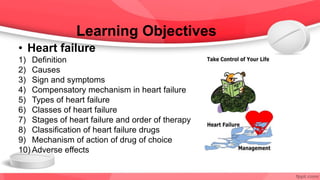
Learning Objectives
• Heart failure
1) Definition
2) Causes
3) Sign and symptoms
4) Compensatory mechanism in heart failure
5) Types of heart failure
6) Classes of heart failure
7) Stages of heart failure and order of therapy
8) Classification of heart failure drugs
9) Mechanism of action of drug of choice
10) Adverse effects
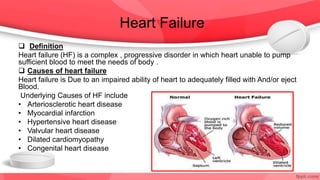
Heart Failure
 Definition
Heart failure (HF) is a complex , progressive disorder in which heart unable to pump
sufficient blood to meet the needs of body .
 Causes of heart failure
Heart failure is Due to an impaired ability of heart to adequately filled with And/or eject
Blood.
Underlying Causes of HF include
• Arteriosclerotic heart disease
• Myocardial infarction
• Hypertensive heart disease
• Valvular heart disease
• Dilated cardiomyopathy
• Congenital heart disease
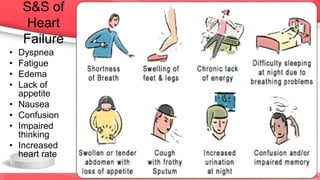
S&S of
Heart
Failure
• Dyspnea
• Fatigue
• Edema
• Lack of
appetite
• Nausea
• Confusion
• Impaired
thinking
• Increased
heart rate
Angiotensin II receptor antagonists/Blockers‘s
MOA
• Angiotensin receptors are a class of G protein-coupled receptors which
are activated by angiotensin II.
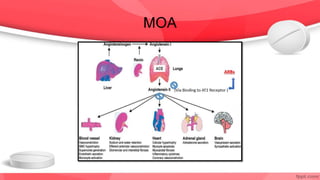
• ARBs block the renin-angiotensin-aldosterone system (RAAS) by
competitive antagonism of the AT1 receptor, thereby decreasing afterload
and preventing LV remodeling.
• Blockage of AT1 receptors directly causes vasodilation, reduces secretion
of vasopressin, and reduces production and secretion of aldosterone,
among other actions. The combined effect reduces blood pressure.
• The use of ARBs increases survival and decreases hospitalization rates,
but these agents are not superior to ACEIs.
• It may induce more complete inhibition of the renin-angiotensin system
than ACE inhibitors, and it does not affect the response to bradykinin
MOA
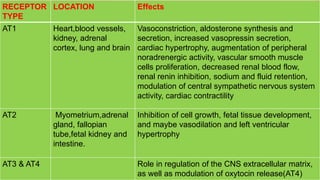
RECEPTOR
TYPE
LOCATION Effects
AT1 Heart,blood vessels,
kidney, adrenal
cortex, lung and brain
Vasoconstriction, aldosterone synthesis and
secretion, increased vasopressin secretion,
cardiac hypertrophy, augmentation of peripheral
noradrenergic activity, vascular smooth muscle
cells proliferation, decreased renal blood flow,
renal renin inhibition, sodium and fluid retention,
modulation of central sympathetic nervous system
activity, cardiac contractility
AT2 Myometrium,adrenal
gland, fallopian
tube,fetal kidney and
intestine.
Inhibition of cell growth, fetal tissue development,
and maybe vasodilation and left ventricular
hypertrophy
AT3 & AT4 Role in regulation of the CNS extracellular matrix,
as well as modulation of oxytocin release(AT4)
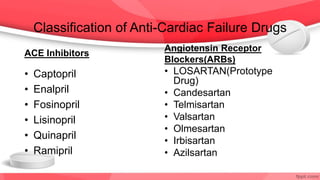
Classification of Anti-Cardiac Failure Drugs
ACE Inhibitors
• Captopril
• Enalpril
• Fosinopril
• Lisinopril
• Quinapril
• Ramipril
Angiotensin Receptor
Blockers(ARBs)
• LOSARTAN(Prototype
Drug)
• Candesartan
• Telmisartan
• Valsartan
• Olmesartan
• Irbisartan
• Azilsartan
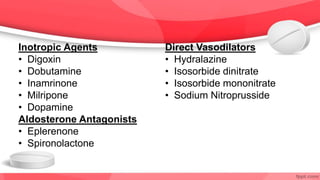
Inotropic Agents
• Digoxin
• Dobutamine
• Inamrinone
• Milripone
• Dopamine
Aldosterone Antagonists
• Eplerenone
• Spironolactone
Direct Vasodilators
• Hydralazine
• Isosorbide dinitrate
• Isosorbide mononitrate
• Sodium Nitroprusside
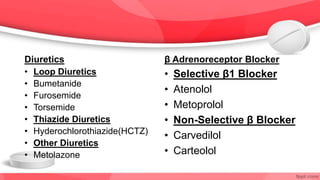
Diuretics
• Loop Diuretics
• Bumetanide
• Furosemide
• Torsemide
• Thiazide Diuretics
• Hyderochlorothiazide(HCTZ)
• Other Diuretics
• Metolazone
β Adrenoreceptor Blocker
• Selective β1 Blocker
• Atenolol
• Metoprolol
• Non-Selective β Blocker
• Carvedilol
• Carteolol
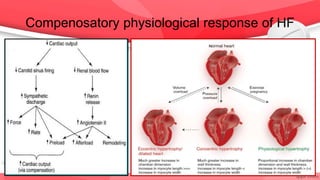
Compenosatory physiological response of HF
Categories of Heart Failure
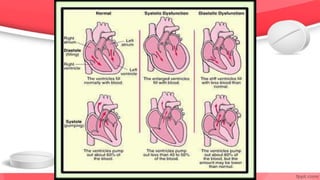
• Types of Heart Failure
• Right heart failure compromises pulmonary flow to the lungs.
• Left heart failure compromises aortic flow to the body and brain. Mixed
presentations are common; left heart failure often leads to right heart
failure in the longer term.
• Whether the abnormality is due to insufficient contraction (systolic
dysfunction), or due to insufficient relaxation of the heart (diastolic
dysfunction), or to both.
• Whether the problem is primarily increased venous back pressure
(preload), or failure to supply adequate arterial perfusion (afterload).
• Whether the abnormality is due to low cardiac output with high systemic
vascular resistance or high cardiac output with low vascular resistance
(low-output heart failure vs. high-output heart failure).
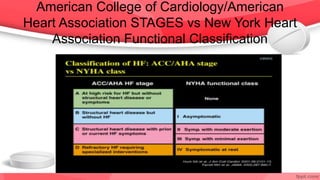
American College of Cardiology/American
Heart Association STAGES vs New York Heart
Association Functional Classification
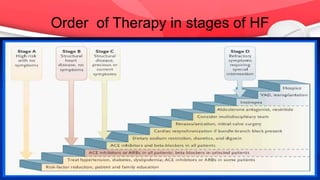
Order of Therapy in stages of HF
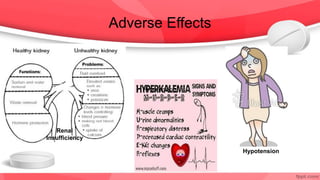
Adverse Effects
Renal
Insufficiency
Hypotension
Refrences
• www.drugs.com
• www.Wikipedia.com
• Chap # 16
Congestive Heart Failure Drugs

Congestive Heart Failure Drugs

  • 2.
    Drugs for Congestive HeartFailure Ramesha Tahir
  • 3.
    Learning Objectives • Heartfailure 1) Definition 2) Causes 3) Sign and symptoms 4) Compensatory mechanism in heart failure 5) Types of heart failure 6) Classes of heart failure 7) Stages of heart failure and order of therapy 8) Classification of heart failure drugs 9) Mechanism of action of drug of choice 10) Adverse effects
  • 4.
    Heart Failure  Definition Heartfailure (HF) is a complex , progressive disorder in which heart unable to pump sufficient blood to meet the needs of body .  Causes of heart failure Heart failure is Due to an impaired ability of heart to adequately filled with And/or eject Blood. Underlying Causes of HF include • Arteriosclerotic heart disease • Myocardial infarction • Hypertensive heart disease • Valvular heart disease • Dilated cardiomyopathy • Congenital heart disease
  • 5.
    S&S of Heart Failure • Dyspnea •Fatigue • Edema • Lack of appetite • Nausea • Confusion • Impaired thinking • Increased heart rate
  • 6.
    Angiotensin II receptorantagonists/Blockers‘s MOA • Angiotensin receptors are a class of G protein-coupled receptors which are activated by angiotensin II. • ARBs block the renin-angiotensin-aldosterone system (RAAS) by competitive antagonism of the AT1 receptor, thereby decreasing afterload and preventing LV remodeling. • Blockage of AT1 receptors directly causes vasodilation, reduces secretion of vasopressin, and reduces production and secretion of aldosterone, among other actions. The combined effect reduces blood pressure. • The use of ARBs increases survival and decreases hospitalization rates, but these agents are not superior to ACEIs. • It may induce more complete inhibition of the renin-angiotensin system than ACE inhibitors, and it does not affect the response to bradykinin
  • 7.
  • 8.
    RECEPTOR TYPE LOCATION Effects AT1 Heart,bloodvessels, kidney, adrenal cortex, lung and brain Vasoconstriction, aldosterone synthesis and secretion, increased vasopressin secretion, cardiac hypertrophy, augmentation of peripheral noradrenergic activity, vascular smooth muscle cells proliferation, decreased renal blood flow, renal renin inhibition, sodium and fluid retention, modulation of central sympathetic nervous system activity, cardiac contractility AT2 Myometrium,adrenal gland, fallopian tube,fetal kidney and intestine. Inhibition of cell growth, fetal tissue development, and maybe vasodilation and left ventricular hypertrophy AT3 & AT4 Role in regulation of the CNS extracellular matrix, as well as modulation of oxytocin release(AT4)
  • 9.
    Classification of Anti-CardiacFailure Drugs ACE Inhibitors • Captopril • Enalpril • Fosinopril • Lisinopril • Quinapril • Ramipril Angiotensin Receptor Blockers(ARBs) • LOSARTAN(Prototype Drug) • Candesartan • Telmisartan • Valsartan • Olmesartan • Irbisartan • Azilsartan
  • 10.
    Inotropic Agents • Digoxin •Dobutamine • Inamrinone • Milripone • Dopamine Aldosterone Antagonists • Eplerenone • Spironolactone Direct Vasodilators • Hydralazine • Isosorbide dinitrate • Isosorbide mononitrate • Sodium Nitroprusside
  • 11.
    Diuretics • Loop Diuretics •Bumetanide • Furosemide • Torsemide • Thiazide Diuretics • Hyderochlorothiazide(HCTZ) • Other Diuretics • Metolazone β Adrenoreceptor Blocker • Selective β1 Blocker • Atenolol • Metoprolol • Non-Selective β Blocker • Carvedilol • Carteolol
  • 12.
  • 13.
    Categories of HeartFailure • Types of Heart Failure • Right heart failure compromises pulmonary flow to the lungs. • Left heart failure compromises aortic flow to the body and brain. Mixed presentations are common; left heart failure often leads to right heart failure in the longer term. • Whether the abnormality is due to insufficient contraction (systolic dysfunction), or due to insufficient relaxation of the heart (diastolic dysfunction), or to both. • Whether the problem is primarily increased venous back pressure (preload), or failure to supply adequate arterial perfusion (afterload). • Whether the abnormality is due to low cardiac output with high systemic vascular resistance or high cardiac output with low vascular resistance (low-output heart failure vs. high-output heart failure).
  • 15.
    American College ofCardiology/American Heart Association STAGES vs New York Heart Association Functional Classification
  • 16.
    Order of Therapyin stages of HF
  • 17.
  • 18.

Editor's Notes

  • #7 The activated receptor in turn activates phospholipase C and increases the cytosolic Ca2+ concentrations, which in turn triggers cellular responses such as stimulation of protein kinase C. Activated receptor also inhibits adenylate cyclase and activates various tyrosine kinases.