AMIODARONEAn effective antiarryhthmic agent
INTRODUCTIONAmiodarone is an iodinated Benzofuran. Structurally similar to THYROXINE and    PROCAINAMIDE.It is a class-3 antiarrhythmic drugs of Vaughan Williams classification It was used initallyas a treatment for angina pectoris.– coronary vasodilation.
MECHANISM OF ACTIONBlocks K+ channels,thus increasing the effective refractory period.Effective blocker of Na+ channels with high affinity for inactivated channels.Anti adrenergic effects by non competitively blocking α and β receptors.Weak calcium channel blocker.Slows sinus rate and AV conduction,slightly prolongs the QT interval.
CLINICAL PHARMACOLOGYHighly lipid soluble compound.DESETHYL AMIODARONE  is the active metabolite.ON ORAL ADMINISTRATIONSlowly absorbed Low bioavailabilityLarge volume of distributionExtensively metabolised
ON INTRAVENOUS ADMINISTRATION100% bioavailabilityLarge volume of distributionVariable t½ ranging from 4.8hr to 68.2hrs
INDICATIONSIt is primarily indicated for atrial fibrillations and flutter.Effective in maintaining sinus rhythm.Not useful as prophylactic in Pt. with risk of sudden cardiac death after MI.It is indicated when other treatments are ineffective or have not been tolerated esp. in recurrent life threatening vent.arrhythmias.
In ventricular arrhythmias after ablation to suppress recurrences.
It is the only drug available for treatment of Pt. with reduced ejection fraction who are at risk of SCD.
In followup of Pt. with an ICD for secondary prevention.DOSAGE AND ADMINSTRATIONLarge oral or iv loading doses are required to hasten the onset of therapeutic action.Loading dosage varies from 600 to 1400 mg/day for 2 to 21 days.Usual maintenance dose varies from 200 to 600 mg/dayPlasma concentrations of AMIDARONE are usually b/w 1 to 2mcg/ml during effective therapy.Levels of drug >3-4mcg/ml,for prolonged periods of time are associated with adverse effects.
ADVERSE REACTIONSHEART : bradycardia and AV conduction disturbances. Thyroid : HYPOTHYROIDISM : it inhibits the enzyme 5-deiodinase.Amiodarone and DEA the entry of thyroid hormone into cells and binding to its receptor.The high iodine content results in WOLFF-CHAIKOFF effect.HYPERTHYROIDISM: In the case of autonomic nodus,where autoregulation is lost,intake of a large amount of iodine can induce Thyrotoxicosis.                                                                                 cont…..
Thyroxineamiodarone
LUNG: Chemical pneumonitis.SKIN : Photosensitivity with susceptibility to sun burns.OCULAR CHANGES: Micro depositions of Amiodarone in the cornea.OTHERS:Neurological changes like peripheral neuropathy,tremor,ataxia
DRUG INTERACTIONSIt inhibits hepatic and renal metabolism of drugs like DIGOXIN.It inhibits several cytochrome P450 pathways ,thus increasing  serum concentrations of drugs such as statins,quinidine,flecainide.It inhibits the metabolism of Coumadin derivatives.It has got an additive proarrhythmic effect with other drugs that prolong the QT interval, such as class 1a anti arrhythmics, TCA, erythromycin ,thiazide diuretics and Sotalol.
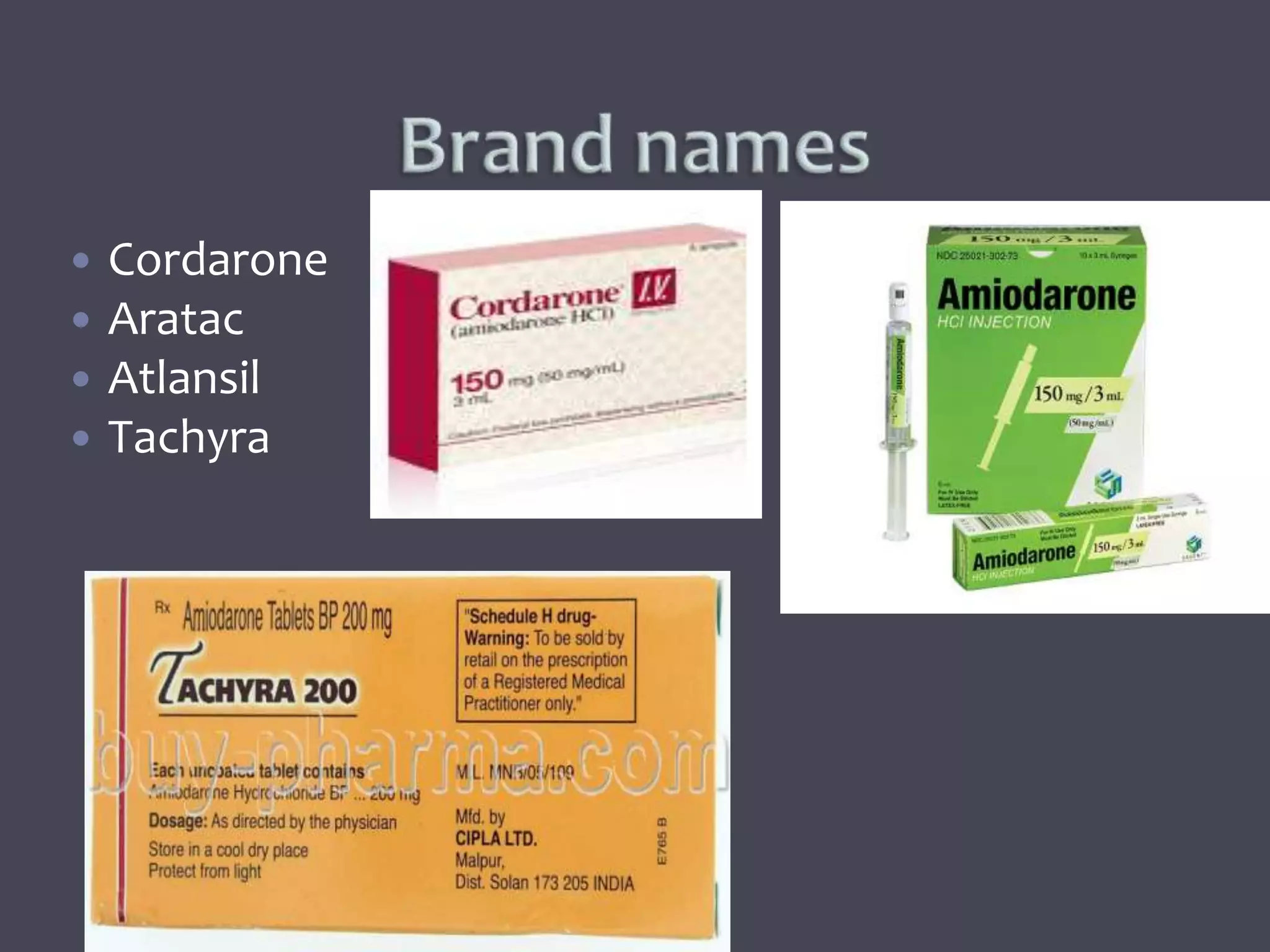
Brand namesCordaroneAratacAtlansilTachyra

Amiodarone

  • 1.
  • 2.
    INTRODUCTIONAmiodarone is aniodinated Benzofuran. Structurally similar to THYROXINE and PROCAINAMIDE.It is a class-3 antiarrhythmic drugs of Vaughan Williams classification It was used initallyas a treatment for angina pectoris.– coronary vasodilation.
  • 3.
    MECHANISM OF ACTIONBlocksK+ channels,thus increasing the effective refractory period.Effective blocker of Na+ channels with high affinity for inactivated channels.Anti adrenergic effects by non competitively blocking α and β receptors.Weak calcium channel blocker.Slows sinus rate and AV conduction,slightly prolongs the QT interval.
  • 5.
    CLINICAL PHARMACOLOGYHighly lipidsoluble compound.DESETHYL AMIODARONE is the active metabolite.ON ORAL ADMINISTRATIONSlowly absorbed Low bioavailabilityLarge volume of distributionExtensively metabolised
  • 6.
    ON INTRAVENOUS ADMINISTRATION100%bioavailabilityLarge volume of distributionVariable t½ ranging from 4.8hr to 68.2hrs
  • 7.
    INDICATIONSIt is primarilyindicated for atrial fibrillations and flutter.Effective in maintaining sinus rhythm.Not useful as prophylactic in Pt. with risk of sudden cardiac death after MI.It is indicated when other treatments are ineffective or have not been tolerated esp. in recurrent life threatening vent.arrhythmias.
  • 8.
    In ventricular arrhythmiasafter ablation to suppress recurrences.
  • 9.
    It is theonly drug available for treatment of Pt. with reduced ejection fraction who are at risk of SCD.
  • 10.
    In followup ofPt. with an ICD for secondary prevention.DOSAGE AND ADMINSTRATIONLarge oral or iv loading doses are required to hasten the onset of therapeutic action.Loading dosage varies from 600 to 1400 mg/day for 2 to 21 days.Usual maintenance dose varies from 200 to 600 mg/dayPlasma concentrations of AMIDARONE are usually b/w 1 to 2mcg/ml during effective therapy.Levels of drug >3-4mcg/ml,for prolonged periods of time are associated with adverse effects.
  • 11.
    ADVERSE REACTIONSHEART :bradycardia and AV conduction disturbances. Thyroid : HYPOTHYROIDISM : it inhibits the enzyme 5-deiodinase.Amiodarone and DEA the entry of thyroid hormone into cells and binding to its receptor.The high iodine content results in WOLFF-CHAIKOFF effect.HYPERTHYROIDISM: In the case of autonomic nodus,where autoregulation is lost,intake of a large amount of iodine can induce Thyrotoxicosis. cont…..
  • 12.
  • 13.
    LUNG: Chemical pneumonitis.SKIN: Photosensitivity with susceptibility to sun burns.OCULAR CHANGES: Micro depositions of Amiodarone in the cornea.OTHERS:Neurological changes like peripheral neuropathy,tremor,ataxia
  • 15.
    DRUG INTERACTIONSIt inhibitshepatic and renal metabolism of drugs like DIGOXIN.It inhibits several cytochrome P450 pathways ,thus increasing serum concentrations of drugs such as statins,quinidine,flecainide.It inhibits the metabolism of Coumadin derivatives.It has got an additive proarrhythmic effect with other drugs that prolong the QT interval, such as class 1a anti arrhythmics, TCA, erythromycin ,thiazide diuretics and Sotalol.
  • 16.