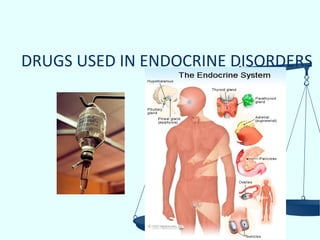
DRUGS USED IN ENDOCRINE DISORDERS
2
Mechanism of action
Once hormones reach a responsive cell, they bind with receptors in
the cell membrane ( protein hormones) or
inside the cell ( steroid and thyroid hormones).
Receptors may be increased (up-regulation) when there are
low levels of hormone or decreased (down-regulation) when
there are excessive amounts of hormone.
The hormone–receptor complex initiates intracellular reactions.
Many hormones act as a 1st
messenger to the cell, and
the hormone–receptor complex activates a 2nd
messenger.
The 2nd
messenger then activates intracellular structures to
produce characteristic cellular functions and products.
Second Messenger Systems
Cyclic AMP is the 2nd
messenger for many hormones, including
Corticotropin, Glucagon, Thyroid stimulating hormone,
Follicle stimulating hormone, Luteinizing hormone,
Parathyroid hormone and Antidiuretic hormone.
It is formed by the action of the enzyme adenyl cyclase on ATP.
Once formed, cAMP activates reactions that alter cell function.
The amount of intracellular cAMP is increased by hormones that
activate adenyl cyclase:
the Pituitary hormones,
Calcitonin,
Glucagon,
Parathyroid hormone
and decreased by hormones that inactivate adenyl cyclase:
Somatostatin
Ca2+
is the 2nd
messenger for Gonadotropin-releasing hormone.
This hormone binds to receptors to increase intracellular Ca2+
.
The Ca2+
binds with an intracellular protein Calmodulin.
The Ca2+
– Calmodulin complex activates Protein kinases, which:
Regulate contractile structures of the cell,
Cell membrane permeability, and
Intracellular enzyme activity.
Specific effects include:
Contraction of smooth muscle,
Changes in the secretions etc.
Some hormones activate cell membrane receptors and transform
them into phospholipase C, an enzyme that causes some of
the phospholipids in cell membranes to split into smaller molecules:
inositol triphosphate and diacylglycerol which act
as 2nd
messengers to intracellular structures.
Inositol triphosphate mobilizes intracellular Ca2+
ions which fulfil
their functions as 2nd
messengers.
Diacylglycerol activates an enzyme, protein kinase C that is
important in cell reproduction.
The lipid component of diacylglycerol is arachidonic acid -
the precursor for PGs, leukotrienes, and other local hormones
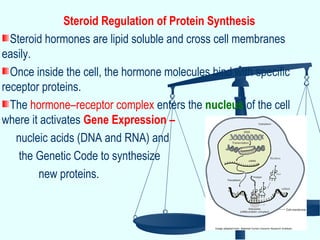
Steroid Regulation of Protein Synthesis
Steroid hormones are lipid soluble and cross cell membranes
easily.
Once inside the cell, the hormone molecules bind with specific
receptor proteins.
The hormone–receptor complex enters the nucleus of the cell
where it activates Gene Expression –
nucleic acids (DNA and RNA) and
the Genetic Code to synthesize
new proteins.
8
9
10
11
12
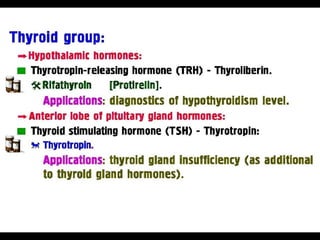
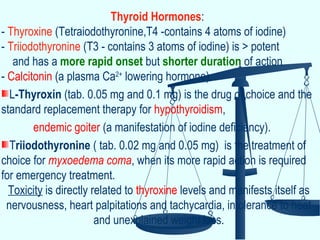
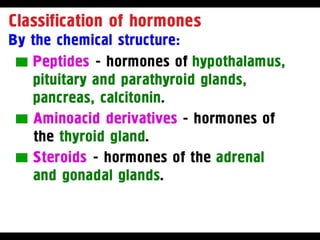
Thyroid Hormones:
- Thyroxine (Tetraiodothyronine,T4 -contains 4 atoms of iodine)
- Triiodothyronine (T3 - contains 3 atoms of iodine) is > potent
and has a more rapid onset but shorter duration of action
- Calcitonin (a plasma Ca2+
lowering hormone).
L-Thyroxin (tab. 0.05 mg and 0.1 mg) is the drug of choice and the
standard replacement therapy for hypothyroidism,
endemic goiter (a manifestation of iodine deficiency).
Triiodothyronine ( tab. 0.02 mg and 0.05 mg) is the treatment of
choice for myxoedema coma, when its more rapid action is required
for emergency treatment.
Toxicity is directly related to thyroxine levels and manifests itself as
nervousness, heart palpitations and tachycardia, intolerance to heat
and unexplained weight loss.
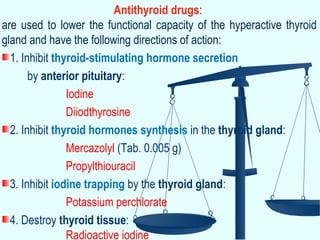
Antithyroid drugs:
are used to lower the functional capacity of the hyperactive thyroid
gland and have the following directions of action:
1. Inhibit thyroid-stimulating hormone secretion
by anterior pituitary:
Iodine
Diiodthyrosine
2. Inhibit thyroid hormones synthesis in the thyroid gland:
Mercazolyl (Tab. 0.005 g)
Propylthiouracil
3. Inhibit iodine trapping by the thyroid gland:
Potassium perchlorate
4. Destroy thyroid tissue:
Radioactive iodine
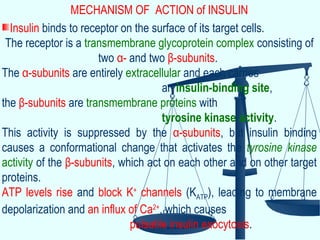
MECHANISM OF ACTION of INSULIN
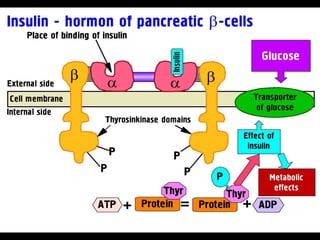
Insulin binds to receptor on the surface of its target cells.
The receptor is a transmembrane glycoprotein complex consisting of
two α- and two β-subunits.
The α-subunits are entirely extracellular and each carries
an insulin-binding site,
the β-subunits are transmembrane proteins with
tyrosine kinase activity.
This activity is suppressed by the α-subunits, but insulin binding
causes a conformational change that activates the tyrosine kinase
activity of the β-subunits, which act on each other and on other target
proteins.
ATP levels rise and block K+
channels (KATP), leading to membrane
depolarization and an influx of Ca2+
, which causes
pulsatile insulin exocytosis.
16
1717
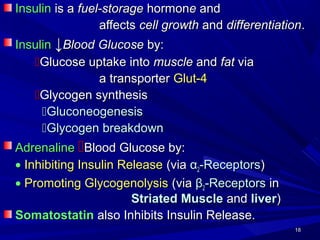
InsulinInsulin is ais a fuel-storagefuel-storage hormonhormonee andand
affectsaffects cell growthcell growth andand differentiationdifferentiation..
InsulinInsulin ↓↓Blood GlucoseBlood Glucose byby::
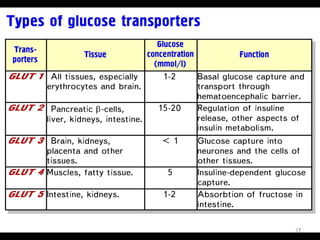
Glucose uptake intoGlucose uptake into musclemuscle andand fatfat viavia
a transportera transporter Glut-4Glut-4
Glycogen synthesisGlycogen synthesis
GluconeogenesisGluconeogenesis
Glycogen breakdownGlycogen breakdown
AdrenalineAdrenaline Blood Glucose by:Blood Glucose by:
•• Inhibiting Insulin ReleaseInhibiting Insulin Release (via(via αα22-Receptors-Receptors))
•• Promoting GlycogenolysisPromoting Glycogenolysis (via(via ββ22-Receptors-Receptors inin
Striated MuscleStriated Muscle andand liverliver))
SomatostatinSomatostatin also Inhibits Insulin Release.also Inhibits Insulin Release.
1818
INSULIN PREPARATIONSINSULIN PREPARATIONS
A. RAPID ACTING INSULINA. RAPID ACTING INSULIN
max effect permax effect per 1-4 hours1-4 hours
short duration of actionshort duration of action 4-8 hours4-8 hours
•• RegularRegular InsulinInsulin -- 55 andand 10 ml10 ml –– 40 U/ml40 U/ml
•• Insulin LisproInsulin Lispro
B. INTERMEDIATE ACTING INSULINB. INTERMEDIATE ACTING INSULIN
max effect permax effect per 6-12 hours6-12 hours
intermediate duration of actionintermediate duration of action 18- 24 hours18- 24 hours
•• Semilente Insulin suspensionSemilente Insulin suspension
•• Lente InsulinLente Insulin::
a mixture ofa mixture of 30% Semilente Insulin30% Semilente Insulin andand
70% Ultralente Insulin70% Ultralente Insulin
1919
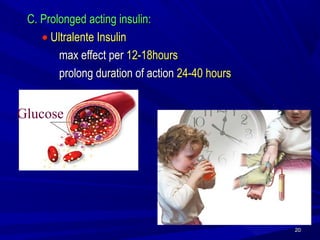
C. Prolonged acting insulin:C. Prolonged acting insulin:
•• Ultralente InsulinUltralente Insulin
max effect permax effect per 12-18hours12-18hours
prolong duration of actionprolong duration of action 24-40 hours24-40 hours
Glucose
2020
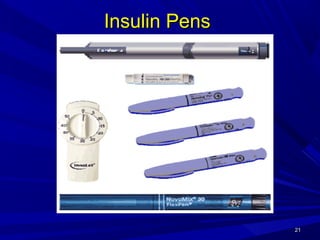
Insulin PensInsulin Pens
2121
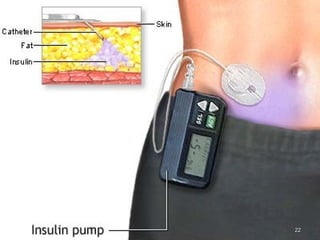
2222
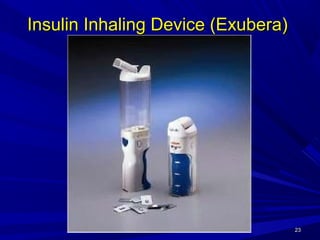
Insulin Inhaling Device (Exubera)Insulin Inhaling Device (Exubera)
2323
CLINICAL USES of INSULINCLINICAL USES of INSULIN::
 Type 1 DiabetesType 1 Diabetes::
 Diabetic KetoacidosisDiabetic Ketoacidosis
 Short-term treatment of patients withShort-term treatment of patients with Type 2 diabetesType 2 diabetes
during intercurrent events: Operations, Infections, AMIduring intercurrent events: Operations, Infections, AMI
 During pregnancy, forDuring pregnancy, for Gestational DiabetesGestational Diabetes not controlled bynot controlled by
diet alone.diet alone.
 Emergency treatmentEmergency treatment ofof hyperkalaemiahyperkalaemia::
 insulininsulin is given withis given with glucoseglucose to lower extracellularto lower extracellular KK++
via redistribution into cellvia redistribution into cell
2424
Oral (Synthetic) Hypoglycemic Agents:
I. Stimulators of insulin release by beta cells:
1. Sulfonylurea derivatives:
I. Generation – moderate duration of action (8-24 hours):
Butamide (Tolbutamide)
II Generation – Long duration of action (24-60 hours):
Chlorpropamide (tab. 0.1 and 0.25 g)
Glibenclamide (tab.5 mg)
Glipizide (tab. 5 mg)
2. Meglitinides:
Repaglinide (tab. 1 mg)
Nateglinide (tab. 120 mg)
Repaglinide and Nateglinide are non-sulfonylureas meglitinides that
lower blood sugar by stimulating pancreatic secretion of insulin.
 can be used as monotherapy with diet and exercise or
in combination with Metformin.
 well absorbed from the GIT;
peak plasma level occurs within 1 hour.
 have a plasma half-life of 1–1.5 hours and
are highly bound (>98%) to plasma proteins.
Repaglinide (NovoNorm) is metabolized and
removed from the bloodstream within 3–4 hours after a dose,
Nateglinide within ~6 hours. This decreases the workload of
pancreatic β cells (i.e., decreases duration of β-cell stimulation),
allows plasma insulin levels to return to normal before
the next meal, and
decreases risks of hypoglycemic episodes.
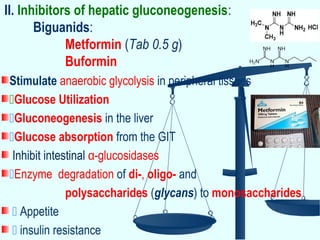
II. Inhibitors of hepatic gluconeogenesis:
Biguanids:
Metformin (Tab 0.5 g)
Buformin
Stimulate anaerobic glycolysis in peripheral tissues
Glucose Utilization
Gluconeogenesis in the liver
Glucose absorption from the GIT
Inhibit intestinal α-glucosidases
Enzyme degradation of di-, oligo- and
polysaccharides (glycans) to monosaccharides
 Appetite
 insulin resistance
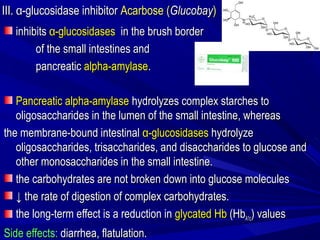
III.III. αα-glucosidase inhibitor-glucosidase inhibitor Acarbose (Acarbose (GlucobayGlucobay))
inhibitsinhibits αα-glucosidases-glucosidases in the brush borderin the brush border
of the small intestines andof the small intestines and
pancreaticpancreatic alpha-amylasealpha-amylase..
Pancreatic alpha-amylasePancreatic alpha-amylase hydrolyzes complex starches tohydrolyzes complex starches to
oligosaccharides in the lumen of the small intestine, whereasoligosaccharides in the lumen of the small intestine, whereas
the membrane-bound intestinalthe membrane-bound intestinal αα-glucosidases-glucosidases hydrolyzehydrolyze
oligosaccharides, trisaccharides, and disaccharides to glucose andoligosaccharides, trisaccharides, and disaccharides to glucose and
other monosaccharides in the small intestine.other monosaccharides in the small intestine.
the carbohydrates are not broken down into glucose moleculesthe carbohydrates are not broken down into glucose molecules
↓↓ the rate of digestion of complex carbohydrates.the rate of digestion of complex carbohydrates.
the long-term effect is a reduction inthe long-term effect is a reduction in glycatedglycated HbHb (Hb(HbA1cA1c) values) values
Side effects:Side effects: diarrhea, flatulation.diarrhea, flatulation.
GLUCOCORTICOIDSGLUCOCORTICOIDS (GCs)(GCs)
1. Short-acting:1. Short-acting: Hydrocortisone acetateHydrocortisone acetate
CortisoneCortisone
2. Intermediate-acting2. Intermediate-acting::
PrednisolonePrednisolone
TriamcinoloneTriamcinolone
3. Long-acting:3. Long-acting: Betametasone,Betametasone,
DexametasoneDexametasone
OINTMENTS for local use -OINTMENTS for local use - FluorineFluorine-containing-containing::
Synaflan, FlumethasoneSynaflan, Flumethasone
AEROSOLS or POWDERS FOR INHALATIONSAEROSOLS or POWDERS FOR INHALATIONS::
BeclometasoneBeclometasone
FluticasoneFluticasone 2929
Action on mediators of inflammatoryAction on mediators of inflammatory
and immune responseand immune response::
GCs change Gene Expression:GCs change Gene Expression:
 Production ofProduction of prostanoidsprostanoids owing toowing to
Decreased Expression ofDecreased Expression of COX-2COX-2
 Generation of cytokines –Generation of cytokines –
IL 1-6, IL-8, TNF-IL 1-6, IL-8, TNF-αα andand cell adhesion factorcell adhesion factor ––
through inhibition of transcription ofthrough inhibition of transcription of
the relevant genesthe relevant genes
 Complement components in the plasmaComplement components in the plasma
 Generation of inducedGeneration of induced NONO
 HistamineHistamine release from basophilsrelease from basophils
 IgG production.IgG production. 3030
Clinical uses of GCsClinical uses of GCs::
1.1. ReplacementReplacement therapy for patients withtherapy for patients with adrenal failureadrenal failure --
Addison’s diseaseAddison’s disease
2.2. Anti-Inflammatory Immunosuppressive TherapyAnti-Inflammatory Immunosuppressive Therapy::
 AsthmaAsthma
 Inflammatory conditions of skin, eye, ear or nose:Inflammatory conditions of skin, eye, ear or nose:
Eczema, Allergic Conjunctivitis or RhinitisEczema, Allergic Conjunctivitis or Rhinitis – topically– topically
 Hypersensitivity States:Hypersensitivity States:
Severe Allergic ReactionsSevere Allergic Reactions – IV– IV
3.3. In neoplastic diseasesIn neoplastic diseases::
In combination with Cytotoxic Drugs as a component ofIn combination with Cytotoxic Drugs as a component of AntiemeticAntiemetic
TreatmentTreatment in the treatment ofin the treatment of Specific MalignanciesSpecific Malignancies
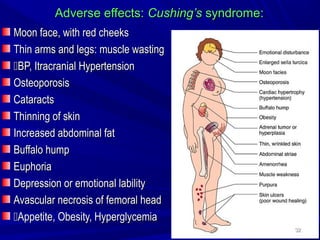
Adverse effects:Adverse effects: Cushing’sCushing’s syndromesyndrome::
Moon face, with red cheeksMoon face, with red cheeks
Thin arms and legsThin arms and legs:: muscle wastingmuscle wasting
BP, Itracranial HypertensionBP, Itracranial Hypertension
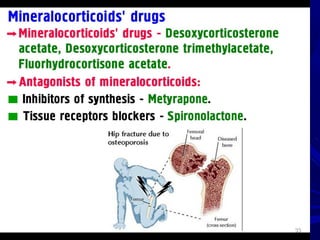
OsteoporosisOsteoporosis
CataractsCataracts
Thinning of skinThinning of skin
Increased abdominal fatIncreased abdominal fat
Buffalo humpBuffalo hump
EuphoriaEuphoria
Depression or emotional labilityDepression or emotional lability
Avascular necrosis of femoral headAvascular necrosis of femoral head
Appetite, Obesity, HyperglycemiaAppetite, Obesity, Hyperglycemia
3232
3333
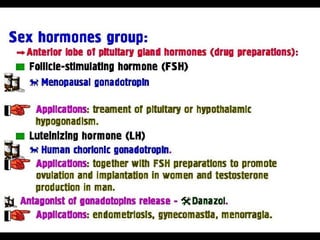
OESTROGENSOESTROGENS
NaturalNatural::
EstradiolEstradiol -- amp 0.1%-1 mlamp 0.1%-1 ml
EstriolEstriol - Tab 1 mg- Tab 1 mg
SyntheticSynthetic::
EthinylestradiolEthinylestradiol - Tab 0,01 mg- Tab 0,01 mg
SynoestrolSynoestrol Tab 1 mg, amp 0.1% - 1 mlTab 1 mg, amp 0.1% - 1 ml
MestranolMestranol
3434
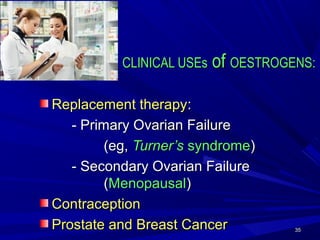
CLINICAL USEsCLINICAL USEs ofof OESTROGENS:OESTROGENS:
Replacement therapyReplacement therapy::
- Primary Ovarian Failure- Primary Ovarian Failure
(eg,(eg, Turner’sTurner’s syndromesyndrome))
- Secondary Ovarian Failure- Secondary Ovarian Failure
((MenopausalMenopausal))
ContraceptionContraception
Prostate and Breast CancerProstate and Breast Cancer 3535
ANTIOESTROGENSANTIOESTROGENS
ClomipheneClomiphene - Tab. 50 mg- Tab. 50 mg
TamoxifenTamoxifen - Tab. 20 mg- Tab. 20 mg
Clomiphene:Clomiphene:
Interfering with theInterfering with the Negative FeedbackNegative Feedback ofof
oestrogensoestrogens on theon the hypothalamushypothalamus andand pituitarypituitary
=>=> SecretionSecretion ofof Gn-RHGn-RH
SecretionSecretion ofof GonadotropinsGonadotropins
=>=> a Stimulation of Ovulationa Stimulation of Ovulation
Clinical useClinical use::
Infertility with Anovulatory CyclesInfertility with Anovulatory Cycles
Breast TumorsBreast Tumors
3636
PROGESTOGENSPROGESTOGENS
1. The naturally occurring hormone and its1. The naturally occurring hormone and its
derivativesderivatives::
ProgesteronProgesteron amp. 1% - 1 ml of oil solutionamp. 1% - 1 ml of oil solution
Oxyprogesterone CaproateOxyprogesterone Caproate amp. 25% - 1 mlamp. 25% - 1 ml
PregninPregnin Tab. 0.01Tab. 0.01
2. Testosterone derivatives2. Testosterone derivatives::
NorethisteroneNorethisterone Tab. 5 mgTab. 5 mg
NorgestrelNorgestrel
DesogestrelDesogestrel
GestodeneGestodene
3737
CLINICAL USE of PROGESTOGENSCLINICAL USE of PROGESTOGENS
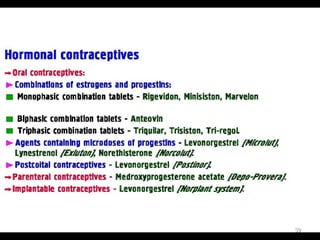
1. CONTRACEPTION1. CONTRACEPTION::
- combined oral contraceptive pill- combined oral contraceptive pill
- as progesterone-only contraceptive pill- as progesterone-only contraceptive pill
- as injectable or implantable progesterone-- as injectable or implantable progesterone-
only contraceptiononly contraception
2. Replacement therapy2. Replacement therapy
3. Dysfunctional uterine bleeding, dysmenorrhea, suppression of3. Dysfunctional uterine bleeding, dysmenorrhea, suppression of
postpartum lactation, endometriosispostpartum lactation, endometriosis
4. Endometrial carcinomas4. Endometrial carcinomas
3838
3939
4040
4141