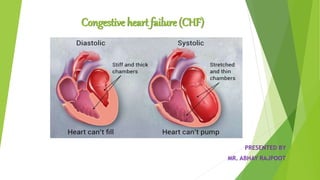




Congestive heart failure (CHF)
PRESENTED BY
MR. ABHAY RAJPOOT
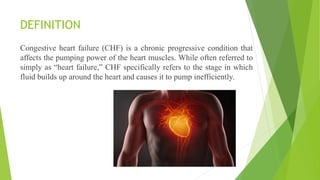
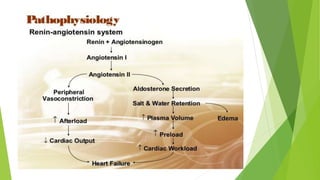
DEFINITION
Congestive heart failure (CHF) is a chronic progressive condition that
affects the pumping power of the heart muscles. While often referred to
simply as “heart failure,” CHF specifically refers to the stage in which
fluid builds up around the heart and causes it to pump inefficiently.
INCIDENCE:
Incidence rates of heart failure, we conservatively estimate
the prevalence of heart failure in India due to coronary heart disease,
hypertension, obesity, diabetes and rheumatic heart disease to range
from 1.3 to 4.6 million, with an annual incidence.
RISK FACTORS:
MODIFIABLE RISK FACTORS:
 Tobacco use
 High blood cholesterol or triglyceride levels
 Lack of exercise
 Obesity
 Stress
NONMODIFIABLE RISK FACTORS:
 Family history of heart disease
 Older age
 Diabetes
 High blood pressure
Types
 Left-sided heart failure
 Right-sided heart failure
 Systolic heart failure
 Diastolic heart failure(also called heart failure with preserved ejection
fraction)
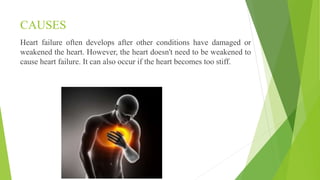
CAUSES
Heart failure often develops after other conditions have damaged or
weakened the heart. However, the heart doesn't need to be weakened to
cause heart failure. It can also occur if the heart becomes too stiff.
SYMPTOMS:
CARDIOVASCULAR-
 Ischemia- Ischemia is a restriction in blood supply to tissues, causing a
shortage of oxygen that is needed for cellula.
 Low cardiac output-
 Chest pain –chest pain occurs suddenly , severe immobilizing chest pain
that not relieved by rest , position change and medications.
 Decrease pulse rate.
 BP may be elevated beacuase of sympathetic stimulation or decreased BP
because of decreased contractility, development if cargiogenic shock .
 Myocardial infarction- when the blood flow decreases or stop to apart of
the heart , causing damage to the heart muscle.
 Diaphoresis –excessive sweating
 ECG changes – ST segment and T wave changes, also show tachycardia,
bradcardia, or dysrhythimas.
 Dysarrithmias
CONTI…
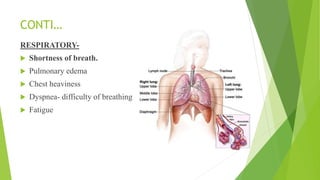
RESPIRATORY-
 Shortness of breath.
 Pulmonary edema
 Chest heaviness
 Dyspnea- difficulty of breathing
 Fatigue
CONTI….
 Genitourinary-Decreased Urinary Output May Indicate Cardiogenic
Shock.
 Gastrointestinal- Nausea And Vomiting
 Skin- Cool, Clammy ,Diaphoretic , And Pale Appearance On Skin
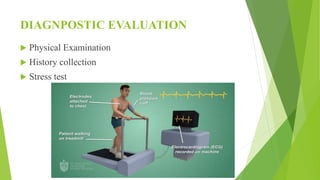
DIAGNPOSTIC EVALUATION
 Physical Examination
 History collection
 Stress test
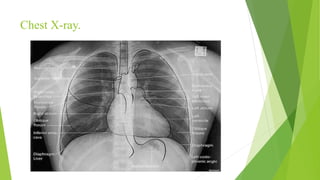
Chest X-ray.
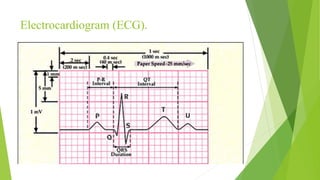
Electrocardiogram (ECG).
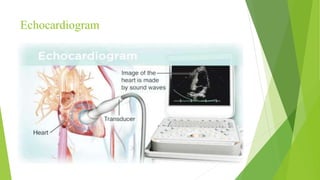
Echocardiogram
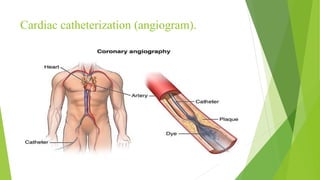
Cardiac catheterization (angiogram).
TROPONIN-TEST
COMPLICATIONS:
 Heart attack
 Heart failure
 Abnormal heart rhythm (arrhythmia)
PREVENTION:
 Quit smoking
 Control conditions such as high blood pressure, high cholesterol and
diabetes
 Stay physically active
 Eat a low-fat, low-salt diet that's rich in fruits, vegetables and whole
grains
 Maintain a healthy weight
 Reduce and manage stress
MEDICAL MANAGEMENT:
Various drugs can be used to treat coronary artery disease, including:
 Vasodilators (These drugs acts as blood vessel dilator):
• Nitrates
 Beta-Blockers (Decrease work load in heart):
• Propranolol 20-40 mg
 Calcium channel blocker (They improve coronary blood flow):
• Nifedipine
• Verapamil
CONTI….
 Anticoagulant Drugs:
 Heparin
 Opiate Analgesic (For reduce pain)
 Morphine sulphate
 Thrombolytic Drugs:
 Streptokinase,Urokinase
ANTIHYPERTENSIVE MEDICINES-
 Methydopa - This medication is used alone or with other medications
to treat high blood pressure (hypertension). Lowering high blood
pressure helps prevent strokes, heart attacks, and kidney problems.
Methyldopa works by relaxing blood vessels so blood can flow more
easily.
 Sodium nitroprusside- It is used for lowering the blood pressure.
 Amlodipine- Amlodipine is used with or without other medications to
treat high blood pressure. Lowering high blood pressure helps prevent
strokes, heart attacks, and kidney problems. Dose-10 mg,20 mg.
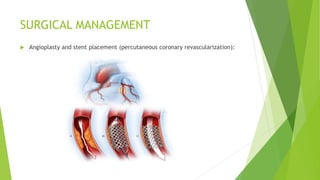
SURGICAL MANAGEMENT
 Angioplasty and stent placement (percutaneous coronary revascularization):
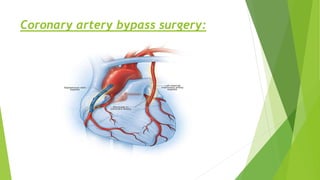
Coronary artery bypass surgery:
NURSING DIAGNOSIS
 Impaired gas exchange related to decreased blood flow as evidenced by
breathlessness
 Acute pain related to disease condition as evidenced by patient verbalization
 Impaired physical mobility related to weakness as evidenced by patient is
unable to perform daily activity.
 Imbalanced nutrition less than body requirement related to less intake of food
as evidenced by weight loss
 Disturbed sleep pattern related to hospitalization as evidenced by patient
verbalization
 Anxiety related to hospitalization as evidenced by patient asking too many
question.
 Knowledge deficit related to disease process and treatment as evidenced by
patient is having many doubts
RESEARCH STUDY
University of Alabama at Birmingham researchers now describe an
important contributor to that heart pathology disruption of the
metabolism that controls immune responses in the spleen and heart.
Doxorubicin, a chemotherapy drug widely used in ovarian, bladder,
lung, thyroid and stomach cancers carries a harmful side effect. The
drug can disrupt the immune system, and cause a dose-dependent heart
toxicity that can lead to congestive heart failure.
SUMMARY
BIBLIOGRAPHY:
 Black M. joyce, Hwks hokanson jane,medical surgical nursing.8th edition.
volume 2. New delhi ;Reed elsevier india private limited:2009.p1411-
1426.
 Suddarth’s and brunner, Hinkle L.Janice, Cheever H.Kerry. text book of
medical surgical nursing.13th edition . volume 1.New delhi: wolters kluwer
india Pvt ltd ;2014.p729-759.
 https://www.mayoclinic.org/diseases-conditions/heart-failure/diagnosis-
treatment/drc-20373148
 https://www.healthline.com/health/congestive-heart-failure
 https://ceufast.com/course/congestive-heart-failure-the-essence-of-heart-
failure
Congestive heart failure

Congestive heart failure

  • 1.
    Congestive heart failure(CHF) PRESENTED BY MR. ABHAY RAJPOOT
  • 2.
    DEFINITION Congestive heart failure(CHF) is a chronic progressive condition that affects the pumping power of the heart muscles. While often referred to simply as “heart failure,” CHF specifically refers to the stage in which fluid builds up around the heart and causes it to pump inefficiently.
  • 3.
    INCIDENCE: Incidence rates ofheart failure, we conservatively estimate the prevalence of heart failure in India due to coronary heart disease, hypertension, obesity, diabetes and rheumatic heart disease to range from 1.3 to 4.6 million, with an annual incidence.
  • 4.
    RISK FACTORS: MODIFIABLE RISKFACTORS:  Tobacco use  High blood cholesterol or triglyceride levels  Lack of exercise  Obesity  Stress NONMODIFIABLE RISK FACTORS:  Family history of heart disease  Older age  Diabetes  High blood pressure
  • 5.
    Types  Left-sided heartfailure  Right-sided heart failure  Systolic heart failure  Diastolic heart failure(also called heart failure with preserved ejection fraction)
  • 6.
    CAUSES Heart failure oftendevelops after other conditions have damaged or weakened the heart. However, the heart doesn't need to be weakened to cause heart failure. It can also occur if the heart becomes too stiff.
  • 8.
    SYMPTOMS: CARDIOVASCULAR-  Ischemia- Ischemiais a restriction in blood supply to tissues, causing a shortage of oxygen that is needed for cellula.  Low cardiac output-  Chest pain –chest pain occurs suddenly , severe immobilizing chest pain that not relieved by rest , position change and medications.  Decrease pulse rate.  BP may be elevated beacuase of sympathetic stimulation or decreased BP because of decreased contractility, development if cargiogenic shock .  Myocardial infarction- when the blood flow decreases or stop to apart of the heart , causing damage to the heart muscle.  Diaphoresis –excessive sweating  ECG changes – ST segment and T wave changes, also show tachycardia, bradcardia, or dysrhythimas.  Dysarrithmias
  • 9.
    CONTI… RESPIRATORY-  Shortness ofbreath.  Pulmonary edema  Chest heaviness  Dyspnea- difficulty of breathing  Fatigue
  • 10.
    CONTI….  Genitourinary-Decreased UrinaryOutput May Indicate Cardiogenic Shock.  Gastrointestinal- Nausea And Vomiting  Skin- Cool, Clammy ,Diaphoretic , And Pale Appearance On Skin
  • 11.
    DIAGNPOSTIC EVALUATION  PhysicalExamination  History collection  Stress test
  • 12.
  • 13.
  • 14.
  • 15.
  • 16.
  • 17.
    COMPLICATIONS:  Heart attack Heart failure  Abnormal heart rhythm (arrhythmia)
  • 18.
    PREVENTION:  Quit smoking Control conditions such as high blood pressure, high cholesterol and diabetes  Stay physically active  Eat a low-fat, low-salt diet that's rich in fruits, vegetables and whole grains  Maintain a healthy weight  Reduce and manage stress
  • 19.
    MEDICAL MANAGEMENT: Various drugscan be used to treat coronary artery disease, including:  Vasodilators (These drugs acts as blood vessel dilator): • Nitrates  Beta-Blockers (Decrease work load in heart): • Propranolol 20-40 mg  Calcium channel blocker (They improve coronary blood flow): • Nifedipine • Verapamil
  • 20.
    CONTI….  Anticoagulant Drugs: Heparin  Opiate Analgesic (For reduce pain)  Morphine sulphate  Thrombolytic Drugs:  Streptokinase,Urokinase
  • 21.
    ANTIHYPERTENSIVE MEDICINES-  Methydopa- This medication is used alone or with other medications to treat high blood pressure (hypertension). Lowering high blood pressure helps prevent strokes, heart attacks, and kidney problems. Methyldopa works by relaxing blood vessels so blood can flow more easily.  Sodium nitroprusside- It is used for lowering the blood pressure.  Amlodipine- Amlodipine is used with or without other medications to treat high blood pressure. Lowering high blood pressure helps prevent strokes, heart attacks, and kidney problems. Dose-10 mg,20 mg.
  • 22.
    SURGICAL MANAGEMENT  Angioplastyand stent placement (percutaneous coronary revascularization):
  • 23.
  • 24.
    NURSING DIAGNOSIS  Impairedgas exchange related to decreased blood flow as evidenced by breathlessness  Acute pain related to disease condition as evidenced by patient verbalization  Impaired physical mobility related to weakness as evidenced by patient is unable to perform daily activity.  Imbalanced nutrition less than body requirement related to less intake of food as evidenced by weight loss  Disturbed sleep pattern related to hospitalization as evidenced by patient verbalization  Anxiety related to hospitalization as evidenced by patient asking too many question.  Knowledge deficit related to disease process and treatment as evidenced by patient is having many doubts
  • 25.
    RESEARCH STUDY University ofAlabama at Birmingham researchers now describe an important contributor to that heart pathology disruption of the metabolism that controls immune responses in the spleen and heart. Doxorubicin, a chemotherapy drug widely used in ovarian, bladder, lung, thyroid and stomach cancers carries a harmful side effect. The drug can disrupt the immune system, and cause a dose-dependent heart toxicity that can lead to congestive heart failure.
  • 26.
  • 27.
    BIBLIOGRAPHY:  Black M.joyce, Hwks hokanson jane,medical surgical nursing.8th edition. volume 2. New delhi ;Reed elsevier india private limited:2009.p1411- 1426.  Suddarth’s and brunner, Hinkle L.Janice, Cheever H.Kerry. text book of medical surgical nursing.13th edition . volume 1.New delhi: wolters kluwer india Pvt ltd ;2014.p729-759.  https://www.mayoclinic.org/diseases-conditions/heart-failure/diagnosis- treatment/drc-20373148  https://www.healthline.com/health/congestive-heart-failure  https://ceufast.com/course/congestive-heart-failure-the-essence-of-heart- failure