PPT. ON
CONFLICT MANAGMENT
Prepared by.
Mebrahtu
Beyene.
( psychologist)
Psychometric analyst
Email. mebre2017@gmail.com
Department of HRM,
Assessment and development team.
The information network security agency of Ethiopia (INSA)
Addis Ababa,
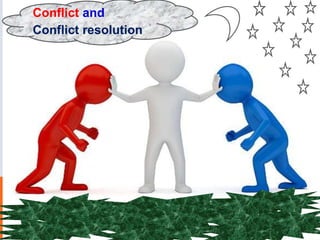
Conflict and
Conflict resolution
Over view
Part one- What is conflict
o Sources of conflict
o Levels
o Types
o Stages
Part two - conflict resolution
o What is conflict resolution
o Conflict management strategies
o Stapes to resolve conflict
o Conclusion
o Summary
PART – ONE
What is conflict?
• It can be described as a disagreement among
groups or individuals characterized by
antagonism and hostility.
. Conflict is “a perceived difference between two or more
parties that results in mutual opposition” (Bartol and David,
1991: 578).
Brainstorming Questions
•What do you understand from the above definition
of conflict?
•What sources of conflict do you know? Try to share
us in relation to the context
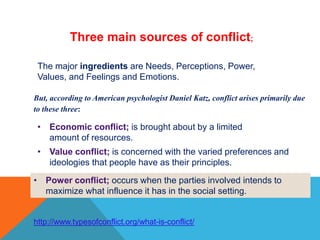
Three main sources of conflict;
• Economic conflict; is brought about by a limited
amount of resources.
• Value conflict; is concerned with the varied preferences and
ideologies that people have as their principles.
• Power conflict; occurs when the parties involved intends to
maximize what influence it has in the social setting.
http://www.typesofconflict.org/what-is-conflict/
But, according to American psychologist Daniel Katz, conflict arises primarily due
to these three:
The major ingredients are Needs, Perceptions, Power,
Values, and Feelings and Emotions.
Levels of conflict
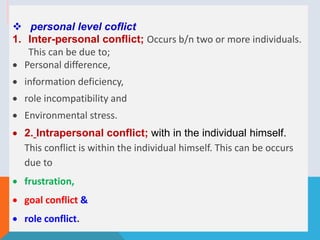
 personal level coflict
1. Inter-personal conflict; Occurs b/n two or more individuals.
This can be due to;
 Personal difference,
 information deficiency,
 role incompatibility and
 Environmental stress.
 2. Intrapersonal conflict; with in the individual himself.
This conflict is within the individual himself. This can be occurs
due to
 frustration,
 goal conflict &
 role conflict.
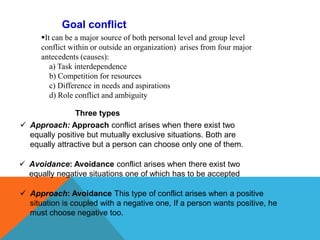
 Approach: Approach conflict arises when there exist two
equally positive but mutually exclusive situations. Both are
equally attractive but a person can choose only one of them.
 Avoidance: Avoidance conflict arises when there exist two
equally negative situations one of which has to be accepted
 Approach: Avoidance This type of conflict arises when a positive
situation is coupled with a negative one, If a person wants positive, he
must choose negative too.
Goal conflict
Three types
It can be a major source of both personal level and group level
conflict within or outside an organization) arises from four major
antecedents (causes):
a) Task interdependence
b) Competition for resources
c) Difference in needs and aspirations
d) Role conflict and ambiguity
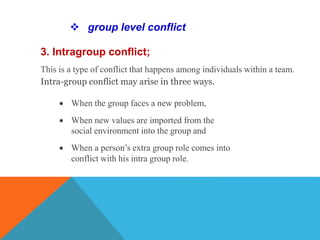
3. Intragroup conflict;
This is a type of conflict that happens among individuals within a team.
Intra-group conflict may arise in three ways.
 group level conflict
 When the group faces a new problem,
 When new values are imported from the
social environment into the group and
 When a person’s extra group role comes into
conflict with his intra group role.
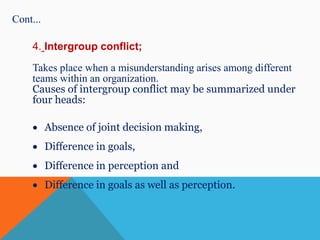
4. Intergroup conflict;
Takes place when a misunderstanding arises among different
teams within an organization.
Causes of intergroup conflict may be summarized under
four heads:
 Absence of joint decision making,
 Difference in goals,
 Difference in perception and
 Difference in goals as well as perception.
Cont...
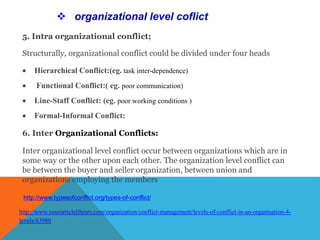
6. Inter Organizational Conflicts:
Inter organizational level conflict occur between organizations which are in
some way or the other upon each other. The organization level conflict can
be between the buyer and seller organization, between union and
organizations employing the members
5. Intra organizational conflict;
Structurally, organizational conflict could be divided under four heads
 Hierarchical Conflict:(eg. task inter-dependence)
 Functional Conflict:( eg. poor communication)
 Line-Staff Conflict: (eg. poor working conditions )
 Formal-Informal Conflict:
http://www.typesofconflict.org/types-of-conflict/
http://www.yourarticlelibrary.com/organization/conflict-management/levels-of-conflict-in-an-organisation-4-
levels/63980
 organizational level coflict
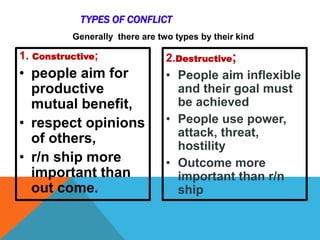
1. Constructive;
• people aim for
productive
mutual benefit,
• respect opinions
of others,
• r/n ship more
important than
out come.
2.Destructive;
• People aim inflexible
and their goal must
be achieved
• People use power,
attack, threat,
hostility
• Outcome more
important than r/n
ship
TYPES OF CONFLICT
Generally there are two types by their kind
 WHAT HAPPEN IN
CONSTRUCTIVE CONFLICT ?
 WHAT HAPPEN IN
DESTRUCTIVE CONFLICT ?
.
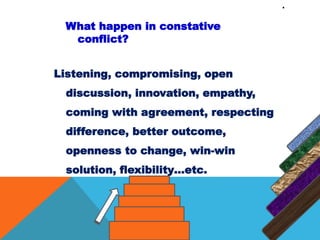
What happen in constative
conflict?
Listening, compromising, open
discussion, innovation, empathy,
coming with agreement, respecting
difference, better outcome,
openness to change, win-win
solution, flexibility…etc.
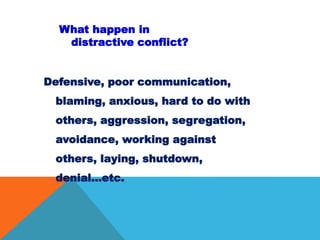
Defensive, poor communication,
blaming, anxious, hard to do with
others, aggression, segregation,
avoidance, working against
others, laying, shutdown,
denial…etc.
What happen in
distractive conflict?
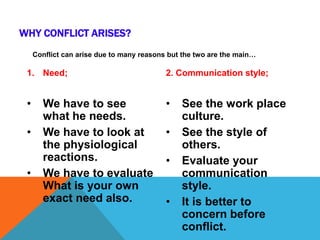
WHY CONFLICT ARISES ?
1. Need;
• We have to see
what he needs.
• We have to look at
the physiological
reactions.
• We have to evaluate
What is your own
exact need also.
2. Communication style;
• See the work place
culture.
• See the style of
others.
• Evaluate your
communication
style.
• It is better to
concern before
conflict.
WHY CONFLICT ARISES?
Conflict can arise due to many reasons but the two are the main…
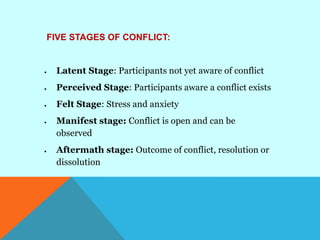
FIVE STAGES OF CONFLICT:
 Latent Stage: Participants not yet aware of conflict
 Perceived Stage: Participants aware a conflict exists
 Felt Stage: Stress and anxiety
 Manifest stage: Conflict is open and can be
observed
 Aftermath stage: Outcome of conflict, resolution or
dissolution
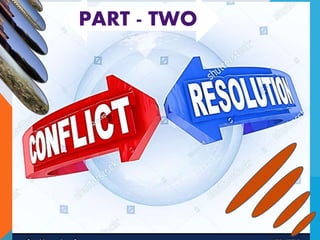
PART - TWO
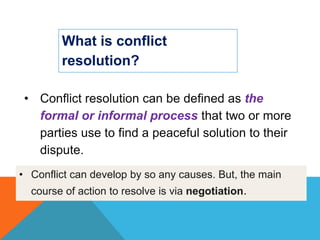
What is conflict
resolution?
• Conflict resolution can be defined as the
formal or informal process that two or more
parties use to find a peaceful solution to their
dispute.
• Conflict can develop by so any causes. But, the main
course of action to resolve is via negotiation.
HOW CAN WE RESOLVE
CONFLICT?
BRAINSTORM…
 Individual Coping Strategies
• Individual Coping strategies to conflict are
techniques that individual employees can use
to manage conflict (stress) with their mind
effectively
Conflict Management
Strategies
There are a number of techniques (strategies) that individuals
can use to reduce those destructive effects (problems) of
intra individual conflict:
• Exercise
• Relaxation
• Cognitive therapy (such as confidence building and
analysis of past knowledge and confrontation), and
• Networking to get social support
• We can also address the behavioral problems due to intra –
individual conflict (like withdrawal and aggressiveness)
through the following five inter – personal conflict
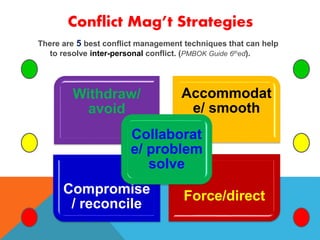
handling modes (approaches
Withdraw/
avoid
Accommodat
e/ smooth
Compromise
/ reconcile
Force/direct
Collaborat
e/ problem
solve
Conflict Mag’t Strategies
There are 5 best conflict management techniques that can help
to resolve inter-personal conflict. (PMBOK Guide 6thed).
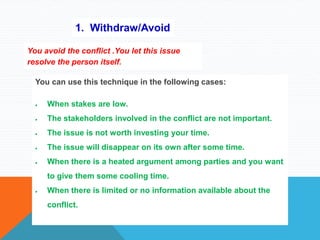
1. Withdraw/Avoid
You avoid the conflict .You let this issue
resolve the person itself.
You can use this technique in the following cases:
 When stakes are low.
 The stakeholders involved in the conflict are not important.
 The issue is not worth investing your time.
 The issue will disappear on its own after some time.
 When there is a heated argument among parties and you want
to give them some cooling time.
 When there is limited or no information available about the
conflict.
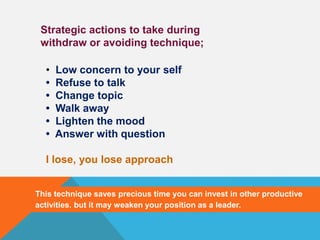
• Low concern to your self
• Refuse to talk
• Change topic
• Walk away
• Lighten the mood
• Answer with question
I lose, you lose approach
Strategic actions to take during
withdraw or avoiding technique;
This technique saves precious time you can invest in other productive
activities. but it may weaken your position as a leader.
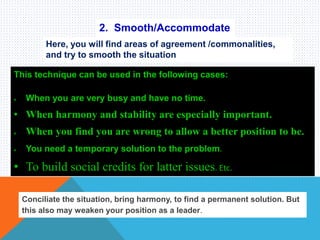
2. Smooth/Accommodate
Here, you will find areas of agreement /commonalities,
and try to smooth the situation
This technique can be used in the following cases:
 When you are very busy and have no time.
• When harmony and stability are especially important.
 When you find you are wrong to allow a better position to be.
 You need a temporary solution to the problem.
• To build social credits for latter issues. Etc.
Conciliate the situation, bring harmony, to find a permanent solution. But
this also may weaken your position as a leader.
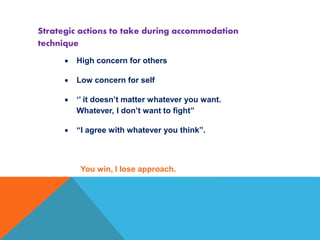
 High concern for others
 Low concern for self
 ‘’ it doesn’t matter whatever you want.
Whatever, I don’t want to fight”
 “I agree with whatever you think”.
You win, I lose approach.
Strategic actions to take during accommodation
technique
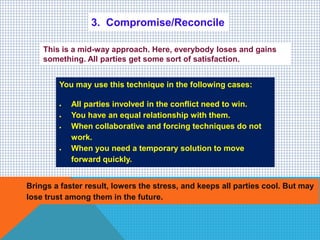
3. Compromise/Reconcile
This is a mid-way approach. Here, everybody loses and gains
something. All parties get some sort of satisfaction.
You may use this technique in the following cases:
 All parties involved in the conflict need to win.
 You have an equal relationship with them.
 When collaborative and forcing techniques do not
work.
 When you need a temporary solution to move
forward quickly.
Brings a faster result, lowers the stress, and keeps all parties cool. But may
lose trust among them in the future.
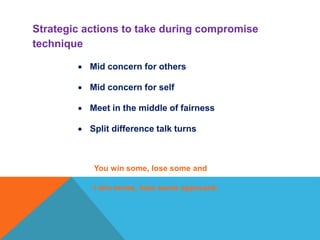
 Mid concern for others
 Mid concern for self
 Meet in the middle of fairness
 Split difference talk turns
You win some, lose some and
I win some, lose some approach.
Strategic actions to take during compromise
technique
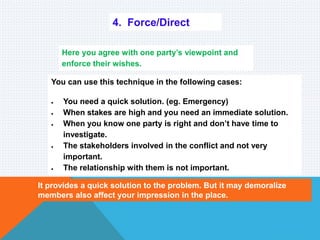
4. Force/Direct
Here you agree with one party’s viewpoint and
enforce their wishes.
You can use this technique in the following cases:
 You need a quick solution. (eg. Emergency)
 When stakes are high and you need an immediate solution.
 When you know one party is right and don’t have time to
investigate.
 The stakeholders involved in the conflict and not very
important.
 The relationship with them is not important.
It provides a quick solution to the problem. But it may demoralize
members also affect your impression in the place.
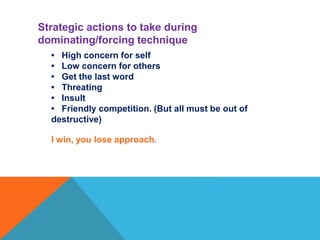
• High concern for self
• Low concern for others
• Get the last word
• Threating
• Insult
• Friendly competition. (But all must be out of
destructive)
I win, you lose approach.
Strategic actions to take during
dominating/forcing technique
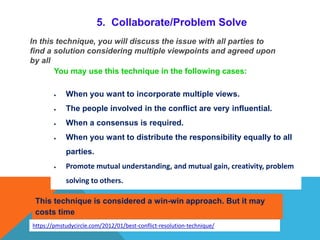
5. Collaborate/Problem Solve
In this technique, you will discuss the issue with all parties to
find a solution considering multiple viewpoints and agreed upon
by all
You may use this technique in the following cases:
 When you want to incorporate multiple views.
 The people involved in the conflict are very influential.
 When a consensus is required.
 When you want to distribute the responsibility equally to all
parties.
 Promote mutual understanding, and mutual gain, creativity, problem
solving to others.
This technique is considered a win-win approach. But it may
costs time
https://pmstudycircle.com/2012/01/best-conflict-resolution-technique/
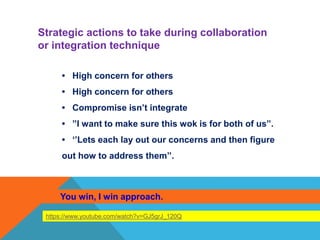
• High concern for others
• Compromise isn’t integrate
• ”I want to make sure this wok is for both of us”.
• ‘’Lets each lay out our concerns and then figure
out how to address them’’.
Strategic actions to take during collaboration
or integration technique
You win, I win approach.
https://www.youtube.com/watch?v=GJ5grJ_120Q
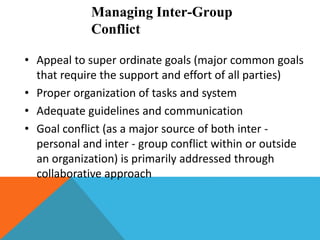
Managing Inter-Group
Conflict
• Appeal to super ordinate goals (major common goals
that require the support and effort of all parties)
• Proper organization of tasks and system
• Adequate guidelines and communication
• Goal conflict (as a major source of both inter -
personal and inter - group conflict within or outside
an organization) is primarily addressed through
collaborative approach
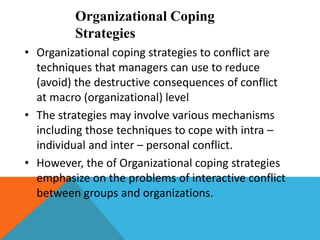
Organizational Coping
Strategies
• Organizational coping strategies to conflict are
techniques that managers can use to reduce
(avoid) the destructive consequences of conflict
at macro (organizational) level
• The strategies may involve various mechanisms
including those techniques to cope with intra –
individual and inter – personal conflict.
• However, the of Organizational coping strategies
emphasize on the problems of interactive conflict
between groups and organizations.
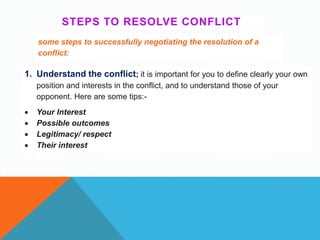
STEPS TO RESOLVE CONFLICT
some steps to successfully negotiating the resolution of a
conflict:
1. Understand the conflict; it is important for you to define clearly your own
position and interests in the conflict, and to understand those of your
opponent. Here are some tips:-
 Your Interest
 Possible outcomes
 Legitimacy/ respect
 Their interest
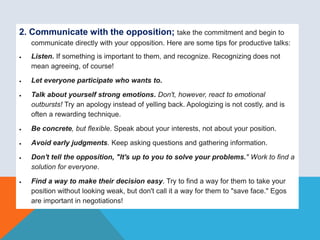
2. Communicate with the opposition; take the commitment and begin to
communicate directly with your opposition. Here are some tips for productive talks:
 Listen. If something is important to them, and recognize. Recognizing does not
mean agreeing, of course!
 Let everyone participate who wants to.
 Talk about yourself strong emotions. Don't, however, react to emotional
outbursts! Try an apology instead of yelling back. Apologizing is not costly, and is
often a rewarding technique.
 Be concrete, but flexible. Speak about your interests, not about your position.
 Avoid early judgments. Keep asking questions and gathering information.
 Don't tell the opposition, "It's up to you to solve your problems." Work to find a
solution for everyone.
 Find a way to make their decision easy. Try to find a way for them to take your
position without looking weak, but don't call it a way for them to "save face." Egos
are important in negotiations!
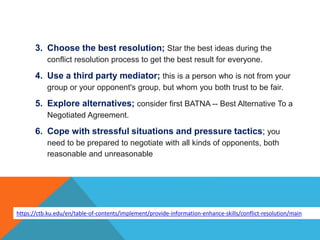
3. Choose the best resolution; Star the best ideas during the
conflict resolution process to get the best result for everyone.
4. Use a third party mediator; this is a person who is not from your
group or your opponent's group, but whom you both trust to be fair.
5. Explore alternatives; consider first BATNA -- Best Alternative To a
Negotiated Agreement.
6. Cope with stressful situations and pressure tactics; you
need to be prepared to negotiate with all kinds of opponents, both
reasonable and unreasonable
https://ctb.ku.edu/en/table-of-contents/implement/provide-information-enhance-skills/conflict-resolution/main
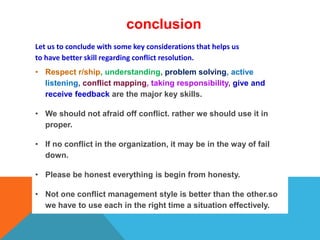
conclusion
Let us to conclude with some key considerations that helps us
to have better skill regarding conflict resolution.
• Respect r/ship, understanding, problem solving, active
listening, conflict mapping, taking responsibility, give and
receive feedback are the major key skills.
• We should not afraid off conflict. rather we should use it in
proper.
• If no conflict in the organization, it may be in the way of fail
down.
• Please be honest everything is begin from honesty.
• Not one conflict management style is better than the other.so
we have to use each in the right time a situation effectively.
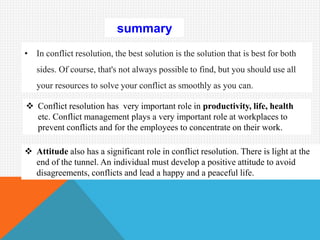
• In conflict resolution, the best solution is the solution that is best for both
sides. Of course, that's not always possible to find, but you should use all
your resources to solve your conflict as smoothly as you can.
summary
 Conflict resolution has very important role in productivity, life, health
etc. Conflict management plays a very important role at workplaces to
prevent conflicts and for the employees to concentrate on their work.
 Attitude also has a significant role in conflict resolution. There is light at the
end of the tunnel. An individual must develop a positive attitude to avoid
disagreements, conflicts and lead a happy and a peaceful life.
Conflict managment. ppt

Conflict managment. ppt

  • 1.
    PPT. ON CONFLICT MANAGMENT Preparedby. Mebrahtu Beyene. ( psychologist) Psychometric analyst Email. mebre2017@gmail.com Department of HRM, Assessment and development team. The information network security agency of Ethiopia (INSA) Addis Ababa,
  • 2.
  • 3.
    Over view Part one-What is conflict o Sources of conflict o Levels o Types o Stages Part two - conflict resolution o What is conflict resolution o Conflict management strategies o Stapes to resolve conflict o Conclusion o Summary
  • 4.
  • 5.
    What is conflict? •It can be described as a disagreement among groups or individuals characterized by antagonism and hostility. . Conflict is “a perceived difference between two or more parties that results in mutual opposition” (Bartol and David, 1991: 578).
  • 6.
    Brainstorming Questions •What doyou understand from the above definition of conflict? •What sources of conflict do you know? Try to share us in relation to the context
  • 7.
    Three main sourcesof conflict; • Economic conflict; is brought about by a limited amount of resources. • Value conflict; is concerned with the varied preferences and ideologies that people have as their principles. • Power conflict; occurs when the parties involved intends to maximize what influence it has in the social setting. http://www.typesofconflict.org/what-is-conflict/ But, according to American psychologist Daniel Katz, conflict arises primarily due to these three: The major ingredients are Needs, Perceptions, Power, Values, and Feelings and Emotions.
  • 8.
  • 9.
     personal levelcoflict 1. Inter-personal conflict; Occurs b/n two or more individuals. This can be due to;  Personal difference,  information deficiency,  role incompatibility and  Environmental stress.  2. Intrapersonal conflict; with in the individual himself. This conflict is within the individual himself. This can be occurs due to  frustration,  goal conflict &  role conflict.
  • 10.
     Approach: Approachconflict arises when there exist two equally positive but mutually exclusive situations. Both are equally attractive but a person can choose only one of them.  Avoidance: Avoidance conflict arises when there exist two equally negative situations one of which has to be accepted  Approach: Avoidance This type of conflict arises when a positive situation is coupled with a negative one, If a person wants positive, he must choose negative too. Goal conflict Three types It can be a major source of both personal level and group level conflict within or outside an organization) arises from four major antecedents (causes): a) Task interdependence b) Competition for resources c) Difference in needs and aspirations d) Role conflict and ambiguity
  • 11.
    3. Intragroup conflict; Thisis a type of conflict that happens among individuals within a team. Intra-group conflict may arise in three ways.  group level conflict  When the group faces a new problem,  When new values are imported from the social environment into the group and  When a person’s extra group role comes into conflict with his intra group role.
  • 12.
    4. Intergroup conflict; Takesplace when a misunderstanding arises among different teams within an organization. Causes of intergroup conflict may be summarized under four heads:  Absence of joint decision making,  Difference in goals,  Difference in perception and  Difference in goals as well as perception. Cont...
  • 13.
    6. Inter OrganizationalConflicts: Inter organizational level conflict occur between organizations which are in some way or the other upon each other. The organization level conflict can be between the buyer and seller organization, between union and organizations employing the members 5. Intra organizational conflict; Structurally, organizational conflict could be divided under four heads  Hierarchical Conflict:(eg. task inter-dependence)  Functional Conflict:( eg. poor communication)  Line-Staff Conflict: (eg. poor working conditions )  Formal-Informal Conflict: http://www.typesofconflict.org/types-of-conflict/ http://www.yourarticlelibrary.com/organization/conflict-management/levels-of-conflict-in-an-organisation-4- levels/63980  organizational level coflict
  • 14.
    1. Constructive; • peopleaim for productive mutual benefit, • respect opinions of others, • r/n ship more important than out come. 2.Destructive; • People aim inflexible and their goal must be achieved • People use power, attack, threat, hostility • Outcome more important than r/n ship TYPES OF CONFLICT Generally there are two types by their kind
  • 15.
     WHAT HAPPENIN CONSTRUCTIVE CONFLICT ?  WHAT HAPPEN IN DESTRUCTIVE CONFLICT ?
  • 16.
    . What happen inconstative conflict? Listening, compromising, open discussion, innovation, empathy, coming with agreement, respecting difference, better outcome, openness to change, win-win solution, flexibility…etc.
  • 17.
    Defensive, poor communication, blaming,anxious, hard to do with others, aggression, segregation, avoidance, working against others, laying, shutdown, denial…etc. What happen in distractive conflict?
  • 18.
  • 19.
    1. Need; • Wehave to see what he needs. • We have to look at the physiological reactions. • We have to evaluate What is your own exact need also. 2. Communication style; • See the work place culture. • See the style of others. • Evaluate your communication style. • It is better to concern before conflict. WHY CONFLICT ARISES? Conflict can arise due to many reasons but the two are the main…
  • 20.
    FIVE STAGES OFCONFLICT:  Latent Stage: Participants not yet aware of conflict  Perceived Stage: Participants aware a conflict exists  Felt Stage: Stress and anxiety  Manifest stage: Conflict is open and can be observed  Aftermath stage: Outcome of conflict, resolution or dissolution
  • 21.
  • 22.
    What is conflict resolution? •Conflict resolution can be defined as the formal or informal process that two or more parties use to find a peaceful solution to their dispute. • Conflict can develop by so any causes. But, the main course of action to resolve is via negotiation.
  • 23.
    HOW CAN WERESOLVE CONFLICT? BRAINSTORM…
  • 24.
     Individual CopingStrategies • Individual Coping strategies to conflict are techniques that individual employees can use to manage conflict (stress) with their mind effectively Conflict Management Strategies
  • 25.
    There are anumber of techniques (strategies) that individuals can use to reduce those destructive effects (problems) of intra individual conflict: • Exercise • Relaxation • Cognitive therapy (such as confidence building and analysis of past knowledge and confrontation), and • Networking to get social support • We can also address the behavioral problems due to intra – individual conflict (like withdrawal and aggressiveness) through the following five inter – personal conflict handling modes (approaches
  • 26.
    Withdraw/ avoid Accommodat e/ smooth Compromise / reconcile Force/direct Collaborat e/problem solve Conflict Mag’t Strategies There are 5 best conflict management techniques that can help to resolve inter-personal conflict. (PMBOK Guide 6thed).
  • 27.
    1. Withdraw/Avoid You avoidthe conflict .You let this issue resolve the person itself. You can use this technique in the following cases:  When stakes are low.  The stakeholders involved in the conflict are not important.  The issue is not worth investing your time.  The issue will disappear on its own after some time.  When there is a heated argument among parties and you want to give them some cooling time.  When there is limited or no information available about the conflict.
  • 28.
    • Low concernto your self • Refuse to talk • Change topic • Walk away • Lighten the mood • Answer with question I lose, you lose approach Strategic actions to take during withdraw or avoiding technique; This technique saves precious time you can invest in other productive activities. but it may weaken your position as a leader.
  • 29.
    2. Smooth/Accommodate Here, youwill find areas of agreement /commonalities, and try to smooth the situation This technique can be used in the following cases:  When you are very busy and have no time. • When harmony and stability are especially important.  When you find you are wrong to allow a better position to be.  You need a temporary solution to the problem. • To build social credits for latter issues. Etc. Conciliate the situation, bring harmony, to find a permanent solution. But this also may weaken your position as a leader.
  • 30.
     High concernfor others  Low concern for self  ‘’ it doesn’t matter whatever you want. Whatever, I don’t want to fight”  “I agree with whatever you think”. You win, I lose approach. Strategic actions to take during accommodation technique
  • 31.
    3. Compromise/Reconcile This isa mid-way approach. Here, everybody loses and gains something. All parties get some sort of satisfaction. You may use this technique in the following cases:  All parties involved in the conflict need to win.  You have an equal relationship with them.  When collaborative and forcing techniques do not work.  When you need a temporary solution to move forward quickly. Brings a faster result, lowers the stress, and keeps all parties cool. But may lose trust among them in the future.
  • 32.
     Mid concernfor others  Mid concern for self  Meet in the middle of fairness  Split difference talk turns You win some, lose some and I win some, lose some approach. Strategic actions to take during compromise technique
  • 33.
    4. Force/Direct Here youagree with one party’s viewpoint and enforce their wishes. You can use this technique in the following cases:  You need a quick solution. (eg. Emergency)  When stakes are high and you need an immediate solution.  When you know one party is right and don’t have time to investigate.  The stakeholders involved in the conflict and not very important.  The relationship with them is not important. It provides a quick solution to the problem. But it may demoralize members also affect your impression in the place.
  • 34.
    • High concernfor self • Low concern for others • Get the last word • Threating • Insult • Friendly competition. (But all must be out of destructive) I win, you lose approach. Strategic actions to take during dominating/forcing technique
  • 35.
    5. Collaborate/Problem Solve Inthis technique, you will discuss the issue with all parties to find a solution considering multiple viewpoints and agreed upon by all You may use this technique in the following cases:  When you want to incorporate multiple views.  The people involved in the conflict are very influential.  When a consensus is required.  When you want to distribute the responsibility equally to all parties.  Promote mutual understanding, and mutual gain, creativity, problem solving to others. This technique is considered a win-win approach. But it may costs time https://pmstudycircle.com/2012/01/best-conflict-resolution-technique/
  • 36.
    • High concernfor others • High concern for others • Compromise isn’t integrate • ”I want to make sure this wok is for both of us”. • ‘’Lets each lay out our concerns and then figure out how to address them’’. Strategic actions to take during collaboration or integration technique You win, I win approach. https://www.youtube.com/watch?v=GJ5grJ_120Q
  • 37.
    Managing Inter-Group Conflict • Appealto super ordinate goals (major common goals that require the support and effort of all parties) • Proper organization of tasks and system • Adequate guidelines and communication • Goal conflict (as a major source of both inter - personal and inter - group conflict within or outside an organization) is primarily addressed through collaborative approach
  • 38.
    Organizational Coping Strategies • Organizationalcoping strategies to conflict are techniques that managers can use to reduce (avoid) the destructive consequences of conflict at macro (organizational) level • The strategies may involve various mechanisms including those techniques to cope with intra – individual and inter – personal conflict. • However, the of Organizational coping strategies emphasize on the problems of interactive conflict between groups and organizations.
  • 39.
    STEPS TO RESOLVECONFLICT some steps to successfully negotiating the resolution of a conflict: 1. Understand the conflict; it is important for you to define clearly your own position and interests in the conflict, and to understand those of your opponent. Here are some tips:-  Your Interest  Possible outcomes  Legitimacy/ respect  Their interest
  • 40.
    2. Communicate withthe opposition; take the commitment and begin to communicate directly with your opposition. Here are some tips for productive talks:  Listen. If something is important to them, and recognize. Recognizing does not mean agreeing, of course!  Let everyone participate who wants to.  Talk about yourself strong emotions. Don't, however, react to emotional outbursts! Try an apology instead of yelling back. Apologizing is not costly, and is often a rewarding technique.  Be concrete, but flexible. Speak about your interests, not about your position.  Avoid early judgments. Keep asking questions and gathering information.  Don't tell the opposition, "It's up to you to solve your problems." Work to find a solution for everyone.  Find a way to make their decision easy. Try to find a way for them to take your position without looking weak, but don't call it a way for them to "save face." Egos are important in negotiations!
  • 41.
    3. Choose thebest resolution; Star the best ideas during the conflict resolution process to get the best result for everyone. 4. Use a third party mediator; this is a person who is not from your group or your opponent's group, but whom you both trust to be fair. 5. Explore alternatives; consider first BATNA -- Best Alternative To a Negotiated Agreement. 6. Cope with stressful situations and pressure tactics; you need to be prepared to negotiate with all kinds of opponents, both reasonable and unreasonable https://ctb.ku.edu/en/table-of-contents/implement/provide-information-enhance-skills/conflict-resolution/main
  • 42.
    conclusion Let us toconclude with some key considerations that helps us to have better skill regarding conflict resolution. • Respect r/ship, understanding, problem solving, active listening, conflict mapping, taking responsibility, give and receive feedback are the major key skills. • We should not afraid off conflict. rather we should use it in proper. • If no conflict in the organization, it may be in the way of fail down. • Please be honest everything is begin from honesty. • Not one conflict management style is better than the other.so we have to use each in the right time a situation effectively.
  • 43.
    • In conflictresolution, the best solution is the solution that is best for both sides. Of course, that's not always possible to find, but you should use all your resources to solve your conflict as smoothly as you can. summary  Conflict resolution has very important role in productivity, life, health etc. Conflict management plays a very important role at workplaces to prevent conflicts and for the employees to concentrate on their work.  Attitude also has a significant role in conflict resolution. There is light at the end of the tunnel. An individual must develop a positive attitude to avoid disagreements, conflicts and lead a happy and a peaceful life.