Occupational Therapy and Group Conflict
Conflict
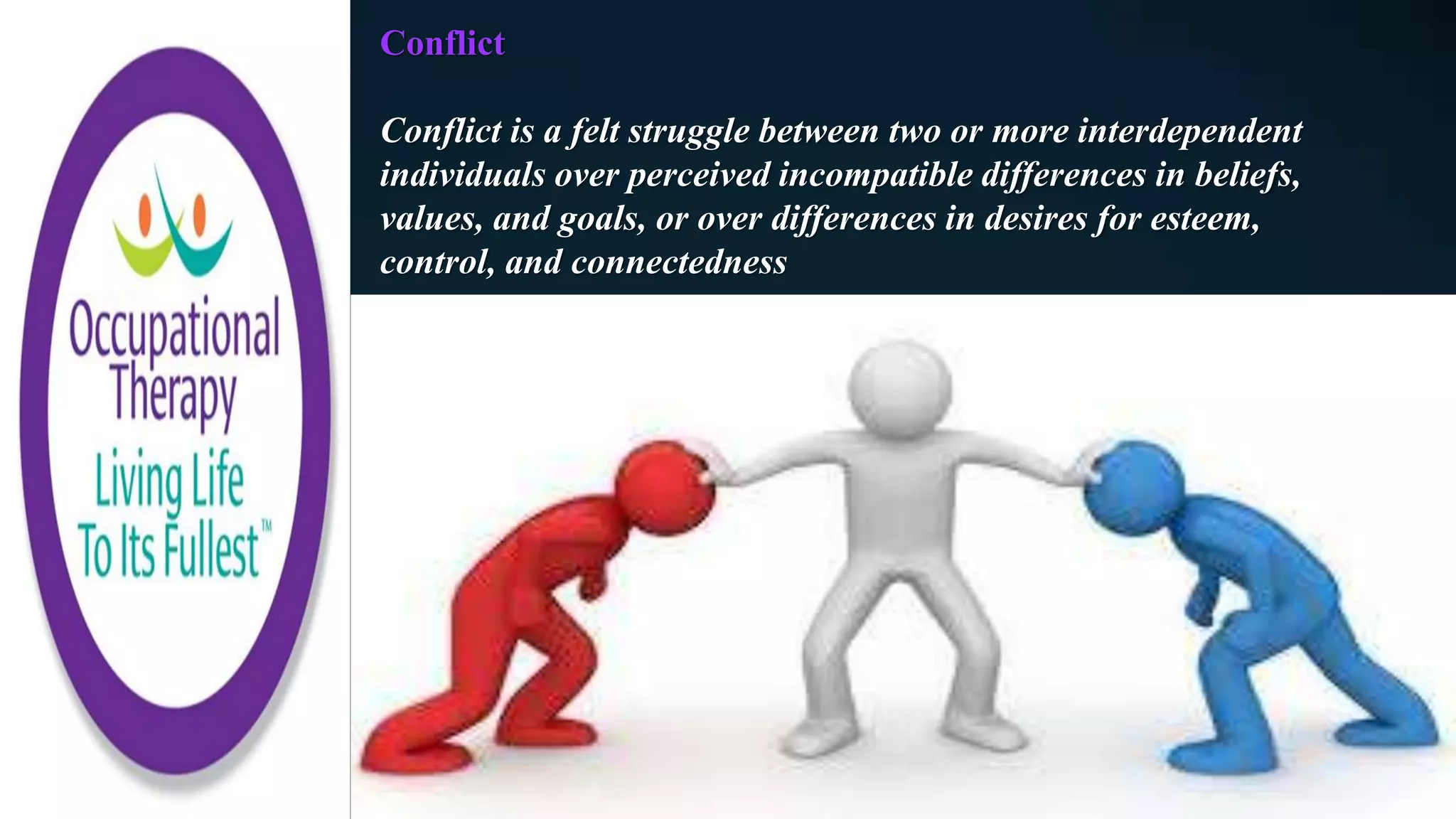
Conflict is a felt struggle between two or more interdependent
individuals over perceived incompatible differences in beliefs,
values, and goals, or over differences in desires for esteem,
control, and connectedness
Conflict Dimensions
Content Dimension
Objective & observable aspects
Relationship Dimension
perceptions of their connection to each other
Always intertwined
The relationship dimension implicitly suggests how the content
dimension should be interpreted because the content alone can be
interpreted in different ways.
Conflict
- Conflict is inevitable in groups and organizations
- Mutual agreement is possible in any conflict situation if people are
willing to negotiate in authentic ways
- Conflict can be uncomfortable, but is not necessarily unhealthy or
bad
- The question is, How can we manage conflict and produce positive
change?
- Communication plays a central role in handling conflict
Conflict
Intrapersonal
- Discord that occurs within an individual
- Involves dynamics of personality
Interpersonal
- Disputes that arise between individuals
Societal
- Clashes between societies and nations
Aspects of Conflict
Struggle
- Opposing forces coming together
Interdependence
- Leaders and followers need each other
- How much influence do I want? How much am I willing to accept?
Feelings
- Emotional arousal within both parties
- Array of emotions including angers, sadness, or disconnection
Differences
- Differences in beliefs, values, goals, or in desire for control, status,
and connectedness
Content Conflicts
- Center on differences in beliefs and values, or goals
- Belief conflicts occur when others’ viewpoints are incompatible
with our own
- Value conflicts occur when others’ values are incompatible with
our own
- Goal conflicts occur when individuals have different goals
Types of Goal Conflict
Procedural Conflict
- When individuals differ on how to reach a goal
Substantive Conflict
- When individuals differ on what the goal should be
Relational Conflicts
- Personality clashes
- Center on issues of esteem, control, or affiliation
Esteem is one of the major human needs:
- We desire to have an affect on our surroundings and to be seen as
worthy of respect
- When our esteem needs aren’t met, we experience relational
conflict
- At the same time, others want their own esteem needs satisfied
- If either party feels they are receiving insufficient validation, a
clash develops
Control issues are common in interpersonal conflict
- Each of us desires to have an impact on others
- Having control increases our feeling of potency and minimizes
feelings of helplessness
- When we see others hindering us or limiting our control, conflict
often results.
- Each of us seeks different levels of control
- Control needs may vary from one time to another
Affiliation is the need to feel included in our relationships, to be
liked and to receive affection
- If our needs for closeness are not satisfied in our relationships, we
experience feelings of conflict
- We each vary in our need for affiliation
- When others behave in ways that are incompatible with our own
desires for warmth and affection, feelings of conflict emerge
Relational issues are often bound to content issues during conflict
Principle 1: Separate the People From the Problem
- Conflict have a people factor and a problem factor that need to be
separated
- This is not easy, because they are entangled
- By separating them we are able to recognize the other’s uniqueness
and needs
- It enables us to be attentive to our relationships and work together
to mutually confront the problem
Principle 2: Focus on Interests, not Positions
- Positions represent our stand or perspective in a particular conflict
- Interests represent what is behind our positions
- Interests often relate to basic human concerns such as belonging,
recognition, control, economic well-being, etc
- Concentrating on interests helps opposing parties address the
“real” conflict
Principle 3: Invent Options for Mutual Gains
- Humans naturally see conflict as an either-or proposition; we
either win or lose
- This principle frames conflict as a win-win
- Parties need to brainstorm and search hard for creative solutions to
conflict
- Where do parties’ interests overlap?
- By beings sensitive to others’ interests we can make it easier for
them to be satisfied
Principle 4: Insist on Using Objective Criteria
- Objective criteria help parties view conflict with an unbiased lens.
- Objective criteria can take many forms
 Precedent
 Professional standards
 What a court would decide
 Moral standards
 Tradition
 Scientific judgment
Conflict Positive consequences
Leads to new ideas
Stimulates creativity
Motivates change
Promotes vitality
Helps individuals and group establish identity
Serves as a safety valve to indicate problems
Conflict Negative consequences
Diverts energy from work
Threatens psychological wellbeing
Wastes resources
Creates negative climate
Breaks down group cohesion
Increase hostility & aggressive behaviors
Not all Conflict is BAD
Stimulate functional conflict
Where healthy or constructive disagreement occurs
• Better awareness of self
• Worked through to gain sense of accomplishment
• Release of tension and improvement in morale
Not all Conflict is BAD
Prevent or resolve dysfunctional conflict
Unhealthy and destructive disagreement occurs
Losses to both parties exceed potential gain
Often emotional or behavioral
Focus is diverted from work to person
It is how conflict is managed that is important
Key Questions
1. Are parties approaching conflict from hostile or emotional
standpoint?
2. Is the outcome likely to be negative for the team?
3. Do the potential losses of the parties exceed any potential gains?
4. Is energy being diverted from the goal accomplishment?
If majority of answers are ‘yes’ conflict probably dysfunctional.
The goal is therefore…
To stimulate functional conflict
To resolve dysfunctional conflict
- Functional conflict should be encouraged if group or team is
exhibiting groupthink.
Causes of conflict in the workplace
- When people experience conflict at work they tend to blame it on
other people’s personality flaws or other factors beyond their
control.
- Need to understand the cause of conflict before you can go about
resolving it.
- Structural contributions
- Unstructured contributions
Structural Factors (that contribute to conflict)
- Unclear, inefficient policies, procedures, organizational practices
or ingrained workplaces practices that repeatedly cause workplace
dispute e.g.
- Overlapping job descriptions
- Organizations that fail to punish racism, sexism, bullying
- Rewards for individual achievement that results in too much
competition between team members e.g. stealing clients
- Failure to reward desired behaviors
- Incentives such as “use or loose” sick leave
- Unclear or unrealistically high performance goals
Unstructured Factors (that contribute to conflict)
- Occurs usually 1 time and can’t be predicted or avoided
- Need to address the individual problem not change policies of the
whole organization e.g.
- Person who is always turning up late
- Employee who does not treat co-workers appropriately even after
training/coaching
- 2 team members who can’t get along but work well with others
- Options: retraining, discipline, termination
Avoiding
Taking no action & disregarding
Low assertion and cooperation
Sometimes appropriate
Overuse of this style results in
negative evaluations from others and
doesn’t contribute to productive outcome
Accommodating
Cooperative but unassertive
Appropriate when
you are wrong or
when you want to let the other party have his or her way or
when the relationship is important
Over-reliance may lead to
loss of respect for you or
you may become frustrated as your needs are never met
Competing
Very assertive and uncooperative
Satisfaction of own interests at other party’s expense
Appropriate when emergency and you are right
Overuse may result in putting others offside or having a team
that is not prepared to disagree with you
Compromising
Intermediate between assertiveness and cooperativeness
Each party gives something up
An effective backup style when efforts to collaborate fail
Compromise is not an optimal solution
Solutions reached may be temporary and often do nothing to
improve relationship between parties
Collaborating
Win-Win
High on assertiveness and cooperativeness
Open and thorough discussion
Solution satisfactory to both parties
Works when both parties need to be committed to final solution
Requires openness, trust and sharing of information
Improved relationships and effective performance long term
Fisher and Ury’s Communicating about Conflict
1. Separate person from the problem
Work side by side, attacking the problem, not the people
Allows relationship to remain intact
2. Focus on interests, not positions
Focusing on interests expands conflict negotiation options.
Understanding what is underpinning the position.
What does each person need or want from this?
3. Invent new options for mutual gain
Brainstorm ideas, evaluate these, look for compatibility Inventing
new option to satisfy both parties
4. Insist on using objective criteria
Scientific findings
Professional standards
Legal precedent
Inter Group Conflict
Positive effects in each group
Increase cohesiveness
Increase focus on tasks
Increased loyalty
Negative consequences
In group/ Out group (them and us)
Prejudice, aggression, territoriality
Decreased communication with other group
More competitive and less cooperative
One group gains and the other loses
Strategies that Work
Superordinate goal
Problem Solving
Expanding resources
Changing team members
Change structure
Alter attitudes and behaviors
Confront and negotiate
Encourage insight and understanding
Strategies that Work
Superordinate goal
Problem Solving
Expanding resources
Changing team members
Change structure
Alter attitudes and behaviours
Confront and negotiate
Encourage insight and understanding

Occupational Therapy and Group Conflict

  • 1.
  • 2.
    Conflict Conflict is afelt struggle between two or more interdependent individuals over perceived incompatible differences in beliefs, values, and goals, or over differences in desires for esteem, control, and connectedness
  • 3.
    Conflict Dimensions Content Dimension Objective& observable aspects Relationship Dimension perceptions of their connection to each other Always intertwined The relationship dimension implicitly suggests how the content dimension should be interpreted because the content alone can be interpreted in different ways.
  • 4.
    Conflict - Conflict isinevitable in groups and organizations - Mutual agreement is possible in any conflict situation if people are willing to negotiate in authentic ways - Conflict can be uncomfortable, but is not necessarily unhealthy or bad - The question is, How can we manage conflict and produce positive change? - Communication plays a central role in handling conflict
  • 5.
    Conflict Intrapersonal - Discord thatoccurs within an individual - Involves dynamics of personality Interpersonal - Disputes that arise between individuals Societal - Clashes between societies and nations
  • 6.
    Aspects of Conflict Struggle -Opposing forces coming together Interdependence - Leaders and followers need each other - How much influence do I want? How much am I willing to accept? Feelings - Emotional arousal within both parties - Array of emotions including angers, sadness, or disconnection Differences - Differences in beliefs, values, goals, or in desire for control, status, and connectedness
  • 7.
    Content Conflicts - Centeron differences in beliefs and values, or goals - Belief conflicts occur when others’ viewpoints are incompatible with our own - Value conflicts occur when others’ values are incompatible with our own - Goal conflicts occur when individuals have different goals
  • 8.
    Types of GoalConflict Procedural Conflict - When individuals differ on how to reach a goal Substantive Conflict - When individuals differ on what the goal should be
  • 9.
    Relational Conflicts - Personalityclashes - Center on issues of esteem, control, or affiliation Esteem is one of the major human needs: - We desire to have an affect on our surroundings and to be seen as worthy of respect - When our esteem needs aren’t met, we experience relational conflict - At the same time, others want their own esteem needs satisfied - If either party feels they are receiving insufficient validation, a clash develops
  • 10.
    Control issues arecommon in interpersonal conflict - Each of us desires to have an impact on others - Having control increases our feeling of potency and minimizes feelings of helplessness - When we see others hindering us or limiting our control, conflict often results. - Each of us seeks different levels of control - Control needs may vary from one time to another
  • 11.
    Affiliation is theneed to feel included in our relationships, to be liked and to receive affection - If our needs for closeness are not satisfied in our relationships, we experience feelings of conflict - We each vary in our need for affiliation - When others behave in ways that are incompatible with our own desires for warmth and affection, feelings of conflict emerge Relational issues are often bound to content issues during conflict
  • 12.
    Principle 1: Separatethe People From the Problem - Conflict have a people factor and a problem factor that need to be separated - This is not easy, because they are entangled - By separating them we are able to recognize the other’s uniqueness and needs - It enables us to be attentive to our relationships and work together to mutually confront the problem
  • 13.
    Principle 2: Focuson Interests, not Positions - Positions represent our stand or perspective in a particular conflict - Interests represent what is behind our positions - Interests often relate to basic human concerns such as belonging, recognition, control, economic well-being, etc - Concentrating on interests helps opposing parties address the “real” conflict
  • 14.
    Principle 3: InventOptions for Mutual Gains - Humans naturally see conflict as an either-or proposition; we either win or lose - This principle frames conflict as a win-win - Parties need to brainstorm and search hard for creative solutions to conflict - Where do parties’ interests overlap? - By beings sensitive to others’ interests we can make it easier for them to be satisfied
  • 15.
    Principle 4: Insiston Using Objective Criteria - Objective criteria help parties view conflict with an unbiased lens. - Objective criteria can take many forms  Precedent  Professional standards  What a court would decide  Moral standards  Tradition  Scientific judgment
  • 16.
    Conflict Positive consequences Leadsto new ideas Stimulates creativity Motivates change Promotes vitality Helps individuals and group establish identity Serves as a safety valve to indicate problems
  • 17.
    Conflict Negative consequences Divertsenergy from work Threatens psychological wellbeing Wastes resources Creates negative climate Breaks down group cohesion Increase hostility & aggressive behaviors
  • 18.
    Not all Conflictis BAD Stimulate functional conflict Where healthy or constructive disagreement occurs • Better awareness of self • Worked through to gain sense of accomplishment • Release of tension and improvement in morale
  • 19.
    Not all Conflictis BAD Prevent or resolve dysfunctional conflict Unhealthy and destructive disagreement occurs Losses to both parties exceed potential gain Often emotional or behavioral Focus is diverted from work to person It is how conflict is managed that is important
  • 20.
    Key Questions 1. Areparties approaching conflict from hostile or emotional standpoint? 2. Is the outcome likely to be negative for the team? 3. Do the potential losses of the parties exceed any potential gains? 4. Is energy being diverted from the goal accomplishment? If majority of answers are ‘yes’ conflict probably dysfunctional.
  • 21.
    The goal istherefore… To stimulate functional conflict To resolve dysfunctional conflict - Functional conflict should be encouraged if group or team is exhibiting groupthink.
  • 22.
    Causes of conflictin the workplace - When people experience conflict at work they tend to blame it on other people’s personality flaws or other factors beyond their control. - Need to understand the cause of conflict before you can go about resolving it. - Structural contributions - Unstructured contributions
  • 23.
    Structural Factors (thatcontribute to conflict) - Unclear, inefficient policies, procedures, organizational practices or ingrained workplaces practices that repeatedly cause workplace dispute e.g. - Overlapping job descriptions - Organizations that fail to punish racism, sexism, bullying - Rewards for individual achievement that results in too much competition between team members e.g. stealing clients - Failure to reward desired behaviors - Incentives such as “use or loose” sick leave - Unclear or unrealistically high performance goals
  • 24.
    Unstructured Factors (thatcontribute to conflict) - Occurs usually 1 time and can’t be predicted or avoided - Need to address the individual problem not change policies of the whole organization e.g. - Person who is always turning up late - Employee who does not treat co-workers appropriately even after training/coaching - 2 team members who can’t get along but work well with others - Options: retraining, discipline, termination
  • 25.
    Avoiding Taking no action& disregarding Low assertion and cooperation Sometimes appropriate Overuse of this style results in negative evaluations from others and doesn’t contribute to productive outcome
  • 26.
    Accommodating Cooperative but unassertive Appropriatewhen you are wrong or when you want to let the other party have his or her way or when the relationship is important Over-reliance may lead to loss of respect for you or you may become frustrated as your needs are never met
  • 27.
    Competing Very assertive anduncooperative Satisfaction of own interests at other party’s expense Appropriate when emergency and you are right Overuse may result in putting others offside or having a team that is not prepared to disagree with you
  • 28.
    Compromising Intermediate between assertivenessand cooperativeness Each party gives something up An effective backup style when efforts to collaborate fail Compromise is not an optimal solution Solutions reached may be temporary and often do nothing to improve relationship between parties
  • 29.
    Collaborating Win-Win High on assertivenessand cooperativeness Open and thorough discussion Solution satisfactory to both parties Works when both parties need to be committed to final solution Requires openness, trust and sharing of information Improved relationships and effective performance long term
  • 30.
    Fisher and Ury’sCommunicating about Conflict 1. Separate person from the problem Work side by side, attacking the problem, not the people Allows relationship to remain intact 2. Focus on interests, not positions Focusing on interests expands conflict negotiation options. Understanding what is underpinning the position. What does each person need or want from this? 3. Invent new options for mutual gain Brainstorm ideas, evaluate these, look for compatibility Inventing new option to satisfy both parties 4. Insist on using objective criteria Scientific findings Professional standards Legal precedent
  • 31.
    Inter Group Conflict Positiveeffects in each group Increase cohesiveness Increase focus on tasks Increased loyalty Negative consequences In group/ Out group (them and us) Prejudice, aggression, territoriality Decreased communication with other group More competitive and less cooperative One group gains and the other loses
  • 32.
    Strategies that Work Superordinategoal Problem Solving Expanding resources Changing team members Change structure Alter attitudes and behaviors Confront and negotiate Encourage insight and understanding
  • 33.
    Strategies that Work Superordinategoal Problem Solving Expanding resources Changing team members Change structure Alter attitudes and behaviours Confront and negotiate Encourage insight and understanding