Condition Based monitoring
By,
Priyesh Nair
Contents:
1. Maintenance Objectives
2. Maintenance Classification
3. Predictive Maintenance & CBM
4. Comparison of Machine to Human
5. Advantages & Necessity of CBM
6. Techniques & Frequency of CBM
7. Flow Chart of Implementation
8. Implementation
Priyesh Nair
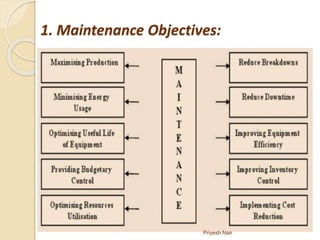
1. Maintenance Objectives:
Priyesh Nair
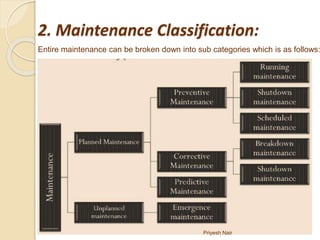
2. Maintenance Classification:
Entire maintenance can be broken down into sub categories which is as follows:
Priyesh Nair
3. Predictive Maintenance:
 As the name implies it involves the prediction of the failure
before it occurs, identifying the root cause for those failure
symptoms and eliminating those causes before the y result
in extensive damage of equipment.
 Type of maintenance performed continuously or at
regular intervals according to the requirements to
diagnose a condition and monitor a condition or system.
Also known as Condition Based Monitoring.
Condition Based Monitoring:
 The ultimate objective of CBM program is to ensure the
availability of the equipment for safe and reliable
operation during its useful life at optimum maintenance
cost.
Priyesh Nair
oPredictive Of M/C Is As Doctor Care Human
 FOR HUMAN:
HEARTBEAT READING----TEMPRATURE-----BLOOD TEST---------CARDIOGRAPH
 FOR M/C:
VIBRATION-----------------THERMOGRAPHY--------M/C OIL TEST------FFT SIGNATURE
4. Comparison of Machine to Human
Priyesh Nair
An approach to best Condition Monitoring
Practices
 Factors Affecting Industrial Appliances:
◦ Where downtime cost is predominantly high.
◦ Where a safety risk is particularly likely to arise from the breakdown of
machinery.
◦ Where accurate and advanced planning of maintenance is essential.
◦ Where plant/equipment is of recent design and may have residual
development problems
◦ Where operators cannot be expected to detect faults in expensive
equipment whose breakdown may result in serious damage.
◦ Where instruments or other equipments required for condition
monitoring can be used or is already being used
◦ Where the manufacturer can offer a condition monitoring service to
users of its equipment
Priyesh Nair
5. Advantages of CBM:
 Allows planned maintenance rather than breakdown
maintenance.
 Production can be modified to extend unit life.
 Cause of failure can be analyzed.
 Permits for maintenance can be planned.
 Manpower/Spares can be arranged well in advance.
 Modifications can be planned.
Necessity for CBM:
Cost Benefits Time Benefits
Minimum equipment damage/repairs Reduced downtime of equipment
through scheduled vs unscheduled
repairs
Minimal oil use and disposal
Less use of inventory items through
reliability enhancement
Reduced Mean Time To Repair
Indirect cost-less part loading due to
equipment outage
High Mean Time Between Failures
differences.Priyesh Nair
6. Techniques for monitoring CBM:
 Vibration Analysis
 Thermography
 Motor Current Signature Analysis
 Oil Analysis
 Wear Debris Analysis
Frequency of implementation:
S.No. Method Frequency
1. Vibration Analysis Monthly
2. Thermography Quarterly
3. Motor Current Signature Analysis Quarterly
4. Oil Analysis Monthly
5. Wear Debris Analysis On need basis
Priyesh Nair
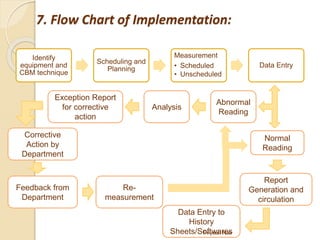
7. Flow Chart of Implementation:
Identify
equipment and
CBM technique
Scheduling and
Planning
Measurement
• Scheduled
• Unscheduled
Data Entry
Abnormal
Reading
Normal
Reading
Report
Generation and
circulation
Analysis
Exception Report
for corrective
action
Corrective
Action by
Department
Feedback from
Department
Re-
measurement
Data Entry to
History
Sheets/SoftwaresPriyesh Nair
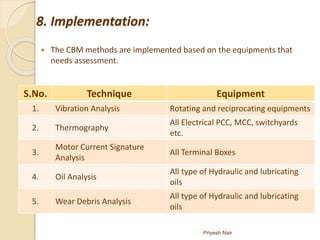
8. Implementation:
 The CBM methods are implemented based on the equipments that
needs assessment.
S.No. Technique Equipment
1. Vibration Analysis Rotating and reciprocating equipments
2. Thermography
All Electrical PCC, MCC, switchyards
etc.
3.
Motor Current Signature
Analysis
All Terminal Boxes
4. Oil Analysis
All type of Hydraulic and lubricating
oils
5. Wear Debris Analysis
All type of Hydraulic and lubricating
oils
Priyesh Nair
Priyesh Nair

Condition based maintenance strategy

  • 1.
  • 2.
    Contents: 1. Maintenance Objectives 2.Maintenance Classification 3. Predictive Maintenance & CBM 4. Comparison of Machine to Human 5. Advantages & Necessity of CBM 6. Techniques & Frequency of CBM 7. Flow Chart of Implementation 8. Implementation Priyesh Nair
  • 3.
  • 4.
    2. Maintenance Classification: Entiremaintenance can be broken down into sub categories which is as follows: Priyesh Nair
  • 5.
    3. Predictive Maintenance: As the name implies it involves the prediction of the failure before it occurs, identifying the root cause for those failure symptoms and eliminating those causes before the y result in extensive damage of equipment.  Type of maintenance performed continuously or at regular intervals according to the requirements to diagnose a condition and monitor a condition or system. Also known as Condition Based Monitoring. Condition Based Monitoring:  The ultimate objective of CBM program is to ensure the availability of the equipment for safe and reliable operation during its useful life at optimum maintenance cost. Priyesh Nair
  • 6.
    oPredictive Of M/CIs As Doctor Care Human  FOR HUMAN: HEARTBEAT READING----TEMPRATURE-----BLOOD TEST---------CARDIOGRAPH  FOR M/C: VIBRATION-----------------THERMOGRAPHY--------M/C OIL TEST------FFT SIGNATURE 4. Comparison of Machine to Human Priyesh Nair
  • 7.
    An approach tobest Condition Monitoring Practices  Factors Affecting Industrial Appliances: ◦ Where downtime cost is predominantly high. ◦ Where a safety risk is particularly likely to arise from the breakdown of machinery. ◦ Where accurate and advanced planning of maintenance is essential. ◦ Where plant/equipment is of recent design and may have residual development problems ◦ Where operators cannot be expected to detect faults in expensive equipment whose breakdown may result in serious damage. ◦ Where instruments or other equipments required for condition monitoring can be used or is already being used ◦ Where the manufacturer can offer a condition monitoring service to users of its equipment Priyesh Nair
  • 8.
    5. Advantages ofCBM:  Allows planned maintenance rather than breakdown maintenance.  Production can be modified to extend unit life.  Cause of failure can be analyzed.  Permits for maintenance can be planned.  Manpower/Spares can be arranged well in advance.  Modifications can be planned. Necessity for CBM: Cost Benefits Time Benefits Minimum equipment damage/repairs Reduced downtime of equipment through scheduled vs unscheduled repairs Minimal oil use and disposal Less use of inventory items through reliability enhancement Reduced Mean Time To Repair Indirect cost-less part loading due to equipment outage High Mean Time Between Failures differences.Priyesh Nair
  • 9.
    6. Techniques formonitoring CBM:  Vibration Analysis  Thermography  Motor Current Signature Analysis  Oil Analysis  Wear Debris Analysis Frequency of implementation: S.No. Method Frequency 1. Vibration Analysis Monthly 2. Thermography Quarterly 3. Motor Current Signature Analysis Quarterly 4. Oil Analysis Monthly 5. Wear Debris Analysis On need basis Priyesh Nair
  • 10.
    7. Flow Chartof Implementation: Identify equipment and CBM technique Scheduling and Planning Measurement • Scheduled • Unscheduled Data Entry Abnormal Reading Normal Reading Report Generation and circulation Analysis Exception Report for corrective action Corrective Action by Department Feedback from Department Re- measurement Data Entry to History Sheets/SoftwaresPriyesh Nair
  • 11.
    8. Implementation:  TheCBM methods are implemented based on the equipments that needs assessment. S.No. Technique Equipment 1. Vibration Analysis Rotating and reciprocating equipments 2. Thermography All Electrical PCC, MCC, switchyards etc. 3. Motor Current Signature Analysis All Terminal Boxes 4. Oil Analysis All type of Hydraulic and lubricating oils 5. Wear Debris Analysis All type of Hydraulic and lubricating oils Priyesh Nair
  • 12.