Repair Methods for Basic
Machine Elements
UNIT-4
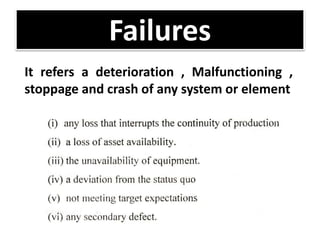
Failures
It refers a deterioration , Malfunctioning ,
stoppage and crash of any system or element
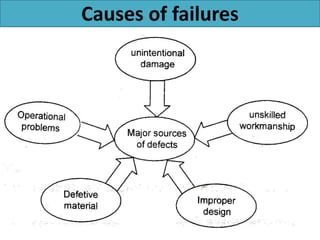
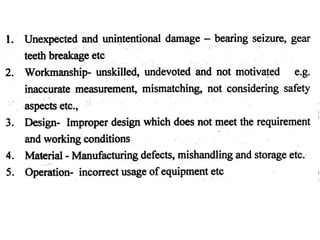
Causes of failures
.
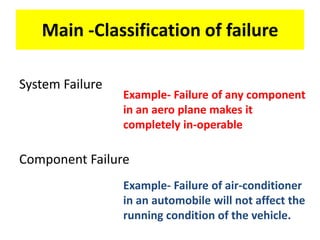
Main -Classification of failure
System Failure
Component Failure
Example- Failure of any component
in an aero plane makes it
completely in-operable
Example- Failure of air-conditioner
in an automobile will not affect the
running condition of the vehicle.
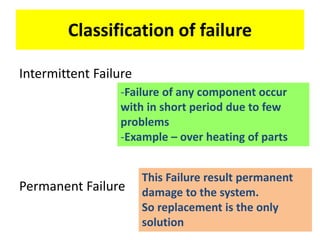
Classification of failure
Intermittent Failure
Permanent Failure
-Failure of any component occur
with in short period due to few
problems
-Example – over heating of parts
This Failure result permanent
damage to the system.
So replacement is the only
solution
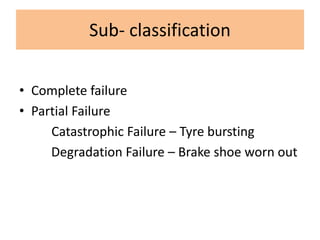
Sub- classification
• Complete failure
• Partial Failure
Catastrophic Failure – Tyre bursting
Degradation Failure – Brake shoe worn out
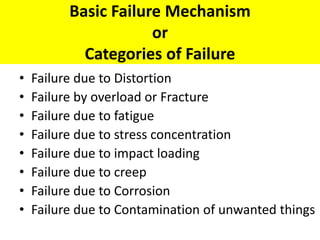
Basic Failure Mechanism
or
Categories of Failure
• Failure due to Distortion
• Failure by overload or Fracture
• Failure due to fatigue
• Failure due to stress concentration
• Failure due to impact loading
• Failure due to creep
• Failure due to Corrosion
• Failure due to Contamination of unwanted things
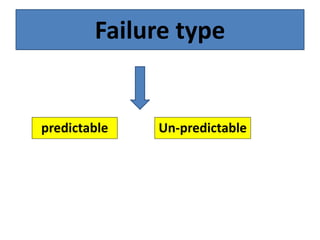
Failure type
predictable Un-predictable
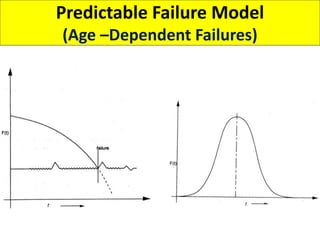
Predictable Failure Model
(Age –Dependent Failures)
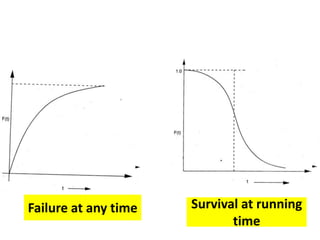
Failure at any time Survival at running
time
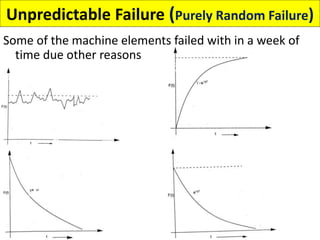
Unpredictable Failure (Purely Random Failure)
Some of the machine elements failed with in a week of
time due other reasons
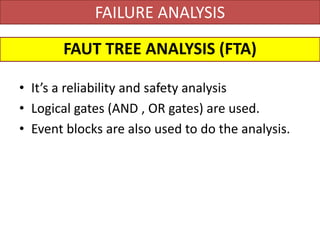
FAILURE ANALYSIS
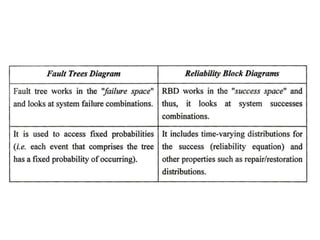
• It’s a reliability and safety analysis
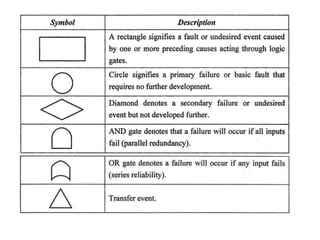
• Logical gates (AND , OR gates) are used.
• Event blocks are also used to do the analysis.
FAUT TREE ANALYSIS (FTA)
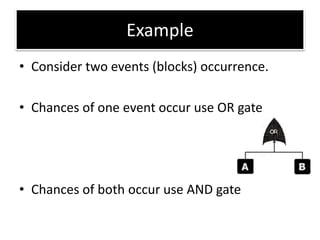
Example
• Consider two events (blocks) occurrence.
• Chances of one event occur use OR gate
• Chances of both occur use AND gate
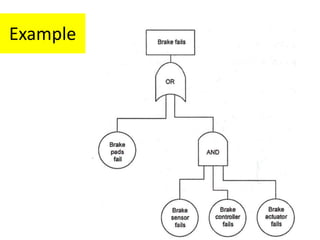
Example
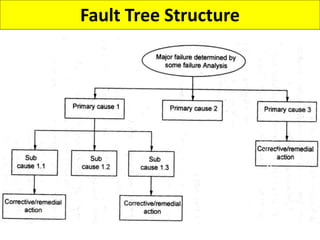
Fault Tree Structure
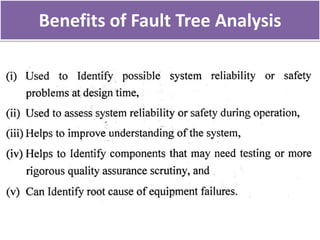
Benefits of Fault Tree Analysis
.
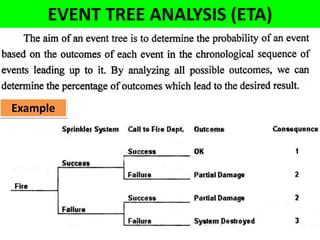
EVENT TREE ANALYSIS (ETA)
It’s a visual representation of all
events which can occur in a system
EVENT TREE ANALYSIS (ETA)
Example
.
Root Cause Analysis (RCA)
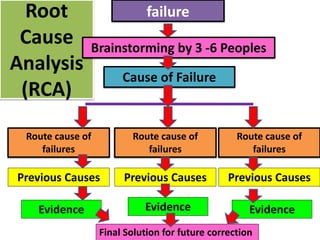
failureRoot
Cause
Analysis
(RCA)
Cause of Failure
Route cause of
failures
Route cause of
failures
Route cause of
failures
Previous Causes Previous Causes Previous Causes
Evidence Evidence Evidence
Final Solution for future correction
Brainstorming by 3 -6 Peoples
Route Cause Failure Analysis
(RCFA)
Same like Route Cause Analysis (RCA)
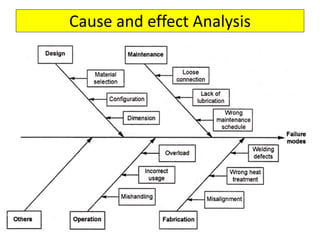
Cause and effect Analysis
.
Failure Mode Effective Analysis
(FMEA)
• FMEA used to identify Potential Failures and their
effect on product
• FMEA is a tool to identify and prevent problems
from occurring.
• It help the design engineer to make safe and
reliable product from the historical data.
Failure Mode Effective Analysis (FMEA)
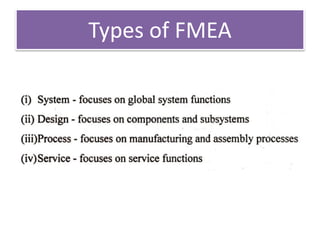
Types of FMEA
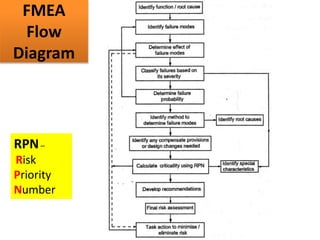
FMEA
Flow
Diagram
RPN–
Risk
Priority
Number
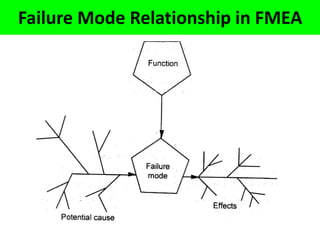
Failure Mode Relationship in FMEA
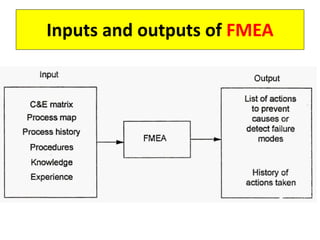
Inputs and outputs of FMEA
Benefits of FMEA
Applications of FMEA
• In Manufacturing and assembly
• In Design Process
• Equipment design and Purchase
• Service
Failure Mode, Effect and Criticality
Analysis (FMECA)
• It’s the extension of FMEA analysis.
• Here , we are ranking the failures depend on
the criticality
Failure Mode, Effect and Criticality
Analysis (FMECA)
Criticality index
• Each Failure data are listed with their danger
rating called criticality index.
• Depend on this number they can judge the list
the hazards and its risks
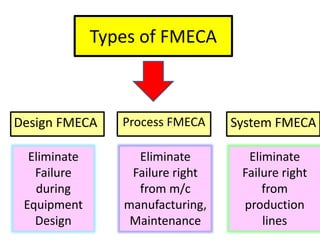
Types of FMECA
Design FMECA Process FMECA System FMECA
Eliminate
Failure
during
Equipment
Design
Eliminate
Failure right
from m/c
manufacturing,
Maintenance
Eliminate
Failure right
from
production
lines
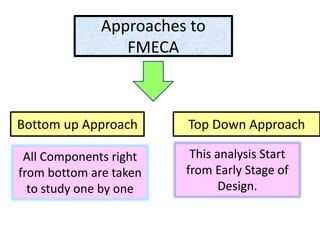
Approaches to
FMECA
Bottom up Approach Top Down Approach
All Components right
from bottom are taken
to study one by one
This analysis Start
from Early Stage of
Design.
Failure Reporting And
Corrective Action System
(FRACAS)
FRACAS
• It’s a closed loop system that is used
to manage failure throughout the
Product life cycle
How it works ?
• The owner of FRACAS is responsible to give a
elaborated statement of how failure
happened, date of failure and conditions .
• Then it goes to an engineer to find out fault
and its solution
.
Maintenance in Gear
• Periodic maintenance
• Proper Lubrication
• Proper loading
• Proper design and installation
Maintenance in Gear
Failure Analysis of Gears
1. Inspect the failed gear
2. Identify the nature of failure
3. Analyzing time constraints
4. Preparing for inspection
5. Failure Inspection at site
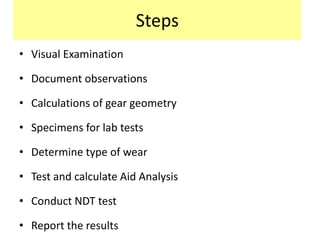
Steps
• Visual Examination
• Document observations
• Calculations of gear geometry
• Specimens for lab tests
• Determine type of wear
• Test and calculate Aid Analysis
• Conduct NDT test
• Report the results
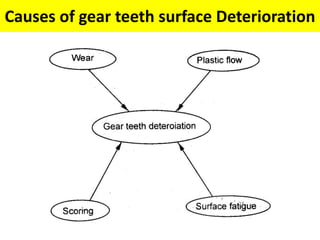
Causes of gear teeth surface Deterioration
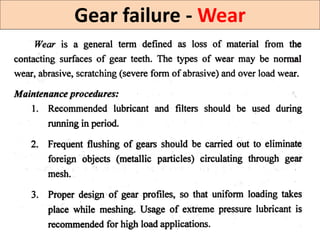
Gear failure - Wear
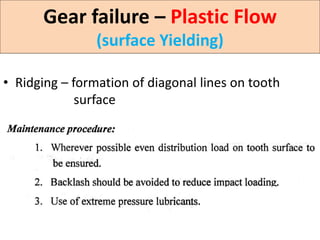
• Ridging – formation of diagonal lines on tooth
surface
Gear failure – Plastic Flow
(surface Yielding)
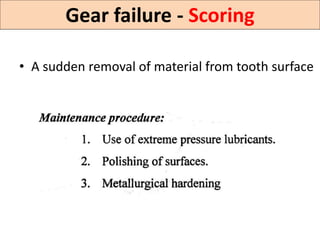
Gear failure - Scoring
• A sudden removal of material from tooth surface
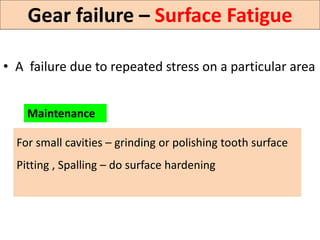
Gear failure – Surface Fatigue
• A failure due to repeated stress on a particular area
For small cavities – grinding or polishing tooth surface
Pitting , Spalling – do surface hardening
Maintenance
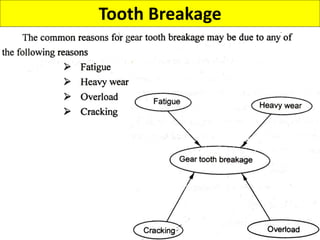
Tooth Breakage
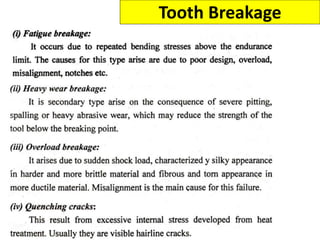
Tooth Breakage
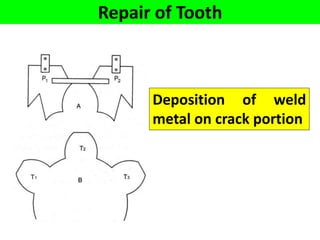
Repair of Tooth
Deposition of weld
metal on crack portion
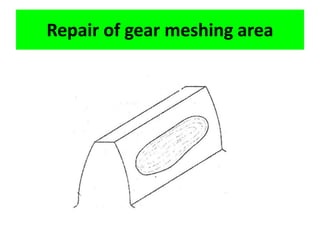
Repair of gear meshing area
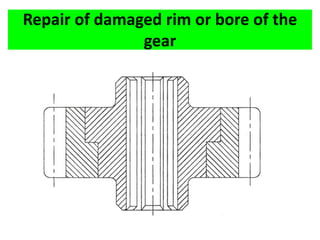
Repair of damaged rim or bore of the
gear
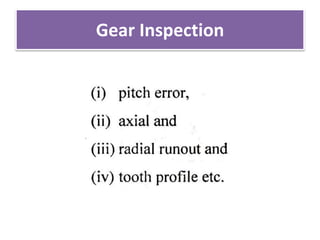
Gear Inspection
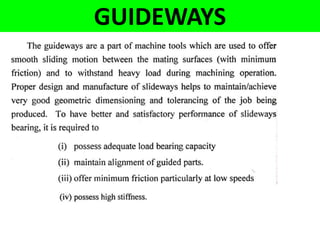
GUIDEWAYS
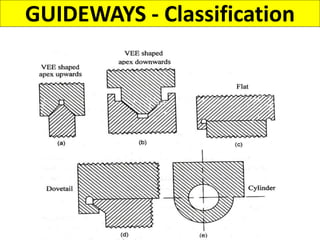
GUIDEWAYS - Classification
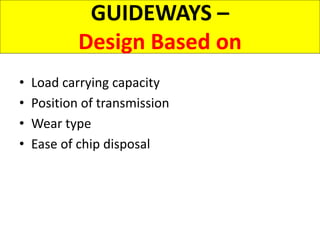
• Load carrying capacity
• Position of transmission
• Wear type
• Ease of chip disposal
GUIDEWAYS –
Design Based on
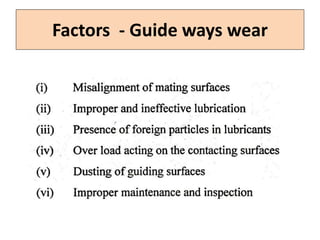
Factors - Guide ways wear
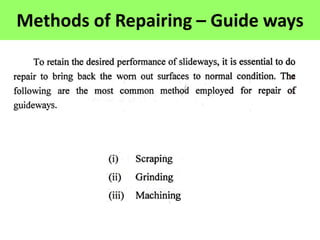
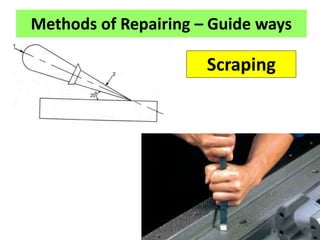
Methods of Repairing – Guide ways
Scraping
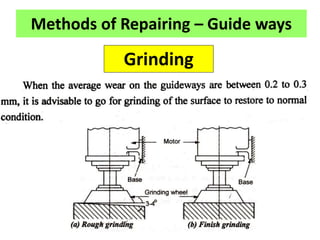
Methods of Repairing – Guide ways
Grinding
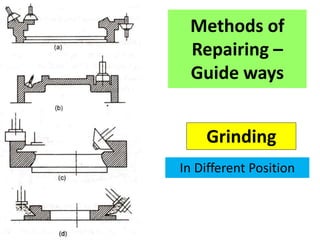
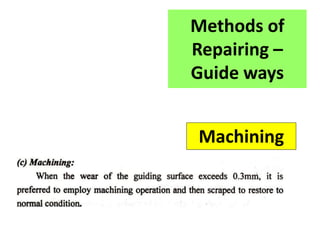
Methods of
Repairing –
Guide ways
Grinding
In Different Position
Methods of
Repairing –
Guide ways
Machining
Checking of Guide ways
• Straightness
• Flatness
• Parallism of surfaces
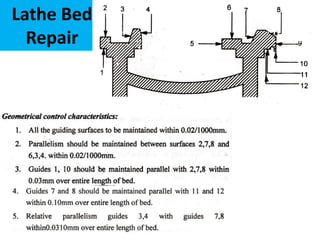
Lathe Bed
Repair
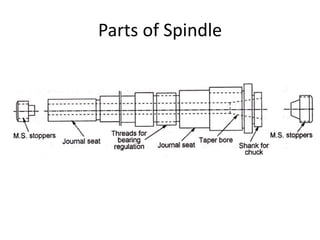
SPINDLES
Parts of Spindle
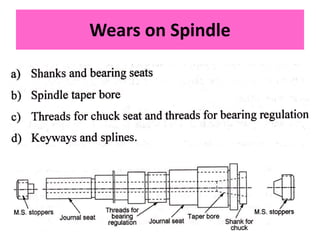
Wears on Spindle
Repair Standards (references)
• The dimension of the existing state of the
spindle are compared with the reference
dimensions called repair standards
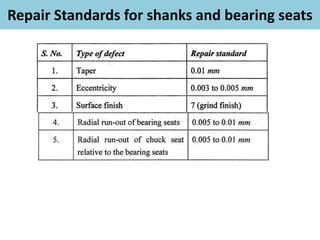
Repair Standards for shanks and bearing seats
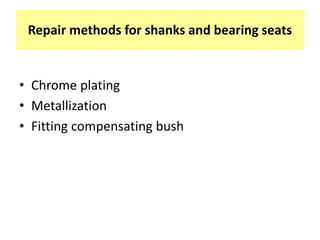
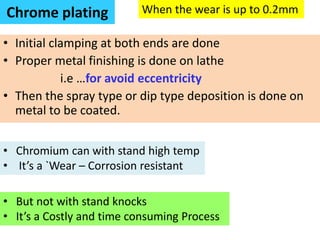
• Chrome plating
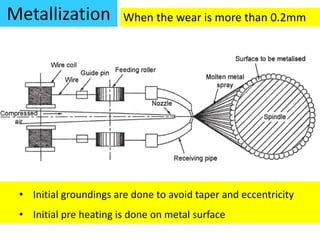
• Metallization
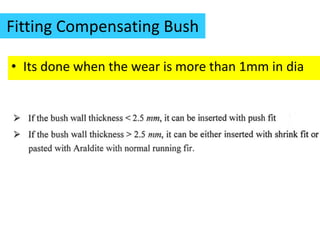
• Fitting compensating bush
Repair methods for shanks and bearing seats
Chrome plating
• Initial clamping at both ends are done
• Proper metal finishing is done on lathe
i.e …for avoid eccentricity
• Then the spray type or dip type deposition is done on
metal to be coated.
• Chromium can with stand high temp
• It’s a `Wear – Corrosion resistant
• But not with stand knocks
• It’s a Costly and time consuming Process
When the wear is up to 0.2mm
Metallization When the wear is more than 0.2mm
• Initial groundings are done to avoid taper and eccentricity
• Initial pre heating is done on metal surface
Fitting Compensating Bush
• Its done when the wear is more than 1mm in dia
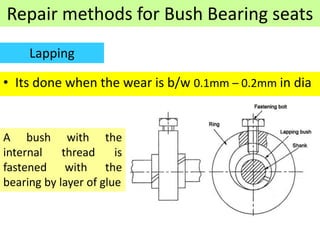
Repair methods for Bush Bearing seats
• Its done when the wear is b/w 0.1mm – 0.2mm in dia
Lapping
A bush with the
internal thread is
fastened with the
bearing by layer of glue
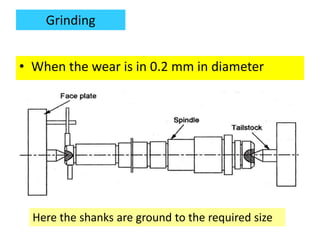
• When the wear is in 0.2 mm in diameter
Grinding
Here the shanks are ground to the required size
Repair methods of taper bore of
spindles
• Grinding
• Fitting Compensating Bush
• Spindle Reversal (boring a new taper hole at other end)
Repair methods for Threads of Spindle
• Metal deposition & thread cutting
it’s the only way to build a new
thread on the surface
Repair methods for Keyways of Spindle
• Over sizing (keyway is made to next std. value)
• Cutting new keyway (Cutting keyway in opp.side of
spindle)
• Weld deposition (Metal Deposit & key way milling)
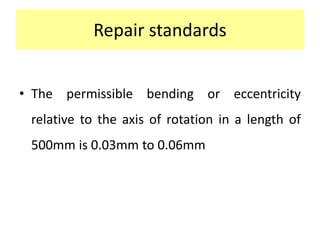
Repair standards
• The permissible bending or eccentricity
relative to the axis of rotation in a length of
500mm is 0.03mm to 0.06mm
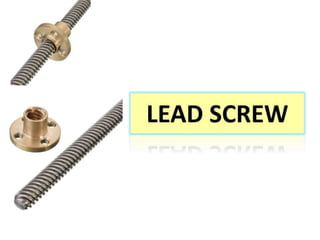
Repairing methods for wear up to 0.3mm
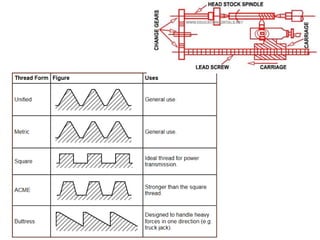
• Both sides of the threads turned slightly
• Reduce diameter and cutting new threads
Repairing methods for wear over 0.3mm
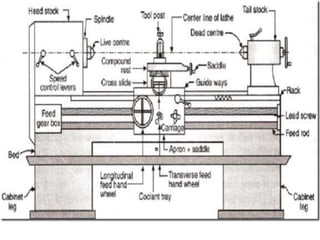
• Worn out lead screw replaced by a new one.
• Partial replacement of Parts
Repairing methods for Lead screw nut
• When ever a lead screw has been replaced or
repaired, the matching nut also replaced or
repaired according to the thread of the screw
METHODS
Depositing Metal
BEARINGS
.
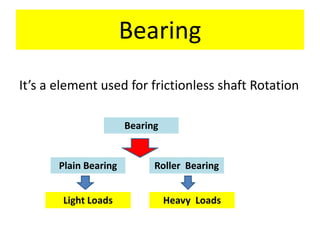
Bearing
It’s a element used for frictionless shaft Rotation
Plain Bearing Roller Bearing
Bearing
Light Loads Heavy Loads
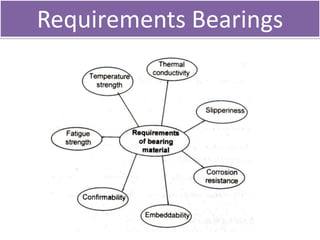
Requirements Bearings
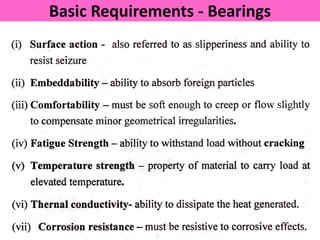
Basic Requirements - Bearings
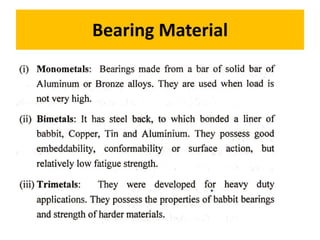
Bearing Material
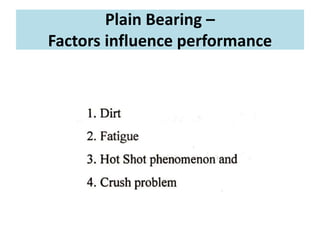
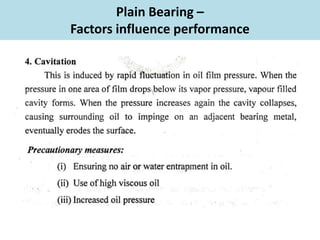
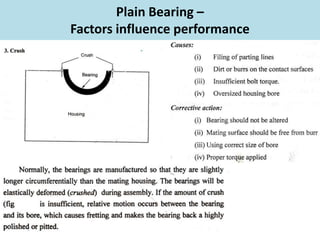
Plain Bearing –
Factors influence performance
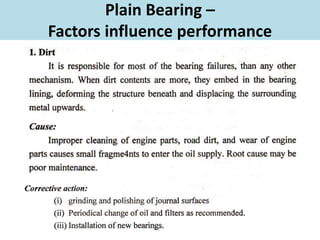
Plain Bearing –
Factors influence performance
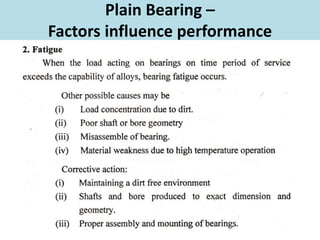
Plain Bearing –
Factors influence performance
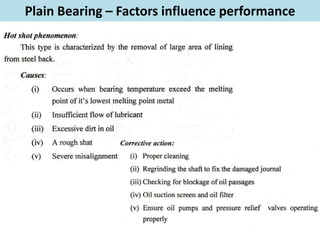
Plain Bearing – Factors influence performance
Plain Bearing –
Factors influence performance
Plain Bearing –
Factors influence performance
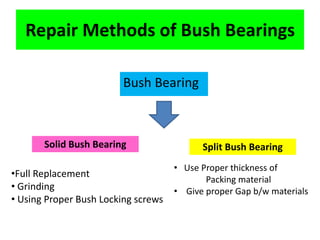
Repair Methods of Bush Bearings
Bush Bearing
Solid Bush Bearing Split Bush Bearing
•Full Replacement
• Grinding
• Using Proper Bush Locking screws
• Use Proper thickness of
Packing material
• Give proper Gap b/w materials
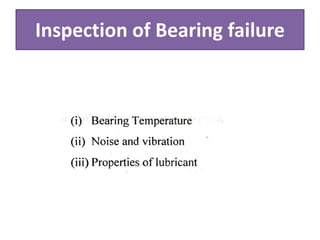
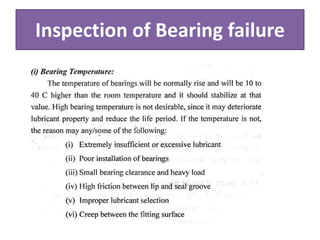
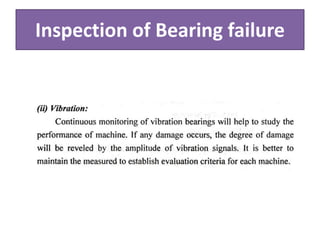
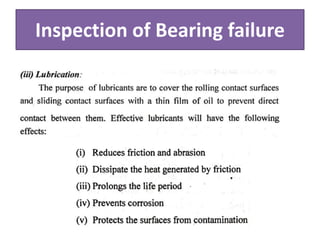
Inspection of Bearing failure
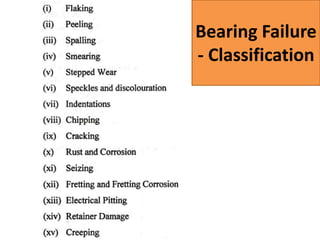
Bearing Failure
- Classification
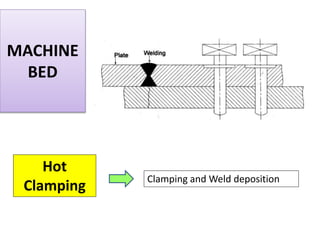
MACHINE BED
.
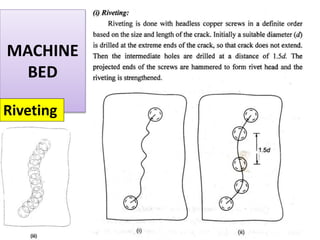
MACHINE
BED
Riveting
MACHINE
BED
Hot
Clamping
Clamping and Weld deposition

Repair methods for basic machine elements