Predictive Maintenance
From RunToFail to ConditionBasedMonitoring
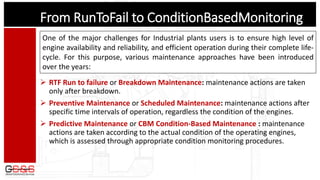
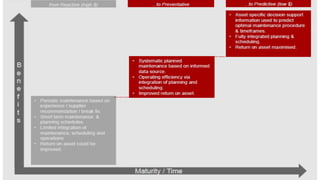
 RTF Run to failure or Breakdown Maintenance: maintenance actions are taken
only after breakdown.
 Preventive Maintenance or Scheduled Maintenance: maintenance actions after
specific time intervals of operation, regardless the condition of the engines.
 Predictive Maintenance or CBM Condition-Based Maintenance : maintenance
actions are taken according to the actual condition of the operating engines,
which is assessed through appropriate condition monitoring procedures.
One of the major challenges for Industrial plants users is to ensure high level of
engine availability and reliability, and efficient operation during their complete life-
cycle. For this purpose, various maintenance approaches have been introduced
over the years:
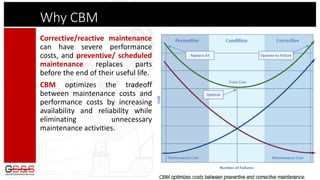
Why CBM
Corrective/reactive maintenance
can have severe performance
costs, and preventive/ scheduled
maintenance replaces parts
before the end of their useful life.
CBM optimizes the tradeoff
between maintenance costs and
performance costs by increasing
availability and reliability while
eliminating unnecessary
maintenance activities.
CBM
Condition based maintenance allows preventive and corrective actions to be
scheduled at the optimal time, thus reducing the total cost of ownership. Today,
improvements in technology are making it easier to gather, store and analyze data
for CBM. In particular, CBM is highly effective where safety and reliability is the
paramount concern such as the aircraft industry, semiconductor manufacturing,
nuclear, oil and gas, and so on.
The goal of condition based maintenance is to spot upcoming equipment failure so
maintenance can be proactively scheduled when it is needed – and not before. Asset
conditions need to trigger maintenance within a long enough time period before failure, so
work can be finished before the asset fails or performance falls below the optimal level.
Predictive maintenance
Relies on maintenance based on trends acquired by equipment data.
Predictive maintenance is based on predicting when an asset needs attention
rather than simply replacing a part, when it could last longer.
It deals with online data, machine conditions are constantly monitored and data
are constantly analyzed.
CBM program:
• Data Acquisition part, where data are acquired from engines under monitoring
• Data Processing part, where the acquired data are validated and transformed
properly according to the requirements of the decision-making techniques that
follow
• Decision Making part, where a number of methods and techniques are applied
to obtain the current health condition of the engine and recommend maintenance
plans
CBM Benefits & Investments
 CBM is performed while the asset is working, this
lowers disruptions to normal operations
 Reduces the cost of asset failures
 Improves equipment reliability
 Minimizes unscheduled downtime due to
catastrophic failure
 Minimizes time spent on maintenance
 Minimizes overtime costs by scheduling the
activities
 Minimizes requirement for emergency spare parts
 Optimized maintenance intervals (more optimal
than manufacturer recommendations)
 Improves worker safety
 Reduces the chances of collateral damage to the
system
 Condition monitoring test equipment is expensive
to install, and databases cost money to analyze
 Cost to train staff – you need a knowledgeable
professional to analyze the data and perform the
work
 Fatigue or uniform wear failures are not easily
detected with CBM measurements
 Condition sensors may not survive in the
operating environment
 May require asset modifications to retrofit the
system with sensors
 Unpredictable maintenance periods
Benefits Investments
Predictive Maintenance Techniques
The predictive maintenance principle is to use a combination of measurement on
process and machinery, to evaluate equipment condition.
Several technologies are available:
Predictive Maintenance Tools
VIBRATION
ANALYSIS
THERMO
IMAGE
NDT/VISUAL
INSPECTION
PERFORMANCE
TEST
OIL
ANALYSIS
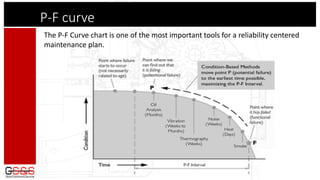
P-F curve
The P-F Curve chart is one of the most important tools for a reliability centered
maintenance plan.
Data collection
All the method described before, needs to analyze machine data.
Data can be collected from the system by two different methods:
 Spot readings: can be performed at
regular intervals using portable
instruments (Pruftechnik)
 Continuous readings: Sensors can be
retrofitted to equipment or installed
during manufacture for continuous
data collection (Condition monitoring
par 2.2 and remote diagnostic cap.3)
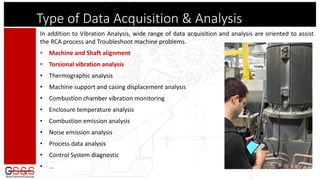
Type of Data Acquisition & Analysis
In addition to Vibration Analysis, wide range of data acquisition and analysis are oriented to assist
the RCA process and Troubleshoot machine problems.
• Machine and Shaft alignment
• Torsional vibration analysis
• Thermographic analysis
• Machine support and casing displacement analysis
• Combustion chamber vibration monitoring
• Enclosure temperature analysis
• Combustion emission analysis
• Noise emission analysis
• Process data analysis
• Control System diagnostic
• …
Web site: www.gssnet.eu
Contact: info@gss-eu.com
Sales Department: matilde.rosati@gss-eu.com
Ph/Fax +39 055 0126653
Mob. +39 3392203342
Follow us
Registered Office: Via Iacopo Vignali n. 42 50142 Firenze (FI) Italy
VAT: IT05998230485 Fiscal Code: 05998230485
Registro delle Imprese di Firenze R.E.A. Firenze: 591900
Ph/Fax + 39 055 0126653

Predictive maintenance

  • 1.
  • 2.
    From RunToFail toConditionBasedMonitoring  RTF Run to failure or Breakdown Maintenance: maintenance actions are taken only after breakdown.  Preventive Maintenance or Scheduled Maintenance: maintenance actions after specific time intervals of operation, regardless the condition of the engines.  Predictive Maintenance or CBM Condition-Based Maintenance : maintenance actions are taken according to the actual condition of the operating engines, which is assessed through appropriate condition monitoring procedures. One of the major challenges for Industrial plants users is to ensure high level of engine availability and reliability, and efficient operation during their complete life- cycle. For this purpose, various maintenance approaches have been introduced over the years:
  • 4.
    Why CBM Corrective/reactive maintenance canhave severe performance costs, and preventive/ scheduled maintenance replaces parts before the end of their useful life. CBM optimizes the tradeoff between maintenance costs and performance costs by increasing availability and reliability while eliminating unnecessary maintenance activities.
  • 5.
    CBM Condition based maintenanceallows preventive and corrective actions to be scheduled at the optimal time, thus reducing the total cost of ownership. Today, improvements in technology are making it easier to gather, store and analyze data for CBM. In particular, CBM is highly effective where safety and reliability is the paramount concern such as the aircraft industry, semiconductor manufacturing, nuclear, oil and gas, and so on. The goal of condition based maintenance is to spot upcoming equipment failure so maintenance can be proactively scheduled when it is needed – and not before. Asset conditions need to trigger maintenance within a long enough time period before failure, so work can be finished before the asset fails or performance falls below the optimal level.
  • 6.
    Predictive maintenance Relies onmaintenance based on trends acquired by equipment data. Predictive maintenance is based on predicting when an asset needs attention rather than simply replacing a part, when it could last longer. It deals with online data, machine conditions are constantly monitored and data are constantly analyzed. CBM program: • Data Acquisition part, where data are acquired from engines under monitoring • Data Processing part, where the acquired data are validated and transformed properly according to the requirements of the decision-making techniques that follow • Decision Making part, where a number of methods and techniques are applied to obtain the current health condition of the engine and recommend maintenance plans
  • 7.
    CBM Benefits &Investments  CBM is performed while the asset is working, this lowers disruptions to normal operations  Reduces the cost of asset failures  Improves equipment reliability  Minimizes unscheduled downtime due to catastrophic failure  Minimizes time spent on maintenance  Minimizes overtime costs by scheduling the activities  Minimizes requirement for emergency spare parts  Optimized maintenance intervals (more optimal than manufacturer recommendations)  Improves worker safety  Reduces the chances of collateral damage to the system  Condition monitoring test equipment is expensive to install, and databases cost money to analyze  Cost to train staff – you need a knowledgeable professional to analyze the data and perform the work  Fatigue or uniform wear failures are not easily detected with CBM measurements  Condition sensors may not survive in the operating environment  May require asset modifications to retrofit the system with sensors  Unpredictable maintenance periods Benefits Investments
  • 8.
  • 9.
    The predictive maintenanceprinciple is to use a combination of measurement on process and machinery, to evaluate equipment condition. Several technologies are available: Predictive Maintenance Tools VIBRATION ANALYSIS THERMO IMAGE NDT/VISUAL INSPECTION PERFORMANCE TEST OIL ANALYSIS
  • 10.
    P-F curve The P-FCurve chart is one of the most important tools for a reliability centered maintenance plan.
  • 11.
    Data collection All themethod described before, needs to analyze machine data. Data can be collected from the system by two different methods:  Spot readings: can be performed at regular intervals using portable instruments (Pruftechnik)  Continuous readings: Sensors can be retrofitted to equipment or installed during manufacture for continuous data collection (Condition monitoring par 2.2 and remote diagnostic cap.3)
  • 12.
    Type of DataAcquisition & Analysis In addition to Vibration Analysis, wide range of data acquisition and analysis are oriented to assist the RCA process and Troubleshoot machine problems. • Machine and Shaft alignment • Torsional vibration analysis • Thermographic analysis • Machine support and casing displacement analysis • Combustion chamber vibration monitoring • Enclosure temperature analysis • Combustion emission analysis • Noise emission analysis • Process data analysis • Control System diagnostic • …
  • 13.
    Web site: www.gssnet.eu Contact:info@gss-eu.com Sales Department: matilde.rosati@gss-eu.com Ph/Fax +39 055 0126653 Mob. +39 3392203342 Follow us Registered Office: Via Iacopo Vignali n. 42 50142 Firenze (FI) Italy VAT: IT05998230485 Fiscal Code: 05998230485 Registro delle Imprese di Firenze R.E.A. Firenze: 591900 Ph/Fax + 39 055 0126653