Copyright 2010 GPAllied©
Presented by: Ricky Smith, CMRP
May 19, 2010
Best Practices in
Maintenance and Reliability
Copyright 2010 GPAllied©
Route Wav eform
25-Jun-03 09:05:36
RMS = .4763
PK(+/-) = 1.85/1.60
CRESTF= 3.88
0 40 80 120 160 200 240 280 320
-10
-5
0
5
10
Time in mSecs
AccelerationinG-s
CF ALARM
CF ALARM
PK ALARM
PK ALARM
SHM - 150 Hp Vertical Turbine Pump
150 Hp VT-M1V Motor #1 Bearing - Vert
Route Spectrum
25-Jun-03 09:05:36
OVERALL= .3255 V-DG
RMS = .4796
LOAD = 100.0
RPM = 1800. (30.00 Hz)
0 1000 2000 3000 4000 5000
0
0.2
0.4
0.6
0.8
1.0
1.2
1.4
Frequency in Hz
RMSAccelerationinG-s
75.3°F
118.9°F
80
90
100
110
119.1°F
74.5°F
156.9°F
80
100
120
140
153.1°F
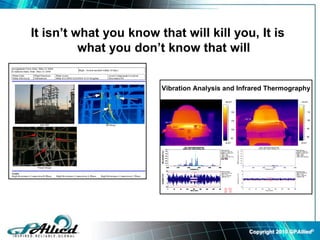
Vibration Analysis and Infrared Thermography
It isn’t what you know that will kill you, It is
what you don’t know that will
Copyright 2010 GPAllied©
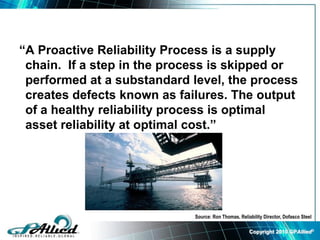
“A Proactive Reliability Process is a supply
chain. If a step in the process is skipped or
performed at a substandard level, the process
creates defects known as failures. The output
of a healthy reliability process is optimal
asset reliability at optimal cost.”
Source: Ron Thomas, Reliability Director, Dofasco Steel
Copyright 2010 GPAllied©
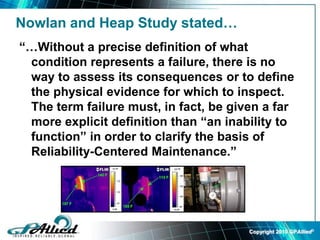
Nowlan and Heap Study stated…
“…Without a precise definition of what
condition represents a failure, there is no
way to assess its consequences or to define
the physical evidence for which to inspect.
The term failure must, in fact, be given a far
more explicit definition than “an inability to
function” in order to clarify the basis of
Reliability-Centered Maintenance.”
Copyright 2010 GPAllied©
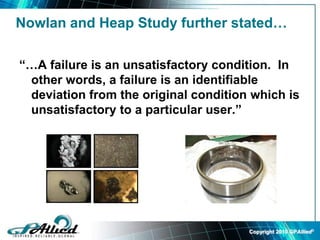
Nowlan and Heap Study further stated…
“…A failure is an unsatisfactory condition. In
other words, a failure is an identifiable
deviation from the original condition which is
unsatisfactory to a particular user.”
Copyright 2010 GPAllied©
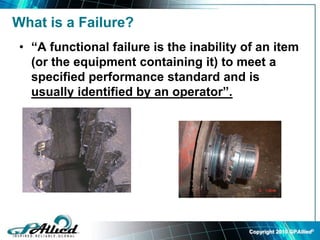
What is a Failure?
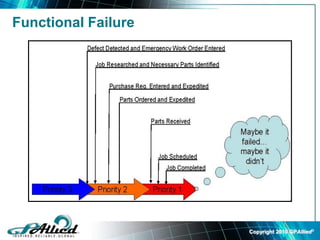
• “A functional failure is the inability of an item
(or the equipment containing it) to meet a
specified performance standard and is
usually identified by an operator”.
Copyright 2010 GPAllied©
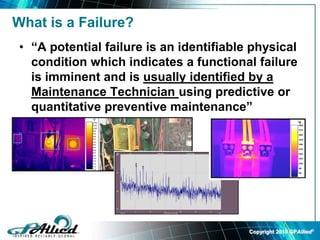
What is a Failure?
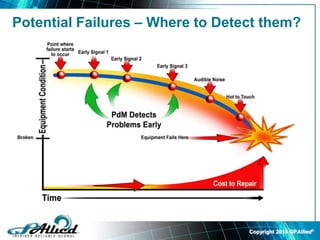
• “A potential failure is an identifiable physical
condition which indicates a functional failure
is imminent and is usually identified by a
Maintenance Technician using predictive or
quantitative preventive maintenance”
Copyright 2010 GPAllied©
Potential Failures – Where to Detect them?
Copyright 2010 GPAllied©
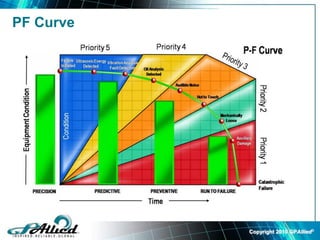
PF Curve
Copyright 2010 GPAllied©
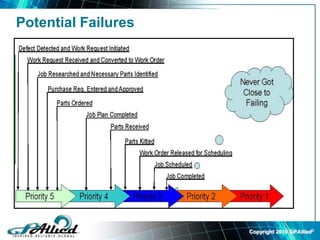
Potential Failures
Copyright 2010 GPAllied©
Functional Failure
Copyright 2010 GPAllied©
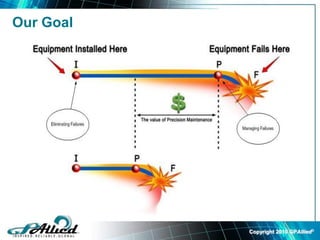
Our Goal
Copyright 2010 GPAllied©
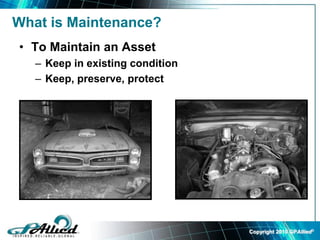
What is Maintenance?
• To Maintain an Asset
– Keep in existing condition
– Keep, preserve, protect
Copyright 2010 GPAllied©
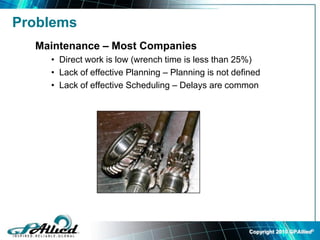
Problems
Maintenance – Most Companies
• Direct work is low (wrench time is less than 25%)
• Lack of effective Planning – Planning is not defined
• Lack of effective Scheduling – Delays are common
Copyright 2010 GPAllied©
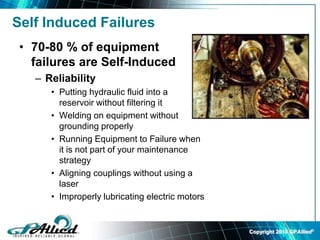
Self Induced Failures
• 70-80 % of equipment
failures are Self-Induced
– Reliability
• Putting hydraulic fluid into a
reservoir without filtering it
• Welding on equipment without
grounding properly
• Running Equipment to Failure when
it is not part of your maintenance
strategy
• Aligning couplings without using a
laser
• Improperly lubricating electric motors
Copyright 2010 GPAllied©
Common Problems
• Equipment continuing to fail without a known
root cause
• PM is performed on time but equipment
continues to break down
• Age of equipment seems to be problem
• There is never enough parts in the
warehouse
• Parts are not ordered fast enough
• Maintenance personnel blamed for standing
around
Copyright 2010 GPAllied©
Common Problems, cont’d
• Management blames Maintenance for the
company not meeting it’s business goals
– Reliability is always the problem
• The Maintenance process is built around
reacting to equipment problems
• Equipment history does not seem complete
and hard to find data
– Planner/Schedulers performing clerk duty
• Production/Operations operates inefficiently
but no one seems to be aware of the problem
Copyright 2010 GPAllied©
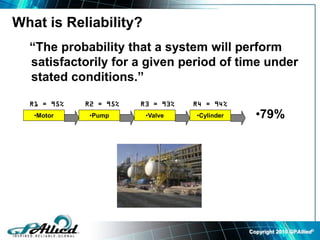
What is Reliability?
“The probability that a system will perform
satisfactorily for a given period of time under
stated conditions.”
•Motor •Pump •Valve •Cylinder •79%
R1 = 95% R2 = 95% R3 = 93% R4 = 94%
Copyright 2010 GPAllied©
Reliability Definitions
• Function: What the owner or user of a physical asset
wants it to do
– Example: Pump: To transfer 300 Gallons of product at 60 PSI -
24 hours a day / 7 Days a week from point A to point B
• Functional Failure: A state in which the physical asset
or system is unable to perform a specific function to a
level of performance that is acceptable by its owner or
user
– Example: Pump: To transfer less than 300 Gallons (250 Gallons) of a
product at 60 PSI 24 hours a day / 7 Days a week (Functional Failure)
•Source: RCM !! – John Moubray
Copyright 2010 GPAllied©
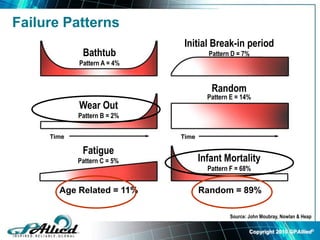
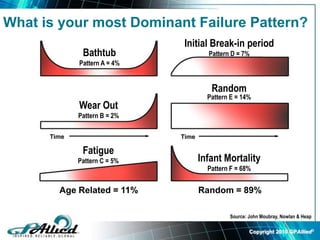
Source: John Moubray, Nowlan & Heap
Time Time
Age Related = 11% Random = 89%
Bathtub
Pattern A = 4%
Wear Out
Pattern B = 2%
Fatigue
Pattern C = 5%
Initial Break-in period
Pattern D = 7%
Random
Pattern E = 14%
Infant Mortality
Pattern F = 68%
Failure Patterns
Copyright 2010 GPAllied©
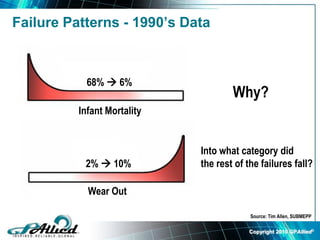
Failure Patterns - 1990’s Data
Source: Tim Allen, SUBMEPP
Infant Mortality
Wear Out
2%  10%
68%  6%
Why?
Into what category did
the rest of the failures fall?
Copyright 2010 GPAllied©
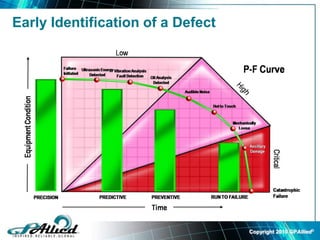
Early Identification of a Defect
Copyright 2010 GPAllied©
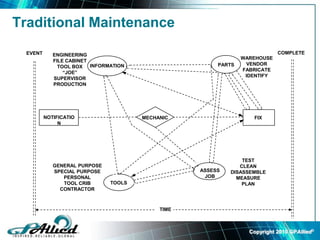
NOTIFICATIO
N
FIX
COMPLETE
INFORMATION PARTS
TOOLS
ENGINEERING
FILE CABINET
TOOL BOX
“JOE”
SUPERVISOR
PRODUCTION
WAREHOUSE
VENDOR
FABRICATE
IDENTIFY
TEST
CLEAN
DISASSEMBLE
MEASURE
PLAN
GENERAL PURPOSE
SPECIAL PURPOSE
PERSONAL
TOOL CRIB
CONTRACTOR
EVENT
TIME
MECHANIC
ASSESS
JOB
Traditional Maintenance
Copyright 2010 GPAllied©
•a
Copyright 2010 GPAllied©
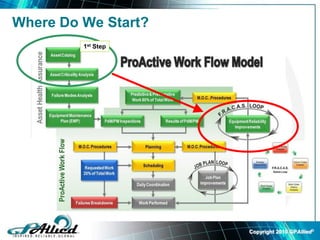
1st Step
Where Do We Start?
•a
Copyright 2010 GPAllied©
Wikipedia Defines…
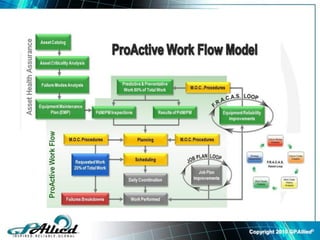
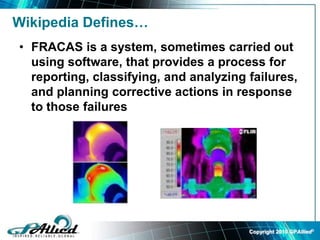
• FRACAS is a system, sometimes carried out
using software, that provides a process for
reporting, classifying, and analyzing failures,
and planning corrective actions in response
to those failures
Copyright 2010 GPAllied©
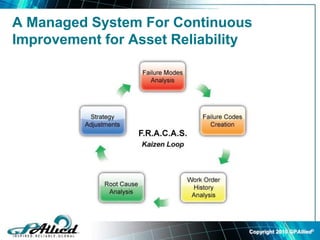
A Managed System For Continuous
Improvement for Asset Reliability
Copyright 2010 GPAllied©
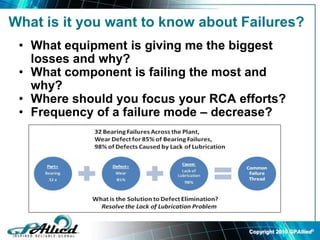
What is it you want to know about Failures?
• What equipment is giving me the biggest
losses and why?
• What component is failing the most and
why?
• Where should you focus your RCA efforts?
• Frequency of a failure mode – decrease?
Copyright 2010 GPAllied©
Source: John Moubray, Nowlan & Heap
Time Time
Age Related = 11% Random = 89%
Bathtub
Pattern A = 4%
Wear Out
Pattern B = 2%
Fatigue
Pattern C = 5%
Initial Break-in period
Pattern D = 7%
Random
Pattern E = 14%
Infant Mortality
Pattern F = 68%
What is your most Dominant Failure Pattern?
Copyright 2010 GPAllied©
Key Points to Know!
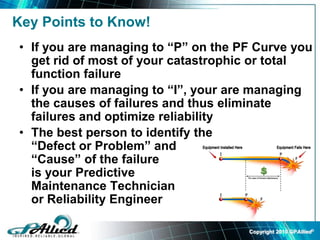
• If you are managing to “P” on the PF Curve you
get rid of most of your catastrophic or total
function failure
• If you are managing to “I”, your are managing
the causes of failures and thus eliminate
failures and optimize reliability
• The best person to identify the
“Defect or Problem” and
“Cause” of the failure
is your Predictive
Maintenance Technician
or Reliability Engineer
Copyright 2010 GPAllied©
“The significant problems we face cannot be
solved with the same level of thinking we
were at when we created them.”
- Albert Einstein
Copyright 2010 GPAllied©
Task/Functions Facility
Owner
MTF
Commander
Maint.
Manager
Reliability
Engineer
Maint.
Supervisors
Contract
Officer
Maint.
Planner
Inputting Work
Order Data -
CMMS/EAM
I R C R A C
Reviewing and
taking action
on KPIs
I I R I C A C
QA of Data
Input
I A C I C
Failure Reports
Findings
I I A R C C I
Maintenance
Strategy
Adjustments
I A R C C C
Responsibility “the Doer”
Accountable “the Buck stops here
Consulted “in the Loop”
Informed “kept in the picture”
Copyright 2010 GPAllied©
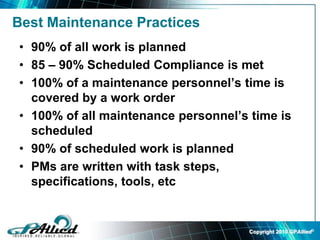
Best Maintenance Practices
• 90% of all work is planned
• 85 – 90% Scheduled Compliance is met
• 100% of a maintenance personnel’s time is
covered by a work order
• 100% of all maintenance personnel’s time is
scheduled
• 90% of scheduled work is planned
• PMs are written with task steps,
specifications, tools, etc
Copyright 2010 GPAllied©
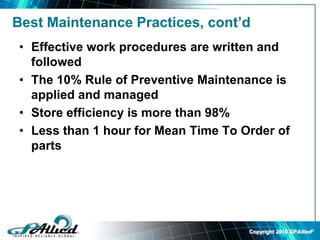
Best Maintenance Practices, cont’d
• Effective work procedures are written and
followed
• The 10% Rule of Preventive Maintenance is
applied and managed
• Store efficiency is more than 98%
• Less than 1 hour for Mean Time To Order of
parts
Copyright 2010 GPAllied©
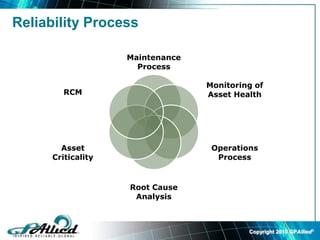
Maintenance
Process
Monitoring of
Asset Health
Operations
Process
Root Cause
Analysis
Asset
Criticality
RCM
Reliability Process
Copyright 2010 GPAllied©
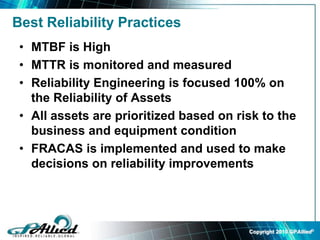
Best Reliability Practices
• MTBF is High
• MTTR is monitored and measured
• Reliability Engineering is focused 100% on
the Reliability of Assets
• All assets are prioritized based on risk to the
business and equipment condition
• FRACAS is implemented and used to make
decisions on reliability improvements
Copyright 2010 GPAllied©
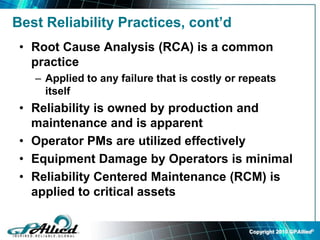
Best Reliability Practices, cont’d
• Root Cause Analysis (RCA) is a common
practice
– Applied to any failure that is costly or repeats
itself
• Reliability is owned by production and
maintenance and is apparent
• Operator PMs are utilized effectively
• Equipment Damage by Operators is minimal
• Reliability Centered Maintenance (RCM) is
applied to critical assets
Copyright 2010 GPAllied©
Best Reliability Practices, cont’d
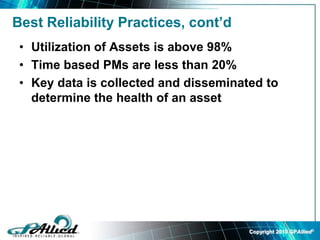
• Utilization of Assets is above 98%
• Time based PMs are less than 20%
• Key data is collected and disseminated to
determine the health of an asset
Copyright 2010 GPAllied©
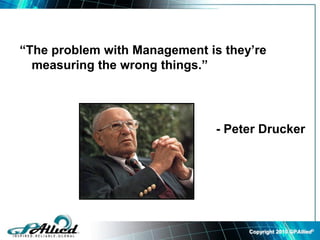
“The problem with Management is they’re
measuring the wrong things.”
- Peter Drucker
Copyright 2010 GPAllied©
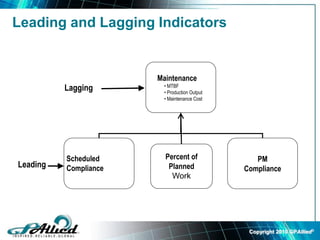
Maintenance
• MTBF
• Production Output
• Maintenance Cost
Scheduled
Compliance
PM
Compliance
Lagging
Leading
Percent of
Planned
Work
Leading and Lagging Indicators
Copyright 2010 GPAllied©
Where to Start with Maintenance and
Reliability Metrics
• MTBF
• MTTR
• MTBR
• PM Compliance
• % of Planned Work
• Scheduled Compliance
• # of breaks to Schedule by Maintenance and
Operations
Copyright 2010 GPAllied©
Where to Start with Maintenance and
Reliability Metrics, cont’d
• PM Labor Hours vs. EM Labor Hours
• Maintenance Cost per unit produced
• Stores Efficiency
• Vendor Efficiency
• Equipment Damage Cost Per Unit
Copyright 2010 GPAllied©
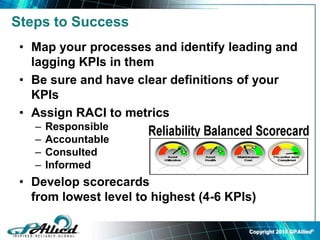
Steps to Success
• Map your processes and identify leading and
lagging KPIs in them
• Be sure and have clear definitions of your
KPIs
• Assign RACI to metrics
– Responsible
– Accountable
– Consulted
– Informed
• Develop scorecards
from lowest level to highest (4-6 KPIs)
Copyright 2010 GPAllied©
Variation in Reliability
• Variation is the largest cause of equipment
failure
Copyright 2010 GPAllied©
Causes of Variation
• Lack of an effective PM Program
• Lack of a repeatable repairs with
specifications
• Lubrication issues, lack of lubrication,
contamination, etc.
• Operator Error
• Use of wrong tool to make repair
– Bearing heater
• Use of wrong specification
– Torque values
Copyright 2010 GPAllied©
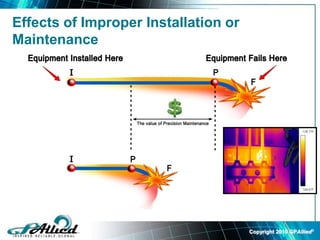
Effects of Improper Installation or
Maintenance
Copyright 2010 GPAllied©
“Excellence is a Habit”
- Aristotle, 330 BC
Copyright 2010 GPAllied©
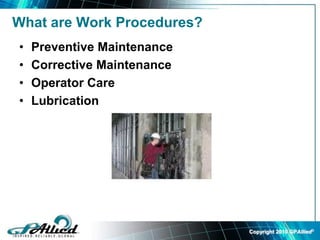
What are Work Procedures?
• Preventive Maintenance
• Corrective Maintenance
• Operator Care
• Lubrication
Copyright 2010 GPAllied©
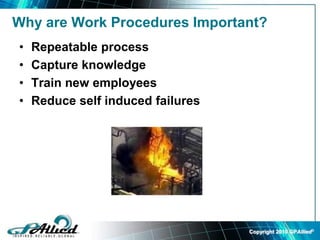
• Repeatable process
• Capture knowledge
• Train new employees
• Reduce self induced failures
Why are Work Procedures Important?
Copyright 2010 GPAllied©
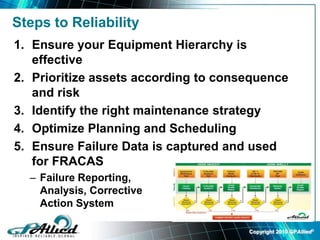
Steps to Reliability
1. Ensure your Equipment Hierarchy is
effective
2. Prioritize assets according to consequence
and risk
3. Identify the right maintenance strategy
4. Optimize Planning and Scheduling
5. Ensure Failure Data is captured and used
for FRACAS
– Failure Reporting,
Analysis, Corrective
Action System
Copyright 2010 GPAllied©
Questions
• Send your questions to rsmith@gpallied.com

Best Practices in Maintenance and Reliability

  • 1.
    Copyright 2010 GPAllied© Presentedby: Ricky Smith, CMRP May 19, 2010 Best Practices in Maintenance and Reliability
  • 2.
    Copyright 2010 GPAllied© RouteWav eform 25-Jun-03 09:05:36 RMS = .4763 PK(+/-) = 1.85/1.60 CRESTF= 3.88 0 40 80 120 160 200 240 280 320 -10 -5 0 5 10 Time in mSecs AccelerationinG-s CF ALARM CF ALARM PK ALARM PK ALARM SHM - 150 Hp Vertical Turbine Pump 150 Hp VT-M1V Motor #1 Bearing - Vert Route Spectrum 25-Jun-03 09:05:36 OVERALL= .3255 V-DG RMS = .4796 LOAD = 100.0 RPM = 1800. (30.00 Hz) 0 1000 2000 3000 4000 5000 0 0.2 0.4 0.6 0.8 1.0 1.2 1.4 Frequency in Hz RMSAccelerationinG-s 75.3°F 118.9°F 80 90 100 110 119.1°F 74.5°F 156.9°F 80 100 120 140 153.1°F Vibration Analysis and Infrared Thermography It isn’t what you know that will kill you, It is what you don’t know that will
  • 3.
    Copyright 2010 GPAllied© “AProactive Reliability Process is a supply chain. If a step in the process is skipped or performed at a substandard level, the process creates defects known as failures. The output of a healthy reliability process is optimal asset reliability at optimal cost.” Source: Ron Thomas, Reliability Director, Dofasco Steel
  • 4.
    Copyright 2010 GPAllied© Nowlanand Heap Study stated… “…Without a precise definition of what condition represents a failure, there is no way to assess its consequences or to define the physical evidence for which to inspect. The term failure must, in fact, be given a far more explicit definition than “an inability to function” in order to clarify the basis of Reliability-Centered Maintenance.”
  • 5.
    Copyright 2010 GPAllied© Nowlanand Heap Study further stated… “…A failure is an unsatisfactory condition. In other words, a failure is an identifiable deviation from the original condition which is unsatisfactory to a particular user.”
  • 6.
    Copyright 2010 GPAllied© Whatis a Failure? • “A functional failure is the inability of an item (or the equipment containing it) to meet a specified performance standard and is usually identified by an operator”.
  • 7.
    Copyright 2010 GPAllied© Whatis a Failure? • “A potential failure is an identifiable physical condition which indicates a functional failure is imminent and is usually identified by a Maintenance Technician using predictive or quantitative preventive maintenance”
  • 8.
    Copyright 2010 GPAllied© PotentialFailures – Where to Detect them?
  • 9.
  • 10.
  • 11.
  • 12.
  • 13.
    Copyright 2010 GPAllied© Whatis Maintenance? • To Maintain an Asset – Keep in existing condition – Keep, preserve, protect
  • 14.
    Copyright 2010 GPAllied© Problems Maintenance– Most Companies • Direct work is low (wrench time is less than 25%) • Lack of effective Planning – Planning is not defined • Lack of effective Scheduling – Delays are common
  • 15.
    Copyright 2010 GPAllied© SelfInduced Failures • 70-80 % of equipment failures are Self-Induced – Reliability • Putting hydraulic fluid into a reservoir without filtering it • Welding on equipment without grounding properly • Running Equipment to Failure when it is not part of your maintenance strategy • Aligning couplings without using a laser • Improperly lubricating electric motors
  • 16.
    Copyright 2010 GPAllied© CommonProblems • Equipment continuing to fail without a known root cause • PM is performed on time but equipment continues to break down • Age of equipment seems to be problem • There is never enough parts in the warehouse • Parts are not ordered fast enough • Maintenance personnel blamed for standing around
  • 17.
    Copyright 2010 GPAllied© CommonProblems, cont’d • Management blames Maintenance for the company not meeting it’s business goals – Reliability is always the problem • The Maintenance process is built around reacting to equipment problems • Equipment history does not seem complete and hard to find data – Planner/Schedulers performing clerk duty • Production/Operations operates inefficiently but no one seems to be aware of the problem
  • 18.
    Copyright 2010 GPAllied© Whatis Reliability? “The probability that a system will perform satisfactorily for a given period of time under stated conditions.” •Motor •Pump •Valve •Cylinder •79% R1 = 95% R2 = 95% R3 = 93% R4 = 94%
  • 19.
    Copyright 2010 GPAllied© ReliabilityDefinitions • Function: What the owner or user of a physical asset wants it to do – Example: Pump: To transfer 300 Gallons of product at 60 PSI - 24 hours a day / 7 Days a week from point A to point B • Functional Failure: A state in which the physical asset or system is unable to perform a specific function to a level of performance that is acceptable by its owner or user – Example: Pump: To transfer less than 300 Gallons (250 Gallons) of a product at 60 PSI 24 hours a day / 7 Days a week (Functional Failure) •Source: RCM !! – John Moubray
  • 20.
    Copyright 2010 GPAllied© Source:John Moubray, Nowlan & Heap Time Time Age Related = 11% Random = 89% Bathtub Pattern A = 4% Wear Out Pattern B = 2% Fatigue Pattern C = 5% Initial Break-in period Pattern D = 7% Random Pattern E = 14% Infant Mortality Pattern F = 68% Failure Patterns
  • 21.
    Copyright 2010 GPAllied© FailurePatterns - 1990’s Data Source: Tim Allen, SUBMEPP Infant Mortality Wear Out 2%  10% 68%  6% Why? Into what category did the rest of the failures fall?
  • 22.
    Copyright 2010 GPAllied© EarlyIdentification of a Defect
  • 23.
    Copyright 2010 GPAllied© NOTIFICATIO N FIX COMPLETE INFORMATIONPARTS TOOLS ENGINEERING FILE CABINET TOOL BOX “JOE” SUPERVISOR PRODUCTION WAREHOUSE VENDOR FABRICATE IDENTIFY TEST CLEAN DISASSEMBLE MEASURE PLAN GENERAL PURPOSE SPECIAL PURPOSE PERSONAL TOOL CRIB CONTRACTOR EVENT TIME MECHANIC ASSESS JOB Traditional Maintenance
  • 24.
  • 25.
    Copyright 2010 GPAllied© 1stStep Where Do We Start? •a
  • 26.
    Copyright 2010 GPAllied© WikipediaDefines… • FRACAS is a system, sometimes carried out using software, that provides a process for reporting, classifying, and analyzing failures, and planning corrective actions in response to those failures
  • 27.
    Copyright 2010 GPAllied© AManaged System For Continuous Improvement for Asset Reliability
  • 28.
    Copyright 2010 GPAllied© Whatis it you want to know about Failures? • What equipment is giving me the biggest losses and why? • What component is failing the most and why? • Where should you focus your RCA efforts? • Frequency of a failure mode – decrease?
  • 29.
    Copyright 2010 GPAllied© Source:John Moubray, Nowlan & Heap Time Time Age Related = 11% Random = 89% Bathtub Pattern A = 4% Wear Out Pattern B = 2% Fatigue Pattern C = 5% Initial Break-in period Pattern D = 7% Random Pattern E = 14% Infant Mortality Pattern F = 68% What is your most Dominant Failure Pattern?
  • 30.
    Copyright 2010 GPAllied© KeyPoints to Know! • If you are managing to “P” on the PF Curve you get rid of most of your catastrophic or total function failure • If you are managing to “I”, your are managing the causes of failures and thus eliminate failures and optimize reliability • The best person to identify the “Defect or Problem” and “Cause” of the failure is your Predictive Maintenance Technician or Reliability Engineer
  • 31.
    Copyright 2010 GPAllied© “Thesignificant problems we face cannot be solved with the same level of thinking we were at when we created them.” - Albert Einstein
  • 32.
    Copyright 2010 GPAllied© Task/FunctionsFacility Owner MTF Commander Maint. Manager Reliability Engineer Maint. Supervisors Contract Officer Maint. Planner Inputting Work Order Data - CMMS/EAM I R C R A C Reviewing and taking action on KPIs I I R I C A C QA of Data Input I A C I C Failure Reports Findings I I A R C C I Maintenance Strategy Adjustments I A R C C C Responsibility “the Doer” Accountable “the Buck stops here Consulted “in the Loop” Informed “kept in the picture”
  • 33.
    Copyright 2010 GPAllied© BestMaintenance Practices • 90% of all work is planned • 85 – 90% Scheduled Compliance is met • 100% of a maintenance personnel’s time is covered by a work order • 100% of all maintenance personnel’s time is scheduled • 90% of scheduled work is planned • PMs are written with task steps, specifications, tools, etc
  • 34.
    Copyright 2010 GPAllied© BestMaintenance Practices, cont’d • Effective work procedures are written and followed • The 10% Rule of Preventive Maintenance is applied and managed • Store efficiency is more than 98% • Less than 1 hour for Mean Time To Order of parts
  • 35.
    Copyright 2010 GPAllied© Maintenance Process Monitoringof Asset Health Operations Process Root Cause Analysis Asset Criticality RCM Reliability Process
  • 36.
    Copyright 2010 GPAllied© BestReliability Practices • MTBF is High • MTTR is monitored and measured • Reliability Engineering is focused 100% on the Reliability of Assets • All assets are prioritized based on risk to the business and equipment condition • FRACAS is implemented and used to make decisions on reliability improvements
  • 37.
    Copyright 2010 GPAllied© BestReliability Practices, cont’d • Root Cause Analysis (RCA) is a common practice – Applied to any failure that is costly or repeats itself • Reliability is owned by production and maintenance and is apparent • Operator PMs are utilized effectively • Equipment Damage by Operators is minimal • Reliability Centered Maintenance (RCM) is applied to critical assets
  • 38.
    Copyright 2010 GPAllied© BestReliability Practices, cont’d • Utilization of Assets is above 98% • Time based PMs are less than 20% • Key data is collected and disseminated to determine the health of an asset
  • 39.
    Copyright 2010 GPAllied© “Theproblem with Management is they’re measuring the wrong things.” - Peter Drucker
  • 40.
  • 41.
    Copyright 2010 GPAllied© Maintenance •MTBF • Production Output • Maintenance Cost Scheduled Compliance PM Compliance Lagging Leading Percent of Planned Work Leading and Lagging Indicators
  • 42.
    Copyright 2010 GPAllied© Whereto Start with Maintenance and Reliability Metrics • MTBF • MTTR • MTBR • PM Compliance • % of Planned Work • Scheduled Compliance • # of breaks to Schedule by Maintenance and Operations
  • 43.
    Copyright 2010 GPAllied© Whereto Start with Maintenance and Reliability Metrics, cont’d • PM Labor Hours vs. EM Labor Hours • Maintenance Cost per unit produced • Stores Efficiency • Vendor Efficiency • Equipment Damage Cost Per Unit
  • 44.
    Copyright 2010 GPAllied© Stepsto Success • Map your processes and identify leading and lagging KPIs in them • Be sure and have clear definitions of your KPIs • Assign RACI to metrics – Responsible – Accountable – Consulted – Informed • Develop scorecards from lowest level to highest (4-6 KPIs)
  • 45.
    Copyright 2010 GPAllied© Variationin Reliability • Variation is the largest cause of equipment failure
  • 46.
    Copyright 2010 GPAllied© Causesof Variation • Lack of an effective PM Program • Lack of a repeatable repairs with specifications • Lubrication issues, lack of lubrication, contamination, etc. • Operator Error • Use of wrong tool to make repair – Bearing heater • Use of wrong specification – Torque values
  • 47.
    Copyright 2010 GPAllied© Effectsof Improper Installation or Maintenance
  • 48.
    Copyright 2010 GPAllied© “Excellenceis a Habit” - Aristotle, 330 BC
  • 49.
    Copyright 2010 GPAllied© Whatare Work Procedures? • Preventive Maintenance • Corrective Maintenance • Operator Care • Lubrication
  • 50.
    Copyright 2010 GPAllied© •Repeatable process • Capture knowledge • Train new employees • Reduce self induced failures Why are Work Procedures Important?
  • 51.
    Copyright 2010 GPAllied© Stepsto Reliability 1. Ensure your Equipment Hierarchy is effective 2. Prioritize assets according to consequence and risk 3. Identify the right maintenance strategy 4. Optimize Planning and Scheduling 5. Ensure Failure Data is captured and used for FRACAS – Failure Reporting, Analysis, Corrective Action System
  • 52.
    Copyright 2010 GPAllied© Questions •Send your questions to rsmith@gpallied.com