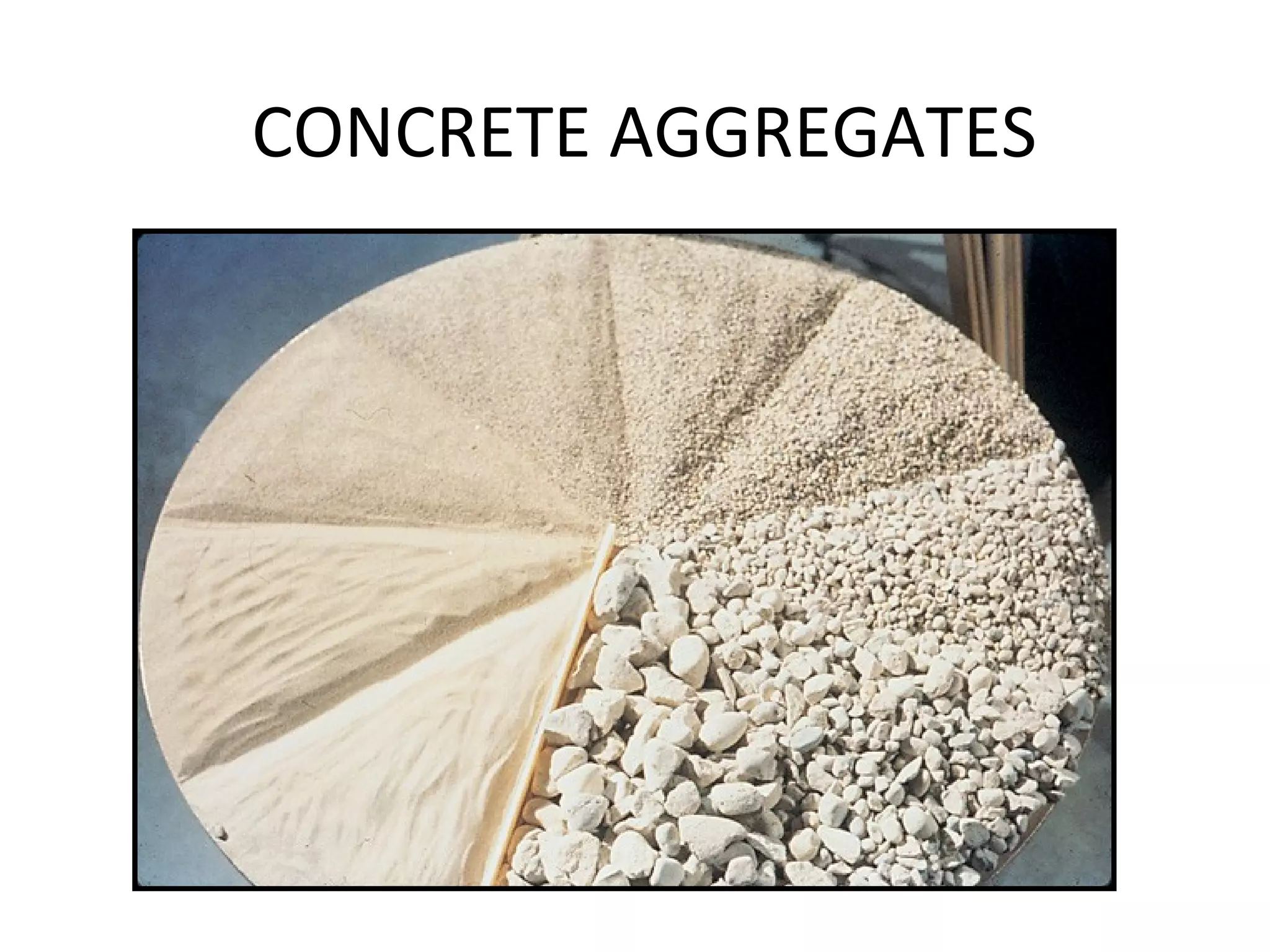
CONCRETE AGGREGATES
binding medium
(mortar)
 Portland Cement Concrete
relatively inert
filler materials
(aggregates)
 In concrete mixtures the proportions of cement paste
& aggregates is controlled by the following factors:
1) Suitable workability & placeability of fresh mass.
2) Adequate strength & durability of hardened product.
3) Minimum cost of the final product
The aggregate occupies ~70-75% of the
volume of concrete, so its quality is of great
importance.
Aggregates may affect the following
properties of concrete:
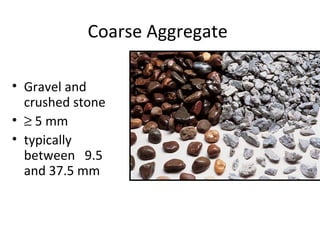
– Strength
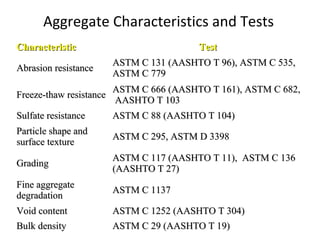
– Durability
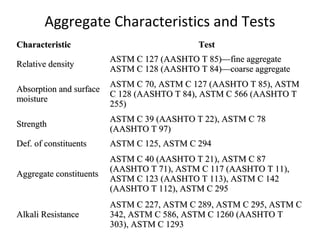
– Structural Performance
– Economy
 Aggregates have 3 main functions in
concrete:
1) To provide a mass of particles which are suitable
to resist the action of applied loads & show
better durability then cement paste alone.
2) To provide a relatively cheap filler for the
cementing material.
3) To reduce volume changes resulting from setting
& hardening process & from moisture changes
during drying.
 The properties of concrete are affected by the
properties of aggregate:
1. The mineral character of aggregate affects the
strength, durability, elasticity of concrete.
2. The surface characteristics of aggregate affects
the workability of fresh mass & the bond between
the aggregate & cement paste in hardened
concrete. If it is rough, workability decreases &
bond increases.
3. The grading of aggregate affects the workability,
density & economy.
4. The amount of aggregate in unit volume of
concrete
Higher aggregate amount/unit volume of
concrete
– Results in less volume changes during setting &
hardening or moisture changes. (increase in
volume stability)
– Increase in strength & durability
– Decrease in cost
It is a common practice to use as much
aggregate as possible in concrete
However, all aggregates are not inert:
– The physical action: swelling & shrinkage
– The chemical action: alkali-agg. Reaction
– The thermal action: expansion & contraction
Like the other ingredients of concrete,
aggregates must also be chosen with certain
care to end up with a satisfactory concrete.
CLASSIFICATION OF AGGREGATES
 According to Source:
1. Natural aggregate: Native deposits with no change
in their natural state other than washing, crushing
& grading. (sand, gravel, crush stone)
2. Artificial aggregates: They are obtained either as a
by-product or by a special manufacturing process
such as heating. (blast furnace slag, expanded
perlite)
 According to Petrological Characteristics:
1. Igneous rocks: are formed by solidification of
molten lava. (granite)
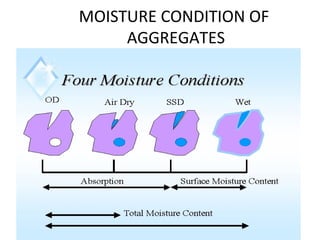
2. Sedimentary rocks: are obtained by deposition of
weathered & transported pre-existing rocks or
solutions. (limestone)
3. Metamorphic rocks: are formed under high heat
& pressure alteration of either igneous &
sedimentary rocks (marble).
 According to Unit Weight:
1. Heavy weight agg.: Hematite, Magnetite
Specific Gravity, Gs > 2.8
2. Normal weight agg.:Gravel, sand, crushed stone 2.8
< Gs < 2.4
3. Light weight agg.:Expanded perlite, burned clay Gs <
2.4
Normal-Weight Aggregate
Most common aggregates
• Sand
• Gravel
• Crushed stone
Produce normal-weight concrete 2200 to 2400 kg/m3
ASTM C 33
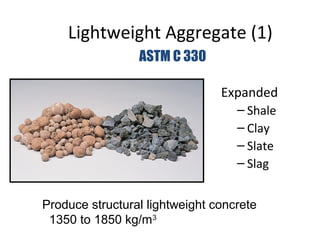
Lightweight Aggregate (1)
Expanded
– Shale
– Clay
– Slate
– Slag
Produce structural lightweight concrete
1350 to 1850 kg/m3
ASTM C 330
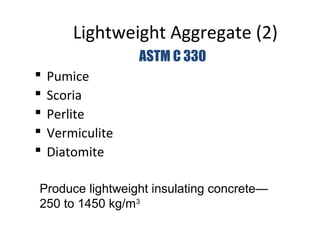
Lightweight Aggregate (2)
 Pumice
 Scoria
 Perlite
 Vermiculite
 Diatomite
Produce lightweight insulating concrete—
250 to 1450 kg/m3
ASTM C 330
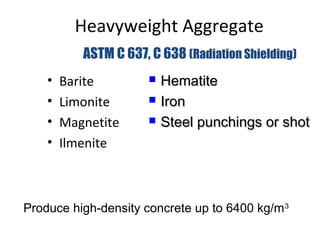
Heavyweight Aggregate
• Barite
• Limonite
• Magnetite
• Ilmenite
ASTM C 637, C 638 (Radiation Shielding)
Produce high-density concrete up to 6400 kg/m3
 HematiteHematite
 IronIron
 Steel punchings or shotSteel punchings or shot
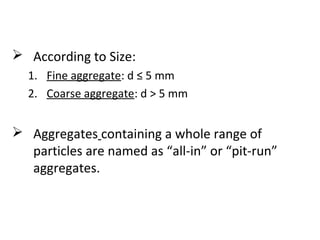
 According to Size:
1. Fine aggregate: d ≤ 5 mm
2. Coarse aggregate: d > 5 mm
 Aggregates containing a whole range of
particles are named as “all-in” or “pit-run”
aggregates.
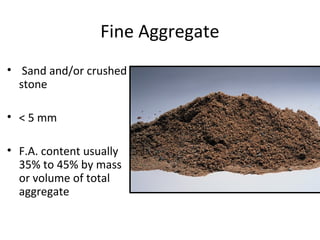
Fine Aggregate
• Sand and/or crushed
stone
• < 5 mm
• F.A. content usually
35% to 45% by mass
or volume of total
aggregate
Coarse Aggregate
• Gravel and
crushed stone
• ≥ 5 mm
• typically
between 9.5
and 37.5 mm
Aggregate Characteristics and Tests
CharacteristicCharacteristic TestTest
Abrasion resistanceAbrasion resistance
ASTM C 131 (AASHTO T 96), ASTM C 535,ASTM C 131 (AASHTO T 96), ASTM C 535,
ASTM C 779ASTM C 779
Freeze-thaw resistanceFreeze-thaw resistance
ASTM C 666 (AASHTO T 161), ASTM C 682,ASTM C 666 (AASHTO T 161), ASTM C 682,
AASHTO T 103AASHTO T 103
Sulfate resistanceSulfate resistance ASTM C 88 (AASHTO T 104)ASTM C 88 (AASHTO T 104)
Particle shape andParticle shape and
surface texturesurface texture
ASTM C 295, ASTM D 3398ASTM C 295, ASTM D 3398
GradingGrading
ASTM C 117 (AASHTO T 11), ASTM C 136ASTM C 117 (AASHTO T 11), ASTM C 136
(AASHTO T 27)(AASHTO T 27)
Fine aggregateFine aggregate
degradationdegradation
ASTM C 1137ASTM C 1137
Void contentVoid content ASTM C 1252 (AASHTO T 304)ASTM C 1252 (AASHTO T 304)
Bulk densityBulk density ASTM C 29 (AASHTO T 19)ASTM C 29 (AASHTO T 19)
Aggregate Characteristics and Tests
CharacteristicCharacteristic TestTest
Relative densityRelative density
ASTM C 127 (AASHTO T 85)—fine aggregateASTM C 127 (AASHTO T 85)—fine aggregate
ASTM C 128 (AASHTO T 84)—coarse aggregateASTM C 128 (AASHTO T 84)—coarse aggregate
Absorption and surfaceAbsorption and surface
moisturemoisture
ASTM C 70, ASTM C 127 (AASHTO T 85), ASTMASTM C 70, ASTM C 127 (AASHTO T 85), ASTM
C 128 (AASHTO T 84), ASTM C 566 (AASHTO TC 128 (AASHTO T 84), ASTM C 566 (AASHTO T
255)255)
StrengthStrength
ASTM C 39 (AASHTO T 22), ASTM C 78ASTM C 39 (AASHTO T 22), ASTM C 78
(AASHTO T 97)(AASHTO T 97)
Def. of constituentsDef. of constituents ASTM C 125, ASTM C 294ASTM C 125, ASTM C 294
Aggregate constituentsAggregate constituents
ASTM C 40 (AASHTO T 21), ASTM C 87ASTM C 40 (AASHTO T 21), ASTM C 87
(AASHTO T 71), ASTM C 117 (AASHTO T 11),(AASHTO T 71), ASTM C 117 (AASHTO T 11),
ASTM C 123 (AASHTO T 113), ASTM C 142ASTM C 123 (AASHTO T 113), ASTM C 142
(AASHTO T 112), ASTM C 295(AASHTO T 112), ASTM C 295
Alkali ResistanceAlkali Resistance
ASTM C 227, ASTM C 289, ASTM C 295, ASTM CASTM C 227, ASTM C 289, ASTM C 295, ASTM C
342, ASTM C 586, ASTM C 1260 (AASHTO T342, ASTM C 586, ASTM C 1260 (AASHTO T
303), ASTM C 1293303), ASTM C 1293
SAMPLING
Tests in the lab is carried out on the samples. So,
certain precautions in obtaining a sample must
be taken to obtain “representative sample”.
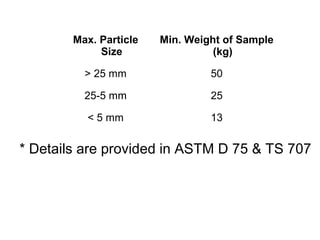
The main sample is made up of portions drawn
from different points. The minimum number of
portions, increment, is 10 & they should add up
to a weight not less than:
Max. Particle
Size
Min. Weight of Sample
(kg)
> 25 mm 50
25-5 mm 25
< 5 mm 13
* Details are provided in ASTM D 75 & TS 707
 Methods of reducing the amount of sample:
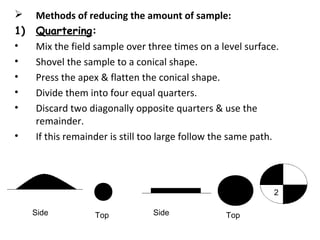
1) Quartering:
• Mix the field sample over three times on a level surface.
• Shovel the sample to a conical shape.
• Press the apex & flatten the conical shape.
• Divide them into four equal quarters.
• Discard two diagonally opposite quarters & use the
remainder.
• If this remainder is still too large follow the same path.
Side SideTop Top
2
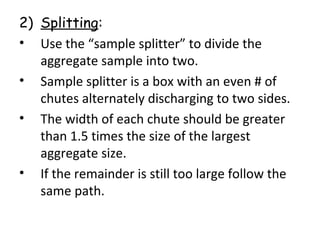
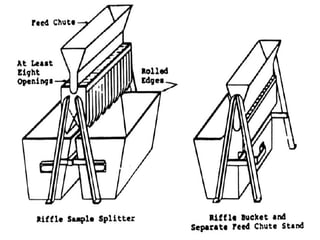
2) Splitting:
• Use the “sample splitter” to divide the
aggregate sample into two.
• Sample splitter is a box with an even # of
chutes alternately discharging to two sides.
• The width of each chute should be greater
than 1.5 times the size of the largest
aggregate size.
• If the remainder is still too large follow the
same path.
PARTICLE SHAPE & SURFACE TEXTURE
In addition to petrological character, the
external characteristics, i.e. The shape &
surface texture of aggregates are of
importance.
Particle Shape
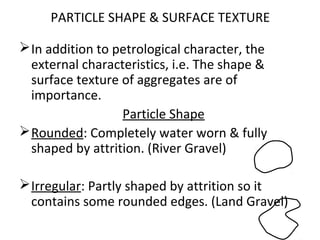
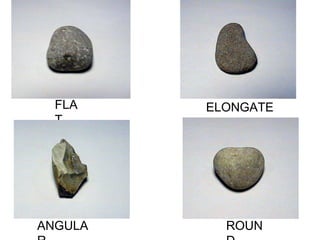
Rounded: Completely water worn & fully
shaped by attrition. (River Gravel)
Irregular: Partly shaped by attrition so it
contains some rounded edges. (Land Gravel)
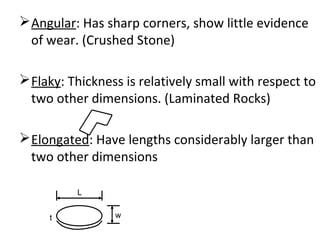
Angular: Has sharp corners, show little evidence
of wear. (Crushed Stone)
Flaky: Thickness is relatively small with respect to
two other dimensions. (Laminated Rocks)
Elongated: Have lengths considerably larger than
two other dimensions
L
wt
FLA
T
ELONGATE
D
ROUNANGULA
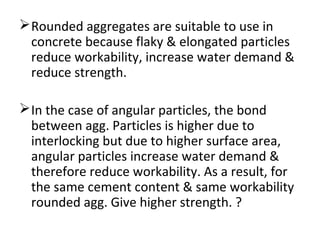
Rounded aggregates are suitable to use in
concrete because flaky & elongated particles
reduce workability, increase water demand &
reduce strength.
In the case of angular particles, the bond
between agg. Particles is higher due to
interlocking but due to higher surface area,
angular particles increase water demand &
therefore reduce workability. As a result, for
the same cement content & same workability
rounded agg. Give higher strength. ?
Surface Texture
This affects the bond to the cement paste &
also influences the water demand of the mix.
Smooth: Bond b/w cement paste & agg is weak.

Rough: Bond b/w cement paste & agg. is strong.
Surface texture is not a very important
property from compressive strength point of
view but agg. Having rough surface texture
perform better under flexural & tensile
stresses.
SMOOTH ROUG
H
Grading of Aggregates
―Grading is the particle-size distribution of an
aggregate as determined by a sieve analysis using
wire mesh sieves with square openings.
ASTM C 33
Fine aggregate―7 standard sieves with openings from
150 μm to 9.5 mm
Coarse aggregate―13 sieves with openings from 1.18
mm to 100 mm
ASTM C 33
125 mm
100 mm
90 mm
75 mm (3")
63 mm
50 mm (2")
37.5 mm (1-1/2")
25 mm (1")
12.5 mm (1/2")
9.5 mm (3/8")
4.75 mm (#4)
2.38 mm (#8)
1.19 mm (#16)
0.595 mm (#30)
0.297 mm (#50)
0.149 mm (#100)
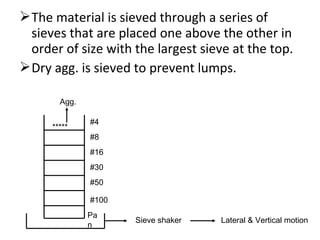
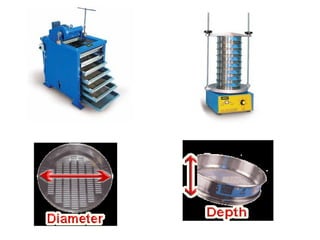
The material is sieved through a series of
sieves that are placed one above the other in
order of size with the largest sieve at the top.
Dry agg. is sieved to prevent lumps.
*****
Agg.
#4
#8
#16
#30
#50
#100
Pa
n
Sieve shaker Lateral & Vertical motion
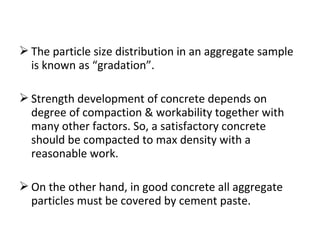
 The particle size distribution in an aggregate sample
is known as “gradation”.
 Strength development of concrete depends on
degree of compaction & workability together with
many other factors. So, a satisfactory concrete
should be compacted to max density with a
reasonable work.
 On the other hand, in good concrete all aggregate
particles must be covered by cement paste.
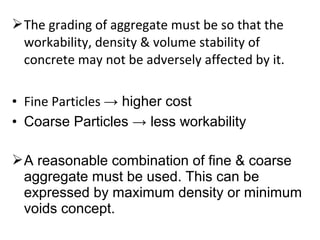
The grading of aggregate must be so that the
workability, density & volume stability of
concrete may not be adversely affected by it.
• Fine Particles → higher cost
• Coarse Particles → less workability
A reasonable combination of fine & coarse
aggregate must be used. This can be
expressed by maximum density or minimum
voids concept.
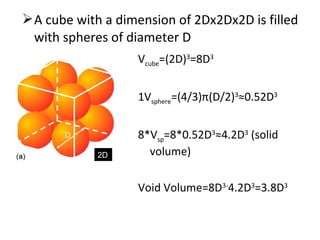
A cube with a dimension of 2Dx2Dx2D is filled
with spheres of diameter D
Vcube=(2D)3
=8D3
1Vsphere=(4/3)π(D/2)3
≈0.52D3
8*Vsp=8*0.52D3
≈4.2D3
(solid
volume)
Void Volume=8D3-
4.2D3
=3.8D3
2D
D
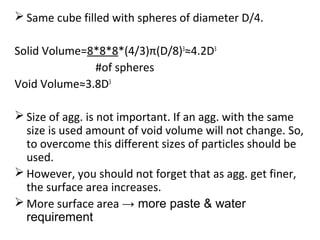
 Same cube filled with spheres of diameter D/4.
Solid Volume=8*8*8*(4/3)π(D/8)3
≈4.2D3
#of spheres
Void Volume≈3.8D3
 Size of agg. is not important. If an agg. with the same
size is used amount of void volume will not change. So,
to overcome this different sizes of particles should be
used.
 However, you should not forget that as agg. get finer,
the surface area increases.
 More surface area → more paste & water
requirement
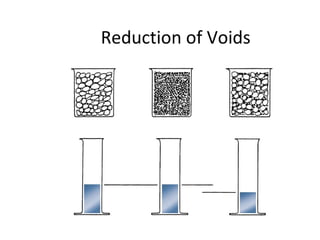
Reduction of Voids
Factors Affecting a Desired Grading
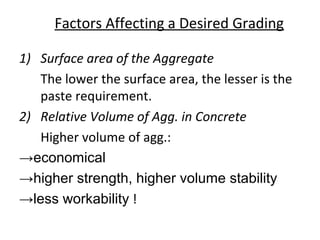
1) Surface area of the Aggregate
The lower the surface area, the lesser is the
paste requirement.
2) Relative Volume of Agg. in Concrete
Higher volume of agg.:
→economical
→higher strength, higher volume stability
→less workability !
3) Workability: The ease with which a concrete mixture
can be mixed, transported, placed in theform &
compacted without any segregation.
Workability increases as the amount of paste b/w fine
agg. part increases. It also increases as the amount of
mortar b/w coarse agg. particles increases.
4) Segregation: Seperation of the particles with different
sizes & specific gravities.
The requirements of workability and absence of
segregation tend to oppose each other. Thus, these
two factors are interrelated. The major of these is
workability which, in turn, affects most of the
properties of concrete.
Determination of the Grading of Aggregate
There are two different methods for determining
the agg. grading:
• Fineness Modulus (FM)
• Granulometry
The grading of the particles in an agg. sample is
performed by “sieve analysis”. The sieve analysis
is conducted by the use of “standard test
sieves”. Test sieves have square openings & their
designation correspond to the sizes of those
openings.
1) Fineness Modulus (FM):
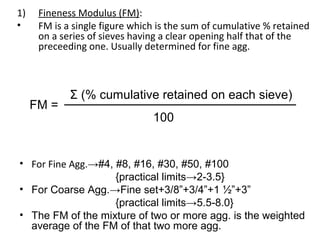
• FM is a single figure which is the sum of cumulative % retained
on a series of sieves having a clear opening half that of the
preceeding one. Usually determined for fine agg.
• For Fine Agg.→#4, #8, #16, #30, #50, #100
{practical limits→2-3.5}
• For Coarse Agg.→Fine set+3/8”+3/4”+1 ½”+3”
{practical limits→5.5-8.0}
• The FM of the mixture of two or more agg. is the weighted
average of the FM of that two more agg.
FM =
Σ (% cumulative retained on each sieve)
100
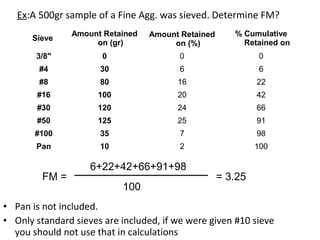
Sieve
Amount Retained
on (gr)
Amount Retained
on (%)
% Cumulative
Retained on
3/8" 0 0 0
#4 30 6 6
#8 80 16 22
#16 100 20 42
#30 120 24 66
#50 125 25 91
#100 35 7 98
Pan 10 2 100
Ex:A 500gr sample of a Fine Agg. was sieved. Determine FM?
• Pan is not included.
• Only standard sieves are included, if we were given #10 sieve
you should not use that in calculations
FM =
6+22+42+66+91+98
100
= 3.25
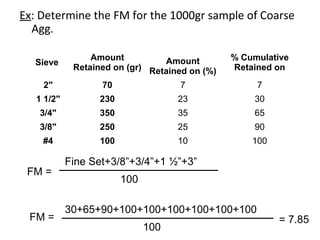
Ex: Determine the FM for the 1000gr sample of Coarse
Agg.
Sieve
Amount
Retained on (gr)
Amount
Retained on (%)
% Cumulative
Retained on
2" 70 7 7
1 1/2" 230 23 30
3/4" 350 35 65
3/8" 250 25 90
#4 100 10 100
FM =
Fine Set+3/8”+3/4”+1 ½”+3”
100
FM =
30+65+90+100+100+100+100+100+100
100
= 7.85
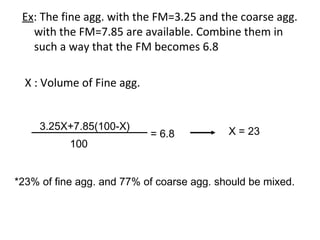
Ex: The fine agg. with the FM=3.25 and the coarse agg.
with the FM=7.85 are available. Combine them in
such a way that the FM becomes 6.8
X : Volume of Fine agg.
3.25X+7.85(100-X)
100
= 6.8 X = 23
*23% of fine agg. and 77% of coarse agg. should be mixed.
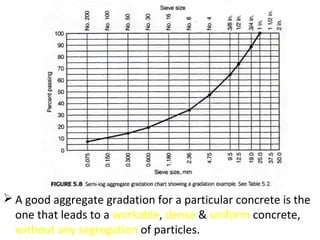
2) Granulometry:
• The FM is not always representative of the
gradation of an aggregate sample and various
gradation curves may give the same FM.
• In the gradation curves, the vertical axis
represents the % passing & the horizontal axis
represents the sieve opening.
• A logarithmic scale is used for horizontal axis.
 A good aggregate gradation for a particular concrete is the
one that leads to a workable, dense & uniform concrete,
without any segregation of particles.
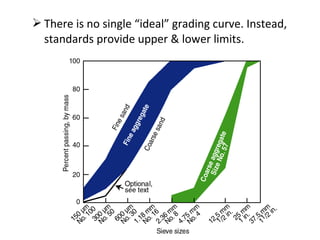
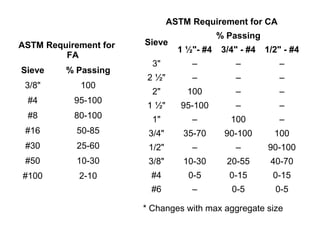
 There is no single “ideal” grading curve. Instead,
standards provide upper & lower limits.
ASTM Requirement for
FA
Sieve % Passing
3/8" 100
#4 95-100
#8 80-100
#16 50-85
#30 25-60
#50 10-30
#100 2-10
ASTM Requirement for CA
Sieve
% Passing
1 ½"- #4 3/4" - #4 1/2" - #4
3" – – –
2 ½" – – –
2" 100 – –
1 ½" 95-100 – –
1" – 100 –
3/4" 35-70 90-100 100
1/2" – – 90-100
3/8" 10-30 20-55 40-70
#4 0-5 0-15 0-15
#6 – 0-5 0-5
* Changes with max aggregate size
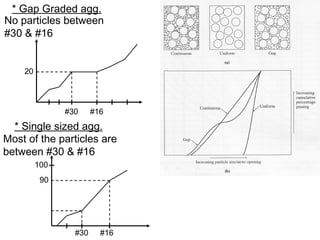
* Gap Graded agg.
#30 #16
20
No particles between
#30 & #16
* Single sized agg.
#30 #16
90
100
Most of the particles are
between #30 & #16
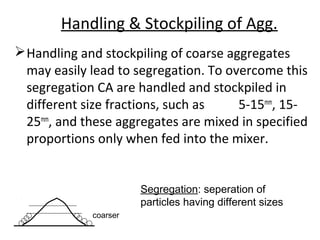
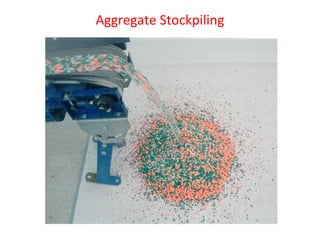
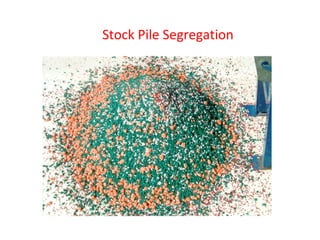
Handling & Stockpiling of Agg.
Handling and stockpiling of coarse aggregates
may easily lead to segregation. To overcome this
segregation CA are handled and stockpiled in
different size fractions, such as 5-15mm
, 15-
25mm
, and these aggregates are mixed in specified
proportions only when fed into the mixer.
coarser
Segregation: seperation of
particles having different sizes
Aggregate Stockpiling
Stock Pile Segregation
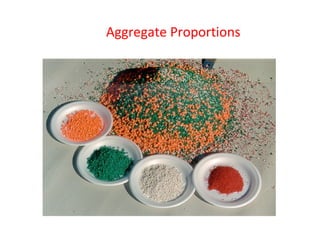
Aggregate Proportions
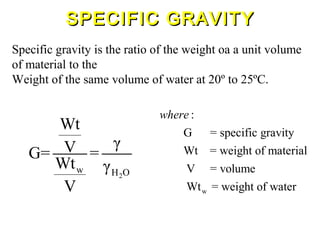
Specific gravity is the ratio of the weight oa a unit volume
of material to the
Weight of the same volume of water at 20º to 25ºC.
2
w H O
Wt
γVG= =
Wt γ
V w
:
G = specific gravity
Wt = weight of material
V = volume
Wt = weight of water
where
SPECIFIC GRAVITYSPECIFIC GRAVITY
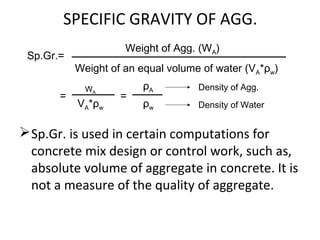
SPECIFIC GRAVITY OF AGG.
Sp.Gr. is used in certain computations for
concrete mix design or control work, such as,
absolute volume of aggregate in concrete. It is
not a measure of the quality of aggregate.
Sp.Gr.=
Weight of Agg. (WA)
Weight of an equal volume of water (VA*ρw)
=
WA
VA*ρw
=
ρA
ρw
Density of Agg.
Density of Water
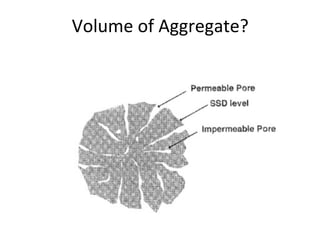
Volume of Aggregate?
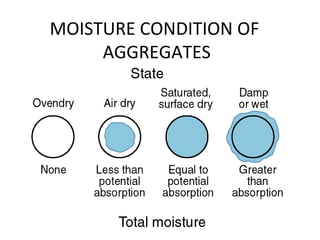
MOISTURE CONDITION OF
AGGREGATES
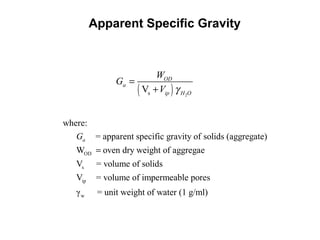
Apparent Specific Gravity
( ) 2sV
OD
a
ip H O
W
G
V γ
=
+
Overall volume of the aggregate exclusive of the volume of the pores or
Capillaries which become filled with water in 24 hrs of soaking
OD
s
ip
w
where:
= apparent specific gravity of solids (aggregate)
W oven dry weight of aggregae
V = volume of solids
V = volume of impermeable pores
γ = unit we
aG
=
ight of water (1 g/ml)
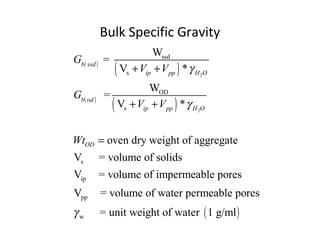
Bulk Specific Gravity
( )
( )
( )
( )
2
2
ssd
s
OD
s
s
ip
pp
w
W
=
V *
W
=
V *
oven dry weight of aggregate
V = volume of solids
V = volume of impermeable pores
V = volume of water permeable pores
= unit
b ssd
ip pp H O
b od
ip pp H O
OD
G
V V
G
V V
Wt
γ
γ
γ
+ +
+ +
=
( )weight of water 1 g/ml
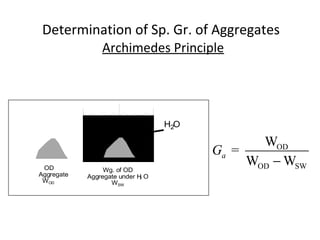
Determination of Sp. Gr. of Aggregates
Archimedes Principle
H O2
OD
Aggregate
WOD
Wg. of OD
Aggregate under H O
WSW
2
OD
OD SW
W
=
W W
aG
−
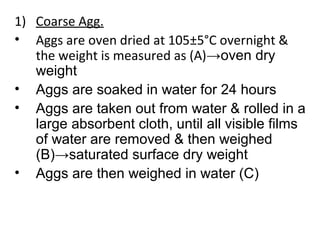
1) Coarse Agg.
• Aggs are oven dried at 105±5°C overnight &
the weight is measured as (A)→oven dry
weight
• Aggs are soaked in water for 24 hours
• Aggs are taken out from water & rolled in a
large absorbent cloth, until all visible films
of water are removed & then weighed
(B)→saturated surface dry weight
• Aggs are then weighed in water (C)
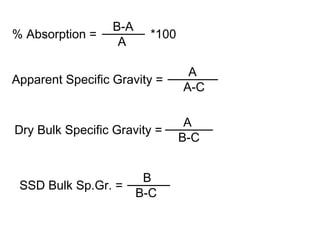
% Absorption =
B-A
A
*100
Apparent Specific Gravity =
A
A-C
Dry Bulk Specific Gravity =
A
B-C
SSD Bulk Sp.Gr. =
B
B-C
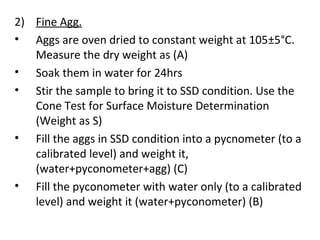
2) Fine Agg.
• Aggs are oven dried to constant weight at 105±5°C.
Measure the dry weight as (A)
• Soak them in water for 24hrs
• Stir the sample to bring it to SSD condition. Use the
Cone Test for Surface Moisture Determination
(Weight as S)
• Fill the aggs in SSD condition into a pycnometer (to a
calibrated level) and weight it,
(water+pyconometer+agg) (C)
• Fill the pyconometer with water only (to a calibrated
level) and weight it (water+pyconometer) (B)
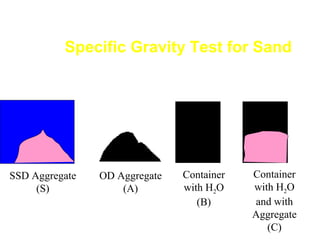
OD Aggregate
(A)
Container
with H2O
(B)
Container
with H2O
and with
Aggregate
(C)
Specific Gravity Test for Sand
SSD Aggregate
(S)
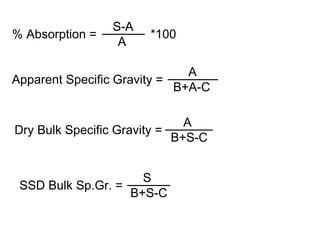
% Absorption =
S-A
A
*100
Apparent Specific Gravity =
A
B+A-C
Dry Bulk Specific Gravity =
A
B+S-C
SSD Bulk Sp.Gr. =
S
B+S-C
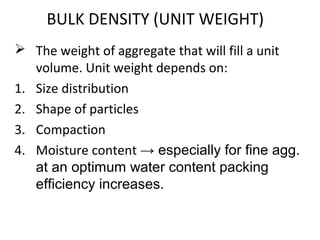
BULK DENSITY (UNIT WEIGHT)
 The weight of aggregate that will fill a unit
volume. Unit weight depends on:
1. Size distribution
2. Shape of particles
3. Compaction
4. Moisture content → especially for fine agg.
at an optimum water content packing
efficiency increases.
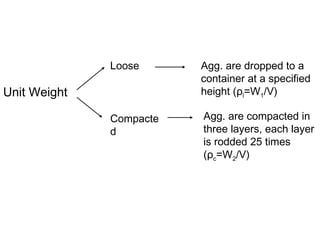
Unit Weight
Loose Agg. are dropped to a
container at a specified
height (ρl=W1/V)
Compacte
d
Agg. are compacted in
three layers, each layer
is rodded 25 times
(ρc=W2/V)
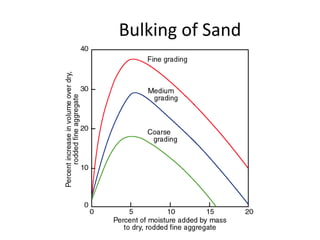
Bulking of Sand
MOISTURE CONDITION OF
AGGREGATES
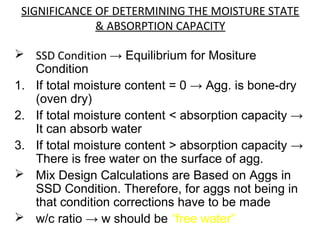
SIGNIFICANCE OF DETERMINING THE MOISTURE STATE
& ABSORPTION CAPACITY
 SSD Condition → Equilibrium for Mositure
Condition
1. If total moisture content = 0 → Agg. is bone-dry
(oven dry)
2. If total moisture content < absorption capacity →
It can absorb water
3. If total moisture content > absorption capacity →
There is free water on the surface of agg.
 Mix Design Calculations are Based on Aggs in
SSD Condition. Therefore, for aggs not being in
that condition corrections have to be made
 w/c ratio → w should be “free water”
Porosity / Absorption of Aggregates
Porosity or permeability of aggregates and its
absorption may affect the following factors:
 The bond between aggregate and cement paste
 Resistance to freezing & thawing of concrete
 Chemical stability
 Resistance to abrasion
 Specific gravity
 Yield of concrete for a given weight of agg.
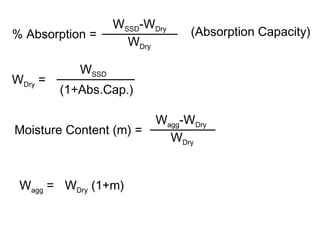
% Absorption =
WSSD-WDry
WDry
(Absorption Capacity)
WDry =
WSSD
(1+Abs.Cap.)
Moisture Content (m) =
Wagg-WDry
WDry
Wagg = WDry (1+m)
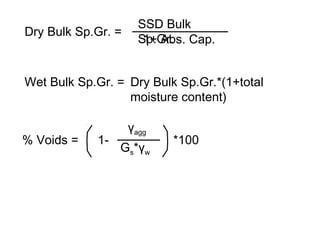
Dry Bulk Sp.Gr. =
SSD Bulk
Sp.Gr.1+ Abs. Cap.
% Voids =
Wet Bulk Sp.Gr. = Dry Bulk Sp.Gr.*(1+total
moisture content)
γagg
Gs*γw
1- *100
DELETERIOUS MATERIALS
IN AGGREGATES
 Organic Impurities in natural aggs may
interfere with the setting & hardening of
concrete. They can be detected by tests, ASTM
C40, TS 3673
DELETERIOUS MATERIALS IN
AGGREGATES
 Very Fine Particles: They can appear in the
form of clay and silt or in the form of stone
dust → they increase the water requirement
or in other words decrease workability.
– They can appear as coatings on the surface of agg
particles → they affect bonding properties.
– TS 3527→ particles smaller than 63μm
– ASTM C 117→ #200 sieve (75μm)
DELETERIOUS MATERIALS IN
AGGREGATES
 Weak & Unsound Materials Light weight
materials (coals, lignide): In excessive
amounts may affect durability of concrete.
If these impurities occur at or near the
surface, they may disintegrate & cause
pop-outs & stains.
DELETERIOUS MATERIALS IN
AGGREGATES
Soft particles : they are objectionable because
they affect the durability adversely. They may
cause pop-outs & may brake up during mixing
and increase the water demand.
Salt contamination : Most important effects are:
 Corrosion of reinforcement
 Effloresence: presence of white deposits on the
surface of concrete.
SOUNDNESS OF AGGREGATES
Soundness is the ability of agg to resist volume
changes to environmental effects.
– Freezing & Thawing
– Alternate Wetting & Drying
– Temperature Changes
SOUNDNESS OF AGGREGATES
Aggs are said to be unsound when volume
changes induced by the above, results in
deterioration of concrete. This effect may be:
– Local scaling
– Extensive surface cracking
– Disintegration over a considerable depth
SOUNDNESS OF AGGREGATES
To detect unsound particles, aggs are treated
with Na2SO4 or MgSO4 solutions.
– 18 hours of immersion
– Dry at 105°C+5°C to constant weight
– After 5 cycles determine the loss in weight of the agg.
SOUNDNESS OF AGGREGATES
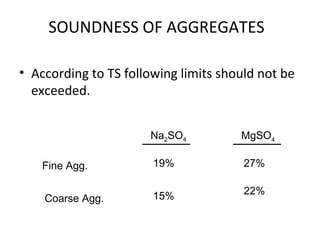
• According to TS following limits should not be
exceeded.
Na2SO4 MgSO4
Fine Agg.
Coarse Agg.
19%
22%15%
27%
ABRASION RESISTANCE
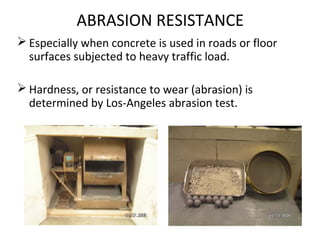
 Especially when concrete is used in roads or floor
surfaces subjected to heavy traffic load.
 Hardness, or resistance to wear (abrasion) is
determined by Los-Angeles abrasion test.
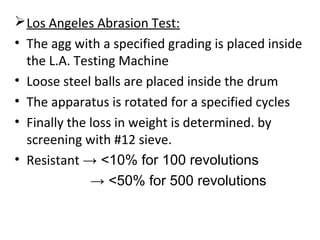
Los Angeles Abrasion Test:
• The agg with a specified grading is placed inside
the L.A. Testing Machine
• Loose steel balls are placed inside the drum
• The apparatus is rotated for a specified cycles
• Finally the loss in weight is determined. by
screening with #12 sieve.
• Resistant → <10% for 100 revolutions
→ <50% for 500 revolutions
Alkali- Aggregate Reactivity ( AAR )
• — is a reaction between the active mineral
constituents of some aggregates and the
sodium and potassium alkali hydroxides and
calcium hydroxide in the concrete.
– Alkali-Silica Reaction (ASR)
– Alkali-Carbonate Reaction (ACR )
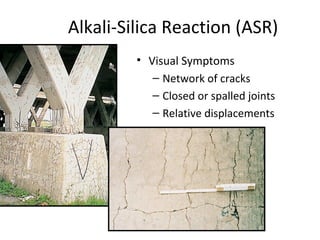
Alkali-Silica Reaction (ASR)
• Visual Symptoms
– Network of cracks
– Closed or spalled joints
– Relative displacements
Alkali-Silica Reaction (ASR)
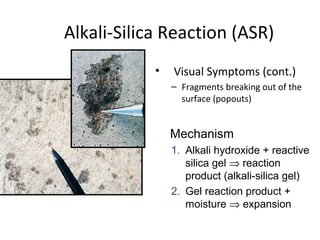
• Visual Symptoms (cont.)
– Fragments breaking out of the
surface (popouts)
Mechanism
1. Alkali hydroxide + reactive
silica gel ⇒ reaction
product (alkali-silica gel)
2. Gel reaction product +
moisture ⇒ expansion
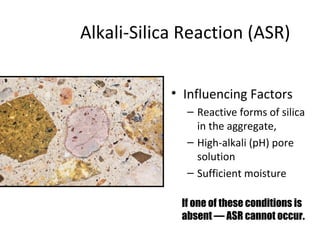
Alkali-Silica Reaction (ASR)
• Influencing Factors
– Reactive forms of silica
in the aggregate,
– High-alkali (pH) pore
solution
– Sufficient moisture
If one of these conditions is
absent ― ASR cannot occur.
Alkali-Silica Reaction (ASR)
• Test Methods
– Mortar-Bar Method (ASTM 227)
– Chemical Method (ASTM C 289)
– Petrographic Examination (ASTM C 295)
– Rapid Mortar-Bar Test (ASTM C 1260)
– Concrete Prism Test (ASTM C 1293 )
Alkali-Silica Reaction (ASR)
• Controlling ASR
– Non-reactive aggregates
– Supplementary cementing materials or blended
cements
– Limit alkalis in cement
– Lithium-based admixtures
– Limestone sweetening (~30% replacement of
reactive aggregate with crushed limestone
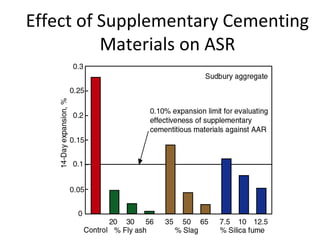
Effect of Supplementary Cementing
Materials on ASR
MAX AGG SIZE
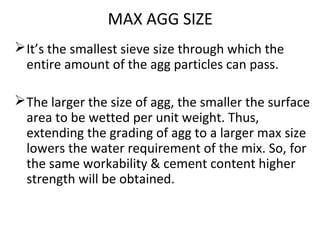
It’s the smallest sieve size through which the
entire amount of the agg particles can pass.
The larger the size of agg, the smaller the surface
area to be wetted per unit weight. Thus,
extending the grading of agg to a larger max size
lowers the water requirement of the mix. So, for
the same workability & cement content higher
strength will be obtained.
Optimum max agg size for structural concrete is
25mm.
Studies have shown that concrete’s made with
max agg size greater than 40mm have lower
strength. Because of the smaller surface area for
the bond between agg to paste. Volume
changes in the paste causes larger stresses at
the interface.
Standard Limitations for Max Agg Size
The concrete mix must be so that, it can be
placed inside the molds and between the
reinforcing bars easily without any segregation.
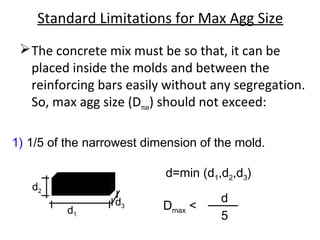
So, max agg size (Dmax) should not exceed:
1) 1/5 of the narrowest dimension of the mold.
d2
d1
d3
d=min (d1,d2,d3)
Dmax <
d
5
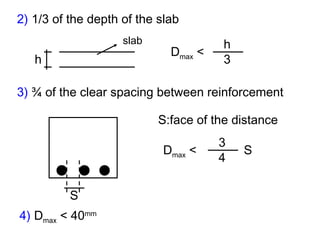
2) 1/3 of the depth of the slab
h
slab
Dmax <
h
3
3) ¾ of the clear spacing between reinforcement
S
S:face of the distance
Dmax <
3
4
S
4) Dmax < 40mm
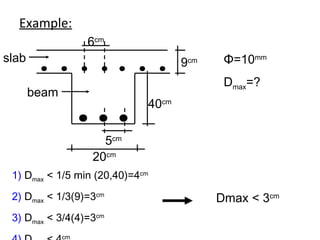
Example:
slab
5cm
6cm
20cm
40cm
9cm
beam
Φ=10mm
Dmax=?
1) Dmax < 1/5 min (20,40)=4cm
2) Dmax < 1/3(9)=3cm
3) Dmax < 3/4(4)=3cm
cm
Dmax < 3cm

Concrete aggregates 2

  • 1.
  • 2.
    binding medium (mortar)  PortlandCement Concrete relatively inert filler materials (aggregates)  In concrete mixtures the proportions of cement paste & aggregates is controlled by the following factors: 1) Suitable workability & placeability of fresh mass. 2) Adequate strength & durability of hardened product. 3) Minimum cost of the final product
  • 3.
    The aggregate occupies~70-75% of the volume of concrete, so its quality is of great importance. Aggregates may affect the following properties of concrete: – Strength – Durability – Structural Performance – Economy
  • 4.
     Aggregates have3 main functions in concrete: 1) To provide a mass of particles which are suitable to resist the action of applied loads & show better durability then cement paste alone. 2) To provide a relatively cheap filler for the cementing material. 3) To reduce volume changes resulting from setting & hardening process & from moisture changes during drying.
  • 5.
     The propertiesof concrete are affected by the properties of aggregate: 1. The mineral character of aggregate affects the strength, durability, elasticity of concrete. 2. The surface characteristics of aggregate affects the workability of fresh mass & the bond between the aggregate & cement paste in hardened concrete. If it is rough, workability decreases & bond increases. 3. The grading of aggregate affects the workability, density & economy. 4. The amount of aggregate in unit volume of concrete
  • 6.
    Higher aggregate amount/unitvolume of concrete – Results in less volume changes during setting & hardening or moisture changes. (increase in volume stability) – Increase in strength & durability – Decrease in cost It is a common practice to use as much aggregate as possible in concrete
  • 7.
    However, all aggregatesare not inert: – The physical action: swelling & shrinkage – The chemical action: alkali-agg. Reaction – The thermal action: expansion & contraction Like the other ingredients of concrete, aggregates must also be chosen with certain care to end up with a satisfactory concrete.
  • 8.
    CLASSIFICATION OF AGGREGATES According to Source: 1. Natural aggregate: Native deposits with no change in their natural state other than washing, crushing & grading. (sand, gravel, crush stone) 2. Artificial aggregates: They are obtained either as a by-product or by a special manufacturing process such as heating. (blast furnace slag, expanded perlite)
  • 9.
     According toPetrological Characteristics: 1. Igneous rocks: are formed by solidification of molten lava. (granite) 2. Sedimentary rocks: are obtained by deposition of weathered & transported pre-existing rocks or solutions. (limestone) 3. Metamorphic rocks: are formed under high heat & pressure alteration of either igneous & sedimentary rocks (marble).
  • 10.
     According toUnit Weight: 1. Heavy weight agg.: Hematite, Magnetite Specific Gravity, Gs > 2.8 2. Normal weight agg.:Gravel, sand, crushed stone 2.8 < Gs < 2.4 3. Light weight agg.:Expanded perlite, burned clay Gs < 2.4
  • 11.
    Normal-Weight Aggregate Most commonaggregates • Sand • Gravel • Crushed stone Produce normal-weight concrete 2200 to 2400 kg/m3 ASTM C 33
  • 12.
    Lightweight Aggregate (1) Expanded –Shale – Clay – Slate – Slag Produce structural lightweight concrete 1350 to 1850 kg/m3 ASTM C 330
  • 13.
    Lightweight Aggregate (2) Pumice  Scoria  Perlite  Vermiculite  Diatomite Produce lightweight insulating concrete— 250 to 1450 kg/m3 ASTM C 330
  • 14.
    Heavyweight Aggregate • Barite •Limonite • Magnetite • Ilmenite ASTM C 637, C 638 (Radiation Shielding) Produce high-density concrete up to 6400 kg/m3  HematiteHematite  IronIron  Steel punchings or shotSteel punchings or shot
  • 15.
     According toSize: 1. Fine aggregate: d ≤ 5 mm 2. Coarse aggregate: d > 5 mm  Aggregates containing a whole range of particles are named as “all-in” or “pit-run” aggregates.
  • 16.
    Fine Aggregate • Sandand/or crushed stone • < 5 mm • F.A. content usually 35% to 45% by mass or volume of total aggregate
  • 17.
    Coarse Aggregate • Graveland crushed stone • ≥ 5 mm • typically between 9.5 and 37.5 mm
  • 18.
    Aggregate Characteristics andTests CharacteristicCharacteristic TestTest Abrasion resistanceAbrasion resistance ASTM C 131 (AASHTO T 96), ASTM C 535,ASTM C 131 (AASHTO T 96), ASTM C 535, ASTM C 779ASTM C 779 Freeze-thaw resistanceFreeze-thaw resistance ASTM C 666 (AASHTO T 161), ASTM C 682,ASTM C 666 (AASHTO T 161), ASTM C 682, AASHTO T 103AASHTO T 103 Sulfate resistanceSulfate resistance ASTM C 88 (AASHTO T 104)ASTM C 88 (AASHTO T 104) Particle shape andParticle shape and surface texturesurface texture ASTM C 295, ASTM D 3398ASTM C 295, ASTM D 3398 GradingGrading ASTM C 117 (AASHTO T 11), ASTM C 136ASTM C 117 (AASHTO T 11), ASTM C 136 (AASHTO T 27)(AASHTO T 27) Fine aggregateFine aggregate degradationdegradation ASTM C 1137ASTM C 1137 Void contentVoid content ASTM C 1252 (AASHTO T 304)ASTM C 1252 (AASHTO T 304) Bulk densityBulk density ASTM C 29 (AASHTO T 19)ASTM C 29 (AASHTO T 19)
  • 19.
    Aggregate Characteristics andTests CharacteristicCharacteristic TestTest Relative densityRelative density ASTM C 127 (AASHTO T 85)—fine aggregateASTM C 127 (AASHTO T 85)—fine aggregate ASTM C 128 (AASHTO T 84)—coarse aggregateASTM C 128 (AASHTO T 84)—coarse aggregate Absorption and surfaceAbsorption and surface moisturemoisture ASTM C 70, ASTM C 127 (AASHTO T 85), ASTMASTM C 70, ASTM C 127 (AASHTO T 85), ASTM C 128 (AASHTO T 84), ASTM C 566 (AASHTO TC 128 (AASHTO T 84), ASTM C 566 (AASHTO T 255)255) StrengthStrength ASTM C 39 (AASHTO T 22), ASTM C 78ASTM C 39 (AASHTO T 22), ASTM C 78 (AASHTO T 97)(AASHTO T 97) Def. of constituentsDef. of constituents ASTM C 125, ASTM C 294ASTM C 125, ASTM C 294 Aggregate constituentsAggregate constituents ASTM C 40 (AASHTO T 21), ASTM C 87ASTM C 40 (AASHTO T 21), ASTM C 87 (AASHTO T 71), ASTM C 117 (AASHTO T 11),(AASHTO T 71), ASTM C 117 (AASHTO T 11), ASTM C 123 (AASHTO T 113), ASTM C 142ASTM C 123 (AASHTO T 113), ASTM C 142 (AASHTO T 112), ASTM C 295(AASHTO T 112), ASTM C 295 Alkali ResistanceAlkali Resistance ASTM C 227, ASTM C 289, ASTM C 295, ASTM CASTM C 227, ASTM C 289, ASTM C 295, ASTM C 342, ASTM C 586, ASTM C 1260 (AASHTO T342, ASTM C 586, ASTM C 1260 (AASHTO T 303), ASTM C 1293303), ASTM C 1293
  • 20.
    SAMPLING Tests in thelab is carried out on the samples. So, certain precautions in obtaining a sample must be taken to obtain “representative sample”. The main sample is made up of portions drawn from different points. The minimum number of portions, increment, is 10 & they should add up to a weight not less than:
  • 21.
    Max. Particle Size Min. Weightof Sample (kg) > 25 mm 50 25-5 mm 25 < 5 mm 13 * Details are provided in ASTM D 75 & TS 707
  • 22.
     Methods ofreducing the amount of sample: 1) Quartering: • Mix the field sample over three times on a level surface. • Shovel the sample to a conical shape. • Press the apex & flatten the conical shape. • Divide them into four equal quarters. • Discard two diagonally opposite quarters & use the remainder. • If this remainder is still too large follow the same path. Side SideTop Top 2
  • 23.
    2) Splitting: • Usethe “sample splitter” to divide the aggregate sample into two. • Sample splitter is a box with an even # of chutes alternately discharging to two sides. • The width of each chute should be greater than 1.5 times the size of the largest aggregate size. • If the remainder is still too large follow the same path.
  • 25.
    PARTICLE SHAPE &SURFACE TEXTURE In addition to petrological character, the external characteristics, i.e. The shape & surface texture of aggregates are of importance. Particle Shape Rounded: Completely water worn & fully shaped by attrition. (River Gravel) Irregular: Partly shaped by attrition so it contains some rounded edges. (Land Gravel)
  • 26.
    Angular: Has sharpcorners, show little evidence of wear. (Crushed Stone) Flaky: Thickness is relatively small with respect to two other dimensions. (Laminated Rocks) Elongated: Have lengths considerably larger than two other dimensions L wt
  • 27.
  • 28.
    Rounded aggregates aresuitable to use in concrete because flaky & elongated particles reduce workability, increase water demand & reduce strength. In the case of angular particles, the bond between agg. Particles is higher due to interlocking but due to higher surface area, angular particles increase water demand & therefore reduce workability. As a result, for the same cement content & same workability rounded agg. Give higher strength. ?
  • 29.
    Surface Texture This affectsthe bond to the cement paste & also influences the water demand of the mix. Smooth: Bond b/w cement paste & agg is weak.  Rough: Bond b/w cement paste & agg. is strong. Surface texture is not a very important property from compressive strength point of view but agg. Having rough surface texture perform better under flexural & tensile stresses.
  • 30.
  • 31.
    Grading of Aggregates ―Gradingis the particle-size distribution of an aggregate as determined by a sieve analysis using wire mesh sieves with square openings. ASTM C 33 Fine aggregate―7 standard sieves with openings from 150 μm to 9.5 mm Coarse aggregate―13 sieves with openings from 1.18 mm to 100 mm
  • 32.
    ASTM C 33 125mm 100 mm 90 mm 75 mm (3") 63 mm 50 mm (2") 37.5 mm (1-1/2") 25 mm (1") 12.5 mm (1/2") 9.5 mm (3/8") 4.75 mm (#4) 2.38 mm (#8) 1.19 mm (#16) 0.595 mm (#30) 0.297 mm (#50) 0.149 mm (#100)
  • 33.
    The material issieved through a series of sieves that are placed one above the other in order of size with the largest sieve at the top. Dry agg. is sieved to prevent lumps. ***** Agg. #4 #8 #16 #30 #50 #100 Pa n Sieve shaker Lateral & Vertical motion
  • 35.
     The particlesize distribution in an aggregate sample is known as “gradation”.  Strength development of concrete depends on degree of compaction & workability together with many other factors. So, a satisfactory concrete should be compacted to max density with a reasonable work.  On the other hand, in good concrete all aggregate particles must be covered by cement paste.
  • 36.
    The grading ofaggregate must be so that the workability, density & volume stability of concrete may not be adversely affected by it. • Fine Particles → higher cost • Coarse Particles → less workability A reasonable combination of fine & coarse aggregate must be used. This can be expressed by maximum density or minimum voids concept.
  • 37.
    A cube witha dimension of 2Dx2Dx2D is filled with spheres of diameter D Vcube=(2D)3 =8D3 1Vsphere=(4/3)π(D/2)3 ≈0.52D3 8*Vsp=8*0.52D3 ≈4.2D3 (solid volume) Void Volume=8D3- 4.2D3 =3.8D3 2D D
  • 38.
     Same cubefilled with spheres of diameter D/4. Solid Volume=8*8*8*(4/3)π(D/8)3 ≈4.2D3 #of spheres Void Volume≈3.8D3  Size of agg. is not important. If an agg. with the same size is used amount of void volume will not change. So, to overcome this different sizes of particles should be used.  However, you should not forget that as agg. get finer, the surface area increases.  More surface area → more paste & water requirement
  • 39.
  • 40.
    Factors Affecting aDesired Grading 1) Surface area of the Aggregate The lower the surface area, the lesser is the paste requirement. 2) Relative Volume of Agg. in Concrete Higher volume of agg.: →economical →higher strength, higher volume stability →less workability !
  • 41.
    3) Workability: Theease with which a concrete mixture can be mixed, transported, placed in theform & compacted without any segregation. Workability increases as the amount of paste b/w fine agg. part increases. It also increases as the amount of mortar b/w coarse agg. particles increases. 4) Segregation: Seperation of the particles with different sizes & specific gravities. The requirements of workability and absence of segregation tend to oppose each other. Thus, these two factors are interrelated. The major of these is workability which, in turn, affects most of the properties of concrete.
  • 42.
    Determination of theGrading of Aggregate There are two different methods for determining the agg. grading: • Fineness Modulus (FM) • Granulometry The grading of the particles in an agg. sample is performed by “sieve analysis”. The sieve analysis is conducted by the use of “standard test sieves”. Test sieves have square openings & their designation correspond to the sizes of those openings.
  • 43.
    1) Fineness Modulus(FM): • FM is a single figure which is the sum of cumulative % retained on a series of sieves having a clear opening half that of the preceeding one. Usually determined for fine agg. • For Fine Agg.→#4, #8, #16, #30, #50, #100 {practical limits→2-3.5} • For Coarse Agg.→Fine set+3/8”+3/4”+1 ½”+3” {practical limits→5.5-8.0} • The FM of the mixture of two or more agg. is the weighted average of the FM of that two more agg. FM = Σ (% cumulative retained on each sieve) 100
  • 44.
    Sieve Amount Retained on (gr) AmountRetained on (%) % Cumulative Retained on 3/8" 0 0 0 #4 30 6 6 #8 80 16 22 #16 100 20 42 #30 120 24 66 #50 125 25 91 #100 35 7 98 Pan 10 2 100 Ex:A 500gr sample of a Fine Agg. was sieved. Determine FM? • Pan is not included. • Only standard sieves are included, if we were given #10 sieve you should not use that in calculations FM = 6+22+42+66+91+98 100 = 3.25
  • 45.
    Ex: Determine theFM for the 1000gr sample of Coarse Agg. Sieve Amount Retained on (gr) Amount Retained on (%) % Cumulative Retained on 2" 70 7 7 1 1/2" 230 23 30 3/4" 350 35 65 3/8" 250 25 90 #4 100 10 100 FM = Fine Set+3/8”+3/4”+1 ½”+3” 100 FM = 30+65+90+100+100+100+100+100+100 100 = 7.85
  • 46.
    Ex: The fineagg. with the FM=3.25 and the coarse agg. with the FM=7.85 are available. Combine them in such a way that the FM becomes 6.8 X : Volume of Fine agg. 3.25X+7.85(100-X) 100 = 6.8 X = 23 *23% of fine agg. and 77% of coarse agg. should be mixed.
  • 47.
    2) Granulometry: • TheFM is not always representative of the gradation of an aggregate sample and various gradation curves may give the same FM. • In the gradation curves, the vertical axis represents the % passing & the horizontal axis represents the sieve opening. • A logarithmic scale is used for horizontal axis.
  • 48.
     A goodaggregate gradation for a particular concrete is the one that leads to a workable, dense & uniform concrete, without any segregation of particles.
  • 49.
     There isno single “ideal” grading curve. Instead, standards provide upper & lower limits.
  • 50.
    ASTM Requirement for FA Sieve% Passing 3/8" 100 #4 95-100 #8 80-100 #16 50-85 #30 25-60 #50 10-30 #100 2-10 ASTM Requirement for CA Sieve % Passing 1 ½"- #4 3/4" - #4 1/2" - #4 3" – – – 2 ½" – – – 2" 100 – – 1 ½" 95-100 – – 1" – 100 – 3/4" 35-70 90-100 100 1/2" – – 90-100 3/8" 10-30 20-55 40-70 #4 0-5 0-15 0-15 #6 – 0-5 0-5 * Changes with max aggregate size
  • 51.
    * Gap Gradedagg. #30 #16 20 No particles between #30 & #16 * Single sized agg. #30 #16 90 100 Most of the particles are between #30 & #16
  • 52.
    Handling & Stockpilingof Agg. Handling and stockpiling of coarse aggregates may easily lead to segregation. To overcome this segregation CA are handled and stockpiled in different size fractions, such as 5-15mm , 15- 25mm , and these aggregates are mixed in specified proportions only when fed into the mixer. coarser Segregation: seperation of particles having different sizes
  • 53.
  • 54.
  • 55.
  • 56.
    Specific gravity isthe ratio of the weight oa a unit volume of material to the Weight of the same volume of water at 20º to 25ºC. 2 w H O Wt γVG= = Wt γ V w : G = specific gravity Wt = weight of material V = volume Wt = weight of water where SPECIFIC GRAVITYSPECIFIC GRAVITY
  • 57.
    SPECIFIC GRAVITY OFAGG. Sp.Gr. is used in certain computations for concrete mix design or control work, such as, absolute volume of aggregate in concrete. It is not a measure of the quality of aggregate. Sp.Gr.= Weight of Agg. (WA) Weight of an equal volume of water (VA*ρw) = WA VA*ρw = ρA ρw Density of Agg. Density of Water
  • 58.
  • 59.
  • 60.
    Apparent Specific Gravity () 2sV OD a ip H O W G V γ = + Overall volume of the aggregate exclusive of the volume of the pores or Capillaries which become filled with water in 24 hrs of soaking OD s ip w where: = apparent specific gravity of solids (aggregate) W oven dry weight of aggregae V = volume of solids V = volume of impermeable pores γ = unit we aG = ight of water (1 g/ml)
  • 61.
    Bulk Specific Gravity () ( ) ( ) ( ) 2 2 ssd s OD s s ip pp w W = V * W = V * oven dry weight of aggregate V = volume of solids V = volume of impermeable pores V = volume of water permeable pores = unit b ssd ip pp H O b od ip pp H O OD G V V G V V Wt γ γ γ + + + + = ( )weight of water 1 g/ml
  • 62.
    Determination of Sp.Gr. of Aggregates Archimedes Principle H O2 OD Aggregate WOD Wg. of OD Aggregate under H O WSW 2 OD OD SW W = W W aG −
  • 63.
    1) Coarse Agg. •Aggs are oven dried at 105±5°C overnight & the weight is measured as (A)→oven dry weight • Aggs are soaked in water for 24 hours • Aggs are taken out from water & rolled in a large absorbent cloth, until all visible films of water are removed & then weighed (B)→saturated surface dry weight • Aggs are then weighed in water (C)
  • 64.
    % Absorption = B-A A *100 ApparentSpecific Gravity = A A-C Dry Bulk Specific Gravity = A B-C SSD Bulk Sp.Gr. = B B-C
  • 65.
    2) Fine Agg. •Aggs are oven dried to constant weight at 105±5°C. Measure the dry weight as (A) • Soak them in water for 24hrs • Stir the sample to bring it to SSD condition. Use the Cone Test for Surface Moisture Determination (Weight as S) • Fill the aggs in SSD condition into a pycnometer (to a calibrated level) and weight it, (water+pyconometer+agg) (C) • Fill the pyconometer with water only (to a calibrated level) and weight it (water+pyconometer) (B)
  • 66.
    OD Aggregate (A) Container with H2O (B) Container withH2O and with Aggregate (C) Specific Gravity Test for Sand SSD Aggregate (S)
  • 67.
    % Absorption = S-A A *100 ApparentSpecific Gravity = A B+A-C Dry Bulk Specific Gravity = A B+S-C SSD Bulk Sp.Gr. = S B+S-C
  • 68.
    BULK DENSITY (UNITWEIGHT)  The weight of aggregate that will fill a unit volume. Unit weight depends on: 1. Size distribution 2. Shape of particles 3. Compaction 4. Moisture content → especially for fine agg. at an optimum water content packing efficiency increases.
  • 69.
    Unit Weight Loose Agg.are dropped to a container at a specified height (ρl=W1/V) Compacte d Agg. are compacted in three layers, each layer is rodded 25 times (ρc=W2/V)
  • 70.
  • 71.
  • 72.
    SIGNIFICANCE OF DETERMININGTHE MOISTURE STATE & ABSORPTION CAPACITY  SSD Condition → Equilibrium for Mositure Condition 1. If total moisture content = 0 → Agg. is bone-dry (oven dry) 2. If total moisture content < absorption capacity → It can absorb water 3. If total moisture content > absorption capacity → There is free water on the surface of agg.  Mix Design Calculations are Based on Aggs in SSD Condition. Therefore, for aggs not being in that condition corrections have to be made  w/c ratio → w should be “free water”
  • 73.
    Porosity / Absorptionof Aggregates Porosity or permeability of aggregates and its absorption may affect the following factors:  The bond between aggregate and cement paste  Resistance to freezing & thawing of concrete  Chemical stability  Resistance to abrasion  Specific gravity  Yield of concrete for a given weight of agg.
  • 74.
    % Absorption = WSSD-WDry WDry (AbsorptionCapacity) WDry = WSSD (1+Abs.Cap.) Moisture Content (m) = Wagg-WDry WDry Wagg = WDry (1+m)
  • 75.
    Dry Bulk Sp.Gr.= SSD Bulk Sp.Gr.1+ Abs. Cap. % Voids = Wet Bulk Sp.Gr. = Dry Bulk Sp.Gr.*(1+total moisture content) γagg Gs*γw 1- *100
  • 76.
    DELETERIOUS MATERIALS IN AGGREGATES Organic Impurities in natural aggs may interfere with the setting & hardening of concrete. They can be detected by tests, ASTM C40, TS 3673
  • 77.
    DELETERIOUS MATERIALS IN AGGREGATES Very Fine Particles: They can appear in the form of clay and silt or in the form of stone dust → they increase the water requirement or in other words decrease workability. – They can appear as coatings on the surface of agg particles → they affect bonding properties. – TS 3527→ particles smaller than 63μm – ASTM C 117→ #200 sieve (75μm)
  • 78.
    DELETERIOUS MATERIALS IN AGGREGATES Weak & Unsound Materials Light weight materials (coals, lignide): In excessive amounts may affect durability of concrete. If these impurities occur at or near the surface, they may disintegrate & cause pop-outs & stains.
  • 79.
    DELETERIOUS MATERIALS IN AGGREGATES Softparticles : they are objectionable because they affect the durability adversely. They may cause pop-outs & may brake up during mixing and increase the water demand. Salt contamination : Most important effects are:  Corrosion of reinforcement  Effloresence: presence of white deposits on the surface of concrete.
  • 80.
    SOUNDNESS OF AGGREGATES Soundnessis the ability of agg to resist volume changes to environmental effects. – Freezing & Thawing – Alternate Wetting & Drying – Temperature Changes
  • 81.
    SOUNDNESS OF AGGREGATES Aggsare said to be unsound when volume changes induced by the above, results in deterioration of concrete. This effect may be: – Local scaling – Extensive surface cracking – Disintegration over a considerable depth
  • 82.
    SOUNDNESS OF AGGREGATES Todetect unsound particles, aggs are treated with Na2SO4 or MgSO4 solutions. – 18 hours of immersion – Dry at 105°C+5°C to constant weight – After 5 cycles determine the loss in weight of the agg.
  • 83.
    SOUNDNESS OF AGGREGATES •According to TS following limits should not be exceeded. Na2SO4 MgSO4 Fine Agg. Coarse Agg. 19% 22%15% 27%
  • 84.
    ABRASION RESISTANCE  Especiallywhen concrete is used in roads or floor surfaces subjected to heavy traffic load.  Hardness, or resistance to wear (abrasion) is determined by Los-Angeles abrasion test.
  • 85.
    Los Angeles AbrasionTest: • The agg with a specified grading is placed inside the L.A. Testing Machine • Loose steel balls are placed inside the drum • The apparatus is rotated for a specified cycles • Finally the loss in weight is determined. by screening with #12 sieve. • Resistant → <10% for 100 revolutions → <50% for 500 revolutions
  • 86.
    Alkali- Aggregate Reactivity( AAR ) • — is a reaction between the active mineral constituents of some aggregates and the sodium and potassium alkali hydroxides and calcium hydroxide in the concrete. – Alkali-Silica Reaction (ASR) – Alkali-Carbonate Reaction (ACR )
  • 87.
    Alkali-Silica Reaction (ASR) •Visual Symptoms – Network of cracks – Closed or spalled joints – Relative displacements
  • 88.
    Alkali-Silica Reaction (ASR) •Visual Symptoms (cont.) – Fragments breaking out of the surface (popouts) Mechanism 1. Alkali hydroxide + reactive silica gel ⇒ reaction product (alkali-silica gel) 2. Gel reaction product + moisture ⇒ expansion
  • 89.
    Alkali-Silica Reaction (ASR) •Influencing Factors – Reactive forms of silica in the aggregate, – High-alkali (pH) pore solution – Sufficient moisture If one of these conditions is absent ― ASR cannot occur.
  • 90.
    Alkali-Silica Reaction (ASR) •Test Methods – Mortar-Bar Method (ASTM 227) – Chemical Method (ASTM C 289) – Petrographic Examination (ASTM C 295) – Rapid Mortar-Bar Test (ASTM C 1260) – Concrete Prism Test (ASTM C 1293 )
  • 91.
    Alkali-Silica Reaction (ASR) •Controlling ASR – Non-reactive aggregates – Supplementary cementing materials or blended cements – Limit alkalis in cement – Lithium-based admixtures – Limestone sweetening (~30% replacement of reactive aggregate with crushed limestone
  • 92.
    Effect of SupplementaryCementing Materials on ASR
  • 93.
    MAX AGG SIZE It’sthe smallest sieve size through which the entire amount of the agg particles can pass. The larger the size of agg, the smaller the surface area to be wetted per unit weight. Thus, extending the grading of agg to a larger max size lowers the water requirement of the mix. So, for the same workability & cement content higher strength will be obtained.
  • 94.
    Optimum max aggsize for structural concrete is 25mm. Studies have shown that concrete’s made with max agg size greater than 40mm have lower strength. Because of the smaller surface area for the bond between agg to paste. Volume changes in the paste causes larger stresses at the interface.
  • 95.
    Standard Limitations forMax Agg Size The concrete mix must be so that, it can be placed inside the molds and between the reinforcing bars easily without any segregation. So, max agg size (Dmax) should not exceed: 1) 1/5 of the narrowest dimension of the mold. d2 d1 d3 d=min (d1,d2,d3) Dmax < d 5
  • 96.
    2) 1/3 ofthe depth of the slab h slab Dmax < h 3 3) ¾ of the clear spacing between reinforcement S S:face of the distance Dmax < 3 4 S 4) Dmax < 40mm
  • 97.
    Example: slab 5cm 6cm 20cm 40cm 9cm beam Φ=10mm Dmax=? 1) Dmax <1/5 min (20,40)=4cm 2) Dmax < 1/3(9)=3cm 3) Dmax < 3/4(4)=3cm cm Dmax < 3cm

Editor's Notes

  • #13 Fig. 5-3. Lightweight aggregate. Expanded clay (left) and expanded shale (right). (69793)
  • #14 See also Chapter 18-EB001-Design and Control of Concrete Mixtures-14th Edition for information on Lightweight Concrete
  • #15 See Chapter 18-EB001-Design and Control of Concrete Mixtures-14th Edition for information on Heavyweight Concrete
  • #17 Fig. 5-1. Closeup of fine aggregate (sand). (69792)
  • #18 Fig. 5-2. Coarse aggregate. Rounded gravel (left) and crushed stone (right). (69791)
  • #19 Table 5.2. Characteristics and Tests of Aggregate The majority of the tests and characteristics listed are referenced in ASTM C 33 (AASHTO M 6/M 80). ACI 221R-96 presents additional test methods and properties of concrete influenced by aggregate characteristics.
  • #20 Table 5.2. Characteristics and Tests of Aggregate The majority of the tests and characteristics listed are referenced in ASTM C 33 (AASHTO M 6/M 80). ACI 221R-96 presents additional test methods and properties of concrete influenced by aggregate characteristics.
  • #40 Fig. 5-7. The level of liquid in the graduates, representing voids, is constant for equal absolute volumes of aggregates of uniform but different size. When different sizes are combined, the void-content decreases. The illustration is not to scale.
  • #71 Fig. 5-13. Surface moisture on fine aggregate can cause considerable bulking; the amount varies with the amount of moisture and the aggregate grading (PCA Major Series 172 and PCA ST20).
  • #72 Fig. 5-12. Moisture conditions of aggregate.
  • #87 Harmful only when it produces significant expansion Alkali-Silica Reaction most common
  • #88 Fig. 5-20 (top and bottom). Cracking of concrete from alkali-silica reactivity. (69549, 58352)
  • #89 Fig. 5-21. Popouts caused by ASR of sand-sized particles. Inset shows closeup of a popout. (51117, 51118)
  • #90 Fig. 5-22. Polished section view of an alkali reactive aggregate in concrete. Observe the alkali-silica reaction rim around the reactive aggregate and the crack formation. (43090)
  • #91 Table 5-8. Test Methods for Alkali-Silica Reactivity (Farny and Kosmatka 1997)
  • #93 Fig. 5-23. Influence of different amounts of fly ash, slag, and silica fume by mass of cementing material on mortar bar expansion (ASTM 1260) after 14 days when using reactive aggregate (Fournier 1997).