Materials for Concrete
Aggregates(Combined)
Materials for Concrete
• Occupy 70-75% of the total volume of
concrete
• Defined as an inert mineral filler for OPC –
BIS, ASTM, ACI & BS 882 codes
Aggregates(Combined)
Aggregates are the inert filler materials,
such as sand or stone, used in making
concrete
Aggregates
• Coarse Aggregates (4.75mm-80mm)
Broken Stones & Gravels
• Fine Aggregates (<4.75mm)
Gravel, Sand, Silt & Clay
Fine & Coarse Aggregates
• Fine Aggregate - <4.75mm (5mm)
• Coarse Aggregate - >4.75mm & up to 80mm
• Boulders – Beyond 80mm
• Grading:
Fine Aggregate Coarse Aggregate
C-Coarse 40, 20, 14mm down
M-Medium till 4.75 mm
F-Fine
Sizes
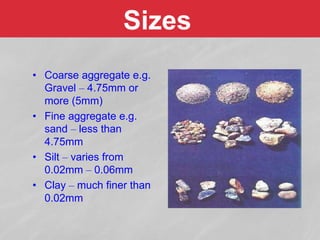
• Coarse aggregate e.g.
Gravel – 4.75mm or
more (5mm)
• Fine aggregate e.g.
sand – less than
4.75mm
• Silt – varies from
0.02mm – 0.06mm
• Clay – much finer than
0.02mm
Classification
• A) Petrological – BS 812
• B) Density
• C) Shape & texture
A) Petrological
1.) Igneous rocks - Granites, basalts
dolerites, gabbro & porphyries – Hard, tough,
dense – Excellent aggregates
2.) Sedimentary rocks - Sandstones -
When hard & dense suitable - Siliceous
better than calcareous which are liable to acid
attack
Limes Stones - Sedimentary rocks chiefly
composed of calcium carbonate Harder, denser
types are suitable
A) Petrological
Shale - Poor aggregates – weak, soft, laminated
& absorptive
3.) Metamorphic rocks - Variable characters
– marbles & quartzite usually massive, dense &
adequately tough & strong
Schist & slates are often thinly laminated &
therefore unsuitable
B) Density
1.) Heavy – SG>4.0
i) Magnetic, natural iron ore (Fe3O4)
ii) Barytes (BaSO4)
2.) Normal SG 2.5-3.0
i) Sands & gravels – division is arbitrarily on size – sands
pass 4.76 mm BS sieve
ii) Granites & basalts – hard & tough
iii) Sandstone – hard & dense types
iv) Limestone – hard & dense types
v) Broken bricks – must be free of plaster – low sulphur
content
vi) Air cooled blast furnace slag
B) Density
3.) Lightweight - SG<2.5
i) Sintered PFA
ii) Foamed slag
iii) Vermiculite
iv) Expanded polystyrene
v) Pumice
vi) Wood waste
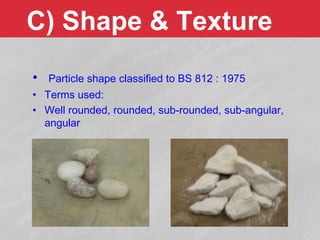
C) Shape & Texture
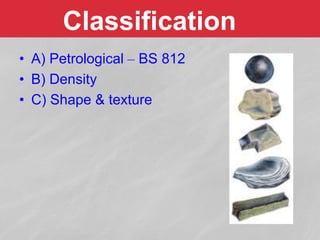
• Particle shape classified to BS 812 : 1975
• Terms used:
• Well rounded, rounded, sub-rounded, sub-angular,
angular
• Surface texture classified to BS 812 : 1975
• Relates to the degree of polish or dullness, smoothness
or roughness of particles surfaces
• Depends on hardness, grain size and pore character
• Note: BS 812 & BS 882 have been
replaced by BS EN 12620
C) Shape & Texture
Bond of Aggregate
• Partly due to interlocking
• Partly due to physical & chemical
characteristics of the aggregate
• Other factors include the cement paste
Aggregate Properties
• Ideally should be chemically inert, durable,
hard & tough
• Should be capable of being compacted to
the appropriate density & provide good
bonding with the cement paste
A) Chemical Properties
• Soluble salts – sulphates - cause problems
with hydrated cement or chloride which
accelerate hydration & increase risk of
corrosion of steel reinforcement.
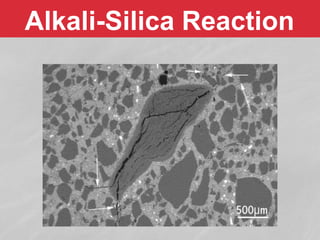
• Reactive aggregates of lime stone or rock
based vulnerable to Alkalies in the cement
resulting with formation of AAR (Alkaline
Aggregate Reaction) – an expansive
compound or ASR (Alkaline Silica Reaction) –
‘concrete cancer’ – not common now but has
been a problem in the past.
Alkali-Silica Reaction
• Clay & silt – defined as materials passing
a 75 micron sieve – harmful to concrete in
substantial amounts – increase specific
surface & hence water requirements
• Weak (unsound particles) – lower the
strength of the concrete
Other Harmful Substances
B) Physical Properties
• Strength
• Porosity
• Thermal
• Bonding
• Moisture
• Density - relative (SSD) & solid (x1000)
- bulk (packing air)
Relative Density - Calculation
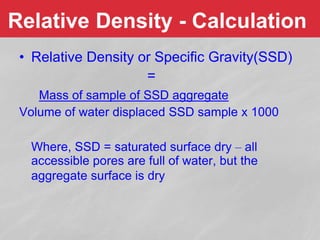
• Relative Density or Specific Gravity(SSD)
=
Mass of sample of SSD aggregate
Volume of water displaced SSD sample x 1000
Where, SSD = saturated surface dry – all
accessible pores are full of water, but the
aggregate surface is dry
Bulk Density(Unit Weight)
• Stockpiles of loosely packed aggregates contain
large volumes of air trapped between particles,
usually many times that of the volume of air
present within the particles – ‘Bulking’
• Coarse aggregates – 30-50% of total space
occupied
• Fine aggregate – approx 20% - varies with
moisture content
Batching of Aggregates
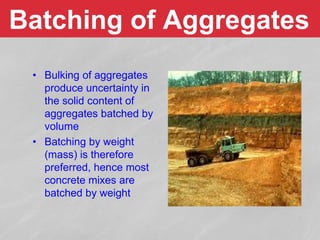
• Bulking of aggregates
produce uncertainty in
the solid content of
aggregates batched by
volume
• Batching by weight
(mass) is therefore
preferred, hence most
concrete mixes are
batched by weight
Grading of Aggregates
• Refers to the size & distribution of the aggregate
• Sieve analysis – BS 410 : 1976
• Grading limits – BS 882 : 1983
Note: The Euro-standard BS EN 12620
now covers testing & specification for
aggregates
Graded Aggregate
• Uniform Graded – equal weights of each
particle size present
• Gap graded – several consecutive particle
sizes missing
• Single graded – consist predominantly of a
single particle size
Aggregate Durability
• Soundness – degradation through
interstitial crystallisation
• Organic matter – act as retarders
• Mica – Muscovite or Biotite
• Chalk – affects strength (freeze/thaw)
• Shell – strength
• Sulphates – limited to 4% overall
• Chlorides – corrosion (<0.06%)
• Metallic Pyrites – Lead, Zinc, Iron
impurities
Aggregate Durability
Coarse Aggregates (Broken Stones)
Procurement process:
Quarrying of Stone
1. Excavating
2. Heating
3. Wedging
4. Blasting
Coarse Aggregates (Broken Stones)
Characteristics of Coarse Aggregate based on
1. Appearance
2. Strength
3. Hardness, Toughness and Resistance to Abrasion
4. Durable
5. Porosity and Absorption
6. Workability
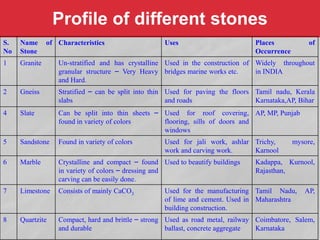
Profile of different stones
S.
No
Name of
Stone
Characteristics Uses Places of
Occurrence
1 Granite Un-stratified and has crystalline
granular structure – Very Heavy
and Hard.
Used in the construction of
bridges marine works etc.
Widely throughout
in INDIA
2 Gneiss Stratified – can be split into thin
slabs
Used for paving the floors
and roads
Tamil nadu, Kerala
Karnataka,AP, Bihar
4 Slate Can be split into thin sheets –
found in variety of colors
Used for roof covering,
flooring, sills of doors and
windows
AP, MP, Punjab
5 Sandstone Found in variety of colors Used for jali work, ashlar
work and carving work.
Trichy, mysore,
Karnool
6 Marble Crystalline and compact – found
in variety of colors – dressing and
carving can be easily done.
Used to beautify buildings Kadappa, Kurnool,
Rajasthan,
7 Limestone Consists of mainly CaCO3 Used for the manufacturing
of lime and cement. Used in
building construction.
Tamil Nadu, AP,
Maharashtra
8 Quartzite Compact, hard and brittle – strong
and durable
Used as road metal, railway
ballast, concrete aggregate
Coimbatore, Salem,
Karnataka
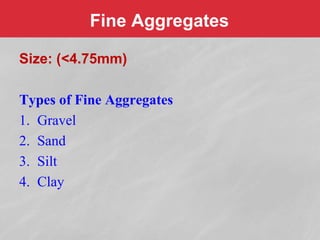
Fine Aggregates
Size: (<4.75mm)
Types of Fine Aggregates
1. Gravel
2. Sand
3. Silt
4. Clay
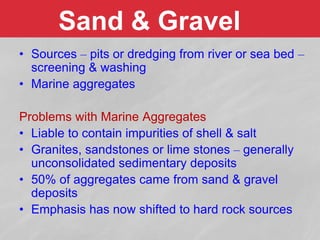
Sand & Gravel
• Sources – pits or dredging from river or sea bed –
screening & washing
• Marine aggregates
Problems with Marine Aggregates
• Liable to contain impurities of shell & salt
• Granites, sandstones or lime stones – generally
unconsolidated sedimentary deposits
• 50% of aggregates came from sand & gravel
deposits
• Emphasis has now shifted to hard rock sources
Fine Aggregates - Sand (<4.75mm)
Important Properties
1. Permeability
2. Consolidation
3. Shear Strength
Aggregate Uses
• Concrete
• Mortar
• Renders
• Screeds
• Unbound pavements
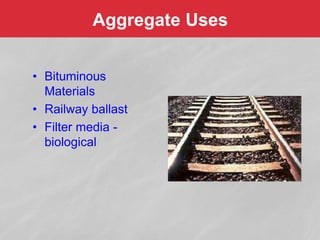
• Bituminous
Materials
• Railway ballast
• Filter media -
biological
Aggregate Uses

1.Aggregate_Intro.ppt

  • 1.
  • 2.
    Materials for Concrete •Occupy 70-75% of the total volume of concrete • Defined as an inert mineral filler for OPC – BIS, ASTM, ACI & BS 882 codes
  • 3.
    Aggregates(Combined) Aggregates are theinert filler materials, such as sand or stone, used in making concrete
  • 4.
    Aggregates • Coarse Aggregates(4.75mm-80mm) Broken Stones & Gravels • Fine Aggregates (<4.75mm) Gravel, Sand, Silt & Clay
  • 5.
    Fine & CoarseAggregates • Fine Aggregate - <4.75mm (5mm) • Coarse Aggregate - >4.75mm & up to 80mm • Boulders – Beyond 80mm • Grading: Fine Aggregate Coarse Aggregate C-Coarse 40, 20, 14mm down M-Medium till 4.75 mm F-Fine
  • 6.
    Sizes • Coarse aggregatee.g. Gravel – 4.75mm or more (5mm) • Fine aggregate e.g. sand – less than 4.75mm • Silt – varies from 0.02mm – 0.06mm • Clay – much finer than 0.02mm
  • 7.
    Classification • A) Petrological– BS 812 • B) Density • C) Shape & texture
  • 8.
    A) Petrological 1.) Igneousrocks - Granites, basalts dolerites, gabbro & porphyries – Hard, tough, dense – Excellent aggregates 2.) Sedimentary rocks - Sandstones - When hard & dense suitable - Siliceous better than calcareous which are liable to acid attack Limes Stones - Sedimentary rocks chiefly composed of calcium carbonate Harder, denser types are suitable
  • 9.
    A) Petrological Shale -Poor aggregates – weak, soft, laminated & absorptive 3.) Metamorphic rocks - Variable characters – marbles & quartzite usually massive, dense & adequately tough & strong Schist & slates are often thinly laminated & therefore unsuitable
  • 10.
    B) Density 1.) Heavy– SG>4.0 i) Magnetic, natural iron ore (Fe3O4) ii) Barytes (BaSO4) 2.) Normal SG 2.5-3.0 i) Sands & gravels – division is arbitrarily on size – sands pass 4.76 mm BS sieve ii) Granites & basalts – hard & tough iii) Sandstone – hard & dense types iv) Limestone – hard & dense types v) Broken bricks – must be free of plaster – low sulphur content vi) Air cooled blast furnace slag
  • 11.
    B) Density 3.) Lightweight- SG<2.5 i) Sintered PFA ii) Foamed slag iii) Vermiculite iv) Expanded polystyrene v) Pumice vi) Wood waste
  • 12.
    C) Shape &Texture • Particle shape classified to BS 812 : 1975 • Terms used: • Well rounded, rounded, sub-rounded, sub-angular, angular
  • 13.
    • Surface textureclassified to BS 812 : 1975 • Relates to the degree of polish or dullness, smoothness or roughness of particles surfaces • Depends on hardness, grain size and pore character • Note: BS 812 & BS 882 have been replaced by BS EN 12620 C) Shape & Texture
  • 14.
    Bond of Aggregate •Partly due to interlocking • Partly due to physical & chemical characteristics of the aggregate • Other factors include the cement paste
  • 15.
    Aggregate Properties • Ideallyshould be chemically inert, durable, hard & tough • Should be capable of being compacted to the appropriate density & provide good bonding with the cement paste
  • 16.
    A) Chemical Properties •Soluble salts – sulphates - cause problems with hydrated cement or chloride which accelerate hydration & increase risk of corrosion of steel reinforcement. • Reactive aggregates of lime stone or rock based vulnerable to Alkalies in the cement resulting with formation of AAR (Alkaline Aggregate Reaction) – an expansive compound or ASR (Alkaline Silica Reaction) – ‘concrete cancer’ – not common now but has been a problem in the past.
  • 17.
  • 18.
    • Clay &silt – defined as materials passing a 75 micron sieve – harmful to concrete in substantial amounts – increase specific surface & hence water requirements • Weak (unsound particles) – lower the strength of the concrete Other Harmful Substances
  • 19.
    B) Physical Properties •Strength • Porosity • Thermal • Bonding • Moisture • Density - relative (SSD) & solid (x1000) - bulk (packing air)
  • 20.
    Relative Density -Calculation • Relative Density or Specific Gravity(SSD) = Mass of sample of SSD aggregate Volume of water displaced SSD sample x 1000 Where, SSD = saturated surface dry – all accessible pores are full of water, but the aggregate surface is dry
  • 21.
    Bulk Density(Unit Weight) •Stockpiles of loosely packed aggregates contain large volumes of air trapped between particles, usually many times that of the volume of air present within the particles – ‘Bulking’ • Coarse aggregates – 30-50% of total space occupied • Fine aggregate – approx 20% - varies with moisture content
  • 22.
    Batching of Aggregates •Bulking of aggregates produce uncertainty in the solid content of aggregates batched by volume • Batching by weight (mass) is therefore preferred, hence most concrete mixes are batched by weight
  • 23.
    Grading of Aggregates •Refers to the size & distribution of the aggregate • Sieve analysis – BS 410 : 1976 • Grading limits – BS 882 : 1983 Note: The Euro-standard BS EN 12620 now covers testing & specification for aggregates
  • 24.
    Graded Aggregate • UniformGraded – equal weights of each particle size present • Gap graded – several consecutive particle sizes missing • Single graded – consist predominantly of a single particle size
  • 25.
    Aggregate Durability • Soundness– degradation through interstitial crystallisation • Organic matter – act as retarders • Mica – Muscovite or Biotite • Chalk – affects strength (freeze/thaw) • Shell – strength
  • 26.
    • Sulphates –limited to 4% overall • Chlorides – corrosion (<0.06%) • Metallic Pyrites – Lead, Zinc, Iron impurities Aggregate Durability
  • 27.
    Coarse Aggregates (BrokenStones) Procurement process: Quarrying of Stone 1. Excavating 2. Heating 3. Wedging 4. Blasting
  • 28.
    Coarse Aggregates (BrokenStones) Characteristics of Coarse Aggregate based on 1. Appearance 2. Strength 3. Hardness, Toughness and Resistance to Abrasion 4. Durable 5. Porosity and Absorption 6. Workability
  • 29.
    Profile of differentstones S. No Name of Stone Characteristics Uses Places of Occurrence 1 Granite Un-stratified and has crystalline granular structure – Very Heavy and Hard. Used in the construction of bridges marine works etc. Widely throughout in INDIA 2 Gneiss Stratified – can be split into thin slabs Used for paving the floors and roads Tamil nadu, Kerala Karnataka,AP, Bihar 4 Slate Can be split into thin sheets – found in variety of colors Used for roof covering, flooring, sills of doors and windows AP, MP, Punjab 5 Sandstone Found in variety of colors Used for jali work, ashlar work and carving work. Trichy, mysore, Karnool 6 Marble Crystalline and compact – found in variety of colors – dressing and carving can be easily done. Used to beautify buildings Kadappa, Kurnool, Rajasthan, 7 Limestone Consists of mainly CaCO3 Used for the manufacturing of lime and cement. Used in building construction. Tamil Nadu, AP, Maharashtra 8 Quartzite Compact, hard and brittle – strong and durable Used as road metal, railway ballast, concrete aggregate Coimbatore, Salem, Karnataka
  • 30.
    Fine Aggregates Size: (<4.75mm) Typesof Fine Aggregates 1. Gravel 2. Sand 3. Silt 4. Clay
  • 31.
    Sand & Gravel •Sources – pits or dredging from river or sea bed – screening & washing • Marine aggregates Problems with Marine Aggregates • Liable to contain impurities of shell & salt • Granites, sandstones or lime stones – generally unconsolidated sedimentary deposits • 50% of aggregates came from sand & gravel deposits • Emphasis has now shifted to hard rock sources
  • 32.
    Fine Aggregates -Sand (<4.75mm) Important Properties 1. Permeability 2. Consolidation 3. Shear Strength
  • 33.
    Aggregate Uses • Concrete •Mortar • Renders • Screeds • Unbound pavements
  • 34.
    • Bituminous Materials • Railwayballast • Filter media - biological Aggregate Uses