
Lecture 07
BY
Engr Muhammad Usman
Mechanical Engineering
Department
CECOS University
FRICTION
Definition
It was assumed that surfaces in contact were either
frictionless (surfaces could move freely with respect
to each other) or rough (tangential forces prevent
relative motion between surfaces).
Actually, no perfectly frictionless surface exists.
For two surfaces in contact, tangential forces, called
friction forces, will develop if one attempts to move
one relative to the other.
Friction forces oppose the tendency of contacting
surfaces to slip one relative to the other.
Static friction
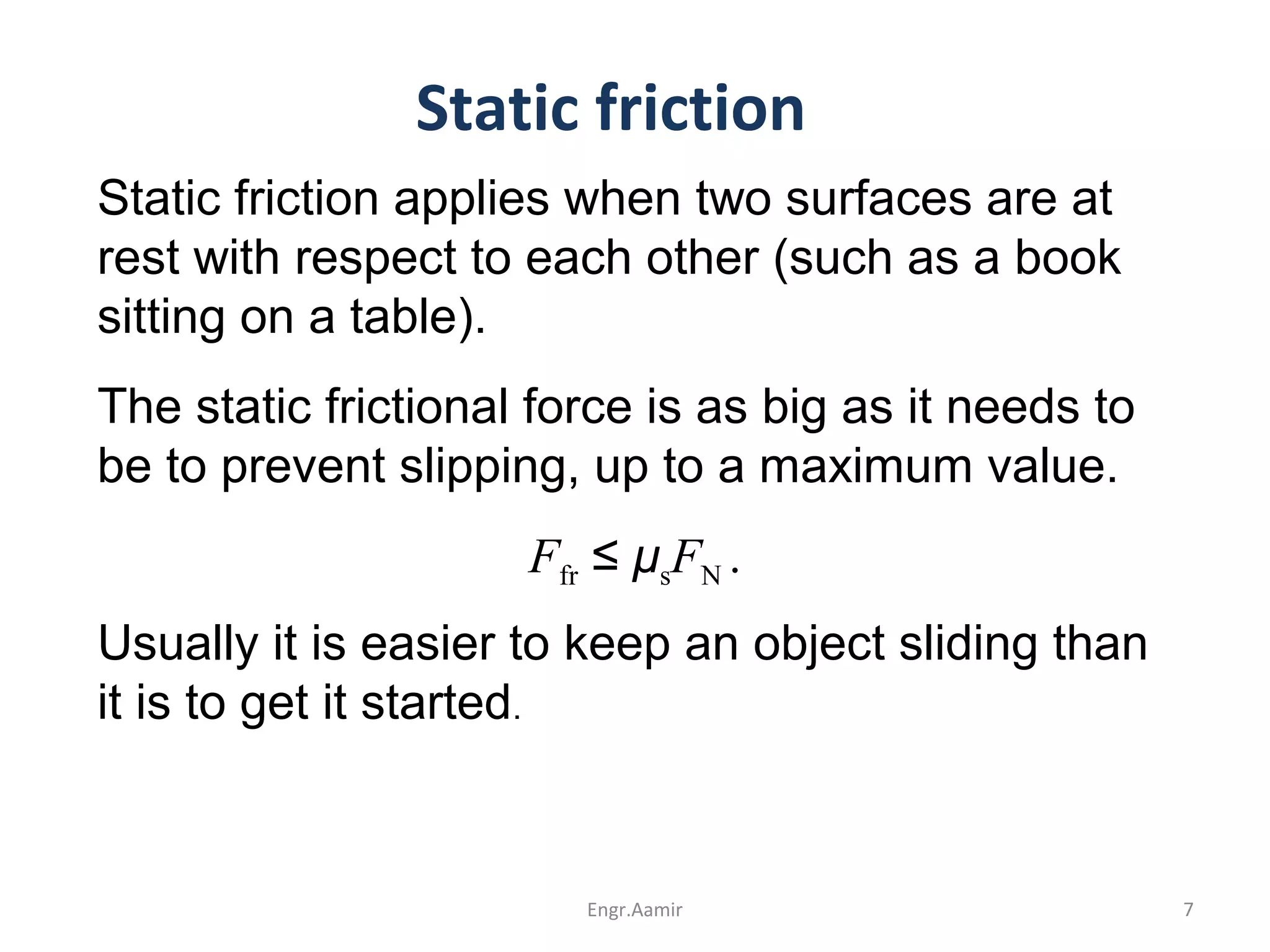
Static friction applies when two surfaces are at
rest with respect to each other (such as a book
sitting on a table).
The static frictional force is as big as it needs to
be to prevent slipping, up to a maximum value.
Ffr ≤ μsFN .
Usually it is easier to keep an object sliding than
it is to get it started.
7Engr.Aamir
Kinetic friction
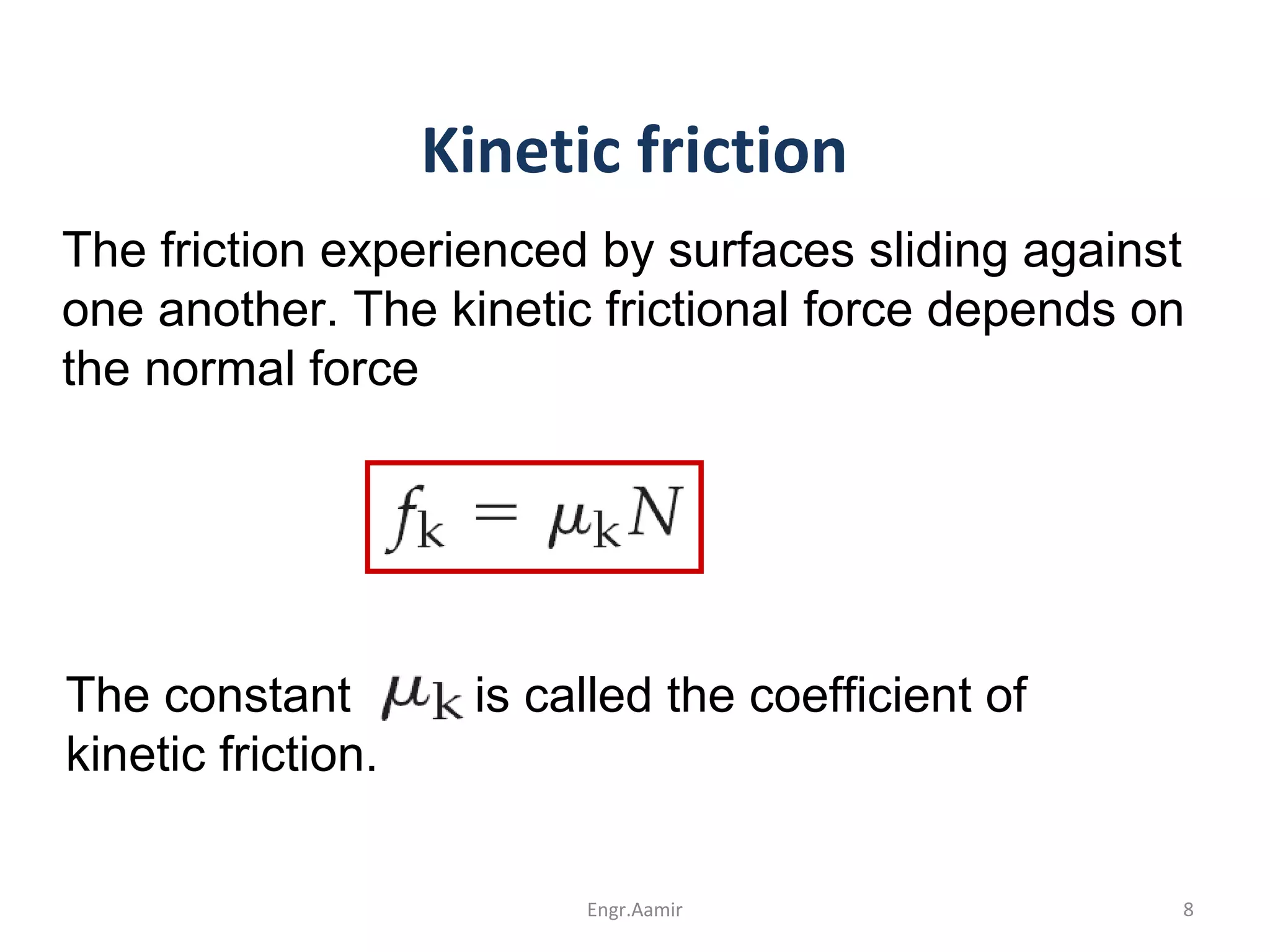
The friction experienced by surfaces sliding against
one another. The kinetic frictional force depends on
the normal force
The constant is called the coefficient of
kinetic friction.
8Engr.Aamir
8 - 9
The Laws of Dry Friction. Coefficients
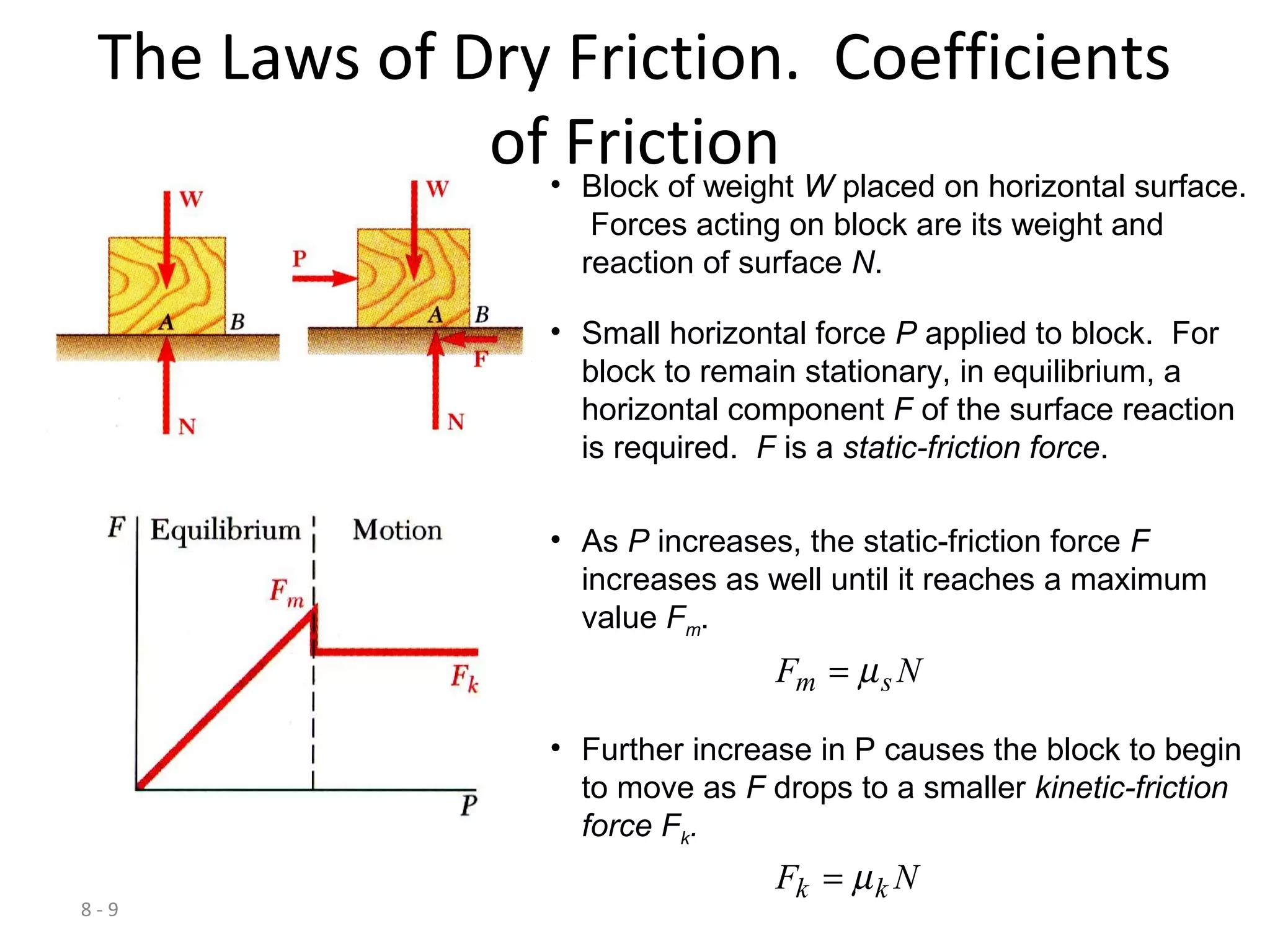
of Friction• Block of weight W placed on horizontal surface.
Forces acting on block are its weight and
reaction of surface N.
• Small horizontal force P applied to block. For
block to remain stationary, in equilibrium, a
horizontal component F of the surface reaction
is required. F is a static-friction force.
• As P increases, the static-friction force F
increases as well until it reaches a maximum
value Fm.
NF sm µ=
• Further increase in P causes the block to begin
to move as F drops to a smaller kinetic-friction
force Fk.
NF kk µ=
8 - 10
The Laws of Dry Friction.
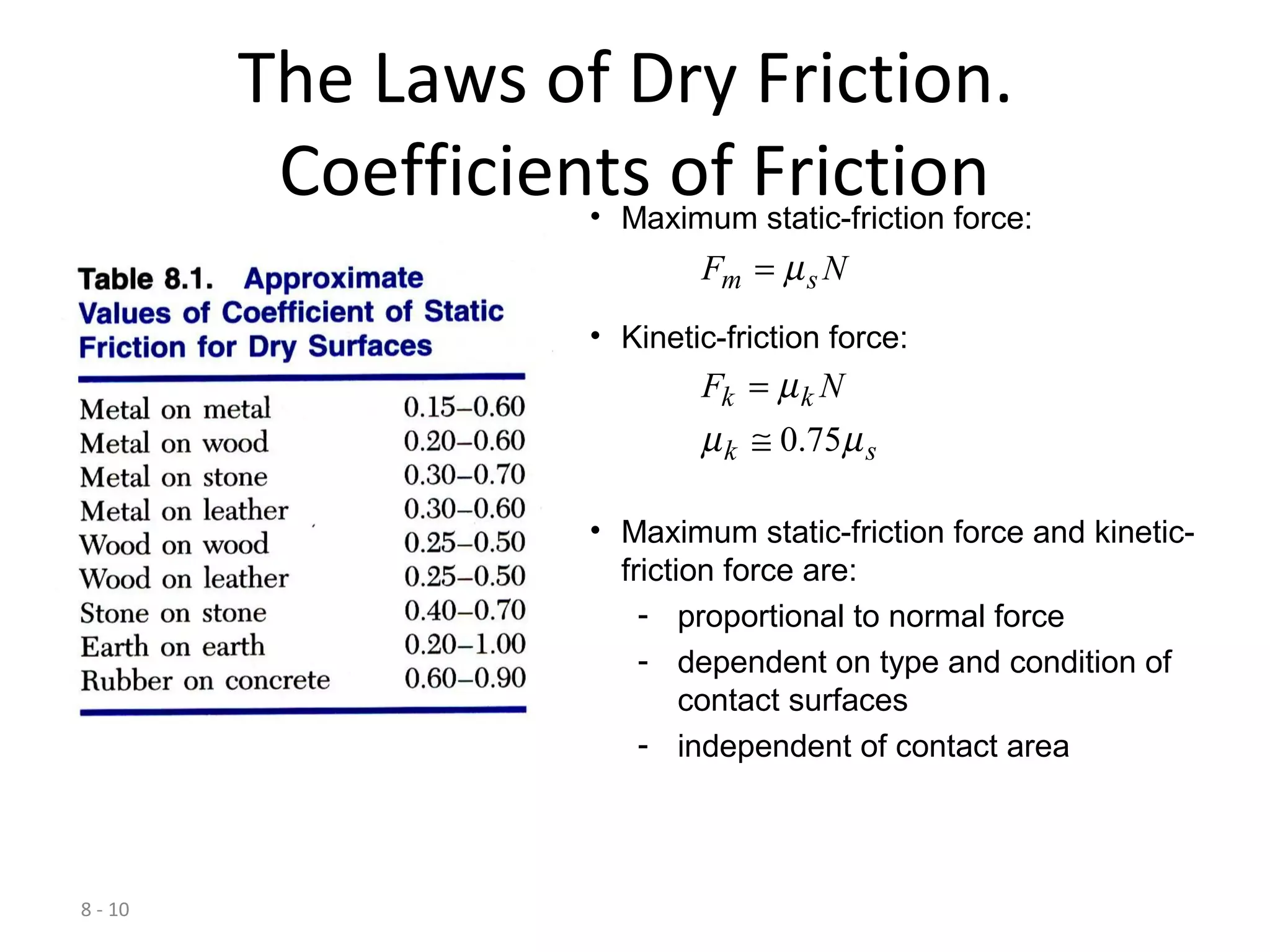
Coefficients of Friction• Maximum static-friction force:
NF sm µ=
• Kinetic-friction force:
sk
kk NF
µµ
µ
75.0≅
=
• Maximum static-friction force and kinetic-
friction force are:
- proportional to normal force
- dependent on type and condition of
contact surfaces
- independent of contact area
8 - 11
The Laws of Dry Friction.
Coefficients of Friction
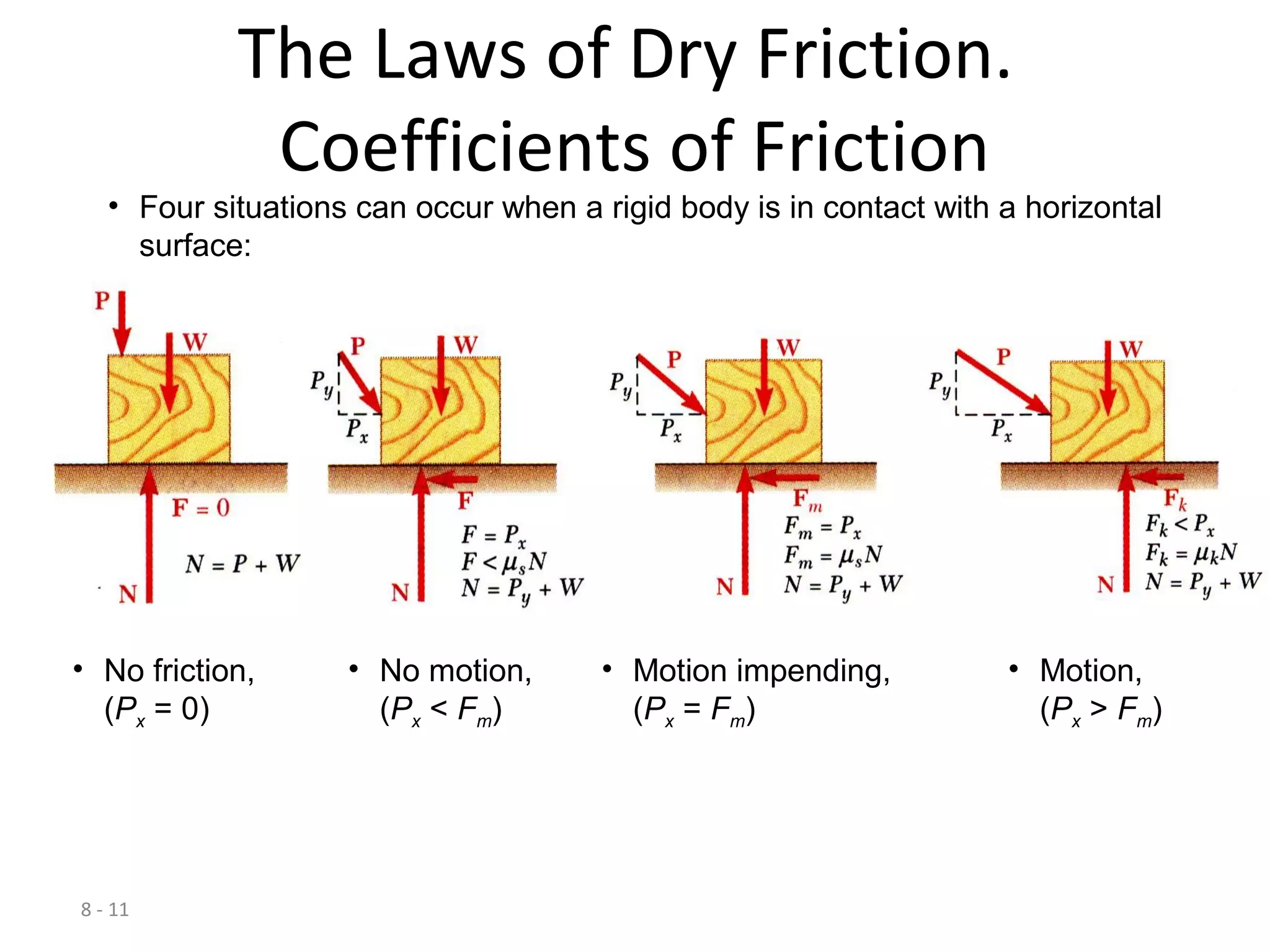
• Four situations can occur when a rigid body is in contact with a horizontal
surface:
• No friction,
(Px = 0)
• No motion,
(Px < Fm)
• Motion impending,
(Px = Fm)
• Motion,
(Px > Fm)
8 - 12
Angles of Friction
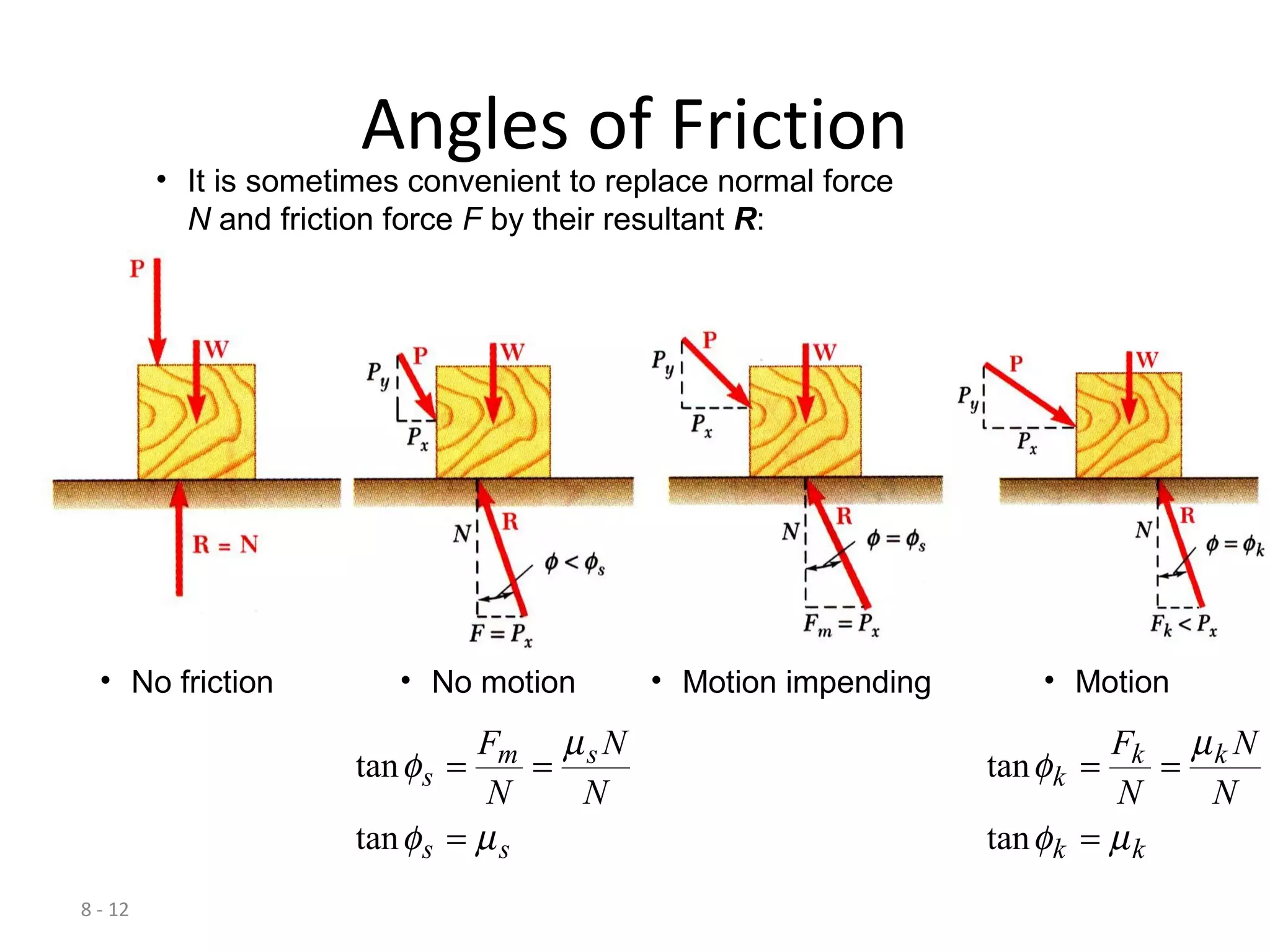
• It is sometimes convenient to replace normal force
N and friction force F by their resultant R:
• No friction • Motion impending• No motion
ss
sm
s
N
N
N
F
µφ
µ
φ
=
==
tan
tan
• Motion
kk
kk
k
N
N
N
F
µφ
µ
φ
=
==
tan
tan
8 - 13
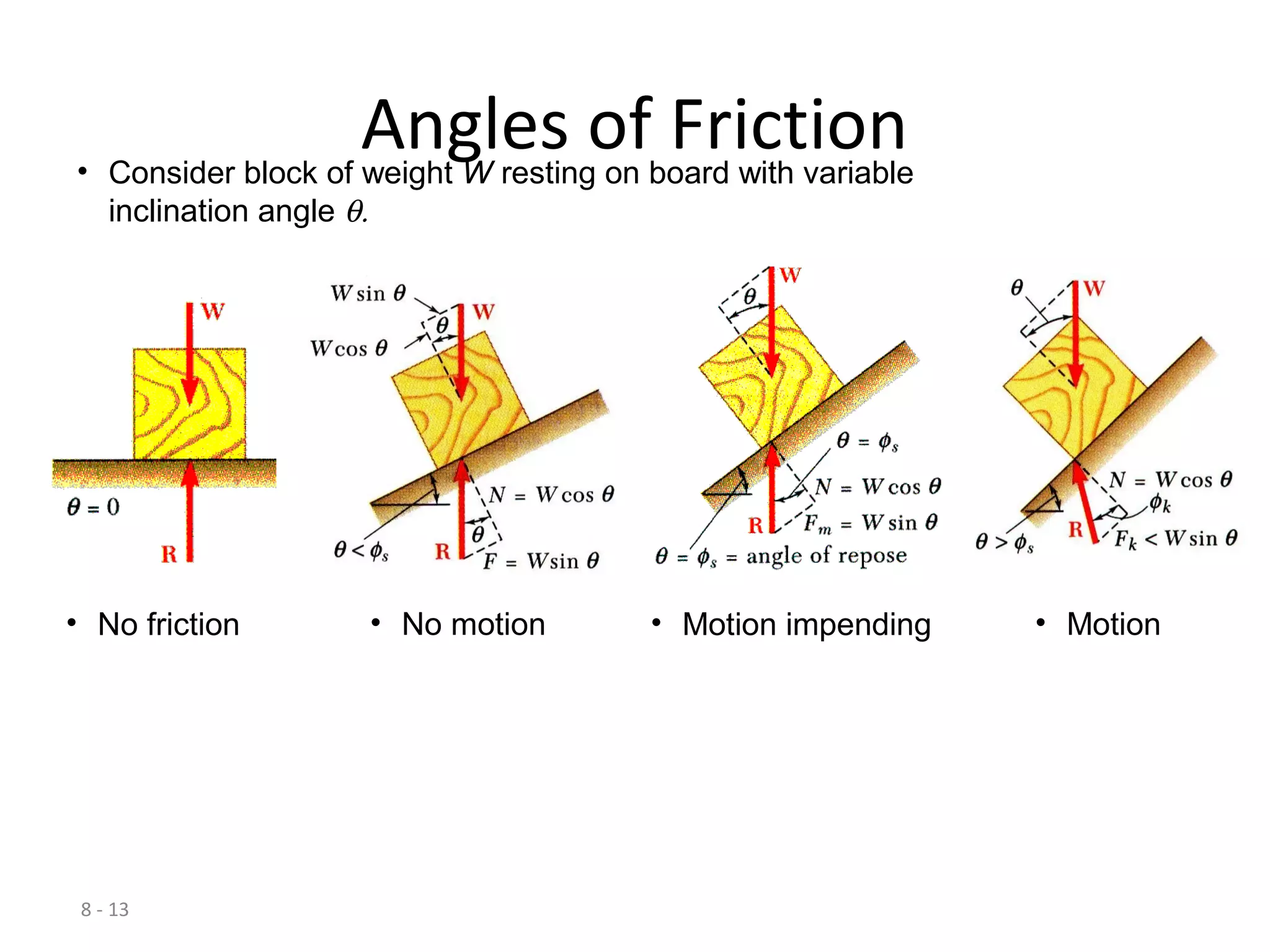
Angles of Friction• Consider block of weight W resting on board with variable
inclination angle θ.
• No friction • No motion • Motion impending • Motion
8 - 14
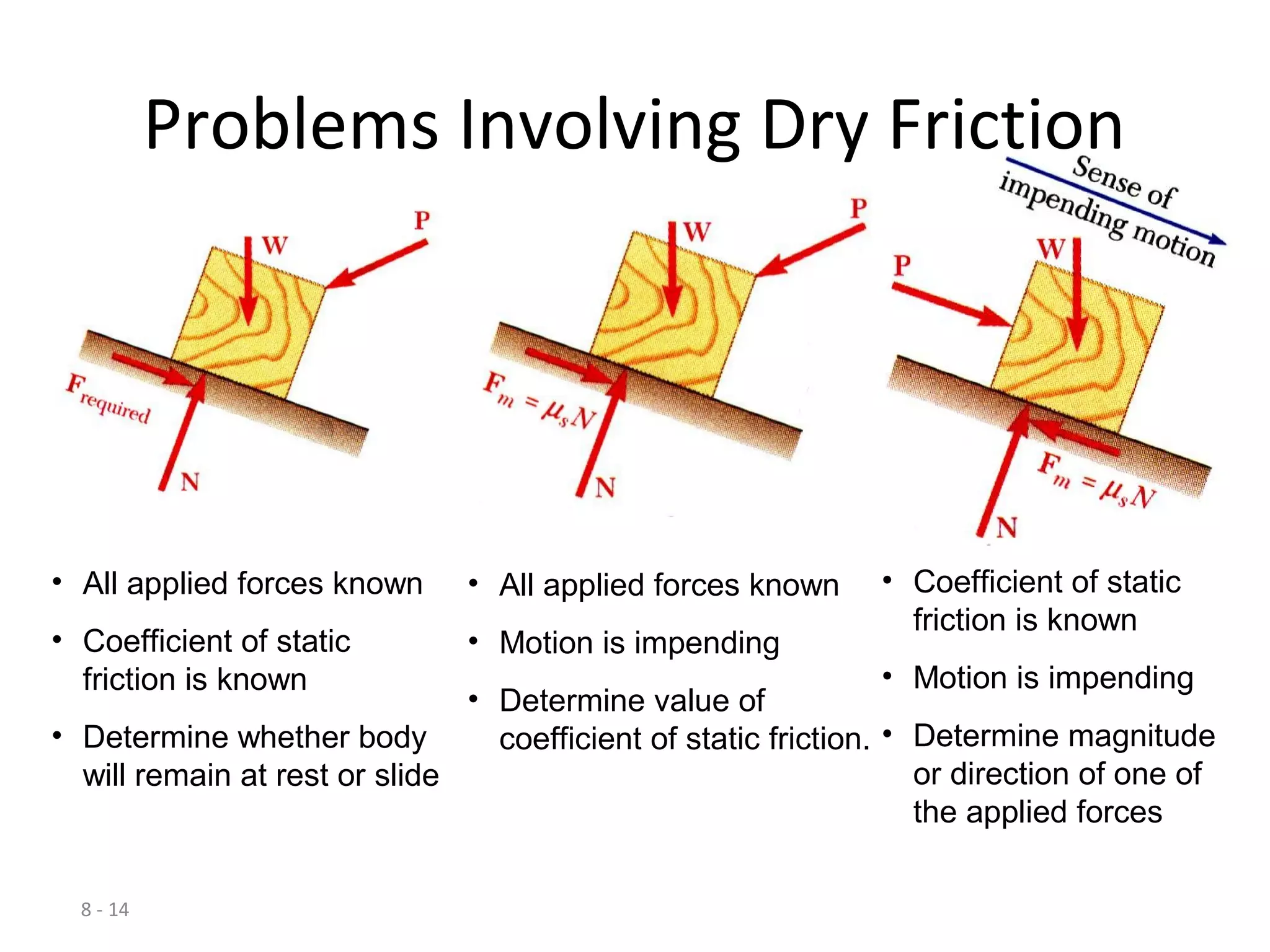
Problems Involving Dry Friction
• All applied forces known
• Coefficient of static
friction is known
• Determine whether body
will remain at rest or slide
• All applied forces known
• Motion is impending
• Determine value of
coefficient of static friction.
• Coefficient of static
friction is known
• Motion is impending
• Determine magnitude
or direction of one of
the applied forces

Engineering Mechanice Lecture 07

  • 1.
    Lecture 07 BY Engr MuhammadUsman Mechanical Engineering Department CECOS University
  • 2.
  • 3.
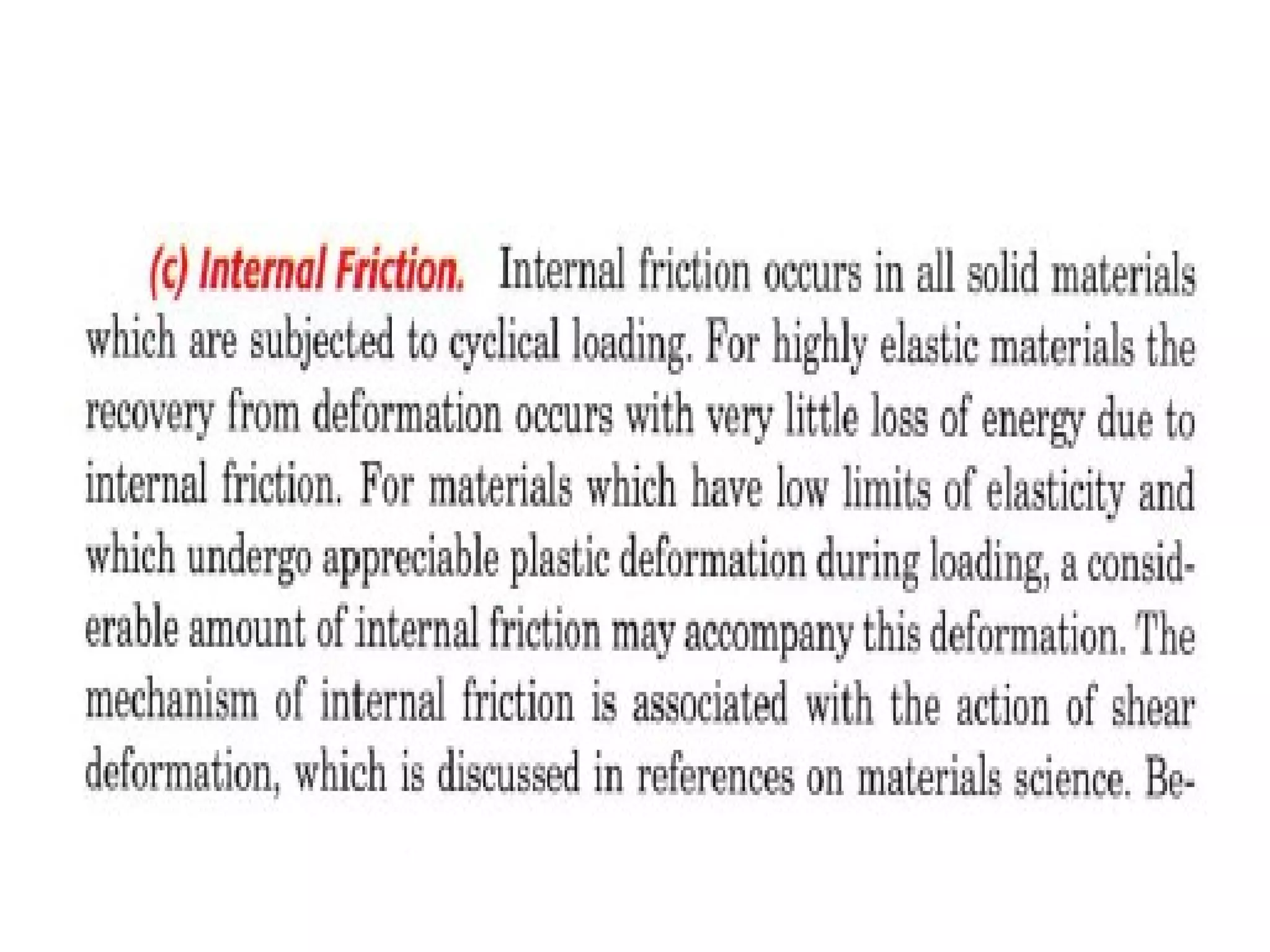
    Definition It was assumedthat surfaces in contact were either frictionless (surfaces could move freely with respect to each other) or rough (tangential forces prevent relative motion between surfaces). Actually, no perfectly frictionless surface exists. For two surfaces in contact, tangential forces, called friction forces, will develop if one attempts to move one relative to the other. Friction forces oppose the tendency of contacting surfaces to slip one relative to the other.
  • 7.
    Static friction Static frictionapplies when two surfaces are at rest with respect to each other (such as a book sitting on a table). The static frictional force is as big as it needs to be to prevent slipping, up to a maximum value. Ffr ≤ μsFN . Usually it is easier to keep an object sliding than it is to get it started. 7Engr.Aamir
  • 8.
    Kinetic friction The frictionexperienced by surfaces sliding against one another. The kinetic frictional force depends on the normal force The constant is called the coefficient of kinetic friction. 8Engr.Aamir
  • 9.
    8 - 9 TheLaws of Dry Friction. Coefficients of Friction• Block of weight W placed on horizontal surface. Forces acting on block are its weight and reaction of surface N. • Small horizontal force P applied to block. For block to remain stationary, in equilibrium, a horizontal component F of the surface reaction is required. F is a static-friction force. • As P increases, the static-friction force F increases as well until it reaches a maximum value Fm. NF sm µ= • Further increase in P causes the block to begin to move as F drops to a smaller kinetic-friction force Fk. NF kk µ=
  • 10.
    8 - 10 TheLaws of Dry Friction. Coefficients of Friction• Maximum static-friction force: NF sm µ= • Kinetic-friction force: sk kk NF µµ µ 75.0≅ = • Maximum static-friction force and kinetic- friction force are: - proportional to normal force - dependent on type and condition of contact surfaces - independent of contact area
  • 11.
    8 - 11 TheLaws of Dry Friction. Coefficients of Friction • Four situations can occur when a rigid body is in contact with a horizontal surface: • No friction, (Px = 0) • No motion, (Px < Fm) • Motion impending, (Px = Fm) • Motion, (Px > Fm)
  • 12.
    8 - 12 Anglesof Friction • It is sometimes convenient to replace normal force N and friction force F by their resultant R: • No friction • Motion impending• No motion ss sm s N N N F µφ µ φ = == tan tan • Motion kk kk k N N N F µφ µ φ = == tan tan
  • 13.
    8 - 13 Anglesof Friction• Consider block of weight W resting on board with variable inclination angle θ. • No friction • No motion • Motion impending • Motion
  • 14.
    8 - 14 ProblemsInvolving Dry Friction • All applied forces known • Coefficient of static friction is known • Determine whether body will remain at rest or slide • All applied forces known • Motion is impending • Determine value of coefficient of static friction. • Coefficient of static friction is known • Motion is impending • Determine magnitude or direction of one of the applied forces