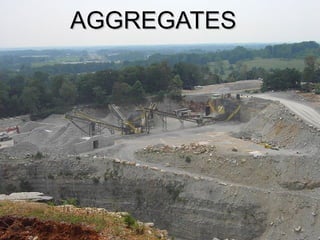
AGGREGATESAGGREGATES
DEFINITION
 A combination of different sizes and
shapes normally of stones. Maximum
size is 75 mm.
USES OF AGGREGATES
 As an underlying material for foundations
and pavements
 As an ingredients in Portland cement
concrete and asphalt concrete.
Selection of aggregates
• aggregates shall be hard, durable and clean
and free from adherent coatings and organic
matter and shall not contain appreciable
amount of clay.
• Aggregates shall not contain harmful
impurities such as iron pyrites, alkalis, salts,
coal, mica, shale or other materials which will
affect hardening and attack reinforcement.
Classification of aggregates
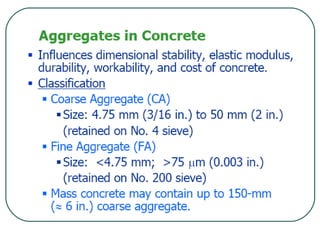
Based on size:
 classified into 2 categories:
• fine aggregates - those aggregates which
pass through 4.75 mm sieve or aggregates
with size less than 5 mm.
• Coarse aggregates – those aggregates
Passing through 75 mm sieve and entirely
retained on 4.75 mm sieve OR those
aggregates with size greater than 5 mm.
Classification of aggregates
Based on source or method of manufacture:
 classified into 2 categories:
• Natural aggregate/uncrushed aggregate- Those from
the river beds, river sand and ex-mines. Normally
rounded in shape and have smooth surface texture.
• Manufactured aggregate / crushed aggregate –those
obtained by mechanically crushing rocks, boulders, or
cobbles. Normally angular in shape and have rough
surface texture
Classification of aggregates
Based on Density:
 Based on specific gravity or density
measured in bulk, aggregate is divided
into 3 types:
• Lightweight aggregate
• Normal-weight aggregate
• Heavyweight aggregate
Normal-weight aggregate
 Crushed stone, gravel and ordinary sand are
examples of normal weight aggregate.
 They are commonly used in manufacture of
normal weight concrete, asphalt concrete and
roadway sub-base.
 The average values of sp.gr. For sand and
gravel are 2.6 and 2.65 respectively. Bulk
density of normal weight aggregate is around
1520 to 1680kg/m3
.
Lightweight aggregate
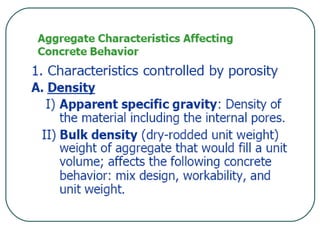
 Lightweight fine aggregate is any aggregate with
bulk density less than 1120kg/m3
and lightweight
coarse aggregate is any aggregate with bulk density
less than 880kg/m3
.
 They are commonly used as ingredients in the
manufacture of lightweight concrete, for making
lightweight masonry blocks (to improved their
thermal and insulating properties and nailing
characteristic), and lightweight floor and roof slabs.
 2 types of lightweight aggregate:
• Natural lightweight aggregates (eg: palm oil shell, rice husk,
etc)
• Manufactured (also called synthetic) lightweight aggregates.
Heavyweight aggregate
 Those aggregate with high density and is
used primarily in the manufacture of
heavyweight concrete, employed for
protection against nuclear radiation and
as bomb shelter.
 The unit weight of heavyweight concrete
varies from 2400kg/m3
with sp.gr range
from 4.0 to 4.6.(eg: mineral ores and
barite)
Physical properties of
aggregates
 Strength
 Hardness
 Toughness
 Durability
 Porosity
 Water absorption
Strength of aggregates
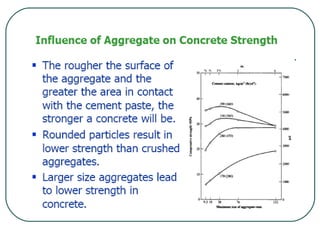
 In practice, majority of normal
aggregates are considerably stronger
than concrete
 A good average value of crushing
strength of aggregates is 200N/mm2.
Hardness of aggregates
 Hardness of aggregates is the ability of the
aggregate to withstand wear or load or applied
pressure.
 This hardness is depending on the type of
parent rock
 The test that can obtain the hardness is the
abrassion test.
 A satisfactory aggregate should have an
abrassion value of not more than 30% for
aggregates used for wearing surfaces and 50%
for aggregates used for non wearing surfaces.
Toughness
 Is the resistance of aggregate to failure by
impact.
 This can be determined by aggregate impact
test.
 The aggregate impact value shall not exceed
45% by weight for aggregate used for concrete
other than those used for wearing surfaces
and 30% for concrete for wearing surfaces.
Durability of aggregates
 Durability is ability of the aggregate to
withstand external or internal damaging
attack or in other words the soundness
of aggregate.
 This can be obtained by carrying out the
Soundness test.
Porosity
 Aggregate normally have pores of various
sizes.
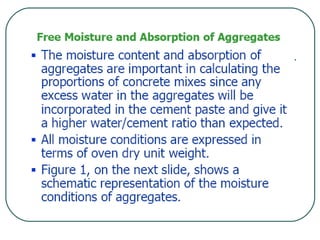
 Aggregates will absorb water when it is dry but
normally release water in the concrete mix
when it is wet.
 The amount of water and its rate of permeation
depends on the size and volume of aggregate
 Since the aggregate comprises 75% of the
concrete volume, it is essential to note that
porosity of an aggregate contribute to the
overall porosity of concrete.
Tests on aggregates
a.Texture and shapes test
i.e. test for shapes of aggregates:
1. round shape –usually natural aggregates
2. irregular shape- a combination of different shapes
3. angular shape- usually of crushed stone
4. flaky shape- where the thickness is less than its length and
width
5. elongated- usually angular where its length is larger than its
width and thickness
6. flaky and elongated- its length is larger than its width and its
width is larger than its thickness.
 In terms of surface texture, the aggregates may have a smooth
texture, or coarse/rough texture or fissures or porous.
 For production of concrete the aggregates which have angular
shape and coarse texture are recommended to have high bond
strength.
 Strength tests
• Aggregates crushing strength
• Los Angeles abrasion test
• Aggregates Impact value test
• Ten percent fine test
Tests on aggregates (Cont’d)
Physical properties:
• Specific gravity: usually 2.6 or 2.7
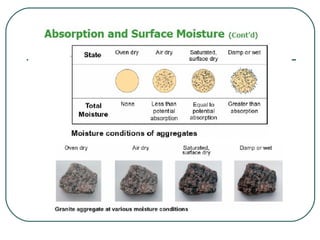
• Water absorption test: aggregates absorb
water because of their porosity.
 If all the pores are filled with water the
aggregates are said to be saturated and
surface dry.
 If all the water inside the pores are removed
by drying, the aggregates are said to have
maximum dry weight.
Tests on aggregates (Cont’d)
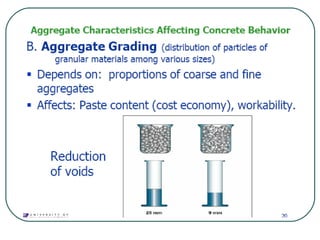
 Coarse and fine aggregates to be used
for making concrete should be well
graded. Gradation means the particle
size distribution of aggregates. Test for
grading of aggregates is carried out
using the sieve analysis method.
Grading of aggregates:
Sieve analysis test equipment
EXAMPLE OF SIEVE ANALYSIS
OF SAND
Sieve Mass Cumulative Mass %
Size retained mass retained passing passing
10 mm 0 0 287 100
5 mm 6 6 281 98
2.36 mm 17 23 264 92
1.18 mm 32 55 232 81
600µmm 48 103 184 64
300µmm 81 184 103 36
150µmm 86 270 17 6
Pan 17 287 - -
287
A sieve analysis of 250g of sand gives the
following results
Sieve size Mass retained
10 mm 0
5 mm 5
2.36 mm 31
1.18 mm 38
600µmm 38
300µmm 79
150µm 51
Pan 8
M.S. 30- Typical grading of fine aggregates
% passing by weight
B.S. 410 Zone 2 Zone 3
Test Sieve
------------------------------------------------------
10.0 mm 100 100
5.0 90-100 90-100
2.36 75-100 85-100
1.18 55-90 75-100
600µm 35-59 60-79
300µm 8-30 12-40
150µm 0-10 0-10
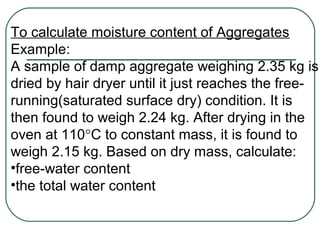
To calculate moisture content of Aggregates
Example:
A sample of damp aggregate weighing 2.35 kg is
dried by hair dryer until it just reaches the free-
running(saturated surface dry) condition. It is
then found to weigh 2.24 kg. After drying in the
oven at 110°C to constant mass, it is found to
weigh 2.15 kg. Based on dry mass, calculate:
•free-water content
•the total water content
Solution:
a) Free-water content in aggregate is defined as the water content
when the aggregate is in saturated surface dry conditions.
i.e. initial weight = 2.35 kg
weight at SSD = 2.24 kg
free water content = 0.11 kg
% of free-water content based on dry mass
= (0.11/2.15) x 100 = 5.1%
b) Total water content = free-water content
+
water absorbed by aggregates
= 0.11 + (2.24 – 2.15)
= 0.2 kg
OR 2.35 – 2.15 = 0.2 kg
(i.e overall weight - wt of max. dry aggregates)
% of total water content based on dry mass,
= 0.2/2.15 x 100
= 9.3%
Aggregates
Aggregates
Aggregates
Aggregates
Aggregates
Aggregates
Aggregates
Aggregates

Aggregates

  • 1.
  • 2.
    DEFINITION  A combinationof different sizes and shapes normally of stones. Maximum size is 75 mm.
  • 3.
    USES OF AGGREGATES As an underlying material for foundations and pavements  As an ingredients in Portland cement concrete and asphalt concrete.
  • 4.
    Selection of aggregates •aggregates shall be hard, durable and clean and free from adherent coatings and organic matter and shall not contain appreciable amount of clay. • Aggregates shall not contain harmful impurities such as iron pyrites, alkalis, salts, coal, mica, shale or other materials which will affect hardening and attack reinforcement.
  • 5.
    Classification of aggregates Basedon size:  classified into 2 categories: • fine aggregates - those aggregates which pass through 4.75 mm sieve or aggregates with size less than 5 mm. • Coarse aggregates – those aggregates Passing through 75 mm sieve and entirely retained on 4.75 mm sieve OR those aggregates with size greater than 5 mm.
  • 6.
    Classification of aggregates Basedon source or method of manufacture:  classified into 2 categories: • Natural aggregate/uncrushed aggregate- Those from the river beds, river sand and ex-mines. Normally rounded in shape and have smooth surface texture. • Manufactured aggregate / crushed aggregate –those obtained by mechanically crushing rocks, boulders, or cobbles. Normally angular in shape and have rough surface texture
  • 7.
    Classification of aggregates Basedon Density:  Based on specific gravity or density measured in bulk, aggregate is divided into 3 types: • Lightweight aggregate • Normal-weight aggregate • Heavyweight aggregate
  • 8.
    Normal-weight aggregate  Crushedstone, gravel and ordinary sand are examples of normal weight aggregate.  They are commonly used in manufacture of normal weight concrete, asphalt concrete and roadway sub-base.  The average values of sp.gr. For sand and gravel are 2.6 and 2.65 respectively. Bulk density of normal weight aggregate is around 1520 to 1680kg/m3 .
  • 9.
    Lightweight aggregate  Lightweightfine aggregate is any aggregate with bulk density less than 1120kg/m3 and lightweight coarse aggregate is any aggregate with bulk density less than 880kg/m3 .  They are commonly used as ingredients in the manufacture of lightweight concrete, for making lightweight masonry blocks (to improved their thermal and insulating properties and nailing characteristic), and lightweight floor and roof slabs.  2 types of lightweight aggregate: • Natural lightweight aggregates (eg: palm oil shell, rice husk, etc) • Manufactured (also called synthetic) lightweight aggregates.
  • 10.
    Heavyweight aggregate  Thoseaggregate with high density and is used primarily in the manufacture of heavyweight concrete, employed for protection against nuclear radiation and as bomb shelter.  The unit weight of heavyweight concrete varies from 2400kg/m3 with sp.gr range from 4.0 to 4.6.(eg: mineral ores and barite)
  • 11.
    Physical properties of aggregates Strength  Hardness  Toughness  Durability  Porosity  Water absorption
  • 12.
    Strength of aggregates In practice, majority of normal aggregates are considerably stronger than concrete  A good average value of crushing strength of aggregates is 200N/mm2.
  • 13.
    Hardness of aggregates Hardness of aggregates is the ability of the aggregate to withstand wear or load or applied pressure.  This hardness is depending on the type of parent rock  The test that can obtain the hardness is the abrassion test.  A satisfactory aggregate should have an abrassion value of not more than 30% for aggregates used for wearing surfaces and 50% for aggregates used for non wearing surfaces.
  • 14.
    Toughness  Is theresistance of aggregate to failure by impact.  This can be determined by aggregate impact test.  The aggregate impact value shall not exceed 45% by weight for aggregate used for concrete other than those used for wearing surfaces and 30% for concrete for wearing surfaces.
  • 15.
    Durability of aggregates Durability is ability of the aggregate to withstand external or internal damaging attack or in other words the soundness of aggregate.  This can be obtained by carrying out the Soundness test.
  • 16.
    Porosity  Aggregate normallyhave pores of various sizes.  Aggregates will absorb water when it is dry but normally release water in the concrete mix when it is wet.  The amount of water and its rate of permeation depends on the size and volume of aggregate  Since the aggregate comprises 75% of the concrete volume, it is essential to note that porosity of an aggregate contribute to the overall porosity of concrete.
  • 17.
    Tests on aggregates a.Textureand shapes test i.e. test for shapes of aggregates: 1. round shape –usually natural aggregates 2. irregular shape- a combination of different shapes 3. angular shape- usually of crushed stone 4. flaky shape- where the thickness is less than its length and width 5. elongated- usually angular where its length is larger than its width and thickness 6. flaky and elongated- its length is larger than its width and its width is larger than its thickness.  In terms of surface texture, the aggregates may have a smooth texture, or coarse/rough texture or fissures or porous.  For production of concrete the aggregates which have angular shape and coarse texture are recommended to have high bond strength.
  • 18.
     Strength tests •Aggregates crushing strength • Los Angeles abrasion test • Aggregates Impact value test • Ten percent fine test Tests on aggregates (Cont’d)
  • 19.
    Physical properties: • Specificgravity: usually 2.6 or 2.7 • Water absorption test: aggregates absorb water because of their porosity.  If all the pores are filled with water the aggregates are said to be saturated and surface dry.  If all the water inside the pores are removed by drying, the aggregates are said to have maximum dry weight. Tests on aggregates (Cont’d)
  • 20.
     Coarse andfine aggregates to be used for making concrete should be well graded. Gradation means the particle size distribution of aggregates. Test for grading of aggregates is carried out using the sieve analysis method. Grading of aggregates:
  • 21.
  • 22.
    EXAMPLE OF SIEVEANALYSIS OF SAND Sieve Mass Cumulative Mass % Size retained mass retained passing passing 10 mm 0 0 287 100 5 mm 6 6 281 98 2.36 mm 17 23 264 92 1.18 mm 32 55 232 81 600µmm 48 103 184 64 300µmm 81 184 103 36 150µmm 86 270 17 6 Pan 17 287 - - 287
  • 23.
    A sieve analysisof 250g of sand gives the following results Sieve size Mass retained 10 mm 0 5 mm 5 2.36 mm 31 1.18 mm 38 600µmm 38 300µmm 79 150µm 51 Pan 8
  • 24.
    M.S. 30- Typicalgrading of fine aggregates % passing by weight B.S. 410 Zone 2 Zone 3 Test Sieve ------------------------------------------------------ 10.0 mm 100 100 5.0 90-100 90-100 2.36 75-100 85-100 1.18 55-90 75-100 600µm 35-59 60-79 300µm 8-30 12-40 150µm 0-10 0-10
  • 35.
    To calculate moisturecontent of Aggregates Example: A sample of damp aggregate weighing 2.35 kg is dried by hair dryer until it just reaches the free- running(saturated surface dry) condition. It is then found to weigh 2.24 kg. After drying in the oven at 110°C to constant mass, it is found to weigh 2.15 kg. Based on dry mass, calculate: •free-water content •the total water content
  • 36.
    Solution: a) Free-water contentin aggregate is defined as the water content when the aggregate is in saturated surface dry conditions. i.e. initial weight = 2.35 kg weight at SSD = 2.24 kg free water content = 0.11 kg % of free-water content based on dry mass = (0.11/2.15) x 100 = 5.1% b) Total water content = free-water content + water absorbed by aggregates = 0.11 + (2.24 – 2.15) = 0.2 kg OR 2.35 – 2.15 = 0.2 kg (i.e overall weight - wt of max. dry aggregates) % of total water content based on dry mass, = 0.2/2.15 x 100 = 9.3%