AdmixturesAdmixtures
SyllabusSyllabus
AdmixturesAdmixtures
•Plasticizers, Retarders, Accelerators andPlasticizers, Retarders, Accelerators and
other admixtures, Tests on admixtures,other admixtures, Tests on admixtures,
chemistry and compatibility with Concretechemistry and compatibility with Concrete
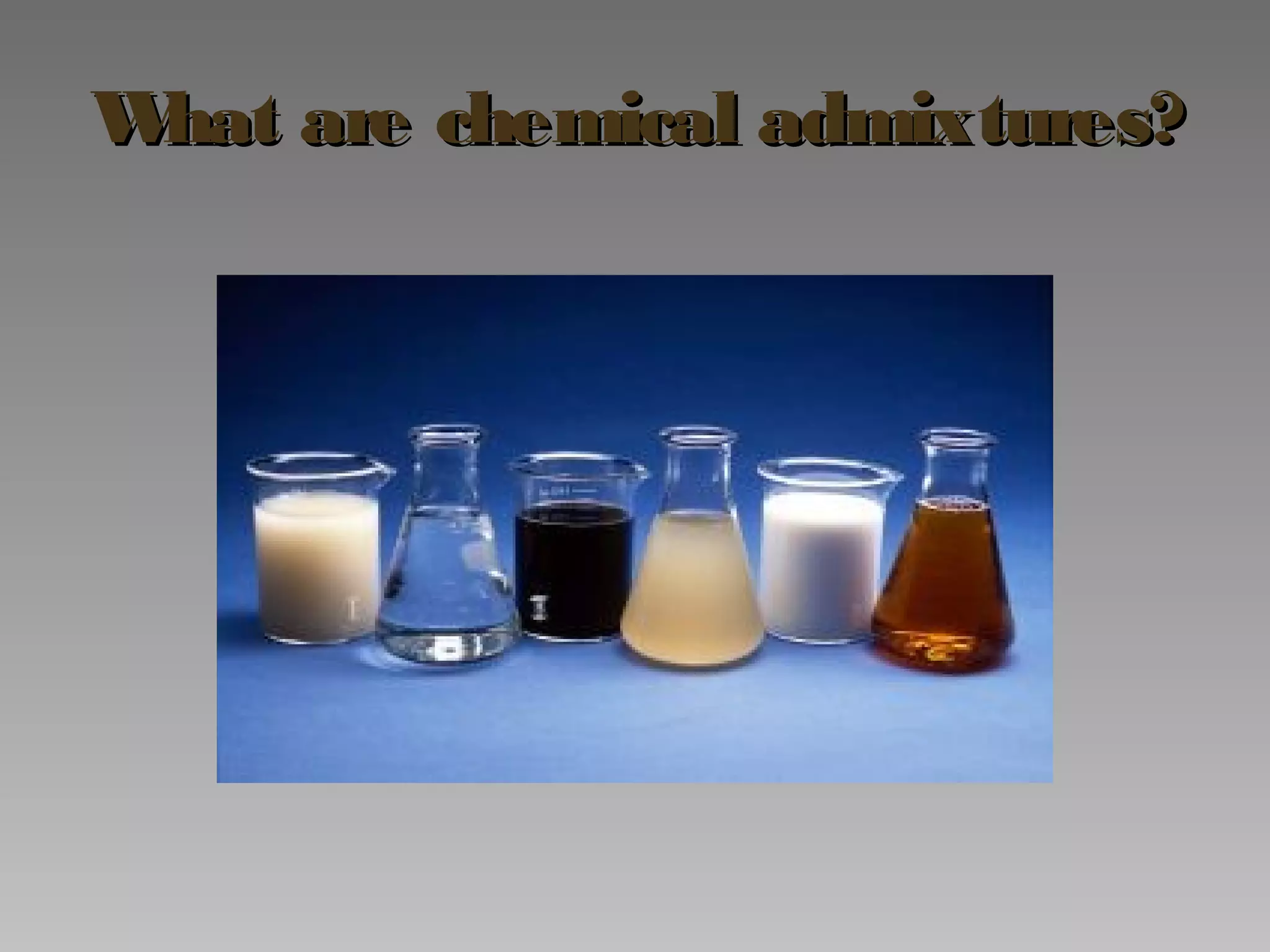
What are chemical admixtures?What are chemical admixtures?
• The definition of RILEM (International Union of Testing andThe definition of RILEM (International Union of Testing and
Research Laboratoriesfor Materialsand Structures) is:Research Laboratoriesfor Materialsand Structures) is:
• •• Admixtures for concrete, mortar or paste are inorganic orAdmixtures for concrete, mortar or paste are inorganic or
organic materials these are added to the normal components oforganic materials these are added to the normal components of
a mix not normally exceeding 5% by mass of cement ora mix not normally exceeding 5% by mass of cement or
cementationsmaterialscementationsmaterials
• •• Admixtures interact with hydrating cement by physical,Admixtures interact with hydrating cement by physical,
chemical or physicochemical actions.chemical or physicochemical actions.
What are chemical admixtures?What are chemical admixtures?
what are chemical admixtures?what are chemical admixtures?
• •• They modify one or more properties of concrete, mortar orThey modify one or more properties of concrete, mortar or
pasteeither in fresh or hardened state.pasteeither in fresh or hardened state.
• •• Admixtures are usually very complex compoundschemicallyAdmixtures are usually very complex compoundschemically
excepting afew.excepting afew.
• •• They are unlikely to be pure compounds but associated withThey are unlikely to be pure compounds but associated with
some other minor chemical compounds or they may be mixedsome other minor chemical compounds or they may be mixed
formulations.formulations.
• •• It is rather difficult for a civil engineer to understand themIt is rather difficult for a civil engineer to understand them
through their chemical nature.through their chemical nature.
Thus, Admixtures are thoseThus, Admixtures are those
ingredients in concrete other thaningredients in concrete other than
Portland cement, water, andPortland cement, water, and
aggregates that are added to theaggregates that are added to the
mixture immediately before ormixture immediately before or
during mixing . Admixtures can beduring mixing . Admixtures can be
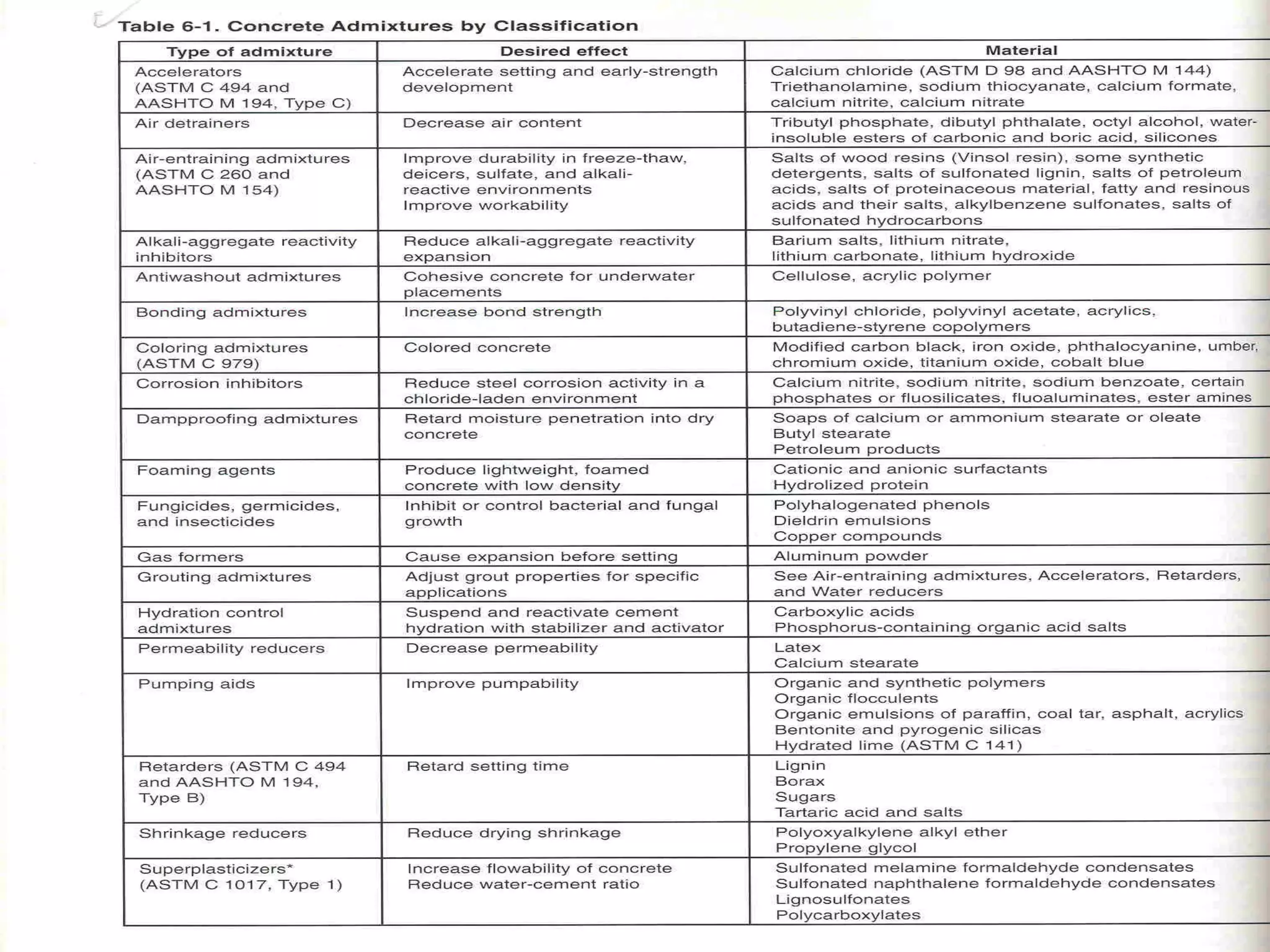
classified by function asfollows:classified by function asfollows:
1. Air-entraining admixtures1. Air-entraining admixtures
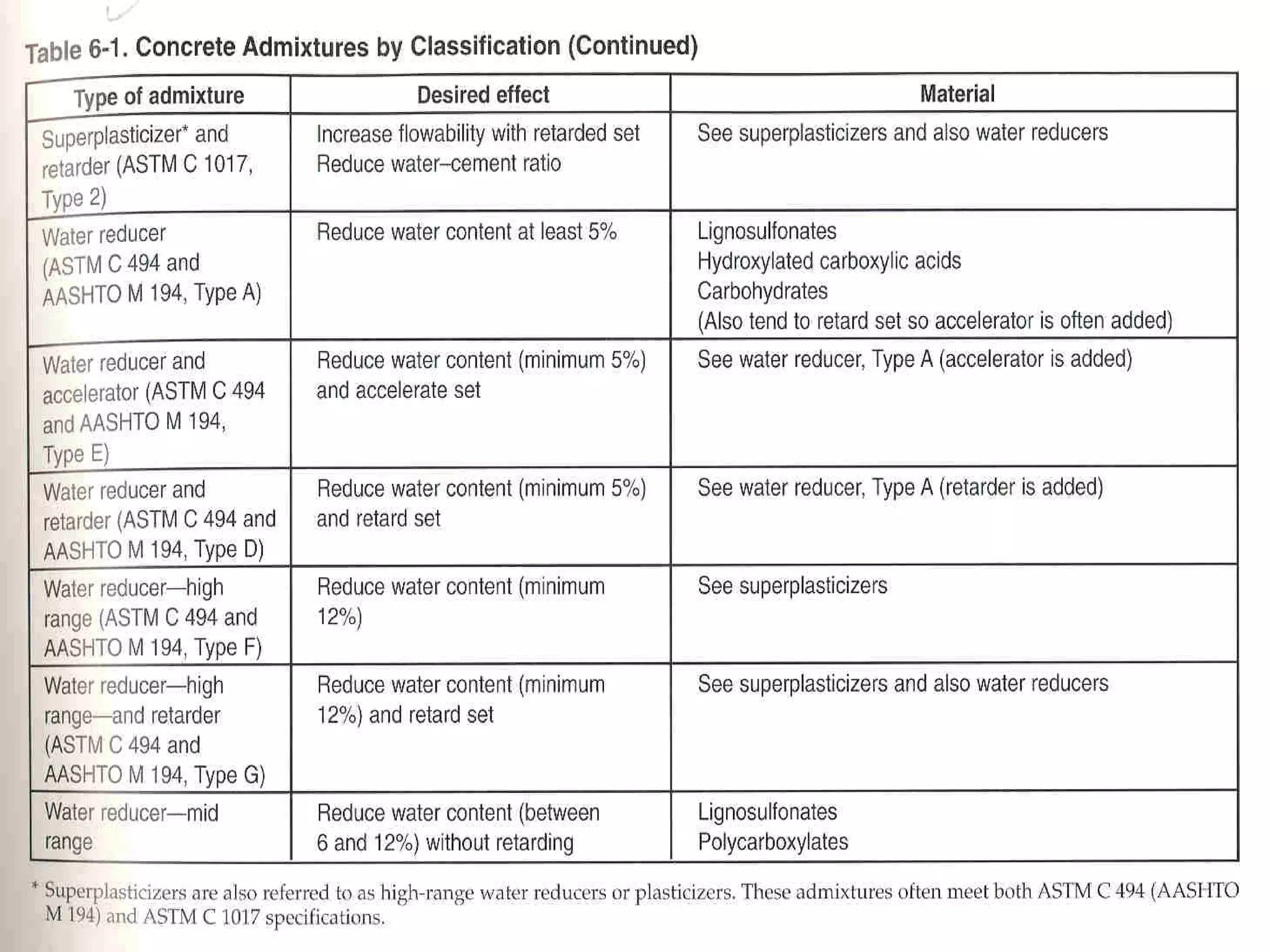
2. Water-reducing admixtures2. Water-reducing admixtures
3. Plasticizers3. Plasticizers
4. Accelerating admixtures4. Accelerating admixtures
5. Retarding admixtures5. Retarding admixtures
6. Hydration-control admixtures6. Hydration-control admixtures
7. Corrosion inhibitors7. Corrosion inhibitors
8. Shrinkage reducers8. Shrinkage reducers
9. Alkali-silica reactivity inhibitors9. Alkali-silica reactivity inhibitors
10. Colouring admixtures10. Colouring admixtures
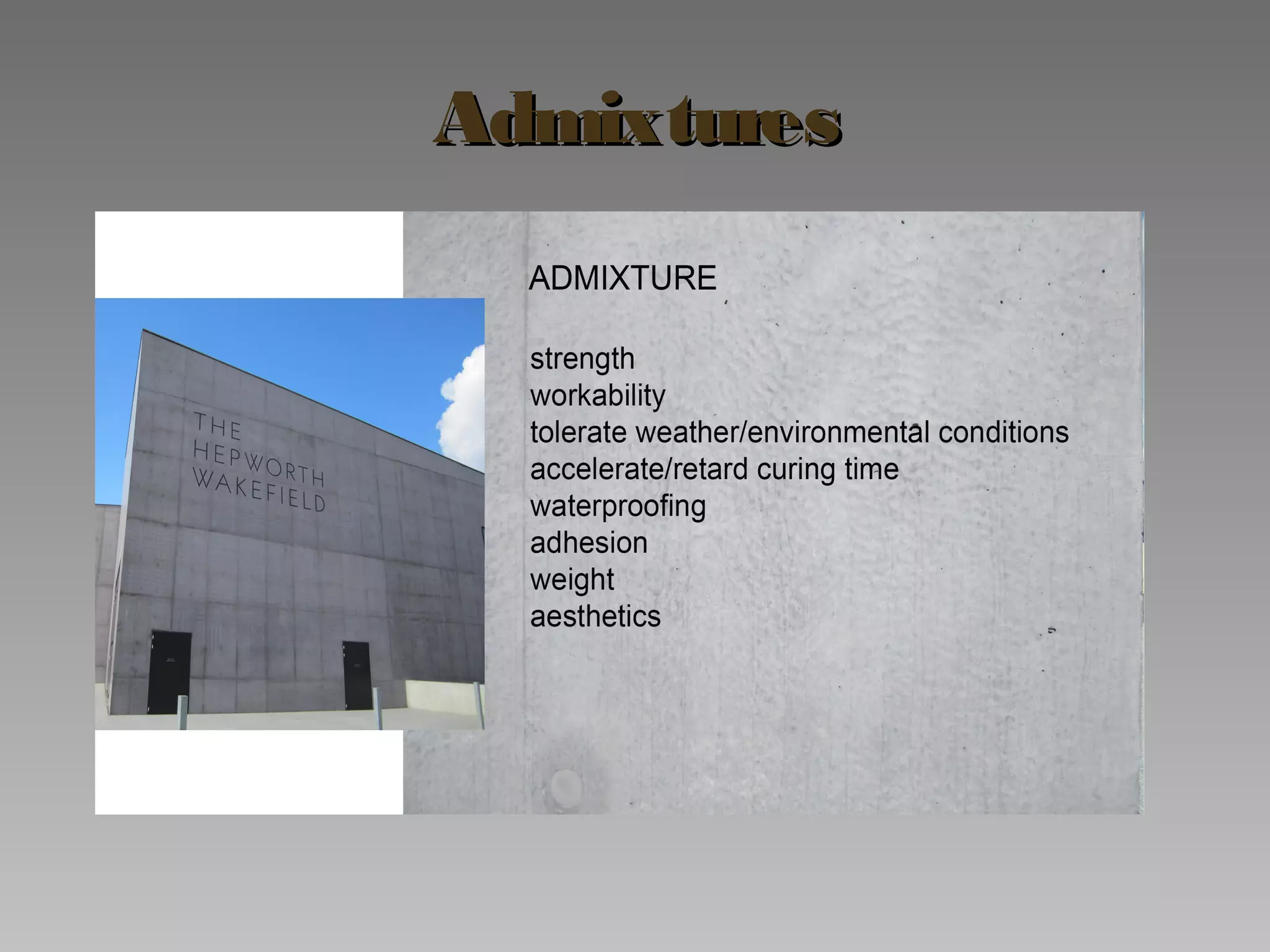
11. Miscellaneous admixtures such workability,11. Miscellaneous admixtures such workability,
bonding, damp proofing, permeabilitybonding, damp proofing, permeability
reducing, grouting, gas-forming, and pumpingreducing, grouting, gas-forming, and pumping
admixturesadmixtures
AdmixturesAdmixtures
• For our country, the most common chemicalFor our country, the most common chemical
admixtures are plasticizers and Super-plasticizers.admixtures are plasticizers and Super-plasticizers.
These are also known as water reducers and high-These are also known as water reducers and high-
rangewater reducers, respectively.rangewater reducers, respectively.
• •• Retarders are likely to be needed, especially for hotRetarders are likely to be needed, especially for hot
weather concreting, ready mixed concrete or forweather concreting, ready mixed concrete or for
special continuouspoursspecial continuouspours
AdmixturesAdmixtures
• Othertypes of admixtures are:Othertypes of admixtures are:
• •• AcceleratorsAccelerators
• •• Air-entraining agentsAir-entraining agents
• •• Pumping aidsPumping aids
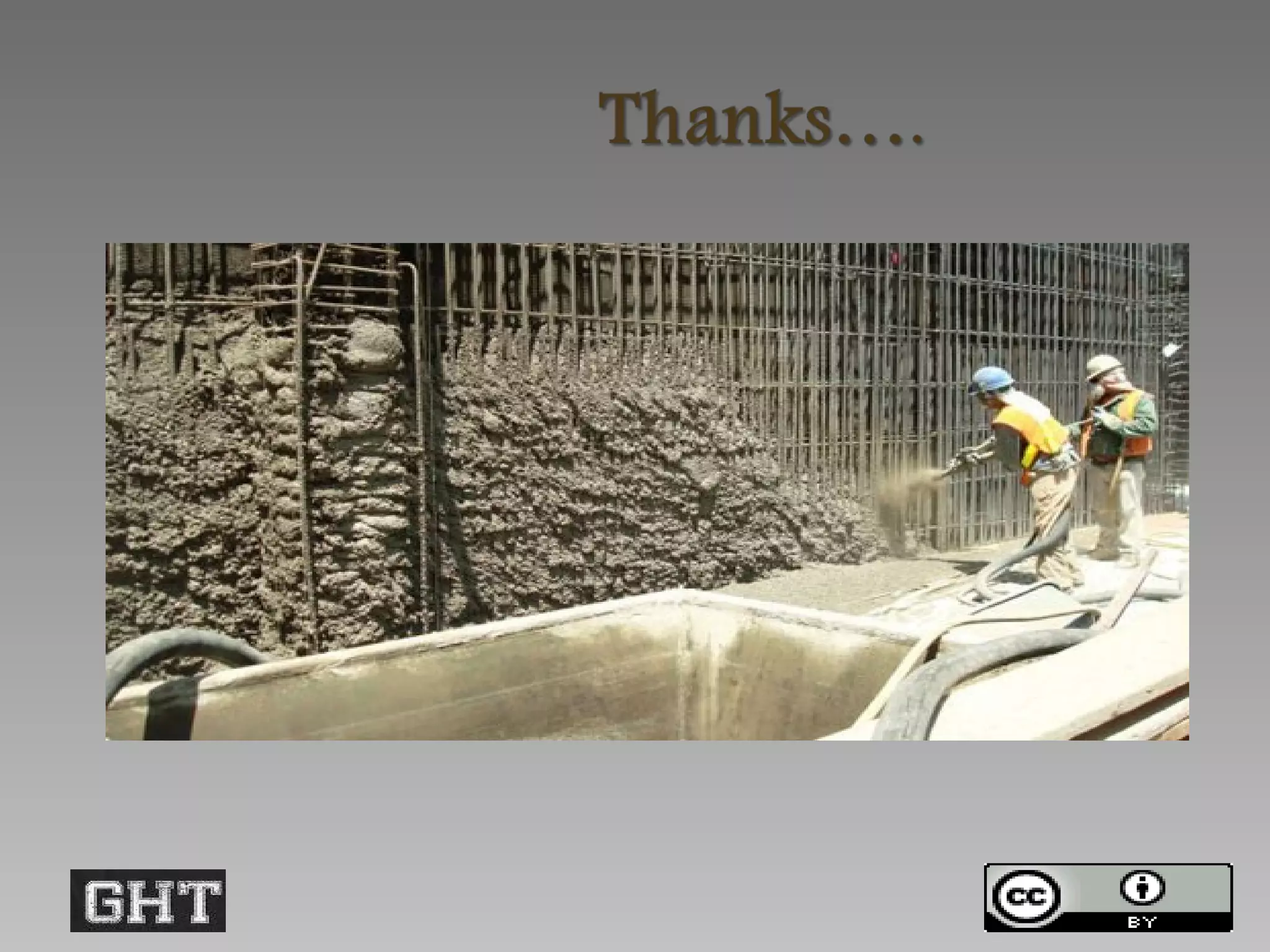
• •• Shot Crete/ Guniting aidsShot Crete/ Guniting aids
• •• Corrosion inhibitors, and someothers.Corrosion inhibitors, and someothers.
How do they act?How do they act?
• •• The chemical, physical or physico-chemical actions of admixtures inThe chemical, physical or physico-chemical actions of admixtures in
cement concretearequitecomplex.cement concretearequitecomplex.
• •• In fact, cement itself is an extremely complex compound with majorIn fact, cement itself is an extremely complex compound with major
compoundssuch ascalcium silicates, calcium aluminates, gypsum.compoundssuch ascalcium silicates, calcium aluminates, gypsum.
• •• Besidesit containsmany alkali and other calcium salts.Besidesit containsmany alkali and other calcium salts.
• •• Theaction of admixturescan, however, besimplified for thesakeofTheaction of admixturescan, however, besimplified for thesakeof
• Understanding, as:Understanding, as:
• (i) adsorption(i) adsorption
• (ii) De-flocculation or dispersion(ii) De-flocculation or dispersion
• (iii)Chemical absorption or interaction(iii)Chemical absorption or interaction
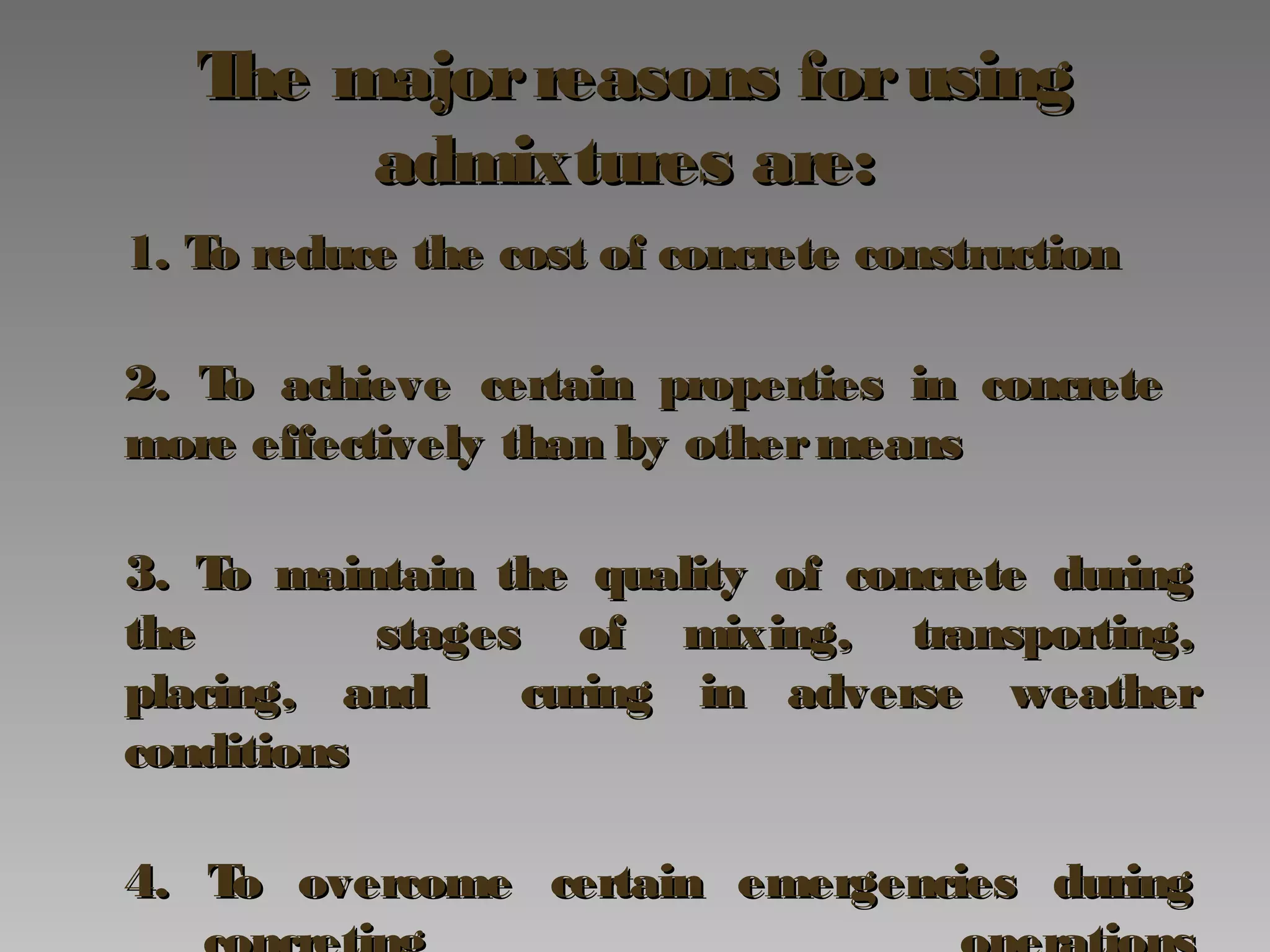
The majorreasons forusingThe majorreasons forusing
admixtures are:admixtures are:
1. To reduce the cost of concrete construction1. To reduce the cost of concrete construction
2. To achieve certain properties in concrete2. To achieve certain properties in concrete
more effectively than by othermeansmore effectively than by othermeans
3. To maintain the quality of concrete during3. To maintain the quality of concrete during
thethe stages of mixing, transporting,stages of mixing, transporting,
placing, andplacing, and curing in adverse weathercuring in adverse weather
conditionsconditions
4. To overcome certain emergencies during4. To overcome certain emergencies during
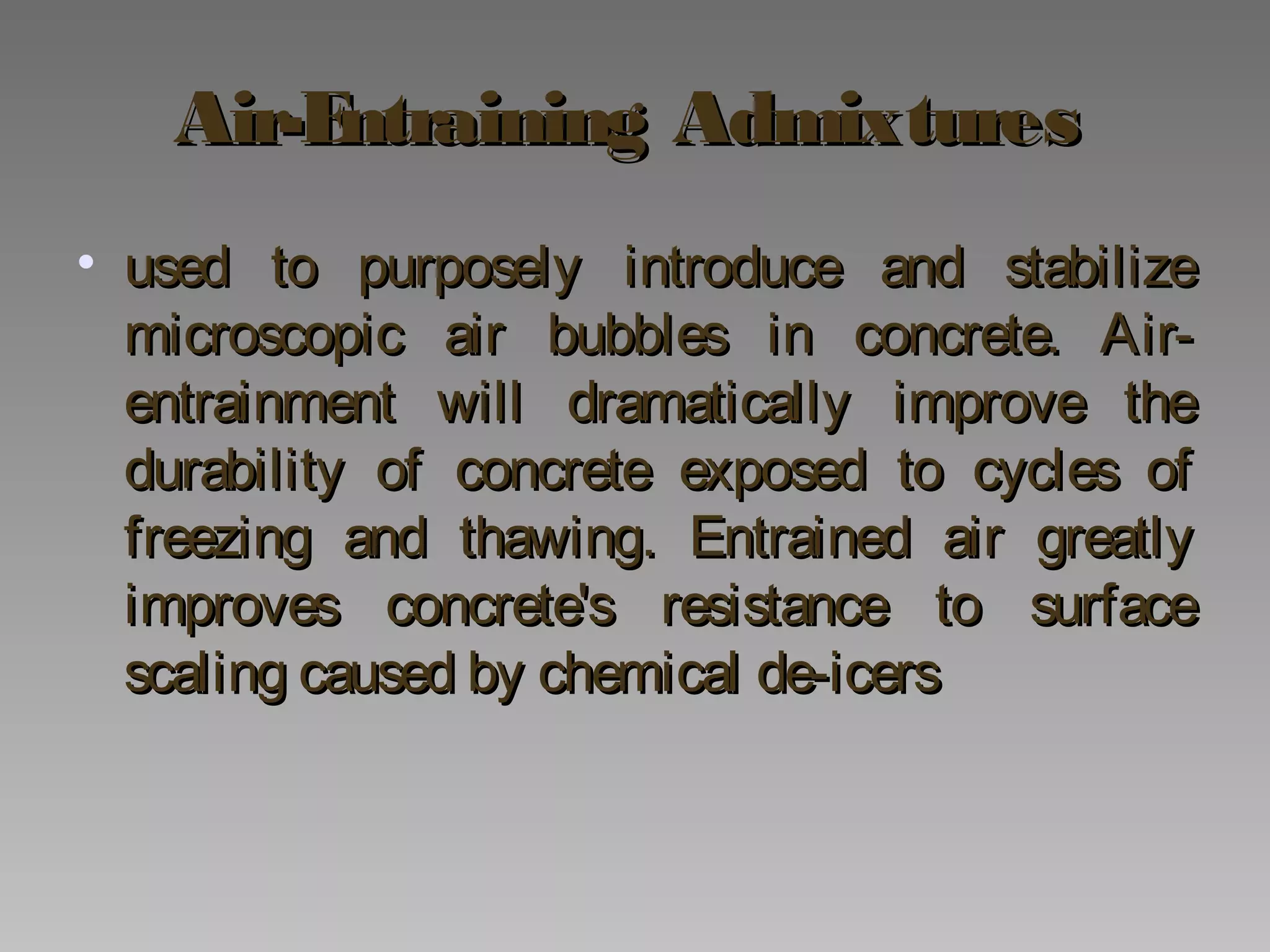
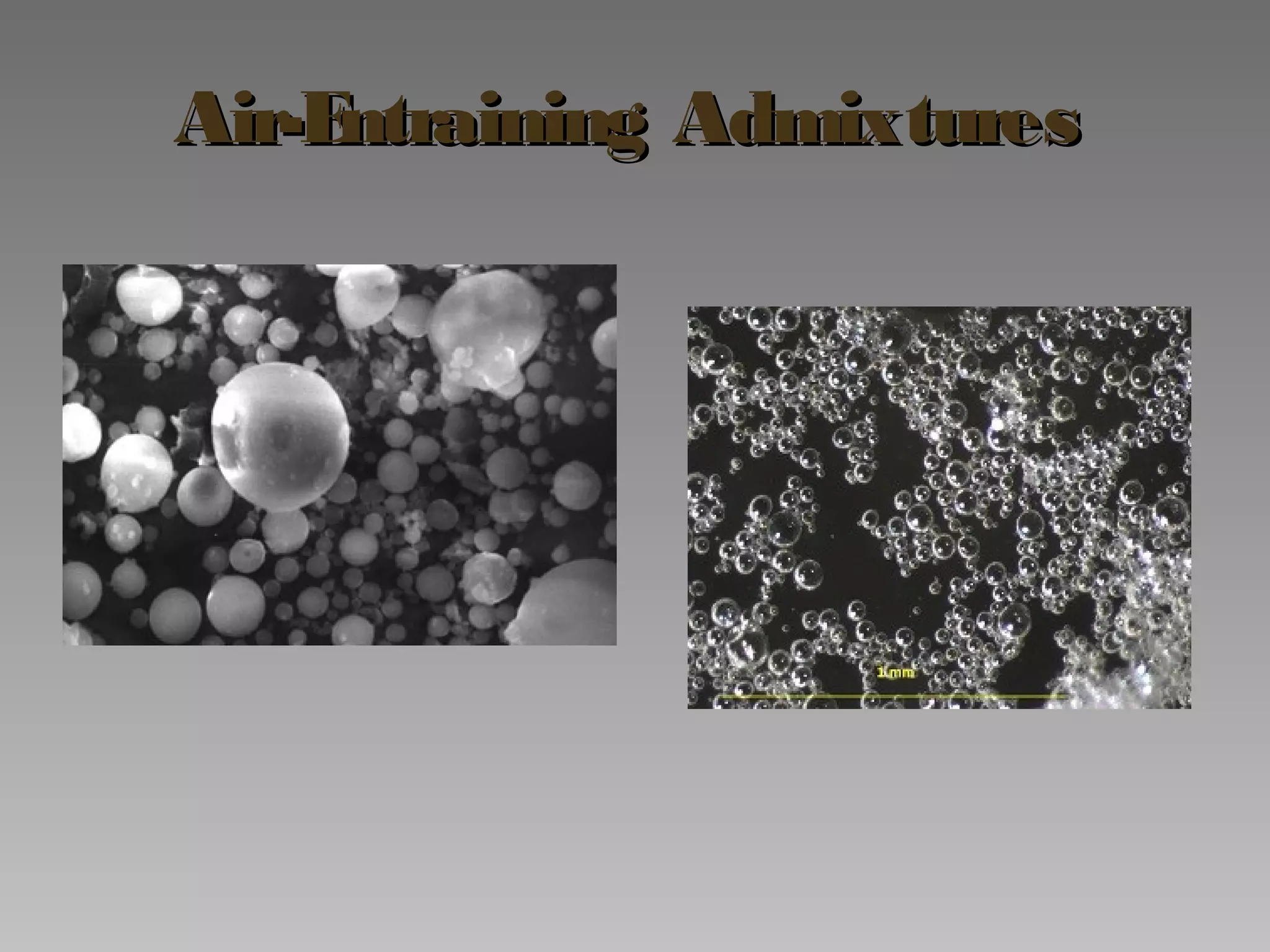
Air-Entraining AdmixturesAir-Entraining Admixtures
• used to purposely introduce and stabilizeused to purposely introduce and stabilize
microscopic air bubbles in concrete. Air-microscopic air bubbles in concrete. Air-
entrainment will dramatically improve theentrainment will dramatically improve the
durability of concrete exposed to cycles ofdurability of concrete exposed to cycles of
freezing and thawing. Entrained air greatlyfreezing and thawing. Entrained air greatly
improves concrete's resistance to surfaceimproves concrete's resistance to surface
scaling caused by chemical de-icersscaling caused by chemical de-icers
Air-Entraining AdmixturesAir-Entraining Admixtures
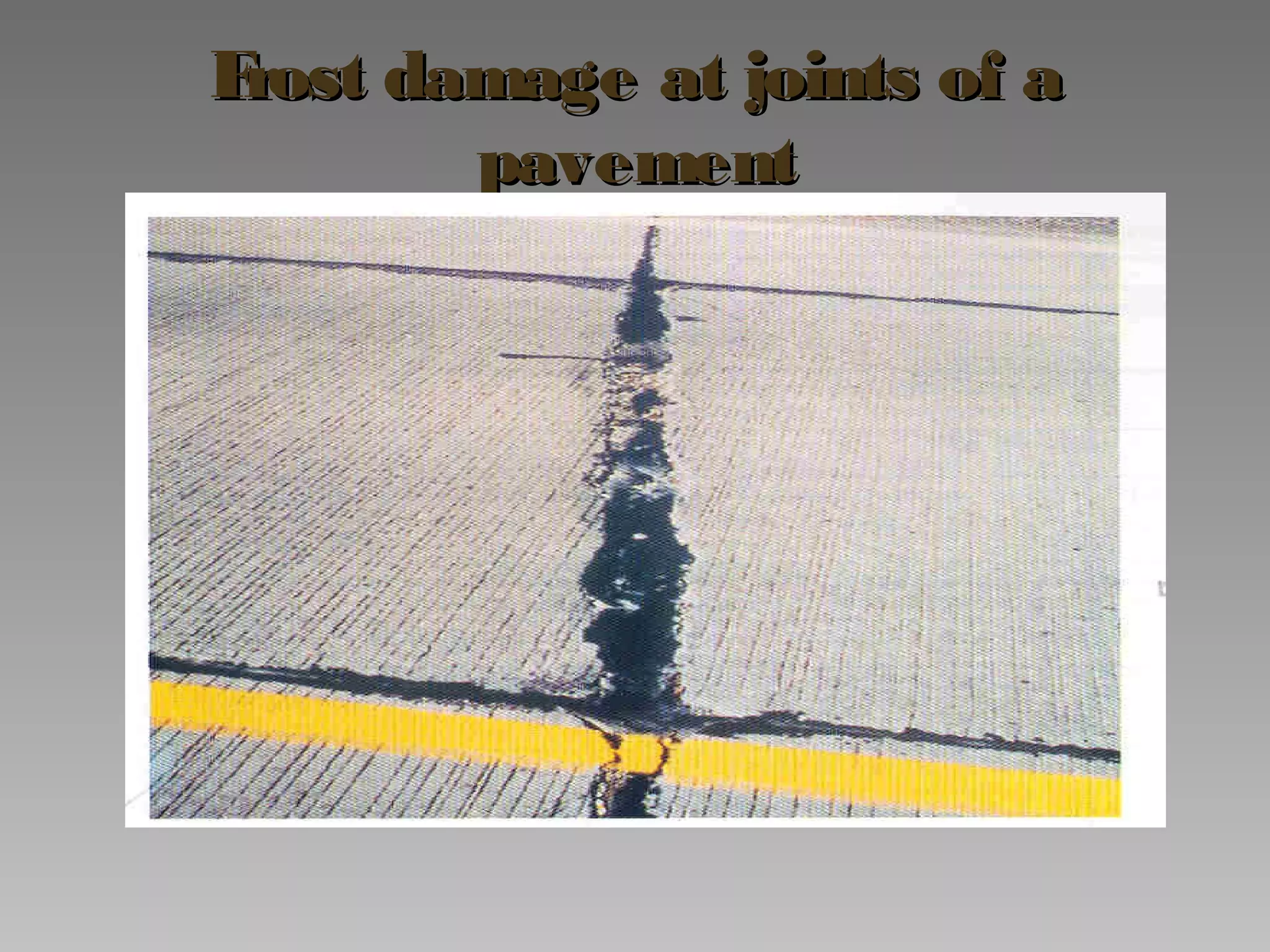
Frost damage at joints of aFrost damage at joints of a
pavementpavement
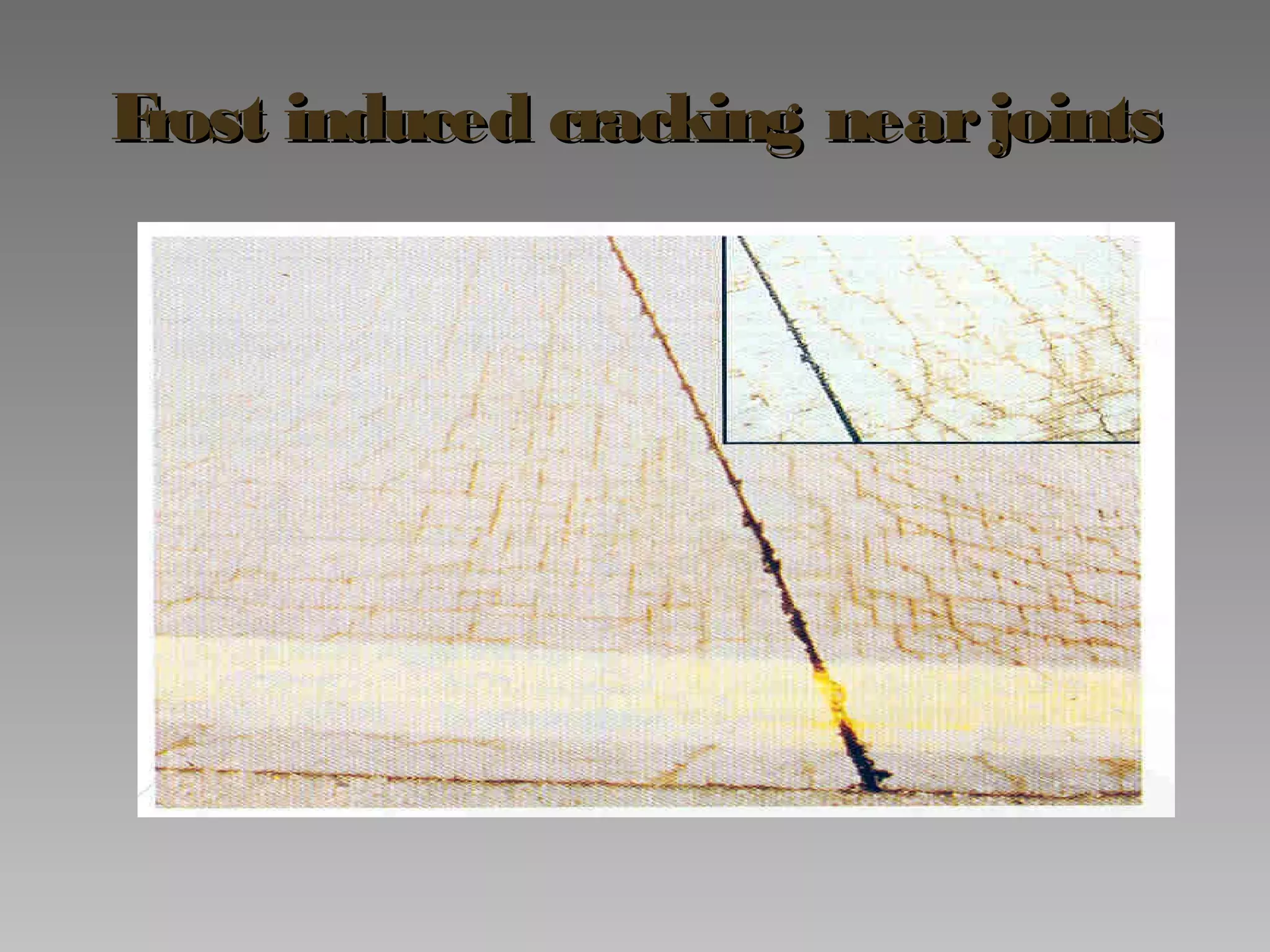
Frost induced cracking nearjointsFrost induced cracking nearjoints
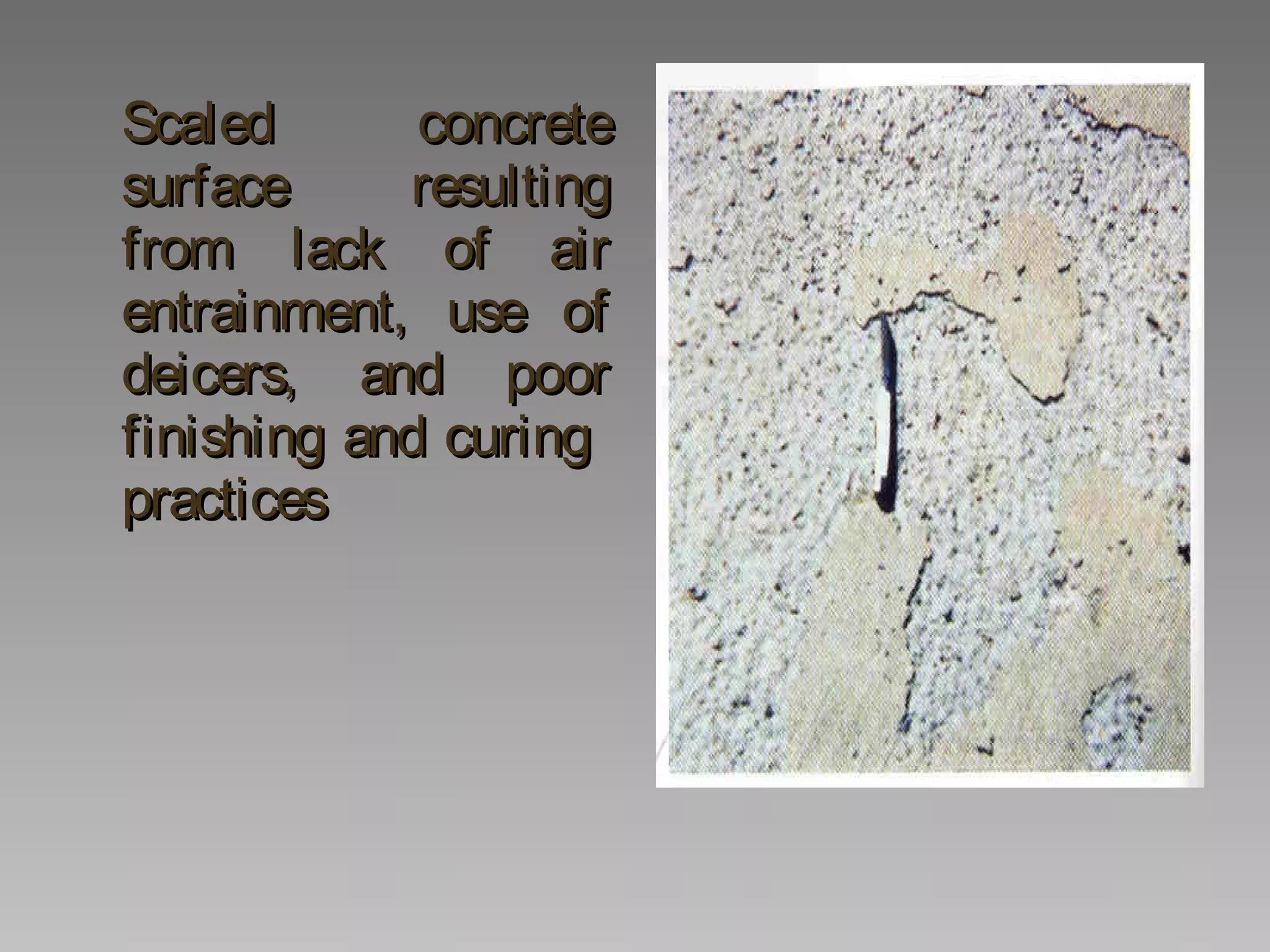
Scaled concreteScaled concrete
surface resultingsurface resulting
from lack of airfrom lack of air
entrainment, use ofentrainment, use of
deicers, and poordeicers, and poor
finishing and curingfinishing and curing
practicespractices
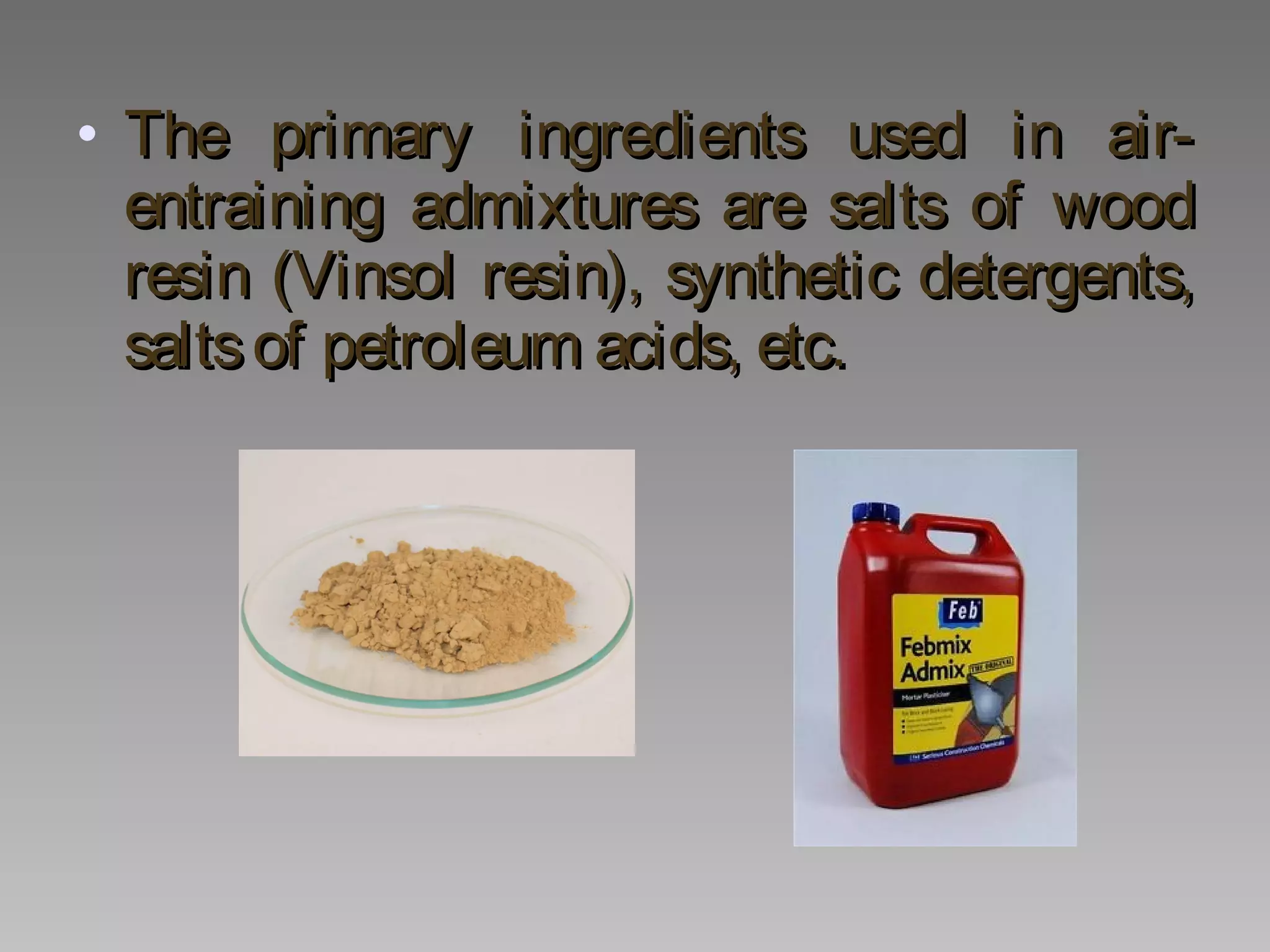
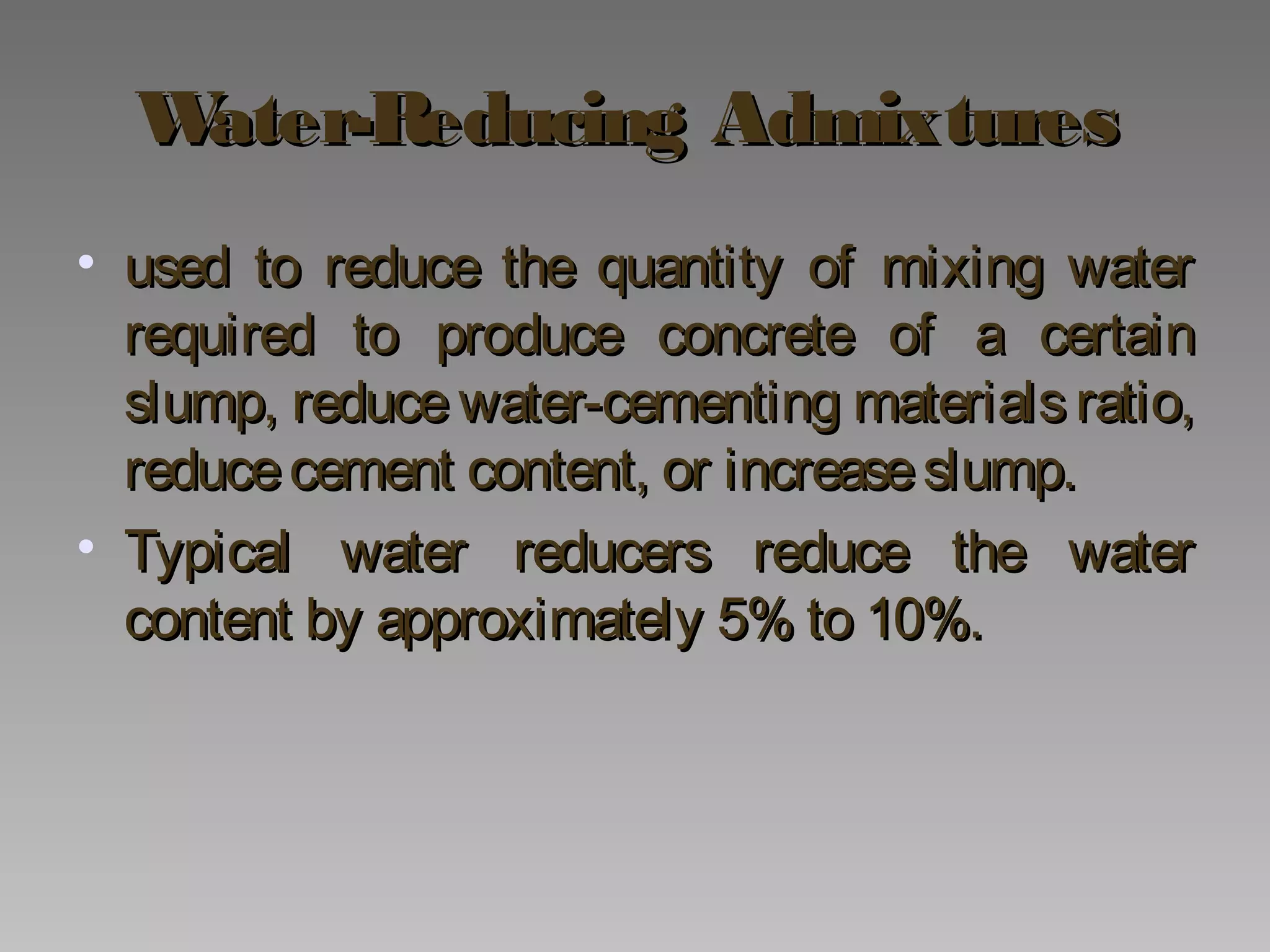
• The primary ingredients used in air-The primary ingredients used in air-
entraining admixtures are salts of woodentraining admixtures are salts of wood
resin (Vinsol resin), synthetic detergents,resin (Vinsol resin), synthetic detergents,
saltsof petroleum acids, etc.saltsof petroleum acids, etc.
Water-Reducing AdmixturesWater-Reducing Admixtures
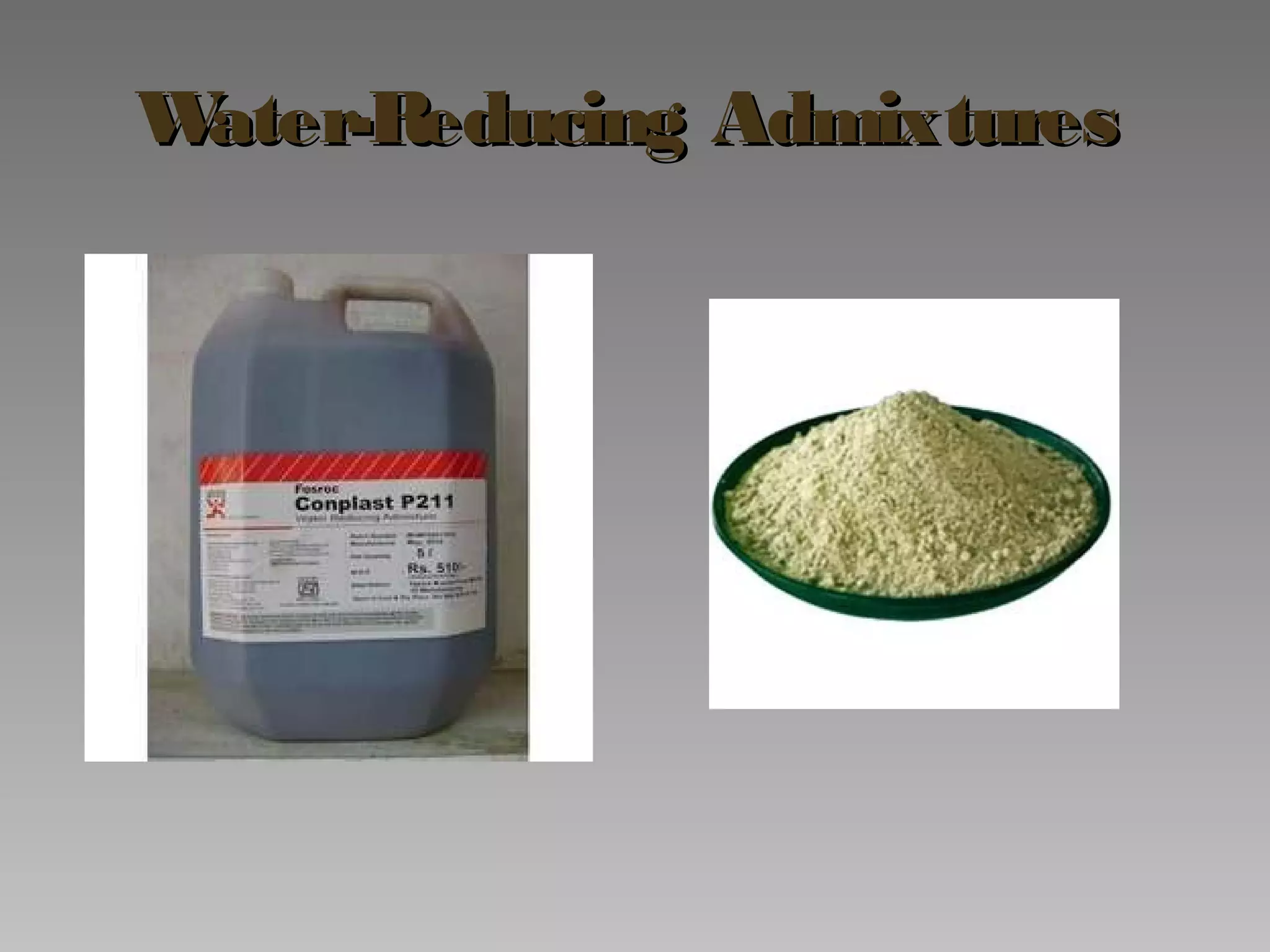
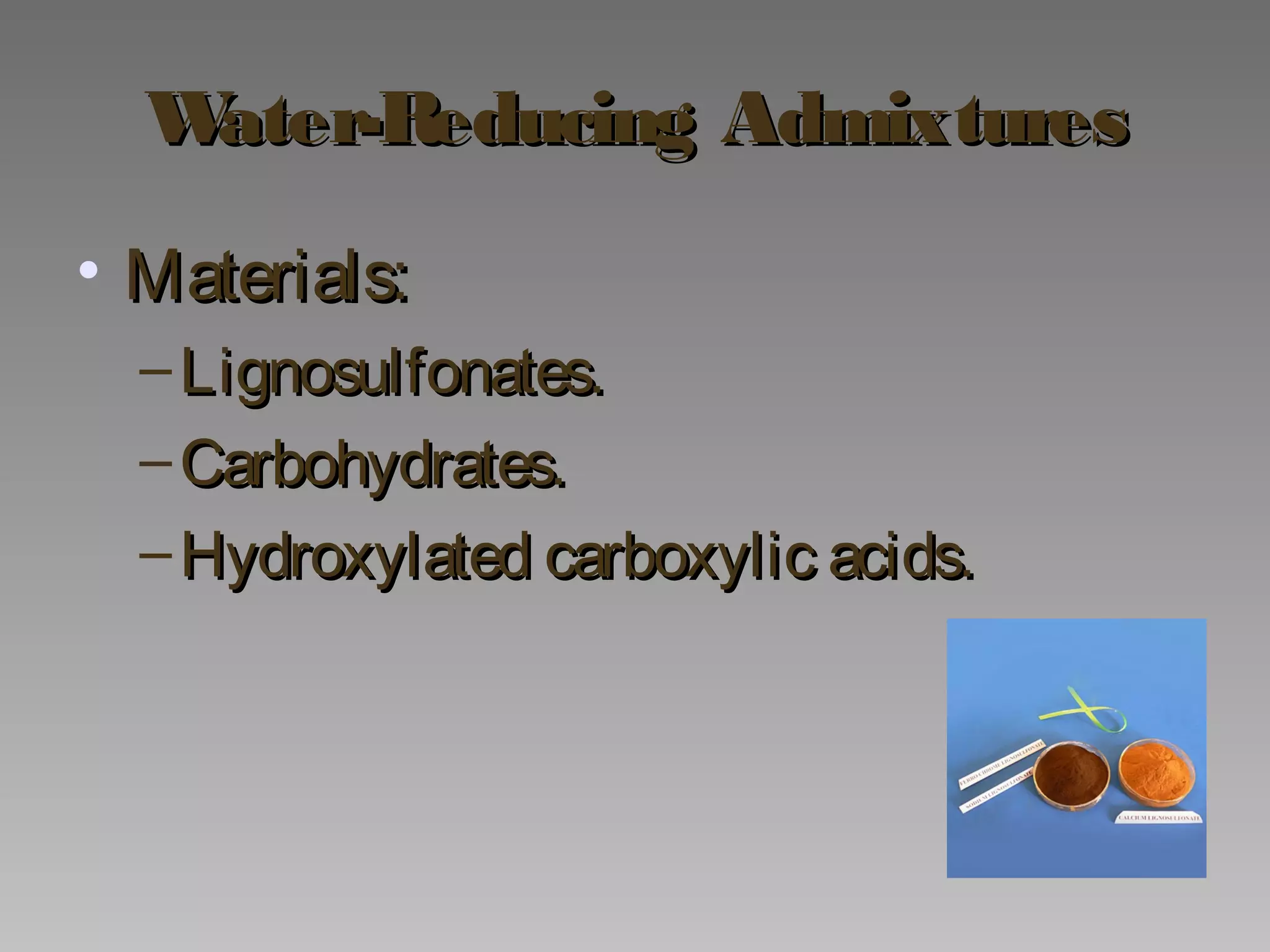
• used to reduce the quantity of mixing waterused to reduce the quantity of mixing water
required to produce concrete of a certainrequired to produce concrete of a certain
slump, reduce water-cementing materials ratio,slump, reduce water-cementing materials ratio,
reducecement content, or increaseslump.reducecement content, or increaseslump.
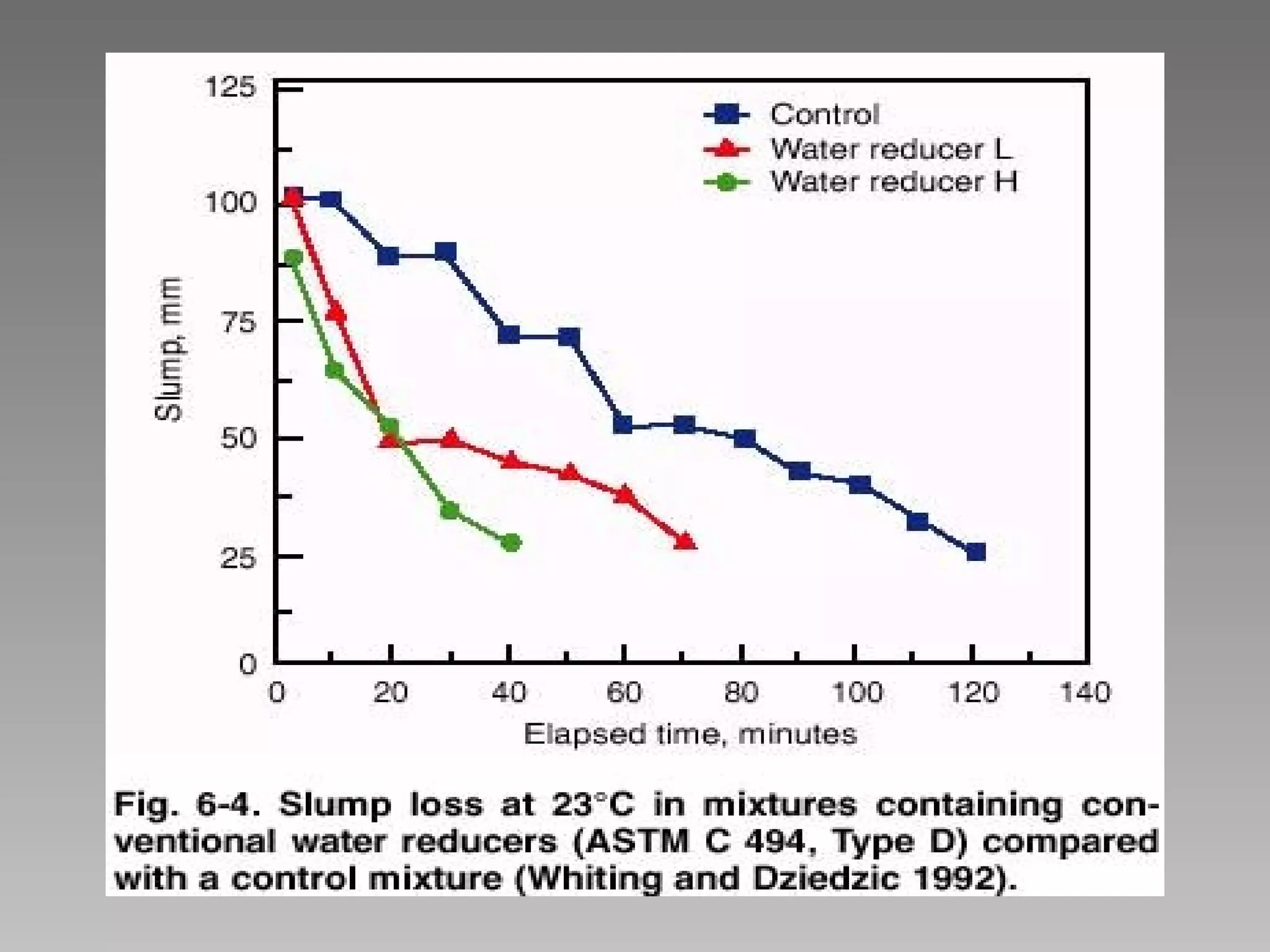
• Typical water reducers reduce the waterTypical water reducers reduce the water
content by approximately 5% to 10%.content by approximately 5% to 10%.
Water-Reducing AdmixturesWater-Reducing Admixtures
• Materials:Materials:
– Lignosulfonates.Lignosulfonates.
– Carbohydrates.Carbohydrates.
– Hydroxylated carboxylic acids.Hydroxylated carboxylic acids.
Water-Reducing AdmixturesWater-Reducing Admixtures
• The effectiveness of water reducers onThe effectiveness of water reducers on
concrete is a function of their chemicalconcrete is a function of their chemical
composition, concrete temperature, cementcomposition, concrete temperature, cement
composition and fineness, cement content, andcomposition and fineness, cement content, and
thepresenceof other admixtures.thepresenceof other admixtures.
Superplasticizers (High-RangeSuperplasticizers (High-Range
WaterReducers)WaterReducers)
• These admixtures are added to concreteThese admixtures are added to concrete
with a low-to-normal slump and water-with a low-to-normal slump and water-
cementing materials ratio to make high-cementing materials ratio to make high-
slump flowing concrete.slump flowing concrete.
• Flowing concrete is a highly fluid butFlowing concrete is a highly fluid but
workable concrete that can be placedworkable concrete that can be placed
with little or no vibration or compactionwith little or no vibration or compaction
while still remaining essentially free ofwhile still remaining essentially free of
excessive bleeding orsegregation.excessive bleeding orsegregation.
Super-plasticizersSuper-plasticizers
(High-Range WaterReducers)(High-Range WaterReducers)
Superplasticizers (High-RangeSuperplasticizers (High-Range
WaterReducers)WaterReducers)
• Applicationswhereflowing concreteisused:Applicationswhereflowing concreteisused:
1.1. thin-section placements,thin-section placements,
2.2. areas of closely spaced and congested reinforcingareas of closely spaced and congested reinforcing
steel,steel,
3.3. pumped concrete to reduce pump pressure,pumped concrete to reduce pump pressure,
thereby increasing lift and distancecapacity,thereby increasing lift and distancecapacity,
4.4. areas where conventional consolidation methodsareas where conventional consolidation methods
areimpractical or can not beused, andareimpractical or can not beused, and
5.5. for reducing handling costs.for reducing handling costs.
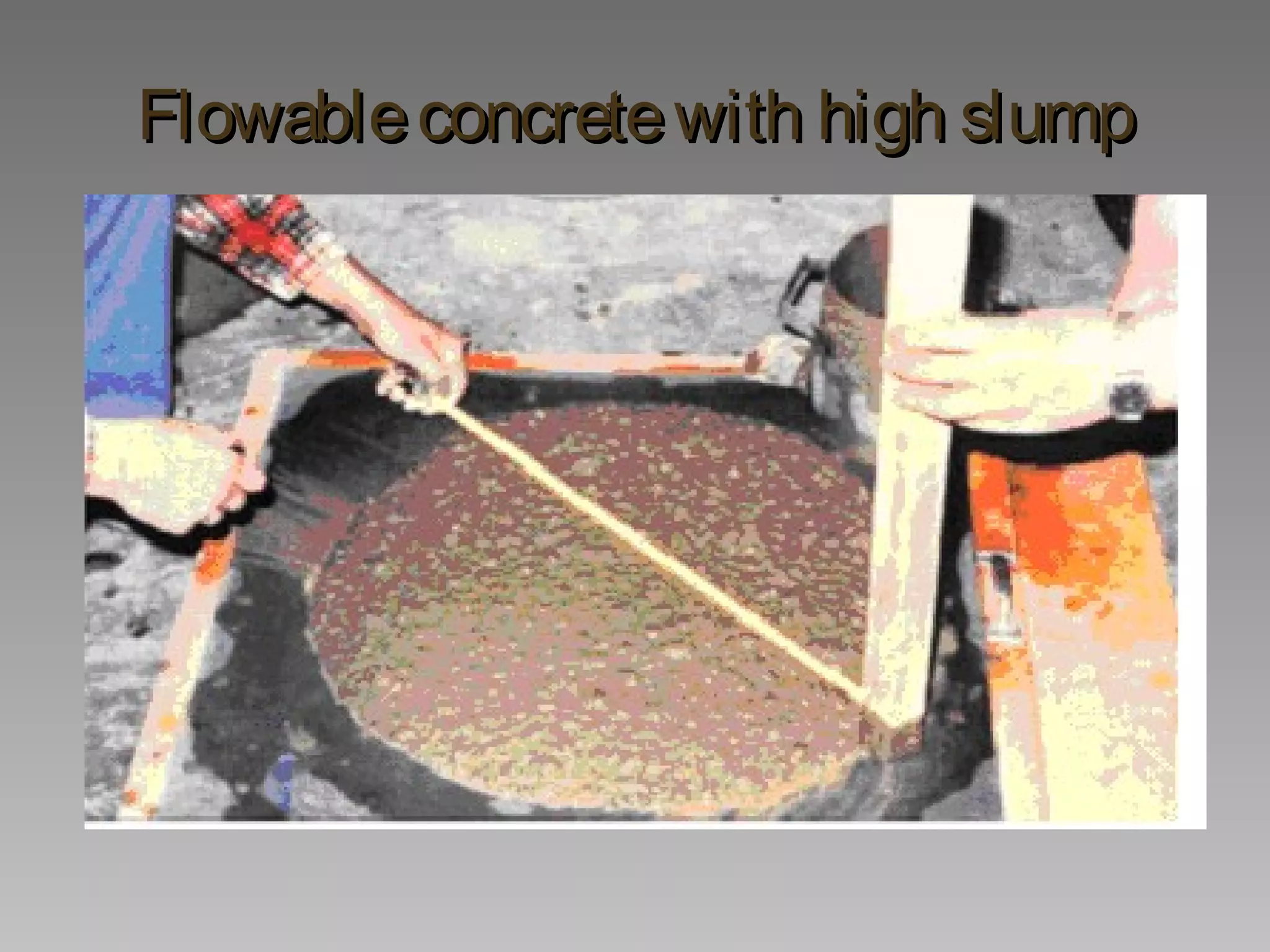
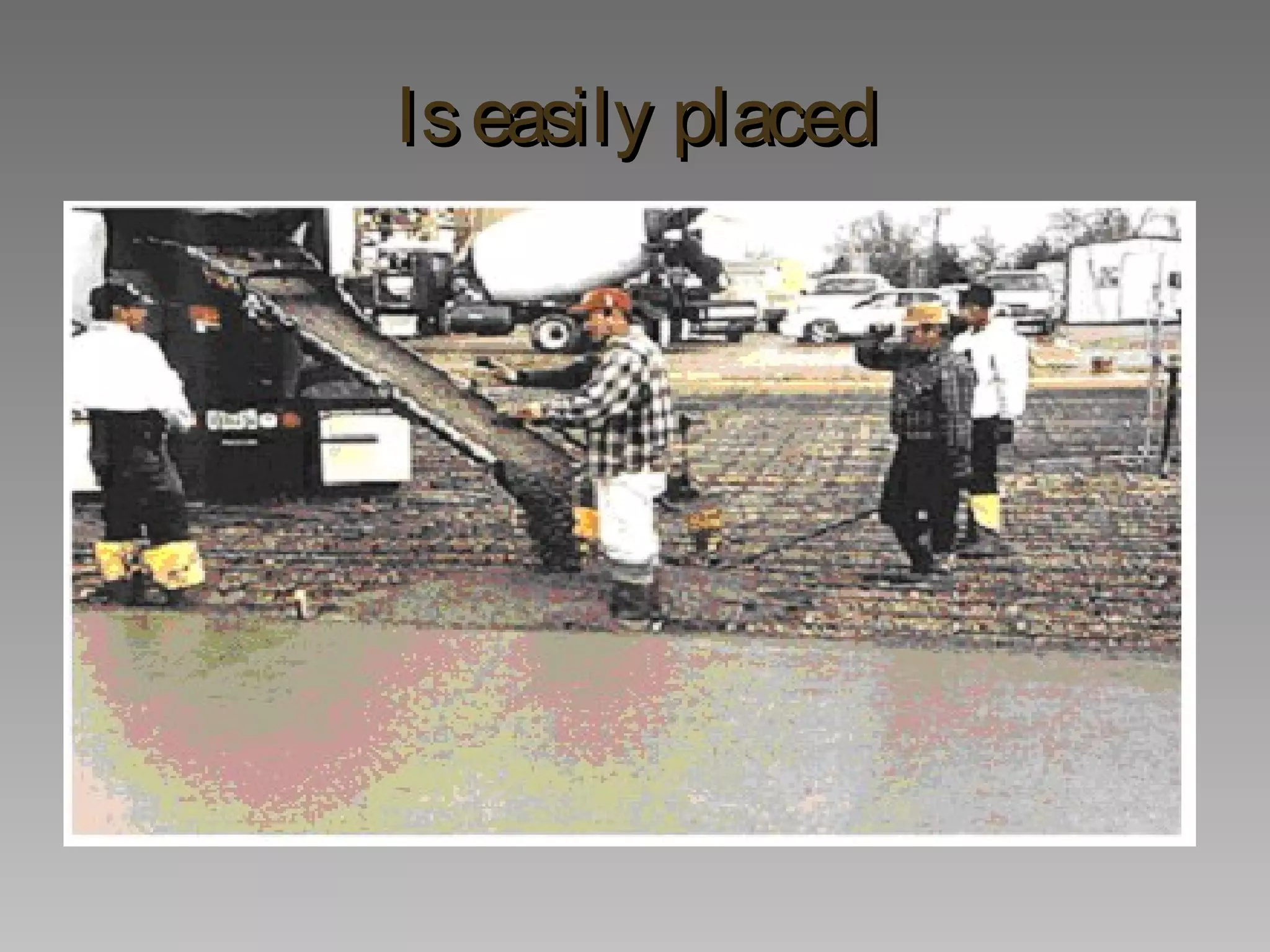
Flowableconcretewith high slumpFlowableconcretewith high slump
Iseasily placedIseasily placed
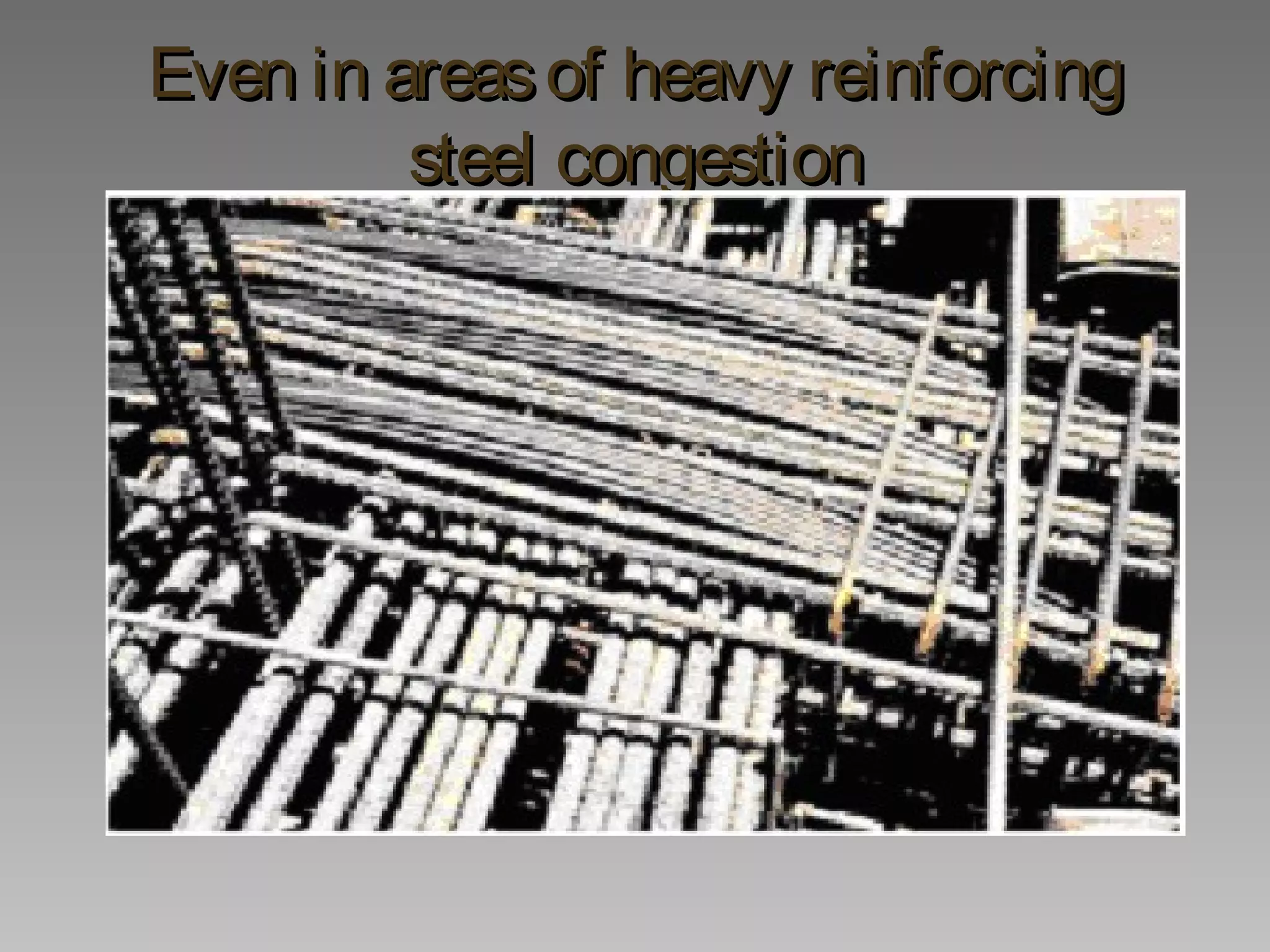
Even in areasof heavy reinforcingEven in areasof heavy reinforcing
steel congestionsteel congestion
• Low water to cementLow water to cement
ratio concrete with lowratio concrete with low
chloride permeability---chloride permeability---
easily made with high-easily made with high-
range water reducers- isrange water reducers- is
ideal for bridgedecksideal for bridgedecks
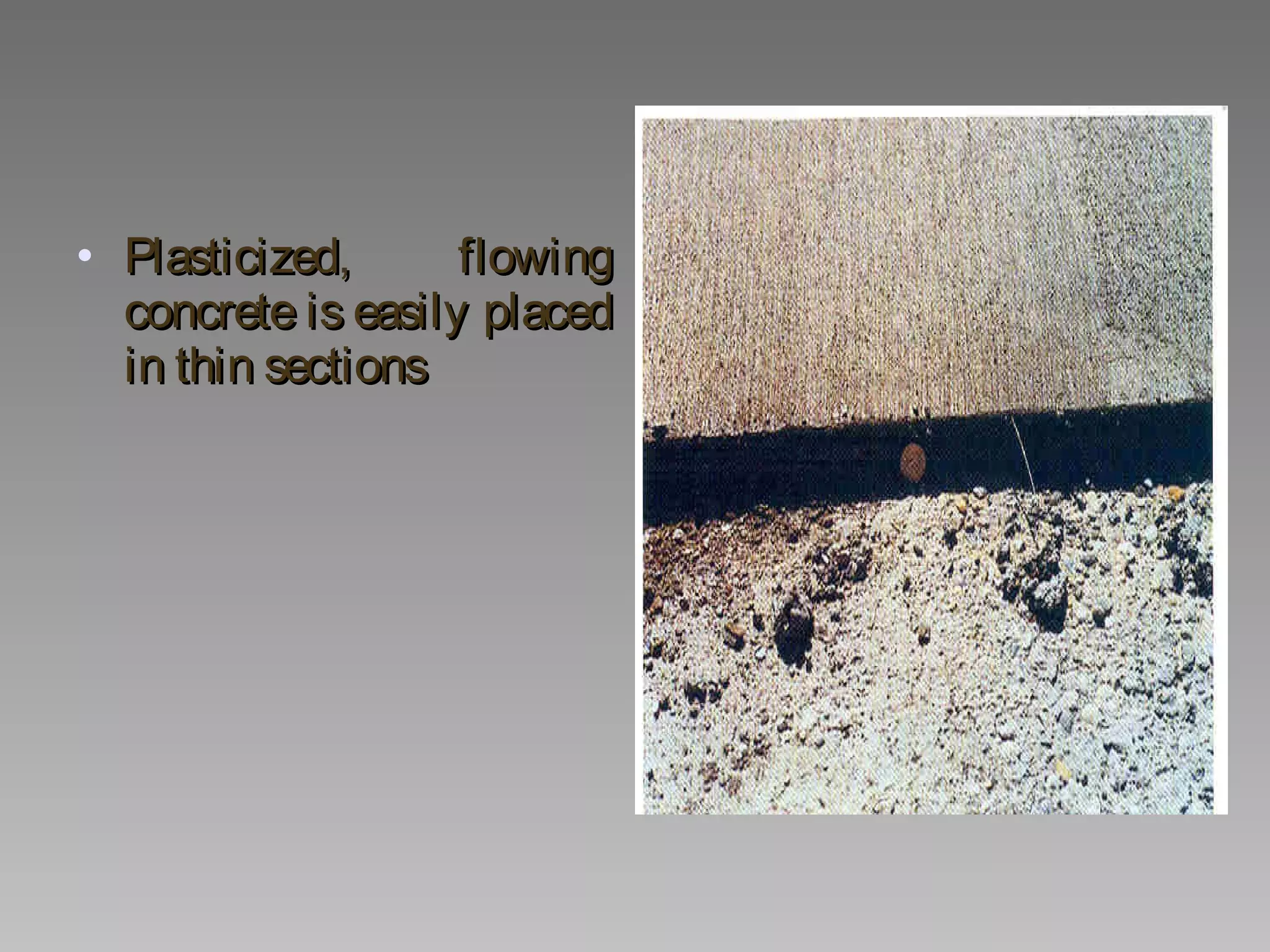
• Plasticized, flowingPlasticized, flowing
concrete is easily placedconcrete is easily placed
in thin sectionsin thin sections
Superplasticizers (High-RangeSuperplasticizers (High-Range
WaterReducers)WaterReducers)
• Typical superplasticizersinclude:Typical superplasticizersinclude:
– Sulfonated melamineformaldehydeSulfonated melamineformaldehyde
condensates.condensates.
– Sulfonated naphthaleneformaldehydeSulfonated naphthaleneformaldehyde
condensate.condensate.
– Lignosulfonates.Lignosulfonates.
– Polycarboxylates.Polycarboxylates.
Superplasticizers (High-RangeSuperplasticizers (High-Range
WaterReducers)WaterReducers)
• bleed significantly less than control concretes ofbleed significantly less than control concretes of
equally high slump and higher water content.equally high slump and higher water content.
• High-slump, low-water-content, plasticized concreteHigh-slump, low-water-content, plasticized concrete
has less drying shrinkage than a high-slump, high-has less drying shrinkage than a high-slump, high-
water-content conventional concretewater-content conventional concrete..
• has similar or higher drying shrinkage thanhas similar or higher drying shrinkage than
conventional low-slump, low-water-contentconventional low-slump, low-water-content
concrete.concrete.
• The effectiveness of the plasticizer is increased withThe effectiveness of the plasticizer is increased with
an increasing amount of cement and fines in thean increasing amount of cement and fines in the
concrete.concrete.
Super-plasticizersSuper-plasticizers
(High-Range WaterReducers)(High-Range WaterReducers)
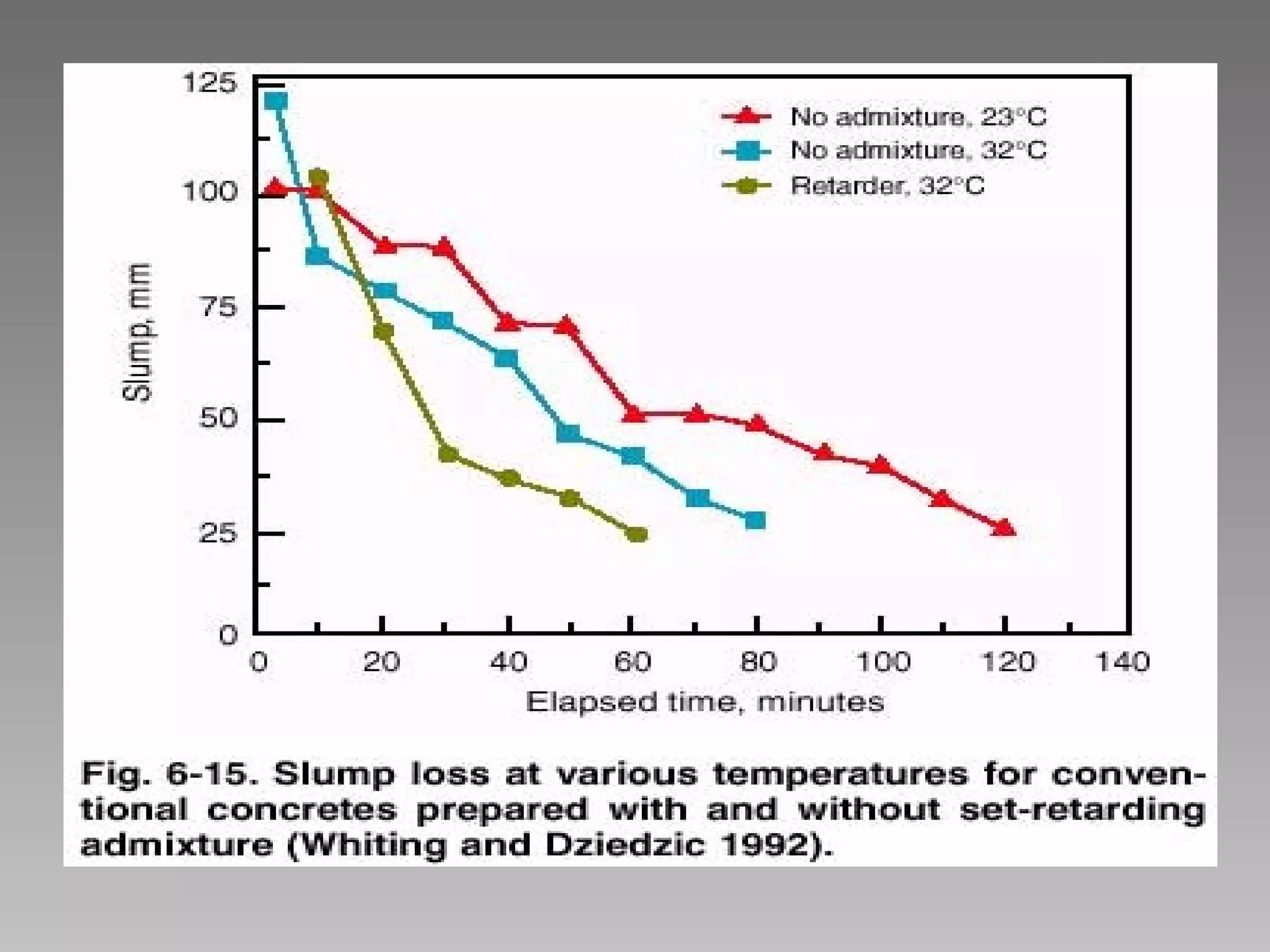
Retarding AdmixturesRetarding Admixtures
• used to retard the rate of setting of concrete at highused to retard the rate of setting of concrete at high
temperaturesof fresh concrete(30°C or more).temperaturesof fresh concrete(30°C or more).
• One of the most practical methods of counteractingOne of the most practical methods of counteracting
this effect is to reduce the temperature of the concretethis effect is to reduce the temperature of the concrete
by cooling themixing water or theaggregates.by cooling themixing water or theaggregates.
• Retarders do not decrease the initial temperature ofRetarders do not decrease the initial temperature of
concrete.concrete.
• The bleeding rate and capacity of plastic concrete isThe bleeding rate and capacity of plastic concrete is
increased with retarders.increased with retarders.
Retarding AdmixturesRetarding Admixtures
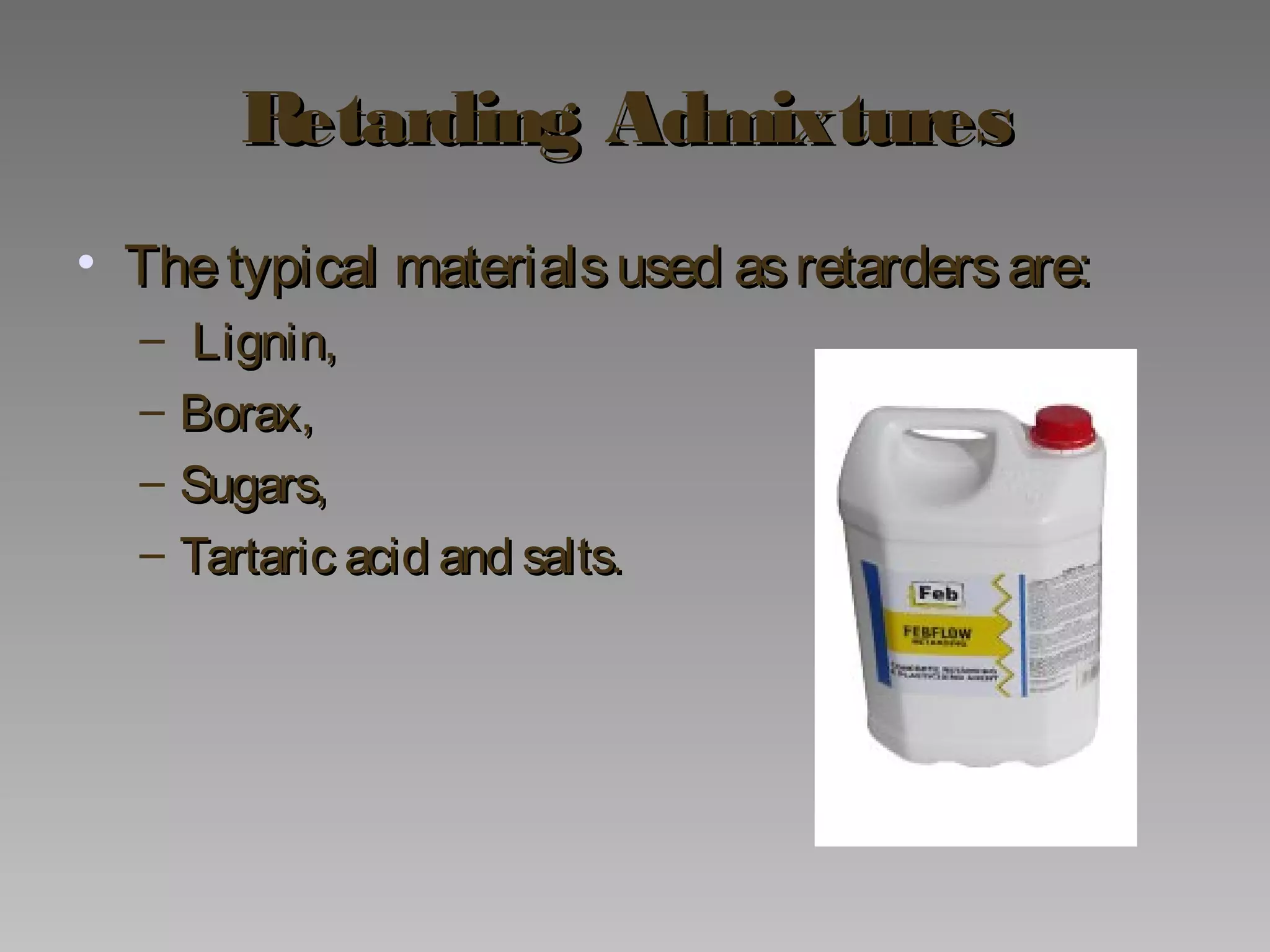
• Thetypical materialsused asretardersare:Thetypical materialsused asretardersare:
– Lignin,Lignin,
– Borax,Borax,
– Sugars,Sugars,
– Tartaric acid and salts.Tartaric acid and salts.
Retarding AdmixturesRetarding Admixtures
• Retardersareused to:Retardersareused to:
1.1. offset theaccelerating effect of hot weather on theoffset theaccelerating effect of hot weather on the
setting of concrete,setting of concrete,
2.2. delay the initial set of concrete when difficult ordelay the initial set of concrete when difficult or
unusual conditionsof placement occur,unusual conditionsof placement occur,
3.3. delay the set for special finishing processes suchdelay the set for special finishing processes such
as an exposed aggregate surface.as an exposed aggregate surface.
Retarding AdmixturesRetarding Admixtures
• some reduction in strength at early ages (one tosome reduction in strength at early ages (one to
threedays) accompaniestheuseof retarders.threedays) accompaniestheuseof retarders.
• The effects of these materials on theother propertiesThe effects of these materials on theother properties
of concrete, such as shrinkage, may not beof concrete, such as shrinkage, may not be
predictable.predictable.
Therefore, acceptance tests of retarders should beTherefore, acceptance tests of retarders should be
made with actual job materials undermade with actual job materials under
anticipated job conditions.anticipated job conditions.
Accelerating AdmixturesAccelerating Admixtures
• used to accelerate strength development ofused to accelerate strength development of
concreteat an early age.concreteat an early age.
• Typical Materialsare:Typical Materialsare:
– Calcium chloride: most commonly used for plainCalcium chloride: most commonly used for plain
concrete.concrete.
– Triethanolamine.Triethanolamine.
– Calcium formate.Calcium formate.
– Calcium nitrate.Calcium nitrate.
– Calcium nitrite.Calcium nitrite.
Accelerating AdmixturesAccelerating Admixtures
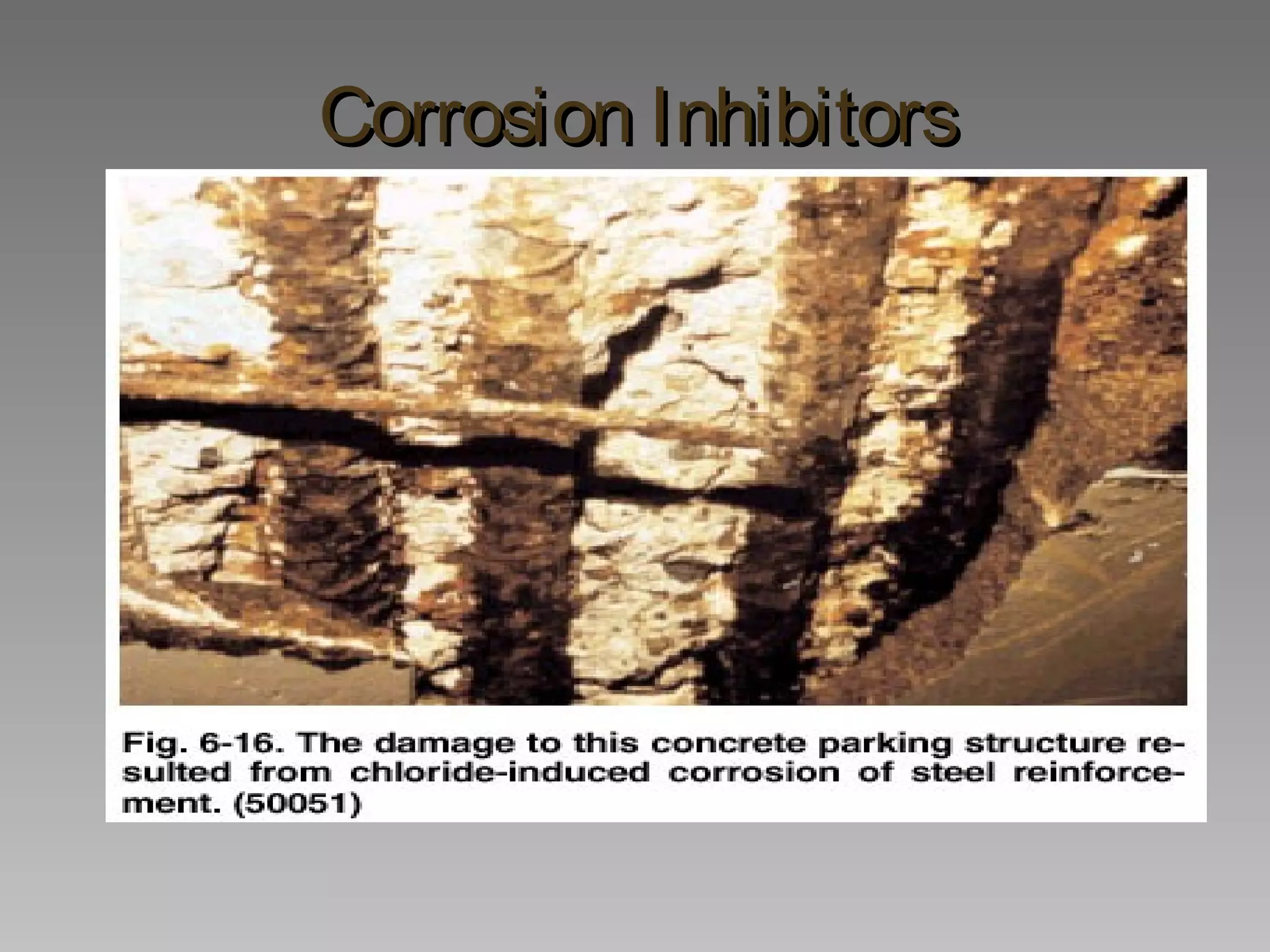
Corrosion InhibitorsCorrosion Inhibitors
• The chlorides can cause corrosion of steelThe chlorides can cause corrosion of steel
reinforcement in concrete.reinforcement in concrete.
• Ferrous oxide and ferric oxide form on theFerrous oxide and ferric oxide form on the
surfaceof reinforcing steel in concrete.surfaceof reinforcing steel in concrete.
• Ferrous oxide reacts with chlorides to formFerrous oxide reacts with chlorides to form
complexes that move away from the steel tocomplexes that move away from the steel to
formform rustrust. The chloride ions continue to attack. The chloride ions continue to attack
thesteel until the oxidelayer isdestroyed.thesteel until the oxidelayer isdestroyed.
Corrosion InhibitorsCorrosion Inhibitors
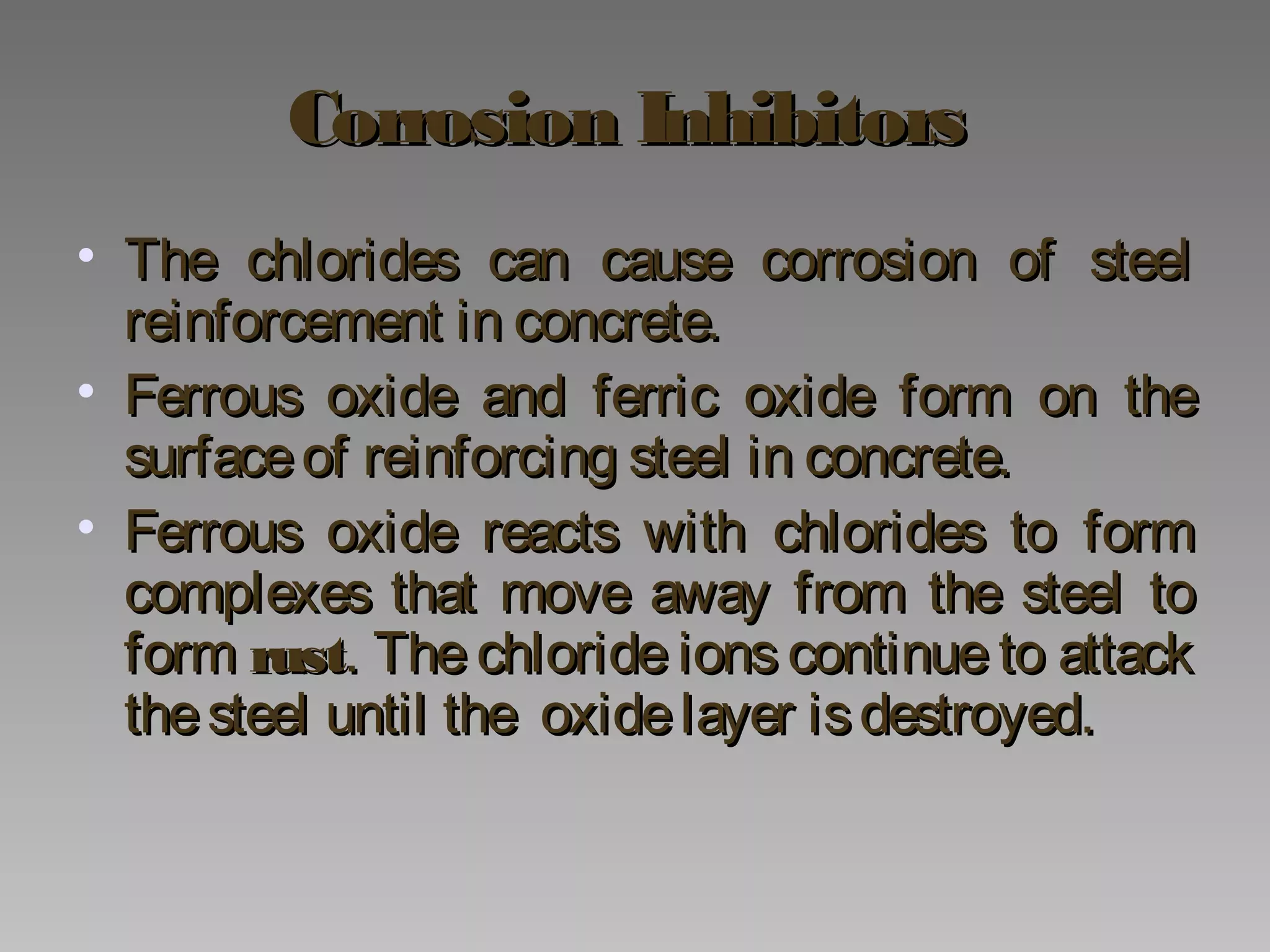
• Corrosion-inhibiting admixtures chemically arrest theCorrosion-inhibiting admixtures chemically arrest the
corrosion reaction.corrosion reaction.
• Commercially availablecorrosion inhibitorsinclude:Commercially availablecorrosion inhibitorsinclude:
– calcium nitrite,calcium nitrite,
– sodium nitrite,sodium nitrite,
– dimethyl ethanolamine,dimethyl ethanolamine,
– amines,amines,
– phosphates,phosphates,
– ester amines.ester amines.
Shrinkage-ReducingAdmixturesShrinkage-ReducingAdmixtures
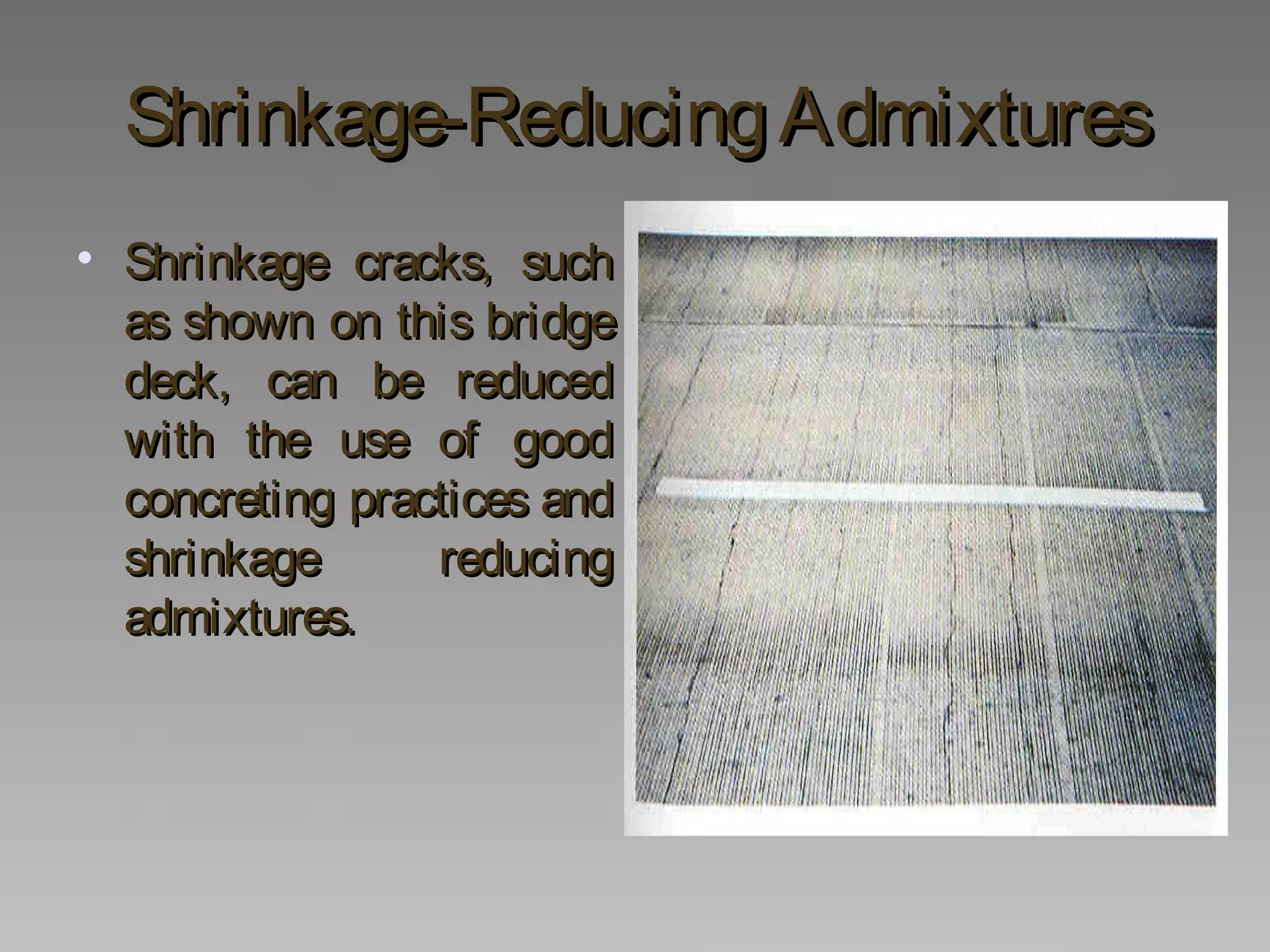
• Shrinkage cracks, suchShrinkage cracks, such
as shown on this bridgeas shown on this bridge
deck, can be reduceddeck, can be reduced
with the use of goodwith the use of good
concreting practices andconcreting practices and
shrinkage reducingshrinkage reducing
admixtures.admixtures.
Chemical Admixtures to reduce Alkali-Chemical Admixtures to reduce Alkali-
aggregate Reactivityaggregate Reactivity
(ASRInhibitors(ASRInhibitors))
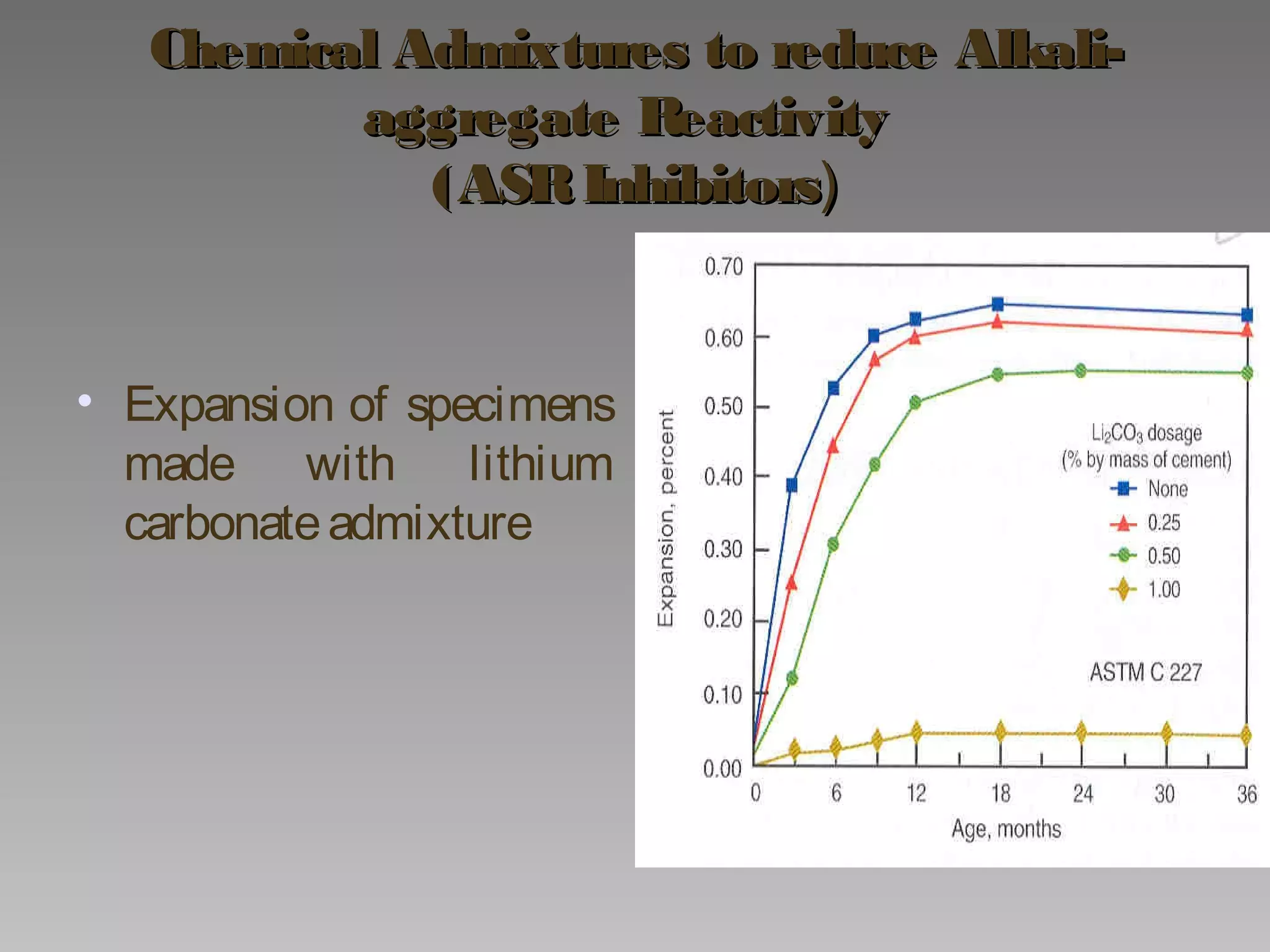
• Expansion of specimens
made with lithium
carbonateadmixture
Coloring admixtures(Pigments)Coloring admixtures(Pigments)
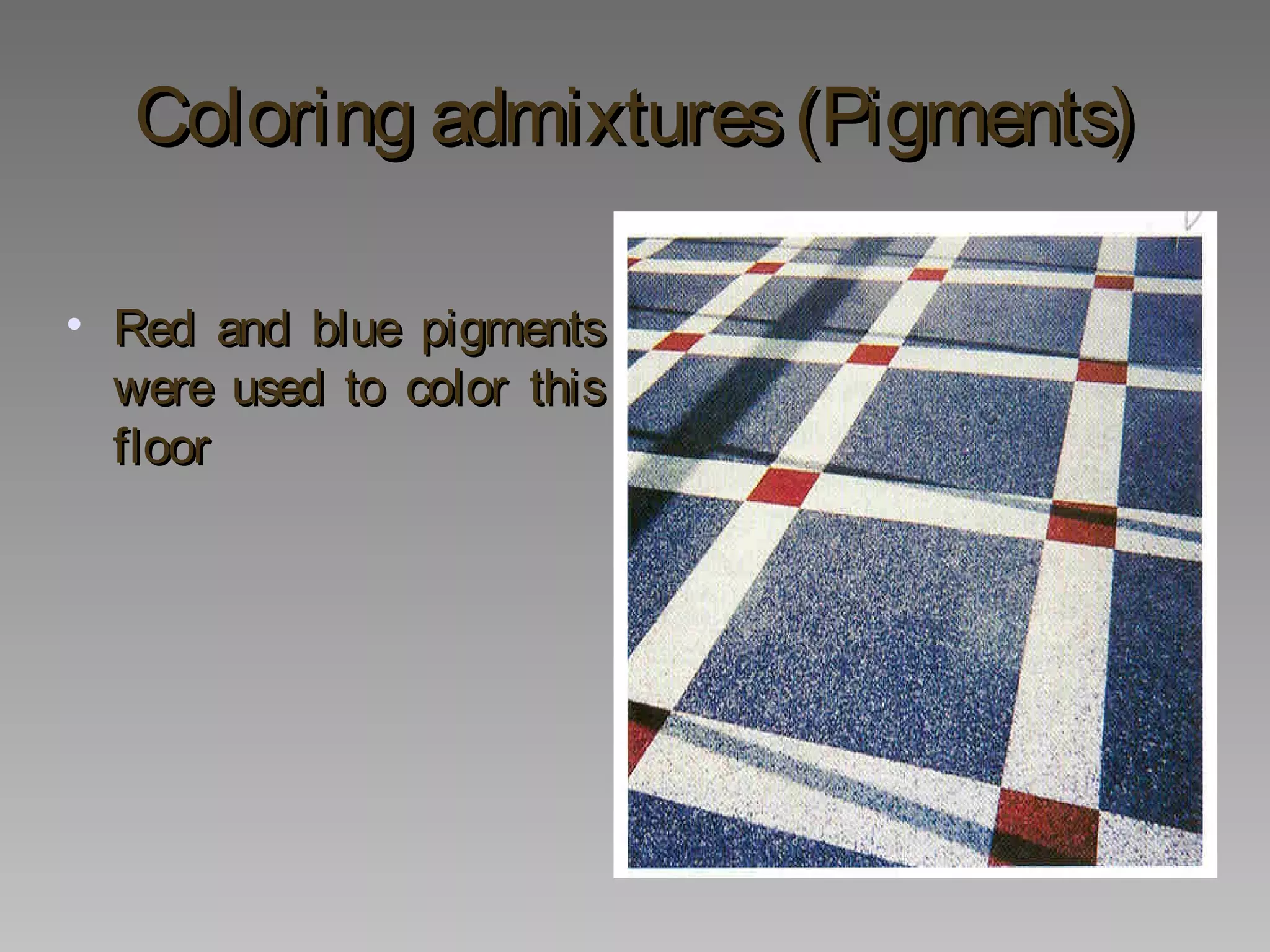
• Red and blue pigmentsRed and blue pigments
were used to color thiswere used to color this
floorfloor
Coloring admixtures(Pigments)Coloring admixtures(Pigments)
• Natural and synthetic materials are used to color concrete forNatural and synthetic materials are used to color concrete for
aesthetic and safety. Red concrete is used around buriedaesthetic and safety. Red concrete is used around buried
electrical or gas lines as a warning to anyone near theseelectrical or gas lines as a warning to anyone near these
facilities. Yellow concrete safety curbs are used in pavingfacilities. Yellow concrete safety curbs are used in paving
applications. Generally, the amount of pigments used inapplications. Generally, the amount of pigments used in
concrete should not exceed 10% by eight of the cement.concrete should not exceed 10% by eight of the cement.
Pigments used in amounts less than 6% generally do notPigments used in amounts less than 6% generally do not
affect concretepropertiesBeforeacoloring admixtureisusedaffect concretepropertiesBeforeacoloring admixtureisused
on a project, it should be tested for color fastness in sunlighton a project, it should be tested for color fastness in sunlight
and autoclaving, chemical stability in cement, and effects onand autoclaving, chemical stability in cement, and effects on
concreteproperties.concreteproperties.
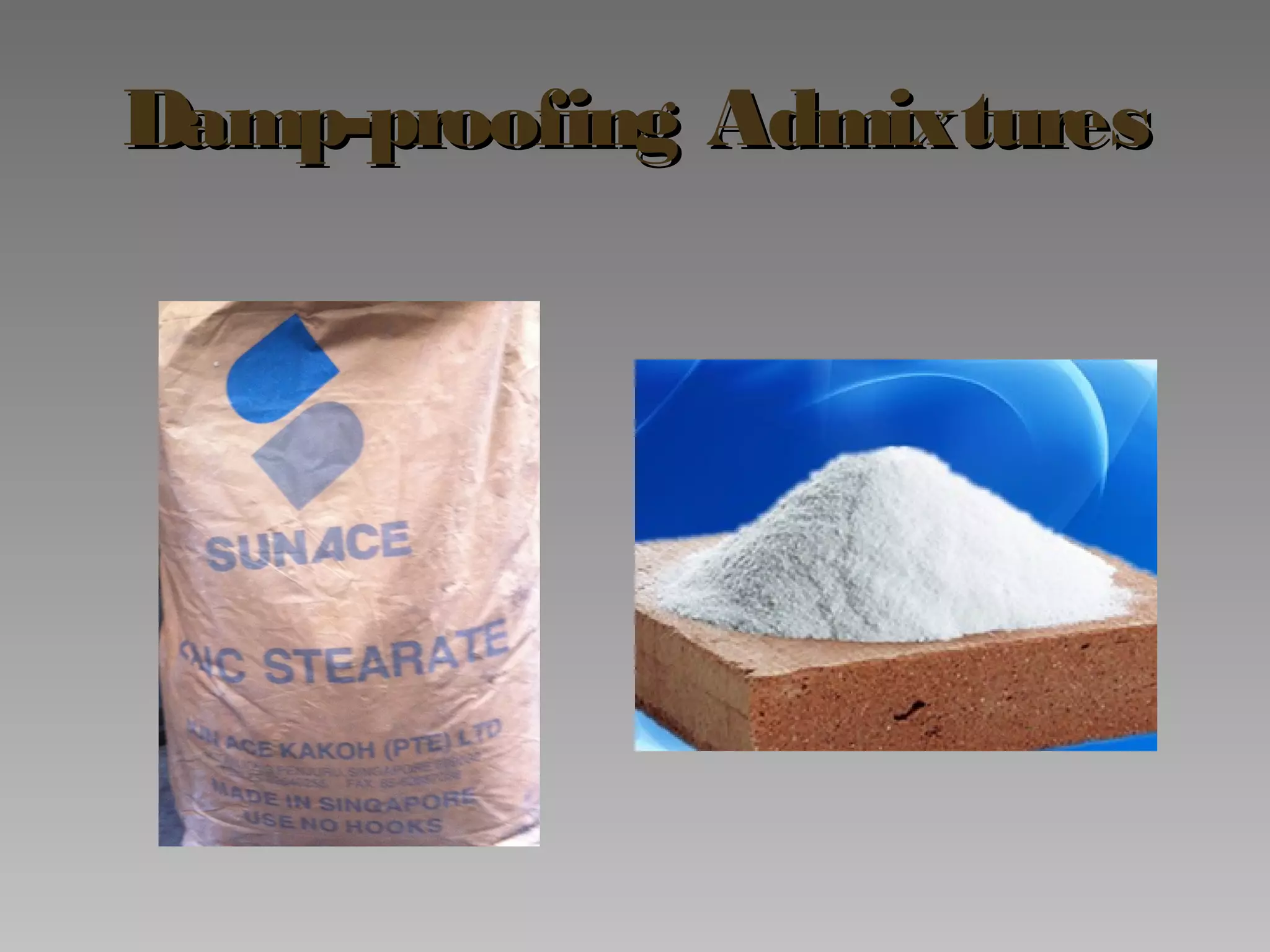
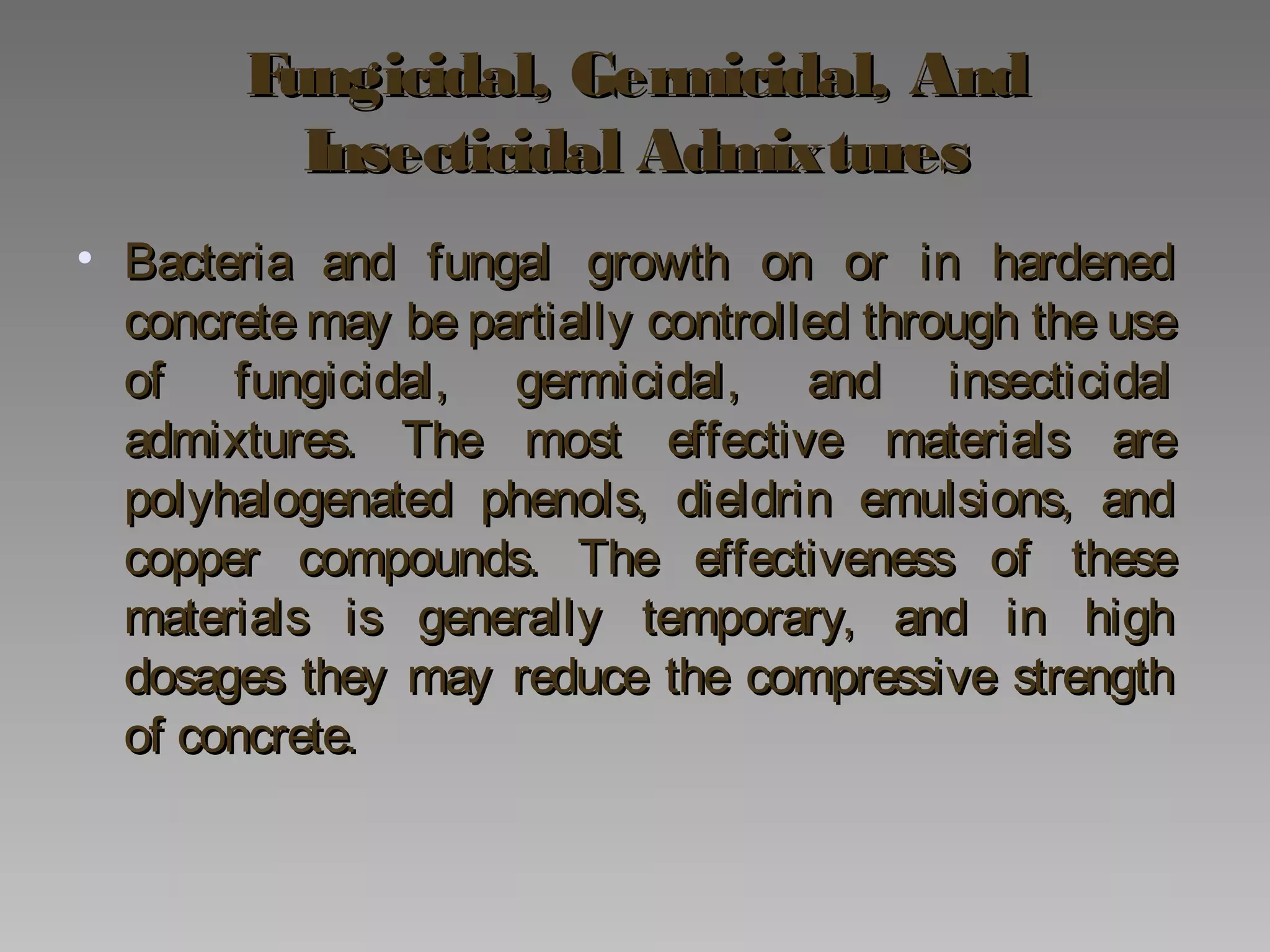
Damp-proofing AdmixturesDamp-proofing Admixtures
• The passage of water through concrete can usuallyThe passage of water through concrete can usually
be traced to the existence of cracks or areas ofbe traced to the existence of cracks or areas of
incomplete consolidation. Sound, dense concreteincomplete consolidation. Sound, dense concrete
made with a water cement ratio of less than 0.50 bymade with a water cement ratio of less than 0.50 by
mass will be watertight if it is properly placed andmass will be watertight if it is properly placed and
cured. Admixtures known as damp proofing agentscured. Admixtures known as damp proofing agents
include certain soaps, stearates, and petroleuminclude certain soaps, stearates, and petroleum
products.products.
Damp-proofing AdmixturesDamp-proofing Admixtures
Fungicidal, Germicidal, AndFungicidal, Germicidal, And
Insecticidal AdmixturesInsecticidal Admixtures
• Bacteria and fungal growth on or in hardenedBacteria and fungal growth on or in hardened
concrete may be partially controlled through the useconcrete may be partially controlled through the use
of fungicidal, germicidal, and insecticidalof fungicidal, germicidal, and insecticidal
admixtures. The most effective materials areadmixtures. The most effective materials are
polyhalogenated phenols, dieldrin emulsions, andpolyhalogenated phenols, dieldrin emulsions, and
copper compounds. The effectiveness of thesecopper compounds. The effectiveness of these
materials is generally temporary, and in highmaterials is generally temporary, and in high
dosages they may reduce the compressive strengthdosages they may reduce the compressive strength
of concrete.of concrete.
Storing And DispensingStoring And Dispensing
Chemical AdmixturesChemical Admixtures
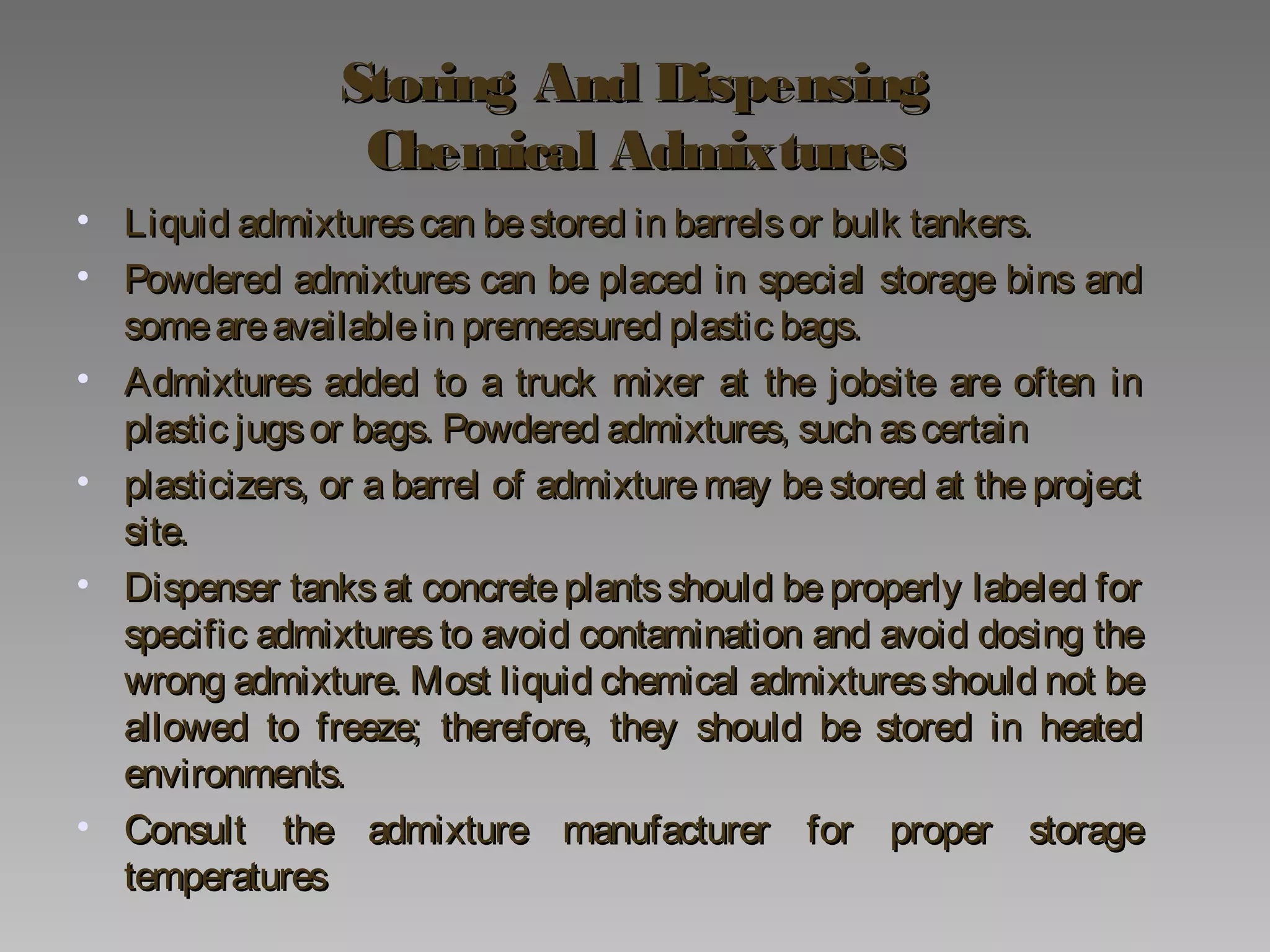
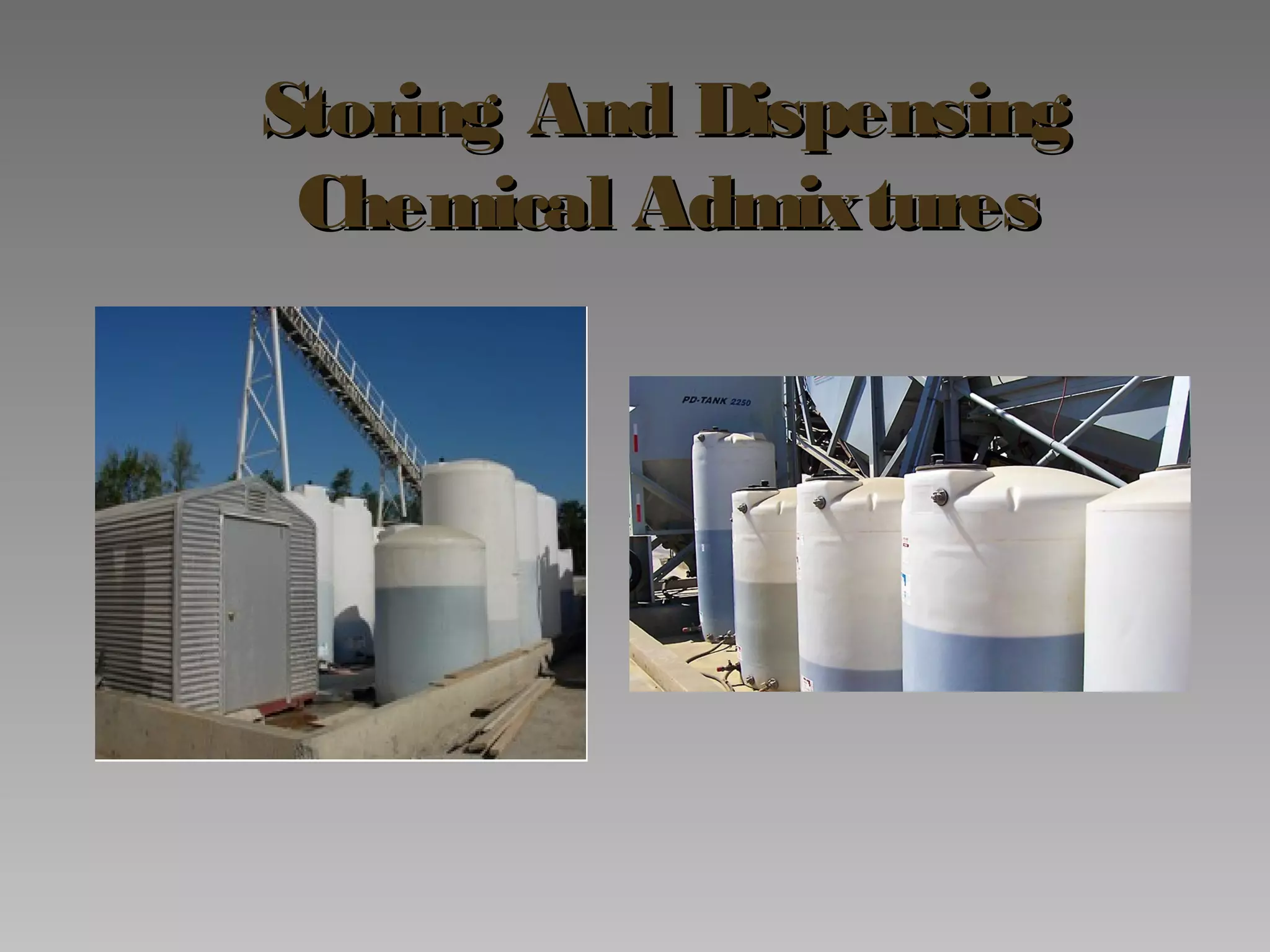
• Liquid admixturescan bestored in barrelsor bulk tankers.Liquid admixturescan bestored in barrelsor bulk tankers.
• Powdered admixtures can be placed in special storage bins andPowdered admixtures can be placed in special storage bins and
someareavailablein premeasured plastic bags.someareavailablein premeasured plastic bags.
• Admixtures added to a truck mixer at the jobsite are often inAdmixtures added to a truck mixer at the jobsite are often in
plastic jugsor bags. Powdered admixtures, such ascertainplastic jugsor bags. Powdered admixtures, such ascertain
• plasticizers, or a barrel of admixture may be stored at the projectplasticizers, or a barrel of admixture may be stored at the project
site.site.
• Dispenser tanks at concrete plants should be properly labeled forDispenser tanks at concrete plants should be properly labeled for
specific admixtures to avoid contamination and avoid dosing thespecific admixtures to avoid contamination and avoid dosing the
wrong admixture. Most liquid chemical admixturesshould not bewrong admixture. Most liquid chemical admixturesshould not be
allowed to freeze; therefore, they should be stored in heatedallowed to freeze; therefore, they should be stored in heated
environments.environments.
• Consult the admixture manufacturer for proper storageConsult the admixture manufacturer for proper storage
temperaturestemperatures
Storing And DispensingStoring And Dispensing
Chemical AdmixturesChemical Admixtures
ReferencesReferences
• Concrete Technology by: R.P. RethaliyaConcrete Technology by: R.P. Rethaliya
• Concrete Technology by . M.S. ShettyConcrete Technology by . M.S. Shetty
• Internet websitesInternet websites
• http://www.foundationsakc.org/http://www.foundationsakc.org/
 Concrete Admixtures

Concrete Admixtures

  • 1.
  • 2.
    SyllabusSyllabus AdmixturesAdmixtures •Plasticizers, Retarders, AcceleratorsandPlasticizers, Retarders, Accelerators and other admixtures, Tests on admixtures,other admixtures, Tests on admixtures, chemistry and compatibility with Concretechemistry and compatibility with Concrete
  • 3.
    What are chemicaladmixtures?What are chemical admixtures? • The definition of RILEM (International Union of Testing andThe definition of RILEM (International Union of Testing and Research Laboratoriesfor Materialsand Structures) is:Research Laboratoriesfor Materialsand Structures) is: • •• Admixtures for concrete, mortar or paste are inorganic orAdmixtures for concrete, mortar or paste are inorganic or organic materials these are added to the normal components oforganic materials these are added to the normal components of a mix not normally exceeding 5% by mass of cement ora mix not normally exceeding 5% by mass of cement or cementationsmaterialscementationsmaterials • •• Admixtures interact with hydrating cement by physical,Admixtures interact with hydrating cement by physical, chemical or physicochemical actions.chemical or physicochemical actions.
  • 4.
    What are chemicaladmixtures?What are chemical admixtures?
  • 5.
    what are chemicaladmixtures?what are chemical admixtures? • •• They modify one or more properties of concrete, mortar orThey modify one or more properties of concrete, mortar or pasteeither in fresh or hardened state.pasteeither in fresh or hardened state. • •• Admixtures are usually very complex compoundschemicallyAdmixtures are usually very complex compoundschemically excepting afew.excepting afew. • •• They are unlikely to be pure compounds but associated withThey are unlikely to be pure compounds but associated with some other minor chemical compounds or they may be mixedsome other minor chemical compounds or they may be mixed formulations.formulations. • •• It is rather difficult for a civil engineer to understand themIt is rather difficult for a civil engineer to understand them through their chemical nature.through their chemical nature.
  • 6.
    Thus, Admixtures arethoseThus, Admixtures are those ingredients in concrete other thaningredients in concrete other than Portland cement, water, andPortland cement, water, and aggregates that are added to theaggregates that are added to the mixture immediately before ormixture immediately before or during mixing . Admixtures can beduring mixing . Admixtures can be classified by function asfollows:classified by function asfollows:
  • 7.
    1. Air-entraining admixtures1.Air-entraining admixtures 2. Water-reducing admixtures2. Water-reducing admixtures 3. Plasticizers3. Plasticizers 4. Accelerating admixtures4. Accelerating admixtures 5. Retarding admixtures5. Retarding admixtures 6. Hydration-control admixtures6. Hydration-control admixtures
  • 8.
    7. Corrosion inhibitors7.Corrosion inhibitors 8. Shrinkage reducers8. Shrinkage reducers 9. Alkali-silica reactivity inhibitors9. Alkali-silica reactivity inhibitors 10. Colouring admixtures10. Colouring admixtures 11. Miscellaneous admixtures such workability,11. Miscellaneous admixtures such workability, bonding, damp proofing, permeabilitybonding, damp proofing, permeability reducing, grouting, gas-forming, and pumpingreducing, grouting, gas-forming, and pumping admixturesadmixtures
  • 9.
    AdmixturesAdmixtures • For ourcountry, the most common chemicalFor our country, the most common chemical admixtures are plasticizers and Super-plasticizers.admixtures are plasticizers and Super-plasticizers. These are also known as water reducers and high-These are also known as water reducers and high- rangewater reducers, respectively.rangewater reducers, respectively. • •• Retarders are likely to be needed, especially for hotRetarders are likely to be needed, especially for hot weather concreting, ready mixed concrete or forweather concreting, ready mixed concrete or for special continuouspoursspecial continuouspours
  • 10.
  • 11.
    AdmixturesAdmixtures • Othertypes ofadmixtures are:Othertypes of admixtures are: • •• AcceleratorsAccelerators • •• Air-entraining agentsAir-entraining agents • •• Pumping aidsPumping aids • •• Shot Crete/ Guniting aidsShot Crete/ Guniting aids • •• Corrosion inhibitors, and someothers.Corrosion inhibitors, and someothers.
  • 12.
    How do theyact?How do they act? • •• The chemical, physical or physico-chemical actions of admixtures inThe chemical, physical or physico-chemical actions of admixtures in cement concretearequitecomplex.cement concretearequitecomplex. • •• In fact, cement itself is an extremely complex compound with majorIn fact, cement itself is an extremely complex compound with major compoundssuch ascalcium silicates, calcium aluminates, gypsum.compoundssuch ascalcium silicates, calcium aluminates, gypsum. • •• Besidesit containsmany alkali and other calcium salts.Besidesit containsmany alkali and other calcium salts. • •• Theaction of admixturescan, however, besimplified for thesakeofTheaction of admixturescan, however, besimplified for thesakeof • Understanding, as:Understanding, as: • (i) adsorption(i) adsorption • (ii) De-flocculation or dispersion(ii) De-flocculation or dispersion • (iii)Chemical absorption or interaction(iii)Chemical absorption or interaction
  • 15.
    The majorreasons forusingThemajorreasons forusing admixtures are:admixtures are: 1. To reduce the cost of concrete construction1. To reduce the cost of concrete construction 2. To achieve certain properties in concrete2. To achieve certain properties in concrete more effectively than by othermeansmore effectively than by othermeans 3. To maintain the quality of concrete during3. To maintain the quality of concrete during thethe stages of mixing, transporting,stages of mixing, transporting, placing, andplacing, and curing in adverse weathercuring in adverse weather conditionsconditions 4. To overcome certain emergencies during4. To overcome certain emergencies during
  • 16.
    Air-Entraining AdmixturesAir-Entraining Admixtures •used to purposely introduce and stabilizeused to purposely introduce and stabilize microscopic air bubbles in concrete. Air-microscopic air bubbles in concrete. Air- entrainment will dramatically improve theentrainment will dramatically improve the durability of concrete exposed to cycles ofdurability of concrete exposed to cycles of freezing and thawing. Entrained air greatlyfreezing and thawing. Entrained air greatly improves concrete's resistance to surfaceimproves concrete's resistance to surface scaling caused by chemical de-icersscaling caused by chemical de-icers
  • 17.
  • 18.
    Frost damage atjoints of aFrost damage at joints of a pavementpavement
  • 19.
    Frost induced crackingnearjointsFrost induced cracking nearjoints
  • 20.
    Scaled concreteScaled concrete surfaceresultingsurface resulting from lack of airfrom lack of air entrainment, use ofentrainment, use of deicers, and poordeicers, and poor finishing and curingfinishing and curing practicespractices
  • 21.
    • The primaryingredients used in air-The primary ingredients used in air- entraining admixtures are salts of woodentraining admixtures are salts of wood resin (Vinsol resin), synthetic detergents,resin (Vinsol resin), synthetic detergents, saltsof petroleum acids, etc.saltsof petroleum acids, etc.
  • 22.
    Water-Reducing AdmixturesWater-Reducing Admixtures •used to reduce the quantity of mixing waterused to reduce the quantity of mixing water required to produce concrete of a certainrequired to produce concrete of a certain slump, reduce water-cementing materials ratio,slump, reduce water-cementing materials ratio, reducecement content, or increaseslump.reducecement content, or increaseslump. • Typical water reducers reduce the waterTypical water reducers reduce the water content by approximately 5% to 10%.content by approximately 5% to 10%.
  • 23.
  • 24.
    Water-Reducing AdmixturesWater-Reducing Admixtures •Materials:Materials: – Lignosulfonates.Lignosulfonates. – Carbohydrates.Carbohydrates. – Hydroxylated carboxylic acids.Hydroxylated carboxylic acids.
  • 26.
    Water-Reducing AdmixturesWater-Reducing Admixtures •The effectiveness of water reducers onThe effectiveness of water reducers on concrete is a function of their chemicalconcrete is a function of their chemical composition, concrete temperature, cementcomposition, concrete temperature, cement composition and fineness, cement content, andcomposition and fineness, cement content, and thepresenceof other admixtures.thepresenceof other admixtures.
  • 27.
    Superplasticizers (High-RangeSuperplasticizers (High-Range WaterReducers)WaterReducers) •These admixtures are added to concreteThese admixtures are added to concrete with a low-to-normal slump and water-with a low-to-normal slump and water- cementing materials ratio to make high-cementing materials ratio to make high- slump flowing concrete.slump flowing concrete. • Flowing concrete is a highly fluid butFlowing concrete is a highly fluid but workable concrete that can be placedworkable concrete that can be placed with little or no vibration or compactionwith little or no vibration or compaction while still remaining essentially free ofwhile still remaining essentially free of excessive bleeding orsegregation.excessive bleeding orsegregation.
  • 28.
  • 29.
    Superplasticizers (High-RangeSuperplasticizers (High-Range WaterReducers)WaterReducers) •Applicationswhereflowing concreteisused:Applicationswhereflowing concreteisused: 1.1. thin-section placements,thin-section placements, 2.2. areas of closely spaced and congested reinforcingareas of closely spaced and congested reinforcing steel,steel, 3.3. pumped concrete to reduce pump pressure,pumped concrete to reduce pump pressure, thereby increasing lift and distancecapacity,thereby increasing lift and distancecapacity, 4.4. areas where conventional consolidation methodsareas where conventional consolidation methods areimpractical or can not beused, andareimpractical or can not beused, and 5.5. for reducing handling costs.for reducing handling costs.
  • 30.
  • 31.
  • 32.
    Even in areasofheavy reinforcingEven in areasof heavy reinforcing steel congestionsteel congestion
  • 33.
    • Low waterto cementLow water to cement ratio concrete with lowratio concrete with low chloride permeability---chloride permeability--- easily made with high-easily made with high- range water reducers- isrange water reducers- is ideal for bridgedecksideal for bridgedecks
  • 34.
    • Plasticized, flowingPlasticized,flowing concrete is easily placedconcrete is easily placed in thin sectionsin thin sections
  • 35.
    Superplasticizers (High-RangeSuperplasticizers (High-Range WaterReducers)WaterReducers) •Typical superplasticizersinclude:Typical superplasticizersinclude: – Sulfonated melamineformaldehydeSulfonated melamineformaldehyde condensates.condensates. – Sulfonated naphthaleneformaldehydeSulfonated naphthaleneformaldehyde condensate.condensate. – Lignosulfonates.Lignosulfonates. – Polycarboxylates.Polycarboxylates.
  • 36.
    Superplasticizers (High-RangeSuperplasticizers (High-Range WaterReducers)WaterReducers) •bleed significantly less than control concretes ofbleed significantly less than control concretes of equally high slump and higher water content.equally high slump and higher water content. • High-slump, low-water-content, plasticized concreteHigh-slump, low-water-content, plasticized concrete has less drying shrinkage than a high-slump, high-has less drying shrinkage than a high-slump, high- water-content conventional concretewater-content conventional concrete.. • has similar or higher drying shrinkage thanhas similar or higher drying shrinkage than conventional low-slump, low-water-contentconventional low-slump, low-water-content concrete.concrete. • The effectiveness of the plasticizer is increased withThe effectiveness of the plasticizer is increased with an increasing amount of cement and fines in thean increasing amount of cement and fines in the concrete.concrete.
  • 37.
  • 38.
    Retarding AdmixturesRetarding Admixtures •used to retard the rate of setting of concrete at highused to retard the rate of setting of concrete at high temperaturesof fresh concrete(30°C or more).temperaturesof fresh concrete(30°C or more). • One of the most practical methods of counteractingOne of the most practical methods of counteracting this effect is to reduce the temperature of the concretethis effect is to reduce the temperature of the concrete by cooling themixing water or theaggregates.by cooling themixing water or theaggregates. • Retarders do not decrease the initial temperature ofRetarders do not decrease the initial temperature of concrete.concrete. • The bleeding rate and capacity of plastic concrete isThe bleeding rate and capacity of plastic concrete is increased with retarders.increased with retarders.
  • 39.
    Retarding AdmixturesRetarding Admixtures •Thetypical materialsused asretardersare:Thetypical materialsused asretardersare: – Lignin,Lignin, – Borax,Borax, – Sugars,Sugars, – Tartaric acid and salts.Tartaric acid and salts.
  • 41.
    Retarding AdmixturesRetarding Admixtures •Retardersareused to:Retardersareused to: 1.1. offset theaccelerating effect of hot weather on theoffset theaccelerating effect of hot weather on the setting of concrete,setting of concrete, 2.2. delay the initial set of concrete when difficult ordelay the initial set of concrete when difficult or unusual conditionsof placement occur,unusual conditionsof placement occur, 3.3. delay the set for special finishing processes suchdelay the set for special finishing processes such as an exposed aggregate surface.as an exposed aggregate surface.
  • 42.
    Retarding AdmixturesRetarding Admixtures •some reduction in strength at early ages (one tosome reduction in strength at early ages (one to threedays) accompaniestheuseof retarders.threedays) accompaniestheuseof retarders. • The effects of these materials on theother propertiesThe effects of these materials on theother properties of concrete, such as shrinkage, may not beof concrete, such as shrinkage, may not be predictable.predictable. Therefore, acceptance tests of retarders should beTherefore, acceptance tests of retarders should be made with actual job materials undermade with actual job materials under anticipated job conditions.anticipated job conditions.
  • 43.
    Accelerating AdmixturesAccelerating Admixtures •used to accelerate strength development ofused to accelerate strength development of concreteat an early age.concreteat an early age. • Typical Materialsare:Typical Materialsare: – Calcium chloride: most commonly used for plainCalcium chloride: most commonly used for plain concrete.concrete. – Triethanolamine.Triethanolamine. – Calcium formate.Calcium formate. – Calcium nitrate.Calcium nitrate. – Calcium nitrite.Calcium nitrite.
  • 44.
  • 45.
  • 46.
  • 47.
    Corrosion InhibitorsCorrosion Inhibitors •The chlorides can cause corrosion of steelThe chlorides can cause corrosion of steel reinforcement in concrete.reinforcement in concrete. • Ferrous oxide and ferric oxide form on theFerrous oxide and ferric oxide form on the surfaceof reinforcing steel in concrete.surfaceof reinforcing steel in concrete. • Ferrous oxide reacts with chlorides to formFerrous oxide reacts with chlorides to form complexes that move away from the steel tocomplexes that move away from the steel to formform rustrust. The chloride ions continue to attack. The chloride ions continue to attack thesteel until the oxidelayer isdestroyed.thesteel until the oxidelayer isdestroyed.
  • 48.
    Corrosion InhibitorsCorrosion Inhibitors •Corrosion-inhibiting admixtures chemically arrest theCorrosion-inhibiting admixtures chemically arrest the corrosion reaction.corrosion reaction. • Commercially availablecorrosion inhibitorsinclude:Commercially availablecorrosion inhibitorsinclude: – calcium nitrite,calcium nitrite, – sodium nitrite,sodium nitrite, – dimethyl ethanolamine,dimethyl ethanolamine, – amines,amines, – phosphates,phosphates, – ester amines.ester amines.
  • 49.
    Shrinkage-ReducingAdmixturesShrinkage-ReducingAdmixtures • Shrinkage cracks,suchShrinkage cracks, such as shown on this bridgeas shown on this bridge deck, can be reduceddeck, can be reduced with the use of goodwith the use of good concreting practices andconcreting practices and shrinkage reducingshrinkage reducing admixtures.admixtures.
  • 50.
    Chemical Admixtures toreduce Alkali-Chemical Admixtures to reduce Alkali- aggregate Reactivityaggregate Reactivity (ASRInhibitors(ASRInhibitors)) • Expansion of specimens made with lithium carbonateadmixture
  • 51.
    Coloring admixtures(Pigments)Coloring admixtures(Pigments) •Red and blue pigmentsRed and blue pigments were used to color thiswere used to color this floorfloor
  • 52.
    Coloring admixtures(Pigments)Coloring admixtures(Pigments) •Natural and synthetic materials are used to color concrete forNatural and synthetic materials are used to color concrete for aesthetic and safety. Red concrete is used around buriedaesthetic and safety. Red concrete is used around buried electrical or gas lines as a warning to anyone near theseelectrical or gas lines as a warning to anyone near these facilities. Yellow concrete safety curbs are used in pavingfacilities. Yellow concrete safety curbs are used in paving applications. Generally, the amount of pigments used inapplications. Generally, the amount of pigments used in concrete should not exceed 10% by eight of the cement.concrete should not exceed 10% by eight of the cement. Pigments used in amounts less than 6% generally do notPigments used in amounts less than 6% generally do not affect concretepropertiesBeforeacoloring admixtureisusedaffect concretepropertiesBeforeacoloring admixtureisused on a project, it should be tested for color fastness in sunlighton a project, it should be tested for color fastness in sunlight and autoclaving, chemical stability in cement, and effects onand autoclaving, chemical stability in cement, and effects on concreteproperties.concreteproperties.
  • 53.
    Damp-proofing AdmixturesDamp-proofing Admixtures •The passage of water through concrete can usuallyThe passage of water through concrete can usually be traced to the existence of cracks or areas ofbe traced to the existence of cracks or areas of incomplete consolidation. Sound, dense concreteincomplete consolidation. Sound, dense concrete made with a water cement ratio of less than 0.50 bymade with a water cement ratio of less than 0.50 by mass will be watertight if it is properly placed andmass will be watertight if it is properly placed and cured. Admixtures known as damp proofing agentscured. Admixtures known as damp proofing agents include certain soaps, stearates, and petroleuminclude certain soaps, stearates, and petroleum products.products.
  • 54.
  • 55.
    Fungicidal, Germicidal, AndFungicidal,Germicidal, And Insecticidal AdmixturesInsecticidal Admixtures • Bacteria and fungal growth on or in hardenedBacteria and fungal growth on or in hardened concrete may be partially controlled through the useconcrete may be partially controlled through the use of fungicidal, germicidal, and insecticidalof fungicidal, germicidal, and insecticidal admixtures. The most effective materials areadmixtures. The most effective materials are polyhalogenated phenols, dieldrin emulsions, andpolyhalogenated phenols, dieldrin emulsions, and copper compounds. The effectiveness of thesecopper compounds. The effectiveness of these materials is generally temporary, and in highmaterials is generally temporary, and in high dosages they may reduce the compressive strengthdosages they may reduce the compressive strength of concrete.of concrete.
  • 56.
    Storing And DispensingStoringAnd Dispensing Chemical AdmixturesChemical Admixtures • Liquid admixturescan bestored in barrelsor bulk tankers.Liquid admixturescan bestored in barrelsor bulk tankers. • Powdered admixtures can be placed in special storage bins andPowdered admixtures can be placed in special storage bins and someareavailablein premeasured plastic bags.someareavailablein premeasured plastic bags. • Admixtures added to a truck mixer at the jobsite are often inAdmixtures added to a truck mixer at the jobsite are often in plastic jugsor bags. Powdered admixtures, such ascertainplastic jugsor bags. Powdered admixtures, such ascertain • plasticizers, or a barrel of admixture may be stored at the projectplasticizers, or a barrel of admixture may be stored at the project site.site. • Dispenser tanks at concrete plants should be properly labeled forDispenser tanks at concrete plants should be properly labeled for specific admixtures to avoid contamination and avoid dosing thespecific admixtures to avoid contamination and avoid dosing the wrong admixture. Most liquid chemical admixturesshould not bewrong admixture. Most liquid chemical admixturesshould not be allowed to freeze; therefore, they should be stored in heatedallowed to freeze; therefore, they should be stored in heated environments.environments. • Consult the admixture manufacturer for proper storageConsult the admixture manufacturer for proper storage temperaturestemperatures
  • 57.
    Storing And DispensingStoringAnd Dispensing Chemical AdmixturesChemical Admixtures
  • 58.
    ReferencesReferences • Concrete Technologyby: R.P. RethaliyaConcrete Technology by: R.P. Rethaliya • Concrete Technology by . M.S. ShettyConcrete Technology by . M.S. Shetty • Internet websitesInternet websites • http://www.foundationsakc.org/http://www.foundationsakc.org/