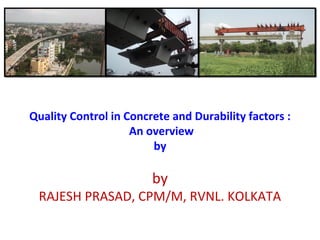
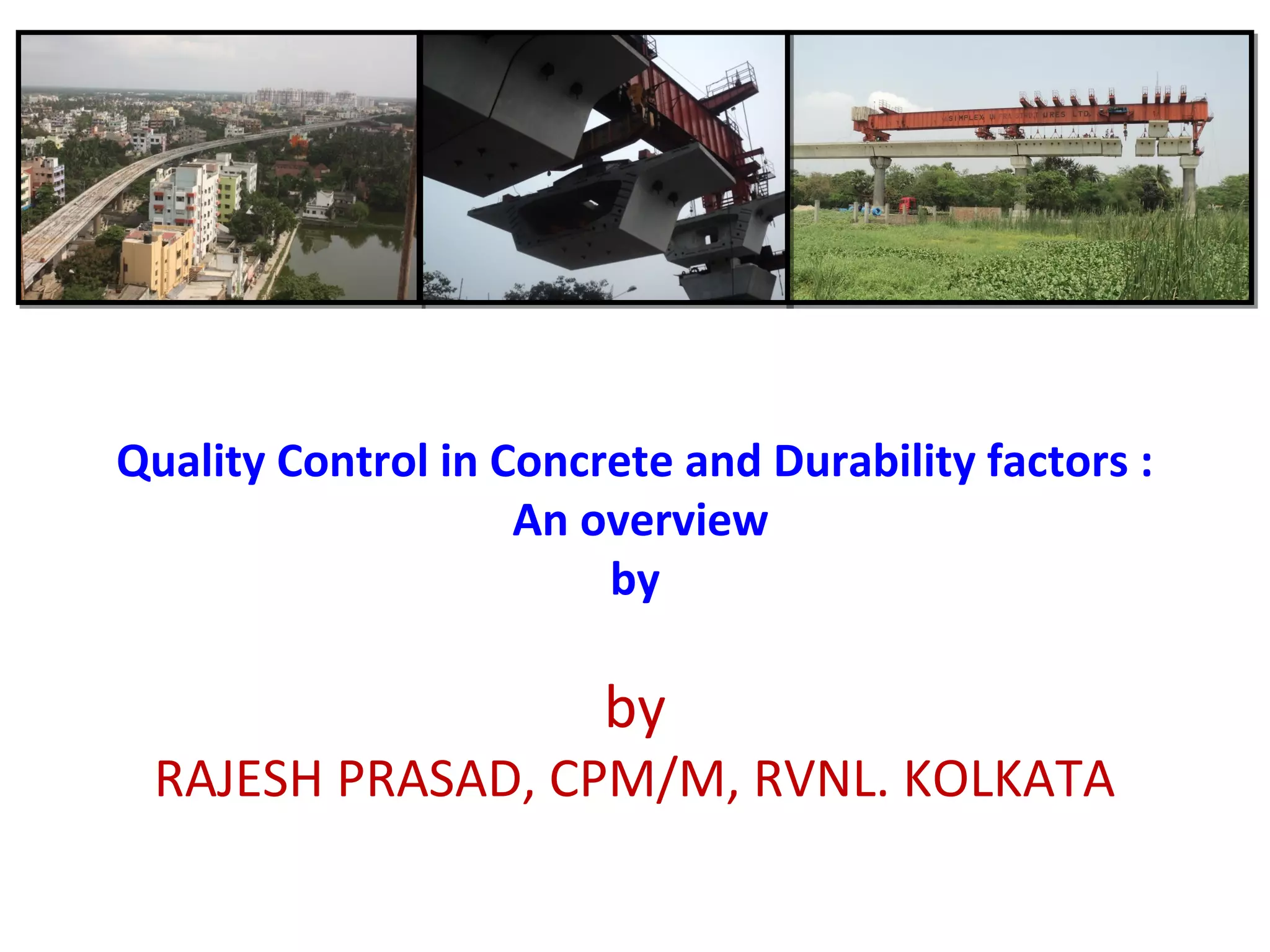
Quality Control in Concrete and Durability factors :
An overview
by
by
RAJESH PRASAD, CPM/M, RVNL. KOLKATA
INTRODUCTION
• Concrete the man made rock is the
most widely used construction
material.
• More than 80,000 crores cum of
concrete are poured every year.
• India has an installed capacity of 200
million tonnes of cement.
• Some Structures are designed with
life of 100 years.
So it is necessary that the concrete used is durable.
QualityQuality
3
 Definition : Conformance to requirements – expressed
& implied.
 Objective : Total customer (both internal & external)
satisfaction.
 Performance standard : ZERO DEFECTS.
 System of causing QualitySystem of causing Quality
4
 DIRFT (DO IT RIGHT THE FIRST TIME)
 Process oriented & Not Inspection oriented approach.
 Prevention and not appraisal.
 MBWA and not MBTA (Management by Wandering
Around and not Management by Talking Around.)
 KAIZEN – slow but continuous improvement.
QualityQuality
5
 Measure : The measurement of quality is the “Price of
non-conformance”.
 Responsible for non- quality : Seniors are the sinners.
QualityQuality
DurabilityDurability
Definition –
• A durable concrete is one that performs satisfactorily in the
working environment during its anticipated exposure
conditions during service (IS 456-2000)
• Durability of concrete is its ability to resist weathering action,
chemical attack, abrasion or any other process of
deterioration (American Concrete Institute).
• When exposed to environment durable concrete is
likely to retain its original form, quality and serviceability
during its lifetime.
• Durable Concrete envisage limits for maximum water
cement ratio, minimum cement content, cover thickness,
type of cement used and presence of amount of chloride
and sulphates in concrete. ( IS-SP-28)
• As Low permeability as possible under situation. (IS-SP-23)
6
Consequences of Improper Quality andConsequences of Improper Quality and
Inadequate DurabilityInadequate Durability
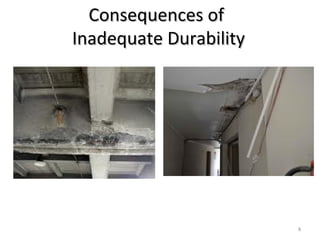
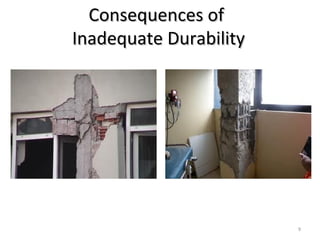
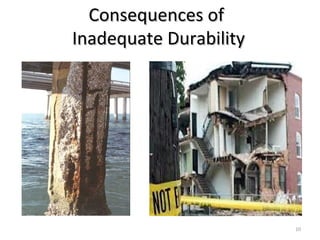
• Loss of strength of concrete
• Concrete liable to be easily affected by deterrents
• Corrosion of rebars
• Loss of serviceability
• Unpleasant appearance
• Danger to persons and property
• Expensive repair costs
• Poor perception of concrete as a material
• Poor perception of agencies involved
• Reduction of service life
• External agencies like weathering, attack by natural or Industrial
liquids, Gases, bacterial Growth etc.
• Alkali- aggregate reaction.
• Ingression of moisture/air facilitating corrosion of steel and cracking
concrete cover.
7
Consequences ofConsequences of
Inadequate DurabilityInadequate Durability
8
Consequences ofConsequences of
Inadequate DurabilityInadequate Durability
9
Consequences ofConsequences of
Inadequate DurabilityInadequate Durability
10
Factors Influencing Durability ofFactors Influencing Durability of
Concrete (IS: 456-2000)Concrete (IS: 456-2000)
• The Environment
• Type and quality of constituent materials
• Cement content and W/C ratio of concrete
• Workmanship especially in compaction curing – it is
very important
• Cover to embedded steel
• Shape and size of the member
11
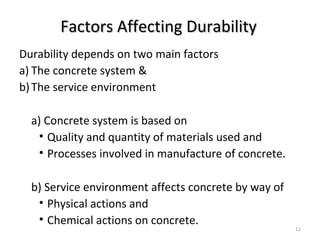
Factors Affecting DurabilityFactors Affecting Durability
Durability depends on two main factors
a) The concrete system &
b)The service environment
a) Concrete system is based on
• Quality and quantity of materials used and
• Processes involved in manufacture of concrete.
b) Service environment affects concrete by way of
• Physical actions and
• Chemical actions on concrete.
12
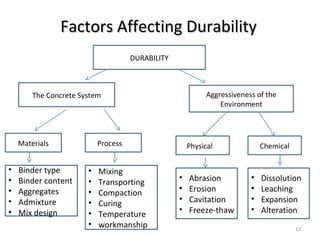
Factors Affecting DurabilityFactors Affecting Durability
13
DURABILITY
The Concrete System Aggressiveness of the
Environment
Materials Process Physical Chemical
• Binder type
• Binder content
• Aggregates
• Admixture
• Mix design
• Mixing
• Transporting
• Compaction
• Curing
• Temperature
• workmanship
• Abrasion
• Erosion
• Cavitation
• Freeze-thaw
• Dissolution
• Leaching
• Expansion
• Alteration
MATERIALSMATERIALS
14
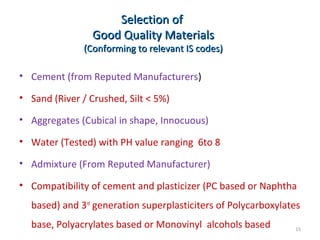
Selection ofSelection of
Good Quality MaterialsGood Quality Materials
(Conforming to relevant IS codes)(Conforming to relevant IS codes)
• Cement (from Reputed Manufacturers)
• Sand (River / Crushed, Silt < 5%)
• Aggregates (Cubical in shape, Innocuous)
• Water (Tested) with PH value ranging 6to 8
• Admixture (From Reputed Manufacturer)
• Compatibility of cement and plasticizer (PC based or Naphtha
based) and 3rd
generation superplasticiters of Polycarboxylates
base, Polyacrylates based or Monovinyl alcohols based 15
UNSOUND MATERIALSUNSOUND MATERIALS
16
UNSOUND MATERIALSUNSOUND MATERIALS
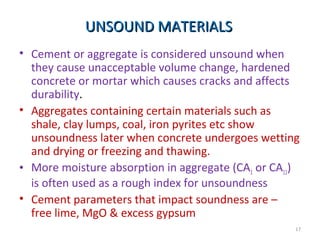
• Cement or aggregate is considered unsound when
they cause unacceptable volume change, hardened
concrete or mortar which causes cracks and affects
durability.
• Aggregates containing certain materials such as
shale, clay lumps, coal, iron pyrites etc show
unsoundness later when concrete undergoes wetting
and drying or freezing and thawing.
• More moisture absorption in aggregate (CA1 or CA11)
is often used as a rough index for unsoundness
• Cement parameters that impact soundness are –
free lime, MgO & excess gypsum
17
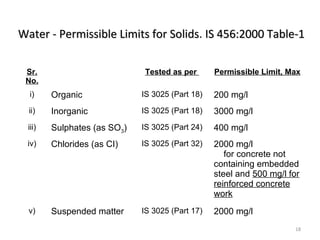
Sr.
No.
Tested as per Permissible Limit, Max
i) Organic IS 3025 (Part 18) 200 mg/l
ii) Inorganic IS 3025 (Part 18) 3000 mg/l
iii) Sulphates (as SO3) IS 3025 (Part 24) 400 mg/l
iv) Chlorides (as CI) IS 3025 (Part 32) 2000 mg/l
for concrete not
containing embedded
steel and 500 mg/l for
reinforced concrete
work
v) Suspended matter IS 3025 (Part 17) 2000 mg/l
18
Water - Permissible Limits for SolidsWater - Permissible Limits for Solids. IS 456:2000 Table-1IS 456:2000 Table-1
Impact of W/C RatioImpact of W/C Ratio
On DurabilityOn Durability
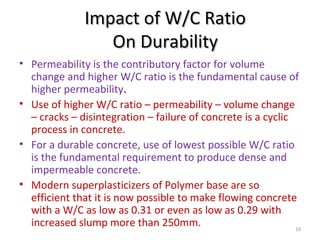
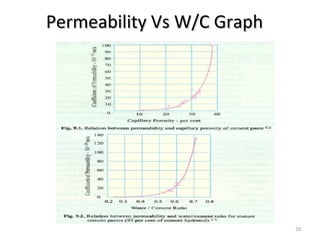
• Permeability is the contributory factor for volume
change and higher W/C ratio is the fundamental cause of
higher permeability.
• Use of higher W/C ratio – permeability – volume change
– cracks – disintegration – failure of concrete is a cyclic
process in concrete.
• For a durable concrete, use of lowest possible W/C ratio
is the fundamental requirement to produce dense and
impermeable concrete.
• Modern superplasticizers of Polymer base are so
efficient that it is now possible to make flowing concrete
with a W/C as low as 0.31 or even as low as 0.29 with
increased slump more than 250mm. 19
Permeability Vs W/C GraphPermeability Vs W/C Graph
20
PROCESSESPROCESSES
21
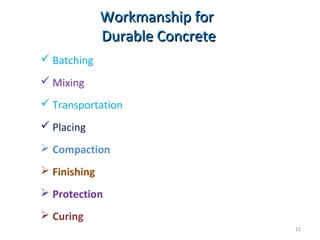
Workmanship forWorkmanship for
Durable ConcreteDurable Concrete
 Batching
 Mixing
 Transportation
 Placing
 Compaction
 Finishing
 Protection
 Curing
22
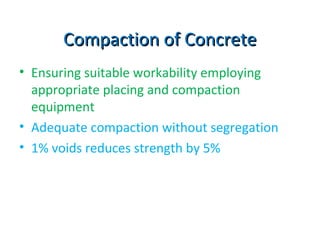
Compaction of ConcreteCompaction of Concrete
• Ensuring suitable workability employing
appropriate placing and compaction
equipment
• Adequate compaction without segregation
• 1% voids reduces strength by 5%
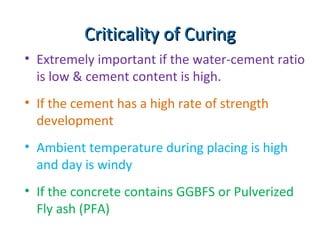
Criticality of CuringCriticality of Curing
• Extremely important if the water-cement ratio
is low & cement content is high.
• If the cement has a high rate of strength
development
• Ambient temperature during placing is high
and day is windy
• If the concrete contains GGBFS or Pulverized
Fly ash (PFA)
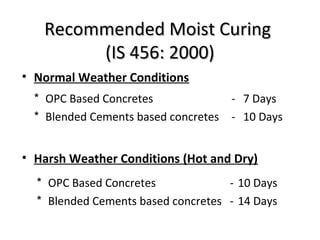
Recommended Moist CuringRecommended Moist Curing
(IS 456: 2000)(IS 456: 2000)
• Normal Weather Conditions
• Harsh Weather Conditions (Hot and Dry)
* OPC Based Concretes - 7 Days
* Blended Cements based concretes - 10 Days
* OPC Based Concretes - 10 Days
* Blended Cements based concretes - 14 Days
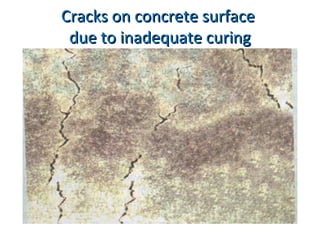
Cracks on concrete surfaceCracks on concrete surface
due to inadequate curingdue to inadequate curing
ENVIRONMENTENVIRONMENT
Environment can be classified asEnvironment can be classified as
a) Physical –
Temperature, Moisture, alternate wetting and
drying, freezing and thawing
b) Chemical –
Acidic, gaseous, alkaline, corrosive
PHYSICAL ENVIRONMENTSPHYSICAL ENVIRONMENTS
ATTACK AFFECTING DURABILITYATTACK AFFECTING DURABILITY
Physical Environment impactsPhysical Environment impacts
Temperature
 Significantly affects rate of hydration of cement.
 Leads to Plastic shrinkage cracks in fresh concrete
 Volume changes and cracking especially in mass
concrete
 Spalling and disintegration of concrete at higher
temperatures > 250ºC (3000
c as per A.M. Neville P-
387)
 Variation in ambient temperature causes secondary
stresses in structures
Physical Environment impactsPhysical Environment impacts
Moisture
 Shrinkage on drying, consequent volume change and
cracking
 Induces corrosion of steel
 Acts as carrier of chemicals inside the body of concrete
 Causes efflorescence and deposition of Ca(Cao+2H20=
Ca (OH)2 +H20 OH)2 on surface
 Seepage / Leakages cause inconvenience to occupants
and deteriorates structures due to permeable concrete.
Alternate wetting and drying
 Causes secondary stresses in the structures
 Accelerates corrosion of steel and
 Chemical attack on concrete
Freezing and Thawing
 Leads to expansion of concrete and cracking
 Ice-melting salts cause erosion of concrete
Physical Environment impactsPhysical Environment impacts
CHEMICAL ENVIRONMENTCHEMICAL ENVIRONMENT
ATTACK AFFECTING DURABILITYATTACK AFFECTING DURABILITY
Chemical ActionChemical Action
When we are dealing with durability, chemical attack
which results in volume change, cracking and
consequent deterioration of concrete become a major
cause of concern
Types of Chemical attack
•Sulphate attack
•Alkali aggregate reaction
•Chloride ion attack - Corrosion
•Carbonation
•Acid Attack
•Effect on concrete in Seawater
34
1. Sulphate attack1. Sulphate attack
• Sulphate attack denotes an increase in the volume of
cement paste in concrete or mortar due to chemical
action between the products of hydration of cement
and solution containing sulphate, and also sodium,
magnesium and Cholorides.
• In hardened concrete, calcium aluminate hydrate (C-A-
H) can react with sulphate salt from outside, product of
reaction is calcium sulphoaluminate, which can cause
an increase in volume up to 227%
• Rate of sulphate attack increases with a saturated
sulphate solution.
• A saturate solution of magnesium sulphate can cause
serious damage to concrete with high w/c ratio.
Sulphate attackSulphate attack
Methods of controlling sulphate attack
•Use SRC (sulphate resisting cement)
•Quality concrete - low w/c ratio, well designed and
compacted dense concrete
•Use of air-entrainment
•Use of puzzolana
•High pressure steam curing
•Use of high alumina cement
36
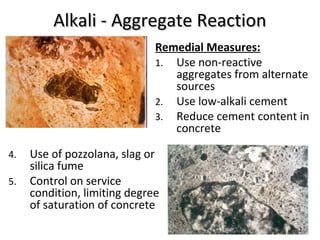
2. Alkali - Aggregate Reaction2. Alkali - Aggregate Reaction
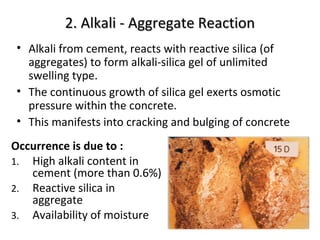
• Alkali from cement, reacts with reactive silica (of
aggregates) to form alkali-silica gel of unlimited
swelling type.
• The continuous growth of silica gel exerts osmotic
pressure within the concrete.
• This manifests into cracking and bulging of concrete
Occurrence is due to :
1. High alkali content in
cement (more than 0.6%)
2. Reactive silica in
aggregate
3. Availability of moisture
Alkali - Aggregate ReactionAlkali - Aggregate Reaction
38
• Alkali-aggregate reaction (AAR) is basically a chemical
reaction between the hydroxyl ions in the pore water
within concrete and certain types of rock minerals
• Since reactive silica in the aggregate is involved in this
chemical reaction it is often called alkali-silica-
reaction (ASR).
• It is recognized as one of the major causes of cracking
of concrete.
• The reaction produces what is called alkali-silica gel
of unlimited swelling type under favorable conditions
of moisture and temperature.
• The crack width can range from 0.1mm to as much as
10mm.
Alkali - Aggregate ReactionAlkali - Aggregate Reaction
39
• Alkali content (K2O and Na2O) or what is called soda
equivalent.
• This is calculated as the actual Na2O content plus
0.658 times the K2O content of the clinker.
• It should be less than 0.6 percent by mass of
cement.
• Alkalis from all these sources must be included in
finding the total alkalis.
• British standard 5328 : part 1 : 1091 specifies a
maximum of 3.0 kg of alkalis (expressed as soda
equivalent) in 1 m3
of concrete in case of alkali
reactive aggregates are used.
Alkali - Aggregate ReactionAlkali - Aggregate Reaction
4. Use of pozzolana, slag or
silica fume
5. Control on service
condition, limiting degree
of saturation of concrete
Remedial Measures:
1. Use non-reactive
aggregates from alternate
sources
2. Use low-alkali cement
3. Reduce cement content in
concrete
3. Chlorides in Concrete3. Chlorides in Concrete
• Chlorides in concrete increases risk of corrosion of
steel (Electrochemical reaction) (IS 456:2000)
• Higher Chloride content or exposure to warm moist
conditions increase the risk of corrosion
• To minimize the chances of corrosion, the levels of
chlorides in concrete should be limited
• Total amount of chloride content (as Cl) in concrete
at the time of placing is provided by IS 456:2000
Methods of ControllingMethods of Controlling
ChloridesChlorides
42
• Chlorides in cement to be less than 0.1 % max ( or
0.05% max for prestressed works)
• Chlorides in water to be less than 2000 mg/ltr for
PCC and below 500 mg/ltr for RCC
• Chlorides in aggregates are generally not
encountered but, it’s a good practice to wash sand
containing salt more than 3%
• Chloride traces are also found in chemical
admixtures. Chloride free admixtures should be
generally preferred.
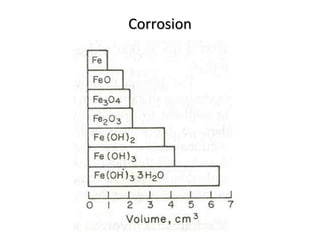
CorrosionCorrosion
Corrosion is an electro-chemical process
Basic Mechanism :
Different areas of the same steel bar become anode and cathode.
The electrical connection being maintained by pore water,
which acts as electrolyte
At the anode, steel releases electron and takes the ionic form
Fe → 2e-
+ Fe2+
At the cathode, water in presence of oxygen and the released
electron forms hydroxyl ions (OH)-
2O2 + H2O + 2e-
→ 2(OH)-
Fe++
+ 2(OH)-
→ Fe(OH)2→Iron Hydroxide (Rust)2H2O+O24e-
=4 (OH-
)
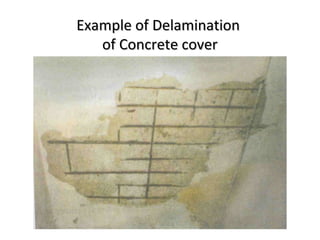
Example of DelaminationExample of Delamination
of Concrete coverof Concrete cover
CorrosionCorrosion
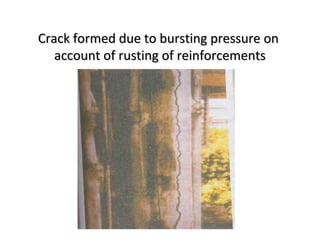
Crack formed due to bursting pressure onCrack formed due to bursting pressure on
account of rusting of reinforcementsaccount of rusting of reinforcements
Methods ofMethods of
Controlling CorrosionControlling Corrosion
47
• Limit the chlorides in water, cement, superplastizers,
etc to acceptable levels
• Provide proper cover as per IS norms
• Cover blocks also need to be of good quality
• Concrete should be properly compacted
• Make dense, impermeable / waterproof concrete
• Have protective coatings wherever suitable
• Ensure proper & timely maintenance of structures
4. Carbonation of Concrete4. Carbonation of Concrete
• Mechanism : Carbon dioxide from the air reacts
with calcium hydroxide to form calcium carbonates
• In the presence of moisture, carbonic acid is
formed which reduces the alkalinity of concrete
• pH value of concrete reduces from 12.5 to 9, thus
destroying the protective layer and exposing the
steel to corrosion
• Rate of Carbonation depends upon relative
humidity, grade of concrete, permeability of
concrete, depth of cover and time
• Nearly 1 mm carbonation is reported per year in
normal M-20 grade of concrete
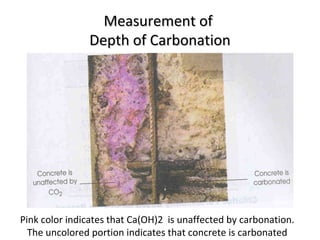
Measurement ofMeasurement of
Depth of CarbonationDepth of Carbonation
Pink color indicates that Ca(OH)2 is unaffected by carbonation.
The uncolored portion indicates that concrete is carbonated
CarbonationCarbonation
• Carbonation of concrete is a process by which carbon
dioxide from the air penetrates into concrete and
reacts with calcium hydroxide to form calcium
carbonates.
• In actual practice, CO2 present in atmosphere
permeates into concrete and carbonates the concrete
and reduces the alkalinity of concrete.
• When all the Ca(OH)2 has become carbonated, the pH
value will reduce upto about 8.3. In such a low pH
value, the protective layer gets destroyed and the steel
is exposed to corrosion.
50
CarbonationCarbonation
• The highest rate of carbonation occurs at a relative
humidity between 50 and 70 percent.
• Protective coating is required to be given for long
span bridge girders, flyovers, Industrial structures and
chimneys. Such as plastic paints (Impermeable)
• Deep cover plays an important role in protecting the
steel from carbonation.
51
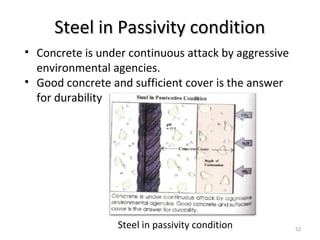
Steel in Passivity conditionSteel in Passivity condition
52
• Concrete is under continuous attack by aggressive
environmental agencies.
• Good concrete and sufficient cover is the answer
for durability
Steel in passivity condition
5. Acid attack5. Acid attack
53
• Concrete is not fully resistant to acids depending
upon the type and concentration of acid.
• Oxalic acid and phosphoric acids are harmless.
• The most vulnerable part of the cement hydrate Is
Ca(OH)2, but C-S-H gel can also be attacked.
• Concrete can be attacked by liquids with pH value
less than 6.5.
Acid attackAcid attack
54
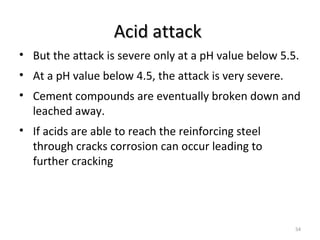
• But the attack is severe only at a pH value below 5.5.
• At a pH value below 4.5, the attack is very severe.
• Cement compounds are eventually broken down and
leached away.
• If acids are able to reach the reinforcing steel
through cracks corrosion can occur leading to
further cracking
COVER TO REINFORCEMENTCOVER TO REINFORCEMENT
55
Cover to ReinforcementCover to Reinforcement
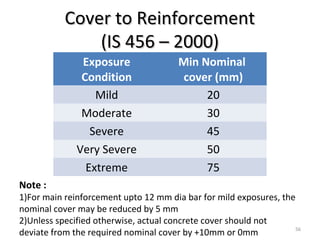
(IS 456 – 2000)(IS 456 – 2000)
56
Exposure
Condition
Min Nominal
cover (mm)
Mild 20
Moderate 30
Severe 45
Very Severe 50
Extreme 75
Note :
1)For main reinforcement upto 12 mm dia bar for mild exposures, the
nominal cover may be reduced by 5 mm
2)Unless specified otherwise, actual concrete cover should not
deviate from the required nominal cover by +10mm or 0mm
Effect of Other materialsEffect of Other materials
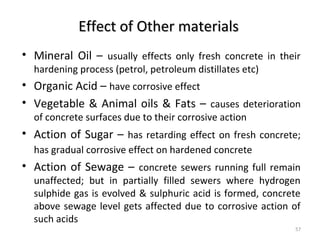
• Mineral Oil – usually effects only fresh concrete in their
hardening process (petrol, petroleum distillates etc)
• Organic Acid – have corrosive effect
• Vegetable & Animal oils & Fats – causes deterioration
of concrete surfaces due to their corrosive action
• Action of Sugar – has retarding effect on fresh concrete;
has gradual corrosive effect on hardened concrete
• Action of Sewage – concrete sewers running full remain
unaffected; but in partially filled sewers where hydrogen
sulphide gas is evolved & sulphuric acid is formed, concrete
above sewage level gets affected due to corrosive action of
such acids
57
Fire ResistanceFire Resistance
• The fire resistance is not only dependent upon the
type of concrete but also on the thickness of cover to
reinforcement.
• Effect of temperature on the strength of concrete is
not much upto a temperature of about 250o
C
• Above 300o
C definite loss of strength takes place.
• Portland blast furnance slag cement is found to be
more resistant to the action of fire.
• Light weight concrete stand up better to fire than
ordinary concrete.
58
Fire ResistanceFire Resistance
• Best fire resistant aggregates amongst the igneous
rocks are, the basalts and dolerites less amount of
silica.
• Since then decomposition takes place only at a very
high temperature of 900o
C , Limestone is considered
as a good fire resistant aggregate.
• Serious reduction in strength occurs at a
temperature of about 600o
C.
59
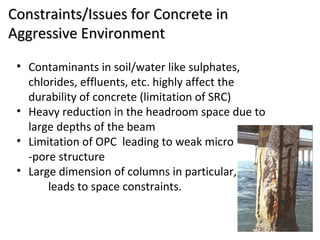
Constraints/Issues for Concrete inConstraints/Issues for Concrete in
Aggressive EnvironmentAggressive Environment
• Contaminants in soil/water like sulphates,
chlorides, effluents, etc. highly affect the
durability of concrete (limitation of SRC)
• Heavy reduction in the headroom space due to
large depths of the beam
• Limitation of OPC leading to weak micro
-pore structure
• Large dimension of columns in particular,
leads to space constraints.
Why is Quality necessary?
• Intense Competitive Environment
• Entry of Foreign Goods and Services
• Increased Customer Consciousness
• Earning Profit instead of making profit
• Organization’s survival / progress depends on it
Safety vs. Operation
Quality vs. Progress
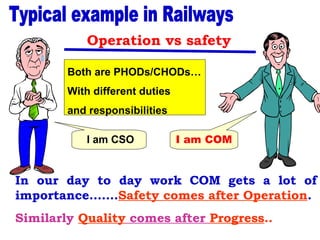
In our day to day work COM gets a lot of
importance…….Safety comes after Operation.
Similarly Quality comes after Progress..
I am CSO I am COM
Both are PHODs/CHODs…
With different duties
and responsibilities
Operation vs safety
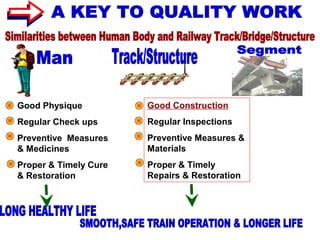
Good Physique
Regular Check ups
Preventive Measures
& Medicines
Proper & Timely Cure
& Restoration
Good Construction
Regular Inspections
Preventive Measures &
Materials
Proper & Timely
Repairs & Restoration
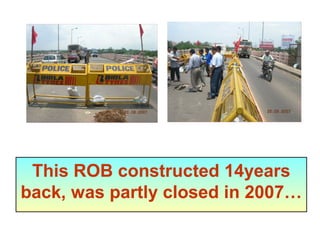
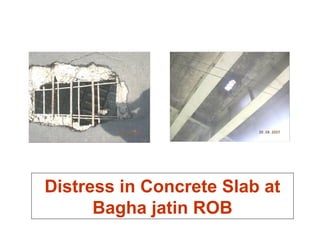
This ROB constructed 14years
back, was partly closed in 2007…
Distress in Concrete Slab at
Bagha jatin ROB
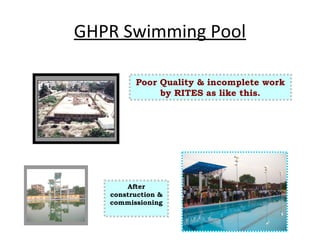
GHPR Swimming Pool
Poor Quality & incomplete work
by RITES as like this.
After
construction &
commissioning
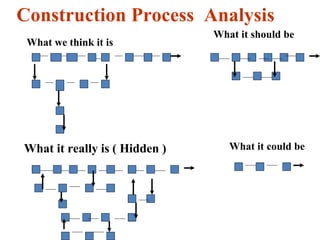
Construction Process Analysis
What we think it is
What it really is ( Hidden )
What it should be
What it could be
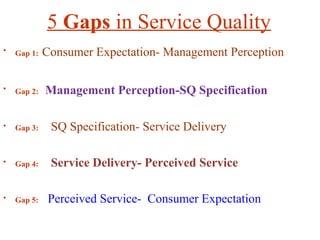
5 Gaps in Service Quality
• Gap 1: Consumer Expectation- Management Perception
• Gap 2: Management Perception-SQ Specification
• Gap 3: SQ Specification- Service Delivery
• Gap 4: Service Delivery- Perceived Service
• Gap 5: Perceived Service- Consumer Expectation
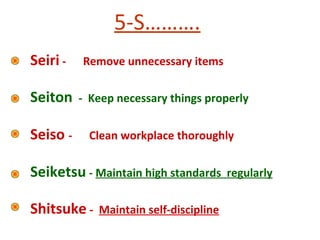
5-S……….
Seiri - Remove unnecessary items
Seiton - Keep necessary things properly
Seiso - Clean workplace thoroughly
Seiketsu - Maintain high standards regularly
Shitsuke - Maintain self-discipline
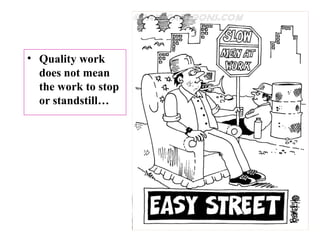
• Quality work
does not mean
the work to stop
or standstill…
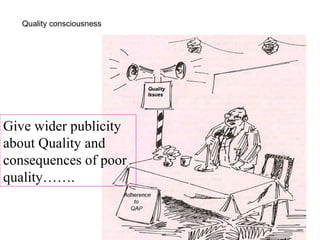
Give wider publicity
about Quality and
consequences of poor
quality…….
Quality consciousness
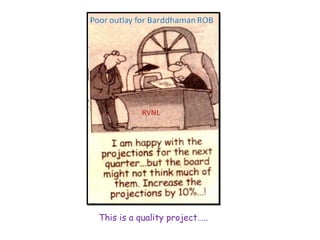
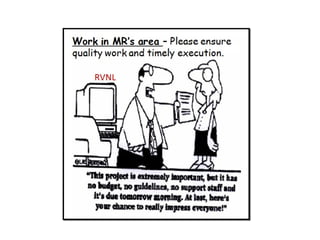
This is a quality project…..
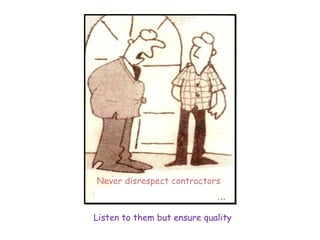
Never disrespect contractors
Listen to them but ensure quality
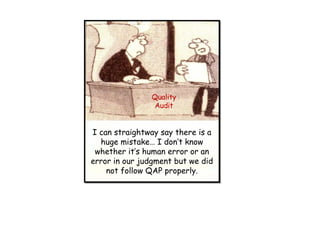
I can straightway say there is a
huge mistake… I don’t know
whether it’s human error or an
error in our judgment but we did
not follow QAP properly.
Quality
Audit
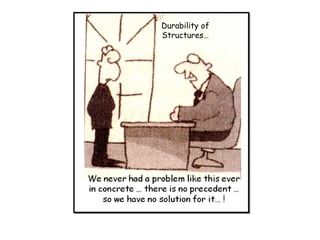
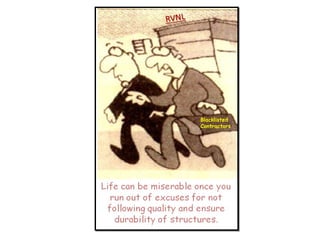
Durability of
Structures…
Blacklisted
Contractors
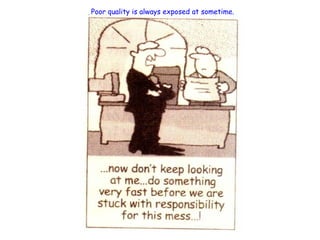
Poor quality is always exposed at sometime.
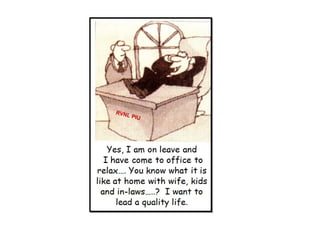
RVNL OFFICE
RVNL PIU
Are You Lonely and Worried for quality and durability of Concrete??
Don’t like working on your own?
Hate making decisions?
Then call A MEETING!!
You can…
 SEE people
 DRAW flowchats
 FEEL important
 IMPRESS your
colleagues
And must discuss on quality related issues
for Project Implementation.
MEETINGS
The practical alternative to work.
Concluding RemarksConcluding Remarks
Strength and durability are two important properties of
concrete.
Concrete is a long lasting material provided adequate care is
taken in
 Selection of ingredients
- Right type of materials & right concrete for
appropriate end applications
 Mix design, batching, mixing, transporting, placing,
compaction, finishing, protection & curing
 Reinforcement detailing and adequate cover
 Good quality form work
 Maintenance and upkeep
Concrete is a dependable construction material and it
should not be abused to the limits….
It should be used with understanding, love and care.
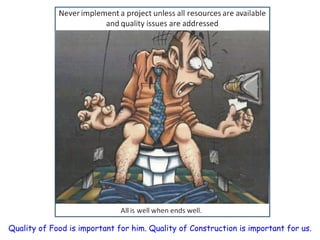
Quality of Food is important for him. Quality of Construction is important for us.
It was a
presentatIon by
rajesh prasad

Durability of concrete

  • 1.
    Quality Control inConcrete and Durability factors : An overview by by RAJESH PRASAD, CPM/M, RVNL. KOLKATA
  • 2.
    INTRODUCTION • Concrete theman made rock is the most widely used construction material. • More than 80,000 crores cum of concrete are poured every year. • India has an installed capacity of 200 million tonnes of cement. • Some Structures are designed with life of 100 years. So it is necessary that the concrete used is durable.
  • 3.
    QualityQuality 3  Definition :Conformance to requirements – expressed & implied.  Objective : Total customer (both internal & external) satisfaction.  Performance standard : ZERO DEFECTS.
  • 4.
     System ofcausing QualitySystem of causing Quality 4  DIRFT (DO IT RIGHT THE FIRST TIME)  Process oriented & Not Inspection oriented approach.  Prevention and not appraisal.  MBWA and not MBTA (Management by Wandering Around and not Management by Talking Around.)  KAIZEN – slow but continuous improvement. QualityQuality
  • 5.
    5  Measure :The measurement of quality is the “Price of non-conformance”.  Responsible for non- quality : Seniors are the sinners. QualityQuality
  • 6.
    DurabilityDurability Definition – • Adurable concrete is one that performs satisfactorily in the working environment during its anticipated exposure conditions during service (IS 456-2000) • Durability of concrete is its ability to resist weathering action, chemical attack, abrasion or any other process of deterioration (American Concrete Institute). • When exposed to environment durable concrete is likely to retain its original form, quality and serviceability during its lifetime. • Durable Concrete envisage limits for maximum water cement ratio, minimum cement content, cover thickness, type of cement used and presence of amount of chloride and sulphates in concrete. ( IS-SP-28) • As Low permeability as possible under situation. (IS-SP-23) 6
  • 7.
    Consequences of ImproperQuality andConsequences of Improper Quality and Inadequate DurabilityInadequate Durability • Loss of strength of concrete • Concrete liable to be easily affected by deterrents • Corrosion of rebars • Loss of serviceability • Unpleasant appearance • Danger to persons and property • Expensive repair costs • Poor perception of concrete as a material • Poor perception of agencies involved • Reduction of service life • External agencies like weathering, attack by natural or Industrial liquids, Gases, bacterial Growth etc. • Alkali- aggregate reaction. • Ingression of moisture/air facilitating corrosion of steel and cracking concrete cover. 7
  • 8.
    Consequences ofConsequences of InadequateDurabilityInadequate Durability 8
  • 9.
    Consequences ofConsequences of InadequateDurabilityInadequate Durability 9
  • 10.
    Consequences ofConsequences of InadequateDurabilityInadequate Durability 10
  • 11.
    Factors Influencing DurabilityofFactors Influencing Durability of Concrete (IS: 456-2000)Concrete (IS: 456-2000) • The Environment • Type and quality of constituent materials • Cement content and W/C ratio of concrete • Workmanship especially in compaction curing – it is very important • Cover to embedded steel • Shape and size of the member 11
  • 12.
    Factors Affecting DurabilityFactorsAffecting Durability Durability depends on two main factors a) The concrete system & b)The service environment a) Concrete system is based on • Quality and quantity of materials used and • Processes involved in manufacture of concrete. b) Service environment affects concrete by way of • Physical actions and • Chemical actions on concrete. 12
  • 13.
    Factors Affecting DurabilityFactorsAffecting Durability 13 DURABILITY The Concrete System Aggressiveness of the Environment Materials Process Physical Chemical • Binder type • Binder content • Aggregates • Admixture • Mix design • Mixing • Transporting • Compaction • Curing • Temperature • workmanship • Abrasion • Erosion • Cavitation • Freeze-thaw • Dissolution • Leaching • Expansion • Alteration
  • 14.
  • 15.
    Selection ofSelection of GoodQuality MaterialsGood Quality Materials (Conforming to relevant IS codes)(Conforming to relevant IS codes) • Cement (from Reputed Manufacturers) • Sand (River / Crushed, Silt < 5%) • Aggregates (Cubical in shape, Innocuous) • Water (Tested) with PH value ranging 6to 8 • Admixture (From Reputed Manufacturer) • Compatibility of cement and plasticizer (PC based or Naphtha based) and 3rd generation superplasticiters of Polycarboxylates base, Polyacrylates based or Monovinyl alcohols based 15
  • 16.
  • 17.
    UNSOUND MATERIALSUNSOUND MATERIALS •Cement or aggregate is considered unsound when they cause unacceptable volume change, hardened concrete or mortar which causes cracks and affects durability. • Aggregates containing certain materials such as shale, clay lumps, coal, iron pyrites etc show unsoundness later when concrete undergoes wetting and drying or freezing and thawing. • More moisture absorption in aggregate (CA1 or CA11) is often used as a rough index for unsoundness • Cement parameters that impact soundness are – free lime, MgO & excess gypsum 17
  • 18.
    Sr. No. Tested as perPermissible Limit, Max i) Organic IS 3025 (Part 18) 200 mg/l ii) Inorganic IS 3025 (Part 18) 3000 mg/l iii) Sulphates (as SO3) IS 3025 (Part 24) 400 mg/l iv) Chlorides (as CI) IS 3025 (Part 32) 2000 mg/l for concrete not containing embedded steel and 500 mg/l for reinforced concrete work v) Suspended matter IS 3025 (Part 17) 2000 mg/l 18 Water - Permissible Limits for SolidsWater - Permissible Limits for Solids. IS 456:2000 Table-1IS 456:2000 Table-1
  • 19.
    Impact of W/CRatioImpact of W/C Ratio On DurabilityOn Durability • Permeability is the contributory factor for volume change and higher W/C ratio is the fundamental cause of higher permeability. • Use of higher W/C ratio – permeability – volume change – cracks – disintegration – failure of concrete is a cyclic process in concrete. • For a durable concrete, use of lowest possible W/C ratio is the fundamental requirement to produce dense and impermeable concrete. • Modern superplasticizers of Polymer base are so efficient that it is now possible to make flowing concrete with a W/C as low as 0.31 or even as low as 0.29 with increased slump more than 250mm. 19
  • 20.
    Permeability Vs W/CGraphPermeability Vs W/C Graph 20
  • 21.
  • 22.
    Workmanship forWorkmanship for DurableConcreteDurable Concrete  Batching  Mixing  Transportation  Placing  Compaction  Finishing  Protection  Curing 22
  • 23.
    Compaction of ConcreteCompactionof Concrete • Ensuring suitable workability employing appropriate placing and compaction equipment • Adequate compaction without segregation • 1% voids reduces strength by 5%
  • 24.
    Criticality of CuringCriticalityof Curing • Extremely important if the water-cement ratio is low & cement content is high. • If the cement has a high rate of strength development • Ambient temperature during placing is high and day is windy • If the concrete contains GGBFS or Pulverized Fly ash (PFA)
  • 25.
    Recommended Moist CuringRecommendedMoist Curing (IS 456: 2000)(IS 456: 2000) • Normal Weather Conditions • Harsh Weather Conditions (Hot and Dry) * OPC Based Concretes - 7 Days * Blended Cements based concretes - 10 Days * OPC Based Concretes - 10 Days * Blended Cements based concretes - 14 Days
  • 26.
    Cracks on concretesurfaceCracks on concrete surface due to inadequate curingdue to inadequate curing
  • 27.
  • 28.
    Environment can beclassified asEnvironment can be classified as a) Physical – Temperature, Moisture, alternate wetting and drying, freezing and thawing b) Chemical – Acidic, gaseous, alkaline, corrosive
  • 29.
    PHYSICAL ENVIRONMENTSPHYSICAL ENVIRONMENTS ATTACKAFFECTING DURABILITYATTACK AFFECTING DURABILITY
  • 30.
    Physical Environment impactsPhysicalEnvironment impacts Temperature  Significantly affects rate of hydration of cement.  Leads to Plastic shrinkage cracks in fresh concrete  Volume changes and cracking especially in mass concrete  Spalling and disintegration of concrete at higher temperatures > 250ºC (3000 c as per A.M. Neville P- 387)  Variation in ambient temperature causes secondary stresses in structures
  • 31.
    Physical Environment impactsPhysicalEnvironment impacts Moisture  Shrinkage on drying, consequent volume change and cracking  Induces corrosion of steel  Acts as carrier of chemicals inside the body of concrete  Causes efflorescence and deposition of Ca(Cao+2H20= Ca (OH)2 +H20 OH)2 on surface  Seepage / Leakages cause inconvenience to occupants and deteriorates structures due to permeable concrete.
  • 32.
    Alternate wetting anddrying  Causes secondary stresses in the structures  Accelerates corrosion of steel and  Chemical attack on concrete Freezing and Thawing  Leads to expansion of concrete and cracking  Ice-melting salts cause erosion of concrete Physical Environment impactsPhysical Environment impacts
  • 33.
    CHEMICAL ENVIRONMENTCHEMICAL ENVIRONMENT ATTACKAFFECTING DURABILITYATTACK AFFECTING DURABILITY
  • 34.
    Chemical ActionChemical Action Whenwe are dealing with durability, chemical attack which results in volume change, cracking and consequent deterioration of concrete become a major cause of concern Types of Chemical attack •Sulphate attack •Alkali aggregate reaction •Chloride ion attack - Corrosion •Carbonation •Acid Attack •Effect on concrete in Seawater 34
  • 35.
    1. Sulphate attack1.Sulphate attack • Sulphate attack denotes an increase in the volume of cement paste in concrete or mortar due to chemical action between the products of hydration of cement and solution containing sulphate, and also sodium, magnesium and Cholorides. • In hardened concrete, calcium aluminate hydrate (C-A- H) can react with sulphate salt from outside, product of reaction is calcium sulphoaluminate, which can cause an increase in volume up to 227% • Rate of sulphate attack increases with a saturated sulphate solution. • A saturate solution of magnesium sulphate can cause serious damage to concrete with high w/c ratio.
  • 36.
    Sulphate attackSulphate attack Methodsof controlling sulphate attack •Use SRC (sulphate resisting cement) •Quality concrete - low w/c ratio, well designed and compacted dense concrete •Use of air-entrainment •Use of puzzolana •High pressure steam curing •Use of high alumina cement 36
  • 37.
    2. Alkali -Aggregate Reaction2. Alkali - Aggregate Reaction • Alkali from cement, reacts with reactive silica (of aggregates) to form alkali-silica gel of unlimited swelling type. • The continuous growth of silica gel exerts osmotic pressure within the concrete. • This manifests into cracking and bulging of concrete Occurrence is due to : 1. High alkali content in cement (more than 0.6%) 2. Reactive silica in aggregate 3. Availability of moisture
  • 38.
    Alkali - AggregateReactionAlkali - Aggregate Reaction 38 • Alkali-aggregate reaction (AAR) is basically a chemical reaction between the hydroxyl ions in the pore water within concrete and certain types of rock minerals • Since reactive silica in the aggregate is involved in this chemical reaction it is often called alkali-silica- reaction (ASR). • It is recognized as one of the major causes of cracking of concrete. • The reaction produces what is called alkali-silica gel of unlimited swelling type under favorable conditions of moisture and temperature. • The crack width can range from 0.1mm to as much as 10mm.
  • 39.
    Alkali - AggregateReactionAlkali - Aggregate Reaction 39 • Alkali content (K2O and Na2O) or what is called soda equivalent. • This is calculated as the actual Na2O content plus 0.658 times the K2O content of the clinker. • It should be less than 0.6 percent by mass of cement. • Alkalis from all these sources must be included in finding the total alkalis. • British standard 5328 : part 1 : 1091 specifies a maximum of 3.0 kg of alkalis (expressed as soda equivalent) in 1 m3 of concrete in case of alkali reactive aggregates are used.
  • 40.
    Alkali - AggregateReactionAlkali - Aggregate Reaction 4. Use of pozzolana, slag or silica fume 5. Control on service condition, limiting degree of saturation of concrete Remedial Measures: 1. Use non-reactive aggregates from alternate sources 2. Use low-alkali cement 3. Reduce cement content in concrete
  • 41.
    3. Chlorides inConcrete3. Chlorides in Concrete • Chlorides in concrete increases risk of corrosion of steel (Electrochemical reaction) (IS 456:2000) • Higher Chloride content or exposure to warm moist conditions increase the risk of corrosion • To minimize the chances of corrosion, the levels of chlorides in concrete should be limited • Total amount of chloride content (as Cl) in concrete at the time of placing is provided by IS 456:2000
  • 42.
    Methods of ControllingMethodsof Controlling ChloridesChlorides 42 • Chlorides in cement to be less than 0.1 % max ( or 0.05% max for prestressed works) • Chlorides in water to be less than 2000 mg/ltr for PCC and below 500 mg/ltr for RCC • Chlorides in aggregates are generally not encountered but, it’s a good practice to wash sand containing salt more than 3% • Chloride traces are also found in chemical admixtures. Chloride free admixtures should be generally preferred.
  • 43.
    CorrosionCorrosion Corrosion is anelectro-chemical process Basic Mechanism : Different areas of the same steel bar become anode and cathode. The electrical connection being maintained by pore water, which acts as electrolyte At the anode, steel releases electron and takes the ionic form Fe → 2e- + Fe2+ At the cathode, water in presence of oxygen and the released electron forms hydroxyl ions (OH)- 2O2 + H2O + 2e- → 2(OH)- Fe++ + 2(OH)- → Fe(OH)2→Iron Hydroxide (Rust)2H2O+O24e- =4 (OH- )
  • 44.
    Example of DelaminationExampleof Delamination of Concrete coverof Concrete cover
  • 45.
  • 46.
    Crack formed dueto bursting pressure onCrack formed due to bursting pressure on account of rusting of reinforcementsaccount of rusting of reinforcements
  • 47.
    Methods ofMethods of ControllingCorrosionControlling Corrosion 47 • Limit the chlorides in water, cement, superplastizers, etc to acceptable levels • Provide proper cover as per IS norms • Cover blocks also need to be of good quality • Concrete should be properly compacted • Make dense, impermeable / waterproof concrete • Have protective coatings wherever suitable • Ensure proper & timely maintenance of structures
  • 48.
    4. Carbonation ofConcrete4. Carbonation of Concrete • Mechanism : Carbon dioxide from the air reacts with calcium hydroxide to form calcium carbonates • In the presence of moisture, carbonic acid is formed which reduces the alkalinity of concrete • pH value of concrete reduces from 12.5 to 9, thus destroying the protective layer and exposing the steel to corrosion • Rate of Carbonation depends upon relative humidity, grade of concrete, permeability of concrete, depth of cover and time • Nearly 1 mm carbonation is reported per year in normal M-20 grade of concrete
  • 49.
    Measurement ofMeasurement of Depthof CarbonationDepth of Carbonation Pink color indicates that Ca(OH)2 is unaffected by carbonation. The uncolored portion indicates that concrete is carbonated
  • 50.
    CarbonationCarbonation • Carbonation ofconcrete is a process by which carbon dioxide from the air penetrates into concrete and reacts with calcium hydroxide to form calcium carbonates. • In actual practice, CO2 present in atmosphere permeates into concrete and carbonates the concrete and reduces the alkalinity of concrete. • When all the Ca(OH)2 has become carbonated, the pH value will reduce upto about 8.3. In such a low pH value, the protective layer gets destroyed and the steel is exposed to corrosion. 50
  • 51.
    CarbonationCarbonation • The highestrate of carbonation occurs at a relative humidity between 50 and 70 percent. • Protective coating is required to be given for long span bridge girders, flyovers, Industrial structures and chimneys. Such as plastic paints (Impermeable) • Deep cover plays an important role in protecting the steel from carbonation. 51
  • 52.
    Steel in PassivityconditionSteel in Passivity condition 52 • Concrete is under continuous attack by aggressive environmental agencies. • Good concrete and sufficient cover is the answer for durability Steel in passivity condition
  • 53.
    5. Acid attack5.Acid attack 53 • Concrete is not fully resistant to acids depending upon the type and concentration of acid. • Oxalic acid and phosphoric acids are harmless. • The most vulnerable part of the cement hydrate Is Ca(OH)2, but C-S-H gel can also be attacked. • Concrete can be attacked by liquids with pH value less than 6.5.
  • 54.
    Acid attackAcid attack 54 •But the attack is severe only at a pH value below 5.5. • At a pH value below 4.5, the attack is very severe. • Cement compounds are eventually broken down and leached away. • If acids are able to reach the reinforcing steel through cracks corrosion can occur leading to further cracking
  • 55.
    COVER TO REINFORCEMENTCOVERTO REINFORCEMENT 55
  • 56.
    Cover to ReinforcementCoverto Reinforcement (IS 456 – 2000)(IS 456 – 2000) 56 Exposure Condition Min Nominal cover (mm) Mild 20 Moderate 30 Severe 45 Very Severe 50 Extreme 75 Note : 1)For main reinforcement upto 12 mm dia bar for mild exposures, the nominal cover may be reduced by 5 mm 2)Unless specified otherwise, actual concrete cover should not deviate from the required nominal cover by +10mm or 0mm
  • 57.
    Effect of OthermaterialsEffect of Other materials • Mineral Oil – usually effects only fresh concrete in their hardening process (petrol, petroleum distillates etc) • Organic Acid – have corrosive effect • Vegetable & Animal oils & Fats – causes deterioration of concrete surfaces due to their corrosive action • Action of Sugar – has retarding effect on fresh concrete; has gradual corrosive effect on hardened concrete • Action of Sewage – concrete sewers running full remain unaffected; but in partially filled sewers where hydrogen sulphide gas is evolved & sulphuric acid is formed, concrete above sewage level gets affected due to corrosive action of such acids 57
  • 58.
    Fire ResistanceFire Resistance •The fire resistance is not only dependent upon the type of concrete but also on the thickness of cover to reinforcement. • Effect of temperature on the strength of concrete is not much upto a temperature of about 250o C • Above 300o C definite loss of strength takes place. • Portland blast furnance slag cement is found to be more resistant to the action of fire. • Light weight concrete stand up better to fire than ordinary concrete. 58
  • 59.
    Fire ResistanceFire Resistance •Best fire resistant aggregates amongst the igneous rocks are, the basalts and dolerites less amount of silica. • Since then decomposition takes place only at a very high temperature of 900o C , Limestone is considered as a good fire resistant aggregate. • Serious reduction in strength occurs at a temperature of about 600o C. 59
  • 60.
    Constraints/Issues for ConcreteinConstraints/Issues for Concrete in Aggressive EnvironmentAggressive Environment • Contaminants in soil/water like sulphates, chlorides, effluents, etc. highly affect the durability of concrete (limitation of SRC) • Heavy reduction in the headroom space due to large depths of the beam • Limitation of OPC leading to weak micro -pore structure • Large dimension of columns in particular, leads to space constraints.
  • 61.
    Why is Qualitynecessary? • Intense Competitive Environment • Entry of Foreign Goods and Services • Increased Customer Consciousness • Earning Profit instead of making profit • Organization’s survival / progress depends on it
  • 62.
  • 63.
    In our dayto day work COM gets a lot of importance…….Safety comes after Operation. Similarly Quality comes after Progress.. I am CSO I am COM Both are PHODs/CHODs… With different duties and responsibilities Operation vs safety
  • 64.
    Good Physique Regular Checkups Preventive Measures & Medicines Proper & Timely Cure & Restoration Good Construction Regular Inspections Preventive Measures & Materials Proper & Timely Repairs & Restoration
  • 65.
    This ROB constructed14years back, was partly closed in 2007…
  • 66.
    Distress in ConcreteSlab at Bagha jatin ROB
  • 67.
    GHPR Swimming Pool PoorQuality & incomplete work by RITES as like this. After construction & commissioning
  • 68.
    Construction Process Analysis Whatwe think it is What it really is ( Hidden ) What it should be What it could be
  • 69.
    5 Gaps inService Quality • Gap 1: Consumer Expectation- Management Perception • Gap 2: Management Perception-SQ Specification • Gap 3: SQ Specification- Service Delivery • Gap 4: Service Delivery- Perceived Service • Gap 5: Perceived Service- Consumer Expectation
  • 70.
    5-S………. Seiri - Removeunnecessary items Seiton - Keep necessary things properly Seiso - Clean workplace thoroughly Seiketsu - Maintain high standards regularly Shitsuke - Maintain self-discipline
  • 72.
    • Quality work doesnot mean the work to stop or standstill…
  • 73.
    Give wider publicity aboutQuality and consequences of poor quality……. Quality consciousness
  • 74.
    This is aquality project…..
  • 76.
    Never disrespect contractors Listento them but ensure quality
  • 77.
    I can straightwaysay there is a huge mistake… I don’t know whether it’s human error or an error in our judgment but we did not follow QAP properly. Quality Audit
  • 79.
  • 80.
  • 82.
    Poor quality isalways exposed at sometime.
  • 83.
  • 84.
  • 85.
    Are You Lonelyand Worried for quality and durability of Concrete?? Don’t like working on your own? Hate making decisions? Then call A MEETING!! You can…  SEE people  DRAW flowchats  FEEL important  IMPRESS your colleagues And must discuss on quality related issues for Project Implementation. MEETINGS The practical alternative to work.
  • 86.
    Concluding RemarksConcluding Remarks Strengthand durability are two important properties of concrete. Concrete is a long lasting material provided adequate care is taken in  Selection of ingredients - Right type of materials & right concrete for appropriate end applications  Mix design, batching, mixing, transporting, placing, compaction, finishing, protection & curing  Reinforcement detailing and adequate cover  Good quality form work  Maintenance and upkeep Concrete is a dependable construction material and it should not be abused to the limits…. It should be used with understanding, love and care.
  • 88.
    Quality of Foodis important for him. Quality of Construction is important for us.
  • 89.
    It was a presentatIonby rajesh prasad