CE6002
CONCRETE TECHNOLOGY
Module 2
CONCRETE ADMIXTURES
CONCRETE ADMIXTURES
• Admixtures are material other than cement, aggregates &
water that are added to concrete either before or during
mixing to alter its properties & performance in fresh
(workability, setting time etc) and hardened state (strength,
durability etc.)
Concrete admixtures are generally divided into 2 types i.e.,
1. Chemical admixture
(Accelerator, Retarder, Plasticizer, Superplasticizer and
Water proofer)
2. Mineral admixture
(Fly Ash, Silica Fume, Ground Granulated Blast Furnace
Slag and Metakaolin)
2/26/2018 Dr.V.Kannan 2
CONCRETE ADMIXTURES (Cont.)
Effect of Chemical or Mineral Admixtures on the
Properties of Fresh Concrete:
To increase workability without increasing the
water cement ratio.
To retard / accelerate time of initial or final
setting.
To modify the rate of bleeding.
To retard segregation or increase cohesion.
To improve pumpability.
2/26/2018 Dr.V.Kannan 3
CONCRETE ADMIXTURES (Cont.)
Effect of Chemical or Mineral Admixtures on the
Properties of Hardened Concrete:
To accelerate the rate of strength development
especially at early stage.
To increase the strength, durability and permeability
To control expansion by alkali-aggregate reaction.
To improve bond with reinforcement.
To improve bond with old /new concrete
To improve impact or abrasion resistance.
To resist corrosion of embedded reinforcement
2/26/2018 Dr.V.Kannan 4
CHEMICAL ADMIXTURES
A chemical admixture is any chemical additive to
the concrete mixture that enhances the
properties of concrete in the fresh or hardened
state.
Types / Classifications
Accelerators
Retarders
Plasticizer
Superplasticizer
Water proofers
2/26/2018 Dr.V.Kannan 5
Water reducing agent
1. ACCELERATOR
Accelerating admixtures are added to accelerate the
setting time and to increase the rate of early
strength development.
Commonly used materials as an accelerator are:
Calcium chloride (Not used now)
 Soluble carbonates
Silicates fluosilicates (Expensive)
Organic compounds such as triethenolamine
(Expensive)
2/26/2018 Dr.V.Kannan 6
1. ACCELERATOR (Cont.)
Advantages / Effects of accelerator on
concrete properties:
Reduced bleeding,
Earlier finishing
Improved protection against early exposure to
freezing and thawing,
Earlier use of structure
Reduction of protection time to achieve a given
quality,
Early removal of form, and early load application.
2/26/2018 Dr.V.Kannan 7
1. ACCELERATOR (Cont.)
 Increases the rate of gain of strength.
 Enables earlier release from precast moulds thus
speeding production.
 Reduces segregation and increase density and
compressive strength.
 Cures concrete faster and therefore uniform curing
in winter and summer can be achieved.
 Early use of concrete floors by accelerating the
setting of concrete.
 Reduces water requirements, bleeding, shrinkage
and time required for initial set.
2/26/2018 Dr.V.Kannan 8
2. Retarder
• These admixtures are used where setting time of
concrete need to be delayed.
• Retarder delays the hydration process but doesn’t
affect the eventual process
• Initial setting time can be delayed by more than
Three hours.
2/26/2018 Dr.V.Kannan 9
2. Retarder (Cont.)
Advantages of Retarders / Effect of retarders
on concrete properties
 Retarding admixtures delay hydration of cement
 To delay or extend the setting time of cement paste in
concrete.
 These are helpful for concrete that has to be
transported to long distance, and helpful in placing the
concrete at high temperatures.
 Used in casting and consolidating large number of pours
without the formation of cold joints
 Used in grouting oil wells.
2/26/2018 Dr.V.Kannan 10
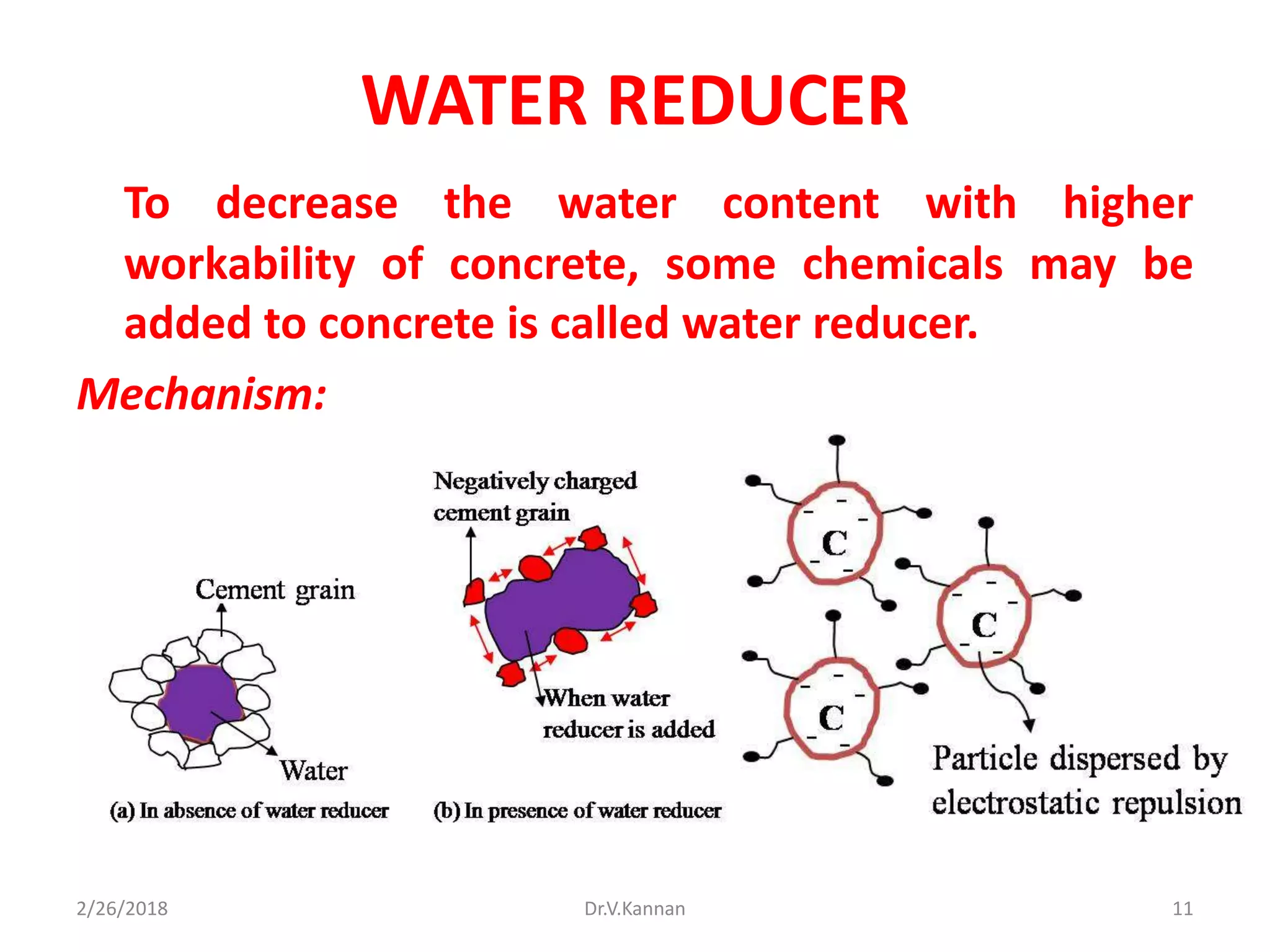
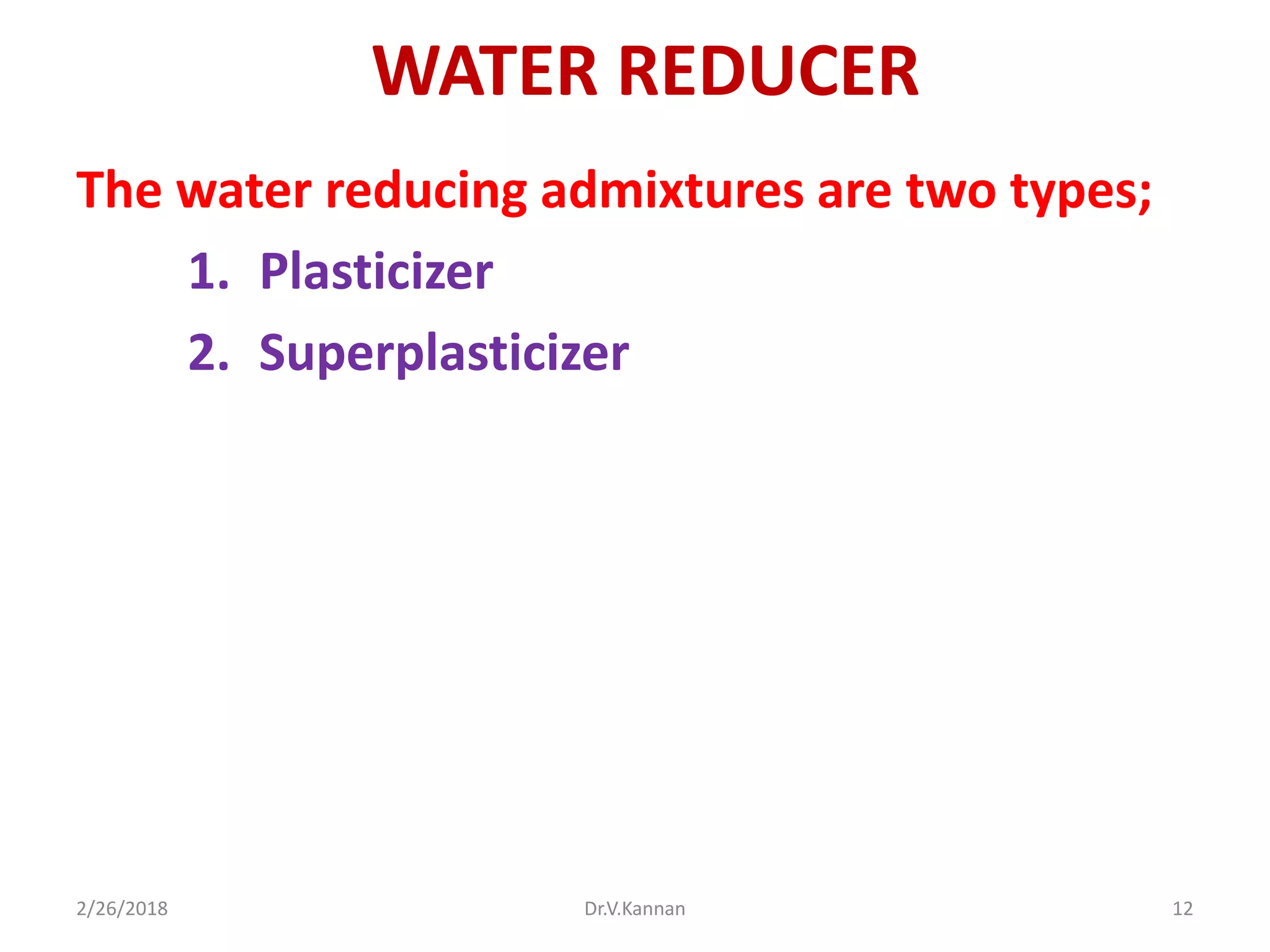
WATER REDUCER
To decrease the water content with higher
workability of concrete, some chemicals may be
added to concrete is called water reducer.
Mechanism:
2/26/2018 Dr.V.Kannan 11
WATER REDUCER
The water reducing admixtures are two types;
1. Plasticizer
2. Superplasticizer
2/26/2018 Dr.V.Kannan 12
1. PLASTICIZER
Plasticizers are the organic or combination of
organic and inorganic substances which reduces
water content for certain degree of workability,
when added in mix.
The basic products consisting
a. Lignosulphonates,
b. Salts of sulphonates hydrocarbon
c. Polyglycol esters,
d. Hydroxylated carboxylic acid products
Dosage: 0.1% - 0.4%
Water reducing capacity: 5% - 15%
2/26/2018 Dr.V.Kannan 13
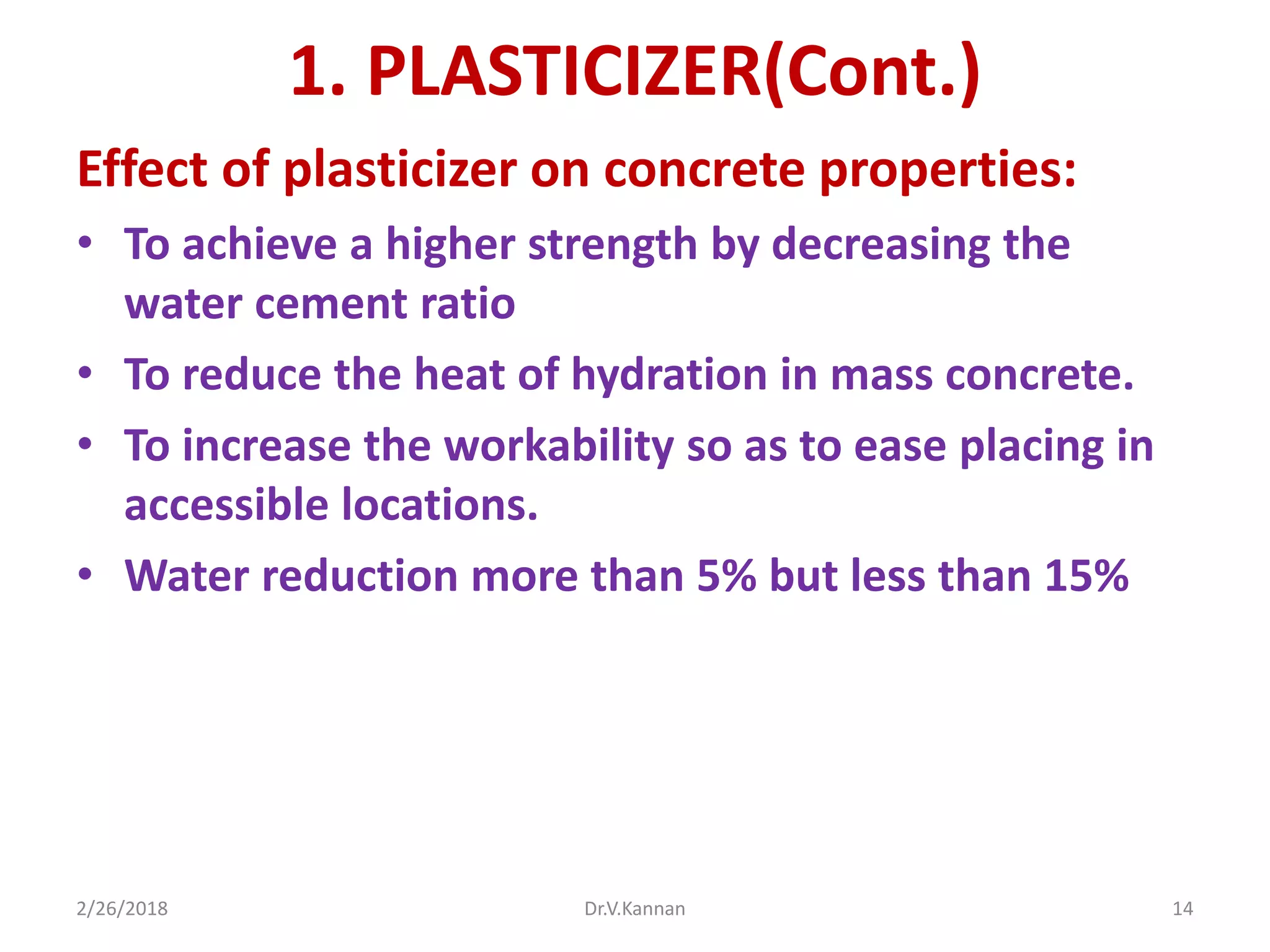
1. PLASTICIZER(Cont.)
Effect of plasticizer on concrete properties:
• To achieve a higher strength by decreasing the
water cement ratio
• To reduce the heat of hydration in mass concrete.
• To increase the workability so as to ease placing in
accessible locations.
• Water reduction more than 5% but less than 15%
2/26/2018 Dr.V.Kannan 14
2. SUPERPLASTICIZER
Chemically different from the PLASTICIZER and capable
of reducing water content by about 30% has been
developed.
Types of superplasticizers:
1. Sulphonated melamine: It is suitable in low
temperature areas
2. Sulphonated naphthalene: It is more suitable in high
temperature areas
3. Ligno sulphates: It is suitable for Indian conditions
where temperature variation is high
4. Carboxylated admixture: It is suitable where
workability is required to be retained for large
duration.
2/26/2018 Dr.V.Kannan 15
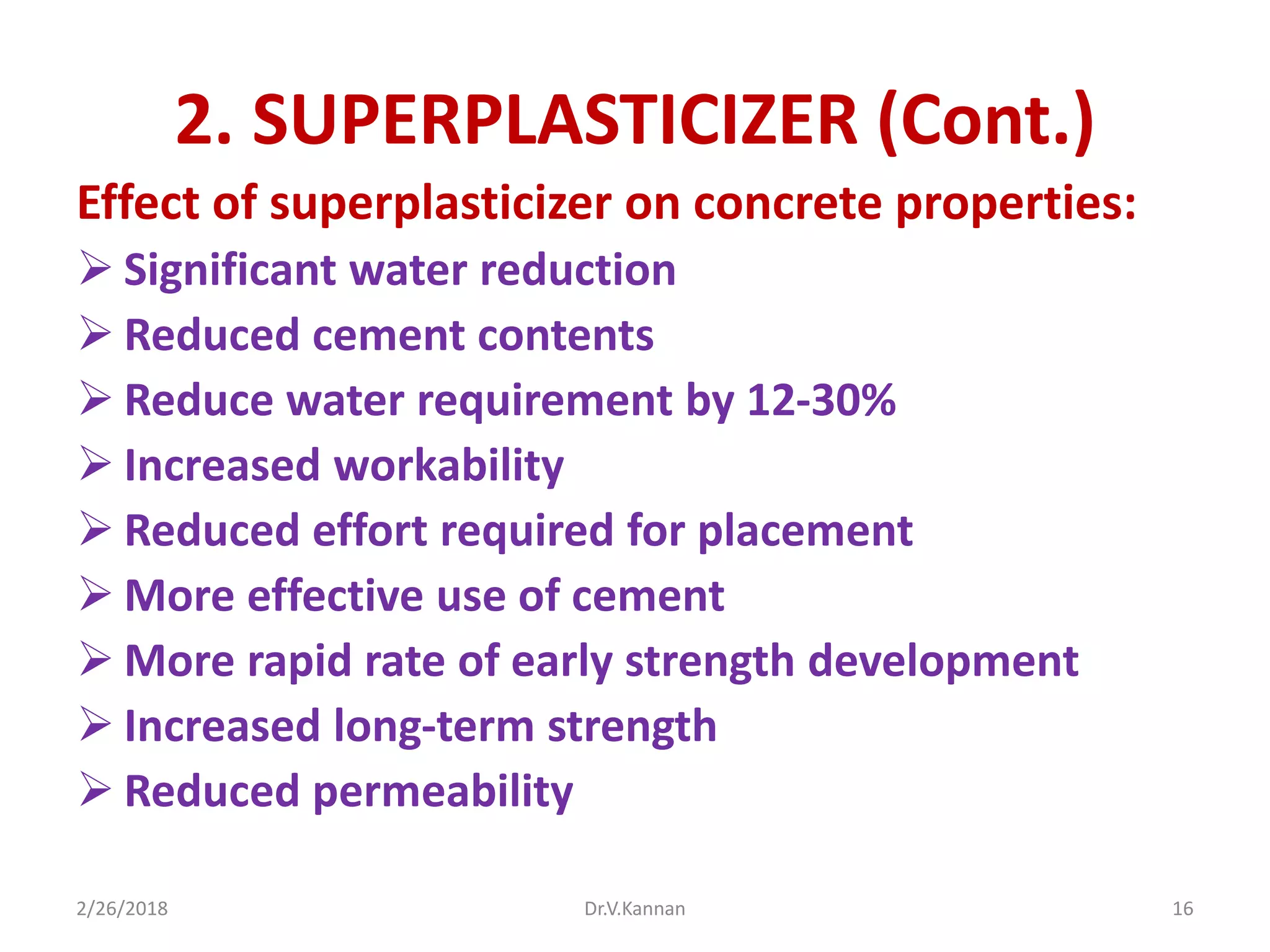
2. SUPERPLASTICIZER (Cont.)
Effect of superplasticizer on concrete properties:
 Significant water reduction
 Reduced cement contents
 Reduce water requirement by 12-30%
 Increased workability
 Reduced effort required for placement
 More effective use of cement
 More rapid rate of early strength development
 Increased long-term strength
 Reduced permeability
2/26/2018 Dr.V.Kannan 16
DOSAGE OF CHEMICAL ADMIXTURES
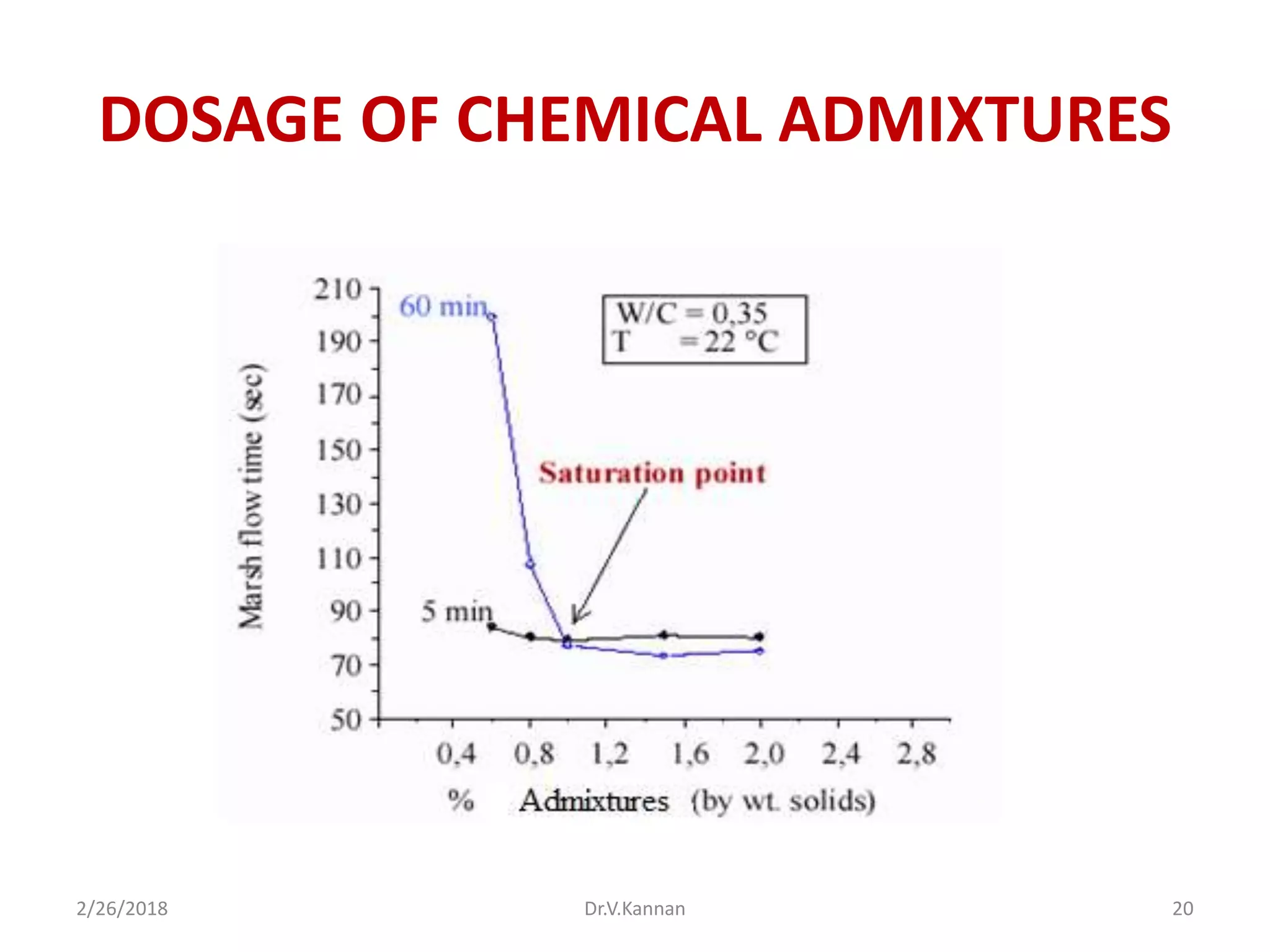
• Marsh cone test is reliable and simple method to
study the rheological properties of cements and
dosage of chemical admixtures (Superplasticizer).
• Apparatus:
2/26/2018 Dr.V.Kannan 17
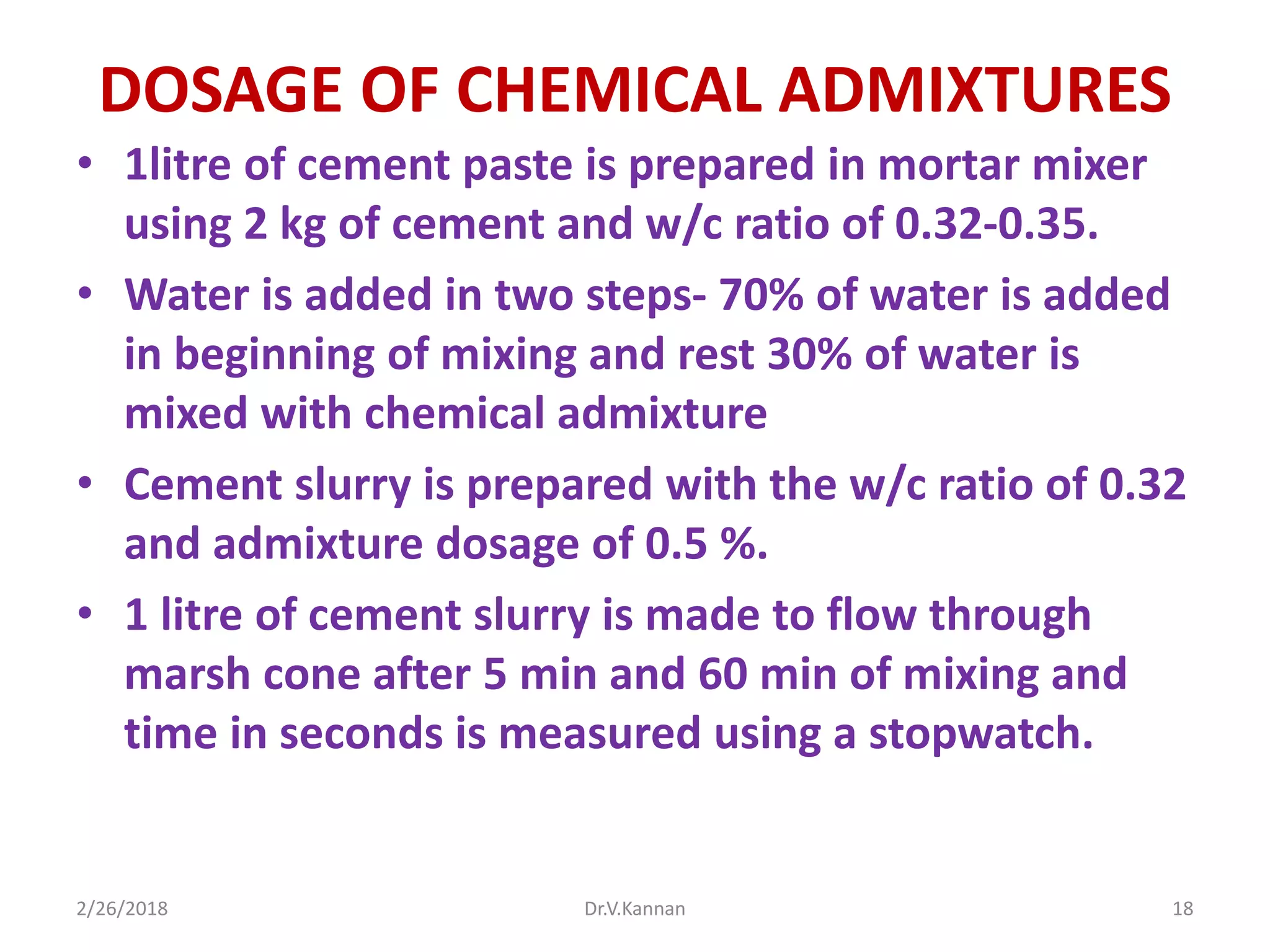
DOSAGE OF CHEMICAL ADMIXTURES
• 1litre of cement paste is prepared in mortar mixer
using 2 kg of cement and w/c ratio of 0.32-0.35.
• Water is added in two steps- 70% of water is added
in beginning of mixing and rest 30% of water is
mixed with chemical admixture
• Cement slurry is prepared with the w/c ratio of 0.32
and admixture dosage of 0.5 %.
• 1 litre of cement slurry is made to flow through
marsh cone after 5 min and 60 min of mixing and
time in seconds is measured using a stopwatch.
2/26/2018 Dr.V.Kannan 18
DOSAGE OF CHEMICAL ADMIXTURES
• The procedure is repeated gradually increasing the
chemical admixture dosage in steps of 0.2%.
• Similar tests are conducted for rest of admixture
and graphs are plotted with time as Y axis and S.P.
dosage as X-axis.
• The saturation dosage of super plasticizer can be
defined as that point beyond which there is no
significant decrease in the flow time
2/26/2018 Dr.V.Kannan 19
DOSAGE OF CHEMICAL ADMIXTURES
2/26/2018 Dr.V.Kannan 20
WATER PROOFER
• It is essential to water proof a structure to prevent the
seepage of water for its durability.
• Provide water proofing solutions for basements, sunken
portions, roofs, terrace gardens and expansion joints
etc.
Water proofers:
• Polymer Modified Cementitious Membranes
• Polyurethane Membranes
• Injection Grouting
• Bituminous membranes
• EPD (ethylene-propylene-diene) Membrane
• PVC Membrane
2/26/2018 Dr.V.Kannan 21
Water Proofer
Effect of water proofer on concrete properties:
 To reduce either the surface adsorption into the
concrete and the passage of water through the
hardened concrete.
 Reducing the size, number and continuity of the
capillary pore structure
 Blocking the capillary pore structure
 Lining the capillaries with a hydrophobic material to
prevent water being drawn in by absorption /
capillary suction.
2/26/2018 Dr.V.Kannan 22
POZZOLANIC or MINERAL ADMIXTURES
• Siliceous or siliceous-aluminous materials
• In finely divided form and in the presence of moisture,
chemically react with calcium hydroxide liberated on
hydration at ordinary temperature
TYPES OF MINERAL OR POZZOLANIC ADMIXTURES
2/26/2018 Dr.V.Kannan 23
Natural Pozzolans
a. Clay and Shales
b. Opalinc Cherts
c. Diatomaceous Earth
d. Volcanic Tuffs and
Pumicites.
Artificial Pozzolans
a. Fly ash
b. Silica Fume
c. Ground Granulated Blast Furnace
Slag (GGBS)
d. Metakaoline
e. Rice Husk ash
f. Surkhi
1. FLY ASH
• Fly ash is finely divided residue resulting from the
combustion of powdered coal in thermal power plant.
• Fly ash is the most widely used pozzolanic material all
over the world.
Types:
• Class F: Fly ash normally produced by burning
bituminous coal, usually has less than 5% CaO. Class F
fly ash has pozzolanic properties only.
• Class C: Fly ash normally produced by burning lignite or
sub-bituminous coal. Some class C fly ash may have CaO
content in excess of 10%. In addition to pozzolanic
properties, class C fly ash also possesses cementitious
properties.
2/26/2018 Dr.V.Kannan 24
1. Fly ash (Cont.)
Effects of Fly Ash on fresh properties of concrete:
• Reduction of water demand for desired slump.
• Used to reduce unit water content, bleeding and drying
shrinkage.
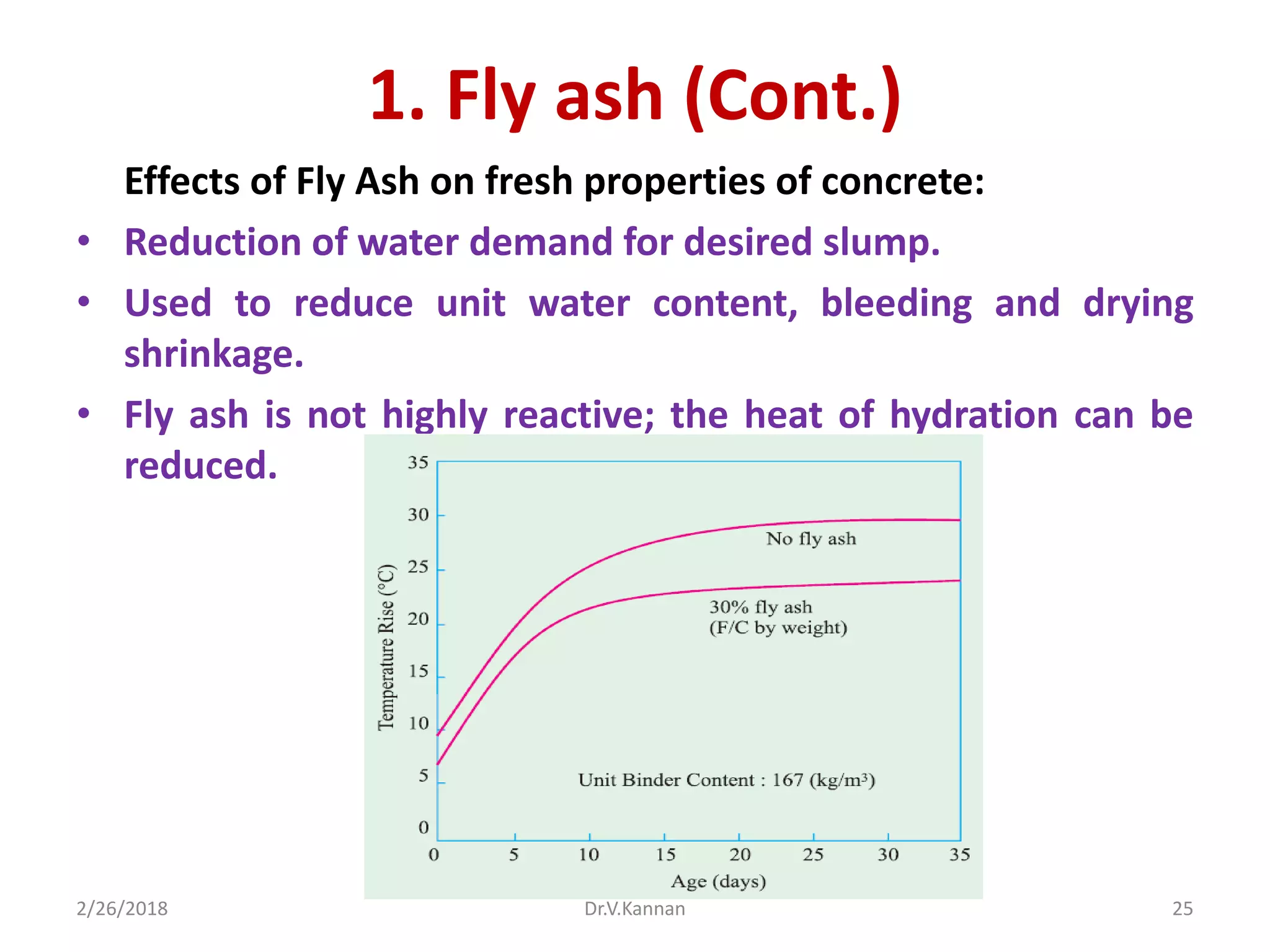
• Fly ash is not highly reactive; the heat of hydration can be
reduced.
2/26/2018 Dr.V.Kannan 25
1. Fly ash (Cont.)
Effects of Fly Ash on harden properties of concrete:
• Contributes to the strength of concrete due to its
pozzolanic reactivity.
• Continued pozzolanic reactivity concrete develops
greater strength at later age not at initial stage.
• Decrease of water permeability and gas permeability.
• Contributes to the expansion due to alkali-aggregate
reaction
• Gives more resistance against corrosion of steel
• Gives more resistance against various acid attack
(Sulfuric acid, hydrochloric acid)
• Contribute durability by means of resisting of
sulphate attacks
2/26/2018 Dr.V.Kannan 26
2. Silica fume
• Silica fume is a byproduct of producing silicon metal
or ferrosilicon alloys.
• Treated as very fine pozzolanic materials
• Cost of the product is high
At least 85% SiO2 content
Mean particle size between 0.1 and 0.2 micron
Minimum specific surface area is 15,000 m2/kg
Spherical particle shape
2/26/2018 Dr.V.Kannan 27
2. Silica fume (Cont.)
Effect of Silica Fume on fresh concrete:
• The increase in water demand of concrete.
• Lead to lower slump but more cohesive mix.
• Make the fresh concrete sticky in nature and hard to
handle.
• Large reduction in bleeding and concrete with microsilica
could be handled and transported without segregation.
• Plastic shrinkage cracking and, therefore, sheet or mat
curing should be considered.
• Produces more heat of hydration at the initial stage of
hydration.
• The total generation of heat will be less than that of
reference concrete.
2/26/2018 Dr.V.Kannan 28
2. Silica fume (Cont.)
Effects of Silica Fume on harden concrete:
• Modulus of elasticity of silica fume concrete is less.
• Improvement in durability of concrete
• Resistance against frost damage.
• Addition of silica fume in small quantities actually
increases the expansion.
2/26/2018 Dr.V.Kannan 29
3. GROUND GRANULATED BLAST FURNACE
SLAG
• Blast-furnace slag is a non-metallic product
consisting essentially of silicates and aluminates of
calcium and other bases.
• The molten slag is rapidly chilled by water to form a
glassy sand like granulated material.
Effects of GGBS on fresh concrete
 Reduces the unit water content necessary to obtain
the same slump.
 Water used for mixing is not immediately lost
 Reduction of bleeding.
2/26/2018 Dr.V.Kannan 30
3. GROUND GRANULATED BLAST
FURNACE SLAG (Cont.)
Effects of GGBS on harden concrete
 Reduced heat of hydration
 Refinement of pore structures
 Reduced permeabilities to the external agencies
 Increased resistance to chemical attack.
 Continued pozzolanic reactivity concrete develops
greater strength at later age not at initial stage
2/26/2018 Dr.V.Kannan 31
4. METAKAOLIN
• Highly reactive metakaolin is made by water
processing to remove unreactive impurities to
make100% reactive pozzolan.
• Such a product, white or cream in colour, purified,
thermally activated is called High Reactive
Metakaolin (HRM).
2/26/2018 Dr.V.Kannan 32
4. METAKAOLIN (Cont.)
Effects of metakaolin on fresh and harden
properties of concrete:
 The water demand will be increased in the concrete
mix
 Early setting and strength than normal concrete
 Resistance against acid and sulphate attack
 Gives good resistance against corrosion of steel
 The cement paste undergoes distinct densification.
 Densification includes an increase in strength and
decrease in permeability.
2/26/2018 Dr.V.Kannan 33
THANK YOU
2/26/2018 Dr.V.Kannan 34

Concrete admixtures

  • 1.
  • 2.
    CONCRETE ADMIXTURES • Admixturesare material other than cement, aggregates & water that are added to concrete either before or during mixing to alter its properties & performance in fresh (workability, setting time etc) and hardened state (strength, durability etc.) Concrete admixtures are generally divided into 2 types i.e., 1. Chemical admixture (Accelerator, Retarder, Plasticizer, Superplasticizer and Water proofer) 2. Mineral admixture (Fly Ash, Silica Fume, Ground Granulated Blast Furnace Slag and Metakaolin) 2/26/2018 Dr.V.Kannan 2
  • 3.
    CONCRETE ADMIXTURES (Cont.) Effectof Chemical or Mineral Admixtures on the Properties of Fresh Concrete: To increase workability without increasing the water cement ratio. To retard / accelerate time of initial or final setting. To modify the rate of bleeding. To retard segregation or increase cohesion. To improve pumpability. 2/26/2018 Dr.V.Kannan 3
  • 4.
    CONCRETE ADMIXTURES (Cont.) Effectof Chemical or Mineral Admixtures on the Properties of Hardened Concrete: To accelerate the rate of strength development especially at early stage. To increase the strength, durability and permeability To control expansion by alkali-aggregate reaction. To improve bond with reinforcement. To improve bond with old /new concrete To improve impact or abrasion resistance. To resist corrosion of embedded reinforcement 2/26/2018 Dr.V.Kannan 4
  • 5.
    CHEMICAL ADMIXTURES A chemicaladmixture is any chemical additive to the concrete mixture that enhances the properties of concrete in the fresh or hardened state. Types / Classifications Accelerators Retarders Plasticizer Superplasticizer Water proofers 2/26/2018 Dr.V.Kannan 5 Water reducing agent
  • 6.
    1. ACCELERATOR Accelerating admixturesare added to accelerate the setting time and to increase the rate of early strength development. Commonly used materials as an accelerator are: Calcium chloride (Not used now)  Soluble carbonates Silicates fluosilicates (Expensive) Organic compounds such as triethenolamine (Expensive) 2/26/2018 Dr.V.Kannan 6
  • 7.
    1. ACCELERATOR (Cont.) Advantages/ Effects of accelerator on concrete properties: Reduced bleeding, Earlier finishing Improved protection against early exposure to freezing and thawing, Earlier use of structure Reduction of protection time to achieve a given quality, Early removal of form, and early load application. 2/26/2018 Dr.V.Kannan 7
  • 8.
    1. ACCELERATOR (Cont.) Increases the rate of gain of strength.  Enables earlier release from precast moulds thus speeding production.  Reduces segregation and increase density and compressive strength.  Cures concrete faster and therefore uniform curing in winter and summer can be achieved.  Early use of concrete floors by accelerating the setting of concrete.  Reduces water requirements, bleeding, shrinkage and time required for initial set. 2/26/2018 Dr.V.Kannan 8
  • 9.
    2. Retarder • Theseadmixtures are used where setting time of concrete need to be delayed. • Retarder delays the hydration process but doesn’t affect the eventual process • Initial setting time can be delayed by more than Three hours. 2/26/2018 Dr.V.Kannan 9
  • 10.
    2. Retarder (Cont.) Advantagesof Retarders / Effect of retarders on concrete properties  Retarding admixtures delay hydration of cement  To delay or extend the setting time of cement paste in concrete.  These are helpful for concrete that has to be transported to long distance, and helpful in placing the concrete at high temperatures.  Used in casting and consolidating large number of pours without the formation of cold joints  Used in grouting oil wells. 2/26/2018 Dr.V.Kannan 10
  • 11.
    WATER REDUCER To decreasethe water content with higher workability of concrete, some chemicals may be added to concrete is called water reducer. Mechanism: 2/26/2018 Dr.V.Kannan 11
  • 12.
    WATER REDUCER The waterreducing admixtures are two types; 1. Plasticizer 2. Superplasticizer 2/26/2018 Dr.V.Kannan 12
  • 13.
    1. PLASTICIZER Plasticizers arethe organic or combination of organic and inorganic substances which reduces water content for certain degree of workability, when added in mix. The basic products consisting a. Lignosulphonates, b. Salts of sulphonates hydrocarbon c. Polyglycol esters, d. Hydroxylated carboxylic acid products Dosage: 0.1% - 0.4% Water reducing capacity: 5% - 15% 2/26/2018 Dr.V.Kannan 13
  • 14.
    1. PLASTICIZER(Cont.) Effect ofplasticizer on concrete properties: • To achieve a higher strength by decreasing the water cement ratio • To reduce the heat of hydration in mass concrete. • To increase the workability so as to ease placing in accessible locations. • Water reduction more than 5% but less than 15% 2/26/2018 Dr.V.Kannan 14
  • 15.
    2. SUPERPLASTICIZER Chemically differentfrom the PLASTICIZER and capable of reducing water content by about 30% has been developed. Types of superplasticizers: 1. Sulphonated melamine: It is suitable in low temperature areas 2. Sulphonated naphthalene: It is more suitable in high temperature areas 3. Ligno sulphates: It is suitable for Indian conditions where temperature variation is high 4. Carboxylated admixture: It is suitable where workability is required to be retained for large duration. 2/26/2018 Dr.V.Kannan 15
  • 16.
    2. SUPERPLASTICIZER (Cont.) Effectof superplasticizer on concrete properties:  Significant water reduction  Reduced cement contents  Reduce water requirement by 12-30%  Increased workability  Reduced effort required for placement  More effective use of cement  More rapid rate of early strength development  Increased long-term strength  Reduced permeability 2/26/2018 Dr.V.Kannan 16
  • 17.
    DOSAGE OF CHEMICALADMIXTURES • Marsh cone test is reliable and simple method to study the rheological properties of cements and dosage of chemical admixtures (Superplasticizer). • Apparatus: 2/26/2018 Dr.V.Kannan 17
  • 18.
    DOSAGE OF CHEMICALADMIXTURES • 1litre of cement paste is prepared in mortar mixer using 2 kg of cement and w/c ratio of 0.32-0.35. • Water is added in two steps- 70% of water is added in beginning of mixing and rest 30% of water is mixed with chemical admixture • Cement slurry is prepared with the w/c ratio of 0.32 and admixture dosage of 0.5 %. • 1 litre of cement slurry is made to flow through marsh cone after 5 min and 60 min of mixing and time in seconds is measured using a stopwatch. 2/26/2018 Dr.V.Kannan 18
  • 19.
    DOSAGE OF CHEMICALADMIXTURES • The procedure is repeated gradually increasing the chemical admixture dosage in steps of 0.2%. • Similar tests are conducted for rest of admixture and graphs are plotted with time as Y axis and S.P. dosage as X-axis. • The saturation dosage of super plasticizer can be defined as that point beyond which there is no significant decrease in the flow time 2/26/2018 Dr.V.Kannan 19
  • 20.
    DOSAGE OF CHEMICALADMIXTURES 2/26/2018 Dr.V.Kannan 20
  • 21.
    WATER PROOFER • Itis essential to water proof a structure to prevent the seepage of water for its durability. • Provide water proofing solutions for basements, sunken portions, roofs, terrace gardens and expansion joints etc. Water proofers: • Polymer Modified Cementitious Membranes • Polyurethane Membranes • Injection Grouting • Bituminous membranes • EPD (ethylene-propylene-diene) Membrane • PVC Membrane 2/26/2018 Dr.V.Kannan 21
  • 22.
    Water Proofer Effect ofwater proofer on concrete properties:  To reduce either the surface adsorption into the concrete and the passage of water through the hardened concrete.  Reducing the size, number and continuity of the capillary pore structure  Blocking the capillary pore structure  Lining the capillaries with a hydrophobic material to prevent water being drawn in by absorption / capillary suction. 2/26/2018 Dr.V.Kannan 22
  • 23.
    POZZOLANIC or MINERALADMIXTURES • Siliceous or siliceous-aluminous materials • In finely divided form and in the presence of moisture, chemically react with calcium hydroxide liberated on hydration at ordinary temperature TYPES OF MINERAL OR POZZOLANIC ADMIXTURES 2/26/2018 Dr.V.Kannan 23 Natural Pozzolans a. Clay and Shales b. Opalinc Cherts c. Diatomaceous Earth d. Volcanic Tuffs and Pumicites. Artificial Pozzolans a. Fly ash b. Silica Fume c. Ground Granulated Blast Furnace Slag (GGBS) d. Metakaoline e. Rice Husk ash f. Surkhi
  • 24.
    1. FLY ASH •Fly ash is finely divided residue resulting from the combustion of powdered coal in thermal power plant. • Fly ash is the most widely used pozzolanic material all over the world. Types: • Class F: Fly ash normally produced by burning bituminous coal, usually has less than 5% CaO. Class F fly ash has pozzolanic properties only. • Class C: Fly ash normally produced by burning lignite or sub-bituminous coal. Some class C fly ash may have CaO content in excess of 10%. In addition to pozzolanic properties, class C fly ash also possesses cementitious properties. 2/26/2018 Dr.V.Kannan 24
  • 25.
    1. Fly ash(Cont.) Effects of Fly Ash on fresh properties of concrete: • Reduction of water demand for desired slump. • Used to reduce unit water content, bleeding and drying shrinkage. • Fly ash is not highly reactive; the heat of hydration can be reduced. 2/26/2018 Dr.V.Kannan 25
  • 26.
    1. Fly ash(Cont.) Effects of Fly Ash on harden properties of concrete: • Contributes to the strength of concrete due to its pozzolanic reactivity. • Continued pozzolanic reactivity concrete develops greater strength at later age not at initial stage. • Decrease of water permeability and gas permeability. • Contributes to the expansion due to alkali-aggregate reaction • Gives more resistance against corrosion of steel • Gives more resistance against various acid attack (Sulfuric acid, hydrochloric acid) • Contribute durability by means of resisting of sulphate attacks 2/26/2018 Dr.V.Kannan 26
  • 27.
    2. Silica fume •Silica fume is a byproduct of producing silicon metal or ferrosilicon alloys. • Treated as very fine pozzolanic materials • Cost of the product is high At least 85% SiO2 content Mean particle size between 0.1 and 0.2 micron Minimum specific surface area is 15,000 m2/kg Spherical particle shape 2/26/2018 Dr.V.Kannan 27
  • 28.
    2. Silica fume(Cont.) Effect of Silica Fume on fresh concrete: • The increase in water demand of concrete. • Lead to lower slump but more cohesive mix. • Make the fresh concrete sticky in nature and hard to handle. • Large reduction in bleeding and concrete with microsilica could be handled and transported without segregation. • Plastic shrinkage cracking and, therefore, sheet or mat curing should be considered. • Produces more heat of hydration at the initial stage of hydration. • The total generation of heat will be less than that of reference concrete. 2/26/2018 Dr.V.Kannan 28
  • 29.
    2. Silica fume(Cont.) Effects of Silica Fume on harden concrete: • Modulus of elasticity of silica fume concrete is less. • Improvement in durability of concrete • Resistance against frost damage. • Addition of silica fume in small quantities actually increases the expansion. 2/26/2018 Dr.V.Kannan 29
  • 30.
    3. GROUND GRANULATEDBLAST FURNACE SLAG • Blast-furnace slag is a non-metallic product consisting essentially of silicates and aluminates of calcium and other bases. • The molten slag is rapidly chilled by water to form a glassy sand like granulated material. Effects of GGBS on fresh concrete  Reduces the unit water content necessary to obtain the same slump.  Water used for mixing is not immediately lost  Reduction of bleeding. 2/26/2018 Dr.V.Kannan 30
  • 31.
    3. GROUND GRANULATEDBLAST FURNACE SLAG (Cont.) Effects of GGBS on harden concrete  Reduced heat of hydration  Refinement of pore structures  Reduced permeabilities to the external agencies  Increased resistance to chemical attack.  Continued pozzolanic reactivity concrete develops greater strength at later age not at initial stage 2/26/2018 Dr.V.Kannan 31
  • 32.
    4. METAKAOLIN • Highlyreactive metakaolin is made by water processing to remove unreactive impurities to make100% reactive pozzolan. • Such a product, white or cream in colour, purified, thermally activated is called High Reactive Metakaolin (HRM). 2/26/2018 Dr.V.Kannan 32
  • 33.
    4. METAKAOLIN (Cont.) Effectsof metakaolin on fresh and harden properties of concrete:  The water demand will be increased in the concrete mix  Early setting and strength than normal concrete  Resistance against acid and sulphate attack  Gives good resistance against corrosion of steel  The cement paste undergoes distinct densification.  Densification includes an increase in strength and decrease in permeability. 2/26/2018 Dr.V.Kannan 33
  • 34.