➢ NAME :- DEBLINA DUTTA
➢ TOPIC NAME :- AGGREGATE
➢ UNIVERSITY ROLL NO :-
10501320003
➢ DEPARTMENT :- CIVIL
ENGINEERING
➢ SEMESTER :- 5th SEM
➢ YEAR :- 3rd YEAR
➢ SUBJECT NAME :- DESIGN OF
RC STRUCTURE
➢ SUBJECT CODE :- CE(PC)501
INTRODUCTION TO AGGREGATES
▪ Aggregates are the important constituents of concrete. Aggregates give body to concrete and make it
economical. Almost all natural aggregates are obtained from quarrying rock bed ordeposits. There are
mainly three kinds of rocks based on the mode of its formation, namely igneous, sedimentary and
metamorphic rocks. As the igneous rock is one of the widely occurring type of rocks on the face of
earth, bulk of the concrete aggregates are of igneous origin.
▪ .Aggregates usually occupy 70-80 % of the volume of concrete. Hence the properties ofaggregates afect
the properties of concrete considerably
CLASSIFICATION OF AGGREGATES
1. Based on Geological Origin-
a) Natural Aggregates :-These are naturally occurring aggregates obtained from quarrying rock bed and crushing it
to desired size range. Some examples of natural aggregates are sand, gravel, crushed rock such as granite,
Quartzite, Basalt, Sandstone, etc.
b) Artificial Aggregate :- These are artificially manufactured or processed aggregates. Some examples of artificial
aggregates are broken bricks, air cooled slag, sintered fly ash, bloated clay, recycled aggregates, etc.
2. Based on Size
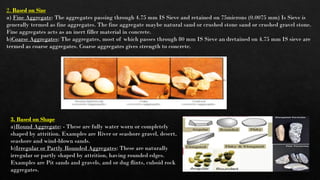
a) Fine Aggregate: The aggregates passing through 4.75 mm IS Sieve and retained on 75microns (0.0075 mm) Is Sieve is
generally termed as fine aggregates. The fine aggregate maybe natural sand or crushed stone sand or crushed gravel stone.
Fine aggregates acts as an inert filler material in concrete.
b)Coarse Aggregates: The aggregates, most of which passes through 80 mm IS Sieve an dretained on 4.75 mm IS sieve are
termed as coarse aggregates. Coarse aggregates gives strength to concrete.
3. Based on Shape
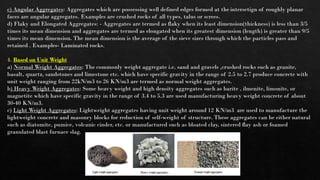
a)Round Aggregate: - These are fully water worn or completely
shaped by attrition. Examples are River or seashore gravel, desert,
seashore and wind-blown sands.
b)Irregular or Partly Rounded Aggregates: These are naturally
irregular or partly shaped by attrition, having rounded edges.
Examples are Pit sands and gravels, and or dug flints, cuboid rock
aggregates.
c) Angular Aggregates: Aggregates which are possessing well defined edges formed at the intersetign of roughly planar
faces are angular aggregates. Examples are crushed rocks of all types, talus or screes.
d) Flaky and Elongated Aggregates: - Aggregates are termed as flaky when its least dimension(thickness) is less than 3/5
times its mean dimension and aggregates are termed as elongated when its greatest dimension (length) is greater than 9/5
times its mean dimension. The mean dimension is the average of the sieve sizes through which the particles pass and
retained . Examples- Laminated rocks.
4. Based on Unit Weight
a) Normal Weight Aggregates: The commonly weight aggregate i.e. sand and gravels ,crushed rocks such as granite,
basalt, quartz, sandstones and limestone etc. which have specific gravity in the range of 2.5 to 2.7 produce concrete with
unit weight ranging from 22kN/m3 to 26 KN/m3 are termed as normal weight aggregates.
b) Heavy Weight Aggregates: Some heavy weight and high density aggregates such as barite , ilmenite, limonite, or
magnetite which have specific gravity in the range of 3.4 to 5.3 are used manufacturing heavy weight concrete of about
30-40 KN/m3.
c) Light Weight Aggregates: Lightweight aggregates having unit weight around 12 KN/m3 are used to manufacture the
lightweight concrete and masonry blocks for reduction of self-weight of structure. These aggregates can be either natural
such as diatomite, pumice, volcanic cinder, etc. or manufactured such as bloated clay, sintered flay ash or foamed
granulated blast furnace slag.
PROPERTIES OF AGGREGATES
1. COMPOSITION
Aggregates consisting of materials that can react with alkalies in cement and cause excessive expansion, cracking and
deterioration of concrete mix should never be used. Therefore it is required to test aggregates to know whether there is
presence of any such constituents in aggregate or not.
2. SIZE & SHAPE
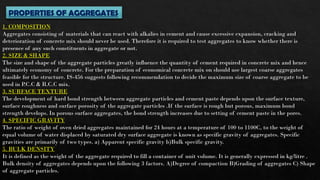
The size and shape of the aggregate particles greatly influence the quantity of cement required in concrete mix and hence
ultimately economy of concrete. For the preparation of economical concrete mix on should use largest coarse aggregates
feasible for the structure. IS-456 suggests following recommendation to decide the maximum size of coarse aggregate to be
used in P
.C.C & R.C.C mix.
3. SURFACE TEXTURE
The development of hard bond strength between aggregate particles and cement paste depends upon the surface texture,
surface roughness and surface porosity of the aggregate particles .If the surface is rough but porous, maximum bond
strength develops. In porous surface aggregates, the bond strength increases due to setting of cement paste in the pores.
4. SPECIFIC GRAVITY
The ratio of weight of oven dried aggregates maintained for 24 hours at a temperature of 100 to 1100C, to the weight of
equal volume of water displaced by saturated dry surface aggregate is known as specific gravity of aggregates. Specific
gravities are primarily of two types. a) Apparent specific gravity b)Bulk specific gravity.
5. BULK DENSITY
It is defined as the weight of the aggregate required to fill a container of unit volume. It is generally expressed in kg/litre .
Bulk density of aggregates depends upon the following 3 factors. A)Degree of compaction B)Grading of aggregates C) Shape
of aggregate particles.
6. VOIDS
The empty spaces between the aggregate particles are known as voids. The volume of void equals the difference between the
gross volume of the aggregate mass and the volume occupied by the particles alone.
7. POROSITY & ABSORPTION
The minute holes formed in rocks during solidification of the molten magma, due to air bubbles, are known as pores. Rocks
containing pores are called porous rocks . Water absorption may be defined as the difference between the weight of very dry
aggregates and the weight of the saturated aggregates with surface dry conditions.
8. BULKING OF SAND
It can be defined as in increase in the bulk volume of the quantity of sand (i.e. fine aggregate) in a moist condition over the
volume of the same quantity of dry or completely saturated sand. The ratio of the volume of moist sand due to the volume
of sand when dry, is called bulking factor.
9. FINENESS MODULUS
Fineness modulus is an empirical factor obtained by adding the cumulative percentages of aggregate retained on each of the
standard sieves ranging from 80 mm to 150 micron and dividing this sum by 100.
10. SPECIFIC SURFACE OF AGGREGATE
The surface area per unit weight of the material is termed as specific surface. This is an indirect measure of the aggregate
grading. Specific surface increases with the reduction in the size of aggregate particle. The specific surface area of the fine
aggregate is very much more than that of coarse aggregate.
11. DELETERIOUS MATERIALS
Aggregates should not contain any harmful material in such a quantity so as to affect the strength and durability of the
concrete. Such harmful materials are called deleterious materials. Deleterious materials may cause one of the following
effects. A) To interfere hydration of cement b)To prevent development of proper bond c)To reduce strength and durability
d)To modify setting times.
USES OF AGGREGATES
Aggregate materials help to make concrete mixes more compact. They also decrease the
consumption of cement and water and contribute to the mechanical strength of the
concrete, making them an indispensable ingredient in the construction and maintenance
of rigid structures.
THANK YOU

10501320003; subcode-CE(PC)501;Deblina Dutta.pdf

  • 1.
    ➢ NAME :-DEBLINA DUTTA ➢ TOPIC NAME :- AGGREGATE ➢ UNIVERSITY ROLL NO :- 10501320003 ➢ DEPARTMENT :- CIVIL ENGINEERING ➢ SEMESTER :- 5th SEM ➢ YEAR :- 3rd YEAR ➢ SUBJECT NAME :- DESIGN OF RC STRUCTURE ➢ SUBJECT CODE :- CE(PC)501
  • 2.
    INTRODUCTION TO AGGREGATES ▪Aggregates are the important constituents of concrete. Aggregates give body to concrete and make it economical. Almost all natural aggregates are obtained from quarrying rock bed ordeposits. There are mainly three kinds of rocks based on the mode of its formation, namely igneous, sedimentary and metamorphic rocks. As the igneous rock is one of the widely occurring type of rocks on the face of earth, bulk of the concrete aggregates are of igneous origin. ▪ .Aggregates usually occupy 70-80 % of the volume of concrete. Hence the properties ofaggregates afect the properties of concrete considerably CLASSIFICATION OF AGGREGATES 1. Based on Geological Origin- a) Natural Aggregates :-These are naturally occurring aggregates obtained from quarrying rock bed and crushing it to desired size range. Some examples of natural aggregates are sand, gravel, crushed rock such as granite, Quartzite, Basalt, Sandstone, etc. b) Artificial Aggregate :- These are artificially manufactured or processed aggregates. Some examples of artificial aggregates are broken bricks, air cooled slag, sintered fly ash, bloated clay, recycled aggregates, etc.
  • 3.
    2. Based onSize a) Fine Aggregate: The aggregates passing through 4.75 mm IS Sieve and retained on 75microns (0.0075 mm) Is Sieve is generally termed as fine aggregates. The fine aggregate maybe natural sand or crushed stone sand or crushed gravel stone. Fine aggregates acts as an inert filler material in concrete. b)Coarse Aggregates: The aggregates, most of which passes through 80 mm IS Sieve an dretained on 4.75 mm IS sieve are termed as coarse aggregates. Coarse aggregates gives strength to concrete. 3. Based on Shape a)Round Aggregate: - These are fully water worn or completely shaped by attrition. Examples are River or seashore gravel, desert, seashore and wind-blown sands. b)Irregular or Partly Rounded Aggregates: These are naturally irregular or partly shaped by attrition, having rounded edges. Examples are Pit sands and gravels, and or dug flints, cuboid rock aggregates.
  • 4.
    c) Angular Aggregates:Aggregates which are possessing well defined edges formed at the intersetign of roughly planar faces are angular aggregates. Examples are crushed rocks of all types, talus or screes. d) Flaky and Elongated Aggregates: - Aggregates are termed as flaky when its least dimension(thickness) is less than 3/5 times its mean dimension and aggregates are termed as elongated when its greatest dimension (length) is greater than 9/5 times its mean dimension. The mean dimension is the average of the sieve sizes through which the particles pass and retained . Examples- Laminated rocks. 4. Based on Unit Weight a) Normal Weight Aggregates: The commonly weight aggregate i.e. sand and gravels ,crushed rocks such as granite, basalt, quartz, sandstones and limestone etc. which have specific gravity in the range of 2.5 to 2.7 produce concrete with unit weight ranging from 22kN/m3 to 26 KN/m3 are termed as normal weight aggregates. b) Heavy Weight Aggregates: Some heavy weight and high density aggregates such as barite , ilmenite, limonite, or magnetite which have specific gravity in the range of 3.4 to 5.3 are used manufacturing heavy weight concrete of about 30-40 KN/m3. c) Light Weight Aggregates: Lightweight aggregates having unit weight around 12 KN/m3 are used to manufacture the lightweight concrete and masonry blocks for reduction of self-weight of structure. These aggregates can be either natural such as diatomite, pumice, volcanic cinder, etc. or manufactured such as bloated clay, sintered flay ash or foamed granulated blast furnace slag.
  • 5.
    PROPERTIES OF AGGREGATES 1.COMPOSITION Aggregates consisting of materials that can react with alkalies in cement and cause excessive expansion, cracking and deterioration of concrete mix should never be used. Therefore it is required to test aggregates to know whether there is presence of any such constituents in aggregate or not. 2. SIZE & SHAPE The size and shape of the aggregate particles greatly influence the quantity of cement required in concrete mix and hence ultimately economy of concrete. For the preparation of economical concrete mix on should use largest coarse aggregates feasible for the structure. IS-456 suggests following recommendation to decide the maximum size of coarse aggregate to be used in P .C.C & R.C.C mix. 3. SURFACE TEXTURE The development of hard bond strength between aggregate particles and cement paste depends upon the surface texture, surface roughness and surface porosity of the aggregate particles .If the surface is rough but porous, maximum bond strength develops. In porous surface aggregates, the bond strength increases due to setting of cement paste in the pores. 4. SPECIFIC GRAVITY The ratio of weight of oven dried aggregates maintained for 24 hours at a temperature of 100 to 1100C, to the weight of equal volume of water displaced by saturated dry surface aggregate is known as specific gravity of aggregates. Specific gravities are primarily of two types. a) Apparent specific gravity b)Bulk specific gravity. 5. BULK DENSITY It is defined as the weight of the aggregate required to fill a container of unit volume. It is generally expressed in kg/litre . Bulk density of aggregates depends upon the following 3 factors. A)Degree of compaction B)Grading of aggregates C) Shape of aggregate particles.
  • 6.
    6. VOIDS The emptyspaces between the aggregate particles are known as voids. The volume of void equals the difference between the gross volume of the aggregate mass and the volume occupied by the particles alone. 7. POROSITY & ABSORPTION The minute holes formed in rocks during solidification of the molten magma, due to air bubbles, are known as pores. Rocks containing pores are called porous rocks . Water absorption may be defined as the difference between the weight of very dry aggregates and the weight of the saturated aggregates with surface dry conditions. 8. BULKING OF SAND It can be defined as in increase in the bulk volume of the quantity of sand (i.e. fine aggregate) in a moist condition over the volume of the same quantity of dry or completely saturated sand. The ratio of the volume of moist sand due to the volume of sand when dry, is called bulking factor. 9. FINENESS MODULUS Fineness modulus is an empirical factor obtained by adding the cumulative percentages of aggregate retained on each of the standard sieves ranging from 80 mm to 150 micron and dividing this sum by 100. 10. SPECIFIC SURFACE OF AGGREGATE The surface area per unit weight of the material is termed as specific surface. This is an indirect measure of the aggregate grading. Specific surface increases with the reduction in the size of aggregate particle. The specific surface area of the fine aggregate is very much more than that of coarse aggregate. 11. DELETERIOUS MATERIALS Aggregates should not contain any harmful material in such a quantity so as to affect the strength and durability of the concrete. Such harmful materials are called deleterious materials. Deleterious materials may cause one of the following effects. A) To interfere hydration of cement b)To prevent development of proper bond c)To reduce strength and durability d)To modify setting times.
  • 7.
    USES OF AGGREGATES Aggregatematerials help to make concrete mixes more compact. They also decrease the consumption of cement and water and contribute to the mechanical strength of the concrete, making them an indispensable ingredient in the construction and maintenance of rigid structures.
  • 8.