CON411.3 Concrete Technology
BCE IV/I Elective
3. Water And Admixture
3.1 Water
• Quality Of water influence
– Strength
– Durability
– Reinforcement corrosion
– Setting time
• Potable water fit for concrete- Thumb Rule
• Concrete water must fulfill
– pH value 6 to 8 otherwise reinforcement corrosion
– Free from organic materials
• Effect of impurities on water
– Carbonates and Bicarbonates affect setting time
• Carbonates /Bicarbonates quick setting
• More than 1000 ppm setting time & strength check conducted
• Allowable variance 10%
– Presence of algae loss of strength (it entraps water)
3.1 Water
• Effect of impurities on water…….cont….
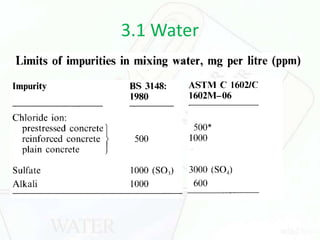
– Chloride not more than 10000 ppm
– Sulfate not more than 3000 ppm
– Turbidity due to silt not more than 2000 ppm
• Affect setting , bond and hardening
• Sea Water
– Salinity 3.5% ( 78% NaCl and 12% MgCl +MgSo4 )
• Higher early strength but lower ultimate strength
• Not more than 15% strength variance (28 days) is tolerable
– Causes dampness and efflorescence
– Avoided if possible
– If used with fly ash no effect on strength
3.1 Water
3.1 Water
• Curing Water
– Mixing water is also suitable for curing
– Iron or organic matter cause surface staining
– Co2 mixed water affect hardened concrete (surface
erosion)
• Tests on Water
– Compare setting time& cube strength with compared
to distilled water
– IST 30 min tolerance
– Strength 10 % tolerance
3.2 Admixture
• Chemical product used to get desired properties
• Modify properties of fresh/hardened concrete and grout
materials
• Not larger than 5 % of cement
• May be organic or inorganic
• Admixture may alter
– Workability
– Pumping quality
– Strength development
– Appearance
– Durability
– Permeability
3.2 Admixture
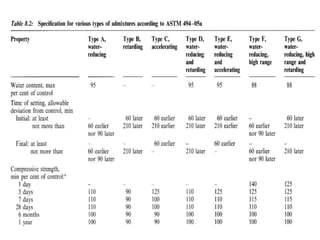
• Classified as their function
– Type A Water Reducing Admixture
– Type B Retarding Admixture
– Type C Accelerating Admixture
– Type D A & B
– Type E A & C
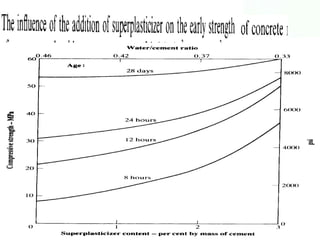
– Type F Super Plasticizer ( High range water reducer )
– Type G F & B
• Dosage
– Described in percentage of cement mass
– Prescribed by manufacturing
• May be solid or liquid
– Liquid disperse rapidly ( preferable )
3.2 Admixture
• Influenced by temperature high temp is preferred
• Less sensitive to small variation in dosage
• Total volume of liquid admixture is counted as water add
• Water Reducing Admixture ( Type A )
– Reduce w/c ratio for same workability
– Improve workability for same w/c ratio
– Reduce water up to 5-10%
– Low segregation and good flow ability ( so used in pumped
concrete )
– Decreases the concrete porosity
– Increases the concrete strength by up to 25%
– Reduces the water permeability (due to less water being used)
3.2 Admixture
• Water Reducing Admixture ( Type A )……. Cont…
– Mechanism
• Surface active chemicals ( surfactants )
• No admixture …..cement particles cling and hide water from rxn
• And less water less workability
• It induces negative charges and destroy flocculation by repulsion
of cement particles
• More water for workability and large surface area for higher
strength
– Too much plasticizer may result in a retarding effect
– manufactured from pop lignosulfonates, a by-product from
the paper industry
– Physical process
3.2 Admixture
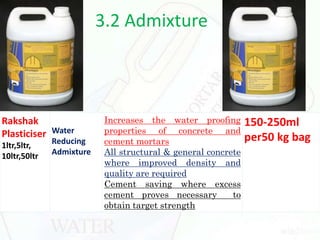
Rakshak
Plasticiser
1ltr,5ltr,
10ltr,50ltr
Water
Reducing
Admixture
Increases the water proofing
properties of concrete and
cement mortars
All structural & general concrete
where improved density and
quality are required
Cement saving where excess
cement proves necessary to
obtain target strength
150-250ml
per50 kg bag
3.2 Admixture
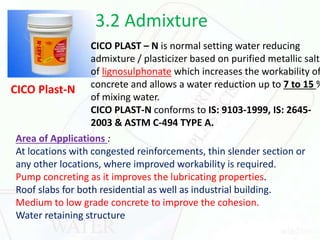
CICO Plast-N
CICO PLAST – N is normal setting water reducing
admixture / plasticizer based on purified metallic salts
of lignosulphonate which increases the workability of
concrete and allows a water reduction up to 7 to 15 %
of mixing water.
CICO PLAST-N conforms to IS: 9103-1999, IS: 2645-
2003 & ASTM C-494 TYPE A.
Area of Applications :
At locations with congested reinforcements, thin slender section or
any other locations, where improved workability is required.
Pump concreting as it improves the lubricating properties.
Roof slabs for both residential as well as industrial building.
Medium to low grade concrete to improve the cohesion.
Water retaining structure
3.2 Admixture
• Retarding Admixture ( Type B )
– Delay of setting of cement paste and hydration process
– IST can be delayed up to 3 hours
– Used to eliminate cold joints
– Prolong the time to transporting , placing and compacting
concrete
– Sugar Carbohydrate Derivatives Methanol and Zinc salts are
Retarders
– 1.0 % sugar totally prevent setting of cement
– Less early strength
– Higher 7 days strength (retarded setting produces dense gel )
– Generally used in hot weather
3.2 Admixture
• Accelerating Admixture ( Type C)
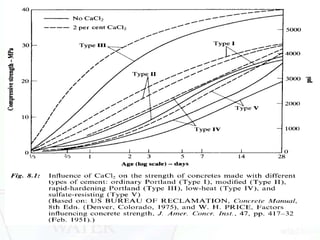
– Accelerate early strength development setting and hardening
– Uses
• Low temperature (2 C )
• Precast concrete
• Urgent repair works e.g. road repair
• Concreting under flowing water
– No use in high temperature …..
• High heat of hydration and thus shrinkage cracking
– Calcium chloride ( CaCl2) is common Accelerator
• Catalyst to accelerate rxn of C3S
• Cheap
• But corrode steel if water and oxygen present
• Less sulphate attack
• Less abrasion and erosion
• Higher strength of steam cured PCC
– Sodium Chloride and Barium Chloride are inferior Accelerator
3.2 Admixture
• Super-Plasticizer( Type F)
– Significant water reducing admixture
– Water soluble organic polymers synthesized to produce high
molecular mass
– Main categories
• Sulfonated Melamine Formaldehyde Condensate
• Sulfonated Naphthalene Formaldehyde Condensate
• Modified Lignosulfonate Formaldehyde Condensate
• Others (sulfonic acid esters and carbohydrate esters )
– Long molecules wrap cement particles giving them negative charge
and thus high repulsive power
– High strength for same w/c ratio
– High workability for same strength
– No bleeding and segregation
3.2 Admixture
• Super-Plasticizer( Type F) ……cont…..
– Can be used in heavily reinforced sections
– Concrete can be placed with little or no compaction
– Dosage
• 1-3 ltr/cu.m. for workability purpose
• 5-20 ltr/cu.m. for strength purpose
– It enables the production of High Grade Strength
– It doesn't affect
• Shrinkage
• Creep
• Modulus of elasticity
• Durability
• Resistance against Freezing and thawing
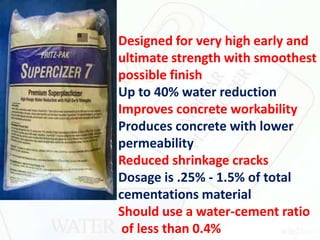
a Designed for very high early and
ultimate strength with smoothest
possible finish
Up to 40% water reduction
Improves concrete workability
Produces concrete with lower
permeability
Reduced shrinkage cracks
Dosage is .25% - 1.5% of total
cementations material
Should use a water-cement ratio
of less than 0.4%
3.2 Admixture
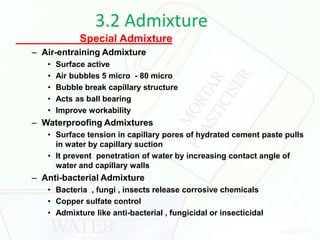
Special Admixture
– Air-entraining Admixture
• Surface active
• Air bubbles 5 micro - 80 micro
• Bubble break capillary structure
• Acts as ball bearing
• Improve workability
– Waterproofing Admixtures
• Surface tension in capillary pores of hydrated cement paste pulls
in water by capillary suction
• It prevent penetration of water by increasing contact angle of
water and capillary walls
– Anti-bacterial Admixture
• Bacteria , fungi , insects release corrosive chemicals
• Copper sulfate control
• Admixture like anti-bacterial , fungicidal or insecticidal
a
b
End Of Chapter Three
Next Chapter 4. Fresh Concrete
Thank You

Water & Admixture

  • 1.
    CON411.3 Concrete Technology BCEIV/I Elective 3. Water And Admixture
  • 2.
    3.1 Water • QualityOf water influence – Strength – Durability – Reinforcement corrosion – Setting time • Potable water fit for concrete- Thumb Rule • Concrete water must fulfill – pH value 6 to 8 otherwise reinforcement corrosion – Free from organic materials • Effect of impurities on water – Carbonates and Bicarbonates affect setting time • Carbonates /Bicarbonates quick setting • More than 1000 ppm setting time & strength check conducted • Allowable variance 10% – Presence of algae loss of strength (it entraps water)
  • 3.
    3.1 Water • Effectof impurities on water…….cont…. – Chloride not more than 10000 ppm – Sulfate not more than 3000 ppm – Turbidity due to silt not more than 2000 ppm • Affect setting , bond and hardening • Sea Water – Salinity 3.5% ( 78% NaCl and 12% MgCl +MgSo4 ) • Higher early strength but lower ultimate strength • Not more than 15% strength variance (28 days) is tolerable – Causes dampness and efflorescence – Avoided if possible – If used with fly ash no effect on strength
  • 4.
  • 5.
    3.1 Water • CuringWater – Mixing water is also suitable for curing – Iron or organic matter cause surface staining – Co2 mixed water affect hardened concrete (surface erosion) • Tests on Water – Compare setting time& cube strength with compared to distilled water – IST 30 min tolerance – Strength 10 % tolerance
  • 6.
    3.2 Admixture • Chemicalproduct used to get desired properties • Modify properties of fresh/hardened concrete and grout materials • Not larger than 5 % of cement • May be organic or inorganic • Admixture may alter – Workability – Pumping quality – Strength development – Appearance – Durability – Permeability
  • 7.
    3.2 Admixture • Classifiedas their function – Type A Water Reducing Admixture – Type B Retarding Admixture – Type C Accelerating Admixture – Type D A & B – Type E A & C – Type F Super Plasticizer ( High range water reducer ) – Type G F & B • Dosage – Described in percentage of cement mass – Prescribed by manufacturing • May be solid or liquid – Liquid disperse rapidly ( preferable )
  • 8.
    3.2 Admixture • Influencedby temperature high temp is preferred • Less sensitive to small variation in dosage • Total volume of liquid admixture is counted as water add • Water Reducing Admixture ( Type A ) – Reduce w/c ratio for same workability – Improve workability for same w/c ratio – Reduce water up to 5-10% – Low segregation and good flow ability ( so used in pumped concrete ) – Decreases the concrete porosity – Increases the concrete strength by up to 25% – Reduces the water permeability (due to less water being used)
  • 9.
    3.2 Admixture • WaterReducing Admixture ( Type A )……. Cont… – Mechanism • Surface active chemicals ( surfactants ) • No admixture …..cement particles cling and hide water from rxn • And less water less workability • It induces negative charges and destroy flocculation by repulsion of cement particles • More water for workability and large surface area for higher strength – Too much plasticizer may result in a retarding effect – manufactured from pop lignosulfonates, a by-product from the paper industry – Physical process
  • 10.
    3.2 Admixture Rakshak Plasticiser 1ltr,5ltr, 10ltr,50ltr Water Reducing Admixture Increases thewater proofing properties of concrete and cement mortars All structural & general concrete where improved density and quality are required Cement saving where excess cement proves necessary to obtain target strength 150-250ml per50 kg bag
  • 11.
    3.2 Admixture CICO Plast-N CICOPLAST – N is normal setting water reducing admixture / plasticizer based on purified metallic salts of lignosulphonate which increases the workability of concrete and allows a water reduction up to 7 to 15 % of mixing water. CICO PLAST-N conforms to IS: 9103-1999, IS: 2645- 2003 & ASTM C-494 TYPE A. Area of Applications : At locations with congested reinforcements, thin slender section or any other locations, where improved workability is required. Pump concreting as it improves the lubricating properties. Roof slabs for both residential as well as industrial building. Medium to low grade concrete to improve the cohesion. Water retaining structure
  • 12.
    3.2 Admixture • RetardingAdmixture ( Type B ) – Delay of setting of cement paste and hydration process – IST can be delayed up to 3 hours – Used to eliminate cold joints – Prolong the time to transporting , placing and compacting concrete – Sugar Carbohydrate Derivatives Methanol and Zinc salts are Retarders – 1.0 % sugar totally prevent setting of cement – Less early strength – Higher 7 days strength (retarded setting produces dense gel ) – Generally used in hot weather
  • 13.
    3.2 Admixture • AcceleratingAdmixture ( Type C) – Accelerate early strength development setting and hardening – Uses • Low temperature (2 C ) • Precast concrete • Urgent repair works e.g. road repair • Concreting under flowing water – No use in high temperature ….. • High heat of hydration and thus shrinkage cracking – Calcium chloride ( CaCl2) is common Accelerator • Catalyst to accelerate rxn of C3S • Cheap • But corrode steel if water and oxygen present • Less sulphate attack • Less abrasion and erosion • Higher strength of steam cured PCC – Sodium Chloride and Barium Chloride are inferior Accelerator
  • 14.
    3.2 Admixture • Super-Plasticizer(Type F) – Significant water reducing admixture – Water soluble organic polymers synthesized to produce high molecular mass – Main categories • Sulfonated Melamine Formaldehyde Condensate • Sulfonated Naphthalene Formaldehyde Condensate • Modified Lignosulfonate Formaldehyde Condensate • Others (sulfonic acid esters and carbohydrate esters ) – Long molecules wrap cement particles giving them negative charge and thus high repulsive power – High strength for same w/c ratio – High workability for same strength – No bleeding and segregation
  • 15.
    3.2 Admixture • Super-Plasticizer(Type F) ……cont….. – Can be used in heavily reinforced sections – Concrete can be placed with little or no compaction – Dosage • 1-3 ltr/cu.m. for workability purpose • 5-20 ltr/cu.m. for strength purpose – It enables the production of High Grade Strength – It doesn't affect • Shrinkage • Creep • Modulus of elasticity • Durability • Resistance against Freezing and thawing
  • 16.
    a Designed forvery high early and ultimate strength with smoothest possible finish Up to 40% water reduction Improves concrete workability Produces concrete with lower permeability Reduced shrinkage cracks Dosage is .25% - 1.5% of total cementations material Should use a water-cement ratio of less than 0.4%
  • 17.
    3.2 Admixture Special Admixture –Air-entraining Admixture • Surface active • Air bubbles 5 micro - 80 micro • Bubble break capillary structure • Acts as ball bearing • Improve workability – Waterproofing Admixtures • Surface tension in capillary pores of hydrated cement paste pulls in water by capillary suction • It prevent penetration of water by increasing contact angle of water and capillary walls – Anti-bacterial Admixture • Bacteria , fungi , insects release corrosive chemicals • Copper sulfate control • Admixture like anti-bacterial , fungicidal or insecticidal
  • 18.
  • 19.
  • 23.
    End Of ChapterThree Next Chapter 4. Fresh Concrete Thank You

Editor's Notes

  • #10 Plasticizers or water reducers, and superplasticizer or high range water reducers, are chemical admixtures that can be added toconcrete mixtures to improve workability. Unless the mix is "starved" of water, the strength of concrete is inversely proportional to the amount of water added or water-cement (w/c) ratio. In order to produce stronger concrete, less water is added (without "starving" the mix), which makes the concrete mixture less workable and difficult to mix, necessitating the use of plasticizers, water reducers, superplasticizers or dispersants. [4] Plasticizers are also often used when pozzolanic ash is added to concrete to improve strength. This method of mix proportioning is especially popular when producing high-strength concrete and fiber-reinforced concrete. Adding 1-2% plasticizer per unit weight of cement is usually sufficient. Adding an excessive amount of plasticizer will result in excessive segregation of concrete and is not advisable. Depending on the particular chemical used, use of too much plasticizer may result in a retarding effect. Plasticizers are commonly manufactured from pop lignosulfonates, a by-product from the paper industry. Superplasticizers have generally been manufactured from sulfonatednaphthalene condensate or sulfonated melamine formaldehyde, although newer products based on polycarboxylic ethers are now available. Traditional lignosulfonate-based plasticisers, naphthalene and melamine sulfonate-based superplasticisers disperse the flocculated cement particles through a mechanism of electrostatic repulsion (see colloid). In normal plasticisers, the active substances are adsorbed on to the cement particles, giving them a negative charge, which leads to repulsion between particles. Lignin, naphthaleneand melamine sulfonate superplasticisers are organic polymers. The long molecules wrap themselves around the cement particles, giving them a highly negative charge so that they repel each other. Polycarboxylate ether superplasticizer (PCE) or just polycarboxylate (PC), work differently from sulfonate-based superplasticizers, giving cement dispersion by steric stabilisation, instead of electrostatic repulsion. This form of dispersion is more powerful in its effect and gives improved workability retention to the cementitious mix.[5] In ancient times, the Romans used animal fat, milk and blood to improve workability of concrete mixes.[6]
  • #11 Deriving expertise from decades of experiencePartnering the growth of India’s construction industry for more than 80 years, CICO Technologies Limited has reached a benchmark position in delivering innovative construction products and solutions. We produce and market groundbreaking, intelligent and reliable construction chemicals that make construction projects not only safer, but also stronger and environmentally viable.  Our array of products cater to a variety of projects across a broad range of sectors including commercial, infrastructure, industrial, residential and marine.  CICO effectively combines its economic growth with environmental protection and social responsibility and ensures that its technological advancements not only enable successful completion of initiatives of our clients and customers but also contribute to a better future. Some key facts and figures: CICO emerged as the youngest entrant in the construction chemical sector with an exceptional growth rate of 191% within a period of 5 years CICO has an extensive network of offices and manufacturing locations across India CICO’s pan India presence is marked by its offices at Nepal, Bangladesh, Sri Lanka and other major countries of South Asia CICO is further represented through distributor and licensee network throughout the nation CICO has the widest range of products catering to various segments of the industry
  • #12 Deriving expertise from decades of experiencePartnering the growth of India’s construction industry for more than 80 years, CICO Technologies Limited has reached a benchmark position in delivering innovative construction products and solutions. We produce and market groundbreaking, intelligent and reliable construction chemicals that make construction projects not only safer, but also stronger and environmentally viable.  Our array of products cater to a variety of projects across a broad range of sectors including commercial, infrastructure, industrial, residential and marine.  CICO effectively combines its economic growth with environmental protection and social responsibility and ensures that its technological advancements not only enable successful completion of initiatives of our clients and customers but also contribute to a better future. Some key facts and figures: CICO emerged as the youngest entrant in the construction chemical sector with an exceptional growth rate of 191% within a period of 5 years CICO has an extensive network of offices and manufacturing locations across India CICO’s pan India presence is marked by its offices at Nepal, Bangladesh, Sri Lanka and other major countries of South Asia CICO is further represented through distributor and licensee network throughout the nation CICO has the widest range of products catering to various segments of the industry CICO Plast-N  Description CICO PLAST – N is normal setting water reducing admixture / plasticizer based on purified metallic salts of lignosulphonate which increases the workability of concrete and allows a water reduction up to 7 to 15 % of mixing water. CICO PLAST-N conforms to IS: 9103-1999, IS: 2645-2003 & ASTM C-494 TYPE A. Uses It is used in producing more workable concrete. In other words concrete slump is increased considerably or else strength can be increased substantially at same slump through water reduction, cement can be saved up to 10%. Area of Applications : At locations with congested reinforcements, thin slender section or any other locations, where improved workability is required. Pump concreting as it improves the lubricating properties. Roof slabs for both residential as well as industrial building. Medium to low grade concrete to improve the cohesion. Water retaining structure Advantages: Improves the workability of concrete. Improves both early and ultimate strength without increasing cement content and without reducing workability. Saves cement without reducing strength and workability. Improves even harsh mix and makes it easier to place the concrete. Improves surface finish, allows to produce denser concrete. Reduces drying shrinkage cracks, bleeding and segregation of concrete. Reduces the permeability of concrete. Makes the concrete more durable.
  • #13 Plasticizers or water reducers, and superplasticizer or high range water reducers, are chemical admixtures that can be added toconcrete mixtures to improve workability. Unless the mix is "starved" of water, the strength of concrete is inversely proportional to the amount of water added or water-cement (w/c) ratio. In order to produce stronger concrete, less water is added (without "starving" the mix), which makes the concrete mixture less workable and difficult to mix, necessitating the use of plasticizers, water reducers, superplasticizers or dispersants. [4] Plasticizers are also often used when pozzolanic ash is added to concrete to improve strength. This method of mix proportioning is especially popular when producing high-strength concrete and fiber-reinforced concrete. Adding 1-2% plasticizer per unit weight of cement is usually sufficient. Adding an excessive amount of plasticizer will result in excessive segregation of concrete and is not advisable. Depending on the particular chemical used, use of too much plasticizer may result in a retarding effect. Plasticizers are commonly manufactured from pop lignosulfonates, a by-product from the paper industry. Superplasticizers have generally been manufactured from sulfonatednaphthalene condensate or sulfonated melamine formaldehyde, although newer products based on polycarboxylic ethers are now available. Traditional lignosulfonate-based plasticisers, naphthalene and melamine sulfonate-based superplasticisers disperse the flocculated cement particles through a mechanism of electrostatic repulsion (see colloid). In normal plasticisers, the active substances are adsorbed on to the cement particles, giving them a negative charge, which leads to repulsion between particles. Lignin, naphthaleneand melamine sulfonate superplasticisers are organic polymers. The long molecules wrap themselves around the cement particles, giving them a highly negative charge so that they repel each other. Polycarboxylate ether superplasticizer (PCE) or just polycarboxylate (PC), work differently from sulfonate-based superplasticizers, giving cement dispersion by steric stabilisation, instead of electrostatic repulsion. This form of dispersion is more powerful in its effect and gives improved workability retention to the cementitious mix.[5] In ancient times, the Romans used animal fat, milk and blood to improve workability of concrete mixes.[6]
  • #14 Plasticizers or water reducers, and superplasticizer or high range water reducers, are chemical admixtures that can be added toconcrete mixtures to improve workability. Unless the mix is "starved" of water, the strength of concrete is inversely proportional to the amount of water added or water-cement (w/c) ratio. In order to produce stronger concrete, less water is added (without "starving" the mix), which makes the concrete mixture less workable and difficult to mix, necessitating the use of plasticizers, water reducers, superplasticizers or dispersants. [4] Plasticizers are also often used when pozzolanic ash is added to concrete to improve strength. This method of mix proportioning is especially popular when producing high-strength concrete and fiber-reinforced concrete. Adding 1-2% plasticizer per unit weight of cement is usually sufficient. Adding an excessive amount of plasticizer will result in excessive segregation of concrete and is not advisable. Depending on the particular chemical used, use of too much plasticizer may result in a retarding effect. Plasticizers are commonly manufactured from pop lignosulfonates, a by-product from the paper industry. Superplasticizers have generally been manufactured from sulfonatednaphthalene condensate or sulfonated melamine formaldehyde, although newer products based on polycarboxylic ethers are now available. Traditional lignosulfonate-based plasticisers, naphthalene and melamine sulfonate-based superplasticisers disperse the flocculated cement particles through a mechanism of electrostatic repulsion (see colloid). In normal plasticisers, the active substances are adsorbed on to the cement particles, giving them a negative charge, which leads to repulsion between particles. Lignin, naphthaleneand melamine sulfonate superplasticisers are organic polymers. The long molecules wrap themselves around the cement particles, giving them a highly negative charge so that they repel each other. Polycarboxylate ether superplasticizer (PCE) or just polycarboxylate (PC), work differently from sulfonate-based superplasticizers, giving cement dispersion by steric stabilisation, instead of electrostatic repulsion. This form of dispersion is more powerful in its effect and gives improved workability retention to the cementitious mix.[5] In ancient times, the Romans used animal fat, milk and blood to improve workability of concrete mixes.[6]
  • #15 Plasticizers or water reducers, and superplasticizer or high range water reducers, are chemical admixtures that can be added toconcrete mixtures to improve workability. Unless the mix is "starved" of water, the strength of concrete is inversely proportional to the amount of water added or water-cement (w/c) ratio. In order to produce stronger concrete, less water is added (without "starving" the mix), which makes the concrete mixture less workable and difficult to mix, necessitating the use of plasticizers, water reducers, superplasticizers or dispersants. [4] Plasticizers are also often used when pozzolanic ash is added to concrete to improve strength. This method of mix proportioning is especially popular when producing high-strength concrete and fiber-reinforced concrete. Naphthalene Based Superplasticizer - Mar, 27 2009 LY-02 series Naphthalene Based Superplasticizer is an admixture based on beta-sulphonate formaldehyde condensates with non-air-entraining superplasticizing, highly effective water reducing and strengthening effects. It has a good compatibility with wide ranges of cements and very low in addition rate and easy to use. It is in particular adaptable to prepare normal concrete and steaming-cured concrete with the requirement of highly water reduction and strength. It is compatible with regular Portland cement, Portland slag and pozzolanic cement.  Adding 1-2% plasticizer per unit weight of cement is usually sufficient. Adding an excessive amount of plasticizer will result in excessive segregation of concrete and is not advisable. Depending on the particular chemical used, use of too much plasticizer may result in a retarding effect. Plasticizers are commonly manufactured from pop lignosulfonates, a by-product from the paper industry. Superplasticizers have generally been manufactured from sulfonatednaphthalene condensate or sulfonated melamine formaldehyde, although newer products based on polycarboxylic ethers are now available. Traditional lignosulfonate-based plasticisers, naphthalene and melamine sulfonate-based superplasticisers disperse the flocculated cement particles through a mechanism of electrostatic repulsion (see colloid). In normal plasticisers, the active substances are adsorbed on to the cement particles, giving them a negative charge, which leads to repulsion between particles. Lignin, naphthaleneand melamine sulfonate superplasticisers are organic polymers. The long molecules wrap themselves around the cement particles, giving them a highly negative charge so that they repel each other. Polycarboxylate ether superplasticizer (PCE) or just polycarboxylate (PC), work differently from sulfonate-based superplasticizers, giving cement dispersion by steric stabilisation, instead of electrostatic repulsion. This form of dispersion is more powerful in its effect and gives improved workability retention to the cementitious mix.[5] In ancient times, the Romans used animal fat, milk and blood to improve workability of concrete mixes.[6]
  • #16 Plasticizers or water reducers, and superplasticizer or high range water reducers, are chemical admixtures that can be added toconcrete mixtures to improve workability. Unless the mix is "starved" of water, the strength of concrete is inversely proportional to the amount of water added or water-cement (w/c) ratio. In order to produce stronger concrete, less water is added (without "starving" the mix), which makes the concrete mixture less workable and difficult to mix, necessitating the use of plasticizers, water reducers, superplasticizers or dispersants. [4] Plasticizers are also often used when pozzolanic ash is added to concrete to improve strength. This method of mix proportioning is especially popular when producing high-strength concrete and fiber-reinforced concrete. Adding 1-2% plasticizer per unit weight of cement is usually sufficient. Adding an excessive amount of plasticizer will result in excessive segregation of concrete and is not advisable. Depending on the particular chemical used, use of too much plasticizer may result in a retarding effect. Plasticizers are commonly manufactured from pop lignosulfonates, a by-product from the paper industry. Superplasticizers have generally been manufactured from sulfonatednaphthalene condensate or sulfonated melamine formaldehyde, although newer products based on polycarboxylic ethers are now available. Traditional lignosulfonate-based plasticisers, naphthalene and melamine sulfonate-based superplasticisers disperse the flocculated cement particles through a mechanism of electrostatic repulsion (see colloid). In normal plasticisers, the active substances are adsorbed on to the cement particles, giving them a negative charge, which leads to repulsion between particles. Lignin, naphthaleneand melamine sulfonate superplasticisers are organic polymers. The long molecules wrap themselves around the cement particles, giving them a highly negative charge so that they repel each other. Polycarboxylate ether superplasticizer (PCE) or just polycarboxylate (PC), work differently from sulfonate-based superplasticizers, giving cement dispersion by steric stabilisation, instead of electrostatic repulsion. This form of dispersion is more powerful in its effect and gives improved workability retention to the cementitious mix.[5] In ancient times, the Romans used animal fat, milk and blood to improve workability of concrete mixes.[6]
  • #17 Supercizer 7 Super Plasticizer, 2.5lb bag    Designed for very high early and ultimate strength with smoothest possible finish Up to 40% water reduction Improves concrete workability Improves cohesiveness and reduces concrete segregation Produces concrete with lower permeability Reduced shrinkage cracks Higher modulus of elasticity Dosage is .25% - 1.5% of total cementatioss material Should use a water-cement ratio of less than 0.4%
  • #18 Plasticizers or water reducers, and superplasticizer or high range water reducers, are chemical admixtures that can be added toconcrete mixtures to improve workability. Unless the mix is "starved" of water, the strength of concrete is inversely proportional to the amount of water added or water-cement (w/c) ratio. In order to produce stronger concrete, less water is added (without "starving" the mix), which makes the concrete mixture less workable and difficult to mix, necessitating the use of plasticizers, water reducers, superplasticizers or dispersants. [4] Plasticizers are also often used when pozzolanic ash is added to concrete to improve strength. This method of mix proportioning is especially popular when producing high-strength concrete and fiber-reinforced concrete. Adding 1-2% plasticizer per unit weight of cement is usually sufficient. Adding an excessive amount of plasticizer will result in excessive segregation of concrete and is not advisable. Depending on the particular chemical used, use of too much plasticizer may result in a retarding effect. Plasticizers are commonly manufactured from pop lignosulfonates, a by-product from the paper industry. Superplasticizers have generally been manufactured from sulfonatednaphthalene condensate or sulfonated melamine formaldehyde, although newer products based on polycarboxylic ethers are now available. Traditional lignosulfonate-based plasticisers, naphthalene and melamine sulfonate-based superplasticisers disperse the flocculated cement particles through a mechanism of electrostatic repulsion (see colloid). In normal plasticisers, the active substances are adsorbed on to the cement particles, giving them a negative charge, which leads to repulsion between particles. Lignin, naphthaleneand melamine sulfonate superplasticisers are organic polymers. The long molecules wrap themselves around the cement particles, giving them a highly negative charge so that they repel each other. Polycarboxylate ether superplasticizer (PCE) or just polycarboxylate (PC), work differently from sulfonate-based superplasticizers, giving cement dispersion by steric stabilisation, instead of electrostatic repulsion. This form of dispersion is more powerful in its effect and gives improved workability retention to the cementitious mix.[5] In ancient times, the Romans used animal fat, milk and blood to improve workability of concrete mixes.[6]
  • #19  Supercizer 7 Super Plasticizer, 2.5lb bag    Item #SP70007 Designed for very high early and ultimate strength with smoothest possible finish Up to 40% water reduction Improves concrete workability Improves cohesiveness and reduces concrete segregation Produces concrete with lower permeability Reduced shrinkage cracks Higher modulus of elasticity Dosage is .25% - 1.5% of total cementatioss material Should use a water-cement ratio of less than 0.4%
  • #24 Video clip lab test………..