Concept Learning - Find S Algorithm,Candidate Elimination Algorithm
1.
Basics of LearningTheory
By :
Sharmila Chidaravalli
Assistant Professor
Global Academy of Technology
2.
Learning is aprocess by which one can acquire knowledge and construct
new ideas or concepts based on the experiences.
Machine learning is an intelligent way of learning general concept from
training examples without writing a program.
There are many machine learning algorithms through which computers can
intelligently learn from past data or experiences, identify patterns, and
make predictions when new data is fed.
3.
What is ConceptLearning…?
Concept learning can be formulated as a problem of searching through a predefined
space of potential hypotheses for the hypothesis that best fits the training examples.
“A task of acquiring potential hypothesis (solution) that best fits the
given training examples.”
Concept learning requires three things:
1. Input
2. Output
3. Test
Formally, Concept learning is defined as–
"Given a set of hypotheses, the learner searches through the
hypothesis space to identify the best hypothesis that matches the
target concept".
4.
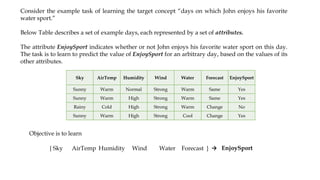
Sky AirTemp HumidityWind Water Forecast EnjoySport
Sunny Warm Normal Strong Warm Same Yes
Sunny Warm High Strong Warm Same Yes
Rainy Cold High Strong Warm Change No
Sunny Warm High Strong Cool Change Yes
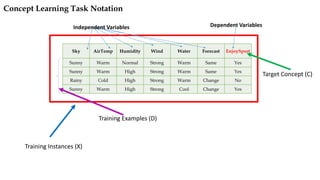
Consider the example task of learning the target concept “days on which John enjoys his favorite
water sport.”
Below Table describes a set of example days, each represented by a set of attributes.
The attribute EnjoySport indicates whether or not John enjoys his favorite water sport on this day.
The task is to learn to predict the value of EnjoySport for an arbitrary day, based on the values of its
other attributes.
Objective is to learn
{ Sky AirTemp Humidity Wind Water Forecast } → EnjoySport
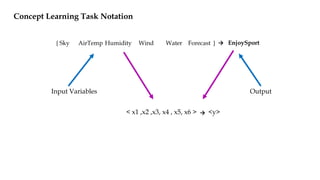
Concept Learning TaskNotation
Sky AirTemp Humidity Wind Water Forecast EnjoySport
Sunny Warm Normal Strong Warm Same Yes
Sunny Warm High Strong Warm Same Yes
Rainy Cold High Strong Warm Change No
Sunny Warm High Strong Cool Change Yes
Training Examples (D)
Target Concept (C)
Training Instances (X)
Independent Variables Dependent Variables
7.
Representation of aHypothesis
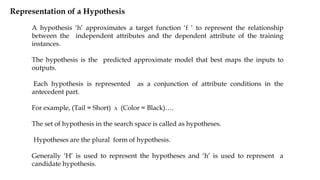
A hypothesis ‘h’ approximates a target function ‘f ’ to represent the relationship
between the independent attributes and the dependent attribute of the training
instances.
The hypothesis is the predicted approximate model that best maps the inputs to
outputs.
Each hypothesis is represented as a conjunction of attribute conditions in the
antecedent part.
For example, (Tail = Short) ʌ (Color = Black)….
The set of hypothesis in the search space is called as hypotheses.
Hypotheses are the plural form of hypothesis.
Generally ‘H’ is used to represent the hypotheses and ‘h’ is used to represent a
candidate hypothesis.
8.
What hypothesis representationis provided to the learner?
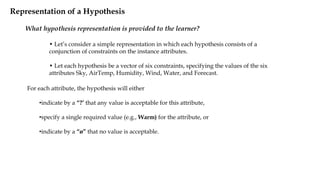
• Let’s consider a simple representation in which each hypothesis consists of a
conjunction of constraints on the instance attributes.
• Let each hypothesis be a vector of six constraints, specifying the values of the six
attributes Sky, AirTemp, Humidity, Wind, Water, and Forecast.
Representation of a Hypothesis
For each attribute, the hypothesis will either
•indicate by a “?’ that any value is acceptable for this attribute,
•specify a single required value (e.g., Warm) for the attribute, or
•indicate by a “ø” that no value is acceptable.
9.
Representation of aHypothesis
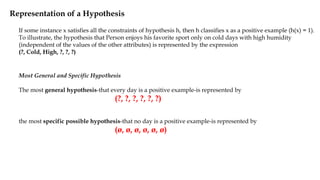
Most General and Specific Hypothesis
The most general hypothesis-that every day is a positive example-is represented by
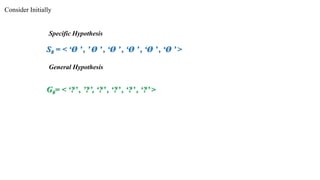
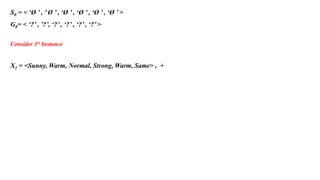
(?, ?, ?, ?, ?, ?)
the most specific possible hypothesis-that no day is a positive example-is represented by
(ø, ø, ø, ø, ø, ø)
If some instance x satisfies all the constraints of hypothesis h, then h classifies x as a positive example (h(x) = 1).
To illustrate, the hypothesis that Person enjoys his favorite sport only on cold days with high humidity
(independent of the values of the other attributes) is represented by the expression
(?, Cold, High, ?, ?, ?)
10.
• The setof items over which the concept is defined is called the set of instances, which is
denoted by X.
Example: X is the set of all possible days, each represented by the attributes:
Sky, AirTemp, Humidity, Wind, Water, and Forecast
• The concept or function to be learned is called the target concept, which is denoted by c.
c can be any Boolean valued function defined over the instances X c: X→ {0, 1}
Example: The target concept corresponds to the value of the attribute EnjoySport
(i.e., c(x) = 1 if EnjoySport = Yes, and c(x) = 0 if EnjoySport = No).
Notation
11.
• Instances forwhich c(x) = 1 are called positive examples, or members of the target concept.
• Instances for which c(x) = 0 are called negative examples, or non-members of the target concept.
• The ordered pair (x, c(x)) to describe the training example consisting of the instance x and its
target concept value c(x).
• D to denote the set of available training examples
• The symbol H to denote the set of all possible hypotheses that the learner may consider regarding
the identity of the target concept.
Each hypothesis h in H represents a Boolean valued function defined over X h: X→{0, 1}
The goal of the learner is to find a hypothesis h such that h(x) = c(x) for all x in X.
Notation
12.
• Given:
Instances X:Possible days, each described by the attributes
• Sky (with possible values Sunny, Cloudy, and Rainy),
• AirTemp (with values Warm and Cold),
• Humidity (with values Normal and High),
• Wind (with values Strong and Weak),
• Water (with values Warm and Cool),
• Forecast (with values Same and Change).
• Hypotheses H: Each hypothesis is described by a conjunction of constraints on the attributes Sky, AirTemp,
Humidity, Wind, Water, and Forecast. The constraints may be "?" (any value is acceptable), “Φ” (no value is
acceptable), or a specific value.
• Target concept c: EnjoySport : X → {0, l}
• Training examples D: Positive and negative examples of the target function
• Determine:
• A hypothesis h in H such that h(x) = c(x) for all x in X.
13.
A CONCEPT LEARNINGTASK
Concept learning can be viewed as the task of searching through
a large space of hypotheses implicitly defined by the hypothesis
representation.
The goal of this search is to find the hypothesis that best fits the training
examples.
It is important to note that by selecting a hypothesis representation, the designer of the learning
algorithm implicitly defines the space of all hypotheses that the program can ever represent and
therefore can ever learn.
14.
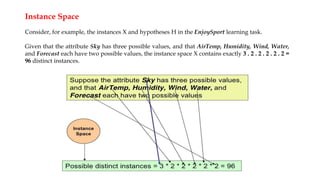
Instance Space
Consider, forexample, the instances X and hypotheses H in the EnjoySport learning task.
Given that the attribute Sky has three possible values, and that AirTemp, Humidity, Wind, Water,
and Forecast each have two possible values, the instance space X contains exactly 3 . 2 . 2 . 2 . 2 . 2 =
96 distinct instances.
15.
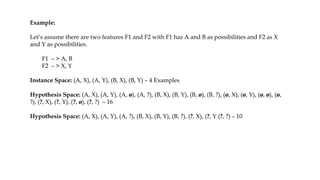
Example:
Let’s assume thereare two features F1 and F2 with F1 has A and B as possibilities and F2 as X
and Y as possibilities.
F1 – > A, B
F2 – > X, Y
Instance Space: (A, X), (A, Y), (B, X), (B, Y) – 4 Examples
Hypothesis Space: (A, X), (A, Y), (A, ø), (A, ?), (B, X), (B, Y), (B, ø), (B, ?), (ø, X), (ø, Y), (ø, ø), (ø,
?), (?, X), (?, Y), (?, ø), (?, ?) – 16
Hypothesis Space: (A, X), (A, Y), (A, ?), (B, X), (B, Y), (B, ?), (?, X), (?, Y (?, ?) – 10
16.
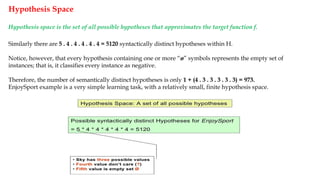
Hypothesis Space
Hypothesis spaceis the set of all possible hypotheses that approximates the target function f.
Similarly there are 5 . 4 . 4 . 4 . 4 . 4 = 5120 syntactically distinct hypotheses within H.
Notice, however, that every hypothesis containing one or more “ø” symbols represents the empty set of
instances; that is, it classifies every instance as negative.
Therefore, the number of semantically distinct hypotheses is only 1 + (4 . 3 . 3 . 3 . 3 . 3) = 973.
EnjoySport example is a very simple learning task, with a relatively small, finite hypothesis space.
17.
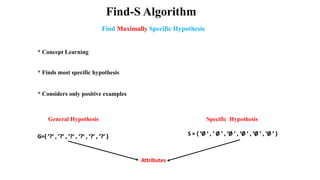
Find-S Algorithm
* ConceptLearning
* Finds most specific hypothesis
* Considers only positive examples
General Hypothesis Specific Hypothesis
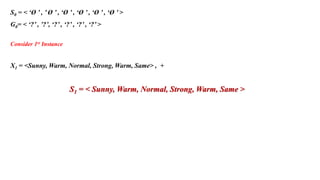
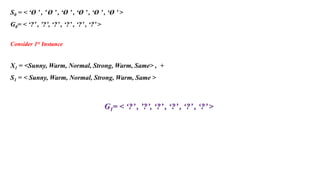
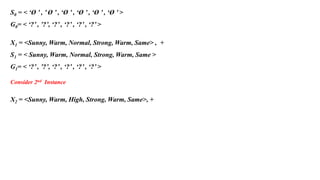
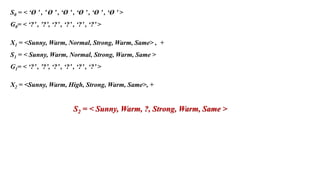
G={ ‘?’ , ’?’ , ‘?’ , ‘?’ , ‘?’ , ‘?’ } S = { ‘Ø ’ , ’ Ø ’ , ‘Ø ’ , ‘Ø ’ , ‘Ø ’ , ‘Ø ’ }
Attributes
Find Maximally Specific Hypothesis
18.
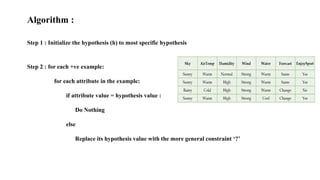
Algorithm :
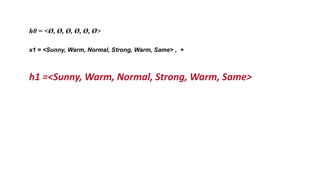
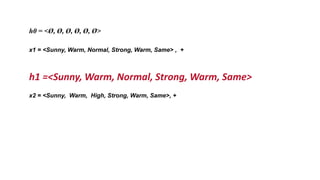
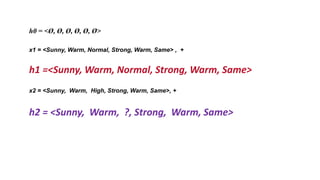
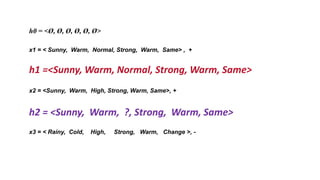
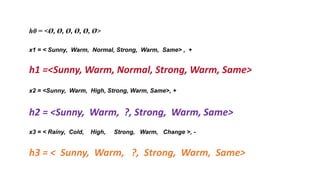
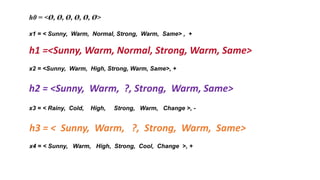
Step 1: Initialize the hypothesis (h) to most specific hypothesis
Step 2 : for each +ve example:
for each attribute in the example:
if attribute value = hypothesis value :
Do Nothing
else
Replace its hypothesis value with the more general constraint ‘?’
19.
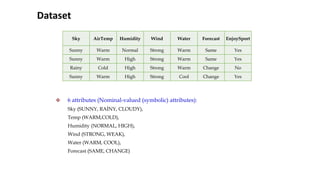
Dataset
6 attributes(Nominal-valued (symbolic) attributes):
Sky (SUNNY, RAİNY, CLOUDY),
Temp (WARM,COLD),
Humidity (NORMAL, HIGH),
Wind (STRONG, WEAK),
Water (WARM, COOL),
Forecast (SAME, CHANGE)
Sky AirTemp Humidity Wind Water Forecast EnjoySport
Sunny Warm Normal Strong Warm Same Yes
Sunny Warm High Strong Warm Same Yes
Rainy Cold High Strong Warm Change No
Sunny Warm High Strong Cool Change Yes
Design of aLearning System
A system that is built around a learning algorithm is called a learning system. The design of systems focuses
on these steps:
1. Choosing a training experience
2. Choosing a target function
3. Representation of a target function
4. Function approximation Training Experience Let us consider designing of a chess
Choosing the Training Experience
• The first design choice is to choose the type of training experience from which the
system will learn.
• The type of training experience available can have a significant impact on success or
failure of the learner.
32.
Determine the TargetFunction
The next step is the determination of a target function.
In this step, the type of knowledge that needs to be learnt is determined.
In direct experience, a board move is selected and is determined whether it is a good move or not
against all other moves.
If it is the best move, then it is chosen as: B -> M, where, B and M are legal moves.
In indirect experience, all legal moves are accepted and a score is generated for each.
The move with largest score is then chosen and executed.
33.
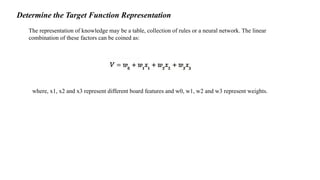
Determine the TargetFunction Representation
The representation of knowledge may be a table, collection of rules or a neural network. The linear
combination of these factors can be coined as:
where, x1, x2 and x3 represent different board features and w0, w1, w2 and w3 represent weights.
34.
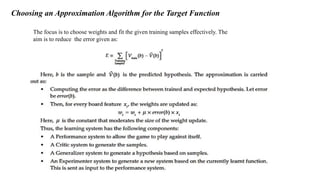
Choosing an ApproximationAlgorithm for the Target Function
The focus is to choose weights and fit the given training samples effectively. The
aim is to reduce the error given as:
35.
Problems with Find-S
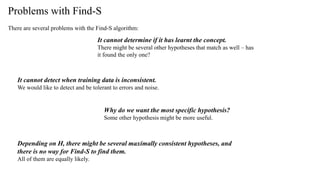
Dependingon H, there might be several maximally consistent hypotheses, and
there is no way for Find-S to find them.
All of them are equally likely.
There are several problems with the Find-S algorithm:
It cannot determine if it has learnt the concept.
There might be several other hypotheses that match as well – has
it found the only one?
It cannot detect when training data is inconsistent.
We would like to detect and be tolerant to errors and noise.
Why do we want the most specific hypothesis?
Some other hypothesis might be more useful.
36.
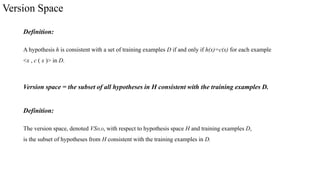
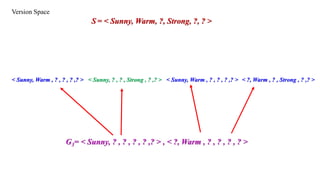
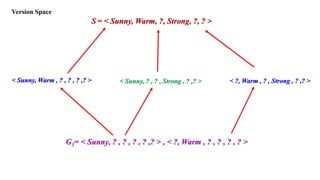
Version Space
Definition:
A hypothesish is consistent with a set of training examples D if and only if h(x)=c(x) for each example
<x , c ( x )> in D.
Version space = the subset of all hypotheses in H consistent with the training examples D.
Definition:
The version space, denoted VSH,D, with respect to hypothesis space H and training examples D,
is the subset of hypotheses from H consistent with the training examples in D.
37.
Representation of VersionSpace
Option 1: List all of the members in the version space.
Works only when the hypothesis space H is finite!
Option 2: Store only the set of most general members G and the set of most specific
members S.
Given these two sets, it is possible to generate any member of the
version space as needed.
38.
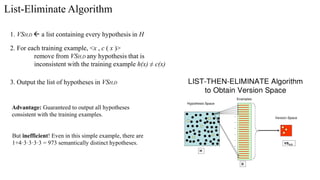
List-Eliminate Algorithm
2. Foreach training example, <x , c ( x )>
remove from VSH,D any hypothesis that is
inconsistent with the training example h(x) ≠ c(x)
1. VSH,D a list containing every hypothesis in H
3. Output the list of hypotheses in VSH,D
Advantage: Guaranteed to output all hypotheses
consistent with the training examples.
But inefficient! Even in this simple example, there are
1+4·3·3·3·3 = 973 semantically distinct hypotheses.
39.
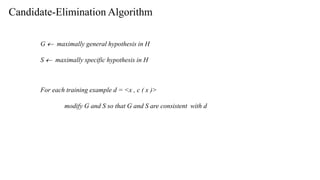
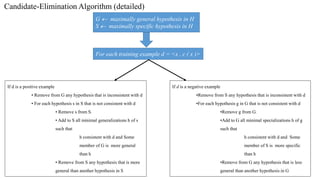
Candidate-Elimination Algorithm
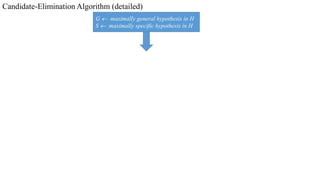
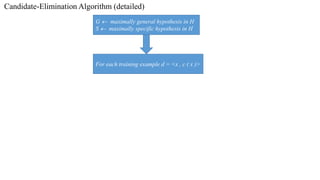
G maximallygeneral hypothesis in H
S maximally specific hypothesis in H
For each training example d = <x , c ( x )>
modify G and S so that G and S are consistent with d
Candidate-Elimination Algorithm (detailed)
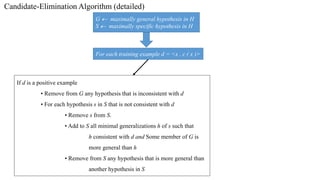
Gmaximally general hypothesis in H
S maximally specific hypothesis in H
For each training example d = <x , c ( x )>
If d is a positive example
• Remove from G any hypothesis that is inconsistent with d
• For each hypothesis s in S that is not consistent with d
• Remove s from S.
• Add to S all minimal generalizations h of s such that
h consistent with d and Some member of G is
more general than h
• Remove from S any hypothesis that is more general than
another hypothesis in S
43.
Candidate-Elimination Algorithm (detailed)
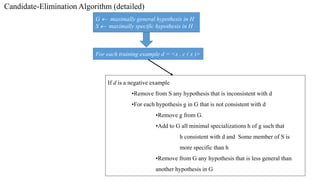
Gmaximally general hypothesis in H
S maximally specific hypothesis in H
For each training example d = <x , c ( x )>
If d is a negative example
•Remove from S any hypothesis that is inconsistent with d
•For each hypothesis g in G that is not consistent with d
•Remove g from G.
•Add to G all minimal specializations h of g such that
h consistent with d and Some member of S is
more specific than h
•Remove from G any hypothesis that is less general than
another hypothesis in G
44.
Candidate-Elimination Algorithm (detailed)
Gmaximally general hypothesis in H
S maximally specific hypothesis in H
For each training example d = <x , c ( x )>
If d is a negative example
•Remove from S any hypothesis that is inconsistent with d
•For each hypothesis g in G that is not consistent with d
•Remove g from G.
•Add to G all minimal specializations h of g
such that
h consistent with d and Some
member of S is more specific
than h
•Remove from G any hypothesis that is less
general than another hypothesis in G
If d is a positive example
• Remove from G any hypothesis that is inconsistent with d
• For each hypothesis s in S that is not consistent with d
• Remove s from S.
• Add to S all minimal generalizations h of s
such that
h consistent with d and Some
member of G is more general
than h
• Remove from S any hypothesis that is more
general than another hypothesis in S
45.
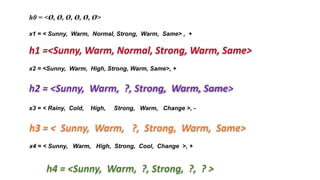
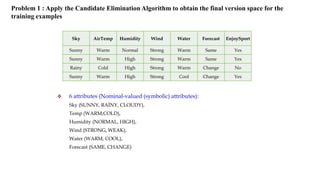
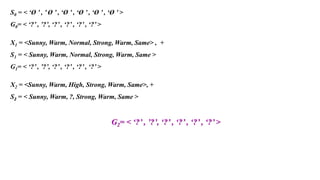
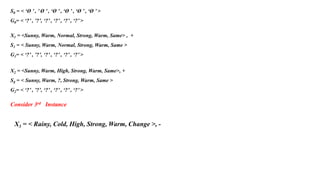
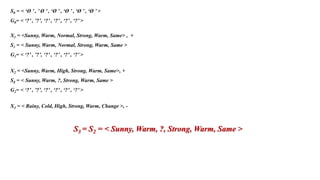
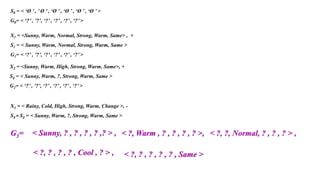
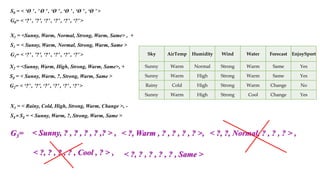
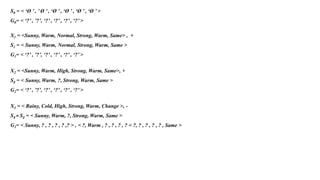
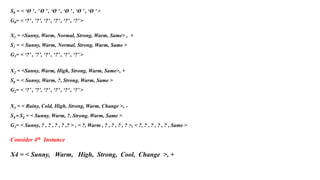
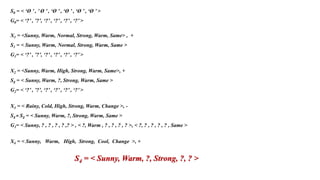
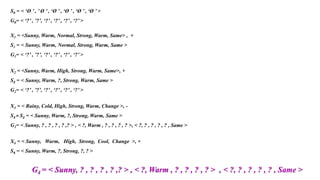
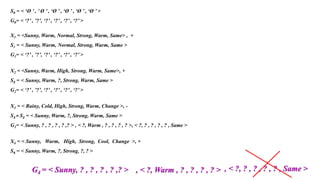
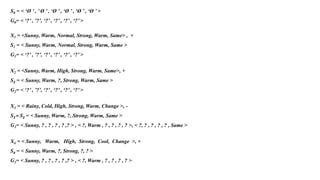
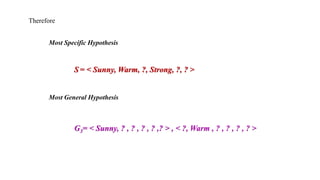
Problem 1 :Apply the Candidate Elimination Algorithm to obtain the final version space for the
training examples
6 attributes (Nominal-valued (symbolic) attributes):
Sky (SUNNY, RAİNY, CLOUDY),
Temp (WARM,COLD),
Humidity (NORMAL, HIGH),
Wind (STRONG, WEAK),
Water (WARM, COOL),
Forecast (SAME, CHANGE)
Sky AirTemp Humidity Wind Water Forecast EnjoySport
Sunny Warm Normal Strong Warm Same Yes
Sunny Warm High Strong Warm Same Yes
Rainy Cold High Strong Warm Change No
Sunny Warm High Strong Cool Change Yes
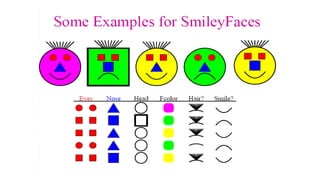
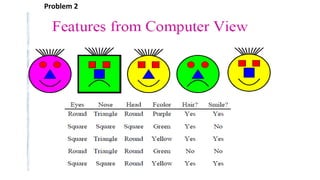
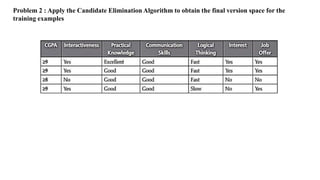
Problem 2 :Apply the Candidate Elimination Algorithm to obtain the final version space for the
training examples
67.
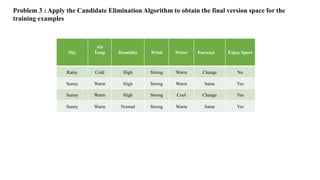
Problem 3 :Apply the Candidate Elimination Algorithm to obtain the final version space for the
training examples
Sky
Air
Temp Humidity Wind Water Forecast Enjoy Sport
Rainy Cold High Strong Warm Change No
Sunny Warm High Strong Warm Same Yes
Sunny Warm High Strong Cool Change Yes
Sunny Warm Normal Strong Warm Same Yes
68.
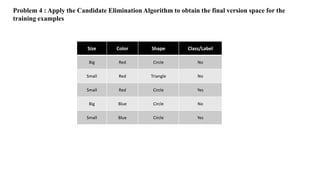
Problem 4 :Apply the Candidate Elimination Algorithm to obtain the final version space for the
training examples
Size Color Shape Class/Label
Big Red Circle No
Small Red Triangle No
Small Red Circle Yes
Big Blue Circle No
Small Blue Circle Yes
69.
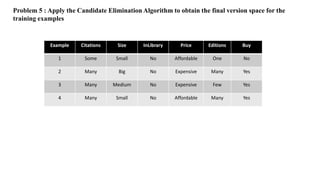
Problem 5 :Apply the Candidate Elimination Algorithm to obtain the final version space for the
training examples
Example Citations Size InLibrary Price Editions Buy
1 Some Small No Affordable One No
2 Many Big No Expensive Many Yes
3 Many Medium No Expensive Few Yes
4 Many Small No Affordable Many Yes
70.
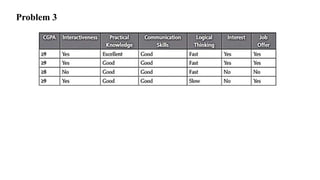
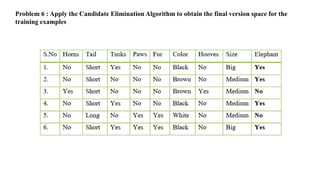
Problem 6 :Apply the Candidate Elimination Algorithm to obtain the final version space for the
training examples
71.
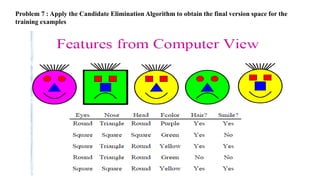
Problem 7 :Apply the Candidate Elimination Algorithm to obtain the final version space for the
training examples