1er. Escela Red ProTIC - Tandil,
2. Concept Learning
2.1 Introduction
Concept Learning: Inferring a boolean-valued
function from training examples of its inputs and
outputs
1er. Escela Red ProTIC - Tandil,
2. Concept Learning
2.2 A Concept Learning Task:
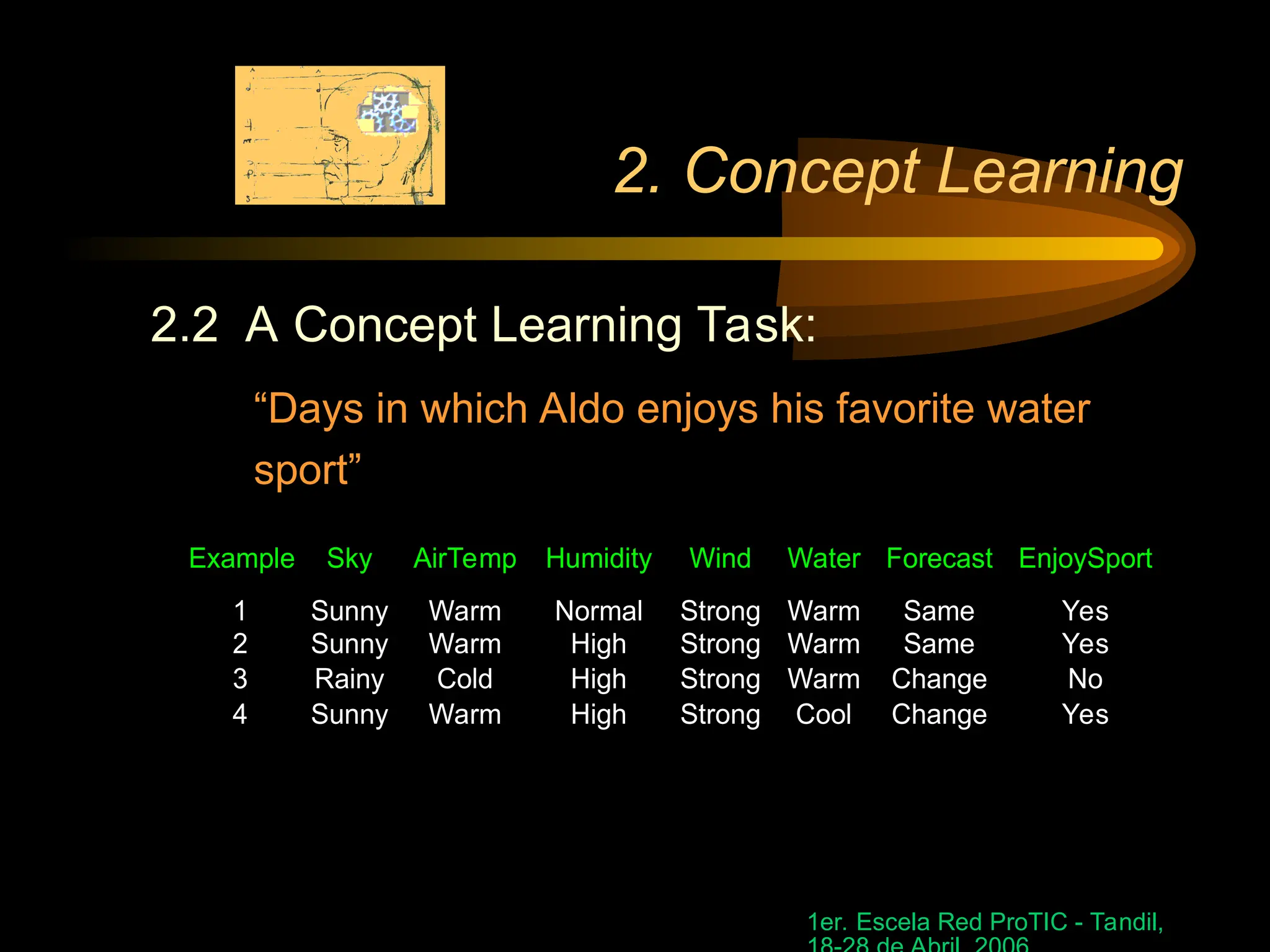
“Days in which Aldo enjoys his favorite water
sport”
Example Sky AirTemp Humidity Wind Water Forecast EnjoySport
1 Sunny Warm Normal Strong Warm Same Yes
2 Sunny Warm High Strong Warm Same Yes
3 Rainy Cold High Strong Warm Change No
4 Sunny Warm High Strong Cool Change Yes
1er. Escela Red ProTIC - Tandil,
2. Concept Learning
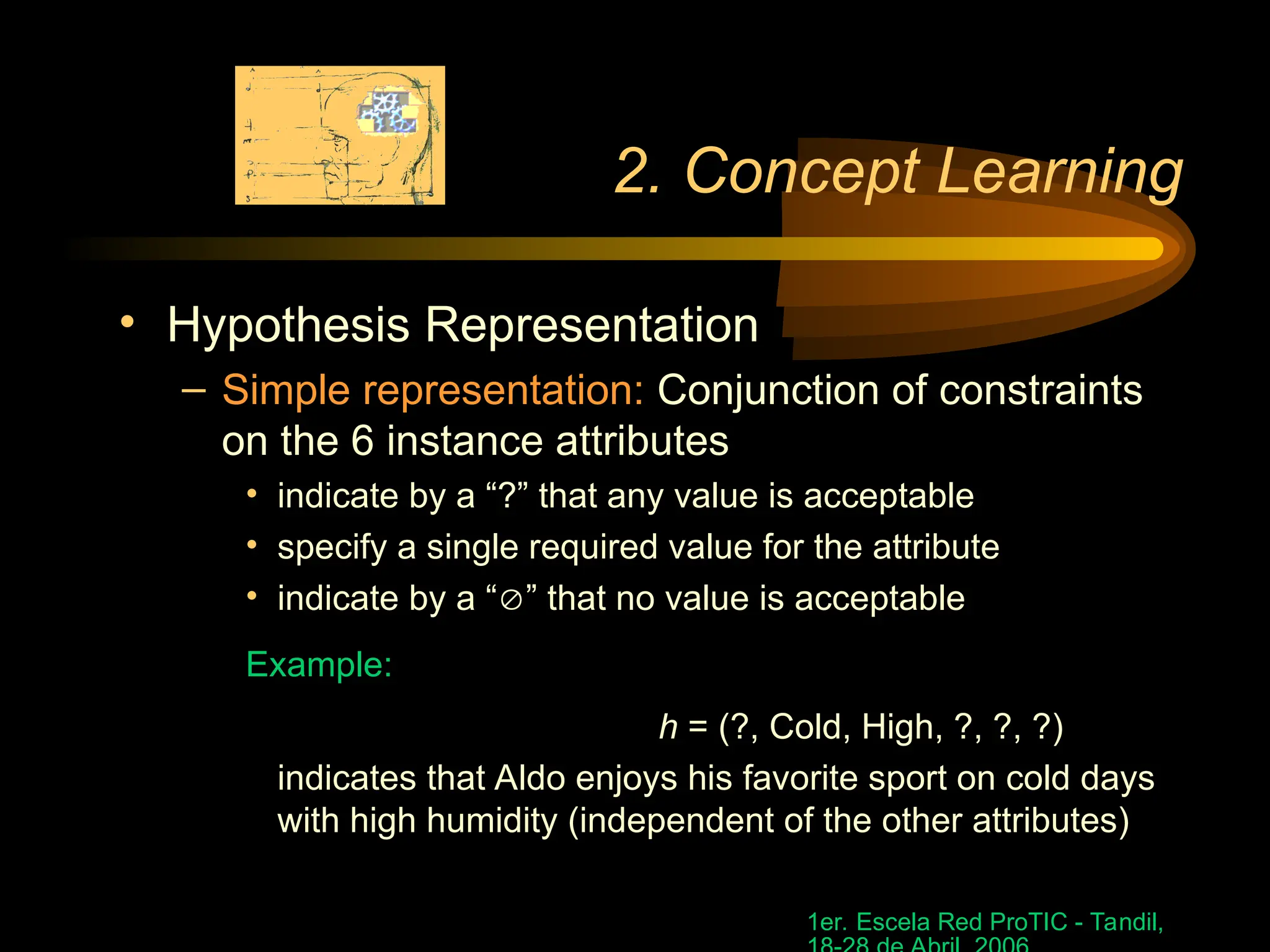
• Hypothesis Representation
– Simple representation: Conjunction of constraints
on the 6 instance attributes
• indicate by a “?” that any value is acceptable
• specify a single required value for the attribute
• indicate by a “” that no value is acceptable
Example:
h = (?, Cold, High, ?, ?, ?)
indicates that Aldo enjoys his favorite sport on cold days
with high humidity (independent of the other attributes)
1er. Escela Red ProTIC - Tandil,
2. Concept Learning
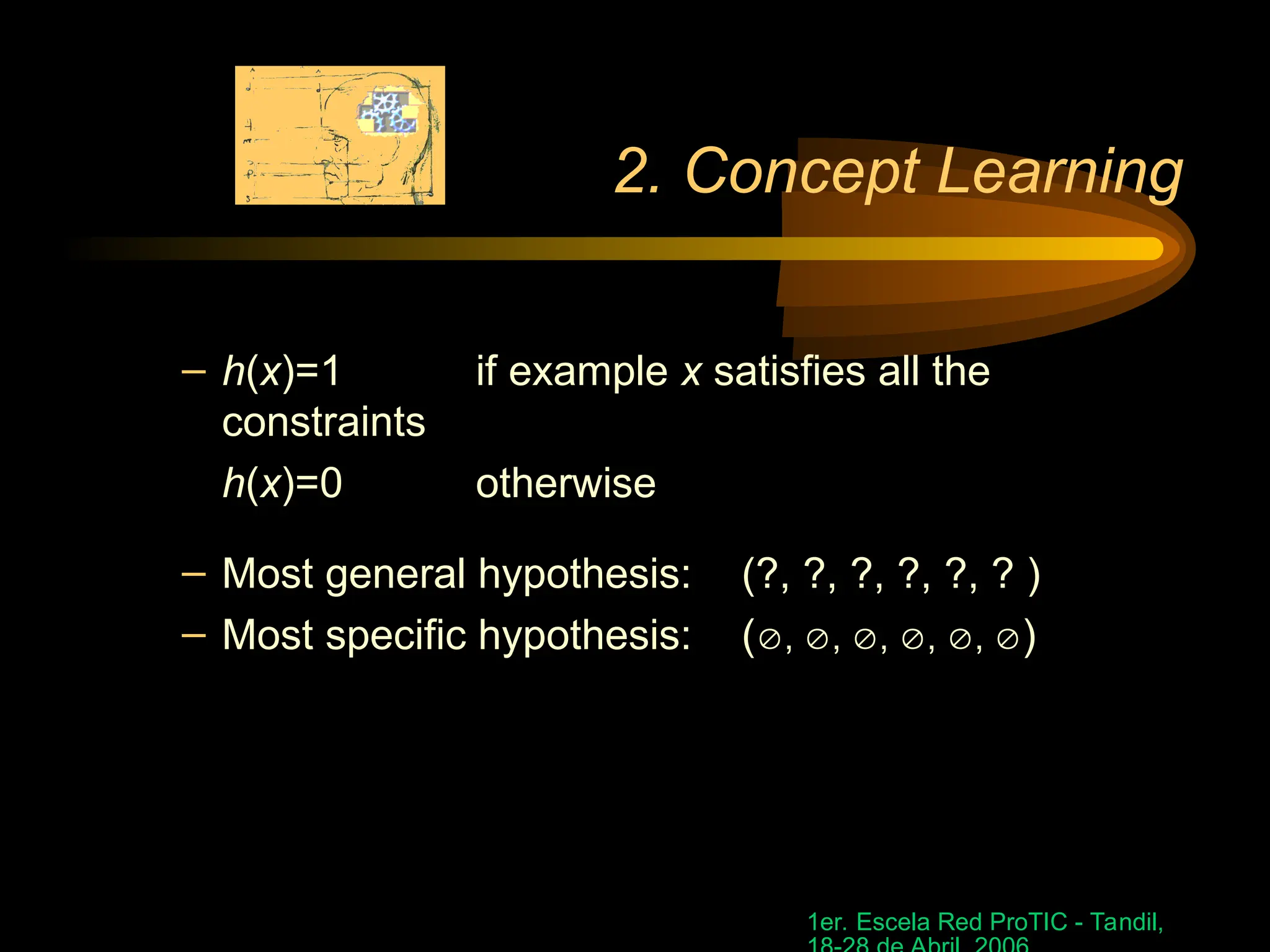
– h(x)=1 if example x satisfies all the
constraints
h(x)=0 otherwise
– Most general hypothesis: (?, ?, ?, ?, ?, ? )
– Most specific hypothesis: (, , , , , )
1er. Escela Red ProTIC - Tandil,
2. Concept Learning
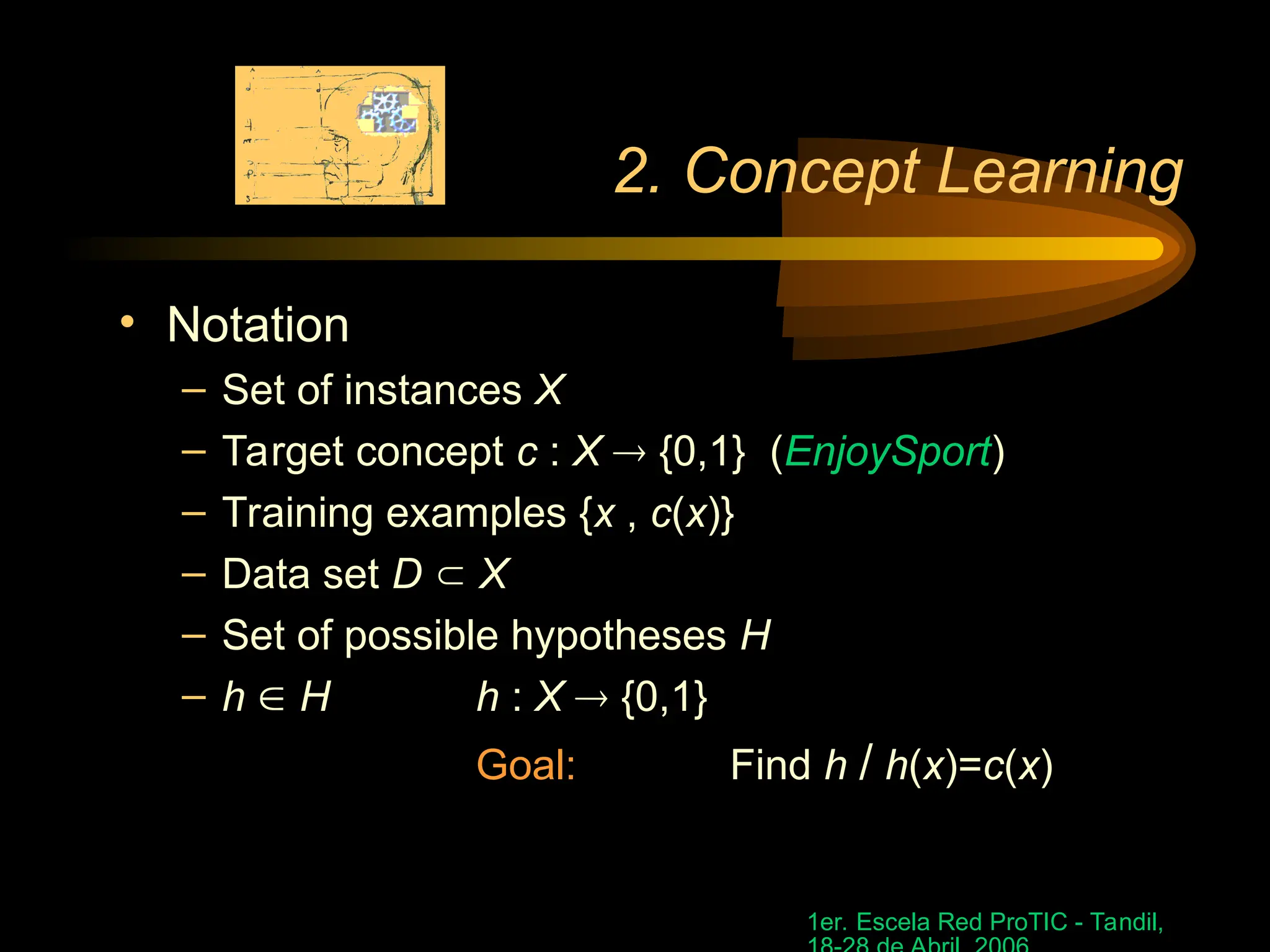
• Notation
– Set of instances X
– Target concept c : X  {0,1} (EnjoySport)
– Training examples {x , c(x)}
– Data set D  X
– Set of possible hypotheses H
– h  H h : X  {0,1}
Goal: Find h / h(x)=c(x)
1er. Escela Red ProTIC - Tandil,
2. Concept Learning
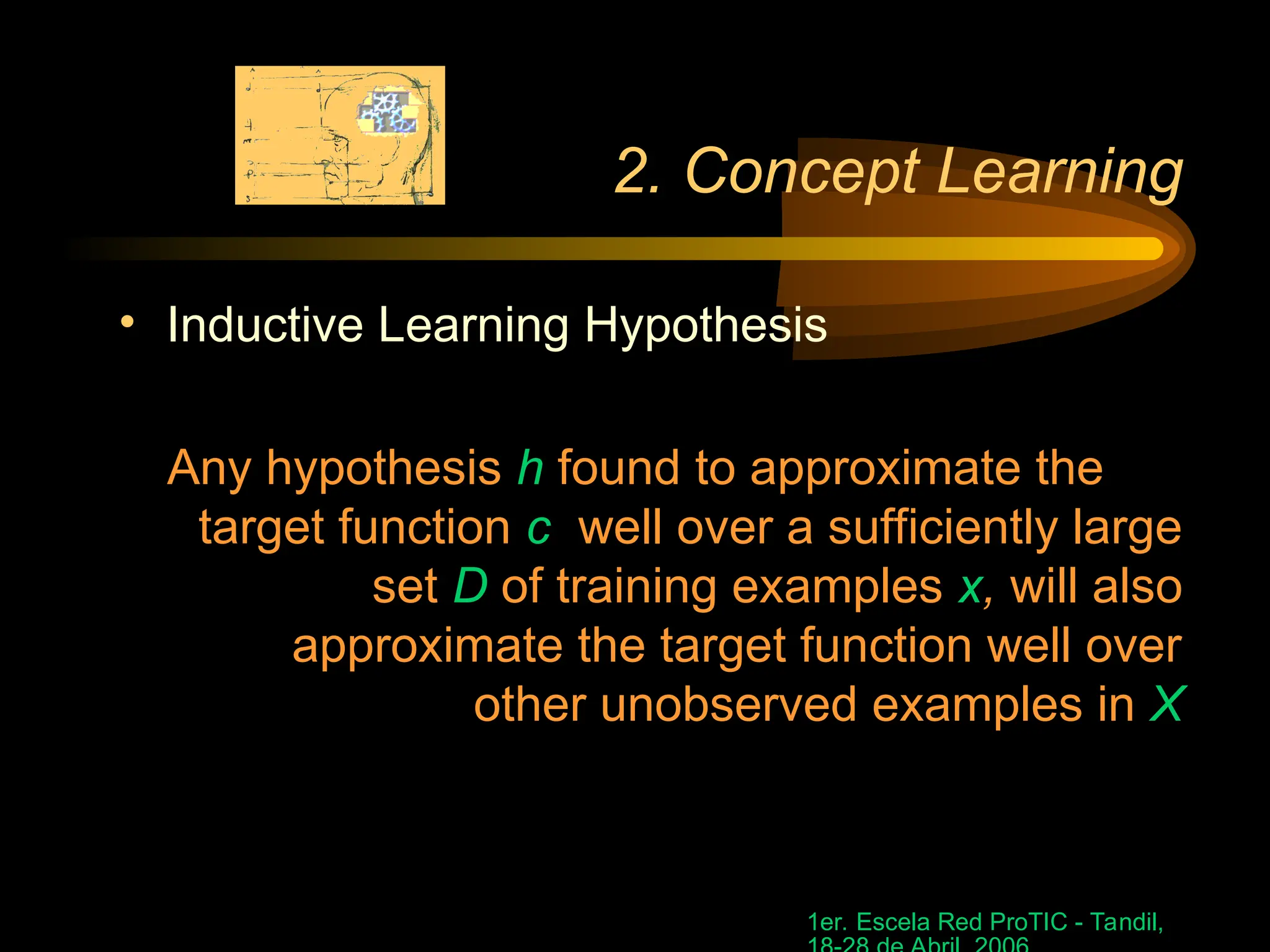
• Inductive Learning Hypothesis
Any hypothesis h found to approximate the
target function c well over a sufficiently large
set D of training examples x, will also
approximate the target function well over
other unobserved examples in X
1er. Escela Red ProTIC - Tandil,
2. Concept Learning
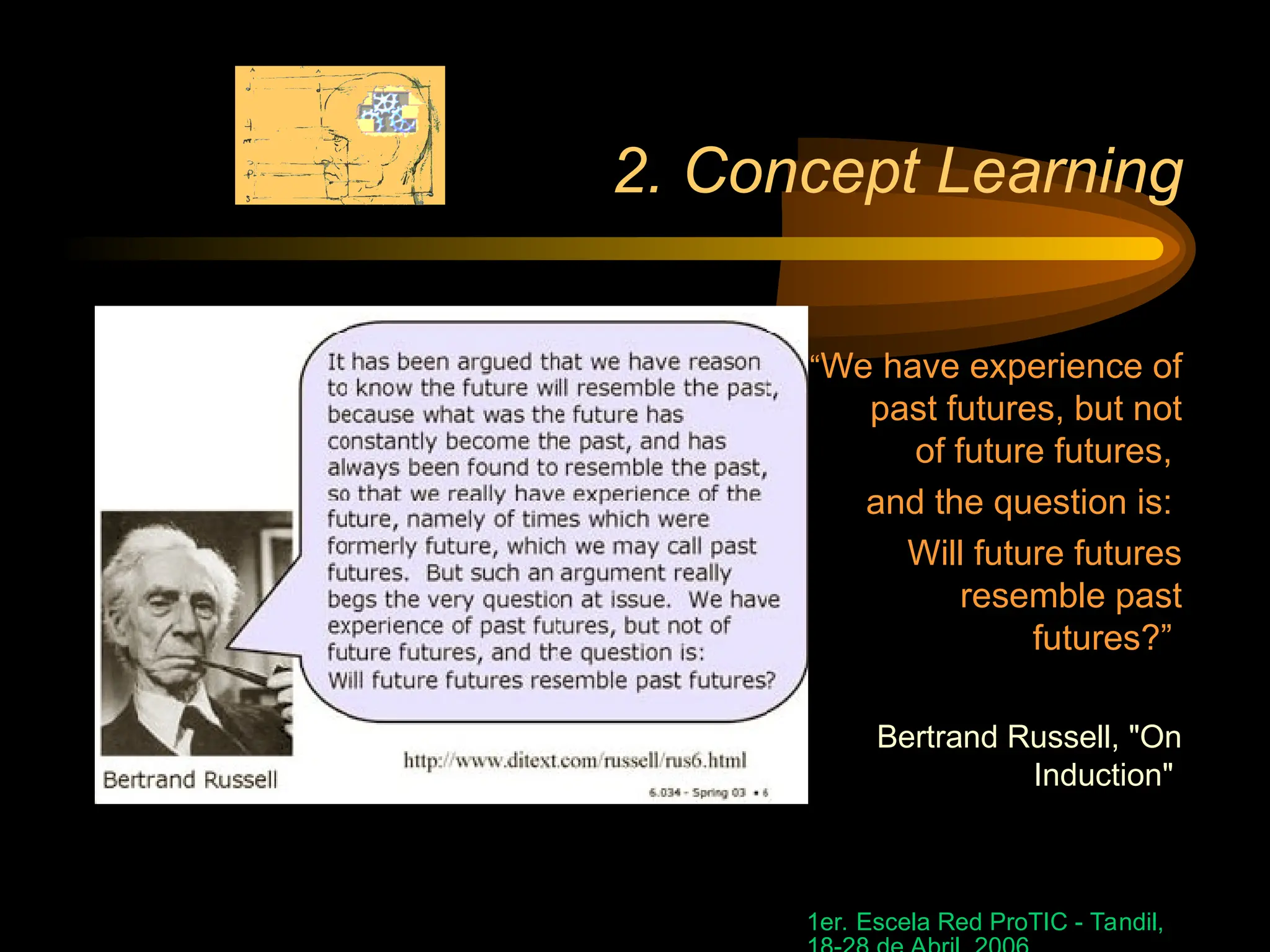
“We have experience of
past futures, but not
of future futures,
and the question is:
Will future futures
resemble past
futures?”
Bertrand Russell, "On
Induction"
1er. Escela Red ProTIC - Tandil,
2. Concept Learning
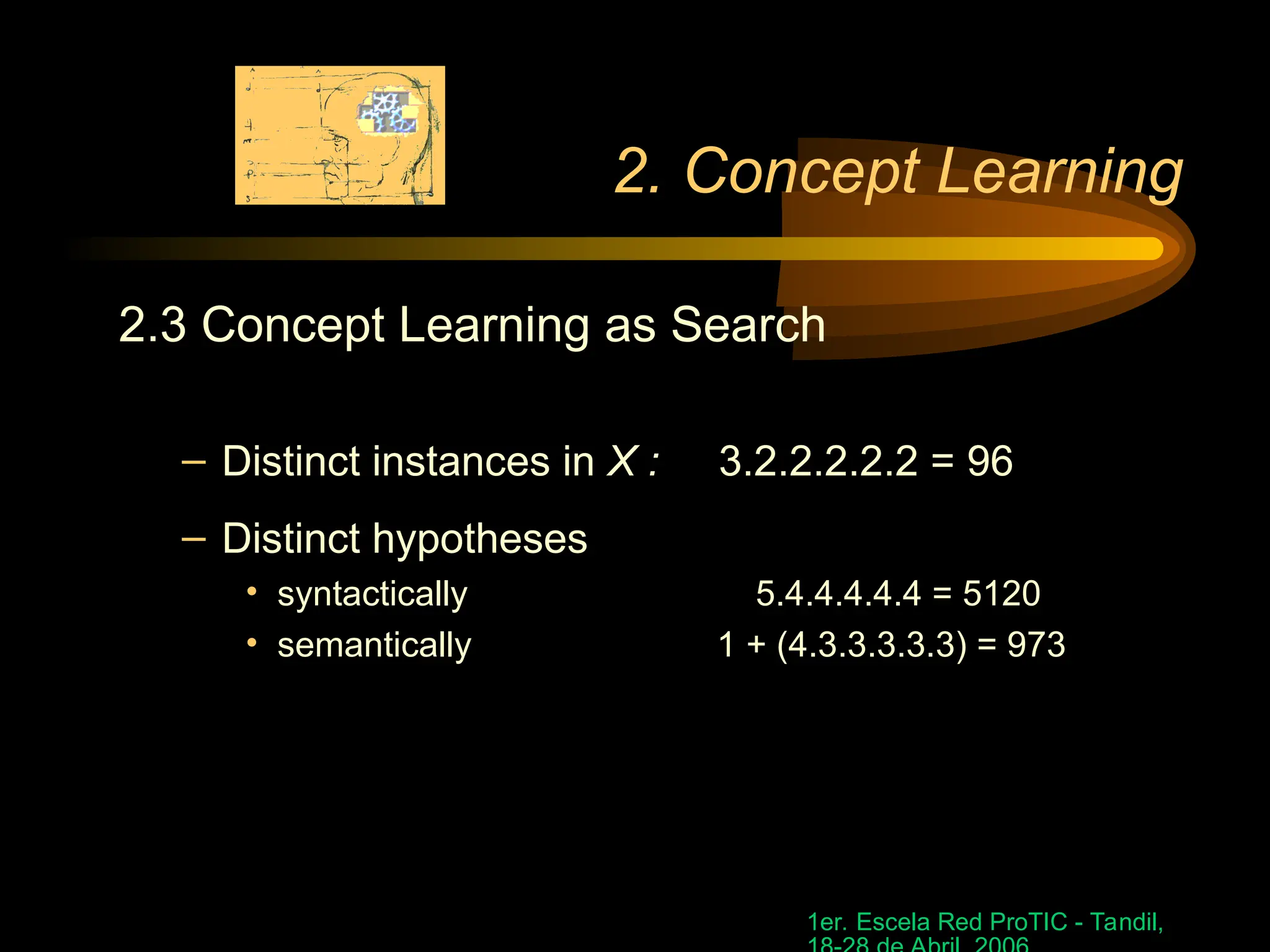
2.3 Concept Learning as Search
– Distinct instances in X : 3.2.2.2.2.2 = 96
– Distinct hypotheses
• syntactically 5.4.4.4.4.4 = 5120
• semantically 1 + (4.3.3.3.3.3) = 973
1er. Escela Red ProTIC - Tandil,
2. Concept Learning
• General-to-Specific Ordering of hypotheses
h1=(sunny,?,?,Strong,?,?) h2=(Sunny,?,?,?,?,?)
Definition: h2 is more_general_than_or_equal_to h1
(written h2 g h1) if and only if
(xX) [ h1(x)=1  h2(x)=1]
g defines a partial order over the hypotheses space
for any concept learning problem
1er. Escela Red ProTIC - Tandil,
2. Concept Learning
1er. Escela Red ProTIC - Tandil,
2. Concept Learning
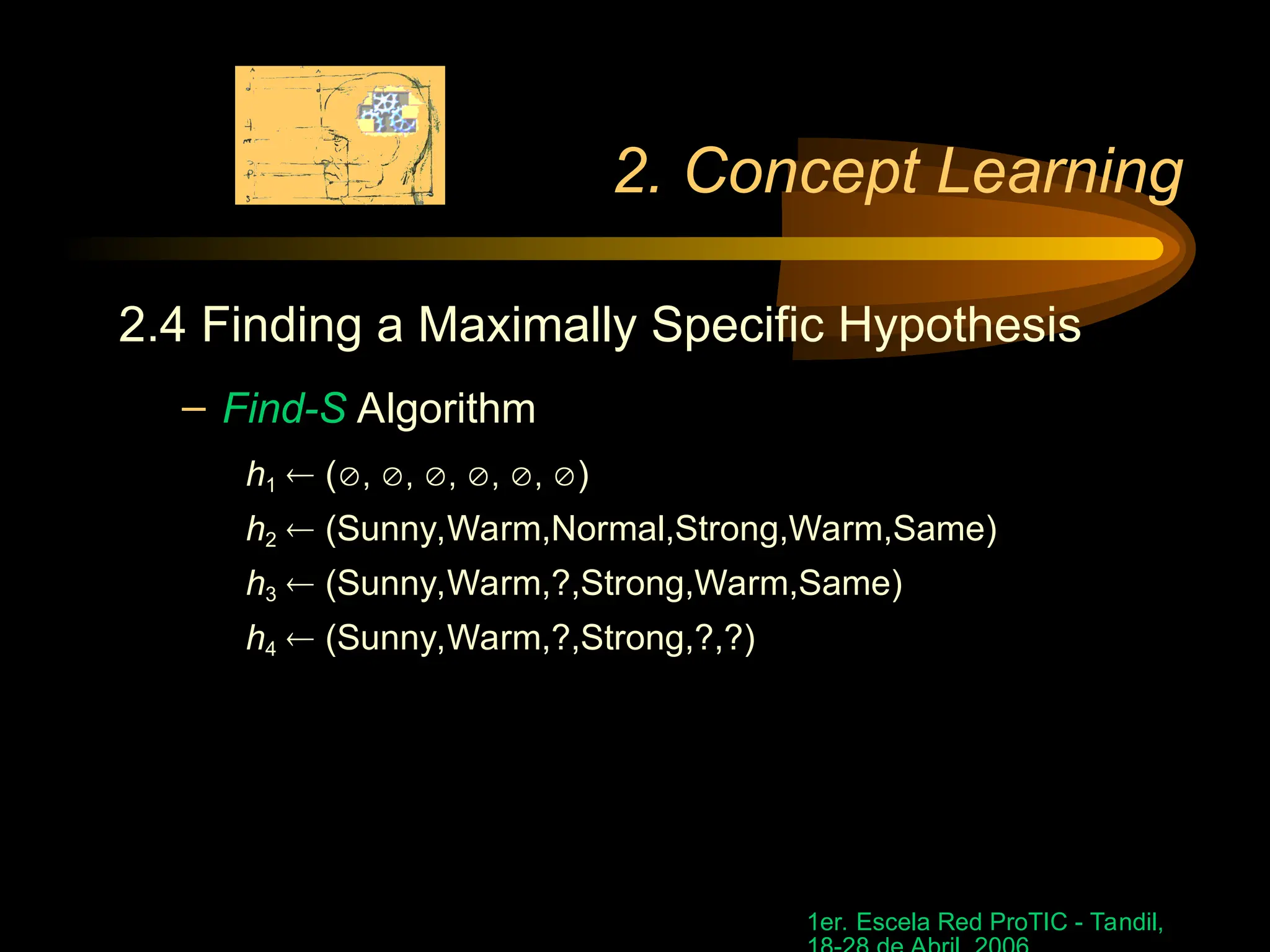
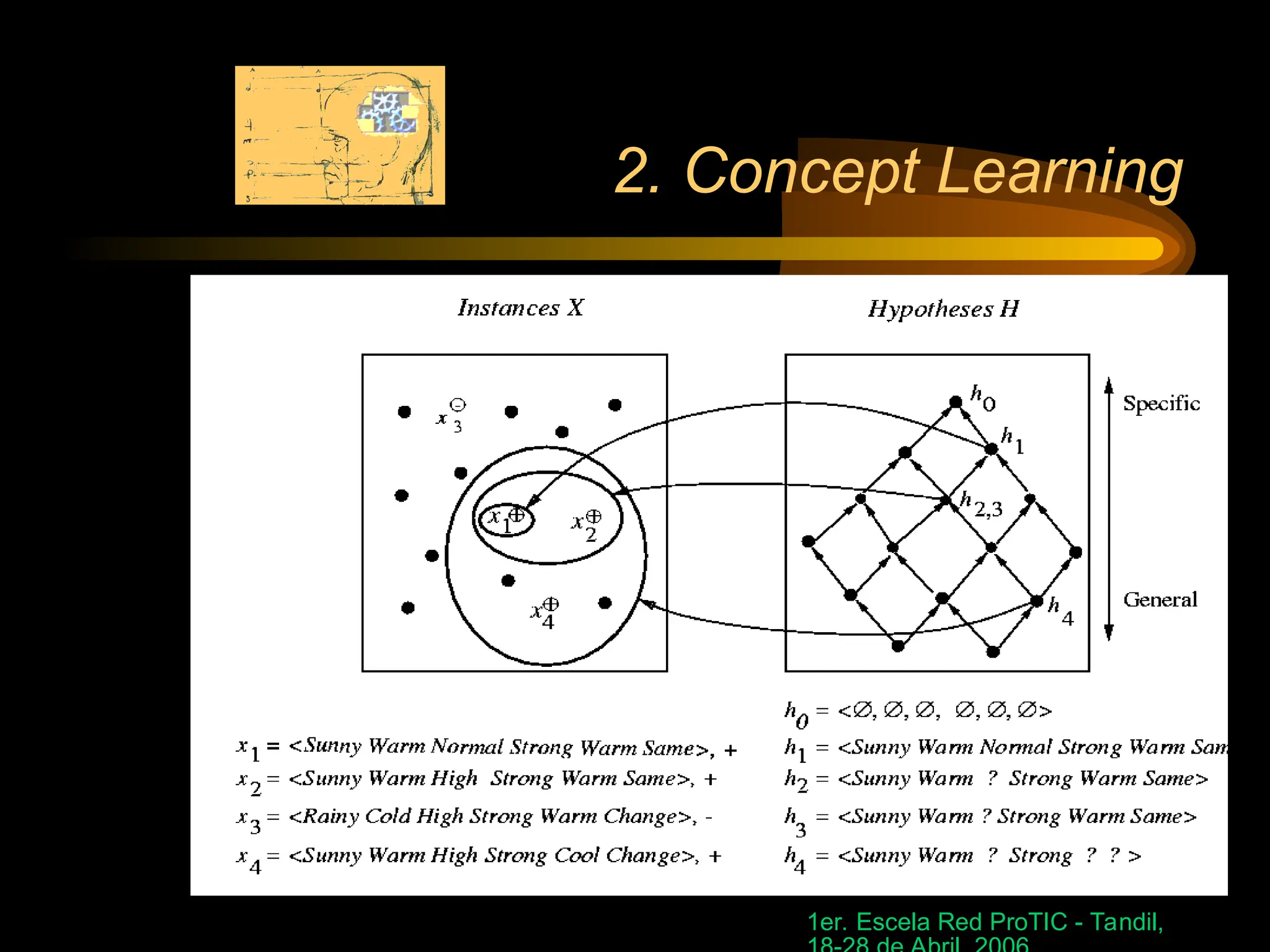
2.4 Finding a Maximally Specific Hypothesis
– Find-S Algorithm
h1  (, , , , , )
h2  (Sunny,Warm,Normal,Strong,Warm,Same)
h3  (Sunny,Warm,?,Strong,Warm,Same)
h4  (Sunny,Warm,?,Strong,?,?)
1er. Escela Red ProTIC - Tandil,
2. Concept Learning
1er. Escela Red ProTIC - Tandil,
2. Concept Learning
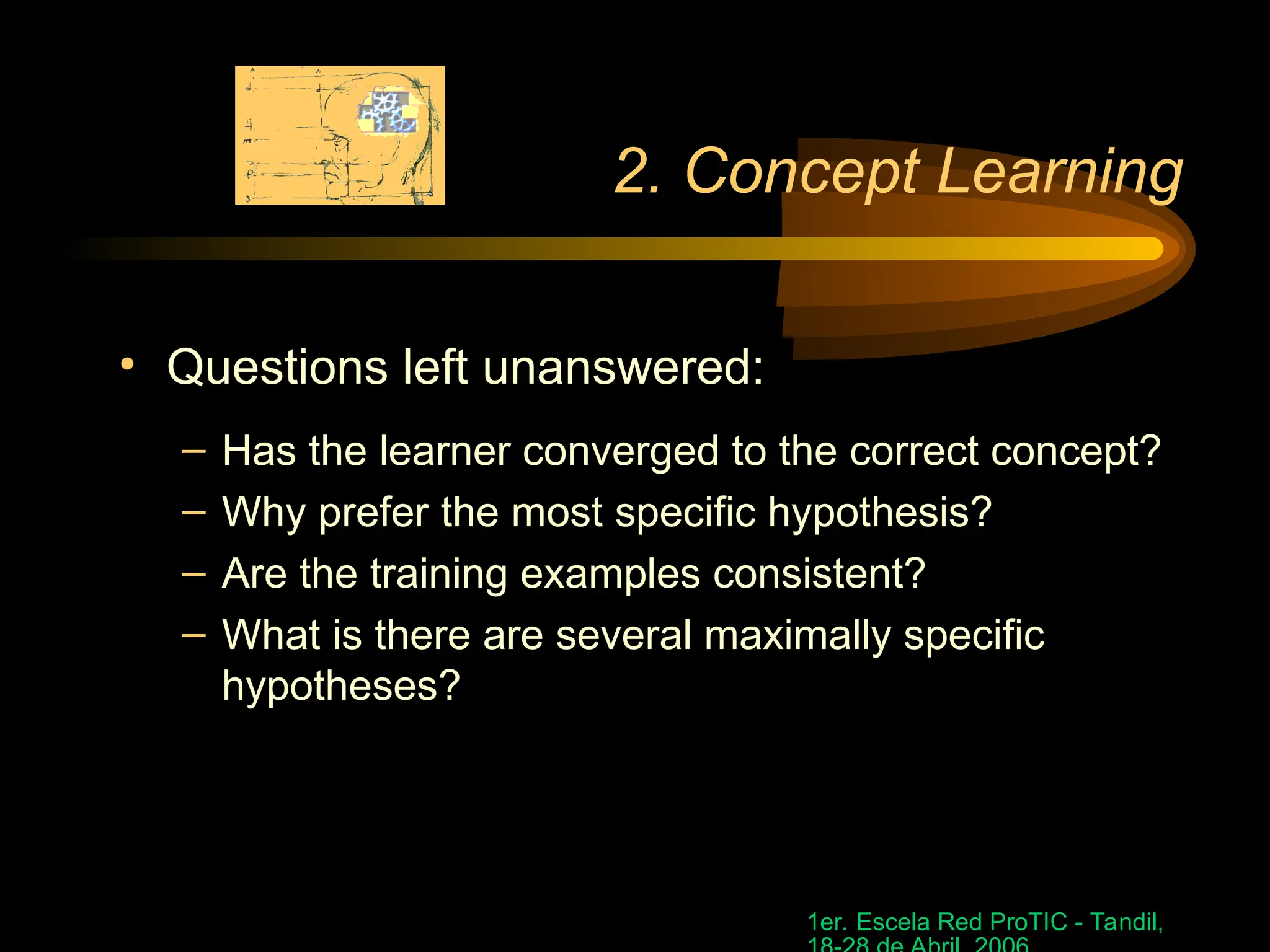
• Questions left unanswered:
– Has the learner converged to the correct concept?
– Why prefer the most specific hypothesis?
– Are the training examples consistent?
– What is there are several maximally specific
hypotheses?
1er. Escela Red ProTIC - Tandil,
2. Concept Learning
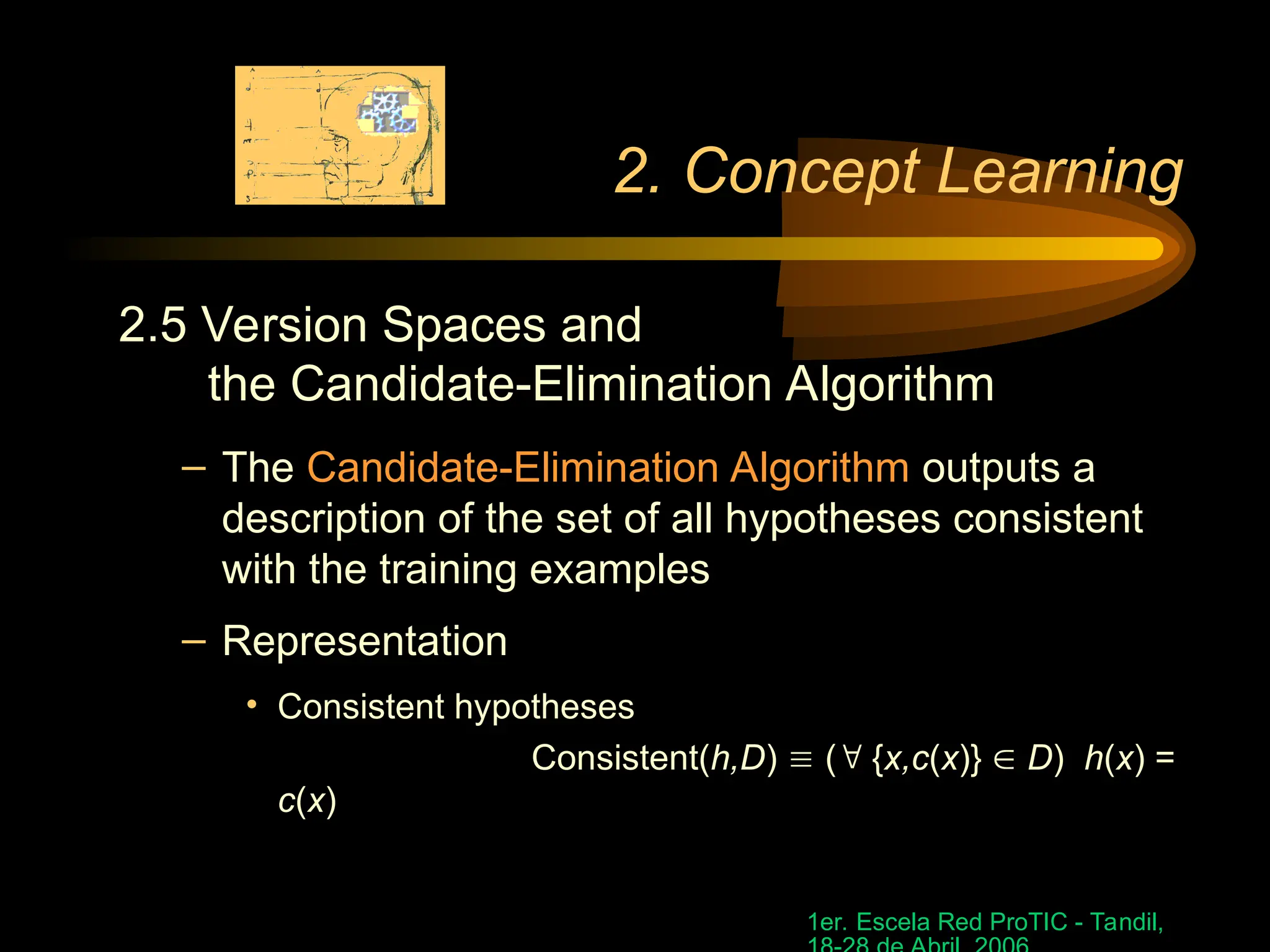
2.5 Version Spaces and
the Candidate-Elimination Algorithm
– The Candidate-Elimination Algorithm outputs a
description of the set of all hypotheses consistent
with the training examples
– Representation
• Consistent hypotheses
Consistent(h,D)  ( {x,c(x)}  D) h(x) =
c(x)
1er. Escela Red ProTIC - Tandil,
2. Concept Learning
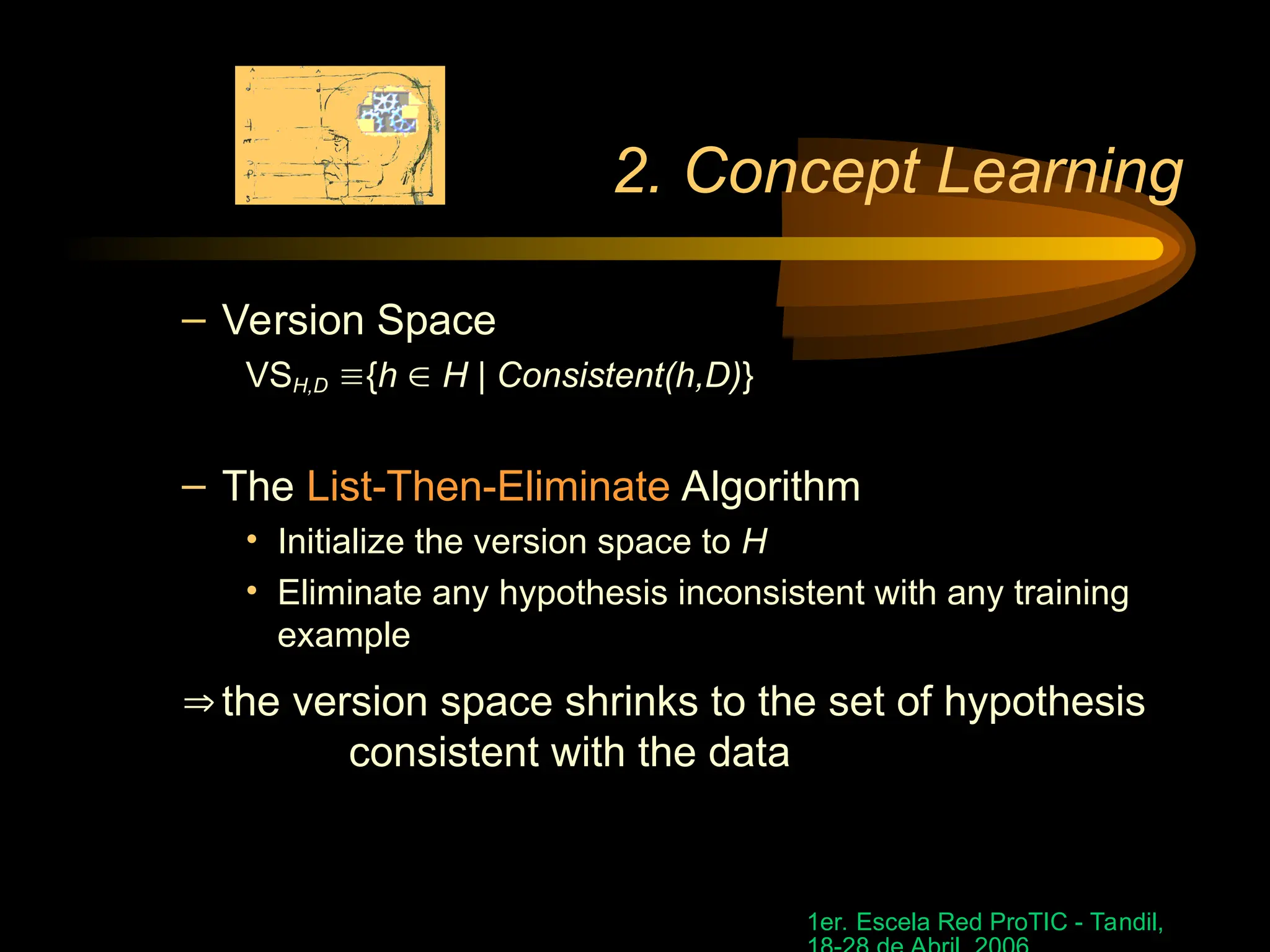
– Version Space
VSH,D {h  H | Consistent(h,D)}
– The List-Then-Eliminate Algorithm
• Initialize the version space to H
• Eliminate any hypothesis inconsistent with any training
example
the version space shrinks to the set of hypothesis
consistent with the data
1er. Escela Red ProTIC - Tandil,
2. Concept Learning
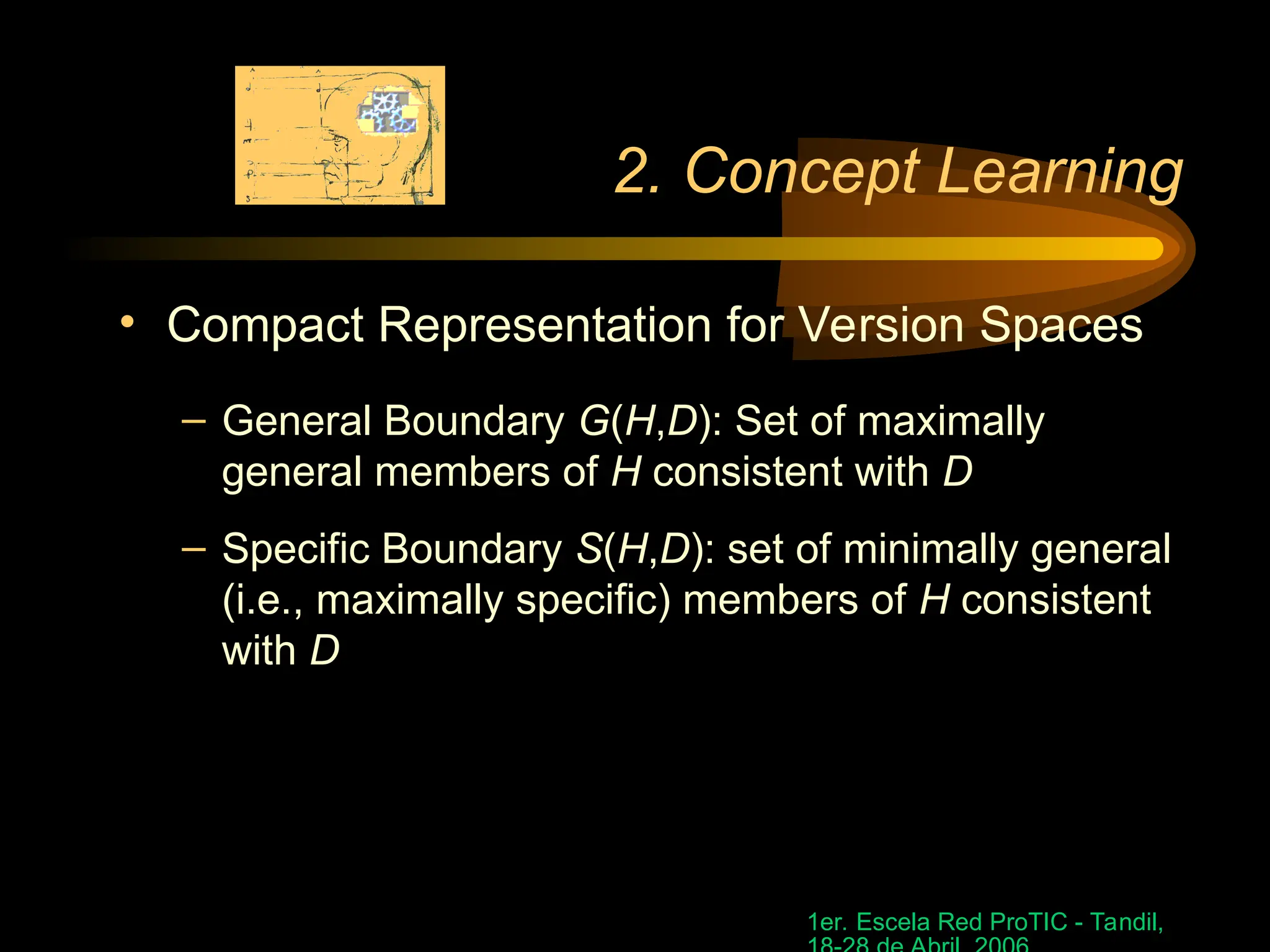
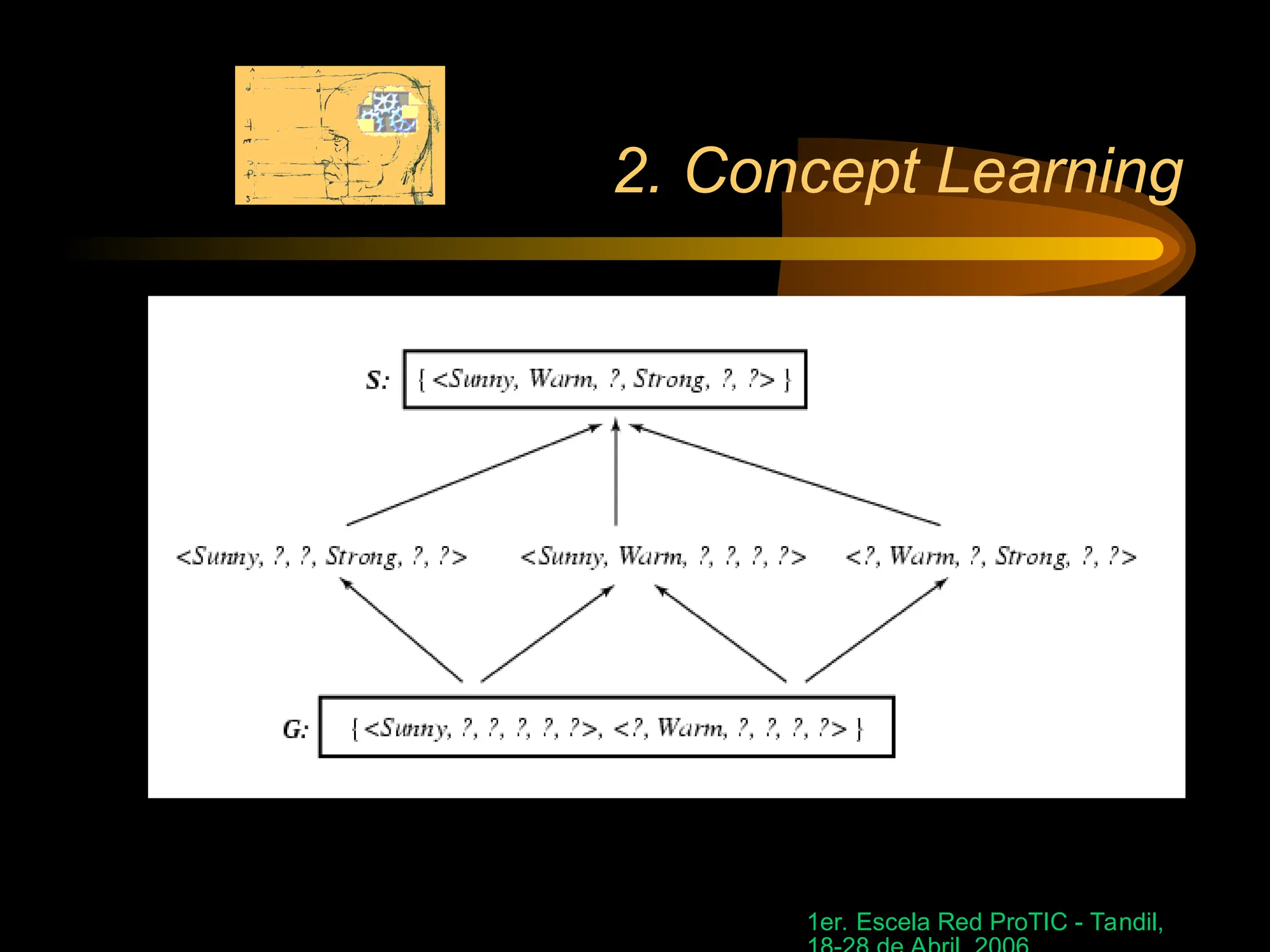
• Compact Representation for Version Spaces
– General Boundary G(H,D): Set of maximally
general members of H consistent with D
– Specific Boundary S(H,D): set of minimally general
(i.e., maximally specific) members of H consistent
with D
1er. Escela Red ProTIC - Tandil,
2. Concept Learning
1er. Escela Red ProTIC - Tandil,
2. Concept Learning
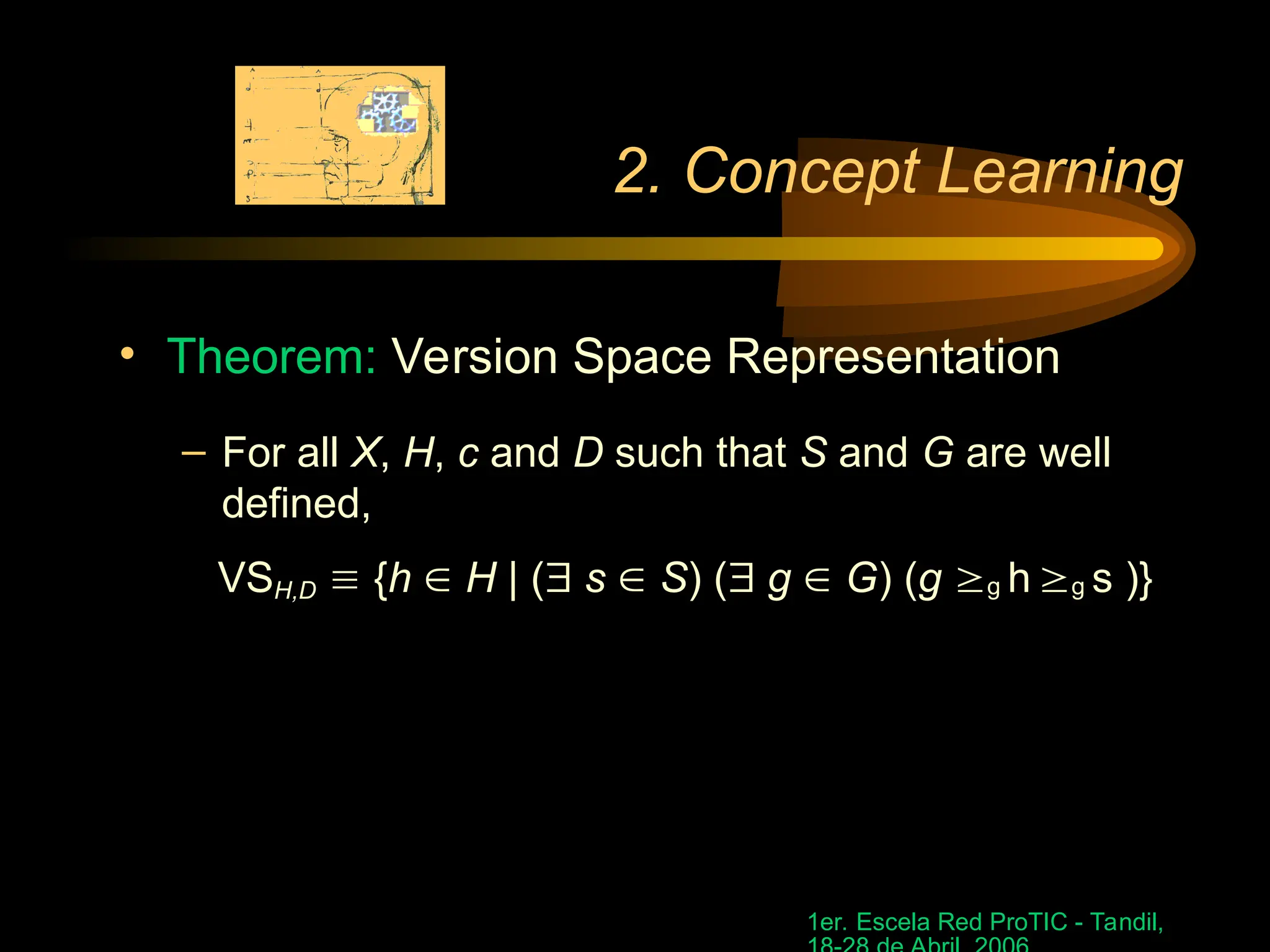
• Theorem: Version Space Representation
– For all X, H, c and D such that S and G are well
defined,
VSH,D  {h  H | ( s  S) ( g  G) (g g h g s )}
1er. Escela Red ProTIC - Tandil,
2. Concept Learning
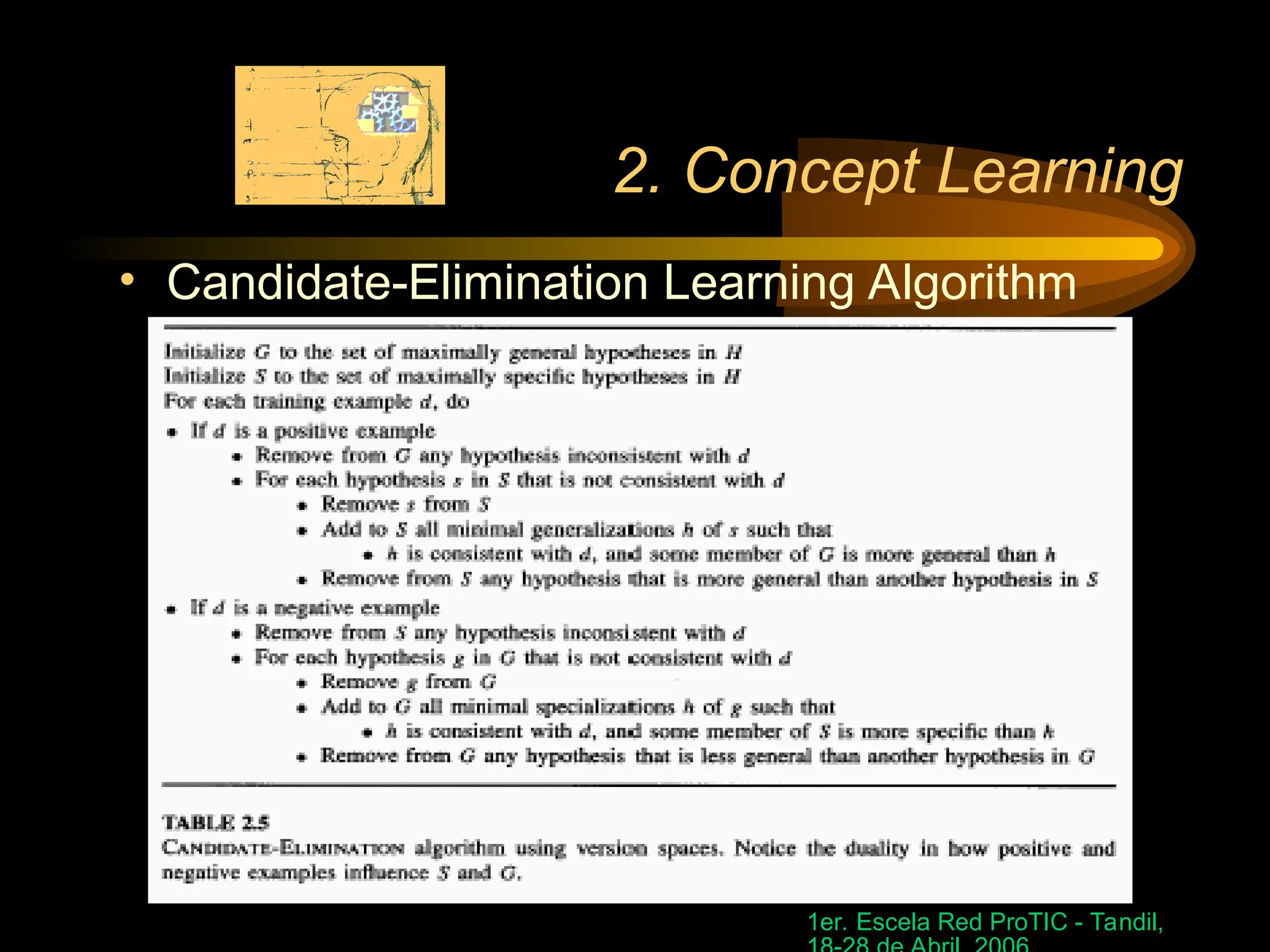
• Candidate-Elimination Learning Algorithm
1er. Escela Red ProTIC - Tandil,
2. Concept Learning
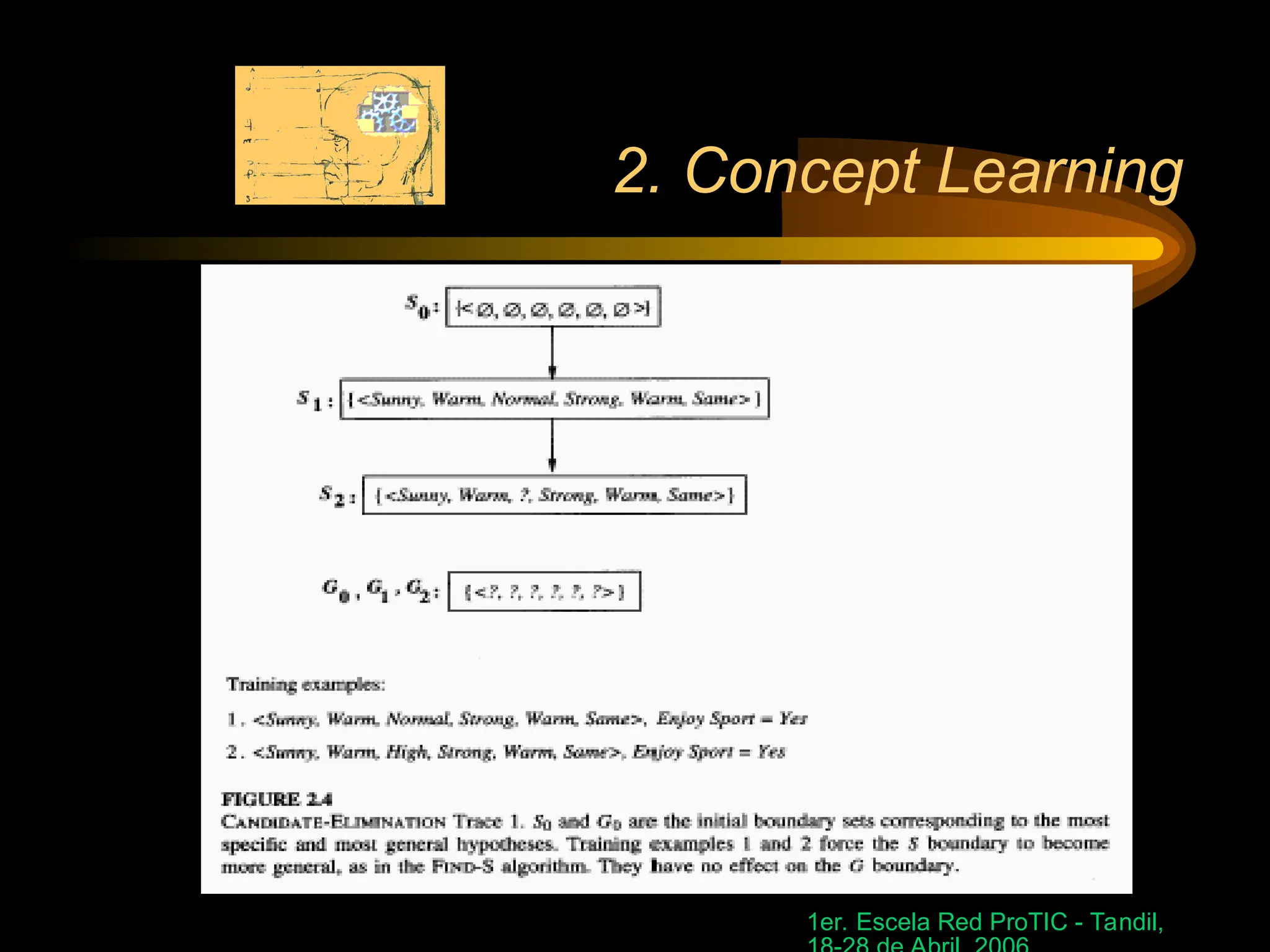
1er. Escela Red ProTIC - Tandil,
2. Concept Learning
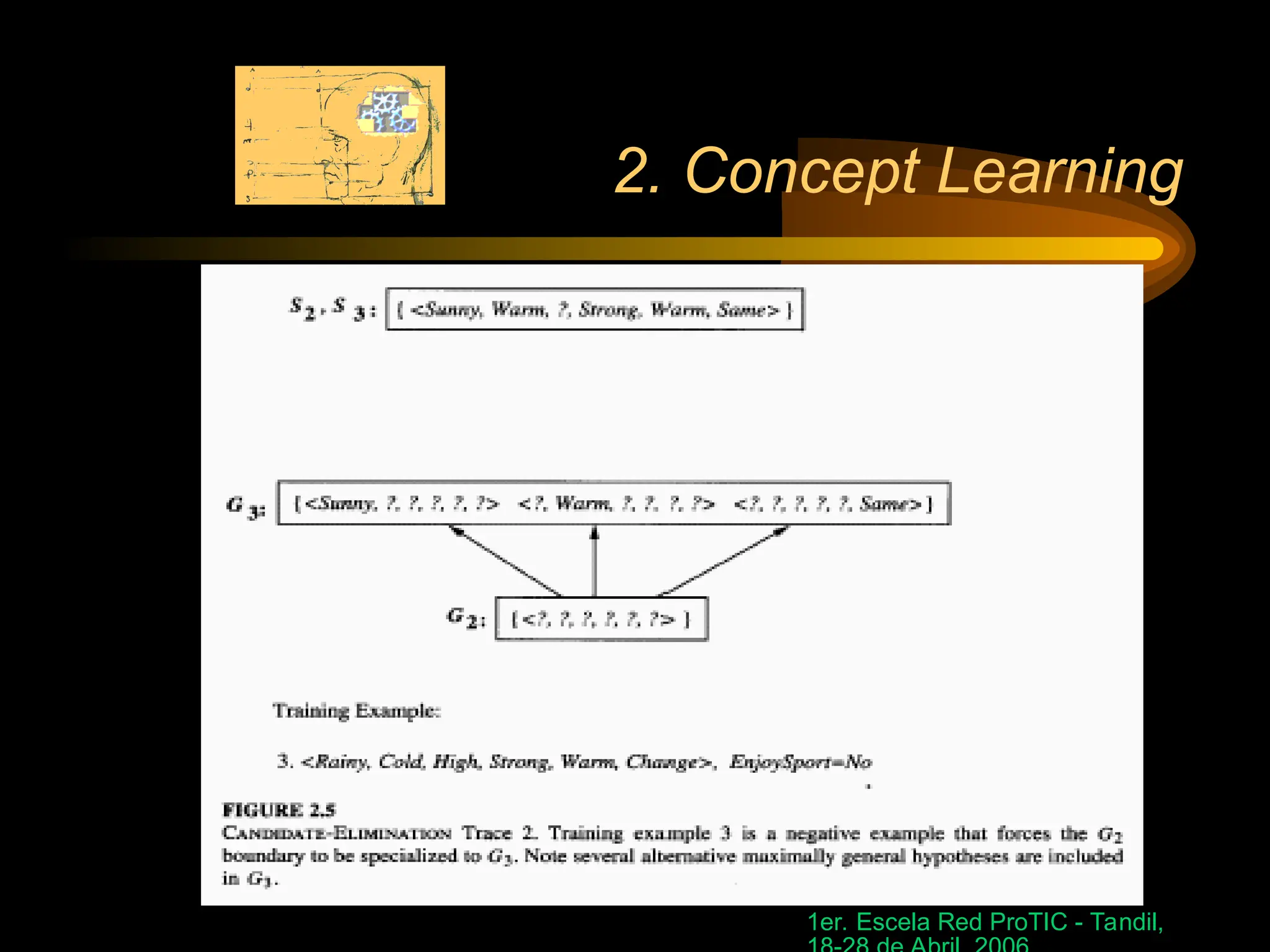
1er. Escela Red ProTIC - Tandil,
2. Concept Learning
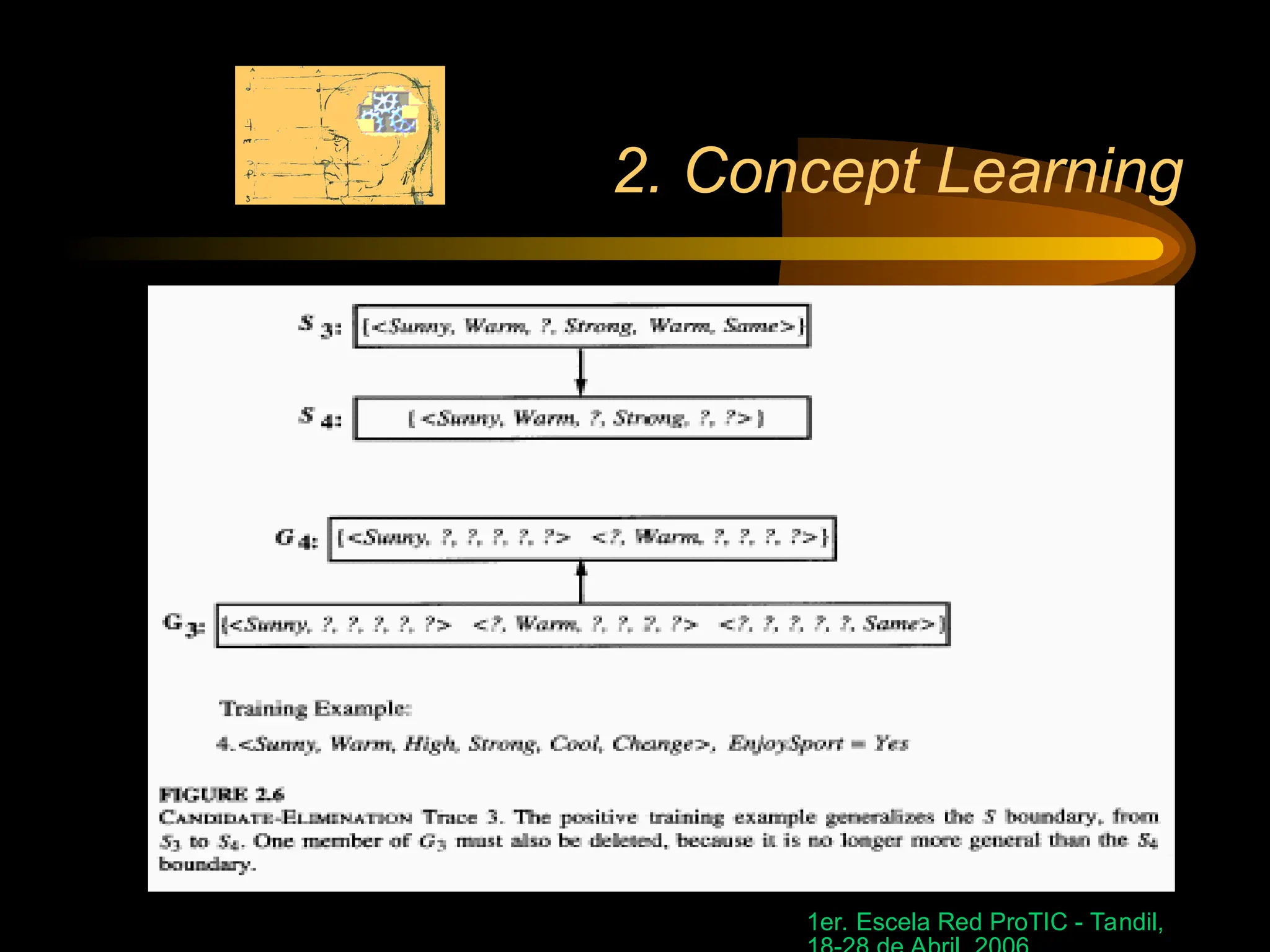
1er. Escela Red ProTIC - Tandil,
2. Concept Learning
1er. Escela Red ProTIC - Tandil,
2. Concept Learning
• Remarks
– Will the Candidate-Elimination converge to the
correct hypothesis?
– What training example should the learner request
next?
– How can partially learned concepts be used?
1er. Escela Red ProTIC - Tandil,
2. Concept Learning
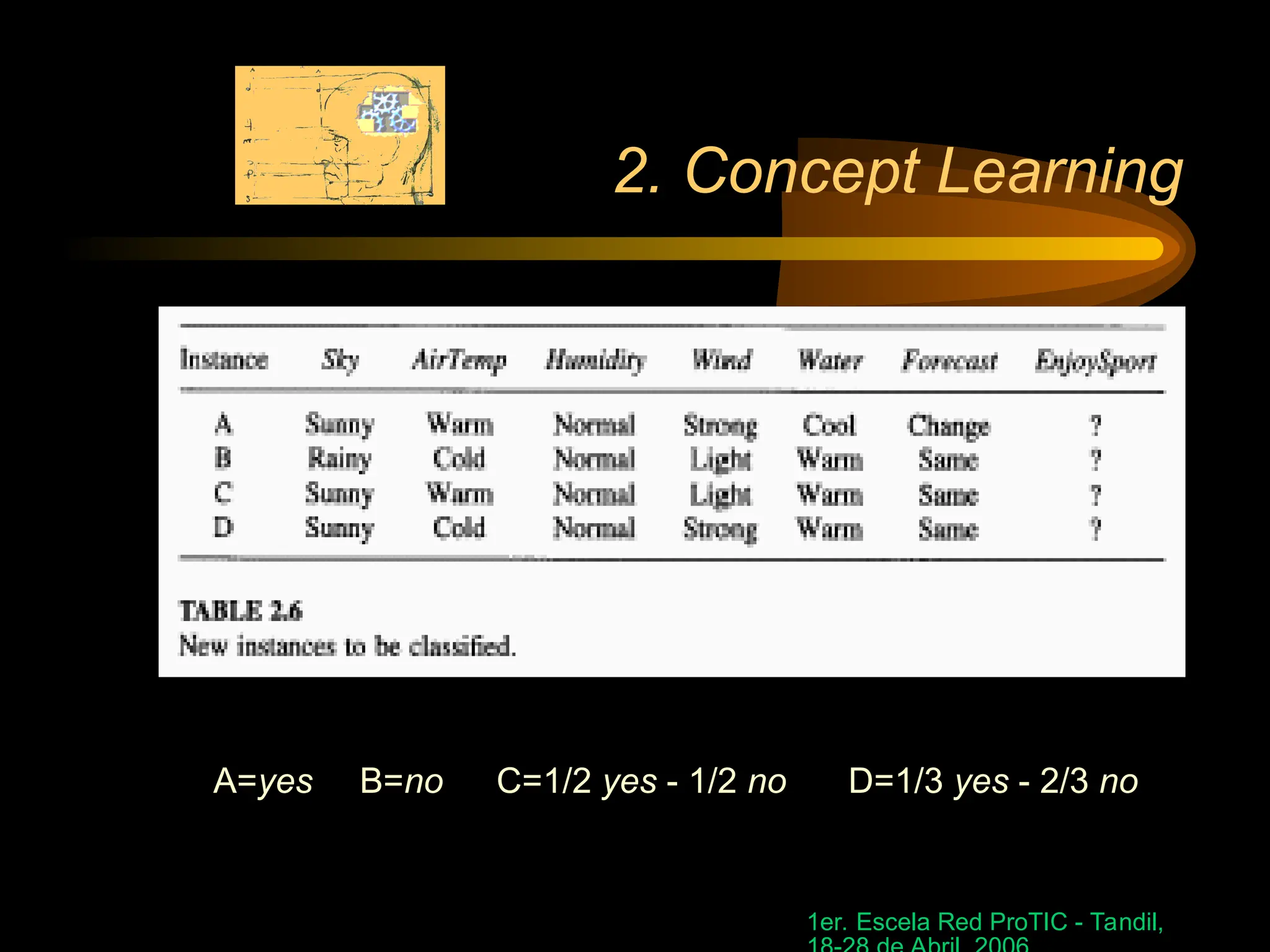
A=yes B=no C=1/2 yes - 1/2 no D=1/3 yes - 2/3 no
1er. Escela Red ProTIC - Tandil,
2. Concept Learning
2.7 Inductive Bias
Can a hypothesis space that includes every possible
hypothesis be used ?
– The hypothesis space previously considered for
the EnjoySport task is biased. For instance, it does
not include disjunctive hypothesis like:
Sky=Sunny or Sky=cloudy
1er. Escela Red ProTIC - Tandil,
2. Concept Learning
An unbiased H must contain the power set of X
PowerSet (X) = the set of all subsets of X
|Power Set (X)| = 2|X |
(= 296
~1028
for EnjoySport)
• Unbiased Learning of EnjoySport
H =Power Set (X)
1er. Escela Red ProTIC - Tandil,
2. Concept Learning
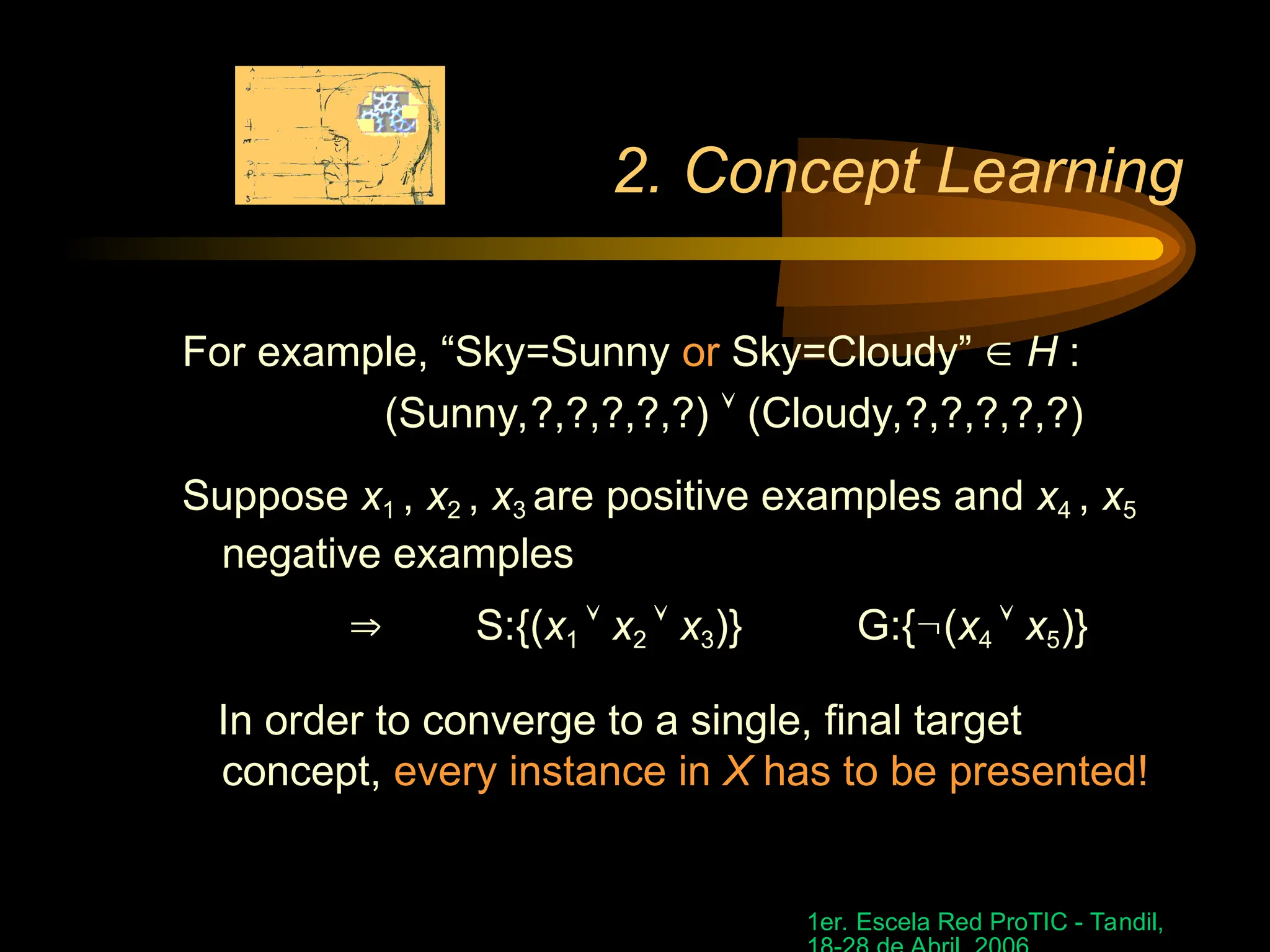
For example, “Sky=Sunny or Sky=Cloudy”  H :
(Sunny,?,?,?,?,?)  (Cloudy,?,?,?,?,?)
Suppose x1 , x2 , x3 are positive examples and x4 , x5
negative examples
 S:{(x1  x2  x3)} G:{(x4  x5)}
In order to converge to a single, final target
concept, every instance in X has to be presented!
1er. Escela Red ProTIC - Tandil,
2. Concept Learning
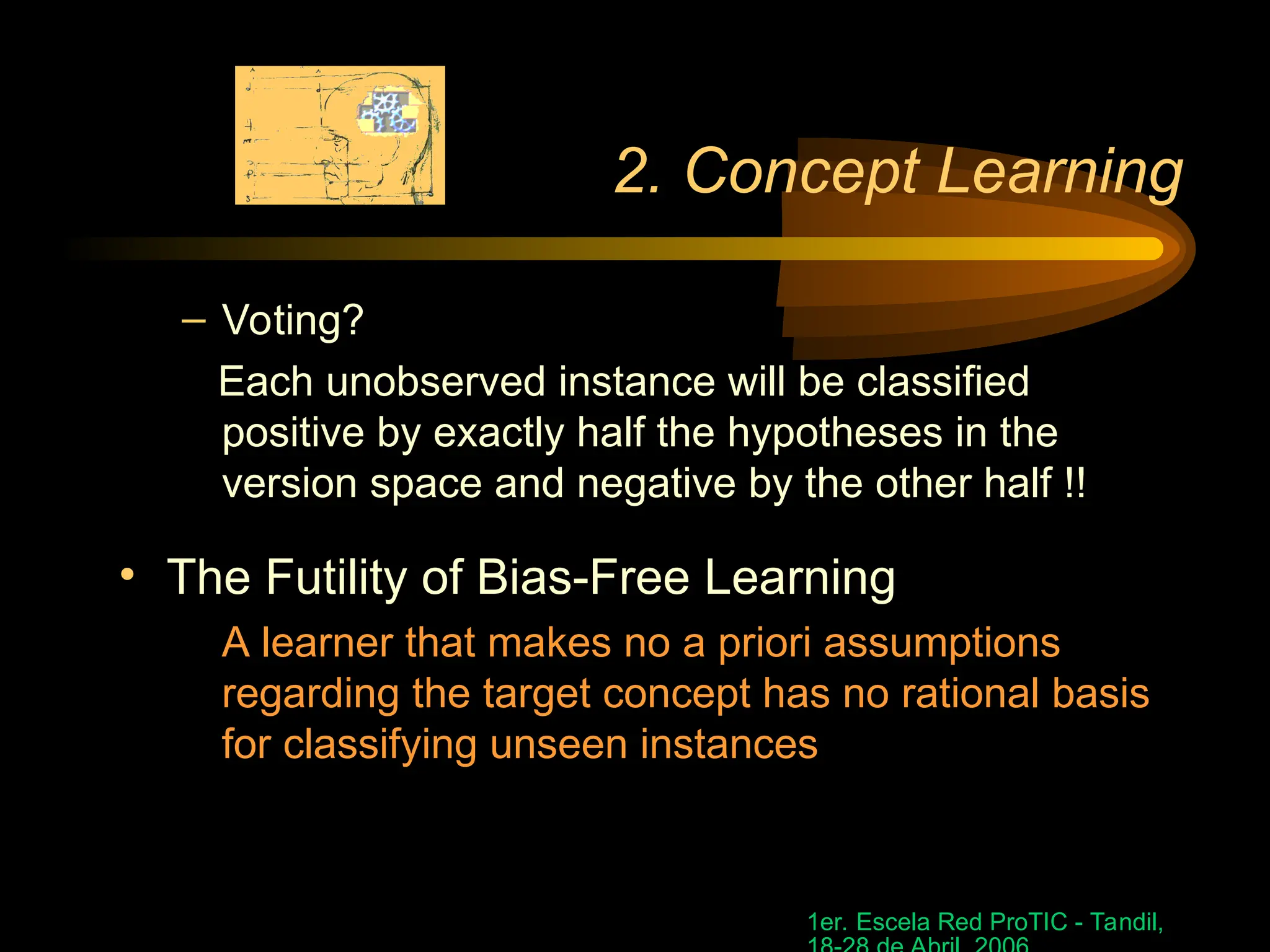
– Voting?
Each unobserved instance will be classified
positive by exactly half the hypotheses in the
version space and negative by the other half !!
• The Futility of Bias-Free Learning
A learner that makes no a priori assumptions
regarding the target concept has no rational basis
for classifying unseen instances
1er. Escela Red ProTIC - Tandil,
2. Concept Learning
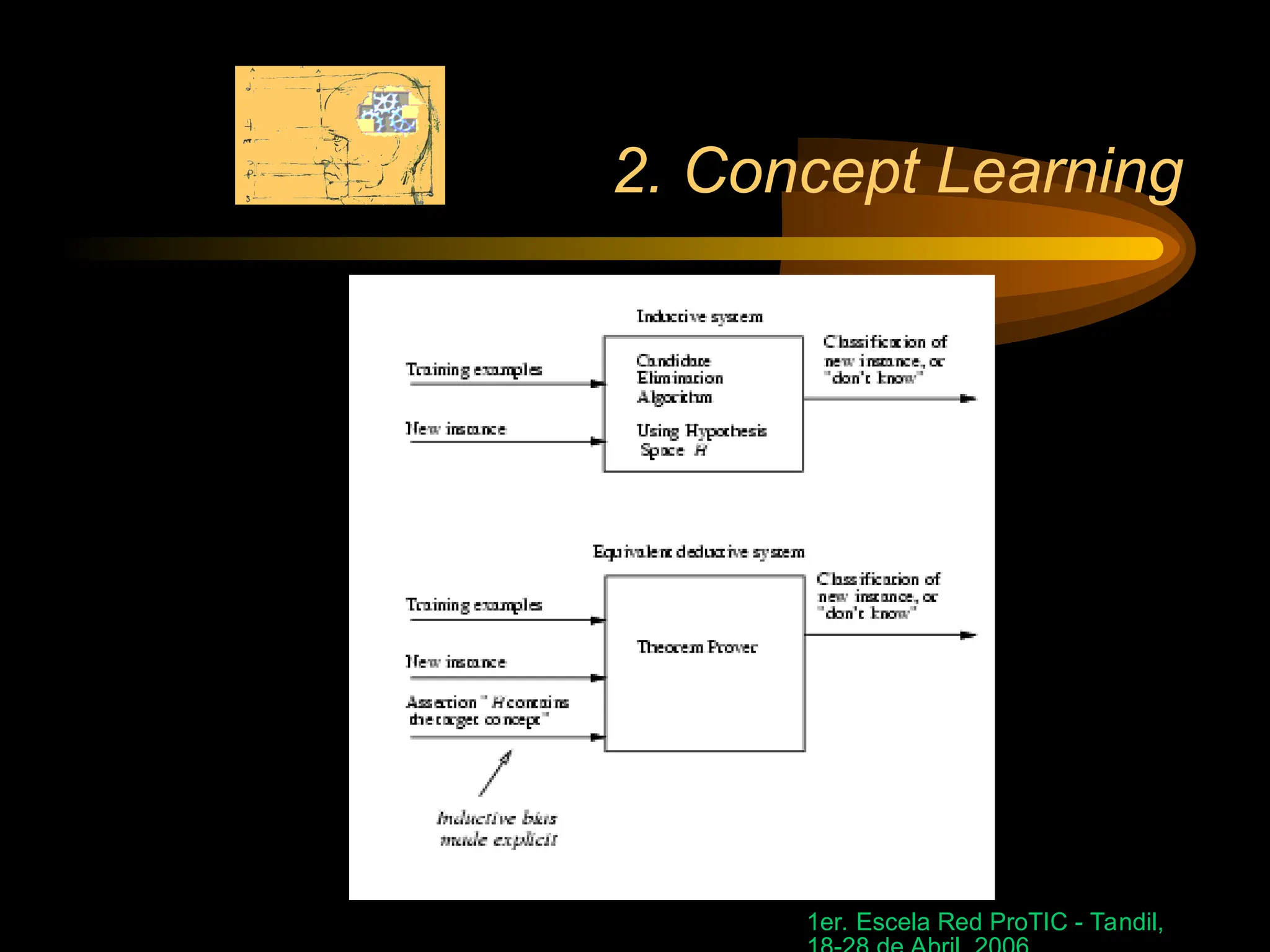
Notation (Inductively inferred from):
(Dc  xi)  L(xi, Dc)
Definition Inductive Bias B:
( xiX) [(B  Dc  xi) L(xi, Dc)]
Inductive bias of the Candidate-Elimination algorithm:
The target concept c is contained in the hypothesis
space H
1er. Escela Red ProTIC - Tandil,
2. Concept Learning

2_conceptlearning in machine learning.ppt

  • 1.
    1er. Escela RedProTIC - Tandil, 2. Concept Learning 2.1 Introduction Concept Learning: Inferring a boolean-valued function from training examples of its inputs and outputs
  • 2.
    1er. Escela RedProTIC - Tandil, 2. Concept Learning 2.2 A Concept Learning Task: “Days in which Aldo enjoys his favorite water sport” Example Sky AirTemp Humidity Wind Water Forecast EnjoySport 1 Sunny Warm Normal Strong Warm Same Yes 2 Sunny Warm High Strong Warm Same Yes 3 Rainy Cold High Strong Warm Change No 4 Sunny Warm High Strong Cool Change Yes
  • 3.
    1er. Escela RedProTIC - Tandil, 2. Concept Learning • Hypothesis Representation – Simple representation: Conjunction of constraints on the 6 instance attributes • indicate by a “?” that any value is acceptable • specify a single required value for the attribute • indicate by a “” that no value is acceptable Example: h = (?, Cold, High, ?, ?, ?) indicates that Aldo enjoys his favorite sport on cold days with high humidity (independent of the other attributes)
  • 4.
    1er. Escela RedProTIC - Tandil, 2. Concept Learning – h(x)=1 if example x satisfies all the constraints h(x)=0 otherwise – Most general hypothesis: (?, ?, ?, ?, ?, ? ) – Most specific hypothesis: (, , , , , )
  • 5.
    1er. Escela RedProTIC - Tandil, 2. Concept Learning • Notation – Set of instances X – Target concept c : X  {0,1} (EnjoySport) – Training examples {x , c(x)} – Data set D  X – Set of possible hypotheses H – h  H h : X  {0,1} Goal: Find h / h(x)=c(x)
  • 6.
    1er. Escela RedProTIC - Tandil, 2. Concept Learning • Inductive Learning Hypothesis Any hypothesis h found to approximate the target function c well over a sufficiently large set D of training examples x, will also approximate the target function well over other unobserved examples in X
  • 7.
    1er. Escela RedProTIC - Tandil, 2. Concept Learning “We have experience of past futures, but not of future futures, and the question is: Will future futures resemble past futures?” Bertrand Russell, "On Induction"
  • 8.
    1er. Escela RedProTIC - Tandil, 2. Concept Learning 2.3 Concept Learning as Search – Distinct instances in X : 3.2.2.2.2.2 = 96 – Distinct hypotheses • syntactically 5.4.4.4.4.4 = 5120 • semantically 1 + (4.3.3.3.3.3) = 973
  • 9.
    1er. Escela RedProTIC - Tandil, 2. Concept Learning • General-to-Specific Ordering of hypotheses h1=(sunny,?,?,Strong,?,?) h2=(Sunny,?,?,?,?,?) Definition: h2 is more_general_than_or_equal_to h1 (written h2 g h1) if and only if (xX) [ h1(x)=1  h2(x)=1] g defines a partial order over the hypotheses space for any concept learning problem
  • 10.
    1er. Escela RedProTIC - Tandil, 2. Concept Learning
  • 11.
    1er. Escela RedProTIC - Tandil, 2. Concept Learning 2.4 Finding a Maximally Specific Hypothesis – Find-S Algorithm h1  (, , , , , ) h2  (Sunny,Warm,Normal,Strong,Warm,Same) h3  (Sunny,Warm,?,Strong,Warm,Same) h4  (Sunny,Warm,?,Strong,?,?)
  • 12.
    1er. Escela RedProTIC - Tandil, 2. Concept Learning
  • 13.
    1er. Escela RedProTIC - Tandil, 2. Concept Learning • Questions left unanswered: – Has the learner converged to the correct concept? – Why prefer the most specific hypothesis? – Are the training examples consistent? – What is there are several maximally specific hypotheses?
  • 14.
    1er. Escela RedProTIC - Tandil, 2. Concept Learning 2.5 Version Spaces and the Candidate-Elimination Algorithm – The Candidate-Elimination Algorithm outputs a description of the set of all hypotheses consistent with the training examples – Representation • Consistent hypotheses Consistent(h,D)  ( {x,c(x)}  D) h(x) = c(x)
  • 15.
    1er. Escela RedProTIC - Tandil, 2. Concept Learning – Version Space VSH,D {h  H | Consistent(h,D)} – The List-Then-Eliminate Algorithm • Initialize the version space to H • Eliminate any hypothesis inconsistent with any training example the version space shrinks to the set of hypothesis consistent with the data
  • 16.
    1er. Escela RedProTIC - Tandil, 2. Concept Learning • Compact Representation for Version Spaces – General Boundary G(H,D): Set of maximally general members of H consistent with D – Specific Boundary S(H,D): set of minimally general (i.e., maximally specific) members of H consistent with D
  • 17.
    1er. Escela RedProTIC - Tandil, 2. Concept Learning
  • 18.
    1er. Escela RedProTIC - Tandil, 2. Concept Learning • Theorem: Version Space Representation – For all X, H, c and D such that S and G are well defined, VSH,D  {h  H | ( s  S) ( g  G) (g g h g s )}
  • 19.
    1er. Escela RedProTIC - Tandil, 2. Concept Learning • Candidate-Elimination Learning Algorithm
  • 20.
    1er. Escela RedProTIC - Tandil, 2. Concept Learning
  • 21.
    1er. Escela RedProTIC - Tandil, 2. Concept Learning
  • 22.
    1er. Escela RedProTIC - Tandil, 2. Concept Learning
  • 23.
    1er. Escela RedProTIC - Tandil, 2. Concept Learning
  • 24.
    1er. Escela RedProTIC - Tandil, 2. Concept Learning • Remarks – Will the Candidate-Elimination converge to the correct hypothesis? – What training example should the learner request next? – How can partially learned concepts be used?
  • 25.
    1er. Escela RedProTIC - Tandil, 2. Concept Learning A=yes B=no C=1/2 yes - 1/2 no D=1/3 yes - 2/3 no
  • 26.
    1er. Escela RedProTIC - Tandil, 2. Concept Learning 2.7 Inductive Bias Can a hypothesis space that includes every possible hypothesis be used ? – The hypothesis space previously considered for the EnjoySport task is biased. For instance, it does not include disjunctive hypothesis like: Sky=Sunny or Sky=cloudy
  • 27.
    1er. Escela RedProTIC - Tandil, 2. Concept Learning An unbiased H must contain the power set of X PowerSet (X) = the set of all subsets of X |Power Set (X)| = 2|X | (= 296 ~1028 for EnjoySport) • Unbiased Learning of EnjoySport H =Power Set (X)
  • 28.
    1er. Escela RedProTIC - Tandil, 2. Concept Learning For example, “Sky=Sunny or Sky=Cloudy”  H : (Sunny,?,?,?,?,?)  (Cloudy,?,?,?,?,?) Suppose x1 , x2 , x3 are positive examples and x4 , x5 negative examples  S:{(x1  x2  x3)} G:{(x4  x5)} In order to converge to a single, final target concept, every instance in X has to be presented!
  • 29.
    1er. Escela RedProTIC - Tandil, 2. Concept Learning – Voting? Each unobserved instance will be classified positive by exactly half the hypotheses in the version space and negative by the other half !! • The Futility of Bias-Free Learning A learner that makes no a priori assumptions regarding the target concept has no rational basis for classifying unseen instances
  • 30.
    1er. Escela RedProTIC - Tandil, 2. Concept Learning Notation (Inductively inferred from): (Dc  xi)  L(xi, Dc) Definition Inductive Bias B: ( xiX) [(B  Dc  xi) L(xi, Dc)] Inductive bias of the Candidate-Elimination algorithm: The target concept c is contained in the hypothesis space H
  • 31.
    1er. Escela RedProTIC - Tandil, 2. Concept Learning